Edith Cowan University Edith Cowan University
Research Online
Research Online
Theses: Doctorates and Masters Theses
2019
Mobility management in 5G heterogeneous networks
Mobility management in 5G heterogeneous networks
Mohammad Arifin Rahman Khan Edith Cowan University
Follow this and additional works at: https://ro.ecu.edu.au/theses
Part of the Electrical and Electronics Commons
Recommended Citation Recommended Citation
Khan, M. A. (2019). Mobility management in 5G heterogeneous networks. https://ro.ecu.edu.au/theses/ 2252
This Thesis is posted at Research Online. https://ro.ecu.edu.au/theses/2252
Edith
Cowan
University
Copyright
Warning
You
may
or
download
ONE
copy
of
this
document
for
the
purpose
of
your
own
research
or
study.
The
University
does
not
authorize
you
to
copy,
communicate
or
otherwise
make
available
electronically
to
any
other
person
any
copyright
material
contained
on
this
site.
You
are
reminded
of
the
following:
Copyright
owners
are
entitled
to
take
legal
action
against
persons
who
infringe
their
copyright.
A
reproduction
of
material
that
is
protected
by
copyright
may
be
a
copyright
infringement.
Where
the
reproduction
of
such
material
is
done
without
attribution
of
authorship,
with
false
attribution
of
authorship
or
the
authorship
is
treated
in
a
derogatory
manner,
this
may
be
a
breach
of
the
author’s
moral
rights
contained
in
Part
IX
of
the
Copyright
Act
1968
(Cth).
Courts
have
the
power
to
impose
a
wide
range
of
civil
and
criminal
sanctions
for
infringement
of
copyright,
infringement
of
moral
rights
and
other
offences
under
the
Copyright
Act
1968
(Cth).
Higher
penalties
may
apply,
and
higher
damages
may
be
awarded,
for
offences
and
infringements
involving
the
conversion
of
material
Mobility
m
anagement in 5G
h
eterogeneous
n
etworks
Mohammad Arifin Rahman Khan
This thesis is presented in fulfilment of the requirements for the degree of
Master of Engineering Science
EDITH COWAN UNIVERSITY
SCHOOL OF ENGINEERING
USE OF THESIS
ii
Abstract
In recent years, mobile data traffic has increased exponentially as a result of widespread popularity and uptake of portable devices, such as smartphones, tablets and laptops. This growth has placed enormous stress on network service providers who are committed to offering the best quality of service to consumer groups. Consequently, telecommunication engineers are investigating innovative solutions to accommodate the additional load offered by growing numbers of mobile users.
The fifth generation (5G) of wireless communication standard is expected to provide numerous innovative solutions to meet the growing demand of consumer groups. Accordingly the ultimate goal is to achieve several key technological milestones including up to 1000 times higher wireless area capacity and a significant cut in power consumption.
Massive deployment of small cells is likely to be a key innovation in 5G, which enables frequent frequency reuse and higher data rates. Small cells, however, present a major challenge for nodes moving at vehicular speeds. This is because the smaller coverage areas of small cells result in frequent handover, which leads to lower throughput and longer delay.
In this thesis, a new mobility management technique is introduced that reduces the number of handovers in a 5G heterogeneous network. This research also investigates techniques to accommodate low latency applications in nodes moving at vehicular speeds.
iii
Declaration
I hereby declare that the project does not:
(i) Comprise any offensive material;
(ii) Incorporate such material, which is previously published by other authors. All information is properly referenced in the text;
(iii) Include material without acknowledging the actual authors.
I also allow the library at Edith Cowan University to make multiple copies of the project, if needed.
Signature: Mohammad Arifin Rahman KHAN Date: 20/03/2019
iv
Acknowledgements
Firstly, I would like to show my gratitude to my principal supervisor Associate Professor Iftekhar Ahmad and co-supervisor Professor Daryoush Habibi. I am grateful for their efforts that they put in assisting me throughout the project span. Despite their professional commitments, they helped me a lot and made it possible for me to complete my degree program and the research work.
My special thanks go to Dr Michael Stein for his constructive advice and help with the writing of my thesis. I am also thankful to Dr. Quoc Viet Phung (ECU, Australia) and Dr. Hoang Nghia Nguyen (Curtin University, Australia) for their valued and insightful comments that they made on my proposal.
I would also like to acknowledge the efforts of all members, working in wireless research and research lab community.
I am grateful for the support and love of my parents and family. It was impossible for me to complete the project without their help and encouragement.
I am thankful to my wife who has shown commendable patience and supported me throughout the period of my research program. It was a difficult decision to move to an entirely new place to complete my research degree. She has inspired me to complete my research work and has always stood by my side.
I am also obliged to ECU scholarships office as well as Graduate School for helping me throughout my degree program.
Lastly, I am thankful to my friends in Australia who have immensely supported me while settling into the new place and throughout the tenure of my research candidature.
v
List of Publications
List of submitted and unpublished manuscript from this research:
1. M. A. R. Khan, I. Ahmad and D. Habibi, “A New Handover Management
Scheme for 5G Heterogeneous Networks,” Revised manuscript under second round of review (Editor has requested for revisions following the first round of
review), Computer Communications, Elsevier Science. .
2. M. A. R. Khan, I. Ahmad and D. Habibi, “Reducing Delay for Delay Sensitive Application Vehicular Communications” Manuscript in preparation for a journal publication.
vi
Table of Contents
Use of Thesis i Abstract ii Declaration iii 1. Introduction 011.1 Significance and Motivation 04
1.2 Aims 05
1.3 Research Contributions 05
1.4 Organisation of Thesis 06
2. Background and Literature Review 08
2.1 Background 08
2.1.1 Emerging Communication Technology 5G 09
2.1.2 Heterogeneous Network and Small cells 10
2.1.3 Vehicular Communication, Types, and Future Applications 15
2.1.4 Handover Types and Mechanisms 19
2.2 Literature Review 23
2.2.1 Handover 23
2.2.2 Handover and Transmission Latency 32
2.3 Research Questions 40
3. A New Handover Management Scheme for 5G Heterogeneous Networks 42
3.1 System Model 42
3.2 Proposed Optimization Model and Heuristic Solution 47
vii
3.3.1 Handover Cost 52
3.3.2 Average Throughput 53
3.4 Simulation Setup 54
3.5 Discussion of Results 56
3.5.1 Comparison Results between the Proposed Optimization Model and the Tradition Scheme 56
3.5.1 Comparison Results between the Proposed Optimization Model and the Heuristics Solution 60
3.6 Concluding Remarks 62
4. Reducing Delay for Delay Sensitive Application Vehicular Communications 63
4.1 System Model 63
4.2 Proposed Solution to Reduce Delay in Vehicular Communications 67
4.3 Simulation Results 73
4.4 Concluding Remarks 79
5. Conclusion and Future Work 81
5.1 Conclusion 81
5.2 Future Work 82
viii
List of Figures
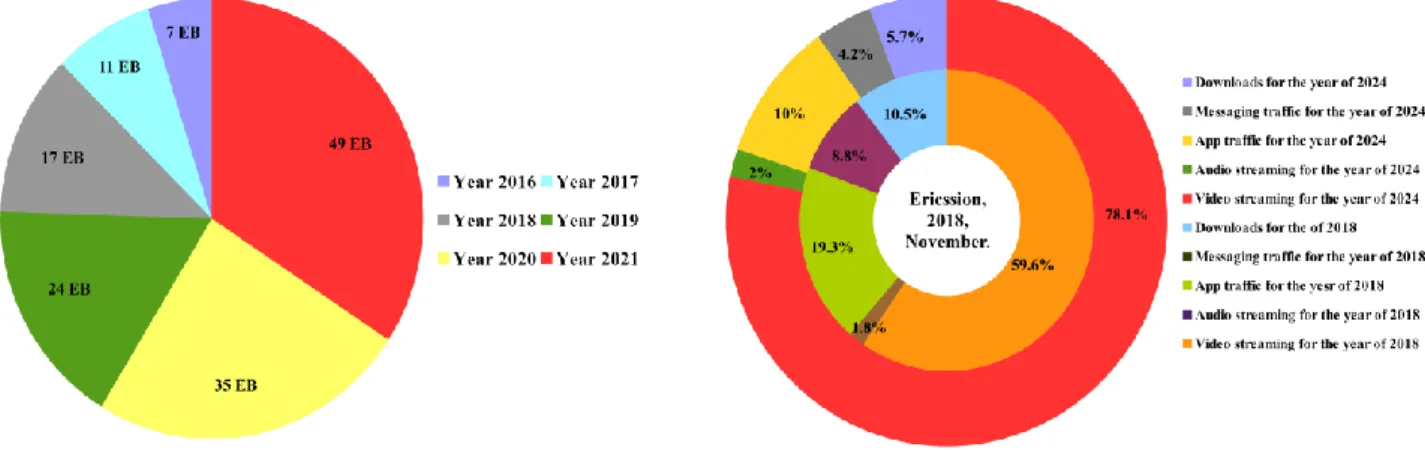
1.1(a): The demand for mobile data traffic by the year of 2021 2
1.1(b): Evolution of the average smartphone user’s data consumption for the year of 2018 and 2024 2
1.2: Small cells in next generation networks 3
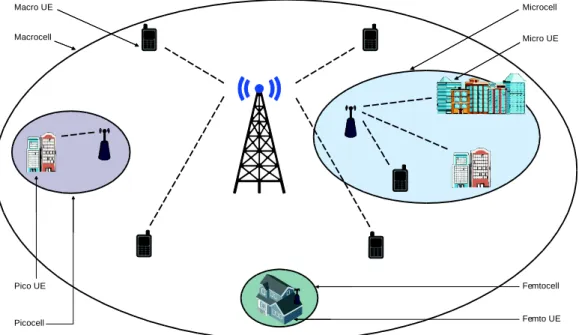
2.1: Difference types of cells and their base station coverage areas in an urban area 10
2.2: Microcell installation concept 13
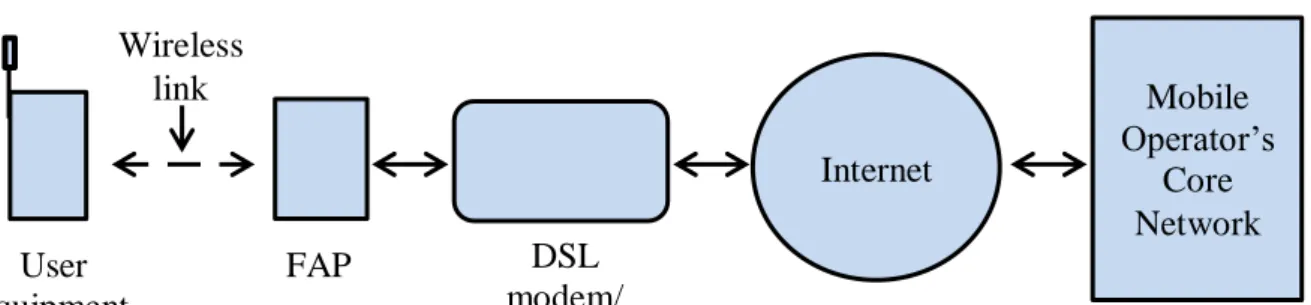
2.3: User Equipment (UE) linked to an operator’s central system in a femtocell 15
2.4: Explain the modes of Vehicular communication 16
2.5: Applications in connected vehicular 18
2.6: Future communication among IT and vehicular 19
2.7(a): Hard handover (HHO) 20
2.7(b): Soft handover (SHO) 20
2.8(a): Horizontal handover 21
2.8(b): Vertical handover 21
2.9: Handover mechanism 22
3.1: Two-tier heterogeneous network model for the 5G 43
3.2: Flowchart of the heuristic solution 51
3.3: Scenario for the simulation (a) City of Perth, (b) Parameter and value 54
3.4: Normalized network traffic load for each hour of the day 55
3.5: Comparison of handover cost 56
3.6: The comparison results of power consumption between the traditional approach and the proposed model 57
ix 3.7: Comparison of average throughput between the traditional model
and proposed model, (when the speed of UE is low, 𝑆=50km/h) 58
3.8: Comparison of average throughput between the traditional model and proposed model, (when the speed of UE is moderate, 𝑆=100km/h) 58
3.9: Comparison of average throughput between the traditional model and proposed model, (when the speed of UE is high, 𝑆=150km/h) 59
3.10: Comparision of handover cost in the heuristic and optimum solution 60
3.11: Comparision of power consumption between the heuristic solution and the optimum solution 61
3.12: Comparion of average throughput between The heuristic and optimum solution 61
4.1: The model of two-tier heterogeneous network showing hotspots emergency vehicular applications 64
4.2: Flow chart of the proposed heuristic solution 70
4.3: QoS and HO aware based proposed algorithm 72
4.4: Simulation scenario: (a) Emergency zones (b) simulation parameters 74
4.5: Normalized traffic load for each hour of the day 74
4.6: Comparision of latency (ms) 75
4.7: Comparision of handover cost 76
4.8: Comparision of power consumption 77
4.9: Average throughput for each hour of the day (when the UE mobility is low, 𝑆 =50 km/h). 78
4.10: Average throughput for each hour of the day (when the UE mobility is medium, 𝑆 =100 km/h). 78 4.11: Average throughput for each hour of the day
x (when the UE mobility is high, 𝑆 =150 km/h). 79
xi
List of Tables
2.1: A comparative survey of representative handover techniques 25 2.2: A comparative study of illustrative handover
xii
Abbreviations
1G = First Generation 2G = Second Generation 3G = Third Generation 4G = Fourth Generation 5G = Fifth Generation3GPP = Third Generation Partnership Project
AAA proxy = Authentication, Authorization, and Accounting proxy AHP = Analytic Hierarchy Process
ANN = Artificial Neural Networks AP = Access Point
BE = Best Effort BS = Base Station
CBD = Central Business District CBR = Constant Bit Rate
CCDF = Complementary Cumulative Distribution Function CIS = Context-aware Information Server
DoS = Denial of Service DSL = Digital Subscriber Line EIS = Enhanced Information Server
FBMIS = Fuzzy-Based Multi-Interface System FDMA = Frequency Division Multiple Access FLC = Fuzzy Logic Controller
xiii GVLL = Generic Virtual Link Layer
HetNet = Heterogeneous Network HHO = Hard Hand-Over
HO = Handover
I2V = Infrastructure-to-vehicle
ICT = Information and Communication Technology IEEE = Institute of Electric and Electronics Engineers IMT-2000 = International Mobile Telecommunication 2000 IINR = Interference to other-Interferences-plus-Noise Ratio IT = Information Technology
LMA = Local Mobility Anchor LTE = Long-Term Evolution
LTE-A = Long Term Evolution-Advanced MAC = Media Access Control
MADM = Multi-Attribute Decision-Making MANET = Mobile Ad-hoc NETwork MBS = Mobile Base Station
METIS = Mobile and wireless communications Enables for Twenty-twenty information Society
MIH = Media Independent Handover MIP = Mobile Internet Protocol MM = Mobility Management MN = Mobile Node
mBS = microcell Base Station
xiv PPP = Public Private Partnership
QoS = Quality of Service
RSS = Received Signal Strength
RSSI = Received Signal Strength Indicator SC = Small-Cell
SDN = Software-Defined Networking SCNs = Small Cell Networks
SHO = Soft Handover
SINR = Signal to interference Noise Ratio SIP = Session Initiation Protocol
ToS = Time of Stay UE = User Equipment
UMTS = Universal Mobile Telecommunications Service URS = User Request Security
V2V = Vehicle-to-Vehicle communication VBR = Variable Bit Rate
VHD = Vertical Handover Decision VHO = Vertical Handover
WLAN = Wireless Local Area Network
xv
List of Symbols
𝜉 The set of microcell
𝑃𝑀 Macrocell transmission Power
𝑃𝑚 Microcell transmission Power
𝑈𝐸 User Equipment
𝜓 Categories of UE
𝑉 The set of the vehicle user
𝑈 The set of the pedestrian user
𝐹 The set of the fixed user
𝐷 Total user Demand
𝛼𝑀 Path loss component for the Macrocell
𝛼𝑚 Path loss component for the microcell
𝐶 The Coverage probability
𝑛𝑚 Number of deployed microcell
𝑃𝑡 Total power consumption
𝛾 The average association preference
𝑁𝑣 Total number of vehicle user
𝑁𝑢 Total number of pedestrian user
𝑁𝑓 Total number of fixed user
𝐵𝑀 Bandwidth for the Macrocell
𝑆𝐸𝑀 Spectral efficiency for the Macrocell
𝐵𝑚 Bandwidth for the microcell
xvi
Φ The handover cost
𝑆 Speed for the high mobility user
𝑇𝑀 The throughput of macrocell users
𝐴𝑚 The probability of being served by mBSs
Γ Distance
𝐿 Latency
𝐵𝑙 Bandwidth of the link
1
Chapter 1
1 Introduction
Information and communication technology (ICT) has become a major industry that plays a transformational role across various economic sectors including business and service delivery. Wireless communication is one of the most successful technologies in the field of Information and Communication Technology (ICT) with its penetration rate reaching over 90%. In developed countries, the share of the population using wireless technologies such as smartphones has increased threefold in the last five years. This share is expected to continue to increase in the near future.
In recent years, there has been a significant increase in the usage of mobile communication systems for data transfer, generally using web-based data or multimedia data. This expansion is related to the increase in the number of cellular devices, particularly smartphones, and tablets, and a rise in the number of web-based services, for instance, video streaming and cloud computing. According to a recent Cisco report [1], mobile data usage is expected to increase exponentially in coming years, and the most notable applications, including video applications, web applications, and social networking applications, will require more data at a much lower latency.
Such an increase in demand (Figure 1.1) presents some major technological challenges for network service providers. Some of these challenges include spectrum shortage, increase in energy demand and energy related cost, delay consideration for low latency applications, and network security naturally, the expectation from the next
2 generation of wireless communication systems is very high. The fifth generation (5G) infrastructure public private partnership (5G-PPP) working group has been working very hard to address the challenges and the 5G system is expected to include some major technological innovations.
Figure 1.1: (a) The demand for mobile data traffic by the year of 2021, (b) Evolution of the average smartphone user’s data consumption for the year of 2018 and 2024. The 5G-PPP has the technical vision to provide improved wireless zone capacity and diverse service abilities. The 5G-PPP also aims to save up to 90% of energy per service provided, and provide a secure, reliable and low latency connection [2]. In order to achieve the goals, researchers have targeted some specific areas of wireless communications including the dense deployment of small cells, multiple input multiple output (MIMO) antenna technology, mmWave and free space optics technology, modulation techniques etc.
The concept of small cells is likely to be a major enabling technology in 5G (Figure 1.2) [3]-[5]. The key idea behind small cells is to use cells with a much smaller coverage area than a traditional macrocell and, where possible, to backhaul the local
3 data using high capacity wired links such as optical fiber. This enables high frequency reuse per unit area [6], [7].
Figure 1.2: Small cells in next generation networks.
The concept of small cells, however, presents a major challenge for mobile nodes as the coverage area per small cell is much smaller than the coverage area of a macrocell. Small cells would cause frequent handovers and connection drop-outs [8], [9] if resources are not carefully managed. This problem is further aggravated by the fact that vehicular communication (e.g., between roadside units and vehicles) is predicted to become increasingly popular in the next few years because of the increasing popularity of automated cars, augmented dashboards, and other safety-critical applications [10] - [12].
Vehicular applications are often time critical and demand very low latency. Current wireless technologies are not equipped to meet such demands. As a result, network service providers expect a lot from the 5G standard to facilitate vehicular
Micro UE Microcell Macrocell Femtocell Picocell Pico UE Macro UE Femto UE
4 communication services. In this thesis, the frequent handover problem in a 5G heterogeneous network is investigated, and two promising solutions are presented in Chapter 3 and 4 to address the challenges arising from the densification of cells.
1.1 Significance and Motivation
The technical vision of 5G is significantly different from the technical vision of the fourth generation (4G) of communication systems. The main driving force comes from the exponential increase in the number of portable devices and the new applications demanding higher bandwidth [13].
Apart from the raw speed, 5G aims to include benefits such as low latency and high capacity. Furthermore, it is anticipated that 5G will facilitate dense employment of wireless communication links, which will help connect more than seven trillion wireless devices used by more than seven billion people. A significant portion of these user groups will be using portable devices to connect to the core network, and users may want to access the network even when they are on the move. As a result, mobility management would become more challenging than ever before.
Due to the advancement in technologies such as autonomous cars, augmented dashboards, roadside safety equipment, and emergency applications, vehicular communication is expected to be a major part of 5G systems.
While the dense deployment of small cells provides numerous advantages, small cell networks offer some major challenges [8], [14]-[16] for vehicular communications. When nodes travel at high speeds and the area covered by a base station becomes smaller (i.e., small cells), frequent handover would be needed to maintain reliable
5 connections in vehicular nodes. In literature, researchers have highlighted the importance of the problem and discussed the significance of possible solutions. This provides the motivation for this research work in which we investigate and present solutions to the frequent handover problem.
1.2 Aims
The aims of this research include:
[1] developing resource management techniques to reduce handover rates in 5G heterogeneous networks. As mentioned earlier, the deployment of small cells will significantly increase the number of handover per unit area. The first objective of this thesis is to present a resource management technique that reduces the total number of handover in a 5G network.
[2] developing solutions to improve latency in vehicular communications. Latency is a major issue for vehicular communications in 5G heterogeneous systems that are likely to support real-time high-speed emergency applications for the high speed movement of emergency mobile user (such as ambulance, police car, fire-service). The second key goal of this thesis is to introduce a new solution to improve the latency.
1.3 Research Contributions
In this thesis, we present our proposed models and solutions to address the high handover and latency challenge in 5G networks. In Chapter 3, we present a mechanism to allocate resources among vehicular, nomadic and fixed users in a heterogeneous
6 network so that the handover cost and the power consumption can be minimised. We introduce a new term in the form of association preference factor, which is considered as one of the two objectives in the optimisation model. The other objective keeps the power consumption low, meaning less carbon footprint and reduced energy bill for the network provider. Simulation results suggest that the proposed solution significantly outperforms existing solutions. In a bid to find a robust solution, we also introduce a heuristic solution, which performs reasonably well compared to the optimum solution.
The second contribution of this thesis in presented in Chapter 4. We address the low latency challenge for the emergency vehicular communications in 5G heterogeneous networks. Simulation outputs confirm that the proposed solution reduces latency and increase throughput in emergency vehicular nodes.
1.4 Organization of Thesis
The remainder of this thesis is structured as follows:
(i) Chapter 2 presents the technical background of 5G heterogeneous networks. This chapter also presents the background of vehicular communications. Relevant existing work available in the literature are presented followed their advantages and shortcomings. The research gap is then identified and highlighted.
(ii) Chapter 3 presents the problem formulation and solution to the frequent handover problem in 5G networks. Numerical results are then discussed in Section 3.5.
7 (iii) Chapter 4 presents the problem formulation and solution to the latency
problem, which is critical for emergency vehicular communications.
(iv) Finally, Chapter 5 summarises and concludes the contributions and significance of this research Suggestions for further research are also recommended in this chapter.
8
Chapter 2
Background and Literature Review
2.1 Background
Each decade has been characterized by developmental changes in mobile communications. The original generation (e.g., 1G) at the 1970s and second generation (2G) cell frameworks during the 1980s were utilized for the most part for voice applications and to help circuit-exchanged administrations.
The 1G framework relied on simple innovations; whereas 2G introduced more advanced frameworks, for example, the Global System for Mobile Communications (GSM), IS54 Digital Cellular, Personal Digital Cellular System (PDC), and IS-95 [17]. These frameworks existed across many countries for a reasonable period of time. Data rates for clients in these frameworks were restricted to approximately a few several kilobits for every second.
International Mobile Telecommunications 2000 (IMT-2000), which was introduced at the start of the 21st century, signalled the third generation (3G) cell framework [18], providing up to 2 Mb/s and 144 kbps in indoor and vehicular conditions, respectively. Nonetheless, even 3G infrastructure lacked the capacity to handle modern mobile working needs. The shortcomings of 3G were compensated for with the development of 4G systems. The infrastructure of 4G systems facilitated higher data support, and new data services. However, irrespective of these advancements, 4G could not met the
9 increasing demands for spectrum as well as the associated energy consumption from current technologies. Naturally, a lot is expected from the 5G communication systems.
2.1.1
Emerging communication technology - 5G
With respect to increasing technological requirements, upcoming 5G wireless communication technology provides an integrated system that consolidated the current mobile communication systems, like LTE-A and Wi-Fi, within under a new air interface [19]. In this regard, a new framework is required to connect an ever expanding array of system devices that require very high traffic rates. As a result, Mobile and wireless communications Enablers for Twenty-twenty Information Society (METIS) has identified association of current 4G frameworks with the fundamental aspirations of the 5G systems [20], [21]. The significant aspects are,
i) that 5G will facilitate an increase in the volume per unit area by a thousand times as compared to 4G.
ii) higher rate of the accessibility of user data by ten to hundred times. iii) an increase in the number of connected devices by ten to hundred times. iv) improved battery life of low-powered devices by ten times.
v) reduced E2E latency “End-to-End” by five times, resulting in the attainment of 5ms with respect to the applications of road safety.
In addition to this, the system stability in terms of cost effectiveness, coverage area, and energy efficiency would also be achieved. It is clearly evident that the targets are ambitious, which requires a number of key innovations in 5G. One such innovation is the heterogeneous network, which is described in the following section.
10
2.1.2
Heterogeneous Network and Small cells
A heterogeneous 5G network incorporates two different kinds of cells namely macrocells and small cells. The primary operation of heterogeneous networks is that numerous smaller cells operate under the umbrella of macrocells to increase the coverage, promote frequency reuse, and enhance the ability to support high traffic rates for all areas [6], [22].
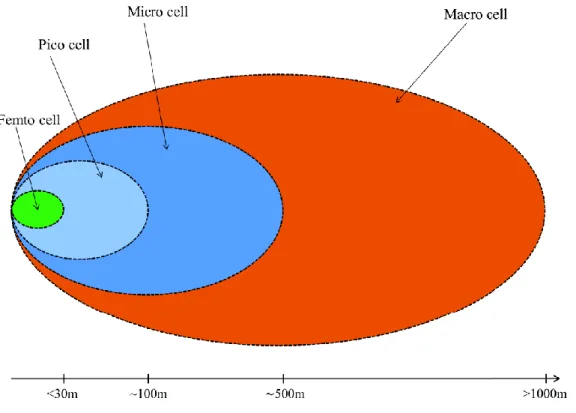
Figure 2.1: Difference types of small cells in an urban area.
Small cells are classified into microcells, picocells, and femtocells. The important features of macrocell and small cells for heterogeneous networks are as follows:
(a) Macrocell
The cell diameter for a macrocell may range from 1 km (about) within the city to more than 40 km within a non-urban environment. The base station of a macrocell requires
11 the installation of powerful antennas on the top of a tall building or a tower at a height of at least 30 m or more. With respect to the transmission power of the antennas, the value also can be set by 46dBm [23]. Moreover, the transceiver equipment of the base station is located within the same tower or the building, maintaining the temperature of the surrounding area. More precisely, even these transceiver devices are placed in the proximity of the antennas based on the reduced sizes as a result of the recent advancements.
In broadband wireless communication systems, a macrocell is regarded as the first element f used for facilitation, and blanket coverage of an inhabited area. As a result, macrocells serve two main objectives with the capability of blanket coverage whilst minimizing initial cost. Moreover, growth aspects of the network with respect to the inclusion of traffic and subscribers are also facilitated. Consequently, the radius of the macrocell is dependent on the following factors,
(i) Peak time facilitation regarding the management of the amount of the anticipated traffic.
(ii) Maximization of the coverage distance.
Peak time facilitation of traffic is associated with the anticipated density of the subscriber, where increasing subscribers require enhanced traffic capacity. Accordingly, the service capacity of each base station is limited to facilitating a set number of users at a particular time. In addition to this, the macrocell coverage area can be small for a densely inhabited area. With respect to the relatively small population density of rural and suburban areas, base stations are capable of facilitating the coverage of a larger area. Therefore, the range of the cell radius entails several
12 “kilometres” for suburban areas, several “hundred meters” for densely populated urban areas, and several “tens of kilometres” for rural areas.
(b) Microcell
Compared to the macrocell, a microcell is smaller and possesses considerable differences in terms of requiring a smaller antenna with reduced power and power settings for transmission. These cells typically provide coverages up to 500 m [24] and can be deployed indoors or outside to fill gaps in terms of both capacity and coverage. For instance, developed urban areas often/may encounter problems of congestion in terms of weakened signals. Moreover, microcell system designs could also be used in highly dense areas such as stadiums or concert arenas, for increasing the capacity of the system [24], [25].
The base station of a microcell is generally directly interconnected with the central network. This connection is established using the link of an optical fibre. However, at certain times, increased traffic is routed by means of the base station of a macrocell, using a point-to-point wireless (Figure. 2.2). Microcells are classified into the following three types,
i) Hot Spots: These include poorly covered or areas with intense density of tele-traffic. The hot spot provides the service by means of being embedded in the larger cells’ cluster in an isolated manner.
ii) Downturn Clustered Microcells: Contiguous and dense areas, providing service to mobiles and pedestrians, are served by these microcells [24]. The coverage networks of urban areas of street canyons are served by these microcells with antennas located below the height of the building.
13 iii) In-Building 3D Cells: These cells are positioned to serve the requirements of pedestrians and office buildings. These cells are intended to eradicate the concerns of clutter dominance of these highly dense areas in terms of slow movement of the users. Thus, the consumption of power of portable units is also a strong concern that is managed by these cells.
Figure 2.2: Microcell Installation concept.
(c) Picocell
A picocell serves as a wireless base station that is designed with very low power output for coverage of a very small area, like a single floor of an office building [26]. The cellular network of picocells tends provide of coverage extensions for indoor areas that face weakened receiving of the signals. Moreover, network capacity is also increased in the areas with dense usage of phones, like airports, train stations or the shopping malls. With respect to the effectiveness of picocells, extensive research has been carried out
14 for enhancing their cost-related and coverage-related performance in serving unapproachable places in the world.
The following are applications of picocells:
(i) Coverage improvement of in-building: In-building coverage is improved mainly caused by the use of innovative techniques of construction along with special materials. Thus, picocells facilitate the coverage in such environments, including visitor centres, train stations, airports, museums and others along with the enhancement of network capacity.
(ii) Filling of Black-spots within the network: Non-existent or minimal coverage creates black spots on the network. The areas of the buildings with marginal coverage encounter sharp drifts in service quality resulting in “network busy” signals, dropped calls, distorted voice signals, and even slower data rates.
(iii) Extension of the capability of macrocells: It has been a global telecommunication challenge to facilitate the capacity availability in the peak hours to the users of highly populated areas. In this regard, operators have been modifying networks through bandwidth-intensive undertakings. Although the intended objectives are attainable through the deployment of macrocells, it would be cost-consuming. Thus, picocells are used as these cells maximize the re-use of the spectrum along with providing enhanced network capacity.
(iv) Applications associated with Satellites: Picocell can provide remote network to confined zones like provincial spots, marine, oil and gas organization, etc. where there is no broadband availability for backhaul. In
15 these conditions, picocell is a feasible arrangement possessing satellite correspondences for backhaul.
(d) Femtocell
Femtocells are smaller in coverage size and transmit power compared to picocells, microcells, and macrocells. Femtocells can be used in a home or small office buildings. The transmit power of femtocells is often less than 100 mw [27]. Normally it can be seen that [28] the coverage range of femtocells is less than 30 meters. Through Ethernet, femtocells are capable of using the cable modem or even a DSL (digital subscriber line) for backhauling data and voice calls within the range of the operator’s network and the internet connection of the consumer [29]. Hence, the mobile network of the operator is extended by means of using the internet connection of the consumer. (Fig. 2.3).
Figure 2.3: User Equipment (UE) linked to an operator’s central system in a femtocell.
2.1.3
Vehicular communication, types, and future applications
Vehicular communication is becoming increasingly popular. Digitization of products and services used in automobiles is playing a key role for the popularity of vehicular communications. Vehicular communications can be categorised into five broad classes [10], [30]: Mobile Operator’s Core Network Internet DSL modem/ Broadband Router FAP Wireless link User equipment (UE)
16 Figure 2.4: Explain the modes of Vehicular Communication.
i) Vehicle to vehicle communications: With the help of vehicle-to-vehicle (V2V) local broadcast, a vehicle can propel information or a message to other vehicles which are in range of their communication system. As the example suggests, V2V local broadcast can inform neighbouring vehicles of speed, heading and current position.
ii) Multi-hop V2V: The multi-hop dissemination of V2V enables the transmission of messages from one vehicle to another as relayed by other vehicles in order to connect outside the communication range of the source vehicle. This type of communication could be used for soft safety purposes, for example of driving and traffic information.
iii) Infrastructure-to-vehicle communications: With the help of infrastructure-to-vehicle (I2V) communications, every infrastructure-to-vehicle can receive local broadcasts
17 from the infrastructure on the roadside, with examples are given as: (a) a traffic controller signal timing information and phase, (b) information about dangerous conditions of the road, and (c) credentials of security. I2V local broadcast can enact implementation of communication with the help of radio transceivers with short range that are deployed from the roadside. Another way to implement I2V is through digital radio, satellite, or cellular broadcast services, to reach various vehicles present in distinctive geographical areas.
iv) Vehicle-to-infrastructure communications: With the bi-directional communication that is present in vehicle-to-infrastructure (V2I), many conveniences and mobility applications require vehicle-to-infrastructure mode of bidirectional communications including navigation and access to the internet in order to browse, send emails, complete electronic transaction electronically to purchase services or goods, as well as to facilitate media downloads. Communication through V2I can also be utilized to broadcast various messages from vehicle to vehicle via a server of infrastructure applications. This method can be sustained with the use of both short range and long range radios. In vehicle telematics devices, capabilities of cellular networking have also been applied as part of this growing trend.
v) Indirect vehicle-to-vehicle: Indirect vehicle-to-vehicle is used to pursue communication with different vehicles via network infrastructure.
18 Figure 2.5: Applications in connected vehicular.
The importance of connected vehicle applications are:
i) Applications for hard safety as shown in Fig.2.5: These applications are targeted at damage minimizing and avoiding the imminent crashes.
ii) Applications of soft safety: Applications that contribute to improved drivers’ safety, for example, warnings for traffic jams, potholes, reduced visibility, construction zones, icy roads, traffic, road, and weather.
iii) Mobility applications: The mobility application concentrates on improving the flow of traffic as it includes traffic coordination, traffic assistance, traffic information services, road guidance, and navigation.
19 Figure 2.6: Future communication among IT and Vehicular
iv) Convenience and connectivity applications: These applications have a focus to make driving a pleasant experience and to provide more convenience including application updates, media downloads, social networking, email and point of interest notifications. The delivery of this application can be incurred via (a) through smartphones or other consumer electronic devices, (b) devices embedded in a vehicle.
2.1.4
Handover Types and Mechanisms
Mobility is undoubtedly a core feature of wireless communication systems. Seamless mobility across multiple cell coverage regions are achieved through handover mechanism in mobile networks. Handover is the mode to shift the base station or
20 channel (frequency, time slot, spreading code or mixture of these) which is connected to the existing association, while the call is in forward step [31]-[33].
From the point of view of heterogeneous networks, different kinds of handovers may occur which will be described as follows:
(i) Hard handover and Soft handover
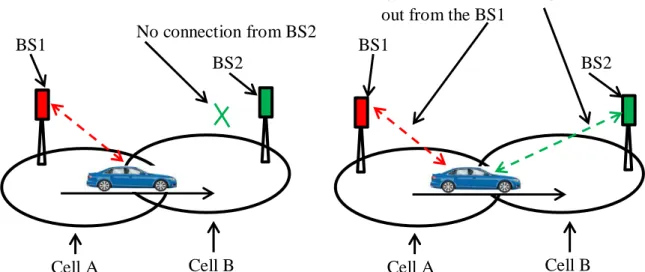
Hard Handover (HHO) can be explained as a break before making up of a connection (Figure 2.7a). In this kind of handover, the mobile terminal communicates with only one base station at a time. At the point when a handover takes place, the existing interconnection is discontinued, whilst a new linking is established.
When the on-going link is broken, resources connected with the old base stations are discharged, and the cellular terminal is allocated with new resources that are connected with the newly established base station [34].
Figure 2.7: (a) Hard handover (HHO) (b) Soft handover (SHO) BS1 No connection from BS2
BS2
Cell A Cell B Cell A Cell B
BS1
Get connection from BS2 before out from the BS1
BS2
21 Soft handover (SHO) is also called a “make-before-break connection”, which involves the process of making a new connection before breaking the previous one (Figure 2.7b). Thus, a user has two connections with two different base stations at a time [34].
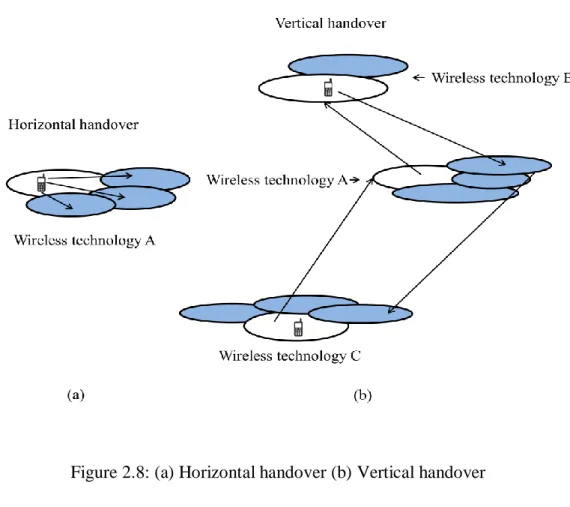
(ii) Horizontal and Vertical handover:
When an interconnection is handed over to the same wireless network’s base station, it is called “horizontal handover” (Figure 2.8a), and this handover process is also known as “intra-system handover” [34], [35].
Figure 2.8: (a) Horizontal handover (b) Vertical handover
Similarly when communication link is handed over to the base station of a dissimilar mobile network, it is called, “a vertical handover” (Fig.2.8b), and this handover process is also known as “inter-system handover” [34].
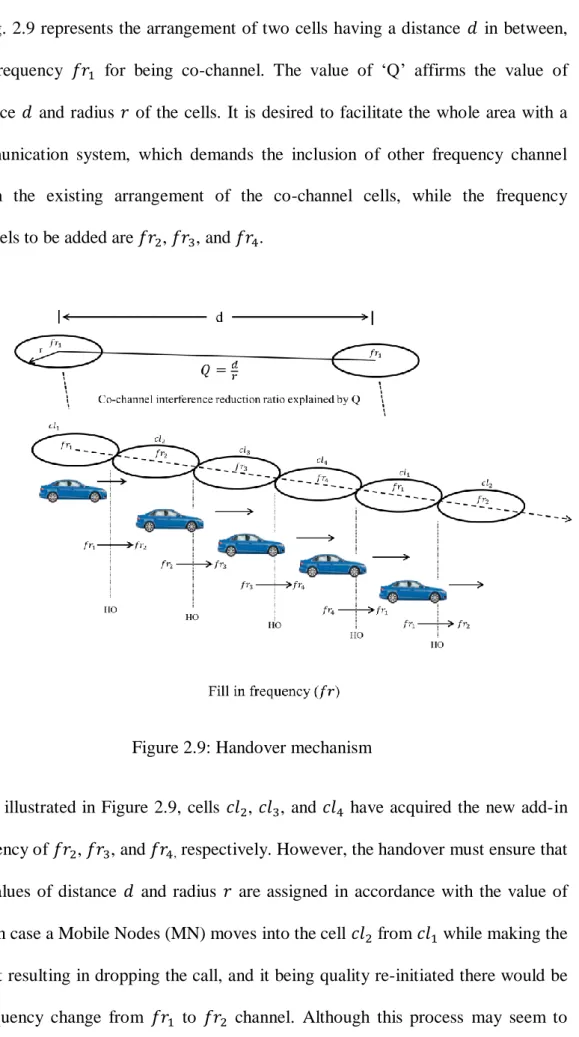
22 Fig. 2.9 represents the arrangement of two cells having a distance 𝑑 in between, and frequency 𝑓𝑟1 for being co-channel. The value of ‘Q’ affirms the value of distance 𝑑 and radius 𝑟 of the cells. It is desired to facilitate the whole area with a communication system, which demands the inclusion of other frequency channel within the existing arrangement of the co-channel cells, while the frequency channels to be added are 𝑓𝑟2, 𝑓𝑟3, and 𝑓𝑟4.
Figure 2.9: Handover mechanism
As illustrated in Figure 2.9, cells 𝑐𝑙2, 𝑐𝑙3, and 𝑐𝑙4 have acquired the new add-in frequency of 𝑓𝑟2, 𝑓𝑟3, and 𝑓𝑟4, respectively. However, the handover must ensure that
the values of distance 𝑑 and radius 𝑟 are assigned in accordance with the value of ‘Q’. In case a Mobile Nodes (MN) moves into the cell 𝑐𝑙2 from 𝑐𝑙1 while making the call, it resulting in dropping the call, and it being quality re-initiated there would be a frequency change from 𝑓𝑟1 to 𝑓𝑟2 channel. Although this process may seem to
23 aggravate the mobile users, the frequency changing process can be automated without requiring the involvement of the user. This handover process is executed for the FDMA, and TDMA systems [36].
2.2
Literature Review
2.2.1
Handover
In heterogeneous networks, data rates can be improved at hotspots by deploying small cells that overlap with the macro cell. As a result of small-macro combinations and the smaller coverage of small cells, more handovers are required in these heterogeneous networks [16]. Zhang et al. [37], have conducted research to reduce the handover
related overheads in macro-femto HetNets. The authors in [38] suggested to reduce the overall delay of the packets and to avoid excessive vertical handovers that are present in the two-tier architecture for downlink cellular networks. In [39] and [40], the authors used the Mamdani fuzzy logic method for analysing the handoff factor. The researchers studied the scenarios of two different handoffs, i.e., handoff from WLAN to UMTS and handoff from UMTS to WLAN. However, defining the fuzzy sets for such networks is a challenging task. The authors in [41] conducted a study to jointly tune the time to trigger and handover margin. In this study, a self-optimizing algorithm was deployed in a fuzzy logic controller. Nonetheless, the parameters update policy was dependent on the information acquired from the ratios of call drop and HOs.
Authors in [42] and [43] suggest a practical and proactive mechanism with the aim of developing further the performance of handovers when it comes to WLANs pertaining to handover impediment, professed throughput and jitters. A handover resolution algorithm has been proposed in [44] by Liming Chen, from WLAN to 4G
24 networking systems, after comparing the contemporary levels of RSS and dynamic and versatile RSS threshold assessment in the case where a WLAN AP connects to an MN. The later RSS threshold helps to reduce the amount of avoidable handovers while keeping the percentage of failures from the handover under some specified perimeter. Some authors believe that the likelihood of failure relating to handovers is more significant in situations with either rising velocity or handover, which is a sign when a predetermined value of RSS threshold has been used up.
Becvar et. al. [45] recommends a handover method of maximizing the efficiency
from the handover prophecy as well as efficiency by means of the stricture of RSSI with hysteresis as in [46]. To use it in the best possible way, they have suggested two thresholds for this parameter. This idea involves the extent of mean value of the specified thresholds, for handover commencement. Accordingly, adequate sample sizes of RSSI are calculated to assist in the estimation of the approximate number of handovers that have a likelihood of happening between the target base station and the actual. This process assists in the evaluation of probabilities and possibilities in handover among the BSs that are participating.
The authors in [47], [48], and [49] place a lot of emphasis on how by scanning of the real-time data actively, information such as direction of mobile node, the speed and the time involved can be smartly retrieved and resources needed can be reserved in advance. Similarly, a useful resolution with end-to-end effectiveness and efficiency can be gained by some smart reconfiguration systems such as configuration which is self-channelled and managed as well as alteration being incorporated in network entities. This approach may aid in the selection of the most suitable network configuration for
25 operation of a handover that not only fulfils the requirements of the users but also the QoS requirements.
Authors in [50] present a SINR based approach by considering the data-rate available as well as the backhaul bandwidth for coming up with and settling on the decision time required for the handover while maximizing the allocation of all the available resources in networks. To improve the usual throughput of the vertical handovers, Hu et al. [51], [52] advised the co-operation of the fast cell assortment as well as softer handover grounded assessment algorithms in the 3GPP networks. Taking help from SINR to be the performance indicator for VHO, they suggested a new boundary, the ratio of interference to that of other Interferences plus Noise, while illustrating its practicability in the overall path of the handover. The authors also suggest that the IINR be used only if those cell nodes selected for handover have cooperation expenditure or outflow is less than their cooperation inflow or gains. Once this is confirmed, the total average throughput of the entire handover process can and may be improvised. However, this approach is only applicable in environments supporting a cooperative network.
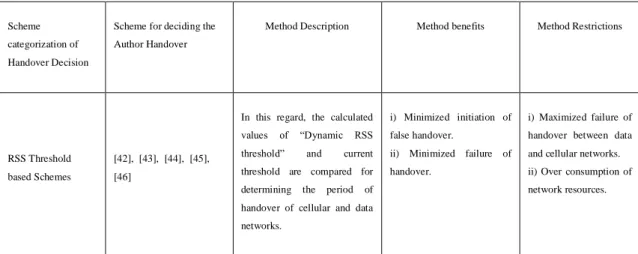
Table 2.1: A comparative survey of representative handover techniques
Scheme categorization of Handover Decision
Scheme for deciding the Author Handover
Method Description Method benefits Method Restrictions
RSS Threshold based Schemes
[42], [43], [44], [45], [46]
In this regard, the calculated values of “Dynamic RSS threshold” and current threshold are compared for determining the period of handover of cellular and data networks.
i) Minimized initiation of false handover.
ii) Minimized failure of handover.
i) Maximized failure of handover between data and cellular networks. ii) Over consumption of network resources.
26
Channel Scanning
based Schemes [47], [48], [49]
The time of handover is decided by the combination of RSS with the estimated scanning period.
i) Adjustment to the user mobility and application. ii) Improved throughput.
i) Higher delays in handover.
ii) Need of additional lookup table.
SINR based Schemes
[50], [51], [52]
During a handover, the distribution and reservation of the resource is considered for the optimization.
i) Maximized throughput. ii) Optimized allocation of resource.
i) Increased latency in handover.
ii) Inappropriate for high speeds.
iii) Effect of Ping-Pong.
Network Score Function based Schemes
[53], [54], [55], [56], [57]
The networks are ranked using the scoring function based on MADM in accordance with the needs of the users for selecting appropriate network.
i) Low blocking rate of handover.
ii) Minimized effect of Ping-Pong.
iii) Selection of network on ranking basis.
i) Degraded QoS. ii) Increased Latency.
ANN based Schemes [58], [59], [60]
The complex problems are dealt by the application of ANN in which the behaviour of handover in dynamic situations is carried out automatically.
i) Efficient handovers. ii) Lower delay of handover processing.
iii) Better selection of network.
i) Increased Latency. ii) Slow process of learning and training. iii) Consumption of supplementary resource.
Intelligent Protocol based Schemes
[61], [62], [63]
The handover mechanisms are aligned with proper networking for seamlessly providing different mobility protocols.
i) Minimized packet loss. ii) Resource conservation at terminal.
iii) Efficient handovers. iv) Ensured security.
i) Relatively high latency.
ii) High overhead of signalling.
iii) Centralized control.
Mobile Agent Based
Schemes [64], [65], [66], [67]
The handover is carried out by the mobile agents that are employed in terms of partially distributed solution. In his regard, these agents gather and distribute the required contextual information.
i) Intelligent collection of context.
ii) Flexibility to different networks.
iii) Proper storage of context.
iv) Optimized rate of handover blocking.
i) Increased overhead in communication. ii) Increased number of agents.
iii) High latency of handover.
iv) Real-world issue of deployment.
Mobility Prediction Based Schemes
[68], [69], [70], [71], [72], [73]
The decision of handover is made by collecting the patterns of users’ mobility and the historical data.
i) Minimized Ping-Pong in the case of low speeds. ii) Appropriate in vague network environments.
i) Volatility for different speeds. ii) Longer duration of handover delay. iii) Higher losses in packet data.
i) Proficient decision making.
i) High cost of signalling.
27
Cooperation Based
Schemes [74], [75], [76], [77]
The decisions of handover are made on the basis of collaboration of multiple entities in the network.
ii) Enhanced QoS. iii) Appropriate for real-time streams.
iv) Completely distributed. v) Improved utilization of system.
ii) Higher loss of packet data.
iii) Security provision.
The authors in [53] and [54] present a selection of network as well as a handover decision method inspired by the system for preference of order by way of similarity to perfect solution for grading networks in a wireless superimpose environment. It is vital to consider the history parameter of handover as a major aspect for establishment of a handover decision as well as a suitable network selection. Other important aspects include sanctuary, the expenditure, jitter, bandwidth, postponement and package loss.
The aim here is to ensure that the persistence of an MN is in the presently linked access network for the longest possible time. The bonds are committed to memory by the method inspired by the system for preference of order by way of similarity to perfect solution decision engine, whose job is to manipulate them in a suitable grade way that it is according to user’s wishes. Authors recommend decreasing the figure of handovers. However, it appears that MN is strained to continue to staying in a network even when the network’s QoS drops beneath the user threshold hence shows the unsuitability and inaptness of such answers in the varied environments of radio access, also depicted by [55], [56], and [57].
In their work, Nasser et al [58] presented a vertical Handover Manager. The
approach based on neural was used in identifying signal putrefy as well as formulation of the handover decision. Some researchers also aspire to propose an intellectual system of network selection, which will be able to opt for the greatest wireless networks that are available. This would have the benefit of user predilections, device
28 potential (like power utilization), and wireless network components such as the expenditure and security network parameters to make sure that there is an enhanced handover decision and network assortment. Nasser et al declared that when the rate of
knowledge and tolerable inaccuracy rate of price are correctly harmonized, it follows that the projected design becomes skilled enough to pronounce the finest available network at optimum level [58].
According to Horrich et. al. [59], fuzzy logic based procedures as well as
propositioned neural networks can be used for the handover decision. The researchers also suggest using Fuzzy Logic Controller techniques for handover decision-making. Fuzzy Logic Controller pertain the specifically defined regulations to the existing system environment. A neural system uses the results from the handover features matrix to learn the FLC’s limitations. From this study the authors projected to exploit the velocity and network fills in the RSS, as the handover decision restrictions. An introductory choice of networks targeted by the handover is executed earlier than commencing the vertical handover method. Target network load and networks with indication level above the ones that are already defined threshold limits are filtered. The targeted network with the paramount signal eminence gets selected. Such a prior selection diminishes the FLC complexity while saving the processing time. Moreover, this proposal suffers from the similar constrictions as the one previously presented in [59], [60].
Vidal et al. [61] recommend a structure for positive and practical backgrounds
transmit for P2P IPTV service contained in IMS networks. The authors measured handover between networks and its circumstances to reduce the packet loss and improving the experience of the users. The authors in [62] concentrated on the matter
29 of joint confirmation in networks that lacked any relationship, in the context of Mobile-Controlled Handovers. In the first stage, a confirmation label is generated which follows speedy verification of the newly incoming mobile nodes within that particular network. The authors took advantage of the benefit of the Authentication, Authorization as well as Accounting method and definite AAA proxy [63] that viaducts the trust relationship with the help of a shared key across diverse networks. The communal key usually propels to the candidate networks in proceed. The AAA proxy is used to directly authenticate the mobile node as it assigns to a new network and does not entail the home network in as far as this purpose is concerned. It is expected that the process will help in minimizing and controlling the packet loss. Additionally, the complete control of keying data for speedy substantiation is given to a MN which determinations the matters of secrecy and safety such as masquerading attacks and DoS to certain extent as well.
Programs characteristically written in a form of a script that may be transferred from a user computer as well as related to a remotely located server computer to aid in implementation [64], are called Mobile Agents. Wei et al. suggested a decision
mechanism framework that was based on handover in [65], describing a decision-making system that is based on mobile agent from which useful data can be downloaded at one point and also invoked later at the point of handover. Furthermore, the projected structural design comprises of three most important parts: (i) a framework for context management, (ii) a platform that is programmable and (iii) a service exploitation plan to supply the operations required in the case of context-aware handover. In [66], the authors put forward a multimedia middleware available everywhere that was based on the mobile agent with the intention of blatantly keeping
30 away from service disturbance during vertical and horizontal handovers in the assorted environment. Zafeiris and Giakoumakis [67] anticipated another insightful input to the context based handovers by suggesting using a design based on mobile agent for handover administration by cantering on the handover instigation as well as decision stages.
Incidentally, the work presented in [68] offers a resolution based on the Dynamic Bayesian Network to tackle the concern of handover while utilizing context changing variables and Semi-Markova models. Nevertheless, it is impossible to compute all the information that is based on various contexts which may impact the future availability of network. The work demonstrated in [69] presents a device that predicts mobility on by way of approximating the behaviour of the user. The authors consider what the what time of the day it is, the amount of time used up in a precise network, the history of handover, group as well as position as handover decision constraints. Authors in [70], [71] and [72] present a solution on a mobility design based mobile supported handover. These authors also suggested to accumulate the historical data of the movement of users in a database and also each time a roaming client uses the same trail using an invariable velocity; Mobile network handovers to the formerly recognized networks. According to Wang et. al. in [73], it is crucial that handover decision making codes in
the radio systems should be used to resolve the issue concerning handover indecision as well as where the requirement of handover is owing to corrosion of signal. The initial method is based on the theory of conformist decision where diverse levels of signals are observed, as the succeeding tactic is supported by the Markov model in which mobility forecast performs an essential role. They take into consideration complex
31 factor of environmental impact on the behaviour and performance of radio signals, device configurations, user inclination and network conditions.
Another novel handover system is recommended in [74] that merges the MIH framework for analysis as the case study for movement management in different wireless networks and the spectrum awareness. Liu et. al. had suggested to use a game
theory that is basis of loose-coupling interworking amid WiMAX and WLAN, specifically for the vertical handovers [75]. The origin of the handover decision is a game procedure that is conducted using a bidding model that considers the delays, bandwidth, loss of packet, charges offered by a wireless network and jitters. Wang et.
al. [76] came up with a design that supports mobility in omnipresent environments. The
authors also offer a management design-based on a decentralized situation that is premeditated to please the requirements of the user like in [77]. The design involves a path-planning module as well as a handover module, which are a mass on the U-gate also known as ubiquitous gate. The U-gate is a key mechanism of the projected design while working as a gateway amidst networks and devices such as sensors or even equipment that is more intelligent. This structural design works with a communication model that plays the role of an intermediary between both, the ubiquitous environment and U-gate and all the contextual information is gathered and modelled in it.
In [78], a network controlled handover optimization and soft-metric mechanism was introduced to more easily cope with the variable user speeds. The speed of user equipment is an essential factor in managing mobility and handover rates. Some other research articles [8] and [15] focus on the high-speed users considering the movement in vehicles and railways whereas some other works [79], [80] focused on the mobility management for users with limited paths. It is worth mentioning here that as the user
32 speed increases, the handover rate also increases because an UE is more probable to cross the coverage boundary of the associated BS.
An available research suggests that BS density for small cells and macro cells is an essential variable for measuring 5G network capacity as the number of UE increases rapidly. Some studies carry out their analysis and simulations on low density cells (2 MBS/Km2) [14]. In contrast, another study [81] used high density for small cells up to 400BS/km2. Some other researchers [82], [83], and [84] also considered the density of UE to study the impact on coverage probability and the average throughput, which is also affected by the UE's velocity along the moving trajectory.
In [85], the authors proposed to avoid frequent handover for high speed mobile nodes by serving them by the MBS even though some smaller cells with better SINR were present. However, the work in [85] assumes that enough resources are always available for mobile nodes. Power consideration in heterogeneous networks requires that the number of active small cells be kept low, meaning more power efficiency can be achieved when users can be served by the MBS instead of small cells [86], [87]. As a result, an energy-efficiency network attempts to utilize the MBS spectrum first, leaving not enough resources for new mobile nodes unless some other mechanisms are deployed. In this proposed study, the authors propose one such mechanism to reduce both the handover and the power consumption.
2.2.2
Handover and Transmission Latency
The primary concept of heterogeneous networks is that numerous smaller cells (e.g., microcell, picocell, femtocell) operate under the umbrella of macrocells to increase the coverage or enhance the ability to support high traffic rates for all areas [6], [22]. In the
33 heterogeneous network repeated handovers with macro-small cell occur owing to its very narrow coverage and the fact that numerous small cells are overlaid [88]. As a consequence of handover, interference between source and target eNBs occurs [89]. This leads to throughput performance degradation. Therefore, many studies have been conducted on reducing handovers in heterogeneous systems.
In a heterogeneous network (during the handover), Lee et al. [90] proposed a
mechanism for call admission control; however, in the same network, they do not work on the different traffic load environment, which leads to call dropping. According to the research on internetworking between WLAN and WiMAX networks, regarding tightly coupled internetworking architecture [91] the available bandwidth and packet delay are parameters that are taken into consideration (related to the evaluation algorithms). However, even in the case of achieving high throughput, high handover delay is predominant with the mobile nodes’ arrival, which causes increasing the number of call dropping. In [92] and [93] the performance analysis was carried out over HO rates. The analysis was primarily conducted for the irregularly shaped topologies of the network. It is due to the fact that no remedial actions have been proposed for the frequent issues, associated with HO.
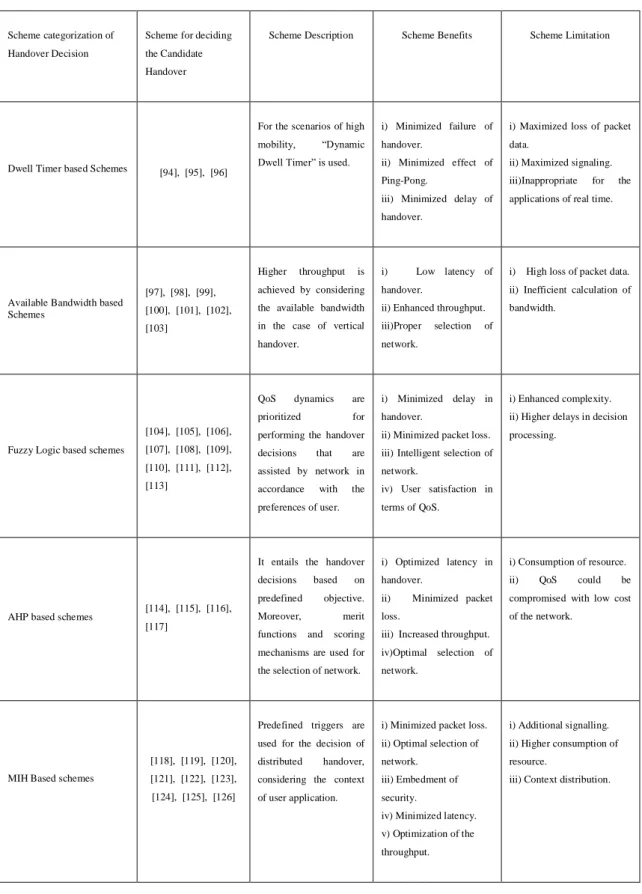
The study of Emmelmann et al. [94] proposed the design along with developing the
prototype for high-speed vehicles based on seamless and unified handover mechanism. In this regard, dynamic dwell timer was used as a significant element regarding the delay issues. The designed scheme was for the networks of IEEE 802.11 that aimed at minimizing the delay of handover mechanism of telemetry services’ provisioning. The projected prototype had two coverage areas of macro and micro cells operating on same frequencies. Likewise, an innovative handover technique was also proposed by the