FINAL ASSESSMENT REPORT
REPORT OF THE ACADEMIC STANDARDS COMMITTEE TO SENATE
March 6, 2012
PERIODIC PROGRAM REVIEW
BACHELOR OF SCIENCE (COMPUTER SCIENCE)
1. PREAMBLE The Department of Computer Science aims to promote and advance all phases of computer and information science education. The key objectives of the department mission are to further improve the quality of the academic program in Computer Science, to train both academic and industrial leaders who strive for excellence in Computer Science at the undergraduate, graduate and professional levels, and to guarantee that faculty members realize their maximum academic potential in contributing to teaching, research, and service. The mission of the Department of Computer Science can therefore be expressed as: Theory (providing the highest quality undergraduate and graduate education within the rapidly evolving fields of computer science; Discovery (promoting basic and applied research in computer science); Application (providing computer science expertise to the society); Partnership (using principles of computing to other disciplines and supporting multi-disciplinary efforts).
The aims of this program accord with those of the university as a whole: “to serve societal need by offering professional and quasi-professional university education.”
2. PROGRAM DESCRIPTION The Department Computer Science offers a 40-course degree program with the designation Bachelor of Science (Computer Science). This program is offered in full-time and part-time formats. The Department also offers an optional Co-op program whereby a student may work for sixteen to twenty months (four or five terms), typically for a software company outside of the university. A student who has applied and is accepted in this option completes the program typically in five years and graduates with the designation Bachelor of Science (Computer Science – Co-op option). All versions of the program are designed to produce graduates who can work effectively as software practitioners in a wide variety of professional areas in the computing industry. The courses in all versions provide students with both theory and practice within the framework of Ryerson’s tripartite curriculum. Theory forms the foundation for an understanding of the complexity of problems and algorithms, while practice prepares students for the development of applications. Students learn programming languages, and they are trained to be multilingual in the programming areas that are currently in demand. They are also given a practical treatment of both systems programming and applications programming. This combination will satisfy future career requirements in areas where a technical knowledge of all phases of software in a given application is a major advantage. An optional thesis in fourth year allows academically stronger students the opportunity to work on projects representative of assignments encountered in industry. Students in the Computer Science program become experienced with: networked environments, web-based applications, client-server applications, database design, and software engineering.
Computer Science at Ryerson was launched in 1970 within the Department of Mathematics and Physics as a three-year diploma program called Computer Applications Technology (CPTR). Within a decade, the CPTR program had become an integral part of the new Department of Mathematics, Physics and Computer Science (MPCS). In 1980 a new program was introduced, The Applied Computer Science Program (ACPS), administered by the School of Computer Science within MPCS. ACPS was a four-year program whose successful completion resulted in a Bachelor of Technology (Applied Computer Science) degree. This program underwent various curriculum reforms in the late 1980s and early 1990s. As a result of Ryerson achieving university status in 1993, the B. Tech. (ACPS) underwent further modifications during the early 1990s to align its curriculum more closely with that of other computer science programs in the province. By 1995, the B. Tech program was being phased out and replaced by the Bachelor of Science (Applied Computer Science) program. This in turn was modified further until the current program, Bachelor of Science (Computer Science), was brought on stream in 2004. In 2005, the stand-alone Department of Computer Science was created from the former Department of Math, Physics and Computer Science. The BSc (Computer Science) program was accredited by the Computer Science Accreditation Council in 2007, an accreditation which remains in force until 2012.
The current faculty complement within the Department stands at 19 tenure-stream/tenured faculty (RFA). Between 2005/2006 and 2009/2010, year 1 intakes in the full-time program have fluctuated between 105 and 154, with the average being 133. Over the same period the intake in the part-time program has declined steadily from 34 in 2005 to just 4 in 2009. The total program enrolment (all years, full-time and part-time) has averaged 448 over the period 2006/2007 to 2009/2010.
3. THE CURRICULUM The program curriculum conforms to the Ryerson tripartite curriculum structure, providing students with a balance of professional (i.e., discipline specific), professionally related (supporting the core discipline) and liberal studies (breadth requirement) courses as summarized in the following table:
Number of courses
Professional Prof-Related Liberal
Studies Total
Required Elective Required Elective
Year 1 3 0 5 0 2 10 Year 2 6 0 4 0 0 10 Year 3 7 0 0 1 2 10 Year 4 0 5 to 7 0 1 to 5 2 10 16 5 to 7 9 2 to 5 6 40 21 to 23 11 to 14
Professional Courses: all department taught courses.
Professionally-Related Courses: all non-department taught courses.
Ryerson’s Computer Science program requires completion of 40 one term courses (eight terms of five courses per term), as is typical of the comparator programs. Each course has three lecture hours per week, which is typical of comparator programs. Courses are offered through in-class lectures that are usually supplemented by laboratories. All but four of the compulsory courses (CPS 311, CPS 506, CPS 706, CPS 721) involve laboratory periods. The number of students in each lab varies from 15 to 40 and they are usually supervised by a graduate assistant.
Professionalism and Ethics: Computer science professionalism and ethics are introduced to our students in their introductory courses (CPS 109 and CPS 209), and elaborated in CPS 633, a required course, which covers the topics using court cases as illustrations. Upper year electives in software engineering also touch upon these topics. Furthermore, all Computer Science students must complete six Liberal Studies courses, one purpose of which is to develop the capacity to understand and appraise the social and cultural context in which graduates will work as professionals and live as educated citizens.
Co-op Option: The program offers a co-op option that provides graduates with 20 months of work experience integrated into their academic program. To be admitted into the co-op program, students must have a CLEAR academic standing and a minimum cumulative GPA of 3.0 at the end of the second semester. Students are assessed through work term reports and employer evaluations in such respects as interpersonal skills, attitude, creativity and dependability.
In the 2006 graduating class, 20% of the students surveyed replied that they had personally used the co-op program. Of those individuals, 93.8% reported they were either satisfied or very satisfied with the program.1
Capstone Course: An optional thesis course (full year, CPS40 A/B) is available to fourth year students who want to work on a research project under the supervision of a faculty advisor. Students creatively apply the material they have learned in prior courses to a significant problem in any area of computer science.
The main objective of the thesis course is to introduce students to the breadth of tasks involved in independent research, including: literature survey (library work); problem formulation; experimentation, simulation and programming; presentation and scientific writing. The mandatory project proposal is a key component in both approving the thesis and establishing a plan for the work. Admission Requirements: For the Full-Time Program: O.S.S.D. with six Grade 12 U/M courses, including Grade 12 U courses in: English, Advanced Functions (MHF4U), one of Physics (SPH4U), or Chemistry
1
Canadian University Survey Consortium. Graduating Student Survey 2006: Frequency distributions for full-time Ryerson programs. (University Planning Office, October 2008).
(SCH4U), or Biology (SBI4U), and either Calculus and Vectors (MCV4U) or Mathematics of Data Management (MDM4U). Calculus and Vectors (MCV4U) is the preferred mathematics course. ENG4U/EAE4U is the preferred English. Physics is the recommended Grade 12 U Science. The grade(s) required in the subject prerequisites (normally in the 65-70 percent range) will be determined subject to competition. Subject to competition, candidates may be required to present averages/grades above the minimum.
For the Part-Time Program: This program is administered by the School of Computer Science and The G. Raymond Chang School of Continuing Education. All applicants to the program must have the following qualifications: A and C, OR B and C. Where: A. O.S.S.D. with six Grade 12 U/M courses, including Grade 12 U courses in: English, Advanced Functions (MHF4U), one of Physics (SPH4U), or Chemistry (SCH4U), or Biology (SBI4U), and either Calculus and Vectors (MCV4U) or Mathematics of Data Management (MDM4U). Calculus and Vectors (MCV4U) is the preferred mathematics course; OR B. Ability to meet the Ryerson Mature Student Guidelines; AND C. Meet one of the following: a university degree (obtained within the last 10 years) in mathematics, science or engineering with a minimum GPA of 2.0; or a three year college diploma (obtained within the last 10 years) in computer science with a GPA of 3.0 (only specific Ontario college programs will be considered. Undergraduate Admissions and Recruitment can provide details); or eight or more Ryerson continuing education credits in Computer Science courses (completed within the last 10 years) with equivalents in the full-time Bachelor of Science, Computer Science program, and completed with a minimum grade of 'C' in each course.
In addition: ENG4U/EAE4U is the preferred English; Physics is the recommended Grade 12 U Science; The grade(s) required in the subject prerequisites (normally in the 65-70 percent range) will be determined subject to competition; Students applying for advanced standing will be assessed on an individual basis to determine transfer credits that they will be given; Some students may wish to transfer from the part-time to the full-time Computer Science degree program. Only students who have completed all of the courses (or equivalent) in the first two years of the full-time program will be eligible for this program change; Subject to competition, candidates may be required to present averages/grades above the minimum.
Program Learning Objectives (UDLEs): While section 1e (Goals and Learning Objectives of the Program) of the Self-Study does make mention of some skills graduates are expected to achieve, these are limited and presented in a cursory fashion (students “may gain experience with research through a thesis course, or working as a research assistant, or continuing their studies with graduate school.”). This brief section does not adequately address the analysis of the program curriculum for consistency with the OCAV degree level expectations; a requirement which has been mandated by Ryerson Senate Policy 126 since 2008.
4. THE PROGRAM REVIEW The self-study review provides comprehensive information about the program and the department, including student data, student and graduate surveys and a comparator review. However, it does not provide a statement of the consistency of the program’s goals and mission with those of the Faculty of Engineering, Architecture and Science nor with the academic plan of the
University. As noted above, the self-study does not address how the curriculum relates to the OCAV UDLEs.
4.1 Assessment of Strengths and Weaknesses: Self-Study The assessment of program strengths and weaknesses, based on the Self-Study Report are presented here.
Strengths:
Curriculum- The Computer Science program’s curriculum covers all requisite core areas in Computer Science and math, while providing students with breadth in engineering, science and business, liberal studies and communication. The curriculum is regularly modified to cover emerging areas, such as data mining, information retrieval and extreme programming.
High Societal Relevance- Computer Science applications are ubiquitous in the modern world. In industries from car manufacturing to banking, computer scientists are needed to build and maintain essential software components. Similarly, in science, innovative software is continually required to decipher the genome, explore space, search for extraterrestrial life, study linguistics, build robots, and improve communications, to name a few areas of active research. Employment demand in computer science is expected to increase by ten to twenty percent in the coming decade.
Preparation of Graduates- Feedback from employer surveys indicates that computer science graduates are ready to be productive from day one. They particularly valued graduates with co-op experience. Nearly 88% of the surveyed employers intended to hire more Ryerson computer science graduates. Student Satisfaction- The PPR data (e.g., NSSE) indicate a high level of student satisfaction with many areas of the program. Respondents rated their “entire educational experience” as either good or excellent, and that they would attend Ryerson again if they were to start over. Upper year students who completed a separate survey noted that while the program was academically challenging (91% of respondents), it is also good preparation for a career (86%), well-organized (76%) and of high quality (90%). Students were also noted to be animated and articulate. Students value the practical foucs of many of the courses.
Graduate Satisfaction- Surveys of graduates found them to be generally positive towards the value of their degrees. They were particularly praiseworthy about issues such as how their experiences at Ryerson contributed to skills (e.g., computer literacy, entrepreneurship, math etc.). Graduates noted a high level of satisfaction with their employment. Nearly half (47%) of graduates surveyed indicated that their jobs were significantly related to what they studied at Ryerson. By comparison, the same value for FEAS is about 49% and about 45% for Ryerson as an institution.
Department Culture- The Department is supportive and is well respected within the Faculty and by senior administration. The atmosphere is collegial.
Excellent Facilities- The undergraduate labs are equipped with up-to-date desktop computers and software. One lab is designed to facilitate the use of student-owned laptop computers on a walk-in
basis. Labs are available 24-7. Students working on projects for faculty also have the use of research labs, such as the Ubiquitous and Pervasive Computing laboratory, or the robotics laboratory.
Experiential Learning- The Co-op program typically has 100% success in placing students with internships at local companies, including IBM, CIBC, and Celestica. Students gain valuable on-the-job training and experience, while earning a good salary. Besides Co-op, some students become research assistants and work on the frontiers of computer science under the supervision of faculty. Within the curriculum, students can explore research by taking the Thesis course.
Human Resources-
Tenure/Tenure-Stream Faculty: The RFA faculty complement has increased over time. The faculty view the Department and University as a positive working environment where young faculty are supported in various ways. Students consider faculty to be caring and responsible and most are responsive to student needs. Teaching loads are viewed as reasonable.
Technical Staff: There is a dedicated technical support team. They enjoy what they do and are well respected by faculty members.
Weaknesses: The Self-Study and PRT reports flag a number of issues as summarized below.
First Year Retention- The Computer Science program experienced a three-year (2005-2007) dip in first year retention. For example, the first year retention figures (same program) for the 2002 cohort to the 2008 cohort are (77%, 73%, 74%, 48%, 59%, 58%, 77%). This problem seems to have been temporary. Some of the contributing factors may have been:
“Bursting of the technology bubble” in 2001, which led to a decline in applications, and a consequent decline in grades of the average student accepted to the program.
Removal of Grade 13 (OAC) in 2003, which led to decreased skills in mathematics (particularly calculus) for incoming students. This no doubt contributed to higher failure rates in the four first-year math courses and the physics course. (Starting in 2009/2010, the program has replaced the admission requirement of physics with a science option where the student chooses one of physics, chemistry or biology).
Possible misdirection of high school students seeking education in computer and information technology. Some of the students that leave or fail our program after first year go to ITM, which they might have chosen in the first place had they been well informed of the differences between the two programs.
Lack of Specializations - One of the strengths of the program is that it is essentially an Honours program with specialization in Computer Science. Some CPS students might be better suited to a less rigorous program, but there are no options available in the program (i.e., no “regular” program). Such a regular program could have less compulsory math courses and more elective computer science courses, or even just more electives in any area.
Lack of Minors - The only minor that a computer science student can obtain in practice is in Mathematics. The program has taken a step to improve this situation by increasing the number of electives in the Engineering/Science/Business Group of the Table of Professionally Related electives. This has opened up the door to many new minors for CPS students, but to obtain a minor in a subject other than Mathematics, a student must take more than 40 courses.
Department Culture - The Department is part of a predominantly Engineering Faculty. Potentially this has a negative influence on the Department’s profile/visibility.
Tenure/Tenure-Stream Faculty/Support Staff - Formal mentoring for new faculty is not in place. A small number of faculty are considered good teachers. The number of faculty may not be sufficient to balance the teaching load needs for the undergraduate and graduate programs. The number of support staff must be adequate for both the undergraduate and graduate programs.
Course Offerings - Students wanted more flexibility with electives and minors. Senior courses are not always offered. The Department does not offer enough summer session courses to satisfy all modes of co-op.
4.2 Report of the Peer Review Team (PRT) Senate policy 126 governing Periodic Program Reviews of undergraduate programs requires that a team of peers2 visit the University and report on their assessment of the program.
Overall, the PRT judged the program to be of high quality and well-rounded, if somewhat conventional. Students are engaged, proud of the program and successful at obtaining employment and admission to graduate school upon graduation. The available facilities are “quite nice” and the Digital Media Zone offers an excellent environment for innovative project work. The program is well aligned with Ryerson’s academic plan, although more effort could be spent in achieving societal relevance, recognition of teaching excellence and building reputation. While the overall picture is positive, the PRT raised a number of issues of concern. These are summarized here, along with recommendations or suggestions provided by the PRT.
Specific Concerns with Curriculum - Overall the curriculum ins clearly and carefully designed. The learning goals and objectives of the course are generally well delineated and clear. The CSAC-accredited curriculum covers the core areas of the discipline and its main areas of application in a thorough fashion. Courses are, by-in-large, taught at an appropriate level and build expertise year-over-year. The PRT identified the liberal studies and science electives as a positive feature providing students with additional breadth. Required communication and management courses were also identified as positive features. However, the PRT did identify some weaknesses with the curriculum.
Mathematics in Years 1 through 3: The PRT felt that the amount of mathematic content and the order in which it is presented is problematic. For example, in Year 1 students are required to take two discrete
2
The members of the PRT were Dr. Peter R. King (Professor Emeritus, University of Manitoba) and Dr. Sylvia Osborn (Associate Professor, University of Western Ontario). The site visit took place on April 5, 2011.
mathematics courses (MTH110 and 210). In most computer science programs a course like MTH210 would be offered in second year and that it might well be challenging for first-year students. Suggestion from PRT- Consider moving MTH210 to Year 2. Requiring two calculus courses in Year 1 and postponing linear algebra to Year 2 seems “odd” as the linear algebra knowledge is useful for the Year 2 discrete math course, a course which students find challenging. The need for a second calculus course is not evident. The PRT recommends the department consider replacing the second calculus course (MTH310) by the required linear algebra course (MTH108) in second semester of Y1; make MTH310 an optional course of use to students wishing to take an upper-year elective requiring additional calculus knowledge; make use of the resulting opening in Y2 in a different way (possibly moving the MTH210 course from Y1 and Y2). MTH816 (Cryptography) was found to rarely be offered. The PRT was quite concerned about this and recommends that steps be taken to ensure MTH816 be available to all students wishing to take it.
Computer Science Courses: The PRT suggested that CPS305 be renamed as Data Structures and Algorithms. In Y3, the team felt there was an excessive emphasis on programming languages and parsing (CPS615 and CPS506). While relevant, this material need not be required of all students. The PRT also noted that this material is no longer required for CSAC accreditation. The suggestion is that the need for this as required content be reconsidered. The same comment is true of the advanced algorithms course, CPS616.
Year 4 Electives- There is a long table of upper year electives but many are not offered in a given year. The PRT was also concerned that the list of offerings in a given year was released shortly before the start of semester 7, providing little time for students to make informed choices.
Overall Program-
Goals: The program meets its stated goals in general. Its graduates are certainly “industry-ready”. The PRT was, however, puzzled that the goal of producing graduates acceptable to graduate computer science programs, while articulated, was not more at centre stage as a key program goal.
Program Structure: Students have virtually no choice of computer science courses during their first three program years. In year 4, their ability to choose is virtually unlimited. This unbalance is atypical in Canadian undergraduate computer science programs. The PRT recommends that the department consider restructuring its curriculum to allow greater choice earlier in the student’s program. Making the programming language/parsing and advanced algorithm courses optional (Year 3) would give flexibility and allow students two years in which they could take computer science elective courses.
Program Streams: Given the large number of elective CPS courses, the program may wish to identify streams within the overall program. These might include multimedia, artificial intelligence and others. Reputation- The PRT encourages the department to continue to work to improve the image of its undergraduate program while recognizing the need to have that image align with Ryerson’s traditions and culture.
Resources-
Faculty/Staff/Graduate TAs: While the faculty-base is sufficient to offer a strong core program, there is little capacity to offer new, cutting edge courses. There is also insufficient capacity to offer the full-range of Y4 CPS elective courses. The launch of the PhD will place additional pressures on the current faculty demands. Administrative support was deemed to be adequate but the PRT was concerned how the current technical staff would cope with the additional demands brought by the PhD program launch. The graduate TA system seems to be working well and both faculty and students seemed satisfied with the level of support provided.
Physical resources: While technology resources were generally adequate, the PRT pointed out that many schools replace equipment on a 3 to 4 year cycle, rather than a 4 to 5 year cycle as is Ryerson’s practice. Students -
Student Performance: The PRT noted that the average entering grades of applicants to the program were below the average of the Faculty and that this might contribute to the observed drop off rate (loss of students). According to the data provided in the review, the rate of students with clear standing after Y1 was only about 50%. The PRT stated that “this is a problem which should be addressed”. It offered a suggestion in the form of the reorganization of when and which math courses should be taught (see above).
Student Experience: The student experience is highly positive and the PRT attributes this to hard work by the department to meets its students needs. The cohort nature of Y1 builds a strong sense of student community which students seem to value. Students are positive about the program and have a great affinity to the institution and to the department. They felt their professors were providing quality instruction in an enthusiastic fashion on up-to-date and relevant material. Students did not comment on class size as an issue of concern. Graduates from the program become employed or admitted to graduate students with rates comparable to other programs in the province.
A few concerns were raised by students. These include: Y4 electives not being available every year; lack of availability of the Cryptography course MTH816; some technical difficulties with downloading data from departmental machines; confusion about the role and implications of the faculty course surveys; an ad hoc approach to evaluation of TAs.
5. DEVELOPMENTAL PLAN AND RESPONSE TO PRT RECOMMENDATIONS
The School’s developmental plan is structured around the articulation of a number of objectives. The objectives and the initiatives which flow from them are summarized here.
Objective 1: Enhancing Staffing - by recruiting high quality faculty, including senior appointments, to replace retiring personnel. These hires will support both the newly approved PhD program and prepare for potential undergraduate enrolment growth. The Department will pursue high-quality hiring opportunities in core, strategic (AI, Robotics, networks, and security), and growth areas and identify
areas in need of additional senior leadership (e.g., research chairs). The Department is developing a detailed proposal for hiring of academic staff in consultation with the Dean.
Objective 2: Enhancing and strengthening the Department’s research activities and knowledge creation - endeavours through establishment of new research intensive graduate program. The Department’s proposal for a PhD in Computer Science has been approved. This will be its second graduate-level program, adding to the current MSc in Computer Science.
- Preparation for academic standards assessment re: the letter of intent for PhD program proposal (Completed)
- Internal review before OCGS appraisal (Completed)
- Preparation for OCGS appraisal (in progress)
- Commencement of the new PhD program in Sep. 2010
Objective 3: Enhancing the quality of the undergraduate program in Computer Science - by offering relevant curriculum, accredited by CIPS, that covers the fundamental principles and state-of the-art tools technologies. To achieve and maintain professional peer-reviewed accreditation status, the program’s curriculum and course content must continue to be regularly reviewed and upgraded - using feedback and suggestions from faculty, students, academic advisory board, and alumni. To reflect the state-of-the-art knowledge in Computer Science field, the program must continue to be regularly developed with respect to available resources, societal need and emerging technologies. The curriculum will be reviewed every year and CIPS accreditation will be maintained at all times. A CIPS assessment committee is established for each cycle of accreditation. Another related objective is improving the retention while maintaining quality. This can be achieved by developing retention strategies adapted towards the challenges experienced by first-year students, to identify the troubled first-year students early in the program, to offer proper assistance to undergraduate students, and to monitor the quality of the first year courses in general, to enhance communication channels among students, faculty, and academic advisors.
- Continuation of the transition program and the early intervention approach (on-going)
- Using carefully selected instructors for the first year courses (on-going)
- Creation of Programming Clinic (Completed)
- Upgrading the undergraduate labs on regular basis with required state-of-art equipment and software (on-going)
- Preparation for the next round of the CIPS accreditation process (2012) (under study)
- Achieving and maintaining the appropriate level/number of faculty, technical and administration in order to maintain the high standard and the quality of the program as mandated by the policies of the professional accreditation body (CIPS) (under study)
- Implementation of undergraduate streams and specializations (under study)
- Exploring and implementation of undergraduate minors and majors (under study)
- Strengthening the Informatics options in the Science program (under study)
- Enhancing the Department profile by increasing collaboration with other universities and the Industry (under study)
- Implementation of a pilot program to offer undergraduate courses on-line (to be implemented in Winter 2010)
Objective 4: Improvement and expansion of research infrastructure – which will support both improved research publications, external funding and graduate student research participation, to renovate the existing computing equipment in laboratories every four years, to acquire special purpose research quality capital equipment and development of strength in research focus areas
- Preparation of infrastructure proposals in cyber security (in progress)
- Preparation of infrastructure proposals in Augmented Reality and Robotics (in progress)
- Preparation of infrastructure proposals in Cognitive Networks (in progress)
- Preparation of infrastructure proposals in Visualization (in progress)
- Request for proper space (in progress)
Objective 5: Enhancing the research capabilities - by creation of single and multi disciplinary research teams, providing seed funding and release time for exploratory research in emerging areas, offering incentive resources such as graduate student support/scholarships for emerging and multidisciplinary fields, supporting and encouraging faculty in pursuing funding opportunities, improving research seed funding, and increasing the number of research manuscripts published in high impact leading computer science journals. The Department goal is to bring the amount of external funding to that of the provincial norm.
- Application to multidisciplinary granting agencies (on-going)
- Encouraging partnership with the industry (under study)
- Encouraging collaboration with other universities (under study)
- Creation of special seeding opportunity for faculty members working in emerging areas (under study)
- Creation of conference scholarships for graduate students (under study)
Objective 6: Improving retention – In addition to the endeavours outlined in Objective 3, we will also examine the possibility of offering multiple degrees in Computer Science. Many of the comparator
universities examined in this document offer multiple degrees in Computer Science, and as mentioned earlier, we compared our program with the most similar one at the other universities, which sometimes was designated as an Honours program with a specialization in computer science. In other words, our program is a very demanding program, requiring a strong foundation in mathematics and a rather strict dedication and focus on computer science. This model does not fit all of the students that come to us. Some are not strong in mathematics, and some would like to combine computer science with study in another area, such as economics or bioinformatics. It may be that we could improve both retention and enrolment by offering in addition to the current degree, one or more other computer science degrees which are geared towards the latter students.
Objective 7 - Improvement of the learning experience, students engagement and satisfaction through maintaining the quality and adapting strategies towards the challenges experienced by undergraduate students, e.g., to identify the troubled 1st/2nd year students early in the program, to offer proper assistance to undergraduate students, to monitor the quality of the 1st/2nd year courses in general, to enhance communication channels among students, faculty, and academic advisors, and to involve undergraduate students with the curriculum and extracurricular professional activities as related to Computer Science.
- Provide personal and academic advising to undergraduate Computer Science students via the Program Director (on-going)
- Enhance experiential learning opportunities for undergraduate students through more involvement with research and teaching activities conducted by the faculty members (under study)
- Ensuring that all office and laboratory support staff are committed to high levels of courteous, compassionate and responsible academic support services to the respective program students. It is also important that adequate staff members are available to provide these academic support services (on-going)
- Continuation of a transition program (on-going)
- Continuation of early intervention strategies (on-going)
- Offering summer courses to reduce the workload in Fall/Winter academic year (under study)
- Use of the best instructors for 1st and 2nd year courses (on-going)
In conclusion, the Computer Science Department is in a phase of rapid and exciting change, as we have introduced a Masters program and we are on schedule towards offering a Doctoral program. The current structure (CTRS) of the undergraduate Computer Science program was initiated in Fall 2004, so the first graduating class was in June 2008 for the regular students and June 2009 for the Co-op students. Over the five years of offering CTRS, there have been three years with poor retention and two years with good retention. The program was accredited by CIPS in 2007. We have listed a number of
objectives to improve retention, teaching, student experience and SRC, while at the same time we wish to stabilize the basic structure of the undergraduate program.
Response to Program Review Team Report
1. Required Mathematics: The main concern/comment as reported in the program review document relates the program structure specifically the amount of required mathematics in the 1st and 2nd year. Response from Computer Science:
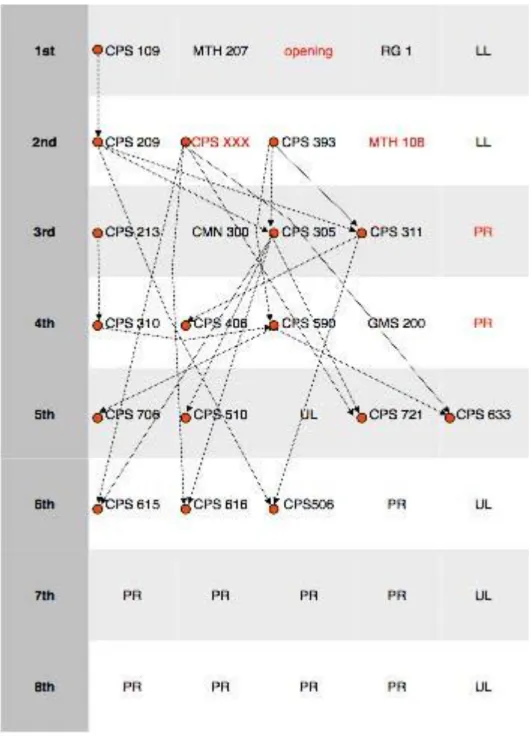
creating a new semester 2 computer science course (CPS XXX - Discrete Structures) as a replacement for two discrete mathematics coursesMTH 110 and MTH 210
making MTH 310 and MTH 304 optional (MTH 304 has proven to be very challenging to students, covering a selection of topics that goes above and beyond the minimal discrete probability coverage suggested by the ACM-CG08. Since the new proposed course, CPS XXX, will cover core discrete probability topics, MTH 304 will become optional, and possibly prerequisite for higher level optional courses.)
moving MTH 108 from semester 3 to semester 2 to replace MTH 310
creating “openings” in the course grid to be filled in with either (possibly new) compulsory or elective courses, one in semester 3 (where MTH108 was positioned) and one in semester 4 (opening created when MTH304 became optional). Results: first year becomes less challenging; optional courses available earlier in program
2. Optional vs Required Courses: The PRT suggested the following courses should become optional courses: CPS506, CPS615, and CPS616.
Response from Comp. Sci:
CPS 616 covers many mandatory topics and needs to be a core course
Figure 2: New course dependencies structure
3. Program Identity: The program would have a more distinctive identity if some effort were made towards making it more innovative and distinctive. The program could put some effort into achieving more societal relevance, having more recognition of teaching excellence, and could continue to work on improving its reputation.
Response: The program agrees with the PRT recommendations on this topic and is actively exploring at least two approaches to address this issue: it is actively working on developing new streams and joint
programs with other departments and faculties. For example, a Letter of Intent for a joint program between Computer Science and Radio and Television Arts on a unique program in gaming is under development. Other options under considerations are streams in computer security, networking, and a possible joint program on software engineering with ITM as well as new minors (e.g., computational financial mathematics). The Dean’s response (section 6, below, also addresses this issue).
4. Cryptography Course: The team was informed that the Mathematics course MTH816 Cryptography, which many students wished to take as fulfilling their mathematics requirement in this year of study, was generally not available to them.
Response: The program has submitted a proposal for a new course in Applied Cryptography as a response to this concern. This is part of an effort to create a stream in computer and network security.
5. Streams at the Undergraduate Level: The team also suggests that, given the rich list of optional courses available to students, the department consider identifying specific streams or options within the overall program. Given the current strengths in the department, one could well imagine streams in multimedia systems, in software, in artificial intelligence and so forth. The identification of such streams or specialties is a common feature of many undergraduate computer science programs.
Response: Note response item 4, above.
6. Faculty Numbers and Upper Year Offerings: Faculty numbers combined with the teaching loads are certainly sufficient to offer a strong core of courses, although not all of the final year optional courses are offered every year. There is little capacity to offer new, cutting edge, courses.
Response: The program recognizes a shortage of faculty as an impediment to creating exciting new offerings. This issue is addressed more completely in the Dean’s response (below).
7. Access to Graduate School: The team feels that the emphasis of the program is very largely on producing individuals who are well qualified for work in industry, less so for individuals who wish to proceed into graduate school.
Response: Both the MSc and PhD programs in Computer Science have been successful with over 60 students combined. The program is looking at various options to promote these programs to potential applicants. As of September 2011, the department has a dedicated support staff member, who has the responsibility of helping to promote the graduate programs. The program is also looking at involving undergraduate students in ongoing research initiatives, investigating the possibility of offering advanced cross-listed courses with SGS, as well as the possibility of a combined Bachelor-Master’s program.
8. Student Performance: The average marks of students admitted from Ontario secondary schools is below both the Faculty and the University averages. The same holds for indicator 1c, the percentage of students entering with an average of 80% or higher, which for Computer Science, is approximately 20% (vs about 45% for FEAS and 62% for Ryerson). In spite of these facts, retention data have improved as noted above. In addition, the percentage of students with a clear academic standing after one year,
which hovered around 50% from 2002/03 to 2006/07, increased to about 63% by 2008/09 and 2009/10. These rates, while improving, still lag the averages for both FEAS and for Ryerson. The program believes that its efforts around early intervention and the development of a transition program have contributed to these improvements. It is committed to continue these initiatives. In addition, it proposes the creation of a first-year office to serve first year program students.
6. DEAN’S RESPONSE
The Dean’s response to the self-study and PRT report/response touches on four broad categories: student retention; societal relevance and distinctiveness of the program; resources; degree level expectations/curriculum mapping.
Student Retention: The Dean supports the early intervention efforts of the program. In addition, the Dean endorses the idea that first-year computer science students would benefit from inclusion under the umbrella of the First Year and Common Science Office “to aid with orientation of new students and administration of early intervention programs”. As noted in the Dean’s response, there would be no requirement for the Computer Science program to align its first-year curriculum with the common science first-year platform.
The Faculty has also introduced strategies to improve student quality in all Science programs, including Computer Science, by creating the Office of Science Outreach and Enrichment (OSOE). This year the OSOE has embarked on an ambitious program to invite local high school science classes to Ryerson to introduce them to science at Ryerson. The aim of the program is to promote Ryerson as a university with a variety of strong Science programs. With partial financial support from the Dean’s, the Department of Computer Science has purchased a fleet of robots, which will be used for these outreach activities. The Dean also see this strategy as a way to strengthen the reputation of the program in Computer Science. The Dean also notes that the program has adopted the PRT recommendation to modify the math content in its curriculum. This is also anticipated to help with student retention.
Societal Relevance and Distinctiveness of the Program: The Dean supports the suggestion that the program find ways to incorporate element so faculty research into undergraduate curriculum as a way of giving the program a distinctive flavour. The Dean is also supportive of the department’s initiatives around interdisciplinary programming, the gaming degree in partnership with Radio and Television Arts is noted in particular.
Resources:
Faculty Complement- The response recognizes several constraints around the faculty complement and how this impacts on program delivery and performance. The response notes that there is one faculty replacement position open which is expected to be filled within the year. In the longer term, growth in student numbers, via increased demand for the current program and/or through launch of new programming, may be a route to additional hires.
Technical Staff- While technical support within the department is currently adequate, the launch of the PhD in Fall 2011 adds additional demand which will increase as that program grows. It is expected that the increased revenue from joint programming (e.g., with Radio and Television Arts) will provide additional funding for technical staff. The department should also benefit from efficiencies due to overlap in the needs of the two undergraduate programs (current and proposed) and the graduate program.
Equipment Renewal- The Computer Science program curriculum is heavily dependent on access to up-to-the-minute computer and peripheral technology as well as software. The PRT indicated the current renewal frequency (4 to 5 years) is too low and recommended a frequency of 3 to 4 years. The Dean agrees with this suggestion and recommends a renewal cycle with 1/3 of the equipment being replaced on an annual basis. The response provides a cost estimate for this approach and recommends the process begin immediately in 2012. The costs would be shared between the Faculty and the department.
Degree Level Expectations/Curriculum Mapping: The Dean points out that having the Computer Science program do an analysis of its curriculum in light of UDLEs (i.e., curriculum mapping) over the next year is timely as it will coincide with program reviews in an number of the other undergraduate science programs.
7. ASC EVALUATION The ASC assessment of the periodic program review of the Bachelor of Computer Science and its recommendations are as follows:
Curriculum Mapping: The self-study does not contain an analysis of the curriculum in light of the degree level expectations expressed in Ryerson’s IQAP. Given the concerns expressed by the PRT about curriculum inflexibility and limited student choice, the ASC recommends that a full curriculum mapping of the program be completed and presented in a follow-up report. It is also important that the program review its curriculum in light of the new curriculum framework. The ASC recommends that the curriculum mapping process be used to seek additional flexibility in the curriculum with the goal of making it consistent with the new framework.
Student Academic Performance: The developmental plan provides a number of suggestions on ways to improve student academic performance. The ASC is supportive of these efforts, especially the early intervention and transition program efforts as there is evidence to suggest these have been effective. ASC is also very supportive of the idea of specialized support for first year students. However, the ASC recommends that first-year student support be provided through the currently existing First Year and Common Science Office, as proposed by the Faculty Dean, rather than a program-specific First Year Office.
The program stated that it is “studying the feasibility of a plan to set the [admission] requirement for successful applicants to a minimum of 80% as of 2012”. The ASC suggests that a move towards a higher entry level average for admission may be misguided. As noted previously, the self-study data support the view that current interventions have been effective in enhancing student academic performance. It
is not clear that raising the admission bar will be a more effective approach than excellent support for admitted students. ASC notes that such a change cannot be implemented for Fall 2012 as the calendar copy deadlines for the 2012/2013 calendar have already passed.
Declining Interest in the Part-Time Program: The self-study clearly shows a strong decline in enrolment in the part-time program. The ASC recommends that the department take steps to establish whether there is a realistic demand for the part-time program and, if there is, to discuss strategies (e.g., partnership with the Chang School) to make the program attractive to students.
Societal Relevance and Distinctiveness of the Program: ASC supports the suggestion from the PRT that the program seek ways to incorporate faculty research themes into undergraduate curriculum. The curriculum mapping may be helpful in this context. In addition, the ASC recommends that the department draw on the expertise of the Science Teaching Chair for advice on strategies to integrate research themes into undergraduate courses in an effective way.
Promoting the BSc Degree as a Route to Graduate Studies: The program’s response to the PRT on this point presents strategies to encourage graduates of the BSc to attend Ryerson graduate programs. This is fine, but some thought should be given to promoting the BSc as a route to graduate studies in computer science at any university.