Dynamic Load Balancing on Heterogeneous Clusters for Parallel Ant Colony
Optimization
--Manuscript
Draft--Manuscript Number: CLUS-D-15-00071R1
Article Type: S.I. : CARLA 2014
Keywords: Heterogeneous Computing; Ant Colony Optimization; CUDA; power-aware systems Corresponding Author: Manuel Ujaldón, Ph.D.
Universidad de Malaga Malaga, Malaga SPAIN
First Author: Antonio Llanes, M.Sc.
Order of Authors: Antonio Llanes, M.Sc. José M. Cecilia, Ph.D. Antonia Sánchez, M.Sc. José M. García, Ph.D. Martyn Amos, Ph.D. Manuel Ujaldón, Ph.D.
Abstract: Ant Colony Optimisation (ACO) is a nature-inspired,
population-based metaheuristic that has been used to solve a wide variety of computationally hard problems. In order to take full
advantage of the inherently stochastic and distributed nature of the method, we describe a parallelization strategy that leverages these features on heterogeneous and large-scale, massively-parallel hardware systems. Our approach balances workload effectively, by dynamically assigning jobs to heterogeneous resources which then run ACO implementations using different search strategies. Our experimental results confirm that we can obtain significant improvements in terms of both solution quality and energy expenditure, thus opening up new possibilities for the development of metaheuristic-based solutions to ``real world" problems on high-performance, energy-efficient contemporary heterogeneous computing platforms.
Noname manuscript No. (will be inserted by the editor)
Dynamic Load Balancing on Heterogeneous Clusters for
Parallel Ant Colony Optimization
Antonio Llanes1 · Jos´e M. Cecilia1 · Antonia S´anchez1 · Jos´e M. Garc´ıa2 · Martyn Amos3 · Manuel Ujald´on4
Abstract Ant Colony Optimisation (ACO) is a nature-inspired, population-based metaheuristic that has been used to solve a wide variety of computationally hard problems. In order to take full advantage of the inher-ently stochastic and distributed nature of the method, we describe a parallelization strategy that leverages these features on heterogeneous and large-scale, massively-parallel hardware systems. Our approach balances work-load effectively, by dynamically assigning jobs to hete-rogeneous resources which then run ACO implementa-tions using different search strategies. Our experimen-tal results confirm that we can obtain significant im-provements in terms of both solution quality and energy expenditure, thus opening up new possibilities for the development of metaheuristic-based solutions to “real world” problems on high-performance, energy-efficient contemporary heterogeneous computing platforms. Keywords Heterogeneous Computing ·Ant Colony Optimization· CUDA·power-aware systems
1 Introduction
Heterogeneous systems combine different types of pro-cessor, and computing nodes may use a combination of traditional multicore architectures (CPUs) and acceler-ators (mostly Nvidia GPUs [34] or Intel Xeon Phi cards [37]). Although such systems are becoming more com-mon [4], they present a new set of specific challenges, Affiliations:
1Department of Computer Science, Universidad Cat´olica San
Antonio de Murcia (UCAM). 30107 Murcia (Spain).
2 Department of Computer Engineering, University of
Mur-cia. 30080 Murcia (Spain).
3School of Computing, Mathematics and Digital Technology,
Manchester Metropolitan University. Manchester (UK).
4 Department of Computer Architecture, University of
M´alaga. 29071 M´alaga (Spain).
such as scalability, energy efficiency, data management, programmability and reliability [6].
The role of the software developer will be increas-ingly important as such systems grow in popularity. They will be expected to manage the inherent tension between performance and power consumption, exploit the most useful feature of each component type, and be able to handle the complexity implied by combinations of hardware, instruction sets and programming models. So far, the efficient mapping of system components to computations within heterogeneous systems is largely the responsibility of the programmer (that is, the abil-ity of the run-time system to achieve this is relatively immature).
The hardware/software co-design methodology has emerged since the 1990s as an approach to providing both analysis methods (which allow developers to as-sess whether or not a system meets its goals in terms of performance, power usage, etc.), andsynthesis meth-ods (which allow developers and researchers to rapidly explore the space of design methodologies) [12], [44].
This approach has facilitated significant advances in high-performance computing, which has, in turn, al-lowed for developments in computational modelling, im-age analysis, and many other areas [29], [40].
A particular application domain of interest to us is metaheuristics; specifically, algorithms inspired by
natural processes or phenomena [39]. Many of these methods (such as the genetic algorithm [22], or parti-cle swarm optimization [27]) arepopulation-based: they maintain acollectionof individual solutions which “evol-ves” in some way as the computation proceeds. These algorithms are generally stochastic, as they tend to rely on randomized search techniques. Additionally, they are inherently parallel, and many such variants have been described [5].
Click here to download Manuscript: submitted.pdf Click here to view linked References
1 2 3 4 5 6 7 8 9 10 11 12 13 14 15 16 17 18 19 20 21 22 23 24 25 26 27 28 29 30 31 32 33 34 35 36 37 38 39 40 41 42 43 44 45 46 47 48 49 50 51 52 53 54 55 56 57 58 59 60
One nature-based method of particular interest is
Ant Colony Optimization(ACO) [15, 16, 20]. This algo-rithm is based on foraging behavior observed in colonies of ants, and has been applied to a wide variety of prob-lems, including vehicle routing [45], feature selection [11] and autonomous robot navigation [21]. The method relies on “ants” (i.e., mobile agents) constructing paths on a graph representing a particular problem, where the paths represent a given solution. Paths are assessed according to the quality of the solution that they rep-resent, and ants then deposit “pheromone” (i.e., sig-nalling chemicals) accordingly (the better the solution, the higher the pheromone concentration). The algo-rithm takes advantage of positive feedback behaviour that emerges from the multi-agent system, where dis-tributed selection quickly drives the population to high quality solutions.
The original ACO method (called the Ant System
[17]) was developed by Dorigo in the 1990s, and this ver-sion (or slight variants thereof, such as the MAX-MIN Ant System (MMAS) [43]) is still in regular use [10, 26, 28]. Parallel versions of the Ant System have been de-veloped [13, 31, 41, 46] (see also [35] for a survey), and, in recent work, we have presented a GPU-based version of ACO that, for the first time, parallelizes both main phases of the algorithm (that is, tour constructionand
pheromone deposition)[7, 8].
The initial version of our ACO algorithm [7, 8] was implemented in CUDA (Compute Unified Device Ar-chitecture) and written in C, which gave access to the parallel processing capabilities of the GPU. This paper extends our framework to encompass large-scale super-computers, thus enabling its implementation in MPI and OpenMP (in addition to CUDA), and also incor-porating different generations of Nvidia GPUs.
Since the advent of CUDA in 2006, at least four dif-ferent generations of GPUs have been released: Tesla, Fermi, Kepler and Maxwell. Our algorithmic design in-vestigates the potential to deploy a load-balancing strat-egy across several generations of Nvidia GPUs, for max-imum performance and minmax-imum power consumption. In what follows, we use our well-established ACO based metaheuristic as a both a benchmarking application and an illustration of the long-term potential for this method. Our experimental study covers a wide range of computing systems, from consumer-market devices to high-end servers.
This paper is organized as follows. Section 2 reviews the ACO method, the CUDA programming model and our ACO-based algorithm. Section 3 describes our par-allelization techniques to enhance ACO simulation on GPU-based heterogeneous clusters, which form the main contribution of this work. Section 4 focuses on the
ex-perimental results, Section 5 gives a performance anal-ysis, and we conclude in Section 6 with an overall as-sessment and suggestions for future work.
2 Background
2.1 Ant Colony Optimisation for the Traveling Salesman Problem
In what follows, we reprise our description of the algo-rithm, which was first given in [9]. The Traveling Sales-man Problem (TSP)[30] involves finding the shortest (or “cheapest”) round-trip route that visits each of a number of “cities” exactly once. The symmetric TSP onncities may be represented as a complete weighted graph,G, with nnodes, with each weighted edge, ei,j, representing the inter-city distancedi,j =dj,i between citiesiand j. The TSP is a well-known NP-hard opti-misation problem, and is used as a standard benchmark for many heuristic algorithms [25].
The TSP was the first problem solved by Ant Colony Optimisation (ACO) [18, 14]. This method uses a num-ber of simulated “ants” (oragents), which perform dis-tributed search on a graph. Each ant moves through on the graph until it completes a tour, and then of-fers this tour as its suggested solution. In order to do this, each ant may drop “pheromone” on the edges con-tained in its proposed solution. The amount of phe-romone dropped, if any, is determined by the quality
of the ant’s solution relative to those obtained by the other ants. The ants probabilistically choose the next city to visit, based on heuristic information obtained from inter-city distances and the net pheromone trail. Although such heuristic information drives the ants to-wards an optimal solution, a process of “evaporation” is also applied in order to prevent the process stalling in a local minimum.
The Ant System (AS) is an early variant of ACO, first proposed by Dorigo [14]. The AS algorithm is di-vided into two main stages:Tour constructionand Phe-romone update. Tour construction is based on m ants building tours in parallel. Initially, ants are randomly placed. At each construction step, each ant applies a probabilistic action choice rule, called therandom pro-portional rule, in order to decide which city to visit next. The probability for ant k, placed at city i, of visiting cityj is given by the equation 1
pki,j = [τi,j] α [ηi,j]β ∑ l∈Nk i [τi,l] α [ηi,l] β, if j∈N k i, (1)
whereηi,j= 1/di,j is a heuristic value that is avail-ablea priori,αandβ are two parameters which 1 2 3 4 5 6 7 8 9 10 11 12 13 14 15 16 17 18 19 20 21 22 23 24 25 26 27 28 29 30 31 32 33 34 35 36 37 38 39 40 41 42 43 44 45 46 47 48 49 50 51 52 53 54 55 56 57 58 59 60
mine the relativeinfluencesof the pheromone trail and the heuristic information respectively, and Nk
i is the feasible neighbourhood of ant k when at city i. This latter set represents the set of cities that antkhas not yet visited; the probability of choosing a city outsideNk i is zero (this prevents an ant returning to a city, which is not allowed in the TSP). By this probabilistic rule, the probability of choosing a particular edge (i, j) increases with the value of the associated pheromone trail τi,j and of the heuristic information valueηi,j. The numer-ator of the equation 1 is pretty much the same for ev-ery ant in a single run, thus, computation times can be saved by storing this information in additional matrix, calledchoice info matrixas showed in [19]. The random propotional rule ends with a selection procedure, which is done analogously to theroulette wheel selection pro-cedure of evolutionary computation (for more detail see [19], [23]). Each value choice inf o[current city][j] of a city j that ant k has not visited yet determines a slice on a circular roulette wheel, the size of the slice be-ing proportional to the weight of the associated choice. Next, the wheel is spun and the city to which the marker points is chosen as the next city for ant k. Furthermore, each antkmaintains a memory,Mk, called thetabu list, which contains the cities already visited, in the order they were visited. This memory is used to define the feasible neighbourhood, and also allows an ant to both to compute the length of the tourTk it generated, and to retrace the path to deposit pheromone.
After all ants have constructed their tours, the phe-romone trails are updated. This is achieved by first low-ering the pheromone value on all edges by a constant factor, and then adding pheromone on edges that ants have crossed in their tours. Pheromone evaporation is implemented by
τi,j←(1−ρ)τi,j, ∀(i, j)∈L, (2) where 0< ρ≤1 is the pheromone evaporation rate. After evaporation, all ants deposit pheromone on their visited edges: τi,j←τi,j+ m ∑ k=1 ∆τi,jk , ∀(i, j)∈L, (3) where ∆τij is the amount of pheromone ant k de-posits. This is defined as follows:
∆τi,jk = {
1/Ck if e(i, j)k belongs toTk
0 otherwise (4)
whereCk, the length of the tourTkbuilt by thek-th ant, is computed as the sum of the lengths of the edges
belonging toTk . According to equation 4, the better an ant’s tour, the more pheromone the edges belonging to this tour receive. In general, edges that are used by many ants (and which are part of short tours), receive more pheromone, and are therefore more likely to be chosen by ants in future iterations of the algorithm.
2.2 The CUDA programming model
Compute Unified Device Architecture (CUDA) [33] is a platform for Graphics Processing Units (GPUs), cov-ering both hardware and software. On the hardware side, the GPU consists of N multiprocessors which are replicated within the silicon area, each endowed with M cores sharing the control unit, and a shared memory (a small cache explicitly managed by the programmer). Each GPU generation has increased CUDA Compute Capabilities (CCC), as well as increasing the number of cores and shared memory size (see Table 1). In con-junction with these developments, power consumption has been reduced by a factor of 2 at each new genera-tion.
The CUDA software paradigm is based on a hi-erarchy of abstraction layers: the thread is the basic execution unit; threads are grouped into blocks, and blocks are mapped to multiprocessors. C language pro-cedures to be ported to GPUs are transformed into CUDAkernels, mapped to many-cores in a SIMD (Sin-gle Instruction Multiple Data) fashion (that is, with all threads running the same code but having different IDs). The programmer deploys parallelism by declaring a grid composed of blocks equally distributed among all multiprocessors. A kernel is therefore executed by a grid of thread blocks, where threads run simultane-ously grouped in batches called warps, which are the main scheduling units.
2.3 Our initial CUDA implementation
In previous work, we developed a CUDA-based ACO implementation, with an emphasis ondata parallelism
[7]. We now summarize this algorithm, as it provides the foundation of the current work.
Recall that our ACO implementation involves ants moving on a graph, deciding where to move next based on simulated pheromone concentrations. When an ant makes a decision on which city/node to visit next, it must calculate heuristic values which are the same for all ants at any one time step (that is, the heuristic in-formation constitutes inin-formation on nodes, which must be consistent and accessible to all ants). It makes sense, therefore, to split the computation of heuristic values 1 2 3 4 5 6 7 8 9 10 11 12 13 14 15 16 17 18 19 20 21 22 23 24 25 26 27 28 29 30 31 32 33 34 35 36 37 38 39 40 41 42 43 44 45 46 47 48 49 50 51 52 53 54 55 56 57 58 59 60
Table 1 CUDA summary by hardware generation since its inception (four generations up to 2015).
Hardware generation Tesla Fermi Kepler Maxwell
and starting year 2007 2010 2012 2014
Multiprocessors per die (up to) 30 16 15 16
Cores per multiprocessor 8 32 192 128
Total number of cores (up to) 240 512 2880 2048
Shared memory size (maximum in Kbytes, per multiprocessor) 16 48 48 96
CUDA Compute Capabilities (CCC) 1.3 2.1 3.5 5.2
Peak single-precision performance (GFLOPS) 672 1178 4290 4980 Performance per watt (approximated and normalized) 1 2 6 12
into a separateheuristic info kernel, which is then ex-ecuted prior to tour construction. Transition proba-bilities are stored in a two-dimensional choice matrix, which is used to inform “roulette wheel” (Monte Carlo) selection by each ant.
In the tour construction kernel, each ant is associ-ated with a thread block, such that each thread rep-resents a city (or cities) that the ant may visit. This avoids the problem of warp divergences, and enhances data parallelism, as all threads within a block may co-operate. The degree of parallelism improves by a factor of 1 :w, wherewis the number of CUDA threads per block.
Finally, thepheromone kernelperforms evaporation and deposition. Evaporation is straightforward, as a sin-gle thread can independently lower each entry in the pheromone matrix by a constant factor. Deposition is more challenging, since each ant generates its own pri-vate tour in parallel, and will eventually visit the same edge as another ant. In order to prevent race condi-tions, we require the use of CUDA atomic operations when accessing the pheromone matrix in this stage.
3 Scaling to heterogeneous clusters
Traditional parallel implementations are not always ef-ficient when ported to heterogeneus systems. They are often inherited from scalable supercomputers, where all nodes in the cluster have the same compute capa-bilities, and they therefore lack the ability to distin-guish computational devices with assymmetric compu-tational power and energy consumption. Differences are not limited to fundamental hardware design (CPUs vs. GPUs), but also occur within the same family of pro-cessors. For example, the Kepler family (see Table 1) in-cludes Tesla K20, K20X and K40 models, endowed with 13, 14 and 15 multiprocessors, respectively (the K80 model even reaches 30 multiprocessors split into two chips). Figure 1 shows a heterogeneous cluster which, nowadays, may include different Nvidia GPU genera-tions, even within the same node.
Fig. 1 Heterogeneous system based on different Nvidia GPU generations.
With this scenario in mind, we introduce a heteroge-neity-aware parallelization of Ant Colony Optimisation applied to the Travelling Salesman Problem as intro-duced in Section 2.1. Our departure point is (1) the CUDA-based implementation of ACO described in Sec-tion 2.3, and (2) the parallelizaSec-tion strategy proposed by St¨utzle [42], where independent instances of the ACO algorithm are run on different processors (GPUs in our case, having assorted CUDA Compute Capabilities).
Parallel runs do not incur any communication over-head, and the final solution is chosen across all inde-pendent executions, taking advantage of the stochastic nature of ACO algorithms. The execution time of each independent execution may differ, as it depends on (1) the underlying GPU each ACO instance runs on, which is actually unknown at compile-time, and (2) the TSP instance size (the same in principle for all processors, but affected by GPU heterogeneity). Given that the slowest GPU will determine the overall execution time, our mission is to make use of the idle time offered by the most powerful GPUs. Performance and energy dif-ferences shown in the last two rows of Table 1 lead us to believe that there is ample room for improvement here. 1 2 3 4 5 6 7 8 9 10 11 12 13 14 15 16 17 18 19 20 21 22 23 24 25 26 27 28 29 30 31 32 33 34 35 36 37 38 39 40 41 42 43 44 45 46 47 48 49 50 51 52 53 54 55 56 57 58 59 60
We have designed an implementation with three main focuses: (1) Resources accounting through MPI pro-cesses, (2) performance monitoring via OpenMP threads and, (3) power consumption balance using GPU Boost. We now expand on each of these in the following sub-sections.
3.1 Resources accounting
First, our algorithm defines a MPI thread for each ex-isting node in the cluster where we run our simula-tion. Heuristic information about inter-city distances is sent to each node, where supporting data structures are also created to avoid communication overhead. Then each MPI thread creates as many OpenMP threads as GPUs are available on a node, which is easily at-tained by querying the GPU properties at runtime (us-ing cudaGetDeviceCount from the CUDA API) and NVML (Nvidia Management Library).
3.2 Performance monitoring
Secondly, a warm-up phase is performed to establish performance differences among all targeted GPUs run-ning the particular TSP instance to be solved. This phase measures, at run-time, the execution time of a small number of iterations of the ACO algorithm (five to ten) in order to detect these differences. Importantly, at this stage, the algorithm is not trying to solve the TSP problem in any meaningful sense (five to ten iter-ations is not enough to do so) but these runs allow us to calculate the performance differences between GPUs. The execution times spent at thiswarm-upphase on all GPUs are reduced to obtain the maximum value using
MPI Allreduce. Thus, the Percent parameter is even-tually determined according to equation 5. The slowest GPU will have P ercent= 1, a GPU two times faster than slowest GPU would have P ercent = 0.5, and so on.
P ercent= Ex.timeactualGP U
Ex.timeslowestGP U/ (5)
We then establish thetime-budget, which is a thresh-old that determines the maximum completion time for that ACO algorithm on every GPU. It corresponds to the execution time required to perform a number of iterations of ACO on the slowest GPU available. This number of iterations (referred to asδfrom now on) is a configuration parameter of our algorithm, and is known by all nodes in the simulation. It is empirically deter-mined to be good enough to find out a good solution
to the TSP on our CUDA implementation of ACO. For instance, in our experimental section δ is set to 1000 iterations.
Each OpenMP thread then calculates the slot that it can use for the simulation (γ, withγ > δ). This slot can be used for a deeper search (thus computing ad-ditional iterations of ACO), or for reducing the power consumption (by relaxing the clock rate in GPU cores). In addition, whenγ ≥δ/2, the algorithm can even do a restart to avoid becoming “trapped” in a local mini-mum.
Additional iterations (γ) are obtained by equation 6.
γ=δ∗(1/percent); (6)
where “percent” is the performance difference iden-tified among GPUs at warm-up stage, which we have previously explained.
The number of restarts or additional iterations that each GPU may perform is calculated by equation 7
γ= 1/percent; (7)
as the numerator represents the percent for the slow-est GPU, which is always set to 1.
Finally, if we wish to reduce the overallpower con-sumptionof our simulation, we may use GPU BoostTM, which is a new hardware feature introduced by Nvidia from the K40 Kepler GPU onwards. GPU Boost manip-ulates the clock rate of the GPU cores to trade perfor-mance by energy. The idea is to sacrifice time in favour of power consumption when the latter is more criti-cal. Developers can use thenvidia-smishell command to set up the frequency in the GPU, usually exceed-ing/reducing the nominal value around 20%. To prevent excessive thermal stress, Nvidia does not allow develop-ers to change this parameter at run-time or within an application, as the Intel SpeedStepTMdoes. Moreover,
the GPU is required to work inPersistence Mode, which ensures that driver stays loaded even when the GPU has no work to run on it. The range of clocks supported can be queried by the nvidia-smi -d SUPPORTED CLOCKS
command, and changed with the -ac option (see [1] for more details and a full list of commands). Clock changes require superuser privileges, or developers can use the NVIDIA Management Library (NVML) [3] in-stead. NVML is a C-based API for monitoring and managing diverse states of NVIDIA GPU devices (in-cluding clock settings), without requiring the user to run nvidia-smi prior to launching the application on the GPU. The real-time power consumption measure-ment of individual GPU components using a software 1 2 3 4 5 6 7 8 9 10 11 12 13 14 15 16 17 18 19 20 21 22 23 24 25 26 27 28 29 30 31 32 33 34 35 36 37 38 39 40 41 42 43 44 45 46 47 48 49 50 51 52 53 54 55 56 57 58 59 60
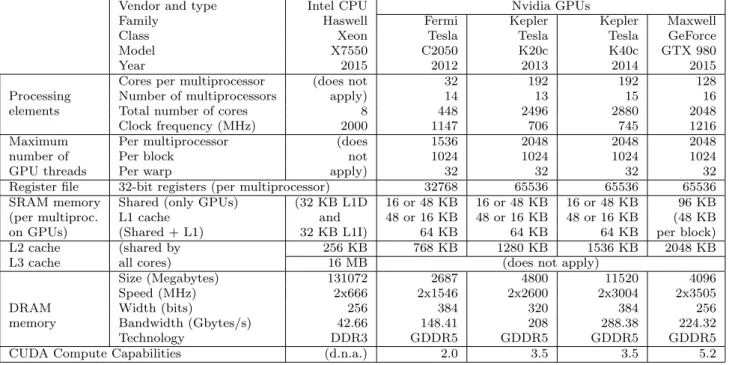
Table 2 Hardware resources and experimental setup used during our executions.
Vendor and type Intel CPU Nvidia GPUs
Family Haswell Fermi Kepler Kepler Maxwell
Class Xeon Tesla Tesla Tesla GeForce
Model X7550 C2050 K20c K40c GTX 980
Year 2015 2012 2013 2014 2015
Cores per multiprocessor (does not 32 192 192 128
Processing Number of multiprocessors apply) 14 13 15 16
elements Total number of cores 8 448 2496 2880 2048
Clock frequency (MHz) 2000 1147 706 745 1216
Maximum Per multiprocessor (does 1536 2048 2048 2048
number of Per block not 1024 1024 1024 1024
GPU threads Per warp apply) 32 32 32 32
Register file 32-bit registers (per multiprocessor) 32768 65536 65536 65536 SRAM memory Shared (only GPUs) (32 KB L1D 16 or 48 KB 16 or 48 KB 16 or 48 KB 96 KB (per multiproc. L1 cache and 48 or 16 KB 48 or 16 KB 48 or 16 KB (48 KB
on GPUs) (Shared + L1) 32 KB L1I) 64 KB 64 KB 64 KB per block)
L2 cache (shared by 256 KB 768 KB 1280 KB 1536 KB 2048 KB
L3 cache all cores) 16 MB (does not apply)
Size (Megabytes) 131072 2687 4800 11520 4096
Speed (MHz) 2x666 2x1546 2x2600 2x3004 2x3505
DRAM Width (bits) 256 384 320 384 256
memory Bandwidth (Gbytes/s) 42.66 148.41 208 288.38 224.32
Technology DDR3 GDDR5 GDDR5 GDDR5 GDDR5
CUDA Compute Capabilities (d.n.a.) 2.0 3.5 3.5 5.2
approach is only supported by the Nvidia Kepler ar-chitecture GPU. This is also done by using NVML, which reports the GPU power usage at real-time. We usenvmlDeviceGetPowerUsagecommand to obtain po-wer usage.
4 Experimental setup 4.1 Hardware environment
For this experimental study, we used the following plat-forms:
– On the CPU side: Four Intel Xeon X7550 pro-cessors running at 2 GHz and plugged into a quad-channel motherboard endowed with 128 Gigabytes of DDR3 memory.
– On the GPU side:Four GPUs, starting with an-Tesla C2050 (Fermi generation, approximately 4 years old) and ending with a brand new GeForce GTX 980 (Maxwell generation), with two Kepler models in between (K20 and K40), all sharing the moth-erboard space with PCI-e 3.0 slots to communicate with the CPUs.
Table 2 gives a detailed descriptions of all these plat-forms. We use gcc 4.8.2 with the -O3 flag to compile on the CPU, and the CUDA compiler/driver/runtime ver-sion 6.5 to compile and run on the GPU.
Table 3 Description of benchmark instances from TSPLIB library (EUC 2D stands for 2D euclidean distance).
Name Cities Type Best tour length
d198 198 EUC 2D 15780 a280 280 EUC 2D 2579 lin318 318 EUC 2D 42029 pcb442 442 EUC 2D 50778 rat783 783 EUC 2D 8806 pr1002 1002 EUC 2D 259045 4.2 Benchmarking
We test our designs using a set of benchmark instances from the well-known TSPLIB library [38] [2]. All bench-mark instances are defined on a complete graph, and all distances are defined as integer numbers. Table 3 shows a list of all targeted benchmark instances with informa-tion on the number of cities, the type of distance and the length of optimal tours.
ACO parameters such as the number of ants (m), and those values to set up their behaviour, likeα,β,ρ, and so on, are set according to the values recommended in [19]. In particular, m = n (being n the number of cities),α= 1,β = 2 andρ= 0.5. 1 2 3 4 5 6 7 8 9 10 11 12 13 14 15 16 17 18 19 20 21 22 23 24 25 26 27 28 29 30 31 32 33 34 35 36 37 38 39 40 41 42 43 44 45 46 47 48 49 50 51 52 53 54 55 56 57 58 59 60
Fig. 2 Execution times in seconds on different Nvidia GPU generations for several TSP instances. Although we have used a Tesla s2050 in our experiments, the figure only shows the performance of a single GPU of the S2050 server (i.e. Tesla C2050).
5 Experimental results
Given the fact that our techniques establish the ex-perimental setup dynamically, results shown below are platform dependent.
5.1 Performance and workload balance
Figure 2 shows performance differences across different GPU generations when they run several TSP instances. Results are recorded for 1000 iterations, and averaged over 10 different runs. The fastest GPU belongs to the latest generation (Maxwell-based GeForce GTX 980), outperforming the slowest GPU by up to a 4.2x factor. This slowest GPU is the Tesla C2050, which determines thetime-budgetfor the entire execution. Tesla K20c, the Kepler model, obtains intermediate results, with up to 1.6x gain versus the Tesla C2050.
Results are measured statically for the sake of show-ing performance differences in a real scenario. How-ever, as described, our methodology includes awarm-up stage to calculate these differences at run-time. In pre-vious work [7], more details about performance analysis are given; in particular, we reported up to 20x speed-up factor on average for a Tesla C2050 versus a single-threaded CPU.
We now enhance our parallelization strategy to take advantage of the time that Kepler and Maxwell GPUs are idle, in order to improve the quality of the results.
One idea, which we callDeep Search, is to increase the
number of iterationsin order to perform a deeper search within the same time budget. For instance, GeForce GTX 980 carries out 4102 iterations, Tesla K40 car-ries out 1946 iterations, Tesla K20c carcar-ries out 1654 iterations, and Tesla C2050 just 1000 iterations (the time-budget established for this simulation).
Another possibility is to include a restart to avoid being trapped in a local minimum. That is possible if and only if the performance gap is at least twice the slowest GPU performance. These two goals can be merged to create a hybrid approach which we call Deep Search + Restart. Driven by this combina-tion, GeForce GTX 980 may perform up to four restarts of 1000 iterations each (as its percent value is 0.24 on pr1002 TSP instance), whereas Tesla K40 and Tesla K20c only perform a single phase with a deeper search involving 1946 and 1657 iterations, respectively (0.51 and 0.60 percent values are not enough to complete two restarts).
Figure 3 shows a tour quality comparison across the sequential run and all parallel strategies for a variety of benchmarks normalized by the optimal solution. The first bar represents the sequential code, written in ANSI C, provided by Stuzle in [19]. This code runs for 1000 ACO iterations on a single-threaded CPU. The second bar is the result quality for our GPU version over 1000 ACO iterations. Figures show that the quality of so-lutions obtained for these two versions are relatively similar to each other.
1 2 3 4 5 6 7 8 9 10 11 12 13 14 15 16 17 18 19 20 21 22 23 24 25 26 27 28 29 30 31 32 33 34 35 36 37 38 39 40 41 42 43 44 45 46 47 48 49 50 51 52 53 54 55 56 57 58 59 60
Fig. 3 Quality of the results obtained for different TSP Lib instances, normalized to the optimal solution.
The third bar shows our GPU Deep Search strategy, and the fourth bar represents Deep Search + Restart. These two last versions improve results by significant margin within the same time-budget, with a small ad-vantage for Deep Search on average. Note that Deep Search performs restarts implicitly, as different searches are executed on different GPUs, whereas Deep Search + Restarts includes restarts explicitly on the same GPU.
5.2 Power consumption
Figure 4 shows the power budget for our simulation un-der different clock settings. Performance gains reflect up to 1.3x speed-up factor, in line with the 31% increment in the clock rate (frequency raises from 666 MHz to 875 MHz).
Figure 5 outlines power consumption in milliwatts for different clock rates. As expected, power consump-tion raises with higher clock frequencies.
The overall power budget is correlated to the total execution time of the application (see Figure 6.a). How-ever, the 745 MHz clock setting - which is actually set by default on Nvidia’s driver for the Tesla K40 - is the most energy efficient.
5.3 Power-aware performance metrics
Researchers have proposed metrics combining perfor-mance and power measures into a single index. The most popular in low-power circuit design is in the form of EDn [36], where E is the energy, D is the circuit delay, andnis a nonnegative integer. The power-delay product (PDP), the energy-delay product (EDP) [24] and the energy-delay-squared product (ED2P) [32] are
all special cases of EDn withn= 0,1,2, respectively.
Intuitively, EDncaptures the energy usage per oper-ation, with a lower value reflecting the fact that power is more efficiently translated into the speed of opera-tion. The parametern implies that a 1% reduction in circuit delay is worth paying an n% increase in energy usage; thus, differentnvalues represent varying degrees of emphasis on deliverable performance over power con-sumption.
Figure 6.b shows the Energy Delay Product (EDP) for our ACO simulation, and Figure 6.c the Energy Delay Square Product (triple weight on performance). These couple of metrics prioritize performance over en-ergy. Figure 4 shows that performance differences among different clock frequencies are remarkable, to benefit fastest settings.
6 Conclusions and future work
We present a parallelization strategy tailored to hete-rogeneous and massively parallel systems. Heterogene-ity may limit acceleration and waste energy unless pro-grammers develop smarter applications to wisely con-trol those features on the road towards an optimal per-formance/watt ratio. Our proposal cares about accu-racy, joules and time equally, deploying those magni-tudes on an equilateral triangle managed by a cooper-ative scheduling of jobs to attain an optimal balance among them at run-time. This makes our strategy par-ticularly useful for non-deterministic algorithms and stochastics behaviours where real-time and/or energy contraints must be fulfilled. With the user setting up those constraints properly, our method may even grant priority to any of the goals composing the metaheuris-tic.
In a preliminary stage of development, we have il-lustrated our ideas using Ant Colony Optimization as case study. Given the scalability demonstrated along 1 2 3 4 5 6 7 8 9 10 11 12 13 14 15 16 17 18 19 20 21 22 23 24 25 26 27 28 29 30 31 32 33 34 35 36 37 38 39 40 41 42 43 44 45 46 47 48 49 50 51 52 53 54 55 56 57 58 59 60
Fig. 4 Execution times in seconds on a Tesla K40 GPU for several TSP instances using different clock frequencies.
Fig. 5 Power consumption (in milliwatts) measured for the Tesla K40 GPU on different clock frequencies and TSP instances.
(a) Total energy. (b) Energy Delay Product (EDP). (c) Energy Delay Square Product.
Fig. 6 Energy consumption inJ oules/1000 (mJ) measured on different clock frequencies for the Tesla K40 GPU. Measure-ments are taken for the execution on all targeted TSP instances, and averaged over 10 launches.
our experimental study, we foresee an immense poten-tial to extend and refine our methods in future hetero-geneous systems. In particular, queries to measure en-ergies and temperatures within the GPU are weak and almost non-existing on low-power devices like Tegra he-terogeneous plaforms. Given the long way ahead for im-provement and how vendors are enthusiastically
endors-ing low-power devices, we believe the ideas presented here will greatly benefit from incoming sensors, hard-ware counters, middlehard-ware, libraries and tools, to pro-vide the research community solid pillars to face the expected growth of heterogeneous systems in a much better power-aware manner.
1 2 3 4 5 6 7 8 9 10 11 12 13 14 15 16 17 18 19 20 21 22 23 24 25 26 27 28 29 30 31 32 33 34 35 36 37 38 39 40 41 42 43 44 45 46 47 48 49 50 51 52 53 54 55 56 57 58 59 60
Acknowledgments
This work is jointly supported by the Fundaci´on S´eneca (Agencia Regional de Ciencia y Tecnolog´ıa, Regi´on de Murcia) under grants 15290/PI/2010 and 18946/JLI/13, by the Spanish MEC under grants TIN2012-31345 and TIN2013-42253-P, by the Nils Coordinated Mobility un-der grant 012-ABEL-CM-2014A, in part financed by the European Regional Development Fund (ERDF), and by the Junta de Andaluc´ıa under Project of Ex-cellence P12-TIC-1741. We also thank Nvidia for hard-ware donations within UCAM and UMA CUDA Teach-ing and Research Centers awards.
References
1. Parallel forall blog. Nvidia CUDA Zone. http://devblogs.nvidia.com/parallelforall/ increase-performance-gpu-boost-k80-autoboost/ [11 March 2015] 2. TSPLIB Webpage (2011). http://comopt.ifi.uni-heidelberg.de/software/ TSPLIB95/
3. Nvidia Corporation. NVML API Reference ([last ac-cesed 15 November 2014]).http://developer.download. Nvidia.com/assets/cuda/files/CUDADownloads/NVML/ nvml.pdf
4. Top 500 supercomputer site ([last accesed 15 November 2014]). http://www.top500.org/
5. Alba, E., Luque, G., Nesmachnow, S.: Parallel meta-heuristics: recent advances and new trends. International Transactions in Operational Research20(1), 1–48 (2013). DOI 10.1111/j.1475-3995.2012.00862.x
6. Carretero, J., Garcia-Blas, J., Singh, D.E., Isaila, F., Fahringer, T., Prodan, R., Bosilca, G., Lastovetsky, A., Symeonidou, C., Perez-Sanchez, H., et al.: Optimizations to enhance sustainability of mpi applications. In: Pro-ceedings of the 21st European MPI Users’ Group Meet-ing, p. 145. ACM (2014)
7. Cecilia, J.M., Garcia, J.M., Nisbet, A., Amos, M., Ujald´on, M.: Enhancing data parallelism for ant colony optimization on GPUs. Journal of Parallel and Dis-tributed Computing73(1), 42–51 (2013)
8. Cecilia, J.M., Garcia, J.M., Ujaldon, M., Nisbet, A., Amos, M.: Parallelization strategies for ant colony opti-misation on GPUs. In: Proceedings of the 2011 IEEE In-ternational Symposium on Parallel and Distributed Pro-cessing, pp. 339–346. IEEE (2011)
9. Cecilia, J.M., Nisbet, A., Amos, M., Garcia, J.M., Ujald´on, M.: Enhancing GPU parallelism in nature-inspired algorithms. Journal of Supercomputing 63(3), 773–789 (2013)
10. Chang, R.S..S., Chang, J.S..S., Lin, P.S..S.: An ant algo-rithm for balanced job scheduling in grids. Future Gen-eration Computer Systems 25(1), 20–27 (2009). DOI 10.1016/j.future.2008.06.004
11. Chen, Y., Miao, D., Wang, R.: A rough set approach to feature selection based on ant colony optimization. Pat-tern Recognition Letters 31(3), 226–233 (2010). DOI 10.1016/j.patrec.2009.10.013
12. De Michell, G., Gupta, R.K.: Hardware/software co-design. Proceedings of the IEEE85(3), 349–365 (1997)
13. Del´evacq, A., Delisle, P., Gravel, M., Krajecki, M.: Paral-lel ant colony optimization on graphics processing units. Journal of Parallel and Distributed Computing 73(1), 52–61 (2013). DOI 10.1016/j.jpdc.2012.01.003
14. Dorigo, M.: Optimization, learning and natural algo-rithms. Ph.D. thesis, Politecnico di Milano, Italy (1992) 15. Dorigo, M., Birattari, M., Stutzle, T.: Ant colony opti-mization. Computational Intelligence Magazine, IEEE
1(4), 28–39 (2006)
16. Dorigo, M., Di Caro, G.: Ant colony optimization: A new meta-heuristic. In: Proceedings of the 1999 Congress on Evolutionary Computation (CEC’99), pp. 1470–1477. IEEE Press (1999)
17. Dorigo, M., Maniezzo, V., Colorni, A.: Ant system: Opti-mization by a colony of cooperating agents. IEEE Trans-actions on Systems, Man and Cybernetics B26(1), 29–41 (1996)
18. Dorigo, M., Maniezzo, V., Colorni, A.: The ant system: Optimization by a colony of cooperating agents. IEEE Transactions on Systems, Man, and Cybernetics-Part B
26, 29–41 (1996)
19. Dorigo, M., Stutzle, T.: Ant Colony Optimization. Brad-ford Company (2004)
20. Dorigo, M., St¨utzle, T.: Ant colony optimization: overview and recent advances. In: Handbook of meta-heuristics, pp. 227–263. Springer (2010)
21. Garcia, M.P., Montiel, O., Castillo, O., Sep´ulveda, R., Melin, P.: Path planning for autonomous mobile robot navigation with ant colony optimization and fuzzy cost function evaluation. Applied Soft Computing9(3), 1102– 1110 (2009). DOI 10.1016/j.asoc.2009.02.014
22. Goldberg, D.E.: Genetic algorithms in search, optimiza-tion, and machine learning. Addison-Wesley Professional (1989)
23. Goldberg, D.E.: Genetic Algorithms in Search, Optimiza-tion and Machine Learning, 1st edn. Addison-Wesley Longman Publishing Co., Inc., Boston, MA, USA (1989) 24. Gonz´alez, R., Horowitz, M.: Energy dissipation in general purpose microprocessors. IEEE Journal of Solid-State Circuits31(9) (1996)
25. Johnson, David S., Mcgeoch, Lyle A.: The Traveling Salesman Problem: A Case Study in Local Optimization (1997)
26. Ke, B.R., Chen, M.C., Lin, C.L.: Block-layout design using max-min ant system for saving energy on mass rapid transit systems. IEEE Transactions on Intelligent Transportation Systems 10(2), 226–235 (2009). DOI 10.1109/TITS.2009.2018324
27. Kennedy, J., Eberhart, R.: Particle swarm optimization. In: Neural Networks, 1995. Proceedings., IEEE Interna-tional Conference on, vol. 4, pp. 1942–1948. IEEE (1995) 28. Komarudin, Wong, K.Y.: Applying ant system for solving unequal area facility layout problems. European Journal of Operational Research202(3), 730–746 (2010). DOI 10.1016/j.ejor.2009.06.016
29. Krueger, J., Donofrio, D., Shalf, J., Mohiyuddin, M., Williams, S., Oliker, L., Pfreund, F.J.: Hard-ware/software co-design for energy-efficient seismic mod-eling. In: Proceedings of 2011 International Conference for High Performance Computing, Networking, Storage and Analysis, p. 73. ACM (2011)
30. Lawler, E., Lenstra, J., Kan, A., Shmoys, D.: The trav-eling salesman problem. Wiley New York (1987) 31. Manfrin, M., Birattari, M., St¨utzle, T., Dorigo, M.:
Par-allel ant colony optimization for the traveling salesman problem. In: Ant Colony Optimization and Swarm Intel-ligence, pp. 224–234. Springer (2006) 1 2 3 4 5 6 7 8 9 10 11 12 13 14 15 16 17 18 19 20 21 22 23 24 25 26 27 28 29 30 31 32 33 34 35 36 37 38 39 40 41 42 43 44 45 46 47 48 49 50 51 52 53 54 55 56 57 58 59 60
32. Martin, A.: Towards an energy complexity of computa-tions. Information Processing Letters77, 181–187 (2001) 33. Nickolls, J., Buck, I., Garland, M., Skadron, K.: Scal-able parallel programming with cuda. Queue6(2), 40–53 (2008)
34. NVIDIA: NVIDIA CUDA C Programming Guide 6.5 (2014)
35. Pedemonte, M., Nesmachnow, S., Cancela, H.: A survey on parallel ant colony optimization. Applied Soft Com-puting 11(8), 5181–5197 (2011). DOI 10.1016/j.asoc. 2011.05.042
36. P´enzes, P., Martin, A.: Energy-delay efficiency of vlsi computations. In: Proceedings of the ACM Great Lakes Symposium on VLSI (GLSVLSI). IEEE (2002)
37. Rahman, R.: Xeon phi system software. In: Intel⃝R
Xeon Phi Coprocessor Architecture and Tools, pp. 97– 112. Springer (2013)
38. Reinelt, G.: TSPLIB— a traveling salesman problem library. ORSA Journal on Computing 3(4), 376–384 (1991)
39. Rozenberg, G., B¨ack, T., Kok, J.N.: Handbook of Natural Computing. Springer (2011)
40. Shalf, J., Quinlan, D., Janssen, C.: Rethinking hardware-software codesign for exascale systems. Computer
44(11), 22–30 (2011)
41. St¨utzle, T.: Parallelization strategies for ant colony op-timization. In: Parallel Problem Solving from Nature (PPSN V), pp. 722–731. Springer (1998)
42. St¨utzle, T.: Parallelization strategies for ant colony opti-mization. In: PPSN V: Proceedings of the 5th Interna-tional Conference on Parallel Problem Solving from Na-ture, pp. 722–731. Springer-Verlag, London, UK (1998) 43. Stutzle, T., Hoos, H.H.: MAX-MIN ant system. Future
Generation Computer Systems16(8), 889–914 (2000) 44. Wolf, W.: A decade of hardware/software codesign.
Com-puter36(4), 38–43 (2003)
45. Yu, B., Yang, Z.Z., Yao, B.: An improved ant colony opti-mization for vehicle routing problem. European Journal of Operational Research196(1), 171–176 (2009). DOI 10.1016/j.ejor.2008.02.028
46. Zhu, W., Curry, J.: Parallel ant colony for nonlinear func-tion optimizafunc-tion with graphics hardware accelerafunc-tion. In: Systems, Man and Cybernetics, 2009. SMC 2009. IEEE International Conference on, pp. 1803–1808. IEEE (2009) 1 2 3 4 5 6 7 8 9 10 11 12 13 14 15 16 17 18 19 20 21 22 23 24 25 26 27 28 29 30 31 32 33 34 35 36 37 38 39 40 41 42 43 44 45 46 47 48 49 50 51 52 53 54 55 56 57 58 59 60