DOTTORATO DI RICERCA IN COMPUTER SCIENCE
XXV CICLO - 2012
ON THE CYBER SECURITY ISSUES OF
THE INTERNET INFRASTRUCTURE
DOTTORATO DI RICERCA IN COMPUTER SCIENCE
XXV CICLO - 2012
DOMENICO VITALI
ON THE CYBER SECURITY ISSUES OF THE
INTERNET INFRASTRUCTURE
Thesis Committee International Reviewers
Prof. Luigi V. Mancini (Advisor) Prof. Panos Papadimitratos
Prof. Giancarlo Bongiovanni Prof. Kavé Salamatian
Domenico Vitali
Computer Science Department Sapienza, Università di Roma Via Salaria 113, 00198 Rome, Italy e-mail: [email protected]
The Internet network has received huge attentions by the research com-munity. At a first glance, the network optimization and scalability issues dominate the efforts of researchers and vendors. Many results have been obtained in the last decades: the Internet’s architecture is optimized to be cheap, robust and ubiquitous. In contrast, such a network has never been perfectly secure. During all its evolution, the security threats of the Inter-net persist as a transversal and endless topic.
Nowadays, the Internet network hosts a multitude of mission critical activities. The electronic voting systems and financial services are carried out through it. Governmental institutions, financial and business organi-zations depend on the performance and the security of the Internet. This role confers to the Internet network a critical characterization. At the same time, the Internet network is a vector of malicious activities, like Denial of Service attacks; many reports of attacks can be found in both academic outcomes and daily news.
In order to mitigate this wide range of issues, many research efforts have been carried out in the past decades; unfortunately, the complex ar-chitecture and the scale of the Internet make hard the evaluation and the adoption of such proposals.
In order to improve the security of the Internet, the research commu-nity can benefit from sharing real network data. Unfortunately, privacy and security concerns inhibit the release of these data: its suffices to imag-ine the big amount of private information (e.g., political preferences or religious belief) it is possible to get while reading the Internet packets ex-changed between users and web services.
dissertation which contributes to the analysis of the security issues of the Internet infrastructures and describes relevant security proposals.
In particular, the main outcomes described in this dissertation are:
• the definition of a secure routing protocol for the Internet network able to provide cryptographic guarantees againstfalse route announce-mentandinvalid pathattack;
• the definition of a new obfuscation technique that allow the research community to publicly release theirrealnetwork flows with formal guarantees of security and privacy;
• the evidence of a new kind of leakage of sensitive informations ob-tained hacking the models used by sundry Machine Learning Algo-rithms.
1 Introduction 1
1.1 Internet as critical infrastructure . . . 1
1.1.1 Research questions . . . 9
1.1.2 Contributions . . . 9
1.1.3 Thesis overview . . . 12
2 State of the Art 15 2.1 Internet Routing Security . . . 15
2.2 Denial of Service attack detection strategies . . . 17
2.3 Obfuscation strategies . . . 20
2.3.1 Defenses tailored to network flows . . . 21
2.3.2 Microdata anonymization techniques . . . 22
2.4 Leakage of Machine Learning models . . . 24
2.5 Monitored network . . . 25
3 Relieve Internet Routing security of PKI 31 3.1 BGP fundamentals . . . 31
3.1.1 Security threats and adversary model . . . 32
3.1.2 Revocation in BGP . . . 34
3.2 Cryptographic primitives . . . 35
3.2.1 Identity-based Aggregate Signature . . . 35
3.3 Protocol reBGP . . . 39
3.3.1 Security analysis . . . 44
3.4 Evaluation . . . 45
3.4.1 Space complexity . . . 45 iii
3.4.3 Convergence Time . . . 50
4 DoS detection: a case study 53 4.1 Background . . . 53
4.2 Entropy and Relative Entropy Metrics . . . 55
4.2.1 Metrics implementation . . . 57
4.3 Attack and anomaly analysis . . . 58
4.3.1 Sample events . . . 59
4.3.2 Metrics comparison . . . 67
5 Obfuscation in Network Flows 69 5.1 A novel technique:(k,j)-obfuscation defense . . . 69
5.1.1 Network flows obfuscation . . . 70
5.1.2 Adversary model . . . 72
5.1.3 Confidentiality guarantees . . . 73
5.2 Enforcing(k,j)-obfuscation . . . 78
5.2.1 Fingerprint-based IP-groups creation . . . 79
5.2.2 Enforcing fp-indistinguishability . . . 80
5.2.3 Correctness and computational complexity . . . 83
5.3 Experimental evaluation . . . 84
5.3.1 Experimental setup . . . 84
5.3.2 Impact of parameterk: IP address grouping . . . 85
5.3.3 Impact of parameterj: fp-indistinguishability . . . . 88
6 Data leakage in Machine Learning models 93 6.1 Background . . . 93
6.2 Hacking Machine Learning classifiers . . . 96
6.2.1 Artificial Neural Networks . . . 96
6.2.2 Classification and Regression Trees . . . 98
6.2.3 An attack strategy . . . 101
6.3 Case studies . . . 104
6.3.1 Hidden Markov Models . . . 105
6.4.1 K-Means . . . 120 6.4.2 Hacking models secured by Differential Privacy . . . 121
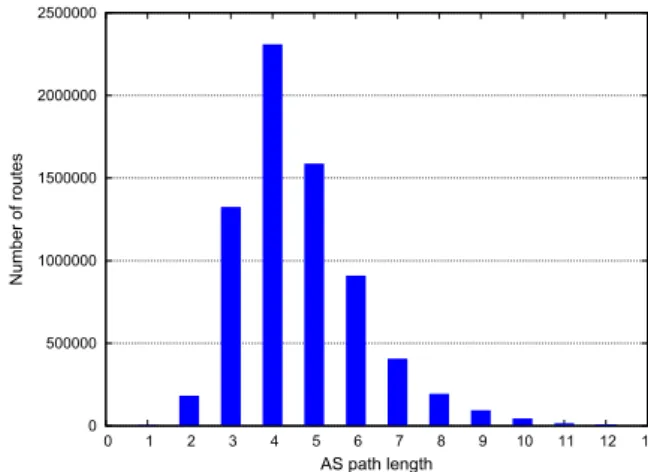
2.1 Monitored network architecture. . . 26 2.2 Export ofCISCOTM Netflow records. . . 28 3.1 BGP threats: illegal prefixes and falsified AS-path attacks. . . 33 3.2 Route revocation in BGP. . . 43 3.3 Route revocation in BGP for Multi-Homing AS. . . 43 3.4 Composition of the RIB table of therrc00RIPEncc router. . 46 3.5 Network topology used to estimate the computational
over-heads of reBGP. . . 48 3.6 Cumulative overhead of every AS in the simulated
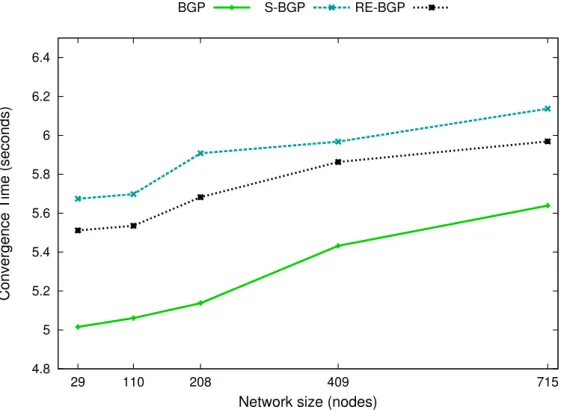
environ-ment. . . 49 3.7 Estimated convergence time of BGP, S-BGP and reBGP. . . . 51 4.1 E1— metrics comparison for a DoS attack. . . 61
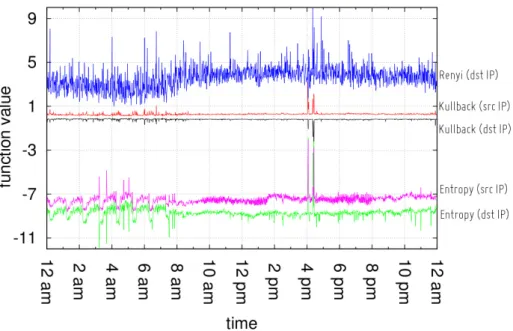
4.2 Kullback-Leibler details forE1on source and destination IP
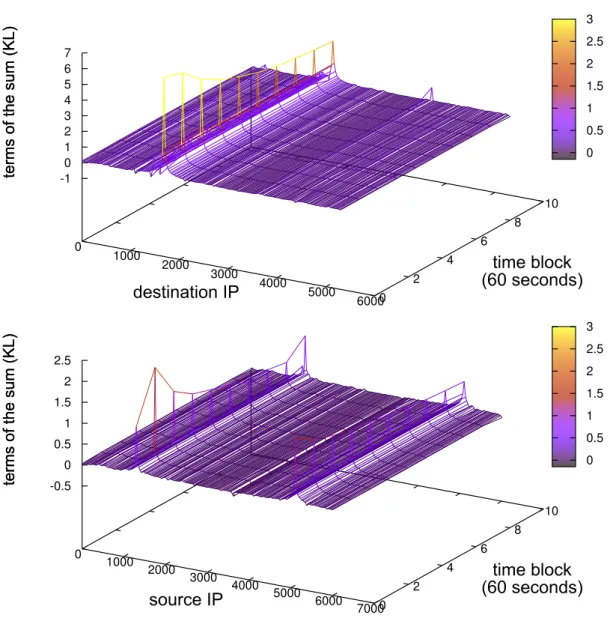
address. . . 62 4.3 E2— metrics evaluations for a DoS attack. . . 63
4.4 Kullback Leibler details forE2, on source and destination IP
address. . . 64 4.5 E3— metrics evaluations for a Distributed DoS attack. . . . 66
4.6 Kullback Leibler details forE3on source and destination IP
address. . . 67 4.7 E4— metrics evaluations for maintenance jobs. . . 68
5.1 Overview of the(k,j)-obfuscation method. . . 77 5.2 Entropy of source IP addresses distribution during one hour. 86
hour. . . 86 5.4 Entropy of source IP addresses distribution during 8 days. . 87 5.5 Entropy of destination IP addresses distribution during 8
days. . . 87 5.6 Suppressed flows (k =10). . . 89 5.7 Adversary’s confidence based on different attacks (k=10). . 90 5.8 Average error rate for aggregate queries on obfuscated
Net-flows (k=10). . . 91 5.9 Average error rate for aggregate queries on obfuscated
Net-flows (k=10). . . 92
6.1 Decision tree model obtained usingWekaFramework,C4.5 algorithm and Iris plantsdataset. . . 100 6.2 Attack methodology. . . 102 6.3 An example of Hidden Markov Model with three states.. . . 106 6.4 Speech recognition attack: frequency of the values ofσ2for
all phonemes in the training data of the meta-classifier. . . . 112 6.5 Support Vector Classifier: graphical interpretation and
func-tional margin for a 2 class separable dataset. . . 116 6.6 K-Means: Centroids of the Internet Traffic Classifierwithout
Differential Privacy. . . 122 6.7 K-Means: Centroids of the Internet Traffic Classifier with
2.1 Monitored network: bandwidth and traffic characterization (input/output). . . 27 3.1 Memory requirement comparison among S-BGP and reBGP. 47 4.1 Malicious events and Denial of Service metrics behavior. . . 60 4.2 E1- traffic statistics. . . 60
4.3 E2- Traffic statistics. . . 63
4.4 E3- Traffic statistics. . . 65
5.1 Summary of the notation used for the (k,j)-obfuscation al-gorithm. . . 72 6.1 The weights of the hidden states of the HMM . . . 98 6.2 Speech recognition attack: the confusion matrix of the
meta-classifier. . . 111 6.3 Speech recognition attack: the confusion matrix of the
fil-teredmeta-classifier. . . 113 6.4 Internet traffic classifier attack: the confusion matrix of the
meta-classifier. . . 118
Introduction
1.1
Internet as critical infrastructure
Over the last decades, the Internet has grown to become a pivot of our society. Thanks to the huge number of "connected" users, Internet is a useful and easy vector able to offer services globally. Internet represents a large media where communications and information pass through and reach the entire world. With the large spread of the mobile devices (e.g., smarthphone, tablets and others), Internet assumes a key role in the com-munication pattern; the ability of stay connected every-where every-when cannot be satisfied without the technological support of such a network.
This aspect gives Internet a primary role in our community. Nowa-days, Internet is the mean for providing a multitude of critical services: example of this is the banking services where users perform economi-cal transactions just clicking on a web page, hedge fund systems or the electronic voting systems which enable the users to express their political preferences. At the same time, Governmental Institutions, financial and business organizations strictly depend on the performance and security of Internet. This aspect in conjunction with the economical and social rel-evance of the above mentioned services, confers to the Internet a critical characterization.
Internet can be seen as a graph where the nodes are the Autonomous 1
Systems(in this thesis referred as AS) and an edge represents the connec-tion between two AS nodes. The Autonomous Systems are uniquely iden-tified by a the AS number and are organized in a hierarchical (multi-tier) fashion. Each AS node manages a collection of connected Internet Protocol (IP)network prefixes. The network prefixes as well as the AS numbers are allocated by a Regional Internet Registry (RIR). Globally, Internet numbers are managed by the Internet Assigned Numbers Authority (IANA), an or-ganization operated by the Internet Corporation for Assigned Names and Numbers (ICANN).
Today, Internet is composed by∼400.000 IP prefixes managed by about 40.000 AS nodes. Each AS exchanges raw data (traffic packets) and rout-ing information with other AS nodes. The routrout-ing information are all the data needed by the routers to make the right decisions on how to forward the packets. The connection between Autonomous Systems is named Peer-ing Agreement: a voluntary interconnection among AS nodes for the pur-pose of exchanging traffic between the customers of their network pre-fixes. This interconnections are usually driven by political and economic agreements. A Peering agreement may occur inside an Internet eXchange Point (IXP), namely the physical infrastructure through which Autono-mous Systems exchange Internet traffic between their networks. In the In-ternet architecture, an IXP introduces two benefits: i) it reduces the traffic of a network which must be delivered via upstream providers decreasing the cost of their service, ii) improves routing efficiency and fault-tolerance of the Internet.
The security of the Internet infrastructure is constantly threatened by cyber attacks. In fact, in the last years, new viruses and cyber weapons have been introduced to violate the national infrastructure.Stuxnet, [148], andFlame, [78], are examples of such cyber attacks.
One of the well known cyber attacks to the Internet infrastructure is the Youtube hijack, reported byRipe NCC in [127], [105] and by the BBC in [6]. On Sunday, 24 February 2008, the Pakistan Telecom (uniquely iden-tified by the AS number AS17557) started the announcement of a sub-prefix of the Youtube’s networks. Youtube’s upstream provider by just
forwarded the announcement without verifying its validity, which caused a global-scale hijacking of traffic related to YouTube into the Pakistan Tele-com autonomous system. Although this event happened in a short time interval, the YouTube’s networks returned to be available after about two hours. In the same fashion, in 2010, one of the Data Centers operated by China Telecom announced about 37,000 unique network prefixes as re-ported in [46]: for a period of 18 minutes the China Telecom Hijacked 15% of the world’s Web traffic to servers in China. Further details can be found in [8] and [5]. The report in [46] claims that the incident affected the traffic to and from U.S. government and military web domains (.gov and .mil), including those of the US Senate, the US Army, the US navy, the US Marine Corps, the US Air Force.
Many other examples of cyber attacks can be found in the history of the Internet. In front of this kind of events the research community is discussing the feasibility of making Internet more secure.
These examples show that the security of the services reachable through the Internet is based on the security of the Internet infrastructures.
Most of the security issues of the Internet infrastructure are related to the Internet routing protocol, namely the Border Gateway Protocol (BGP) defined in the RFC 4271, [126]. BGP is a path vector protocol that allows the Internet routers to exchange routing informations; currently, the Inter-net routing implements the version 4 of the protocol [125], proposed in 1995. The lack of security mechanisms exposes the BGP protocol to a wide range of threats that are constantly undermining security of the Internet.
The security of the BGP protocol has become a critical goal of the In-ternet management community, since every (erroneous or malicious) mis-configuration of a participating router can lead to severe attacks, e.g. the network disruptions or traffic hijacking [98, 3]. As BGP has been designed with no security features, there are many examples of how easily BGP al-terations had a negative impact on the normal Internet traffic such as the China hijack described above. BGP vulnerabilities are due to the lack of a scalable means to verify the authenticity and legitimacy of BGP control traffic. The lacks of security in the BGP protocol has been highlighted
early after its widespread deployment, since no cryptographic authenti-cation of the communiauthenti-cations is considered. Announced routes are not verified but rather directly propagated. The lack of security mechanisms leads to forged route announcement propagation, which is probably the major weakness of the BGP protocol.
The security concerns of the Internet network are largely transposed into the research communities. In the last decade, a huge amount of papers and surveys have been written, [143, 19, 73, 154, 16, 67, 149, 147, 110, 154]. A number of cryptographic solutions to prevent BGP attacks have been proposed, [73, 147, 110], but they have not been adopted due to involved operations and considerable overheads. Many studies on the adoption of these solutions have been also provided [74, 138].
The earliest solution to BGP security (i.e., S-BGP [73]) involves digi-tal signature schemes, where AS nodes sign their announcements that can later be verified by other peers. However, digital signatures require a Pub-lic Key Infrastructure (PKI) to issue and deliver pubPub-lic key certificates. S-BGP has fostered a number of research efforts to secure S-BGP [15, 73, 154]. Nevertheless, involved operations, complex trust relations and the diffi-culty to set up and manage a global PKI hinder the real-world deployment of any security means designed for BGP.
Furthermore, it seems that no secure version of BGP has efficiently ad-dressed the problem of bothrouteandprefixrevocation. With current PKI-based solutions, once an AS has been authorized to forward an IP prefix, there is no means to securely revoke the authorization. In particular, it is possible to revoke the AS certificate so that all its announcements become invalid. However, no proposal provides fine-grained revocation of single announcements.
Observation 1 The Internet cyber security depends on the security of the under-lying routing protocol. The Border Gateway Protocol, namely the state of the art of the Internet Routing Protocol, does not provide suitable security guarantees.
challenge, at the same time, the Internet scale makes it hard to apply solu-tions, evaluates algorithms and proposals.
In order to evaluate the application of new Internet protocols, the re-search communities can get benefit by the sharing of real network data collected by the nodes of the network. In fact, each AS node of Internet maintains a limited and isolated point of view of the entire network. It seems that the amount of data that cross these nodes does not suffice to build a complete and coherent view of the entire Internet Infrastructure. It sounds like the old Indian story of John Godfrey Saxe titled “The blind men and an elephant”, [130].
Examples of real data to be shared include network traffic, routing ta-bles and network topology as also stated in [21]. In details, the authors of [21] provide a model for evaluating the adaptability of a secure BGP routing protocol by an ISP point of view; the model uses the exchanged traffic and the Internet topology (in terms of weighted AS-level graph) as parameter to define theAdaptability valueof a secure BGP protocol.
Furthermore, real network data are a very valuable resource for re-searchers; for instance, to model the network behavior, to experiment new protocols, and to study many cyber security attacks.
Observation 2 The sharing of real network data provides a great benefit for the study and the evaluation of new network research proposals.
Unfortunately, getting accurate details on real AS traffic is impractical since this kind of data are usually confidential, or may contain private in-formations: security and privacy concerns discourage the publication of such data sets. Mainly, the concerns related with the release of real net-work data are two: by point of view of the data owner, shared information may reveal sensitive details exploitable by malicious users; on the other hand, there exist legal questions about the users privacy.
Consider a real data set ofnetwork flowsof Internet traffic, namely the list of connections exchanged between two AS nodes. Based on network flows about the Web sites visited by a given individual, an adversary may infer sensitive data, such as political preferences, religious belief, health
status, and more. At the same time, network flows may reveal personal communications among specific individuals, such as the existence of email exchanges, and chat sessions among them. Moreover, network flows can be exploited by adversaries to gather useful informations in planning net-work attacks, for instance, for identifying possible bottlenecks in the target network in order to increase the impact of Denial of Service attacks.
As a consequence, various research efforts have been carried on to pro-tect privacy of real network data while preserving the practical interest in using the released network flows. Early techniques were based on the sub-stitution of the real IP addresses with pseudo-IDs, for instance in Crypto-PAn[52]. However, it has been shown that this technique is insufficient, since an adversary may reconstruct the real IPs based on the values of other fields of the flows [76], exploiting his knowledge of the characteris-tics of network hosts (fingerprintingattacks), or by injecting peculiar flows in the monitored network (injectionattacks). For this reason, more sophis-ticated techniques have been proposed, based on the perturbation of other data in the flows, e.g., [14, 115, 134, 54]. However, it seems that the tech-niques proposed do not provide any formal guarantee of protections, and it has been recently shown that they are prone to different kinds of at-tacks [18].
In addition consider the topology of Internet, namely the physical and logical interconnection between AS nodes (usually named “peering agree-ments”). These agreements are usually driven by political and economic agreements, hence, they are confidentials and reserved since them can be maliciously exploited by a competitors.
Furthermore, the sharing of real network data can also bring benefits to other research fields. The Denial of Service attack detection is another relevant research field which can get benefit of the sharing of real net-work data. The Denial of Service attacks is one of the most effective ma-licious activities achievable in a network. In the last years, thousand of Distributed Denial of Service attacks (DDoS) have been registered against Governmental Institutions and companies [84, 124]. The insight behind these attacks is quite simple: the high number of connections, or high
rate of session-work required by the adversary, fill the resources (e.g stor-age, bandwidth or CPU) of the targeted appliance. Automatic tools, freely available in the Internet, help attacker in performing these malicious ac-tions. Such easy-to-use interface makes these activities exploitable by all Internet users: political activists (aka “hacktivists”), individuals or groups of interest keep increasing the use of these tools to express their own dis-agreement against private companies or political initiative (i.e., websites of Public Administrations, mail servers etc.). The Cisco security annual report, [28], documents this.
Many network administration tools, such as DoS detection algorithms and Traffic Classifiers, can be improved if companies, Institutions and re-searchers could share the real data with a high degree of security, privacy and precision. Even if the sharing of network data can help the research communities, it’s important to notice how the lack of such sharing can cause unexpected results.
In fact, many traffic classification engine, as well as DoS detection al-gorithms, have been proposed in the past, [99, 48, 49, 7, 106, 50, 2, 152]; each of them proposes new techniques, implements different algorithms and performs good results. Usually, the motivation for such results is twofold: i) the researcher performs algorithms evaluations using synthetic data, namely, traffic logs artificially generated or ii) the training data sets used to evaluate algorithms are not so representative. Consider the De-nial of Service Detection algorithms, the literature abounds of conflicting proposals. Many papers propose the use of sundry metrics borrowed by the Information Theory field, [85, 132, 86, 87, 129], as the best solution, at the same time, other results claim that statistical approaches work bet-ter, [150, 37, 53, 112, 136]. Equally, similar considerations can be done for Intrusion Detection Systems [22, 113, 75, 103, 26, 114].
The relevance of shared real network data is also documented by the huge amount of research and paper that survey the anonimization and privacy issues, or by the number of projects which involve the use of real data. The DARPA Intrusion Detection Data Sets1provided by the Lincoln
Laboratory, Massachusetts Institute of Technology, is a valid example of this phenomenon. The Lincoln Laboratory published dataset of real net-work data in which several attacks have been recorder. These data sets were largely used by the research community as support of Intrusion De-tection Systems.
Observation 3 The security and privacy concerns inhibit the release of real net-work data. No previous proposal of netnet-work data anonymization provides formal guarantee about security and privacy.
Note that, the real network data can be released in a direct or indirect fashion. The privacy and security concerns are not only related to the real network data directly released. For example, real network data can be “synthesized” in mathematical models, used by the Machine Learning Algorithms. Usually, the Machine Learning (ML) systems are trained to perform a variety of complex tasks. Machine Learning systems learn how to recognize patterns (training phase), make unexpected decisions, or re-act to a dynamic environment (classification phase). During the learning phase, the relationships and the correlations implied in the training sam-ples (e.g., real network data) are gathered inside themodel. Afterwards, the model is used during the classification phase to classify and evaluate new data. These trained models may leak sensitive information as discussed in chapter 6.
The models used in Machine Learning algorithms are also subject of many privacy and security attacks. In the lasts years, two techniques have been developed to mitigate these issues: the Privacy Preserving Data Mining, [142], and the Differential Privacy, [44]. The Privacy Preserving Data min-ing is a prolific research area in which many techniques able to preserve the privacy of the single records are proposed. On the other hand, in 2004, Cynthia Dwork proposed Differential Privacy, namely a technique able to maximize the accuracy of queries from statistical databases while mini-mizing the identification of its records.
The Machine Learning algorithms are largely used for many network-ing operations, [48, 49, 7, 77, 106, 17], security tasks, [116, 131, 75, 104, 103,
66, 26, 114], medical activities, [146, 97, 135, 88, 63] and more [70, 140]. The outcomes of my research focus on the issues described in this sce-nario and contribute in several aspects of the cyber security issues of the Internet Infrastructure.
1.1.1
Research questions
There are many security aspects that require a deep analysis and more efforts by researchers and vendors. In particular, this dissertation ad-dresses the following research questions:
Question 1 How can the Internet community get a secure Internet Routing pro-tocol? Can this solution be easily applicable on the Internet?
Question 2 How can a network administrator detect a Denial of Service attacks? Are the most used metrics really reliable?
Question 3 Can companies, Institutions and research communities safely share the real network data of their network while preserving the security of their net-work and the privacy of their users?
Question 4 Can companies, Institutions and research communities safely share a Machine Learning Classifier with others, without any leakage of sensitive infor-mations? For example, can Institutions and research communities safely share a DoS detection system or a Internet Traffic Classifier learned with the real network data of their network?
1.1.2
Contributions
The outcomes proposed in this dissertation, provide the following con-tributions:
Contribution 1 (Internet Routing Security [94]) Lack of security mech-anisms expose the Border Gateway Protocol (BGP) to a wide range of threats that are constantly undermining security of the Internet. Chapter 3
introduces the protocol reBGP, [94], a secure BGP protocol that leverages state of the art cryptographic primitives to mitigate prefix hijacking and in-valid path attacks as well as to manage revocation and reassignment of IP prefixes. Protocol reBGP uses Identity-Based Cryptography to eliminate the requirement of a Public Key Infrastructure and aggregated signatures to reduce the communication overhead.
In reBGP, a trusted authority (e.g., the ICANN) assigns an IP prefixes to an AS issuing a prefix endorsement that certifies the AS as the originator for that prefix. Similarly, the AS nodes sign their announcements within a route endorsement that authorize their peers to propagate their routes. This leads to a “chain of trust” that guarantees the validity of paths in the network.
Protocol reBGP enjoys constant time route verification, so that the over-head for the added security is minimal and balanced between the routers. Furthermore, reBGP introduces a mechanism for route endorsement revo-cation, allowing any AS to revoke previous endorsements, simply issuing new ones. The new endorsement becomes immediately valid and auto-matically revoke the old ones. The same approach is used by the ICANN to revoke prefix endorsements, in order to reassign an IP prefix to a new originator AS. Finally, protocol reBGP has been extensively simulated in order to validate its correctness and to evaluate the introduced overheads in terms of computations and communications.
Contribution 2 (Denial of Service Detection [43]) The Denial of Service Attacks is a malicious activity aimed to negate a service or a resource to a legitimate users; in literature, many results about this threat can be found, since it represents a macro-category of attacks achievable in many context (operating system, network, application based etc etc) and it does not re-quire an high skill by the users.
Starting from the huge data set of realnetwork data, this dissertation contributes on the topic with (i) a validation the theoretical research re-sults, namely applying the most used information theory metrics; (ii) the analysis of the proposed metrics using a lightweight dump data set (i.e.,
using the network data format provided by CISCOTM netflow protocol), and (iii) reporting the ability to perform (D)DoS detection by the analysis of “aggregated” network traffic data [43].
Furthermore, this thesis compares the different metrics and evaluate their effectiveness against several network activities (like (D)DoS attacks and nightly scheduled maintenance jobs), in terms of anomaly detection and robustness.
Contribution 3 (Obfuscation of sensitive data in network Flows [41])
Real world network traffic traces represent a gold mine for different re-search activities. Existing techniques proposed to sanitize network flows do not provide any formal guarantees and, on the other side, many anony-mization procedure does not preserve statistical and semantics property of original data set, reducing data utility.
This dissertation provides a novel obfuscation technique, named(k,j) -obfuscation, [41], for network flows that provides formal guarantees un-der realistic assumptions about the adversary’s knowledge. The(k,j) -ob-fuscation technique is supported by extensive experiments with a large set of real network flows collected at an important Italian Tier II Autonomous System, hosting sensitive government and corporate sites (section 2.5 pro-vides a detailed description of the network data sources.).
Contribution 4 (Security risk on sharing ML Classifiers [56]) The shar-ing of data between research communities is strongly significant to achieve good results. Whether we speak about Machine Learning Classifier, many countermeasures have been proposed. In this context, the results pro-posed in this dissertation provide evidence that new kinds of attack ex-ists, and that previous privacy preserving techniques do not provide any formal or practical guarantee.
A new information leakage, that it has not been considered before, is the outcomes presented in chapter 6. The contribution in this context shows that it is unsafe to release trained classifiers since valuable infor-mation about the training set can be extracted from them. Results show
a new attack strategy: a meta-classifier can be trained to extract mean-ingful data from targeted classifiers. Furthermore, chapter 6 describes several attacks against existing ML classifiers, in particular, it presents attack against an Internet traffic classifier implemented via Support Vec-tor Machines (SVMs) and a speech recognition software based on Hidden Markov Models (HMMs).
During my research, in addition to [41, 43, 56, 94], the following pub-lications have also been presented:
• D.Vitali, A. Spognardi, L.V. Mancini,Replication schemes in Unattended Sensor Networks, proceedings of the 4th IFIP International Conference on New Technologies, Mobility and Security (NTMS), February 2011, Paris, France (DOI 10.1109/NTMS.2011.5721047).
• D. Vitali, A. Spognardi, L. V. Mancini and A. Villani,MhRep: Multi-hop Replication Scheme for Data Survival in Unattended Wireless Sen-sor Networks, proceedings of the IEEE Symposium on Reliable Dis-tributed Systems Workshops (SRDSW), October 2011, Madrid, Spain (DOI 10.1109/SRDSW.2011.15).
1.1.3
Thesis overview
Chapter 2 surveys the related works of the issues debated in this dis-sertation.
Chapter 3 introducesreBGP, a new secure version of the Border Gate-way Protocol, reBGP, which provides cryptographic guarantees against in-valid pathandfalse routeannouncements attacks. Furthermore, reBGP, does not require the deployment of Public Key Infrastructure, hence, it can be easily set to secure the Internet network.
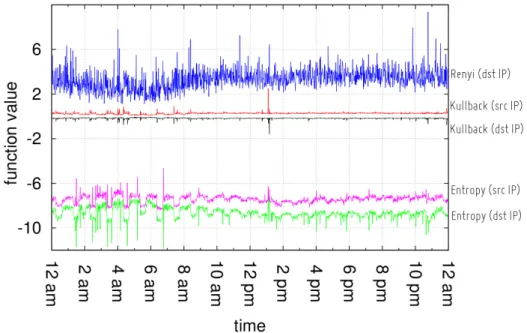
Chapter 4 investigates the effectiveness of sundry Denial of Services detection strategies based on several Information theory’s metrics using a huge andrealdataset of CISCOTMnetwork flows.
Chapter 5 presents a new obfuscation technique for network flows able to provide formal guarantees of work under realistic assumptions on the power of the adversary.
Chapter 6 introduces a new attack to the Machine Learning models aiming to extract meaningful information which cannot be protected by the previous privacy-aware techniques (e.g., privacy preserving data min-ing or differential privacy)
State of the Art
This chapter describes the state of the art of the topics addressed by this dissertation.
2.1
Internet Routing Security
This section introduces the state of the art of the proposal aimed to provide a secure Internet routing protocol.
Main security issues of the BGP protocol concern thecontrol plane, i.e., the way BGP speakers build the routes of the Internet. Attacks to the con-trol plane have direct implications on thedata plane, that is how the traffic is routed [58, 149]. This section reviews prominent works related to BGP protocol and refer the reader to [19] for a comprehensive review of the weaknesses of BGP.
Nowadays, the most debated solution to secure BGP is S-BGP, pro-posed by Kent et al. in [73]. Their protocol provides a range of security features for BGP but suffers from high management cost. In particular, S-BGP assumes the deployment of two Public Key Infrastructures (PKI) to authenticate UPDATE messages and the Internet resources (namely, AS numbers and the association between IP prefixes and AS number).
Other PKI-based proposals are soBGP, [147], and psBGP, [110]. Pro-tocol soBGP does not target AS-path authentication but only guarantees
the authenticity of announcements made by IP prefix owners. Protocol psBGP, [110], proposes to replace one of the PKIs required by S-BGP with a reputation scheme. In particular, psBGP uses a centralized PKI for au-thenticating AS numbers, and a decentralized trust model for verifying the correctness of IP prefix origination. Goldber et al., [59], provides a quan-titative comparison among the above BGP security proposals (S-BGP and soBGP) and shows their weaknesses against several attacks.
SPV, [67], leverages Merkle Hash Trees to reduce the use of a central PKI and one-time signatures to protect BGP against path forgeries. SPV is a complex protocol that requires the management and the exchange of a significant amount of state informations. Security flaws of SPV have been exposed in [123]; the same work also suggests how to fix the protocol.
Zhao et al. [158] proposes to reduce the overhead introduced by S-BGP, using aggregate signatures to sign/verify AS-paths in the UPDATEs. In [158], multiple messages are combined together to obtain a Merkle Hash Tree, so to sign only the root of the tree. However, the deployment of a PKI like the one assumed in S-BGP [73] is still required.
The authors of [15] present an aggregate signature scheme that allows for “lazy verification”. In this scheme, signers can add their signature to the signed-so-far message and delay its verification at a later time. How-ever, the scheme requires a per-singer random string that makes the sig-nature length dependent on the number of singers.
A symmetric-key based approach is proposed in [16]. The authors claim that their scheme affords UPDATE message authentication as long as at least one router on the path is honest. Message complexity is linear in the number of signer and verification cost is logarithmic in the number of singers.
The idea of using Identity-Based Cryptography to avoid PKI in secure BGP routing has been suggested by others papers (e.g., [57] and [10]) but, it seems that there is no implementation nor evaluation. Notably, the au-thors of [67] highlight the problem of revocation in Identity-Based settings, one of the issues that protocol reBGP addresses (Chapter 3). The only BGP proposal that leverages IB cryptography and has been evaluated, relies
on Trusted Platform Modules (TPM), and is presented in [90]. Its authors claim that AS-path authenticity can be guaranteed by checking only the announcements of neighboring routers, as long as cryptographic keys and routing policy management are enforced by a TPM running on each router. In other words, the authors assume that signing key are sealed in the TPM and routers cannot obtain a signature over a route that does not comply with the routing policy. As a result, the security of the schema heavily de-pends on the security of the TPM. Moreover, the authors do not discuss how TPM keys should be revoked/updated when IP prefixes are moved from one AS node to another.
2.2
Denial of Service attack detection strategies
This section overviews some results about the strategies for detection of Denial of Service cyber attacks. As shown in the following, conflicting results are the effect of the lack of the sharing ofrealnetwork data.
Detection and mitigation of (D)DoS attacks is still an open challenge [38, 34]. A systematic analysis of DDoS attacks is presented by [101], where the authors define a complete taxonomy of attacks, proposing different criteria such as Exploited Weaknesses, Degree of Automation, Exploited Weakness to Deny Service, Source Address Validity, Possibility of Char-acterization, Dynamics, Persistence of Agent Set, Victim Type or Impact on the Victim. Many results, like [53] and [112], agree upon the use of Entropy and Relative Entropy (information divergence) as effective metrics for anomaly detection (an introduction to those metrics will follow in Sec-tion 4.2). In [53], the authors analyze several genuine network full traces, using blocks of 1000 consecutive packets to compute entropy and frequency-sorted distribution of selected packet attributes. The full network traces used include the headers and the payloads of the packets. Since the net-work traces are not known to contain malicious activities, the authors overlay synthetic DDoS attacks at various degree of concentrations. An attack alarm is raised if the computed entropy value overcomes a
thresh-old, pre-determined from empirical analysis.
Authors in [112], show that the use of entropy of the IP addresses distri-bution using fixed-dimension blocks of packets can be very time consum-ing even for small organizations and imposes a CPU-burnconsum-ing process for big bandwidth network edge. Moreover, they introduce a dynamic defini-tion of alarm threshold in order to mitigate entropy fluctuadefini-tions, based on its standard deviation. Others works, like [107] and [129], improve attack detection using other information theory metrics, like cumulative entropy. Other entropy based metrics are based on the concepts of information di-vergence, such as Rényi, [86], and Kullback-Leibler divergence, [85]. Their main advantages are the ability to improve the anomaly detection, provid-ing at the same time earlier responses and low false positive rate [150]. The previous entropy based approaches, indeed, experience many false posi-tives in case of fluctuations of traffic pattern. Section 4.3 of this dissertation addresses these aspects.
Common issues of related works is the consistency and the nature of used data sets. Almost all the papers refer to datasets that are histori-cally consolidated (like the DARPA dataset) or that have been collected from restricted and unrepresentative traffic, [53, 80]. DARPA dataset has been created by the Information Systems Technology Group (IST) of MIT Lincoln Laboratory, under Defense Advanced Research Projects Agency (DARPA) and Air Force Research Laboratory (AFRL/SNHS) sponsorship. The purpose of this dataset is to collect and distribute the first standard corpora for evaluation of computer network Intrusion Detection Systems (IDS), [38, 39]. Although its nature, MIT datasets have been used by searchers to evaluate malicious activities, like DoS or DDoS in sundry re-searches, [85, 112, 107, 129]. The DARPA data sets are organized based on the DDoS attacking software leading that these attacks have the simplic-ity of structure and type in spite of the complexsimplic-ity of the real data. As stated in [68], the methodology used to generate the data by MIT Lincoln Laboratory and the nature of data itself are not appropriate for simulat-ing different, non academic, network environments. So the experimental results of many works suffer of the above limitation. In general, many
pro-posed works use synthetic traffic in combination with attack-free network traces, like [86] and [150]. Such a methodology can limit the validity of the research results and lack of generality. In fact, malicious activities ar-tificially injected can miss relevant features that real activities exhibit: this lacking may produce unrealistic behavior and, in the worst case, unreal or unexpected results. The work in [150] is an example of such limitation: in order to enrich the simulations dataset, authors generate synthetic traffic and attack traffic using, respectively, Gaussian and Poisson distributions.
Furthermore, the use of DARPA-2000 or other similar traces impose a huge computation effort and technical limit. In fact, these dataset includes tcpdumplogs (TCP headerand payload) and so require a non-negligible ef-fort by network equipments and large computations efef-forts.
An alternative to full packet traces areCISCOTMNetflow, [139]. In fact, CISCOTM Netflow provides a lightweight picture of the network since it does not include the payload informations. One recent study that uses CISCOTM Netflow technology to perform DDoS detection is [132], that proposes a multi-layer approach that combines several steps on sampled netflows. Again, in [132], synthetic attacks were introduced in the real traffic gathered from a tier I ISP, in order to simulate DDoS attack.
Today, huge and real data sets are needed to analyze the emergent types of coordinated and DDoS attacks, made by volunteer users, as oppo-site to the early crackers with bad intention. A recent analysis of high tech cyber threats to national critical infrastructures, [27], introduces the con-cept of “hacktivism”, to emphasize the new user role. The authors report some real cases where citizens were involved to disrupt national infras-tructures, “carrying out politically-motivated hacking and bringing down Government agencies’ website”. The recent Operation Paybackis actually a proof of this statement. Again, in the case of historically consolidated datasets [112], it is easy to notice that they are too old to represent recent (D)DoS attack under the hacktivists or zombies.
Instead, the analysis and results presented in Section 4.3.1, are based on completelyrealnetwork data with theknownofrealtraffic anomalies.
2.3
Obfuscation strategies
This section provides an overview on the obfuscation strategies pre-viously presented in literature. Furthermore, this section presents the at-tacks that can be performed on anonymized network data sets.
Early techniques for network flows obfuscation were based on the en-cryption of source and destination IP addresses. However, those tech-niques proved to be ineffective, since an adversary might be able to re-identify message source and destination by other values in a network flow, or in a sequence of flows (see, e.g., [14, 153, 13, 32]).
King et al. in [76] proposes an extensive taxonomy of attacks against network flow sanitization methods; techniques fall into two main cate-gories:
• Fingerprinting:re-identification is performed by matching flows fields’ values to the characteristics of the target environment (such as knowl-edge of network topology and its settings, types of OS and services of target hosts, etc). Typical re-identifying values for network flows are: Type of Service (tos), TCP Flags, timestamps, number of bytes, and number of packets per flow.
• Injection:the adversary injects a sequence of flows in the network to be logged, that are easily recognized due to their specific characteris-tics; e.g., marked with uncommon TCP flags, or following particular patterns. In order to perform this attack, the adversary must know in advance in which network the flows will be collected, and during which time period.
Additional techniques can be used to exploit the results of the above attacks to decrypt IP addresses of new network flows. In particular, if the IP address encryption is performed with the same key across the whole set of flows (as in most existing defense techniques), and the adversary discovers an IP mapping in one flow, he can decrypt the same IP address in any other flow.
2.3.1
Defenses tailored to network flows
Several efforts have been devoted to the implementation of frameworks (e.g., [134]) or configurable tools (e.g., [54]) through which the network ad-ministrator can define ad-hoc and per-field obfuscation policies.
Roughly speaking, defenses that can be found in the literature (e.g., [14, 115] among many others) take a “reactionary” approach: typically, in those works, a new kind of attack is identified, and a defense technique is pro-posed for that attack, which is generally based on the permutation or gen-eralization of some fields’ values. However, proposed techniques do not provide a general solution. Indeed, as theoretically proved by Brekne and Årnes in [13], and empirically shown by Burkhart et al. in [18], those tech-niques can be easily defeated by the injection of flows following complex patterns over sufficiently long periods of time.
As a case study, it can be considered the well-known Crypto-PAn [52] technique, which is currently incorporated within several network flow collector tools. Crypto-PAn is a sanitization tool for network flows that encrypts IP addresses in a prefix-preserving manner. Crypto-PAn has the following properties: (a) it performs a one-to-one mapping from original IP addresses to anonymized IP addresses, based on AES encryption; (b) IP address encryption is prefix-preserving; and (c) it isconsistent across the whole set of released traces.
A malicious user, which acts inside the monitored network, can inject bogus and easily detectable flows (i.e., marked with uncommon TCP Flags that match distinguishing statistical or behavioral patterns) in order to un-derstand how one IP address is mapped to its encrypted value inside the obfuscated flow set.
The defense technique described in section 5.1 adopts cryptographic primitives to hide real IP addresses (Pseudo Random Number Generator), and obfuscation of flow fields’ values. However, differently from previous works, it provides strong confidentiality protection even when the adver-sary can reconstruct the mapping between an IP address and its encrypted value, possibly as a result of injection attacks.
2.3.2
Microdata anonymization techniques
Techniques proposed in the database area for microdata anonymiza-tion have the advantage of providing formal privacy guarantees, under specific assumptions. Hence, it is natural to investigate the application of these techniques to network flows. At first glance, network flow logs seem very similar in nature to any other record sets stored in a relational database (census data, medical records, etc.). However, as explained be-low, those techniques are unfeasible to network flows, due to the peculiar characteristics of these data.
The simplest microdata anonymity principle isk-anonymity [128], which consists in making any record indistinguishable in a group of at least k records based onQuasi Identifier (QI)values; i.e., values that, joined with external information, may reduce the candidate set of record respondents. Any group of records having the same values for QI attributes is called aQI-group. The main criticism found in the literature about the applica-tion of this principle to network flow logs (see, e.g., [31]) regards loss of information: indeed, since many fields of network flows may act as QI, data quality would be degraded to an unacceptable extent. The same ar-gument holds for more sophisticated privacy principles that guarantee not only anonymity but also sensitive value diversity, such asl-diversity [95] andt-closeness [89].
However, it can be observed that the above mentioned principles are not even applicable to the anonymization of network flows. Indeed, if the private value of each individual does not change in released microdata (this is the case of network flow logs, if IP address encryption is consistent across the whole set of flows), works in [128, 95, 89] are effective only under the assumption that each individual is the respondent of at most one record in the released microdata. Indeed, if the adversary knows that the same individual (in this case the IP addressI) is the respondent of one tuple in more than one QI-group, an adversary may be able to derive the confidential information (the encryption of I) by simply intersecting the private values of tuples in those QI-groups.
Since the same IP address typically appears in multiple network flows, an appropriate privacy principle to be considered is m-invariance [151], which has been proposed to enforce both anonymity and diversity for incremental release of microdata. This principle ensures that (i) all the QI-groups in which an individual’s records appear have the same set of private values, and(ii)each QI-group does not contain records having the same private value. However, the application ofm-invariance to network flow logs is unfeasible, since the cardinality of IP addresses is very large; this would result in a very coarse generalization of QI-values, and in the introduction of a large number of counterfeit flows to enforce property(i). In order to overcome the above problems, the (k,j)-obfuscation tech-nique introduced in section 5.1, adopt a many-to-one mapping among IP addresses and encrypted values; this mapping is consistent across the whole set of network flows.
In general, the fact that two specific hosts A and B exchanged some messages may be considered confidential information. Hence, since an IP address uniquely identifies its host, the(k,j)-obfuscation technique as-sumes that confidential information in a network flow is the set of at-tributes {src_addr, dst_addr}. Indeed, if removing those fields from net-work logs, no confidentiality violation could reasonably be perpetrated. Unfortunately, removal of IP addresses from logs would completely dis-rupt the utility of the data. Note that, from the point of view of privacy preservation, it is not relevant distinguishing between source and desti-nation IP, since in many cases a flow from A to B (request) implies the existence of a flow from B to A (response). When joined with external information, fields in the network flow other than IP addresses may re-strict the candidate set of source and/or destination hosts. For instance, as shown in [153], based on network flow data such as packet and byte counts, it is possible to identify the Web server originating the request.
Observation 4 A network flow is obfuscated if it cannot be associated with high confidence to its source and destination IP addresses.
2.4
Leakage of Machine Learning models
This section describes the security and privacy concerns related to the realdata indirectly released. In fact, as introduced in section 1.1, security and privacy concerns are not only related to raw network data, but may affects mathematical models used in Machine Learning algorithms.
In the past, many results on this topic have been published. Although the scope of the results reported in section 6 is strictly related to informa-tion leakages issues, this secinforma-tion briefly describes also relevant results in terms of privacy concerns, i.e., Privacy Preserving Data Mining (PPDM), [142] and Differential Privacy, [44]. It is worth describing some of these related results, even though this thesis considers a the type of leakage which has not been considered before.
As formalized by Dwork in [44],differential privacy deals with the gen-eral problem of privacy preserving analysis of data. More formally,a ran-domized mechanism M providese−differential privacy if, for a database D1 and
D2, which differ by at most one element, and for any t:
Pr[M(D1) =t]
Pr[M(D2) =t]
≤ee
In the differential privacy model, a trusted server holds a database with sensitive information. Answers to queries are perturbed by the addition of random noise generated according to a random distribution (usually a Laplace distribution). Two settings are defined: non interactive, where the trusted server computes and publishes statistics on the original data, andinteractive, where the server sits in the middle and directly alters the answers to user queries to guarantee specific privacy properties.
Chaudhuri et al. [24] design a privacy preserving logistic regression al-gorithm which works in thee−differential privacy model [45]. The idea
is quite simple: the result of the trained classifier is perturbed with a dy-namic amount of noise. This approach does not consider the security is-sues due to the exposure of the model generated during the learning phase of the linear regression algorithm.
Other machine learning algorithms, such as Decision Trees, Artificial Neu-ral Networks, Clustering, have been re-engineered to provide differential privacy and several of them are defined within the SulQ framework [9].
Privacy Preserving Data Mining, [1], is a research area aimed at devel-oping techniques that perform data mining primitives while protecting the privacy of individual data records. In [142], Verykios et al. classi-fied PPDM techniques in five classes. Among them, the Privacy preserva-tion class refers to techniques used to preserve privacy forselective mod-ifications of data records. This can be achieved through heuristic val-ues (e.g., selecting the valval-ues that minimize the utility loss of the data), cryptographic protocols (e.g., via Secure Multiparty Computation [93]), or reconstruction-based techniques (e.g., strategy aimed at reconstructing the original data distribution using randomized data).
2.5
Monitored network
The research activities I worked on were funded by the European pro-ject ExtrABIRE, [30]. The obpro-jective of the propro-ject as to evaluate the overall resiliency of the Internet infrastructure of a Member State and, more generally, to assess the impacts of a coordinated cyber-attack on its Internet infrastructure.The final aim of the Project is to develop a national Internet contingency plan that will include the identification of processes, procedures, organizational issues and technical countermeasures that Member States and private organizations should adopt and implement to mitigate threats to their Internet connectivity1.
One of the partners of the ExtrABIRE project is the CASPUR consor-tium (Consorzio interuniversitario per le Applicazioni di Supercalcolo Per Università e Ricerca,2). The collaboration with the CASPUR allowed me the ability of analyze a big amount ofrealdata. In fact, during these activ-ities, an important AS node of the Internet infrastructure has been moni-1With the respect of the Non-Disclosure-Agreement of theExTrABIREproject, no
de-tailed information about AS (such as AS name or number) nor ISP interconnections will be provided to preserve AS and host privacy.
tored. During this research activities, a probe of network flows collected more than 2 years of CiscoTM netflows: these data are essential for the results proposed in this dissertation.
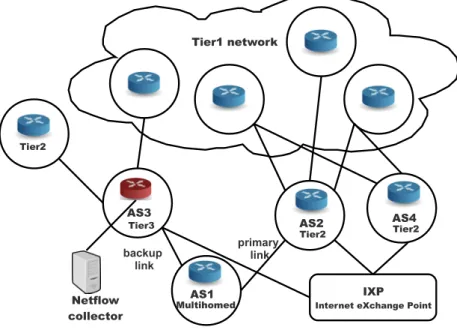
The monitored network is represented in Figure 2.1. The network probe has been installed within the AS3. The AS3 reaches the Internet through a Tier2 and a Tier1 AS node and, at the same time, it is the Upstream provider for AS1, acting as backup link. Furthermore, the AS3 provides sundry services, e.g. web hosting, mail servers and end-user X-DSL con-nections. During the collection phase, the AS1 was target of many attacks and malicious activities and these data have been used to verify the effec-tiveness of the DoS detection metrics (chapter 4).
IXP
Internet eXchange Point
Netflow collector AS2 AS3 AS1 Tier2 Multihomed Tier3 Tier2 Tier1 network backup link primary link Tier2 AS4
Figure 2.1: Monitored network architecture.
SinceAS3 is composed by heterogeneous networks and services, it can be considered as a good testing case for the research activity proposed in this dissertation; furthermore, it is general enough to represent many real contexts. To show the dimension of the monitored AS node, AS3, table 2.1 reports the average of the exchanged traffic. Considering that it
manages thousands of unique IP addresses and that the amount of packets is around 30Kbits/seconds, the monitored AS node can be considered of medium size for an European member state.
Time of the day Flows/s Packets/s Mbit/s
00:00AM-11:00AM 377/312 8.8K/6.4K 37/44
11:00AM-06:00PM 1.3Kb/930 21Kb/13K 113/54
06:00PM-11:59PM 764/575 14Kb/8K 80/27
Table 2.1: Monitored network: bandwidth and traffic characterization (in-put/output).
Netflows dataset
The Netflow protocol is a CiscoTM technology used for monitoring IP traffic [139]. Despite the classical packet collector (packet dump), Netflow only collects data in Layers 2-4.
Netflow efficiently monitors a network, enabling services like traffic accounting, usage-based network billing, network planning, as well as Denial of Services monitoring. Netflow records are extremely compacts and representative, avoiding to maintain the packet’s payload and making analysis and computation lighter. While several kind of attacks crafted in the traffic payload are able to circumvent the detection filter, traffic anoma-lies are still effectively observable. Netflow is recognized as a network monitoring tool: many research papers as well as professional software use Netflow protocol as source of data to query network status or get back data logs.
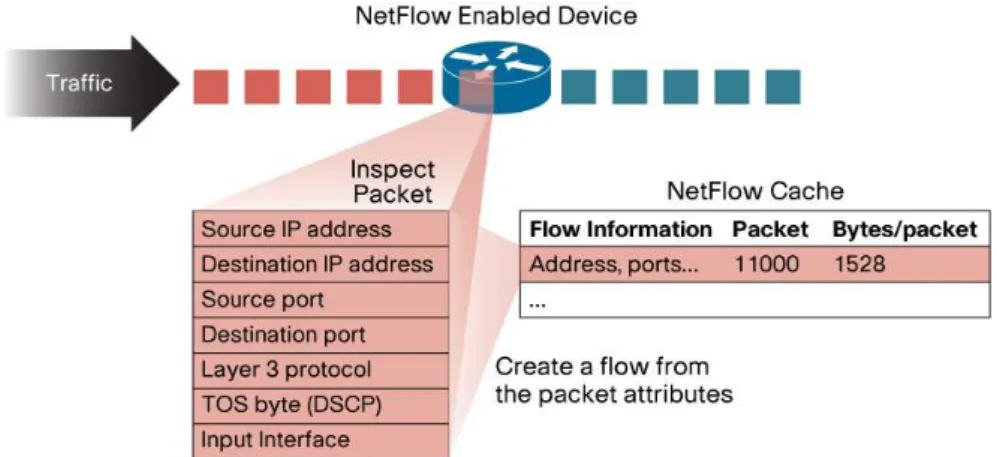
The typical configuration to leverage the Netflow protocol is made by a router with netflow capabilities (netflow exporter) and a probe ( net-flow collector) able to store received data (see Figure 2.1). Netflow records are sent as a UDPstream of bytes. A netflow-enabled router creates one record with only selected fields from the TCP headers of each transiting connection (Figure 2.2): a single netflow record is aunidirectionalsequence of packets all sharing the 7 values source and destination IP addresses,
Figure 2.2: How a Netflow enabled device exports netflow records. This image is taken from Introduction to CiscoTMIOS Netflow.
source and destination ports (for UDP or TCP, 0 for other protocols), IP protocol, Ingress interface (SNMP ifIndex) and IP Type of Service. Other valuable informations associated to the flow, like timestamps, duration, number of packets and transmitted bytes, are also recorded. A single flow is a record that represents the data exchanged between two hosts only in one direction, since it aggregates all the IP packets that composed a single communication session. Indeed, a single TCP connection is represented by two distinct flows in opposite directions, despite the number of IP packets or the number of exchanged bytes.
A netflow-enabled router sends to the probe a single flow as soon as the relative connection expires. This can happen when(i)when TCP con-nection reaches the end of the byte stream (FIN flag or RST flag are set); (ii)when a flow is idle for a specific timeout; (iii)if a connection exceeds long live terms (30 minutes by default).
The use of Netflow technology has several advantages with respect to the raw packet sniffing, since using just few information it is able to give a lightweight picture of monitored network. Several researches proposed netflow collectors as IDSs (Intrusion Detection Systems), [22], traffic clas-sifiers, [42], and others security tools. To have a flavor of the advantages of a netflow dataset in terms of dimension and required effort, the following statistics can be considered: a 2 G Bytes of full netflow entries contains 110
millions of flows, 2 billions of packets and about 1, 5 T Byte of exchanged data, corresponding to the data gathered in one single day. Until today, the dataset used in this dissertation consists in a collection of 48 months long netflow records (about 4 T Bytes of data) and it keeps growing.
Note that, despite the advantage of low computational requirements to process an extensive amount of data, netflows inevitably sacrifice a lot of valuable information related to traffic payload: carried attacks to single host services, virus or malware specific signatures, particular malformed packets and so on, are dropped and cannot be recovered from netflows. In this configuration, due to some privacy issues, it is not possible to ac-cess to the whole payload to perform a full packet inspection. In fact, the monitored network contains several governmental networks that ex-change sensitive data and any access to their packet payloads is restricted.
Relieve Internet Routing security
of Public Key Infrastructure
This chapter introduces the protocol reBGP, a secure BGP protocol that mitigate prefix hijacking and invalid path attacks.
3.1
BGP fundamentals
The Border Gateway Protocol (BGP) is the IETF standard routing pro-tocol on the Internet. It is a path vector propro-tocol in which routers choose the route with the “best” path for inclusion in the routing table and an-nounce the selected path to other neighbors. Selection of the best path depends on many factors, like local preference, commercial agreement or path length (refer to [126] for more details.).
Every BGP router is referred to as a “BGP speaker”. Each of them is directly connected to a number of neighbors with whom it exchanges routing information and network packets. The AS node responsible for a specific network is said to be theoriginator, while all the AS nodes that can be traversed to reach that network constitute oneAS-pathfor that pre-fix. Hence, the originator issues theannouncementof a prefix, while other
The work described in this chapter is a joint work with L.V.Mancini, A. Spognardi, A. Villani and C. Soriente and it appeared in the International Conference on Computer Communication Networks (ICCCN2012), [94].
AS nodes along the AS-pathpropagatethe announcement, appending their AS number to the received AS-path. Since a network prefix represents the identity of a network it is also called Network Layer Reachability Infor-mation (NLRI). An NLRI is composed of a length and a prefix. The length is a network mask inCIDRnotation (e.g.: /25) specifying the number of network bits, and the prefix is the Network address for that subnet. An NLRI would look something like: 192.168.1.0/24..
Once a network becomes unreachable for an AS node, it forwards a withdrawalmessage for that route to its neighbors: those, in turn, choose and propagate an alternative route (if any) for that network. In particular, BGP speakers exchange announcements, propagations and withdrawals withinUPDATEmessages.
3.1.1
Security threats and adversary model
The mechanism BGP uses to propagate routing data is extremely sim-ple: an AS node receives announcements, store it and according with its routing policies, propagates them. This simplicity has determined its suc-cess but, at the same time, it is also the cause of many dangerous attacks against Internet. In fact, each speaker constructs its routing table only using the information received by its neighbors. Nothing prevents any speaker to behave maliciously and advertise to its peers prefixes it is not responsible of or routes that it cannot actually reach. This kind of behavior is the onereBGP, [94], seeks to mitigate.
Similarly to relevant work in the area [73, 67], this dissertation con-siders an active insider adversary that performs falsification attacks. The attacker can compromise any BGP speaker and inject fake BGP messages that do not reflect the real network topology. In particular, the adversary has access to all the cryptographic material the compromised router stores and can sign or encrypt any message on behalf of that router. The aim of the adversary is to subvert the correct BGP functioning in order to alter the normal routing of the traffic in Internet.
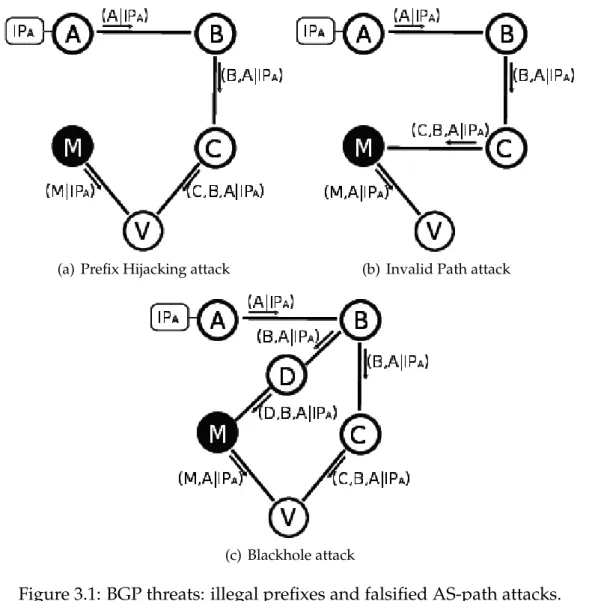
informa-(a) Prefix Hijacking attack (b) Invalid Path attack
(c) Blackhole attack
Figure 3.1: BGP threats: illegal prefixes and falsified AS-path attacks. tion in order to perform aprefix hijackingand the AS-path attribute of an UPDATE message, in order to perform aninvalid path attack[90].
Prefix hijacking
With this attack a compromised router can introduce UPDATE mes-sages for networks that it does not administrate. For example, it could pretend to be the originator of a prefix 10.0.0.0/16 announcing that prefix to its neighbors (like the malicious AS node M of Figure 3.1(a) that an-nouncesIPAowned by ASA). Or, it could announce more specific prefixes
of that network (like 10.0.0.0/18): longer prefixes, in fact, are preferred respect to smaller ones, since they are less specific (as happened in the Youtube hijack cyber attack).
Once the route eventually propagates to other AS nodes, the best path selection process for 10.0.0.0 would consider the regular path and the fal-sified one. In this way, the compromised router would attract all the traffic directed to 10.0.0.0 (or to a subnet) generated by the AS nodes that choose the falsified route.
Invalid path attack
In this attack the adversary issues UPDATE messages with a fabricated AS-path. For example the attacker can shorten a route of any NLRI simply removing some or even all the AS nodes from the AS-path attribute. This attack is depicted in Figure 3.1(b), where the AS nodeM drops from the AS-path forIPAthe AS nodesBandC. The invalid path attack can lead to ablackhole that is related to the data plane security issues. In particular, a blackholehappens when a malicious AS attracts traffic that would not flow through it, exploiting falsified AS-paths. For example, the AS nodeM of Figure 3.1(c) using a fake AS-path is able to attract the traffic towardsIPA from the victim AS V. Similarly, the attacker could modify the AS-path introducing some random AS in order to enlarge the path or to produce loops. In general, the effects of an invalid path attack would impact on the best route selection algorithm: shorter paths would be preferred against longer ones, while paths that include loops would be directly discarded as malformed routes.
3.1.2
Revocation in BGP
Just as in reBGP, signature-based solutions to secure BGP, e.g., [73], au-thenticate AS-paths by nesting the signatures of each AS on the path. In such a setting, revocation is performed by the trusted authority in charge of issuing public key certificates, that revokes the certificate of malicious or simply eliminated AS nodes. From that moment on, all announcements
made by the revoked AS are discarded by other peers. Other solutions, e.g. [67], propose to leverage the concept of “epochs”, namely, they as-sume time is divided in periods of fixed length, after which all routes must be re-advertised. Nevertheless, a dynamic environment like the Internet requires fine-grained revocation means. For example, consider autono-mous system ASithat authorizes its neighbor ASjto advertise its prefixes 10.0.0.0 and 11.0.0.0. Later on,ASichanges its commercial strategy and de-cides thatASjshould keep advertising 10.0.0.0, but 11.0.0.0 should only be advertised by another peer, say ASl. PKI certificate revocation is clearly a poor match in this scenario due to the large amount of communication and computational requirements. Moreover, AS nodes should retain complete control of the authorization they distribute or revoke, without resorting to a trusted third party. A possible solution would be for ASi to sign a mes-sage that invalidates all announcements made by ASj about 11.0.0.0 and to broadcast it. However, this would generate a considerable number of messages. reBGP tackles selective revocation embedding revocation infor-mation within AS-path announcement. In the above example, ASi would just provide an authorization for ASl to announce a path towards 11.0.0.0. As explained in the next sections, the authorization itself carries enough informations that allow other peers to accept the new route as the genuine one and to discard any further announcement made by ASj on the old route for 11.0.0.0.
3.2
Cryptographic primitives
This section reviews the main cryptographic primitives used in the pro-tocol reBGP, namelyIdentity-based Aggregate Signatures.
3.2.1
Identity-based Aggregate Signature
Traditional public key cryptography relies on one or more trusted au-thorities that issue certificates to bind users to public keys. Hence, before encrypting a message under one’s public key, its authenticity must be
ver-ified by means of a valid certificate issued by the authority. Similarly, a certificate is required to validate the (public) verification key of a party, before verifying its signatures.
Certificate distribution and management requires a complex infras-tructure known as Public Key Infrasinfras-tructure (PKI). While traditional cryp-tography has been previously recommended to secure Internet-domain routing [73], the proposal has never been adopted because of the involve-ment of the PKI and complex trust relations among its components.
Identity Base (IB) Cryptography is an effective alternative to traditional Public Key cryptography that relies on certificates to endorse public key authenticity. In an IB cryptographic scheme, the identities of the parties “are” their public keys. In other words, any string can serve as a pub-lic key; corresponding private keys are managed and issued by a trusted authority, referred to as Private Key Generator (PKG). The latter is only active when issuing new keys.
The main advantages of the IBE Cryptosystems, are related to the its use of user identity’s attributes (e.g email addresses or identity numbers) instead of digital certificates, for cryptographic operations. This environ-ment significantly reduces the complexity of a cryptography system by eliminating the need for generating and managing users’ certificates, so reducing communication and computational costs. Although an IBE cryp-tosystems avoids the need a PKI, it relies on a trusted third party, namely the Private Key Generator (PKG) which generates and issues the pub-lic/private keypairs. Furthermore, using such settings, there is no need to managing a public key infrastructure, including the CRLs (Certificate Revocation Lists).
It is relevant of mention other advantages of an IBC. In a IBC all the encryption keys are always available for all recipients. In fact, the encryp-tion key is derived mathematically from the receiver’s identity. This con-dition also assures the server can securely regenerate keys for recipients as needed.
Identity Based Aggregate Signatures (IBAS) allow multiple users to sign multiple messages and aggregate all signatures in a fixed-size token.