Sadawi, N, Olier, I, Vanschoren, J, van Rijn, JN, Besnard, J, Bickerton, R,
Grosan, C, Soldatova, L and King, RD
Multi-task learning with a natural metric for quantitative structure activity
relationship learning
http://researchonline.ljmu.ac.uk/id/eprint/11710/
Article
LJMU has developed LJMU Research Online for users to access the research output of the University more effectively. Copyright © and Moral Rights for the papers on this site are retained by the individual authors and/or other copyright owners. Users may download and/or print one copy of any article(s) in LJMU Research Online to facilitate their private study or for non-commercial research. You may not engage in further distribution of the material or use it for any profit-making activities or any commercial gain.
The version presented here may differ from the published version or from the version of the record. Please see the repository URL above for details on accessing the published version and note that access may require a subscription.
For more information please contact [email protected]
http://researchonline.ljmu.ac.uk/
Citation
(please note it is advisable to refer to the publisher’s version if you
intend to cite from this work)
Sadawi, N, Olier, I, Vanschoren, J, van Rijn, JN, Besnard, J, Bickerton, R,
Grosan, C, Soldatova, L and King, RD Multi-task learning with a natural
metric for quantitative structure activity relationship learning. Journal of
Cheminformatics. ISSN 1758-2946 (Accepted)
RESEARCH
Multi-task learning with a natural metric for
quantitative structure activity relationship
learning
Noureddin Sadawi
1,7, Ivan Olier
2, Joaquin Vanschoren
3, Jan N. van Rijn
4, Jeremy Besnard
5,6, Richard
Bickerton
5,6, Crina Grosan
7, Larisa Soldatova
7,8*and Ross D. King
9*Correspondence: [email protected] 8Goldsmiths, University of London, London, UK Full list of author information is available at the end of the article
Abstract
The goal of Quantitative Structure Activity Relationship (QSAR) Learning is to learn a function that, given the structure of a small molecule (a potential drug), outputs the predicted activity of the compound. We employed multi-task learning (MTL) to exploit commonalities in drug targets and assays. We used datasets containing curated records about the activity of specific compounds on drug targets provided by ChEMBL. Totally, 1091 assays have been analysed. As a baseline, a single task learning approach that trains random forest to predict drug activity for each drug target individually was considered. We then carried out feature-based and instance-based MTL to predict drug activities. We introduced a natural metric of evolutionary distance between drug targets as a measure of tasks relatedness.
Instance-based MTL significantly outperformed both, feature-based MTL and the base learner, on 741 drug targets out of 1091. Feature-based MTL won on 179 occasions and the base learner performed best on 171 drug targets. We conclude that MTL QSAR is improved by incorporating the evolutionary distance between targets. These results indicate that QSAR learning can be performed effectively, even if little data is available for specific drug targets, by leveraging what is known about similar drug targets.
Availability:https://github.com/nsadawi/MTL-QSAR
Keywords: Multi-Task Learning; Quantitative Structure Activity Relationship; Sequence-Based Similarity; Random Forest
Introduction and problem specification
Rich Caruana in his widely cited paper defined multi-task learning (MTL)(see the list of abbreviations below) as “an approach to inductive transfer that improves generalization by using the domain information contained in the training signals of related tasks as an inductive bias. It does this by learning tasks in parallel while using a shared representation; what is learned for each task can help other tasks be learned better” [1]. A more formal definition of MTL is given in [2]:
Definition (MTL): Given mlearning tasks {Ti}ii==1m
where all the tasks or a subset of them are related but not identical, MTL aims to help improve the learning of a model for Ti by using the knowledge contained in
themtasks.
There are three aspects of the task relatedness: feature, parameter, and instance; and correspondingly - three types of MTL [2]:
1 Feature-based MTL models assume that different tasks share identical or similar feature representations, which can be a subset or a transformation of the original features.
2 Parameter-based MTL models aim to encode the task relatedness into the learning model via the regularization or prior on model parameters. 3 Instance-based MTL modelspropose to use data instances from all the
tasks to construct a learner for each task via instance weighting.
In recent years, MTL has been an active research area within the machine learning community and beyond. Instance-based MTL is among the most popular approaches because it often yields improved predictive performance [3, 4]. The intuition is that by combining training data across multiple related tasks, each task benefits from the related information in other tasks, resulting in higher accuracy learning [5]. In other words, model generalization for individual tasks can be enhanced by sharing representations among tasks that are related.
MTL is considered as a sub-area of transfer learning [6]. The idea of transfer learning is to extract knowledge from one or more source domains, and reuse this knowledge in atarget domain where data is scarce, with the aim of building better performing learning models in the target domain [7].
In this work we apply instance-based and feature-based MTL for the problem of predicting Quantitative Structure Activity Relationship (QSAR). The goal of QSAR learning is to learn a function that, given the structure of a small molecule (a potential drug), outputs the predicted activity of the compound against an assay (a test that predicts the potential of the compound being a drug) [8].
QSAR modelling has come a long way since its establishment in the early 1960s [9]. Although many drug targets are well studied and analyzed, a considerable number of them is still not, meaning that the quantity of labelled data for such targets is scarce (i.e. the number of chemical compounds with known bioactivity against these targets is small). Therefore, this leads to poor quality QSAR models which hampers understanding of these drug targets. Accurate predictive QSAR models are key for the discovery of new bioactive chemical compounds [10].
A single task Ti is a task of predicting an activity Ai given a QSAR dataset
of molecular structures (see Table 1 for a typical example of QSAR dataset and the Data section for further explanations). MTL is a suitable approach for the considered problem because:
• Different QSAR learning tasks share identical feature representations. For example, one of the most widely-used representations is fingerprints (see the Data section for further detail).
• There are publicly available datasets for many QSAR tasks, and these data instances can be used to construct a learner for each task via instance weighting (see the Methods section for further detail).
• It is also possible to apply parameter-based MTL, because there are available parametric QSAR models, although this is outside of the scope of this paper.
The application of MTL for QSAR learning in particular is beneficial because a considerable number of drug targets remains poorly studied and the quantity of labelled data for such targets is scarce. It is costly to obtain labeled data and this limits opportunities for constructing high-quality QSAR models and advancing understanding of these drug targets. In this paper we report the results of the use of existing data from related drug targets, where labeled data is aplenty, to predict activities for the drug targets where data is scarce. Our method is to use MTL where we exploit the drug target relatedness through the incorporation of the natural evolutionary metric. Specifically, in this paper we test the following two hypotheses:
1 MTL can improve on standard QSAR learning through the use of related targets.
2 MTL QSAR can be improved by incorporating the evolutionary distance of targets.
Related work
Mult-itask learning
MTL has been used in many areas. For example, Chen et al. employed MTL to learn a common feature space from multiple related tasks and applied it for web page categorization [11]. Bickel et al. applied MTL for HIV therapy screening data with the focus on assigning weights to instances from multiple tasks so that tasks can be learned jointly even if data for different tasks have arbitrary different distributions [12]. Bickel et al. introduced a new MTL method for weighting groups in tree guided group-lasso regression and applied it for the analysis of genotype and gene expression data [13].
Zhang et al. reported on a multi-modal multi-task (M3T) method for simultaneously predicting multiple outcomes for multi-modal data [2]. The method is based on selecting common relevant features, applying kernel based data fusion and then applying multi-outcome support vector regression. Experiments were performed to jointly predict clinical scores in Alzheimer’s disease.
Deep learning
Deep learning has gained significant attention over the last years and there are attempts to employ it for MTL. For example, deep relationship networks (DRN) were proposed to estimate the relationships between tasks in the area of computer vision [14]. In natural language processing (NLP), MTL was used with deep learning for identifying better hierarchies for tasks to improve performance [15].
Task relatedness
A number of approaches have been reported in the literature for the specification of task similarity, an important element of MTL. One common approach is to build models on the individual tasks, and then to learn a common prior over the trained model parameters. For instance, this prior can be inferred using Dirichlet processes [16], matrix-variate normal distributions [17], or a maximum likelihood procedure [18]. Clustered multi-task learning (CMTL) preforms clustering of tasks into groups prior to applying MTL. This clustering can be done both on the task
level [3, 19, 20] and on the level of shared feature representations among tasks [21, 22, 23, 24].
Discovering highly important marker genes was the main focus of the work reported in [25] where the aim was to identify a shared gene subspace across different gene expression datasets using MTL. Zhou et al. modeled disease progression by considering predictions at different time points as different tasks and transform the problem into MTL [26]. The relatedness between tasks was obtained by using a temporal group Lasso regularizer.
Taxonomy-based MTL was used to conduct biological sequence classification for the purpose of predicting the splice sites in various drug targets [27]. In this approach, the relatedness of tasks was defined by a phylogenic tree based structure and learning was performed at different levels of the tree. Furthermore, taxonomy- and graph-based transfer learning and MTL were used to predict the binding of the Major Histocompatibility Complex (MHC)-I [28]. Although task relatedness can be derived from the hierarchy, the authors report an interesting approach to quantify this relatedness using multi-kernel SVMs. Also, a two step MTL approach was employed for the prediction of small interfering RNA (siRNA) efficacy [29]. In the first step, shared-task representations are learned, and in the second step, these representations are fed into a regressor to model each task.
A methodology that employs sequence based distance is described in [30]. In this approach an attempt was made to predict the similarity in binding profile between any pair of kinases from the human kinome. A binding profile was built for each kinase and it was used to compute pairwise similarity between kinases. This similarity was compared with the sequence based distance in order to check whether there is any correlation between the two. The difference between our approach and this approach is that we use the pairwise sequence based similarity between drug targets as input features to the classifier. Also, unlike our work, this method does not allow predicting the activity of individual molecules on drug targets.
Multi-task learning for QSAR learning
MTL employing neural networks is reported in [31]. Multi-target predictions were made for a total of 19 assays at the same time. Although training is conducted by combining data from multiple assays, this method does not take advantage of the task relatedness. The QSAR problem is considered as a classification problem (i.e. whether a compound is active or inactive in a certain assay). This is different from our approach where we treat QSAR as a regression problem, and we work with a considerably larger number of assays (1091 assays).
Work applying MTL in QSAR learning includes applications in sequence biology [28] using a graph-based regularization method [3, 32] based on SVM [33]. Experiments were performed on data from the human kinome, and the relatedness between tasks was extracted from the taxonomy of kinase targets. A distance matrix was derived from the taxonomy by considering the distance between two taxa as the weight of the shortest path between them in the taxonomy [34]. This matrix was then transformed into a similarity matrix and the values were used to perform MTL. This measure of similarity is different from the homology used in our work, and it is less biologically meaningful. Ning et al. used SVM-based MTL
approach to learn a classification model for a drug target together with other related drug targets, where compound- and target-specific kernel functions were used to capture intrinsic commonalities [35].
One of the key QSAR studies that employed MTL as well as transfer learning was reported in [36]. In addition to MTL, the approach uses feature nets (FN) to construct neural network and partial least squares (PLS) models for the modeling of 11 types of tissue-air partition coefficients. A total of 56 and 50 models for H/tissue and R/tissue respectively were obtained in the experiments which demonstrated the usefulness of MTL and transfer learning in general. The reported approaches showed that these techniques are specially useful when data is scarce. Our approache is different in multiple ways. We performed experiments on a much larger scale. Also, the authors did not evaluate traditional machine learning methods to select the best performing ones for STL. In particular, random forest (RF) was not considered [36]. This could be due to the used descriptors: we worked with fingerprints whereas they worked with some physicochemical properties as well as ISIDA descriptors [37]. In addition, our results are more statistically significant.
A recent approach, that reports significant improvements over traditional baseline machine learning approaches, applied massively multi-task neural networks for drug discovery [38]. In this work, an attempt was made to use deep learning to provide a framework for sharing information across a large number of datasets. The end goal was to classify compounds as either active or inactive.
Another approach that employs deep neural networks (DNN) is the work presented in [39] which tried to not only demonstrate that multi-task DNNs work in QSAR but also to explain why this is the case. The authors report that some form of signal transfer takes place between structurally similar molecules during the training process, and this can lead to better performance when molecule activities are correlated. A recent review of applications and challenges of MTL and transfer learning in QSAR can be found in [40].
Advantages of the proposed approach
The proposed approach has the following advantages compared with the previous MTL work:
1 The QSAR learning problem is considered as a regression problem. This is more natural as finding the best threshold value to determine whether a specific compound is active or inactive is problematic and often results in loss of information.
2 We employ RF as the base learner. We showed in a previous study that RF outperforms other learners on QSAR data in the majority of scenarios [41] 3 We employ the functional-class fingerprints (FCFP) method to represent
molecular structures. We have empirically found them to generally be the most successful QSAR prediction representation. We have done this by performing tests and comparisons using thousands of datasets and several learners [41].
4 One of the contributions of our work is the use of the drug target similarities in an MTL setting. The majority of existing MTL approaches focus on learning the task similarities, whereas in our case, we exploit the sequence
based similarities and incorporate them in our experiments. There are often commonalities in QSAR assays as the target proteins may be evolutionary related. We took advantage of this and used protein sequence similarity values as our task similarities. This enables the inference of a natural metric of evolutionary distance between the drug targets.
In this paper we introduce an intuitive, simple and effective method of learning QSARs jointly. We test whether our MTL method can improve on standard QSAR learning through the use of related targets, and evaluate whether QSAR MTL can be improved by incorporating the evolutionary distance between targets. Our method is based on the classification of drug targets into families and the use of sequence similarity values between those drug targets [42].
Data
We obtained drug activity data from the publicly available database ChEMBL containing curated records about the activity of specific compounds (drugs, small molecules) on drug targets (proteins) [43]. Activities in ChEMBL, e.g. potency and affinity endpoints, are recorded as real values (i.e. IC50, EC50, Ki, Kd and their equivalents).
In this study we used IC50 values, inhibitory drug concentrations at 50%. IC50 value states the concentration of the drug compound that is required to block or inhibit 50% of the proteins. This response data has been normalised by taking the negative log of the drug concentrations that inhibited 50% of a target (pXC50):
pXC50 =−log10IC50
The pXC50 provides a continuous scale of 1-12 where a compound of the value 1 is the least potent inhibitor and requires a large concentration of the drug to achieve 50% inhibition and 12 is the most potent inhibitor requiring a very low concentration to achieve 50% inhibition. In a small proportion of cases, where multiple activities have been reported for a particular compound-target pair, a consensus value was selected as the median of those activities falling in the modal log unit. Therefore, the unit of activity we are referring to is thepseudo-pIC50. This is a similar procedure to what was used in the AEROPATH target database project [44].
ChEMBL provides two ways of categorizing drug targets: a 6-level hierarchical
classification of protein families, and agrouping of drug targets by their preferred names. In this paper, we perform MTL on the level of both groups and classes.
Drug target classes
In the 6-level hierarchy, the ChEMBL database curators have classified protein targets into a manually curated family hierarchy according to nomenclature commonly used by drug discovery scientists, e.g. a ligand-based classification of G-protein-coupled receptors, and a division of enzymes into proteases/kinases/phosphatases. The version of the hierarchy used in this study is ChEMBL20, and it comprises of 6 levels, with Level 1 (L1) being the broadest class and Level 6 (L6) - the most specific. For example, the protein ”tyrosine-protein kinase Srms” is classified as follows: enzyme (L1), kinase (L2),
protein kinase (L3), TK protein kinase group (L4), tyrosine protein kinase Src family (L5), tyrosine protein kinase Srm (L6). Different classes in L1 are not evolutionary related to one another, whereas members of classes in L3 and below share common evolutionary origins for the most part. The picture is mixed for L2. The hierarchy is not fully populated, with the greatest emphasis being placed on the target families of highest pharmaceutical interest, and the different levels of the hierarchy are not defined by rigorous criteria. However, the hierarchical classification provides a useful means of grouping related targets at different levels of granularity.
Drug target groupings
The method using preferred names is based on the practice that individual proteins can be described by a range of different identifiers and textual descriptions across the various data resources. The ChEMBL curators have assigned each protein target a preferred name in a robust and consistent manner, independent of the various adopted names and synonyms used elsewhere. The detailed manual annotation of canonical target names means that, for the most part, orthologous proteins from related species are described consistently, allowing the most related proteins to be grouped together. In the preferred name groupings, we obtained 468 drug target groups. The minimum number of drug targets in a group is two, and the maximum number of drug targets is 21 for the dihydrofolate reductase group (DHFR).
Drug targets similarity
In our approach we employ evolutionary relatedness of drug targets as a similarity metric between drug targets within each drug target group or class. Drug targets similarity is based on the similarity of their amino-acid sequences. Sequence alignment is a method to detect regions of similarity among sequences [45]. There are two types of alignment: global and local. In global alignment the full lengths of sequences are aligned, whereas in local alignment, only parts of the sequences are aligned. Often, the Needleman-Wunsch algorithm [46] is used for performing global sequence alignment and the Smith-Waterman algorithm [47] is used to carry out local sequence alignment.
To obtain a metric for the similarity of protein targets we pairwise aligned their sequences using the Smith-Waterman algorithm and measured amino-acid residue similarity. We used the full sequence as the active sites are not easily labeled. Using active sites might further improve the results, but in this study we opted for the simplest option.
In more detail, given a pairwise sequence alignment of related protein sequences, it is common practice to quote the value of PID (Percentage Sequence Identity ) as a simple measure of evolutionary relatedness. This gives us a metric of evolutionary distance that ranges between zero and one; with numbers closer to one indicating more related drug targets. There is no universally accepted standard method to calculate PID [48]. In this workP ID1 method (the default setting in BioStrings [49]) was used:
P ID1 = 100∗ identical positions
Methods
Based on our previous extensive comparative study of conventional learners [41] showing that RF [50] outperforms other learners for the majority of QSAR problems, we decided to employ RF with 100 trees as our base learner, and evaluate its performance with 10-fold cross-validation. We have chosen to use RMSE (the Root Mean Squared Error) [51] as the evaluation measure because we are predicting a real value number (the pseudo-pIC50).
We used the FCFP 1024-bit molecular fingerprints to represent molecules. Molecular fingerprints encode the structure of a chemical compound as a series of binary digits that indicate the presence or absence of particular substructures in the molecule [52]. For example, if a molecule contains a benzyl ring, the corresponding bit in the fingerprint will be 1, and if not - 0. This molecule representation was selected because it is highly reliable for QSAR problems. More details can be found in our previous work [41] where we carried out an extensive comparison between several representations such as different kinds of fingerprints and descriptors.
In this work we performed all experiments using WEKA 3.7.11 machine learning library [53]. The implementation was done in Java utilising WEKA API as the basis for building our algorithms and running experiments.
Single task learning
As a baseline, we include a single task learning (STL) approach that trains RF to predict drug activity for each drug target individually. Table 1 shows an example QSAR dataset, consisting of chemical compounds, their fingerprints and activity values. We will refer to this setting as STL.
Table 1: A typical QSAR dataset.
MOL ID FP 1 FP 2 ... FP n Activity ID 1 1 0 ... 1 6.351 ID 2 0 1 ... 0 7.534 ... ... ... ... ... ... ID 22 1 1 ... 1 8.001 ID 23 0 1 ... 0 6.239 Feature-based MTL
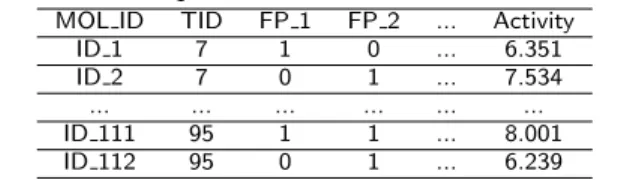
In the feature-based MTL approach we aim to learn all drug targets for a particular protein target group (e.g. DHFR) or class (e.g. AMPA receptor) simultaneously. This was done by concatenating all the datasets of the same group or class, and adding an extraindicator attribute. As shown in Table 2, theTarget ID attribute,
TID for short, indicates which drug target, or species, the example came from (e.g. P. falciparum). As dataset entries (i.e. examples) are molecules, we give each molecule a unique identifier (MOL ID). This helps to keep track of molecules even if the same molecule appears in more than one dataset.
Table 2: An input dataset for feature-based MTL.
MOL ID TID FP 1 FP 2 ... Activity
ID 1 7 1 0 ... 6.351
ID 2 7 0 1 ... 7.534
... ... ... ... ... ...
ID 111 95 1 1 ... 8.001
ID 112 95 0 1 ... 6.239
Algorithm 1 shows the pseudocode of feature-based MTL. We ran RF (with 100 trees) on the concatenated dataset and performed 10 fold cross-validation to obtain an estimate of the performance. We used stratified sampling based on the TID attribute for cross-validation [54]. Such sampling procedure ensures that, when randomly selecting a sample from the population, the proportion of each group in the sample is the same as in the original population. Although this is usually done in the context of classification problems with imbalanced classes, we employ it here to ensure that our per-fold performance estimates are based on the actual distribution of drug targets in the original data. We evaluate the performance (RMSE) of our MTL approach for each TID separately by filtering out the predictions for that specific TID in each test set.
Input :ndatasets which belong to the same drug target group (each dataset represents one drug target)
Output:Performance evaluation of RF models built for each of these datasets
1- Concatenate thendatasets into one big dataset; 2- Add an indicator variable T IDto each example; 3- Perform the following using the big dataset; fori←1 to10do
Observe: the splits are stratified based on TID; - train set = 90% of the big dataset;
- test set = 10% of the big dataset; - build RF using train set;
- predict the test set (here we save MOL ID, TID, actual and predicted values);
end
4- Evaluate using the saved predictions; forj ←1to ndo
- filter predictions using jthTID;
- compute and save RMSE for the jthdrug target; end
Algorithm 1: Feature-based MTL.
By the end of the cross-validation, we obtained a list of all molecules and their respective TIDs, and their actual and predicted activity values (see Table 3). In order to examine the performance of RF on any particular drug target, we select instances that are from that particular target’s dataset by filtering TIDs. This gives the actual and predicted activity values for that particular dataset, and it
is straightforward to compute RMSEs (see the Experiments and results section). The same procedure is used for the evaluation of the performance of instance-based MTL.
Table 3: An output table for feature-based MTL.
FOLD MOL ID TID Activity Prediction
1 ID 1 7 6.351 6.011 1 ID 2 7 7.534 7.681 ... ... ... ... ... 10 ID 111 95 8.001 7.764 10 ID 112 95 6.239 6.401 Instance-based MTL
In the instance-based MTL we made use of the quantitative similarity between drug targets described in the Drug target similarity section. To represent this information, we addednextra attributes that consist of the similarity values to the other species (n is the number of drug targets in each drug target group or class). As Table 4 shows, the attribute SimT oT ID 7 gives the similarity value between drug target with TID 7 and all other drug targets in this concatenated dataset. For examples which belong to TID 7, this value will be 1.
Table 4: A dataset for instance-based MTL.
MOL ID TID SimToTID 7 ... SimToTID 95 FP 1 FP 2 ... Activity
ID 1 7 1 ... 0.584 1 0 ... 6.351
ID 2 7 1 ... 0.584 0 1 ... 7.534
... ... ... ... ... ... ... ... ...
ID 111 95 0.584 ... 1 1 1 ... 8.001
ID 112 95 0.584 ... 1 1 1 ... 6.239
Algorithm 2 shows the pseudocode of instance-based MTL. We again used RF with 100 trees on the concatenated dataset, which now contains the similarity values. As in feature-based MTL, we used stratified 10 fold cross-validation training based on the TID to evaluate the performance of instance-based MTL approach, and compute the RMSE for each TID individually.
Input :ndatasets which belong to the same drug target group (each dataset represents one drug target)
Output:Performance evaluation of RF models built for each of these datasets
1- Concatenate thendatasets into one big dataset; 2- Add nextra variables to the big dataset:
SimToTID 1, SimToTID 2, ..., SimToTID n;
3- Fill values of these variables using similarities between drug targets:
sim(TID,SimToTID 1), sim(TID,SimToTID 2) ... and so on; 4- Perform the following using the big dataset;
fori←1 to10do
Observe: the splits are stratified based on TID; - train set = 90% of the big dataset;
- test set = 10% of the big dataset; - build RF using train set;
- predict the test set (here we save MOL ID, TID, actual and predicted values);
end
5- Now evaluate using the saved predictions; forj ←1to ndo
- filter predictions using jthTID;
- compute and save RMSE for the jthdrug target; end
Algorithm 2:Instance-based MTL.
Results and discussion
To evaluate the performance of our MTL approach, we performed MTL on the level of all groups and classes of drug targets, building a model simultaneously for all drug targets within that group or class. We only considered groups or classes that have more than one drug target, because otherwise there would be no difference with STL, and only included drug targets for which the minimum size of their dataset was 10, because we employ 10-fold cross-validation. In other words, each dataset must contain at least 10 compounds with their corresponding activity against that drug target.
We compared the three settings discussed in the Methods section by running MTL on all drug classes and groups, obtaining a list of drug targets with their corresponding RMSE values for STL, feature-based and instance-based MTLs. Finally, we counted the number of cases where each setting had lowest RMSE.
To examine the distribution of RMSE values for each setting we drew histograms, ran Shapiro-Wilk tests [55], generated Q-Q plots, and concluded that these values do not follow a normal distribution. Hence, we applied the non-parametric Wilcoxon Signed-ranks test to examine whether or not the difference between these values is statistically significant. For each experiment, we show the results of three different Wilcoxon Signed-ranks tests to pairwise compare the RMSE performance of the
three settings. The following subsections show the details of our experiments using ChEMBL’s 6-level hierarchical classification and its grouping by preferred names.
Using ChEMBL’s class levels
We previously described ChEMBL’s 6-level hierarchical protein family classification which starts with L1 (most generic class) to L6 (most specific class). Table 5 displays the number of classes we obtained at each level. Note that table 5 shows the number of classes at each level in the hierarchy explained in the Drug target classes section, and this is different from the number of groups in the preferred named grouping explained in the Drug target groupings section.
Table 5: ChEMBL’s 6-level protein family classification.
Level No of Classes L1 13 L2 24 L3 46 L4 111 L5 180 L6 50
Broad classes such as enzyme and membrane receptors can be found at L1, whereas as we traverse down the hierarchy, we can find more specific classes such as antiporter and protein kinase at L3 and amine and motilin receptor at L5. It is reasonable to assume that more specific classes are more evolutionarily related. L5 has more classes than any level, i.e. 180, as shown in table 5. Over the total of 1091 drug targets (corresponding to 1091 assays we run experiments for), we expect that a grouping at L5 would yield sets of targets which are closely related. Therefore, we present our experimental results using this level.
Table 6: Pair-wise sign test for the L5 results.
Setting # +ve # -ve # ties
feature-based MTL vs STL 686 405 0
instance-based MTL vs STL 911 180 0
instance-based MTL vs feature-based MTL 891 200 0
Table 6 shows a simple sign test where we count how many times the RMSE value for each algorithm is less than the other. The +ve column indicates how many times the RMSE for the first setting is less than the second setting while the -ve column indicates how many times the RMSE for the second setting is less than the first setting. This shows that, for instance, feature-based MTL outperforms STL in 686 of the cases. Counting the number of overall wins, shown in Figure 1, yields that instance-based MTL outperforms both feature-based MTL and STL on 741 drug targets. Feature-based MTL won on 179 occasions and STL performed best on 171 occasions. The statistical significance of these results is shown in Table 7. Finally, Figure 2 shows a point ranking where we award the best setting three points, the second best two points and the third best one point.
ChEMBL datasets are known to be imbalanced toward active compounds [56]; hence we have compared our methods using the coefficient of determination (also known as R-squared) [57]. Unlike RMSE where we are interested in the minimum
value, when using R-squared we are interested in the highest value. This is because R-squared explains how good a model is. The value of R-squared normally ranges between 0 and 1, where 0 indicates a useless model and 1 indicates a perfect model. Our results are illustrated in Figure 3. The figure shows how many drug targets each setting scores the highest R-squared on. Instance-based MTL outperforms both feature-based MTL and STL on 639 drug targets, feature-based MTL performs better than instance-based MTL and STL on 360 drug targets whereas STL performed best on 92 drug targets.
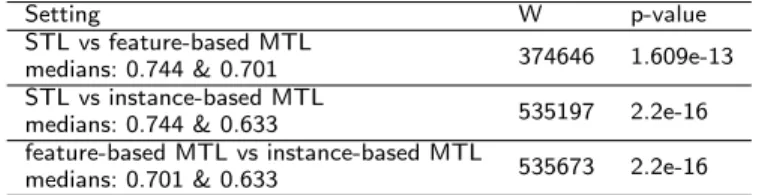
Table 7 shows the results of the pairwise Wilcoxon signed-rank tests. The null hypothesis is that the median change in RMSE values when we use our MTL methods is zero. As can be seen, feature-based MTL (Median RMSE=0.701) and instance-based MTL (Median RMSE=0.633) both significantly outperformed STL (Median RMSE=0.744). Moreover, instance-based MTL also significantly outperforms feature-based MTL. The difference in medians is further evident in the boxplot provided in Figure 4.
Setting W p-value
STL vs feature-based MTL
medians: 0.744 & 0.701 374646 1.609e-13
STL vs instance-based MTL
medians: 0.744 & 0.633 535197 2.2e-16
feature-based MTL vs instance-based MTL
medians: 0.701 & 0.633 535673 2.2e-16
Table 7: Pair-wise Wilcoxon signed-ranks test for L5 results(W is the test statistic).
For validation, we carried out a Y-randomisation procedure [58] on the feature-based MTL method. We repeated the same feature-feature-based MTL procedure 1000 times using L5 target classes, and permuted the activity values each time. We then performed a sign test similar to that reported in Table 6, and the results demonstrate that RF (i.e. STL) performed significantly better than feature-based MTL in all runs. All our results are available on the Github repository mentioned above.
We also performed a randomisation procedure by shuffling the similarity values in the instance-based MTL approach. We have randomly selected 24 level 5 classes (the total number of selected drug targets is 120) and randomised their similarity values 1000 times. Each time we randomised, we run instance-based MTL and compute RSME for each drug target. Our results show that in 104 out of the 120 drug targets, the standard instance-based MTL approach performs better than when the similarity values are randomised (i.e. the RSME value for most drug targets when using the standard instance-based MTL approach is less than when randomising the similarity values). That is 86.67% of the randomly selected drug targets. This shows that the evolutionary data indeed significantly improves QSAR learners. Our results are available on the github repository mentioned above.
We have analysed the results of our work further by identifying what drug target classes benefited from the proposed MTL QSAR. We define afully benefitedclass as an L5 class in which all drug targets have better results when using feature-based MTL as compared with STL or instance-based MTL as compared with feature-based MTL. On the other hand, we define ano benefit class as an L5 class in which none
of the drug targets have better results when using feature-based MTL as compared with STL or instance-based MTL as compared with feature-based MTL. Our results show that there are 12 no benefit drug target classes, for examples Neurotensin receptor class with 4 drug targets and Cholecystokinin receptor class with 2 targets. We have also found that 40 drug target classes fully benefited from feature-based MTL. Examples are CMGC protein kinase RCK family with 2 drug targets and tyrosine protein kinase Trk family with 3 drug targets. On the other hand, only 9 drug target classes fall under the instance-based MTL no benefit class. Example classes are cytochrome P450 51A1 with 2 drug targets and aspartic protease A2A subfamily with 3 drug targets. Also, as many as 78 drug target classes fully benefited from instance-based MTL. Examples are tyrosine protein kinase EGFR family with 6 drug target and MCH receptor with 4 drug target. A list of all these drug target classes is provided on our github repository.
Our results indicate that the size of no benefit classes are generally small with the highest number of drug targets in each class as 3. In addition, we have studied the similarity values amongst drug targets of fully benefited classes, and our analysis shows that instance-based MTL works better if there is a range of evolutionary distances in the class. In other words, if not all drug targets are very close or distant from each other.
Using ChEMBL’s preferred name groups
Finally, we repeated our experiments using 468 drug target groups based on ChEMBL’s preferred name grouping (see the Data section). For a more detailed analysis, we investigated the performance of the three settings on the largest drug target group we have, which is DHFR with 21 drug targets.
Figure 5 shows a barplot of the RMSE values for the three settings on each of the 21 drug targets in the DHFR group. Instance-based MTL outperformed both feature-based MTL and STL in 18 drug targets and was never the third best. The STL was the best performer for only two drug targets whereas feature-based MTL won on only one drug target.
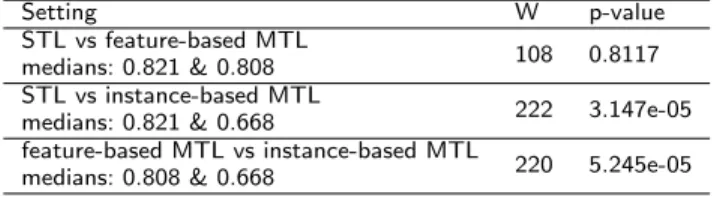
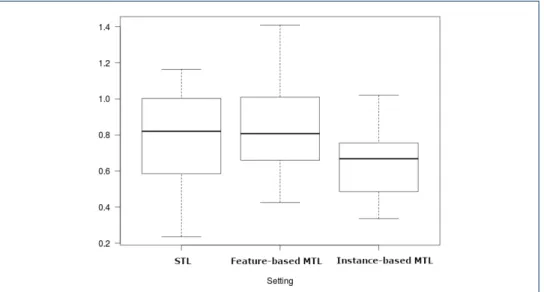
Table 8 shows the results of the pairwise Wilcoxon signed-rank test. The null hypothesis is that the median change in RMSE values when we use our MTL methods is zero. As can be seen, for the specific DHFR group, there was no significant difference in the RMSE values for STL (Median RMSE=0.821) and feature-based MTL (Median RMSE=0.808). However, instance-based MTL (Median RMSE=0.668) is significantly better than both STL and feature-based MTL. The difference in medians is evident in the boxplot provided in Figure 6.
Table 8: Pair-wise Wilcoxon signed-ranks test for the 21 DHFR group results (W is the test statistic).
Setting W p-value
STL vs feature-based MTL
medians: 0.821 & 0.808 108 0.8117
STL vs instance-based MTL
medians: 0.821 & 0.668 222 3.147e-05
feature-based MTL vs instance-based MTL
Conclusions and future work
We have shown that MTL can significantly improve the performance of QSAR learning models, and thus can help to better predict the activity of drugs against specific drug targets. We predicted the activities of potential drugs against 1091 assays (i.e. 1091 drug targets) by grouping similar drug targets and training models on all targets within the same group simultaneously. Drug targets were grouped based on ChEMBL’s 6-level classification, as well as based on their preferred names. The results show that MTL significantly outperformed learning QSAR models individually. Moreover, when incorporating a novel, natural similarity measure between drug targets based on their sequence alignment, and hence their evolutionary kinship, we can further significantly improve QSAR learning. These results indicate that QSAR learning can be performed effectively, even if little data is available for specific drug targets, by leveraging what is known about similar drug targets.
The QSAR datasets and experimental results are available on OpenML [59]. OpenML is an open source platform that facilitates discovering, sharing and reusing data, machine learning models and experiments. OpenML ensures that the submitted experiments are compliant with the W3C MLSchema [60], and therefore can be reproduced and reused in future work [61]. The Java source code for all reported experiments is freely available on Github [62]. The link also provides detailed information and a video demonstrating how the code can be run and how to analyse the results.
In future work, we plan to evaluate the performance of our methods without TID-based stratification. we intend to use the distance between drug targets instead of similarity values (distance = 1 - similarity) and use similarity, or distance, between datasets instead of drug targets and compare performance.
Abbreviations:
QSAR: Quantitative Structure Activity Relationship, MTL: Multi-Task Learning,
DHFR: Dihydrofolate Reductase, MHC: Histocompatibility Complex, RNA: Ribonucleic Acid,
DRN: Deep Relationship Networks, FN: Feature Nets,
PLS: Partial Least Squares, NLP: Natural Language Processing, CMTL: Clustered Multi-Task Learning, DNNs: deep neural networks, SVM: Support Vector Machines, RF: Random Forest,
FCFP: Functional-Class Fingerprints,
ChEMBL: Chemical database at the European Molecular Biology Laboratory, PID: Percentage Sequence Identity,
TID: Target Identifier, MOL ID: Molecule Identifier, RMSE: Root Mean Squared Error, STL: Single Task Learning,
AMPA Receptor:α-amino-3-hydroxy-5-methyl-4-isoxazolepropionic acid receptor
Declarations
Authors’ Contributions:
NS developed the MTL methods and ran all the experiments with input from RDK and LS. He also wrote most of the manuscript. IO, JB and RB assisted with preparing the data and choosing the sequence similarity method as well as providing insight into ChEMBL’s hierarchy of drug targets. CG and JV contributed to result evaluation and making data available on OpenML. JV and JNV analysed the methods from a machine learning perspective. The entire project was supervised by LS and RDK. The final manuscript was read and approved by all authors.
Competing interests:
The authors declare that they have no competing interests.
Ethics approval and consent to participate:
The research reported in this manuscript has been approved by respective organisations.
Availability of data and material:
All datasets and code are freely available at: https://github.com/nsadawi/MTL-QSAR
Acknowledgements:
This research was funded by the Engineering and Physical Sciences Research Council (EPSRC) grant EP/K030469/1. NS would like to thank the EU PhenoMeNal project (Horizon 2020, 654241).
Author details
1Department of Medicine, Imperial College London, London, UK. 2Department of Applied Mathematics, Liverpool John Moores University, Liverpool, UK. 3Eindhoven University of Technology, Eindhoven, Netherlands. 4Leiden University, Leiden, Netherland. 5University of Dundee, Dundee, Dundee, UK. 6Ex Scientia Ltd, Dundee, UK. 7Brunel University London, London, UK. 8Goldsmiths, University of London, London, UK. 9University of Manchester, Manchester, UK.
References
1. Caruana, R.: Multitask learning. Machine Learning28(1), 41–75 (1997). doi:10.1023/A:1007379606734 2. Zhang, D., Shen, D.: Multi-modal multi-task learning for joint prediction of multiple regression and classification
variables in alzheimer’s disease. NeuroImage59(2), 895–907 (2012). doi:10.1016/j.neuroimage.2011.09.069 3. Evgeniou, T., Micchelli, C.A., Pontil, M.: Learning multiple tasks with kernel methods. J. Mach. Learn. Res.6,
615–637 (2005)
4. Ando, R.K., Zhang, T.: A framework for learning predictive structures from multiple tasks and unlabeled data. J. Mach. Learn. Res.6, 1817–1853 (2005)
5. Zhang, Y., Yang, Q.: An overview of multi-task learning. National Science Review, 105 (2017). doi:10.1093/nsr/nwx105
6. Pan, S.J., Yang, Q.: A survey on transfer learning. IEEE Trans. on Knowl. and Data Eng.22(10), 1345–1359 (2010). doi:10.1109/TKDE.2009.191
7. Dai, W., Yang, Q., Xue, G.-R., Yu, Y.: Boosting for transfer learning. In: Proceedings of the 24th International Conference on Machine Learning. ICML ’07, pp. 193–200. ACM, New York, NY, USA (2007).
doi:10.1145/1273496.1273521. http://doi.acm.org/10.1145/1273496.1273521
8. Roy, K., Kar, S., Das, R.N.: Chapter 1 - background of qsar and historical developments. In: Roy, K., Kar, S., Das, R.N. (eds.) Understanding the Basics of QSAR for Applications in Pharmaceutical Sciences and Risk Assessment, pp. 1–46. Academic Press, Boston (2015). doi:10.1016/B978-0-12-801505-6.00001-6. http://www.sciencedirect.com/science/article/pii/B9780128015056000016
9. Hansch, C., Maloney, P., Fujita, T., Muir, R.: Correlation of biological activity of phenoxyacetic acids with hammett substituent constants and partition coefficients. Nature194(1962). doi:10.1038/194178b0 10. Cherkasov, A., Muratov, E.N., Fourches, D., Varnek, A., Baskin, I.I., Cronin, M., Dearden, J., Gramatica, P.,
Martin, Y.C., Todeschini, R., Consonni, V., Kuz’min, V.E., Cramer, R., Benigni, R., Yang, C., Rathman, J., Terfloth, L., Gasteiger, J., Richard, A., Tropsha, A.: Qsar modeling: Where have you been? where are you going to? Journal of Medicinal Chemistry57(12), 4977–5010 (2014). doi:10.1021/jm4004285. PMID: 24351051. https://doi.org/10.1021/jm4004285
11. Chen, J., Tang, L., Liu, J., Ye, J.: A convex formulation for learning shared structures from multiple tasks. In: Proceedings of the 26th Annual International Conference on Machine Learning. ICML ’09, pp. 137–144. ACM, New York, NY, USA (2009). doi:10.1145/1553374.1553392. http://doi.acm.org/10.1145/1553374.1553392 12. Bickel, S., Bogojeska, J., Lengauer, T., Scheffer, T.: Multi-task learning for hiv therapy screening. In:
Proceedings of the 25th International Conference on Machine Learning. ICML ’08, pp. 56–63. ACM, New York, NY, USA (2008). doi:10.1145/1390156.1390164. http://doi.acm.org/10.1145/1390156.1390164
13. Kim, S., Xing, E.P.: Tree-guided group lasso for multi-task regression with structured sparsity. In: Proceedings of the 27th International Conference on Machine Learning (ICML-10), pp. 543–550. Omnipress, ??? (2010). http://www.icml2010.org/papers/352.pdf
14. Long, M., Wang, J.: Learning multiple tasks with deep relationship networks. CoRRabs/1506.02117(2015). 1506.02117
15. Sogaard, A., Goldberg, Y.: Deep multi-task learning with low level tasks supervised at lower layers. In: Proceedings of the 54th Annual Meeting of the Association for Computational Linguistics, pp. 231–235 (2016) 16. Xue, Y., Liao, X., Carin, L., Krishnapuram, B.: Multi-task learning for classification with dirichlet process priors.
J. Mach. Learn. Res.8, 35–63 (2007)
17. Zhang, Y., Yeung, D.-Y.: A regularization approach to learning task relationships in multitask learning. ACM Trans. Knowl. Discov. Data8(3), 12–11231 (2014). doi:10.1145/2538028
18. Bakker, B., Heskes, T.: Task clustering and gating for bayesian multitask learning. J. Mach. Learn. Res.4, 83–99 (2003). doi:10.1162/153244304322765658
19. Jacob, L., Vert, J.-p., Bach, F.R.: Clustered multi-task learning: A convex formulation. In: Koller, D., Schuurmans, D., Bengio, Y., Bottou, L. (eds.) Advances in Neural Information Processing Systems 21, pp. 745–752. Curran Associates, Inc., ??? (2009).
http://papers.nips.cc/paper/3499-clustered-multi-task-learning-a-convex-formulation.pdf
20. Argyriou, A., Evgeniou, T., Pontil, M.: Convex multi-task feature learning. Machine Learning73(3), 243–272 (2008). doi:10.1007/s10994-007-5040-8
21. Kang, Z., Grauman, K., Sha, F.: Learning with whom to share in multi-task feature learning. In: Getoor, L., Scheffer, T. (eds.) Proceedings of the 28th International Conference on Machine Learning (ICML-11), pp. 521–528. ACM, New York, NY, USA (2011). http://www.icml-2011.org/papers/344 icmlpaper.pdf 22. Xu, L., Huang, A., Chen, J., Chen, E.: Exploiting task-feature co-clusters in multi-task learning (2015) 23. Zhong, W., Kwok, J.T.: Convex multitask learning with flexible task clusters. CoRRabs/1206.4601(2012) 24. Yousefi, N., Georgiopoulos, M., Anagnostopoulos, G.C.: Multi-task learning with group-specific feature space
sharing. CoRRabs/1508.03329(2015)
25. Xu, Q., Xue, H., Yang, Q.: Multi-platform gene-expression mining and marker gene analysis. Int. J. Data Min. Bioinformatics5(5), 485–503 (2011). doi:10.1504/IJDMB.2011.043030
26. Zhou, J., Yuan, L., Liu, J., Ye, J.: A multi-task learning formulation for predicting disease progression. In: Proceedings of the 17th ACM SIGKDD International Conference on Knowledge Discovery and Data Mining. KDD ’11, pp. 814–822. ACM, New York, NY, USA (2011). doi:10.1145/2020408.2020549.
http://doi.acm.org/10.1145/2020408.2020549
27. Widmer, C., Leiva, J., Altun, Y., R¨atsch, G.: Leveraging sequence classification by taxonomy-based multitask learning. In: Research in Computational Molecular Biology, LNCS, Vol. 6044, pp. 522–534. Springer, Berlin, Germany (2010)
28. Widmer, C., R¨atsch, G.: Multitask learning in computational biology. In: Guyon, I., Dror, G., Lemaire, V., Taylor, G.W., Silver, D.L. (eds.) ICML Unsupervised and Transfer Learning. JMLR Proceedings, vol. 27, pp. 207–216. JMLR.org, ??? (2012). http://dblp.uni-trier.de/db/journals/jmlr/jmlrp27.html#WidmerR12 29. Liu, Q., Xu, Q., Zheng, V.W., Xue, H., Cao, Z., Yang, Q.: Multi-task learning for cross-platform sirna efficacy
prediction: an in-silico study. BMC Bioinformatics11(1), 181 (2010). doi:10.1186/1471-2105-11-181 30. Sheridan, R.P., Nam, K., Maiorov, V.N., McMasters, D.R., Cornell, W.D.: Qsar models for predicting the
similarity in binding profiles for pairs of protein kinases and the variation of models between experimental data sets. Journal of Chemical Information and Modeling49(8), 1974–1985 (2009). doi:10.1021/ci900176y. PMID: 19639957. http://dx.doi.org/10.1021/ci900176y
31. Dahl, G.E., Jaitly, N., Salakhutdinov, R.: Multi-task Neural Networks for QSAR Predictions. ArXiv e-prints (2014). 1406.1231
32. Evgeniou, T., Pontil, M.: Regularized multi-task learning. In: Proceedings of the Tenth ACM SIGKDD International Conference on Knowledge Discovery and Data Mining, pp. 109–117. ACM, ??? (2004) 33. Rosenbaum, L., D¨orr, A., Bauer, M.R., Boeckler, F.M., Zell, A.: Inferring multi-target QSAR models with
taxonomy-based multi-task learning. J. Cheminformatics5, 33 (2013). doi:10.1186/1758-2946-5-33 34. Manning, G., Whyte, D.B., Martinez, R., Hunter, T., Sudarsanam, S.: The protein kinase complement of the
human genome. Science298(5600), 1912–1934 (2002). doi:10.1126/science.1075762. http://science.sciencemag.org/content/298/5600/1912.full.pdf
35. Ning, X., Rangwala, H., Karypis, G.: Multi-Assay-Based Structure- Activity Relationship Models: Improving Structure- Activity Relationship Models by Incorporating Activity Information from Related Targets. Journal of chemical information and modeling49(11), 2444–2456 (2009)
36. Varnek, A., Gaudin, C., Marcou, G., Baskin, I., Pandey, A.K., Tetko, I.V.: Inductive transfer of knowledge: Application of multi-task learning and feature net approaches to model tissue-air partition coefficients. Journal of Chemical Information and Modeling49(1), 133–144 (2009). doi:10.1021/ci8002914. PMID: 19125628. https://doi.org/10.1021/ci8002914
37. Ruggiu, F., Marcou, G., Varnek, A., Horvath, D.: Isida property-labelled fragment descriptors. MOLECULAR INFORMATICS29, 855–68 (2010)
38. Ramsundar, B., Kearnes, S.M., Riley, P., Webster, D., Konerding, D.E., Pande, V.S.: Massively multitask networks for drug discovery. CoRRabs/1502.02072(2015). 1502.02072
39. Xu, Y., Ma, J., Liaw, A., Sheridan, R.P., Svetnik, V.: Demystifying multitask deep neural networks for quantitative structure–activity relationships. Journal of Chemical Information and Modeling57(10), 2490–2504 (2017). doi:10.1021/acs.jcim.7b00087. PMID: 28872869. http://dx.doi.org/10.1021/acs.jcim.7b00087 40. Sim˜oes, R.S., Maltarollo, V.G., Oliveira, P.R., Honorio, K.M.: Transfer and multi-task learning in qsar
modeling: Advances and challenges. Frontiers in pharmacology9, 74 (2018). doi:10.3389/fphar.2018.00074 41. Olier, I., Sadawi, N., Bickerton, G.R., Vanschoren, J., Grosan, C., Soldatova, L., King, R.D.: Meta-qsar: a
large-scale application of meta-learning to drug design and discovery. Machine Learning (2017). doi:10.1007/s10994-017-5685-x
42. Imming, P., Sinning, C., Meyer, A.: Drugs, their targets and the nature and number of drug targets. Nature Reviews Drug Discovery5(10), 821–834 (2006). doi:10.1038/nrd2132
43. Gaulton, A., Bellis, L.J., Bento, A.P., Chambers, J., Davies, M., Hersey, A., Light, Y., McGlinchey, S., Michalovich, D., Al-Lazikani, B., Overington, J.P.: ChEMBL: a large-scale bioactivity database for drug discovery. Nucleic Acids Research40(D1), 777–1107 (2011). doi:10.1093/nar/gkr777
44. AEROPATH Team: AEROPATH Target Database.http://aeropath.lifesci.dundee.ac.uk/. Accessed on: 26 Mar 2019
45. Mount, D.W.: Bioinformatics: Sequence and Genome Analysis. Cold Spring Harbor Laboratory Press, ??? (2004). https://books.google.co.uk/books?id=M8pqAAAAMAAJ
46. Needleman, S.B., Wunsch, C.D.: A general method applicable to the search for similarities in the amino acid sequence of two proteins. Journal of Molecular Biology48(3), 443–453 (1970).
doi:10.1016/0022-2836(70)90057-4
47. Smith, T.F., Waterman, M.S.: Identification of common molecular subsequences. Journal of molecular biology
147(1), 195–197 (1981)
48. Raghava, G.P., Barton, G.J.: Quantification of the variation in percentage identity for protein sequence alignments. BMC bioinformatics7(1), 415 (2006)
49. Pages, H., Aboyoun, P., Gentleman, R., DebRoy, S.: Biostrings:String objects representing biological sequences, and matching algorithms. Online
51. Witten, I.H., Frank, E.: Data Mining: Practical Machine Learning Tools and Techniques, Second Edition (Morgan Kaufmann Series in Data Management Systems). Morgan Kaufmann Publishers Inc., San Francisco, CA, USA (2005)
52. Todeschini, R., Consonni, V., Mannhold, R., Kubinyi, H., Timmerman, H.: Handbook of Molecular Descriptors. Methods and Principles in Medicinal Chemistry. Wiley, ??? (2008).
https://books.google.co.uk/books?id=TCuHqbvgMbEC
53. Hall, M., Frank, E., Holmes, G., Pfahringer, B., Reutemann, P., Witten, I.H.: The weka data mining software: An update. SIGKDD Explor. Newsl.11(1), 10–18 (2009). doi:10.1145/1656274.1656278
54. Foreman, E.K.: Survey Sampling Principles. Statistics: A Series of Textbooks and Monographs. Taylor & Francis, ??? (1991). https://books.google.co.uk/books?id=NaB38L1pcpwC
55. SHAPIRO, S.S., WILK, M.B.: An analysis of variance test for normality (complete samples). Biometrika
52(3-4), 591–611 (1965). doi:10.1093/biomet/52.3-4.591. http://biomet.oxfordjournals.org/content/52/3-4/591.full.pdf+html
56. Zakharov, A.V., Peach, M.L., Sitzmann, M., Nicklaus, M.C.: Qsar modeling of imbalanced high-throughput screening data in pubchem. Journal of Chemical Information and Modeling54(3), 705–712 (2014). doi:10.1021/ci400737s. https://doi.org/10.1021/ci400737s
57. Alexander, D.L.J., Tropsha, A., Winkler, D.A.: Beware of r2: Simple, unambiguous assessment of the prediction accuracy of qsar and qspr models. Journal of Chemical Information and Modeling55(7), 1316–1322 (2015). doi:10.1021/acs.jcim.5b00206. PMID: 26099013. https://doi.org/10.1021/acs.jcim.5b00206
58. R¨ucker, C., R¨ucker, G., Meringer, M.: y-randomization and its variants in qspr/qsar. Journal of Chemical Information and Modeling47(6), 2345–2357 (2007). doi:10.1021/ci700157b. PMID: 17880194. https://doi.org/10.1021/ci700157b
59. Vanschoren, J., van Rijn, J.N., Bischl, B., Torgo, L.: OpenML: Networked science in machine learning. SIGKDD Explorations15(2), 49–60 (2013). doi:10.1145/2641190.2641198
60. MLS Team: W3C MLSchema. Online. Accessed on: 25 Mar 2019 (2019)
61. MTL-QSAR Team: MTL-QSAR on OpenML. Online. Accessed on: 25 Mar 2019 (2019) 62. MTL-QSAR Team: MTL-QSAR on Github. Online. Accessed on: 25 Mar 2019 (2019)
Figures
Figure 1: The number of drug targets each method scores the lowest RMSE value.
Figure 2: Feature-based and instance-based MTL compared with STL (ranked from 3 to 1) using L5 classes.
Figure 3: The number of drug targets each method scored the highest R-squared value.
Figure 4: Boxplot of RMSE values for the three settings when applied to all L5 drug target classes.
Figure 6: Boxplot of RMSE values for the three settings when applied to 21 DHFR drug targets.