EMPLOYING DESIGN AND DEVELOPMENT RESEARCH (DDR)
APPROACHES IN THE DESIGN AND DEVELOPMENT OF ONLINE ARABIC
VOCABULARY LEARNING GAMES PROTOTYPE
Muhammad Sabri SahrirKuliyyah of Islamic Revealed Knowledge and Human Sciences International Islamic University Malaysia
[email protected] Nor Aziah Alias Faculty of Education Universiti Teknologi MARA [email protected] Zawawi Ismail Faculty of Education, University of Malaya [email protected] Nurulhuda Osman
Centre for Languages and Pre-University Academic Development International Islamic University Malaysia
ABSTRACT
The design and development research, first proposed by Brown and Collins in the 1990s, is currently among the well-known methods in educational research to test theory and validate its practicality. The method is also known as developmental research, design research, design-based research, formative research and design-cased and possesses conceptual underpinning and practical aspects of the ‘what’ and ‘how’ of ‘doing’. This paper describes the design and development of a web-based Arabic vocabulary learning games prototype incorporating the methods and approaches of DDR for elementary learners in Centre for Foundation Studies (CFS), International Islamic University Malaysia (IIUM). The effort in generating this learning prototype attempts to design, develop and integrate a game-based learning application in an online platform. It is meant to provide an interactive learning experience for learners who have been through traditional non-computer based Arabic teaching and learning methods. Their feedbacks and responses are then gathered and analysed as the formative evaluation for the design and development principles. The exploration of the potential of use for the game-based learning prototype in teaching and learning in real setting by various experts, learners and teachers was also among the steps taken to evaluate the usability and practicality of the prototype during the design and development phases.
Keywords: Design and development research, online games, Arabic vocabulary learning, formative evaluation, web-based games
INTRODUCTION
Nowadays, online digital educational games are described as the new model of e-learning (Squire, 2005) and have attracted researchers’ attention from around the world and perceived as an integrated tool within the teaching and learning process (Prensky, 2001; Pivec, Koubek & Dondi, 2004; Whitton, 2010; Roslina et. al., 2011). The term ‘game-based learning’ or GBL describes the teaching and learning process via computer games similar to terms such as ‘digital game-based learning’ (Prensky, 2001), ‘edutainment’ and ‘serious games’ (Tsai F.H., et. al, 2008). ‘Serious games’, however, differ from edutainment games in terms of more advanced design consideration, latest hardware and software and rules of simulation (Michael & Chen, 2006). The differences between games and simulations are also viewed as fulfilling a particular psychological situation for the player in games and participants in simulations (Gredler, 1992). Simulations are also found potentially helpful in assisting the students to learn by construction in a simulated embodied experience and problem solving skills (Liu, Chen & Huang, 2011) and is also capable of evoking flow experiences and positive effects (Chiang, et. al., 2011). The computer games characteristics are also among the main factors that differentiate them from any other instructional media and technology. Malone and Lepper (1987), for instance, identify motivational factors in games such as challenge, fantasy, curiosity and control. Other researchers have expanded the potential characteristics of games in designing game-based learning framework in terms of fun, entertainment, constraints,
goals achieving, acquiring knowledge and skills (Gredler, 1992), experiential learning and challenging (Gredler, 2004), competitiveness, enjoyable, creativity (Akilli, 2007), played on various platforms or game consoles (Roslina & Azizah, 2008), motivating (Tuzun, 2004; Alessi & Trollips, 2001) and experienced-based storyline (Zarina & Hanafizan, 2005).
Design and Development Methodology in Educational Games
The design and development of games proves to be a not so easy process requiring an extensive programming project from the development of game engine, middleware, interface programming and audio programming. Despite the difficulties, a number of tools such as functional authoring tools and drag and drop interface have been recently developed to ease the complexities (Roslina & Azizah, 2008). Several frameworks and models have been proposed by researchers in the field of game design such as The Design Framework for Edutainment Environment by Embi (2005), Adopted Interaction Cycle for Games by Barendregt and Bekker (2004), Game Object Model by Amory (2001) and The Engaging Multimedia Design Model for Children by Said (2004), as cited in Tan, Ling and Ting (2007).
The design and development principles of the online Arabic vocabulary games in study were based on the 5 level of games learning which Prensky (2001) refers to as: ”“How,” “What,”“Why,” “Where,” and “When/
Whether” levels at which learning occurs invideo and computer games (Pivec, Koubek & Dondi, 2004, p. 42). The design and development process of the Arabic vocabulary games prototype in this paper involves the integration of Arabic learning contents from the traditional text book and the Raptivity ® e-learning authoring software supplying many and various games templates. The selection of this software is due to reasons of its supportive features to the correct display of Arabic fonts and the right to left Arabic writing system. It is also a tool that can be easily navigated through by educators without requiring high level of computer skills, which is among the identified shortcomings of the Arabic language teachers (Mohd Feham & Isarji, 2006; Mohd Feham, 2006; Zawawi, 2008).
The online mode is selected as the games platform for this prototype because it allows learners, regardless of their geographic location, to independently participate in the learning environment (Connolly & Stansfield, 2006). It is played on a computer platform with the internet connection; the games are stored and played directly from the server (Roslina & Azizah, 2008). An online platform is also chosen for the games prototype to facilitate the usability and ensure easy-access to this application for the Arabic language learners.
Design and Development Research (DDR) Method as Employed Approaches
The employment of design and development research (DDR) methodology as the selected approach is justified in this study by its pragmatism in testing the theory and validating the practicality. Besides, it is described as a way to establish new procedures, techniques and tools based on specific needs analysis (Richey & Klein, 2007). This methodology is also formerly known as developmental research (Richey, Klein & Nelson, 2004), designed case (Reigeluth & Frick, 1999), design-based research (Reeves, 2006 & Herrington, et. al, 2007), formative research (Nieveen, 2007), and design research (Bannan-Ritland, 2003; Van der Akker, 2007).
Although many terms have been introduced to explain and describe this research method within its similarities and differences, it was first proposed by Brown and Collins in 1992 as an extension to other educational research methods (Wang & Hannafin, 2005, Markauskaite & Reimann, 2008) and to test theory and validate its practices (Richey & Klein, 2007). It is also employedto design and develop an intervention (such as programs, teaching-learning strategies and materials, products and systems) with the aim to solve a complex educational problem and to advance our knowledge on the characteristics of these interventions and the processes to design and develop them (Plomp, 2007, p.12). Wang and Hannafin (2005) define it “as a systematic but flexible methodology aimed to improve educational practices through iterative analysis, design, development, and implementation, based on collaboration among researchers and practitioners in real-world settings, and leading to contextually-sensitive design principles and theories” (p. 6). Table 1.0 illustrates the pragmatic elements of a design and development research that have been adapted in this study:
Table 1.0 : Elements of a design and development research Goals Dual goals – theory and practice
Theory development Multidisciplinary and interdisciplinary
Method Mixed modes
Process Cyclical, iterative, teamwork
Resources Extensive literature, collaboration, partnership, various research technologies Outcomes Improved theory, product, design principles
A Pragmatic Model of Design and Development of Online Arabic Vocabulary Learning Games Prototype
The employment of pragmatic elements of a design and development research (DDR) in this paper is described as the followings :
a) Multidisciplinary and interdisciplinary theory development: The design and development of the online Arabic vocabulary learning games involved various multidisciplinary and interdisciplinary analyses of needs for the design and development of games addressing numerous aspects of Arabic vocabulary learning problems among learners, teachers and experts. The design and development aspects from other fields of knowledge were also considered prior to the games’ design and development process.
b) Mixed modesmethods :
The mixed modes methods were implemented in the formative evaluation of the online Arabic games. The evaluation is meant to judge the strengths and weaknesses of its instruction in its developing stages, for purposes of revising the instruction to improve its effectiveness and appeal (Tessmer, 1993, p. 11). The evaluation was divided into 2 phases of game prototype 1 and game prototype 2 implementing both quantitative and qualitative mix-method instrumentations. The validation of the instruments for the formative evaluation was conducted by an expert in instructional design and game-based learning from the University of South Dakota, United States of America (USA).
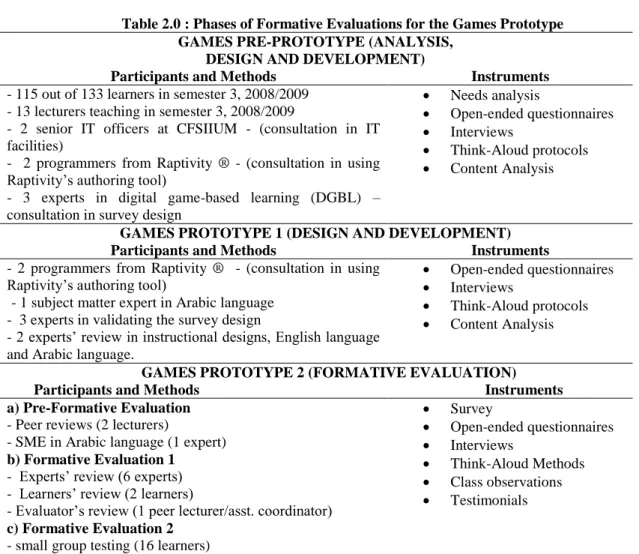
The process of consultation, discussion and validation were communicated through the researcher’s email at [email protected]. The formative evaluation for pre-prototype 1 went through several try-out sessions with a limited number of the user groups such as teachers and learners who will eventually use the materials and expert appraisal or review from a group of experts consisting of subject matter experts, instructional design experts, and teachers review of the materials (Nieveen, 2007). Prototype 1 and prototype 2 have been evaluated via four (4) types of formative evaluation which are expert review, one-to-one evaluation, small group test and field test which were adapted from Tessmer (1993, p. 15). The process of formative evaluations for the design and development principles were conducted in the following phases as shown in Table 2.0 below:
Table 2.0 : Phases of Formative Evaluations for the Games Prototype GAMES PRE-PROTOTYPE (ANALYSIS,
DESIGN AND DEVELOPMENT)
Participants and Methods Instruments
- 115 out of 133 learners in semester 3, 2008/2009 - 13 lecturers teaching in semester 3, 2008/2009
- 2 senior IT officers at CFSIIUM - (consultation in IT facilities)
- 2 programmers from Raptivity ® - (consultation in using Raptivity’s authoring tool)
- 3 experts in digital game-based learning (DGBL) – consultation in survey design
Needs analysis
Open-ended questionnaires Interviews
Think-Aloud protocols Content Analysis
GAMES PROTOTYPE 1 (DESIGN AND DEVELOPMENT) Participants and Methods Instruments
- 2 programmers from Raptivity ® - (consultation in using Raptivity’s authoring tool)
- 1 subject matter expert in Arabic language - 3 experts in validating the survey design
- 2 experts’ review in instructional designs, English language and Arabic language.
Open-ended questionnaires Interviews
Think-Aloud protocols Content Analysis
GAMES PROTOTYPE 2 (FORMATIVE EVALUATION) Participants and Methods Instruments a) Pre-Formative Evaluation
- Peer reviews (2 lecturers)
- SME in Arabic language (1 expert)
b) Formative Evaluation 1
- Experts’ review (6 experts) - Learners’ review (2 learners)
- Evaluator’s review (1 peer lecturer/asst. coordinator)
c) Formative Evaluation 2
- small group testing (16 learners) - field testing 1 (33 learners) - field testing 2 (49 learners)
Survey Open-ended questionnaires Interviews Think-Aloud Methods Class observations Testimonials
c) Cyclical, iterative, teamwork :
The iterative cycles of the five (5) phases of analysis, design, development, implementation and evaluation used in this project are in accordance to the ADDIE Model as shown in Figure 1.0 :
Figure 1.0 : Iterative cycles of adapted ADDIE’s model
The front-end analysis for the learning needs of the prototype’s design and development was then conducted based on the design and development of product and tool research (Richey & Klein, 2007) or previously known as Type 1 of developmental research (Richey, Klein, & Nelson, 2004). The differences between TYPE 1 and TYPE 2 developmental research are shown in Table 3.0 below :
Table 3.0 : A Summary of the 2 Types of Developmental Research Product and Tool Research
Or Type 1 of DR
Model Research Or Type 2 of DR
Emphasis
Study of specific product or program design, development, &/or
evaluation project
Study of design, development, or evaluation processes, tools, or models
(can focus only on ONE phase)
Product
Lessons learned from developing specific products and analyzing the
conditions that facilitate their use
New design, development, and evaluation procedures &/or models and
conditions that facilitate their use
CONTEXT-SPECIFIC CONCLUSION
GENERALIZED CONCLUSIONS
This research has embraced the product and tool research method (Richey & Klein, 2007) or previously known as Type 1 of developmental research (Richey, Klein, & Nelson, 2004). The product for this study is an online Arabic vocabulary learning games prototype, which was conceptualized, designed and developed based on both
theoretical and practical aspects. The development of the online Arabic vocabulary learning games prototype as a final educational product is a combination of the design and development principles with vocabulary games templates from Raptivity ® e-learning authoring tools in an online learning environment. The researcher is the main designer and developer of this learning prototype module. It is however, the nature of developmental research that the researcher collaborates with a development team. Relevant tools of development are employed and the development process is documented in work logs as illustrated in Table 4.0 :
Table 4.0 : Work Logs of Development Process and Stages Stage Work Log Descriptions
Stage 1 Designing the online games storyboards.
Designing the storyboards based on ‘Design Principles’.
Stage 2 Designing the webpage.
Designing the webpage for the online vocabulary games learning.
Stage 3 Developing the vocabulary games.
Developing the games by integrating the learning contents into the games design templates of Raptivity. Stage 4 Uploading and
publishing the games website.
Uploading and publishing the website in the internet server and testing the application.
Stage 5 Conducting pre-formative evaluation
Conducting pre-formative evaluation with subject-matter expert (SME) and lecturers as future users. Stage 6 Revision of design
and development
Revising and modifying the development process based on the feedbacks and responses.
Stage 7 Conducting formativeevaluation 1.
Conducting formative evaluation 1 of the online Arabic vocabulary games with expert reviewers, lecturers and learners as actual users.
Phase 8 Revision of design and development
Revising and modifying the development process based on the feedbacks and responses.
Stage 9 Conducting formative evaluation 2.
Conducting formative evaluation 2 of the online Arabic vocabulary games with students and teachers as the actual users.
Phase 10 Data analysis and report
Conducting the data analysis and report of the design and development process
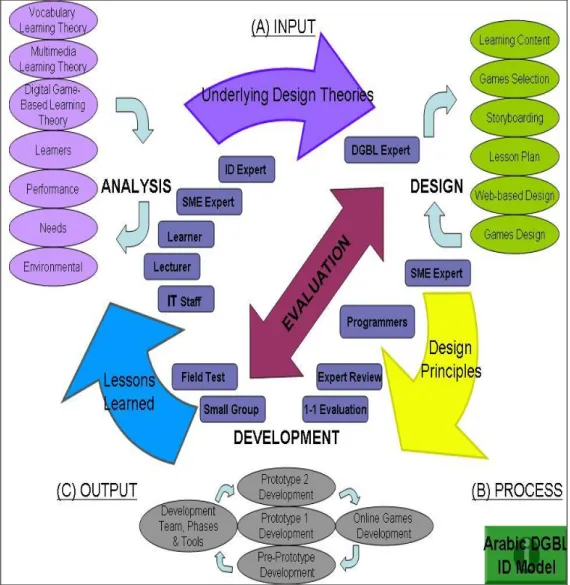
d) Extensive literature, collaboration, partnership and various research technologies : The design and development of the online Arabic vocabulary learning games prototype have not been simply conducted as in designing and evaluating the games formatively or summatively. It has been scrutinized through the analysis of extensive literature, collaboration and partnership between different learners, lecturers, experts and instructional designers and integrated various research technologies and tools. In order to construct the framework for the online Arabic vocabulary learning games prototype, as shown in Figure 2.0, analyses of theories from literature such as of Nation’s (2003), digital game-based learning (Prensky, 2001) and multimedia learning (Mayer, 2001) were conducted. The analyses of extensive literature were combined with a 9-year personal teaching experience of the researcher and the reasons for failures in Arabic subjects among learners in 4 consecutive semesters of 2005/2006 until 2008/2009 (TEMU Report, 2005-2009). Based on the researcher’s initial analysis and observation, the lack of instructional technologies in current teaching and learning of Arabic has led to the problem of memorizing the content of Arabic lessons taught in the classroom, as echoed by Mohd Feham (2006) and Zawawi (2008). Concurrently, the reports on students’ failures revealed that among the main and obvious factors were poor attendance in the classroom, weaknesses in memorizing Arabic vocabularies and their minimal effort to improve and pay attention in Arabic language learning. These factors are mainly related to students’ learning attitude and motivation in learning Arabic.
Figure 2.0 : Design theories of online vocabulary learning games from extensive review of related literature
In addition, the ADDIE’s adapted model is chosen as the instructional design model for the research as it fits the design and development methods, objectives and approaches to portray a complete picture and understanding, theoretically and practically, of an online vocabulary learning module. Walter Dick and Lou Carey are widely viewed as the torchbearers of the ADDIE methodology, through their book The Systematic Design of Instruction
(Dick & Carey, 1996). Akilli (2004) has proposed the FID2GE model, also consisting of four phases of design; analysis, design, development and evaluation, which stands for “Fuzzified Instructional Design Development of
Game-like Environments” for learning in which the name was derived from the dynamism, non- linearity and
the fuzziness of games (p. 139-142) as shown in Figure 3.0 :
Figure 3.0 : FID2GE model
The researcher, however, opted to use the adapted ADDIE’s model (Figure 1.0) instead of FID2GE due to the uncertainty of the implementation phase in FID2GE and the existence of five (5) main phases in ADDIE to facilitate the research. The argument of whether ADDIE is a model or just a process is not the objective of discussion in this paper. To reiterate, the ADDIE model is chosen for its systematic generic approach in instructional design, which clarifies the instructional framework to the designers or researchers in order to ensure the effectiveness of instructional products with creative processes (College Station, 2001).
e) Improved theory, product and design principles based outcome :
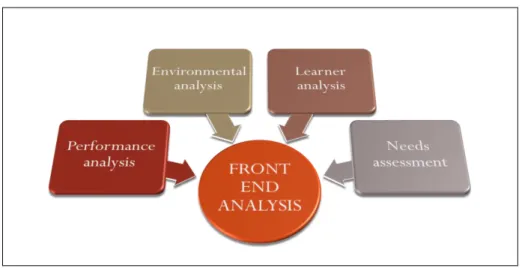
The refinement of theories from the literature in the iterative cycles of testing and refinement of solutions in practice (Reeves, 2006 & Herrington, 2007)begun at the front-end analysis phase directed at analysing four (4) components of needs analysis which was adapted by Dabbagh (2006) and as shown in Figure 4.0. The participants involved were 113 out of 133 students studied Arabic language in semester 3, 2008/2009 as well as
EVALUATION DESIGN AND DEVELOPMENT ANALYSIS PRE -ANALYSIS
the lecturers and were required to answer the needs and pre-design survey of an online Arabic vocabulary games in CFSIIUM (Muhammad Sabri and Nor Aziah, 2011). The validation of the instrument was completed by a lecturer, from the Institute of Education (INSTED, IIUM), teaching the subject of Research Methodology in IIUM.
Figure 4.0 : The Analysis Procedure in Developmental Research
The initial design from the analysis phase was then validated by an expert who is an Arabic language lecturer from the Centre for Language and Pre-University Academic Development (CELPAD) of IIUM in order to refine the contents of Arabic language integrated in the online games. The theories were also refined by an expert from the Centre for Professional Development (CPD) of IIUM who specializes in instructional design and teaching using technology. At the end of this phase, the design and development principles were established to guide the development process. The details of procedures conducted were previously explained in Table 2.0.
Design and Development of Online Arabic Vocabulary Learning Games Prototype
The online vocabulary learning games was designed as a final research product of additional teaching and learning aid in Arabic vocabulary learning and was hosted in a web-based environment. The general outlines of design and development of this online Arabic vocabulary games prototype are as the followings:
a) Constructing general research framework b) Conducting front-end analysis procedures c) Validations from various experts (ID & SME) d) Consultations from various experts (ID & SME) e) Constructing ‘Initial design principles’
f) Revising and validating ‘design principles’ g) Development of initial pre-prototype
h) Revisions of prototype 1 and prototype 2 in iterative and cyclic and process – meant for changes and improvement of final games prototype
i) Conducting formative evaluation of design and development among various experts, lecturers, and learners
j) Final product is ready for use
Figure 5.0 : Main Page of Online Arabic Vocabulary Learning Website
Figure 6.0 : Screenshot of Online Arabic Vocabulary Learning Website
Main Characteristics of Online Arabic Vocabulary Learning Games Prototype
b) It has a compendium of 34 varieties of games and distributed into 7 levels of vocabulary difficulties. c) It is supported by online learning tools such as instructions to play, learning objectives for every game, online translator, online dictionary, games glossary in English to Arabic and 2 vocabulary test games.
d) It is functioning as a supportive teaching and learning tool for Arabic language in the classroom and multimedia laboratory as the followings:.
i) The lecturer facilitates (facilitator)
ii) Learners collaborate (collaborative learning)
iii) Has the potential for self-instruction (synchronous and asynchronous modes) iv) Supportive learning tool for blended/hybrid learning
v) Can be used between 14 weeks of semester (flexibility)
Challenges and Obstacles
Design and development research (DDR) provides an alternative to conduct rigorous and systematic design research based on solid theoretical foundations. It possesses the necessary approaches to design and develop the principles of the games prototype with the flexibility of revision in iterative cycles of user testing sessions in real and authentic setting. However, each endeavor is not without its own challenges and barriers. The challenges and obstacles mentioned in this paper were established from the experience of researcher during the design and development of this online games prototype and are as the followings:
a) The limitation of technical support in Raptivity ® software in Arabic writing systems and fonts exists, and has caused some restrictions in using Arabic conveniently, especially in the display of Arabic fonts with the vowel sounds.
b) The limitation of games design templates in this software also restricted the design of language games with advanced features such as in displaying overall scores for all players for the purpose of competition, more choices of attractive games templates, colours, and buttons.
c) This study is specifically designed for elementary level Arabic learners only based on the selection of vocabulary games and may not be suitable for higher level of learning.
d) The financial implication is one of the restrictions to producing a high technology games for this study which has resulted in the researcher in using the Raptivity ® software as a platform to develop Arabic vocabulary games.
e) This software can be used by all educators with proper training and briefing without the need for a high level of computer competency skills such asin using advanced authoring software to develop games such as the Adobe Flash, and SwishMax ®. Thus, this software could not be used to develop the advanced features of language games.
SUGGESTIONS FOR EDUCATORS AND INSTRUCTIONAL DESIGNERS
a) The technical limitation of this software in Arabic writing systems and fonts should be improved and enhanced in order to make it more compatible, convenient and user-friendly to Arabic learning application. b) The limitation of games design templates in the Raptivity ® software can also be upgraded and enhanced with advanced features such as in displaying overall scores for all players for the purpose of competition, more choices of attractive games templates, colours, and buttons.
c) The future research and study of using game-based learning in Arabic language could attempt to design and develop the games that use different learning platforms compared to this study such as the arcade, console, CD-based and handheld or mobile learning games.
d) The educational institutions that offer Arabic language learning should play more active role in producing attractive and interactive teaching and learning aids in order to enhance students’ motivation and attitude in learning process and improving their achievement and performance.
e) The Arabic language teachers and practitioners should be more aware of and knowledgeable with the latest teaching technology and computer skills. Some groups with high computer skills in every educational institution can be trained periodically in a cluster training in order to help them producing new teaching and learning aids in Arabic language.
f) There should be sessions of cooperative work and research activities between language teachers such as the Arabic, English or other languages with the instructional designers and computer experts to design and develop advance and effective games for teachers and learners.
g) Other ID models may be used in the design and development of games based on the objectives, structures, expected outcome, technology or others issues based on the suitability and purpose of games design and development.
SUMMARY
This paper has described an effort to design and develop an online Arabic vocabulary learning games prototype in IIUM using the design and development research (DDR) methodology and approach. This Arabic educational DGBL is now in function and linked to several learning and research institutions such as My-Arabic at CELPAD, IIUM (Link: http://myarabic.e-celpad.com/), Malaysian Foundation of Innovation (Link : http://www.yim.my/databank/index.cfm?menuid=5&action=show&ib=128&), and educational blog in Arabic learning such as http://mari-belajar-bahasa-arab.blogspot.com/. The outcome of this project will hopefully enhance the process of teaching and learning Arabic language in IIUM as well as in other institutions. This research is hoped to trigger more in-depth research methodologies and approaches in the design and development on online educational games based on real needs in the real settings of learning environment and institutions, This prototype has reflected a set of design and development principles for an online Arabic vocabulary learning games in the Malaysian context specifically and for non-native Arab speakers in general.
NOTES ON CONTRIBUTOR
Muhammad Sabri Sahrir (Ph.D) is currently an academic staff at the Department of Arabic Language and Literature, KIRKHS, International Islamic University Malaysia (IIUM). His research interests are curriculum development and evaluation, educational technology, and teaching Arabic as a foreign language.
Nor Aziah Alias (Ph.D) is an associate professor at the Faculty of Education, Universiti Teknologi MARA (UiTM). Her current research is mainly in educational design research, instructional design and technology and ICT for development. She has also published in the areas of adult and online distance learning.
Zawawi Ismail (Ph.D) is a senior lecturer at Department of Language and Literacy Education, Faculty of Education Building, University of Malaya. His current areas of expertise are teacher education, Islamic education, Arabic curriculum, teaching methodology and ICT in education.
Nurulhuda Osman (Ph.D candidate) is currently an academic staff at the Centre for Languages and Pre-University Academic Development, International Islamic Pre-University Malaysia (IIUM). Her research interests are curriculum development and evaluation and teaching Arabic as a foreign language.
REFERENCES
Akilli, G.K. (2004). A proposal of instructional design/development model for game-like learning environments:The FID2GE model. Master Thesis, The Middle East Technical University, Turkey, retrieved on 15th December 2008 from http://simge.metu.edu.tr/master/index.pdf
Akili, G.K. (2007). Games and simulation: A new approach in education. In D. Gibson, C. Aldrich, & M. Prensky (Ed.). Games and simulations in online learning, research and development framework. (1st ed., pp. 1-20). United States of America : Information Science Publishing.
Bannan-Ritland, B. (2003). The role of design in research: The integrative learning design framework. Educational Researcher, Vol. 32, No. 1, January/February, 2003, pp. 21-24.
College Station (2001). ADDIE instructional design model. Texas Copyright 2001 © LOT All rights reserved. L:\htms\training\handouts\pf_files\addie.doc. Published on 01/23/01.
Connolly, T. & Stansfield, M. (2006). Using games-based eLearning technologies in overcoming difficulties in teaching information systems. Journal of Information Technology Education, Volume 5, 2006. p. 463 Chiang, Y.T., Sunny Lin, S.J., Cheng, C.Y. & Eric Liu, Z.F. (2011). Exploring online game players’ flow
experiences and positive affect. Turkish Online Journal of Educational Technology, 10(1), pp. 106-114. Dabbagh, N. (2006). The instructional design knowledge base. (Online) Retrieved from
http://classweb.gmu.edu/ndabbagh/Resources/Resources2/FrontEnd.htm on 27 July, 2011.
Dick W., & Carey L. (1996). The systematic design of instruction (4th Edition). New York: Haper Collins College Publishers.
Gredler, M.E. (1992). Designing and evaluating games and simulations: A process approach. London, Great Britain : Kogan Page Limited.
Gredler, M.E. (2004). Games and simulations and their relationship to learning In D.H. Jonassen (Ed.),
Handbook of research on educational communication and technology, (2nd ed., pp. 571-581). New Jersey, US : Lawrence Erlbaum Associates Publishers.
Herrington, J., McKenney, S., Reeves, T. & Oliver, R. (2007). Design-based research and doctoral students: Guidelines for preparing a dissertation proposal. In C. Montgomerie & J. Seale (Eds.), Proceedings of World Conference on Educational Multimedia, Hypermedia and Telecommunications 2007 (pp. 4089- 4097). Chesapeake, VA: AACE.
Liu, C.C., Chen, Y.B. & Huang, C.W. (2011). The effect of simulation games on the learning of computational problem solving. Computers & Education 57 (2011), pp.1907–1918.
Malone ,T.W., & Lepper, M.R. (1987). Intrinsic motivation and instructional effectiveness in computer-based education. In R.E. Snow, & M.J. Farr (Eds.) Aptitude, learning and instruction, 3. Cognitive and affective process analysis. (pp. 255-286). Hillsdale NJ: Erlbaum.
Mayer, R.E. (2001). Multimedia learning. 9th edition, 2007. New York, USA: Cambridge University Press. Markauskaite, L. & Reimann, P. (2008). Enhancing and scaling-up design-based research: The potential of
e-research. Centre for Research on Computer-supported learning and Cognition (CoCo), University of Sydney, Australia. Retrieved on 12th Dec 2008 from www.fi.uu.nl/en/icls2008/343/paper343.pdf
Michael, D. & Chen, S. (2006). Serious games – Games that educate, train and inform. E-Book edition, Canada: Thomson Course Technology PTR, pp. 30-43.
Mohd Feham, Md. Ghalib & Isarji, Sarudin (2000). On-line Arabic: Challenges, limitations and
recommendations.In proceedings of National Conference on Teaching and Learning in Higher Education, Universiti Utara Malaysia, Kedah, pp. 231-239.
Mohd Feham, Md. Ghalib (2006). The design, development and testing on the efficacy of a pedagogical agent on the performance and program rating scores among students learning Arabic. Unpublished doctoral dissertation, Universiti Sains Malaysia (USM).
Muhammad Sabri, Sahrir & Nor Aziah, Alias (2011) A study on Malaysian language learners’ perception towards learning Arabic via online games. GEMA Online Journal of Language Studies, 11 (3). pp. 129-145. ISSN 1675-8021
Nation I.S.P. (2001) Learning vocabulary in another language. 4th edition, 2003. United Kingdom : University Press, Cambridge.
Nor Aziah Alias (2007). Spurring innovation through developmental research in education. Educational Awakening : Journal of The Educational Sciences, 4(1), 2007, pp. 45 – 60, published by Institute of Education, International Islamic University Malaysia.
Nieveen, N. (2007). Formative evaluation in educational design research. - An introduction to educational design research. In the proceedings of the seminar conducted at the East China Normal University, Shanghai (PR China), November 23-26, 2007, pp. 89-102.
Pivec. M., Koubek, A. & Dondi, C. (2004). Guidelines for game-based learning. Lengerich, Germany: Pabst Science Publishers.
Plomp, Tjeerd (2007). Educational design research : An introduction. In the proceedings of the seminar
conducted at the East China Normal University, Shanghai (PR China), November 23-26, 2007, pp. 9-36. Prensky, M. (2001). Digital game-based learning. Edition 2007, USA: Paragon House.
Reeves, T. (2006). Design-based research for advancing educational technology. Retrieved on 9th January, 2009 from http://www.it.coe.uga.edu/~treeves/EDIT9990/EDIT99909Jan06.ppt
Reigeluth, C. M. & Frick T.W., (1999). Formative research: A methodology for creating and improving design theories. In Regeluth, C. M. (Ed.) Instructional Design Theories and Models Vol. II., pp.
633-651.Mahwah NJ: Lawrence Erlbaum Associates.
Richey, R.C., Klein, J.D. & Nelson, W. A. (2004). Developmental research: Studies of instructional design and development. Retrieved on 31st March, 2009 from http://www.aect.org/edtech/41.pdf
Richey, R.C. & Klein, J.D. (2007). Design and development research. New Jersey, USA : Lawrence Erlbaum Associates, Inc.
Roslina, Ibrahim & Azizah, Jaafar (2008). Web based educational games as a learning tools: Issues and challenges on design and development perspective in Malaysia. Proceeding in the 4th International
Conference on University Learning and Teaching, pp. 421-432, on 20-21 October 2008 organised by UiTM Shah Alam, Malaysia.
Roslina Ibrahim, Rasimah Che Mohd Yusoff, Hasiah Mohamed@Omar, & Azizah Jaafar (2011). Students perceptions of using educational games to learn introductory programming. Journal of Computer and Information Science, Vol. 4, No. 1; January 2011, retrieved on April 14, 2011 from
www.ccsenet.org/journal/index.php/cis/article/download/8246/6507
Squire, K. (2005). Game-based learning : Present and future of state of the field. Retrieved on 31st December, 2008 from http://www.masieweb.com/dmdocuments/Game-Based_Learning.pdf
Tan, P-H. Ling, S-W. & Ting, C-Y. (2007). Adaptive digital game-based learning framework. DIMEA '07 Perth, Western Australia. © 2007 ACM 978-1-59593-708-7/07/09
Testing and Measurement Unit – TEMU (2005-2009). Report of percentage failure in Arabic subjects and reasons. Quranic Language Department (QLD), Centre for Foundation Studies (CFS), International Islamic University Malaysia (IIUM).
Tessmer, M. (1993). Planning and conducting formative evaluations, improving the quality of education and training. © Martin Tessmer, 1993, London: Kogan Page Limited.
Tuzun, H. (2004). Motivating learner in educational computer games. Doctoral dissertation, Indiana University, USA. Retrieved from ProQuest Theses, (UMI number 3134052) on January 9, 2008.
Tsai F.H., Yu, K.C. & Hsiao, H.S. (2008). A pilot study of comparing the effectiveness in game-based and web-based learning. Retrieved from National Taiwan Normal University Website on 31st of December, 2008 from http://www.ntnu.edu.tw/acad/docmeet/96/a16/a1601.pdf
Van der Akker, J. (2007). Curriculum design research. - An introduction to educational design research. In the proceedings of the seminar conducted at the East China Normal University, Shanghai (PR China), November 23-26, 2007, pp. 37-52.
Wang, F. & Hannafin, M.J. (2005). Design-based research and technology-enhanced learning environments. ETR&D, Vol. 53, No. 4, 2005, pp. 5–23, ISSN 1042–1629.
Whitton, N. (2010). Learning with digital game, a practical guide to engaging students in higher education. New York and London : Routledge Taylor & Francis Group.
Zarina Che Embi, & Hanafizan Hussain (2005). Analysis of local and foreign edutainment products – An effort to implement the design framework for an edutainment environment in Malaysia. Multimedia University, Malaysia. The Journal of Computers in Mathematics and Science Teaching, 24(1), 2005,
ProQuest Education Journals, pp. 27-42.
Zawawi, Ismail. (2008). Penilaian pelaksanaan kurikulum kemahiran bertutur bahasa Arab Komunikasi Di Sekolah Menengah Kebangsaan Agama. An evaluation of implemented curriculum of speaking skill in Arabic Communicative subjects in Religious Secondary Schools. Unpublished PhD Dissertation, Universiti Kebangsaan Malaysia, Bangi.