A Conceptual Framework
Judy van Biljon and Ronell van der Merwe
University of South Africa, Johannesburg, South Africa
[email protected]
[email protected]
Abstract: Advances in cloud computing technology coupled with increasing volumes of data has driven the growth and differentiation of cloud-based solutions in teaching and learning. The cloud computing industry has matured over the past decade and the number of publications steadily rose, to build on the maturity of the field researchers investigating cloud computing research in the mobile teaching and learning domain need to be cognisant of the state of the art. The objective of this paper is to analyse the available literature in the field of cloud computing for mobile teaching and learning to identify the main categories of research, the prevalent methodologies and research gaps, and then integrate the findings in a conceptual framework representing the current state of the field in terms of research opportunities. A systematic mapping study on relevant publications in journals and conferences was conducted. Mapping studies are a suitable method for structuring a research field concerning research questions about contents, methods and trends in the available publications. A systematic literature review and mapping was used to select 107 articles from a total of 21 822 publications in five prominent databases, namely ACM, ERIC, IEEE, Google Scholar and Springer. The analysis was done in October 2017 on papers published between 2013 and 2017. The contribution is to classify existing work and suggest future opportunities based on a systematic mapping of mobile cloud computing (MCC) for teaching and learning research. The analysis provides an overview of the field in terms of what is researched, how that is researched and where the future research contributions may lie. The findings are integrated to present a non-prescriptive, conceptual framework on mobile cloud computing research for teaching and learning. Researchers can use the proposed framework as a point of reference in starting or aligning their own projects and establishing where future research opportunities exist.
Keywords: mobile, cloud computing, maturity, m-learning, e-learning
1.
Background
Research fields mature over time in terms of the kinds of research that are published; therefore, it could be argued that the changing nature of the published papers can be used as an indicator of how a field is maturing (Bødker, 2015). Systematic mapping studies are considered a suitable method for structuring a broad research field in terms of research questions about contents, methods and trends in the available publications (Wendler, 2012). The cloud computing industry has matured over that past decade and literature surveys have been done as exemplified in the following: a general overview (Fernando, Loke and Rahayu, 2013); an overview on issues, challenges and needs (Gao, Gruhn and Roussos, 2013), architectures, challenges, and applications (Liu et al., 2013) and state of the art and future directions (Rahimi et al., 2014). There has been surveys on MCC for education (González-Martínez et al., 2015) as well as on security issues and challenges of MCC (Shahzad and Hussain, 2013) and many case studies on implementing MCC. What is lacking is a conceptual framework to represent and connect the research topics, methodologies and opportunities in the teaching and learning domain. The research is guided by the question: How can research opportunities in the field of cloud computing for mobile teaching and learning be presented?
The objective of this paper is to analyse the available literature in the field of cloud computing for mobile teaching and learning to propose a conceptual framework that can be used as a benchmark and a point of departure in further research on MCC and specialisation within the MCC domain. We investigate some maturity trends like the number of papers and the citation counts, but the contribution is a conceptual framework and not a maturity model.
2.
Research methodology
A systematic literature review comprises a systematic search for, appraisal and synthesis of research evidence of comprehensive scope with clear inclusion and exclusion criteria (Pickering et al., 2015). Grant and Booth (2009) propose a topology including 14 types of reviews to provide descriptive insight into the most common types of reviews and associated methodologies. According to their topology, the critical review is relevant since our aim is to identify significant terms in the field. We do that by specifying the time and scope constraints and also seeks to identify gaps in the literature. The latter resonates with the characteristics of
mapping reviews and therefore the methodology followed can be described as a critical mapping review. In this study, the synthesis is narrative with tabular accompaniment. Given the interdependence between the literature review and the findings from the literature review, a clear separation between methodological description and findings was not always possible. The methodology will now be presented followed by the main results from the literature review.
2.1 Systematic literature review
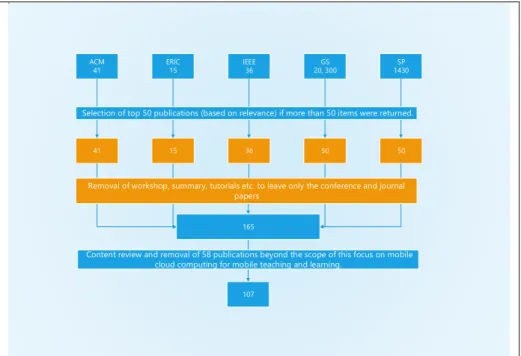
The data capturing was done in October 2017. The search string used to extract the publications were as follows: mobile AND technology AND ‘cloud computing’ AND (teaching OR learning). The date range was: 2013 to 2017 and we selected only journals and conference papers. The databases searches included the ACM, ERIC, IEEE, Google Scholar and Springer. The database search results were selected according to relevance. Figure 1 presents the selection process. After the removal of those items that were not conference or journal papers, 165 publications remained. The abstracts of the 165 papers were read and the relevant sections were extracted into an Excel spreadsheet for content analysis. The publications were combined and grouped by year. During this revision, 58 of the publications were found to be outside the scope of this study and thus removed. The main topics of the papers removed are indicated below per publication year. This brought the number of publications analysed with Atlas.ti to 107. The topics of the papers removed included the following: health care, physical infrastructure, alternative communication, vehicular cloud computing, networks, cultural heritage and multimedia, vision-based navigation and authentication.
Figure 1: Systematic literature selection flow diagram
2.2 Text analysis
The papers were read and content from the dataset of 107 papers were abstracted into the following columns: title, purpose, theories or models applied, methodology, limitations, findings and future research. The publications are in different formats and the reporting differs in terms of the level of detail. Therefore, it is not possible to conclude that the lack of reporting a specific aspect implies omission. For example, when people refer to ‘literature review’ as a methodology, it is not clear if that implies a systematic literature review. However, if a literature review is specified as a methodology, we assumed that to be a systematic literature review. Atlas.ti version 8 was used to do the content analysis. The datasheet containing the information originally extracted for the 107 papers can be downloaded from goo.gl/DjpWSM.
3.
Results and findings
The systematic literature review was used to select the most appropriate publications. The content analysis of the papers revealed the following: 71% (77) of the 107 papers focused on teaching or learning; the rest referred to teaching and learning in passing. The 107 papers included 40% (43) applications. The content analysis to identify the topical domains and the methodologies used will be discussed in the next section.
ACM
41 ERIC15 IEEE36 20, 300GS 1430SP
41 15 36 50 50
107
Selection of top 50 publications (based on relevance) if more than 50 items were returned.
165
Removal of workshop, summary, tutorials etc. to leave only the conference and journal papers
Content review and removal of 58 publications beyond the scope of this focus on mobile cloud computing for mobile teaching and learning.
3.1 Textual analysis
The content analysis (using Atlas.ti software) was done to identify the research types, prioritise the methodologies according to frequency of use and detect the areas of future research, as explained below.
3.1.1 Research types
A previous survey identified three main domains (types of research), namely the instructional, architectural
and theoretical (Van der Merwe and Van Biljon, 2018) and we used that to classify the publications. The publications that did not fit into any of those domains were reread and the following keywords emerged:
usability, augmented reality and internet of things (IOT). Going forward, we added Usability as a domain and grouped the rest under the domain, Next generation computing. Table 1 contains the references of the papers that received more than ten citations, due to space limitations we could not include all the papers but the full table with the references is available from https://tinyurl.com/yd2y85rv .
Table 1: Summary of the findings
Domains References
Instructional (new teaching approaches), i.e. how to use the cloud to support teaching and learning in practice
(Fernando, Loke and Rahayu, 2013), (Ally and Samaka, 2013), (Gibson, 2013), (Liu et al., 2013), (Despotović-Zrakić et al., 2013), (Herro, Kiger and Owens, 2014), (El-Sofany et al., 2013), (Wang, Chen and Khan, 2014), 5), (Sun and Shen, 2014), (Meske et al., 2014), (Wang, Chen and Khan, 2014) Architectural (portability,
interoperability and integration of teaching resources towards building the platform
(Jararweh et al., 2013), (Butoi, Tomai and Mocean, 2013), (García-Peñalvo
et al., 2014), (Abolfazli et al., 2014), (Wong et al., 2015), (Lane, Georgiev and Qendro, 2015)
Theoretical (models, frameworks and taxonomies for
understanding MCC and theorising the opportunities, challenges, and benefits of using the technology)
(Selviandro and Hasibuan, 2013), (Fulantelli et al., 2013), (Bora and Ahmed, 2013), (Choi, Park and Jeong, 2013), (Shahzad and Hussain, 2013), (Gao, Gruhn and Roussos, 2013), (Macario and Srirama, 2013),
(Kaewpuang et al., 2013), (Zhu et al., 2013), (Ratten, 2013), (Zhang & Zhou, 2014), (Rahimi et al., 2014), (Alzahrani, Alalwan and Sarrab, 2014), (Park and Joon, 2013), (Cochrane, 2014), (Zu et al., 2015), (Nguyen, Nguyen and Misra, 2014), (González-Martínez et al., 2015)
3.1.2 Methodologies
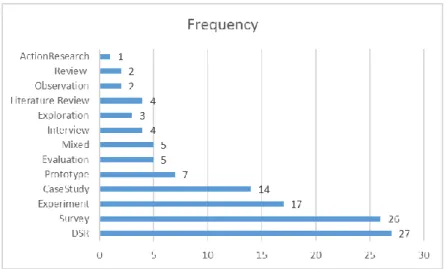
Figure 2 shows the most prevalent methodologies based on word frequency counts of the terms (methodologies) extracted. In some publications, the methodology was simply indicated as qualitative (11 papers) or quantitative (5 papers) but most authors provided a more detailed description. The term "questionnaire" describes the tool used in surveys, but the term is also used as a synonym for a survey and therefore the studies reporting survey and questionnaire were combined under survey. Design science research (DSR) was the most common methodology, followed by surveys, experiments and case studies. The prevalence of DSR can be explained by the fact that 41% of the studies involved the development of an application.
Figure 2: Methodologies rated according to frequency
3.1.3 Research directions
To get an understanding of the future research planned, we investigated the terms (actual words) most frequently used in discussing future research. Considering the text extracted from the publications on future research, the word frequencies were computed. After removing the search terms, prepositions and other common terms the word frequencies were calculated. The results are depicted in figure 3.
Figure 3: Words most frequently used in describing future research
The technology aspect is represented by terms such as devices, development, application, design and
implement is important. This resonates with existing research which identified research on new applications, services and functions as follows (Van der Merwe and Van Biljon, 2018): new applications, services and functions to be embedded in the cloud (Anshari, Alas and Guan, 2016), existing services to be improved in terms of cost (Cheng, Huang and Lin, 2012) and scalability, flexibility and availability of e-learning resources to be improved (Anwar, Masud and Huang, 2012).
Another focus is the human aspect suggested by terms such as students, learners, users, social and teachers. The confluence of those aspects lead to the research in Human-Computer interaction and usability. The term
trust resonates with the notions of security and ethics (Meske et al., 2014) but also relates to the social aspects of MCC and interaction. Therefore the research areas should not be seen as mutually exclusive. More research is needed on the policies that govern privacy, security and ethics for the users (both learners and educators) that engage with the content, as well the protection of the intellectual property on the MCC platform (Traxler,
9% 9% 8% 7% 7% 6% 6% 6% 5% 4% 4% 4% 4% 4% 4% 3% 3% 3% 3% 3%
devices development students environment application learners design platform social model
educational users smart test data
2010). Terms such as smart, data, analysis could represent the data science focus, previously identified by (Eynon, 2013; Abaker et al., 2015) and concurs with earlier findings that the role of “big data” and how it can be utilised in the MCC learning environment to enhance learning (Anshari, Alas and Guan, 2016) is under-researched. The investigation of new uses of cloud computing enabled by dynamic, interactive knowledge management and the blending of services and prototypal set-ups developed to evaluate new technologies for environmentally driven education also warrants attention (Caviglione, Coccoli and Gianuzzi, 2011).
3.1.4 Maturity of the field
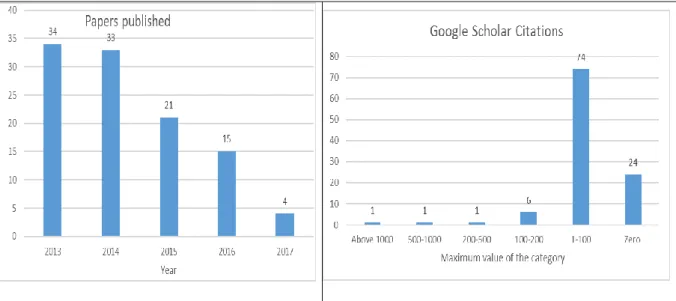
The maturity of a research field is generally determined by the volume of the research, the continued growth and diversification and the impact of the research. Cheon, Sabherwal and Groven (1993) argue that for the maturity of the field as a whole, a greater diversity of research topics and methods is needed. Publication and citation analysis can yield significant insights into the history and potential future of a research field (Casey et al., 2015). In this analysis, we focus on the number of publications during 2013 to 2017 and the citations of those publications. The number of publications per year (based on keyword selection criteria) showed a remarkable decline, 2013(34); 2014(33); 2015(21), 2016(15) and 2017(4) as depicted in figure 4. The delay in capturing publications on databases could explain the low 2017 value, but that still means a downward trend in the number of papers published in 2015 and 2016. There could be many reasons for the decline; one thereof is that the field may be maturing so that the later papers are becoming more specialised and were therefore not picked-up by the set of general keywords used.
Figure 5 depicts the number of citations in the categories above 1000, 500–1000; 200–500; 100–200; 1–100 and zero. From observation, most of the papers have between 1 and 100 citation with very few highly cited papers and 25 with no citations. Notably 7 of the 10 most cited papers (all those above 130 citations) were surveys describing the state of the art, architectures, challenges, applications and future directions. The time lapse between the publication of a paper and the citations being registered impacts the findings. However, the existing volume of publications together with the number of citations suggest that the field of MCC for teaching and learning is growing and maturing.
Figure 4: Papers published 2013–2017 Figure 5: Frequency of Google Scholar citations
3.1.5 Integration of the findings in a conceptual framework
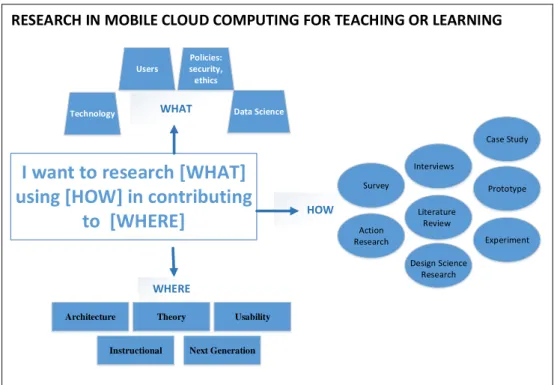
To present the findings coherently we applied the knowledge mobilisers framework suggested by Ward (2016), the latter was designed to help knowledge mobilisers reflect on, communicate and evaluate their aims and objectives towards increasing clarity and understanding across the field (Ward 2016). Acknowledging the continued growth and diversification in the field, our framework is proposed as a non-prescriptive, point of departure for verification and further research in the field of mobile cloud computing for teaching and learning. Our main findings on MCC are integrated and represented as figure 6 under the what, how and where sections, explained as follows:
The most important future research application areas (directions) based on the keyword frequencies and supported by literature include the technological development of new devices and services, the social implications for the users, data science (big data, data mining, etc.) and policies including the ethics and security policies as evident form section 3.1.3. This is useful when deciding WHAT the project is about.
The prioritisation of the methodologies used led to the selection of DSR, survey, experiment, case study, prototype, interviews, literature reviews and action research as explained in section 3.1.2. Those methodologies are useful in response to the question HOW research could be undertaken. Although that is not intended to limit the possibilities it is useful to consider what methods have been used in previous research on related topics.
The content analysis (section 3.1.1) confirmed the relevance of the types of research (instructional, architectural and theoretical) previously identified and extended that to include the domains usability and Next Generation Computing. Those categories should be considered when asking WHERE the contribution of a research study will be.
An in-depth discussion of the differences between a model and a framework is beyond the scope of this paper but having departed from Ward’s framework this is considered to be a framework. The domains identified and the application areas (directions) for future research are distinguished by their contribution to the conceptual framework. The type of research (domains) emerged from analysing the purpose of the specific research and their contribution which links closely to the methodology. For example, a person may have the aim of researching MCC policies on ethics (application area) by doing a literature survey and the contribution will be theoretical. Another may develop a technologically novel mobile App using design science research that adds to the body of instructional knowledge.
We acknowledge that the boundaries are not always clear and some research may fall into more than one application area but that does not detract from the value of thinking about the application area, the methodology and the type of research when considering a model of the existing research domain as a basis for future research.
Figure 4: Conceptual framework proposed as a point of departure in MCC research for teaching and learning.
4.
Discussion
The notable decline in the number of papers on mobile cloud computing for teaching and learning could be due to the maturation and specialisation of the field since 2013. The application areas identified, namely technology, users and policies resonate with the salient concepts of teaching and learning including the
HOW Design Science Research Survey Experiment Literature Review Prototype Action Research
RESEARCH IN MOBILE CLOUD COMPUTING FOR TEACHING OR LEARNING
Interviews
Case Study
I want to research [WHAT]
using [HOW] in contributing
to [WHERE]
Technology Data Science Policies:
security, ethics Users
Instructional Next Generation Theory
Architecture Usability
WHERE WHAT
systems, the people and the context. Data science is a dynamic application area that may become mainstream and thus be integrated with the existing areas. Regarding methodologies, design science research (which includes design based research for the purpose of this analysis) was the most prevalent. This provides evidence of a critical-realist orientation where the focus is on constructing knowledge artefacts rather than simply describing. Surveys are a close second in frequency which means that the interpretive orientation towards understanding is also strong. The evidence of experiments as a methodology (rated third in terms of frequency) could imply a positivist orientation, but those could also include design and develop projects. The types of research identified was based on an earlier publication (Van der Merwe and Van Biljon, 2018) but that is most in need of external verification and validation.
The generalisation of the findings are limited by the constrained data set and the somewhat arbitrary choices that were necessitated by the external constraints on the selection process. For example, when classifying the papers according to domains (See Table 1) we could not include all the references (in order to stay within the allowed word count) and decided to include only those papers with more than 10 citations. However, the systematic nature and rigorous description of the selection process which includes access to the extended table 1 (see https://tinyurl.com/yd2y85rv ) and access to the original data set (see
https://tinyurl.com/ydcrp4fn ) makes the study repeatable and the findings verifiable.
5.
Conclusion
This paper provided an overview of the mobile cloud computing literature from 2013 to 2017 based on a systematic selection of 107 publications from the ACM, ERIC, IEEE, Google Scholar and Springer. The analysis revealed that the number of publications returned in response to the search string declined every year from 2013 to 2017; specialisation was considered the most probable explanation. The citations (based on Google Scholar) varied with most papers (69%) receiving less than 100 citations and 22% not having been cited at all. The six most highly cited papers were all literature surveys. Future research remains focused on the broad topics of technology and users, but trends towards researching policies (concerning ethics, privacy and security) and data science is emerging.
The relevance of the categories instructional, architectural and theoretical were confirmed and usability and
next generation computing were introduced as new domains where contributions could be made. As evident from the literature there has been many surveys on MCC. This study has confirmed and extended some of the earlier findings in terms of research domains and application areas and provide evidence that the field is active and researchers are building on each other’s work through citations. The novelty and main theoretical contribution of this study is to integrate the findings and insights in a structured knowledge mobiliser’s framework for the domain MCC for teaching and learning. Applying Ward’s knowledge mobilisers framework, we formulate our insights in terms of questions that provide a point of departure in orienting a new project within the research domain. The practical contribution is that the framework can be used to guide research projects in the field of mobile cloud computing for teaching and learning in deciding what to research, how to do that and what types of contributions to consider on condition that the framework is not considered complete or immutable. . This paper contributes to the important debate on the maturity and future direction of mobile cloud computing research in education but more research is needed to replicate the study towards confirming the findings and refining the proposed framework.
References
Abaker, I., Hashem, T., Yaqoob, I., Badrul, N., Mokhtar, S., Gani, A. and Ullah, S. (2015) ‘The rise of “ big data ” on cloud computing : Review and open research issues’, Information Systems, 47, pp. 98–115. doi: 10.1016/j.is.2014.07.006. Abolfazli, S., Sanaei, Z., Alizadeh, M., Gani, A. and Xia, F. (2014) ‘An experimental analysis on cloud-based mobile
augmentation in mobile cloud computing’, IEEE Transactions on Consumer Electronics, 60(1), pp. 146–154. doi: 10.1109/TCE.2014.6780937.
Ally, M. and Samaka, M. (2013) ‘Open Education Resources and Mobile Technology to Narrow the Learning Divide’, International Review of Research in Open and Distance Learning, 14(2), pp. 14–27. doi: 10.19173/irrodl.v14i2.1530. Alzahrani, A., Alalwan, N. and Sarrab, M. (2014) ‘Mobile cloud computing: advantage, disadvantage and open challenge’, in
Proceedings of the 7th Euro American Conference on Telematics and Information Systems - EATIS ’14, pp. 1–4. doi: 10.1145/2590651.2590670.
Anshari, M., Alas, Y. and Guan, L. S. (2016) ‘Developing online learning resources: Big data, social networks, and cloud computing to support pervasive knowledge’, Education and Information Technologies, 21(6), pp. 1663–1677. doi: 10.1007/s10639-015-9407-3.
Anwar, M., Masud, H. and Huang, X. (2012) ‘An E-learning System Architecture based on Cloud Computing’, World Academy of Science, Engineering and Technology, 62, pp. 74–78. doi: 10.1.1.221.4704.
Bødker, S. (2015) ‘Third-wave HCI, 10 years later -participation and sharing’, Interactions, 22(5), pp. 24–31. doi: 10.1145/2804405.
Bora, U. J. and Ahmed, M. (2013) ‘E-Learning using Cloud Computing’, International Journal of Science and Modern Engineering (IJISME), 1(2), pp. 9–13. Available at:
https://pdfs.semanticscholar.org/c585/9727cf8118b25eb09c9466954968566b7fed.pdf (Accessed: 16 January 2018). Butoi, A., Tomai, N. and Mocean, L. (2013) ‘Cloud-Based Mobile Learning’, Informatica Economica, 17(2/2013), pp. 27–40.
doi: 10.12948/issn14531305/17.2.2013.03.
Casey, M.-C., Kerin, M. J., Brown, J. A. and Sweeney, K. J. (2015) ‘Evolution of a research field—a micro (RNA) example’, PeerJ, 3, p. e829. doi: 10.7717/peerj.829.
Caviglione, L., Coccoli, M. and Gianuzzi, V. (2011) ‘Opportunities, integration and issues of applying new technologies over e-learning platforms’, in 2011 3rd International Conference on Next Generation Networks and Services (NGNS). IEEE, pp. 12–17. doi: 10.1109/NGNS.2011.6142540.
Cheng, J.-S., Huang, E. and Lin, C.-L. (2012) ‘An E-Book Hub Service Based on a Cloud Platform’, International Review of Research in Open and Distance Learning, 13(5), pp. 39–55.
Cheon, M. J., Sabherwal, R. and Groven, V. (1993) ‘The evolution of empirical research in IS: A study in IS maturity’, Information & Management, 24(3), pp. 107–119.
Choi, M., Park, J. and Jeong, Y.-S. (2013) ‘Mobile cloud computing framework for a pervasive and ubiquitous environment’, The Journal of Supercomputing, 64(2), pp. 331–356. doi: 10.1007/s11227-011-0681-6.
Cochrane, T. D. (2014) ‘Critical success factors for transforming pedagogy with mobile Web 2.0’, British Journal of Educational Technology, 45(1), pp. 65–82. doi: 10.1111/j.1467-8535.2012.01384.x.
Despotović-Zrakić, M., Simić, K., Labus, A., Milić, A. and Jovanić, B. (2013) ‘Scaffolding Environment for е-Learning through Cloud Computing’, Educational Technology & Society, 16(3), pp. 301–314. Available at:
http://www.jstor.org/stable/jeductechsoci.16.3.301 (Accessed: 16 January 2018).
El-Sofany, H., Tayeb, A. Al, Alghatani, K. and El-seoud, S. A. (2013) ‘The Impact of Cloud Computing Technologies in E-Learning’, International Journal of Emerging Technologies in Learning, 8(1), pp. 37–43. doi: 10.3991/ijet.v8iS1.2344. Eynon, R. (2013) ‘The rise of Big Data: what does it mean for education, technology, and media research?’, Learning, Media
and Technology. Routledge , 38(3), pp. 237–240. doi: 10.1080/17439884.2013.771783.
Fernando, N., Loke, S. W. and Rahayu, W. (2013) ‘Mobile cloud computing: A survey’, Future Generation Computer Systems, 29(1), pp. 84–106. doi: 10.1016/j.future.2012.05.023.
Fulantelli, G., Taibi, D., Arrigo, M. and University of, S. (2013) ‘A Semantic approach to Mobile Learning Analytics’, in 1st International Conference on Technological Ecosystem for Enhancing Multiculturality, TEEM 2013, pp. 285–292. doi: 10.1145/2536536.2536579.
Gao, J., Gruhn, V. and Roussos, G. (2013) ‘Mobile Cloud Computing Research - Issues, Challenges and Needs’, in 2013 IEEE Seventh International Symposium on Service-Oriented System Engineering, pp. 442–453. doi: 10.1109/SOSE.2013.96. García-Peñalvo, F. J., Johnson, M., Alves, G. R., Minović, M. and Conde-González, M. Á. (2014) ‘Informal learning
recognition through a cloud ecosystem’, Future Generation Computer Systems, 32(1), pp. 282–294. doi: 10.1016/j.future.2013.08.004.
Gibson, D. (2013) ‘Assessing Teaching Skills with a Mobile Simulation.’, Journal of Digital Learning in Teacher Education, 30(1), pp. 4–10. doi: 10.1080/21532974.2013.10784720.
González-Martínez, J. A., Bote-Lorenzo, M. L., Gómez-Sánchez, E. and Cano-Parra, R. (2015) ‘Cloud computing and education: A state-of-the-art survey’, Computers and Education, 80, pp. 132–151. doi:
10.1016/j.compedu.2014.08.017.
Grant, M. J. and Booth, A. (2009) ‘A typology of reviews: An analysis of 14 review types and associated methodologies’, Health Information and Libraries Journal, 26(2), pp. 91–108. doi: 10.1111/j.1471-1842.2009.00848.x.
Herro, D., Kiger, D. and Owens, C. (2014) ‘Mobile Technology: Case-Based Suggestions for Classroom Integration and Teacher Educators’, Journal of Digital Learning in Teacher Education, 30(1), pp. 30–40. doi: 10.4018/978-1-61520-592-9.ch012.
Jararweh, Y., Tawalbeh, L., Ababneh, F. and Dosari, F. (2013) ‘Resource efficient mobile computing using cloudlet infrastructure’, in Proceedings - IEEE 9th International Conference on Mobile Ad-Hoc and Sensor Networks, MSN 2013, pp. 373–377. doi: 10.1109/MSN.2013.75.
Kaewpuang, R., Niyato, D., Ping, W., Hossain, E., Wang, P. and Hossain, E. (2013) ‘A Framework for Cooperative Resource Management in Mobile Cloud Computing’, Selected Areas in Communications, IEEE Journal on, 31(12), pp. 2685–2700. doi: 10.1109/JSAC.2013.131209.
Lane, N. D., Georgiev, P. and Qendro, L. (2015) ‘DeepEar: Robust Smartphone Audio Sensing in Unconstrained Acoustic Environments using Deep Learning’, in Ubicomp, pp. 283–294. doi: 10.1145/2750858.2804262.
Liu, F., Shu, P., Jin, H., Ding, L., Yu, J., Niu, D. and Li, B. (2013) ‘Gearing resource-poor mobile devices with powerful clouds: Architectures, challenges, and applications’, IEEE Wireless Communications, 20(3), pp. 14–21. doi:
10.1109/MWC.2013.6549279.
Macario, H. F. and Srirama, S. (2013) ‘Adaptive code offloading for mobile cloud applications: Exploiting fuzzy sets and evidence-based learning’, in In Proceeding of the fourth ACM workshop on Mobile cloud computing and services. ACM., pp. 9–16. doi: 10.1145/2482981.2482984.
Meske, C., Stieglitz, S., Vogl, R., Rudolph, D. and Öksüz, A. (2014) ‘Cloud storage services in higher education - Results of a preliminary study in the context of the Sync&Share-project in Germany’, International Conference on Learning and Collaboration Technologies, 8523 LNCS(PART 1), pp. 161–171. doi: 10.1007/978-3-319-07482-5_16.
Nguyen, T. D., Nguyen, T. T. T. and Misra, S. (2014) ‘Cloud-Based ERP Solution for Modern Education in Vietnam’, in FDSE 2014, pp. 234–247. doi: 10.1007/978-3-319-12778-1_18.
Park, E. and Joon, K. (2013) ‘An integrated adoption model of mobile cloud services: exploration of key determinants and extension of technology acceptance model’, Telematics and Informatics, 31(3), pp. 376–385. doi:
10.1016/j.tele.2013.11.008.
Pickering, C., Grignon, J., Steven, R., Guitart, D. and Byrne, J. (2015) ‘Publishing not perishing: how research students transition from novice to knowledgeable using systematic quantitative literature reviews’, Studies in Higher Education. Routledge, 40(10), pp. 1756–1769. doi: 10.1080/03075079.2014.914907.
Rahimi, M. R., Ren, J., Liu, C. H., Vasilakos, A. V. and Venkatasubramanian, N. (2014) ‘Mobile cloud computing: A survey, state of art and future directions’, in Mobile Networks and Applications, pp. 133–143. doi: 10.1007/s11036-013-0477-4. Ratten, V. (2013) ‘Cloud computing: A social cognitive perspective of ethics, entrepreneurship, technology marketing,
computer self-efficacy and outcome expectancy on behavioural intentions’, Australasian Marketing Journal, 21(3), pp. 137–146. doi: 10.1016/j.ausmj.2013.02.008.
Selviandro, N. and Hasibuan, Z. A. (2013) ‘Cloud-Based E-Learning: A Proposed Model and Benefits by Using E-Learning Based on Cloud Computing for Educational Institution’, in In Information and Communication Technology-EurAsia Conference. Berlin, Heidelberg: Springer, pp. 192–201. doi: 10.1007/978-3-642-36818-9_20.
Shahzad, A. and Hussain, M. (2013) ‘Security Issues and Challenges of Mobile Cloud Computing’, International Journal of Grid and Distributed Computing, 6(6), pp. 37–50. doi: 10.14257/ijgdc.2013.6.6.04.
Sun, G. and Shen, J. (2014) ‘Facilitating social collaboration in mobile cloud-based learning: A teamworkas a service (TaaS) approach’, IEEE Transactions on Learning Technologies, 7(3), pp. 207–220. doi: 10.1109/TLT.2014.2340402.
Traxler, J. (2010) ‘Students and mobile devices’, Research in Learning Technology, 18(2). doi: 10.3402/rlt.v18i2.10759. Van der Merwe, P. and Van Biljon, J. (2018) ‘Cloud computing services for mobile interactions: the theory practice nexus’,
Information Communication & Society. IEEE Computer Society,Durban, South Africa. pp.57-62.
Wang, M., Chen, Y. and Khan, M. J. (2014) ‘Mobile cloud learning for higher education: A case study of Moodle in the cloud’, The International Review of Research in Open and Distributed Learning, 15(2), pp. 255–267. doi:
10.19173/irrodl.v15i2.1676.
Ward, V. (2016) ‘Why, whose, what and how? A framework for knowledge mobilisers’, Evidence & Policy. doi: http://dx.doi.org/10.1332/174426416X14634763278725.
Wendler, R. (2012) ‘The maturity of maturity model research: A systematic mapping study’, Information and Software Technology. Elsevier B.V., 54(12), pp. 1317–1339. doi: 10.1016/j.infsof.2012.07.007.
Wong, L. H., Chai, C. S., Zhang, X. and King, R. B. (2015) ‘Employing the TPACK framework for researcher-teacher co-design of a mobile-assisted seamless language learning environment’, IEEE Transactions on Learning Technologies, 8(1), pp. 31–42. doi: 10.1109/TLT.2014.2354038.
Zhang, M. and Zhou, J. (2014) ‘Construction of Basic Education Cloud Computing Platform Based on Virtualization Technology’, in In Intelligent Computing Methodologies. Springer International Publishing., pp. 709–716. doi: 10.1007/978-3-319-09339-0_71.
Zhu, C., Leung, V. C. M., Hu, X., Shu, L. and Yang, L. T. (2013) ‘A Review of Key Issues That Concern the Feasibility of Mobile Cloud Computing’, in 2013 IEEE International Conference on Green Computing and Communications and IEEE Internet of Things and IEEE Cyber, Physical and Social Computing, pp. 769–776. doi:
10.1109/GreenCom-iThings-CPSCom.2013.138.
Zu, Q., Hu, B., Gu, N. and Seng, S. (2015) ‘CluSoAF: A Cluster-Based Semantic Oriented Analyzing Framework for User Behaviors in Mobile Learning Environment’, Lecture Notes in Computer Science (including subseries Lecture Notes in Artificial Intelligence and Lecture Notes in Bioinformatics), 8944, pp. 340–351. doi: 10.1007/978-3-319-15554-8.