ETSI TS 125 401
V8.2.0
(2009-01)
Technical SpecificationUniversal Mobile Telecommunications System (UMTS);
UTRAN overall description
(3GPP TS 25.401 version 8.2.0 Release 8)
Reference RTS/TSGR-0325401v820
Keywords UMTS
ETSI
650 Route des Lucioles
F-06921 Sophia Antipolis Cedex - FRANCE Tel.: +33 4 92 94 42 00 Fax: +33 4 93 65 47 16
Siret N° 348 623 562 00017 - NAF 742 C Association à but non lucratif enregistrée à la
Sous-Préfecture de Grasse (06) N° 7803/88
Important notice
Individual copies of the present document can be downloaded from:
http://www.etsi.org
The present document may be made available in more than one electronic version or in print. In any case of existing or perceived difference in contents between such versions, the reference version is the Portable Document Format (PDF). In case of dispute, the reference shall be the printing on ETSI printers of the PDF version kept on a specific network drive
within ETSI Secretariat.
Users of the present document should be aware that the document may be subject to revision or change of status. Information on the current status of this and other ETSI documents is available at
http://portal.etsi.org/tb/status/status.asp
If you find errors in the present document, please send your comment to one of the following services:
http://portal.etsi.org/chaircor/ETSI_support.asp
Copyright Notification
No part may be reproduced except as authorized by written permission. The copyright and the foregoing restriction extend to reproduction in all media.
© European Telecommunications Standards Institute 2009. All rights reserved.
DECTTM, PLUGTESTSTM, UMTSTM, TIPHONTM, the TIPHON logo and the ETSI logo are Trade Marks of ETSI registered for the benefit of its Members.
3GPPTM is a Trade Mark of ETSI registered for the benefit of its Members and of the 3GPP Organizational Partners. LTE™ is a Trade Mark of ETSI currently being registered
for the benefit of its Members and of the 3GPP Organizational Partners.
Intellectual Property Rights
IPRs essential or potentially essential to the present document may have been declared to ETSI. The information pertaining to these essential IPRs, if any, is publicly available for ETSI members and non-members, and can be found in ETSI SR 000 314: "Intellectual Property Rights (IPRs); Essential, or potentially Essential, IPRs notified to ETSI in
respect of ETSI standards", which is available from the ETSI Secretariat. Latest updates are available on the ETSI Web
server (http://webapp.etsi.org/IPR/home.asp).
Pursuant to the ETSI IPR Policy, no investigation, including IPR searches, has been carried out by ETSI. No guarantee can be given as to the existence of other IPRs not referenced in ETSI SR 000 314 (or the updates on the ETSI Web server) which are, or may be, or may become, essential to the present document.
Foreword
This Technical Specification (TS) has been produced by ETSI 3rd Generation Partnership Project (3GPP).
The present document may refer to technical specifications or reports using their 3GPP identities, UMTS identitiesor GSM identities. These should be interpreted as being references to the corresponding ETSI deliverables.
The cross reference between GSM, UMTS, 3GPP and ETSI identities can be found under
Contents
Intellectual Property Rights ... 2
Foreword ... 2
Foreword ... 6
1 Scope
... 7
2 References
... 7
3 Definitions
and
abbreviations
... 8
3.1 Definitions ... 8
3.2 Abbreviations ... 10
3.3 Notation ... 12
4 General
principles ... 13
5 UMTS
General
architecture
... 13
5.1 Overview ... 13
5.2 General protocols architecture ... 14
5.2.1 User plane ... 14 5.2.2 Control plane ... 14
6 UTRAN
Architecture
... 15
6.1 UTRAN Identifiers ... 19 6.1.1 PLMN Identity ... 19 6.1.2 CN Domain Identifier ... 19 6.1.3 RNC Identifier ... 206.1.4 Service Area Identifier ... 20
6.1.5 Cell Identifier ... 20
6.1.6 Local Cell Identifier ... 20
6.1.7 UE Identifiers ... 20
6.1.7.1 Usage of RNTI ... 22
6.1.8 Identifiers for dedicated resources within UTRAN ... 22
6.1.8.1 Radio Network Control Plane identifiers ... 22
6.1.8.2 Transport Network Identifiers ... 22
6.1.8.3 Binding identifier ... 23
6.1.9 URA Identity ... 24
6.1.10 Service Identifiers for MBMS ... 25
6.1.10.1 IP Multicast Address and APN ... 25
6.1.10.2 TMGI ... 25
6.1.10.3 Session Identifier ... 25
6.1.10.4 MBMS Service Area ... 25
6.1.10.5 MBMS Cell Group Identifier ... 25
6.1.10.6 MBMS UTRAN Cell Group Identifier ... 25
6.1.11 Transport Network Identifiers for MBMS ... 25
6.1.12 Binding Identifiers for MBMS... 25
6.2 Transport Addresses ... 25
6.3 Function Distribution Principles ... 26
7
UTRAN Functions description ... 26
7.1 List of functions ... 26
7.2 Functions description ... 28
7.2.0 Transfer of user data ... 28
7.2.1 Functions related to overall system access control ... 28
7.2.1.1 Admission Control ... 28
7.2.1.2 Congestion Control ... 28
7.2.1.3 System information broadcasting ... 28
7.2.1.4 MOCN and GWCN configuration support ... 28
7.2.3 Functions related to Mobility ... 29
7.2.3.1 Handover ... 29
7.2.3.2 SRNS Relocation ... 29
7.2.3.3 Paging support ... 29
7.2.3.4 Positioning ... 29
7.2.3.5 NAS Node Selection Function ... 29
7.2.3.6 Shared Networks Access Control ... 30
7.2.3.7 GERAN System Information Retrieval ... 30
7.2.3.8 Enhanced SRNS Relocation ... 30
7.2.4 Functions related to radio resource management and control ... 30
7.2.4.1 Radio resource configuration and operation ... 30
7.2.4.2 Radio environment survey ... 30
7.2.4.3 Combining/splitting control ... 31
7.2.4.4 Connection set-up and release ... 31
7.2.4.5 Allocation and deallocation of Radio Bearers ... 31
7.2.4.6 [TDD - Dynamic Channel Allocation (DCA)] ... 32
7.2.4.7 Radio protocols function ... 32
7.2.4.8 RF power control ... 32
7.2.4.8.1 UL Outer Loop Power Control ... 32
7.2.4.8.2 DL Outer Loop Power Control ... 32
7.2.4.8.3 UL Inner Loop Power Control ... 32
7.2.4.8.4 DL Inner Loop Power Control ... 33
7.2.4.8.5 UL Open Loop Power Control ... 33
7.2.4.8.6 DL Open Loop Power Control ... 33
7.2.4.9 Radio channel coding ... 33
7.2.4.10 Radio channel decoding ... 33
7.2.4.11 Channel coding control ... 33
7.2.4.12 Initial (random) access detection and handling ... 33
7.2.4.13 CN Distribution function for Non Access Stratum messages ... 34
7.2.4.14 [3.84 Mcps and 7.68 Mcps TDD - Timing Advance] ... 34
7.2.4.15 Service specific function for Non Access Stratum messages ... 34
7.2.4.16 [1.28 Mcps TDD – Uplink Synchronisation] ... 34
7.2.5 Functions related to broadcast and multicast services (broadcast/multicast interworking function BM-IWF) ... 34
7.2.5.1 Broadcast/Multicast Information Distribution ... 34
7.2.5.2 Broadcast/Multicast Flow Control ... 34
7.2.5.3 CBS Status Reporting ... 34
7.2.6 Tracing ... 35
7.2.7 Volume Reporting ... 35
7.2.8 RAN Information Management ... 35
7.2.9 Functions related to MBMS ... 35
7.2.9.1 MBMS provision ... 35
7.2.9.2 MBMS Notification Coordination ... 35
8 Mobility
Management ... 35
8.1 Signalling connection ... 35
8.2 Consequences for Mobility Handling ... 36
9 Synchronisation
... 36
9.1 SYNCHRONISATION MODEL ... 36
10
UTRAN O&M Requirements ... 37
10.1 O&M of Node B ... 37
10.1.1 Implementation Specific O&M ... 38
10.1.2 Logical O&M ... 38
11 UTRAN
Interfaces
... 38
11.1 General Protocol Model for UTRAN Interfaces ... 38
11.1.1 General ... 38
11.1.2 Horizontal Layers ... 39
11.1.3 Vertical Planes ... 39
11.1.3.3 Transport Network Control Plane ... 39
11.1.3.4 Transport Network User Plane ... 40
11.2 Protocol Model (Informative)... 40
11.2.1 RACH Transport Channel ... 40
11.2.2 CPCH [FDD] Transport Channel ... 41
11.2.3 FACH Transport Channel ... 42
11.2.4 DCH Transport Channel ... 43
11.2.5 DSCH Transport Channel [TDD] ... 44
11.2.6 USCH Transport Channel [TDD] ... 45
11.2.7 HS-DSCH Transport Channel... 46
11.2.8 E-DCH Transport Channel ... 49
12
UTRAN Performance Requirements ... 51
12.1 UTRAN delay requirements ... 51
Annex A (informative): Change history ... 52
Foreword
This Technical Specification (TS) has been produced by the 3rd Generation Partnership Project (3GPP).
The contents of the present document are subject to continuing work within the TSG and may change following formal TSG approval. Should the TSG modify the contents of the present document, it will be re-released by the TSG with an identifying change of release date and an increase in version number as follows:
Version x.y.z where:
x the first digit:
1 presented to TSG for information; 2 presented to TSG for approval;
3 or greater indicates TSG approved document under change control.
y the second digit is incremented for all changes of substance, i.e. technical enhancements, corrections, updates, etc.
1 Scope
The present document describes the overall architecture of the UTRAN, including internal interfaces and assumptions on the radio and Iu interfaces.
2 References
The following documents contain provisions which, through reference in this text, constitute provisions of the present document.
• References are either specific (identified by date of publication, edition number, version number, etc.) or non-specific.
• For a specific reference, subsequent revisions do not apply.
• For a non-specific reference, the latest version applies. In the case of a reference to a 3GPP document (including a GSM document), a non-specific reference implicitly refers to the latest version of that document in the same
Release as the present document.
[1] 3GPP TR 25.990: "Vocabulary".
[2] 3GPP TS 23.110: "UMTS Access Stratum Services and Functions".
[3] 3GPP TS 25.211: "Physical channels and mapping of transport channels onto physical channels (FDD)".
[4] 3GPP TS 25.442: "UTRAN Implementation Specific O&M Transport". [5] 3GPP TS 25.402: "Synchronisation in UTRAN, Stage 2".
[6] 3GPP TS 23.003: "Numbering, Addressing and Identification". [7] 3GPP TS 25.331: "RRC Protocol Specification".
[8] 3GPP TS 23.101: "General UMTS Architecture".
[9] 3GPP TS 25.414: " UTRAN Iu Interface Data Transport & Transport Signalling".
[10] 3GPP TS 25.424: "UTRAN Iur Interface Data Transport & Transport Signalling for Common Transport Channel Data Streams".
[11] 3GPP TS 25.434: "UTRAN Iub Interface Data Transport & Transport Signalling for Common Transport Channel Data Streams".
[12] IETF RFC 2460: "Internet Protocol, Version 6 (Ipv6) Specification".
[13] IETF RFC 2474: "Definition of the Differentiated Services Field (DS Field) in the IPv4 and IPv6 Headers " December 1998
[14] IETF RFC 768: "User Datagram Protocol", (8/1980)
[15] "Information technology – Open Systems Interconnection – Network service definition", X.213, ISO/IEC 8348.
[16] "Information technology – Open Systems Interconnection – Network service definition Amendment 1: Addition of the Internet protocol address format identifier", X.213/Amd.1, ISO/IEC 8348.
[17] IETF RFC 791 (1981): "Internet Protocol".
[18] 3GPP TS 25.426: "UTRAN Iur and Iub Interface Data Transport & Transport Signalling for DCH Data Streams".
[19] Void
[20] 3GPP TS 23.236: "Intra-domain connection of Radio Access Network (RAN) nodes to multiple Core Network (CN) nodes".
[21] 3GPP TR 43.930: "Iur-g interface; Stage 2".
[22] 3GPP TR 44.901: "External Network Assisted Cell Change".
[23] 3GPP TS 48.018: "General Packet Radio Service (GPRS); BSS GPRS Protocol (BSSGP)". [24] 3GPP TS 25.460: "UTRAN Iuant Interface: General Aspects and Principles".
[25] 3GPP TS 25.461: "UTRAN Iuant Interface: Layer 1".
[26] 3GPP TS 25.462: "UTRAN Iuant Interface: Signalling Transport". [27] Void
[28] 3GPP TS 23.251: "Network sharing - Architecture and functional description". [29] 3GPP TS 25.410: 'UTRAN Iu Interface: general aspects and principles'.
[30] 3GPP TS 25.346: 'Introduction of the Multimedia Broadcast Multicast Service (MBMS) in the Radio Access Network (RAN); Stage 2'.
[31] 3GPP TS 25.413: "UTRAN Iu Interface RANAP Signalling". [32] 3GPP TS 25.466: "UTRAN Iuant Interface: Application part".
[33] 3GPP TS 25.305: "Stage 2 functional specification of UE positioning in UTRAN". [34] IETF RFC 4548: "Internet Code Point (ICP) Assignments for NSAP Addresses"
3 Definitions
and
abbreviations
3.1 Definitions
For the purposes of the present document, the following terms and definitions apply:
[1.28Mcps TDD - Multi-frequency Cell: If multiple frequencies are configured in one cell, the cell is defined as the multi-frequency cell.]
[1.28Mcps TDD - Primary frequency: In a multi-frequency cell, the frequency on which the P-CCPCH is transmitted is defined as primary frequency.]
[1.28Mcps TDD - Secondary frequency: In a multi-frequency cell, any frequency other than the primary frequency is defined as secondary frequency.]
ALCAP: generic name for the transport signalling protocols used to set-up and tear-down transport bearers Cell: Radio Network object that can be uniquely identified by a User Equipment from a (cell) identification that is broadcasted over a geographical area from one UTRAN Access Point
A Cell is either FDD or TDD mode.
Iu: interface between an RNC and an MSC, SGSN or CBC, providing an interconnection point between the RNS and the Core Network. It is also considered as a reference point
Iub: interface between the RNC and the Node B Iur: logical interface between two RNCs
Iur-g: logical interface between RNC/BSS and BSS
Whilst logically representing a point to point link between RNC/BSS and BSS, the physical realisation need not be a point to point link.
Logical Model: Logical Model defines an abstract view of a network or network element by means of information objects representing network element, aggregations of network elements, the topological relationship between the elements, endpoints of connections (termination points), and transport entities (such as connections) that transport information between two or more termination points
The information objects defined in the Logical Model are used, among others, by connection management functions. In this way, a physical implementation independent management is achieved.
Network sharing supporting UE: as defined in [28]. Network sharing non-supporting UE: as defined in [28].
Node B: logical node in the RNS responsible for radio transmission / reception in one or more cells to/from the UE The logical node terminates the Iub interface towards the RNC.
Radio Resources: resources that constitute the radio interface in UTRAN, e.g. frequencies, scrambling codes, spreading factors, power for common and dedicated channels
Node B Application Part: Radio Network Signalling over the Iub
Radio Network Controller: logical node in the RNS in charge of controlling the use and the integrity of the radio resources
Controlling RNC: role an RNC can take with respect to a specific set of Node B's
There is only one Controlling RNC for any Node B. The Controlling RNC has the overall control of the logical resources of its node B's.
MBMS Master RNC: role an RNC can take with respect to one or more specific MBSFN cluster(s)
MRNC may be used for Inter-RNC MBSFN operation whenever dynamic synchronization of radio resources used for MBMS services is centrally controlled. There is only one MBMS Master RNC for any MBSFN cluster, which may control one or more MBSFN cluster(s). The MRNC has the overall control of the logical resources of the RNSs that are used for MBSFN operation within the MBSFN cluster(s).
Radio Network Subsystem: RNS can be either a full UTRAN or only a part of a UTRAN
An RNS offers the allocation and release of specific radio resources to establish means of connection in between an UE and the UTRAN. A Radio Network Subsystem contains one RNC and is responsible for the resources and
transmission/reception in a set of cells.
Serving RNS: role an RNS can take with respect to a specific connection between an UE and UTRAN
There is one Serving RNS for each UE that has a connection to UTRAN. The Serving RNS is in charge of the radio connection between a UE and the UTRAN. The Serving RNS terminates the Iu for this UE.
Drift RNS: role an RNS can take with respect to a specific connection between an UE and UTRAN
An RNS that supports the Serving RNS with radio resources when the connection between the UTRAN and the UE need to use cell(s) controlled by this RNS is referred to as Drift RNS.
Radio Access Network Application Part: Radio Network Signalling over the Iu Radio Network Subsystem Application Part: Radio Network Signalling over the Iur
RRC Connection: point-to-point bi-directional connection between RRC peer entities on the UE and the UTRAN sides, respectively
An UE has either zero or one RRC connection. Stand-Alone SMLC: as defined in [33].
User Equipment: Mobile Equipment with one or several UMTS Subscriber Identity Module(s)
A device allowing a user access to network services via the Uu interface. The UE is defined in ref. [8]. If this term is used in the context of Iur-g, it means MS in case it uses radio resources of a DBSS.
Universal Terrestrial Radio Access Network: UTRAN is a conceptual term identifying that part of the network which consists of RNCs and Node Bs between Iu an Uu
The concept of UTRAN instantiation is currently undefined.
UTRAN Access Point: conceptual point within the UTRAN performing radio transmission and reception
A UTRAN access point is associated with one specific cell, i.e. there exists one UTRAN access point for each cell. It is the UTRAN-side end point of a radio link.
Radio Link: "radio link" is a logical association between a single User Equipment and a single UTRAN access point Its physical realisation comprises one or more radio bearer transmissions.
Radio Link Set: set of one or more Radio Links that has a common generation of Transmit Power Control (TPC) commands in the DL
Uu: Radio interface between UTRAN and the User Equipment
RAB sub-flows: Radio Access Bearer can be realised by UTRAN through several sub-flows
These sub-flows correspond to the NAS service data streams that have QoS characteristics that differ in a predefined manner within a RAB e.g. different reliability classes.
RAB sub-flows have the following characteristics:
1) The sub-flows of a RAB are established and released at the RAB establishment and release, respectively. 2) The sub-flows of a RAB are submitted and delivered together at the RAB SAP.
3) The sub-flows of a RAB are carried over the same Iu transport bearer.
4) The sub-flows of a RAB are organised in a predefined manner at the SAP and over the Iu interface. The organisation is imposed by the NAS as part of its co-ordination responsibility.
Set of co-ordinated DCHs: set of co-ordinated DCHs is a set of dedicated transport channels that are always established and released in combination
Individual DCHs within a set of co-ordinated DCHs cannot be operated on individually e.g. if the establishment of one DCH fails, the establishment of all other DCHs in the set of co-ordinated DCHs shall be terminated unsuccessfully. A set of coordinated DCHs is transferred over one transport bearer. All DCHs in a set of co-ordinated DCHs shall have the same TTI.
Shared Network Area (SNA): Area consisting of one or more LA"s to which access can be controlled.
3.2 Abbreviations
For the purposes of the present document, the following abbreviations apply:
AAL ATM Adaptation Layer
AAL2 ATM Adaptation Layer 2
ALCAP Access Link Control Application Part
APN Access Point Name
ATM Asynchronous Transfer Mode
BM-IWF Broadcast Multicast Interworking Function
BMC Broadcast/Multicast Control
BSS Base Station Subsystem CBC Cell Broadcast Centre CBS Cell Broadcast Service
CN Core Network
CRNC Controlling Radio Network Controller
DCH Dedicated Channel
DL Downlink
DRNS Drift RNS
DSP Domain Specific Part
E-DCH Enhanced UL DCH
GERAN GSM EDGE Radio Access Network GSM Global System for Mobile Communications GTP GPRS Tunnelling Protocol
GWCN GateWay Core Network
HPLMN Home PLMN
IDP Initial Domain Part IPv4 Internet Protocol, version 4 IPv6 Internet Protocol, version 6
LA Location Area
MAC Medium Access Control
MBMS Multimedia Broadcast Multicast Service MCCH MBMS point-to-multipoint Control Channel MOCN Multi Operator Core Network
MRNC MBMS Master Radio Network Controller MSCH MBMS point-to-multipoint Scheduling Channel MTCH MBMS point-to-multipoint Traffic Channel NACC Network Assisted Cell Change
NAS Non Access Stratum
NBAP Node B Application Part NNSF NAS Node Selection Fuction NSAP Network Service Access Point
PCH Paging Channel
PLMN Public Land Mobile Network PTM Point To Multipoint
PTP Point To Point
QoS Quality of Service
RAB Radio Access Bearer
RACH Random Access Channel
RANAP Radio Access Network Application Part RET Remote Electrical Tilting
RIM RAN Information Management
RNC Radio Network Controller
RNL Radio Network Layer
RNS Radio Network Subsystem
RNSAP Radio Network Subsystem Application Part RNTI Radio Network Temporary Identity
SAB Service Area Broadcast
SAS Stand-Alone SMLC
SMLC Serving Mobile Location Centre
SNA Shared Network Area
SRNC Serving Radio Network Controller
SRNS Serving RNS
TMA Tower Mounted Amplifier
TEID Tunnel Endpoint Identifier TMGI Temporary Mobile Group Identity
TNL Transport Network Layer
TTI Transmission Time Interval UDP User Datagram Protocol
UE User Equipment
UL Uplink
UMTS Universal Mobile Telecommunication System
URA UTRAN Registration Area
USIM UMTS Subscriber Identity Module
3.3 Notation
For the purposes of the present document, the following notations apply:
[FDD] This tagging of a word indicates that the word preceding the tag "[FDD]" applies only to FDD. This tagging of a heading indicates that the heading preceding the tag "[FDD]" and the section following the heading applies only to FDD.
[TDD] This tagging of a word indicates that the word preceding the tag "[TDD]" applies only to TDD, including 3.84Mcps TDD, 7.68Mcps TDD and 1.28Mcps TDD. This tagging of a heading
indicates that the heading preceding the tag "[TDD]" and the section following the heading applies only to TDD, including 3.84Mcps TDD, 7.68Mcps TDD and 1.28Mcps TDD.
[3.84Mcps TDD] This tagging of a word indicates that the word preceding the tag "[3.84Mcps TDD]" applies only to 3.84Mcps TDD. This tagging of a heading indicates that the heading preceding the tag "[3.84Mcps TDD]" and the section following the heading applies only to 3.84Mcps TDD. [1.28Mcps TDD] This tagging of a word indicates that the word preceding the tag "[1.28Mcps TDD]" applies only
to 1.28Mcps TDD. This tagging of a heading indicates that the heading preceding the tag "[1.28Mcps TDD]" and the section following the heading applies only to 1.28Mcps TDD. [7.68Mcps TDD] This tagging of a word indicates that the word preceding the tag "[7.68Mcps TDD]" applies only
to 7.68Mcps TDD. This tagging of a heading indicates that the heading preceding the tag "[7.68Mcps TDD]" and the section following the heading applies only to 7.68Mcps TDD. [FDD - …] This tagging indicates that the enclosed text following the "[FDD - " applies only to FDD.
Multiple sequential paragraphs applying only to FDD are enclosed separately to enable insertion of TDD specific (or common) paragraphs between the FDD specific paragraphs.
[TDD - …] This tagging indicates that the enclosed text following the "[TDD - " applies only to TDD including 3.84Mcps TDD, 7.68Mcps TDD and 1.28Mcps TDD. Multiple sequential paragraphs applying only to TDD are enclosed separately to enable insertion of FDD specific (or common) paragraphs between the TDD specific paragraphs.
[3.84Mcps TDD - …] This tagging indicates that the enclosed text following the "[3.84Mcps TDD - " applies only to 3.84Mcps TDD. Multiple sequential paragraphs applying only to 3.84Mcps TDD are enclosed separately to enable insertion of FDD and TDD specific (or common) paragraphs between the 3.84Mcps TDD specific paragraphs.
[1.28Mcps TDD - …] This tagging indicates that the enclosed text following the "[1.28Mcps TDD - " applies only to 1.28Mcps TDD. Multiple sequential paragraphs applying only to 1.28Mcps TDD are enclosed separately to enable insertion of FDD and TDD specific (or common) paragraphs between the 1.28Mcps TDD specific paragraphs.
[7.68Mcps TDD - …] This tagging indicates that the enclosed text following the "[7.68Mcps TDD - " applies only to 7.68Mcps TDD. Multiple sequential paragraphs applying only to 7.68Mcps TDD are enclosed separately to enable insertion of FDD and TDD specific (or common) paragraphs between the 7.68Mcps TDD specific paragraphs.
Message When referring to a message in the specification, the MESSAGE NAME is written with all letters in upper case characters followed by the word "message", e.g. RADIO LINK SETUP REQUEST message.
IE When referring to an information element (IE) in the specification, the Information Element Name is written with the first letters in each word in upper case characters and all letters in Italic font followed by the abbreviation "IE", e.g. Transport Format Set IE.
Value of an IE When referring to the value of an information element (IE) in the specification, the "Value" is enclosed by quotation marks, e.g. "Abstract Syntax Error (Reject)".
Frame When referring to a control or data frame in the specification, the CONTROL/DATA FRAME NAME is written with all letters in upper case characters followed by the words "control/data frame", e.g. FACH FLOW CONTROL control frame.
4 General
principles
The general principles guiding the definition of UTRAN Architecture as well as the UTRAN interfaces are the following:
- Logical separation of signalling and data transport networks.
- UTRAN and CN functions are fully separated from transports functions. Addressing scheme used in UTRAN and CN shall not be tied to the addressing schemes of transport functions. The fact that some UTRAN or CN function resides in the same equipment as some transport functions does not make the transport functions part of the UTRAN or the CN.
- [FDD - Macro diversity is fully handled in the UTRAN.] - Mobility for RRC connection is fully controlled by the UTRAN.
- When defining the UTRAN interfaces the following principles were followed: The functional division across the interfaces shall have as few options as possible.
- Interfaces should be based on a logical model of the entity controlled through this interface. - One Physical Network Element can implement multiple Logical Nodes.
Transport Network Control Plane is a functional plane in the interfaces protocol structure that is used for the transport bearer management. The actual signalling protocol that is in use within the Transport Network Control Plane depends on the underlying transport layer technology. The intention is not to specify a new UTRAN specific Application Part for the Transport Network Control Plane but to use signalling protocols standardised in other groups (if needed) for the applied transport layer technology.
5 UMTS
General
architecture
5.1 Overview
Figure 1 shows a simplified UMTS architecture with the external reference points and interfaces to the UTRAN.
Iu
U T R A N
U E U u
U TR A N U M TS T errestria l R a d io A ccess N etw ork C N C ore N etw ork
U E U ser E q u ip m en t
C N
5.2
General protocols architecture
The protocols over Uu and Iu interfaces are divided into two structures:- User plane protocols
These are the protocols implementing the actual radio access bearer service, i.e. carrying user data through the access stratum.
- Control plane protocols
These are the protocols for controlling the radio access bearers and the connection between the UE and the network from different aspects (including requesting the service, controlling different transmission resources, handover & streamlining etc.). Also a mechanism for transparent transfer of NAS messages is included.
5.2.1 User
plane
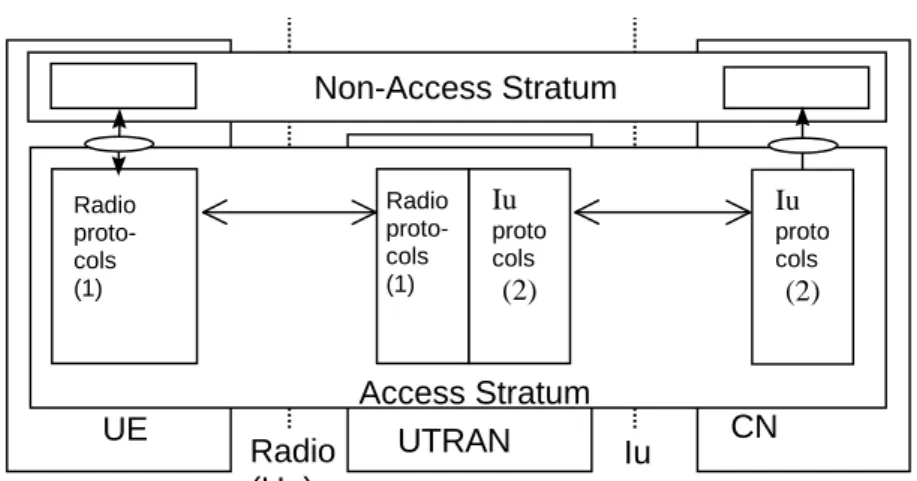
The radio access bearer service is offered from SAP to SAP by the Access Stratum. Figure 2 shows the protocols on the Uu and Iu interfaces that linked together provide this radio access bearer service.
UTRAN
UE
CN
Access Stratum
Non-Access Stratum
Radio
(Uu)
Iu
Radio proto-cols (1) Radio proto-cols (1) Iu proto cols (2) Iu proto cols (2)(1) The radio interface protocols are defined in documents TS 25.2xx and TS 25.3xx. (2) The Iu interface protocols are defined in documents TS 25.41x.
Figure 2: Iu and Uu User plane
5.2.2 Control
plane
UTRAN
UE
CN
Access Stratum
Non-Access Stratum
Radio
(Uu)
Iu
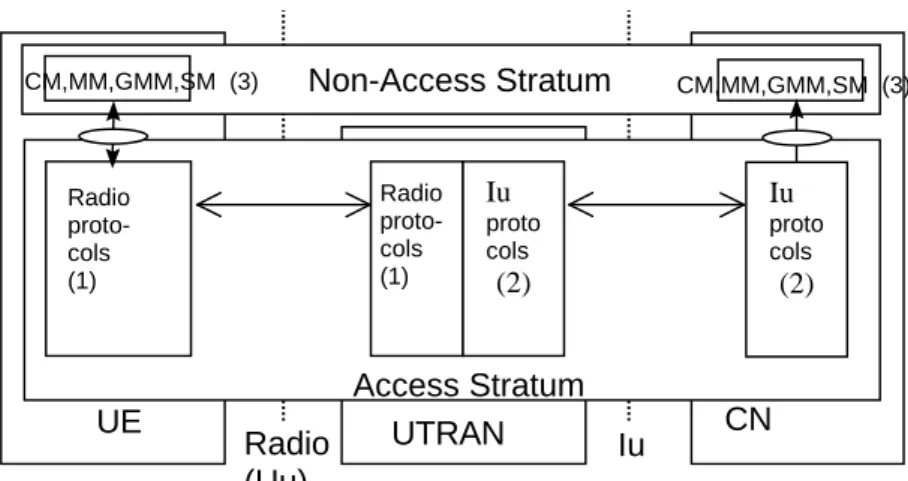
Radio proto-cols (1) Radio proto-cols (1) Iu proto cols (2) Iu proto cols (2) CM,MM,GMM,SM (3) CM,MM,GMM,SM (3)(1) The radio interface protocols are defined in documents TS 25.2xx and TS 25.3xx. (2) The protocol is defined in documents TS 25.41x. (Description of Iu interface).
(3) CM,MM,GMM,SM: This exemplifies a set of NAS control protocols between UE and CN. There may be different NAS protocol stacks in parallel. The evolution of the protocol architecture for these protocols is outside the scope of the present document.
Figure 3: Iu and Uu Control plane
NOTE: Both the Radio protocols and the Iu protocols contain a mechanism to transparently transfer NAS messages.
6 UTRAN
Architecture
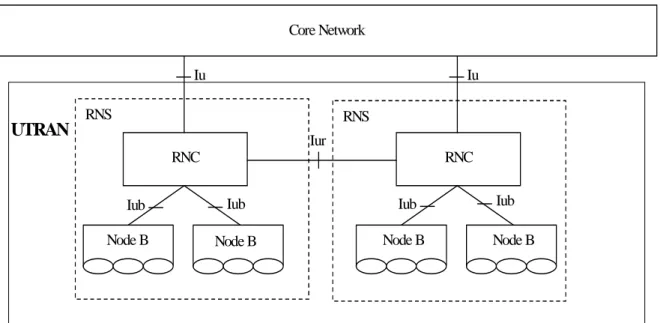
The UTRAN consists of a set of Radio Network Subsystems connected to the Core Network through the Iu.
A RNS consists of a Radio Network Controller one or more Node Bs and optionally one SAS. A Node B is connected to the RNC through the Iub interface.
A Node B can support FDD mode, TDD mode or dual-mode operation.
There are three chip-rate options in the TDD mode: 7.68 Mcps TDD, 3.84 Mcps TDD and 1.28 Mcps TDD. Each TDD cell supports one of these options.
A Node B which supports TDD cells can support one chip-rate option only, or more than one option. A RNC which supports TDD cells can support one chip-rate option only, or more than one option. The RNC is responsible for the Handover decisions that require signalling to the UE.
A RNC may include a combining/splitting function to support combination/splitting of information streams (see subclause 7.2.4.3).
Inside the UTRAN, the RNCs of the Radio Network Subsystems can be interconnected together through the Iur. Iu(s) and Iur are logical interfaces. Iur can be conveyed over direct physical connection between RNCs or virtual networks using any suitable transport network.
RNS
RNC
RNS
RNC Core Network
Node B Node B Node B Node B
Iu Iu
Iur
Iub Iub
Iub Iub
UTRAN
Figure 4: UTRAN Architecture
Regarding the UE positioning method, the RNC may have full internal support for this function and/or may be connected to one SAS via the Iupc interface. The following picture illustrates the resulting UTRAN architecture when the Iupc interface is adopted.
R N S R N C R N S R N C C o re N etw o rk N o d e B N o d e B N o d e B N o d e B Iu Iu Iu r Iu b Iu b Iub Iu b SA S Iu p c
Figure 4a: UTRAN Architecture with the Iupc option
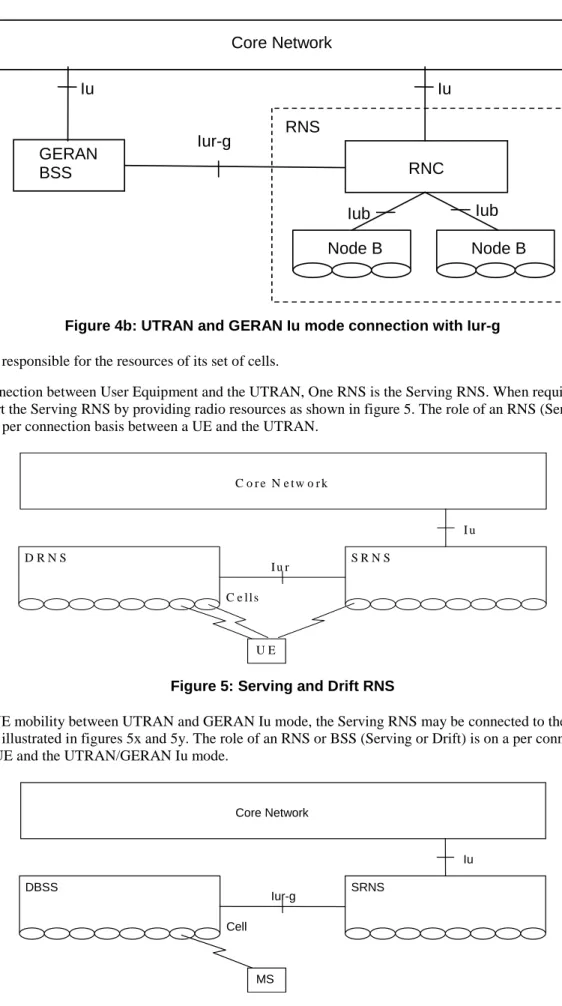
The RNC may be connected to BSS supporting GERAN Iu mode via the Iur-g interface. The following picture illustrates the UTRAN and GERAN Iu mode connection when the Iur-g interface is adopted.
RNS
RNC
Core Network
Node B
Node B
Iu
Iu
Iur-g
Iub
Iub
GERAN
BSS
Figure 4b: UTRAN and GERAN Iu mode connection with Iur-g
Each RNS is responsible for the resources of its set of cells.
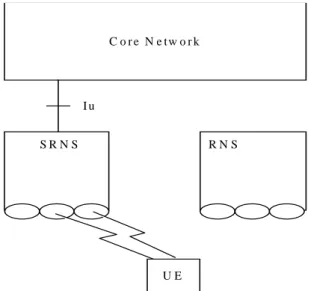
For each connection between User Equipment and the UTRAN, One RNS is the Serving RNS. When required, Drift RNSs support the Serving RNS by providing radio resources as shown in figure 5. The role of an RNS (Serving or Drift) is on a per connection basis between a UE and the UTRAN.
S R N S C o r e N e t w o r k I u D R N S I u r U E C e l l s
Figure 5: Serving and Drift RNS
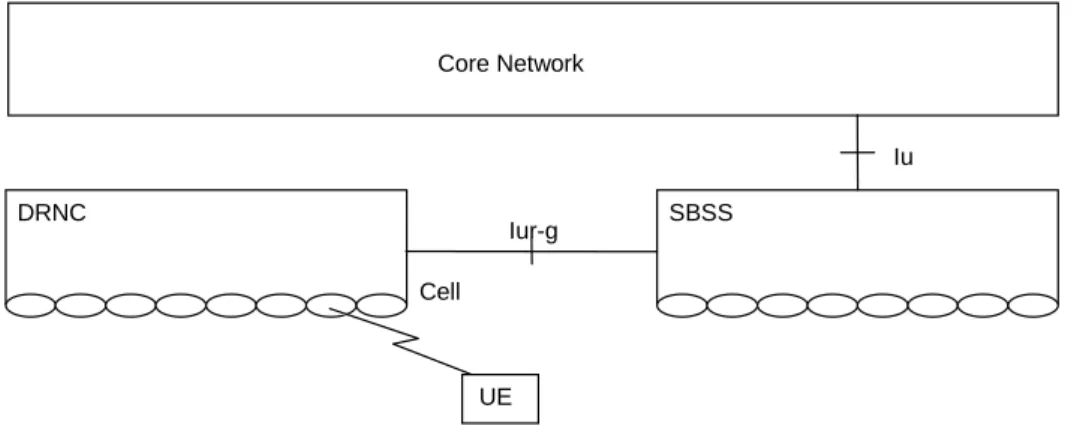
To support UE mobility between UTRAN and GERAN Iu mode, the Serving RNS may be connected to the DBSS and vice versa as illustrated in figures 5x and 5y. The role of an RNS or BSS (Serving or Drift) is on a per connection basis between an UE and the UTRAN/GERAN Iu mode.
SRNS Core Network Iu DBSS Iur-g MS Cell
SBSS Core Network Iu DRNC Iur-g UE Cell
Figure 5b: Serving BSS and Drift RNS
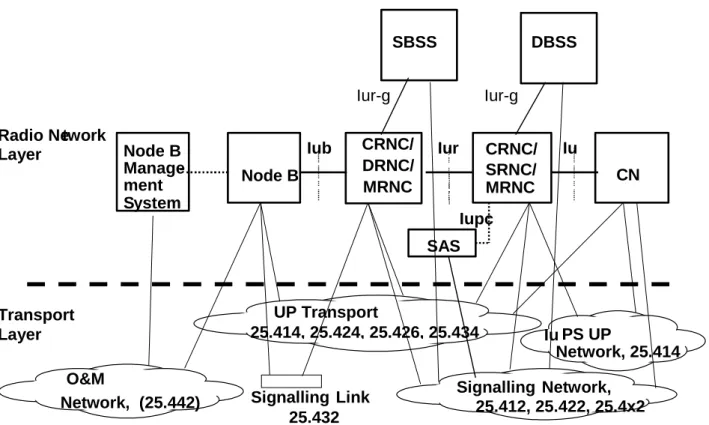
The UTRAN is layered into a Radio Network Layer and a Transport Network Layer.
The UTRAN architecture, i.e. the UTRAN logical nodes and interfaces between them, are defined as part of the Radio Network Layer.
For each UTRAN interface (Iu, Iur, Iub, Iupc) the related transport network layer protocol and functionality is specified. The transport network layer provides services for user plane transport, signalling transport and transport of
implementation specific O&M.
An implementation of equipment compliant with the specifications of a certain interface shall support the Radio Network Layer protocols specified for that interface. It shall also as a minimum, for interoperability, support the transport network layer protocols according to the transport network layer specifications for that interface. The network architecture of the transport network layer is not specified by 3GPP and is left as an operator issue. The equipment compliant to 3GPP standards shall at least be able to act as endpoints in the transport network layer, and may also act as a switch/router within the transport network layer.
For implementation specific O&M signalling to the Node B, only the transport network layer protocols are in the scope of UTRAN specifications.
Radio Ne
twork
Layer
Transport
Network
Layer
Iur
Iu
Iub
CN
UP Transport
Network
25.414, 25.424, 25.426, 25.434
Signalling
Network,
25.412, 25.422, 25.4x2
O&M
Transport
Network, (25.442)
Signalling
Link
25.432
Network, 25.414
Iu
PS UP
Transport
SAS
Iupc
Node B
Manage
-
ment
S ystem
Node B
CRNC/
CRNC/
SRNC/
?
Iur-g Iur-g
SBSS
DBSS
MRNC
MRNC
DRNC/
Figure 6: Protocol layering
Figure 6 illustrates which parts of the transport network layer that may be (but are not mandated to be) configured by the operator as transport networks, i.e. the radio network layer provides a destination address, namely:
- Transport network for implementation specific O&M traffic; - Signalling network for Iu, Iur, Iur-g and Iupc;
- Transport network for Iub, Iur and Iu CS user plane connections; - Transport network for Iu PS user plane connections.
The signalling link for Iub signalling as seen by the radio network layer cannot be configured as a network (no address provided).
A transport network for UTRAN may be configured by the operator to be used also for other traffic than UTRAN traffic.
6.1 UTRAN
Identifiers
6.1.1 PLMN
Identity
A Public Land Mobile Network is uniquely identified as define in [6] subclause 12.1.
6.1.2
CN Domain Identifier
6.1.3 RNC
Identifier
An RNC node is uniquely identified by its RNC Identifier among the nodes in UTRAN and GERAN Iu mode as defined in [6] sub-clause 12.3. A BSS node in GERAN Iu mode is uniquely identified by its RNC Identifier among the nodes in GERAN Iu mode and UTRAN.
6.1.4
Service Area Identifier
The Service Area Identifier (SAI) is defined in [6] sub-clause 12.4.
6.1.5 Cell
Identifier
The Cell identifier (C-Id) is used to uniquely identify a cell within an RNS/BSS. The Cell-Id together with the identifier of the controlling RNC/BSS (CRNC-Id) constitutes the UTRAN/GERAN Cell Identity (UC-Id) and is used to identify the cell uniquely within UTRAN/GERAN Iu mode. UC-Id or C-Id is used to identify a cell in UTRAN Iub and Iur interfaces or Iur-g interface.
- UC-Id = RNC-Id + C-Id.
The C-Id is defined by the operator, and set in the RNC/BSS via O&M. The C-Id is set in a Node B by its C-RNC or in the GERAN Iu mode cell.
6.1.6 Local
Cell
Identifier
The Local Cell identifier is used to uniquely identify the set of resources within a Node B required to support a cell (as identified by a C-Id). As a minimum it shall be unique within the Node B, but it is also capable of supporting
uniqueness within the UTRAN for management system purposes.
The Local Cell Identifier is used for the initial configuration of a Node B when no C-Id is defined. The Local Cell identifier is defined by the operator, and set in both the Node B and its C-RNC via O&M. The relationship between the Local Cell Identifier and C-Id is set in the C-RNC via O&M.
6.1.7 UE
Identifiers
Radio Network Temporary Identities (RNTI) are used as UE identifiers within UTRAN/GERAN Iu mode and in signalling messages between UE and UTRAN/GERAN Iu mode.
Six types of RNTI exist:
1) Serving RNC/BSS RNTI (s-RNTI); 2) Drift RNC/BSS RNTI (d-RNTI); 3) Cell RNTI (c-RNTI); 4) UTRAN/GERAN RNTI (u-RNTI);
5) [TDD – DSCH RNTI (DSCH-RNTI)];
6) HS-DSCH RNTI (HS-DSCH RNTI);
7) E-DCH RNTI (E-RNTI);
s-RNTI is used:
- by UE to identify itself to the Serving RNC/BSS; - by SRNC/SBSS to address the UE/MS;
s-RNTI is allocated for all UEs having a RRC connection, it is allocated by the Serving RNC/BSS and it is unique within the Serving RNC/BSS. s-RNTI is reallocated always when the Serving RNC/BSS for the RRC connection is changed.
d-RNTI is used:
- by serving RNC/BSS to identify the UE to Drift RNC/BSS. NOTE: The d-RNTI is never used on Uu.
d-RNTI is allocated by drift RNC/BSS upon drift UE contexts establishment and it shall be unique within the drift RNC/BSS. Serving RNC/BSS shall know the mapping between s-RNTI and the d-RNTIs allocated in Drift RNCs/BSSs for the same UE. Drift RNC/BSS shall know the s-RNTI and SRNC-ID related to existing d-RNTI within the drift RNC/BSS.
c-RNTI is used:
- by UE to identify itself to the controlling RNC; - by controlling RNC to address the UE.
c-RNTI is allocated by controlling RNC upon UE accessing a new cell. C-RNTI shall be unique within the accessed cell. Controlling RNC shall know the d-RNTI associated to the c-RNTI within the same logical RNC (if any).
u-RNTI
The u-RNTI is allocated to an UE having a RRC connection and identifies the UE within UTRAN/GERAN Iu mode.
u-RNTI is composed of: - SRNC identity; - s-RNTI.
[TDD – DSCH-RNTI is used:]
- [TDD – by controlling RNC to address the UE on the DSCH and USCH].
[TDD – RNTI is allocated by controlling RNC upon UE establishing a DSCH or USCH channel. DSCH-RNTI shall be unique within the cell carrying the DSCH and/or USCH. DSCH-DSCH-RNTI is used as UE identifier in RRC messages concerning DSCH and USCH allocations and is used in both the downlink and uplink.
HS-DSCH RNTI is used:
- for the UE specific CRC in HS-SCCH and HS-PDSCH.
HS-DSCH RNTI is allocated by controlling RNC upon UE establishing a HS-DSCH channel. HS-DSCH RNTI shall be unique within the cell carrying the HS-DSCH.
E-RNTI is used:
- for the UE[FDD - /UE group] specific CRC in E-AGCH.
EDCH RNTI is allocated by NodeB upon UE establishing an EDCH channel. EDCH RNTI allocated to a UE [FDD -/UE group] shall be unique within the cell carrying the E-DCH.
Each RNC has a unique identifier within the UTRAN part of the PLMN, denoted by RNC identifier (RNC-ID). This identifier is used to route UTRAN interface messages to correct RNC. RNC-ID of the serving RNC together with the s-RNTI is a unique identifier of the UE in the UTRAN part of the PLMN.
6.1.7.1
Usage of RNTI
u-RNTI is used as a UE identifier for the first cell access (at cell change) when a RRC connection exists for this UE and for UTRAN originated paging including associated response messages. RNC-ID is used by Controlling RNC/BSS to route the received uplink messages towards the Serving RNC/BSS.
NOTE: For the initial access a unique core network UE identifier is used.
c-RNTI is used as a UE identifier in all other DCCH/DTCH common channel messages on air interface.
6.1.8
Identifiers for dedicated resources within UTRAN
6.1.8.1
Radio Network Control Plane identifiers
Each addressable object in each reference point has an application part level identifier. This identifier is allocated autonomously by the entity responsible for initiation of the setup of the object. This application part identifier will be used as a reference to the object that is setup. Both ends of the reference point shall memorise the AP Identifier during the lifetime of the object. Application part identifier can be related to a specific Transport Network identifier and that relationship shall also be memorised by both ends.
Table 1 lists the basic AP level identifiers in each reference point.
Table 1: Basic AP level identifiers in each reference point
Object Identifier Abbreviation Valid for Radio Access Bearer Radio Access Bearer ID RAB-ID Iu
Dedicated Transport channel
DCH-ID DCH-ID Iur, Iub
[TDD – Downlink Shared Channel]
DSCH-ID DSCH-ID Iur, Iub
[TDD – Uplink Shared Channel]
USCH-ID USCH-ID Iur, Iub
6.1.8.2
Transport Network Identifiers
Transport Network identifiers are used in the Transport Network Layer (TNL) to identify the transport bearer and may be used in User Plane in the actual data transmission using the transport link. The Transport Network identifier identifies the transport link according to the naming conventions defined for the transport link type in question. Both ends of the reference point of the concerned TNL shall memorise the Transport Network identifiers during the lifetime of the transport link. Each Transport Network identifier can be binded to an Application Part identifier.
The Transport Network identifiers vary depending on the transport link type.
Table 2 indicates examples of the identifiers used for different transmission link types.
Table 2: Examples of the identifiers used for different transmission link types
Transmission link type Transport Network Identifier
AAL2 AAL2 Path ID + CID
GTP over IP IP address + TEID UDP over IP IP address + UDP port The communication of Transport Network identifiers is made in two ways:
When an ALCAP is used, the transport layer address communicated via the Radio Network Layers protocols (NBAP, RNSAP, RANAP…) is a Transport Network Control Plane address and the Transport Network identifiers are communicated through this Transport Network Control Plane only.
When no ALCAP is used, the Transport Network identifiers are directly communicated via the Radio Network Layers protocols (NBAP, RNSAP, RANAP…) on all interfaces.
In both cases, the transport layer address (e.g. IP address) is encapsulated by the Transport Network Layer in the NSAP structure as defined in [Annex A of [15], [16]] transported transparently on Iub, Iur and Iu-CS and passed transparently from the Radio Network Layer to the Transport Network Layer. The NSAP structure (encapsulation) is only used in order to provide to the TNL explicit identification of the type of the TNL address that is being conveyed by the given RNL protocol. It is then the responsibility of the Transport Network Layer to interpret this structure (e.g. to determine accordingly if the requested network type is ATM or IP).
On the Iu-PS, the NSAP structure is not used in RANAP but the 'straight IP addressing" shall be used.
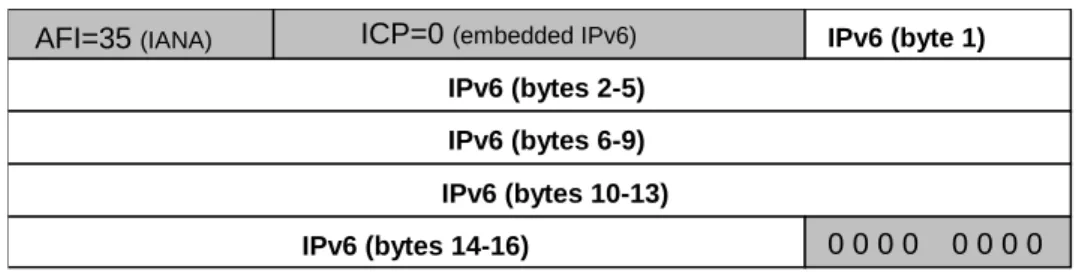
The following scheme depicts the encapsulation of a native IPv6 address in NSAP structure when conveyed in RANAP, RNSAP and NBAP.
Octet 1 octet 2 octet 3 octet 4
AFI=35 (IANA) ICP=0 (embedded IPv6) IPv6 (byte 1)
IPv6 (bytes 2-5) IPv6 (bytes 6-9) IPv6 (bytes 10-13)
IPv6 (bytes 14-16) 0 0 0 0 0 0 0 0
Figure 6A: IPv6 address embedded in NSAP structure in RANAP/RNSAP/NBAP.
Note 1: The last octet of the DSP (the DSP is the remaining octets after the IDP [34]) the encapsulation of a native IPv6 address in NSAP structure is unspecified.
Note 2: The encapsulation of a native IPv4 address in NSAP structure when conveyed in RANAP, RNSAP and NBAP shall be encoded according to [34]. The last 13 octets of the DSP are unspecified.
Note 3: The default values for the unspecified octets are zero.
6.1.8.3 Binding
identifier
Binding Identifier (Binding ID) is used to initialise the linkage between ALCAP and Application Part (RANAP, RNSAP, NBAP) identifiers. Binding identifier can be used both in Radio Network Control plane Application Part protocols and in Transport Network Control Plane's ALCAP protocol. When no ALCAP is used, Binding ID may also be used to carry the UDP port on Iub, Iur and Iu-CS interfaces.
Binding ID binds the Radio and Transport Network Control plane identifiers together. To ensure maximal independence of those two planes, the binding ID should be used only when necessary: Binding ID shall thus be used only in Radio Network Control plane Application Part messages in which a new association between the planes is created and in ALCAP messages creating new transport bearers.
Binding ID for each transport bearer shall be allocated before the setup of that transport bearer.
The Binding ID is sent on one direction using the Application Part protocol and is return in the other direction by the ALCAP protocol.
When an Application Part procedure with an allocated Binding ID is applied for modifying an existing Radio Network User Plane connection, the decision to use the Binding ID (and the ALCAP procedures) shall be done by that end of the reference point that decides whether to use the existing transport bearer or to set up a new transport bearer.
The Binding ID shall already be assigned and tied to a radio application procedure when the first ALCAP message is received in a node.
The association between the connection Id in the Application Part protocol (e.g. identifying a RAB) and the
corresponding connection Id in the ALCAP protocol (e.g. identifying the AAL2 channel for that RAB) that was created with the help of Binding ID shall be memorised by both peers of each reference point for the lifetime of the
The Binding ID may be released and re-used as soon as both the Application Part procedure and the ALCAP procedure that used it are completed in both peers of the reference point.
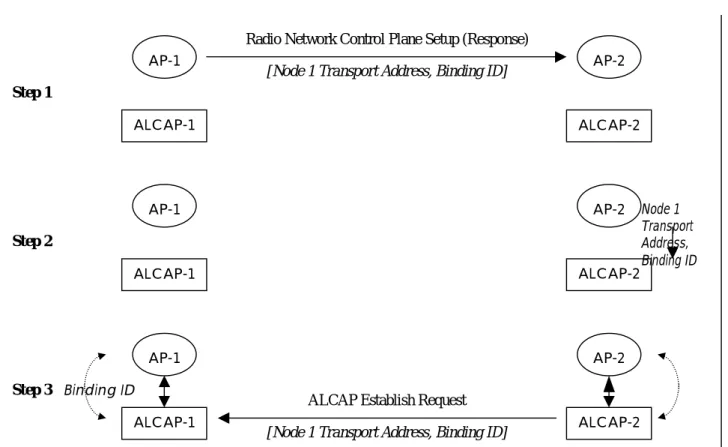
Figure 6a illustrates how application instances of the Radio Network Control Plane and instances of the Transport Network Plane are linked together through the Binding Identifier in the set-up phase.
[Node 1 Transport Address, Binding ID]
AP-1 AP-2
ALCAP-1 ALCAP-2
Step 1
AP-1 AP-2
ALCAP-1 ALCAP-2
[Node 1 Transport Address, Binding ID]
Step 2
AP-1 AP-2
ALCAP-1 ALCAP-2
Step 3
ALCAP Establish Request
Radio Network Control Plane Setup (Response)
Node 1 Transport Address, Binding ID
Binding ID
Step 1: Application Part AP-1 assigns the Binding Identifier and sends a Radio Network Control Plane Set-up (Response) message (which of the two messages depends on the involved interface - Iu/Iur or Iub). The message contains the originating node Transport layer address and the Binding Identifier.
Step 2: Among reception of the Radio Network Control Plane Set-up message, the peer entity AP-2 requests ALCAP-2 to establish a transport bearer. The Binding Identifier is passed to ALCAP-2.
Step 3: ALCAP-2 sends an ALCAP Establish Request to the peer entity ALCAP-1. The message contains the Binding Identifier. The Binding Identifier allows correlating the incoming transport connection with the Application Part transaction in step 1.
Figure 6a: Usage of Binding ID
Table 3 indicates the binding identifier allocating entity in each interface.
Table 3: Binding identifier allocating entity in each interface
Reference point Allocating entity Application part message including Binding-ID
Iu CN Request from CN
Iur DRNC Response to the request from SRNC
Iub Node-B Response to the request from DRNC
6.1.9 URA
Identity
The URA identity is used to uniquely identify an URA, which is a specified set of UTRAN and/or GERAN cells. The URA identity can be used to indicate to the UE and the SRNC which URA it shall use in case there are multiple URA identities broadcast in the cell where the UE is located.
6.1.10
Service Identifiers for MBMS
6.1.10.1
IP Multicast Address and APN
The IP Multicast Address and an APN are used to enable the routing of MBMS registration requests within the CN. These identifiers are transparent to RAN.
6.1.10.2 TMGI
The Temporary Mobile Group Identity (TMGI) is used for group notification purposes and is unique within HPLMN. TMGI is used at the start of a session and at UE linking to identify an MBMS Bearer Service.
The structure of TMGI is specified in [6].
6.1.10.3 Session
Identifier
MBMS session Identifier is used to identify one specific session of a MBMS service and is forwarded transparently to the UE.
6.1.10.4
MBMS Service Area
The MBMS Service Area is defined in [31].
The mapping between a MBMS Service Area and a list of cells is set in the RNC via O&M.
6.1.10.5
MBMS Cell Group Identifier
The MBMS Cell Group Identifier is defined in [30]
6.1.10.6
MBMS UTRAN Cell Group Identifier
Void.
6.1.11
Transport Network Identifiers for MBMS
Transport Network identifiers are used in the Transport Network Layer (TNL) to identify the MBMS transport bearers and may be used in User Plane in the actual MBMS data transmission using the transport link. Each MBMS Transport Network identifier can be binded to an Application Part identifier. The Application Part identifier over the Iu interface is the TMGI corresponding to one MBMS Bearer Service.
The handling of the MBMS Transport Network identifiers is the same as the handling of Transport Network identifiers for dedicated resources described in section 6.1.8.2.
6.1.12
Binding Identifiers for MBMS
Binding identifiers can be used for MBMS both in Radio Network Control plane Application Part protocols and in Transport Network Control Plane's ALCAP protocol. When ALCAP is used, Binding Identifiers (Binding ID) are used to initialise the linkage between ALCAP and the MBMS Application Part (RNSAP, NBAP) identifiers. When no ALCAP is used, the Binding ID may also be used to carry the UDP port on Iub and Iur interfaces.
The handling of the MBMS Binding identifiers is the same as the handling of Binding identifiers for dedicated resources described in section 6.1.8.3.
6.2 Transport
Addresses
The transport layer address parameter is transported in the radio network application signalling procedures that result in establishment of transport bearer connections.
The transport layer address parameter shall not be interpreted in the radio network application protocols and reveal the addressing format used in the transport layer.
The formats of the transport layer addresses are further elaborated in [9], [10], [11], [18].
6.3
Function Distribution Principles
For radio resource management functionality, the following principles apply: - The CRNC owns the radio resources of a cell.
- The SRNC handles the connection to one UE, and may borrow radio resources of a certain cell from the CRNC. - When used, the MRNC controls the logical resources of the RNSs that are used for MBSFN operation within the
MBSFN cluster(s).
Dynamical control of power for dedicated channels, within limits admitted by CRNC, is done by the SRNC. - Dynamic control on smaller time-scale for some radio links of the UE connection may be done by the Node B.
This 'inner loop' control is controlled by an 'outer loop', for which the SRNC has overall responsibility. - Scheduling of data for dedicated channels is done by the SRNC, while for common channels it is done by the
CRNC.
For management of node-internal resources, the following principle apply:
- Each UTRAN node is considered a network element on its own. The knowledge about the equipment of a network element is kept within the network element itself and its management system. The node itself always manages node-internal resources.
For transport network resource management, the following principle apply:
- Management of transport network resources belong to the Transport Layer. Mechanisms relevant for the selected transport technology are used. No functional split between UTRAN nodes is specified what regards the
Transport Layer.
As a general guideline, the UTRAN protocols should be designed in such a way that they minimise the need for a DRNC to interpret the user plane frame protocol information other than for the combining/splitting purpose.
7
UTRAN Functions description
7.1
List of functions
- Transfer of User Data.
- Functions related to overall system access control: - Admission Control;
- Congestion Control;
- System information broadcasting. - Radio channel ciphering and deciphering. - Integrity protection.
- Functions related to mobility: - Handover;
- Paging support; - Positioning;
- GERAN System Information Retrieval; - Enhanced SRNS Relocation.
- Functions related to radio resource management and control: - Radio resource configuration and operation;
- Radio environment survey; - Combining/splitting control; - Connection set-up and release;
- Allocation and deallocation of Radio Bearers; - [TDD - Dynamic Channel Allocation (DCA)]; - Radio protocols function;
- RF power control;
- [3.84 Mcps TDD and 7.68Mcps TDD - Timing Advance]; - [1.28 Mcps TDD – Uplink Synchronisation];
- Radio channel coding; - Radio channel decoding; - Channel coding control;
- Initial (random) access detection and handling;
- CN Distribution function for Non Access Stratum messages. - Synchronisation.
- Functions related to broadcast and multicast services (see note) (broadcast/multicast interworking function BM-IWF).
NOTE: Only Broadcast is applicable for Release 99. - Broadcast/Multicast Information Distribution. - Broadcast/Multicast Flow Control. - CBS Status Reporting.
- Tracing.
- Volume reporting. - NAS Node Selection.
- RAN Information Management. - MBMS provision.
- MBMS Notification
7.2 Functions
description
7.2.0
Transfer of user data
This function provides user data transfer capability across the UTRAN between the Iu and Uu reference points.
7.2.1
Functions related to overall system access control
System access is the means by which a UMTS user is connected to the UTRAN in order to use UMTS services and/or facilities. User system access may be initiated from either the mobile side, e.g. a mobile originated call, or the network side, e.g. a mobile terminated call.
7.2.1.1 Admission
Control
The purpose of the admission control is to admit or deny new users, new radio access bearers or new radio links (for example due to handover). The admission control should try to avoid overload situations and base its decisions on interference and resource measurements. The admission control is employed at for example initial UE access, RAB assignment/reconfiguration and at handover. These cases may give different answers depending on priority and situation.
The Admission Control function based on UL interference and DL power is located in the Controlling RNC. The Serving RNC is performing admission Control towards the Iu interface.
7.2.1.2 Congestion
Control
The task of congestion control is to monitor, detect and handle situations when the system is reaching a near overload or an overload situation with the already connected users. This means that some part of the network has run out, or will soon run out of resources. The congestion control should then bring the system back to a stable state as seamless as possible.
NOTE: This admission Control function is related to Radio Resources. Congestion control is performed within UTRAN.
7.2.1.3 System
information
broadcasting
This function provides the mobile station with the Access Stratum and Non Access Stratum information which are needed by the UE for its operation within the network.
The basic control and synchronisation of this function is located in UTRAN.
7.2.1.4
MOCN and GWCN configuration support
In the MOCN configuration only the radio access part of the network is shared. For the MOCN configuration it is required that the rerouting function, as described in [29], is supported.
In the GWCN configuration, besides shared radio access network, the core network operators also share part of the core network, at least MSC and/or SGSN.
For both the GWCN and MOCN configurations, the RNC carries the selected PLMN-id between network sharing supporting UEs and the corresponding CN.
The network sharing MOCN and GWCN configurations are described in detail in [28].
7.2.2
Radio channel ciphering and deciphering
This function is a pure computation function whereby the radio transmitted data can be protected against a non-authorised third-party. Ciphering and deciphering may be based on the usage of a session-dependent key, derived
This function is located in the UE and in the UTRAN.
7.2.3
Functions related to Mobility
7.2.3.1 Handover
This function manages the mobility of the radio interface. It is based on radio measurements and it is used to maintains the Quality of Service requested by the Core Network.
Handover may be directed to/from another system (e.g. UMTS to GSM handover).
The handover function may be either controlled by the network, or independently by the UE. Therefore, this function may be located in the SRNC, the UE, or both.
7.2.3.2 SRNS
Relocation
The SRNS Relocation function coordinates the activities when the SRNS role is to be taken over by another RNS/BSS. The SRNS relocation function manages the Iu interface connection mobility from an RNS to another RNS/BSS.
S R N S C o r e N e t w o r k I u D R N S I u r U E R N S C o r e N e t w o r k I u S R N S U E A f t e r S R N S R e l o c a t i o n B e f o r e S R N S R e l o c a t i o n C e l l s
Figure 7: Serving RNS Relocation
The SRNS Relocation is initiated by the SRNC. This function is located in the RNC and the CN.
7.2.3.3 Paging
support
This function provides the capability to request a UE to contact the UTRAN/GERAN Iu mode when the UE is in Idle, CELL_PCH or URA_PCH/GRA_PCH states [6], [21]. This function also encompasses a coordination function between the different Core Network Domains onto a single RRC connection.
7.2.3.4 Positioning
This function provides the capability to determine the geographic position and optionally the velocity of a UE.
7.2.3.5
NAS Node Selection Function
The optional NAS Node Selection Function (NNSF) enables the RNC to initially assign CN resources to serve a UE and subsequently setup a signalling connection to the assigned CN resource.
The NNSF is described in detail in [20].
7.2.3.6
Shared Networks Access Control
The Shared Networks Access Control function allows the CN to request the UTRAN to apply UE specific access control to LAs of the UTRAN and LAs of neighbouring networks.
The Shared Networks Access Control function is based on either whole PLMNs or Shared Network Areas (SNAs). An SNA is an area corresponding to one ore more LAs within a single PLMN to which UE access can be controlled. In order to apply Shared Networks Access Control for the UTRAN or for a neighbouring system, the UTRAN shall be aware of whether the concerned LA belongs to one (or several) SNA(s) or not.
If access for a specific UE needs to be restricted, the CN shall provide SNA Access Information for that UE. The SNA Access Information indicates which PLMNs and/or which SNAs the UE is allowed to access.
Based on whether the LA belongs to the PLMNs or SNAs the UE is allowed to access, the UTRAN determines if access to a certain LA for a certain UE shall be allowed.
If access is not allowed, the UTRAN shall request the CN to release existing resources either by initiating Iu Release Request procedure with cause value 'Access Restricted due to Shared Network' or by requesting a relocation with the same cause value.
7.2.3.7
GERAN System Information Retrieval
In order to provide the UE with system information related to NACC towards a GERAN system - to be used as an optimisation - the GERAN System Information Retrieval function allows:
- The source RAN to request GERAN (via CN) to provide this system information.
- The SRNC to request the DRNC (via Iur interface) to provide this system information, if available. The request and subsequent transfer of the GERAN System Information is performed transparently with the RIM function. The RIM function is further described in section 7.2.8.
7.2.3.8
Enhanced SRNS Relocation
The Enhanced SRNS Relocation function coordinates the activities when the SRNS role is to be taken over by another RNS. The Enhanced SRNS Relocation function manages the Iu interface connection mobility from an RNS to another RNS.
The Enhanced SRNS Relocation is initiated by the SRNC. The relocation of the SRNS functionality is prepared via RNSAP means. The CN is not informed until the preparation and execution of the relocation has taken place. This function is located in the RNC and the CN.
7.2.4
Functions related to radio resource management and control
Radio resource management is concerned with the allocation and maintenance of radio communication resources.
UMTS radio resources must be shared between circuit transfer mode services and packet transfer modes services (i.e. Connection-oriented and/or connectionless-oriented services).
7.2.4.1
Radio resource configuration and operation
This function performs configures the radio network resources, i.e. cells and common transport channels, and takes the resources into or out of operation.
7.2.4.2
Radio environment survey
1) Received signal strengths (current and surrounding cells); 2) Estimated bit error ratios, (current and surrounding cells);
3) Estimation of propagation environments (e.g. high-speed, low-speed, satellite, etc.); 4) Transmission range (e.g. through timing information);
5) Doppler shift;
6) Synchronisation status; 7) Received interference level;
8) Total DL transmission power per cell.
This function is located in the UE and in the UTRAN.
7.2.4.3 Combining/splitting
control
This function controls the combining/splitting of information streams to receive/ transmit the same information through multiple physical channels (possibly in different cells) from/ towards a single mobile terminal.
The UL combining of information streams may be performed using any suitable algorithm, for example: • [FDD - based on maximum ratio algorithm (maximum ratio combining)];
• [FDD - based on quality information associated to each TBS (selection-combining)]; • [TDD - based on the presence/absence of the signal (selection)]
.
[FDD - combining/splitting control should interact with channel coding control in order to reduce the bit error ratio when combining the different information streams].
In some cases, depending on physical network configuration, there may be several entities which combine the different information streams, i.e. there may be combining/splitting at the SRNC, DRNC or Node B level.
This function is located in the UTRAN.
7.2.4.4
Connection set-up and release
This function is responsible for the control of connection element set-up and release in the radio access sub network. The purpose of this function is:
1) To participate in the processing of the end-to-end connection set-up and release;
2) And to manage and maintain the element of the end-to-end connection, which is located in the radio access sub network.
In the former case, this function will be activated by request from other functional entities at call set-up/release. In the latter case, i.e. when the end-to-end connection has already been established, this function may also be invoked to cater for in-call service modification or at handover execution.
This function is located both in the UE and in the RNC.
7.2.4.5
Allocation and deallocation of Radio Bearers
This function consists of translating the connection element set-up (resp. release) requests into physical radio channel allocation (resp. deallocation) accordingly to the QoS of the Radio Access Bearer.
This function may be activated during the call since e.g. the user service request may vary, or macro diversity may be used.