Article
Probabilistic Modelling for Unsupervised Analysis of
Human Behaviour in Smart Cities
Yazan Qarout1,*, Yordan P. Raykov1and Max A. Little2
1 Department of Mathematics, Aston University, Birmingham B4 7ET, UK; [email protected] 2 Department of Computer Science, University of Birmingham, Birmingham B15 2TT, UK; [email protected]
* Correspondence: [email protected]
Received: 10 December 2019; Accepted: 27 January 2020; Published: 31 January 2020
Abstract:The growth of urban areas in recent years has motivated a large amount of new sensor applications in smart cities. At the centre of many new applications stands the goal of gaining insights into human activity. Scalable monitoring of urban environments can facilitate better informed city planning, efficient security, regular transport and commerce. A large part of monitoring capabilities have already been deployed; however, most rely on expensive motion imagery and privacy invading video cameras. It is possible to use a low-cost sensor alternative, which enables deep understanding of population behaviour such as the Global Positioning System (GPS) data. However, the automated analysis of such low dimensional sensor data, requires new flexible and structured techniques that can describe the generative distribution and time dynamics of the observation data, while accounting for external contextual influences such as time of day or the difference between weekend/weekday trends. In this paper, we propose a novel time series analysis technique that allows for multiple different transition matrices depending on the data’s contextual realisations all following shared adaptive observational models that govern the global distribution of the data given a latent sequence. The proposed approach, which we name Adaptive Input Hidden Markov model (AI-HMM) is tested on two datasets from different sensor types: GPS trajectories of taxis and derived vehicle counts in populated areas. We demonstrate that our model can group different categories of behavioural trends and identify time specific anomalies.
Keywords:time series; probabilistic modelling; trajectory analysis; smart city
1. Introduction
The rising population in modern cities introduces many challenges in urban city planning including problems associated with improving the inhabitants’ quality of life and security. The utilisation of sensors and communication technology gives rise to the concept of Smart Cities and enables the adequate study of specific focus problems in urban development. Among the
many examples are applications on structural health monitoring [1], where material conditions of
civil infrastructure are monitored and automatically analysed to ensure population safety; smart
waste management [2] to improve service provisioning by the utilisation of smart garbage bins and
Internet of Things (IoT) technology; smart lighting solutions [3] for cost and greenhouse emission
reduction by the installation of sensors and weather analytics on city streets; and, in the manufacturing
industry [4], combining IOT with machine learning. With the growing interest and importance of
sensor application in smart cities, there has also been a rise in the interest in human movement behavioural characteristics from sensors to identify movement trends and improve the understanding of traffic. Examples from recent literature on applications of human behavioural understanding
include De Marsico et al. [5] user gait identification for automatic activation of controlled entry spaces,
and Paul et al. [6], Torre-Bastida et al. [7] big data and social IOT was utilised for real time definition
of human behaviours. For traffic analysis, Bhatti et al. [8] introduced an IOT accident detection and notification system that relies on multiple, commonly available smart-phone sensors.
The analysis of car traffic can aid the understanding of population dynamics in smart cities. This, on the other hand, leads to better capabilities for congestion control and accident detection
Ahmad et al. [9]. For example, Kanungo et al. [10] studied traffic light management using video
surveillance analysis, whereas Ozkurt and Camci [11] use surveillance footage to estimate density
patterns. This focus on video surveillance data has prompted research on camera placement for greater
area coverage [12] to reduce the high cost accumulation of such sensors. However, the high costs and
privacy concerns related to CCTV data are a key driver of the search of alternative sensor resources: such as density counts, noise levels or automated geolocation data (such as GPS).
Despite the prior work on behaviour understanding from GPS [13–15], a lot of the GPS data
analysis remains challenging due to noise, irregular sampling, heterogeneity and frequent interruption
of data collection as environmental factors cause missing data [16]. To address this Ellam et al. [17],
a recently proposed parameter estimation framework for spatial interaction models was demonstrated to simulate accurately the flow of customers. In scenarios where large amounts of individual-level data is available, we can also try to approach the problem reversely and first search for recurring patterns from large databases of movement in cities. Frequently sampled monitoring data such as the
GPS data can be highly multimodal. To account for this, Witayangkurn et al. [18] proposed the use
of a Hidden Markov Model (HMM) to detect anomalies from large scale GPS data. Nonetheless, this approach does not consider the time self-dependence of the observation sequence and requires that the model complexity be predefined which may bias the unsupervised approach to the analysis. The geospatial relationship between the journeys of individuals is often dependent on various contextual factors such as differences between weekend/weekday behaviour, peak/off-peak behaviour and individual idiosyncrasies.
To address some of these challenges, we design an exploratory nonparametric probabilistic modelling approach suitable for this type of data. We deploy a flexible HMM with augmented latent space to account for various types of contextual information. This contextual information can include difference between peak/off-peak time driving, weekday/weekend differences and person specific manoeuvrability decisions. To achieve this, we propose an intuitive Adaptive Input Hidden Markov Model (AI-HMM). Building on the theory of the Vector Autoregressive Hidden Markov Model
(VAR-HMM) [19] to allow for autoregressive self-dependence between observations, we introduce
a new discrete and independent semi-Markov variable which acts as a parent to the state indicator variable in the graphical model to represent environmental factors that influence movement behaviour.
For example, in our case study in Section5on GPS data, we assume that the growing complexity of
human trips, as more trajectories are observed, can be well captured with Bayesian nonparametric structure and that environmental factors such as time of day (e.g., peak or off-peak) may also influence the modality of the behaviour and therefore should be considered in the design of the generative model structure. We show that we are able to learn common patterns occurring across different contextual realisations, in addition to their specific generative distributions. To summarise, the contributions of this paper are as follows.
• We develop an extension of the ubiquitous Hidden Markov model, which can robustly segment
different behaviours in monitoring applications while accounting for present contextual factors.
• We have derived a principled framework for inference in the developed AI-HMM approach.
• We have shown the particularly suitability of the nonparametric switching autoregressive model
for analysis of GPS and traffic count data.
This paper will continue as follows. Section2discusses related studies, Section3summarises the
background of the used techniques, Section4explains the details of the proposed framework, Sections5
2. Related Work
Human behaviour profiling and automated analysis has great potential for both security and retail commercial applications in smart city designs. However, labelled sensor data of such nature
is usually scarce and unsupervised clustering or direct time series methods must be used [20–22].
One commonly used pipeline is the online segmentation of crowd data from video feeds. For example,
Mehran et al. [14] proposed a novel Social Force model for identifying abnormal behaviours in crowds.
The approach assumes that located moving particles on sequences of frames are individuals and uses them to estimate their interaction forces throughout time and estimate the “normal” behaviour of the crowd. Then, a bag-of-words classifier is trained to separate normal and abnormal crowd
behaviours. Mahadevan et al. [23] also proposed a supervised anomaly detection method based on
crowd videos. However, [23] evaluated their methods on a significantly smaller database of videos.
Rodriguez et al. [24] developed a partially Bayesian approach to the same problem which allows
for robust analysis of crowd videos completely unseen during training. While civic value can be demonstrated through the analysis of videos at crowded locations, such data provides only localised snapshots of the movement within the city. It is available only for a small set of chosen locations and requires a large amount of labelled location specific training data. Video feeds have also been used
extensively for activity recognition applications [20,25,26]; however, such techniques are likely far
from being applicable on larger spatial scale across a city.
Continuous location data can be used to study a more diverse geographic perspective on personal
mobility and daily activity patterns. Jiang et al. [21] investigated how to cluster daily patterns of
activity in the city using both GPS data from individuals as well as additional survey data concerning their true activities. The study used the Chicago Regional Household Travel Inventory (CRHTI)
dataset [27], which is one of the few data sources with fine labelled information in addition to GPS
data. GPS trajectory data was not explicitly modelled but only used to identify different location areas
for the participants. Jiang et al. [21] first constructed a calender type array indicating which of nine
activities (work, home, school, etc.) occurred. Principal Component Analysis (PCA) was then applied followed by K-means clustering to infer patterns of daily activity across different regions of the city. The inferred patterns were used to reveal socio-demographic information about the region. The results of the study are informative on human behaviour; however, if GPS information is included in the analysis, the complexity of the data may affect the effectiveness of the proposed framework.
Shih et al. [22] modelled different mobility patterns based on GPS data from the Geolife dataset [28]
to classify trips of people diagnosed with Alzheimer’s disease. The basis for this is the common assumption that a symptom of Alzheimer’s patients is spatio-temporal confusion. The abnormal trajectories were predicted based on thresholding the similarity to the training set. Although the results showed up to 97% accuracy rate in detecting abnormal mobility patterns, there was no ground truth data, and explicitly, no real information on the Alzheimer state of each subject. Instead, external sequences were added to the data of some individuals to represent Alzheimer’s patients. This can add clear biases to the analysis and may indicate that the accuracy of the technique on more representative
data will not mimic that of the presented study. More recently, Yao et al. [15] also proposed a novel
behaviour recognition framework for GPS data, demonstrated on trajectories of ships. They used a Long-Short Term Memory (LSTM) autoencoder to infer the latent structure in features which were extracted from sliding windows of the trajectory time series. By passing the dataset through a trained network, the inferred embeddings were extracted and stored for each input time series. These embeddings were then clustered with K-means to identify different behavioural patterns in ship data. However, trajectories of ship movement contain significantly smaller variations across patterns and a constrained space of behaviours which can be explored. The LSTM autoencoder is likely to require multiple different behaviour sequences in order to group the trajectories in the latent space. Also, when
3. Dynamic Time Series Modelling 3.1. Vector Autoregressive Model (VAR)
The Vector Autoregressive (VAR) model [30] is a widely used linear time series model for dynamic
multidimensional data. An orderpVAR assumes each observation in a sequence can be modelled as a
linear combination ofpprevious points in the sequence and a stochastic term. The VAR model is also
a parametric model of the spectral density. Unlike Fourier-based methods which require a windowing
strategy, VARs are defined in the time domain and we can usepto control the number of spikes we
assume in the power spectrum of the input. LetY= (y1,y2, . . . ,yT)be a stationary time series where yt∈RD= (y
(1)
t , . . . ,y
(D)
t )T, a VAR(p) model will have the form of
yt=Θ1yt−1+· · ·+Θpyt−p+µµµ+eeet, (1)
where Θi is a(D×D) matrix of weights, µµµ is the mean of the sequenceY andeeet is a (D×1)
vector of white noise with zero mean and covariance matrixΣ. Using the matrix notationYp+1:T =
(yp+1,yp+2, . . . ,yT)we can then write the VAR in the following form,
Yp+1:T=ΘΘΘY¯+E, (2)
withΘΘΘ= (µµµ,Θ1, . . . ,Θp), ¯Y= (1,YpT:T−1, . . . ,Y1:TT−p)T,1being a vector of ones with the same length
asYp+1:T andE = (eeep+1, . . . ,eeeT). Using this formulation, the parameters of a VAR model may be
estimated in few main ways depending on the adopted formalism: via maximum likelihood estimation, using the Yule–Walker equations and via Bayesian inference. Inference in Bayesian VAR models is practically identical to statistical inference in Bayesian linear regression. Assuming, for practical
convenience, a conjugate prior over the VAR parameters, the joint prior over the parametersΘΘΘand the
covariance matrixΣis a coupled Matrix-Normal Inverse-Wishart (MN I W) distribution, implied by
the Gaussian likelihood of the outputs.
Σ∼ I W(n0,S0), Θ Θ Θ|Σ∼ MN(M,Σ,K), Yp+1:T|Y¯,ΘΘΘ,Σ∼ MN(ΘΘΘY¯,Σ,I), (3)
where n0 is the number of degrees of freedom; S is the scale matrix; M,Σ and S0 are the mean,
covariance of the rows and covariance of the columns of parameterΘΘΘ, respectively; andIis the identity
matrix. The posterior of the VAR coefficients is then
p(ΘΘΘ|Y,Σ)∝p(Y|Y¯,ΘΘΘ,Σ)p(ΘΘΘ|Σ). (4) To compute posterior of the VAR noise covariance, it is more efficient to use the marginal likelihood, instead giving
p(Σ|Y)∝p(Y|Σ)p(Σ), p(Y|Σ)∝ Z ΘΘΘp(Y| ¯ Y,ΘΘΘ,Σ)p(ΘΘΘ|Σ)dΘΘΘ. (5)
3.2. Autoregressive Infinite Hidden Markov Model (AR-iHMM)
The infinite Hidden Markov Model (iHMM) also known as the Hierarchical Dirichlet Process HMM (HDP-HMM) is a Bayesian nonparametric approach to the HMM first proposed by
Beal et al. [31] then formalised by Teh et al. [32]. The nonparametric formalisation tackled the
limitations of the traditional HMM of needing to pre-specify the structure of the model allowing it to automatically infer in adaptive manner the complexity depending on the amount of data observed.
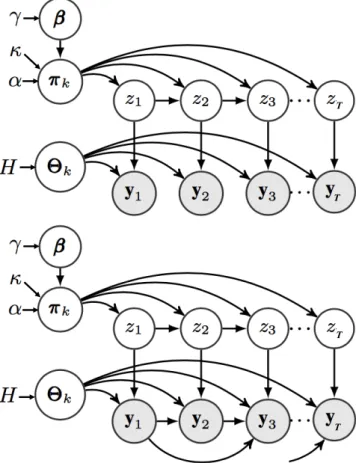
form the AR-iHMM (or also known as HDP-AR-HMM). Figure1depicts the Probabilistic Graphical Model (PGM) representation of the iHMM and the AR-iHMM.
T
T T
T
Figure 1.iHMM (top) and AR-iHMM (bottom) probabilistic graphical models. Mixing Parameters β
β
βare used to sample the transition distributionπππk, which the state indicatorszare sampled from.
The observationsytare generated from functions with parametersΘΘΘzt which are in turn sampled
from base distribution H. The AR-iHMM differs such that there are autoregressive dependence between observations.
Letz = (z1, . . . ,zT)denote the state indicator variables andπππk be the state specific transition
distribution for state k where zt ∼ Categorical πππzt−1
. The observations yt are conditionally
independent given zt and ¯Yt = (yTt−1, . . . ,ytT−p)T; each observation is modelled with emission
distributionsyt|zt, ¯Yt ∼ f(ΘΘΘztY¯t)whereΘΘΘzt are the emission parameters for state indicated byzt.
The complete data likelihood can then be written as
p(z,Y) = T
∏
t=p+1 p(zt|zt−1)p(yt|zt, ¯Yt), p(z,Y) = T∏
t=p+1 K+∑
k=1 πzt−1,kf(yt;ΘΘΘk, ¯Yt). (6)usingK+to denote the inferred number of represented states.
The iHMM defines a set of random probability measuresGk for each state representing the
dynamic observationsYsampled from a Dirichlet Process (DP) with a global probability measureG0
and concentration parameterα. The base probability measure itself is DP distributed with concentration
G0|γ,H∼DP(γ,H), Gk|α,G0∼DP(α,G0),
(7)
where measuresGk are conditionally independent givenG0. Intuitively, Equation (7) means that
random distributionsGkvary aroundG0with variability governed byγ, whereasG0varies around the
base distributionHwith variabilityα. Including explicit hyperparameter controlling the self-transitions
probability in the AR-iHMM [31,33] we can summarize the full AR-iHMM as follows,
β β β|γ,H∼GEM(γ), π ππk|α,βββ∼DP α+κ,αβββ+κδk α+κ , ΘΘΘk|H∼H, zt|zt−1,(πππk)∞k=1∼πππzt−1, yt|zt, ¯Yt,(ΘΘΘk)k∞=1∼f(ΘΘΘztY¯t), (8)
whereβββ= (βk)∞k=1is both a mixing prior for the top level DP and a base measure for the lower level DP,
GEM (which stands for Griffiths, Engen and McCloskey [34]) represents the stick breaking construction
and(·)∞k=1represents an infinite set.
4. Adaptive Input Infinite Hidden Markov Model (AI-iHMM) 4.1. Model Specification
AR-iHMMs are powerful models that are capable of modelling complex dynamic data effectively.
However, as a generative model, they assume that the state indicatorztis only dependent on the state
indicator at the previous time stepzt−1. The model also assumes that the full time series share the same
upper layer mixing priorβββand therefore the same set of transition distributionsΠ= (πππT1,πππT2, . . . ,πππTK)T.
In some real-world problems, there are independent and discrete featuresτττ= (τ1,τ2, . . . ,τT)that affect
the model’s state indicators and transition distributions. The semi-Markov variableτττcan represent
certain events or periods for the dataset where data generated during any fixed realisation ofτt=v
can share the same mixing priorβββand same set of transition distributions Π, but have different
distributions for different realisations v. For example, in the case of human movement analysis,
different periods of the dayτt∈ {1, 2}, such as off-peak and peak time, respectively, can have different
behavioural traits with separate parameters{Π1,Π2}and{βββ1,βββ2}. Although the desired separation
can be achieved by modelling the data generated for every realisation separately with different models,
it will likely result in assigning exclusive states and state emission parametersΘΘΘk for each model.
This will raise the problem of identifying a suitable method to measure state overlap across different models, specifically in cases like human movement behaviour where any small change in the states parameters may be important.
To avoid this problem, we propose a novel Adaptive Input infinite Hidden Markov Model (AI-iHMM) where an additional DP layer is added to the models hierarchy allowing for the generation
of a different base measureG0(v)for each unique value ofτττwhile still sharing the same upper level
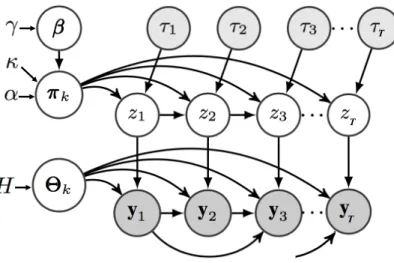
base distributionHfor the sampling of the model parametersΘΘΘk. Figure2depicts the PGM of the
proposed model with the respective joint probability distribution and formalisation.
P(τττ,z,Y) =
T
∏
t=p+1Q|ψ,H∼DP(ψ,H), G0(v)|γ,H∼DP(γ,Q), Gk(v)|α,G0(v)∼DP(α,G0(v)),
(10)
whereHis the base probability measure for the upper layer DP with concentration parameterψ,Qis
the master probability measure for the middle layer DP associated with the possible values ofτττwith
concentration parameterγ,G(0v)is the global probability measure for the lower layer DP associated
withτt = v with shared concentration parameterαacross all values ofv, andG(jv)is the random
probability measure for statejwhenτt=v.
T T
T
Figure 2.PGM of the AI-HMM structure. Observationytbeing dependent on the indicator variablezt
andpprevious observations, whereasztis dependent onzt−1in addition to the semi-Markov feature τt. Parametersβββare used to sample the transition distributionπππkwhich the state indicatorszare
sampled from. The observationsytare generated from functions with parametersΘΘΘzt which are in
turn sampled from base distributionH.
The possible values ofτττcan be inferred adaptively as will be described in Section4.2by placing
an appropriate prior on them (for example the DP would be a conjugate choice) and estimate them using modified MCMC inference. This is useful when it is known that there is an underlying variable
affectingzand the values for each time instance are unknown. For more intuitive analysis and better
understanding of the effect the contextual category has on the transition dynamics of the time series
data,τττcan also be set as a fixed categorical input to the model. This allows for more precise inference
of the transition dynamics associated with each contextvand for their custom selection based on the
problem of interest. Depending on the complexity of the data, the estimation of inputτττin addition
to the estimation of the remaining model parameters may be result in numerous local minima if no prior knowledge is known about the model. Therefore, it would be advantageous to train with partial
knowledge ofτττor pre-train with a fixed input when inferring it adaptively. In the general case of a
λλλ|ψ,H∼GEM(ψ), β ββv|γ,λλλ∼DP(γ,λλλ), πππ(kv)|α,βββv∼DP α+κ,αβββv+κδk α+κ , e(j,vi)∼πππ(j,vi)Dir η V λzt−1, ΘΘΘk|H∼H, τt|zt,zt−1,eee∼eeezt−1,zt, zt|zt−1,τt=v, πππ(kv) ∞ k=1∼πππ (v) zt−1, yt|zt, ¯Yt,(ΘΘΘk)k∞=1∼f(ΘΘΘztY¯t), (11)
whereλλλis the upper level mixing parameter and the middle level base measure,ηis the prior parameter
of the distribution ofτττandevj,iis the posterior probability ofτt=vwhenzt=iandzt−1=j. 4.2. Inference
Similarly to the AR-iHMM structure, the parameters of the AI-HMM can be inferred by blocked
Gibbs sampling. A truncation levelLis set to denote the maximum number of states expected expected
for the time series modelling so thatk∈ {1, 2, . . . ,L}. Given previously set transition distributions
{Π(vn−1)}, mixing parameters{βββv(n−1)}and emission distribution parameters{ΘΘΘ(kn−1)}and assuming
a normal distribution likelihood on the autoregressive observation sequence; the first step is to block
sample the input contextual vectorτττ. Given its Markov blanket, the posterior ofτtis
p(τt|zt,zt−1)∝p(zt|τt,zt−1)p(τt)p(zt−1). (12)
Here,p(zt|τt,zt−1)is simply the transition matrix elements{π(ztv−)1,zt}across allv,p(τt)is the prior
Dir(Vη), asτtis assumed to be categorically distributed with a Dirichlet prior andp(zt−1)is the global
prior ofzt−1. By design, changes in the value ofτtshould be sparse and infrequent since they represent
broad categories of transition dynamics and cover long contextual periods relative to the time series. For the case ofzt=zt−1=k, it can be possible that{e(kv,k)}is similar for multiple values ofvdue to the
closeness in value between probabilities{πππ(kv,k)}. A change in the value ofτtdirectly implies that the
state forzthas changed as well, due to the hierarchy of the model. This means that effectivelyτtis
only sampled on whenzt6=zt−1, which naturally enforces state persistence. To sample
τt∼ V
∑
v=1 e(zvt−)1,zt ∝ V∑
v=1 π ππ(zvt−)1,ztDir η V λzt−1δ(τt,v) ifzt6=zt−1; τt=τt−1 ifzt=zt−1. (13)The next set of parameters to sample arez. This is done using a variation of the forward-backward
algorithm where the(1×L)backward messagemt,t−1is calculated by
mt,t−1=mt+1,tΠτt L
∑
k=1N(yt;ΘΘΘkY¯t,Σk). (14)
The forward messagef(yt) = (f1(yt), . . . ,fL(yt))for observationytis
f(yt) =Nyt;{ΘΘΘkY¯t,Σk}Lk=1
×mt+1,t, (15)
where the first element of mt+1,t is equal to 1 and N yt;{ΘΘΘkY¯t,Σk}Lk=1
= (N(yt;ΘΘΘ1Y¯t,Σ1), . . . ,N(yt;ΘΘΘLY¯t,ΣL)). The indicator variableztcan then be sampled by
zt∼ L
∑
k=1 fk(yt)π (τt) zt−1,kδ(zt,k). (16)To sample the mixing parametersβββv, the following auxiliary variables must be sampled all of
shape(L×L):Mvrepresenting the count of transitions occurring due to sampling directly from the
base probability; ¯Mvrepresenting the counts of new transitions unobserved previously before in the
sequencezandN(v)representing the counts of transitioning from statejto statek. To estimateM
v,
for each(j,k)∈ {1, . . . ,L}vsetm(v)
j,k =0 and forn=1, . . . ,n (v) j,k sample x ∼Ber αβ (v) k +κδ(j,k) n+αβ(kv)+κδ(j,k) ! , (17)
then incrementnand ifx=1 incrementm(j,vk). Then, forj∈ {1, . . . ,L}, estimateWvby
ω(jv)∼Binomial m (v) j,j , κ κ+αβ(jv) , (18)
whereω(jv)denotes of the override counts when the base probability distribution was used to draw
self transitions for statej. This can in turn be used to estimate ¯m(j,vk)
¯ m(j,vk)= m(j,vk) j6=k; m(j,vj)−ω(jv) j=k. (19) β β
βvmay now be sampled by
βββv∼Dir
¯
mmm¯¯(.,1v), . . . , ¯mmm¯¯.,(vL), (20) where ¯mmm¯¯(.,vj)denotes thejthcolumn of ¯Mv. The mixing parameter may then be used to sampleπππ(kv)
π ππ(kv)∼Dir αβ(1v)+nk,1, . . . ,αβ(kv)+κ+nk,k, . . . ,αβ(Lv)+nk,L , (21)
where the hyperparameterκis added to the parameters for statekto enforce self transitions. The final
step in the iterative optimisation procedure is to sample the state specific vector autoregressive
parametersΘΘΘkandΣk. When using aMN I Wprior as explained in Section3.1, the parameters may
be updated given the observationsYand state indicator variablesz. For more details on the derivation
of the update, please see Fox [33].
SY(¯kY)¯ =Y¯(k)Y¯(k) T +K, SY(kY)¯ =Y(k)Y¯(k)T+MK, S(YYk) =Y(k)Y(k)T+MKMT, SY(k|)Y¯ =SYY(k)+SY(kY¯)S−Y¯Y(¯k)SY(kY)¯T, (22)
whereY(k)and ¯Y(k)are the observations and lag matrix of lagged observations, respectively, that are
classified to statek.SY(¯kY)¯,S (k) YY¯,S (k) YYandS (k)
Y|Y¯are the posterior parameters such that Σk∼ I W n0+
∑
v ck(v),SY(k|)Y¯+S0 ! , ΘΘΘk|Σk ∼ MN SY(kY)¯S−Y¯Y¯(k),Σk,S(Y¯kY)¯ , (23)wherec(kv)is the count of the number of observations in statekthrough whenτt=v.
The AI-HMM is a generative model that can represent the observation data statistically with the optimised model parameters. Therefore, given a pre-trained model and initial starting points, it may be possible to sample new observations that resemble the dynamics of the training data. The parameters can even be altered manually to represent different types of behaviours and trends. This allows for generation of new custom datasets that can be used for research across different fields.
5. Modelling With Fixed Inputs
To demonstrate the effectiveness of the AI-HMM, we tested the model on two different datasets that represent human and traffic behaviour in smart city environments. The first was the Dodgers loop
dataset [35] containing loop sensor data counting the number of vehicles that pass through the Glendale
on-ramp for the 101 North Freeway in Los Angeles in 5 min (288 reading per day) intervals over a period of 25 weeks. In addition to the presence of weekday morning and afternoon traffic-peak trends in the dataset, a baseball stadium in the vicinity of the ramp allows for the observation of the post-game traffic rise. This allows us to study the performance of the model at identifying commonly repeating daily trends that may change depending on external contextual information (weekend/weekday trends) as well as studying the outlier detection capabilities with the spike in density counts due to sparsely occurring games at the nearby stadium. The dataset is simple and uniformly sampled with easily identifiable trends that can be detected by simple data visualisation. Results can be seen in
Section5.1. The second dataset was the T-drive dataset [13,36] which contains GPS trajectory data from
more than 10,000 taxis collected over a period of 1 week within the city of Beijing, China. Analysing this dataset is more challenging as GPS data can be very noisy, sparse, irregularly sampled, heterogeneous and its data collection can be frequently interrupted due to environmental factors causing missing data (rarely missing at random). This type of data is complex and allows us to explore the effect of multiple contextual realisations on the observation data such as time of day and user identity. It also relates well traffic analysis, an important topic in smart city research. The AI-HMM identifies interesting patterns
and results as seen in Section5.2.
5.1. Dodgers Loop Sensor Dataset
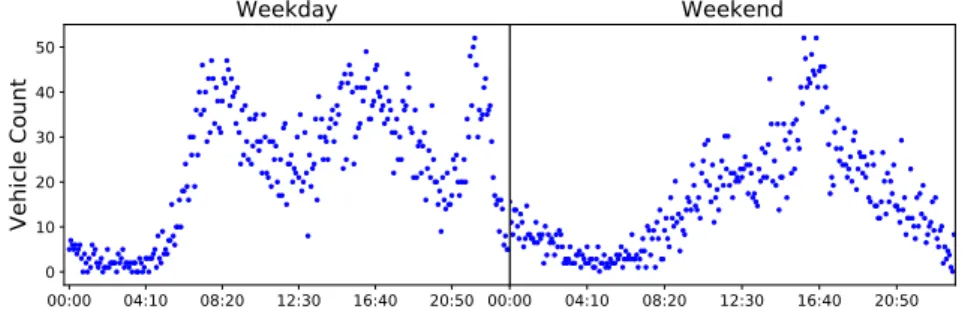
The AI-HMM was used to model the complete dodgers loop sensor dataset. Figure3shows
the count scatter for an average game day on a weekday and on a weekend. As is can be seen from the sharp peaks on the plots, games on weekdays often occur in the evening, whereas games on the weekends can occur at a similar time in the evening or, as depicted in the figure, they can occur in the afternoon. 00:00 04:10 08:20 12:30 16:40 20:50 time
Weekend
00:00 04:10 08:20 12:30 16:40 20:50 time 0 10 20 30 40 50Vehicle Count
Weekday
Figure 3.Scatter plots for vehicular density counts on an average game day on a weekday (left) and weekend (right). The first two distinct peaks on the weekday represent the morning and afternoon traffic peaks respectively, whereas the sharp peaks around 23:00 on the weekday and on 16:30 on the weekend represent traffic caused by fans leaving the stadium after a baseball game.
For this experiment, the observation instancesyt= (c,h)wherecis the vehicle count for the 5 min
traffic dynamics commonly differ in density flow, the input featureτt∈ {1, 2}whereτt=1 denotes
weekdays andτt=2 is assigned for weekends. This choice is supported by the assumption that traffic
dynamics generally repeat on a daily basis for weekends and weekdays separately, enforcing the belief of having different transition behaviours for each in the generative model. The VAR order was set to
p=288 being the number of observations in a day.
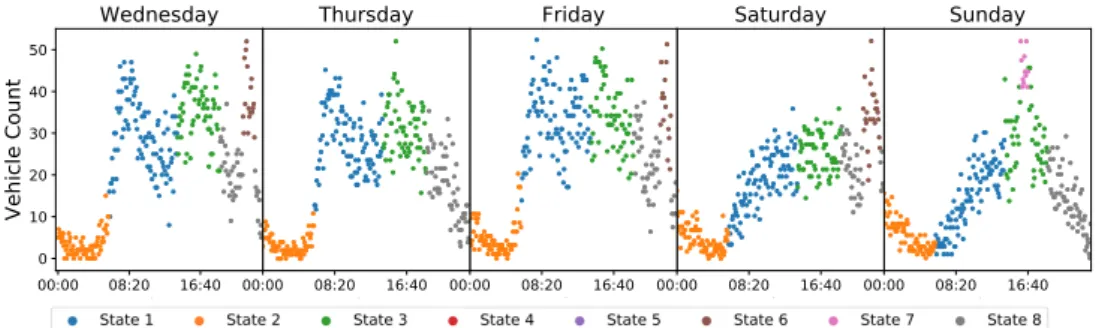
Figure4shows an example of the results for five days in one week. Looking at the weekday plot,
it can be seen that the morning and afternoon peak periods were clustered into states 1 (blue) and 4 (green), respectively. The sharp peaks in the evening (~23:00) on some weekdays corresponding to traffic rises due to the baseball games were clustered into state 6 (brown). On the weekend, the evening game on Saturday was also clustered into state 6; however, the afternoon (~16:30) game on
Sunday was clustered into state 7 (pink); a state which is not encountered on weekdays whenτt=1.
This demonstrates the dynamics of the AI-HMM. States are shared across the structures relating to the
different values ofτt, however, there may be differences when a set of observations following a certain
behaviour trends occur exclusively for realisationi.
00:00 08:20 16:40 time
Sunday
00:00 08:20 16:40 timeSaturday
00:00 08:20 16:40 timeFriday
00:00 08:20 16:40 timeThursday
00:00 08:20 16:40 time 0 10 20 30 40 50Vehicle Count
Wednesday
Figure 4.Scatter plots for vehicular density counts. Each colour represents a specific state that the respective observations was clustered into. Morning and evening traffic peaks on weekdays are clustered into state 1 (blue) and state 3 (green), respectively. Traffic caused by evening baseball games near 23:00 (Wednesday, Friday and Saturday) have been clustered into state 6 (brown), whereas traffic peaks caused by afternoon games at about 16:30 (Sunday) were clustered into state 7 (pink).
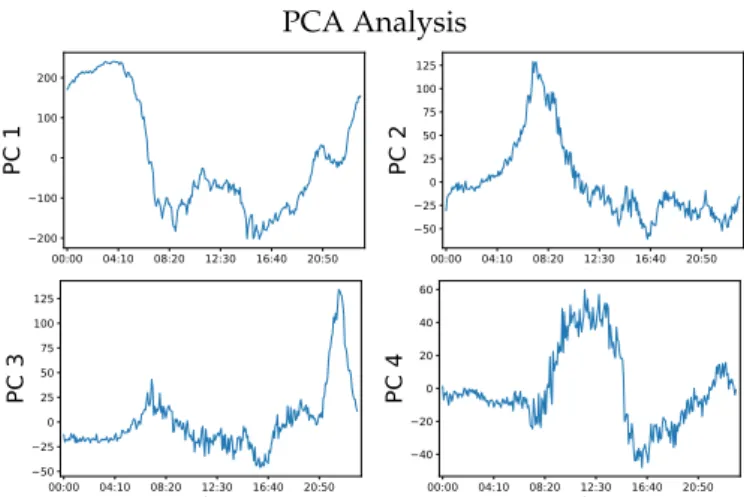
To compare the results, we use Principal Component Analysis (PCA) on the density counts of
vehicles per day. Figure5shows the first 4 PCs plotted against time. It can be seen that PC 2 seems to
capture the dynamics of the morning peak hours, whereas PC 4 captures the dynamics of the lighter weekend midday traffic. PC 3 Captures the trend of the evening game which commonly occurs on weekdays and Saturdays. These results inform us which orthogonal direction in the multidimensional data distribution we can expect to see these respective dynamics. However, this is specific to this data only, any additional day vectors added may alter the expected results. Moreover, using this technique alone, it is not possible to identify which days contain the identified trends and which days do not. Within the first four PCs, there was no PC that appears to identify the evening peaks nor the afternoon baseball games. All these shortcomings are solved with the AI-HMM approach demonstrating the effectiveness of the technique.
PCA Analysis 00:00 04:10 08:20 12:30 16:40 20:50 time 200 100 0 100 200
PC 1
00:00 04:10 08:20 12:30 16:40 20:50 time 50 25 0 25 50 75 100 125PC 2
00:00 04:10 08:20 12:30 16:40 20:50 time 50 25 0 25 50 75 100 125PC 3
00:00 04:10 08:20 12:30 16:40 20:50 time 40 20 0 20 40 60PC 4
Figure 5. Figure depicting the first four (PCs with the largest eigen values in the PCA analysis of the Dodgers loop sensor dataset). PC 2 capture the dynamics of the morning peak; PC 3 represents the sharp traffic rise due to the evening baseball game, which commonly occurs on weekdays and Saturdays; and PC 4 captures the dynamics of the weekend light midday traffic.
5.2. T-Drive Dataset
5.2.1. Data Preprocessing
GPS data are often in the form of a collection of geolocation data points in the form of
X = (x1,x2, . . . ,xT)wherext = (time,λ,l) ∈ R3,λis the longitude coordinate andlis the latitude
coordinate. The altitude is also included in some data sources; however, it is neglected for the purpose of this paper since it is not always available. Given that the altitude is recorded in the dataset, the feature be added for analysis in the proposed technique with no changes to the structure. Extreme outliers relating to errors in the sensors measurement and very short trajectories (a trajectory consisting of only five data points for example) may be neglected since they do not generally hold much information about the journey.
Using only the trajectory time seriesX, the feature sequenceY is calculated to describe the
trajectory path whereY = (y1,y2, . . . ,yT),yt= (λ,l,h,∆v) ∈R4,his the hour of day and∆vis the
average velocity given the distance travelled between two points∆d. The distance is calculated with
the Haversine Equation [37]
h ∆d t r =h(∆λ) +cos(λt−1)cos(λt)h(∆), (24) whereh(φ) = sin2φ 2
andr = 6371kmis the radius of the Earth assumed to be constant on all
locations on its surface.∆vis then calculated by ∆dt
∆timet. From the T-drive dataset, the recorder journeys
of 10 taxis were selected randomly and modelled with the proposed AI-HMM. GPS data is often recorded as a sequence of geolocation observationsX= (x1,x2, . . . ,xT), wherext∈R3= (time,λ,l),
λis the longitude coordinate andlis the latitude coordinate. The feature sequenceYis calculated
to describe the trajectory path whereY= (y1,y2, . . . ,yT),yt∈R4= (λ,l,h,∆v),his the hour of day
and∆vis the average velocity given the distance travelled between two points as calculated by the
Haversine Equation [37].
5.2.2. AI-HMM Modelling with Predefined Inputτ
Beijing is a busy city that is known for congested streets throughout most hours of the day [38].
However, the trajectories of trips in peak and off-peak times are likely to have very different latent
dynamics. For this part of the case study, we assume thatτt∈ {1, 2}can represent peak and off-peak
point was recorded in. Due to the smoothness of the sampled GPS trajectories, we opted for a low VAR
order ofp=2. The hyperparametersγ,αandκcan be set experimentally by Bayesian model selection
or by placing an updatable prior over them as seen in Fox et al. [33]. After running the experiment
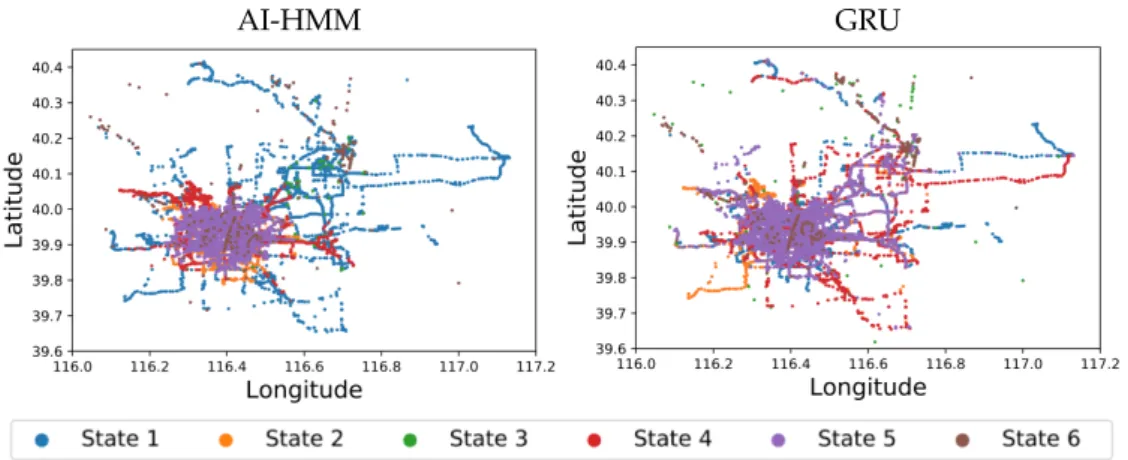
until convergence, the model identified six states corresponding to different movement behaviour as
presented in Figure6.
AI-HMM GRU
Figure 6. Results obtained from analysing 10 taxi trajectories using the novel AI-HMM framework (left) and the GRU technique (right). Each data point corresponds to a GPS observation where its colour represents the state to which it was assigned. The plots depict the longitudeλagainst latitudel reconstructions of the movements of the taxi locations on a map.
For comparison, a t-distributed Stochastic Neighbour Embedding (tSNE)-based technique [39]
was applied following the methodology of Singleton [40]. However, due to the complexity of the
data, the technique failed at identifying meaningful clusters; experimentally converging to the sample data average. We also compare our framework with a deep learning Gated Recurrent Unit (GRU)
autoencoder embedding model with K-means clustering, similar to that proposed by Yao et al. [15].
To enable direct comparison, the number of clusters for the K-means algorithm was set to 6, following the number of states that were automatically identified with the nonparametric AI-HMM framework.
Figure6shows the results obtained from the AI-HMM and the GRU frameworks while Table1
shows the median velocityvmedianinterquartile range (IQR) velocityvIQR, and the most prominent
time rangeshprominentfor each of the states using both techniques. The plots depict a reconstructed
scatter map of the data where each point represents an observation with its corresponding value and time-step, whereas the colours represent which state the points belong to according to the legend. States 2 (orange) and 5 (purple) are mostly focused in the middle of the city with median velocities of 18 km/h and 19km/h, respectively. Their most prominent hours of day indicate that they represent the morning and afternoon peak periods when the roads are highly congested. As night approaches and traffic subsides, they are replaced by state 4 (red), which is also most prominent in the center of the city with a median velocity of 23 km/h. State 1 (blue) is focussed on the highway network where velocities are expectedly higher with a median velocity of 26 km/h. The observations belonging to state 3 (green) with a median velocity of 0 km/h are mostly distributed near Beijing capital international airport, where taxis often spend prolonged periods of time in stationary motion awaiting customers. As previously mentioned, GPS data can be very noisy with sporadic measurement errors causing possible location jumps. This noise was not filtered prior to analysis; however, the model was capable of identifying the noisy observations and separating from the rest of the data into state 6 (purple).
Table 1.Cluster statistics (velocity in km/h).
State AI-HMM GRU
vmedian vIQR hprominent vmedian vIQR hprominent
1 26 35 00:00–23:00 18 24 12:00–18:00 2 18 19 17:00–23:00 18 34 00:00–06:00 3 0 0 00:00–23:00 2147 7697 00:00–23:00 4 23 27 00:00–06:00 16 29 06:00–13:00 5 19 19 10:00–18:00 16 22 18:00–23:00 6 497 1336 00:00–23:00 186 176 00:00–23:00
The GRU analysis was also successful at identifying the noisy observations and filtering them into states 3 (green) and 6 (brown); however, the remaining states have very similar median velocities. Inspection of state velocity histogram distributions indicates that the clustering values have been affected by long periods of stationarity (influenced by taxis at the airport). The distribution of the
data points in Figure6also shows that there is minimal location based clustering since most of the
states overlap between all regions of the city (e.g., city centre and highways). Therefore, the GRU was effective at identifying the most separated clusters; however, it identified more specific and less diverged behaviour patterns. The AI-HMM framework was capable of identifying meaningful states that represent behaviour trends combining location information, velocity and hour of day patterns, yielding more informative and representative results.
6. Adaptive Input
In cases where the contextual inputτis known or can be assigned to the data, the AI-HMM
demonstrates highly informative unsupervised analysis results outperforming other commonly used
time series sensor analysis techniques in the literature. However, it is often the case thatτis partially
missing, and must therefore be inferred from the data adaptively. To demonstrate the performance of
adaptively inferring the input vectorτgiven a pre-trained model, another experiment was conducted
on the T-drive dataset whereτwas used to indicate the taxis identity. The full data of two different
taxis was extracted and separated into 75% training set and 25% test set. For the training data points,
the input was set toτt∈ {1, 2}representing taxi 1 and taxi 2, respectively, and they were fit with the
AI-HMM model to learn all remaining parameters and variablesΘΘΘk,µµµk,Σk,Πv,βββvandztrain. The aim
for the test data was to infer the values ofztest as well asτττtest using Equation (13) assuming they
are unknown.
As would be expected, the transition distributions of the two different taxis given the training data showed some overlap in behaviour time dynamics with the addition of some differences. This firstly proves the hypothesis that sensor data belonging to different contextual factors (i.e., person identity in this example) follow different time dynamics in an HMM structure. Correctly identifying these transition distributions allows for more accurate model fitting; the framework will refer to a more specific transitions matrix representing the state transitions under the specified contextual representation during optimisation, generating more informative clustering results. For example, if transitions into state 4 representing late night, off-peak travel is absent from taxi 2’s behaviour dynamics, indicating that this taxi avoids late night fairs and prefers to work at different times of day, whereas taxi 1 may prefer to work in such less congested times.
The presence of differences in the transition dynamics allow for accurate estimation ofτgiven the
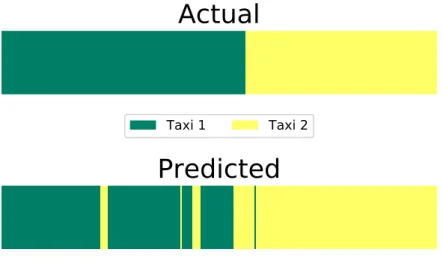
trained parameters on unseen data as reflected by the results obtained from the test data run. Figure7
shows the AI-HMMs capability of estimating the correct identity of the taxi using adaptiveτinference
Actual
Taxi 1
Taxi 2
Predicted
Figure 7.Prediction of the value ofτtcorresponding to the taxi identity on the test. The top plot shows
the sample labels, whereas the bottom plot shows the predictedτtvalues using the AI-HMM with an
accuracy of 93%. 7. Conclusions
This paper demonstrates a novel Bayesian nonparametric model for the identification of human behavioural trends from smart city sensors. We address the unsupervised problem of analysing complex data sequences representing human movement by designing a generative PGM that permits for the adaptive contextual switching of transition dynamics. Results obtained from applying the model to complex real-world data demonstrated effectiveness in identifying different dynamic behavioural trends and noise filtering capabilities. We have motivated the value of the presented approach via piratical problems in monitoring and compared the results to examples of alternative tools such as RNNs. The presented framework allows for easy augmentation of existing systems with an adaptive factor which can estimate the effect of discrete contextual information. By adaptively estimating the input value given a pre-trained model, it is possible to accurately identify the contextual realisation which the data belongs to, such as predicting the identity of the individual that generated the data.
As of now, the model is only limited to low dimensional time-series data. However, future work will include broadening the model to scenarios where the observation model can be high dimensional and where multiple dependent contextual variables can be included.
Author Contributions: Methodology, Y.Q.; Software, Y.Q.; Supervision, Y.P.R. and M.A.L.; Writing—original draft, Y.Q.; Writing—review & editing, Y.P.R. All authors have read and agreed to the published version of the manuscript.
Acknowledgments:We would like to thank the Engineering and Physical Sciences Research Council (EPSRC) for their support and contribution to this work, without whom, this research will not be possible.
Conflicts of Interest:The authors declare no conflict of interest. Abbreviations
The following abbreviations are used in this manuscript: AR Autoregressive
AI-HMM Adaptive Input Hidden Markov Model AR-iHMM Autoregressive infinite Hidden Markov Model CRHTI Chicago Regional Household Travel Inventory DP Dirichlet Process
FF-BS Forward Filtering Backward Sampling GEM Griffiths, Engen and McCloskey GPS Global Positioning System GRU Gated Recurrent Unit
HDP-HMM Hierarchical Dirichlet Process Hidden Markov Model HMM Hidden Markov Model
iHMM infinite Hidden Markov Model IQR interquartile Range
LSTM Long-Short Term Memory MCMC Markov Chain Monte Carlo MLP Multi-Layer Perceptron MNIW Matrix-Normal Inverse-Wishart PC Principal Component
PCA Principal Component Analysis PGM Probabilistic Graphical Model
tSNE t-distributed Stochastic Neighbour Embedding VAR Vector Autoregressive
VAR-HMM Vector Autoregressive Hidden Markov Model References
1. Jang, S.; Jo, H.; Cho, S.; Mechitov, K.; Rice, J.A.; Sim, S.H.; Jung, H.J.; Yun, C.B.; Spencer, B.F., Jr.; Agha, G. Structural health monitoring of a cable-stayed bridge using smart sensor technology: Deployment and evaluation. Smart Struct. Syst.2010,6, 439–459. [CrossRef]
2. Hong, I.; Park, S.; Lee, B.; Lee, J.; Jeong, D.; Park, S. IoT-based smart garbage system for efficient food waste management. Sci. World J.2014,2014, 646953. [CrossRef] [PubMed]
3. Castro, M.; Jara, A.J.; Skarmeta, A.F. Smart lighting solutions for smart cities. In Proceedings of the 2013 27th International Conference on Advanced Information Networking and Applications Workshops, Barcelona, Spain, 25–28 March 2013; pp. 1374–1379.
4. Masse, R.A.C.; Ochoa-Zezzatti, A.; García, V.; Mejía, J.; Gonzalez, S. Application of IoT with haptics interface in the smart manufacturing industry. Int. J. Comb. Optim. Probl. Inform.2019,10, 57–70.
5. De Marsico, M.; Mecca, A.; Barra, S. Walking in a smart city: Investigating the gait stabilization effect for biometric recognition via wearable sensors. Comput. Electr. Eng.2019,80, 106501. [CrossRef]
6. Paul, A.; Ahmad, A.; Rathore, M.M.; Jabbar, S. Smartbuddy: Defining human behaviors using big data analytics in social internet of things.IEEE Wirel. Commun.2016,23, 68–74. [CrossRef]
7. Torre-Bastida, A.I.; Del Ser, J.; Laña, I.; Ilardia, M.; Bilbao, M.N.; Campos-Cordobés, S. Big Data for transportation and mobility: Recent advances, trends and challenges. IET Intell. Transp. Syst. 2018,
12, 742–755. [CrossRef]
8. Bhatti, F.; Shah, M.A.; Maple, C.; Islam, S.U. A novel internet of things-enabled accident detection and reporting system for smart city environments.Sensors2019,19, 2071. [CrossRef] [PubMed]
9. Ahmad, A.; Paul, A.; Rathore, M.M.; Chang, H. Smart cyber society: Integration of capillary devices with high usability based on Cyber–Physical System. Future Gener. Comput. Syst.2016,56, 493–503. [CrossRef] 10. Kanungo, A.; Sharma, A.; Singla, C. Smart traffic lights switching and traffic density calculation using
video processing. In Proceedings of the 2014 Recent Advances in Engineering and Computational Sciences (RAECS), Chandigarh, India, 6–8 March 2014; pp. 1–6.
11. Ozkurt, C.; Camci, F. Automatic traffic density estimation and vehicle classification for traffic surveillance systems using neural networks. Math. Comput. Appl.2009,14, 187–196. [CrossRef]
12. Ma, X.; He, Y.; Luo, X.; Li, J.; Zhao, M.; An, B.; Guan, X. Camera placement based on vehicle traffic for better city security surveillance. IEEE Intell. Syst.2018,33, 49–61. [CrossRef]
13. Yuan, J.; Zheng, Y.; Xie, X.; Sun, G. Driving with knowledge from the physical world. In Proceedings of the 17th ACM SIGKDD international conference on Knowledge discovery and data mining, San Diego, CA, USA, 21–24 August 2011; pp. 316–324.
14. Mehran, R.; Oyama, A.; Shah, M. Abnormal crowd behavior detection using social force model. In Proceedings of the 2009 IEEE Conference on Computer Vision and Pattern Recognition, Miami, FL, USA, 20–25 June 2009; pp. 935–942.
15. Yao, D.; Zhang, C.; Zhu, Z.; Huang, J.; Bi, J. Trajectory clustering via deep representation learning. In Proceedings of the 2017 International Joint Conference on Neural Networks (IJCNN), Anchorage, AK, USA, 14–19 May 2017; pp. 3880–3887.
16. Wang, Y.; Zhu, Y.; He, Z.; Yue, Y.; Li, Q.Challenges and Opportunities in Exploiting Large-Scale GPS Probe Data; Technical Report HPL-2011-109; HP Laboratories: Palo Alto, CA, USA, 21 July 2011.
17. Ellam, L.; Girolami, M.; Pavliotis, G.; Wilson, A. Stochastic modelling of urban structure. Proc. R. Soc. A Math. Phys. Eng. Sci.2018,474, 20170700. [CrossRef] [PubMed]
18. Witayangkurn, A.; Horanont, T.; Sekimoto, Y.; Shibasaki, R. Anomalous event detection on large-scale gps data from mobile phones using hidden markov model and cloud platform. In Proceedings of the 2013 ACM conference on Pervasive and ubiquitous computing adjunct publication, Zurich, Switzerland, 8–12 September 2013; pp. 1219–1228.
19. Fox, E.; Sudderth, E.B.; Jordan, M.I.; Willsky, A.S. Nonparametric Bayesian learning of switching linear dynamical systems. In Proceedings of the Neural Information Processing Systems 2008, Vancouver, BC, Canada, 8–10 December 2008; pp. 457–464.
20. Suzuki, N.; Hirasawa, K.; Tanaka, K.; Kobayashi, Y.; Sato, Y.; Fujino, Y. Learning motion patterns and anomaly detection by human trajectory analysis. In Proceedings of the 2007 IEEE International Conference on Systems, Man and Cybernetics,Montreal, QC, Canada, 7–10 October 2007; pp. 498–503.
21. Jiang, S.; Ferreira, J.; González, M.C. Clustering daily patterns of human activities in the city. Data Min. Knowl. Discov.2012,25, 478–510. [CrossRef]
22. Shih, D.H.; Shih, M.H.; Yen, D.C.; Hsu, J.H. Personal mobility pattern mining and anomaly detection in the GPS era.Cartogr. Geogr. Inf. Sci.2016,43, 55–67. [CrossRef]
23. Mahadevan, V.; Li, W.; Bhalodia, V.; Vasconcelos, N. Anomaly detection in crowded scenes. In Proceedings of the 2010 IEEE Computer Society Conference on Computer Vision and Pattern Recognition, San Francisco, CA, USA, 13–18 June 2010; pp. 1975–1981.
24. Rodriguez, M.; Sivic, J.; Laptev, I.; Audibert, J.Y. Data-driven crowd analysis in videos. In Proceedings of the 2011 International Conference on Computer Vision, Barcelona, Spain, 6–13 November 2011; pp. 1235–1242. 25. Fu, Z.; Hu, W.; Tan, T. Similarity based vehicle trajectory clustering and anomaly detection. In Proceedings
of the IEEE International Conference on Image Processing 2005, Genova, Italy, 14 Septemer 2005.
26. Piciarelli, C.; Micheloni, C.; Foresti, G.L. Trajectory-based anomalous event detection. IEEE Trans. Circuits Syst. Video Technol.2008,18, 1544–1554. [CrossRef]
27. Frank, P. Chicago Regional Household Travel Inventory. Available online:https://www.cmap.illinois. gov/documents/10180/77659/TravelTracker_ModeShareReport20100604.pdf/a67bf419-c05a-45c2-a127-a18d7984cd7d(accessed on 28 January 2020).
28. Zheng, Y.; Xie, X.; Ma, W.Y. Geolife: A collaborative social networking service among user, location and trajectory. IEEE Data Eng. Bull.2010,33, 32–39.
29. Raykov, Y.P.; Ozer, E.; Dasika, G.; Boukouvalas, A.; Little, M.A. Predicting room occupancy with a single passive infrared (PIR) sensor through behavior extraction. In Proceedings of the 2016 ACM International Joint Conference on Pervasive and Ubiquitous Computing, Heidelberg, Germany, 12–16 September 2016; pp. 1016–1027.
30. Kunst, R.M. Vector Autoregressions. Available online:https://homepage.univie.ac.at/robert.kunst/var.pdf (accessed on 28 January 2020).
31. Beal, M.J.; Ghahramani, Z.; Rasmussen, C.E. The infinite hidden Markov model. In Proceedings of the Advances in Neural Information Processing Systems 2002, Vancouver, BC, Canada, 9–14 December 2002; pp. 577–584.
32. Teh, Y.W.; Jordan, M.I.; Beal, M.J.; Blei, D.M. Hierarchical Dirichlet Processes. J. Am. Stat. Assoc. 2006,
101, 1566–1581. doi:10.1198/016214506000000302. [CrossRef]
33. Fox, E.B. Bayesian Nonparametric Learning of Complex Dynamical Phenomena. Ph.D. Thesis, Massachusetts Institute of Technology, Cambridge, MA, USA, 2009.
34. Pitman, J. Poisson–Dirichlet and GEM invariant distributions for split-and-merge transformations of an interval partition.Comb. Probab. Comput.2002,11, 501–514. [CrossRef]
35. Ihler, A.; Hutchins, J.; Smyth, P. Adaptive event detection with time-varying poisson processes. In Proceedings of the 12th ACM SIGKDD International Conference on Knowledge Discovery and Data Mining, Philadelphia, PA, USA, 20–23 August 2006; pp. 207–216.
36. Yuan, J.; Zheng, Y.; Zhang, C.; Xie, W.; Xie, X.; Sun, G.; Huang, Y. T-drive: Driving directions based on taxi trajectories. In Proceedings of the 18th SIGSPATIAL International Conference on Advances in Geographic Information Systems, San Jose, CA, USA, 2–5 November 2010; pp. 99–108.
37. Van Brummelen, G.Heavenly Mathematics: The Forgotten Art of Spherical Trigonometry; Princeton University Press: Princeton, NJ, USA, 2012; pp. 160–162.
38. Zhang, H.H. Beijing Still Struggling Deal Traffic Congestion. Available online:https://www.scmp.com/ news/china/article/1298559/beijing-still-struggling-deal-traffic-congestion(accessed on 7 March 2019). 39. Maaten, L.; Hinton, G. Visualizing data using t-SNE.J. Mach. Learn. Res.2008,9, 2579–2605.
40. Singleton, A.D.; Spielman, S.; Folch, D.Urban Analytics; Sage Publishing: Thousand Oaks, CA, USA, 2017. c
2020 by the authors. Licensee MDPI, Basel, Switzerland. This article is an open access article distributed under the terms and conditions of the Creative Commons Attribution (CC BY) license (http://creativecommons.org/licenses/by/4.0/).