Handle-Rewriting
Hypergraph Grammars*
BRUNO COURCELLELaBRI, Universitt! de Bordeaux I, 351, Cows de la Lihkration, 33405 Talence, France
AND
JOOST ENGELFRIET AND GRZEG~RZ ROZENBERG
Department of Computer Scietice, Leiden University, P.O. Box 9512, 2300 RA Leiden, The Netherlands
Received June 15, 1990; revised August 27, 1991
We introduce the handle-rewriting hypergraph grammars (HH grammars), based on the replacement of handles, i.e., of subhypergraphs consisting of one hyperedge together with its incident vertices. This extends hyperedge replacement, where only the hyperedge is replaced. A HH grammar is separated (an S-HH grammar) if nonterminal handles do not overlap. The S-HH grammars are context-free, and the sets they generate can be characterized as the least solutions of certain systems of equations. They generate the same sets of graphs as the NLC-like vertex-rewriting C-edNCE graph grammars that are also context-free. 0 1993 Academic Press, Inc.
INTRODUCTION
The concept of a context-free graph grammar is an attractive way of formalizing the notion of a recursively defined set of graphs, i.e., of a recursive graph property.
Unfortunately, as opposed to the case of strings, there is not one type of context-
free graph grammar, but there are many types, depending, e.g., on what kind of graph is generated or how the embedding works. Roughly speaking one may distinguish three types of context-free graph grammars, according to which part of a given graph is rewritten into another graph: a vertex, an edge, or a handle (i.e., an edge, together with its two incident vertices). In general one can say that handle-
rewriting grammars are more powerful than vertex-rewriting grammars, which in
their turn have more power than edge-rewriting grammars. To increase the power
of edge-rewriting grammars, hyperedge-rewriting grammars have been introduced
in [l, 27, 281 (and studied, e.g., in [S, 10, 18, 19, 25, 26, 33, 371). Such grammars
generate (directed) hypergraphs, of which the (hyper)edges are rewritten into
hypergraphs. Still, these grammars are not as powerful as vertex-rewriting
grammars, with the set of all complete graphs as a counterexample. In this paper
we introduce the so-called separated handle-rewriting hypergraph grammar (S-HH
* Supported by ESPRIT BRWG 3299 “Computing by Graph Transformations.”
218
OO22-OOOO/93 $5.00
Copyright 0 1993 by Academic Press, Inc. All rights of reproduction in any form reserved.
grammar). In such a grammar, a handle, i.e., a hyperedge, together with all its incident vertices, is rewritten into a hypergraph. The adjective “separated” means
that the nonterminal handles (i.e., the handles that are rewritten) do not overlap,
which means that they have no common incident vertices. S-HH grammars are a
natural generalization of the hyperedge-rewriting grammars of [ 1,27,28]. We
show, as our first main result, that the S-HH grammars have the same power as the
largest known class of context-free vertex-rewriting grammars: the confluent
edNCE grammars (or C-edNCE grammars) studied in, e.g., [3, 16, 32,401.
C-edNCE grammars are a special case of the grammars of [38] and a generaliza- tion of the NLC grammars of [ 30, 311; subclasses of C-edNCE grammars were considered in, e.g., [21-241.
A completely different type of graph grammar is the algebraic term-rewriting
graph grammar [ 1, 5, 361. The sentential forms of a term-rewriting grammar are
terms rather than (hyper)graphs, i.e., they are expressions that denote graphs. A
term-rewriting grammar is just a context-free (string) grammar (or a ground term-
rewriting system) that generates a set of such expressions. To obtain the generated (hyper)graph language one just interprets these expressions as (hyper)graphs. We define three types of operations on hypergraphs or, rather, on “hypergraphs with ports,” i.e., hypergraphs of which some of the vertices are labeled with integers, The operations are disjoint union, edge creation (using the integers to determine which edges are created), and port selection (that changes the integer labeling). We show, as our second main result, that, using the expressions built from these operators (together with two constants denoting the empty and the one-vertex hypergraph),
term-rewriting grammars have the same power as S-HH grammars, and hence (in
view of our first result), the same power as the vertex-rewriting C-edNCE
grammars. Such an algebraic characterization did not yet exist for vertex-rewriting
graph grammars (for hyperedge-rewriting grammars see [ 1 I). One advantage of
term-rewriting grammars is that, through their interpretation as the least fixed
point of a system of equations, they correspond closely to the intuitive way in
which recursive definitions of graph properties are usually given (whereas the
ordinary graph grammars have a more operational, generative flavour). Another advantage is that they lead to results concerning monadic second-order logic, as in [lo].
These three distinct descriptions of this class of graph languages (through S-HH
grammars, C-edNCE grammars, and algebraic term-rewriting grammars), together
with two other characterizations (through regular string/tree languages and
through monadic second-order logic, see [ 16, 171) demonstrate that it is a natural class of graph languages.
The separation property (which also holds for the sentential forms) guarantees that every S-HH grammar is confluent, i.e., that the order of applying productions does not influence the derived hypergraph. Confluence is a property that graph grammars should have to deserve the adjective context-free (see [6]). The edNCE grammars are not confluent, in general, which is the reason to restrict attention to confluent edNCE grammars (C-edNCE grammars). Since confluence is a dynamic,
operational property, it is rather difficult to work with. For this reason it is convenient to have an equivalent class of grammars (the S-HH grammars) for which no such restriction holds. To be more honest, we will first introduce arbitrary HH grammars, which are not confluent, and then impose confluence by requiring
them to be separated. However, separation is a completely static, structural
restriction.
This paper is divided into seven sections, The first section contains the necessary definitions of (directed, labeled) hypergraphs and graphs; the latter are conveniently defined as a special case of the former. In Section 2 HH grammars, and, in particular, S-HH grammars, are introduced, together with some of their elementary properties. After Section 2 the reader may either read Sections 3 and 4, in which the first main result is shown, or Sections 5 and 6, in which the second main result is shown. Section 3 contains the definition of C-edNCE grammars, and in Section 4 it is shown that S-HH grammars have the same graph generating power as the C-edNCE grammars. In Section 5 we define the three types of operations on
hypergraphs with ports and we define the corresponding term-rewriting grammars,
in the form of systems of equations (with least fixed point). Section 5 also contains a key lemma that is used in Section 6 to prove the equivalence of S-HH grammars and systems of equations. Finally, Section 7 discusses confluent NLC grammars (a subclass of the C-edNCE grammars investigated in [6]) and the hyperedge- rewriting grammars of [l, 281. (A short version of this paper appeared in [12].)
We will use N to denote (0, 1, 2, . ..} and N + to denote ( 1, 2, . ..}. For m, n E N, [m, n] = { ie N 1 m < i < n}. For a finite set A, card(A) denotes its cardinality, and P(A) its powerset.
1. HYPERGRAPHS AND GRAPHS
Let A be an alphabet (of edge labels). A (directed, edge labeled) hypergraph over A is a tuple H = (V, E), where V is the finite set of vertices and E is the finite set of hyperedges. Each hyperedge is a tuple (a, u,, . . . . uk) with a~.4, k > 1, and USE I/ for i E [ 1, k]. We will often use “edge” instead of “hyperedge.” HG(A) denotes the set of all hypergraphs over A.
Let H = (V, E) be a hypergraph over A. Note that H may have multiple edges, but not with the same label. For an edge e = (a, ui, . . . . uk) in E, we write vert(e) = (u,, . . . . u,), vert(e, i) = ui, and vset(e) = {ui, . . . . uk}. Each ui is said to be a vertex of e, or a vertex incident with e. The number i is said to be a tentacle of e. Note that the ui are not necessarily distinct. Note also that we do not allow k = 0. The integer k 2 1 is called the rank of e, denoted rank(e), and a is called the label of e, denoted lab(e).
As usual, we will add a subscript H to indicate that we deal with the hypergraph H; thus, VH stands for V, E, for E, and, e.g., vert, for vert.
Two hypergraphs H and K are disjoint if V, and VK are disjoint. Two hyper- graphs H and K are isomorphic if they differ only with respect to the identity of
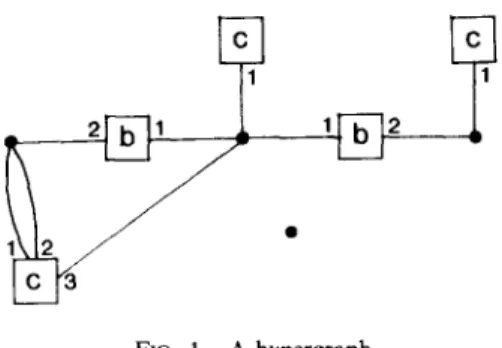
FIG. 1. A hypergraph.
their vertices; i.e., formally, if there is a bijection f: Y, + V, such that E,= {f(e) 1 eEEH}, where, for e=(a, ui ,..., uk), f(e) = (a, f(o,), . . . . f(~~)). Such a mapping is called an isomorphism.
EXAMPLE. A hypergraph (I’, E) over A = {b, c} is shown in Fig. 1. The set of vertices is V= {vi, u2, u3, u4}, where we have enumerated the vertices from left to right, and the set of edges is E = { (c, ul, 01, u,), (6 u2, Ul), cc, 021, (b, u2, fh),
(c, u4)}. Note that u3 is an isolated vertex.
In general, a vertex is drawn as a dot, and a hyperedge (a, vi, . . . . uk) is drawn as a square box with label u inside, together with a line labeled i (a tentacle) between the box and the dot representing ui, for every iE [ 1, k]. An edge (a, ui, u2) may also be drawn as an ordinary directed edge from vi to u2, with label a, and an edge (a, u1 ) may also be drawn as vertex label a of u i ; thus, Fig. 2 shows the same hyper- graph as Fig. 1. These last conventions allow us to draw directed labeled graphs, defined next, in the usual way.
Let A be an alphabet (of edge and vertex labels). A (directed, edge labeled, vertex labeled) graph over A is a hypergraph H= (I’, E) over A such that (1) rank(e) = 1 or rank(e) = 2 for every e E E, and (2) for every u E V there is exactly one hyperedge e E E such that e = (a, u) for some a E A. The hyperedges of rank 2 are the edges of the graph, whereas the hyperedges of rank 1 are the vertex labels. Thus, for graphs, the word “edge” will always refer to the hyperedges of rank 2. For i = 1,2 we write
l C
E(i) = {e E E 1 rank(e) = i}. If e = (a, u) E E( 1 ), then the label a of e is also called the
label of U, denoted lab(u); thus, a = lab(e) = lab(u). If e = (a, U, v) E E(2), we say, as
usual, that e leads from u to u. Note that loops, i.e., edges (a, U, u), are allowed. GR(A) denotes the set of all graphs over A. Thus, GR(A) E HG(A).
For any notion of isomorphism between objects, we use [x] to denote the set
of objects isomorphic to object x. For a set X of objects, [X] denotes
u ( [x] ( x E X>, i.e., the set of all objects that are isomorphic to some object in X. Sometimes, x is called a concrete object and [xl, an abstract object. In particular,
for a hypergraph H, [H] is an abstract hypergraph. [HG(A )] denotes the set of
all abstract hypergraphs over A.
2. HANDLE HYPERGRAPH GRAMMARS
In context-free-like (hyper)graph grammars, a production is often of the form
X-P (H, emb), where X is a nonterminal, H is a (hyper)graph, and emb is an
embedding relation. The nonterminal X is meant to label a vertex or an edge,
depending on whether the grammar rewrites vertices or edges. A rewriting step according to such a production consists of removing the vertex or edge labeled X
from the given (hyper)graph, substituting H in its place, and connecting H to the
remainder of the graph in a way specified by the embedding relation emb. A
convenient way of treating this process formally is to add emb to H, to consider the
pair (H, emb) as a new type of object, say, “hypergraph with embedding,” and to
view rewriting as a substitution operation on such objects (cf. [S]). Intuitively,
these objects are quite natural: they are hypergraphs ready to be embedded in an environment. In this section we define a new type of graph grammar in this way:
the handle hypergraph grammar (abbreviated HH grammar). It is a rather
straightforward generalization of the context-free hypergraph grammar (or hyper-
edge replacement grammar) of [l, 26, 27, 281.
The sentential forms of a HH grammar are arbitrary hypergraphs, of which the
edges are labeled by nonterminal and terminal symbols. However, as opposed to
the context-free hypergraph grammar, the grammar is not edge rewriting but
handle rewriting. This means that not only the (nonterminal) edge is removed, but
also its incident vertices: a “handle” is an edge together with its incident vertices, cf. [ 15, 341 (do not confuse it with the notion of handle in parsing theory). Handle rewriting in hypergraphs may be viewed as a generalization of both (hyper)edge rewriting (in case the incident vertices are re-established) and vertex rewriting (in case the hyperedge is of rank l), and is related to the handle rewriting of [35]. In
HH grammars, the embedding is similar to that of NLC-like vertex rewriting
grammars (such as, the edNCE grammars discussed in the next section), in the sense that edges in the environment may be duplicated or deleted. The embedding
is also similar to, and may be viewed as a “multi-valued” version of, the one used
in the context-free hypergraph grammars: each incident vertex of the rewritten edge is replaced by several vertices (gluing points), rather than just one. These gluing
points will be called “ports.” We start by defining “hypergraphs with embedding,” as discussed above. The embedding relation consists of a specification of the ports.
Let A be an alphabet. A hypergraph with ports over A is a pair (H, port) such
that H is in HG(A) and port is a finite subset of N + x V,. HGP(A) denotes the set of all hypergraphs with ports over A. If (i, u) E port, we say that v is an i-port (or just a port) and that i is a port number of v. Since port is a relation, we can employ the usual terminology for relations. Thus, port(i) denotes {u E I’, 1 (i, u) E port }: the set of all i-ports, and port-‘(v) denotes {i E N + 1 (i, v) E port}: the set of
all port numbers of a given vertex u. If H = (V, E), we also write (I’, E, port) for
(H, port). If port = 0, we identify (H, port) with H. Thus, every hypergraph is a
hypergraph with ports. Two hypergraphs with ports (H, port,) and (K, port,) are
isomorphic if there is an isomorphism f from H to K such that port,= { (i,f(v)) 1
(i, u) E port,}.
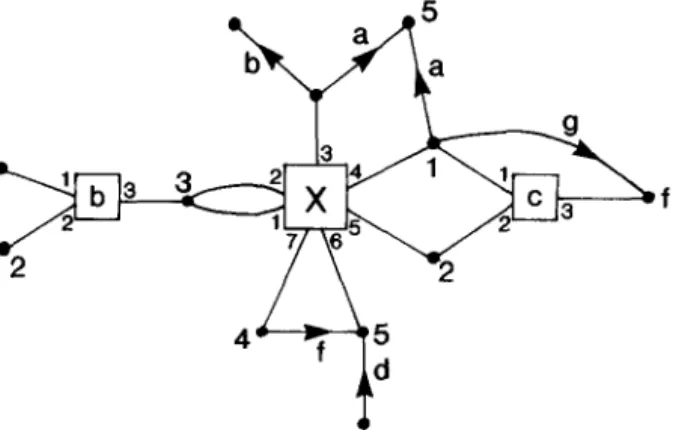
EXAMPLE. Figure 3 shows a hypergraph with ports. To indicate the ports, each vertex v is labeled with the elements of port -l(u). To avoid confusion with a vertex label (a, v) we never use integers in A.
Intuitively, suppose that, in a hypergraph K, the hypergraph with ports
(H, port,) is substituted for a handle consisting of an edge e of K together with all
its incident vertices. The substitution consists of (1) removing e and all its incident
vertices from K, together with all edges incident with those vertices, (2) adding H
to the remainder, and (3) embedding H in this remainder. The embedding is
controlled by the ports in port,, as follows. If an edge e’ different from e was
incident with the ith vertex of e, then for each vertex w of H that has port number i
a “copy” of e’ is created that will be incident with w. More precisely, each edge ( a, v,, . . . . uk) # e of K is replaced by all edges (a, wi, . . . . wk) such that forj6 [l, k]: if vi& vset,(e) then wj= vi, and if uje vset,(e) then there exists iE [ 1, rank(e)] such that vi = vert,(e, i) and (i, wj) E port,.
Thus, the vertices in port,(i) are the gluing points that replace vert,(e, i). If
port,(i) contains more than one vertex, then, intuitively, vert,(e, i) is duplicated,
and if port,(i) is empty, vert,(e, i) is deleted.
In the above we have explained how to substitute a hypergraph with ports into a hypergraph (without ports). This idea is consistent with the fact that a hyper-
6-&+6
graph with ports formalizes the notion of a hypergraph ready to be substituted. To have a more uniform theory of substitution (see [6]) it is convenient to define the substitution of hypergraphs with ports into hypergraphs that also have ports (and hence one has to explain what the ports of the new object will be). For the reader who is interested in Sections 2-4 only, it suffices to understand this definition in the
case that port,= 0 (in which case also port = 0); the full definition is needed in
Sections 5-7.
DEFINITION 2.1. Let (K, port,) and (H, port,) be two hypergraphs with ports in HGJ’(A), such that K and H are disjoint, and let e be an edge of K. Then the
substitution of (H, port,) for e in (K, port,), denoted (K, port,)[(H, port,)/e], is
the hypergraph with ports (V, E, port) in HGP(A), defined as follows: V= (V, - vset(e)) u V,.
For every vertex u E V,, define rep(u) c V by rep(u) =
1
b> if u $ vset(e)
(J {port,(i) ) u = vert(e, i), iE [I, rank(e)]} otherwise.
(Intuitively, rep(u) is the set of vertices by which u is replaced in V.)
E=EHu {(a, w,, . . . . wk) 1 3e’EEK-{e}:e’=(a,u ,,..., uk),
wiorep(ui) for every ie [l, k]}.
port = {(i, W) 1 3u E V,: (i, u) E port, and w E rep(u)}. In other words, for every i, port(i)= lJ {rep(u) ( uEportK(i)}.
Although the form of the above definitions of E and port does not reflect the “locality” of substitution as well as the one of V, it is short and hence convenient in proofs.
As an example, Fig. 4 shows a hypergraph (K, port,) with ports, and Fig. 5
shows (an isomorphic copy of) the hypergraph (K, port,)[(H, port,)/e], where
(ZY, port,) is the hypergraph with ports from Fig. 3 and e is the edge of K with
label X.
DEFINITION 2.2. A handle hypergraph grammar (abbreviated HH grammar) is a
tuple G = (N, A, P, Xi,), where N is the nonterminal alphabet, A is the terminal
alphabet (disjoint with N), P is the finite set of productions of the form
X+ (H, port) with XE N and (H, port) E HGP(Nu A), and Xi” EN is the initial nonterminal.
For a hypergraph KE HG(N u A) we say that e E EK is a nonterminal edge if lab,(e) E N, and that it is a terminal edge otherwise. Moreover, we say that u E V,
FIG. 4. Another hypergraph with ports (K, port,).
vertex if it is not incident with any nonterminal edge. Two objects pi= Xi +
(Hi, port,), i= 1, 2, where Xi is in N and (Hi, porti) is a hypergraph with ports, are
called isomorphic if X, = X, and (H, , port,), (Hz, port,) are isomorphic. The
elements of [P] will also be called productions of G. For a production p = A’+
(ZI, port) we use rhs(p) to denote H.
The process of rewriting in the HH grammar G is defined through the notion of
substitution in a standard language theoretic way, as follows: Let K and K’ be
hypergraphs over Nu A, let e E E,, and let p = X-t (I& port) be a production of G
(i.e., an element of [PI). Then we write K (e, K’ if lab,(e) = X and
K’= K[(H, port)/e]. Note that K and H must be disjoint. A derivation
K, - K, - . . .
(el.PI) (Q.PZ) (e. K,,, n 2 0, is disjoint if the hypergraphs in the set {&I u {ohs I iE [ 1, ;]I are mutually disjoint. We will restrict ourselves to
disjoint derivations (without loss of generality, and without always mentioning it).
Thus, we write K % K’ if there is a disjoint derivation as above, with K, = K and
K,, = K’. Let se(Xi,) denote a hypergraph with a single vertex v and a single edge
(Xi”, v). A sentential form of G is a hypergraph KC HG(Nu A) such that se(Xi,) 9 K. The hypergraph language generated by G is L(G) = { [K] ) KE HG(A),
se(Xi,) 5 K}. Thus, sentential forms of G are concrete hypergraphs, but the
language generated by G contains abstract hypergraphs, i.e., L(G) E [HG(A)].
Note that, since in the first step of each derivation se(Xi,) is replaced in one stroke (because it is a handle), it is not essential that we have defined se(X,,) with a single vertex only.
Remark 2.3. Let G = (N, A, P, Xi,) be an HH grammar. In the (disjoint)
derivations of G we have allowed the application of arbitrary productions in [P].
However, it should be clear that we do not need the full power of [PI, as long as
there are sufficiently many isomorphic copies of productions in P. In fact, if
P’ c_ [P] has the following property:
for every p E P and every finite set U there exists p’ E P’ n [p] such that V,,,(p’) and U are disjoint,
then we may restrict attention to (disjoint) derivations in which productions from’
P’ only are applied. We will call this P’-restricted derivations. In particular,
disregarding derivations that are not P’-restricted does not change L(G).
In a sentential form K of an HH grammar G, the terminal vertices of K and all
(terminal) edges between them cannot be altered any more by G. The other
elements of K may be altered by G. An edge (either terminal or nonterminal) may
be altered, even duplicated or deleted, if it is adjacent to a nonterminal edge (when this nonterminal edge is rewritten). A nonterminal vertex or edge is removed when
a production is applied to the corresponding handle. In the example just before
Definition 2.2, where a production X-+ (H, port,) is applied to nonterminal edge e
of K (disregarding port,), the b-labeled edge of rank 3 is duplicated (and so are the
d- and f-labeled edges of rank 2), the c-labeled edge of rank 3 is deleted, and the
two a-labeled edges of rank 2 are merged.
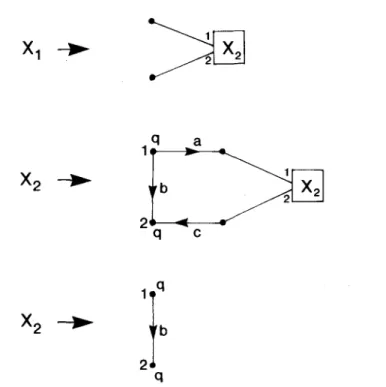
EXAMPLES. We give several examples of handle hypergraph grammars. All these grammars will in fact generate graphs. Figure 6 shows the three productions of HH
grammar G,=(N,A, P,Xi,) with N=(X,,X,}, Xin=Xl, and A={a,b, c,q}.
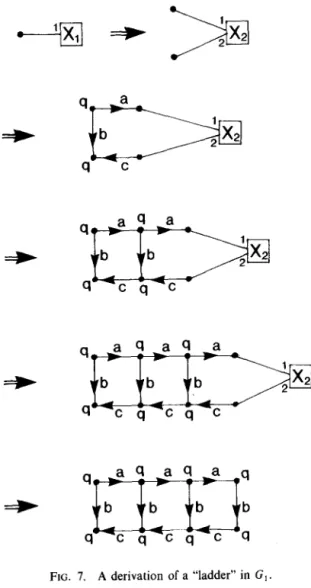
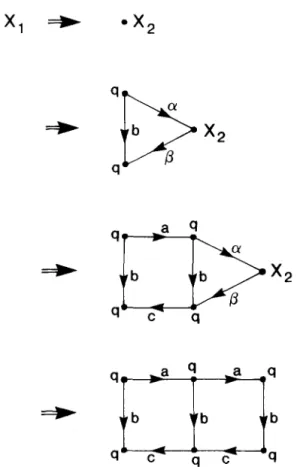
Figure 7 shows a derivation of a graph in L(G,). It is not difficult to see that L(G,) is the set of all “ladders” of the form shown in Fig. 7 (with an arbitrary number of “squares” rather than 3). Note that port( 1) and port(2) are both singletons, in each of the productions for X,. Thus, there is no duplication or deletion of nonterminal vertices (and their incident edges). In fact, G, is also a context-free hypergraph
grammar (of [ 1,27,28]). Note, finally, that the first production is superfluous
(i.e., X, may as well be taken as the initial nonterminal).
The productions of an HH grammar G, generating all complete directed graphs (without loops) are shown in Fig. 8. We have dropped the unique terminal label.
21 q
FIG. 6. The HH grammar G,, generating all “ladders.”
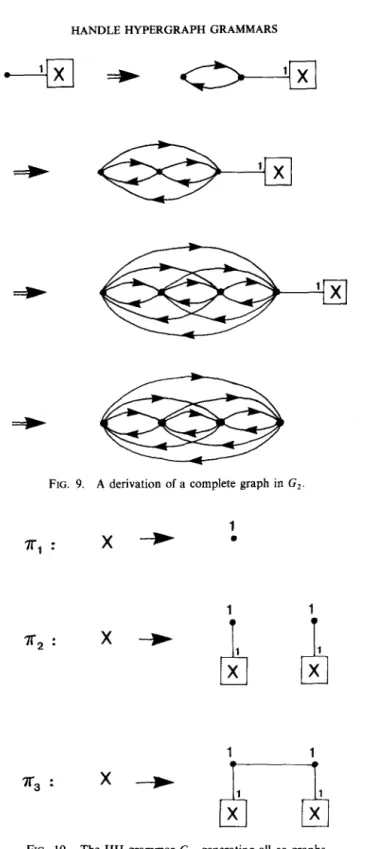
Application of the first production to a nonterminal hyperedge (X, u) results in the duplication of vertex u and all its incident edges. Figure 9 shows a derivation of the complete graph with four vertices. This language cannot be generated by a context- free hypergraph grammar (see Propositions 3.17 and 4.17 of [l]; see also [26,27]).
By taking a unique terminal label and by viewing an undirected edge as two directed edges in opposite directions, we can generate undirected, unlabeled graphs. In pictures we will drop the terminal label, and we will draw an undirected edge in the usual way. Co-graphs are undirected, unlabeled graphs defined recursively as follows (see [4]): (1) a graph consisting of one vertex is a co-graph; (2) if H, and
H, are (disjoint) co-graphs, then so is their (disjoint) union H, + H,; (3) if H, and
H, are (disjoint) co-graphs, then so is the graph H, x H,, obtained from H, + H,
by adding all edges that connect a vertex of H, and a vertex of HZ. An HH
grammar G3 generating all co-graphs is shown in Fig. 10, where production rci
corresponds to case (i) of the above definition. A derivation in G, of the square is shown in Fig. 11.
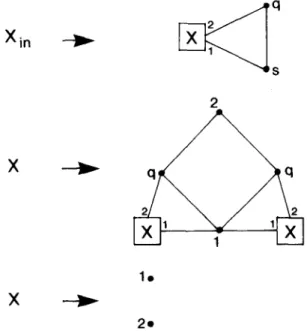
HH grammar G4 in Fig. 12 generates all “dotted” trees, i.e., all undirected binary
trees, of which the vertices are labeled q, together with one additional vertex labeled
s ‘that is connected by an edge to every vertex of the binary tree. The initial
nonterminal Xi, generates the s-labeled vertex, together with the root of the tree.
The second production adds two new leaves as the sons of an old leaf. G4 is also a context-free hypergraph grammar.
FIG. 7. A derivation of a “ladder” in G1.
X+
:
FIG. 9. A derivation of a complete graph in G, 1 7r, :
X-)
. 1 7r 2 : X-W A x’ 1 l7rs
:
x--m
A
X’
16
x’
1 I X' FIG. 10. The HH grammar G3, generating all co-graphs.X’
‘X
+x
X1
‘X
=6
X
FIG. 11. A derivation of a co-graph in G, and Gs.
X
10
x +
2.
X
1
a
x -) , q--- * 2
a
FIG. 13. The HH grammar G5, generating all (b-directional) edge complements of chains.
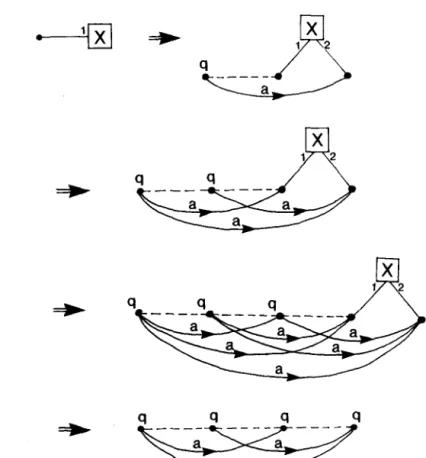
HH grammar G, in Fig. 13 generates chains of vertices, where a vertex has an edge from every vertex to its left and to every vertex to its right, except its immediate neighbours. The dotted lines should be disregarded; they represent “missing” edges. A derivation in G5 is shown in Fig. 14. Thus, when disregarding the direction of the edges (and the labels), G5 generates all edge complements of chains.
=) q*
X--W
1
X--f-
.FIG. 15. The HH grammar G,, generating all edge complements of binary trees.
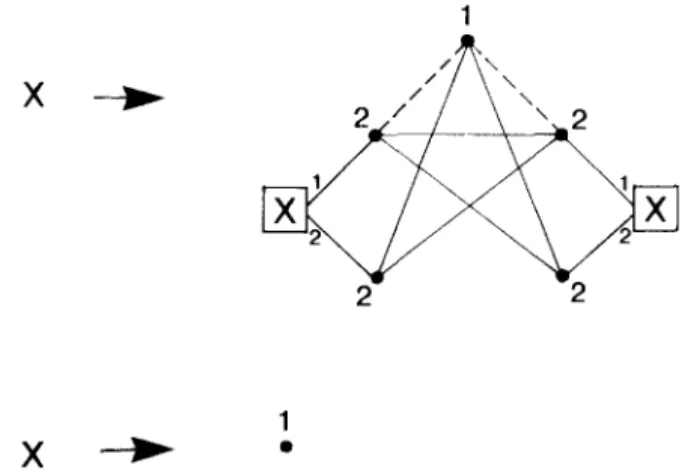
HH grammar G, in Fig. 15 is similar to G,: it generates all edge complements of (undirected, unlabeled) binary trees. For a nonterminal edge e in a sentential form, vert(e, 1) is a leaf of the binary tree, whereas vert(e, 2) is an auxiliary vertex that is connected with all vertices of the tree except vert(e, 1). Again, the dotted lines should be disregarded; they represent the edges of the binary tree. Showing a derivation in this grammar would not be very helpful, due to the large number of edges.
Although rewriting in HH grammars has the context-free property that a produc- tion with left-hand side X is always applicable to an edge labeled X, it is not context-free in the sense that rewriting of one nonterminal edge may influence the
remaining nonterminal edges (they may be duplicated or deleted). One, rather
drastic but quite natural, way to avoid this is to require that no two nonterminal edges share incident vertices (this is similar to the so-called boundary restriction for
the vertex-rewriting NLC graph grammars: no two nonterminal vertices share an
incident edge [39]). We say that a hypergraph (with ports) over Nu A is separated
if no vertex is incident with two distinct nonterminal edges. In other words, in a
separated hypergraph all nonterminal handles are disjoint: vset(e) n vset(e’) = JZ
for every two distinct nonterminal edges e and e’.
DEFINITION 2.4. An HH grammar is separated (abbreviated S-HH grammar) if all right-hand sides of its productions are separated.
The only example grammar that is not separated is Gq. It is easy to see that all sentential forms of an S-HH grammar are separated too. Due to this property, the notion of a separated HH grammar is an example of the abstract notion of grammar discussed in Section 2 of [6]. Separated HH grammars form the topic of investigation of this paper.
in the sense that the result of applying two productions to distinct nonterminal edges/vertices of a sentential form may depend on the order in which these
productions are applied. Grammars for which the application of productions is
order independent are said to be confruent [6,32] or to have the finite
Church-Rosser property [3,39,40]. As argued in Theorem 2.11 of [6], confluent
grammars allow the use of derivation trees. We now show that S-HH grammars are confluent.
LEMMA 2.5. Let G be an S-HH grammar, and let K be a sentential form of G. If K - (Cl, PI) KI (et,~~i KU and K - (e2, P2) K2 (el,prj K,, are (disjoint) derivations with e,,
e2 E EK, then K12 = K21,
Proof Obviously, e, and e, are distinct nonterminal edges of K. Let pi = Xi --t
(Hi, port,), for i = 1, 2. H, and H, are disjoint, because the derivations are disjoint.
Now K12
=KCWly portIYeIlC(H2, port2)/e21 and K21 =KCW2, porbYe21CW1~
port,)/e,]. Since K is separated, it can easily be checked that these (concrete)
hypergraphs are equal. 1
We now turn to two lemmas that provide a normal form for S-HH grammars.
An edge
f
of a hypergraph over N u A is a parasite if there is a nonterminal edgee #f such that vset(f) E vset(e). Note that if e is rewritten, the embedding process
may establish edges (corresponding to
f)
that lie completely within the right-handside of the applied production. We say that a hypergraph over N u A is parasite-
free if it has no parasites. An HH grammar is parasite-free if all right-hand sides of
its productions are parasite-free (all example grammars, except Gq, are parasite- free). It is easy to see that the sentential forms of a parasite-free S-HH grammar are all parasite-free.
LEMMA 2.6. For every S-HH grammar G there is a parasite-free S-HH grammar G’ such that L(G’) = L(G).
Proof Let G = (N, A, P, Xi,) be an S-HH grammar. We will construct G’ =
(N’, A, P’, Xi,). The (obvious) idea is to remove the (terminal!) parasites from the
productions and sentential forms of G and to keep track of them in the labels of the nonterminal edges. When such a nonterminal edge is rewritten, the appropriate embedding edges can be added (statically) to the right-hand side of the production applied.
We first define the nonterminal alphabet N’ of G’. Let m be the maximal
rank of the edges in the right-hand sides of the productions of G. Now,
N’={(X,R)IXeN, Rc{(a,i,, i2 ,..., i,)(aEA, kE[l,m], ijE[l,m] for all
j E [ 1, k] } }. Intuitively, if (X, R) labels an edge e, an element (a, i, , . . . . ik) of R represents the terminal edge (a, vert(e, i,), . . . . vert(e, ik)).
We now define a function g: HG(Nu A) -+ HG(N’u A) that replaces the
which the edges have rank <m, g(H) is the parasite-free separated hypergraph that
is obtained from H in the following steps:
- if e is a nonterminal edge with label X, then relabel it by (X, R), where
R= {(a, i,, . . . . ik) ( a E A, (a, vert,(e, ii), . . . . vert,(e, ik)) E EH},
- remove all parasites, i.e., all terminal edges of the form (a, vert(e, ii), . . . .
vert(e, ik)) for some nonterminal edge e.
Next, we extend g to hypergraphs with ports, for every R (with (X, R)EN’ for
some XE N). Let (H, port) E HGP(Nu A) be a hypergraph with ports, such that H
is separated and has edges of rank at most m. Then g,(H, port) is defined to be
(g(H,), port), where H, is obtained from H by adding all (terminal) edges (4 v I, . . . . vk) such that there exists (a, ii, . . . . ik) E R with (ii, vi) E port for all
je CL kl.
Finally, we complete the construction of G’ by defining Xi, = (Xi,, 0) and
P’= {(X, R) -+g,(H, port) I (X, R)EN’, and X-, (H, port) is in P}.
It can be shown that g(K[(H, port)/e])=g(K)[g,(H, port)/e’], where e’ is the
edge corresponding to e, i.e., lab&e’) = (lab,(e), R) and vert,(,)(e’) = vert,(e).
From this it follows (by induction on the length of the derivations) that, for every K’EHG(N’uA),
se(&) % K’ in G’ iff
XEHG(NUA):~~(X,,) % KinGandK’=g(K).
For the only-if direction note that [P’] = {(X, R) -+ gR( H, port) 1 (X, R) E N’, and
X+ (H, port) is in [PI}. S ince g is the identity on hypergraphs in HG(A), this
proves that L(G’) = L(G). i
A nonterminal edge e of a hypergraph is loop-free if vert(e, l), . . . . vert(e, k) are
all distinct (where k = rank(e)). We say that a hypergraph is loop-free if all its non-
terminal edges are loop-free. An HH grammar is loop-free if all right-hand sides of
its productions are loop-free (all example grammars are loop-free). Obviously, the sentential forms of a loop-free S-HH grammar are all loop-free.
LEMMA 2.7. For every S-HH grammar G there is a loop-free and parasite-free
S-HH grammar G’ such that L(G’) = L(G).
Proof: Informally, the obvious idea is as follows. If vert(e, i) = vert(e,j) for i#j, then we split this vertex into two and duplicate all incident edges. Let
G = (N, A, P, Xi,) be an S-HH grammar. By Lemma 2.6 we may assume that G is
parasite-free. We construct G’ = (N, A, P’, Xi”), where P’ is obtained with the help
of the translation g: HGP(N u A) + HGP(N u A) that splits vertices and duplicates
edges, formally defined as follows. For every separated (H, port) E HGP(N u A),
g(H, port) is the loop-free separated hypergraph with ports (V, E, port’) such that
V= {v E V, 1 v is terminal} u {(e, i) I e E E, is nonterminal, i E [ 1, rank(e)] },
E = {(lab,(e), (e, 11, . . . . (e, k)) 1 e E E, is nonterminal, k = rank(e)} u {(a, UI 1 . ..1 VA I (a, old(v,), . . . . old(u,)) E EH is terminal},
where old(u) = zi if v is a terminal vertex of H, and old(e, i) = vert,(e, i), port’ = {(i, u) 1 (i, old(v)) E port}.
Note that g preserves parasite-freeness. Now we set P’ = {X + g(H, port) I X-,
(H, port) is in P}. Thus, G’ is loop-free and parasite-free.
It can be shown, for separated hypergraphs K and (H, port), and a nonterminal
edge e of K, that g(K[(H, port)/e]) =g(K)[g(H, port)/e’], where e’= (lab,(e),
(e, l), . . . . (e, k)) with k = rank(e). From this follows, as in the proof of Lemma 2.6, that L(G’) = L(G). The only difference is that in this case we have to restrict
the derivations of G’ to g( [P] )-restricted derivations, where g( [P] ) =
(X+g(H, port) ) X-r (ZY, port) is in [PI}. It is easy to check that this is allowed,
according to Remark 2.3. 1
3. THE edNCE GRAPH GRAMMARS
One of our main results is that separated HH grammars have the same graph generating power as confluent edNCE graph grammars. The edNCE grammars are vertex rewriting grammars that have been studied both as a restriction of the grammars of [38] (in [2, 3, 32, 403) and as a generalization of the NLC grammars of [30, 311 (in, e.g., [16, 21, 22, 23, 24, 2571). By restricting edNCE grammars to be confluent one obtains a class of grammars that is the largest known class of context-free graph grammars, where “largest” refers to the corresponding class of graph languages (and “context-free” is meant in the sense of [6], which excludes, e.g., the context-free graph grammars of [38]).
In this section we define the class of confluent edNCE grammars in the way
sketched in the introduction of Section 2. NCE stands for “neighbourhood
controlled embedding,” e for “edge labeled graphs” (it being understood that they
are vertex labeled), and d for “directed graphs.” We start with the appropriate
definition of “graphs with embedding,” i.e., a graph ready to be substituted.
Let A be an alphabet. A graph with (neighbourhood controlled) embedding over
A is a pair (H, emb) with HE GR(A) and emb E 1/,x A x A x A x {in, out).
GRe(A) denotes the set of all such graphs with embedding. If H= (V, E), then
(H, emb) will also be written (V, E, emb). If emb = @, we identify (H, emb) with H.
Thus, GR(A) s GRe(,4). Two graphs with embedding (H, emb,) and (K, emb,) are
isomorphic if there is an isomorphismffrom H to K such that emb,= {(f(u), a, b,
q, 4 I (u, a, b, q, 4 E emb,}.
Intuitively, a tuple (u, u, b, q, out) ~emb means that if there was an u-labeled
edge from the vertex u for which (H, emb) is substituted to a vertex w with label
q, then the embedding process will establish a b-labeled edge from u to w. And
similarly for in instead of out (where “in” refers to incoming edges of u and “out” to outgoing edges of u). Thus, as opposed to HH grammars, the embedding looks at edge labels and changes them; it also looks at the direction of the edge and at the label of the neighbouring vertex.
We now define this formally. The reader who is not interested in Section 7 may take both emb, and emb below to be empty. Recall that, for a graph (V, E), E(2) denotes its set of edges and E( 1) its vertex labeling.
DEFINITION 3.1. Let (K, emb,) and (H, emb,,) be two graphs with embedding, in GR’(A), such that K and H are disjoint, and let u be a vertex of K. Then the substitution of (a emb,) for v in (K, emb,), denoted (K, emb,)[(H, emb,)/v], is
the graph with embedding (V, E, emb) in GR’(A), defined as follows:
v= (VK- {4+J v,,
E(l)= {(a, w)eEK(l) I UEA, w#v}uE,(l),
E(2)={(a,u,w)~E,(2)la~A,u#v,w#v)uE,(2)
u ((6, U, w) 13a~A: (a, v, w)~E,(2), (u, a, b,lab,(w), out)Eemb,} u ((6, w, U) I 3u~A: (a, w, U)E E,(2), (u, a, b, lab,(w), in)Eemb,}, emb={(u,a,b,q,d)~emb,~u#v}
u ((u, a, c, q, 4 I3bEA: (v, a, b, q, d)Eemb,, (u, b, c, q, d)Eemb,}.
An elementary property of substitution of graphs with embedding is that of
ussociutivity, which means that the following lemma holds.
LEMMA 3.2. Let M, K, H be three mutually disjoint graphs with embedding, in GR’(A). Let w be a vertex of M and v a vertex of K. Then M[K/w][H/v] =
M~-KCWU~I~~.
The proof is a straightforward but lengthy verification from the definitions and
will not be given (a similar proof is given in Lemma 5.3 of [6]). We note that substitution of separated hypergraphs with ports is associative too.
The definition of edNCE grammar is now analogous to that of HH grammar. DEFINITION 3.3. An edNCE grammar is a tuple G = (N, A, P, Xi,), where N is
the nonterminal alphabet, A is the terminal alphabet (disjoint with N), P is the
finite set of productions of the form X-* (H, emb) with XE N and (H, emb) E
GR’( N u A), and Xi, E N is the initial nonterminal.
For a graph Kg GR(N u A) we say that v E V, is a nonterminal vertex
if lab,(u) EN, and that it is a terminal vertex otherwise. As in the case of HH
grammars we denote by [P] the class of productions that are isomorphic to a
production in P. For a production p = X -+ (H, emb) we use rhs(p) to denote H.
We now define the process of rewriting in an edNCE grammar through the
notion of substitution, in the usual way. Let K and K’ be graphs over N u A, let
UE VK, and let p = X-+ (H, emb) be in [P]. Then we write K (u, K’ if
lab,(u) = X and K’ = K[(H, emb)/u]. As in the case of HH grammars we restrict
labeled Kin, and no edges. A graph KEGR(NuA) such that sV(Xi”) 3 K is a sentential form of G. The graph language generated by G is L(G) = { [K] 1 KE
GR(A), sV(Xin) r K). Thus, L(G) E [GR(A)].
EXAMPLES. Figure 16 shows the productions of an edNCE grammar G, = (N, A,
P, X,), with N = {X, , X2, c(, j?}, that generates the same set of ‘ladders” as the HH
grammar G,. For each production X+ (H, emb) the picture shows both H and
emb; emb is represented by the dotted labeled lines, in a rather obvious way. The
second production has H = (V, E) with V= {x, y, z} and E= ((b, x, y), (c(, x, z),
(PY 23 YL (4, x)3 (43 Yh (Jf*, 41 and en-h= {tx, ~1, a, q, in), (y, P, c, q, out)}. A
derivation in G, of a ladder with two “squares” is shown in Fig. 17. The first
production is superfluous: X, might as well have been the initial nonterminal.
Figure 18 shows the productions of an edNCE grammar G, generating
all co-graphs (i.e., the same language as HH grammar G3). Figure 11 is also a derivation in G8 (disregarding labels).
Figure 19 shows edNCE grammar G, that generates the same graphs as HH
grammar G, (the uni-directional edge complements of chains). Just as G,, Gg
generates the vertices one by one from left to right. The unique nonterminal vertex is connected by an g-labeled edge to all terminal vertices except the last, and by a b-labeled edge to all terminal vertices.
cr/a
q-- *- q
1
q a q CY - D b b X2 P q c q
FIG. 17. A derivation of a “ladder” in G,.
As an important class of edNCE grammars we consider confluent edNCE
grammars, i.e., those grammars in which the application of productions is order
independent. It is well known that NLC grammars (a subclass of edNCE
grammars) are not always confluent. Confluent NLC grammars were studied in [6], and confluent edNCE grammars in [3, 16, 32, 401 (called fCR DNELC
grammars in [3]). Since our notion of substitution is associative (Lemma 3.2),
confluent edNCE grammars (or C-edNCE grammars) might also be called context- free edNCE grammars, in the sense of [6]. S-HH grammars are context-free in the same sense.
DEFINITION 3.4. An edNCE grammar G = (ZV, A, P, Xi,) is confluent (abbreviated
C-edNCE) if the following holds for every sentential form K of G: if
K - (v1.m) K, (v2,p~j K,, and K - (w. P2) & (vl,plj K,, are (disjoint) derivations with
a,X a,X I \ I \a/a 1 a/a I I
x
+
b :X
X
a,X a,Xx
--w
X
X
FIG. 18. The edNCE grammar Gs, generating all co-graphs. a,X
X---W
X--+
qt
A
cr/a /By C-edNCE we denote the class of graph languages generated by C-edNCE
grammars. It is decidable whether an edNCE grammar is confluent (Corollary 3.25
of [32]), but we shall not need this property. G,, Gg, and G, are all confluent (in G, and G, each sentential form contains at most one nonterminal vertex, and in G, the embeddings contain all possible tuples).
It is well known that “boundary” graph grammars are confluent (see Lemma 2.3 or [39]). An edNCE grammar is boundary (abbreviated B-edNCE) if in no right-
hand side of a production there is an edge between two distinct nonterminal
vertices. G, and G, are trivially boundary, but G8 is not. It is easy to show that B-edNCE grammars are confluent. Thus, B-edNCE c C-edNCE.
An important property of confluent grammars is that every derivation is
equivalent to a “leftmost” derivation. The only way we know to simulate a
C-edNCE grammar G by an S-HH grammar G’ is such that G’ simulates the leftmost derivations of G: in this way G’ has control over the dynamic relabeling of edges in G. To define leftmost derivations in a precise way, it is convenient to
put a linear order on the nonterminal vertices of sentential forms (and the non-
terminal vertices of the right-hand side of a production), see [6]. In order not to
burden our terminology and notation, we will do this in a rather informal way that should be understandable to the reader.
An ordered graph (possibly with embedding) is a graph, together with a (linear)
order of its nonterminal vertices (if it has such vertices). If K and (H, emb,) are
ordered and u is a nonterminal vertex of K, then the order of K[(H, emb,)/u] is
obtained, informally, by substituting the order of H for u in the order of K.
Formally, if the nonterminal vertices of K are ordered as (ui , . . . . uk) with v = vi, and
those of H are ordered as (w,, . . . . w,), then the order of K[(H, emb,)/u J is
(0 1~ . ..p vi- 1 > WI 9 ‘9’~ wh, Vi+ 1 > ...> ‘J/c).
The concept of an ordered edNCE grammar is obtained by considering ordered
graphs throughout the definition of edNCE grammar. It should be clear that the
order has no influence on the language generated, i.e., an ordered edNCE grammar generates the same language as the edNCE grammar that is obtained from it by disregarding the orders. However, for an ordered edNCE grammar G there is a
natural notion of leftmost derivation. A derivation step K 3 K’ in G is leftmost
if v is the first nonterminal vertex in the order of K. A derivation is leftmost if all
its steps are. We write K 2 K’ if there is a leftmost (disjoint) derivation from K
to K’. The graph language leftmost generated by G is L,,(G) = ([K] 1 KE GR(A),
sv(Xi,) 2 K}. By L-edNCE we denote the class of all graph languages leftmost
generated by ordered edNCE grammars.
PROPOSITION 3.5, C-edNCE E L-edNCE. In particular, if G is an ordered
C-edNCE grammar, then L,,(G) = L(G).
This proposition can be proved in a standard way (cf., e.g., [6]). In fact, since the grammar is confluent, the order of two consecutive independent applications of productions can be interchanged without changing the result of the derivation. It
turns out that in our simulation of the leftmost derivations of a C-edNCE grammar G by an S-HH grammar G’ we will not any more make use of the confluence of G.
Thus, that proof shows that even L-edNCEr S-HH. Hence, as a corollary we
obtain that C-edNCE = L-edNCE (cf. also [ 161). In the case of NLC grammars, L-NLC contains languages not even in NLC (see [29]). Note that NLC grammars can be viewed as a special case of edNCE grammars (cf. Definition 7.1); hence L-NLC E L-edNCE.
4. SIMULATION OF HH GRAMMARS BY edNCE GRAMMARS AND VICE VERSA
In this section we show that S-HH grammars and C-edNCE grammars have the same graph generating power (and, in fact, the same as L-edNCE grammars too).
An HH grammar G = (N, A, P, Xi”) is graph generating if L(G) z [GR(A)]. By
GRL we denote the class of all graph languages. Thus, S-HH n GRL is the class of
all languages generated by graph generating S-HH grammars. We will show that
S-HH n GRL = C-edNCE = L-edNCE. We start with the simulation of graph
generating S-HH grammars by C-edNCE grammars.
LEMMA 4.1. S-HH n GRL c C-edNCE.
Proof. Let G = (N, A, P, Xi,) be a graph generating S-HH grammar. By Lemma 2.7 we may assume that G is loop-free and parasite-free (in fact, in the construction that follows, it suffices to take G parasite-free). Moreover, since G is graph generating, we may assume that in each right-hand side of a production (and hence in each sentential form) every terminal hyperedge has rank 4 2 (just delete the terminal hyperedges of greater rank). Note finally that, since G is parasite-free, nonterminal vertices of a sentential form K of G are not incident with hyperedges
of rank 1; also, each terminal vertex of K is incident with exactly one hyperedge of
rank 1; and the same holds for right-hand sides of productions.
We simulate G by an edNCE grammar G’ = (N’, A, P’, Xi,), with N c N’. The
idea is to simulate each nonterminal hyperedge e of G by a nonterminal vertex u
of G’, with the same label, and to simulate a terminal hyperedge of rank 2 that is
incident with vert(e, i), by an edge that is incident with u, with i encoded in the
label of that edge. Nonterminal vertices of G are removed, and terminal vertices of
G are carried over to G’ (with the same label, i.e., the same incident terminal hyperedge of rank 1). This simulation can be defined by a direct translation of the sentential forms and productions of G into those of G’. See Fig. 20 for an example.
Let m be the maximal rank of all nonterminal hyperedges in the right-hand sides
of the productions of G. The nonterminal alphabet N’ of G’ is defined by
N’=NuM,whereM=(Ax[O,m]x[O,m])-(Ax{O}x(O}).TheelementsofN
will be used to label vertices, and those of M to label edges. To simplify the
construction that follows we will identify (a, 0,O) with a, for every a E A.
H:
g(H):
<b,3,2>
q <a,O,O>
FIG. 20. From hypergraphs to graphs.
the same reason we define vert(u, 0) = u for every terminal vertex v in a hypergraph
H from HG(NuA). Intuitively, for (a, i,j) EMU A, i refers to the ith vertex of a
nonterminal hyperedge of H in case i 3 1, or to a terminal vertex of H in case i = 0
(and similarly for j).
We now define the translation g: HGP(Nu A) + GR’(N’ u A). For a (loop-free
and) parasite-free separated hypergraph with ports (H, port) E HGP(Nu A) (of
which the nonterminal hyperedges have rank <m, and each terminal vertex is
incident with exactly one hyperedge of rank I), g(H, port) is the graph with
embedding (K, emb) E GRe(N’ u A) defined as
VK = (e E E, ) e is nonterminal} u (o E V, 1 u is terminal},
E,(l)={(X,e) I X=lab,(e)}u((a,u)~E,,(l)~ visterminal},
E,(2) = {((a, W, -x9 .Y) I ( a, m-t,@, 4, vertH(v,j)) E E,},
emb = {(A (a, i,j>, (a, kj), q, out) I (6 vert,(x, k)) E port}
u (lx, (a,j, i>, (a,j, k), q, in) I (i, vert,k k))Eport3,
where the appropriate specifications should be added to the definitions of E, and
emb (in particular, q E N u A).
We conclude the definition of G’ by putting P’ = {X + g( H, port) 1 X + (ZY, port)
is in P).
It can now be shown that, for appropriate hypergraphs K and (ZY, port), and a
nonterminal edge eE E,, g(K[(H, port)/e]) =g(K)[g(H, port)/e]. In other words,
g is a homomorphism with respect to substitution (for such hypergraphs). From
this it follows by induction that, for every K’ E GR(N’ u A),
sv(Xin) %- K’ in G’ iff
IKE HG(Nu A): se(Xi,) S K in G, K’ = g(K),
provided we consider g( [PI)-restricted derivations in G’, where g( [ P] ) =
(X+g(H, port) 1 X+ (H, port) is in [PI}. Since g is the identity on graphs in
GR(A), it now follows that L(G’) = L(G). Confluence of G’ easily follows from the confluence of G (Lemma 2.5), using again the facts that g is a homomorphism
with respect to substitution, and that, in G’, we may consider g( [PI)-restricted
derivations only. 1
As an example, consider the graph generating S-HH grammar G,. The construc- tion in the proof of Lemma 4.1 produces the C-edNCE grammar G9 (apart from useless tuples in the embedding relations), taking c1= (a, 0, 1) and /I = (a, 0,2).
Similarly, G, corresponds to G,, with a=(a,O,l) and j?=(c,2,0); see also
Figs. 7 and 17.
To show that C-edNCE E S-HH and even that L-edNCE c S-HH (as observed before), we need a simple closure property for S-HH.
LEMMA 4.2. If L E S-HH, L E [GR(A)], and BE A, then L n [GR( B)] E S-HH. Proof: Let G = (N, A, P, Xi”) be an S-HH grammar that generates L. We will
call a terminal hyperedge e (of rank 1 or 2) a non-B-edge if lab(e) $ B. It is not
correct to remove from P all productions of which the right-hand side contains a
non-B-edge. In fact, the non-B-edge may be deleted later in the derivation. Thus, we first construct an S-HH grammar G’ with L(G’) = L(G), such that the label of
every nonterminal hyperedge of a sentential form of G’ contains the information
which of its vertices are incident with a non-B-edge.
Let m be the maximal rank of the nonterminal hyperedges in the right-hand sides
of the productions of G. We define G’ = (N’, A, P’, Xi,) where N’ = {(X, T) 1 XE N,
TG Cl, ml>, and Xi,= (Xi”, a). For every TE [l, m] we define a mapping
g,: HGP(N u A) + HGP(N’ u A) such that, for every (H, port) E HGP(N u A),
g,(H, port) is obtained from (H, port) as follows: if e is a nonterminal hyperedge of H with label X, then relabel e by (X, T,), where T, = {i E [ 1, m] 1 vert,(e, i) is
incident with a non-B-edge, or vert,(e, i) is aj-port for somejs T}.
We now define P’ = {(X, T) -+ g,(H, port) 1 (X, T) E N’, X+ (a port) is in P}. It is easy to show that, for every K’ E HG(N’ u A),
se(X&) 5. K’ in G’
iff
IKE HG(Nu A): se(X,,) 9 K in G, K’ = g&K).
Hence, an S-HH grammar G” such that L(G”) = L(G) n [GR(B)] is obtained from
G’ by removing from P’ all productions (X, T) -+ gT(H, port) such that either there
is a non-&edge between terminal vertices of g,(H, port), or there is a terminal
i-port of g,(H, port) for some iE T. B
We now show that L-edNCE & S-HH. To do this we also need leftmost deriva-
tions for S-HH grammars. An ordered separated hypergraph (possibly with ports) is
a separated hypergraph together with an order of its nonterminal hyperedges. As
for edNCE grammars, we can define leftmost derivations and L,,(G) for an
(ordered) S-HH grammar G. Since every S-HH grammar is confluent (Lemma 2.5), it follows that L,,(G) = L(G), as for C-edNCE grammars (Proposition 3.5).
LEMMA 4.3. L-edNCE E S-HH.
Proof Let G = (N, A, P, Xi,) be an ordered edNCE grammar. We may assume that in the right-hand sides of the productions (and in the sentential forms) of G no edge is labeled by a nonterminal: by an easy edge relabeling we can see to it that N is partitioned into N, and N,, where the elements of N, label edges only, and those of N, label vertices only; then we can apply Lemma 4.2, using the fact that
L,,(G) = L,,(G’) n [GR(A)], where G’ = (NV, A u N,, P, Xi,).
We will simulate the leftmost derivations of G by the leftmost derivations of an
S-HH grammar G’ = (N, A, P’, Xi,). Note that G’ has the same nonterminals as G.
Again, the simulation of G by G’ will be by a direct translation of the sentential
forms and productions of G. Nonterminal vertices of G will be translated into non-
terminal hyperedges of G’ (with an appropriate number of incident vertices), and terminal vertices of G will be turned into terminal vertices of G’ (with the same label). But the translation of the edges is quite complicated. The main problem is the simulation of the dynamically changing edge labels of G in G’ (where edge
labels cannot change). In G, an edge (a, U, U) between nonterminal vertices u and
u can be changed into many differently labeled edges (a’, u’, u’) between descendants
U’ and u’ of u and v, respectively. As long as U’ and u’ are nonterminal, we will
simulate these edge labels in G’ by “tentacle names” (coded as integers) of the non- terminal hyperedges corresponding to U’ and u’.
The set T of “tentacle names” is defined by T = A x (N u A) x {in, out} x A x A.
Let m be the cardinality of T. We identify the elements of T with the integers in
[ 1, m] in a (arbitrarily) fixed way. This will enable us, e.g., to speak about
X A
Y
a
FIG. 21. From graphs to hypergraphs; i= (c, I’, out, q, b) and j= (b, q, in, q’, a) for every guess of (4, b) and (4’. a>.
Let us now try to explain the idea behind the translation g: GR’(Nu A) -+
HGJ’(Nu A), where we assume all (hyper)graphs involved to be ordered. Let
HE GR(Nu A). The nonterminal vertices of H are turned into nonterminal hyper-
edges of rank m in g(H), with their order carried over, and, as observed before, the
terminal vertices of H are turned into terminal vertices of g(H), with the same label
(i.e., hyperedge of rank 1). Each nonterminal hyperedge e of g(H) gets m new
(private) vertices that are incident with e. Now suppose that there is an edge
(c, U, u) in H such that u and u are nonterminal vertices, and u is, say, to the left
of u (in the order of the nonterminal vertices of H). Let X and Y be the labels of
u and u, respectively. Intuitively, we would like to reverse the construction in the
proof of Lemma 4.1 and translate this edge into a hyperedge (of rank 2) between two incident vertices of u and u in g(H), i.e., a hyperedge (a, vert(u, i), vert(v, j)), see Fig. 21. In this way, we guess the label a of one of the edges (between terminal descendants of u and u) that the c-edge will finally turn into. In the tentacle names i and j we have to encode sufficient information for u and u to be able to simulate the leftmost derivations of u and u in G independent of each other in G’. Thus, we
will take i = (c, Y, out, q, b) E T, where (c, Y, out) encodes the information
needed by u about the original c-edge, and (q, b) is a guess concerning the label
q of the terminal descendant U’ of u to which the edge will be attached and the label
b of the edge at that moment. Furthermore, we take j = (6, q, in, q’, a) E T, where
(6, q, in) is the information about the edge at the moment that u “takes over” the
leftmost derivation from u’, consistent with the guess of (q, b) in i, and (q’, a) is
a guess concerning the final edge (between terminal vertices), similar to the guess (q, b) in i (but note that a was already guessed to be its label; moreover, the guess
of q’ is in fact not needed, but added to simplify the formal construction). Thus, for
every possible guess of a, q, b, and q’, a terminal hyperedge (of rank 2) is added to
g(H), as described above.
This ends the informal discussion. We now continue with the formal definition of
g. For every ordered graph with embedding (H, emb,) E GR’(Nu A), g(H, emb,)
is the ordered separated hypergraph with ports (K, port,) E HGP(N u A) defined as
follows. First, V, = {u E I’,, 1 u is terminal} u {(u, i) 1 u E V, is nonterminal, i E T }.
Second, E, = NE, u TE,( 1) u TE,(2), where NE, is the set of nonterminal hyper-
edges of K, and TE,(l) and TE,(2) are the sets of terminal hyperedges of K, of
inherits the order of the nonterminal vertices of H in the obvious way. TE,( 1) =
{(a, u) EEL I a~ A}, and TE,(2) is constructed as follows. Recall that T=
A x (NuA)x {in, out} XA x A. Let (c, U, u) be an edge of H. We consider five
cases:
(1) If u and u are terminal vertices of H, then (c, U, u) is in TE,(2).
(2) If u and v are distinct nonterminal vertices of H, and u is to the left
of v, then, for every (q, h ), (q’, a ) E A x A, TE,(2) contains the hyperedge
(0, vert,(u, Cc, lab,(v), out, q, b)), vert,(v, (b, q, in, q’, a))).
(3) Similarly, if u and v are distinct nonterminal vertices of H, and u is to the
right of v, then, for every (q, b ), (q’, a) E A x A, TE,(2) contains the hyperedge
(a, vert,(u, <b, q, out, q’, a>), vert,(u, Cc, lab,(u), in, q, b))).
(4) If u is a nonterminal vertex and u a terminal vertex of H, then TE,(2)
contains the hyperedge (a, vert,(u, (c, lab,(v), out, q’, a)), v), for every (q’, a) E
A x A. (Intuitively, (c, lab,(v), out) encodes the necessary information about the
edge (c, U, z), and (q’, a) is a guess concerning the final edge label a and the label
q’ of the terminal vertex to which it is attached, see Fig. 22.)
(5) Similarly, if u is a terminal vertex and v a nonterminal vertex of H, then,.
for every (q’, a) E A x A, TE,(2) contains the hyperedge (a, U, vert,(v, (c, lab,(u),
in, q’, a>)).
This ends the construction of E,. It remains to construct the set port,, as
follows: Let (x, c, c’, Y, d) E emb,. Thus, XE V,, c, c’ E A, YE Nu A, and
de {in, out}. We consider two cases:
(1) If x is a terminal vertex of H, then port, contains ((c, Y, d, lab,(x),
c’), x). (Intuitively, here the guess (lab,(x), c’) is verified.)
(2) If x is a nonterminal vertex of H, then, for every (q, b) E A x A, port,
contains ((c, Y, d, q, b), vert,(x, (c’, Y, d, q, b))).
This ends the definition of the translation g. We complete the construction of G’ by
defining P’= {X+g(H, emb) 1 X-r (H, emb) is in P}.
As in the proof of Lemma 4.1 it can now be shown, for (ordered) graphs K and
(H, emb), and a nonterminal vertex v of K, that g(K[(H, emb)/u]) = g(K)[ g(H,
emb)/v], provided v is the first nonterminal vertex in the order of K. Thus, g is a
X &r
homomorphism with respect to “leftmost substitution.” From this it follows that,
for every (ordered) K’eHG(Nu A),
se(Xi,) + K in G’
iff
3(ordered)KE GR(Nu A): SV(Xin) 9 K in G, K’ = g(K),
where only g([P])-restricted leftmost derivations in G’ are considered. Since g is
the identity on graphs in GR(A), it follows that L&G’) = L,,(G). Hence, since G’
is confluent (Lemma 2.5) L(G’) = L,,(G). 1
As an example, consider the C-edNCE grammar G9 and take N= {X) and
A = {a, a, fl}. The construction in the proof of Lemma 4.3 produces the S-HH
grammar GS (apart from useless tentacles of X), where tentacle 1 corresponds to tentacle name (c(, q, in, q, a) and tentacle 2 to (p, q, in, q, a) (note that (q, a) is the only useful guess). Similarly, G1 corresponds to G,, with tentacle 1 corre-
sponding to (a, q, in, q, a) and tentacle 2 to (p, q, out, q, c); see also Figs. 7
and 17.
Our first main result follows from Proposition 3.5 and Lemmas 4.1 and 4.3.
THEOREM 4.4. S-HH n GRL = C-edNCE.
COROLLARY 4.5. C-edNCE = {L(G) 1 G . zs an S-HH grammar satisfying Pgra}, where Pgra means that for every production X + (H, port) of G
(1) the rank of a terminal edge of H is at most 2,
(2) nonterminal vertices of H are not incident with terminal edges of rank 1, (3) each terminal vertex of H is incident with exactly one terminal edge of rank 1.
ProoJ (If) It is easy to see that (l)-(3) also hold for sentential forms H of G.
(Only if) See the first paragraph of the proof of Lemma 4.1. 1
Thus, S-HH grammars with property Pgra can be used instead of C-edNCE
grammars. The advantage is that they are defined by easy structural properties,
rather than by the dynamic property of confluence in the case of C-edNCE
grammars.
We end this section by discussing the boundary case. As observed in Section 3, an edNCE grammar is boundary (B-edNCE) if in no right-hand side of a produc- tion there is an edge between two distinct nonterminal vertices (see, e.g., [21, 241).
Similarly, we now define an HH grammar to be boundary (abbreviated B-HH) if
the following holds for every right-hand side H of a production: if e and e’ are
distinct nonterminal hyperedges of H, and ie [l, rank(e)], i’E Cl, rank(e’) J, then