European Online Journal of Natural and Social Sciences; vol.2, No. 3(s), pp. 700-708 Copyright © Mohammad Omidvar, Fariba Bordbar, 2013
Corresponding author: Mohammad Omidvar, Sarkhoon and Qeshm Gas Refinery Inc., Bandar Abbas, Iran. Email: [email protected]
Advanced decision support systems for managers
Mohammad Omidvar1, Fariba Bordbar2
1 Sarkhoon and Qeshm Gas Refinery Inc., Bandar Abbas, Iran; 2Bordbar’s House, Bandar Abbas, Iran
Abstract
Managers need to make timely decisions to solve the problems in the organization or to take advantage of the opportunities. But accessing the related infor-mation and knowledge is a necessity for the purpose of decision-making. Current transactional informa-tion systems in organizainforma-tions easily manage the affairs of the organization, but they do not provide the nec-essary ability and intelligence to take a good decision and business performance management. Here, the importance of using such systems to support man-agement decisions and business intelligence tools are highlighted. The purpose of this paper is to analyze the decision-making process, the structure, components, and features. Also a decision support system (DSS) is described. Then, the types of decision support systems will be defined and their abilities and functions will be expressed. The following performance management and business intelligence are explained. Finally, Intel-ligent Decision Support System will be examined and their functions and abilities to develop a decision sup-port tool for decision-making will be analyzed.
Keywords: Decision Support Systems, Intelli-gent Support Systems, Decision-Making, DSS
Introduction
Every day, many decisions are taken by the mem-bers. But most of the major decisions are taken by man-agers. Management is a process by which organizational goals are achieved by applying resources (people, mon-ey, energy, materials, space and time). These resources are consider as an input and achieving the goals are con-sidered as an output of this process . Managers monitor this process to optimize that. To be able to understand how computer support managers, at first needs to be ex-plained what managers are doing (Turban, 2006).
Managers based on their position in the organiza-tion, culture, and organizational policies and own char-acter, doing many things. Mintzberg divided roles of the management into three categories: The individual (as a ceremonial leader and liaison), informational (moni-tor, dissemination and speaker (or decision maker) entrepreneur, vehicle problems, resource allocator and negotiator (Mintsberg, 1973). Therefore, Mintsberg and Vestly analyze the role of the decision makers in the information age (Mintsberg, 2001). Huber Finally, de-scribed the role of top management in today’s complex and the turbulent atmosphere (Huber, 2003).
Essentially, the role of the first information systems was to support their basic information. But in recent years, information systems have been upgraded to sup-port all three roles. The decision is defined to choose between two or more options. Decisions are different in nature and are frequently undertaken by individuals and groups. Purposes of decision making in an orga-nization can be divided into two major groups: solving a problem and taking advantage of opportunities. In both cases, managers must make decisions. Research-ers have found that only ten percent of the directors, principally due to the difficult decision space, think of all the things they mentioned are very good. It seems to be a trial and error method, which is likely to approach decisions in the past, in many cases, expensive or inef-fective. Therefore, managers need to learn how to use new tools and techniques that help them to make bet-ter decisions about their use (Huber, 2003). Many of the techniques used the quantitative analysis approach and are supported by the computer.
Lack of necessary intelligence in the operational systems
Information systems in many organizations support as well as the ongoing operations such as processing or-ders, accounting documents, warehouse management, purchasing, material control, production operations.
However, these systems do not tell managers how they can improve their activities and what corrective actions to be done to improve employees’ activities comply with the strategies. Enterprise resource planning systems, de-spite the transparency of the processes between the dif-ferent units, is not able to create analytical consciousness required to manage organizational performance (Weill, Ross). Enterprise resource planning systems faced staffs and managers with a flood of information, but this in-formation is not necessarily prepare required intelli-gence for organizational managers to help them taking a better decisions (Open Group Consortium, 2007). For example, a detailed report of the various items of inventory management is not appropriate for decision making. Even the initial processing of the data and cre-ate reports of sensitive goods inventory shortage, a se-nior executive is not convincing. What the Chief wants a balance between the strategic objective of reducing the storage and supply of capital goods required custom-ers to optimize the domestic units of the organization. For this work needs to analyze the large volume of data available in the sales, warehouse, logistics and financial systems are touched.
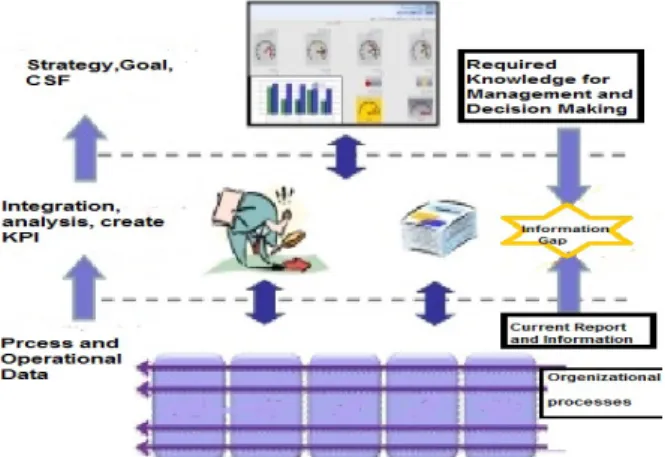
Figure 1. Structure of required information for man-agement`
As shown in Figure 1. Data collection and integra-tion of various data sources and store them in a data warehouse is the best way to access key information about managers. This data warehousing is designed based on the management decision scenarios and or-ganizational key performance indicators, and they have high performance in the representing of multi-dimen-sional reporting. Mechanisms for gathering, processing, transmission and storage of information requires a com-prehensive and detailed architecture. A major challenge facing managers regularly communicate with all levels of the organization and information about the organiza-tion’s goals and strategies (Timothy et al., 2007).
If the managers and employees of organizations who want to describe their strategies, in most cases you do not hear completely identical. Many workers are un-aware of their organization’s overall strategy, they are often completely passive pressurized daily activities and problems that they spent all their time. A short distance data communication between the mission and vision of the organization and senior management personnel are daily activities. Performance management concepts have been developed to eliminate the gap of information and communications. Methodology that supports tools such as Performance Management Strategy maps and score cards are used, Strategies that will help achieve the goal of all the activities. Peter Senge: “Many leaders and managers of organizations have good personal goals and visions that never become common objectives is not an organization. The lack of a sense of what it is, a mecha-nism that will translate personal goals to the collective goals. “ (Senge, 1999)
Methodologies such as Activity Based Costing (ABC) approach based on the reality of the cur-rent financial reinsurance organization offers. But just having a good financial outlook may not be important in all aspects of performance evaluation because many of the capabilities and assets of the organization’s financial indicators are not measure-ments (Kaplan, Norton, 2007). For example, the level of skills, corporate culture, customer satisfac-tion, waiting time shopping and many other issues cannot be measured by financial indicators.
Management Support Systems (MSS)
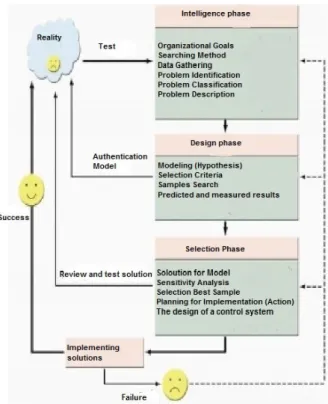
Origine of these systems, decision support sys-tems (DSS), which were used in the mid-70s. This system is basically a bit of analysis and decision sup-port. The second group is Executive Support Sys-tem (ESS) that are implemented in the mid ‘80s to support the informatic roles of executives. The third group, group decision support systems (GDSS) to support the management and staff team work. Fourth, technology is an intelligent system (IS) technology, and the four independent variables can be used or they can be combined with each other so that each can provide different capabilities. De-cision-making (personal and organizational), the decision process is relatively consistent. Simon ex-plained that the process consists of three basic steps: Intelligence, design and choice. The fourth phase (implementation) was added later. Providing com-prehensive four-step modeling process is shown in Figure 2.Figure 2. Decision-making process (Stonebraker, 2002) Decision-making process begins with the intel-ligent phase in which managers assess the situation, identify and define the problem. In the design phase, the decision makers design models that simplify the problem. This is making the assumption that the facts are simple and describe relationships among all the variables is done. This model is then evaluated and the decision-makers selected criteria to evaluate potential solutions identified set. This process is repeated for each of the decisions in complex situations. The out-put of the predecision, is an inout-put for the main deci-sion. A computer-based decision support system au-tomatically tries diverse activities in this process that most of them are modeled. A model of decision mak-ing provides a simple and abstract reality. Modelmak-ing, one can test virtual reality model of analysis (rather than analysis of reality itself) pay. Provided by the model can be found in varying degrees of abstraction to four video analog (analog), and mental math to di-vide. Goori and Scott Morton framework for decision support offered. Simon is based on the framework of the first half, according to which decision-making pro-cesses throughout the chain of decisions that are highly structured (planned) to infinity decisions unstructured (non-scheduled) are included in the (Gorry, Morton, 1971). Structured and iterative process applied to ev-eryday issues which are standard solutions for them. Non-structured processes, problems “vague” and complex and there are no predetermined solution does not exist for them. In an unstructured problem, none
of the three stages of a structured decision not to base decisions often have human intuition.
Semi- structured problems that are structured where only some of these steps require a combination of standard solution procedures and individual judg-ment. Examples of semi-structured problems are ex-changed bonds, setting budgets for marketing and in-vestment analysis. Here, DSS is the most appropriate option. In this system, the quality of decisions based on information that will not only provide a single so-lution but a set of possible scenarios increases.
The second half of framework is based on the classification of 1965. This framework includes three major management activities are defined:
1 - strategic planning, -2 Management control, 3 - Operational Control (Turban,2010).
Decision support systems
In a broad definition, a decision support system, a computer-based information system that com-bines models and data, Extensive collaboration with the user to solve some problems of semi-structured and structured deals. Due to a lack of general agree-ment about the DSS, of exactly what components formed, there is clearly no consensus on the charac-teristics and capabilities of DSS. However, most of the DSS system, at least some of the features offered in the following ones.
• Decision makers at all levels of management, individual, group, mainly semi-structured and non-structured situations, with real data and supporting human judgment brings.
• The number of decisions, or consecutively de-pending on me for support.
• All stages of the decision-making process (identification, design, selection and implementa-tion of the various types of decision support.
• User over time to address changing condi-tions, is compatible.
• In many cases easy to DSS design and use. • To promote learning that leads to new de-mands, improving current programs, learn more and more.
• Usually, quantification of models (standard and customized uses.
• It is equipped with advanced knowledge and access to a lot of problems, provides effective and efficient solutions.
• DSS can be used, by the web distributed. • The sensitivity analysis enables easy imple-mentation of DSS (Turban, 2006).
DSS Structure and Components
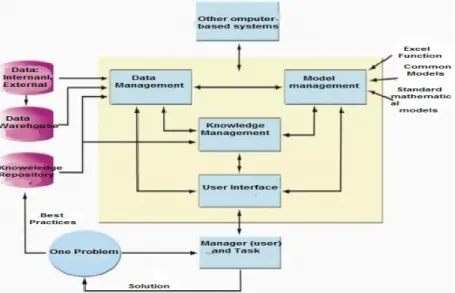
The DSS as shown in Figure 3, at least part of the data management, model management compo-nent, the user interface is composed of end users. and can additional software (e.g. multimedia appli-cations) are provided. Tools such as Excel, includ-ing some of the components and end-users can use it to build DSS. DSS users of its data from the data
warehouse, database and other data sources. When a user has a problem, his problem is evaluated by the processes described in Figure 3. The DSS sys-tem is built. Data from the left and from the right are models. Knowledge can be obtained from the corporate knowledge base. As more problems are solved, more knowledge is collected in the knowl-edge base (Turban, 2010).
Figure 3. DSS system architecture
Decision-making is a common process in many cases. When the band decision, electronically support-ed, this support group decision support (GDSS) can be read. Two types of group decision making are consid-ered: physical group whose members are in the same place), such as meeting rooms and virtual team mem-bers are in different locations. A group decision sup-port system, which is an interactive computer systems solution, semi-structured or non-structured problems by a group of decision makers makes it easy. The pur-pose of a GDSS to support the decision-making pro-cess. The first generation of systems, GDSS, attend to support in what was called the room was designed.
Managerial and organizational decision
sup-port systems
The first word of organizational decision support systems (ODSS) were discussed by Kasuren and Keen who identified the three support level of the individual, groups and organizations. They believed that comput-er systems can be used to support the decision for each of these levels extended. (Hackathorn, Jeen, 1981).
ODSS features include 1 - Impact on multiple organizational units or corporate problems, 2 - to in-fluence organizational functions or hierarchical lay-ers, 3 - including computer-based technologies, as well as regular, communications technologies. ODSS often organization-wide information systems such as executive support systems interact or be combined. In addition, the Web has led to the development of orga-nizational decision support systems (Shim et al, 2002).
Executive support systems
Executive Information System (EIS), which is also known as executive support system (ESS) , a technol-ogy that is specifically designed in response to the spe-cific needs of senior executives. Senior executives and senior managers, information systems terminology, concepts support system is different for various people. The following definitions, EIS is distinct from the ESS. EIS is a computer-based system that responds to the needs of high-level managers. The system provides di-rect access to relevant and timely information, through direct access to management reports, monitoring the
organization’s performance and manage growth and improve instruction. It is very user friendly and takes advantage of the high graphics (Business World, 2004).
Main features of this system are: exceptions re-ports, quary. The system easily connects to on-line electronic services and Email.
ESS is a comprehensive support system that goes beyond the EIS analysis and automated sup-port is in office.
Some of the major features and benefits of the ESS support systems are as follows (Singh et al, 2002).
• Quary: the ability to go into detail on all levels • Critical Success Factors CSF are key factors for the success of a company, these factors can be institutional, industrial, etc are a part.
• The main performance indicators: Special scales CSF
• Access to state: latest data, KPI, the ideal and the real, are available.
• Trend analysis: short, medium and long-term KPI or other measures, using prediction methods are designed.
• Case Analysis: Analysis at any time and con-sistent with all elements of good communication.
• Report exceptions: the management concept based on exceptions, deviations greater than the speci-fied range are reported. Reports may only be deviated. ESS and EIS products and technologies more comprehensive for years, to manage the operation of a business or organization has become. Business per-formance management, BPM, a method for measur-ing organizational performance is the performance comparison of some measures, the analysis of the performance and how to improve their planning.
Performance Management and Business
In-telligence
Performance management process to measure and evaluate the achievement of objectives and strategies to optimize the performance of individuals, teams and the enterprise. Performance management includes tech-niques for determining strategies, setting goals, plan-ning, budgeting, forecasting and modeling .For imple-menting performance management use scorecards in the organization. The business intelligence tool and process technologies to convert data into information and information into knowledge needed for decision making in the organization. Data warehousing technol-ogies in data warehouses, data collection and data in-tegration, reporting, analysis, data mining and business intelligence from being used (Fryman, 2007).
Dashboards allow management to business in-telligence. The use of these two systems together, enabling new levels of interaction strategies to pro-mote organizational forms for all employees. In ad-dition to observing and analyzing key information associated with business processes to help manag-er’s decisions and to take appropriate corrective ac-tion. The main benefits of this system are as follows:
• promote strategies
• monitoring and corrective measures to imple-ment strategies
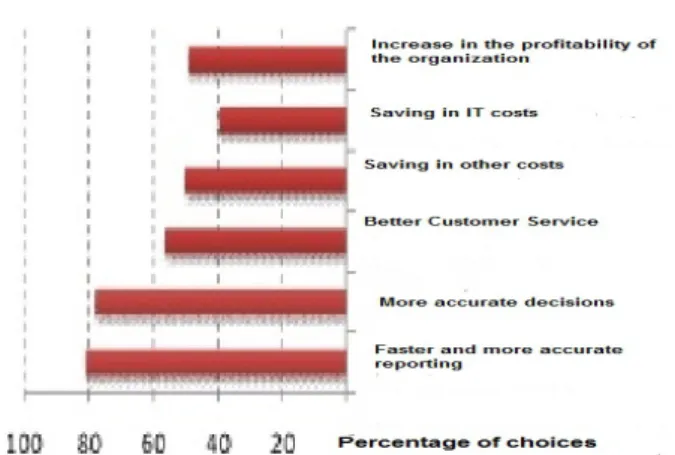
• Provide information to all staff and students One study in 2006 showed that managers in perfor-mance management solutions as the crowning achieve-ment of the advantages of using this approach can be considered. Other achievements of the strategy to im-prove customer service, grow revenue, increase profit-ability and better utilization of resources. Another study of 1047 firms that have applied performance manage-ment solutions is given in Figure 4. Accurate reporting and decision-making as the most important achieve-ment of this solution are listed in (Eckerson, 2007).
Figure 4. Results of the Performance Management System
Business activity monitoring systems (BAM)
In this system, one of the main tools for control-ling business activities. Control Systems business, is comprised of enterprise systems when Managers about potential opportunities, challenges and threats ahead and tell them to react through models and collabora-tion, empowers. Situations, immediately discovered, quickly becomes the analysis of the reaction is shown. BAM process internal and external data integration and interoperability of enterprise decision for the group provides. The main activity of the system, de-tecting dangerous situations growing fast, and respond quickly to the BAM technology as the best solutionfor a class of BPM, business process and analyze the data by the time they are used. Results and events in an enterprise portal (such as an enterprise business pro-cess management tool, called dashboards) will be pre-sented. Insights dashboard of business metrics show reasonable offers. Nowadays, developed tools for in-tegrating and and business intelligence, real standards (such as XML) and advanced software development techniques and tools, this technology makes it possible to update (Keating, 2003).
Dashboard: dashboard, essentially viewing on-line analytical processing. Dashboards, managers are required to provide updated information in the correct context is established. Ideally, the admin-istrator can view the dashboard, to focus on issues important to business. Intelligent Systems business, a dashboard systems that are the foundation of en-terprise information systems, information systems managers, and altered the system of OLAP, data warehouses have access to.
Artificial Intelligence Support systems (AI)
Intelligent systems: artificial intelligence is a term that describes a variety of commercial applica-tions. Most experts agree that the AI is associated with two ideas. The first consists of the thinking processes of human AI is the AI cars will be offered through these processes (Russell, Norving, 2002). In the wake of September 11 because of the AI’s abil-ity to aid in the fight against terrorism, has attracted much attention. Another development that has at-tracted much attention in the AI, a large number of intelligent devices in the market (Rivlin, 2003).AI programs: despite their limitations, are extreme-ly valuable. They facilitate computer use and access to knowledge is widespread. A major potential advantage of artificial intelligence, increase the speed and stability of fundamental routines are common. These problems include: They solve problems that are difficult with con-ventional processing and data problems that they are not completely clear. Another advantage of AI, a significant increase of productivity in bulk material handling multi-ple tasks and help summarize or paraphrase information or to search the information is huge. Intelligent systems are: expert systems, natural language processing, speech perception, robots and sensor systems, fuzzy logic, neu-ral processing, computer vision and scene detection and intelligent computer-aided instruction. More about this is explained briefly.
Expert System: Rule-based systems are usually consultations computer.
Natural Language Processing: discharged and understand human language makes it possible for computers.
Speech understanding: recognize words and un-derstand sentences with a short sound the computer makes possible.
Robotics and sensors: programmable combina-tion of mechanical and computer programs, their environment through sensors detect.
Computer vision and scene detection: interpreta-tion of the content of the images taken by the cam-era to the computer, makes it possible.
Machine learning: An interpretation of the data content and data obtained by the sensors, the com-puter makes possible.
Handwriting recognition: recognize the signs (letters, numbers) enables handwritten notes to the computer.
Process neural network (s) using massive par-allel processing, capable of identifying patterns in large amounts of data .
Fuzzy logic: enabling computers to argue with some of the information.
Intelligent agents: software programs that are applied to a superhuman or a machine.
Semantic Web: intelligent software applications that understand the web page content.
Genetic Algorithms: Combining automated analysis and computer programs.
Expert systems: try to mimic that of human ex-perts. Expert systems, decision support, or they can be completely replaced them (Edwards, Schwab, 2003).
Expert Systems and Applied Artificial Intelligence technologies are the most successful commercially.
Arnold offered to assist in your research of in-telligent decision, it is best to supplement the ex-pert decision-makers to analyze and solve complex problems are (Arnold et al, 2004).
Typically, ES software, a decision that could be compared to a human expert, the surface of the prob-lem in some specific domains generally be limited. ES basic idea is simple: Expertise of a specialist (or other source of expertise) is transferred to the com-puter. Then, this knowledge is organized and stored in the computer. If necessary, users can request spe-cific advice to computer. Computer can understand and come to fruition. Then, like a human expert, non-expert to provide advice and, if necessary , ex-plain the rationale behind this recommendation. ES systems can sometimes do better than an expert.
Expert System has the following benefits: • Increased output and productivity
• Increase quality with good advice
• providing and promoting patient rather rare specialties such as medical diagnosis system
• Ability to work in dangers environments. • access to knowledge centers and Accountability • Increased reliability and confidence
• Increased functionality through integration with other systems of the ES
• Ability to work with incomplete or inaccurate information provided training
• improved decision-making and problem-solving capabilities
• Reduce time to decide
• Reducing sleep time engine diagnostics Components of an expert system including knowledge base, inference engine, scratch pad (workspace), and a user interface sub system explain (justify) In the future, the system will include the refinement of knowledge. The components of an expert system are shown in Figure 5 [Turban, 2010].
Figure 5. Process and Structure of an Expert System
One of the most useful applications of expert sys-tem, placing it as a component of other systems. Ex-pert systems are thus integrated components or sys-tems that have become part of a transparent process.
Advantages and applications of neural networks: the neural network technologies, including its useful-ness for pattern recognition, learning and interpre-tation of the input is incomplete and noisy. Neural networks, have the potential to provide some of the characteristics of human problem solving simulation for decision support systems or expert systems, doors are the problem. One of these properties, Pattern Recognition 19. Neural networks are able to make large amounts of data model design and specifica-tion, when the logic or rules are unknown, analysis. Neural networks for financial applications, such as the timing of buying and selling shares (Eckerson, 2007), bankruptcy prediction (Gentry et al., 2002), predicted rates (Davis et al, 2001), and detect fraud. (Mercator Advisory Group, 2004), are very useful.
Neural processing beyond the processing mechanism and data mining is considered as one option, able to create a computer-based information system with the hybrid system is a powerful combination.
Genetic algorithms: are another means of ma-chine learning, neural networks, genetic algorithms, which automatically and independently of how to solve the problem. This tool generates thousands of random computer programs, and then re-com-bined using principles such as mutation, selection, and amplification of the gene, Darwin’s concept of natural selection applies. This tool tries to generate numerous improvements (Koza et al., 2003) neu-ral processing as an effective technology in pattern recognition, are shown. It was translated into many programs is often integrated with fuzzy logic.
Fuzzy logic: Fuzzy logic by simulating human reasoning process, in order to deal with uncertainty and the computer enables precise and logical than the old computers. Often, fuzzy logic can be used
with other intelligent systems. For example, the Ad-vanced Passenger Information System, a convenient way to offer the traveler, the travel time is used for optimization of fuzzy nerve (Dharia, Adeli, 2003).
Hybrid Intelligent Systems: combination of two or more systems above link is known as an intelli-gent system often with other intelliintelli-gent systems or traditional systems (like DSS) is integrated.
Web-based Executive Support System: Web is a complete environment for deploying decision sup-port system capabilities on a global basis (Simic, Devedzic, 2003). Web-based Executive Support Systems include all types of decision support sys-tems, including a variety of intelligent, and the hybrid. Web-based Executive Support Systems for enterprise systems are very good. The system allows access to rich data, ease of data retrieval, ease of use and learning, reduce paperwork and processing the raw data, make better decisions, made of DSS ap-plications, reducing development costs provides.
Simulation: simulation in general DSS, as a way to conduct a computer-based model of the system is known. Semi-structured and unstructured situa-tions such as DSS deals, including complex reality is that it may easily be analyzed using standard optimi-zation or other models but can often be investigated by simulation. Therefore, simulation is one of the most useful tools of DSS (Law, Kelton, 1999). For example, simulate a more practical decision support tools are part of the airline industry for short-term decision (Adelantado, 2004) Among the benefits of simulation for decision support can include.
• Considering the complexity of real problems, it makes possible.
• a description.
• To examine various problems
• can show the effects of time compression. • Can be conducted anywhere.
Conclusions
Nowadays having accurate and timely informa-tion and knowledge as competitive advantage are the key success factors in organizations. Therefore, organizations that are able to respond appropriately and optimally deploy and use the support system can be effectively realize their strategies and achieve their goals. In the past, most organizations were based on trial and error to take place. In the past, most orga-nizations were based on trial and error to take place. Recently, with the development of intelligent support systems (BI), such as expert systems, data mining and
statistical techniques, neural networks and genetic al-gorithms are expected organizations to analyze vast amounts of data and detect patterns appropriate to predict the future in this area.
References
Adelantado, M. (2004). Rapid prototyping of air-port advance operational systems and proce-dures through distributed simulation. Simula-tion: Transaction of Society for Modeling and Simulation International, 80(1).
Arnold, V., et al.(2004). Impact of intelligent deci-sion aids on expert and novice decideci-sion makers judgments, Accounting and Finance, 33(1). Business World, (2004). Executive
informa-tion system: the right move itnzattes.com.ph / news_05042002f.html
Davis J .T., et al. (2001). Predicting direction shift on Canadian-U.S. exchange rates with artificial neu-ral networks, International Journal of Intelligent Systems in Accounting, Finance of Management, 10.
Dharia, A., & Adeli, H. (2003). Neural network model for rapid forecasting of freeway link travel time en-gineering application of artificial intelligence.
Edwards, C. (2003). Charls Schwab, Business Week
Fryman. H, (2007). Four strategies to broaden business intelligence adoption, Business Intelligence Journal.
Gentry, J.A., et al. (2002). Using inductive learn-ing to predict bankruptcy, Journal of Organiza-tional Computing and Electronic Commerce, 12.
Gorry ,G.A, & Scott Morton, M.S. (1971). A framework for management information sys-tem. Sloan Management Review, 13(1).
Hackathorn, R.D., and Keen, P.G. (1981). Orga-nizational strategies for personal computing in decision support system, MIS Quarterly, 5, 7-21 Huber, G. (2003). The necessary future firms: attri-butes of survivors in a changing world, San Fran-cisco: Sage Publication
Kaplan. R, Norton, D.(2004). Strategy maps, Har-vard Business School Press
Kaplan. R, & Norton, D. (2007). Using balanced scorecard as a strategic management system,
Harvard Business Review.
Keating, W. (2003). Fast tracking, ACM Computing Surveys, 20, 115-46.
Koza, J.R. (2003). Genetic programming’s human competitive results, IEEE intelligent systems.
Law, A.M., & Kelton, D.W. (1999). Simulation mod-eling and analysis, New York, McGraw-Hill.
Mercator Advisory Group (2003). Credit scoring and analytic technologies: roi better than ever, re-searchandmarkets.com/reports/54412,
Mintsberg, H. (1973). The nature of the managerial
work. New York: Harper Er Row
Mintsberg, H., & Westly, F. (2001). Decision mak-ing: it’s not what you think, MIT Sloan Manage-ment Review
Open Group Consortium (2007). The open group architecture framework (TOGAF), version 8.1,
Open Group Publication
Rivlin, G. (2003). The things they carry. fortune.cnet. com/fortune/0,10000,0-5937473-7-7707001,00. html?Tag=txt
Russell, S. J., & Norving, P. (2002). Artificial intel-ligence (2nd Ed). Upper Saddle River, NJ:
Pren-tice Hall
Senge .P, 1999. The fifth discipline: the art and prac-tice of the leading organization
Shadbolt, J., et al., (2002). Neural network and the financial markets: predicating, combining, and portfolio optimization (perspective of neural com-puting), New York: Springer Verlag.
Shim, J.P, et al., (2002). Past, present and future of decision support technology, Decision Support Systems, 33(2).
Simic ,G. & Devedzic, V. (2003). Building an intel-ligent system using modern internet technolo-gies, expert system with applications
Singh, S.K et al., 2002. EIS Support of strategic man-agement process, decision support systems.
Stonebraker, J .S. (2002). How Bayer makes deci-sion to develop new drugs
Timothy .B, Nunes, P. F., Walter E., & Shill (2007). The chief strategy officer, Harvard Business Review
Turban, E. et al., (2006). Information technology management, transforming organizations in the digital economy, 5th Edition, John Wiley and
Sons Inc, 730-810
Turban, E, et al., (2010). Decision support and business intelligence systems, Prentice Hall Press, 144-201 Wayne, W.E. (2007). Deploying dashboards and
scorecards, Business Intelligence Journal
Weill .P, & Ross .J. (2004). IT governance: how top performers manage it decision rights for supe-rior results. Harvard Business Review