W65C265S
8/16-bit Microcontroller
WDC reserves the right to make changes at any time without notice in order to improve design and supply the best possible product. Information contained herein is provided gratuitously and without liability, to any user. Reasonable efforts have been made to verify the accuracy of the information but no guarantee whatsoever is given as to the accuracy or as to its applicability to particular uses. In every instance, it must be the responsibility of the user to determine the suitability of the products for each application. WDC products are not authorized for use as critical components in life support devices or systems. Nothing contained herein shall be construed as a recommendation to use any product in violation of existing patents or other rights of third parties. The sale of any WDC product is subject to all WDC Terms and Conditions of Sales and Sales Policies, copies of which are available upon request.
www
.WDC65xx.
com2
TABLE OF CONTENTS
DOCUMENT REVISION HISTORY ... 5
1 INTRODUCTION
... 6
1.1 KEY FEATURES OF THE W65C265S
... 6
1.2 Functional Block Diagram
... 7
2 FUNCTION DESCRIPTION
... 8
2.1 W65C816 Static 8/16-bit Microprocessor Core
... 8
2.2 Monitor ROM
... 8
2.3 SRAM
... 8
2.4 Priority Interrupt Controller Module Information
... 8
2.4.1 Emulation Mode Priority Encoded Interrupt Vector Module
... 9
2.4.2 Native Mode Priority Encoded Interrupt Vector Module
... 10
2.5 Memory Map
... 11
2.5.1 Communication Register Memory Map
... 12
2.5.2 Timer Register Memory Map
... 13
2.5.3 Control and Status Register Memory Map
... 14
2.5.4 I/O Register Memory Map
... 15
2.6 Bus Control Register (BCR)
... 16
2.6.1 Bus Control Register (BCR) Description
... 17
2.7 Timers
... 18
2.7.1 Timer Functions
... 19
2.7.2 Timer Control Register (TCR) Description
... 19
2.7.3 Timer Enable Register (TER) Description
... 20
2.8 Interrupt Flag Registers (TIFR, EIFR, UIFR)
... 21
2.8.1 Timer Interrupt
Enable Register (TIER) Description
... 22
2.8.2 Timer Interrupt Flag
Register (TIFR) Description
... 23
2.8.3 Edge Interrupt
Enable Register (EIER) Description
... 24
2.8.4 Edge Interrupt Flag
Register (EIFR) Description
... 25
2.8.5 UART Interrupt
Enable Register (UIER) Description
... 26
2.8.6 UART Interrupt Flag
Register (UIFR) Description
... 27
2.9 Universal Asynchronous Receiver/Transmitters (UARTs)
... 28
2.9.1 Transmitter Operation
... 28
2.9.2 UART Data Register Description
... 28
2.9.3 Transmitter Mode with Parity
... 29
2.9.4 Receiver Operation
... 29
2.9.5 Data Timing for 7-bit Data without Parity and two stop bits.
... 29
2.9.6 UART RXD and TXD Data Rate Generation.
... 30
2.9.7 Asynchronous Control and Status Registers (ACSRx) Description
... 31
2.10 Parallel Interface Bus (PIB)
... 32
2.10.1 PIB Enable Register (PIBER) Description
... 33
2.10.2 PIB Flag Register (PIBFR) Description
... 34
2.11 Twin Tone Generators
... 35
2.12.1 System Speed Control Register (SSCR) ... 37
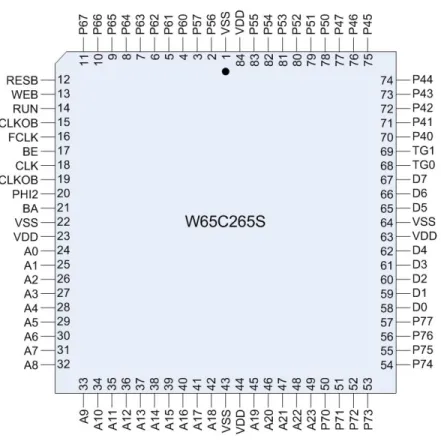
3 Pin and Pin Function Description for 84 Pin PLCC
... 39
Figure 2-2a 100 Lead QFP Chip Carrier Pinout
... 39
Figure 2-2b 84 Lead Chip Carrier Pinout
... 40
3.1 Write Enable (active low) (WEB)
... 44
3.2 RUN and SYNC outputs with WAI and STP defined (RUN)
... 44
3.3 Phase 2 Clock Output (PHI2)
... 44
3.4 Clock Inputs (CLKOB, FCLKOB Outputs) (CLK. FCLK)
... 44
3.5 Bus Enable and RDY Input (BE)
... 45
Figure 3.5-1 BE Timing Relative to PHI2
... 45
3.6 Reset Input/Output (active low) (RESB)
... 46
3.7 Positive Power Supply (VDD)
... 46
3.8 Internal Logic Ground (VSS)
... 46
3.9 I/O Port Pins (Pxx)
... 46
3.10 Address Bus (Axx)
... 46
3.12 Positive Edge Interrupt inputs (PExx)
... 47
3.13 Negative Edge Interrupt inputs (NExx)
... 47
3.14 Chip Select outputs (active low) (CSxB)
... 47
3.15 Level Sensitive Interrupt Request input (IRQB)
... 47
3.16 Non-Maskable Edge and ABORT Interrupt Input (NMIB/ABORTB)
... 47
3.17 Asynchronous Receiver Inputs/Transmitter Outputs (RXDx, TXDx)
... 48
3.18 Timer 4 Input and Output (TIN, TOUT)
... 48
2.19 Bus Available/Disable Output Data (BA)
... 48
3.20 Tone Generator Outputs (TGx)
... 48
3.21 Parallel Interface Bus (PIB)
... 48
3.22 Pulse Width Measurement Input (PWM)
... 49
4 TIMING, AC AND DC CHARACTERISTICS
... 49
4.1
Absolute Maximum Ratings (Note 1)
... 49
4.2 DC Characteristics
... 50
Table 4-2-1 DC Characteristics
... 50
4.3 AC Characteristics
... 51
Table 4.3-1 AC Characteristics
... 51
4.4 AC Parameters
... 52
Table 4.4-1 AC Parameters
... 52
4.5 AC Timing Diagram Notes
... 53
4.6 AC Timing Diagrams
... 54
Figure 4.6-1 AC Timing Diagram #1
... 54
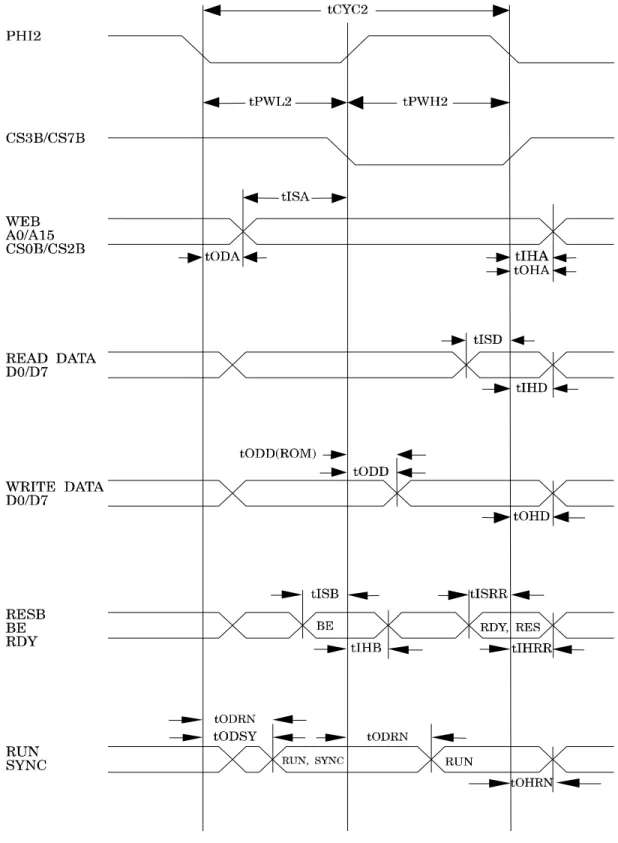
Figure 4.6-2 AC Timing Diagram #2
... 55
Figure 4.6-3 AC Timing Diagram #3
... 56
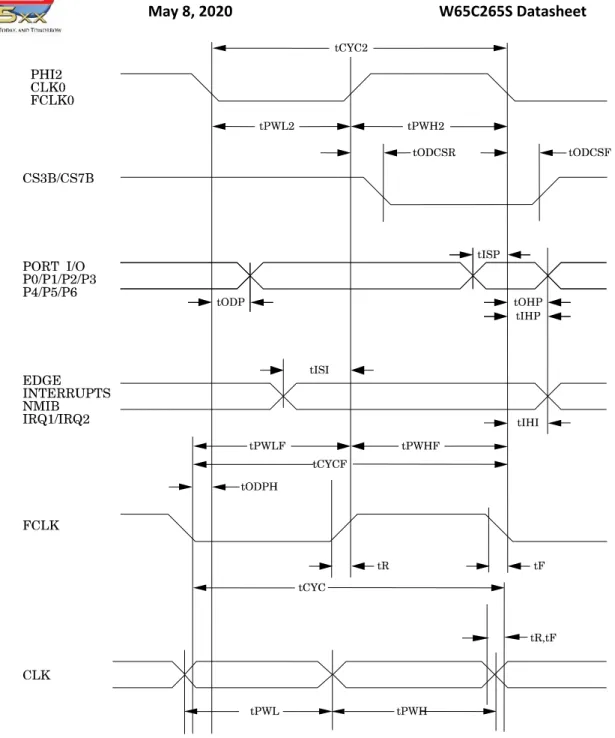
Figure 4.6-4 AC Timing Diagram #4
... 57
www
.WDC65xx.
com4
Figure 5-6 Tone Generator (TGx) Block Diagram
... 62
5.1 Recommended CLK and FCLK oscillators
... 63
Figure 5.1-1 Oscillator Circuit
... 63
Figure 5.1-2 Circuit Board Layout for Oscillator Circuit
... 64
Figure 5.1-3 Resonator Circuit
... 65
5.2 Wait state information and uses for the BE pin
... 65
DOCUMENT REVISION HISTORY
Version Date Authors Description
2.0 10/15/2019 Bill Mensch Rewrite of the W65C265S Datasheet
2.1 05/07/2020 David Gray Update Pin Description for QFP. Clarification for PLCC package EOL.
www
.WDC65xx.
com6
1 INTRODUCTION
The W65C265S 8/16-bit CMOS Microcontroller is fully static with key features listed below.
This product description assumes that the reader is familiar with the W65C816S 8/16-bit Microprocessor. Refer to the W65C816S 8/16-bit Microprocessor Datasheet for additional information.
1.1
KEY FEATURES OF THE W65C265S CMOS process
Operating TA =0ºC to +70ºC
Single 2.8V to 5.5V power supply
Static to 8MHz clock operation
W65C816S compatible CPU
8- and 16-bit parallel processing
Variable length stack
True indexing capability
Twenty-four address modes
Decimal or binary arithmetic
Pipeline architecture
Fully static CPU
Single chip microcomputer
2 Tone Generators
64 CMOS compatible I/O lines
8,192 x 8 ROM on-chip
576 x 8 SRAM on-chip
WAIt for interrupt
SToP the clock
Fast oscillator start and stop feature
16Mbyte linear address space
Twenty-nine priority encoded interrupts
BRK software interrupt
RESET "RESTART" interrupt
NMIB Non-Maskable interrupt
ABORT interrupt
COP software interrupt
IRQB level interrupt
8 timer edge interrupts
6 edge interrupts
PIB interrupt
4 UART Receiver interrupts
4 UART Transmitter interrupts
Four UARTS's
Time of Day (ToD) clock features
8 x 16 bit timer/counters
Bus Control Register
Many bus operating features and modes
8 Programmable chip select outputs
Low cost surface mount 84 and 100 lead packages
Macro and Cross assemblers available
www
.WDC65xx.
com8
2 FUNCTION DESCRIPTION
2.1
W65C816 Static 8/16-bit Microprocessor CoreThe W65C816S 8/16-bit microprocessor is the fully static. The W65C265S has the full 24-bit address and data bus available as opposed to the W65C816S having the high order 16-23 address pin multiplexed with the data bus. The W65C265S is found on the W65C265SXB for easy getting started with the W65C265S IC.
Refer to the W65C816S Microprocessor Datasheet for the Microprocessor Programming Model, Status Register Coding and complete information. More information is found in Programming the 65816: Including the 6502, 65C02 and 65802 Manual available through Amazon.
2.2
Monitor ROMThe W65C265S 8K x 8 bit Read Only Memory (ROM) contains the Mensch Monitor. See the W65C265S Monitor ROM Reference Manual for more information.
2.3
SRAMThe 512 bytes of SRAM are located at 0x0000-0x01FF, and 64 bytes at 0xDF80-0xDFBF for a total of 576 bytes.
2.4
Priority Interrupt Controller Module InformationThe Interrupt Control Module controls the priority encoded vectored memory map for interrupts. Each interrupt is connected to the Interrupt Control Module for prioritizing.
Interrupt Enable Registers for the various interrupts are the interrupt enable by the various enable bits. Reading the various IER and IFR bits determines the interrupt that occurred. By prioritizing the interrupts one can determine which interrupt occurred in the associated interrupt handler routine. Notice that any of the 8 interrupts for a GPIO 8-bit port will cause a GPIO vectored interrupt to occur.
2.4.1 Emulation Mode Priority Encoded Interrupt Vector Module
Address Label Function
0xFFFE,F IRQBRK BRK - Software Interrupt 0xFFFC,D IRQRES RES - "REStart" Interrupt 0xFFFA,B IRQNMI Non-Maskable Interrupt
0xFFF8,9 IABORT ABORT Interrupt 0xFFF6,7 IRQRVD Reserved 0xFFF4,5 IRQCOP COP Software Interrupt 0xFFF2,3 IRQRVD Reserved 0xFFF0,1 IRQRVD Reserved
0xFFEE,F IRQAT3 UART3 Transmitter Interrupt 0xFFEC,D IRQAR3 UART3 Receiver Interrupt 0xFFEA,B IRQAT2 UART2 Transmitter Interrupt
0xFFE8,9 IRQAR2 UART2 Receiver Interrupt 0xFFE6,7 IRQAT1 UART1 Transmitter Interrupt 0xFFE4,5 IRQAR1 UART1 Receiver Interrupt 0xFFE2,3 IRQAT0 UART0 Transmitter Interrupt 0xFFE0,1 IRQAR0 UART0 Receiver Interrupt 0xFFDE,F IRQ IRQ Level Interrupt
0xFFDC,D IRQPIB Parallel Interface Bus (PIB) Interrupt 0xFFDA,B IRNE66 Negative Edge Interrupt on P66 0xFFD8,9 IRNE64 Negative Edge Interrupt on P64 0xFFD6,7 IRPE62 Positive Edge Interrupt on P62 for PWM 0xFFD4,5 IRPE60 Positive Edge Interrupt on P60 0xFFD2,3 IRNE57 Negative Edge Interrupt on P57 0xFFD0,1 IRPE56 Positive Edge Interrupt on P56 0xFFCE,F IRQT7 Timer 7 Interrupt 0xFFCC,D IRQT6 Timer 6 Interrupt 0xFFCA,B IRQT5 Timer 5 Interrupt 0xFFC8,9 IRQT4 Timer 4 Interrupt 0xFFC6,7 IRQT3 Timer 3 Interrupt 0xFFC4,5 IRQT2 Timer 2 Interrupt
www
.WDC65xx.
com10
2.4.2 Native Mode Priority Encoded Interrupt Vector Module
Address Label Function 0xFFBE,F IRQRVD Reserved 0xFFBC,D IRQRVD Reserved 0xFFBA,B IRQNMI Non-Maskable Interrupt
0xFFB8,9 IABORT ABORT Interrupt 0xFFB6,7 IRQBRK BRK Software Interrupt 0xFFB4,5 IRQCOP COP Software Interrupt 0xFFB2,3 IRQRVD COP Software Interrupt 0xFFB0,1 IRQRVD Reserved
0xFFAE,F IRQAT3 UART3 Transmitter Interrupt 0xFFAC,D IRQAR3 UART3 Receiver Interrupt 0xFFAA,B IRQAT2 UART2 Transmitter Interrupt
0xFFA8,9 IRQAR2 UART2 Receiver Interrupt 0xFFA6,7 IRQAT1 UART1 Transmitter Interrupt 0xFFA4,5 IRQAR1 UART1 Receiver Interrupt 0xFFA2,3 IRQAT0 UART0 Transmitter Interrupt 0xFFA0,1 IRQAR0 UART0 Receiver Interrupt 0xFF9E,F IRQ IRQ Level Interrupt
0xFF9C,D IRQPIB Parallel Interface Bus (PIB) Interrupt 0xFF9A,B IRNE66 Negative Edge Interrupt on P66 0xFF98,9 IRNE64 Negative Edge Interrupt on P64 0xFF96,7 IRPE62 Positive Edge Interrupt on P62 for 0xFF94,5 IRPE60 Positive Edge Interrupt on P60 0xFF92,3 IRNE57 Negative Edge Interrupt on P57 0xFF90,1 IRPE56 Positive Edge Interrupt on P56 0xFF8E,F IRQT7 Timer 7 Interrupt 0xFF8C,D IRQT6 Timer 6 Interrupt 0xFF8A,B IRQT5 Timer 5 Interrupt 0xFF88,9 IRQT4 Timer 4 Interrupt 0xFF86,7 IRQT3 Timer 3 Interrupt 0xFF84,5 IRQT2 Timer 2 Interrupt 0xFF82,3 IRQT1 Timer 1 Interrupt 0xFF80,1 IRQT0 Timer 0 Interrupt
2.5
Memory MapStart End Size Description
C00000 FFFFFF 4MB CS7B Chip Select 7 for User 4MB Memory 400000 BFFFFF 8MB CS6B Chip Select for User 8MB Memory
000000 3FFFFF 4MB CS5B Chip Select for User 4MB-selected Memory (Note 1, 2) 0xE000 0xFFFF 8,192 B CS4B Monitor ROM (Note 1, 2)
0xDFC0 0xDFFF 64 B CS1B PIB SRAM Expansion (Note 2) 0xDF80 0xDFBF 64 B On-Chip PIB SRAM
0xDF70 0xDF7F 16 B On Chip UART Registers 0xDF50 0xDF6F 32 B On-Chip Timer Registers 0xDF40 0xDF4F 16 B On-Chip Control Registers 0xDF20 0xDF27 8 B On-Chip IO Registers
0xDF00 0xDF1F 32 B CS0B Port Replacement and Expansion (Note 2, 4) 0xDF00 0xDF07 8 B On-Chip IO Registers
0x8000 0xDEFF 24,320 B CS4B External FLASH Program and Data Memory 0x0200 0x7FFF 32,256 B CS3B External SRAM (Note 2, 3)
0x0000 0x01FF 512 B On-Chip SRAM
Note 1: When on-chip 8K bytes of ROM are enabled, addresses 0xE000-0xFFFF will not appear in CS4B chip select decode. On Chip addresses 0xDF00-0xDFFF never appear in CS4B or CS5B chip select decode.
Note 2: When on-chip ROM, CS3B and/or CS4B are enabled, then CS5B decode is reduced by the
addresses used by same. CS0B and CS1B address space never appears in CS2B, CS4B or CS5B decoded space.
Note 3: When SSCR2 is "0" (internal RAM), then CS3B is active for addresses 0x0200-0x7FFF. When SSCR2 is "1" (external RAM), then CS3B is active for addresses 0x0000-0x7FFF.
Note 4: CS0B is inactive when 0xDF00-0xDF07 are used for internal I/O register select (BCR0=0) when (BCR0=1) external memory bus is enabled CS0B is active for addresses 0xDF00-0xDF1F.
www
.WDC65xx.
com12
2.5.1 Communication Register Memory Map
Address Label Function Reset Value 0xDFC0-FF RAM CS1B PIB SRAM Expansion External 0xDF80-BF RAM RAM Registers uninitialized
0xDF7F PIR7 Parallel Interface Register 7 uninitialized 0xDF7E PIR6 Parallel Interface Register 6 uninitialized 0xDF7D PIR5 Parallel Interface Register 5 uninitialized 0xDF7C PIR4 Parallel Interface Register 4 uninitialized 0xDF7B PIR3 Parallel Interface Register 3 uninitialized 0xDF7A PIR2 Parallel Interface Register 2 uninitialized 0xDF79 PIBER Parallel Interface Enable Register $00 0xDF78 PIBFR Parallel Interface Flag Register $00 0xDF77 ARTD3 UART 3 Data Register uninitialized 0xDF76 ACSR3 UART 3 Control/Status Register $00 0xDF75 ARTD2 UART 2 Data Register uninitialized 0xDF74 ACSR2 UART 2 Control/Status Register $00 0xDF73 ARTD1 UART 1 Data Register uninitialized 0xDF72 ACSR1 UART 1 Control/Status Register $00 0xDF71 ARTD0 UART 0 Data Register uninitialized 0xDF70 ACSRO UART 0 Control/Status Register $00
2.5.2 Timer Register Memory Map
Address Label Function Reset Value 0xDF6F T7CH Timer 7 Counter High uninitialized 0xDF6E T7CL Timer 7 Counter Low uninitialized 0xDF6D T6CH Timer 6 Counter High uninitialized 0xDF6C T6CL Timer 6 Counter Low uninitialized 0xDF6B T5CH Timer 5 Counter High uninitialized 0xDF6A T5CL Timer 5 Counter Low uninitialized 0xDF69 T4CH Timer 4 Counter High uninitialized 0xDF68 T4CL Timer 4 Counter Low uninitialized 0xDF67 T3CH Timer 3 Counter High uninitialized 0xDF66 T3CL Timer 3 Counter Low uninitialized 0xDF65 T2CH Timer 2 Counter High uninitialized 0xDF64 T2CL Timer 2 Counter Low uninitialized 0xDF63 T1CH Timer 1 Counter High uninitialized 0xDF62 T1CL Timer 1 Counter Low uninitialized 0xDF61 T0CH Timer 0 Counter High uninitialized 0xDF60 T0CL Timer 0 Counter Low uninitialized 0xDF5F T7LH Timer 7 Latch High uninitialized 0xDF5E T7LL Timer 7 Latch Low uninitialized 0xDF5D T6LH Timer 6 Latch High uninitialized 0xDF5C T6LL Timer 6 Latch Low uninitialized 0xDF5B T5LH Timer 5 Latch High uninitialized 0xDF5A T5LL Timer 5 Latch Low uninitialized 0xDF59 T4LH Timer 4 Latch High uninitialized 0xDF58 T4LL Timer 4 Latch Low uninitialized 0xDF57 T3LH Timer 3 Latch High uninitialized 0xDF56 T3LL Timer 3 Latch Low uninitialized 0xDF55 T2LH Timer 2 Latch High uninitialized 0xDF54 T2LL Timer 2 Latch Low uninitialized 0xDF53 T1LH Timer 1 Latch High uninitialized 0xDF52 T1LL Timer 1 Latch Low uninitialized
www
.WDC65xx.
com14
2.5.3 Control and Status Register Memory Map
Address Label Function Reset Value 0xDF4A-4F --- Reserved uninitialized
0xDF49 UIER UART Interrupt Enable Register $00 0xDF48 UIFR UART Interrupt Flag Register $00 0xDF47 EIER Edge Interrupt Enable Register $00 0xDF46 TIER Timer Interrupt Enable Register $00 0xDF45 EIFR Edge Interrupt Flag Register $00 0xDF44 TIFR Timer Interrupt Flag Register $00 0xDF43 TER Timer Enable Register $00 0xDF42 TCR Timer Control Register $00 0xDF41 SSCR System Speed Control Register $00 0xDF40 BCR Bus Control Register $00/$89
2.5.4 I/O Register Memory Map
Address Label Function Reset Value 0xDF28-3F --- Reserved uninitialized 0xDF27 PCS7 Port 7 Chip Select $00 0xDF26 PDD6 Port 6 Data Direction Register $00 0xDF25 PDD5 Post 5 Data Direction Register $00 0xDF24 PDD4 Port 4 Data Direction Register $00 0xDF23 PD7 Port 7 Data Register $FF 0xDF22 PD6 Port 6 Data Register $00 0xDF21 PD5 Port 5 Data Register $00 0xDF20 PD4 Port 4 Data Register $00 0xDF00-1F CS0 Port Replacement & Expansion uninitialized 0xDF07 PDD3 Port 3 Data Direction Register $00 0xDF06 PDD2 Port 2 Data Direction Register $00 0xDF05 PDD1 Port 1 Data Direction Register $00 0xDF04 PDD0 Port 0 Data Direction Register $00 0xDF03 PD3 Port 3 Data Register $00 0xDF02 PD2 Port 2 Data Register $00 0xDF01 PD1 Port 1 Data Register $00 0xDF00 PD0 Port 0 Data Register $00
www
.WDC65xx.
com16
2.6
Bus Control Register (BCR)The Bus Control Register (BCR) controls the various modes of I/O and external memory interface during power-up. The value of BE defines the initial values of BCR0, BCR3 and BCR7, three bits in the BCR that set up the W65C265S for In-Circuit-Emulation (ICE) or normal mode. When BE goes high after RESB goes high the BCR sets up the W65C265S for emulation. Port 0 and 1 are the address outputs, Port 2 is the data I/O bus and RUN is the multiplexed RUN function. (See RUN pin function description).
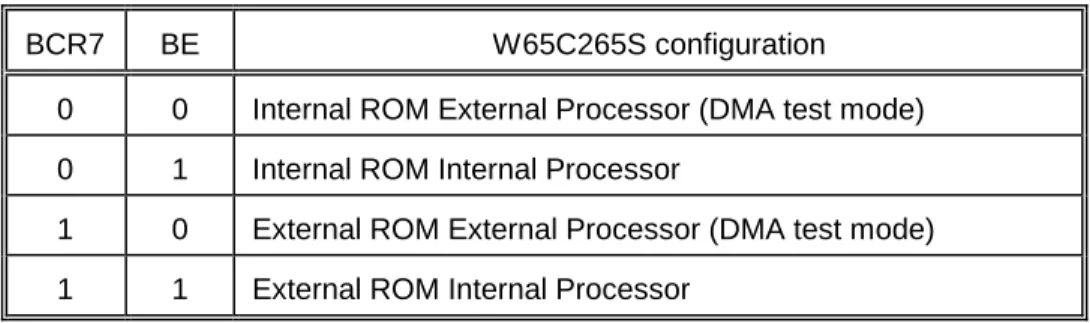
When the rising edge of BE occurs before the rising edge of RESB, all bits in the BCR are "0". After RESB goes high BE no longer effects the BCR register, and BCR may be written under software control to reconfigure the W65C265S as desired. Table 1-1 and Figure 1-1 (following page) indicate how BCR7 and BE define the W65C265S configuration.
Table 1-1 BCR7 and BE Control BCR7 BE W65C265S configuration
0 0 Internal ROM External Processor (DMA test mode) 0 1 Internal ROM Internal Processor
1 0 External ROM External Processor (DMA test mode) 1 1 External ROM Internal Processor
2.6.1 Bus Control Register (BCR) Description
Address = 0xDF40 BCR Register Reset Value = 0x00 7:0-> BCR7 BCR6 BCR5 BCR4 BCR3 BCR2 BCR1 BCR0
HWRES 0 = BE High 0 0 0 0 0 0 0
BERES 1 = BE Low - - - 1 - - 1
Bit Name Access Description
7 BCR7 R/W 1 = External ROM (BE controls shown in Table 1-1) 0 = Internal ROM (BE Controls shown in Table 1-1) 6 BCR6 R/W
1 = Enable NMIB on P40 Input is level sensitive, NMIB and ABORTB cannot both be enabled at the same time.
0 = Disable NMIB 5 BCR5 R/W
1 = Enable ABORTB on P40 Input is level sensitive, NMIB and ABORTB cannot both be enabled at the same time.
0 = Disable ABORTB 4 BCR4 R/W 1 = Watch Dog Enabled
0 = Watch Dog Disabled
3 BCR3 R/W
1 = Emulation Mode, RUN=Run, BA=BA/1 All on-chip addressed memory or I/O for reads or writes are output on the data bus (this is the emulation mode of operation)
0 = Normal Operation RUN=RUN, BA=BA 2 BCR2 R/W 1 = Enable TG1
0 = Disable TG1 1 BCR1 R/W 1 = Enable TG0
0 = Disable TG0
0 BCR0 R/W 1 = Ports 0,1,2,3 are address and data bus pins 0 = Ports 0,1,2,3 are I/O pins
www
.WDC65xx.
com18
2.7
TimersUpon Timer clock input negative edge the timer counter is decremented by 1. A write to the timer low counter writes the timer low latch.
A read of the timer high or low counter reads the timer high or low counter.
Upon Timer clock input negative edge when the timer low counter reaches zero, the timer high counter is decremented by 1. Upon Timer clock input positive edge, when the timer high counter reaches zero, this sequence occurs:
The Timer sets its associated interrupt flag. If the interrupt is enabled the MPU is then interrupted and control is transferred to the vector associated with the interrupt. When the Watch Dog Timer 0 times out, the W65C265S is restarted: on-chip logic pulls RESB pin low for 2 CLK cycles and releases RESB to go high, "restarting" the W65C265S.
The Timer high counter is loaded from the timer high latch, and timer low counter is loaded from timer low latch.
A write to the Timer high counter writes to the timer high latch and this sequence occurs: The timer high latch is loaded from data bus.
The timer low counter is loaded from the timer low latch, and the timer high counter is loaded from the timer high latch.
The Watch Dog Timer 0 is disabled after RESB and is activated by the first TER0 transition from "0" to "1" resulting in the first load of Timer 0 after the W65C265S has been restarted.
The Timer 0 counter is reloaded with the value in the Timer 0 latches when the TER0 bit 0 makes a transition from a "0" to "1". TER0 transition from a "1" to a "0" has no effect on the timer.
A timer must be reloaded after it is disabled with TERx for it could have been stopped with all $FFFF's and when restarted will require full length count down.
2.7.1 Timer Functions
Number Timer Function TCR0=0 TCR0=1 T7 Pulse Width Measurement FCLK - T6 Tone Generator FCLK - T5 Tone Generator FCLK - T4 UART Baud Rate or Pulse,
Input/Output
FCLK P60
T3 UART Baud Rate FCLK - T2 Prescaled Interrupt FCLK/16 -
T1 Time of Day CLK -
T0 Monitor Watch Dog CLK -
2.7.2 Timer Control Register (TCR) Description
Address = 0xDF42 TCR: Timer Control Register Reset Value = 0x00 7:0-> TCR7 TCR6 TCR5 TCR4 TCR3 TCR2 TCR1 TCR0
Bit Name Access Description
7 TCR7 R/W 1 = UART3 Timer 4 Selected
0 = UART3 Timer 3 Selected
6 TCR6 R/W 1 = UART2 Timer 4 Selected
0 = UART2 Timer 3 Selected
5 TCR5 R/W 1 = UART1 Timer 4 Selected
0 = UART1 Timer 3 Selected
4 TCR4 R/W 1 = UART0 Timer 4 Selected
0 = UART0 Timer 3 Selected
3 TCR3 R/W 11 = Pulse Width Measurement on P62 Both Edges
10 = Pulse Width Measurement on P62 Negative Edges
2 TCR2 R/W 01 = Pulse Width Measurement on P62 Positive Edges
00 = Disable
1 TCR1 R/W 1 = Enable Timer 4 on P61
0 = Disable Timer 4 on P61
0 TCR0 R/W 1 = Timer 4 Clock Selected on P60
www
.WDC65xx.
com20
2.7.3 Timer Enable Register (TER) Description
Address = 0xDF43 TER: Timer Enable Register Reset Value = 0x00 7:0-> TER7 TER6 TER5 TER4 TER3 TER2 TER1 TER0
Bit Name Access Description
7 TER7 R/W 1 = Timer 7 Enabled
0 = Timer 7 Disabled
6 TER6 R/W 1 = Timer 6 Enabled
0 = Timer 6 Disabled
5 TER5 R/W 1 = Timer 5 Enabled
0 = Timer 5 Disabled
4 TER4 R/W 1 = Timer 4 Enabled
0 = Timer 4 Disabled
3 TER3 R/W 1 = Timer 3 Enabled
0 = Timer 3 Disabled
2 TER2 R/W 1 = Timer 2 Enabled
0 = Timer 2 Disabled
1 TER1 R/W 1 = Timer 1 Enabled
0 = Timer 1 Disabled
0 TER0 R/W 1 = Timer 0 Enabled
2.8
Interrupt Flag Registers (TIFR, EIFR, UIFR)TIER, EIER, and UIER are the interrupt enable registers. Reading an IER register reads its contents and puts the value on the internal data bus. Writing an IER writes a value from the data bus into the register. Setting a bit in an IER to "1" permits the interrupt corresponding to the same bit in the IFR to cause a processor interrupt. If a WAI instruction has been executed prior to the interrupt occurring and the part is in the non-emulation mode (BCR3=0). The RUN pin will be low until the interrupt occurs and will then go high to indicate the part is running.
Note that the "I" flag in the microprocessor status register must be cleared with an instruction before any of the interrupts controlled by TIER, EIER, and UIER can occur.
A bit of these registers is set to a "1" in response to an interrupt signal from a source. Sources specified as level-triggered assert the corresponding IFR bit if an edge occurs and is held to a "1" as long as the IRQB input is held low. Sources specified as edge-triggered assert the corresponding IFR bit upon and only upon transition to the specified polarity. Note that changes for edge-triggered bits are asynchronous with PHI2.
A read from an IFR register transfers its value to the internal data bus.
Write to an IFR register. A write of a "1" to any bits of these registers clears those bits but has no further effect when execution of that write instruction is completed; that is, the bit is reset by a pulse but not held reset. A write of a "0" to any bits of these registers has no effect. Note that you must write a "1" to the corresponding IFR bit after the interrupt has been serviced; otherwise, the interrupt will continue to occur. Interrupt Priority. If more than one bit of the Interrupt Flag Registers are set to a "1" and enabled, the vector corresponding to the highest memory map location and bit number asserted is used. For example, if both the TIFR1 and EIFR3 were asserted and enabled, then the vector corresponding to EIFR3 would be used. For another example, if both the TIFR3 and EIFR0 were asserted and enabled, then the vector corresponding to EIFR0 would be used.
www
.WDC65xx.
com22
2.8.1 Timer Interrupt Enable Register (TIER) Description
Address = 0xDF46 TIER: Timer Interrupt Enable Register Reset Value = 0x00 7:0-> TIER7 TIER6 TIER5 TIER4 TIER3 TIER2 TIER1 TIER0
Bit Name Access Description
7 TIER7 R/W 1 = Timer 7 Enabled
0 = Timer 7 Disabled
6 TIER6 R/W 1 = Timer 6 Enabled
0 = Timer 6 Disabled
5 TIER5 R/W 1 = Timer 5 Enabled
0 = Timer 5 Disabled
4 TIER4 R/W 1 = Timer 4 Enabled
0 = Timer 4 Disabled
3 TIER3 R/W 1 = Timer 3 Enabled
0 = Timer 3 Disabled
2 TIER2 R/W 1 = Timer 2 Enabled
0 = Timer 2 Disabled
1 TIER1 R/W 1 = Timer 1 Enabled
0 = Timer 1 Disabled
0 TIER0 R/W 1 = Timer 0 Enabled
2.8.2 Timer Interrupt Flag Register (TIFR) Description
Address = 0xDF44 TIER: Timer Interrupt Flag Register Reset Value = 0x00 7:0-> TIFR7 TIFR6 TIFR5 TIFR4 TIFR3 TIFR2 TIFR1 TIFR0
Bit Name Access Description
7 TIFR7
R/ W=1 Clears
1 = Timer 7 Interrupted 0 = Timer 7 Did not interrupt
6 TIFR6
R/ W=1 Clears
1 = Timer 6 Interrupted 0 = Timer 6 Did not interrupt
5 TIFR5
R/ W=1 Clears
1 = Timer 5 Interrupted 0 = Timer 5 Did not interrupt
4 TIFR4
R/ W=1 Clears
1 = Timer 4 Interrupted 0 = Timer 4 Did not interrupt
3 TIFR3
R/ W=1 Clears
1 = Timer 3 Interrupted 0 = Timer 3 Did not interrupt
2 TIFR2
R/ W=1 Clears
1 = Timer 2 Interrupted 0 = Timer 2 Did not interrupt
1 TIFR1
R/ W=1 Clears
1 = Timer 1 Interrupted 0 = Timer 1 Did not interrupt
0 TIFR0
R/ W=1 Clears
1 = Timer 0 Interrupted 0 = Timer 0 Did not interrupt
www
.WDC65xx.
com24
2.8.3 Edge Interrupt Enable Register (EIER) Description
Address = 0xDF45 TIER: Edge Interrupt Enable Register Reset Value = 0x00 7:0-> IRQBE PIBE NE66E NE64E PWME PE60E NE57E PE56E
Bit Name Access Description
7 IRQBE R/W 1 = Enable 0 = Disable 6 PIBE R/W 1 = Enable 0 = Disable 5 NE66E R/W 1 = Enable 0 = Disable 4 NE64E R/W 1 = Enable 0 = Disable 3 PWME R/W 1 = Enable 0 = Disable 2 PE60E R/W 1 = Enable 0 = Disable 1 NE57E R/W 1 = Enable 0 = Disable 0 PE56E R/W 1 = Enable 0 = Disable
2.8.4 Edge Interrupt Flag Register (EIFR) Description
Address = 0xDF47 EIER: Edge Interrupt Flag Register Reset Value = 0x00 7:0-> IRQB PIB NE66 NE64 PWM PE60 NE57 PE56
Bit Name Access Description
7 IRQB
R/ W=1 Clears
1 = Interrupted 0 = Did not interrupt
6 PIB
R/ W=1 Clears
1 = Interrupted 0 = Did not interrupt
5 NE66
R/ W=1 Clears
1 = Interrupted 0 = Did not interrupt
4 NE64
R/ W=1 Clears
1 = Interrupted 0 = Did not interrupt
3 PWM
R/ W=1 Clears
1 = Interrupted 0 = Did not interrupt
2 PE60
R/ W=1 Clears
1 = Interrupted 0 = Did not interrupt
1 NE57
R/ W=1 Clears
1 = Interrupted 0 = Did not interrupt
0 PE56
R/ W=1 Clears
1 = Interrupted 0 = Did not interrupt
www
.WDC65xx.
com26
2.8.5 UART Interrupt Enable Register (UIER) Description
Address = 0xDF49 UIER: UART Interrupt Enable Register Reset Value = 0x00 7:0-> U3TE U3RE U2TE U2RE U1TE U1RE U0TE U0RE
Bit Name Access Description
7 U3TE R/W 1 = Enable 0 = Disable 6 U3RE R/W 1 = Enable 0 = Disable 5 U2TE R/W 1 = Enable 0 = Disable 4 U2RE R/W 1 = Enable 0 = Disable 3 U1TE R/W 1 = Enable 0 = Disable 2 U1RE R/W 1 = Enable 0 = Disable 1 U0TE R/W 1 = Enable 0 = Disable 0 U0RE R/W 1 = Enable 0 = Disable
2.8.6 UART Interrupt Flag Register (UIFR) Description
Address = 0xDF47 UIFR: UART Interrupt Flag Register Reset Value = 0x00 7:0-> IRQATx U3RE IRQATx U2RE IRQATx U1RE IRQATx U0RE
Bit Name Access Description
7 IRQATx
R/ W=1 Clears
1 = Interrupted 0 = Did not interrupt
6 U3RF
R/ W=1 Clears
1 = Interrupted 0 = Did not interrupt
5 U2TF
R/ W=1 Clears
1 = Interrupted 0 = Did not interrupt
4 U2RF
R/ W=1 Clears
1 = Interrupted 0 = Did not interrupt
3 U1TF
R/ W=1 Clears
1 = Interrupted 0 = Did not interrupt
2 U1RF
R/ W=1 Clears
1 = Interrupted 0 = Did not interrupt
1 U0TF
R/ W=1 Clears
1 = Interrupted 0 = Did not interrupt
0 U0RF
R/ W=1 Clears
1 = Interrupted 0 = Did not interrupt
www
.WDC65xx.
com28
2.9
Universal Asynchronous Receiver/Transmitters (UARTs)The W65C265S has four full duplex Universal Asynchronous Receiver/Transmitters (UART) with programmable bit rates. The serial I/O functions are controlled by the Asynchronous Communication Control and Status Registers (ACSRx). The serial bit rate is determined by Timer 3 or 4 for all modes for the UART's. The maximum data rate using the internal clock is 0.5MHz bits per second (FCLK = 8MHz). The Asynchronous Transmitter and Asynchronous Receiver can be independently enabled or disabled. All transmitter and receiver bit rates will occur at one sixteenth of Timer 3 or 4 as selected.
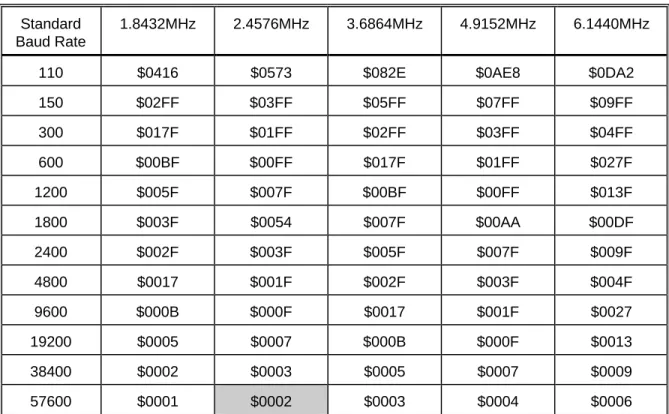
Whenever Timer 3 or 4 is required as a timing source, it must be loaded with the hexadecimal code that selects the data rate for the serial I/O Port. Refer to Table 1-3 for a table of hexadecimal values that represent the desired data rate.
Standard UART Features
7 or 8 bit data with or without Odd or Even parity.
The Transmitter has 1 stop bit with parity or 2 stop bits without parity.
The Receiver requires only 1 stop bit for all modes.
Both the Receiver and Transmitter have priority encoded interrupts for service routines.
The Receiver has error detection for parity error, framing error, or over-run error conditions that may require re-transmission of the message.
The Receiver Interrupt occurs due to a receiver data register full condition.
The Transmitter Interrupt can be selected to occur on either the data register empty (end-of-byte transmission) or both the data register empty and the shift register empty (end-of-message transmission) condition.
2.9.1 Transmitter Operation
The transmitter operation is controlled by the Asynchronous Control and Status Register (ACSRx. The transmitter automatically adds a start bit, parity bit and one or two stop bits as defined by the ACSRx. A word of transmitted data is 7 or 8 bits of data.
The Transmitter Data Register (ARTDx) is located at addresses $DF71, $DF73, $DF75, and $DF77 and is loaded on a write. The Receiver is read at this same address.
2.9.2 UART Data Register Description
Address = Base + 1 ARTDx: UART Data Register Reset Value = 0x00 7:0-> ARTDx7 ARTDx6 ARTDx5 ARTDx4 ARTDx3 ARTDx2 ARTDx1 ARTDx0
Bit Name Access Description
7 - 0 ARTDx [7-0] R/W R = Read Receiver Data Register W = Write Transmitter Data Register
2.9.3 Transmitter Mode with Parity
The Transmitter Interrupt is controlled by the Asynchronous Control Status Register bit ACSRx1.
IRQATx = ACSRx0 ((ACSRx1B) (DATA REGISTER EMPTY) + (ACSRx1) (DATA REGISTER AND SHIFT REGISTER EMPTY))
2.9.4 Receiver Operation
The receiver and its selected control and status functions are enabled when ACSRx5 is set to a "1". The data format must have a start bit, 7 or 8 data bits, and one stop bit or one parity bit and one stop bit. The receiver bit period is divided into 16 sub-intervals for internal synchronization. The receiver bit stream is synchronized by the start bit, and a strobe signal is generated at the approximate center of each incoming bit. The character assembly process does not start if the start bit signal is less than one-half the bit time after a low level is detected on the Receive Data Input. A framing error, parity error or an over-run will set ASCRx7 the receiver error detection bit. An over-run condition occurs when the receiver data register has not been read and new data byte is transferred from the receiver shift register.
Serial Data Start Bit 0 1 2 3 4 5 6 Stop Bit Stop Bit
2.9.5 Data Timing for 7-bit Data without Parity and two stop bits.
The receiver requires only one stop bit but the transmitter supplies two stop bits for older system timing. A receiver interrupt (IRQARx) is generated whenever the receiver shift register is transferred to the receiver data register. Serial Data Start Bit 0 1 2 3 4 5 6 7 Parity Bit Stop Bit
www
.WDC65xx.
com30
2.9.6 UART RXD and TXD Data Rate Generation.
Timer 3 and 4 provide clock timing for the RXD and TXD data rate. Timer 3 and 4 operate as configured by Timer Control Register (TCRx) and Timer Enable Register (TERx) should be set up prior to enabling the UARTx.
The table below identifies the values to be loaded into Timer 3 and 4 to select standard data rates. Any data rate can be selected by using the formula:
N = (FCLK / (16 x bps)) - 1
N = decimal value to be loaded into timer using its hexadecimal equivalent FCLK = the clock frequency
Bps = the desired data rate
Note that one may notice slight differences between the standard rate and the actual data rate. However, transmitter and receiver error of 1.5% or less is acceptable.
Table 2.9.6-1 Timer 3 and 4 Values for Baud Rate Selection
Standard Baud Rate
1.8432MHz 2.4576MHz 3.6864MHz 4.9152MHz 6.1440MHz
110 $0416 $0573 $082E $0AE8 $0DA2 150 $02FF $03FF $05FF $07FF $09FF 300 $017F $01FF $02FF $03FF $04FF 600 $00BF $00FF $017F $01FF $027F 1200 $005F $007F $00BF $00FF $013F 1800 $003F $0054 $007F $00AA $00DF 2400 $002F $003F $005F $007F $009F 4800 $0017 $001F $002F $003F $004F 9600 $000B $000F $0017 $001F $0027 19200 $0005 $0007 $000B $000F $0013 38400 $0002 $0003 $0005 $0007 $0009 57600 $0001 $0002 $0003 $0004 $0006
2.9.7 Asynchronous Control and Status Registers (ACSRx) Description
The Asynchronous Control and Status Register (ACSRx) enables the Receiver and Transmitter and holds information on communication status error conditions.
Address = Base ACSRx: Asynchronous Control and Status Register Reset Value = 0x00 7:0-> ACSRx7 ACSRx6 ACSRx5 ACSRx4 ACSRx3 ACSRx2 ACSRx1 ACSRx0
Bit Name Access Description
7 ACSRx7 R/W
1 = Receiver Error Flag. The Receiver logic detects three possible error conditions and sets ACSRx7: parity, framing or over-run. A parity error occurs when the parity bit received does not match the parity generated on the receive data. A framing error occurs when the stop bit time finds a "0" instead of a "1". An over-run occurs when the last data in the Receiver Data Register has not been read and new data is transferred from the Receive Shift Register.
0 = Cleared by writing a "1" to ACSRx7. Writing a "0" to ACSR7 has not effect on ACSRx7.
6 ACSRx6 R/W
1 = Software Semaphore. ACSRx6 may be used for communications among routines which access the UARTx. This bit has no effect on the UART operation. The bit can be thought of as a manually set busy signal.
0 = User defined.
5 ACSRx5 R/W 1 = Enable Receiver, Receiver Interrupt, and RXDx output on Port 6.
0 = Disable Receiver.
4 ACSRx4 R/W
1 = Even parity is enabled. Even parity is when the number of ones in the data register plus parity bit equal an even number of "1's".
0 = Odd parity is enabled. Odd parity is generated where the number of ones is the data register plus parity bit equal an odd number of "1's".
3 ACSRx3 R/W 1 = Enable Parity.
0 = Disable Parity
2 ACSRx2 R/W
1 = Transmitter and Receiver send and receive 8-bit data. The
Transmitter sends 11 bits of information (one start, 8 data, one parity and one stop or two stop bits). The Receiver receives 10 or 11 bits of information (one start, 8 data, one stop or one parity and one stop bit). 0 = Transmitter and Receiver send and receive 7-bit data. The
Transmitter sends a total of 10 bits of information (one start, 7 data, one parity and one stop or 2 stop bits). The Receiver receives 9 or 10 bits of information (one start, 7 data, and one stop or one stop and one parity bits). When writing to the Transmitter in seven bit mode, bit 7 is discarded. When reading from the receive data register during seven bit mode, bit 7 is always zero.
1 = Transmitter Interrupt occurs due to both the Transmitter Data and Shift register empty condition (end-of-message transmission. ACSRx0 = 0
www
.WDC65xx.
com32
2.10
Parallel Interface Bus (PIB)The Parallel Interface Bus (PIB) is used to communicate instructions and data to and from task oriented processors, smart peripherals, co-processors, and parallel processors.
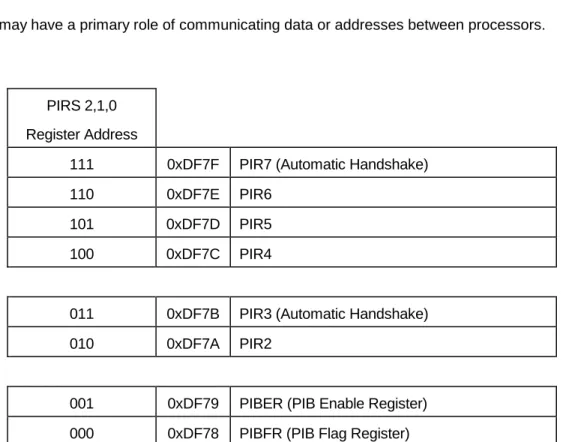
Register 3 may have a primary role of communicating commands or opcodes between processors. Register 7 may have a primary role of communicating data or addresses between processors.
PIRS 2,1,0 Register Address
111 0xDF7F PIR7 (Automatic Handshake) 110 0xDF7E PIR6
101 0xDF7D PIR5 100 0xDF7C PIR4
011 0xDF7B PIR3 (Automatic Handshake) 010 0xDF7A PIR2
001 0xDF79 PIBER (PIB Enable Register) 000 0xDF78 PIBFR (PIB Flag Register)
Figure 2.10-1 PIB Registers
Address = Base + 2-7 PIR2-7: Parallel Interface Registers 2-7 Reset Value = xx 7:0-> PIRx7 PIRx6 PIRx5 PIRx4 PIRx3 PIRx2 PIRx1 PIRx0
Bit Name Access Description
7 - 0 PIRx[7-0] R/W R = Read by Processor and Host W = Write by Processor and Host
2.10.1 PIB Enable Register (PIBER) Description
Notes:
*1 Read only from Host or Processor
*2 Read only from Processor, Read or Write from Host *3 Read only from Host, Read or Write from Processor
*4 Read only from Host or Processor, will always read back a zero.
Address = 0xDF79 PIBER: PIB Interrupt Enable Register Reset Value = 0x00 7:0-> PIBER7 PIBER6 PIBER5 PIBER4 PIBER3 PIBER2 PIBER1 PIBER0
Bit Name Access Description
7 PIBER7 R/W 1 = Enable Automatic Handshake Input Data in PIR7 Interrupt *3
0 = Disable *3
6 PIBER6 R/W 1 = Enable Automatic Handshake Output Data in PIR7 Interrupt *2
0 = Disable *2
5 PIBER5 R/W 1 = Enable Manual Handshake from Host *3
0 = Disable *3
4 PIBER4 R/W 1 = Enable Manual Handshake from Processor *2
0 = Disable *2
3 PIBER3 R/W 1 = Enable Automatic Handshake Input Data in PIR3 Interrupt *3
0 = Disable *3
2 PIBER2 R/W 1 = Enable Automatic Handshake Output Data in PIR3 Interrupt *2
0 = Disable *2
1 PIBER1 R/W 1 = Enable RDB and WRB *3
0 = Disable *3
0 PIBER0 R/W 1 = Enable PIB *3
www
.WDC65xx.
com34
2.10.2 PIB Flag Register (PIBFR) Description
Notes:
*1 Read only from Host or Processor
*2 Read only from Processor, Read or Write from Host *3 Read only from Host, Read or Write from Processor
*4 Read only from Host or Processor, will always read back a zero.
Address = 0xDF78 PIBFR: Timer Interrupt Flag Register Reset Value = 0x00 7:0-> PIBFR7 PIBFR6 PIBFR5 PIBFR4 PIBFR3 PIBFR2 PIBFR1 PIBFR0
Bit Name Access Description
7 PIBFR7 R/W 1 = Host Write to PIR7 and Interrupt Processor *1
0 = Cleared by Processor Read of PIR7 *1
6 PIBFR6 R/W 1 = Processor Write to PIR7 and Interrupt Host *1
0 = Cleared by Host Read of PIR7 *1
5 PIBFR5 R/W 1 = Write "1" from Host and Interrupt Processor *2
0 = Write "0" from Host *2
4 PIBFR4 R/W 1 = Write "1" from Processor and Interrupt Host *3
0 = Write "0" from Processor *3
3 PIBFR3 R/W 1 = Host Write to PIR3 and Interrupt Processor *1
0 = Processor Read of PIR3 *1
2 PIBFR2 R/W 1 = Processor Write to PIR3 and Interrupt Host *1
0 = Host Read of PIR3 *1
1 PIBFR1 R/W 1 = Enable RDB and WRB *4
0 = Disable *4
0 PIBFR0 R/W 1 = Enable P4B *4
2.11
Twin Tone GeneratorsEach Tone Generator (TGx), as shown in figure 1-13 is comprised of a 16 bit timer and a 16 step divider circuit that selects the proper Digital to Analog (DA) output level. The enable bits for the tone generators are located in bits 1 and 2 of the BCR register.
DA Level n = E COS ( x (2n+1) /16) 0 < n < 7 N = value loaded into timer latches
Register Value N = (FCLK / (16 x F)) - 1 F=desired frequency
FCLK = FCLK input clock
Figure 2.11-1 Tone Generator Block Diagram
www
.WDC65xx.
com36
Oscillator FCLK = 3.579545 MHz Oscillator FCLK = 4.000000 MHz Standard Frequency (Hz) Register Value Actual Frequency (Hz) Register Value Actual Frequency (Hz) Hexa- decimal Decimal Hexa- decimal Decimal DTMF Row 697 770 852 941 0140 0122 0106 00ED 320 290 262 237 697 769 851 940 0166 0144 0124 0109 358 324 292 265 696 769 853 940 DTMF Column 1209 1336 1477 1633 00B8 00A6 0096 0088 184 166 150 136 1209 1340 1482 1633 00CE 00BA 00AB 0098 206 186 168 152 1208 1337 1479 1634 Subscriber Tones 350 440 480 620 027E 01FB 01D1 0168 638 507 465 360 350 440 480 620 02C9 0237 0208 0192 713 567 520 402 350 440 480 620 US 110, 300 Baud Modem 1070 1270 2025 2225 00D0 00AF 006D 0064 208 175 109 100 1070 1271 2034 2215 00E9 00C4 007A 006F 233 196 122 111 1068 1269 2033 2232 European 110, 300 Baud Modem 980 1180 1650 1850 00E3 00BD 0087 0078 227 189 135 120 981 1177 1645 1849 00FE 00D3 0097 0086 254 211 151 134 980 1179 1645 1832 Teletext 390 450 1300 2100 023D 01F0 00AB 006A 573 496 171 106 390 450 1301 2091 0280 022B 00BF 0076 640 555 191 118 390 450 1302 2101 US 1200 Baud Modem 390 450 1200 2200 023D 01F0 00B9 0065 573 496 185 101 390 450 1203 2193 0280 022B 00CF 0071 640 555 207 113 390 450 1202 21932.12
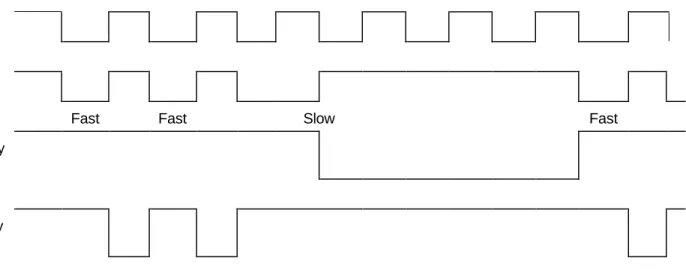
System Speed Control Register (SSCR)The System Speed Control Register (SSCR) provides a slowing of the memory clock rate for slower memory. When slower memories are addressed, the PHI2 clock rate is slowed by extending the PHI2 low and high times.
2.12.1 System Speed Control Register (SSCR)
Address = 0xDF41 SSCR: System Speed Control Register Reset Value = 0x00 7:0-> SSCR7 SSCR6 SSCR5 SSCR4 SSCR3 SSCR2 SSCR1 SSCR0
Bit Name Access Description
7 SSCR7 R/W 1 = CS7 Speed Select = Fast (FCLK)
0 = CS7 Speed Select = Slow (FCLK/4)
6 SSCR6 R/W 1 = CS6 Speed Select = Fast (FCLK)
0 = CS6 Speed Select = Slow (FCLK/4)
5 SSCR5 R/W 1 = CS5 Speed Select = Fast (FCLK)
0 = CS5 Speed Select = Slow (FCLK/4)
4 SSCR4 R/W 1 = CS4 Speed Select = Fast (FCLK)
0 = CS4 Speed Select = Slow (FCLK/4)
3 SSCR3 R/W 1 = System (CS0B-CS7B) Speed Select = Fast (FCLK)
0 = System (CS0B-CS7B) Speed Select = Slow (FCLK/4)
2 SSCR2 R/W 1 = External RAM 0x0000-01FF
0 = Internal RAM 0x0000-01FF
1 SSCR1 R/W 1 = PHI2 clock source is FCLK/4 or FCLK
0 = PHI2 clock source is CLK
0 SSCR0 R/W 1 = Start FCLK
www
.WDC65xx.
com38
FCLKPHI2
Fast Fast Slow Fast
Slow Memory Select
Fast Memory Select
3 Pin and Pin Function Description for 84 Pin PLCC
www
.WDC65xx.
com40
Figure 2-2b 84 Lead Chip Carrier Pinout
Note: This PLCC package is only available in limited quantities. Use QFP100 package for new designs.
PLCC 84 Pin
QFP 100 Pin
Name Control Bit Signal with
Control Bit=0
Signal with Control Bit=1
1 15 VSS --- VSS VSS
2 16 P56 EIER0 P56 PE56
PID6 PIBER0 PID6
3 17 P57 EIER1 P57 NE57
PID7 PIBER0 PID7
4 18 P60 ACSR05 P60 RXD0
TIN TCR1 TIN
PE60 EIER02 P60 PE60
5 19 P61 ACSR00 P61 TXD0 TOUT TCR0 TOUT 6 20 P62 ACSR15 P62 RXD1 PWM TCR2+TCR3 PWM 7 21 P63 ACSR10 P63 TXD1 TOUT 8 22 P64 ACSR25 P64 RXD2
NE64 EIER4 P64 NE64
9 23 P65 ACSR20 P65 TXD2
10 24 P66 ACSR35 P66 RXD3
NE66 EIER5 P66 NE66
11 25 P67 ACSR30 P67 TXD3
12 26 RESB --- RESB RESB
13 31 WEB --- WEB WEB
14 32 RUN BCR3 RUN RUN
15 33 FCLKOB --- FCLKOB FCLKOB
16 34 FCLK --- FCLK FCLK
17 35 BE --- BE BE
18 36 CLK --- CLK CLK
19 37 CLKOB --- CLKOB CLKOB
20 38 PHI2 --- PHI2 PHI2
www
.WDC65xx.
com42
24 42 A0 BCR0 P00 A0 25 43 A1 BCR0 P01 A1 26 44 A2 BCR0 P02 A2 27 27 45 A3 BCRO PO3 A3 28 46 A4 BCR0 P04 A4 29 47 A5 BCR0 P05 A5 30 48 A6 BCR0 P06 A6 31 49 A7 BCR0 P07 A7 32 50 A8 BCR0 P10 A8 33 55 A9 BCR0 P11 A9 34 56 A10 BCR0 P12 A10 35 57 A11 BCR0 P13 A11 36 58 A12 BCR0 P14 A12 37 59 A13 BCR0 P15 A13 38 60 A14 BCR0 P16 A14 39 61 A15 BCR0 P17 A15 40 62 A16 BCR0 P30 A16 41 63 A17 BCR0 P31 A17 42 64 A18 BCR0 P32 A18 43 65 VSS --- VSS VSS 44 66 VDD --- VDD VDD 45 67 A19 BCR0 P33 A19 46 68 A20 BCR0 P34 A20 47 69 A21 BCR0 P35 A21 48 70 A22 BCR0 P36 A22 49 71 A23 BCR0 P37 A23 50 72 P70 PCS70 P70 CS0B 51 73 P71 PCS71 P71 CS1B 52 74 P72 PCS72 P72 CS2B 53 75 P73 PCS73 P73 CS3B 54 80 P74 PCS74 P74 CS4B 55 81 P75 PCS75 P75 CS5B 56 82 P76 PCS76 P76 CS6B 57 83 P77 PCS77 P77 CS7B58 5858 84 D0 BCR0 P20 D0 59 85 D1 BCR0 P21 D1 60 86 D2 BCR0 P22 D2 61 87 D3 BCR0 P23 D3 62 88 D4 BCR0 P24 D4 63 89 VDD --- VDD VDD 64 64 90 VSS --- VSS VSS 65 91 D5 BCR0 P25 D5 66 92 D6 BCR0 P26 D6 67 93 D7 BCR0 P27 D7 68 94 TG0 TCR31 --- TG0 69 95 TG1 TCR33 --- TG1 70 96 P40 BCR5· BCR6 P40 NMIB ABORTB BCR5· BCR6B ABORTB 71 97 P41 EIER3 P41 IRQB 72 98 P42 PIBER0 P42 PIIB
73 99 P43 PIBER0· PIBER1B P43 PIWEB
PIWRB PIBER0· PIBER1 PIWRB
74 100 P44 PIBER0 · PIBER1B P44 PICSB
PIRDB PIBER0· PIBER1 PIRDB
75 5 P45 PIBER0 P45 PIRS0 76 6 P46 PIBER0 P46 PIRS1 77 7 P47 PIBER0 P47 PIRS2 78 8 P50 PIBER0 P50 PID0 79 9 P51 PIBER0 P51 PID1 80 10 P52 PIBER0 P52 PID2 81 11 P53 PIBER0 P53 PID3 82 12 P54 PIBER0 P54 PID4 83 13 P55 PIBER0 P55 PID5 84 14 VDD --- VDD VDD
www
.WDC65xx.
com44
3.1
Write Enable (active low) (WEB)The WEB signal is high when the microprocessor is reading data from external memory or I/O and high when it is reading or writing to internal memory or I/O. When WEB is low the microprocessor is writing to external memory or external I/O. The WEB signal is bi-directional; when BE is low this is an input for DMA operations to on-chip RAM or I/O. When BE is high the internal microprocessor controls WEB.
3.2
RUN and SYNC outputs with WAI and STP defined (RUN)The RUN function of the RUN output is pulled low as the result of a WAI or STP instruction. RUN is used to signal an external oscillator to start PHI2. The processor is stopped when RUN is low.
When BCR3=1 (emulation mode), the SYNC function (SYNC=1 indicates an opcode fetch) is multiplexed on RUN during PHI2 low time and RUN is multiplexed during PHI2 high time. When BCR3=0 (normal operating mode), the RUN function is output during the entire clock cycle. An ICE system can demultiplex RUN to provide full emulation capability for the RUN function.
The BE input has no effect on RUN.
When RUN goes low the PHI2 signal may be stopped when high or low; however, it is recommended PHI2 stop in the high state. When RUN goes high due to an enabled interrupt or reset, the internal PHI2 clock is requested to start. The clock control function is referred to as the RUN function of RUN.
The WAI instruction pulls RUN low during PHI2 high time. RUN stays low until an enabled interrupt is requested or until RESB goes from low to high, starting the microprocessor.
The STP instruction pulls RUN low during PHI2 high time and stops the internal PHI2 clock. RUN remains low and the clock remains stopped until RESB goes from low to high.
FCLK can be started or stopped by writing to System Speed Control Register (SSCR) bit 0. When SSCR0=0 (reset forces SSCR0=0), FCLK is stopped. When SSCR0=1, FCLK is started. When starting FCLK oscillator, the system software should wait (100 milliseconds or an appropriate amount of time) for the oscillator to be stable before using FCLK.
3.3
Phase 2 Clock Output (PHI2)PHI2 output is the main system clock used by the microprocessor for instruction timing, general on-chip memory, and I/O timing. The PHI2 clock source is either CLK or FCLK depending on the value of System Speed Control Register bit 1 (SSCR1). When SSCR1=0, then CLK is the PHI2 clock source. When SSCR1=1, then FCLK is the PHI2 clock source.
3.4
Clock Inputs (CLKOB, FCLKOB Outputs) (CLK. FCLK)CLK and FCLK inputs are used by the timers, for PHI2 system clock generation, counting events or implementing Real Time clock type functions. CLK should always be equal to or less than one-fourth the FCLK clock rate when FCLK is running (see the timer description for more information). CLKOB, FCLKOB outputs are the inverted CLK and FCLK inputs that are used for oscillator circuits that employ crystals or a resistor-capacitor time base.
3.5
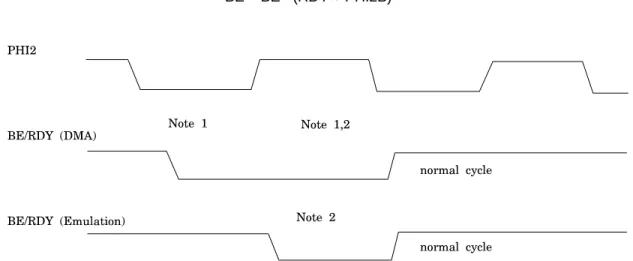
Bus Enable and RDY Input (BE)BE controls the address bus, data bus and WEB signals. When RESB goes high signaling in the power-up condition, the processor starts; and if BE was low when RESB went from low to high then the Bus Control Register (BCR) bits 0, 3, and 7 (BCR0, BCR3, and BCR7) are set to 1 (emulation mode). See Figure 1-1. After RESB goes high BE controls the direction of the address bus (A0-A7, A8-A15, A16-A23), data bus (D0-D7) and WEB.
When BE goes low during PHI2 low time, the address bus and WEB are inputs, providing for DMA (direct memory and I/O access) for emulation purposes. Data from D0-D7 is written to any register addressed by A0-A15 when WEB is low. Data is read from D0-D7 when WEB is high. The W65C816S is stopped when BE is low, during PHI2 high time.
When BE is high, the A0-A15, D0-D7 and WEB are controlled by the on-chip microprocessor.
When BE is pulled low during PHI2 high time, BE does not affect the direction of the address, data BUS and WEB signals. When BE is pulled low in PHI2 high time, the W65C816S is stopped so that the processor may be single stepped in emulation.
Figure 3.5-1 BE Timing Relative to PHI2
BE = BE· (RDY + PHI2B)
Notes:
1) Address and WEB are inputs with data bus input except when reading on-chip I/O registers or memory. Use this mode for DMA.
2) W65C816S stopped with RDY function of BE pin. When BCR3=1, the W65C816S read or write of internal I/O register or memory is output on the external data bus so that the internal data bus may be traced in emulation.
www
.WDC65xx.
com46
3.6
Reset Input/Output (active low) (RESB)When RESB is low for 2 or more processor PHI2 cycles all activity on the chip stops and the chip goes into the static low power state.
After a Reset, all I/O pins become inputs. Because of NOR gates on the inputs, RESB disables all input buffers. The inputs will not float due to the bus holding devices while RESB is low. Inputs that are unaffected by RESB are BE and WEB.
When RESB goes from low to high, RUN goes high, the Bus Control Register is initialized to $89 if BE is low or to $00 if BE is high. The MPU then begins the power-up reset interrupt sequence in which the program counter is loaded with the reset vector that points to the first instruction to be executed. (See WDC's W65C816S microprocessor data sheet for more information and instruction timing.)
The reset sequence takes 9 cycles to complete before loading the first instruction opcode.
RESB is a bidirectional pin which is pulled low internally for "restarting" due to a "monitor time out", Timer M times out causing a system Reset. (See section 1.5, The Timers for more information.)
3.7
Positive Power Supply (VDD)VDD is the positive power supply and has a range of 2.8V to 5.5V for use in a wide range of applications.
3.8
Internal Logic Ground (VSS)VSS is the system logic ground. All voltages are referenced to this supply pin.
3.9
I/O Port Pins (Pxx)All ports, except Port 7, which is an output Port, are bi directional I/O ports. Each of these bi-directional Ports has a port data register (PDx) and port data direction register (PDDx). A zero ("0") in PDDxx defines the associated I/O pin as an input with the output transistors in the "off" high impedance state. A one ("1") in PDDxx defines the I/O pin as an output. A read of PDx always "reads" the pin. After reset, all Port pins become input pins with both the data and data direction registers reset to 0.
Port 7 has a Chip Select register (PCS) that is used to enable Chip Selects (CSxB). A "1" in bit x of PCSx enables Chip Select CSx- to be output over P7x while a "0" in PCSx specifies the value in the output data register is to be output on P7x. Port 7 data register is set to all "1's" after Reset, and PCS is cleared to all "0's" after Reset.
3.10
Address Bus (Axx)Ports 0, 1, and 3 are also the address bus A0-A23 when configured by the Bus Control Register (BCR). When BCR0 and BCR7 are set to "1" and BCR3=0 (normal operating mode) for external memory addressing, Axx are all "1's" when addressing on-chip memory. When BCR3=1 (emulation mode), the address bus is always active so that an emulator can trace internal read and write operations.
3.11
Data Bus (Dx)Port 2 is the data bus D0-D7 when configured by the Bus Control Register (BCR). (See section 1.4 for BCR mode selection.) When BCR0 and BCR7 are set to a "1" and BCR3=0 (normal operating mode) for external memory addressing, Dx are all "1's" when addressing on-chip memory. When BCR3=1 (emulation mode), the data bus is always active so that an emulator can trace internal read and write operations. During external memory cycles the data bus is in the Hi-Z state during PHI2 low time.
3.12
Positive Edge Interrupt inputs (PExx)Port pin P56, P60 and P62 have Positive Edge sensitive interrupt inputs (PE56,PE60,PWM) multiplexed with the I/O. The associated bit is set (by an internal one-shot circuit) in the Interrupt Flag Register (IFRx) on a positive transition from "0" to "1". The transition from "1" to "0" has no effect on the IFR. When the associated Interrupt Enable Register bit (IERx) is set to a "1", the MPU will be interrupted provided the interrupt flag bit in the MPU status register P (I flag) is cleared to a "0". When the I flag is "1", interrupts are disabled.
3.13
Negative Edge Interrupt inputs (NExx)Port pin P57, P62, P64 and P66 have Negative Edge sensitive interrupt inputs (NE57, PWM, NE64, NE66) multiplexed with the I/O. The associated bit is set (by an internal one-shot circuit) in the Interrupt Flag Register (IFRx) on a negative transition from "1" to "0". The transition from "0" to "1" has no effect on the IFR. When the associated Interrupt Enable Register bit (IERx) is set to a "1", the MPU will be interrupted provided the interrupt flag bit in the MPU status register P (I flag) is cleared to a "0". When the I flag is a "1", interrupts are disabled.
3.14
Chip Select outputs (active low) (CSxB)The CSxB Chip Select outputs are enabled (individually) as outputs on Port 7 with the PCS register. Each of the eight chip selects is dedicated to one block of external memory defined by the programmable chip select registers; the mapping of each chip select to external addresses is given in Table 1-5, System Memory Map.
3.15
Level Sensitive Interrupt Request input (IRQB)The I/O function of port pin P41 is multiplexed with IRQB Level Sensitive Interrupt input. When IRQB is held low the Edge Interrupt Flag Register Bit 7 (EIFR7) is set to a "1". When the Edge Interrupt Enable Register bit 7 (EIER7) is set to a "1" the MPU will be interrupted provided the I flag of the MPU is cleared to a "0" allowing interrupts. Unlike the edge interrupts, which do not hold the interrupt bit set, an interrupt will be generated as long as IRQB is low.
3.16
Non-Maskable Edge and ABORT Interrupt Input (NMIB/ABORTB)The I/O Function of port pin P40 is multiplexed with both the NMIB edge triggered interrupt and the ABORT interrupt. When BCR6=1, the NMIB interrupt is enabled; the MPU will be interrupted on all negative edges of NMIB. Because the I flag cannot prevent NMIB from interrupting, NMIB is thought of as Non-Maskable. When BCR5=1, the ABORT interrupt is enabled. Should both BCR5 and BCR6 be set to "1", both NMIB and ABORT are enabled (normally, this is not desirable).
www
.WDC65xx.
com48
3.17
Asynchronous Receiver Inputs/Transmitter Outputs (RXDx, TXDx)The W65C265S has four full duplex Universal Asynchronous Receivers and Transmitters (UARTx) that may be enabled by the Asynchronous Control and Status Registers (ACSRs). When a Receiver is enabled by ACSRx0=1 then port pin P60, P62, P64 or P66 becomes the Asynchronous Receiver Input (RXDx). When a Transmitter is enabled by ACSRx4=1, then port pin P61, P63, P65 or P67 becomes the Asynchronous Transmitter Output (TXDx).
3.18
Timer 4 Input and Output (TIN, TOUT)Timer 4 is controlled by TCRx and TERx. When the UART is not in use, Timer 4 can be used for counting input negative pulses on TIN. Timer 4 can also be used to put out a square wave or rectangular wave form on TOUT. When counting negative pulses on TIN the TIN frequency should always be less than one-half the frequency of PHI2. TOUT changes state on every time-out of Timer 4; therefore, varying waveform and frequency depends on the timer latch values and may be modified under software control. TIN is multiplexed on P60 and TOUT is multiplexed on P61.
2.19
Bus Available/Disable Output Data (BA)The BA output indicates the microprocessor is using the internal data and address buses when BA is high. The microprocessor is using the external bus when BA is low, then an external device can use the bus without slowing down processing. BE must be used to gain access to the WEB and address bus. When DODB is low (during PHI2 high) then the microprocessor is writing data to the external data bus. The other devices using the bus should disable their outputs. This signal could be thought of as a valid memory
address negative edge for sampling the address bus on the negative edge. When BCR3=1(emulation mode) the DODB function is multiplexed on BA during PHI2 high time and BA is multiplexed during PHI2 low time. When BCR3=0 (normal mode) the BA is output during PHI2 low time and a 1 level is output during PHI2 high time.
3.20
Tone Generator Outputs (TGx)The Twin Tone Generator outputs (TGx) are synthesized 16 step cosine waveform outputs as described in Section 2.21 Twin Tone Generators.
3.21
Parallel Interface Bus (PIB)The Parallel Interface Bus (PIB) pins are used to communicate between processors in a "star" network configuration or as a co-processor on a "host" processor bus such as an IBM PC or compatible or an Apple II or Mac II personal computer. This PIB may also be used as part of the file server system for large memory systems.
The Parallel Interface Write Enable (PIWEB) input pin is used with the Parallel Interface Chip Select (low active)/Parallel Interface Chip Select (high active) (PICSB/PICS) signal to transfer data to and from the Parallel Interface Register selected by the Parallel Interface Register select (PIRSx) input pins. When PIWEB and PICSB are configured by the Parallel Interface Bus Enable Register bit 1 (PIBER1=0), then the PIB interface is compatible with WDC microprocessor WE- logical operation with the chip select PICSB input. The use of PIWEB and PICS are configured by PIBER1=1.
The PIB interrupt output to the "host" is generated on the Parallel Interface Interrupt (PII) pin. The "host" interrupt is suggested to be received on the IRQ level interrupt input pin of the "host" processor.