Doctoral Dissertations Student Theses and Dissertations
Summer 2016
A control theoretic approach for security of cyber-physical
A control theoretic approach for security of cyber-physical
systems
systems
Haifeng Niu
Follow this and additional works at: https://scholarsmine.mst.edu/doctoral_dissertations
Part of the Electrical and Computer Engineering Commons
Department: Electrical and Computer Engineering Department: Electrical and Computer Engineering
Recommended Citation Recommended Citation
Niu, Haifeng, "A control theoretic approach for security of cyber-physical systems" (2016). Doctoral Dissertations. 2516.
https://scholarsmine.mst.edu/doctoral_dissertations/2516
This thesis is brought to you by Scholars' Mine, a service of the Missouri S&T Library and Learning Resources. This work is protected by U. S. Copyright Law. Unauthorized use including reproduction for redistribution requires the permission of the copyright holder. For more information, please contact [email protected].
A CONTROL THEORETIC APPROACH FOR SECURITY OF CYBER-PHYSICAL SYSTEMS
by
HAIFENG NIU
A DISSERTATION
Presented to the Faculty of the Graduate School of the
MISSOURI UNIVERSITY OF SCIENCE AND TECHNOLOGY
In Partial Fulfillment of the Requirements for the Degree
DOCTOR OF PHILOSOPHY in
ELECTRICAL ENGINEERING
2016
Approved by
Jagannathan Sarangapani, Advisor Wei Jiang
Sanjay Madria Sahra Sedigh Maciej Zawodniok
PUBLICATION DISSERTATION OPTION
This dissertation consists of the following five articles, formatted in the style used by the Missouri University of Science and Technology:
Paper I, Pages 12-62: H. Niu, E. Taqieddin, and S. Jagannathan, “EPC Gen2v2 RFID Standard Authentication and Ownership Management Protocol,” IEEE Transactions on Mobile Computing, vol. 15, no. 1, pp. 137-149, 2016.
Paper II, Pages 63-104: H. Niu and S. Jagannathan, “Optimal Defense and Control of Dynamic Systems Modeled as Cyber-physical Systems,” Journal of Defense Modeling and Simulation: Applications, Methodology, Technology, vol. 12, no. 4, pp. 423-438, 2015.
Paper III, Pages 105-156: H. Niu and S. Jagannathan, “Attack Detection and Accommodation for Networked Control Systems,” under review in IEEE Transactions on Control System Technology.
Paper IV, Pages 157-212: H. Niu and S. Jagannathan, “An Optimal Q-learning Approach for Attack Detection in Networked Control Systems,” to be submitted.
Paper V, Pages 213-254: H. Niu and S. Jagannathan, “Attack Detection and Approximation in Nonlinear Networked Control Systems using Neural Networks,” to be submitted.
ABSTRACT
In this dissertation, several novel defense methodologies for cyber-physical systems have been proposed. First, a special type of cyber-physical system, the RFID system, is considered for which a lightweight mutual authentication and ownership management protocol is proposed in order to protect the data confidentiality and integrity. Then considering the fact that the protection of the data confidentiality and integrity is insufficient to guarantee the security in cyber-physical systems, we turn to the development of a general framework for developing security schemes for cyber-physical systems wherein the cyber system states affect the physical system and vice versa. After that, we apply this general framework by selecting the traffic flow as the cyber system state and a novel attack detection scheme that is capable of capturing the abnormality in the traffic flow in those communication links due to a class of attacks has been proposed. On the other hand, an attack detection scheme that is capable of detecting both sensor and actuator attacks is proposed for the physical system in the presence of network induced delays and packet losses. Next, an attack detection scheme is proposed when the network parameters are unknown by using an optimal Q-learning approach. Finally, this attack detection and accommodation scheme has been further extended to the case where the network is modeled as a nonlinear system with unknown system dynamics.
ACKNOWLEDGMENTS
I would like to express sincere gratitude to my advisor, Professor Jagannathan Saragapani, for his close supervision, deep knowledge, patience, and general support over the last three years. I would also like to thank Dr. Maciej Zawodniok, Dr. Sahra Sedigh, Dr. Sanjay Madria, Dr. Wei Jiang, and Dr. Sriram Chellappan for serving on my doctoral committee. In particular, I would like to thank Dr. Al Salour from the Boeing Company for his support through IMS and research projects for the past four years. In addition, I would like to thank the National Science Foundation (NSF) and Intelligent System Center (ISC) for providing financial support through my Ph.D. study.
I am greatly thankful to my father, for his encouragement and also dedicate this dissertation to my beloved mother. I also would like to extend a special thanks to my girlfriend, the love of my life, Jia Cai, who has been helping and supporting me all the way along. I also express my sincere gratitude to rest of my family members back home in China for their understanding and love. I also thank all my friends here in the US and as well back home for their time and support.
Further, I would like to thank Dr. Hao Xu, who gave me many helpful discussions and suggestions concerning my work. I would like to thank my colleagues, Dr. Avimanyu Sahoo, Dr. Qiming Zhao, Lei Wang, Vignesh Narayanan, Krishnan Raghavan as well as many other friends at the Embedded Systems and Networking Laboratory, who made my Ph.D. life more fun and interesting.
Finally, I would like thank the staff of ECE department for their continuous assistance and also would like to thank the staff of Curtis Laws Wilson Library for providing me with the necessary literature.
TABLE OF CONTENTS
Page
PUBLICATION DISSERTATION OPTION ... iii
ABSTRACT ... iv
ACKNOWLEDGMENTS ... v
LIST OF FIGURES ... xii
LIST OF TABLES ... xvi
SECTION 1. INTRODUCTION ... 1
1.1. OVERVIEW ... 1
1.2. ORGANIZATION OF THE DISSERTATION... 7
1.3. CONTRIBUTIONS OF THE DISSERTATION ... 10
PAPER I. EPC GEN2V2 RFID STANDARD AUTHENTICATION AND OWNERSHIP MANAGEMENT PROTOCOL ... 12
1. INTRODUCTION ... 13
1.1. RELATED WORK ... 15
1.2. CONTRIBUTIONS ... 17
2. PROPOSED PROTOCOL ... 19
2.1. INITIALIZATION ... 20
2.2. PHASE I: MUTUAL AUTHENTICATION ... 21
2.3. PHASE II, CASE 1: DELEGATION ... 23
2.5. EXAMPLE OF AUTHENTICATION AND OWNERSHIP TRANSFER ... 27
3. SECURITY ANALYSIS ... 29
3.1. AUTHENTICATION ... 31
3.2. SECRECY... 37
4. COMPARISON WITH RELATED PROTOCOLS ... 38
5. HARDWARE IMPLEMENTATION AND EVALUATION ... 41
5.1. IMPLEMENTATION DETAILS ... 41
5.2. OT OPERATION TIME, WITH SUFFICIENT ENERGY ... 46
5.3. OT OPERATION TIME, WITH INSUFFICIENT ENERGY ... 47
5.4. OT OF MULTIPLE TAGS, WITH SUFFICIENT ENERGY ... 48
5.5. LOCATION PRIVACY... 50
5.6. READER IMPERSONATION ... 51
6. CONCLUSIONS AND FUTURE WORK... 54
7. REFERENCES ... 55
II. OPTIMAL DEFENSE AND CONTROL OF DYNAMIC SYSTEMS MODELED AS CYBER-PHYSICAL SYSTEMS ... 60
1. INTRODUCTION ... 61
2. PROPOSED REPRESENTATION FOR CYBER-PHYSICAL SYSTEMS ... 65
2.1. CYBER SYSTEM ... 65
2.2. PHYSICAL SYSTEM ... 69
3. OPTIMAL ATTACK/DEFENSE POLICY FOR CYBER SYSTEMS ... 72
4. OPTIMAL CONTROLLER DESIGN ... 78
5. AN ILLUSTRATIVE EXAMPLE ... 83
5.2. CYBER SYSTEM SETUP ... 85
5.3. SIMULATION RESULTS ... 88
5.3.1. Results of Deriving the Optimal Attack/Defense Policies. ... 89
5.3.2. Scenario I: Defender Chooses the Optimal Policy. ... 94
5.3.3. Scenario II: Defender Chooses a Random Policy. ... 95
6. CONCLUSIONS AND FUTURE WORK... 96
7. REFERENCES ... 97
III. FLOW-BASED ATTACK DETECTION AND ACCOMMODATION FOR NETWORKED CONTROL SYSTEMS... 100
1. INTRODUCTION ... 101
2. STOCHASTIC FLOW MODEL ... 106
3. FLOW OBSERVER AND CONTROLLER DESIGN ... 110
3.1. STABILITY IN THE HEALTHY CASE ... 111
3.2. CONTROLLER AND OBSERVER GAIN SELECTION ... 116
4. NETWORK ATTACK DETECTION ... 119
4.1. ADVERSARY MODEL ... 119
4.2. ATTACK DETECTION SCHEME ... 120
5. PHYSICAL SYSTEM CONTROLLER DESIGN... 124
6. SIMULATION AND HARDWARE IMPLEMENTATION RESULTS ... 132
6.1. NETWORK SIMULATION RESULTS ... 132
6.1.1. Scenario A1 (Normal Case). ... 133
6.1.2. Scenario A2~A4. ... 134
6.1.3. Scenario A5. ... 137
6.3. PHYSICAL SYSTEM ATTACK DETECTION... 141
6.4. HARDWARE IMPLEMENTATION ... 142
7. CONCLUSIONS AND FUTURE WORK... 145
8. REFERENCES ... 146
IV. AN OPTIMAL Q-LEARNING APPROACH FOR ATTACK DETECTION IN NETWORKED CONTROL SYSTEMS ... 149
1. INTRODUCTION ... 150
2. LINEAR FLOW MODEL WITH UNKNOWN DYNAMICS ... 155
3. FLOW OBSERVER AND CONTROLLER DESIGN ... 159
3.1. PARAMETER ESTIMATION ... 159
3.2. CONTROLLER DESIGN ... 162
4. NETWORK FLOW ATTACK DETECTION SCHEME ... 168
4.1. ADVERSARY MODEL ... 168
4.2. ATTACK DETECTION AND ESTIMATION SCHEME... 169
5. ATTACK DETECTION FOR THE PHYSICAL SYSTEM ... 176
5.1. PHYSICAL SYSTEM DYNAMICS ... 176
5.2. ATTACK DETECTION FOR THE PHYSICAL SYSTEM ... 185
6. SIMULATION AND HARDWARE IMPLEMENTATION RESULTS ... 189
6.1. NETWORK SIMULATION RESULTS ... 189
6.1.1. Scenario A1 (Normal Case). ... 189
6.1.2. Scenario A2 (Under Attack). ... 190
6.2. SIMULATION RESULTS FOR THE PHYSICAL SYSTEMS ... 192
6.2.1. Scenario B1 (Normal Case). ... 192
6.2.3. Scenario B3 (Physical System under Attack). ... 195
7. CONCLUSIONS AND FUTURE WORK... 197
8. REFERENCES ... 198
V. ATTACK DETECTION AND APPROXIMATION IN NONLINEAR NETWORKED CONTROL SYSTEMS USING NEURAL NETWORKS ... 201
1. INTRODUCTION ... 202
2. CONTROLLER AND OBSERVER DESIGN FOR THE NONLINEAR FLOW MODEL ... 206
2.1. NONLINEAR FLOW MODEL ... 206
2.2. CONTROLLER DESIGN ... 209
2.3. OBSERVER DESIGN ... 210
2.4. ATTACK DETECTION AND ESTIMATION ... 212
3. ATTACK DETECTION FOR PHYSICAL SYSTEMS ... 217
3.1. PHYSICAL SYSTEM DYNAMICS ... 217
3.2. STOCHASTIC ETC DESIGN ... 219
3.3. PHYSICAL ATTACK DETECTION ... 223
4. SIMULATION RESULTS ... 228
4.1. NETWORK SIMULATION ... 228
4.2. PHYSICAL SYSTEM ... 231
5. CONCLUSIONS AND FUTURE WORK... 236
6. REFERENCES ... 237
SECTION 2. CONCLUSIONS AND FUTURE WORK ... 240
2.2. FUTURE WORK ... 242 3. REFERENCES ... 244 VITA ... 247
LIST OF FIGURES
Page
Figure 1.1. Challenges in cyber-physical systems. ... 2
Figure 1.2. Requirements of defense methodologies for CPS. ... 3
Figure 1.3. Dissertation outline. ... 7
PAPER I Figure 2.1. Mutual authentication and keys update. ... 22
Figure 2.2. Ticket computation on an old owner and tag. ... 23
Figure 2.3. Ownership delegation. ... 24
Figure 2.4. Complete ownership transfer. ... 26
Figure 3.1. Strand space representation of the proposed protocol. ... 32
Figure 3.2. Illustration of Lemma 1 and 2. ... 34
Figure 5.1. Mutual authentication under EPC Gen2v2 standard. ... 42
Figure 5.2. Modified WISP: Class-1 Generation-2 UHF passive RFID tag platform. ... 45
Figure 5.3. Software structure of the evaluation platform. ... 45
Figure 5.4. Number of successful OT sessions per minute... 48
Figure 5.5. Number of successful OT sessions per minute for multiple tags. ... 49
Figure 5.6. Hamming weight of IDS values and average of Hamming distance... 51
Figure 5.7. Compromise time for 50 iterations of the brute force attack... 52
PAPER II Figure 2.1. Proposed representation of a cyber-physical system. ... 65
Figure 2.2. Inter-relationship between the cyber and the physical system. ... 70
Figure 3.2. Flowchart of the optimal policy for the defender/attacker. ... 77
Figure 5.1. Illustration of a yaw rotation. ... 84
Figure 5.2. Diagram of the UAV with remote controller. ... 84
Figure 5.3. Models of delay/packet loss rate under (a) smurf attack, no defense; (b) slow read attack, no defense; (c) smurf attack with the corresponding defense; (d) slow read attack with the corresponding defense. ... 86
Figure 5.4. Q-values in region for (a) the attacker; (b) the defender. ... 89
Figure 5.5. Evolution of the states (a) delay; (b) packet loss rate. ... 91
Figure 5.6. Evolution of the output. ... 92
Figure 5.7. Evolution of average payoff. ... 92
Figure 5.8. Evolution of the output. ... 93
Figure 5.9. Regulation errors in Case I where the cyber defense is optimal. ... 94
Figure 5.10. Delay in Case II where the cyber defense is randomly selected. ... 95
Figure 5.11. System becomes unstable in Case II. ... 95
PAPER III Figure 2.1. Diagram of a typical NCS. ... 106
Figure 2.2. Illustration of the delayed measurement... 109
Figure 4.1. Jamming attack. ... 121
Figure 4.2. Black hole attack. ... 121
Figure 4.3. Minimum rate DoS streams attack. ... 121
Figure 5.1. Illustration of transitions of the networks and physical states. ... 125
Figure 6.1. Actual flow. ... 133
Figure 6.2. Estimation error. ... 133
Figure 6.4. Output rate. ... 134
Figure 6.5. Injected flow by the jamming attack with estimation. ... 135
Figure 6.6. Estimation error in Scenario A2. ... 135
Figure 6.7. Dropped flow by the black hole attacker. ... 136
Figure 6.8. Estimation error in Scenario A3. ... 136
Figure 6.9. Injected flow by the Minimum rate DoS attacker. ... 137
Figure 6.10. Estimation error in Scenario A4. ... 137
Figure 6.11. Injected and dropped flow in Scenario. ... 138
Figure 6.12. Estimation error in Scenario A5. ... 138
Figure 6.13. Simulation results for the attack detection on the physical system. ... 140
Figure 6.14. Detection of attacks on the physical systems. ... 142
Figure 6.15. Diagram of the hardware implementation. ... 143
Figure 6.16. Estimation error for (a) the normal scenario; (b) the jamming attack scenario; (c) the blackhole attack scenario. ... 144
PAPER IV Figure 2.1. Diagram of a typical NCS. ... 155
Figure 4.1. Jamming attack. ... 170
Figure 4.2. Black hole attack. ... 170
Figure 4.3. Minimum rate DoS streams attack. ... 170
Figure 6.1. QFE error converges in the absence of attacks. ... 190
Figure 6.2. Actual and desired number of packets in the bottleneck node. ... 190
Figure 6.3. Injected flow by the jamming attack with estimation. ... 191
Figure 6.4. Estimation error exceeds the threshold in Scenario A2. ... 191
Figure 6.6. Convergence of system states in Scenario B1. ... 193
Figure 6.7. Estimation error comparison between the time-driven Q-learning and the hybrid event-trigger learning algorithm. ... 193
Figure 6.8. Delay and packet loss in Scenario B2. ... 194
Figure 6.9. System becomes unstable in Scenario B2. ... 194
Figure 6.10. Attack on the physical system in Scenario B3. ... 195
Figure 6.11. Actuator attack detection for the physical system. ... 195
Figure 6.12. Actuator attack detection for the physical system. ... 196
PAPER V Figure 2.1. Diagram of a typical NCS. ... 207
Figure 3.1. Structure of MBETC with attacks on the controller and sensor. ... 218
Figure 4.1. Actual and desired number of packets in the bottleneck node. ... 229
Figure 4.2. Parameter error for the number of packets before the attack is launched. ... 229
Figure 4.3. The estimation error and the attacker injected packets, when the observer given in Theorem 2 is applied. ... 230
Figure 4.4. Estimated and actual number of packets injected by the attacker. ... 231
Figure 4.5. The convergence of the states when the network is healthy. ... 232
Figure 4.6. The evolution of trigger threshold and state estimation error. ... 233
Figure 4.7. Number of dropped packets with and without ETC. ... 233
Figure 4.8. The system states when overall delay exceeds the threshold. ... 234
Figure 4.9. Attack detection results for the physical system. ... 235
LIST OF TABLES
Page PAPER I
Table 4.1. Comparison with previous related work. ... 40
Table 5.1. Authenticate command. ... 43
Table 5.2. “Message” field in “authenticate” command. ... 43
Table 5.3. Response message of the “authenticate” command. ... 43
Table 5.4. Measured time and instruction cycles. ... 46
PAPER II Table 5.1. Summary of system information used in the illustrative example... 87
Table 5.2. Numerical values used in the simulation. ... 88
Table 5.3. Percentages for each action in the region. ... 90
SECTION
1. INTRODUCTION 1.1.OVERVIEW
In the past a few decades, technology, science, and engineering has significantly redefined the physical world. For example, with the new communication system such as the internet and wireless networking, we are able to interact with objects and people from almost anywhere on earth. The state-of-the-art transportation system allows us to travel to the destination within unimaginably short time. Most recently, a new class of system, named as cyber-physical system (CPS), has shown great potential of further rendering us capabilities to experience the physical world in a more secure, economical and comfortable fashion.
The CPSs are engineered systems that are constructed as networked interactions of physical and computational cyber components [1]. Applications of CPS are found in areas as diverse as automobiles, air transportation, civil infrastructure, power grid, embedded medical devices, and consumer appliances. A CPS is a highly collaborative computer system because the embedded devices monitor and control the physical processes through a networked feedback loop. A major difference between a CPS and a regular control system is the employment of communications, which adds re-configurability and scalability as well as complexity and potential insecurity. Moreover, CPS has significantly more intelligence in sensors and actuators as well as substantially stricter performance constraints [2].
Since a CPS is highly complex, spanning multiple scientific and technological domains, they thus pose several fundamental challenges, which have been summarized in [3] and presented in Figure 1.1. Six major challenges in CPS have been considered: dependability, sustainability, reliability, predictability, interoperability, and security. To be specific, dependability refers to the property of a system to perform without significant degradation in its performance whereas sustainability means the ability of renewing the system’s resources and using them efficiently. Reliability refers to the degree of correctness
which a system provides to perform its function while predictability refers to the degree of foreseeing of a system’s behavior. On the other hand, interoperability refers to the ability
of the systems to work together, exchange information and use this information to provide specified services. Finally, security in CPS, which is the main scope of this dissertation, refers to the property of a system to control access to the system resources and protect sensitive information from unauthorized disclosures.
Predictability CPS Challenges Reliability Sustainability Dependability Security Interoperability
Attributes Reasons of relation Composability
Scalability Heterogeneity
Incorporating operating components Scaling in size and throughput Combining different components
Attributes Reasons of relation Integrity
Confidentiality Availability
Correct and trusted info Secret info, privacy Denial of Service issue
Attributes Reasons of relation Reliability
Maintainability Safety
Functioning correctly Operating as before Not causing harm
Attributes Reasons of relation Accuracy
Compositonality
Quantitative outcome Behavior inference
Attributes Reasons of relation Robustness
Predictability Maintainability
Stableness Guaranteed behavior Able to keep operating
Attributes Reasons of relation Adaptability
Reconfigurability Efficiency
Evolving circumstances Self-healing Well use of resources
The concern of security in CPS stems from the presence of a hierarchy of communication networks that collects information for sensing, exploring, processing and aggregating [4]. On one hand, those communication networks are often distributed over wide geographic area and thus exposed to a variety of adversaries. On the other hand, many components in CPS such as RFID sensors are low-cost embedded devices. As a result, the resources including the power budget, computational and transmission abilities are quite limited.
Therefore, the defense methodology for CPS is critical and necessary. As shown in Figure 1.2, in order to guarantee the security of CPS, the defense system is required to possess the following three capabilities: protection of information security, detection of cyber states abnormalities, and detection of physical states abnormalities.
C1 C2 CN
P1 P2 PN
Cyber World
Physical World
Detection of cyber states abnormalities
-- Methodology: explore the behavior of attackers formulate cyber changes under attacks present defense strategies -- Tools: Markov decision process & game-theoretic approach
Detection of physical states abnormalities
-- Methodology: characterizing dynamics of the physical system under attacks apply classic control theory to bring states back to normal -- Tools: state-space analysis & observer-based attack detection
Protection of information security
-- Methodology: protect data confidentiality and integrity -- Tools: encryption & authorization algorithms
The first requirement of the defense methodology is the ability to protect data confidentiality and integrity in the communication networks. The majority of the efforts are devoted to the development of light-weight encryption and authorization algorithms, which has been summarized in [5][6]. In particular, although RFID systems has been widely used in CPS due to their low cost and battery-free feature, the concern of disclosing the data and location privacy has not been completely addressed. The main challenge is that the computation capability of the RFID tags is too limited to implement complicated encryption algorithms and communication protocols. Due to the shared nature of wireless channels between the RFID tags and readers, various attacks can be launched by unauthorized users to either collect information about the tagged items or create a disruption of the system operation. Therefore, it is necessary for the readers and tags to authenticate each other before any data exchange. A comprehensive survey that examines several aspects related to RFID security has been presented in [7].
It is important to note that unlike the traditional information technology systems, the protection of data confidentiality and integrity alone is far from enough for CPS because certain attacks, especially those targeting at the availability of data, do not require knowledge of the cryptographic mechanisms. For example, the wormhole attacker attracts data traffic by establishing a link between two geographically distant regions of the network and then delays or drops the attracted data [8]. The jamming attacks over wireless networks may severely degrade the performance in terms of message delay and data throughput by broadcasting radio interferences [9]. The replay attacker maliciously repeats the messages delivered from the operator to the actuator and causes communication unreliability, which has been successfully used by the virus attack of Stuxnet [10][11]. This
explains the necessity for the defense methodology to meet the second requirement introduced in Figure 1.2.
The second requirement of the defense methodology is the ability to detect the cyber state abnormalities. In order to meet this, the defender needs to explore the behavior of the attackers, formulate the cyber changes under attacks, and present an appropriate strategy to bring the cyber system back to normal. For instance, the effort in [12] introduces the DoS flooding attacks by a continuous-time Markov chain and utilizes the state space method to compute security measures accurately. Different from [12], the authors in [13] study the cyber defense by modeling the actions of the attacker and the defender as a stochastic zero-sum game. In [14], the measure of vulnerabilities in cyber-physical systems with application to power systems is defined and a security framework including anomaly detection and mitigation strategies is provided. The authors in [15] evaluate the cyber security by computing the expected probabilities of the attacker and using the probabilities to build a transition model through game-theoretic approach. In [15], the cyber vulnerability is evaluated dynamically by using hidden Markov model and by providing a mechanism for handling sensor data with different trustworthiness.
In particular, selecting the network traffic flow as the cyber states provides a feasible to way to deal with the previously mentioned cyber-attacks [8-11] since it is observed that these attacks tend to deviate the amount of traffic flow from the normal value. Flow control has been studied in the literature [16-18]. For example, the authors in [16] model the high-speed network as fluid-flow queues with a fixed propagation delay for each channel. In [17], a receiver-based flow control scheme is proposed that achieves the given optimal utility. The authors in [18] propose a new utility max-min flow control framework
using classic sliding mode control. However, to the best of our knowledge, minimal effort has been spent on studying the flow control from the perspective of network security when the network is attacked by injecting or dropping traffic flow.
The third requirement of the defense methodology is the ability to detect the state abnormalities of the physical system. This can be done through characterizing the dynamics of the physical system under attacks by extending the classical state-space description. For instance, in [20], the system dynamics include an extra term to model the deception attack. In [21], the system state under attack is represented with an additive term which in turn is used to simulate the false data injection attack. The authors in [22] characterize the deception attacks using a set of objectives and propose policies to synthesize stealthy deception attacks. In [23], the estimation and control of linear systems when sensors or actuators are corrupted by an attacker is provided, together with a secure local control loop that can improve the resilience of the system.
However, there are many weaknesses in the reported work [12-15][20-23]. First of all, these approaches only focus on either the cyber system or the physical system and fail to take the interactions between the cyber defense policy and the system controller performance into consideration. Second, the representations [8-11] can only describe a single type of attack due to the fact that attacks affect the system dynamics in a variety of ways. Last but not least, it is difficult to implement the representation developed in the literature so far since the system dynamics under attacks are considered known. For instance, the physical system dynamics becomes uncertain due to random delays and packet losses caused by certain cyber-attacks [24].
To conclude, in order to guarantee the security of CPS, the defense methodology is required to be capable of protecting the information security and detecting cyber state abnormalities as well as the physical state vector abnormalities. Such a comprehensive defense framework, which is lacking in the existing literature to the best of our knowledge, is the main objective of this dissertation.
1.2.ORGANIZATION OF THE DISSERTATION
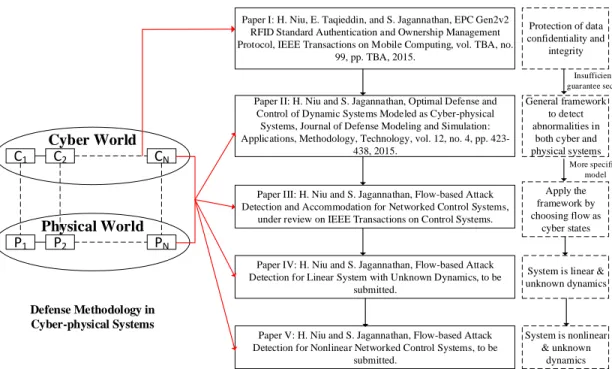
In this dissertation, a comprehensive defense framework and several novel defense methodologies for CPS has been proposed. This dissertation is presented in five papers, and their relationship to one another is illustrated in Figure 1.3. The common theme in these five papers is the development of defense methodologies for cyber-physical systems.
Paper I: H. Niu, E. Taqieddin, and S. Jagannathan, EPC Gen2v2 RFID Standard Authentication and Ownership Management Protocol, IEEE Transactions on Mobile Computing, vol. TBA, no.
99, pp. TBA, 2015.
Paper II: H. Niu and S. Jagannathan, Optimal Defense and Control of Dynamic Systems Modeled as Cyber-physical
Systems, Journal of Defense Modeling and Simulation: Applications, Methodology, Technology, vol. 12, no. 4, pp.
423-438, 2015.
Paper III: H. Niu and S. Jagannathan, Flow-based Attack Detection and Accommodation for Networked Control Systems,
under review on IEEE Transactions on Control Systems.
Paper IV: H. Niu and S. Jagannathan, Flow-based Attack Detection for Linear System with Unknown Dynamics, to be
submitted.
Paper V: H. Niu and S. Jagannathan, Flow-based Attack Detection for Nonlinear Networked Control Systems, to be
submitted. C1 C2 CN P1 P2 PN Cyber World Physical World Defense Methodology in Cyber-physical Systems Protection of data confidentiality and integrity General framework to detect abnormalities in
both cyber and physical systems Insufficient to guarantee security Apply the framework by choosing flow as cyber states More specified model
System is linear & unknown dynamics
System is nonlinear & unknown
dynamics
In the first paper, the objective is to protect data confidentiality and integrity for a particular cyber-physical system – mainly in RFID systems. To this end, a lightweight mutual authentication and ownership management protocol is proposed. The protocol is compliant with the latest EPC Gen2v2 standard. The protocol is designed to fit within the computational abilities of the tag as well as the scarce energy resources. The details of the protocol are given along with formal security proof of its correctness. Further, the protocol is implemented on EPC compliant tags and is shown to add minimal overhead to the standard message exchanges.
Next, since the protection of the data confidentiality and integrity is insufficient to guarantee the security in CPS, in the second paper, we propose a novel representation for developing security schemes wherein the cyber system states affect the physical system and vice versa. Subsequently by using this representation, an optimal strategy via Q-learning is derived for the cyber defense in the presence of an attack. Since the cyber system under attack will affect the physical system stability and performance, an optimal controller by using Q-learning is considered for the physical system with uncertain dynamics. As an example, cyber-attacks that increase the network delay and packet losses are considered and the goal of the proposed cyber defense and optimal controller is to thwart the attack and mitigate the performance degradation of the physical system due to increased delays and packet losses.
In the third paper, we further apply the framework proposed in the second paper by selecting the traffic flow as the cyber system states. To be specific, we first propose a novel attack detection scheme that is capable of capturing the abnormal traffic flow in the communication links due to a class of attacks. Further, it is shown that the stability of the
physical system can be affected by the condition of the network due to delays and packet losses induced by the attacks. An observer-based detection scheme is developed both for the network and physical system. Attacks on the networks as well as on the physical system can be detected and upon detection, the physical system can be stabilized by adjusting the controller gains. Several attacks are considered in the simulation to show the applicability of the proposed scheme.
Subsequently, in the fourth paper, the work in the third paper is extended to the case where the CPS dynamics becomes unknown due to the unknown network parameters. Accordingly, an adaptive observer is proposed to estimate the unknown system dynamics and an optimal Q-learning based controller is developed to stabilize the flow in the presence of disturbances. The detection residual generated by the adaptive observer is in turn utilized to determine the onset of an attack when it exceeds a predefined threshold. For the physical system, we consider a stochastic dynamic system which incorporates uncertain network-induced delays and packet losses in the system dynamics. The proposed detection scheme includes an optimal Q-learning based event-triggered controller that is capable of detecting attacks on both sensors and actuators.
Finally, the last paper considers the case where the network traffic flow is modeled as a nonlinear system with unknown dynamics. A one-layer neural network (NN) based estimator is adopted in order to approximate the unknown system dynamics. Similar to Paper IV, the network attack detection residual generated by the adaptive observer is utilized to determine the onset of an attack. Upon detecting the attack, another NN-base approximator is introduced to estimate the attack input. For the physical system, we develop an attack detection scheme by using an optimal or approximate dynamic
programming-based event-triggered controller in the presence of network delays and packet losses. Moreover, attacks on the sensor or actuators of the physical system can be detected and further estimated with the proposed attack detection scheme.
1.3.CONTRIBUTIONS OF THE DISSERTATION
This dissertation provides contributions to the area of defense methodologies for the cyber-physical systems. The proposed uniform representation for CPS can be used in a variety of applications including autonomous systems. In particular, the cyber defender is able to make thorough decisions by selecting appropriate cyber state vector and output and customizing the payoff function that is of interest. Therefore, the proposed effort overcomes these deficiencies mentioned in Section 1.1.
The contributions of Paper I include the development of a novel lightweight authentication and ownership transfer protocol for passive RFID systems. We also demonstrate how the proposed protocol is compliant with the EPC Gen2v2 standard. The protocol is analyzed by using strand space and implemented and evaluated on hardware, which, to the best knowledge of the authors, is the first hardware based evaluation for ownership transfer protocols.
For the second paper, the main contribution is the novel and comprehensive representation of the CPS that captures the interrelationship between the cyber and the physical elements. The optimal strategies for the defender and the attacker are also developed based on the proposed framework.
On the other hand, the contributions of the third paper include the design of the flow controller with randomly delayed measurement in the presence of attacks and the development of novel observer-based network attack detection and estimation scheme
along with detectability condition. A controller is also designed for the physical system to maintain the stability of the physical system which can be utilized to maintain the healthy condition of the communication networks in terms of the delays and packet losses using adversary models.
The contributions of the fourth paper include the design of the optimal flow controller in the presence of disturbances and cyber-attacks, where the network parameters are considered unknown. A novel observer-based network attack detection and estimation scheme along with detectability condition is also provided. The contribution of the fourth paper also includes the development of sensor/actuator attack detection scheme with an event-triggered controller for the physical system with uncertain system dynamics.
Finally, for the last paper, the main contributions include the development of a novel observer-based network attack detection and estimation scheme for nonlinear NCS with unknown system dynamics. It is demonstrated that the proposed scheme works in the presence of a class of attacks with specific adversary models. The contributions on the physical system include the development of an event-triggered controller in the presence of network-induced delays and packet losses and a sensor/actuator attack detection and estimation scheme.
PAPER
I. EPC GEN2V2 RFID STANDARD AUTHENTICATION AND OWNERSHIP MANAGEMENT PROTOCOL
Haifeng Niu, Eyad Taqieddin, and S. Jagannathan
Providing security in passive RFID systems has gained significant attention due to their widespread use. Research has focused on providing both location and data privacy through mutual authentication between the readers and tags. In such systems, each party is responsible of verifying the identity of the other party with whom it is communicating. For such a task to succeed, the tags and readers are initialized with shared secret information which is updated after a successful authentication session. Ownership management, which includes transfer and delegation, builds upon mutual authentication. Here, the use of security in RFID is extended to encompass the more practical case where a tagged item is shifted from one owner to another. As such, we propose a new authentication and ownership management protocol that is compliant with the EPC Class-1 Generation-2 Version 2 standard. The protocol is formally analyzed and successfully implemented on hardware. The implementation shows that the use of such protocol adds security with little added overhead in terms of communication and computation.
1.INTRODUCTION
Radio Frequency Identification (RFID) systems are deployed in numerous automated asset management applications. Examples of such applications include libraries, warehouses, and border control to name a few. In a RFID system, the identification information of the tracked objects is stored in a nonvolatile memory on passive tags. These tags are queried by readers which transmit an RF signal to energize the tags so as to get the backscattered information. The readers are connected to backend servers which store and process the data.
An important aspect to be considered in RFID systems is the data and location privacy. Given that the communication between the tags and readers is wireless, various attacks may be launched by an unauthorized user to either collect information about the tagged items or cause a disruption of the system operation. As a result, the communicating parties, a tag and a reader, must authenticate each other before any data exchange. Moreover, the data should be concealed from unauthorized access through encryption. As such, both the reader and the tag need to share secret information.
Besides authentication, ownership management (i.e.; transfer or delegation) (OT) is also an important aspect of RFID security as most tagged items will change owners at least once during their lifetime. For example, the ownership of the tagged item is transferred from the manufacture to the retailer, and then to the customer. Special attention to the security must be paid because this process is relatively vulnerable to attacks due to the exchange of secret keys or passwords. Further, it is desired that the ownership management protocol would protect the privacy of the new owner from tracking by the
previous owner(s) and to guarantee that the new owner will not be able to retrieve the previous secret keys used by the old owner.
To add security features to the passive tags, the EPC Class-1 Generation-2 standard (EPC Gen2v1) [1] introduces the access and kill password. The access password is used whenever the reader wishes to read/write data in a tag’s memory. On the other hand, the kill password along with the kill command is issued to stop the tag from responding to any subsequent queries. These basic security mechanisms are easily defeated because the passwords are XORed with a random number that is sent in plaintext, which can easily be retrieved.
Recently, the EPC Class-1 Generation-2 standard version 2 (EPC Gen2v2) [2], has been ratified. Backward-compatible with the old version, the new one provides a series of features intended to improve security of the tag by allowing the manufacturers to customize the cryptographic authentication methods to verify identity and provenance, as well as avoid unauthorized access. Similar to the previous standard, EPC Gen2v2 supports the use of a pseudo random number generator (PRNG), a cyclic redundancy check (CRC) function, and XOR operation.
A security protocol is usually considered as “EPC compliant” if it solely uses one
or more of these functions. However, these functions by themselves are not cryptographic functions. Other measures should be taken to provide an acceptable level of security considering their computational capabilities since there are only 500 – 5000 gate elements on the tag, of which 200 – 2000 can be used for security-related functions [3]. The Advanced Encryption Standard (AES), for example, requires about 3000 gate elements to be implemented. Hash functions like MD5 and SHA-256 require even more gate elements,
8000 – 10000 [4]. Therefore, securing information among RFID devices is a major challenge due to the limited storage and computational capabilities on the passive tags.
1.1.RELATED WORK
A comprehensive survey [5] examines several aspects related to RFID security. Mainly, the importance of mutual authentication and secret information sharing is emphasized. In [6], a classification of RFID authentication protocols, based on the cryptographic/logical functions, is presented. These protocols range from full-fledged protocols in which symmetric, asymmetric, and hash functions are supported [7]-[12] to the least computationally demanding class called the ultra-lightweight, where basic bitwise logical and shift operations are employed [13]-[16].
In [17], an EPC compliant mutual authentication protocol based on CRC exchange followed by update on secret information after each authentication session is proposed to provide privacy, anonymity, and to resist replay and denial of service (DoS) attacks. However, [18] and [19] indicated that [17] did not achieve its intended goals. The work of [18] detailed the steps to successfully impersonate a valid tag either temporarily or permanently and how to run a DoS attack. These attacks are shown to be practical due to the short length of the data units exchanged. In [19], the impersonation attack is extended to include the back-end database as well as the tags. The analysis shows how the location of the tag can be identified and tracked.
The authors in [20] proposed a new protocol called Azumi to overcome the security flaws of [21] and claim that it is capable of defending against location tracking, DoS attacks, counterfeit reader or tag, and man-in-the-middle (MitM) attacks. However, it is
shown that the work in [20] is vulnerable to tag impersonation and secret disclosure attacks. An enhanced version Azumi+ was proposed in [22] as a solution.
Several research efforts considered the problem of ownership management. One of the earliest ownership transfer protocols appeared in [23]. However, the old owner privacy cannot be guaranteed due to the way the shared keys are updated, leading to a de-synchronization attack. Around the same time, the authors in [24] proposed a scalable, delegated pseudonym protocol enabling ownership transfer. However, as pointed out in [25], the keys shared by several tags become a weakness that reduces security. In [26], a protocol based on the use of hash functions, symmetric cryptography, and the XOR operation is proposed. The protocol is shown to be vulnerable to tracking and DoS attacks by manipulating the value of the random number sent to the tag [27]. Moreover, in [28], an attacker can add noise to the final message exchange resulting in the tag holding incorrect secret information due to which any subsequent authentication would fail.
Another protocol appeared in [29] referred to as product-flow ownership-transfer protocol (POP). This protocol supports querying, disabling, or updating the secret keys on the tag. However, this protocol does not provide privacy to the new owner because the old owner will still be able to access the tag by exploiting his knowledge of the shared secret keys. In addition, it is prone to de-synchronization attacks similar to [30], [31].
As for ownership delegation protocols, for example, the work in [30] assumes that the channel from the tag to the reader is secure and that any ownership transfer/delegation will be securely accomplished. This is an impractical assumption and cannot be relied upon. Another variant of [26] was proposed in [33] as an ownership delegation protocol. Delegation is possible because the message containing the new key uses the old key as a
variable. As such, the old owner will be able to keep track of the key updates and modify its keys accordingly.
The ownership management protocols mentioned above [23]-[30], as well as in [32]-[35], are not EPC compliant due to the nature of the cryptographic functions used in computing the messages. An EPC compliant lightweight protocol is given in [36] wherein PRNG and XOR functions are used on the tag side. However, the protocol is sensitive to replay and MitM attacks. Another EPC compliant ownership transfer protocol is proposed in [37] where the authors add a modular division operation to the functions of the tag because such a function would not require a large number of gate elements. However, a potential attacker can disguise as an owner who can update the secret keys in the same way as the new owner does, thus eliminating the security.
The other ownership transfer protocols [37]-[41] conforming to EPC standards use CRC as the encryption method and cannot guarantee security because of the complete linearity property of CRC. In fact, as analyzed in [19] and [39][42], the attacker is able to trace, impersonate and eventually disclose all the information stored in tags with very few interactions. In summary, an EPC compliant secure authentication and owner management protocol is yet to be developed for passive tags.
1.2.CONTRIBUTIONS
In this paper, a lightweight mutual authentication and ownership management protocol is proposed. The protocol is compliant with the EPC Gen2v2 standard. The basic supported operations, along with permutation, are used as basic operations to provide the cryptographic functionality.
The protocol is designed to fit within the computational abilities of the tag as well as the scarce energy resources. The details of the protocol are given along with formal security proof of its correctness. Further, the protocol is implemented by using EPC compliant tags and is shown to add minimal overhead to the standard message exchanges. This paper is an extended version of work published in [43]. We extend our previous work by making the following improvements. 1) In addition to the basic ownership transfer scheme introduced in [43], the protocol presented in this work also supports ownership delegation. 2) A mathematical proof of both authentication and secrecy with strand space theory is provided. 3) A detailed description on how the proposed protocol is implemented in hardware is offered. 4) More experiments are conducted to evaluate the performance of the proposed protocol, such as time consumption analysis for multiple-tag ownership transfer and resistance evaluation to the brutal force attack.
The main contributions of this work include: 1) the development of a novel lightweight authentication and ownership transfer protocol for passive RFID systems by taking into account both delegation and ownership transfer into consideration, 2) the demonstration of how the proposed protocol is compliant with the EPC Gen2v2 standard, 3) the security analysis of the protocol by using strand space, and 4) hardware implementation and evaluation, which, to the best knowledge of the authors, is the first hardware based evaluation for ownership transfer protocols.
The rest of the paper is organized as follows. In Section 2, the detailed description of proposed protocol is given followed by the security analysis given in Section 3 and a comparison with pervious work in Section 4. The hardware implementation and evaluation is given in Section 5. The paper is concluded in Section 6.
2.PROPOSED PROTOCOL
In addition to the limited functions supported by the EPC standard, the available power on the tag for various computations and transmissions needed as part of the security protocol implementation is an important constraint. Moreover, the limited available time for executing the steps for the authentication and ownership management protocol is an added challenge. Finally, the protocol has to be implemented in a practical setting in which hundreds or thousands of tags are present with several tags simultaneously performing exchange and this should be completed within the allowed timeslot.
To enhance the functionality of the protocol, the ultra-lightweight permutation operation (Per) [16] is added to the existing functions on the tag. This operation offers diffusion of the bits and helps overcome any problem occurring because of the nature of bitwise operations. The operation is defined as follows:
Definition 1 [16]: For two n-bit strings, X andY, in the form
1 2 n, i {0,1}, 1, 2,... ; 1 2 n, yi {0,1}, 1, 2,...
X x x x x i n Y y y y i n.
The Hamming weight ofY, wt Y( ) , ism (0 m n) and
1 2 m 1, m1 m2 n 0, k k k k k k y y y y y y where 1 2 1 2 1 k k km n, 1km km kn n.
Then, the permutation ofX according toY, denoted asPer X Y( , ) , is given by
1 2 1 2 1
( , )
m n n m m
k k k k k k k
The following assumptions are made in designing the protocol:
1) The link between the readers is secure. Also, the link between any reader and the trusted third party (TTP) is assumed to be secure. This is a reasonable and quite common assumption as the readers are built with more powerful processors which can take advantage of complex encryption algorithms to guarantee secure data transmission. 2) The link between the tag and any other entity is considered insecure.
3) The current owner and the tag share a secret key that is only known to them.
2.1.INITIALIZATION
The tag is initialized with the following values:
1) K: secret key shared with both current and new owners, as well as delegates, if any. 2) KM: master key only shared with the tag owner. A reader with KM is able to modify
key K, but a reader with key K does not have access to KM.
3) KTTP: key shared between the tag and the TTP.
4) EPC: electronic product code, the static identifier of a tag. 5) RIDi: The ID of the readericurrently owning the tag.
6) IDS: In the protocol, index pseudonym (IDS) is exchanged instead of using the tag identifier (ID). The IDS is a pointer to a database entry in which the information of the tag is stored. Such an entry may include the identifying information and the keys related to that tag. We use the IDS instead of concealing the EPC in the messages, for the following two reasons: 1) The EPC value is constant and its use in multiple runs of the protocol may reveal information about the tag and its secret values. 2) Tracking the EPC by the old owner is possible.
Note that for compliance with the EPC standard, all data units in the protocol are 96 bits long. For the convenience of implementation, these 96-bit data are broken into six 16-bit words. For example, a 96-bit parameter Ais broken into six words, denoted as
(1), (2),... ( ),... (6),
A A A i A where A i( ) is the ith 16-bit subunit. As a result, all the
computations are executed six times in order to get the complete 96-bit data.
The current owner is initialized with K, KM, IDS, RIDi and EPC. As mentioned
earlier, the proposed ownership management protocol takes both delegation (details in Section 2.3) and complete ownership transfer (Section 2.4) into consideration. However, it is important to notice that before either delegation or complete ownership transfer take place, mutual authentication is needed to verify the authority of all parties involved.
2.2.PHASE I: MUTUAL AUTHENTICATION
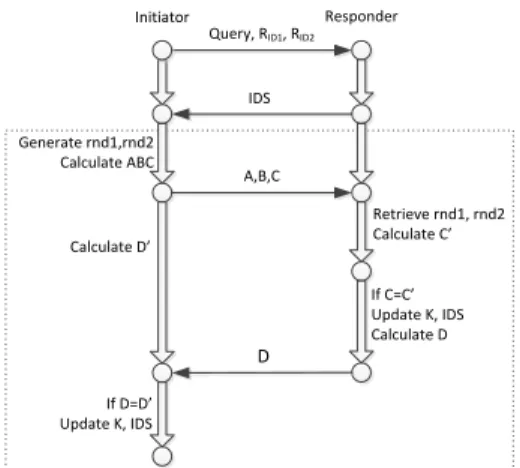
A general scenario for an authentication session starts with the reader querying a tag. In response, the tag sends an index pseudonym (IDS). A sequence of exchanges follows such that the reader securely sends random numbers to the tag by using the shared key, the tag authenticates the reader and vice versa, and the keys and IDS are updated. The transactions that take place are shown in Figure 2.1.
The purpose of the authentication phase is to: 1) prove the possession of shared secret key to each other without disclosing it; 2) pass the nonces that are used to update the keys. To achieve this, the reader generates two 96-bit random values (rnd1, rnd2) as the nonces, then computes A, B, and C in a way described in Figure 2.1. Particularly, in the computation of A and B, the secret key is part of the input of PRNG function so that the key is protected while the tag can verify the readers’ possession of the key by doing the
correct nonces (rnd1, rnd2) from messages A and B. It is very important to note that the PRNG is a nonlinear function, meaning that if an attacker flips one bit of RID2, the tag will get a totally different (and incorrect) rnd1. Moreover, since rnd1 is used to retrieve rnd2 from B, therefore rnd2 derived by the tag will be incorrect, As a result, even if the attacker flips the same bit of B, it will not get C’ that equals to C.
Old Owner
K,KM, EPC, RID1
Secret
Generate random number rnd1, rnd2, calculate A, B, C:
A(i) = rnd1(i) ⊕ PRNG(K(i) ⊕RID1(i)) ⊕ PRNG(K(i) ⊕ RID2(i)) )
B(i) = rnd2(i) ⊕ PRNG(rnd1(i)⊕K(i)) C(i)= PRNG(rnd1(i) ⊕ RID1(i)) ⊕ PRNG(rnd2(i) ⊕ RID2(i))
Where i=1~6. Tag K, KM, EPC, RID, IDS A, B, C Retrieve rnd1, rnd2, calculate C’: Generate rnd1, rnd2, calculate A, B, C: rnd1(i) = A(i) ⊕ PRNG(K(i) ⊕RID1(i)) ⊕ PRNG(K(i) ⊕ RID2(i)) )
rnd2(i) = B(i) ⊕ PRNG(rnd1(i)⊕K(i)) C’(i)= PRNG(rnd1(i) ⊕ RID1(i)) ⊕ PRNG(rnd2(i) ⊕ RID2(i)) If C = C’, update K and IDS, calculate D: K*(i) = Per(rnd1(i), K(i)) ⊕ K( (i+1)mod 6)
IDS*(i) = Per(rnd2(i), K(i)) ⊕ K(i) D(i) = PRNG(K*(i) ⊕ IDS*(i)), i = 1 to 6 D
Calculate D’:
D’(i) = PRNG(K*(i) ⊕ IDS*(i)) i=1 to 6
If D = D’, tag is authorized
Secret
Figure 2.1. Mutual authentication and keys update [43].
If C equals to C’, then it is believed that the reader does have the secret key and the
tag has retrieved rnd1 and rnd2 successfully. Then the new key and IDS are computed in a way specified in Figure 2.1. Similarly, we use message D to: 1) prove the tags’ possession of the secret key; 2) inform the reader that the tag has computed the new key and IDS.
Upon receiving message D, the reader will compute D’ in the same manner and determines whether D equals to D’ or not. If that is true, then the tag is authenticated.
Consequently, the reader and the tag update to the new computed key and IDS for future uses. It should be noted, however, that both the reader and the tag should maintain a copy of the old key and IDS to avoid desynchronization problems (more explanation can be found in Section 4).
2.3.PHASE II, CASE 1: DELEGATION
At this point, RID1 is ready to delegate its rights over the tag to RID2. For that purpose, we introduce the use of the ticket. This is used by the delegate reader to prove to the tag that it is a valid reader and that it had received sufficient credentials from the current owner to allow it to access the tag. In the proposed delegation protocol, both RID1 and the tag compute the ticket as shown in Figure 2.2.
Old Owner
K,KM, EPC, RID1
Tag
K, KM, EPC, RID, IDS Ticket = KM ⊕ EPC ⊕ rnd1 ⊕ rnd2 Ticket = KM ⊕ EPC ⊕ rnd1 ⊕ rnd2
Secret Secret
Figure 2.2. Ticket computation on an old owner and tag.
RID1 uses a secure link with RID2 and passes to it the EPC, IDS, K, and ticket. A valid ticket allows RID2 to query the tag and to run mutual authentication sessions with it.
Figure 2.3 shows how the delegate RID2 uses the ticket to query and update the tag. Note that the ticket value becomes an integral part of the message computations.
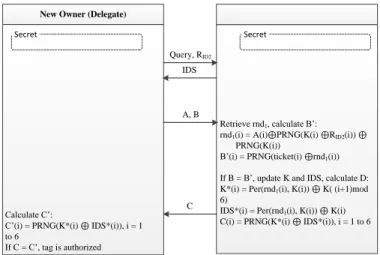
New Owner (Delegate)
K, ticket, EPC, RID2
Generate rnd1, calculate A, B: A(i) = rnd1(i)⊕PRNG(K(i) ⊕RID2(i)) ⊕ PRNG(K(i))
B(i) = PRNG(ticket(i) ⊕rnd1(i)) where i = 1~6
Tag
K, KM, EPC, ticket, IDS Query, RID2
IDS
A, B
Retrieve rnd1, calculate B’:
rnd1(i) = A(i)⊕PRNG(K(i) ⊕RID2(i)) ⊕ PRNG(K(i))
B’(i) = PRNG(ticket(i) ⊕rnd1(i)) If B = B’, update K and IDS, calculate D: K*(i) = Per(rnd1(i), K(i)) ⊕ K( (i+1)mod 6)
IDS*(i) = Per(rnd1(i), K(i)) ⊕ K(i) C(i) = PRNG(K*(i) ⊕ IDS*(i)), i = 1 to 6 C
Calculate C’:
C’(i) = PRNG(K*(i) ⊕ IDS*(i)), i = 1 to 6
If C = C’, tag is authorized
Secret Secret
Figure 2.3. Ownership delegation.
In the case of delegation, RID1 may wish to restore its sole ownership of the tag. This means that it has to revoke the ticket such that RID2 will not pass the test of equality between B and B’. When that happens, no update will take place and the tag will not run
further session with the revoked reader. The proposed approach for this is to modify the value ofKM such that the ticket given to RID2 will not match with the computed value.
Note that the value of the ticket is updated with every session because the values of rnd1 and rnd2 are changed.
Delegation is suitable for those cases where certain “guest readers” need to access the tag temporally. In other cases, however, the old owner needs to give up the ownership completely and transfer it to the new owner. This process is presented in the following section.
2.4.PHASE II, CASE 2: COMPLETE OWNERSHIP TRANSFER
In this case, we propose the use of a TTP to guarantee the correctness of the protocol. The need for the TTP arises from the fact that the old owner holds the same values shared between the new owner and the tag. This means that any update taking place by RID2 may be mirrored by RID1. This violates an important property of ownership transfer which is backward privacy.
However, it is worth to note that the EPC Gen2v2 standard introduces a new “untraceable” command, which allows the tag to reduce its operating range for all readers.
This function, to some degree, may give a practical solution of releasing the use of TTP by reducing the operating range so that only the new owner can reach the tag. As a result, the old owner cannot repeat the key update process and thus the backward privacy is guaranteed.
In this protocol, the goal is to change the value of KM stored on the tag such that it
matches that stored on RID2. After that, RID1 will have no access to the tag anymore. This proposed approach adds an extra functionality that we may use the reverse process in case we wish to satisfy the ownership repossession property. As presented in Figure 2.4, the outline of the protocol includes those steps:
TTP
KM, KTTP, EPC, RID2
Generate rnd1, update KM, Calculate A, B
KM*(i) = PRNG(Per(KM(i), rnd1(i))), A(i) = rnd1(i)⊕PRNG(KTTP(i)),
B(i) = PRNG(KM (i) ⊕ rnd1(i)), i = 1~6
Tag
KTTP, KM, EPC, IDS
A, B
Retrieve rnd1, calculate B’:
rnd1(i) = A(i)⊕PRNG(KTTP(i)),
B’(i) = PRNG(KM (i) ⊕ rnd1(i)), i = 1~6
If B = B’, update KM:
KM*(i) = PRNG(Per(KM(i), rnd1(i)))
Secret Secret New Owner K, EPC, RID2 Store KM* Secret KM*
Try to Authenticate each other. OT is complete if success
Figure 2.4. Complete ownership transfer [43].
1) TTP generates a random number rnd1and uses it to update KM to
* M
K . This will
become the new master key shared between the tag and the new owner, RID2.
2) TTP sends *
M
K to RID2 using the secure channel.
3) The challenging part for the TTP becomes to send * M
K to the tag. For that, we propose
the use of messages A and B shown in Figure 2.4. Similar to what we have done in the authentication phase, the secret key is set as the input of the nonlinear PRNG function while the nonce is XORed with the PRNG output so that the key will not be disclosed and the nonce can be passed to the tag safely. Message B is used for the tag to verify TTP’s possession of the secret key and to check the correctness of the nonce.
4) The tag retrieves rnd1 from A and verifies that B is equal to B’. 5) The value of rnd1is used by the tag to update *
M
K in a manner similar to that used by
the TTP.
6) The new owner and tag need to challenge each other to verify that both have the same value of *
M
2.5.EXAMPLE OF AUTHENTICATION AND OWNERSHIP TRANSFER
To illustrate the operations that take place, we give a numeric example. Assume that the tag is initialized with the following values:
K = 0xF702A7DE0826C3F829A1E411; KM = 0x5998C1D7782AB07071536E71; KTTP = 0xD4B087E2874D2702DE62DE89; RID1 = 0x8C00CACD2BD37051AE008186; RID2 = 0xF51EF5A0B4BF61ADA7B4B2F6.
According the protocol, the reader generates two random numbers to be used in the computation of messages A, B, and C. Assuming that the random numbers are
rnd1 = 0x18F86BF86469F341C132C052; rnd2 = 0x474BEA6DA7CD08D146A9414E. The reader will then send
A = 0xC8D9BBBC295F1707A0D1B9D7; B = 0xB2430574BF1375B0B3186233; C = 0xB09F6C3B632DD765C2F767D4.
Upon receipt of these values, the tag retrieves rnd1 and rnd2 from messages A and B, and then computes C’ to compare it with C. If they match then the tag computes new values for K and IDS and uses these updated values to compute D.
K* = 0xB7E16E19AB54DF2527093616; IDS* = 0xB8A64333A6C0C36F650BA775;
The reader verifies the value of D by comparing with D’. If they match then the tag
and reader both have successfully authenticated each other and updated their secret key and IDS values.
The ownership transfer phase follows a similar manner. Messages A and B are used between the TTP and the tag to convey a random number and to prove to the tag that the messages originate from an authentic source, the TTP. To illustrate, assume that the TTP generates rnd1 as
rnd1 = 0x411895D3C7772A68D368159E. Then A and B will be
A = 0x330B34429236E6B83E1BD20C; B = 0x4DC01DE6C69F8F6E88E025D0. The tag retrieves rnd1 and then updates KM to
KM* = 0x232F1EBB84FED34E175A0797.
The same key is already in the possession of the new owner through the secure channel with the TTP. Thus, the tag and the new owner can communicate with each securely using the new key. Note that the old owner will not be able to compute KM* since it does not have the rnd1 value.
3.SECURITY ANALYSIS
In this part, we use the strand space analysis to prove the correctness of the protocol. A strand is a sequence of events that a single principal may engage in, while a strand space is a set of strands [44]. Here, “principal” stands for any participant that may be involved in the protocol such as old/new owner, tag, attacker, or TTP [44]. In the following analysis, we use some of the definitions and lemmas provided in [44]. We analyze the security of the authentication phase only. The analysis of the other two phases is either part of or identical to that of the authentication phase.
Let Tname Tnamebe the set of names such as RID1 and RID2 RID1, RID2,and IDS IDS
Key Keyxis the set of keys known by the principal x. Let mbe a message and Kis a key,
then we represent the encryption of message musingK as
km {m}K. Also, K1 is the
corresponding decryption key of K. Now, for simplicity, we rewrite messages A B C, ,
and D: 1 2 1 { , ID1}KA { , ID2}KA Arnd K R K R ; (1) 2 { , 1}KB Brnd K rnd ; (2) 1 2 1 2 { 1, } { 2, } C C ID K ID K C rnd R rnd R ; (3) * * { , } D K D K IDS , (4) where 1 1 1 1 1 1 , 2 , , 1 , 2 A A B C C K K K K K and 1 D
K are unknown to all the principals because of
the one-way property of PRNG function. We can show that under the following Assumption 1, this presentation is equivalent to the original one in Figure 2.1 in the sense of security.
Assumption 1: If yPRNG x( ) and y is known to a principal P , then the probability thatPis able to compute the value of xis negligible.
According to EPC Gen2v2 standards [2], the PRNG function shall meet the following randomness criteria:
1) The probabilityPthat any RN16 has valueRN16 j, for any j, should be bounded by
16 16
0.8 / 2 P 1.25 / 2 .
2) For a tag population of up to 10,000 tags, the probability that any two or more tags simultaneously generate the same sequence of RN16s shall be less than 0.1%.
3) An RN16 drawn from a Tag’s PRNG 10ms after the rise time shall not be predictable with a probability greater than 0.025% if the outcomes of prior draws from the PRNG, performed under identical conditions, are known.
In our protocol, the 96-bit random number consisting of six 16-bit random numbers is used which means that the probabilities defined in the above criteria are much smaller
(new probabilityP'equals toP6 , not just6P). Therefore, this assumption is reasonable. Taking the computation of messageAas an example, we can conclude that even if a penetrator managed to get the value of bothPRNG K( RID1)and PRNG K( RID2)(in fact
he can only know the XOR results of them), by Assumption 1, he still cannot compute the value of K R, ID1andRID2.
Next, we will introduce the definition of the proposed ownership transfer strand spaceSOT.
Definition 2: An infiltrated strand space, is an SOT space if it is the union of three kinds of strands:
![Figure 1.1. Challenges in cyber-physical systems [3].](https://thumb-us.123doks.com/thumbv2/123dok_us/9021689.2800025/19.918.163.810.772.1005/figure-challenges-in-cyber-physical-systems.webp)
![Figure 2.1. Mutual authentication and keys update [43].](https://thumb-us.123doks.com/thumbv2/123dok_us/9021689.2800025/39.918.298.675.432.707/figure-mutual-authentication-keys-update.webp)
![Figure 2.4. Complete ownership transfer [43].](https://thumb-us.123doks.com/thumbv2/123dok_us/9021689.2800025/43.918.296.676.105.276/figure-complete-ownership-transfer.webp)
![Table 4.1. Comparison with previous related work [43].](https://thumb-us.123doks.com/thumbv2/123dok_us/9021689.2800025/57.918.178.793.390.612/table-comparison-previous-related-work.webp)
![Figure 5.1. Mutual authentication under EPC Gen2v2 standard [43].](https://thumb-us.123doks.com/thumbv2/123dok_us/9021689.2800025/59.918.314.659.340.584/figure-mutual-authentication-under-epc-gen-v-standard.webp)
![Table 5.1. Authenticate command [2][43].](https://thumb-us.123doks.com/thumbv2/123dok_us/9021689.2800025/60.918.175.734.147.224/table-authenticate-command.webp)