
GRAVITATIONAL-WAVE
ASTRONOMY WITH
COALESCING COMPACT
BINARIES: DETECTION AND
PARAMETER ESTIMATION
WITH ADVANCED DETECTORS
RORY JAMES EDWIN SMITH
A thesis submitted to the
University of Birmingham
for the degree of
DOCTOR OF PHILOSOPHY
Astrophysics and Space Research
School of Physics and Astronomy
College of Engineering and Physical Sciences
University of Birmingham
January 2013
University of Birmingham Research Archive
e-theses repository
This unpublished thesis/dissertation is copyright of the author and/or third parties. The intellectual property rights of the author or third parties in respect of this work are as defined by The Copyright Designs and Patents Act 1988 or as modified by any successor legislation.
Any use made of information contained in this thesis/dissertation must be in accordance with that legislation and must be properly acknowledged. Further distribution or reproduction in any format is prohibited without the permission of the copyright holder.
Acknowledgements
It is my sincere pleasure to thank the following people: My supervisors Ilya Mandel and Alberto Vecchio for their mentorship, support and patience; Chad Hanna for his mentorship, and for always keeping an open door despite his busy schedule; The members of the Bayesian and CBC groups for all their help; All my friends in the ASR group at Birmingham, especially Charlotte Bond, Mark Burke, Ludovico Carbone, Chris Collins, Paul Fulda, Kat Grover, Carl-Johan Haster, Konstantinos Kolokythas, Ilya Mandel, Chiara Mingarelli, Trevor Sidery and Will Vousden for years of fun and adventures; Andy Pearsall, Brigid Jones, Amelia Perry, Charlotte Kimbly, Stacey McGowan, Jim Phillips, Peter Rothery, Patrick Scott, Jim Smyth and Mat Turnbull for their friendship over the years; The Dog & Dolphin, refuge from real world problems; And my family, especially my parents, for their love and support.
Several of the chapters in this thesis were the result of collaborations and benefited from discussions with several people. Chapter 2 was based on work done in collaboration with Ilya Mandel and Alberto Vecchio, and benefited from discussions with Eliu Huerta. Chapter 3 was based on work done in collaboration with Kip Cannon, Chad Hanna, Drew Keppel and Ilya Mandel, and benefited from discussions with Tyson Littenberg. Chapter 4 was based on work done in collaboration with Chad Hanna, Ilya Mandel and Alberto Vecchio, and benefited from discussions with several people, in particular: Kipp Cannon, Scott Field, Drew Keppel, Vivien Raymond, Manuel Tiglio and Alan Weinstein. Finally, I am grateful for the many helpful comments on this thesis from Stephen Fairhurst and Andreas Freise.
My work has been supported by the STFC and the Perimeter Institute for Theoretical Physics.
The current generation of interferometric gravitational-wave detec-tors, LIGO and Virgo, are undergoing upgrade to their so-called ad-vanced phase. These instruments, together with new instruments in Japan and India, KAGRA and LIGO India, will form a network of advanced gravitational-wave detectors with which detections are ex-pected to become routine. Amongst the prime sources for gravitational-wave astronomy are coalescing compact binaries consisting of neu-tron stars and/or black holes. Filtering detector data to detect these sources relies on precise templates of the expected gravitational-wave signals. In addition, estimating the parameters encoded in the signals (masses, spins etc...) requires sophisticated Bayesian inference tech-niques. Templates are typically computationally expensive to gener-ate and can be a bottle-neck in data analysis.
Here we focus on two aspects of gravitational-wave astronomy us-ing coalescus-ing compact binaries. The first part of this thesis fo-cuses on studying the requirements of template waveforms to detect intermediate-mass black holes through the coalescence of a stellar-mass companion into an intermediate-stellar-mass black hole in Advanced LIGO. The second part of this thesis focuses on numerical and an-alytic techniques to improve the efficiency of (Bayesian) parameter estimation on coalescing binaries when parameter estimation is dom-inated by template waveform generation. Such efficiency improve-ments to parameter estimation are crucial for gravitational-wave as-tronomy using advanced detectors.
Contents
Acknowledgements i
Contents iii
List of Figures vii
List of Tables ix
1 INTRODUCTION 1
2 DETECTING INTERMEDIATE MASS-RATIO BINARIES WITH
ADVANCED DETECTORS 21
2.1 Introduction . . . 21
2.2 Matched filtering of gravitational-wave signals . . . 25
2.3 Waveforms . . . 28 2.3.1 EOBNR . . . 29 2.3.1.1 Inspiral-plunge waveform . . . 29 2.3.1.2 Merger-ringdown waveform . . . 30 2.3.2 HG waveforms . . . 30 2.3.3 TaylorT4 . . . 32
2.4 SNR from inspiral, merger and ringdown . . . 32
2.5 Effectiveness of inspiral-only templates for IMRAC searches . . . 38
2.6 Comparison of inspiral-only waveforms . . . 44
3 TOWARDS RAPID COMPACT BINARY PARAMETER
ES-TIMATION USING INTERPOLATED WAVEFORMS 49
3.1 Introduction . . . 49
3.2 CBC parameter estimation . . . 51
3.2.1 MCMC . . . 54
3.3 Singular value decomposition of gravitational-wave template banks for CBC sources . . . 56
3.4 Interpolating template waveforms using the SVD . . . 59
3.5 Parameter estimation using interpolated waveforms . . . 62
3.6 Results: Comparison of parameter estimates using interpolated and non-interpolated waveforms . . . 67
3.7 Discussion and conclusion . . . 71
4 PARAMETER ESTIMATION USING INTERPOLATED TIME-DOMAIN TEMPLATE WAVEFORMS 73 4.1 Introduction . . . 73
4.2 Interpolating inspiral-only time-domain waveforms . . . 75
4.2.1 Parameter estimation using interpolated TaylorT4 wave-forms: 5-dimensional case . . . 78
4.2.1.1 Prior distributions . . . 78
4.2.1.2 SVD set up . . . 79
4.2.1.3 Results . . . 79
4.3 Interpolating inspiral-merger-ringdown waveforms . . . 81
4.4 Future work and Discussion . . . 84
5 RAPIDLY EVALUATING THE COMPACT BINARY LIKELI-HOOD FUNCTION VIA INTERPOLATION 85 5.1 Introduction . . . 85
5.1.1 Directly interpolating the likelihood function . . . 88
5.1.2 Likelihood interpolation: Examples . . . 89
5.1.2.1 Example 1: High-mass binary black holes . . . . 90
5.1.2.2 Example 2: Binary neutron stars . . . 92
CONTENTS
5.1.2.4 Discussion and conclusion . . . 94
6 SUMMARY 97
A FREQUENTLY USED QUANTITIES 101
A.1 Definitions of discrete representations of continuous functions . . . 101 A.2 Post-Newtonian phasing formulae . . . 103 A.2.1 TaylorF2 . . . 103 A.2.2 TaylorT4 . . . 103
B SINGULAR VALUE DECOMPOSITION OF M ×N
MATRI-CES 105
B.1 Definitions of the singular value decomposition of M ×N matrices 105 B.1.1 Step-by-step example . . . 106 B.1.2 Geometric picture of the SVD . . . 108
List of Figures
1.1 Inspiral phase of a gravitational wave from compact binary coales-cence. . . 6 1.2 Anticipated Advanced LIGO noise sources. . . 8 1.3 Noise amplitude spectral densities of various Earth based
gravitational-wave detectors. . . 9 2.1 Advanced LIGO high-power, zero-detuned noise PSD . . . 33 2.2 RMS strain of IMRAC sources in Advanced LIGO. . . 35 2.3 SNR of IMRAC sources in Advanced LIGO as a function of total
mass and mass ratio. . . 37 2.4 Effectiveness of inspiral-only templates to filter inspiral, merger
and ringdown signals. . . 41 2.5 Effectiveness of inspiral-only EOBNR templates at filtering HG
sig-nals (left) and TaylorT4 sigsig-nals (right) as a function of the source component masses encoded in the signal. . . 45 3.1 Coalescing compact binary system relative to a ground based
gravitational-wave detector. . . 52 3.2 Initial LIGO noise power spectral density. . . 64 3.3 Patching of parameter space. . . 67 3.4 Marginalized one-dimensional posterior probability density
func-tions produced using interpolated and non-interpolated template waveforms. . . 68
4.1 Histogram of mismatches between (normalized) interpolated and non-interpolated TaylorT4 waveforms. . . 77 4.2 Marginalized one-dimensional posterior probability density
func-tions produced using interpolated and non-interpolated TaylorT4 waveforms. . . 80 4.3 Histogram of mismatches between (normalized) interpolated and
non-interpolated EOBNR waveforms. . . 83 5.1 Interpolated and non-interpolated log likelihoods (top), and
per-centage error (bottom) for a data set containing a gravitational-wave signal from the coalescence of binary black holes. . . 91 B.1 Action of a matrix on the unit circle. . . 108
List of Tables
2.1 Effectiveness of inspiral-only searches. . . 43 2.2 Effectiveness of inspiral-only EOBNR template waveforms in
re-covering signals modelled using different waveform families. . . 46 3.1 Mean posterior parameter estimates (and standard deviations) of
the marginalized PDFs using interpolated and non-interpolated SPA waveforms (Fig.3.4). . . 68 3.2 Computational time of template waveform generation in units of
computational time of interpolated waveforms. . . 70 4.1 Mean posterior value parameter estimates (and standard
devia-tions) of the marginalized PDFs using interpolated and non-interpolated TaylorT4 waveforms (Fig.4.2). . . 81
Chapter 1
INTRODUCTION
Gravitational-wave astronomy will open an entirely new observational window to the Universe with the direct detections of gravitational waves from high energy as-trophysical phenomena. A network of ground-based interferometric gravitational-wave observatories (LIGO-Hanford and LIGO-Livingston (USA) and Virgo (Italy) [1]) are undergoing upgrades to their so-called “advanced” configurations which will be an order of magnitude more sensitive than their initial configurations and are scheduled to begin collecting data around 2015 [2]. In addition, two new ground-based interferometric detectors in Japan and India, KAGRA [3] and LIGO India [4] respectively, are expected to be online around 2020. This will usher in the “advanced detector era” in which gravitational-wave detections are expected to become routine [5].
The advanced detector network is expected to detect gravitational waves from a variety of fascinating astrophysical and cosmological events; from the late stages of the coalescence of compact binaries [5; 6; 7; 8] to a stochastic background of gravitational waves of astrophysical and cosmological origin [9; 10]. Of all the target sources, coalescing compact binaries are perhaps the the most likely can-didates for detection [5]. Compact binary systems, consisting of neutron stars and/or black holes are believed to be in abundance throughout the Universe. In-deed, the first indirect evidence for the existence of gravitational radiation came from the observation of the binary pulsar system PSR B1913+16, known as the “Hulse-Taylor” binary pulsar after its discoverers, which is undergoing orbital decay through the emission of gravitational waves [11]. For their discovery, Hulse
and Taylor were awarded the Nobel Prize in 1993. The Hulse-Taylor binary pul-sar is undergoing orbital decay very slowly and will not merge for around three hundred million years. In contrast the advanced-detector network will directly observe the gravitational waves from the final minutes to seconds of the coales-cence of compact binaries before they merge to form a single object. This makes compact binary coalescence (CBC) an ideal laboratory for probing dynamical, strong-field gravity.
With observations of gravitational waves from coalescing compact binaries we will be able to make precise measurements of their masses and spins as well as of their demographics [12; 13]. These measurements are essential for astro-physics/astronomy and fundamental physics using gravitational waves from com-pact binaries. Determination of the masses and spins will distinguish neutron stars and black holes and can be used to test the null-hypothesis that black holes are described by the Kerr metric [14; 15]. In addition, determination of source demographics, together with merger rates, places constraints on the formation mechanisms of binary systems [16]. While there are around ten known binary neutron star (NS-NS) systems [17] there are currently no known binary black hole (BH-BH) or black-hole-neutron-star (BH-NS) systems [18]. Despite this, BH-BH and BH-NS systems are believed to be fairly common throughout the Universe: population synthesis models suggest that realistic detection rates of BH-BH and BH-NS systems in Advanced LIGO/Virgo (aLIGO/Virgo) could be as high as 40 yr−1 [5]. Unsurprisingly, binary black holes are difficult to observe in the elec-tromagnetic spectrum and gravitational waves are likely theonly means by which they can be detected.
There are numerous open issues relating to black hole systems which grav-itational -wave detections will be able to make important contributions to. In particular gravitational-wave detectors will be able to search for binary systems with total masses up to around 500M [19] and will therefore be able to provide
the first unambiguous observations of “intermediate-mass” black holes (IMBHs). Intermediate-mass is a blanket term which refers to black holes with masses (roughly) in the range 50−103M
. Believed to form in globular clusters [e.g.,
20;21;22], IMBHs are extremely difficult to observe in the electromagnetic spec-trum and there are currently only tentative results suggesting their existence.
Detecting IMBHs will thus have important implications for globular cluster dy-namics. In addition, detections of compact binary coalescence will be important in addressing the so called black hole “mass-gap” problem [23]: The stellar mass-distribution is continuous in the range 0.1−100M and one would expect the
same to be true of ensuing compact remnants. However, while neutron stars have been observed to have masses up to around 2M, the lightest black holes
are observed to have masses around 5M, with no compact objects with masses
in-between [24]. Gravitational-wave observations of BH-BH or BH-NS systems will therefore be able to shed light on whether there is a genuine gap between the heaviest neutron stars and the lightest black holes.
The central theme of the work presented here is the detection of, and param-eter estimation on gravitational waves from CBC sources. Gravitational-wave astronomy using compact binaries will ultimately be limited by our ability to ro-bustly detect and estimate the parameters of the sources. Here we focus on two challenges for detection and parameter estimation in aLIGO. Firstly, we study the potential to detect IMBHs using aLIGO through the coalescence of a stellar-mass companion into an IMBH. We refer to this kind of binary as an “intermediate mass-ratio coalescence” (IMRAC) source. Secondly, we address the computa-tional efficiency of performing parameter estimation on gravitacomputa-tional waves from CBC sources. Parameter estimation on gravitational waves from CBC sources is currently highly computationally intensive [25], and the computational cost of performing parameter estimation on aLIGO data will be exacerbated if not directly addressed.
Detecting gravitational-wave signals from coalescing
com-pact binaries and estimating the source parameters
Despite the scientific potential of gravitational-wave detectors, detection and pa-rameter estimation are extremely difficult in practice. A passing gravitational wave creates a transverse strain in spacetime which we aim to detect using inter-ferometers. An interferometric gravitational-wave detector in the path of such a gravitational-wave thus experiences a relative change in the length of its arms. This strain is the observable quantity upon which gravitational-wave astronomy
relies. The exact form of the strain from a gravitational-wave from binary coa-lescence depends sensitively on the parameters of the binary, e.g. its masses and spins. However, in general a gravitational-wave signal from a coalescing binary has a characteristic signature. The coalescence of a binary system can be approx-imately split into three stages; (i) the so-called “inspiral” phase during which the components of the binary evolve along a quasi-circular orbit, “spiralling” into one another, (ii) a rapid merger where the two objects form a single object, and (iii) a quasi-normal ringing phase where the (merged) object behaves like a damped os-cillator [26]. While it is possible to have inspiralling binaries on elliptical orbits, binaries observable over the bandwidth of aLIGO/Virgo are expected to have circularized, see e.g. [27]. These three stages of coalescence imprint a distinct signature to the gravitational-wave signal. Schematically it is useful to consider a gravitational-wave signal h(t), as seen in a detector, to have the form
h(t) = hinspiral(t)Θ(τ −t)
+ hmerger−RD(t)Θ(t−τ), (1.1) wherehinspiral(t) is the part of the waveform from the inspiral phase of coalescence andhmerger−RD(t) is the part of the waveform from the merger and ringdown (RD) phases of coalescence. Here Θ(.) is the usual Heaviside step function. The time
t = 0 is taken to be the time at a fiducial gravitational-wave frequency,fgw. The time τ corresponds to the time from fgw until the binary reaches a point close to the “inner-most stable circular orbit” (ISCO), after which the binary undergoes a plunge before the components merge [28]. Typically, τ is referred to as the “chirp time”. To leading order the chirp time is given by [29]
τ = 2.18 s 1.12M Mc !5/3 100 Hz fgw !8/3 , (1.2)
where Mc= (m1m2)3/5/(m1+m2)1/5 is known as the “chirp mass” of the binary. For a binary consisting of two neutron stars, each with mass m1 =m2 = 1.4M,
at 10 Hz, roughly the low frequency cut off of aLIGO, one has access to around
At leading order, the gravitational-wave frequency at which the binary reaches the ISCO is fISCO= 4.4 kHz M M , (1.3)
whereM is the total mass of the binary. Thus a binary consisting of two neutron stars with total mass of 2.8 M will reach ISCO at around 1.5 kHz after which
the components begin to merge.
The inspiral phase of coalescence
To leading order a coalescing binary is a mass-quadrupole radiator and the gravitational-wave strain from the inspiral phase (at leading order) is controlled by the second time-derivative of the binary’s quadrupole moment, with a char-acteristic 1/r fall-off wherer is the distance from the source to an observer. For a binary with chirp mass Mc, angular frequency Ω, and orbital phase φ(t), the
inspiral phase of the strain signal of a face-on, overhead binary is to leading order given by [29]
hinspiral(t) = hinspiral0 (t) cosφ(t), hinspiral0 (t) ≈ 10−231Mpc r Mc M !5/3 Ω2/3, (1.4)
It is simple to estimate the typical strain from the inspiral of a compact binary source using Eq. (1.4). The gravitational-wave frequency is twice the orbital frequency, hence Ω = π fgw where fgw is the gravitational-wave frequency. Thus for a binary neutron star system with component masses m1 = m2 = 1.4M
located at a fiducial distance of 15 Mpc (roughly the distance to the Virgo galaxy cluster) at a gravitational-wave frequency of 10 Hz, around the low frequency cut off of Advanced LIGO, the strain amplitude is approximately 10−23. For an interferometric gravitational-wave detector with arms of length l = 4 Km, the strain is δl/l≈10−23 whereδ l is the change in the arm length. Thus the change in length of the arms which one aims to measure is approximatelyδ l≈10−20m. As the binary evolves in time the frequency evolution is driven by the energy radiated through gravitational waves. The gravitational-wave frequency evolution
Figure 1.1: Inspiral phase of a gravitational-wave signal emitted from the coales-cence of a face-on, overhead binary black hole system. The component masses of the binary are m1 = m2 = 5M. The waveform’s amplitude and frequency
increase up to the merger. This waveform was generated using the LIGO Scien-tific Collaboration Algorithm Library’s (LAL) implementation of the TaylorT4 waveform approximant [26].
(to leading order) scales like [29]
˙ fgw ∝ Mc M !5/3 fgw11/3. (1.5)
As the frequency of the gravitational-wave signal increases, both hinspiral0 (t) and ˙
fgw increase. This endows the inspiral phase of the coalescence signal with a characteristic “chirp” signature, i.e., a signal which increases in both amplitude and frequency. An example of the inspiral phase of a gravitational-wave signal from binary coalescence is shown in Fig. 1.1.
The merger and ringdown phases of coalescence
After the inspiral phase the components of the binary merge and undergo quasi-normal ringing, with the gravitational-wave strain amplitude decreasing expo-nentially over a short time scale. The characteristic time scale is given by [30]
T = 2 π 1 f0 , (1.6) f0 = 10 kHz M M . (1.7)
To leading order the ringdown waveform (for a binary with non-spinning compo-nents) has the form [30]
hringdown(t)≈10−20 1 Mpc
r M
M
e−t/T cos(2πf0t). (1.8)
For a double neutron star binary with component masses m1 =m2 = 1.4M the
amplitude decreases by an e-fold after time t∼ 5×10⁻⁵ s.
Detecting the strain signal from a coalescing binary
Detecting gravitational waves thus requires measuring a signal whose amplitude is physically very small. Noise sources in the detectors typically cause strains in the instrument at the frequency of the gravitational-wave strain signal, which makes the task of detecting the strain from a gravitational wave challenging. The dominant noise sources for aLIGO include thermal (or Brownian) noise, quantum noise from the uncertainty in the photon count in the lasers (also called shot noise) and seismic noise from the Earth’s seismic activity [2]. The strain spectrum (strain/√Hz) of the various noise sources of aLIGO is shown in Fig. 1.2. Each noise source typically acts over a certain frequency range which is illustrated in Fig. 1.2. For example, thermal noise in the suspensions and mirrors is present over a frequency range betweenO(10 Hz) andO(1 kHz). Conversely, seismic noise typically dominates the noise below frequencies of O(10 Hz) which effectively sets the low frequency cut off of the instruments. The combined noise (shown as the black curve) is known as the detector noise amplitude spectral density
Figure 1.2: Anticipated Advanced LIGO noise sources generated using the online GWINC tool [31]. The combined noise (shown as the black curve) is known as the detector noise amplitude spectral density (ASD) and defines the overall sensitivity of the instrument. The noise ASD corresponds to the instrument in its high-powered zero-detuned configuration.
(ASD) and defines the overall sensitivity of the instrument. The peak strain-sensitivity of aLIGO can be read off from Fig. 1.2 and is around 10−23Hz−1/2 over a frequency range 10 Hz . f . 103Hz. In Fig. 1.3 we show the noise amplitude spectral densities for various Earth based gravitational-wave detectors. From Fig. 1.3 one can see the improvement in sensitivity between LIGO/Virgo, and their advanced configurations aLIGO/Virgo, which are around an order of magnitude more sensitive.
The problem of detecting signals in noise is a classic of signal analysis. The noise properties are well understood and over time scales around the typical length of a gravitational-wave signal it is effectively stationary [1; 29]. In addi-tion, for many practical purposes it is often assumed that the noise will not be correlated with a gravitational-wave signal, for example, by considering it to be Gaussian. However, in practice real noise is not Gaussian and a large effort is spent on characterizing the non-Gaussian features of the detector noise (see e.g., [33; 34; 35]). Secondly, the functional form of gravitational-wave signals from
Figure 1.3: Noise amplitude spectral densities of various Earth based gravitational-wave detectors [32]. Note the increase in sensitivity by around an order of magnitude between LIGO and Virgo, and Advanced LIGO and Advanced Virgo.
CBC sources can be modelled accurately [26], and one can filter the data for a signal of known functional form. This is known as “matched filtering” [5;6;7;8] and is effective for detecting gravitational waves from CBC sources precisely be-cause the gravitational-wave signal can be accurately modelled. In the presence of a gravitational-wave signal h(t), the data d(t) has the form
d(t) = n(t) +h(t), (1.9) where n(t) is the noise. To detect gravitational waves using matched filtering one compares the data with a set of theoretical gravitational waveforms {T(t)} (known as templates), normalized by the square of the detector’s ASD, which act as filters of the data. The filter which maximizes the detection-statistic is then chosen to be the candidate signal. A commonly used detection statistic is the signal-to-noise ratio (SNR) which is a ratio of the power of the gravitational-wave signal to that of the noise. The SNR of the data set d in Eq. (1.9) is [29]
SNR = 4< 1
σ
Z ∞
0
df T˜∗(f) ˜d(f)/Sn(f), (1.10)
where ˜T(f) is the Fourier-transform of the template T(t) (and similarly for the data) andSn(f) is the detector power spectral density (PSD), which is the square
of the ASD. The normalization σ is given by σ=hR0∞ df T˜∗(f) ˜T(f)/Sn(f)
i1/2
. The optimal SNR is achieved when the template waveform is same as the signal in the data set and hence one requires the templates to be a faithful descrip-tion of real gravitadescrip-tional waveforms. Using templates which are not accurate descriptions of gravitational waves contained in the data degrades the SNR, as the optimal SNR is recovered only when the template corresponds exactly to the signal. Using inaccurate templates also leads to losses in detection rates which can be understood as follows. The gravitational-wave signal from binary coales-cence has a 1/r fall-off, c.f. Eq. (1.4), where r is the distance from the Earth to the source. Using a template which degrades the SNR by a fixed fractional ammount can be compensated for by increasing the overall amplitude of the template. This is achieved by reducing the distance to the source by the same amount as the SNR loss. Reducing the distance to the source by a factor of
thus reduces the observable volume to a factor of3 of its original size. Assuming an isotropic distribution of sources, the fractional loss in detection rates should thus scale like (1−3)
One of the key considerations for a gravitational-wave search is the templates one uses to filter the data. For example, searches which target so called “low mass” systems with total masses less than 25 M [7] typically only require
wave-forms which describe the inspiral phase of coalescence. This can be understood by considering the frequency at which the binaries merge; a system with total mass of 5 M will merge at around 1 kHz, c.f. Eq. (2.1). For initial LIGO this
inspiral phase sits in the frequency band over which the detector is most sensitive and hence the inspiral phase can dominate the SNR, c.f. Fig. 1.3. Conversely, heavier systems are liable to merge at frequencies at which the detector is most sensitive and so searches for these systems need to employ waveforms which also describe the merger and ringdown. The so-called “high mass” searches in initial LIGO [8] which aimed to detect compact binaries with masses up to 100 M
em-ployed such waveforms. Systems with even higher masses may have a very short detectable inspiral phase, or may have even merged at the point at which they are detectable. For such systems, the ringdown can be the dominant source of the SNR and hence one may require waveforms which describe solely the ringdown. The “ringdown search” during initial LIGO [30] employed such ringdown-only waveforms to search for binaries with total masses up to 390 M.
Extracting the binary’s parameters
The gravitational waves encode the parameters of the source and for a binary system with non-spinning components there are nine such parameters: the two component masses, the distance to the Earth, the two angles which specify the sky position, the binary’s inclination, the “polarization phase”, the time of co-alescence and the orbital phase at coco-alescence. Spinning binaries also have the two spin-vectors of each component which increases the number of parameters to fifteen. Because the filters are parameterized, the filter which maximizes the SNR can be used to estimate the parameters of the source. This is thes maximum like-lihood estimator of the source parameters [29] and in this fashion one can extract
information about the source of a candidate gravitational-wave signal.
A limitation of these kinds of parameter estimates is that one only gets a “point estimate” of the parameters of the gravitational-wave source, the maxi-mum likelihood estimator. A more informative approach would also provide a quantitative picture of the uncertainty of parameter estimates over the full do-main of the parameter space. For this one subjects a stretch of data to a full Bayesian analysis and computes the posterior probability distributions of the source parameters of a candidate gravitational-wave signal, see e.g. [12; 36; 37]. This approach allows one to assign meaningful probability distributions to the measured properties of the candidate source. The Bayesian approach also allows for “model selection”, by comparing the null hypothesis that the data contains only noise, to the hypothesis that the data also contains a signal. This is the ratio of the probability that a data set is described by just noise, to the probabil-ity that the data contains a gravitational-wave signal. This is commonly known as the “Bayes factor” [12] and provides a useful way of quantifying the relative probability that the data contains a gravitational-wave signal.
Challenges of waveform modelling for detection and
pa-rameter estimation
There are a number of theoretical challenges associated with gravitational-wave detection and (Bayesian) parameter estimation. Firstly, in order to robustly detect and make parameter estimates of gravitational-wave sources, one requires templates which are accurate descriptions of real gravitational waves. While there are several schemes in which gravitational waveforms can be modelled, such as the post-Newtonian (PN) perturbative expansion and numerical solutions to the Ein-stein field equations (numerical relativity) [26], there is not yet a complete analytic description of a gravitational waveform for binary systems with arbitrary mass ratios and spins. For example, the PN expansion is valid when the binary system has components with comparable masses and the expansion is itself only formally valid up to a point before the binary’s components merge, when the expansion parameter, v/c becomes large. For orbital velocities v/c = (M πf)1/3 & 0.2 the PN energy flux deviates significantly from more accurate numerical expressions,
see [e.g., 38; 39]. Hence waveforms computed using the PN expansion only de-scribe the “inspiral” of the coalescence, ignoring the merger and the subsequent quasi-normal ringing of the merged objects. In contrast, numerical relativity is an approach which solves the Einstein field equations numerically and can describe the full coalescence. However, numerical relativity is extremely computationally expensive, with a single simulation taking between several hundred, to thousands of CPU-hours [40].
The limitations of both approaches owe to the difficulty of the two-body prob-lem in general relativity. Because of this there has been a strong effort to produce waveforms which are a hybrid of analytic and numerical approaches, stitching together analytic fits and numerical expressions to produce an approximation scheme which can describe the full coalescence. An example of such a scheme which is commonly employed for gravitational-wave detection is the effective one-body numerical relativity (EOBNR) [26; 41] approach. Despite its success, it is only known to be accurate for binaries with mass ratiosq ≡m2/m1 ≥1/6 though it is also formally valid in the test-particle limitq→0. For binaries with extreme mass-ratios (q 1), consisting of a stellar-mass black hole and a super-massive black hole, several authors ([e.g., 42; 43]) have modelled the two body motion as that of a point particle in Kerr/Schwarzschild space-time, with corrections to account for the gravitational radiation-reaction from solutions to the Teukolsky equation. Like the PN approach, this also only describes the inspiral phase of the coalescence. More recently, the authors in [44] have added high-order-in-mass-ratio corrections to extreme mass-high-order-in-mass-ratio inspiral waveforms so that they describe binaries with so called “intermediate mass-ratios”. For the work here we consider an intermediate mass-ratio q to be in the range 1/200 ≤q ≤ 1/10. However, to date only one numerical simulation of an intermediate mass-ratio binary exists [45] and analytic approximations to describe intermediate mass-ratio inspirals are at an early stage of development. This renders the problem of robustly detecting sources which consist of an intermediate-mass black hole and a small stellar mass companion difficult. For matched filtering to be successful, the template must be able to track the phasing of the gravitational wave in the data to within a wave-cycle, over many wave cycles. Errors in the phasing of the filters can render them ineffective and can thus lead to losses in detection rates.
Template waveform generation can be a computational burden to performing matched-filtered searches or Bayesian parameter estimation. In order to perform a matched-filtered search for gravitational waves, or a full Bayesian parameter estimation, one requires a set of template waveforms which have to be computed numerically, known as a “template bank”. Templates generated using the PN or EOBNR approach are computed by first solving the underlying two-body equa-tions of motion from which the gravitational waves are extracted. This is some-what undesirable for gravitational-wave data analysis because of the sheer number of template waveforms required to construct a template bank for detection. In order to effectively search for gravitational waves, one typically constructs a dense template bank on the intrinsic parameter-space (the two masses and spins which control the phase evolution) to ensure that one does not lose a significant amount of SNR through under-dense gridding [46]. The typical number of template wave-forms required for detection can be on the order of hundreds of thousands [47]. In addition, the accuracy requirements of Bayesian parameter estimation are some-what stricter than for detection, and a standard analysis requires computing of millions of template waveforms [25]. Whereas in a gravitational-wave search one performs a maximization procedure to find the maximum-likelihood estimator, in Bayesian parameter estimation one is interested in computing the full posterior probability density function (PDF) of the source parameters. The PDFp(~θ|d,H) of a set of parameters ~θ which parameterize a model, H, assumed to describe a data set d, is related to the likelihood p(d|~θ,H), the a priori probability dis-tribution of the source parameters p(~θ|H) and the “evidence” p(d|H) via Bayes’ theorem [48]:
p(~θ|d,H) = p(~θ|H) p(d|~θ,H)
p(d|H) . (1.11) As discussed earlier, the parameter vector ~θ for coalescing binaries is nine di-mensional for binaries with non-spinning components and fifteen didi-mensional for binaries with spinning components. It is immediately clear that a fine gridding in each dimension is not feasible and so one must make use of algorithms to preferentially sample regions of the parameter space where the bulk of the pos-terior probability is contained. There are currently several stochastic sampling algorithms which are dedicated to parameter estimation on gravitational waves
from CBC sources. These include Markov-chain Monte Carlos [13] and nested sampling [12] algorithms. A typical stochastic Bayesian analysis can take up to several weeks to run on a single stretch of data, around ten seconds in duration. The dominant cost of parameter estimation is waveform generation, and the cost of the analysis scales linearly with the cost of waveform generation.
Methods to improve the efficiency of detection and parameter estimation are therefore crucial for gravitational-wave astronomy. On the side of detection it has recently been shown that there is a large redundancy in the number of filters used for gravitational-wave searches [49] and the authors employed a singular value de-composition (SVD) of a template bank of waveforms used for a gravitational-wave search to show that the total number can be reduced by around an order of mag-nitude without incurring significant losses in SNR. In addition, the decomposition of the (discrete) template bank can be used to generate a continuous description of the bank (effectively an interpolation technique) [50]. The interpolation by-passes the need to perform ODE solving to generate template waveforms and could offer improvements to the efficiency of detection and parameter estimation when the computational cost is dominated by template waveform generation. It is all the more crucial to address the issue of the computational cost of template generation in the run-up to the advanced detector era as the in-band signal dura-tion will be longer than in the initial configuradura-tions of the instruments. This will render computing templates more computationally expensive if not directly dealt with. For example, a binary neutron star system with total mass of 2.8M at a
gravitational-wave frequency of 40 Hz, roughly the low frequency cut off of initial LIGO, would have an in band signal duration of around 25 s (c.f. Eq. (1.2)). Conversely, the same system at a gravitational-wave frequency of 10 Hz, roughly the low frequency cut off of aLIGO, has an in band signal duration of around 20 min. Computing hundreds of thousands, or millions of these waveforms will ren-der detection and parameter estimation an even more computationally expensive procedure.
Overview of the thesis
Chapter II
Chapter II focuses on the detection of intermediate-mass black holes in aLIGO. As a detection channel we consider the coalescence of a stellar-mass black hole into an intermediate-mass black hole (IMBH) which we refer to as an intermediate mass-ratio coalescence (IMRAC). We consider binaries in which the IMBH has mass in the range 24 M−200 Mwith a stellar-mass companion having masses in
the range 1.4 M−18.5 M, and with mass ratios 1/140≤q≤1/10. This range
is well within the detectable mass-range of aLIGO. We investigate the relative contribution to the signal-to-noise ratio (SNR) of the three different phases of the coalescence - inspiral, merger and ringdown - of IMRACs as would be seen by aLIGO. We find that merger and ringdown play the dominant role over the bulk of the mass space though there is a small portion in which the inspiral portion of the coalescence signal dominates. We identify three regions in the mass-space in which (i) inspiral-only searches could be performed with losses in detection rates, L, in the range 10%.L .27%, (ii) searches based on inspiral-only templates lead to a loss in detection rates in the range 27%.L.50%, and (iii) templates that include merger and ringdown are essential to prevent losses in detection rates greater than 50%. In addition, we provide a comparison of existing inspiral-only waveforms over the mass range considered in the study. We consider waveforms based on the EOBNR and PN approximation schemes, and a waveform family developed specifically to describe intermediate mass-ratio inspirals [44] which we refer to as the “Huerta-Gair” waveform family after its authors. We measure the consistency of waveforms in different families by computing their normalized inner-products, maximized over the parameters which control the phase evolution of the waveforms. We find that the different families are ≥90% consistent with each other which reinforces the importance of several numerical relativity simulations in this mass-range with which semi-analytical models of waveforms could be constructed in order to produce robust templates for detecting IMRACs. This study is restricted to binaries on (quasi-) circular orbits with non-spinning components.
Alberto Vecchio [19]. My contribution to this work was: (i) the implementation of the Huerta-Gair waveform family, (ii) implementation of all the calculations (iii) organized and led the project (iv) wrote the paper. The paper benefited from discussions with Eliu Huerta. This paper has arXiv number arXiv:1302.6049 [astro-ph.HE].
Chapter III
Chapter III is the first of three chapters on techniques to improve the efficiency of Bayesian parameter estimation. In Chapter III we provide a proof of prin-ciple of a technique which could be used to improve the efficiency of Bayesian parameter estimation on CBC sources when the computational cost of the anal-ysis is dominated by template waveform generation. The work employs a singu-lar value decomposition (SVD) of a template bank of waveforms which we use to interpolate templates for parameter estimation. The interpolated templates have already been employed in gravitational-wave searches [49; 50]. Interpolat-ing template waveforms can be a less intensive computational procedure than generating templates via differential equation solving, for example. Because the accuracy requirements of gravitational-wave searches are typically less stringent than for parameter estimation we (a) study the bias in posterior parameter esti-mates incurred through using interpolated template waveforms, and (b) compute the relative computational cost of computing interpolated templates and non-interpolated templates. We find that the bias in mean posterior parameter esti-mates is negligible on the scale of statistical measurement uncertainty and that interpolating templates is around an order of magnitude faster than generating standard time-domain waveforms, e.g., TaylorT4 and EOBNR [26] waveforms. Our study uses a simple class of interpolated inspiral-only template waveforms and is restricted to a small patch of the parameter space. We consider future work required in order for interpolated template waveforms to be integrated within pa-rameter estimation pipelines.
Chapter III grew out of a collaboration between Rory Smith, Kipp Cannon, Chad Hanna, Drew Keppel and Ilya Mandel while on a fellowship at the Perimeter Institute for Theoretical Physics. The text of Chapter III is based on a paper by
Rory Smith, Kipp Cannon, Chad Hanna, Drew Keppel and Ilya Mandel [51]. My contribution to this work was: (i) writing the SVD-interpolation software, (ii) in-tegrating the SVD-interpolation software into the LSC Algorithm Library (LAL), (iii) the comparison of PDFs generated using interpolated and non-interpolated waveforms in Sec. 3.5, (iv) the comparison of computational time of waveform families in Sec.3.6, (v) organized and led the project, (vi) wrote the paper. This paper has arXiv number arXiv:1211.1254 [astro-ph.HE].
Chapter IV
Chapter IV builds on the previous chapter and represents continuing work on improving the efficiency of Bayesian parameter estimation. Here we extend the interpolation used in Chapter III to more general classes of template waveforms; inspiral-only time-domain waveforms, and time-domain waveforms which describe the full coalescence signal. We find that our implementation of the interpolation is successful for inspiral-only time-domain waveforms but fails for time-domain waveforms which describe the full coalescence.
All the work in Chapter IV is my own. It grew out of the work in Chapter III which was a collaboration with Kipp Cannon, Chad Hanna, Drew Keppel and Ilya Mandel, and benefited from discussions with the afore mentioned people.
Chapter V
Chapter V builds on the previous two chapters on improving the efficiency of Bayesian parameter estimation. While the previous two chapters focussed on in-terpolating template waveforms, here we show how to efficiently compute the con-tinuous likelihood function on the three-dimensional subspace of parameters on which it has a non-trivial dependence – the chirp mass, symmetric mass ratio and coalescence time – via interpolation. We show that subsequently, sampling this interpolated likelihood function is a significantly cheaper computational process than directly evaluating the likelihood; we report improvements in computational time of between two and three orders of magnitude while keeping likelihoods ac-curate to . 0.025 %. Generating the interpolant of the likelihood function over a significant portion of the CBC mass space is computationally expensive but
highly parallelizable. This suggests that the overall wall time of generating the interpolant of the likelihood function can in principle be very small compared to the time of a full parameter estimation analysis.
The work in Chapter V is based on a paper byRory Smith, Chad Hanna, Ilya Mandel and Alberto Vecchio. This work benefited from discussions with several people, in particular Kipp Cannon, Scott Field, Drew Keppel, Vivien Raymond, Manuel Tiglio and Alan Weinstein. This paper has arXiv number arXiv:1305.3798 [astro-ph.HE].
Chapter 2
DETECTING INTERMEDIATE
MASS-RATIO BINARIES
WITH ADVANCED
DETECTORS
2.1
Introduction
Observations of ultra-luminous X-ray sources and simulations of globular cluster dynamics suggest the existence of intermediate-mass black holes (IMBHs) [5;
20; 52; 53; 54; 55]. However, observational evidence for their existence is still under debate, see e.g. [56; 57]. Gravitational waves from binary coalescences involving IMBHs with masses 50 M . M . 500 M are potentially detectable
by advanced detectors – including Advanced LIGO [58], Advanced Virgo [59], and KAGRA [60] – with a low frequency cutoff of around 10 Hz. If IMBHs do exist, one likely contribution to gravitational-wave detections is believed to be through the coalescence of a compact stellar-mass companion (black hole or neutron star) with an IMBH, at a possible rate of up to ∼10 yr−1 [5; 14; 61], with masses of the IMBH in the range 50M .M .350M [14]. We will denote these signals
as intermediate mass-ratio coalescences (IMRACs)1.
Given that IMBHs in this mass range have proved extremely difficult to ob-serve in the electromagnetic spectrum, gravitational-wave detections may provide the first unambiguous observations of such objects. Such observations would form an important channel for probing the dynamical history of globular clusters. Fur-thermore, Advanced LIGO/Virgo (aLIGO/Virgo) may be able to provide mea-surements of the quadrupole moment of a black hole [14; 15], which would allow a null-hypothesis test of the Kerr metric for IMBHs.
The gravitational waveform from the coalescence of two compact objects can be divided into three phases: a gradual inspiral, a rapid merger, and the quasi-normal ringdown of the resulting black hole. The relative contribution to the expected coalescence signal from inspiral, merger and ringdown is an important consideration for gravitational-wave searches. To leading Newtonian order the gravitational wave frequency at the inner-most stable circular orbit (ISCO) is
fISCO= 4.4 kHz M M , (2.1)
where M is the total mass of the binary. For advanced detectors with a low frequency cut-off of ∼ 10 Hz, we may only have access to either the very late stages of the inspiral, or solely merger and ringdown for the heaviest IMRAC systems. While the power in the merger and ringdown is suppressed by a factor of the mass ratio relative to the power in the inspiral [62], the fact that IM-RAC systems are liable to merge either in-band, or at the low frequency limit of the bandwidth, means that merger and ringdown may be significant over a large portion of the detectable mass-space. Additionally, for cases where IM-RAC waveforms are inspiral-dominated, it is useful to know where inspiral-only searches could be targeted.
Detecting IMRACs through gravitational waves will require template gravitational-waveform families adapted to highly asymmetrical mass-ratio systems. However the development of numerical relativity simulations and perturbative techniques
1 In the literature, the term frequently used for this class of objects is intermediate
mass-ratio inspirals or IMRIs, see e.g. [14;61]. However, in the context of ground-based observations, in particular with second-generation instruments, we will show that the full coalescence is important for these systems, and it therefore seems to be more appropriate to call them IMRAC.
in this regime is at an early stage which is potentially problematic. The issue of appropriate template waveform families is thus central to the detection of IM-RACs through gravitational waves.
The effective-one-body approach, calibrated to numerical relativity, has led to template waveforms, known as EOBNR [41], that describe the full inspi-ral, merger and ringdown coalescence-signal for comparable mass-ratio binaries; EOBNR waveforms should also be accurate at extreme mass ratios. However, to date only one full numerical simulation exists for mass-ratio q = 1/100 binaries [45]. EOBNR waveforms have not yet been compared to NR simulations at such mass ratios, so their validity in the IMRAC regime remains to be demonstrated. Meanwhile, in the context of extreme mass-ratio binaries, several authors have modelled the two-body motion by computing radiative and conservative self-force corrections to Kerr geodesic motion [42; 43]. Waveforms computed within this scheme are inspiral-only and are only developed to lowest order in the mass ratio. These waveforms have been adapted to describe intermediate mass-ratio inspirals by including higher-order-in-mass-ratio corrections in [63] and have been used to study the detection of intermediate mass-ratio inspirals in the Einstein Telescope [44]. We refer to these intermediate mass-ratio inspiral waveforms as the “Huerta Gair” (HG) waveform family after its authors. This waveform family should be physically well motivated to describe the inspiral of IMRACs.
Typically one does not have an exact representation of “true” gravitational-wave signals but requires templates which are sufficiently effective at filtering such signals. A common metric for quantifying how well approximate waveform families are at filtering gravitational-wave signals is known the “effectiveness”, or fitting factor [26]. This measures the fraction of the theoretical maximum signal-to-noise ratio (SNR) that could be recovered by using non-exact template waveforms.
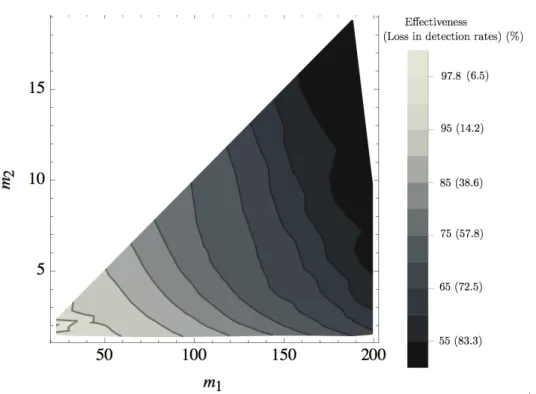
The work in this Chapter focuses on the requirements of template waveforms for the detection of IMRACs in aLIGO. Firstly, by computing the effectiveness of inspiral-only template waveforms at filtering the full coalescence signal, we determine the relative importance of the inspiral and merger-ringdown phases. We identify three regions in them1-m2 plane in which: (a) inspiral-only searches are feasible with losses in detection rates L in the range 10% . L . 27%, (b)
searches are limited by the lack of merger and ringdown in template waveforms and are liable to incur losses in detection rates in the range 27% . L . 50%, and (c) where merger and ringdown are essential for searches in order to prevent losses in detection rates greater than 50%.
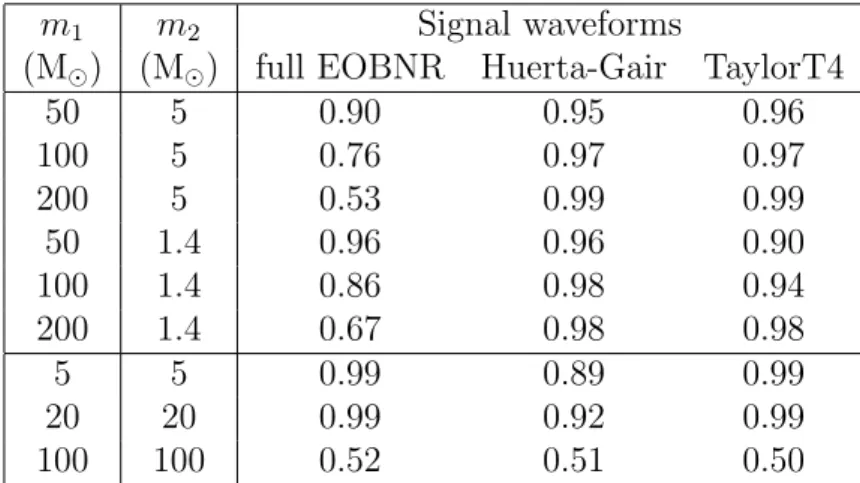
Secondly, to gain insight into the accuracy of the inspiral portion of IMRAC waveforms we compute the effectiveness of the inspiral-only portion of EOBNR waveforms at filtering gravitational-wave signals as described by the HG wave-form family. We find that there is a non-negligible discrepancy between EOBNR and HG inspirals in the regime where inspiral-only searches could be considered sufficient. For reference we also compare EOBNR inspirals to a post-Newtonian (PN) [64;65] waveform family known as TaylorT4 [26]. The PN expansion is li-able to be a poor choice of approximant for IMRACs because of the large number of cycles spent at small radii. We find that EOBNR and HG are in better agree-ment with each other than to TaylorT4, as might be expected from the previous observation.
Our approach does not directly address the accuracy of template waveforms, because none of the waveforms considered have been matched to full numerical waveforms. However, assuming that the waveform families we consider “bracket” the correct gravitational waveforms in the IMRAC regime, this approach pro-vides a useful heuristic for quantifying the effectiveness of existing gravitational waveforms for IMRAC searches. Further numerical relativity simulations will be important in the continuing development of accurate template waveforms for IMRACs.
Our analysis improves upon previous work to determine the detectability of IMRAC sources [66] which only considered the faithfulness of template waveforms, i.e., the effectiveness of template waveforms evaluated at the signal parameters. Additionally, that study only considered inspiral-only waveforms and focused on the LISA regime.
This chapter is organized as follows. In Sec. 2.2 we review the basics of matched filtering as applied to gravitational-wave detection. In Sec. 2.3 we de-scribe the waveform families used in our study. In Sec. 2.4 we compute the contributions to signal-to-noise ratio (SNR) from the inspiral and merger and ringdown phases of EOBNR waveforms in the intermediate mass-ratio regime. In
Sec. 2.5 we study the effectiveness of only waveforms to filter inspiral-merger-ringdown gravitational wave signals from IMRAC sources and identify the three regions in which different searches could be conducted. In Sec. 2.6 we compare the inspiral portion of EOBNR waveforms to HG and TaylorT4 wave-forms. In Sec 2.7 we consider the implications of our results for future searches in advanced detectors.
2.2
Matched filtering of gravitational-wave
sig-nals
In order to quantify the requirements of gravitational waveforms for IMRAC searches, we summarize the key concepts of matched filtering which is the core principle behind gravitational-wave detection. The fundamental object is the optimal filter of the data which is used to define the maximum signal-to-noise ratio achievable from a stretch of data which contains a gravitational-wave signal. The output of a wave detector which contains a gravitational-wave signal will generally be of the form s(t) = h(t) + n(t). Here s(t) is a data-stream consisting of a gravitational-wave signal h(t) and noise n(t). We take the noise to be Gaussian and stationary for simplicity. We note that in general the noise will not be Gaussian and stationary in the detector network, though will not consider the effects of non-Gaussianity in the noise here.
One can filter the data for a signal h(t) if we know the form ofh(t). Consider the following filtering procedure. We take a signal containing a rapidly oscillating function of time, h(t), to be the signal buried in Gaussian and stationary noise. The convolution of the detector output, s(t), with the signal, averaged over an observation time T, is 1 T Z T 0 dt s(t)h(t) = 1 T Z T 0 dt h2(t) + 1 T Z T 0 dt n(t)h(t). (2.2) Both h and n are separately oscillating functions of time. The first term on the right hand side of Eq. (2.2) is positive definite and grows, for large values ofT, as
of the signal, 1/T R0T dt h2(t) ∼h20, where h0 is the average amplitude of h(t). Conversely, the noise n(t) and the signal h(t) are uncorrelated. The second term on the right hand side of Eq. (2.2) grows at most, for large T, as T1/2 so that 1/T R0T dt n(t)h(t) ∼ (τ /T)1/2 n0h0, where n0 is the characteristic amplitude of the noise and τ is its characteristic period of the noise. Hence in the limit
T → ∞, the second term on the right hand side of Eq. (2.2) averages to zero and the signal is filtered out of the data-stream.
More formally, we work with the filtered detector output ˆs given by ˆ
s =
Z ∞ −∞
dt s(t)K(t), (2.3)
where s(t) is a data stream and K(t) is the filter function. A commonly used detection statistic is the “signal-to-noise” ratio (SNR), defined as the ratio of the expected value of ˆs when a signal is present, S, to the rms value of ˆs when the signal is absent, N. We thus seek the filter K(t) which maximises the SNR. The expectation value of the filtered signal, S, is [29]
S = Z dths(t)iK(t), = Z dt h(t)K(t), = Z df˜h∗(f) ˜K(f), (2.4)
where we have used the fact that hn(t)i = 0 on the second line. The Fourier transform, ˜h(f) of h(t), and its inverse are defined in Eq. (A.1). The rms value of ˆs when the signal is absent, N can be computed from [29]
N2 = hhs2(t)i − hs(t)i2i h=0 , = hs2(t)ih=0, = Z df 1 2Sn(f)| ˜ K(f)|2, (2.5)
(PSD), and is defined by the ensemble average of the noise [67]: 1
2Sn(f) =h|˜n(f)| 2i 1
T , (2.6)
where T is the duration of an observation time over which the noise would typi-cally be collected in an experiment. The SNR is thus given by [67]
S N = R∞ −∞ df ˜h(f) ˜K ∗(f) h R∞ −∞ df (1/2)Sn(f)|K˜(f)|2 i1/2. (2.7)
To find the filter K which maximizes Eq. (2.7) we define the “noise-weighted inner-product”: (a|b) = 4 < Z ∞ 0 df ˜a ∗(f)˜b(f) Sn(f) , (2.8)
in terms of which the SNR, Eq. (2.7), is given by
S
N =
(u|h)
(u|u)1/2, (2.9) where u(t) is a function with Fourier transform ˜u(f) = (1/2) Sn(f) ˜K(f).
Geo-metrically, we have a vector of unit norm ˆu=u/(u|u)1/2 with which we are taking the inner-product with h. Thus, the SNR is maximized when ˆu is parallel toh. The optimal filter, K, which maximizes the SNR is therefore given by
˜ K(f) = const. ˜ h(f) Sn(f) . (2.10)
The constant is irrelevant and the best filter is thus given by the signal itself. This is a crucial point as it states that we must know the form of the signal which we want to detect in order to obtain the optimal SNR. In terms of the noise-weighted inner-product the optimal SNR is expressed succinctly as
S
N
max
= (h|h)1/2. (2.11)
of model waveform hwhich we require to filter the data. In the section below we outline three model waveform families which we use in our study.
2.3
Waveforms
In this section we summarise the key concepts entering the construction of the waveforms used in this study. Throughout the chapter, for a binary system with individual component masses m1 and m2 (with m2 < m1) we define the total mass as M ≡m1+m2, and mass ratio and symmetric mass ratio as q≡m2/m1 and η ≡m1m2/(m1+m2)2, respectively.
We first consider the family of waveforms constructed by calibrating the effective-one-body approach to numerical relativity (EOBNR) [41; 68; 69]. The EOBNR family describes the full inspiral-merger-ringdown signal; it is currently used in searches that reach the IMBH mass range, so far up to 100 M [8]. The
free coefficients in the family have been fitted to comparable mass ratio numerical relativity simulations, and by construction this family is deemed to be faithful in the test particle limit. For this work, we use the implementation provided by the LIGO Scientific Collaboration Algorithm Library (LAL) that corresponds to the approximant EOBNRv2 [41].
We also consider a waveform family based on test particle motion in Kerr / Schwarzschild space-time with radiative and conservative self-force corrections which we refer to as the Huerta-Gair (HG) family [44]. The approximation scheme is constructed specifically to handle highly-asymmetrical mass-ratio binaries and is therefore a physically well motivated approximation scheme for intermediate mass-ratio inspirals. These waveforms have been compared against Teukolsky based waveforms and the match exceeds 95% over a large portion of the pa-rameter space [63]. These waveforms have been used to study detection of in-termediate mass-ratio inspirals in Einstein telescope in [44]. The Huerta-Gair waveforms describe only the inspiral portion of the coalescence signal. There is no corresponding LAL approximant for the HG waveform family.
Finally, as a reference we use the standard inspiral-only post-Newtonian ap-proximation corresponding to the LAL approximant TaylorT4 at three-and-a-half post-Newtonian order in phase [26].
The TaylorT4 waveforms used here are computed in the so-called “restricted” amplitude approximation, which assumes the waveform amplitude to be zeroth post-Newtonian order and only includes the leading second harmonic of the or-bital phase. We only include the leading second harmonic of the oror-bital phase in the EOBNR waveforms. We do not consider the effects of spin or eccentricity in any of the waveform families, as we restrict to circular orbits and non-spinning black holes.
2.3.1
EOBNR
EOBNR uses an effective one body (EOB) Hamiltonian to evolve the system’s trajectory through the inspiral and plunge phase, while numerical simulations and black hole perturbation theory are used to construct the merger and ringdown phases respectively. The PN Hamiltonian generates a waveform hinsp−plunge(t)
which is matched at some time, tmatch, to a merger and ringdown waveform,
hmerger−RD. The full EOBNR waveform is given by (see [26] and references
therein),
h(t) = hinsp−plunge(t)Θ(tmatch−t)
+ hmerger−RD(t)Θ(t−tmatch), (2.12)
where Θ(.) is the Heaviside step function.
2.3.1.1 Inspiral-plunge waveform
To calculate the inspiral trajectory one solves Hamilton’s equations given the Hamiltonian of the EOB metric and the inspiral-plunge waveform at leading Newtonian-order is [26],
h(t)insp−plunge =A ωˆ1/3sin [2φ(t)], (2.13) where the “angular frequency” ˆω is given by Eq. (3.23b) in [26]. The overall scaling A depends on the source location with respect to the detector. In this
chapter we will use normalized template waveforms and so we leave this factor unspecified.
2.3.1.2 Merger-ringdown waveform
The merger-ringdown waveform is made up of a superposition of quasi-normal modes (QNMs) [41; 70;71]. We only consider the dominant (2,2) mode and the merger-ringdown waveform is given by
hmerger−RD(t) =A N−1 X n=0 A22ne−iσ22n(t−t 22 match), (2.14)
where n is the overtone number of the Kerr QNM, N is the number of overtones,
t22match is the time at which the (2,2) mode is matched to the inspiral-plunge waveform and the coefficient A22n is found by a matching procedure. We take
σ22n≡ωn−iαnwhereωn >0 are the oscillation frequencies andαn >0 are
asso-ciated with the inverse of the decay times of the QNM. The full inspiral-merger-ringdown waveform is then given by matching the inspiral- plunge waveform, Eq. (2.13), to the merger-ringdown waveform, Eq. (2.14), waveform close to the EOB light-ring [72].
2.3.2
HG waveforms
HG waveforms aim to capture the main features of the binary inspiral when the mass-ratio of the system is small. Physically, this means we work in a test particle limit. For non-spinning bodies, this limit guarantees that the inspiralling particle instantaneously follows Schwarzschild geodesics while the flux of the orbital pa-rameters is adiabatic. The orbital papa-rameters (E, Lz) are evolved slowly using a
prescription for the flux of energy, E, and angular momentum projected along the central black holes spin axis, Lz. Combining these fluxes with the geodesic
equa-tions for a test particle in Schwarzschild space-time yields the particles trajectory in Schwarzschild coordinates, (t, p, θ, φ). Here we specialize to (quasi-)circular orbits around a non-spinning central black hole.
Lz m2 = p M M p 1−(3M/p) , (2.15) and the inspiral trajectory is generated by the flux of the above quantity which is given by [63], ˙ Lz =− 32 5 m22 M M r 7/2 1− 1247 336 M p + 4π M p 3/2 (2.16) −44711 9072 M p 2 + ca1 +cb1M p 1/2 +cc1M p !)
The values of the coefficients are ca
1 =−28.1517, cb1 = 60.9607, cc1 = 40.9998. Conservative self force corrections modify the orbital frequency and are given by, [63] dφ dt := Ω = 1 M M p 3/2 +δΩ, = 1 M M p 3/2( 1 + + m2 d0+d1 M p +d1.5 M p 3/2 +d2 M p 2! ) . (2.17)
The values of the coefficients are d0 = 1/8, d1 = 1975/896, d1.5 = −1027π, d2 = 1152343/451584. To compute the inspiral trajectory at each instant in time we evolve Lz and φ according to Eq. (2.16) and Eq. (2.17) and compute p from Lz
from Eq. (2.15). The gravitational-wave strain, h(t), is given by,
h(t) = A Ω(t)p(t)2sin [2φ(t)]. (2.18) The overall scaling A depends on the source location with respect to the detector. In this chapter we will use normalized template waveforms and so we leave this factor unspecified.
2.3.3
TaylorT4
The TaylorT4 approximant is based on the post-Newtonian (PN) expansion (see section III B. of Ref. [26] and references therein). The orbital phase is given by solving the coupled differential equations of the orbital phase and velocity, φ(t) and v(t), respectively, dφ dt − v3(t) M = 0, (2.19) dv dt = K(t), (2.20)
where the acceleration K(t) is given Eq. (A.14).
The gravitational wave strain h(t) can then be expressed directly as
h(t) =Av2sin [2φ(t)] . (2.21) The overall amplitude A depends on the source location with respect to the detector. The amplitude is given in [73]. In this chapter we will use normalized template waveforms and so we leave this factor unspecified.
2.4
SNR from inspiral, merger and ringdown
In this section we consider the relative contributions of the different portions of the gravitational-wave coalescence signal to the SNR as a function of the IMRAC’s mass. We take the instrument noise power spectral density (PSD) Sn(f) to be
the aLIGO high-power, zero-detuned noise PSD [74] which is shown in Fig. 2.1. The expectation value of the optimal matched filtering SNR, in the case when the signal and template waveforms are identical, is given by [67]
S N max = (h|h)1/2, = " 4< Z fmax fmin f|h˜(f)| p f Sn(f) !2 dlnf #1/2 , (2.22)
ing the maximum SNR in the form above clearly separates it into contributions from the signal strain, f|˜h(f)|, and the root-mean-squared (rms) noise spectral amplitude,pf Sn(f), which is the strain signal associated with the detector noise.
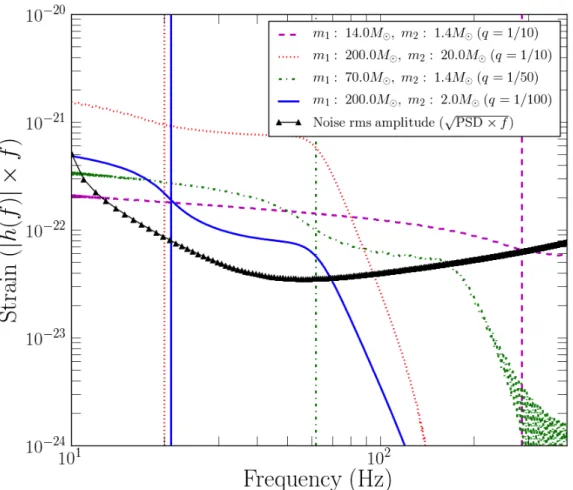
One can gain insight into the relative contributions to the SNR from inspiral, merger and ringdown by comparing the gravitational-wave strain to the noise rms value. In Fig. 2.2 we show the strain for selected overhead and face-on (i.e., optimally-located and orientated) IMRAC sources at a fiducial distance of 1Gpc as described by the EOBNR waveform family, and noise rms amplitude. The ISCO frequency of each signal is shown as a vertical line. The strain from merger and ringdown is thus the portion after the ISCO frequency. The contribution to the strain from merger and ringdown from binaries with component masses (m1, m2) = [(200,20) M,(200,2) M], is greater than that of the noise rms
amplitude (black curve with triangles). In general, systems with ISCO frequencies between 30−100 Hz, merge in the “bucket” of the noise curve, i.e., where the detector is most sensitive. For example, for the (m1, m2) = (200,20) M system
(red dotted curve in Fig. 2.2), the merger and ringdown contribute the bulk of the SNR. Conversely, the inspiral contribution to the SNR is strongly suppressed for such massive systems.
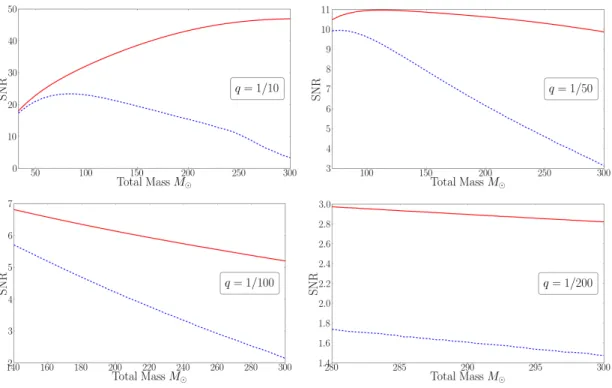
In Fig.2.3we show the maximum SNR, Eq. (2.22), as a function of the binary’s total mass produced by inspiral-only and full EOBNR waveforms at four different mass-ratios in the range 1/200 ≤q ≤ 1/10. We construct inspiral-only EOBNR waveforms by Fourier transforming the full waveform into the frequency domain (see Eq. (A.1) ) and truncating it at the ISCO frequency. We have considered the SNR for optimally-located and orientated sources at a fiducial distance of 1 Gpc. The lower bound mass of the smaller body is set to m2 = 1.4 M which is
the canonical neutron-star mass.
We note that the IMRAC systems we are considering are liable to produce an appreciable SNR at distances greater than 1 Gpc. Such cosmological distances correspond to red shifts z ≥ 0.2 [75]. Gravitational waves from binaries which propagate in an expanding FRW universe experience a Doppler shifting of their frequency such that the observed gravitational-wave frequency fobs is related to the gravitational-wave frequency at the source, fs, by fobs = (1/(1 +z))fs [29].
Figure 2.2: Strain of optimally-located and orientated IMRAC sources at a fiducial distance of 1 Gpc as described by EOBNR waveforms, and aLIGO noise. The corresponding ISCO frequency of each signal is shown as a verti-cal dashed line. The strain from the merger and ringdown from each source contributes after the ISCO frequency. For the sources with component masses (m1, m2) = [(200,20) M,(200,2) M], the strain from merger and ringdown sits
above the noise spectrum. The SNR from the full EOBNR waveform and from its inspiral-only portion are shown in Fig.2.3.
is larger by a factor of (1 +z) which is typically referred to as the “red shifted chirp mass” of the binary. Thus, systems at red shift z = 0.2 appear to be 1.2 times heavier. Hence, when we refer to binary masses in the following pages, we strictly mean the red shifted masses of the binary.
The lowest total mass for the q = 1/50, 1/100 and 1/200 subplots is set by fixing the mass of the smaller body to m2 = 1.4 M. For the q = 1/10 subplot
in Fig. 2.3 the smallest total mass is set to M = 35 M as the inspiral phase
accounts for∼100% of the SNR below this value. The lower limit of integration of Eq. (2.22) is 10 Hz and the upper limit is 2048 Hz, which is the Nyquist frequency of discretely sampled EOBNR waveforms generated at a sampling rate of ∆t = 4096 s in the time-domain. We only consider systems with total masses such that the ISCO frequency is greater than 10 Hz (our low frequency cut-off). The highest total mass for each of the subplots in Fig2.3 is set toM = 300 Mwhich
ensures the ISCO frequency is greater than 10 Hz.
As anticipated from Fig. 2.2 there is a significant difference in the SNR be-tween inspiral-only and full EOBNR waveforms which can be seen at all four mass-ratios. We also note that for systems with mass-ratios of q = 1/10 with total masses below around M = 35 M the inspiral phase is the dominant source
of SNR. If we consider 3% as a fiducial value of the difference between the full SNR and the one associated to the inspiral-only waveform – which leads to a loss in detection rates of 10% – this happens at M ≈ 35 M for q = 1/10. For
bina-ries with q = 1/50, 1/100 and 1/200, the minimum difference in SNR between inspiral-only and full waveforms is ≈6%, 15% and 40% respectively for the mass ranges considered in Fig 2.3.
In summary, we have shown that inspiral-only templates will miss a signifi-cant portion of the total SNR of IMRAC signals over the bulk of the detectable mass-space. Future searches will therefore require templates that can match the full inspiral-merger-ringdown. However, there is a small region of the parameter space for which inspiral-only templates may suffice for searches, without induc-ing drastic losses in detection rates. In the followinduc-ing section we quantify the effectiveness of inspiral-only templates for searching for full coalescence signals in aLIGO.

![Figure 1.2: Anticipated Advanced LIGO noise sources generated using the online GWINC tool [31]](https://thumb-us.123doks.com/thumbv2/123dok_us/9037028.2801502/20.892.197.770.211.528/figure-anticipated-advanced-ligo-sources-generated-online-gwinc.webp)
![Figure 1.3: Noise amplitude spectral densities of various Earth based gravitational-wave detectors [32]](https://thumb-us.123doks.com/thumbv2/123dok_us/9037028.2801502/21.892.166.696.409.779/figure-noise-amplitude-spectral-densities-various-gravitational-detectors.webp)
![Figure 2.1: Advanced LIGO high-power, zero-detuned noise PSD [74]](https://thumb-us.123doks.com/thumbv2/123dok_us/9037028.2801502/45.892.130.739.395.876/figure-advanced-ligo-high-power-zero-detuned-noise.webp)
![Figure 3.1: Cartesian coordinate system (x, y, z) attached to a ground based interferometer and a coalescing binary system in that frame [81]](https://thumb-us.123doks.com/thumbv2/123dok_us/9037028.2801502/64.892.304.701.365.808/figure-cartesian-coordinate-attached-ground-interferometer-coalescing-binary.webp)
![Figure 3.2: Noise PSD used to whiten template waveforms, Eq. (3.13), roughly matching that of initial LIGO [1].](https://thumb-us.123doks.com/thumbv2/123dok_us/9037028.2801502/76.892.228.805.676.1032/figure-noise-whiten-template-waveforms-roughly-matching-initial.webp)
