Clause structure
In this chapter I describe the basic structure of clauses in Barupu. Out of keeping with polysynthetic typology, there is linear ordering of grammatical functions in the
clause, but there is no strong evidence of hierarchical structure within that ordering, see §6.2. Section 6.3 discusses the grammatical status of verbal affixes and their interaction with overt NPs. In§6.4, I present an overview of mechanisms for marking the pragmatic status of participants, including deviations from canonical word order. Finally, in §6.5 I discuss non-verbal predicates. I begin with definitions and a
summary of grammatical functions in Barupu.
6.1
Grammatical functions
Every verb in Barupu shows agreement for at least one argument and some
obligatorily show agreement for two. One consequence of obligatory agreement is that there is no deletion of arguments under identity conditions, or control of infinitives, meaning that many of the usual syntactic tests used for identifYing
grammatical relations cannot be appealed to. This also means that there is no need to identifY a privileged 'grammatical subject' or 'pivot' function. In addition, any participant can be relativised in Barupu and there are no voice operations. The
functions I will identifY for Barupu have clause-internal definitions only.
Another factor complicating the identification of grammatical functions in Barupu is the lack of any NP marking. There are no case markers, adpositions or particles which give any information about the role an NP has in the clause. There are indications of an NP's role (e.g. word order) but there is no overt marking. The lack ofNP marking, coupled with the lack of cross-clausal operations targetting specific arguments, makes it difficult to define a class of core arguments and draw the familiar line between them and obliques.
Following is a list ofthe seven possible functions an NP might be performing in a Barupu clause and their identifYing characteristics. Three of these can be
instantiated in a simple or complex verbal word, the others are only identified by distributional characteristics such as word order and, insome cases, inherent meaning.
• Subject: we can identifY the subject relation as encompassing the single argument of an intransitive verb (5) and the most Actor-like participant of a transitive verb (A). This argument is marked directly on the verb root by prefixes, as well as, in some conj ugation classes, infixes. Any NP
co-referencing this argument must be pre-verbal. The words unake 'alone' and
bekuREFL have scope over this argument.
Identifying an object relation is less straightforward. Non-subjects ofunderived clauses are theobligatorynon-Actor-like participants of monotransitive verbs (P), and the Themes (T) and Recipients (R) of ditransitive verbs. These arguments have the following characteristics:
• P: monotransitive verbs fall into two classes according to the morphological treatment of their Ps. As discussed in detail in §4.2.2, verbs with typically
inanimate, unindividuated Ps do not cross-reference their Ps with suffixes. The NP representing an unindividuated P (Pu) always appears before the verb. Verbs with typically animate, individuated Ps obligatorily cross-reference their Ps on the verb with a suffix. The NP representing an individuated P (Pi)
unrnarkedly appears pre-verbally but can appear after the verb in a pragmatically-marked construction (§6.4.1).
• T: like Pu, this argument is not marked on the verb; its only instantiation in the clause is an NP, and again like Pu, the NP must be pre-verbal.
• R: this argument is obligatorily cross-referenced on the verb by suffix and the NP unrnarkedly appears post-verbally.
As well as the obligatory participants of underived clauses discussed above, the following NPs may also be found in the clause:
• Instrument: an optional participant which is not case marked nor marked on the verb. An NP referencing this participant is most often pre-verbal but can also be found post-verbally.
• Location/Reason: an optional participant which is not case marked nor marked on the verb. An NP referencing this participant is unrnarkedly post-verbal. When a nominal found here has inherently locational semantics e.g. bo 'place', it supplies a Goal/Source/Location role depending on the verb; when a nominal without any locational semantics is found here it supplies a sort of 'Reason' role, see below.
• 'Adjunct' nominal: a nominal which, for reasons given in §6.2.6 below, I will argue fonus a complex predicate with the verb rather than acting as a
• Added object: introduced into the clause by one of twelve participant-adding suffixes or the Beneficiary/Possessor prefix. The added object is obligatorily marked by a suffix directly on the participant-adding morpheme. Added objects can play many different semantic roles, depending on the meaning of the participant-adding morpheme and the meaning of the verb. They fulfil most of the functions of adpositions and semantic cases in other languages (see Chapter 7). NPs co-referencing these participants are unrnarkedly post-verbal.
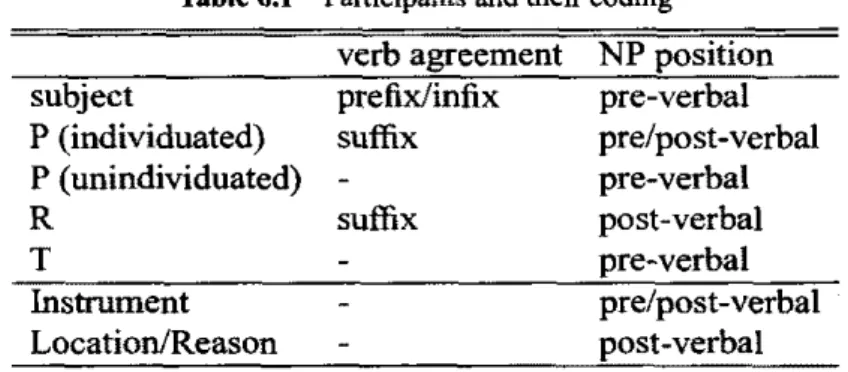
Leaving out the non-participant adjunct nominals and the objects added by extra morphology, we can list the possible participants of simple clauses and schematise their characteristics as in Table 6.1.
Table 6.1 Participants and tbeir coding
subject P (individuated) P (unindividuated) R T Instrument Location/Reason verb agreement prefix/infix suffix suffix NP position pre-verbal pre/post-verbal pre-verbal post-verbal pre-verbal pre/post-verbal post-verbal
As is shown in the Table there are only two ways - verb agreement and word order to potentially group the obligatory sub-categorised arguments (subject, Ps, T and R), and distinguish them from the optional non-subcategorised adjuncts
(Instrument and LocationlReason).
Turning first to the obligatory arguments set and the difficulty of uniquely identifYing the object relations, we can see that unindividuated Ps of monotransitive verbs receive the same treatment as Ts of ditransitive verbs. Neither is
cross-referenced on the verb and both must appear pre-verbally. Rsof ditransitive verbs receive the same morphological marking as individuated Ps of monotransitive
verbs but the two argument types have different word order distributions in the clause; individuated Ps are unmarkedly pre-verbal while R;;are unmarkedly post-verbal.
In establishing object systems Dryer (1986:29) shows that a system which treats P and T in the same way in contrast toR,has a direct/indirect object distinction like that found in English. A system which treats P and R in the same way in contrast to T has a primary/secondary object distinction. This can be seen in Figure 6.1.
3.direct vs. indirect object Direct Object
b. primary"'S.secondary object
Primary Object Ditransitive Indirect Object Monotransitive Ditransitive R Secondary Object
Figure 6.1 Groupings ofP, T and R.Source: Dryer (1986:29)
Adapting this system to Barupu is not straightforward. For example, in Barupu, we must identify two different Ps of monotransitive verbs: individuated (Pi) and unidividuated (Pu). The Barupu groupings are shown in Figure 6.2.
Pre-verbal Preorpost ,,<bat Post-verbal Monoltansitive Oiuansitive Obligatory wffix Nomarking
a. Word order possibilities b. Verb Agreement
We can see from Figure 6.2 that the Barupu object system is mixed. Word order treats Puin the same way as T in contrast to both R and Pi.! Verb morphology, on the other hand, treats Pi and R the same in contrast to Pu and T - yielding something similar to a primary/secondary object distinction.
There does not seem to be a simple way of reducing the object relations to grammatical functions - Pu and T can be conflated to one function, which I will call secondary object. However, Pi and R cannot be grouped into the one function of primary object, because of their different positions in the clause. I will refer to the
suffix on the verb as the object slot even though it seems more closely related to individuation/animacy than to a grammatical function, but I will continue to make a distinction between Pi and R in discussions of word order.
I tum now to the agreement and word order characteristics ofthe optional participants and the difficulty of giving a clear morpho-syntactic statement about the difference between core and oblique participants in Barupu. Neither Instruments nor Location/Reason participants are cross-referenced on the verb. Instruments are unmarkedly pre-verbal and LocationlReason participants are unmarkedly post-verbal. One argument might be that lack of verb agreement indicates non-core status. The problem with this is thatPuand T are not marked on the verb and yet they are obligatory. If these participants could be shown to be non-arguments (e.g.
incorporated) then this analysis would hold. However, they do seem to have all the characteristics of full arguments (e.g. they can be full NPs).
Another argument might be that the post-verbal position occupied by
Location/Reason is the oblique position because all other arguments in simple clauses have the potential to appear pre-verbally. This grouping would mean singling out
IItis interesting to consider the pragmatic permubility of Pi in terms ofBarupu's incipient polysyn-thetic typology. For example, we could speculate that it is a sign of movement away from fixed word order to a more discourse·figurational clause structure. At the same time, the lack of verbal agreement and fixity of the Pu could be a movement towards incorporation of these arguments.
Instrument for special treatment because it can appear before the verb, but that may be alright because it is not always clear whether Instruments are sub-categorised or not (Andrews 1985:91-92). However, Rs also appear post-verbally and these are obligatorily marked on the verb and clearly obligatory sub-categorised arguments.
Insummary, we cannot identify a unified object relation in Barupu and nor can we make a clear morphosyntactic statement about a distinction between core
arguments and obliques. The word order and verb morphology each encode different aspects of theP,T and R roles. Verb morphology encodes notions of animacy and individuation: Rs are more likely to be animate, and therefore individuated, than Ts so it is not unexpected that they should receive morphological marking. Word order suggests that Rs could be thought of as individuated Goals (this is returned to below) but there is no other morphosyntactic reason to label them oblique.
6.2
Verbal clauses
In this section I exemplify the various points made above about the positions and characteristics of grammatical functions in Barupu.
6.2.1 Intransitive clauses
The single argument of an intransitive verb always appears before the verb and is obligatorily marked on the verb by prefix, as in (243), or prefix and infix as in (244). (243) Kuimi k-o-koe.
mother RL-3sG.F-gO.Up
S V
'Mother went up.'
(244) Tf cM tora hI k-e-no(p)i monrai n-e-titi.
line head old ancestor RL-3pL.M-(3pL.M)go singsing IRR-3PL.M-dance
6.2.2 Monotransitive clauses
In a clause headed by a suffix-taking monotransitive verb (245), the A and Pi are both obligatorily marked on the verb - A by prefix/infix and Pi by suffix - and any NPs co-referencing these arguments both appear before the verb. The basic ordering of NPs in transitive clauses is thus A PiV.
(245) Kucmi aka k-o-yarii-ka.
mother father RL-3sG.F-see-3SG.M
A Pi V
'Mother saw father.'
In the above example, the gender specification in the verb's obligatory prefix and suffix helps to assign the right interpretation to the clause. But, as the following example shows, when the verb agreement does not disambiguate, word order does. Given equal animacy - and neutral pragmatic status of - participants, the following example would have an A Pi V interpretation (see §6.4.2, below, for examples of when Pi AV ordering is appropriate).
(246) Bio biam ma biam k-a-yarii-ka.
person man childman RL-3sG.M-see-3sG.M
A Pi V
'The man saw the boy.'
There is a preferred order of arguments, but there are no movement or
substitution processes which positively identify a constituent, so there do not seem to be compelling reasons for positing aVPconstituent consisting of the verb and the Pi.
In clauses headed by non-suffixing monotransitive verbs thePu must always appear before the verb and is not cross-referenced on the verb. An example of a clause with a Pu is given in (247).
(247)
Oi
k-ii-r-a.sago RL-3sG.M-3sG.M·eat Pu V
The totally fixed position of this argument with respect to the verb might suggest the existence of a constituent, but again, as there are no substitution or movement processes, it is unclear that a VP analysis is useful. Secondary objects are full, modifiable NPs, as shown in examples(248)and (249),suggesting that they are not incorporated.
(248) Raj pako neni ek6k6 pliko k-o-chiiro.
sibling big ISG.F string.bag big RL-3sG.F-carry.on.head
'My big sister carries a big string bag on her head.' [DlCT-PA:Ol]
(249) Eif nape anianw nenti k-e-p-u=ero?
hey who fruit.sp ISG.M RL-3pL.M-3pL.M-pick.fruit=DIRR
'Hey, who's picking my fruit?'[ANR-MN:Ol]
The secondary object NP can be omitted but only if its identity is fully recoverable (see §6.3.3, below).
6.2.2.1 Rejlexive and reciprocal
A verb in a reflexive clause takes the same number of affixes in the same positions as itwould in a non-reflexive clause and it takes two NP arguments. However, a
reflexive object is always post-verbal on suffixing transitive verbs. The construction is marked in three ways. First, a suffixing transitive verb will take co-referential subject and object affixes. Second, an overt pronoun is obligatory and followed by the
reflexive particleheku. Third, the reflexivised pronoun appears after the verb. This is shown in the following example. Here the suffixing monotransitive verb-ye 'hit' takes a prefix and a suffix, both referring to the same participant, and the overt reflexivised pronoun is post-verbal.
(250) Kua Manuela k-o-ye-iJ b6 heku.
AT PN RL-3sG.F-hit-3sG.F 3SG.F REFL
'Manuela hit herself.'
With dual and plural pronouns a clause with a post-verbal reflexive NP is ambiguous between reflexive and reciprocal.
(251) K-epi-p-ye-pi mepi heku. RL-lou-lou-hit-Iou lou REFL 'We hit ourselves/each other.'
Some intransitive verbs are inherently reflexive or reciprocal and require no operations. For example, the intransitive verbpi-nii 'wash' is inherently reflexive and the intransitive verb-oa'fight' is always found with dual or plural subject agreement and implied reciprocity. This is shown in examples (252) and (253).
(252) Pi k-e-ni(n)i.
water RL-ISG.F-(lsG.F)wash '1 wash (myself).'
(253) K-ere-o(p)a. RL-30u-(30u)fight
'Those two fought (each other).'
The reflexive particleheku is also used in Barupu for emphasis (as in English '1 did it myself').
(254) Ya beku k-a-kae k-a-ore-o ekoko.
3SG.M REFL RL-3SG.M-come RL-3sG.M-search-oOWN string.bag 'He himself came and had a look in the string bag.' [ANR-MN:Olj
Reflexive possession also uses regular word ordering, as in the following example. The possessed reflexive Piom ya beku 'his own wife' appears before the verb in the normal position for Pi.
(255) Anranae om ya beku k-a-ye-u k-o-rai.
demon wife 3SG.M REFL RL-3sG.M-hit-3SG.F RL-3sG.F-die 'The demon killed his own wife.' [ANR-MN:Olj
(256) Owu k-e-vlri, reM beku=va k-e-p-ye-u.
some RL-3pL.M-die.PLS body REFL=PRM RL-3PL.M-3pL.M-hit-3SG.F
'Some men died, they took their own lives.' ('They hit their own body.') [DC-MM:03]
(257) Au eno beku k-o-r-a.
thing hand REFL RL-3sG.F-3sG.F-do
The non-suffixing transitive verbs do not appear witb reflexive objects but this may be due to the facts that the types of participants tbey take as Undergoers are not very highly animate and thus unlikely to act on themselves, and tbat tbe 3SG.F personal pronounbecannot be used to refer to inanimates, e.g. *iii k-u-iro b6 beku
(tree RL-3SG.F-fell3sG.F REFL).
Another way to indicate a reciprocal action is by reduplicating the modifier
Mru'return' following a verb marked with dual or plural subject, as in(258). (258) K-ere-tere Mru-Mru.
RL-3Du-ask REDUP-retum
'They asked (each other) back (and fortb).' [TP-MN:OIJ 6.2.3 Ditransitive clauses
The following example shows the structure of a clause headed by the ditransitive verb
-0'give'. The Themeba=va'fish=PRM', like Pu, appears before the verb and there is
no instantiation of this argument in the verb. The Recipient,niiki'dog', is marked on tbe verb with a suffix-ka, like a Pi, but it appears after the verb.
(259) Cha Menriri ba=va k-a-r-o-a niiki.
AT PN fish=PRM RL-3sG.M-3sG.M-give-3sG.M dog
'ChaMenriri gave the dog-spirit a fish.' [TP-MN:O1]
All NPs, including Pu and T, can be omitted if their identities are recoverable from context. And, even when the T NP is omitted, the R still appears after the verb. This is shown in the following example from a procedural text about how to make paint. The Theme has already been established and so is not overt in these clauses.
(260) Miire k-anii-irai.
now RL-lsG.M-say 'Now I'm telling (it),
bai n-e-m-irita-i mev6va miirenau. apo mem v6va.
FUTIRR-lpL-lpL-leach-3pL.M children now NOWgrand.relation lPL again so we can teach (it) to the children of today, and our grandchildren again.' [p-MG:03]
The above example shows that it is not just the structural presence of the Theme which forces a Recipient to fonow the verb.
6.2.4 Instruments
The Instrument in Barupu is not case-marked nor marked on the verb, and often appears before the verb, making it look very like a secondary object. Unlike secondary objects, however, Instruments can appear after the verb. In clauses with transitive verbs and pre-verbal Instruments, the fonowing orders are attested: A Inst V Pi (26la); A Pi Inst V (26lb) and A Inst Pi V (26lc). The Instrument and ( are in bold in the following examples.
(261) a) Kucmi Iii k-o-ye-ya mao
mother tree RL-3sG.F-hit-3sG.M child
A lnstV Pi
'Mother hit the child with a stick.' b) Kucmi ma Iii k-o-ye-ya.
mother child tree RL-3sG.F-hit-3SG.M
A Pi lnstV
'Mother hit the child with a stick.' c) Kuani Iii ma k-o-ye-ya.
mother tree child RL-3sG.F-hit-3sG.M A lnst Pi V
'Mother hit the child with a stick.'
Example (261 c) requires some extra remarks. This ordering is almost indistinguishable from another very common way to express Instrument relations. This way involves a serial verb construction (see Chapter 7) with a 'get' verb (either
-ko 'get.sGO' or-una 'get.PLO'). This construction is shown in the following example.
(262) Kuani iii k-o-ko ma=va k-o-ye-ya.
mother tree RL-3sG.F-gel.SGO child=PRM RL-3sG.F-hit-3sG.M
A PuV Pi V
But, this construction is most commonly realised in abbreviated form, with the 'get' verb elided, as in the following example. Speakers refer to this as a 'short cut' to the serial verb construction.
(263) Kuimi Iii ma=va k-o-ye-ya.
mother stick '" child=PRM RL-3SG.F-hit-3sG.M
A Pu (V) Pi V
'Mother got a stick and hit the child.'
The short cut is usually accompanied by a slight intonation break at the site of the missing verb, but it is almost impossible to distinguish between this construction and a simple clause with tbe structure A Inst Pi V in connected speech.
As mentioned above, the Instrument can also appear after the verb, as in the following example.
(264) Kuani mli k-o-ye-ya al.
mother child RL-3sG.F-hit-3sG.M tree
A Pi V lnst
'Mother hit the child with a stick.'
The factors motivating the different word orders appear to be
discourse-pragmatic; new or important information is preferably pre-verbal. When the Instrument is the only overt nominal in a clause, its preferred position is before the verb. A possible reason for this preferred position might be that the Instrument is sub-categorised for and that clauses with Instruments are treated as something like ditransitive clauses: Instruments are conceptualised as similar to Themes.
Non-suffixing monotransitive verbs with Instruments show a slightly different pattern. Again the Instrument can appear before or after the verb, but, as always, the Pu object cannot appear after the verb. The subject NPs have been omitted from the following examples; the Instruments are in bold-face type.
(265) a) Ai=a k-ana-ira liimon kamo. tree=PRM RL-lsG.M-fell axe
Pu V lnst
b) Ai~a iiimon kamo k-ana-iro. tree=PRM axe RL-I SO.M-feli
Pu Inst V
'I chopped the tree with an axe.'
c) Aimon kamo iii=a k-ana-iro. axe tree=PRM RL-Iso.M-feli
lnst Pu V
'I chopped the tree with an axe.'
c) *Aimon kamo k-ana-iro al. knife steel RL-Iso.M-feli tree
lnst V Pu
Even though it can be fairly clearly established that Pus and Instruments do have differing behaviour, it seems that speakers prefer constructions where they are maximally differentiated. That is, many speakers prefer the serial verb construction over a simple clause involving both a secondary object and an Instrument (again Inst Pu V ordering is difficult to distinguish from the abbreviated serial-verb
construction), while others seem to have a strong preference for post-verbal
Instruments in these cases. Both of these preferences can probably be attributed to the fact that they are not disambiguated by verb agreement and speakers may wish to distinguish them using word order.
Itis also true that the semantics of the nominals themselves can serve to disambiguate. The nouniii can mean either 'tree' or 'piece of wood', and when it is in a clause about chopping and there is an axe present, its most likely interpretation is as the secondary object; a tree or piece of wood that has an axe taken to it. Wheniii is in a clause about hitting and there is a hittable object, like a child or dog, present, its most likely interpretation is as the Instrument.
6.2.5 Location and Reason
Locative and Reason participants are not marked on the verb and appear after the verb. As the following examples will show, the interpretation of the unmarked
post-verbal NP as a locative participant - Goal, Path, Location, Source - or Reason, depends heavily on the semantics of the verbs and nouns involved. These participants are always optional and sentences are perfectly grammatical without them.
In the following example, both mother and father are in the house. To specifY that only one of them is in the house, a relative clause would be used (see §5.6).
(266) Kuimi aka k-o-yarii-kil oro. mother father RL-3sG.F-see-3sG.M house
S 0 V Loc
'Mother saw fatherinthe house.'
There can be no more than one locative argument in anyone clause. Itis impossible to say things like'go along the road to the house' ina single clause.
(267) *K-en-ute rara oro. RL-ISG.F-walk road house
Instead, the information must be spread over two clauses or two verbs in a serial verb construction. An example of this is given in (268), but see Chapter 7.
(268) K-en-ute rara k-e-n-aro oro.
RL-lsG.F-walk road RL-lsG.F-lsG.F-go.down house 'I'm walking along the road, going home.'
Non-ease-marked, non-iterative, post-verbal locatives are found in Skou languages (Donohue 2004), as well as in the areally close Torricelli languages (see McGregor and McGregor 1982:53). McGregor and McGregor (1982:53) label post-verbal nouns functioning as Locations 'adverbs of place' , e.g. Ie ratiuf (he
stayed village) 'he stayed in the village'. They do not explicitly discuss Goals or Sources, but according to their example sentences these arguments apparently either appear unmarked after the verb, e.g. mampeis ki keliuf (afterwards I go village)
preposition marker',..jat the end of a verb, e.g. pele les laule-fwenem (dog will come-prep house) 'The dog will come to the house.' (p.65).
The following examples show how the meanings of the verbs and the nouns themselves are important in determining the interpretation of the post-verbal
participant in Barupu. Example (269), shows that a nominal with receptacle or place semantics will be interpreted as a Goal on 'putting' verbs.
(269) Goal
K-e-m-ikoro-wo(m)o poro.
RL-lpL-1PL-putin-(AG)DOWN canoe
'We put (them/it) down in the canoe.' [P-MB:03j
Example (270) shows that a place noun with a posture verb will be interpreted as an Location.
(270) Location
K-o-kei oro.
RL-3sG.F-sit house
'She sits in her house.'
As a general rule, a post-verbal place noun with a direction of motion verb will be interpreted as a Goal, (as in 271).
(271) Goal
K-ere-ta k-ere-p-aro kikom.
RL-3pL.F-paddle RL-3Du-3Du-go.down mangrove
'They (two) paddled to the mangrove.'
However, the direction of motion verbs in combination with an established deictic centre are also used to indicate how a post-verbal place noun should be
interpreted. For example the interpretation of a place-noun after the 'hither' verb -kae
'come' can depend on context. If the hither verb is followed by a place that is shared by the discourse participants, or is an established deictic centre, then that place can be interpreted as the Goal (i.e 'come to'). If, however, the place is not shared and is not a
deictic centre then it could be interpreted as a Source (i.e. 'come from'). One verb, -bere, determines that the following place is interpreted as a Source.
(272) Source
Cha Paivi pevara k-a-yara-i k-e-bere-ka Baro.
AT PN magician RL-3sG.M-see-3PL.M RL-3PL.M-leave-TOwARD PLN 'Mr Paivi saw magicians coming here from Baro.'
The fact that direction of motion verbs govern the semantic role of the post-verbal NP does strongly suggest the possibility that these NPs are arguments rather than adjuncts and they are not marked on the verb because they are
unindividuated. In a sense they are to R what Pu is to Pi, but Goal and Source NPs are never obligatory.
With manner of motion verbs a post-verbal place noun is always interpreted as a PathILocation, as in (273). Manner-of-motion verbs need to appear in serial verb constructions with direction of motion verbs if they are Goal-directed. This is shown in (274) (see also §7.1.1).
(273) Path/LocatioD
K-ere-ta raka.
RL-3pL.F-paddle river
'They paddled along/in the river.'
(274) PathlLocatioD
K-ere-ta k-ere-r-aro raka.
RL-3pL.F-paddle RL-3pL.F-3pL.F-go.down river 'They paddled down to the river.'
Examples of nouns with place semantics, that is, potential Paths, Locations, Goals and Sources are: proper place names; nouns denoting places like yin 'beach' or
oro 'house'; or receptacles for putting verbs such as rfna 'sago bark' or ek6k6 'string bag'.
Nominals without inherently place or receptacle semantics, such as
oi
'sago', awei 'meat' and arnori 'namesake party' can be interpreted as a sort of Reason role,something equivalent to NPs introduced by 'for' in English. This is shown in the following examples.
(275) K-ere-r-aro 01.
RL-3pL.F-3PL.F-go.down sago 'They've gone to (work) sago.'
(276) K-emi-ta awei.
RL-l PL-paddle meat
'We paddle for fish (to eat).' [u-Gx:o I]
(277) N-e-p-ye-ma amori.
IRR-3PL.M-3PL.M-kill-2sG.M namesake.party
'They're going to kill you for (eating at) a namesake party.' [NScl-cA:03] Animates can never appear as Paths, Locations, Sources, Goals or Reasons of simple verbs. Instead, they must be added objects which are introduced into the clause by the participant-adding morphemes, see Chapter 7 and §6.2.9, below. The relative locations, 'on', 'amid', 'around' and 'under' are also specified with
participant-adding morphemes.
Some locative relations which would be specified with prepositions like 'beside' or 'inside' in a language like English, are achieved through nominal compounding in Barupu. For example,oro 'house' is a potential place and it can be compounded with a locational such as iiri'inside' tooroiiri'inside of afthe house' (see §5.1.2).
Another possible interpretation for an unmarked post-verbal NP is Instrument.
A post-verbal Instrument precludes the appearance of a locative, which is
unsurprising given the non-interativity of post-verbal adjunct NPs. The following example demonstrates that a clause with a post-verbal Instrument as well as a Location is ungrammatical.
(278) *Kuani ma k-o-ye-ya at oro art.
mother child RL-3sG.F-hit-3SG.M tree house inside
S 0 V InstLoc
If speakers wantedto specifY a locative and an Instrument in the same clause, they would have to use a pre-verbal Instrument.
(279) Chakim m=a k-a-ye-ya nJki uka.
grandfather tree=PRM RL-3sG.F-hit-3SG.M dog bush
S Inst V 0 Loc
'Grandfather hit the dog with a stick in the bush.'
Another alternative, with a Location and Instrument in the same clause, is the serial verb construction.
(280) Kuimi Ji=a k-o-ko rna k-o-ye-ya oro an.
mother tree=PRM RL-3SG.F-get.SGO child RL-3sG.F-hit-3SG.M house inside
S Inst V O V Loc
'Mother hit the child with a stick in the house.'
PathILocationiReason NPs can co-occur with Recipients.
(281) Kuani bQ kama aka erora.
k-o-r-o-a
mother fish RL-3sG.F-3SG.F-give-3SG.M father garden 'Mother gave father a fish in the garden.'
There are no examples of a clause with both a Recipient and a Goal or Source.
6.2.6 'Adjunct' nominals
Multi-word predicates involving a nominal-like word and a verb are widespread in Papuan languages.2 The construction is commonly referred to as the 'adjunct nominal construction' (Donohue2004; Foley1986),which is the term1use here. In general, the nominal is present to provide most of the semantic information while the verb is present to contribute some semantic informatioIl, but mostly to carry inflection.
2These predicates have been called 'periphrastic' or 'augmented' verbs (Davies 1985:40,49ff) and 'verb compounds' (Haiman 1980:117·124), among other things. The verb roots in the constructions have been referred to as 'support verbs' (Hairnan 1980; Davies 1985) and more recently 'light verbs' (Foley 2000:inter alia), or 'generic verbs' (Pawley 1993). The nominal-like element has been called 'verbal adjunct' (Gravelle 1997; Pawley et al. 2000), 'complement' (Ross 1980), 'root' Haiman (1980) and 'adjunct nominal' Foley (1986).
Importantly, as Foley (2000:385) points out, the adjunct nominals 'fonn a close-knit syntactic unit with their light verbs as befits a single predication.'
The adjunct nominal constructions found in Barupu can be divided into two main types: those which use a light verb, 'do' where the nominal provides all the semantics, and those which use a verb with its own specific semantics. In both kinds, the nominals can be frequently used nouns or have limited or no use outside the constructions (e.g. the nominal aware 'cooking' is only ever found as an adjunct nominal).
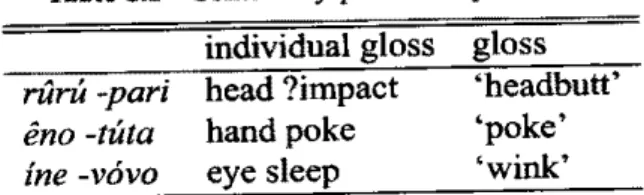
Some examples ofthe first type are given in Table 6.2. In some cases the construction is the only way to describe a certain event (e.g. monrai
-a
(singsing do) 'have a singsing'). However, in other cases there are specific verbs to refer to an action but speakers can choose to use this construction instead (e.g. there are many different verbs of fishing, but speakers can also sayM-a
'fish do').Table 6.2 Adjunct nominals with 'light' verbs
monrai
-a
aware-a rama-a
M-a
awa-a adjunct nominal singsing cooking fight fish string game verb do do do do do gloss 'have a singsing' cook fight go fishingplay string games
(282) Monrai k-e-n-a.
singsing Rl-ISG.F-ISG.F-do 'I'm in a traditional singsing.' (283) Aware k-e-n-a.
cooking Rl-lsG.F-lsG.F-do 'I'm (doing the) cooking.'
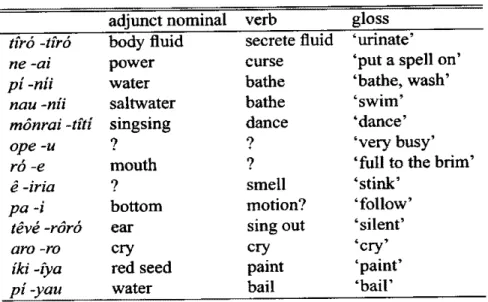
The second type is where the verbs have limited or no use outside an adjunct nominal construction. A sample of this type is given in Table 6.3. Where the verbs and nominals have no attested uses outside this construction, it is not always possible
to give an exact gloss for either of them, indicated by a question mark in the table.
Table 6.3 Adjunct nominals with 'heavy' verbs
adjunct nominal verb gloss tiro -tiro body fluid secrete fluid 'urinate'
ne -ai power curse 'put a spell on'
pi -nii water bathe 'bathe, wash'
nau -nii saltwater bathe 'swim'
monrai -titf singsing dance 'dance'
ope-u ? ? 'very busy'
r6 -e mouth ? 'full to the brim'
e
-iria ? smell 'stink'pa -i bottom motion? 'follow'
teve -roro ear sing out 'silent'
aro oro cry cry 'cry'
ild -iya red seed paint 'paint'
pi -yau water bail 'bail'
Anexample of an intransitive adjunct nominal construction istiro -tiro 'urinate' .
(284) Tiro n-o-tfro.
body.f1uid RL-3sG.F-secrete 'She'll urinate.'
The words are glossed as 'body.fluid' and 'secrete', because even though the nountiro is commonly used to mean 'urine', the verb -tiro is also found to describe other secreting events, as in example (285), which is about dead bodies being smoked over a fire. When the bodies begin to decompose they secrete liquid.
(285) Ai=a k-e-p-ere-p-o-i k-e-tfro
tree=PRM RL-3PL.M-3PL.M-put-AG-GIVE-3pL.M RL-3PL.M-secrete
'They make a fire for them (dead people) and they (the dead people) secrete liquid ...' [DC-MM:03]
Itis only the adjunct nominal construction using both the noun and the verb that specifically means 'urinate'. (Other secreting verbs like 'sweat' have a dedicated lexeme: -bene 'sweat')
Some analyses of these constructions have likened them to cognate objects familiar from languages like English - constructions like 'have a bath' or 'smile a happy smile'. These are defined by Filhnore as 'the object or being resulting from the action or state identified by the verb, or understood as part of the meaning of the verb' (in Baron 1971:72). And this may well be the best analysis for the Barupu
constructions using the light verb 'do' - the only distinction between the nominals found in these constructions and the unmarked secondary objects described above is that in the adjunct nominal construction the nominals cannot be modified or further specified; they must be generic.
In the constructions using semantically specific verbs there is clearer evidence that the nominals are not objects. For example, 'adjunct nominal' constructions can also take their own direct objects. The constructionpi-nii 'wash' can be found with a Pi.
(286) Aro bOm ma pi k-ere-ni(r)i-a.
people woman child water RL-3PLF-(3PLF)wash-3SG.M 'Women washed the child.'
Adjunct nominalsare similar to secondary objects both in terms of their position in the clause - directly before the verb - as well as in the types of
relationships holding between them and the verb (for example, semantically cognate, unidividuated, objects - e.g. secrete.body.fluid body.fluid). Adjunct nominals can also appear to have an Instrumental-like relationship with the verb (e.g. water wash). Itis true that the distinction between secondary objects and adjunct nominals is not always clear-cut (as in the 'light' verb constructions described above). However, in the semantically-specific verb constructions the nominals can be distinguished from Instruments and secondary objects by the following characteristics:
Both secondary objects and Instruments can be full, referential NPs and secondary objects can be replaced by pronouns. Adjunct nominals cannot be
modified by demonstratives or be replaced by profotms. All three relations can, however, take the phrase-level prominence clitic =a.
ii Secondary objects can be omitted under discourse identity, adjunct nominals cannot.
These points will now be exemplified in turn.
6.2.6.1 NPtypes
Examples (287) and (288), show that a secondary object and an Instrument can be modified with an adjective.
(287) Ai pako kiro. k-e-iro
treebig RL-3pL.M-fell
'They are felling a big tree.' (288) Aimon kamo pako kiro.
k-e-iro
axe big RL-3pL.M-feli
'They are felling (it) with a big axe.'
Example (289) shows that an adjunct nominal modified by an adjective has very borderline grammaticality. Speakers did not unanimously reject constructions like this in elicitations, but there is not one natural example in the data.
(289) ? Pi pako k-o-ni(m)i.
waterbig IRR-2sG.F-(2sG.F)wash
However, adjunct nominals do quite often appear with the phrase-level prominence c1itic =a. This is shown in the following example.
(290) Ne=va kaikeu. k-a-ai-ke-u
power=PRM RL-3SG. M-curse-ADv-3SG. F
6.2.6.2 Obligatoriness
The second major difference between secondary objects and adjunct nominals is that whereas secondary objects can be omitted from the clause if their identities are fully recoverable, adjunct nominals are never omitted. The verbnfiis never found without either the noun pi 'water' or another noun nau 'ocean', as shownin(291).
(291) Nau n-e-ni(n)i.
water IRR-lsG.F-(lsG.F)bathe 'I'm swimming around in the sea.'
With pi the verb means 'bathe' or 'wash'. With nau the verb means to swim for pleasure in the ocean. Itdoesn't matter how often this verb appearsina stretch of text, the nominal will always be present. Speakers do not accept this verb without the nominal and all speakers claim that the verb means nothing on its own.
If the adjunct nominals are arguments of the verb, they differ from all argument types previously identified for Barupu - subject, Pi, R, secondary object - in that they cannot be omitted without seriously altering the meaning of the predicate, as in (285), or rendering the sentence meaningless. The verb -nii, for example, means nothing on its own.
6.2.7 Post-verbal modifying slot
There is a slot directly after the verb for words providing manner, locational or duration information. Evidence that this is a separate slot to the locative NPs is that the two can co-occur; the modifier always appears before a locative NP, as shown in the following examples.
(292) K-or-u-avo-ki(r)e-na rewo maikub6 bib RL-3SG.F-BEN.3sG.F-hold.3sG.F-(AG)AWAY-EXTV well torso 3SG.F person tare.
alive
(293) ... ya k-ere-tG n-ere-ko(p)e btlru oro. and IRR-3Du-paddle IRR-3DU-(3DU)gO.Up returnhouse ' ... and they paddled back up to the house.' [DC-MM:03]
As discussed in Chapter 4, temporals appear at the beginning of the clause if they are providing clock or calendar time information, and in the post-verbal modifiying position if they are expressing the duration of an event.
6.2.8 Summary of word order in underived clauses
The fonowing figures summarise the structures described in the preceding sections. Neither of the ditransitive verbs in my data are compatible with an Instrument participant so there is no data on the position of Instruments in ditransitive clauses.
Intransitive: Transitive: Ditransitive: Time Time Time S (Inst) S (Inst), PifPu S T (AdjN) V (AdjN) V V Modifier Modifier R Modifier (LoclInst) (LoclInst) (Loc) 6.2.9 Added objects
The final NP-type needing introduction is the added object. Added objects are added to the clause by extra morphemes on the verb. They usually appear after the verb. The types of participants introduced by these morphemes include relative locations, such as 'under' and 'on', adversatives, benefactives, comitatives and datives, among others, see §7.2.3 for a detailed treatment of the semantics of added objects.
The fonowing example shows the NST verb -iirai 'throw'. This verb almost
always appears with an incorporated direction of motion element, which is -00 DOWN in the fonowing example. This element agrees with the subject through infixing. Fonowing the directional is a participant-adding morpheme-0 'GIVE', this morpheme also always appears with a C prefix indexing the subject, although see Chapters 2 and 7 for some complications. The added object in the following example isya 3SG.M pronoun 'him'.
(294) Aikekeinei k-ere-r-arai-[o(r)o}-[r-o-aJ yc:i;.
ladder vine.sp RL-3PL.F-3pL.F-throW-[(AG) DOWN]-[AG-G1VE-3sG.M] 3SG.M
h V ~
'They threw a rope ladder down to him.' [FF2-CA:03j
The added object does not replace or demote a Pi or secondary object. The next example shows a Pi,aimana,and an added object, Cha Charlie, in the same clause.
(295) Aimana; k-e-n-ye-ya,-[n-o-aj} Cha Charlie].
dog RL-lSG.F-lSG.F-hit-3SG.M-[AG-G1VE-3SG.M] AT PN
°
V 0A'I beat the dog for Charlie.'
Added objects appear before locatives.
(296) E=va k-a-awe-[ki}-[na-i} mevovaGI U.
bag=PRM RL-3SG.M-hang-[AWAY]-[APPL-3PL.Mj children tree branch
Pu V 0A Lac
'He hung the bilum with the children in it on a branch.' [ANR-MN:Olj
Verb modifiers can precede or follow added objects. In example (297) the added objectrai owu ya 'some of his brothers' appears afterminia 'too'.
(297) K-a-irai-r-o-i minia rai owu ya be.
RL-3sG.M-say-AG-G1VE-3sG.M too sibling some 3SG.M DPROX
V Mod OA
'He spoketosome of his brothers as well.' [U-EM:OI]
In example (297), the added objectmevova 'children' appears before the modifiermariro 'softly'.
(298) K-en-irai-r-o-i mevova mariro.
RL-lsG.F-say-3sG-GIVE-3pL.M children softly
V OA Mod
'I spoke to Charlie softly.'
The semantics of the verb and the relationship of the post-verbal elements to it affects the preferred orderings of post-verbal elements. For example, a proprietive participant might be expected to precede a Goal participant because establishing that
something is in a bag or on somebody's person is semantically prior to where the bag or the person is going.
The position of various elements with regard to the added object can be summarised as follows. In this schema, naturally attested orderings are given preference over elicited ones.
Complexverb: AJS PulPi V-V Modifier, Oa Loc
6.3
The grammatical status of verb agreement
As noted above, subject affixes are always obligatory and object affixes are obligatory for those verbs that take them. Inflected verbs can stand alone as grammatical
clauses; NPs are often left out after the first mention until they do something
unexpected like change grammatical function (see below), or an ambiguity needs to be avoided. Foley (1999: 135) notes that this is very common cross-linguistically and he puts it down to the following principle: 'ifthe referent of a constituent is already known or activated in the discourse context, attenuate its fonnal representation' .
The following examples are grammatical, NP-Iess clauses.
(299) K-o-kOe.
RL-3sG.F-go up 'She ascended.'
(300) K-o-yarii-ka.
RL-3sG.F-see-3SG.M 'She saw him.'
Obligatory affixes like this are often called bound pronominals and are treated as the arguments of the verbs they appear on and any co-referring external NPs are treated as adjuncts (Baker 1996; Jelinek 1984). However, another view is that
can be true for subject affixes as we1l3
),Evans argues,
'" bound object affixes in at least some polysynthetic languages pattern more like subject agreement morphology in European languages than like free pronouns, in that they specify person and number
information while remaining non-committal about reference and discourse status. A corollary of this is that, in order to obtain a full referring expression, external material needs to be integrated more closely than can be captured simply by treating it as an adjunct.
Evans goes on to say that he does not disagree with the proposition that bound pronominals can saturate the argument structure of the verb, only with 'the specific equation of these inflections with pronouns, and the corollary that external material is therefore always some kind of adjunct' (2002). The alternative view is that while obligatory bound pronominals in polysynthetic languages can function as anaphoric pronominals in the absence of overt nominals, they are not functionally equivalent. When overt nominals are present, the bound pronominals function much more like agreement than anaphors. 1 argue this to be the case in Barupu. In the following sections I give a summary of some of the interactions between nominals and agreement in Barupu.
6.3.1 BoundpronominaIs and referentiality
The main argument against analysing obligatory bound pronominals as equivalent to free pronouns is that whereas free pronouns and optional bound pronominals almost always index activated, referential participants (with some exceptions, see below), bound pronominals can index both referential and non-referential participants. For example, in the absence of any external nominal, a bound pronominal in Barupu will most often be interpreted as referential. In the following example, both 3PL.M
referents are probably identifiable to the hearer.
'Evans (2002:20) argues that in the Australian language Bininj Gun-Wok, '[s]ubject and object
prefixes are comparable to agreement suffixes in well-known European languages in being referentially open.'
(301) K-e-te-i.
RL-3PL.M-shoot-3PL.M 'They shoot them.'
However, with the addition of an overt NP, agreement in Barupu is no longer necessarily referential. In the following example, there is no assertion of any particular pigs or any particular people, but the verb still takes its obligatory 3 PL. M cross-referencing.
(302) Aro rau k-e-te-i.
people pig RL-3pL.M-shoot-3pL.M 'People shoot pigs.'
Similarly, bound pronominals must co-reference questioned participants. This is shown in examples(303)and(304). AsB. Baker(2004:66)points out, when bound pronominals co-reference questioned participants 'the questioned referent ... (from the speaker's point of view at least) can only be characterised as indefinite and non-specific' .
(303) Erara. nape k-a-r-a-ke?
garden who RL-3sG.M-3sG.M-rnake-INTs 'This garden, who made it?' [TP-MN:Ol]
(304) Bib nape wa k-a-r-a k-o-koru-ki?
person who canoe RL-3SG.M-3sG.M-make RL-3sG.F-capsize-AWAY 'Who made the canoe capsize?' [C-EM:03]
Notice that in the above examples the verb is inllected with masculine subject. Both of these examples were taken from texts and clearly the narrator knew the sex of the questioned participant. Inother contexts the choice of gender in questioned
arguments seems to be a matter of choice coupled with real world knowledge. For example, some verbs suggest possible participants - a question such as 'who's cooking?' is likely to have feminine subject marking (see Chapter 9).
In addition, generic or non-specific NPs such as 'kind' referents must also be indexed even though they are non-referential.
(305) Petapon ti k-o-buto. flower.sp blossom RL-ISG.F-white
'Thepetapon blossom is white.
Petapon pe n-a-m-a pi n-a-ni(m).
flower.sp leaf IRR-2sG.M-2sG.M-eat water IRR-2SG.M-(2sG.M)wash You chew up the leaves and wash (with them).' [D1CT-PB:OI]
The absence of an NP almost always signals that the argument is referential, but there are several common constructions where a bound pronominal can have a
generic, or non-referential, interpretation in the absence of an overt nominal. One example, the generic second person, can be seen in (305), above. Here there is no referent for the 2SG.M pronominal agreement except the understood reader ofthe text. Another is the generic use of IpL. This is shown in (306), where the lPL prefix does not refer to any of the people involved in the actual discourse but it is
interpretable as Barupu people generally. This is an example sentence from the dictionary under the entry for 'chicken/rooster'.
(306) Ra oro. K-e-roro, bei=a k-e-m-a, pe k-em-oro. bird house RL-3PL.M-crowmeat~PRM RL-JPL-JPL-eat feather RL-JpL-decorate 'House bird. They crow, we eat the meat and decorate with the feathers.' [D1CT-EM:OI]
Another example is the vague 3PL.M, as shown in the following. Here there is no overt NP but the 3PL.M prefix is not referring to any specific group of men (except perhaps the ancestors who named the spot).
(307) ... k-e-p-ina Toeyoro. RL-3pL.M-3pL.M-name PLN
' .. they call it Toeyoro.' ('It's called Toeyoro.')
All of these are special cases and as the free translations show, they are equivalent to grammatical uses of non-referential free pronouns in English as well. However, there are also examples in Barupu of bound pronominals being used
non-referentially in the absence of external material in situations that would be absolutely impossible in English.
Consider the following opening section from a text about making canoes. In the opening lines the narrator talks about cutting down a tree and hollowing it out. The 3PL.Mverb agreement on the verb -rin 'pull' does not co-reference any external nominal; it can only be interpreted as something like 'some people'. Likewise the 3SG.Madded object addressee on the verb -frai in the second section has no anaphoric referent, it can only be interpreted as referring to 'someone'. These clauses could not be felicitously translated into English using pronouns instead of generic NPs.
(308) Nena pora k-ana-iro. K-a-n-eri k-a-n-a
ISG.F tree RL-lSG.M-cut.down RL-lSG.M-lSG.M-hollow RL-lSG.M-lSG.M-do
k-o-biiun-ki.
RL-3SG. F-not.be.at-AWAY
'I cut down a canoe-making tree. 1 hollow it out, 1 work until it's done.
K-e-rin-p-o-na k-o-kae k-u-fnia be
RL-3PL.M-pull-AG-REG-lsG.M RL-3SG.F-come RL-3sG.F-be.at DPROX
oroka.
under.house
They(=Some men help me pull it up under the house.' [cB-JT:Olj
Three lines of text intervene in which the narrator talks about painting the canoe and taking it out on the lagoon and coming back.
(309) ... N-ana-rin n-a-ko(n)e nake ya
IRR-lsG.M-pull IRR-lsG.M-(lsG.M)gO.Up on.top and
n-a-ko(n)-ro.
IRR-l SG.M-( 1SG.M)gO.Up-SHORT
'I'll pull it up on top and walk a little way up.
N-ana-irai-n-o-a poro k-ana-rin k-u-fnia raka.
IRR-lsG.M-say-AG-GIVE-3SG.M canoe RL-lsG.M-pull RL-3SG.F-be.at river
I'll tell him(=a man) I've pulled my canoe up, it's atthe river.' [CB-JT:Olj
The above discussion has shown that free pronouns in more analytic languages and obligatory bound pronominals in polysynthetic languages are not functionally equivalent. Two further differences are that free pronouns in Barupu are always referential (there are no generic uses), and those pronouns co-referencing subjects
and primary objects have the special pragmatic functions of marking a participant as the focus of a contrast or as having switched role. This is discussed in §6.4 along with other pragmatic marking.
6.3.2 Unification of information
The second problem with the traditional claim that external NPs are adjunctive is argued to be that verb agreement or an external NP may be underspecificied to certain degrees and often information from both must unify to create 'full referring
expressions' (Evans 2002: 17). For example, in (310) biD is unspecified for gender (cf. biD bOmperson woman 'woman', biD biam person man 'man'), but the object
agreement on -ye is fully specified for masculine gender. The combination of the non-gender-specific noun biD 'person' and masculine verb agreement allows the translation of the NP to be 'man'.
(310) Kuiniarf bib n-o-ye-ya n-o-rai-ta-ka reM tare.
can person IRR-3SG.F-hit-3SG.M IRR-3SG.F-die.sGS-oN-3sG.M body new 'She can kill a man and die with him to come back to Iife.'[DlcT-PW:Olj Another example can be seenin(311). Headless NPs consisting of only an adjective or quantifier can also unify with information in the affixes. This is shown in the following example where the quantifier modifies the bound pronominaI2sG.M, to create a partitive-definite construction.
(311) Beya ra=va n-ama-ute val.
NEG one=PRM IRR-2SG.M-walkPOL
'Not one of you will go.' [ANR-MN:Olj
External NPs and internal cross-referencing each contribute important information neededtointerpret the clause.
6.3.3 Omission of secondary objects
A question arises as to the omission of obligatory arguments without any
morphological representation - namely secondary objects. Secondary objects can be omitted from clauses, but only when their identities are recoverable from fairly
immediate context, ideally in the same complex sentence (see Chapter 10). In the following example rau is the primary object of the first clause headed by
-ye
'hit'. This same participant is also understood as the secondary object Theme of the second verb-0 'give' as well as the secondary object of the third verb-a
'eat'.(312) Raupon n-opu-te-i. n-o-p-o-i aro O.
pig only IRR-2PL.M-shoot-3pL.M IRR-2pL.M-2pL.M-give-3PL.M people namesake bai n-e-p-a.
FUT IRR-3pL.M-3pL.M-eat
'Just shoot pigs and give (them) to the namesakes so they can eat (them):
[NSC l-CA:03j
Anabsent secondary object is always referential and identifiable. Verbs like
-a
'eat' are never found without a secondary object unless it is recoverable. It is not grammatical to say something like k-e-n-a (RL-lsG.F-1SG.F-eat) 'I am eating', out of context with 'food' an understood object. A secondary object must be present (e.g. akorom kena (food RL-lsG.F-lsG.F-eat) 'I am eating food:).6.4
Word order variations and other pragmatic marking
In this section I summarise the known mechanisms speakers have for marking information structure.
6.4.1 Post-verbal Pi
When an event is old information that is being reiterated, a Pi of a monotransitive verb appears pre-verbally in the first mention but may appear post-verbally in the second mention. In example (313) the object,biG,is pre-verbal in the first clause but post-verbal when the same clause is repeated. Note that the whole event, not just the
post-posed participant, must be old information. Itis also interesting that the NP is realised at all, since the participant is fully activated and referential.
(313) Biiuni! Ino bia k-en-yarii-ka.
no NOTperson RL-lsG.F-see-3SG.M 'No I didn't see a man.
Bo nen k-e-ke(n) k-e-ke(n) e.
TVF ISG.F RL-lsG.F-(lsG.F)sit RL-lSG.F-(ISG.F)sit DPROX I've just been sitting here.
Ino k-en-yarii-ka bia.
NOTRL-lsG.F-lsG.F-see-3sG.M person I didn't see a man.' [FF2-CA:03j
Another textual example is provided below.
(314) K-a-kOe ari k-a-yara-o om ya beya k-o-kei vai.
RL-3sG.M-gO.up inside RL-3SG.M-see-3sG.F wife 3SG.M NEG RL-3SG.F-sit POL
Maintopa k-o-ye-u.
flying. fox RL-3SG.F-hit-3SG.F
'He went inside and saw that his wife wasn't there. The flying fox killed her.
K-ere-o(P)a, k-o-ye-u ya k-o-r-a. Ma
RL-3DU-{3DU)fight RL-3sG.F-hit"3sG.F and RL-3sG.M-3sG.F-eat child
k-o-ye-o k-o-r-a k-o-biiun.
RL-3sG.F-hit-3sG.F RL-3sG.F-3SG.F-eat RL-3sG.F-no.
The two fought and she ate her. She killed the child and ate her.
M6 k-ere-o(p)a vava k-ere-6(p)a k-o-noi k-o-noi.
mother RL-3DU-(3DU)fight again RL-3DU-(3DU)fight RL-3sG.F-go RL-3sG.F-go
Maintopa k-o-ye-u mo.
f1ying.fox RL-3sG.F-hit-3sG.F mother
As for the mother, the two fought again, they fought and fought. The flying fox killed the mother.' [U-EM:Olj
In this example, the clause with the post-verbal Pi is not an exact repetition of any ofthe preceding clauses. That is, there is no clausemaintopa rna koyeu,but the event described in the clause takes place in the preceding clauses. The construction does not ocur with great frequency in narratives and its frequency in conversation is not known. The post-verbal ordering in Barupu seems to signal something like finality, indicating that it's all the speaker has to say on the matter.
Post-verbal Pis precede adverbs and locative participants, suggesting that they are not post-posed to the clause, but only to the verb. This is showninexamples (315
a& b)
(315) a) Cha John k-a-ye-ya noki toron.
AT PN RL-3SG.M-hit-3SG.M dog hard
'John hit the dog hard.'
b) Cha John k-a-ye-ya niiki yamankoko.
AT PN RL-3sG.M-hit-3sG.M dog verandah
'John hit the dog on the verandah.'
A verb and post-verbal Pi cannot be separated by anadjunct. The verb followed by a Pi is thus another candidate for a possible VP constituent, but there is still a lack of positive evidence from movement or substitution, and it would be very unlikely given Barupu's right-headed typology.
6.4.2 Topicalisation
There is an external topic position in Barupu. A topicalised NP is set off from the sentence by comma intonation and can also be marked offby an optional pronoun. Obligatory bound pronominals pose a problem for the traditional distinction between left-dislocation, in which the pre-posed NP is reiterated inside the sentence by a pro-form, and topicalisation, where it is not reiterated, because it is not clear whether they should be treated as pronominal reiterations of an pre-posed NP, or as obligatory agreement. I have argued above that obligatory bound pronominals are in some respects similar to agreement and this, coupled with the fact that pre-posed NPs are never reiterated by afree pronoun, leads me to analyse the Barupu construction as topicalisation.
In example (316), the Pi is of higher animacy than the subject. In this case it will almost always be topicalised and appear before the subject. This is a
followed by any other text about Peter or the snake; animacy is the only motivation for the move. A topicalised NP is offset by a pause and comma intonation.
(316) PAY-higher animate P Cha Pita. minI' k-u-f(r} i-a.
AT PN snakeF RL-3SG.F-(3sG.F}bite-3sG.M 'Peter, the snake bit him.' [DICT-EM:Olj
Lower animate primary objects can also be topicalised if they are of higher discourse importance - for example, if they are the topic (in the sense of 'what the clause is about') of the clause. The next example is from the example sentence for the dictionary definition ofepa 'citrus tree'. Clearly this is the topic under discussion and so, even though it is inanimate, it is placed at the front of the clause before the
animate subject,chapa 'grandfather'.4
(317) Epa=ero, Chapa k-a-r-ere-o-r-a(r}i-o bU.
citrus=DIRR grandfather RL-3SG.M-3SG.M-put-3SG.F-AG-(AG}SRND-3SG.F border 'This citrus tree, Grandfather put it around (it) as a border.' [DICT-PB:Olj
Example (318) shows a topicalised secondary object. In the first clause, the secondary objectkora 'half' appears before the subject Cha Carl. Inthe second clause of example (318), there is no subject NP, but the secondary objectkora 'half' is still marked offby a pronoun and a pause so it is analysable as topicalised here as well.
(318) Kora bOo Cha Carl k-a-irai ben.
half 3SG.F AT PN RL-3sG.M-sayalready 'Half, Cha Carl told already.'
Orait kora bO. k-a-n-a-ke n-ana-Irai
e.
ALRIGHT half 3SG.F RL-lsG.M-lsG.M-want-lNTS IRR-lSG.M-say DPROX K-ana-joinim
RL-l SG.M-JOIN
'Alright, half, I'm going to tell now. I'mjoining it.' [Nsc2-MM:03j 4Note the use of the irrealis demonstrative; this is a made up sentence about a made uptree.
The next example is also from the dictionary. The topicalised secondary object
epi ero(tree.sp DIRR) 'this tree' is marked off by a pronoun.
(319) Epi=ero bO, k6pu k-u-ora-r-o-na nena.
tree.sp=DlRR 3SG.F grandmother RL-3sG.F-plant-AG-G1VE-IsG.M ISG.M 'This tree, my grandmother planted for me.' [DICT-PB:O I]
The following example shows a topicalised Goal.
(320) Cha=va, bQi=a k-o-cha k-o-r-o-a=evo.
head=PRM lime=PRM RL-3SG.F-fill.up.with RL-3sG.F-3sG.F-give-3sG.M-DREF 'His head, she filled up with lime and gave it to him there.' [DC-CA:03] The next example shows a topicalised Reason participant.
(321) iki, bi=a k-e-tau meri briri k-e-ko.
red.paint ancestor=PRM RL-3pL.M-paddle soil red RL-3pL.M-get.SGO For red paint, the ancestors paddled and got red soil.' (p-MG:03]
Subjects can also be topicalised. In the following examples the topicalised subject is marked off by a pronoun. Many of the dictionary definitions show this feature.
(322) Ame bO, k-o-ramo-ramo iii nake.
animal 3SG.F RL-3sG.F-REDUP-clamber tree top
'This animal, it clambers around in the tree tops.' (a possum) [DICT-EM:01]
(323) Ame ya, k-a-kei iii nake.
animal3SG.M RL-3sG.M-sit tree top
'This animal, it sits in the tree tops.' (a tree kangaroo) (DICT-EM:OI]
Recapitulating pronouns also feature in equative verbless clauses and clauses using the copularverb-ave(see §6.5.1).
6.4.3 Free pronouns
As in many polysynthetic languages, free pronouns in Barupu have particular pragmatic effects. As the following examples will show, when free pronouns
co-reference the obligatory bound pronominals of underived verbs, they typically function to compare the actions of two participants or signal a switch in topic from one participant to another. These free pronouns are always topicalised. Free pronouns that do not share reference with a bound pronominal (secondary objects), or else share reference with a suffix attached to a participant-adding morpheme (added objects), do not have any special pragmatic function. These points will be exemplified in this section.
In (324) a husband wants to go to a singsing, but because his wife is nursing a newborn she can't come. He checks with her to see if she minds if he goes, and she replies.s The two participants will be carrying out different actions.
(324) N-a-no(m). Nent bai n-e-ke(n)i.
IRR-2sG.M-(2sG.M}go.along ISG.FFUTIRR-ISG.F-(ISG.F}sit
'Go. And me, I'll stay.' [U-EM:Ol]
In the next example a man has a hidden garden and he has been arguing with another man who has discovered it. Finally the owner of the garden says to the intruder:
(325) Yake. Merna n-a-k6(m)e. Nemi n-a-n-aro.
enough 2SG.M IRR-2SG.M-(2sG.M}gO.Up ISG.M IRR-ISG.M-lsG.M-go.down
'Enough. You, you go. And me, I'll go.
Uri ya n-epi-ka(p)e be er6ra.
morning and IRR-IDu-(IDu}come DPROX garden
When it's morning then we'll come here to the garden.' [TP-MN:Ol]
The next day the same two men sit smoking; one asks the other:
(326) To memaarape k-a-m-a be?
CQ 2SG.M what RL-2sG.M-2sG.M-do DPROX
'And you, what are you smoking here?' [TP-MN:Oll
In the next example, a spirit has returned from hunting and tells his wife he's caught some little boys for them to eat. He tells her that he's going to sleep and that she should get things ready to cook and eat.
(327) N-ana-vovo-na-ki mentan-mentan.
Mom"
n-o-no(m)iIRR-lsG.M-sleep-lSG.M-AWAY REDUP-small 2SG.F IRR-2SG.F-(2SG.F)go lii=a n-om-ore
tree=PRM IRR-2sG.F-search
'I'm going to sleep for a little while. And you, you go looking for firewood ...' [ANR-MN:Ol]
The following example shows a Pi pronoun. The following clause comes after a list of instructions from a dead man to his wife. Itdetails all the ways she might have of killing herself before she can come looking for him. The free pronoun signals a change in topic away from the woman and back to the man.
(328) .. ,ya pa n-o-m-e-ke-na.
and back IRR-2sG.F-2sG.F-gO-ADV-ISG.M ' ... and you can follow me.
Nend n-on-yara-na bo be.
lSG.M IRR-2sG.M-see-lsG.M place DPROX
And me, you will see me at this place.' [DC-CA:03]
Example (329) comes after some men have cooked and killed an animal. They are carving it up and handing out pieces. Ro ma (stomach mother) is a compound meaning the stomach and intestines.
(329) Ro ma ya chapo. Ya k-a-mompe-ke. Wend, ro
stomach mother 3SG.M grandfather 3SG.M RL-3sG.M-claim-INTS lSG.M stomach pan n-o-p-o-na.'
only IRR-2pL.M-2PL.M-give-1 SG.M
'The stomach was the grandfather's. Him, he claimed it. "And me, just give me the stomach.'" [FF2-cA:031
As discussed above, the Recipient of the verb 'give' is normally post-verbal, but in this example, because it is a topicalised free pronoun, it appears first in the clause before the secondary object, ro'stomach'. This is the first mention of this man in the story, and he goes on to be the main protagonist of the rest of the story. This example also has a third person subject pronoun, the 3SG.Mya. Third person free pronouns do
not have such a pragmatically marked effect as first and second person pronouns; they are typically used when a participant is introduced as a topic. Itis significant that there are no examples of clauses with Pi or Recipient third person free pronouns in the data. I have elicited clauses with third person non-subject pronouns, but it has not been possible to determine their pragmatic force. Following are some third person subject examples, also taken from narratives.
Example(330)is taken from a story which starts out with boys talking about what they are going to to do. They set off and find a fruit tree belonging to a spirit. They climb it and start picking fruit. The narrative then moves over to the owner of the fruit tree sitting in his house listening to the boys. He yells out at them and the next clause is as given in(330). Here the narrative returns to the boys and they go from being the objects of the previous clause to the subjects of this one.
(330) Yei ero=va k-e-toro-p-eri
3PL.M noise=PRM RL-3pL.M-make.noise-pL.M-SEP.SG 'Them, they were making lots of noise
beya k-e-rlvo-p-o-a vai.
NEG RL-3pL.M-hear-AG-GIVE-3SG.M POL and didn't hear him.' [ANR-MN:OI]
When a participant is reintroduced and there is possible confusion about the identities of the participants - for example, they are both 3SG.F -- the free pronoun can be followed by an identifying noun phrase. In the following example a
grandmother has been sitting looking at her old skin and she goes to ask her
granddaughter to come to the bush with her. Up till now the focus has been fully on the grandmother. In the next clause the granddaughter asks a question. She is not a new participant because the grandmother has been talking to her previously but she has not been the main topic before.
(331) Bo, opu tare, k-o-tere-r-o-o b6
3SG.F grand.relation new RL-3sG.F-ask-AG-GIVE-3SG.F 3SG.F 'Her" the granddaughter" she, asked herj ...' [NS-MM:03]
Note that there are two 3SG.Fpronouns in the above example. The second one,
after the verb, is the object of the serialised verb GIVE. There is no pragmatic effect associated with added object free pronouns. Secondary object pronouns are rare since secondary objects are rarely animate and there are no inanimate pronouns.
6.4.4 NP elide
As can be seen scattered throughout example sentences in this thesis, any or up to two pre-verbal NPs (except pronouns, proper names or NPs with demonstratives), can appear with a clitic=aor=VG. The form is toneless and phonologically conditioned by the final sound of the worditattaches to. Itis=aafter a consonant (including glides) and=vaafter a vowel.
This clitic is entirely optional. In some texts it appears once or twice or not at all; in others it appears much more often. The exact function of this clitic is not known, but some possibilities can be ruled out. Itappears overwhelmingly on objects, Instruments and adjunct nominals (Le. non-subjects) but it also appears on
intransitive and transitive subjects, so it is not an accusative or absolutive marker. Cross-linguistically it has been shown to be preferable for sentences to be cast with transitive subjects as old information, sometimes called Topic, while new participants are preferably introduced as absolutive arguments - that is, intransitive subjects or objects (Dubois 1987). One possibility is that the correlation between absolutive and =vamight be to do with new information or Focus. However, it is extremely common for this clitic to attach to a particular participant and appear on it every time it is mentioned throughout a text, even in contiguous clauses, so it is not a marker of new information.
Nor does it seem to mark definiteness, as the following text extract show, it can appear on definites but it can also appear on generics. This is especially clear in the following text extract discussing the correlation between the size of a women's