This is an Open Access document downloaded from ORCA, Cardiff University's institutional
repository: http://orca.cf.ac.uk/117170/
This is the author’s version of a work that was submitted to / accepted for publication.
Citation for final published version:
Pickernell, David, Jones, Paul and Beynon, Malcolm J. 2019. Innovation performance and the role
of clustering at the local enterprise level: a fuzzy-set qualitative comparative analysis approach.
Entrepreneurship and Regional Development 31 (1-2) , pp. 82-103. 10.1080/08985626.2018.1537149
file
Publishers page: http://dx.doi.org/10.1080/08985626.2018.1537149
<http://dx.doi.org/10.1080/08985626.2018.1537149>
Please note:
Changes made as a result of publishing processes such as copy-editing, formatting and page
numbers may not be reflected in this version. For the definitive version of this publication, please
refer to the published source. You are advised to consult the publisher’s version if you wish to cite
this paper.
This version is being made available in accordance with publisher policies. See
http://orca.cf.ac.uk/policies.html for usage policies. Copyright and moral rights for publications
made available in ORCA are retained by the copyright holders.
Innovation Performance and the role of Clustering at the Local Enterprise Level: A Fuzzy-set Qualitative Comparative Analysis Approach
Professor David Pickernell, University of Portsmouth, Richmond Building Portland Street Portsmouth, England, PO1 3DE
Professor Paul Jones, School of Management, Swansea University, Bay Campus, Swansea, Wales, SA1 8EN, Email: [email protected]
Professor Malcolm J. Beynon, Cardiff Business School, Cardiff University, Cardiff, Wales CF10 3EU, UK
Innovation Performance and the role of Clustering at the Local Enterprise Level: A Fuzzy-set Qualitative Comparative Analysis Approach
Abstract
This study, utilizes an innovative methodological approach, fuzzy-set Qualitative Comparative Analysis (fsQCA), investigating the drivers of heterogeneous geographies characterizing English Local Economic Partnerships (LEPs). The fsQCA technique offers a novel configurational alternative to regression-based approaches investigating the effects of clustering in conjunction with firm-level innovation, university third-sector activity (TSA) and entrepreneurship, on LEPs innovation performance. The findings, offer contributions to the theories of industrial clusters and innovation, regional innovation systems, knowledge spillovers and entrepreneurial university innovation within LEPs. First, supporting fsQCAs, no individual variable generates either a positive/negative innovation outcome. Second, while all positive innovation recipes include presence of the cluster variable, for negative innovation recipes, only one does not identify absence of clustering as relevant. Given that the cluster variable does not appear in any recipes without at least one of the other variables suggests activity concentration does not exist in isolation to generate innovation outcomes without other localized conditions existing, e.g. firm-level innovation. Third, there is evidence for the non-cluster-based aspects of knowledge spillover theory of entrepreneurship with respect to university activity and the entrepreneurial university concept. Instead, roles of entrepreneurship and university TSA, while important, appear to be more peripheral and geographically context specific.
1. Introduction
Innovation is an increasingly important activity in modern developed economies, such as the UK (Evans et al., 2015). Oh et al. (2016) illustrate, through their discussion of the development of the innovation ecosystem approach, that this is a highly complex and contested area of theoretical debate, in which a range of overlapping theories and concepts have relevance. Differences in firm growth and innovation and the strategic priorities and capabilities that drive them across geographies may also require different regional support policies (Mason and Brown, 2013). Nevertheless, within this broad and complex innovation literature, the study of clusters, particularly the work of Michael Porter has gained prominence (Delgado et al., 2014). For policymakers within Europe, pressure has been growing to develop effective policies promoting cluster development to increase the benefits for the regions and nations in which they were situated.
Geographical concentration potentially facilitates long-term relationships and face-to-face contact, allowing firms to identify new technological possibilities, through improved access to information, knowledge and supporting institutions (Pickernell et al., 2007). High-growth firms’ innovation potential is also strongly clustered and conditioned by the nature of the local environment (Brown et al., 2017). The geography of innovating firms, which has a major impact on regional development, therefore suggests a spatial logic exists (Li et al., 2016).
Isaksen (2016), however, argues that the emergence of clusters requires both appropriate conditions and triggers to determine where they will develop. Capozza et al. (2018) suggests that local industrial structure and agglomeration economies (a benefit of
clustering) also affects the creation of innovative start-ups differently across regions with heterogeneous development conditions. Clifton et al. (2011) also note that innovation requires multiple processes and interactions, identifying the requirement to examine relationships between firms, universities and other actors, even where policy promotion of geographically based entrepreneurial clusters occurs. This highlights the importance of taking regional economic environmental disparities into account when designing local policy interventions.
According to the knowledge spillover theory of entrepreneurship, articulated in Acs et al. (2013), the level of knowledge-based (i.e. innovation) entrepreneurship is determined by the extent to which new knowledge is generated, as well as whether entrepreneurial absorptive capacity exists to exploit this. This suggests that where firms are innovative and/or universities undertake activities to create and disseminate new knowledge, if accompanied by entrepreneurial activity this will result in higher levels of beneficial innovation outcomes (Youtie and Shapira, 2008). In Regional Innovation Systems (RISs), Asheim and Coenen (2006) highlight the overlapping roles of firm innovation, clustering, university activity and entrepreneurship in driving beneficial innovation outcomes for a region.
Innovation-supporting outcomes may also exist, however, in the absence of Porterian clusters (Boschma, 2005). Capozza et al. (2018) identify that the presence of technical and scientific universities constitute a positive location factor for innovative start-ups, particularly in less developed regions, potentially acting as a substitute for other cluster-related factors. The knowledge spillover theory of entrepreneurship (Acs et al., 2013) also highlights that whilst clustering (specifically agglomeration) processes can assist knowledge spillover to be exploited by new firms entering the local economy creating innovative products, there also negative effects from firm concentration in similar activities (e.g. from competition). This illustrates the complexity of this issue and requirement for further research.
The current study focuses on the integration of cluster analysis with the contribution of a range of actors in SME innovation creation and dissemination frameworks, analyses evidence from the English Local Enterprise Partnerships (LEPs), introduced by the Conservative-Liberal Democrat coalition Government in June 2010. LEPs replaced the Regional Development Agencies and Training and Enterprise Councils in England that existed previously (HM Government, 2010), one aim identified as being to provide innovation opportunities for business in their areas (Johnston and Blenkinsopp, 2017). LEPs in England are defined as (James and Guile, 2014, p. 181):
“… joint local authority-business bodies brought forward by groups of local authorities to support local economic development across ‘functional economies’”,
the rest of the UK (Northern Ireland, Scotland and Wales) having devolved responsibility for their own economic development policy. This study provides pre-LEP baseline data to enable LEPs to more effectively evaluate their consequent business support practices and inform future policymaking. It does so by exploring evidence of the potential existence or non-existence of innovation supporting clusters at the LEP level, through fuzzy-set Qualitative Comparative Analysis (fsQCA) (Ragin, 2008; Bojica et al., 2018) of geographical concentrations of officially identified key sectors in combination with other potential drivers of innovation outcomes (using measures of firms’, universities’ and entrepreneurs’ activities).
All of the data used in the model has been taken directly from the BIS (2015) dataset used in the official Department for Business, Information and Skills (BIS) report (Evans et al., 2015) for the 39 LEP areas in England, through fsQCA, to explore these theories and identify the potential role of clustering and cluster policy in broader LEP economic development policy initiatives.
This generates contributions to knowledge regarding clusters and clustering, specifically clusters’ potential influence on firms’ innovation performance in conjunction with other related factors present within regional innovation, knowledge spillover and entrepreneurial university innovation concepts. Thus, it allows us to reconsider the circumstances which support the rationale for cluster-based provision (as opposed to alternative foci), allowing improved future evaluation of the impact of cluster development policy on innovation.
The rest of the paper is structured as follows. Next, follows a brief literature review identifying the key issues surrounding clustering, and related (sometimes competing) theories of relevance in driving regional innovation performance, through which the theoretical framework for analysis is derived. The case geography focused on, fsQCA method and data utilized are then discussed. Results are then outlined, followed by a discussion of these in relation to the extant literature. Finally the conclusions summarise the contributions made by the paper, limitations in the research and areas for future research.
2. Literature
Kazadi et al. (2016) highlight, that innovation is an increasingly networked activity, therefore involve firm activity with other firms and supporting stakeholders. Whilst this has meant discussion of innovation has inevitably become intertwined with theories of agglomeration and more recently clustering, this is by no means uncontested. Boschma (2005), for example categorises five dimensions of proximity that can affect learning and knowledge (and hence innovation), but which do not necessarily require geographical proximity. Clifton et al. (2011) also identify circumstances in which local university and local activities more generally (including entrepreneurship and other firm innovation), are less relevant to firm innovation than Cross Local Network (CLN) linkages. Findings from empirical studies also suggest that non-local, as well as local, relationships are important sources of process and product innovation (Asheim and Coenen, 2006; Asheim and Isaksen, 2002; Freel, 2003). Before focusing on clustering specifically, therefore, a review of non-cluster based approaches is first required.
2.1 Non-Cluster Based Approaches
Beginning at the firm-specific level, therefore, activities and processes that drive engagement by firms in innovation can be derived from internal Research and Development (R&D) that draws on the firm’s previously accumulated knowledge of its own activities and innovations from others, as well as financial investment in physical and human capital (Beynon et al., 2016). Acs et al. (2013) also identify these as being required to enable successful creation, absorption and utilisation of innovation. Consequently, when firms undertake innovation activities, and these lead to innovation focused products in the marketplace, this outcome can
be regarded as a proxy for internal activities and resource investments having taken place to some extent. This identifies firm innovation as a relevant variable in this debate.
Higher Education Institutions (HEIs) have also been encouraged to undertake greater responsibility in local economic development, particularly through innovation activities (Perkmann et al., 2013). Acting as a local firm-supporting actor as well as a direct driver of innovation, is the concept of the entrepreneurial university (Etzkowitz, 2003). The ‘entrepreneurial university’ concept (Gibb et al., 2009) is also relevant more broadly as one of the focal points of the Triple Helix, which initiates collaboration between universities, governments and industry (Etzkowitz, 2008). In this model, Etzkowitz (2008) suggests universities develop close regional ties through ongoing mutually beneficial knowledge exchange, defined as Third Sector Activities (TSAs), underpinning the model, the entrepreneurial university able to be defined here as mainly focused on the innovation-related activities of the university itself (Fuller et al., 2017).
Goldstein and Renault (2004) identify that universities in smaller, less urban areas, but with proactive regional development policies, can have positive innovation impacts, capable of counteracting disadvantages associated with a lack of agglomeration (e.g. clustering). This suggests that in areas that lack agglomeration (clustering), university activity can act as a substitute. Lagendijk and Rutten (2003), however, found that universities were often difficult to integrate into regional strategies, making uncertain the extent to which universities can assist the creation and dissemination of innovation in less favoured regions (Kitagawa, 2004). Clifton et al. (2010), analysing contributions of a range of actors in SME innovation creation and dissemination, highlight that because levels of UK firm-UK university cooperation was often low, firms also required a certain level of absorptive capacity (through their own innovation activities), to provide legitimacy prior to being able to beneficially cooperate with a university. This suggests that beneficial innovation outcomes are more likely where university knowledge dissemination occurs in an environment where businesses are also undertaking their own innovation activities. This highlights, therefore, the potential importance of University TSA to innovation, both individually and in combination with other variables, such as firm innovation. An alternative use of university innovation activity is offered by the knowledge spillover theory of entrepreneurship (Acs et al., 2013), specifically, the part of this theory linking entrepreneurship to the presence of knowledge creating institutions such as (though not solely) universities (Braunerhjelm et al., 2010), where the knowledge emanating from such institutions spills over into the local economy to be exploited through entrepreneurs creating innovative new firms. Geographical context is also of importance here. Lawton-Smith (2003), for example, found university missions likely to depend on their size, but also catchment area and context, along with funding. Boucher et al. (2003) suggested more traditional universities in core regions (e.g. around capital cities) are often less engaged with their own regions than large single universities in more peripheral regions where they are the only HEI presence. Hewitt-Dundas (2012) also found low research-intensive universities focused more upon engaging with regional players than high research-intensive universities able to attract increased national and international partners due to their higher research standing. In the UK context, this suggests that the role of universities within the knowledge spillover theory remains uncertain requiring further evidence.
The knowledge spillover theory also identifies, however, that in the absence of spillovers of knowledge from domestic knowledge creators such as universities, large multinational firms located in the region may also offer knowledge (not developed in the region) with them that entrepreneurial activity can exploit (Acs et al., 2012), specifically the knowledge spillover theory of entrepreneurship linked to FDI. Potentially, this identifies alternative processes whereby entrepreneurship itself, without strong domestic firm knowledge production or local university TSA, can produce strong innovation outcomes. This suggests, therefore, that entrepreneurship as a variable is of importance in the innovation debate, potentially both with and without local firm innovation and activity.
2.2 Clustering and Innovation
What this discussion of the non-cluster specific literature identifies, therefore, is that there are multiple processes that can produce beneficial innovation outcomes without the necessity of clustering. The knowledge spillover theory of entrepreneurship linked to FDI, however, is also often linked to concepts of clustering. More broadly, these outcomes are often more likely where there are combinations of these factors, the identification, in Acs et al. (2013), of the interplay between the (negative) competition effects of concentrations of firms in an industry and (positive) agglomeration effects, highlighting the potential (albeit complex) importance of clustering processes in a wider context. This suggests, therefore, that clustering as a variable, whilst of importance, will most likely be so in combination with one or more of the variables previously discussed (though as will be seen below, there are also circumstances where clustering can theoretically lead to innovative outcomes when local firm innovation, university TSA and entrepreneurship are all absent).
Indeed, combining the roles of firm innovation, university TSA, entrepreneurship and clustering together, is evident in Asheim and Coenen’s (2006) study in their discussion of the fully functioning RIS. Gunasakera (2006) also highlights that within the RIS based approach, clustering, new firm formation and university TSA were all relevant, and more broadly, an environment where at least three of the four variables is present, is suggestive of at least the potential for RIS development.
Li (2018), focusing on potentially innovative cluster formation, also specifically identifies a process that starts with the combination of local (firms) and external knowledge (from universities), which generates innovation and stimulates the creation of new local pioneering firms in a new field (through entrepreneurship). The growth of follow-up entrants requires the local (firm) knowledge pool to be further developed via external knowledge inflows, but also through local knowledge sharing (through clustering).
Considering the processes that take place within clustered enviroments specifically, Gordon and McCann (2000) identify advantages for geographically based clusters and networks, driven by external economies of scale, scope, and complexity (agglomeration). These can also reduce transactions costs, with social networks easing knowledge flows. Focusing on the innovation capacity effects of clustering, Furman et al. (2002) argues that this depends upon infrastructure and interconnectivity, in addition to the cluster environment itself. Spatial proximity, by positively affecting knowledge spillovers from firms and research organizations, reinforces the concentration of innovation geographically (Cooke et al., 2005). Cluster formation is therefore characterized by a network-building process of local actors, in
high-tech industries, through labour mobility and research alliances (Casper, 2007) in traditional sectors through long-term social interaction (Hervas-Oliver et al., 2017). Capozza et al. (2018) therefore posit that knowledge spillovers themselves are geographically bounded within the region where new knowledge is created. This results in agglomeration of innovative activities (Audretsch and Feldman, 2004), with the number of innovating firms in a particular industry and region itself increasing with regional specialisation (Van der Panne, 2004), producing a potential innovation cluster that is actually in existence. Conversely, Guerrieri and Pietrobelli (2004) highlight that potential state anchored industrial district-type clusters might develop around institutions such as a university, without necessarily requiring strong local entrepreneurial and / or existing firm innovation activities.
Further, Pickernell et al. (2007) identify at least eight different basic cluster types, by no means all focused on generating benefits in terms of innovation, some focused on a combination of knowledge, innovation and cost, and other more focused on cost benefits specifically. Large multinational firms, for example, bring knowledge not developed in the region with them. This can also create a concentration of production in innovation-rich products relevant to the Satellite Industrial Platform (SIP) type of cluster (Pickernell et al., 2007), even where there is a lack of embeddedness in the local economy (i.e.where local firm innovation, university TSA, and entrepreneurship are all absent).
This discussion therefore tends to support Crawley and Munday’s (2017) questioning of the existing evidence often used when identifying clusters. They highlight that users of the Porterian cluster concept have often condensed notions of, concentration, specialisation and agglomeration, into a single package, concentration of activity in a sector/sectors measured through Location Quotients (LQs). This, however, does not identify what type of cluster exists; in terms of the processes clustering is meant to induce, implying a requirement for further evidence before conclusions regarding the effects of clustering are drawn. Crawley and Munday’s (2017) summary of the quantitative and qualitative approaches used highlights that different methodological approaches will potentially produce different priority sectors to be selected, and broad based analysis using LQs to identify potential clusters should be treated with caution, combined with analysis of other factors, and used as a precursor to further in-depth analysis rather than an end in itself.
2.3 The Framework for Analysis
Overall, this review of the literature suggests complex, uncertain, overlapping broad relationships exist between firm innovation, universities’ activities, entrepreneurship and clustering, and their roles in beneficial outcomes from innovation. Unsurprisingly, therefore, there are a number of knowledge gaps and consequent research problems that this paper seeks to address, specifically related to a number of potential shortcomings identified in relation to existing clustering research. First, whilst there are a number of overlapping theoretical concepts in relation to innovation outcomes at the local geographic level, there has been a lack of consequent conjunctional research analysing how the different combinations of variables implied by these overlapping concepts may work together. Second, and related, there is therefore a lack of work aimed at validating these mechanisms empirically. Third, because of the potentially heterogeneous effects of local economic geography on these mechanisms,
highlighted in the literature, there has been a lack of analysis able to account for equifinality (different configurations leading to the same outcome) and asymmetric causality.
This produces a consequent requirement for further analysis. In terms of the theoretical framework, there is a need for specific consideration of the variables in multiple combinations as well as individually. In the case of clustering, for example, only SIPs and CLNs do not also require at least one other local activity (in terms of firm innovation, university TSA, or entrepreneurship), in combination with a concentration of activity in combination with. The following basic summary framework, shown in Table 1, used to structure the analysis of the results, can be posited from the literature previously discussed. Specifically, the table demonstrates the different basic combinations of firm innovation, university TSA, entrepreneurship and clustering that are assumed to theoretically lead to beneficial innovation outcomes, the specific combination differing dependent on the theory in question. Given the overlapping nature of the concepts discussed it is important to point out that the titles given to the combinations are broadly descriptive rather than excluding the relevance of other theories and concepts, and does not exclude analysis of single variable-based theoretical explanations for innovation (e.g. SIPs) the evidence for which will also be explored.
Insert Table 1 about here
The method employed in the analysis, therefore, needs to utilise an analytical technique capable of identifying combinations of variables, rather than single variables, in explaining innovation outcomes. The literature also suggests that effects of economic geography, are likely to determine whether, and which, of these sets of contexts are of relevance to specific localities, given that geographic regions and the businesses within them differ significantly (Chadwick et al., 2013), and this implies that different combinations of variables may be relevant in different geographies. This identifies a requirement to select a set of geographies to undertake the analysis upon where the relevant data is available, and to utilise a method capable of undertaking this analysis.
3. Method
Geographical Focus: English LEPs
The data utilised in this study focuses on the LEP geographies in England. In a UK context, Peck et al. (2013) identify a requirement for increased place sensitivity in UK industrial policy, and the requirement for enhanced consideration regarding the contribution of LEPs towards the delivery of regional, national and sub-national economic strategies. The strategic aim of LEPs was to empower communities and businesses to provide the vision, knowledge and strategic leadership to meet their potential through attainable economic growth and regeneration policy (Mellows-Facer, 2011). Almond et al. (2015) identified that LEP remits were self-determining and included a spectrum of policy areas including economic development, but also housing and transport, as well as linkages with local authorities and local HEIs.
LEPs, however, achieved limited initial perceived impact, 50% of businesses claiming LEPs had minimal or no impact on growth, and 45% claiming no engagement with a LEP (Confederation of British Industry, 2012). Chadwick et al. (2013) identified that LEPs were
not able to effectively articulate their priorities, objectives and success measures. The small business sector in particular, also noted confusion regarding LEPs and concerns over removal of support programmes and systems (James and Guile, 2014). Apart from the above sources, Harris and Moffat (2015), Evans et al. (2015) and Anyadike-Danes et al. (2013), there is also relatively limited, pre-LEP policy enactment, analysis of LEP economic geographies, with a particular lack of analysis with regard to innovation. There is also a requirement to identify, where possible, groups of LEPs facing similar challenges, so that they have the opportunity to utilise resources using jointly developed policies that are relevant to similar economic geographies (Almond et al., 2015).
This study adopts a similar approach to Pike et al.’s (2015) analysis of the how LEPs have evolved since 2010, aimed at providing a basic starting point for future policymaking and research. The research, using fsQCA, identifies groups of LEPs sharing similar combinations of conditions or “causal recipes” with regard to innovation intentions for the SMEs within these geographies. This study represents an initial pre-LEP policy benchmarking activity for LEP geographies, exploring innovation performance in LEPs across England, and the role of clustering and overlapping concepts in supporting such innovation outcomes, which are of relevance to LEP policymakers. The focus on the LEP geographies also allows the benefit of being able to utilise one official government summary source for the data.
The Method
The primary analytical tool employed in this study is fuzzy-set Qualitative Comparative Analysis (fsQCA), a set-theoretic technique for causal oriented investigation (Ragin, 2000, 2008). Since its introduction, fsQCA has continued to develop as a substitute to traditional correlation methods, in particular in social science, to establish causal conditions related to an outcome (Roig-Tierno et al., 2017). Further, it has also found itself to be a respected technique employed in entrepreneurship and innovation based research (Kraus et al., 2018). It should be noted, the term causal here, as used in the fsQCA literature, is as a technical term denoting the presence of an association between a condition and an outcome (see Andrews et al., 2016).
The set-theoretic foundation of fsQCA enables specific features in the analysis to be enabled (Ragin, 2008; Kraus et al., 2018); i) Conjunctural - logical connections between the combinations of causal conditions and an outcome, ii) Asymmetric - relationships between the condition and outcome variables may be asymmetric, and iii) Small n data - the number of cases is too large for traditional qualitative analysis and at the same time too small for many accustomed statistical analysis. To further elucidate the analysis position of fsQCA, a comparison against the well-known regression approach to data analysis is given, as stated in (Jordan et al., 2011, p.1171):
“Statistical regression methods are focused on determining the net, independent effect of each variable on an outcome. In contrast, QCA focuses on combinations of configurations that lead to an outcome, not how frequent or likely these configurations are.”
It is this configurational based approach that offers the opportunity to fully elucidate the relationship between clustering (and aspects associated with it, specifically university, entrepreneurship and firm innovation activity) and innovation performance, as well as to
consider alternative non-cluster based relationships between innovation and university, entrepreneurship and firm innovation. Jordan et al. (2011) also make effort to discuss the use and misuse of fsQCA, including the need to be transparent in the pre-preparation and parameter (including threshold) decisions made in the fsQCA analysis. This transparency attitude is embraced here through the analysis undertaken.
As a technique able to pertinently analyse small n data, it is well suited to the frame of reference here, namely the 39 LEPs established in England. The LEP based data analyzed using fsQCA is next described.
Data
All the cross sectional data used in the study is taken directly from one official UK government source, the BIS (2015) dataset used for the Department for Business, Innovation and Skills report ‘Mapping Local Comparative Advantages in Innovation Framework and Indicators’ (Evans et al., 2015). Published in 2015, this dataset includes a wide range of innovation-relevant economic data, which is representative of the English LEP geographic areas used as the unit of inquiry, for the time period just prior to LEP policy activities beginning to take effect, between 2008 and 2012.
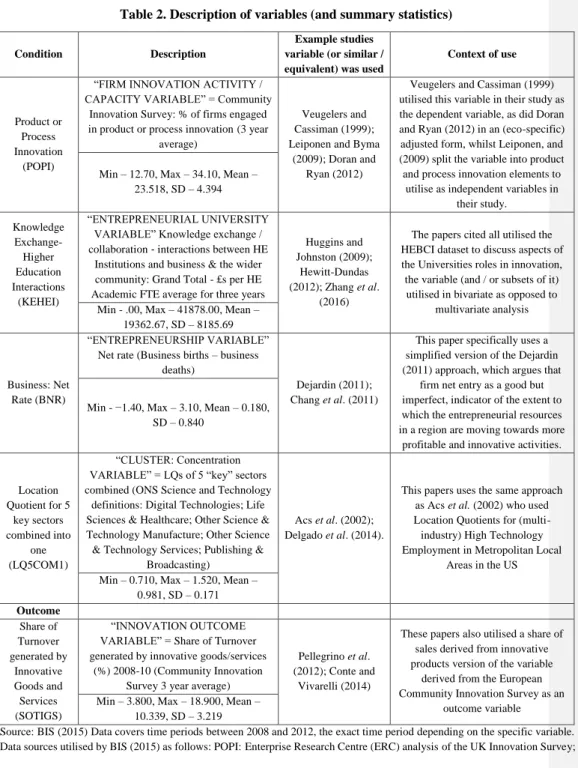
A description of the four condition (proxying for “firm innovation”, “entrepreneurial university”, “entrepreneurship” and “clustering”) and one outcome (“innovation performance”) variables taken from the BIS (2015) dataset are given in Table 2. Also included for each variable are, summary statistics, examples from the literature in which the same or similar variables have been used in contexts relevant to this study.
Insert Table 2 about here
To help illustrate the basic LEP frame of reference for this paper, which is focused on the links between clustering and innovation, an elucidation of the LQ5COM1 condition variable and the SOTIGS outcome variable values for the 39 LEPs is given based on a heatmap of the geographical LEP positions across England, see Figure 1.
Insert Figure 1 about here
The details in Figure 1, aid in the understanding of the 39 LEPs considered, and the distribution of the LQ5COM1 and SOTIGS variable values (in this case). LQ5COM1 ranges from 0.71 (Cornwall and the Isles of Scilly) to 1.52 (Oxfordshire). At a very general level, it can be seen that there is broadly, a concentration of higher values for LQ5COM1 in LEPs in the South of the country. For SOTIGS value, ranging from 3.7% (Humber) up to 18.9% (Dorset). The innovation outcome variable, SOTIGS, by way of contrast shows more of a geographic spread, though again with more of a concentration in the South of England. This provides preliminary evidence supporting the relationship between innovation outcomes and a concentration of sectors deemed important to innovation, but also that this is by no means uniform.
A feature of fsQCA is the undertaking of analysis based on fuzzy membership scores describing the cases (LEPs) over the considered condition and outcome variables (Ragin, 2008, p. 4). Vaisey (2009, p. 309) offers a statement on the calibration requirement.
“Measured variables use arbitrary units like “inches”, … . Calibrated fuzzy sets, on the other hand, reflect each case's degree of membership (from 0 to 1) in conceptual categories like "tall”, … . Set membership values are therefore concept-relative as well as case-relative. Calibration is the process of translating a variable into a set using a function derived from substantive knowledge.”
The calibration process undertaken here comes from Ragin (2008), and is called the Direct method, based on the initial evaluation of qualitative anchors (to structure calibration, ibid.). Here, the qualitative anchors are initially found following Andrews et al. (2016) and Beynon et al. (2016), and are based on the percentiles, 5th (x– lower threshold), 50th (x– crossover, and 95th (xT– upper threshold), of the associated probability distribution functions (pdfs) of the variable values, see Figure 2.
Insert Figure 2 about here
In each Figure 2 diagram, the solid line is the constructed pdf for a variable (condition a-d and outcome e), the three dotted lines represent the concomitant threshold values (left to right x, x and xT), with the dashed line showing the subsequent fuzzy membership score function (transforming variable values to grades of membership over the domain 0.0 to 1.0). The pdf graphs above are the actual point values associated with each of the 39 LEPs, with arrows pointing left and right, and labelled with the numbers of LEPs with variable values below and above the identified crossover points (for the condition variables only – since will consider strong membership later).
There is one point of alteration undertaken here (with all results in Figure 2 discussed by experts), namely in relation to the crossover point associated with the LQ based variable, LQ5COM1. The actual 50th percentile for this variable was found to be 0.967, but given that the LQ measure has a specific interpretation that can be applied to the 1.000 values (Crawley and Munday, 2017), namely it is the boundary between the LEP having a relative concentration of employment below (< 1.000) and above (> 1.000) the English average, the crossover point was moved to 1.000, to allow this variable to be explicitly interpreted in this way.
The authors believe, the graphical elucidation of membership score based evaluation, and the further consideration of crossover point for LQ5COM1, demonstrate the transparency and qualitative consideration undertaken in this pre-calibration of variables, as advocated in regard to fsQCA (Jordan et al., 2011). A sample of the results of the pre-calibration process are given in Table 3.
Insert Table 3 about here
In Table 3, a sample of three LEPs are shown, with their actual condition and outcome variable values displayed (on the top row of each cell). Below these values, the first value is the respective fuzzy membership score value, and the second value is the concomitant strong
membership association value (only for condition variables - used in later fsQCA analysis it is a 0 or 1 representation, depending on whether the fuzzy membership score value is below or above 0.5, see Ragin, 2008).
To aid in the understanding of the strong membership of LEPs to configurations (for use later), in Figure 3, a Venn diagram is shown, which summarily groups the LEPs based on 0 or 1 strong membership values for each of the condition variables (as exemplified in Table 3). The Venn diagram also aids the reader to appreciate the nearness of LEPs in different configurations (collection of strong membership values across condition variables). Moreover, where those cells in the Venn diagram neighbour each other (with one or more edges) they differ in strong membership terms by only one condition variable (e.g. configurations 1 (0000) and 9 (1000) differ in the POPI variable).
Insert Figure 3 about here
Each cell in Figure 3 includes the LEPs which, based on strong membership terms, are associated with the same configuration (of condition variables). Only two of the configurations have no LEPs associated with them, though a further four have only one LEP associated. Of the remaining 10 configurations, some notable patterns exist. For example, configuration 16, which includes only Oxfordshire and Greater Cambridgeshire and Greater Peterborough can be characterised as most closely indicating the potential for a full RIS existing. Configuration 1, contrastingly, shows none of these characteristics, all the LEPs contained in this configuration being geographically peripheral in the English context. The other configurations include combinations of different geographies and LEP types (e.g. city-region with non-city-region LEPs), illustrating the complexity of the economic geography under discussion and therefore the need for in-depth analysis of these geographies prior to policy initiation.
4. Results: FsQCA Analysis
The analysis approach using fsQCA differs to the approach undertaken using, for example, regression. Instead the analysis is comprised of several stages. These stages include analysis of necessity and analysis of sufficiency, both in terms of the condition variables and their association to the outcome variable (for discussion of technical details see, Ragin, 2008; Kraus et al., 2018). Throughout this elucidation of the analysis, the results presented were found using fsQCAv3.0 software (Ragin and Davey, 2017).
Necessity
In technical terms, based on the fuzzy membership scores describing the cases, the necessary condition is expressed through the degree to which it can be shown that membership in the outcome is consistently less than or equal to membership in the case (Ragin, 2008). The necessity results, both in terms of consistency and coverage, are given for each condition variable (both high and low derivatives) against the outcome variable (both high and low derivatives), see Table 4.
The results in Table 4, with particular emphasis on the consistency results, (looking at min and max statistics at bottom of table), indicate no single condition variable exhibits a consistency value above 0.900, the often employed threshold in this case (Young and Park, 2013), hence not necessary with regard to either High SOTIGS or Low SOTIGS.
Sufficiency
Moving from necessity to sufficiency, in particular possible combinations of condition offering explanation to an outcome (High SOTIGS or Low SOTIGS). This starts with formulation of the associated truth table (Ragin, 2008), where configurations of considered condition variables are exposited.
The associated truth table for the LEP-innovation data set (fuzzy membership score version) is presented in Table 5. The main part of the truth table is the presentation of the 16 logically possible configurations associated with the four condition variables (24 = 16), and the high and low derivatives of the outcome variable.
Insert Table 5 about here
For each configuration in Table 5, the number of LEPs associated with them, in strong membership terms, are shown (as well as the names of the LEPs – see Figure 3). Also shown in the truth table are the consistency values associating a configuration to the High SOTIGS and Low SOTIGS derivatives of the outcome variable. Based on this evidence, two threshold values, frequency and consistency are next considered.
The first of these is frequency threshold, which considers the number of cases (LEPs here), which need to be strong membership based associated with a configuration (the No column in Table 5). With only 39 LEPs (cases) considered, in line with other research (in a small-size sample situation (e.g. 10–50 cases) as stated in Kraus et al. (2018)), a frequency threshold of at least one case was necessary for a configuration to be further considered was employed. Inspection of the No. column in the truth table shows two configurations, 7 (0110) and 10 (1001), have no LEP based support, hence not further considered (hence termed remainders – which may be compared against later), denoted here by having their configuration details striked through.
The next threshold to consider is consistency threshold, a value above or below which the concomitant consistency values of configurations to an outcome derivative, will determine whether they are future considered in regard to the relevant outcome derivative. An initial consistency threshold consideration, following Andrew et al. (2016) and Beynon et al. (2016), was to find the least consistency level which retained the feature of no configuration being then both associated with High SOTIGS and Low SOTIGS, this meant a value of 0.840 (all other still considered 14 configurations have one consistency value above 0.840 – to either High SOTIGS or Low SOTIGS).
A further check was made for any inconsistent results apparent, whereby an outcome may not be explained by the condition used, in terms of the broader patterns around them (Schneider and Wagemann, 2010). This check was based on the proposed consistency threshold level of 0.840, here using also the heatmap of LEP SOTIGS values shown in Figure
1b and grouping of LEPs shown in Figure 3. The Dorset LEP, for example, demonstrates this possible inconsistent issue, since in Figure 1b, it has the darkest shading, indicating it has the highest SOTIGS value (18.900), but in the truth table in Table 5 it is in a configuration on its own (9 (1000)), and its consistency scores suggest most association to Low SOTIGS (0.869 consistency value in Table 5). There are three points to consider in this inconsistency (high individual SOTIGS score but association to low SOTIGS in configuration), namely:
i) Individual configuration consistency scores are based on all LEPs condition variable values and their SOTIGS values (based on fuzzy membership score values as demonstrated in Table 3) – not just the LEPs associated with a configuration in strong membership terms. ii) The 9 (1000) configuration only has one LEP associated with it (Dorset).
iii) Neighbour configurations, 1 (0000) and 13 (1100), have noticeably more than one LEP associated with them – and are more associated with Low SOTIGS (see Table 5 - but not the case for other neighbour configuration 11 (1010)).
Hence, the evidence of those near to the configuration suggests association to Low SOTIGS, inconsistent with the single LEP strong membership based association of Dorset with the 9 (1000) configuration. A solution to such inconsistent cases should be considered (Schneider and Wagemann, 2010), it follows here, to be general in consistent threshold assignment, the value was assigned 0.870 (above the initial 0.840), so removing configuration 9 from further consideration, as well as others, denoted by configurations’ details italicised.
At the bottom of the truth table, the employed threshold values are presented, along with their impact, showing five and four configurations associated with High SOTIGS and Low SOTIGS, respectively (with 10 and 15 LEPs most associated with these sets of configurations). The subsequent sufficiency analysis was undertaken using the 0.870 consistency threshold value, see Table 6 (amended version of the notation system from Ragin and Fiss, 2008, as used in Andrews et al., 2016). The analysis here shows two out of the three often considered solutions, Complex, Intermediate and Parsimonious (which take different the relevancy of remainders). Moreover, here the complex solution (minimal formula derived without the aid of any logical remainders” - Rihoux and Ragin, 2009, p. 181) and parsimonious solution (“minimal formula derived with the aid of logical remainders, without evaluation” - ibid., p. 183) are considered (Wagemann and Schneider, 2010).
Insert Table 6 about here
In Table 6, the sufficiency results are shown based on the generation of causal recipes (in case based research the focus is often on how conditions combine to generate an outcome – the combined condition being a causal recipe (all the ingredients in a given recipe have to be present for the outcome to occur)) – see Ragin, 2008). It follows, for each outcome derivative (High SOTIGS and Low SOTIGS), there are; i) From complex solution – two (CHS1 and CHS2) and three (CLS1, CLS2 and CLS3) causal recipes for High and Low SOTIGS, respectively, and ii) From Parsimonious solution – two (PHS1 and PHS2) and two (PLS1 and PLS2) causal recipes for High and Low SOTIGS, respectively.
Further shown are the configurations associated with each causal recipe (using Table 5 the specific LEPs associated with these configurations). In the case of the causal recipes
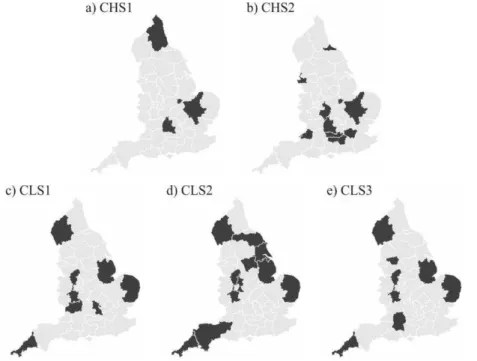
associated with Low SOTIGS, the configuration 1 (0000) is described by more than one causal recipe (an outcome may be generated by one or more causal recipes - Ragin, 2008). Associated measures accompanying the established causal recipes include (Ragin, 2008); consistency (how consistently a configuration is a subset of the outcome), raw coverage (extent to which a recipe explains the outcome), unique coverage (proportion of cases that can be explained exclusively by that recipe), and respective solution consistency and coverage values (relate to the respective set of causal recipes across high and low outcome derivatives). To aid in the elucidation of the identified causal recipes, geographical representation of the LEPs associated with the established causal recipes (in strong membership terms) is given, shown in black- see Figure 4.
Insert Figure 4 about here
For each LEP map shown in Figure 4, the dark shaded LEPs are those associated with the configurations described by the respective causal recipes for the complex solution (details in Figure 1 and Table 5 identify specific names of LEPs). Further interpretation of the established causal recipes is next described.
5. Discussion
The results show that all of the condition variables are of relevance in at least some geographical contexts, and that presence of a variable is associated with a high innovation outcome whilst absence is associated with a low innovation outcome. In addition, it is apparent that no individual variable will generate either a positive (if present) or negative (if absent) innovation outcome, supporting the configurational fsQCA approach taken in the analysis.
Evaluation of the configurations and the LEPs associated with them does show, however, that all of the positive innovation recipes include the cluster variable in their configuration, whilst for the negative innovation recipes, only CLS1 / PLS1 does not identify clustering as of relevance (in terms of presence or absence). Broadly, therefore, the evidence supports the importance of clustering-based innovation theories relative to non-cluster-based ones in the English LEP context. The fact that the cluster variable does not appear in any of the recipes without at least one of the other variables also suggests, however, that concentration of activity does not exist in isolation to generate innovation outcomes without other localised conditions also existing. The evidence does not therefore support the existence in the English LEP innovation context of cross locational networks as identified in Clifton et al. (2011), or the SIP cluster type as defined in Pickernell et al. (2007). From a practical perspective these results support Crawley and Munday’s (2017) assertion that evidence of geographic concentration of activity also requires additional analysis of potential supporting activities (i.e. other condition variables), before such concentrations can be regarded as generating the beneficial innovation outcomes suggested by clustering theory, and relevant policy support enacted.
Of these other condition variables, firm innovation activity appears in the same number of recipes as absent in the low innovation recipes and present in one of the two high innovation recipes. University activity and entrepreneurship, by way of contrast, appear in fewer recipes and are of peripheral importance in several recipes. For one of the high innovation recipe
results (PLS1), the potential innovative cluster that exists are likely linked most strongly to firms’ own innovation, though with university activity playing a peripheral role (CHS1) in processes which may suggest potential development towards a more fully functioning RIS. The alternative high innovation recipe (PLS2) sees the clustering more likely linked to knowledge spillovers to entrepreneurship from FDI, given the lack of relevance associated with either university or local firm innovation activity.
Whilst the English LEPs experiencing these high innovation results are relatively strongly concentrated geographically in the south of the country, this is not exclusively the case, identifying potential for beneficial mutual policy development on a wider geographical basis. The only configuration (16) affected by all the positive recipes covers only two LEPs, however, and is, perhaps unsurprisingly, the one including Oxford and Cambridge (where two of the historically strongest English universities are located, in addition to a range of other HEIs). This is also the configuration with the strongest possibility of a full RIS being in existence, though the results do not show the full system as being necessary for high innovation outcomes.
For the low innovation results, however, the lack of the building blocks for a potential RIS (i.e. absence of at least three of the four condition variables in all of the complex solution causal recipes and one in the case of parsimonious solution), highlights that tackling the low innovation issue is a complex problem in the English LEP context. Across the three sets of low innovation recipes it is the lack of firm innovation that is the only constant. The complex solutions then indicate three different ways in which low innovation is related to the absence of pairs of (two from three), university activity, entrepreneurship, and clustering. This indicates a potentially complex, substituting relationship being relevant. The LEPs experiencing these low innovation results are relatively strongly concentrated outside the South East of England, and mainly in more geographically peripheral/rural areas. For the configuration (1) that is associated with all three low innovation recipes, issues of peripherality and rurality would seem to be particularly relevant.
Overall, the fact that the firm innovation and clustering variables appear most and consistently in the recipes (i.e. presence related to positive outcomes and absence related to negative), suggesting these are the more unambiguous areas to concentrate future policy on, particularly for low innovation LEPs who are relatively close to the boundaries for these variables. This would lend support to high innovation outcomes being most strongly determined by knowledge and spillovers from firms geographically bounded within the region where the new knowledge is created (Capozza et al., 2018), and Van der Panne’s research supporting Marshall in terms of the number of innovating firms in a particular industry and region itself increasing with regional specialisation (Van der Panne, 2004).
The roles of entrepreneurship and particularly university TSA appears, conversely, to be more supportive than central. There also appears to be a degree of substitutability between entrepreneurship and university TSA across different configurations of LEP areas. This identifies a requirement for these specific geographies to be analysed before committing policy resources.
Apart from the examples of LEPs covering Oxford and Cambridge, which also have the presence of all the variables associated with the more fully developed RISs, there is a lack of evidence to support the knowledge spillover theory of entrepreneurship involving universities
currently operating in English LEP areas, or indeed the entrepreneurial university concept leading to high regional innovation outcomes to any great degree in the English context. Overall, therefore, there is a lack of evidence in this study for the knowledge spillover theory of entrepreneurship currently operating with respect to university activity in English LEP areas. Further, the entrepreneurial university in terms of its role in innovation appears to have the weakest level of support, instead being most strongly associated with low innovation outcomes and absence of university TSA.
This may suggest that, for LEPS where there is most potential for policy to directly beneficially promote firm innovation and concentration of activity, this would take primary importance, with entrepreneurship and/or entrepreneurial university promotion policies of secondary, supportive importance, determined after careful consideration of the LEP geography under discussion.
For low innovation LEP areas, the work of Tödtling and Trippl (2005) for innovation peripheral regions is one alternative, particularly given that the multiple deficiencies identified suggest the need to strengthen the basic local economy holistically, the mix of policies depending on the specific geography. Policy for firms themselves could involve priority being given to organisational and technological “catch up” through dissemination of existing innovation from outside the locality. Similarly, “cluster” building via the use of external links to attract existing firms and/or institutions may be applicable, as is institution (e.g. university activity) building and entrepreneurship promotion.
6. Conclusions
The fsQCA technique employed in this study offers a novel configurational alternative to traditional regression based approaches to investigate the effects of clustering in conjunction with firm-level innovation, university third –sector activity (TSA) and entrepreneurship, on the overall innovation performance, of LEP geographies. The heterogeneous effects of local economic geography in driving equifinality (different configurations leading to the same outcome) and asymmetric causality have also been able to be accounted for, leading to a range of insights. Within the English LEP context, the fsQCA-derived findings identify contributions to both theories of industrial clustering and innovation specifically, but also overlapping fields of regional innovation systems, knowledge spillovers and entrepreneurial university innovation more generally.
First, the analysis has demonstrated that it is multi-conjunctural sets of conditions, as opposed to single conditions, that are associated with English LEPs’ innovation performance. Second, the ability of fsQCA to consider separately the limits, high (SOTIGS) and low (SOTIGS) innovation performance allowed generation of results that indicate both the key importance of the existence or non-existence of clustering (and hence cluster-based theories) in particular in high and low innovation outcomes, but that, in order to lead to these outcomes, other variables are also of relevance, most notably local firm innovation itself. Third, the roles of entrepreneurship and university TSA, important for some recipes, and supporting the existence of developing RIS in a limited number of English LEPS, are also relatively more peripheral and geographically context specific in the recipes than clustering and firm innovation, with a consequent lack of evidence in this study for the non-cluster based aspects
of the theories of the knowledge spillover theory of entrepreneurship with respect to university activity, or the entrepreneurial university concept in English LEP areas. From a policy perspective, this suggests careful initial analysis of the local economic geography is required before committing scarce resources to policies aimed at promoting university TSA and entrepreneurship.
Clearly however, this research is also, from necessity, at a relatively general level which creates several limitations which more in-depth future research will need to address. For example, in order to utilise fsQCA to analyse a range of overlapping clustering and innovation relevant concepts within a relatively small dataset, only a limited number of condition variables could be included. This then necessitated broadly defined condition variables, including the measurement of potential basic clustering, specifically LQ measuring concentration of key sectors defined via the government data provided. Similarly, broad definitions were also used to measure university TSA activity, entrepreneurial activity and firm innovation activities. Further more detailed analysis of LEP areas is therefore required, such as the detailed cluster analysis for individual LEPs and similar areas illustrated in Crawley and Munday (2017), which could include research into the sectors and sub sectors on which specific specialisations, concentration and clustering processes to promote innovation could be built. . It must also be acknowledged that this cross sectional research provides only a snapshot of the pre-LEP policy situation and further longitudinal approaches would also be of relevance. Third, in order determine whether these findings also apply in other regions or countries, further research using fsQCA in different contexts is clearly required. In technical terms, the use of fsQCA also brings the potential for limitations, for example Roig-Tierno et al. (2017) suggest the problem of irrelevant conditions leads to consideration of false positives in the analysis. Looking forward, further results should be considered in this respect through reading overview papers such as Roig-Tierno et al. (2017) and Kraus et al. (2018).
What this suggests, therefore, is that the study offers novel insights regarding the basic potential for clusters to influence firms’ innovation performance in conjunction with a heterogeneous set of related factors within different local economic geographies, which can then act as a starting point for more in-depth analysis. This fsQCA-based approach also therefore allows an initial evaluation of the rationale for cluster-based support, alternative policy foci, and which policies should be treated as core or supporting when allocating resources. The findings can therefore be seen as being more widely applicable in showing that differences in economic conditions within countries with regards to innovation and the conditions that drive it mean there is a key need to first take account of local economic geography, with the fsQCA technique allowing initial analysis of this to take place in other geographies.
References
Acs, Z.J., L. Anselin, and A. Varga. 2002. “Patents and innovation counts as measures of regional production of new knowledge.” Research Policy 31 (7): 1069-1085. doi:10.1016/S0048-7333(01)00184-6.
Acs, Z., P. Braunerhjelm, D. Audretsch, and B. Carlsson. 2009. “The Knowledge Spillover Theory of Entrepreneurship.” Small Business Economics 32 (1): 15–30. doi:10.1007/s11187-013-9505-9.
Acs, Z., D. Brooksbank, C. O’Gorman, D. Pickernell, and S. Terjesen. 2012. “The knowledge spillover theory of entrepreneurship: An application to foreign direct investment.” International Journal of Entrepreneurship and Small Business 15 (2): 237–261. doi:10.1504/IJESB.2012.045206.
Acs, Z.J., D. Audretsch, and E.E. Lehmann. 2013. “The knowledge spillover theory of entrepreneurship.” Small Business Economics 41 (4): 757-774. doi:10.1007/s11187-013-9505-9.
Almond P., A. Ferner, and O. Tregaskis. 2015. “The changing context of regional governance of FDI in England.” European Urban and Regional Studies 22 (1): 61–76. doi:10.1177/0969776412459861.
Andrews R., M.J. Beynon, and A. McDermott. 2016. “Organizational Capability in the Public Sector: A Configurational Approach.” Journal of Public Administration Research Theory 26 (2): 239-258. doi:10.1093/jopart/muv005.Anyadike-Danes, M., K. Bonner, C-D. Drews, and M. Hart. 2013. “Localisation of Industrial Activity across England’s LEPs.” ERC Research Paper Number 15, Enterprise Research Centre. Accessed 12 August 2015. http://www.enterpriseresearch.ac.uk/wp-content/uploads/2013/12/RP15-LEP-Clusters-Report-Dec-2013-Final.pdf.
Asheim, B.T., and T. Coenen. 2006. “Contextualising Regional Innovation Systems in a Globalising Learning Economy: on Knowledge Bases and Institutional Frameworks.” Journal of Technology Transfer 31 (1): 163-173. doi:10.1007/s10961-005-5028-0. Asheim, B.T., and A. Isaksen. 2002. “Regional Innovation Systems: The integration of local
‘sticky’ and global ‘ubiquitous’ knowledge.” Journal of Technology Transfer 27 (1): 77-86.doi:10.1023/A:1013100704794.
Audretsch, D.B., and M.P. Feldman. 2004. “Knowledge Spillovers and the Geography of Innovation.” In Handbook of Regional and Urban Economics, 4, Edited by V. Henderson and J.F. Thisse, 2713–2739. Amsterdam: Elsevier.
Beynon, M., P. Jones., and D. Pickernell. 2016. “Country-level investigation of innovation investment in manufacturing: Paired fsQCA of two models.” Journal of Business Research 69 (11): 5401-5407. doi:10.1016/j.jbusres.2016.04.145.
BIS. 2015. “Local Enterprise Partnerships: evidence on local innovation strengths: Mapping local comparative advantages in innovation: framework and indicators (appendices).”
Department for Business Innovation and Skills, September 27.
https://www.gov.uk/government/publications/local-enterprise-partnerships-evidence-on-local-innovation-strengths.
Bojica, A.M., J.M. Ruiz Jiménez, J.A. Ruiz Nava, and M.M. Fuentes-Fuentes. 2018. “Bricolage and growth in social entrepreneurship organisations.” Entrepreneurship & Regional Development 30 (3-4): 362-389. doi:10.1080/08985626.2017.1413768. Boschma, R.A. 2005. “Proximity and Innovation: A critical assessment.” Regional Studies 39
(1): 61-74. doi:10.1080/0034340052000320887.
Boucher, G., C. Conway, and E. Van Der Meer. 2003. “Tiers of engagement by universities in their region’s development.” Regional Studies 37 (9): 887–897. doi:10.1080/0034340032000143896.
Braunerhjelm, P., Z. Acs, D. Audretsch., and B. Carlsson. 2010. “The missing link: knowledge diffusion and entrepreneurship in endogenous growth.” Small Business Economics 34 (2): 105–125. doi:10.1007/s11187-009-9235-1
Brown, R., S. Mawson, and C. Mason. 2017. “Myth-busting and Entrepreneurship Policy: The Case of High Growth Firms.” Entrepreneurship & Regional Development 29 (5–6): 414– 443.doi:10.1080/08985626.2017.1291762.
Capozza, C., S. Salomone, and E. Somma. 2018. “Local industrial structure, agglomeration economies and the creation of innovative start-ups: evidence from the Italian case”. Entrepreneurship & Regional Development: 30 (7-8): 749-775. doi: 10.1080/08985626.2018.1457087.
Casper, S. 2007. “How do Technology Clusters Emerge and Become Sustainable? Social Network Formation and Inter-firm Mobility within the San Diego Biotechnology Cluster.” Research Policy 36 (4): 438–455.doi:10.1016/j.respol.2007.02.018.
Chadwick, M., P. Tyler, and C. Warnock. 2013. “How to raise the bar on impact evaluation: Challenges for the evaluation of local enterprise partnerships and the regional growth fund in times of austerity.” Local Economy 28 (7-8): 842-851. doi:10.1177/0269094213505982. Chang, E., J. Chrisman, and F. Kellermanns. 2011. “The Relationship between Prior and Subsequent New Venture Creation in the United States: A County Level Analysis.” Journal of Business Venturing 26 (2): 200–211. doi:10.1016/j.jbusvent.2009.05.001. Clifton, N., R. Keast, D. Pickernell, and M. Senior. 2010. “Network structure, knowledge
governance, and firm performance: Evidence from innovation networks and SMEs in the UK.” Growth and Change 41 (3): 337-373. doi:10.1111/j.1468-2257.2010.00529.x. Clifton, N., R. David, O. Ehret, and D. Pickernell, 2011. “An analysis of actual and potential
clustering structures, stakeholder governance activities and cross-locality linkages in the Welsh aerospace industry.” European Planning Studies 19 (2): 279-309. doi:10.1080/09654313.2011.532676.
Confederation of British Industry. 2012. “UK’s growth landscape harnessing private sector potential across the country.” Confederation of British Industry, March 20. http://www.cbi.org.uk/business-issues/the-economy/.
Conte, A., and M. Vivarelli, M. 2014. “Succeeding in innovation: key insights on the role of R&D and technological acquisition drawn from company data.” Empirical Economics 47 (4): 1317-1340. doi:10.1007/s00181-013-0779-1.
Cooke, P., N. Clifton, and M. Oleaga. 2005. “Social capital, firm embeddedness and regional development.” Regional Studies 39 (8): 1065–1077. doi:10.1080/00343400500328065. Crawley, A., and M. Munday, 2017. “Priority sectors in city regions? Some issues from a study
of the Cardiff Capital Region.” Local Economy 32 (6): 576-589. doi:10.1177/0269094217728247.
Dejardin, M. 2011. “Linking net entry to regional economic growth.” Small Business Economics 36 (4): 443-460. doi:10.1007/s11187-009-9255-x.
Delgado, M., M.E. Porter and S. Stern. 2014. “Clusters, convergence, and economic performance.” Research Policy 43 (10): 1785-1799. doi:10.1016/j.respol.2014.05.007. Doran, J., and G. Ryan. 2012. “Regulation and firm perception, eco-innovation and firm
performance.” European Journal of Innovation Management 15 (4): 421-441. doi:10.1108/14601061211272367
Etzkowitz, H. 2003. “Research Groups as Quasi-Firms: The Invention of the Entrepreneurial University.” Research Policy 32 (1): 109–121. doi:10.1016/S0048-7333(02)00009-4. Etzkowitz, H. 2008. The Triple Helix: University-Industry-Government Innovation in Action.
London: Routledge.
Evans, R., R. Megan, J. Karecha, and G. Jones. 2015. Mapping Local Comparative Advantage in Innovation: Frameworks and Indicators. Department for Business, Innovation and Skills, London, BIS.
Freel, M. 2003. “Sectoral patterns of small firm innovation, networking and proximity.” Research Policy, 32 (5): 751–770. doi:10.1016/S0048-7333(02)00084-7.
Fuller, D., M. Beynon, and D. Pickernell. 2017. “Indexing third stream activities in UK universities: exploring the entrepreneurial/enterprising university”. Studies in Higher Education 1-25. Advance online publication doi:10.1080/03075079.2017.1339029 Furman, J., M. Porter, and S. Stern. 2002. “The determinants of national innovative capacity.”
Research Policy 31 (6): 899–933. doi:10.1016/S0048-7333(01)00152-4.
Gibb, A., G. Haskins, and I. Robertson. 2009. “Leading the Entrepreneurial University.” July 4. http://eureka.sbs.ox.ac.uk/4861/.
Goldstein, H., and C. Renault. 2004. “Contributions of universities to regional economic development: a quasi-experimental approach.” Regional Studies 38 (7): 733–746. doi:10.1080/0034340042000265232.
Gordon, I.R., and P. McCann. 2000. “Industrial Clusters: Complexes, Agglomeration and /or Social Networks.” Urban Studies 37 (3): 513-532. doi:10.1080/0042098002096. Gunasekara, C. 2006. “Reframing the role of universities in the development of regional
innovation systems.” Journal of Technology Transfer 31 (1): 101–113. doi:10.1007/s10961-005-5016-4.
Guerrieri, P., and C. Pietrobelli. 2004. “Industrial districts’ evolution and technological regimes: Italy and Taiwan.” Technovation 24 (11): 899-914. doi:10.1016/S0166-4972(03)00048-8.
Harris, R. and J. Moffat. 2015. “Total Factor Productivity Growth in Local Enterprise Partnership Regions in Britain, 1997–2008.” Regional Studies 49 (6): 1019-1041. doi:10.1080/00343404.2013.799770.
Hervas-Oliver, J.-L., M. Lleo, and R. Cervello. 2017. “The Dynamics of Cluster Entrepreneurship: Knowledge Legacy from Parents or Agglomeration Effects? The Case of the Castellon Ceramic Tile District.” Research Policy 46 (1): 73–92. doi:10.1016/j.respol.2016.10.006.
Hewitt-Dundas, N. 2012. “Research Intensity and Knowledge Transfer Activity in UK Universities.” Research Policy 41 (2): 262–275.doi:10.1016/j.respol.2011.10.010. HM Government. 2010. “Local Growth: realising every place’s potential.” CM7961, London:
The Stationary Office Ltd.
Huggins, R. and A. Johnston. 2009. “The economic and innovation contribution of universities: a regional perspective.” Environment and Planning C: Government and Policy 27 (6): 1088-1106.doi:10.1068/c08125b.
Isaksen, A. 2016. “Cluster Emergence: Combining Pre-existing Conditions and Triggering Factors.” Entrepreneurship and Regional Development 28 (9–10): 704–723. doi:10.1080/08985626.2016.1239762.