Standardforside til projekter og specialer
Projekt- eller specialetitel:
Cursed by Resources or Institutions – A Case Study of Angola Projektseminar/værkstedsseminar:
Project
Udarbejdet af (Navn(e) og studienr.): Projektets art: Modul:
Alice Greschkow - 56103 GS Project K3
Lasse Hammer Holm - 45041 GS Project K2
Mia Bahl Jensen - 46706 GS Project K1
Pi Arnth Pedersen -56131 GS Project K1
Vejleders navn:
Laurids Sandager Lauridsen Afleveringsdato:
December 18, 2014
Antal anslag inkl. mellemrum: (Se næste side) 176.529
Tilladte antal anslag inkl. mellemrum jf. de udfyldende bestemmelser: (Se næste side) A maximum of 180.000
2 Abstract
This project examines the hypothesis set forth by Halvor Mehlum, Karl Moene and Ragnar Torvik., that institutional quality determines whether natural resource abundance becomes a blessing or a curse, by analysing the quality of institutions in the resource abundant Sub-Saharan country of Angola. By operationalizing institutional quality into the rule of law, bureaucratic quality, corruption and the business environment in Angola, both quantitative and qualitative data is applied, in order to analyse in-depth the impact of institutions. This project finds, that the institutions of Angola can be characterized as grabber-friendly, and see little structural transformation in the country, but that the economic growth in the period 2006 – 2013, cannot be accounted for by the hypothesis. Therefore it is concluded, that the hypothesis of Mehlum et al. lacks explanatory power to demonstrate why Angola has good growth rates, while exhibiting bad quality institutions.
3 Table of contents
Abbreviations and Acronyms ... 5
1.0 Introduction ... 6
1.1 Problem formulation ... 7
1.2 Working questions ... 7
1.3 Elaboration of the problem formulation ... 8
1.4 Background knowledge on Angola ... 9
1.5 Structure of the report ...11
2.0 Literature Review... 13
2.1 Terms of trade and the volatility of commodity prices ... 13
2.2 The Dutch Disease ... 14
2.3 The enclave nature of resource activities ... 14
3.0 Institutional Approach ... 16
3.1 New Institutional Economics ... 16
3.2 Halvor Mehlum, Karl Moene and Ragnar Torvik ... 18
3.3 The rent-seeking model ... 20
3.4 Douglass North ... 21
3.5 Ronald Coase ... 24
3.6 Sub conclusion ... 25
3.7 Complimentary theoretical views ... 27
3.8 Critical assessment of the institutional approach ... 29
4.0 Methodology ... 32
4.1 Methodological considerations ... 32
4.2 Purpose of research ... 32
4.3 Case Study ... 33
4.4 Empirical Data... 34
4.4.1 Qualitative and quantitative data ... 35
4.4.2 Critical assessment of the empirical framework ... 38
4.5 Operationalization ... 41
4.5.1 Analytical indicators for the quality of institutions ... 41
5.0 Analysis ... 45
5.1 The economic performance in Angola ... 46
5.2 Institutional quality in Angola – a quantitative analysis ... 49
5.2.1 The indicators of rule of law and bureaucratic quality ... 49
5.2.2 The indicator of corruption in government ... 52
5.2.3 The indicator of business environment ... 53
5.2.4 Sub conclusion on the quantitative analysis ... 56
5.3 Institutional quality in Angola – a qualitative analysis... 57
5.3.1 The indicator of business environment ... 57
5.3.2 The indicator of corruption in government ... 59
5.3.3 The indicators of rule of law and bureaucratic quality ... 61
5.4 The impact of Sonangol on institutional quality ... 63
4
5.6 Analytical discussion ... 68
5.6.1 Political foundations of the resource curse ... 69
5.6.2 Theory versus reality ... 71
5.6.3 Omitted variables ... 73
6.0 Conclusion... 75
Bibliography ... 78
5
Abbreviations and Acronyms
CPI Corruption Perception Index
FNLA Frente Nacional de Libertação de Angola
(National Front for the Liberation of Angola)
GNI Gross National Income
GDP Gross Domestic Product
ICSID International Centre for Settlement of Investment Disputes
IFC International Finance Corporation
IMF International Monetary Fund
IOC International Oil Company
MIGA Multilateral Investment Guarantee Agency
MPLA Movimento Popular de Libertação de Angola
(People's Movement for the Liberation of Angola)
NGO Non-Governmental Organization
NIE New Institutional Economics
NOC National Oil Company
PSA Product sharing agreement
UNICEF United Nations Children’s Fund
UNDP United Nations Development Program
UNITA União Nacional para a Independência Total de Angola
(National Union for the Total Independence of Angola)
WB World Bank
6
1.0 Introduction
It is the perfect paradox: resource abundant countries struggle with lower growth rates and a weaker performance of democracy, than countries without significant resources. This seems to apply especially when the particular resource is a point resource (for example oil or gas), although extractive energy commodities have a growing demand on global markets (Bulte et al., 2005:1029-1031; Auty, 2001:6). What scholars classically coined as the “Resource Curse” – a symbiosis of many factors determining the poor economic performance of resource abundant countries – has generally been considered a reasonable explanation for this conundrum.
We find it puzzling that natural resources in many cases, particularly in Sub-Saharan Africa, do not constitute a blessing to these countries, and how some countries have succeeded in avoiding the curse. The resource curse literature does provide explanations for this paradox, however some gaps are evident (Boschini et al., 2007:596-597). These theories cannot sufficiently explain why some countries like Norway and Botswana have been able to avoid their ‘inevitable’ destiny, and make their resources a blessing (Polterovich et al., 2010:1). For that reason some scholars suggest another explanation to this paradox: they stress that the explanation is to be found in the institutional differences (Mehlum et al. 2006; Ross 2001; Murshed 2003; Gylfason & Zoega 2001 among others).
Therefore, in this project, the classic approaches dooming resource abundant countries will be challenged by a focus on institutions. We will test the robustness of this hypothesis by applying the theoretical framework of the institutional approach to the case of Angola. With huge resource endowments and an often criticised economic, social and political trajectory (Trading Economics, Consumer Sentiment; Hammond, 2011:356), Angola has often been used as a classical example of the resource curse (Hammond, 2011:348). Furthermore, it relies heavily on oil as an export commodity (World Bank, 2011: Oil Rents). However, while most scholars agree that the indicators of a resource cursed country are apparent in Angola, many disagree on why it has come so far (Niño & Le Billon 2014; Hammond 2011; Hodges 2004). Where the vast majority of traditional explanations seem to point to the inevitability of resource endowments leading to bad economic performances, the
7 institutional approach leaves room for manoeuvrability, thus the possibility that bad economic performance can be turned into a good over time (Rosser, 2006:14). We find it both important and intriguing to test this more optimistic approach on a case examining many of the indicators of a resource cursed country, such as Angola does.
That being said, the aim of this paper is to contribute to the resource curse debate from an institutional perspective, in which we find Angola suitable for an examination of the link between resource abundance and economic performance, when taking institutions into account. This leads us to the following problem formulation:
1.1 Problem formulation
To what extent and how does the quality of institutions determine whether natural resource abundance has a negative or positive impact on economic performance in the case of Angola?
1.2 Working questions
We will pursue to answer the above problem formulation through the following working questions. The first two questions will be answered in the theory chapter and methodology chapter, respectively, and question 3-5 will be answered during the analysis.
1. According to institutional theories, what is the definition of institutions and institutional quality?
2. How can we answer our problem formulation, and how can we operationalize the institutional theories?
3. How has the economic performance of Angola developed from 2006 to 2013?
4. What is the quality of institution of Angola, based on quantitative and qualitative data?
5. How is the oil sector organized in Angola, and what impact does the national oil company Sonangol have on institutional quality?
8
1.3 Elaboration of the problem formulation
In this section, we will briefly elaborate on our problem formulation, in order to define what we mean by the different terms and concepts set forth herein.
First of all, it is an important task to identify the proper definitions of both institutions and the quality of institutions for this project. We have adopted the definition of institutions as the “rules of the game”, shaped by both informal and formal rules from Douglas North (2005, 2011), which will be elaborated further in the theory chapter (Page 21). When referring to ‘quality of institutions’ it is in accordance with the definition from the theoretical framework of Mehlum et al. (2006ab): high quality institutions are equal to producer-friendly institutions, and low quality institution is equal to grabber-friendly institutions. This will be further clarified in the theory chapter (Page 18) and operationalized in the methodological chapter (Page 41).
Second, when referring to natural resource abundance in the case of Angola we are only referring to the oil sector. This is the strongest economical branch within the country and driving force in the Angolan economy.
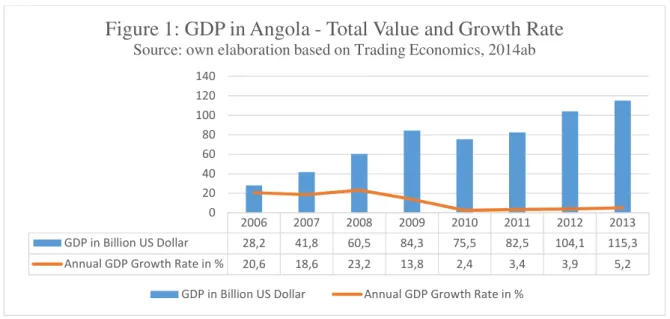
Thirdly, we would like to clarify what we mean by economic performance. In this project, we have chosen to look at economic performance based on the GDP measures and the structural transformation within Angola. In this project, we have worked with structural transformation as the reallocation of economic activity in order to develop new, more productive economic activities, and movement of resources to newer sectors (African Economic Outlook, 2013 Taking Stock on Africa’s Structural Transformation). When briefly examining the structural transformation, we will mainly be looking at employment structures and the agricultural sector, which offers great potential for development to the industrial sector (ibid).
Fourth, our theoretical chapter will furthermore present the institutional approach, which will constitute our theoretical framework throughout this project. This framework will be based on the writings by the
9 New Institutional Economics, while drawing specifically on the merits by Mehlum et al. (2006ab), Douglass North (2005, 2011) and Ronald Coase (1960). We intend to test the robustness of the hypothesis set forth by the institutional approach, which holds that there is a link between resource abundance and economic performance, when institutions are considered. However, we will test this hypothesis while at the same time be open-minded to the fact, that we may or may not discover a direct link concerning this specific causality.
Finally, we find it important to set a certain time frame concerning the case of Angola. It could be argued, that it is not possible to investigate an institutional setting within a country during a civil war, and Angola has been affected by civil war up until 2002. Furthermore, according to the Heritage Foundation, grading of Angola has been temporarily suspended from 2001 to 2005, and much of its notable progress over the history has occurred since 2006 (Miller et al., 2014:97). Thus, we have set the time frame from 2006 – up until 2013, in order to analyse the institutional quality of Angola in the best possible way.
1.4 Background knowledge on Angola
In this subsection, we would like to provide a brief introduction to the case of Angola. Theoretically, Angola has the potential to benefit from its resources: it is endowed with an abundance of natural resources, particularly oil and minerals, and it is one of Africa's biggest oil and diamond producers (Hammond, 2011:354). The country has an extensive economic growth, which almost exclusively origin from the oil sector through a combination of increased production and record prices for oil (Hammond, 2011:358; Trading Economics, 2014 Angola–BNP–Vækst–2014), whereas oil rents contributed on average to 47% of GDP in the years 2008 – 2012 (World Bank, 2011 Oil Rents (% of GDP)). However, the Angolan population has received virtually no benefits from this (Shaxson, 2009:91). Instead, scholars argue, that a narrow elite skim the cream (Roque, 2011:2; Shaxson, 2009:91). Hodges (2004) puts it eerily bluntly when stating that:
“If these resources were managed properly, Angola's economy would be among the most dynamic in the developing world. Its people would be among the best fed, best educated and healthiest on the African continent. The reality is quite the opposite” (Hodges, 2004:1).
10 This has to be understood in the context of Angola’s bloody history: In 1961, a violent struggle against Angola’s colonial superiors began (Hammond, 2011:357; Shaxson, 2009:52), and Angola gained independence in 1975 (Hammond, 2011:356), however, the establishment of independence did not lead to peace. Along with the struggles three rebel factions arose, and after the independence the fights amongst these groups started a civil war that lasted until 2002 (Shaxson, 2009:52; De Oliveria, 2007:597; Hammond, 2011:357). Since the end of the civil war, the MPLA party and its leader Jose Eduardo Dos Santos gained rule of the country. The party is virtually uncontested politically, and holds a great share of the electorate (Roque, 2013:1), although Angola has been ranked as one of the countries with extraordinary and severe challenges regarding corruption (Shaxson, 2009:71; Hammond, 2011:360). Some even talk of Angola having a parallel government: a formal and an informal shadow government (Roque, 2011, Shaxson, 2009:70). The system of parallel governing has maintained a stable political order since the end of the civil war, as well as spurring economic growth, through authoritarian governing practices (Hammond, 2011:360; Roque, 2011:1).
A crucial player in the extractive branch is the national oil company Sonangol, established in 1976 to manage the oil industry and secure a maximum amount of rents for the Angolan state (Heller, 2012:836). In the Angolan oil sector, mainly the multinational actors perform the greatest amount of the work, especially international oil companies from the U.S. and Europe are the big players in terms of exploration, extraction and production of oil in the country. This is related to the fact that most of oil is being extracted offshore and technological assets are required to produce efficiently (U.S. Energy Information Administration, 2014 Angola Background).
The anatomy of the Angolan economy, before the finding and effective extraction of oil, should be contrasted in order to show the destructive effect on other sectors. In 1960, coffee was the main product for export in Angola, manufacturing played a significant role and unprocessed agricultural goods constituted 56% of exports (Hammond, 2011:356). Today, coffee exports is a mere 0,0006% of total export revenue (Niño & Le Billon, 2014:89; Shaxson, 2009:64). The collapse of the non-oil sectors has ensured a high export concentration of oil. Combined with the fact that the Angolan exports reach very few markets indicates, that Angolan (non-oil-related) firms face severe problems in their ability to
11 participate in the global economy (World Bank, 2013:8). The combination of vulnerability to fluctuating oil prices, the lack of developed non-oil sectors, authoritarian rule and widespread poverty has convinced most scholars that Angola is a resource cursed country (Shaxson 2009; Hammond 2011).
1.5 Structure of the report
In this section, we would like to present the structure of this report and explain our intention with each section accordingly.
1. Introduction: The introduction should now have provided the reader with a presentation to this project. This includes a presentation of the problem formulation, working questions, the elaboration of the problem formulation and finally a brief introduction to the case of Angola.
2. Literature review: In order to embroil the reader in the, at times, murky waters of the resource abundance and resource curse literature, a brief outline of the most important debates in this field will be presented.
3. Institutional approach: From the literature review, we will introduce the theoretical approach of the project, beginning with a general introduction to the field of New Institutional Economics. Next, we will introduce the theoretical merits by Mehlum et al. (2006ab), Douglass North (2005, 2011) and Ronald Coase (1960), while also presenting some additional theoretical views mainly based on writings by Acemoglu et al. (2002, 2004) and Robinson et al. (2006).
4. Methodology: Next, within the methodology section, we wish to introduce our methodological considerations on how we intent to answer our problem formulation. This section will also serve to clarify our quantitative and qualitative data and the operationalization of the institutional approach.
5. Analysis: Having first presented the economic performance of Angola, we have chosen to divide our analysis into three parts.
12 1. The first part of the analysis will serve to analyse the quality of institutions based on quantitative data. In determining the quality of institutions we will draw upon four analytical indicators, in which we have derived from our theoretical framework and operationalized. The indicators are: the rule of law, bureaucratic quality, corruption in government and the business environment.
2. In the second part of the analysis we will put the findings from part one into a broader perspective, as we seek to analyse the quality of institutions in Angola based on qualitative data. As in part one of the analysis we will analyse part two accordingly to the four analytical indicators. These two parts combined will serve to clarify the quality of institutions within Angola.
3. In the third and final part we seek to include an analytical discussion in order to fully answer our problem formulation. In this sense we will discuss the findings of the economic performance of Angola and the quality of its institutions in determining: to what extent and how the quality of institutions determine whether natural resource abundance has a negative or positive impact on economic performance in the case of Angola.
13
2.0 Literature Review
This leads us to the following literature review on the resource curse debate. To perceive natural resources as a curse rather than a blessing could seem rather paradoxical. Nevertheless, this is the argument set forth by many scholars in relation to Sub-Saharan Africa (Carmignani & Chowdhury 2010; Lundgren et al. 2013 among others). It has been necessary to boil these down to a few of what we deem the most relevant, in order to show the field in which the institutional approach is situated. Drawing upon Kaplinsky et al. (2012), we have summed up the different debates into three main subchapters: terms of trade and the volatility of commodity prices, the Dutch Disease and the enclave nature of resource activities.
2.1 Terms of trade and the volatility of commodity prices
Prebisch and Singer (1950) are two very prominent scholars in the field of resource abundance, who have contributed with one of the earliest debates on economic performance and resource abundance. According to Rosser (2006) these scholars base their argument on the assumption, that countries rich on natural resources will experience declining terms of trade and commodity prices falling relative to manufacturing (Rosser, 2006:13). Furthermore, the long-term trends will affect commodity- and manufacturing prices by labour markets and high- and low-income economies.
According to Kaplinsky et al. (2012) Prebisch and Singer’s results shows that prices on low-income countries’ commodity tend to stay low, because of a surplus of labour, and lack of demand for higher wages from trade unions, unlike in the high income countries (Kaplinsky et al., 2012:4). This means that they can export their commodities very cheaply while importing is expensive (Kaplinsky et al., 2012:5). Singer argues, according to Rosser (2006), that because of its relative difficult-to-copy technology, high barriers protect manufacturing. However, this is not the case for commodities, and therefore the barriers to entry in this sector is low, and the income of producers is not protected like in the manufacturing sector, which means high competitive pressures. Because of this nature of the global commodity market, as well as the structure of the global economy, countries, relying on natural
14 resource exports, are put at a serious disadvantage (Rosser, 2006:7). Thus, the declining terms of trade makes sure that countries with abundance in natural resource are constrained in their prospects for economic growth and development (Rosser, 2006:13).
2.2 The Dutch Disease
Another argument central to the resource curse advocates is the Dutch Disease. Within this area, Sachs and Warner (1995) are often referred to as central scholars. According to Kaplinsky et al. (2012) Sachs and Warner find a negative correlation between resource abundance and GDP. They observed a significant reduction in GDP growth from 1970-1990, alongside with a doubling of primary products share in total export (Kaplinsky et al., 2012:6-7).
The Dutch Disease, according to Rosser (2006) therefore derives from the perception that a resource boom leads to a rapid increase in exchange rates, thus a stronger currency, which is damaging to the manufacturing and other tradable sectors (Rosser, 2006:14). This negative effect on manufacturing is the result of the unequal competition between non-traded goods and the producers of the traded goods. Traded goods become, according to Kaplinsky et al. (2012), more expensive while imports become cheaper, which makes it very hard for the producers of the traded goods to compete in export and imports. It simply becomes cheaper to import rather than produce the goods at home, and prices on exported goods rises (Kaplinsky et al., 2012:7). Thus, Kaplinsky et al. (2012) further argues, that the findings by Sachs and Warner connected resource abundance with decline in the manufacturing and service sectors (Kaplinsky et al., 2012:7). Thus, according to Di John (2011) deindustrialization becomes the inevitable outcome of an oil boom, and resource abundance a curse rather than a blessing (Di John, 2011:169).
2.3 The enclave nature of resource activities
The enclave nature of resource activities is another popular explanation of the resource curse, and the consequence of large resource endowments (Kaplinsky et al., 2012:3). Kaplinsky et al. (2012) point out how puzzling the coexistence of a foreign economy next to the domestic sectors is, in terms of a proper
15 economic analysis, and refer to the article “The Distribution of Gains Between Investing and Borrowing Countries” (1950) by Hans Singer (Kaplinsky et al., 2012:9).
However, Singer emphasizes that it is necessary to be careful with conclusions about the economic performance of an underdeveloped country. This is due to a pattern in underdeveloped countries with high productivity in the export sectors, while the sector with production for the domestic demand remains low on productivity levels (Singer, 1950:474). Although the initial assumption is to conclude towards beneficial effects of sectors related to foreign trade regarding the economic capacity and knowledge, Singer warns of quick interpretations (Singer, 1950:474). Singer draws the picture of an enclave of an economic sector in an underdeveloped country, which, due to lacking linkages, has not become a part of the local economy. It can actually easily even hamper their own technological development of the country – an aspect that is crucial for industrialization of a country (Singer, 1950:477).
Kaplinsky et al. (2012) further argues that the existence of an export sector leads to the fact that emerging industrial linkages would be directly connected to this economic branch, leaving the other domestically orientated sectors without development in terms of linkages (Kaplinsky et al., 2012:10). Furthermore, the concentration of infrastructural development, related to an easier export of the particular commodity, leaves other sectors, within an underdeveloped country, without incentives to extend its roads, ports or energy and water supply (Kaplinsky et al., 2012:10). These aspects lead to the assumption within a pessimist assumption that resource abundance has a negative effect on economic performance, and serve to curse a country.
16
3.0 Institutional Approach
While these more traditional explanations of the resource curse, put forward in the literature review, mainly focus on the average effect of resource wealth on a number of states, more recent literature focus on why outcomes vary in the same number of states (Ross, 2014:3). Furthermore, where the initial studies of resource abundance suggested that there was a strictly economic connection between resource abundance and economic growth, newer studies have emphasised that institutional differences matter. The result has been that some economists have started to incorporate ideas from political science into their work on the resource curse, mainly deriving from Neoclassical Economics or New Institutional Economics (Rosser, 2006:14).
Recent studies claim to find empirical evidence for this institutional approach, as well as claiming that by no means is the resource curse cast in stone. By taking foothold in New Institutional Economics, scholars such as Mehlum et al. (2006ab) and North (2005, 2011) provide a more 'optimistic' view on resource abundance.
In the following chapter, we will review the relevant institutional theories surrounding our case in Angola. This theoretical review will take a starting point in New Institutional Economics, which serves as our overall understanding of the institutional theories. Next, the chapter will focus on the specific work by Mehlum et al. (2006ab) Douglass North (2005, 2011) and briefly touch upon Ronald H. Coase (1960). Combined, these theories will serve as an operationalization as our overall theoretical understanding of institutions and institutional quality. Furthermore, we will introduce complementary theoretical views and a critical assessment of the institutional approach, mainly based on Mehlum et al. (2006ab).
3.1 New Institutional Economics
Scholars of New Institutional Economics (NIE) study institutions, and how these interact with organisational arrangements such as markets, firms, contractual agreements and various behavioural
17 traits underlying the arrangements (Menard & Shirley, 2005:1).
The approach of NIE define institutions as:
“The written and unwritten rules, norms and constraints that humans device to reduce uncertainty and control their environment. These include (i) written rules and agreements that govern contractual relations and corporate governance, (ii) constitutions, laws and rules that govern politics, government, finance, and society more broadly, and (iii) unwritten codes of conduct, norms of behaviour, and beliefs” (Menard & Shirley, 2005:1).
Economic change cannot be understood without these institutions, and institutions cannot be understood without analysing human incentives and intentions (Menard & Shirley, 2005:2). NIE seeks to explain why institutions emerge, why they perform in a certain way and which effect the institutional arrangement has on certain individuals. This is in contrast with the older neoclassical paradigm, which was only marginally interested in institutions, but focused more on the efficiency of the outcomes of markets (Spruyt, 2013:117). In general, NIE differs from the old neoclassical paradigm in one important way: by assuming that actors are rational, it realizes that individuals make decisions under uncertainty (Spruyt, 2013:118). In this sense both approaches are methodologically individualist, but whereas the older neoclassical paradigm operates on the premise that individuals are the primary unit of analysis, the NIE approach seeks to make institutions the centrepiece of its analysis (Spruyt, 2013:118-119).
While the older neoclassical economy assumes that individuals have perfect information and always act rationally, the NIE approach stresses the limited mental capacity of individuals and lack of complete information. Because of this uncertainty, they incur transaction costs1 in order to achieve this information (Menard & Shirley, 2005:1). In order to limit these risks and transactions costs, humans create institutions, which can play out either as formal or informal institutions. Formal institutions are
18 derived from writing and enforcing constitutions, laws, contracts and regulations2, whereas informal institutions consist of the structuring and indoctrinating norms of conduct, beliefs and habits of thought and behaviour (Menard & Shirley, 2005:2).
Institutions as the centrepiece of analysis have also been addressed by scholars such as Mehlum et al. (2006ab) and North (2005, 2011), as they claim institutions matter in the context of resource abundance. The NIE approach offers a possibility to combine concepts of economics and political science, as well as focusing on the agent, instead of only focussing on the structural implications. In this context, two things should be noted: the first being, that even though we place Mehlum et al. (2006ab) and North in the category of NIE, only North is referred to as an NIE scholar (Menard & Shirley, 2005). We have placed Mehlum et al. (2006ab) in this category since they base their assumptions on key elements of NIE. In other words, even though these scholars have not explicitly stated that they adhere to the NIE approach, we believe that the particular articles, that we employ, belong to the category.
We now intend to turn our focus to the concrete theoretical assumptions taking root in the work of Mehlum et al. (2006ab).
3.2 Halvor Mehlum, Karl Moene and Ragnar Torvik
Mehlum et al. find it quite puzzling that not all resource rich countries are cursed, as growth winners such as Botswana, Norway, Canada and Australia have become prosperous because of, rather than despite of their natural resources (Mehlum et al., 2006b:1117). This implies that natural resources are not a curse per se. According to Mehlum et al. (2006ab) the economic consequences of finding natural resources are therefore determined by the quality of institutions. The resource curse is in this sense less deterministic, as it is possible to escape the resource curse by rearranging the allocation of resource rents. Thus, the poor economic performance depends on the ability of institutions to either channel the
19 rents into the productive economy, or just by letting the rents be captured by the elite for personal enrichment (Mehlum et al., 2006b:1119).
This institutional approach contrasts the rent-seeking hypothesis that Sachs and Warner (1995) considered, but ended up dismissing in favour of the Dutch Disease. Sachs and Warner did try to explore the connection between economic growth and institutional quality, but end up arguing: “[…] there is only weak evidence that primary resources is associated with poorer bureaucratic quality” (Sachs & Warner 1995:19). However, Mehlum et al. (2006ab) argue that the role of institutions cannot be disregarded only based on the lack of empirical evidence of institutional decay caused by resource abundance, as:
“Institutions may be decisive for how natural resources affect economic growth even if resource abundance has no effect on institutions. We claim that natural resources put the institutional arrangements to a test, so that the resource curse only appears in countries with inferior institutions,” (Mehlum et al, 2006a:3).
In this sense Mehlum et al. criticizes Sachs and Warner for not considering the hypothesis that bad institutions can explain the resource curse, and that good institutions can help eliminate the resource curse, and even make natural resources a blessing. This institutional approach must therefore be seen in the light of trying to make the Dutch Disease story less acceptable as the main explanation for the resource curse, as has often been the case in the resource curse literature (Mehlum et al., 2006a: 12; Mehlum et al., 2006b:1120).
The main theoretical focus of hypothesis by Mehlum et al., is the tension between production and certain ways of rent seeking, thus the allocation of entrepreneurs between productive and unproductive rent extraction (grabbing). As already mentioned, resource rents may be channelled into the productive economy or be captured, ‘grabbed’, by the elite. As grabbing obviously harms economic development, it depends on the quality of the institutions that these resources may or may not induce entrepreneurs to specialise in grabbing (Mehlum et al., 2006a:4). The scholars provide empirical evidence for this
20 hypothesis, using the dataset of Sachs and Warner (1997), thus combined they introduce the rent-seeking model:
3.3 The rent-seeking model
For Mehlum et al. (2006ab) the most important institutions are those governing the profitability of productive enterprise in the private sector. As the private sector is not further defined by these scholars this project has chosen the definition of the business environment. In this sense, the private sector is the sector, which is run by private enterprises and entrepreneurs. The model by Mehlum et al. (2006ab) therefore stresses the importance of institutions of private sector efficiency such as the rule of law, bureaucratic efficiency, low corruption and the risk of expropriation and repudiation of contracts (Mehlum et al., 2006b:1122).
In the rent-seeking, model entrepreneurs choose between rent-seeking and productive activities. The relative profitability of productive activities depends on the quality of institutions. High institutional quality (producer-friendly institutions) leads to an equilibrium where all entrepreneurs are producers, and low institutional quality (grabber-friendly institutions) leads to one where certain amounts of entrepreneurs are rent-seekers. A grabber-friendly institution has characteristics such as dysfunctional democracies, which invites political rent appropriation; low transparency, corruption, weak rule of law, weak protection of property- and citizens’ rights (Mehlum et al., 2006b:1121). With this type of institutions rent-seeking pays off outside the productive economy, as there is a disadvantage from being a producer in the competition for natural resource rents, thus production and rent-seeking becomes competing activities (Mehlum et al., 2006b:1121). Consequently, the model illustrates how grabber-friendly institutions push aggregate income down, when natural resources are discovered in a given country. This also explains how natural resources become a curse rather than a blessing (Mehlum et al., 2006b:1128). This effect is by the scholars denoted as the displacement effect, as it reduces national income because entrepreneurs move from production to grabbing.
21 In contrast, we see an immediate income effect in producer-friendly institutions, as higher resource rent leads to an increase in national income (Mehlum et al., 2006a:9). Producer-friendly institutions have characteristics that all imply effective production activities, such as high bureaucratic quality, low corruption in government and rule of law (Mehlum et al., 2006b:1122). With producer-friendly institutions the national income increases with the discovery of natural resources, thus making it possible for a resource abundant country to escape the resource curse, and even make it a blessing (Mehlum et al., 2006b:1128). Hence, with a producer-friendly institution it becomes difficult to be an effective rent-seeker, unless you are a producer. These institutions provide an advantage regarding subsidies, public support etc. for producers, in which production and rent seeking becomes complementary, instead of competing, activities.
The rent-seeking model set forth by Mehlum et al. (2006ab) has been widely discussed, and even empirically tested as being highly relevant for economic development in poor countries (Kolstad, 2007). However, as rent-seeking models tend to focus only at the private sector institutions, and we wish to apply a broader institutional perspective, we have chosen to draw upon the work by Douglass North (2005, 2011) and Ronald Coase (1960). At the same time, Mehlum et al. does specify that in focusing on the decisive role of institutions for economic development the scholars are, among others, inspired by North and Thomas (1973) (Mehlum et al., 2006a:2).
3.4 Douglass North
The approach of North in grasping institutional and economic change, as well as economic performance has, in the vein of NIE, the entrepreneur as the centrepiece. Where institutions make up the 'rules of the game', as both formal written and unwritten rules, organisations are the players (North, 2011:4). Organizations are made up of groups of individuals seeking the same objectives, as for instance economic organizations such as firms and trade unions (North, 2011:5). Organizations, and hereby individuals, are seeking profit maximizing in the short run, and, because of scarcity and competition, are ultimately fighting for survival. This scarcity and fight for survival is what induces entrepreneurs to invest in skills and knowledge to the benefit of their organization (North, 2005:22).
22 From Mehlum et al. we saw that the entrepreneurs would choose between rent-seeking or productive activities according to what is the most profitable (Mehlum et al. 2006ab). This is in line with North (2005), who elaborates further that the main goal of the entrepreneur is maximizing profit or payoff, and that this is the main driver for investment and knowledge accumulation, eventually leading to institutional change (North, 2005:23).
North further emphasises that institutional change is incremental, and path dependent (North, 2005:24). According to North, it is important to note, that change does not necessarily equate to economic growth or progress, but that the direction of change is a result of whether income redistribution or productive activity is perceived to lead to the highest amount of payoff. This distinction resemble to that of Mehlum et al. (2006ab) with the distinction of producer-friendly and grabber-friendly institutions. In North's account, every economy has a different set of incentives for both activities, and the weight between the redistributive and productive incentives are crucial factors for the performance of the economy as such (North, 2005:23). The institutional framework will shape the trajectory of a given economy, which can be viewed through the particular investments in skills and knowledge its leading organizations make.
In other words if the highest rate of return in a given economy comes from a redistributive activity such as piracy, then one can reasonably expect that the organizations will invest in the skills and knowledge needed to make them better pirates. However, if there are higher returns in productivity increasing activities3, it is similarly reasonable to expect organizations to invest in skills and knowledge that increases overall productivity (ibid.). Whether an economy is driven by either redistributive or productive activities, will have an effect on the level of investment into fundamental economic foundations, such as formal education, schooling, the dissemination of knowledge, and research (ibid.). Where Mehlum et al. (2006ab) make the distinction between grabber-friendly and producer-friendly
3 North gives the example of a pirate and a chemical manufacturer. The economy, where piracy (income redistribution) is the most preferred (profitable) activity, a demand will rise of naval warfare technology, which will shape the trajectory of this given economy. However, in another economy, e.g. in the early 20th century USA, successful chemical manufacturers (productivity increasing) gave rise to a demand for both applied and pure chemical research, as well as the study of markets, efficiency and transaction costs (North, 2011:77).
23 institutions to show that institutions, are decisive in whether or not resources may be harmful to an economy, North illustrates how the shaping and emergence of these institutions have long term consequences for an economy.
In essence this boils down to the argument that if an economy has a history of, to use the term of Mehlum et al. (2006ab): grabber-friendly institutions, then changing this is going to be incremental. Structures have a constraining effect on actors, or entrepreneurs, but they can and eventually will be changed, through the profit and opportunity seeking of the entrepreneur (North, 2011). The focus of Mehlum et al. (2006ab) follows the logic of North, in that it is the quality of institutions that induces the entrepreneur to either specialise in grabbing or in productive activities (Mehlum et al., 2006a:4).
What lacks from this explanation is the interplay between the agency of the entrepreneur and the constraints of institutional structures. Here, North points to the belief systems of a society: The dominant belief system in a society, held by leading political and economic entrepreneurs, leads them to create certain structures of institutions, or rules, both formal and informal, determining the economic and political performance of a country. These structures make up a so-called institutional matrix that imposes constraints on modification or introduction of new institutions in order to improve the position of the entrepreneur. This is also the reason why economies perform differently; because of the way, individuals perceive payoff. This perception is shaped by the way the human mind interprets information it receives, stemming from the genetic evolution of the mind, the cultural heritage of the individual, local everyday problems, that must be confronted and solved, and non-local learning (North, 2005:29).
Because of this, individuals, from different backgrounds, will interpret the same evidence differently, and this may lead them to make different choices. Following this, difficulties of economic change can often be subscribed to the belief system that has evolved as a result of cumulative past experiences of a society, which may not have equipped its members to confront and solve new problems (ibid.).
24
3.5 Ronald Coase
The theoretical assumptions about institutions, developed by North (2011, 2005) and Mehlum et al. (2006ab,) are all eventually based on the Coase Theorem, within the framework of New Institutional Economics. Nobel Prize laureate Ronald H. Coase first developed this in the paper “The Problem of Social Cost” (1960). The economist coined the theory of NIE already in 1937 with his paper “The Nature of the Firm”. We intend to supplement the findings of our institutional approach with the writings of Ronald Coase concerning his focus on property rights.
Emerged from the analysis about the logic of relations among firms, according to the Coase Theorem, transaction cost, which is “[…] the costs of running the economic system” (Arrow, 1969:48), play a significant role in market dynamics. Perfect information about other actors’ property rights is necessary in order to avoid negative externalities and achieve the most efficient and beneficial agreement. In this sense, property rights can be defined as “[…] sanctioned behavioural relations among men, which arise from the existence of things and pertain to their use” (Furubotn & Pejovich, 1972:1139, emphasis in original). Property rights “affect the allocation of resources in specific and predictable ways” (Furubotn & Pejovich, 1972:1139, emphasis in original), and they have to be well-defined in order to keep transaction costs low. Nevertheless, transaction costs will always emerge due to the imperfection of human beings, and these imperfections, like asymmetric information and knowledge, lead to inefficiency of the economic system (Furubotn & Richter, 2005:47-48), but their extent can be influenced. According to the Coase Theorem, by the introduction of well-defined property rights, transaction costs can be sufficiently overcome for a significant increase of efficiency.
As North points out, institutions are the formal and informal rules of the game (North, 2005:22), and these institutions have to be strong in order to define property rights accurately, which leads to the most efficient economic allocation (Coase, 1960:6). The efficiency determines the actions and incentives of the actors in the game. If property rights are ill-defined different actors in economic interactions will interfere with the others’ actions respectively, which leads to harm or negative externalities. By having well-defined property rights actors will gain success through bargaining each other’s rights (Coase,
25 1960:2). This is an important part of the theoretical approach of both North (2005, 2011) and Mehlum et al. (2006ab), in the sense that incentives are what leads entrepreneurs to engage in either redistributive or productive activities. Moreover, since entrepreneurs are the main drivers of investment in skills and knowledge in a society, consequently when property rights are ill-defined entrepreneurs will shift away from productive activities towards rent-seeking (Mehlum et al., 2006ab).
In a nutshell it is initially crucial to have stable institutions to keep transaction costs low; otherwise, the adjustment of property rights becomes far too expensive and hampers beneficial incentives for economic allocation. This is what contribute in general to the focus on institutions governing the profitability of productive enterprises in the private sector since this is the main area where the entrepreneurs of a given society decide whether it pays off to engage in activities inside or outside the productive part of the economy4.
3.6 Sub conclusion
Based on this theoretical framework we can derive certain perceptions of institutions and institutional quality. We derive our definition on institutions from North (2011), who infer that institutions are ‘the rule of the game’. Furthermore, North distinguishes between the informal rules, such as behaviour and beliefs, and formal rules of the game, such as constitutions and laws, which in different ways constraints and thus directs human actions (North, 2011:3, 36-47). As stated by the references to North (2005, 2011), Coase (1960) and Mehlum et al. (2006ab) the quality of institutions have a great significance, since they have an impact on the economic performance. When referring to the resource curse we will apply the definition by Mehlum et al.: “When institutions are bad resource abundance is a growth curse, when institutions are good resource abundance is a blessing” (Mehlum et al., 2006b:1127).
From Mehlum et al. (2006ab) we can derive that institutions of high quality are defined as
4 E.g. Whether an actor can attain most profit from being a warlord outside of the productive economy, or from taking part in the productive economy, as for instance an oil contractor in a resource abundant country (Mehlum, 2006b:1121).
26 friendly institutions, whereas institutions of low quality are defined as grabber-friendly institutions. In determining the level of institutional quality we intend to look at the same areas set forth by Mehlum et al.: rule of law, bureaucratic quality, corruption in government, risk of expropriation, and risk of government repudiation of contracts (Mehlum et al., 2006b:1127). We have chosen to apply these four areas as analytical indicators in the analysis, which will be operationalized in methodology (page 41). In doing so, we will define these as:
1. Rule of law
In this project, we intend to define the rule of law as the formal rules of the game, such as “...the quality of contract enforcement, property rights, the police, and the courts, as well as the likelihood of crime and violence.” (World Bank Group, 2014 Rule of Law). Furthermore, as property rights are a crucial element of rule of law, we intend to define this in accordance with NIE: property rights can be defined as “[…] sanctioned behavioural relations among men, which arise from the existence of things and pertain to their use” (Furubotn & Pejovich, 1972:1139, emphasis in original).
2. Bureaucratic quality
The indicator of bureaucratic quality is an important one as it is closely linked to the rule of law. Turning to the World Bank Governance Indicators, we will define this as:
“[…] the traditions and institutions by which authority in a country is exercised. This includes (a) the process by which governments are selected, monitored and replaced; (b) the capacity of the government to effectively formulate and implement sound policies; and (c) the respect of citizens and the state for the institutions that govern economic and social interactions among them.” (Kaufmann et al., 2010:4).
3. Corruption in government
In this project, we will work with an overall definition of corruption based on the perception, that corruption is the misuse of entrusted power for private gain. This applies in both the private and public sector, which means that we will be drawing upon data on corruption in both businesses and government.
27 4. Business environment
The last two areas set forth by Mehlum et al. (2006ab): risk of expropriation and risk of government repudiation of contracts will be combined under the analytical indicator: business environment. This implies that we seek to analyse whether or not the business environment in Angola have had an impact on its economic performance. The business environment will be limited to a discussion of the ease of starting a business, the enforcement of contracts, and protection of minority investor.
These indicators will be operationalized on page 41in the section of methodology and presented as part of our analytical strategy.
3.7 Complimentary theoretical views
In this chapter, we seek to bring in some complimentary views on the institutional framework, which we have presented. Having many reservations regarding their own theory, Mehlum et al. does specify that there may also be additional reasons for why institutions are key to understanding the resource curse, than illustrated by their own model (Mehlum et al., 2006b:1126). Referring to the model developed by Robinson et al. (2006), Mehlum et al. point to an additional factor such as politics, which may be able to explain the link between institutions and the resource curse. According to Robinson et al. (2006) the theoretical work on the resource curse has not developed explicitly political models, which is a gap in the literature.
Theorists such as Mehlum et al. (2006ab) tend to ignore politicians and political incentives and perceive the state as simply an aggregator of pressure from interests groups. In reality, and particularly in developing countries, politicians seems to have quite a large amount of autonomy from interest groups (Robinson et al., 2006:448). This leaves room for a discussion on which institutions matter, when dealing with economic performance, as this project is. Because as the rent-seeking model by Mehlum et al. (2006ab) seem to stress the importance of institutions of private sector efficiency such as the rule of law, bureaucratic efficiency, the risk of expropriation and repudiation of contracts, the
28 patronage model of Robinson et al (2006) emphasizes institutions of public sector accountability (Kolstad, 2007:2).
This political factor emphasised by Robinson et al. (2006) is an addition to NIE, which is also stressed by Acemoglu et al. (2002). In the paper ”Reversal of Fortune: Geography and Institutions in the making of the Modern World Income Distribution5”. Acemoglu et al. (2002) seek to explain why those countries that were rich before being colonized by European powers in the 1500's, are now relatively poor. In doing so, the scholars emphasise that societies, with a social organisation that can encourage investment, tend to be the ones that prosper the most (Acemoglu et al., 2002:1262). In this context, a good social organisation is defined as a cluster of political, economic and social institutions ensuring, that as large a part of society as possible enjoys effective property rights (Acemoglu et al., 2002:1262).
These so-called clusters are referred to as institutions of private property and extractive institutions. Akin to what Mehlum et al. (2006ab) define as grabber-friendly institutions, extractive institutions are institutions:”[...]where the majority of a population faces a high risk of expropriation and hold up by the government, the ruling elite, or other agents” (Acemoglu et al., 2002:1262). It is crucial for an economy that those with productive opportunities can expect to receive a return for their investments, as well as being encouraged to undertake such investments in the first place. Furthermore, a society in which only a minor fraction of the population holds the wealth and political power is not necessarily conducive to investments, as many of the actors, with entrepreneurial human capital and investment opportunities, may very well be those without effective property rights protection (Acemoglu et al., 2002:1263). The fact that only a narrow elite benefits from state rules and regulations offers scant prospects for long-term growth, whereas broad based political power is vital in the long run (ibid.).
The scholars refer to these types of regimes as “kleptocratic” regimes, which implies that the state is controlled and run for the benefit of an individual, or a small group, who use their power to transfer a large fraction of society’s resources to themselves (Acemoglu et al., 2004:162). Many countries within
5 Daren Acemoglu & James Robinson published a new book in 2013 with the title: Why Nations Fail: The Origins of
29 Sub-Saharan Africa suffer under these types of regimes, and especially those countries rich on natural resources (Acemoglu et al., 2004:165). Going beyond Mehlum et al. (2006ab), Acemoglu et al. (2002) argues that the colonial past may also have something to say in the institutional development of a country. In the past, European colonialism has disrupted the social organisations, or led to the establishment or continuation of already existing extractive institutions in colonialized countries. In those colonies, where Europeans set up or took over extractive institutions, political power became concentrated in the hands of the few, who extracted resources from the rest of the population (Acemoglu et al., 2002:1264).
3.8 Critical assessment of the institutional approach
With our application of the institutional approach, set forth by Mehlum et al. (2006ab), it could be argued that the literature is deficient in some directions. First, different scholars have several times pointed to the concerns that the natural resource abundance indicator by Sachs and Warner (1995, 1997), which is also used by Mehlum et al. (2006ab), is problematic. The problem lies with this particular indicator, which is the share of primary exports in GDP per exports (Sachs & Warner, 1995:2-3). However, the indicator is argued only to capture the lack of non-resource sectors, rather than indicating whether a country is resource based or not. For instance would this same data today, if applied on countries like Norway or Australia, show, that these countries are resource poor, reflected by relatively small shares of primary exports. This is because Norway and Australia both have high resource abundance per capita, but also have a relatively large non-resource sector. In this sense it could be argued that the dominance of primary exports is an indication of how specialised a country is, and this may be related to the structure of the economy rather than to the resource curse (Bakwena et al., 2009:4).
Robinson et al. (2006) point to the same problem, arguing that the measure of resource is endogenous. In the Congo under Mobutu, as the economy fell to pieces, the only sector left, apart from subsistence activities, was the extraction of resources. This yields some severe methodological problems for the omitted variables in the data by Sachs and Warner (Robinson et al. 2006:451), thus also in the research
30 by Mehlum et al (2006ab).
Second, turning to the main hypothesis set forth by Mehlum et al. (2006ab) it could be argued, that the link between resource abundance Economic performance, when taking institutions into account, depends on how resource abundance is defined and measured. Bruunscheweiler & Bulte (2008) point to the fact that it is challenging to find truly exogenous measures of resource abundance. The scholars argue that previous studies on resource abundance is defined as the ratio of resource exports to GDP, generally based on the information for a single year at the beginning of the observation period (Bruunschweiler & Bulte, 2008:249). However, when scholars use the current resources per capita as an independent variable in cross-country analysis it becomes a problem, if these countries have discovered oil at different years. Comparing their oil reserves at a given point in time may understate the extent of oil abundance for those who discovered and produced oil earlier on (Cotet & Tsui, 2009:9).
Furthermore, the ratio to measure oil is often thought of as a measure of resource dependence (or comparative advantage in resource products) and not as resource abundance. This denominator tends to measure the magnitude of other activities in the economy, which implies that the ratio variable is not independent of the institutions, in which they are produced. In this sense, the resource dependence suffers from endogeneity problems, and perhaps it should be treated as an exogenous variable. Conclusively the authors propose, that a better measure of resource abundance would reflect resource stocks (Bruunschweiler & Bulte, 2008:249). Therefore, these scholars state, that it can be valuable to distinguish between resource abundance (a stock measure of resource wealth), resource rents (the flow of income derived from the resource stock at some point in time) and resource dependence (the degree to which countries do—or do not—have access to alternative sources of income other than resource extraction, again at some point in time) (Bruunschweiler & Bulte 2008: 261).
Third, Saad-Filho & Weeks point to the critical factor that many studies seek to demonstrate that resource abundance is correlated with poor growth. However, the scholars argue that, even if this correlation could be demonstrated, the causality might also be turned around. For instance poverty, low
31 skills and weak infrastructure might as well result in reliance on primary product exports, in which case the latter becomes a symptom of underdevelopment rather than its cause. It is also possible that poor performance could be caused by a third (omitted) variable (Saad-Filho & Weeks, 2013:5).
In this sense, when dealing with the resource curse and resource abundance in general, different scholars question how to measure oil abundance properly, and how it should be applied in research. At the same time, the causality between resources, institutions and economic performance is not fixed. Besides other omitted variables, which may influence this link, it could also be argued that the curse simply does not exist. As argued by Bruunschweiler & Bulte (2008) the empirical relationship between institutional quality and resource dependence may just be a reflection of the fact, that countries with poor institutions are unlikely to develop non-primary production sectors to reduce their dependence on resource exports. If so, the causality would be from institutions to dependence, and not the other way around.
Fourth, we would like to stress that we perceive the institutional approach by Mehlum et al (2006ab) as quite superficial. Many of the important concepts are not defined, which has forced us to interpret and redefine many of the variables and indicators used in their theory. In this sense, we have put our own fingerprints on this theory, when applied during the project.
32
4.0 Methodology
In this section, we wish to clarify our methodological considerations and chosen methods, and argue how we are going to answer our problem formulation. First, we wish clarify our methodological considerations and purpose of this research. Following these sections, we will briefly present our case study, while also arguing for why we have chosen the case of Angola. Next, we will present our empirical data, while critically assessing the empirical framework. Finally, we will end this chapter with an operationalization of the institutional approach to clarify how we apply the theory in the analysis.
4.1 Methodological considerations
In this project, we have chosen to work with the NIE as our overall theoretical framework. In this sense NIE will be a part of our theoretical, as well as our ontological, point of departure. As mentioned in our theory chapter (page 17), the NIE approach moves beyond neoclassical theory with the assumption, that actors are not infinitely rational or have perfect information. To make up for this actors create institutions, which infer that the institutional structures governing the economy are as changeable as they are confining. In contrast to the more traditional approaches6, NIE opens up for the fact, that the agent, or entrepreneur in our case, make active choices that can affect the economic structures. For instance, when economic and political entrepreneurs chooses to either engage in rent-seeking or productive activities, this has a profound impact on the trajectory of the economy. Thus, our understanding of reality throughout this project will be shaped by the agency-structure duality, which is stressed by NIE.
4.2 Purpose of research
The purpose of this paper is primarily to test the robustness of the hypothesis of how and to what extent there is a link between resource abundance and economic performance, when the quality of institutions is taken into account within the case of Angola. Furthermore, this project serves as an in-depth analysis
33 of a resource abundant country, where the majority of research, in the resource abundance literature, seems to focus on cross-country analysis (Ross, 2014). In addition to this, in analysing the institutional quality of a country, that exhibits largely all the indicators of being resource cursed, the findings of this paper will contribute to either strengthening or weakening the hypothesis set forth by Mehlum et al. (2006ab). Consequently, we will be positioning ourselves in the on-going debate on the link between resources and economic performance in resource rich countries, which is what Rosser refers to as the rational actor strand (Rosser, 2006:15). Lastly, the findings of our analysis will add to the literature on whether, or to which degree, Angola is resource cursed.
4.3 Case Study
This paper will be based on a case study of Angola. Whilst working with a specific case it will enable us to understand the current and particular situation of Angola. A case study is an in-depth, contextual examination of a specific phenomenon (Flyvbjerg, 2010:464). The purpose of a case study is therefore not to find an universal explanation, independent from the studied context, but instead to cover and clarify the reality of a specific case (Bryman, 2012:68-69). One critique towards using a case study is that it is too subjective and does not depict an objective perspective (Flyvbjerg, 2010:478). However, we do not believe that any knowledge exists, which merely portrays an objective perspective. Thus, while constructing a project, as this one, we will always have a certain viewpoint and a certain objective (Flyvbjerg, 2010:479ff). In this sense, we argue, in line with Bent Flyvbjerg (2010), that context-bound knowledge is more valuable than the endless search for universal explanations.
We find Angola an interesting case to examine; first, because it is one of the most frequently used cases to portray as a resource cursed country by academic scholars (Boschini et al. 2007; Niño & Le Billon, 2013). Second, almost 90% of Angola’s export is based on the oil sector (Hammond, 2011:354), and according to both Bulte et al. and Auty countries rich on point resources like oil, is more vulnerable to exploitation by political elites (Bulte et al., 2005:1031; Auty, 2001:6). These countries:
34
“[…] are expected to have ‘‘bad policies,’’ and suffer from the so-called rentier effects, repression e ffects, or policies that postpone the transition to competitive industrialization and diversification of t he economy” (Bulte et al., 2005:1031).
In this sense, Angola will work as a typical case, or an exemplifying case. This implies that our choice of Angola as a case is not because it is extreme or unusual in any way, merely because Angola will represent a broader category of cases and provide us with a suitable context for our problem formulation to be answered (Bryman, 2012:70). However, we do not claim that we can generalize based on this case study. Thus, all of our conclusions will only portray one picture of the case of Angola, and how we have studied this specific case. Therefore, the objective is to test the robustness of the hypothesis set forth by the institutional approach based on the typical case of Angola.
4.4 Empirical Data
In this chapter, we intend to present and critically assess our empirical framework and collection of data. We have gathered our empirical data by applying the so-called snowball-method, where one source will lead to the next (Lyngaard, 2012:141). By doing so, it creates an immense knowledge and makes possible to view the area of interest from several perspectives. Thus, we have been able to grasp the whole complexity of the debate as far as possible.
As case studies frequently sites for both quantitative and qualitative research we have adopted the same approach of data triangulation (Bryman, 2012:68). Data triangulation is defined as: “[…] the combination of methodologies in the study of the same phenomenon” (Jick, 1979:602). It has often been argued that, by using data triangulation, one method (or type of data) will compensate for the weaknesses in the other (Jick, 1979:604). Thus, by combining different sets of data, our study seeks to be strengthened by gaining a more in-depth and comprehensive understanding of our problem formulation. In the next two sections, we will present our data collection, and how we have applied quantitative and qualitative data in the analysis, respectively. In the following section, we intend to reflect critically upon this data collection. Much of the gathered data within this empirical framework stems from different indices. As a courtesy to the reader, we have provided an overview of the use of