A Simple and Secure E-Ticketing System for Intelligent
Public Transportation based on NFC
Ivan Gudymenko
TU Dresden 01062 Dresden Saxony, Germany[email protected]
Felipe Sousa
UFCGRua Aprígio Veloso, 882 -Bodocongó
Campina Grande - PB, Brazil
[email protected]
Stefan Köpsell
TU Dresden 01062 Dresden Saxony, Germany[email protected]
ABSTRACT
E-ticketing systems for public transportation (ESPT) are an integral part of intelligent transportation systems (ITS) which shape the urban environment of the future. The wide deployment of ESPT around the world has proven its suc-cess and demonstrated large potential. However, till now the majority of such systems being in operation adhere to the specific standards which are often closed. In this paper, we aim at suggesting an open and secure e-ticketing archi-tecture which provides an alternative to the conventional paper-based ticketing and is customizable for different tariff schemes. Our solution is based on NFC which should facili-tate its interoperability with value-added services (from the third parties as well) and pave the way to its convergence with other applications comprising an Internet of Things (IoT) ecosystem in the urban environment.
The suggested architecture covers the main processes spe-cific to the ESPT scenario and provides for e-ticket unclon-ability, unforgeability as well as for protection from tapping and replay attacks. Finally, the results of practical valida-tion using real hardware are presented to demonstrate the real-world pertinence of our solution.
Categories and Subject Descriptors
Domain-specific security and privacy architectures, Secure online transactions, Distributed systems security.
General Terms
Systems design
Keywords
E-ticketing, NFC, Security, Open Source
1.
INTRODUCTION
The ever growing trend of substituting analog systems by their digital counterparts has had a profound impact on a
Permission to make digital or hard copies of all or part of this work for personal or classroom use is granted without fee provided that copies are not made or distributed for profit or commercial advantage and that copies bear this notice and the full cita-tion on the first page. Copyrights for components of this work owned by others than ACM must be honored. Abstracting with credit is permitted. To copy otherwise, or re-publish, to post on servers or to redistribute to lists, requires prior specific permission and/or a fee. Request permissions from [email protected].
Urb-IoT ’14October 27 - 28 2014, Rome, Italy
Copyright is held by the owner/author(s). Publication rights licensed to ACM. ACM 978-1-4503-2966-8/14/10...$15.00
http://dx.doi.org/10.1145/2666681.2666687
complex urban ecosystem. Intelligent transportation sys-tems becoming an integral part of any modern megalopolis are one of the consequences of such transition. In many cities around the world, the concept of the so-called elec-tronic ticketing (e-ticketing) is being extensively used for issuing travel permissions which may eventually result in conventional paper-based tickets being completely phased out already in the nearest future. Opal Card in Sydney [8], Oyster Card in London [7], Touch & Travel in Germany [9] are all the examples of how well the e-ticketing has been accepted both by customers and public transportation com-panies.
However, the vast majority of such e-ticketing systems for public transportation (ESPT) deployed around the world adhere to closed specifications and are subject to different standards (which are for the most part closed as well). In this paper, we are aiming at suggesting a simple yet per-formant ESPT model which is based on open source com-ponents and is, therefore, by default extensible and open to public review. The proposed system architecture adheres to the so-called “honor-based” system for public transportation widely deployed in Germany. That is, the customer does not have to prove the possession of a travel permission every time using the transportation service (e.g., to pass through a turnstile) but rather be prepared to present a valid travel credential if being checked by a conductor.
The paper is organized as follows. The use case scenario of ESPT is described in Section 2 with the core requirements following in Section 3. The adopted attacker model is dis-cussed in Section 4. The suggested solution is presented in Section 5 and evaluated in Section 6. The related work is discussed in Section 7. Section 8 concludes the paper.
2.
TARGET USE CASE SCENARIO
2.1
Core Processes
Our system provides a digital alternative to a conventional paper-based ticketing in public transportation. Therefore, the following processes have to be considered: (1) e-ticket acquisition,(2)e-ticket stamping, and(3)e-ticket checking.
(1) E-ticket acquisition (online): describes the process of a customer acquiring (i.e., buying) an e-ticket ei-ther via a Web interface (ticket issuing server, hence requiring online connection to the back-end) or from a local vending machine (via the NFC interface). It
is assumed that the obtained e-ticket must be further activated (i.e. “stamped”) before entering the public transportation system.
(2) E-ticket stamping (offline): refers to activating the e-ticket making it valid for a current ride and ready for possible inspection. Stamping is performed via NFC by choosing the appropriate e-ticket from e-ticket manager app and then holding the smart phone in the vicinity of a dedicated area of stamping machine. Due to their wide distribution (e.g., several machines at every station), it would be too costly to assume that they can maintain constant connection to the back-end. Therefore, our system supports offline stamping.
(3) E-ticket validation (offline): captures the event of a conductor checking the validity of an e-ticket (that is, checking if the e-ticket was stamped correctly and is still valid). Validation is performed offline via NFC as during stamping. Similarly to the stamping case, it would be too costly to assume that every conductor device can constantly maintain online connection to the back-end at each point of the route (e.g., including the tunnels, underground and other areas with weak or no network coverage).
2.2
E-ticket States
According to the aforementioned processes, the e-ticket can have the following states: (1) acquired after having been obtained from a vending machine (after process 1), and (2) stamped after interacting with a stamping machine (af-ter process 2). The lat(af-ter state can be further divided into (a) valid (that is, the e-ticket is stamped and valid in the current context) and(b) invalid (the e-ticket is stamped but not valid in the current context, e.g., it is used in another zone or the time since the first ride has been exceeded, etc.)
2.3
Main Actors
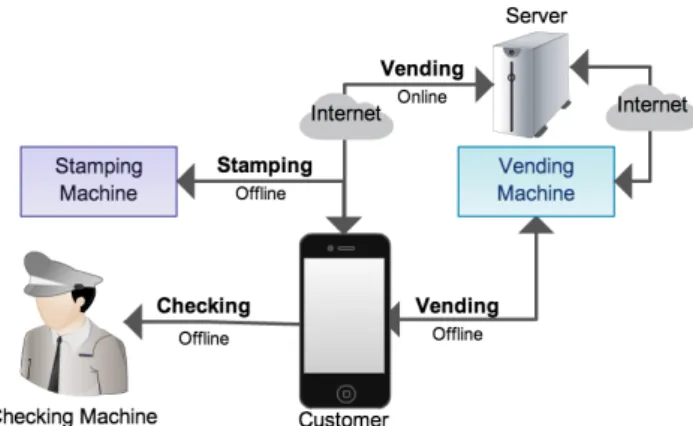
Corresponding to the processes described above, the follow-ing entities (main actors) are considered: (a) a customer (acting via an e-ticketing app installed on his/her NFC-enabled smart phone),(b)a vending machine (remote server or a local e-ticket vending kiosk),(c)a stamping machine, and(d)a checking machine (a conductor’s device performing e-ticket inspection). Main system players are summarized in Figure 1 for clarity. Stamping machines are situated at each station in order to provide for locality (that is, issuing such attributes as station ID during stamping, etc.). Conductors possess mobile checking devices allowing them to check the validity of e-tickets.
3.
SYSTEM REQUIREMENTS
The aforementioned use case scenario essentially defines a set of functional requirements. Additionally, several require-ments with respect to efficiency and security must be ad-dressed. The resultant requirements set considered within this paper is summarized in Table 1.
4.
ADOPTED ATTACKER MODEL
The set of possible attackers with respect to the target sys-tem can be roughly divided into(1) external attackers (re-ferring to the entities exogenous to the system) and(2) in-ternal adversaries (the entities which are involved into
sys-Figure 1: Main actors of the e-ticketing system. Table 1: Main requirements
1. Open source components
2. Offline stamping and checking (as opposed to vending) 3. Ticket unforgeability
4. Protection from replay attacks 5. Ticket unclonability
6. Double spending prevention
7. Timing (especially for stamping and checking)
tem processes). Within the first category, the following at-tacker types can be distinguished: (a)an observing attacker tapping the communication between system entities (actors) and(b)a modifying adversary performing a spoofing attack (i.e. essentially masquerading itself as a legitimate system actor). Among the internal adversaries, the possible attack-ers can be further categorized as follows: (a) a user trying to forge/clone an e-ticket,(b)a vending machine issuing the invalid ticket/a stamping machine providing the incorrect stamp, (c) a conductor framing the user as having an in-valid e-ticket.
5.
SYSTEM DESCRIPTION
5.1
An E-ticket
Within this paper, it is implied that an e-ticket is a digital alternative to a conventional paper ticket. E-ticket is es-sentially a digital token describing the acquired travel per-mission bound to a concrete user. The binding is performed using the user’s public keyP Ku(see Section 5.2 for details).
Our system provides support for many different types of e-tickets by using attributes (see Table 2). This enables for the implementation of various tariff schemes providing each transport authority with the opportunity of customize its service as required. Without loss of generality, however, it can be stated that the two most popular types of e-tickets are: time-bounded tickets (e.g. hourly tickets) and single ride tickets which are considered in our paper as an example.
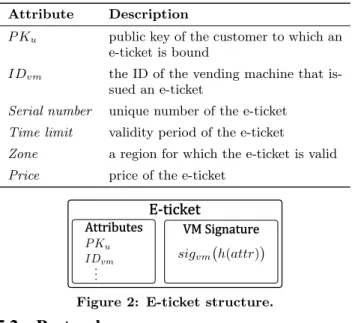
In general, each e-ticket is comprised of (1) attributes (in-cluding P Ku) and (2) a vending machine’s signature over
the hash of the attributes (see Figure 2). The set of at-tributes defines the type of an e-ticket as well as the validity
conditions, see Table 2. The signature ensures the integrity of an e-ticket. The certificate of a vending machine, which is sent to the user device along with the actual e-ticket, must be signed by the root certificate of a transport authority (that is known to the e-ticketing app).
Table 2: E-ticket attributes. Attribute Description
P Ku public key of the customer to which an
e-ticket is bound
IDvm the ID of the vending machine that
is-sued an e-ticket
Serial number unique number of the e-ticket Time limit validity period of the e-ticket
Zone a region for which the e-ticket is valid Price price of the e-ticket
Attributes VMSignature
E-ticket
Figure 2: E-ticket structure.
5.2
Protocols
The protocols corresponding to the main processes described in Section 2 are presented in detail below. The notations used during the description of each protocol are summarized in Table 3 for clarity.
Table 3: A summary of the notations used. Notation Meaning
(P Ku, SKu) user’s public/private (secret) key pair;
certvm certificate of a vending machine;
certsm certificate of a stamping machine;
certcm certificate of a checking machine;
nonce a number used once;
chal challenge sent to the e-ticket
5.2.1
Vending
In order to acquire an e-ticket, a user triggers the respective action in the e-ticketing app. Then, in case the purchase is performed online, a secure connection to the online vend-ing service is established usvend-ing the certificate of a vendvend-ing machine, certvm. The latter is checked using the root
cer-tificate of a transport authority which is stored inside the e-ticketing app. Afterwards, the following interactions be-tween the e-ticketing app and the server are performed:
1. The user app sends the request for a certain type of an e-ticket (which can be resolved to the respective attributes, see Table 2) together with the user’s public keyP Ku.
2. Having agreed on payment details (out of scope of this paper), the vending service selects a particular e-ticket (with the corresponding attributes), binds it toP Ku,
signs the result and sends it back to the user.
3. The user app checks the well-formedness of the ob-tained e-ticket including the verification of the vending machine’s signature and sends an acknowledgment.
Main steps of the vending process are depicted in Figure 3.
Figure 3: E-ticket vending.
5.2.2
Stamping
Stamping is performed in order to activate the e-ticket and to make it valid for the particular ride (that is, essentially transforming the e-ticket to the stamped state, see Sec-tion 2.2). The transformaSec-tion to the stamped state is per-formed via local interaction with a stamping machine. As a result of the stamping protocol, a user obtains a stamp together with the respective signature of the stamping ma-chine over the stamp’s hash (see Figure 4).
StampAttributes SMSignature Stamp
Figure 4: Stamp structure.
The main attributes included into a stamp are summarized in Table 4.
Table 4: Stamp attributes. Attribute Description
Serial number serial number of the e-ticket Timestamp date and time of stamping
IDst station ID
IDsm stamping machine ID.
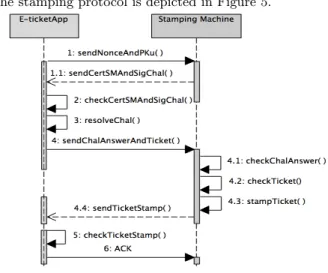
Stamping essentially encompasses the following steps:
1. The e-ticketing app (EA) generates a nonce re and
sends it to the stamping machine (SM) along with the user’s public keyP Ku.
2. SM creates a challenge, chal, by generating another noncersm and appending it to the one received from
the e-ticketing app: chal ←(re||rsm). The challenge
is then encrypted withP Ku and subsequently signed
by SM. The result is then sent to EA along with the certificate of SM,certsm.
3. EA checks the validity of certsm. If it is invalid, EA
If it is valid,chalis decrypted using the user’s private keySKu, the noncersmgenerated by SM is extracted
from chal and its hash is sent back to SM together with the e-ticket to be stamped.
4. SM checks if the EA’s answer was correct. Then it checks if the received e-ticket is indeed bound to the
P Kuexchanged within the first step. Afterwards, SM
stamps the e-ticket by adding the respective stamping attributes (see Table 4). Finally, the signed stamp is sent to EA.
5. EA checks the signature and well-formedness of the stamp and sends an acknowledgment back to SM. The stamping protocol is depicted in Figure 5.
Figure 5: The stamping protocol.
5.2.3
Checking
Similarly to stamping, checking is performed locally by a conductor using a checking machine (CM). Checking proto-col follows the same pattern as the stamping one right until the step when the EA answer is checked, see Figure 5. After this step, the actions specific to the checking protocol are performed, namely the stamp and the e-ticket attributes are inspected. More specifically, it is checked if the e-ticket is in astampedandvalid state(see Section 2.2). The checking protocol is depicted in Figure 6.
Figure 6: The checking protocol.
6.
EVALUATION AND DISCUSSION
6.1
Satisfying the Requirements
The suggested e-ticketing system for public transportation satisfies the main requirements posed to it, see Table 1.
It by design allows for open source development (see the open source components used for a prototype, Section 6.2). Stamping and checking are performed offline. The ticket can not be forged, since it would imply that the signature of the vending machine could be forged as well. Should an observing attacker (see Section 4) try to replay the tapped message to the stamping or vending machine, no gain would be achieved due to (1) nonce exchange during the proto-col session (session binding) and (2) check of the knowl-edge of the private key SKu (which an attacker does not
have) corresponding to the public key to which the e-ticket is bound. To provide for e-ticket unclonability, the follow-ing measures can be taken. Firstly, a common assumption in this case is that the private key SKu resides in a
pro-tected memory area (even possibly tamper-resistant in case of a secure element is used, for example) and therefore, can not be extracted and copied. Stamping and checking in our system require the proof of knowledge of the corresponding private key. Therefore, the e-ticket in essence can not be used on another device, since the corresponding private key can not be transferred together with the e-ticket. Moreover, in case the e-ticket purchase had been an identifying trans-action, the act of cloning can be detected by analyzing the logs from stamping and checking machines (e.g., the same ticket appeared in two different places roughly at the same time) and the corresponding action towards the user can be taken. The double spending prevention can be ensured by having the e-ticketing app enforce the secure transition of the e-ticket’s state from acquired to stamped (see Sec-tion 2.2), that is to say, deleting the unstamped e-ticket after it has been stamped. Moreover, if stamping and checking machines could be interconnected in a non-real time fashion and regularly synchronize their logs, then the act of double spending could be detected and the serial number of the e-ticket spent twice can be added to the respective blacklists. Note, that stamping and checking would still be performed offline and the user experience would not be negatively af-fected by network delays, etc. If the e-ticket acquisition had been an identifying transaction, then an appropriate action could be additionally imposed on the user. Lastly, in order to assess the practical performance of our system, the re-spective prototype was implemented, see the discussion in Section 6.2.
Our system covers all attacker types introduced in Section 4. An observing attacker (type 1-(a)) is defended against by securing the underlying connection between the user device and other system actors. Since a certificate-based authenti-cation is used, a spoofing adversary (type1-(b)) would not be able to successfully mount an attack either. In case of internal attackers, a malicious user (type2-(a)) can be mit-igated by using the measures against forgery and cloning discussed above. In order to defend an honest user against a malicious vending or stamping machine (attacker 2-(b)), the attribute inspection together with well-formedness and signature check is performed by the e-ticketing app. In case a conductor trying to frame a user (attacker 2-(c)), an op-tional online check (e.g., a special checking service running in the back-end) can be used to prove (e.g. to security per-sonnel) the validity of the e-ticket.
6.2
Practical Evaluation
In order to practically evaluate our solution, the prototype was created covering all main actors in the system (see
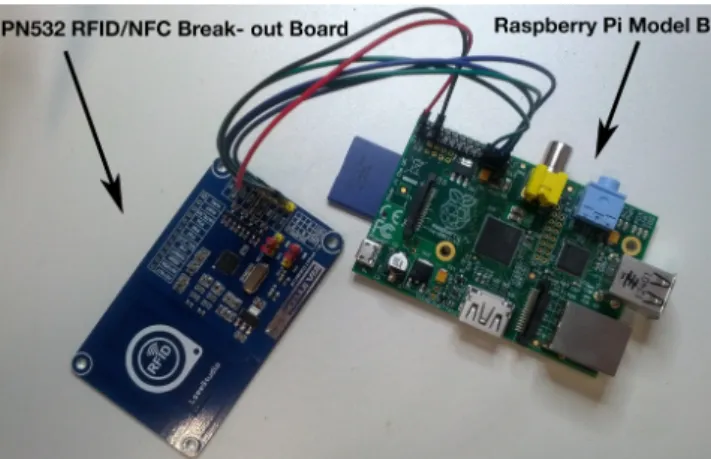
Fig-ure 1). Namely,a customer’s deviceis represented by a Sam-sung Galaxy Nexus GT-I9250 smart phone running Android 4.4. An e-ticketing app (see Figure 7) is installed on the user device to manage e-tickets, acquire the new ones, and inter-act with the other inter-actors in a system. A vending machine was implemented as a vending service running on a server. A stamping machineas well asa conductor device were im-plemented as an NFC terminal. The latter consists of(1)a Raspberry Pi Model B (512 MB RAM) with Raspbian OS (version 2014) and (2) the NFC front-end represented by Adafuit PN532 RFID/NFC Breakout Board connected to the Raspberry Pi via SPI (serial peripheral interface), see Figure 8. The terminal side was running an open source library Libnfc 1.7.0 [4] for NFC communication. To make our solution portable and platform independent, the NFC channel was implemented on top using the so-called inverse reader mode, firstly mentioned by [5] and further enhanced at our chair. The source code of our project is available as open source, see [6].
RSA (with key length of 1024 and 2048) was chosen as the underlying cryptographic primitive in our system, namely for a user key pair (for e-ticket binding) as well as for the certificates. Interestingly enough, Elliptic Curves (with key lengths of 160 and 224 bits) turned out to be one orderslower than RSA (with the corresponding bit lengths of 1024 and 2048 bits respectively), both for signing and signature check-ing (that is, for effectively decryptcheck-ing and encryptcheck-ing). We assume that the reason for this may be(1) the poor imple-mentation of ECC in Bouncy Castle cryptographic library we used and/or(2) the underlying hardware optimization being available for RSA and not available for ECC on a user device. For hashing, a widely used SHA-1 was used. The performance of each protocol is summarized in Table 5.
Figure 7: The implemented e-ticketing app. Table 5: Performance of each protocol
Protocol Execution time
RSA-1024 RSA-2048 Vending 0.09 s 0.12 s Stamping 3.85 s 4.65 s Checking 3.33 s 4.23 s
As it can be seen from Table 5, the vending protocol is the fastest, since in our prototype it was carried out via a Web interface. Stamping and vending are considerably slower since they were run via NFC. The reason for this is that our own implementation of the underlying platform-independent interactive NFC communication is relatively slow. Basically,
Figure 8: Terminal hardware.
the execution times of all three protocols are comparable and the difference is largely defined by the communication channel (that is, the socket based communication with the server vs. interactive NFC communication). With the im-provement of the underlying interactive NFC communica-tion, the protocol execution time is going to be substantially enhanced. Even in the current prototype, the execution time for stamping and checking is acceptable, let alone the one of vending.
The last remark should be made with respect to the check-ing protocol. Dependcheck-ing on the concrete tariff scheme in use, the analysis of the attributes contained in the stamp and in the e-ticket may take different amount of time. For example, the conductor may “manually” meet the decision on the validity of e-ticket being inspected by taking into ac-count the notification from his/her checking device that the e-ticket and stamp signature are valid (that is the e-ticket is in the stamped state, see Section 2.2) and examining the extracted e-ticket attributes. An alternative way would be to fully automate the conductor application to have it out-put “valid” or “invalid” based on context information, such as the current date and time, location, etc.
6.3
Privacy Implications
Binding an e-ticket to the customer’s public key is an im-portant security measure which, however, may introduce an undesired tracking parameter by this raising additional con-cerns over privacy. A straightforward measure to address this would be using a new key pair (P Ku, SKu) for each
e-ticket. Modern smart phones possess enough resources to maintain the resultant key pool. Moreover, after the e-ticket has been used, the corresponding key pair together with the e-ticket can be deleted by the e-ticketing app for memory management. A more serious privacy concern, however, is raised by the actual buying procedure of an e-ticket. In case of an online purchase, the vast majority of today’s transac-tions are the identifying ones (e.g., containing a reference to the bank account number and account holder name). There-fore, the acquired e-ticket can be linked to the user and the latter can be tracked and even identified. In case an anony-mous pre-paid account was used for a purchase, the e-ticket can still be traced. The most privacy-respecting option for online purchase would then be(1)using untraceable anony-mous payment systems similar to the e-cash concept [2],
(2) untraceable variants of electronic currency such as bit-coin (e.g., bitbit-coins with “laundry” systems [1]), or(3)paying through a trusted third party. Another obvious but possi-bly not the most convenient way to obtain an e-ticket in a privacy-preserving manner would be simply paying cash at the local vending machine (that is, offline with respect to the communication between a user device and a vend-ing machine). An important trade-off between privacy (user anonymity and untraceability) and security (especially dou-ble spending prevention and unclonability) should be men-tioned at this stage. The designer of a concrete e-ticketing system for public transportation must take this trade-off into account and carefully analyze the resulting implications on both system security and customer privacy.
7.
RELATED WORK
Saminger et. al described an e-ticketing system based on the so-called NFC inverse reader mode in their paper [5]. Their solution was primarily targeted at interoperability be-tween different NFC platforms (hardware) and operating systems (with respect to user devices, i.e. NFC-enabled smart phones). According to the authors, among the three standardized NFC modes (reader/writer, card emulation, and peer-to-peer), the reader/writer mode is the most sup-ported one across different platforms as well as the most lightweight. By inverting the reader/writer mode, the ad-vantages of the classic reader/writer mode can be lever-aged together with a further one: bypassing the secure ele-ment and by this making the e-ticketing system independent from the manufacturer of the secure element. An important caveat of this approach is, however, that not every commer-cially available reader device supports the card emulation mode (the terminal side) which is required for the novel inverse reader mode to function (the details are provided in [5]). Moreover, since the approach presented in [5] was rather focused on the novel inverse reader/writer model, the e-ticketing architecture was only superficially described.
The authors of [3] presented a prototype of an e-ticketing system based on NFC. During the evaluation, an NFC-enabled Nokia 6131 phone with a secure element was used as a user device. Unfortunately, the protocols related to e-ticketing (such as vending, checking, etc.) were not presented in detail and thus their properties could not be assessed. However, in [3], the usability tests were performed which were used for providing the recommendations for better acceptance of the developed e-ticketing system in the real-world scenario.
Lastly in [11], a solution was presented allowing to inte-grate NFC ticketing into an existing infrastructure which conforms to the special standard for interoperable public transport and revenue sharing (known as the core applica-tion, VDV-KA, see [10]). Despite providing a solid concept having high pertinence to the real world scenario, the so-lution is tailor-made for the specific context of VDV-KA standard. This may substantially limit its adoption in other systems for public transportation which are not based on it. Moreover, similarly to [3], the relevant processes were not described in detail but rather implicitly referenced in the complex VDV-KA specification which is not open for a public review (at least, not all parts of it). Furthermore, in [3, 11] the prototypes used for concept evaluation were based on NFC-enabled Nokia phones running Symbian as a
user device, whereas in our paper the evaluation was per-formed on more modern devices running Android.
8.
CONCLUSION AND FUTURE WORK
In this paper, an architecture of an e-ticketing system for public transportation (ESPT) based on NFC which supports open source development was presented. The suggested ar-chitecture satisfies the major requirements posed to such kind of a system. The main protocols generic to ESPT (vending, stamping, checking) were discussed in detail. Our concept is backed up with a practical implementation based on open source components. For future work, it is planned to perform usability tests as it was done in [3]. Moreover, the countermeasures against relay attacks are going to be additionally researched on.
Acknowledgments
The authors would like to express their gratitude to Manuel Weißbach for his work on the interactive NFC interface. The first author is financially supported by the Free State of Saxony and the European Social Fund (ESF) under grant number 100097574. The second author carried out his work within the NoPa project “TrueGrid”.
9.
REFERENCES
[1] BitLaundry.com. BitLaundry - For all your Bitcoin washing needs.http://app.bitlaundry.com/about. Accessed on 18.06.2014.
[2] D. Chaum et al. Untraceable Electronic Cash. In Proceedings of CRYPTO ’88, CRYPTO ’88, pages 319–327, London, UK, UK, 1990. Springer-Verlag. [3] S. L. Gh`ıron et al. NFC Ticketing: A Prototype and
Usability Test of an NFC-Based Virtual Ticketing Application. InProceedings of the First International Workshop on NFC, NFC ’09, pages 45–50,
Washington, DC, USA, 2009. IEEE. [4] libnfc community. Libnfc: Official wiki.
http://nfc-tools.org/index.php. Accessed on
12.06.2014.
[5] C. Saminger et al. An NFC Ticketing System with A New Approach of An Inverse Reader Mode. In5th International Workshop on NFC, pages 1–5, Feb 2013. [6] F. Sousa, I. Gudymenko, and S. K¨opsell. A Simple
and Secure E-Ticketing System for Intelligent Public Transportation based on NFC: A Source Code.
https://bitbucket.org/dud-team/ssticket,
September 2014.
[7] Transport for London. Oyster Online.
https://oyster.tfl.gov.uk/oyster/entry.do, 2012.
Accessed on 30.10.2012.
[8] Transport for NSW. Opal Card.http:
//www.transport.nsw.gov.au/content/opal-card,
2014. Accessed on 10.06.2014. [9] Transport for NSW. Touch & Travel.
http://www.touchandtravel.de/, 2014. Accessed on
10.06.2014.
[10] VDV-KA KG. VDV-Kernapplikation ist der elektronische Ticket-Standard.
http://mitglieder.vdv.de/wir_ueber_uns/vdv_
projekte/vdv_kernapplikation_efm.html. Accessed
on 18.06.14.
[11] R. Widmann et al. System Integration of NFC Ticketing into an Existing Public Transport Infrastructure. In4th International Workshop on NFC, pages 13–18, March 2012.