TELECOMMUNICATIONS
(INTERCEPTION AND ACCESS) ACT 1979
TELECOMMUNICATIONS
(INTERCEPTION AND ACCESS) ACT 1979
ISBN 978-1-925118-83-4
© Commonwealth of Australia 2015
All material presented in this publication is provided under a Creative Commons Attribution 3.0 Australia licence (www.creativecommons.org/licenses).
For the avoidance of doubt, this means this licence only applies to material as set out in this document.
The details of the relevant licence conditions are available on the Creative Commons website as is the full legal code for the CC BY 3.0 AU licence (www.creativecommons.org/licenses). Use of the Coat of Arms
The terms under which the Coat of Arms can be used are detailed on the It’s an Honour website (www.itsanhonour.gov.au).
Contact us
Enquiries regarding the licence and any use of this document are welcome at:
Business Law Branch
Attorney-General’s Department 3–5 National Cct
BARTON ACT 2600 Telephone: 02 6141 6666 [email protected]
CONTENTS
EXECUTIvE SUMMARY v
CHAPTER 1 – TELECOMMUNICATIONS INTERCEPTION 1
Key legislative developments 2013–14 1
Key judicial decisions 2013–14 2
Key policy developments 2013–14 3
Serious offences 5
Eligibility to issue an interception warrant 7 Applications for and issue of telecommunications interception warrants 7 Effectiveness of telecommunications interception warrants 12
Named person warrants 16
B-Party warrants 20
Duration of warrants 21
Eligible warrants 24
Interception without a warrant 25
Mutual assistance 26
Number of interceptions carried out on behalf of other agencies 26 Telecommunications interception expenditure 27
Emergency service facilities 28
Safeguards, controls and reporting requirements 29 Commonwealth Ombudsman—inspection of telecommunications
interception records 30
Commonwealth Ombudsman’s summary of findings 31 Commonwealth Ombudsman’s findings for individual agency 31
CHAPTER 2 – STORED COMMUNICATIONS 35 Effectiveness of stored communications warrants 37
Preservation notices 38
Mutual assistance 39
Commonwealth Ombudsman—inspection of stored communications
access records 40
CHAPTER 3 – TELECOMMUNICATIONS DATA 44
Existing data—enforcement of a criminal law 45 Existing data—enforcement of a law imposing a pecuniary penalty or
protecting public revenue 48
Prospective data—authorisations 52
Data authorisations to locate missing persons 53 Data authorisations for foreign law enforcement 54 CHAPTER 4 – FURTHER INFORMATION 55
APPENDIX A – LIST OF TABLES AND FIGURES 56
APPENDIX B – INTERCEPTION AGENCIES UNDER THE TIA ACT 59 APPENDIX C – ABBREvIATIONS 60 APPENDIX D – CATEGORIES OF SERIOUS OFFENCES 62
EXECUTIvE SUMMARY
The Telecommunications (Interception and Access) Act 1979 Act Annual Report 2013–14
sets out how eligible Commonwealth, State and Territory government agencies have used the powers available under the Telecommunications (Interception and Access) Act 1979 (the TIA Act) between 1 July 2013 and 30 June 2014.
The primary function of the TIA Act is to protect the privacy of the communications of people who use the Australian telecommunications network. Law enforcement agencies’1 use of interception powers under the TIA Act is independently overseen by
the Commonwealth Ombudsman and equivalent state bodies.
The TIA Act provides a legal framework for national security and law enforcement agencies to access the information held by communications providers that agencies need to investigate criminal offences and other activities that threaten safety and security.
Serious and organised criminals and persons seeking to harm Australia’s national security, routinely use telecommunications service providers and communications technology to plan and to carry out their activities. Some activities, including child pornography, are predominantly executed through communications devices such as phones and computers.
Legislative reforms
This 2013–14 annual report contains reports on three ‘eligible authorities’2 under the
TIA Act created by an amendment to the TIA Act during the 2012–13 reporting period. These new eligible authorities are the Independent Broad-based Anti-corruption Commission (victoria), the victorian Inspectorate, and the Independent Commissioner Against Corruption (South Australia).
Key judicial decisions
This 2013–14 annual report contains two decisions from courts in South Australia and Western Australia. These decisions relate to provisions in the TIA Act dealing with notifying a carrier of the issue of a warrant and exempt proceedings.
1 An ‘enforcement agency’ is broadly defined to include all interception agencies as well as a body whose functions include administering a law imposing a pecuniary penalty or administering a law relating to the protection of the public revenue.
2 Eligible authorities can access information obtained under telecommunications interception warrants and can be declared by the Commonwealth Attorney-General to be an interception agency (subject to being satisfied that the requesting State has met the preconditions in section 35 of the TIA Act).
Policy developments
There were two inquiries during the 2013–14 reporting period:
• the Senate Legal and Constitutional Affairs Reference Committee Inquiry into a comprehensive revision of the TIA Act with regard to two particular recommendations3
• the Senate Legal and Constitutional Affairs Legislation Committee Inquiry into the Telecommunications Amendment (Get a Warrant) Bill 2013.
Key findings
• In 2013–14, issuing authorities issued 4,007 interception warrants, a decrease of around 5 per cent from 2012–13, when 4,232 warrants were issued.
Interception warrants are highly privacy intrusive and are only sought when operationally necessary.
• During 2013–14, information obtained under interception warrants was used in:4
– 2,938 arrests – 4,008 prosecutions – 2,210 convictions.
• In 2013–14, 77 enforcement agencies made 334,658 authorisations for the disclosure of historical telecommunications data. Of these, 324,260 authorisations were made to enforce a criminal law. This compares with 330,798 data authorisations made by 73 enforcement agencies in 2012–13, of which 320,032 authorisations were made to enforce a criminal law (a 1.3 per cent increase from 2012–13). A total increase of 1.2 per cent is significantly less than the previous reporting period. In 2012–13 around 9.8 per cent more authorisations were made than in 2011–12.
• In 2013–14, 139 B-Party warrants5 were issued, around 16 per cent more
than in 2012–13. Around 10 per cent of these warrants were issued with conditions or restrictions.
• In 2013–14, 999 named person warrants were issued, a 12 per cent increase from 2012–13. The increase is consistent with fluctuations associated with operational demand (between 2011–12 and 2012–13 there was a 28 per cent increase in the number of named person warrants issued).
3 a. the recommendations of the Australian Law Reform Commission For Your Information: Australian Privacy Law and Practice report, dated May 2008, particularly recommendation 71.2; and b. recommendations relating to the Act from the Parliamentary Joint Committee on Intelligence and Security Inquiry into the potential reforms of Australia’s National Security Legislation report, dated May 2013.
4 These figures provide an indication about the effectiveness of interception, rather than the full picture, as, for example, a conviction can be recorded without entering intercepted information into evidence. 5 A B-Party warrant is an interception warrant that enables an interception agency to intercept the
communications of a person who is communicating with a person suspected of involvement in a serious offence.
• In 2013–14, law enforcement agencies made 153 arrests, conducted 176 prosecutions and obtained 144 convictions based on evidence obtained under stored communications warrants.6
• In 2013–14, consistent with the last reporting period, the majority of named person warrants were for the interception of between two to five telecommunications services.
• During the reporting period the Commonwealth Ombudsman conducted six inspections of the interception records of the ACC, ACLEI and the AFP (two inspections for each agency).
• The Ombudsman found that there continued to be a high level of compliance with the telecommunications interception provisions of the TIA Act and that agencies were cooperative with inspections and receptive to suggestions for improvement.
Telecommunications interception
Accessing content, or the substance of a communication—for instance, the message written in an email, the discussion between two parties to a phone call, the subject line of an email or a private social media post—without the knowledge of the person making the communication is highly privacy intrusive and, under the TIA Act, can only occur under an interception or stored communications warrant, or in certain limited circumstances such as a life-threatening emergency. Interception is subject to significant limitations, oversight and reporting obligations and the annual report is an important part of this accountability framework.
Lawful interception is an effective investigative tool that supports and complements information obtained through other methods. In many cases, the weight of evidence obtained through telecommunications interception results in defendants entering guilty pleas, thereby eliminating the need for the intercepted information to be introduced into evidence.
Telecommunications data
A critical tool available under the TIA Act is access to telecommunications data.7
Telecommunications data is often the first source of lead information for further investigations, helping to eliminate potential suspects and to support applications for more privacy intrusive investigative tools including search warrants and interception warrants. For example, an examination of call charge records can show that a potential person of interest has had no contact with criminals being investigated.
Data gives agencies a clear method for tracing all telecommunications from end-to-end and can also be used to demonstrate an association between people or to prove that two or more people spoke with each other at a critical point in time (such as before the commission of an alleged offence).
6 These figures provide an indication about the effectiveness of interception, rather than the full picture, as, for example, a conviction can be recorded without entering intercepted information into evidence. 7 Telecommunications data is information about a communication, such as the phone numbers of the
people who called each other, how long they talked to each other, the email address from which a message was sent and the time the message was sent.
Access to telecommunications data is regulated by Chapter 4 of the TIA Act, which permits authorities or bodies that are an ‘enforcement agency’ under the TIA Act to authorise telecommunications carriers to disclose telecommunications data where that information is reasonably necessary for the enforcement of the criminal law, a law imposing a pecuniary penalty, or the protection of the public revenue. All interception agencies are also enforcement agencies as well as authorities or bodies whose functions include administering a law imposing a pecuniary penalty or administering a law relating to the protection of the public revenue.
Under the TIA Act, all enforcement agencies can access historical data8 and criminal
law-enforcement agencies can also access prospective data9.
This annual report is organised into three main chapters: chapter 1 focuses on interception warrants, chapter 2 reports on stored communications, and chapter 3 deals with telecommunications data.
The TIA Act is available online at <www.comlaw.gov.au>
8 Historical data, also known as existing data, is information that is already in existence when an authorisation for disclosure is received by a telecommunications carrier.
9 Prospective data is telecommunications data that comes into existence during a period of time in which an authorisation is in force.
CHAPTER 1
TELECOMMUNICATIONS INTERCEPTION
The primary function of the TIA Act is to protect the privacy of the communications of people who use the Australian telecommunications network by making it an offence to intercept communications, subject to limited lawful exceptions. Under the TIA Act, communications cannot be intercepted while they are passing over the Australian telecommunications system, except as authorised in the circumstances set out in the TIA Act.
Definition
The term ‘interception agency’ is defined in section 5 of the TIA Act and is limited to agencies such as the Australian Federal Police and state police forces eligible to apply under Part 2–5 of the TIA Act for an interception warrant.
Key legislative developments 2013–14
New interception agencies under the TIA Act
In the 2012–13 reporting period, the Telecommunications Interception and Other Legislation Amendment (State Bodies) Act 2012 (the TI State Bodies Act) amended the TIA Act to add the following agencies as ‘eligible authorities’ under the TIA Act:
• the Independent Broad-based Anti-corruption Commission (victoria) (the IBAC) • the victorian Inspectorate
• the Independent Commissioner Against Corruption (South Australia) (the ICAC (SA)).
Eligible authorities can access information obtained under telecommunications interception warrants and can be declared by the Commonwealth Attorney-General to be an interception agency (subject to being satisfied that the requesting State has met the preconditions in section 35 of the TIA Act).
The IBAC became an interception agency on 10 February 2013, when it replaced the victorian Office of Police Integrity. The 2013–14 Annual Report contains the first full year of reporting information about the IBAC. The ICAC (SA) became an interception agency on 1 September 2013 and information in this annual report about the ICAC (SA) relates to that time period. Consistent with powers available to other state oversight bodies, the victorian Inspectorate is not an interception agency.
Key judicial decisions 2013–14
Notification of the issue of a warrant
In R v Scarpantoni (No 2) [2013] SADC 70 (22 May 2013), the District Court of South Australia followed the reasoning of the Western Australia Court of Appeal in Geldert v The State of Western Australia [2012] WASCA 226 (9 November 2012) that, where there is a valid warrant, there is no requirement for the service of a certified copy of the warrant to be a precondition to the agency’s authority to commence interception. Notification to the carrier is the means by which the carrier can commence doing what it is required to do to facilitate the interception of the communications by the officers of the agency. The court found, provided that the carrier has been informed of the issue of the warrant, the carrier did not also require the certified copy in order to commence the interception. The requirement to provide a certified copy of the warrant was to provide an audit trail and underpinned the accountability and reporting obligations in the Act, rather than a necessary part of notification to the carrier.
Geldert v The State of Western Australia [2012] WASCA 226 (9 November 2012) rejected the judgments in The State of Western Australia v Tanevski [No 5] [2012] WADC 64 (Tanevski No 1) and The State of Western Australia v Tanevski [2012] WADC 87 (Tanevski No 2). In those cases, the WA District Court of Western Australia considered the
notification and authorisation provisions in relation to stored communications warrants (sections 121 and 126) and telecommunications service warrants (sections 47 and 60) respectively. The court held that the process for notifying a carrier of a stored communications (Tanevski No 1) or interception warrant (Tanevski No 2) required the agency to provide a certified copy, in addition to informing the carrier of the warrant.
Exempt proceedings
In Sands v State of South Australia [2013] SASC 44, the Supreme Court of South Australia determined that certain intercepted conversations were admissible in a claim for defamation as the proceeding related to the ‘alleged misbehaviour, or alleged improper conduct, of an officer of the Commonwealth or of a State’.
The defamation claim in Sands was based on an allegation that the police had acted unlawfully, maliciously and in breach of their statutory duties in the course of the investigation by leaking information to a journalist that identified the plaintiff as the primary murder suspect.
The Supreme Court distinguished the narrower construction in Kizon v Palmer (1997) 72 FCR 409, which found that a proceeding relating to ‘alleged misbehaviour, or alleged improper conduct, of an officer of the Commonwealth or of a State’ referred to alleged misbehaviour or improper conduct of a kind commonly associated with disciplinary action against an employee or office-holder, such as dismissal, removal from office or other sanction.
The Court found that amendments to the definition of ‘exempt proceeding’ in section 5B of the TIA Act, which were made after the Kizon decision, together with the phrase ‘any other proceeding’ in subsection 5B(1)(f), brought the current proceedings within the TIA Act. The foundation of the defamation claim was that the police acted unlawfully,
maliciously and in breach of their statutory duty, allegations that could lead to disciplinary or criminal charges.
The Court also considered that the intercepted conversations were admissible on the basis that the material had previously been admitted in an earlier proceeding. Under the TIA Act, lawfully intercepted information that has been given in evidence in a previous proceeding can subsequently be given in evidence in any proceeding (section 75A of the TIA Act).
Key policy developments 2013–14
Senate inquiry into the
Telecommunications (Interception and Access)
Act 1979
On 12 December 2013, the Senate referred the following matter to the Legal and Constitutional Affairs References Committee (the References Committee) for inquiry and report:
Comprehensive revision of the Telecommunications (Interception and Access) Act 1979 (the Act), with regard to:
a. the recommendations of the Australian Law Reform Commission For Your Information: Australian Privacy Law and Practice report, dated May 2008, particularly recommendation 71.2; and
b. recommendations relating to the Act from the Parliamentary Joint Committee on Intelligence and Security Inquiry into the potential reforms of Australia’s National Security Legislation report, dated May 2013.
The Attorney-General’s Department made a submission to the inquiry, a copy of which can be found online at <www.aph.gov.au/Parliamentary_Business/Committees/Senate/ Legal_and_Constitutional_Affairs/Comprehensive_revision_of_TIA_Act>
In its submission, the department welcomed the current inquiry and reiterated the relevance of the issues raised by the department in its submission to the 2012–13
Inquiry into Potential Reforms of Australia’s National Security Legislation by the Parliamentary Joint Committee on Intelligence and Security (the PJCIS).
The References Committee released its report on 24 March 2015, a copy of which can be found online at <www.aph.gov.au/Parliamentary_Business/Committees/Senate/Legal_ and_Constitutional_Affairs/Comprehensive_revision_of_TIA_Act>
Senate inquiry into the Telecommunications Amendment (Get a Warrant)
Bill 2013
On 20 June 2013, the Senate referred the Telecommunications Amendment (Get a Warrant) Bill 2013 (the Bill) to the Senate Legal and Constitutional Affairs Legislation Committee (the Legislation Committee) for inquiry and report by 31 October 2013. The Bill sought to amend the TIA Act to require law enforcement and national security agencies to obtain a warrant to access telecommunications data.
The Legislation Committee received 18 submissions from government agencies and community organisations. The Attorney-General’s Department made a submission to the inquiry, a copy of which can be found online at <www.aph.gov.au/Parliamentary_ Business/Committees/Senate/Legal_and_Constitutional_Affairs/Completed_ inquiries/2010-13/getawarrant2013/submissions>
The department’s submission noted that, if enacted, the Bill would significantly affect the ability of law enforcement and national security agencies to perform their legislated roles.
On 5 August 2013, the Governor-General prorogued the 43rd Parliament and dissolved the House of Representatives (a Federal election was held on 7 September 2013). On 20 August 2013 the Legislation Committee wrote to the President of the Senate advising that, consistent with the general approach adopted by other Senate committees to inquiries during elections, the Legislation Committee had resolved not to continue its inquiry into the Bill.
More information
Further information about telecommunications, interception and privacy law can be found at:
• Attorney-General’s Department <www.ag.gov.au/>
• Department of Communications <www.communications.gov.au/> • Commonwealth Ombudsman <www.ombudsman.gov.au/>
• Office of the Australian Information Commissioner <www.oaic.gov.au/> • Telecommunications Industry Ombudsman <www.tio.com.au/>
• Australian Communications and Media Authority <www.acma.gov.au/> The TIA Act provides for several separate warrants for law enforcement agencies to access the content of a communication, including warrants relating to accessing real-time content (for example, a phone call while the parties are talking with each other) and a warrant to access ‘stored communications’ (including emails and text messages accessed from the telecommunications carrier after they have been sent). During the reporting period interception warrants were only available to 17
Commonwealth, state and territory agencies including: • ACC, ACLEI and AFP
• State and Territory Police, and • State anti-corruption agencies.
Serious offences
Interception warrants can only be obtained to investigate serious offences. Serious offences generally carry a penalty of at least seven years’ imprisonment.
Serious offences for which interception can be obtained under the TIA Act include murder, kidnapping, serious drug offences, terrorism, offences involving child pornography, money laundering, and offences involving organised crime.
In the 2013 report Organised Crime in Australia, the Australian Crime Commission (the ACC) assessed the overall risk to Australia from organised crime as high10 and estimated
the cost to Australia of organised crime such as identity crime, money laundering, fraud, cybercrime, drug trafficking and people smuggling at $15 billion per year.11
The information provided in Table 1 illustrates the important role telecommunications interception plays in investigating serious crimes. Consistent with previous years, in 2013–14 agencies obtained the majority of warrants to assist with investigations into serious drug offences (1,772 warrants). Loss of life or personal injury offences were specified in 624 warrants and 447 warrants related to murder investigations. Organised crime was specified as an offence in 246 warrants. The total number of offences is typically larger than the total number of warrants issued as warrants can be issued to investigate more than one serious offence.
Information about the serious offences covered under each category of serious offence set out in the first column of Table 1 is provided in Appendix D.
10 ACC, Organised Crime in Australia 2013, www.crimecommission.gov.au/sites/default/files/files/ACC%20 OCA%202013.pdf, p. 12
Tabl
e 1: Cat
egories of serious off
enc es specified in t el ec ommunic ations int er ception w arr ant s—s s. 100(1)(f), 100(1)(g), 100(2)(f) and 100(2)(g) Cat egories of off enc es ACC A CLEI AFP CCC (WA) CCC (QLD) ICAC (NSW) NSW CC NSW POL NT POL PIC QLD POL SA POL TA S POL VIC POL WA POL IBAC ICAC (SA) TOT A L AC C special inv es tigations 235 -235 Adminis tr ation of Jus tic e -2 -2 As sis ting a per son t o esc ape or dispose of pr oc eeds -12 19 -12 -43 Bribery or c orruption; off enc es agains t
ss 131.1, 135.1, 142.1, 142.2, 148.2, 268.112 of the Criminal Code
-37 21 60 12 21 -5 -29 -1 -2 13 13 6 220 Cart el off enc es -Chil d pornogr aph y off enc es -3 -5 -8 Conspir
e/aid/abet serious off
enc e -10 -5 38 -2 -7 -62 C yber crime off enc es -3 4 -1 -8 Kidnapping -9 -3 32 -9 1 -54 Los s of lif e or per sonal injury -46 -2 -3 469 3 -29 9 -46 17 -624 Mone y laundering 15 -151 -41 4 -1 -1 18 -231 Mur der -12 -51 180 7 -51 43 9 59 35 -447 Or ganised off enc es and/or criminal or ganisations -7 -16 186 -1 -1 35 -246 P eopl e smuggling and r elat ed -Serious damage t o pr operty and/or serious ar son -28 -55 -4 -2 3 13 -105
Serious drug off
enc es and/or tr afficking 3 2 493 -24 -230 462 33 4 207 68 24 55 167 -1,772 Serious fr aud and/or r ev enue l os s -24 -52 -1 -1 3 -81 Tel ec ommunic ations off enc es -Terr orism off enc es -152 -6 -158 Tot al 253 39 961 64 38 21 361 1,514 43 35 304 130 35 176 300 16 6 4,296
Eligibility to issue an interception warrant
An interception warrant may only be issued by an eligible Judge or a nominated Administrative Appeals Tribunal (AAT) member. Table 2 shows that in 2013–14 there were 80 issuing authorities.
An eligible judge is a judge who has consented in writing and been declared by the Attorney-General to be an eligible judge. In the reporting period, eligible judges included members of:
• the Federal Court of Australia • the Family Court of Australia • the Federal Circuit Court.
A nominated AAT member is a deputy president, senior member or member of the AAT who has been nominated by the Attorney-General to issue warrants.
Table 2: Availability of Federal Court Judges, Family Court Judges, Federal Circuit Court Judges and nominated AAT Members to issue telecommunications interception warrants— s. 103(ab)
Issuing authority Number eligible
Federal Court judges 11
Family Court judges 7
Federal Circuit Court judges 33
Nominated AAT members 29
Before issuing an interception warrant the authority must be satisfied that: • the agency is investigating a serious offence
• the gravity of the offence warrants the intrusion into privacy • the interception is likely to support the investigation.
Applications for and issue of telecommunications
interception warrants
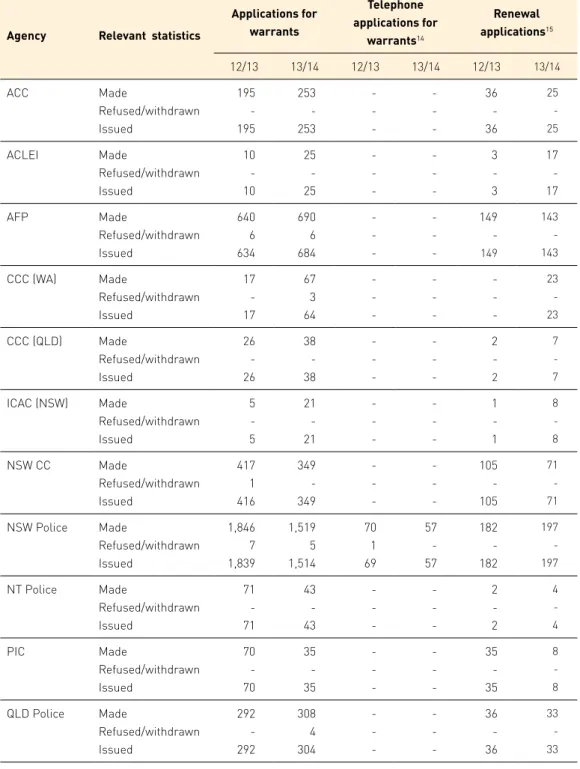
Tables 3 and 4 set out information about the number of eligible judges and nominated AAT members and the agencies to which they issued warrants. In 2013–14, issuing authorities issued 4,007 interception warrants, a decrease of around 5 per cent from 2012–13, when 4,232 warrants were issued. Interception warrants are highly privacy intrusive and are only sought when operationally necessary.
Table 3: Number of telecommunications interception warrants issued by Federal Court judges, Family Court judges, Federal Circuit Court judges and nominated AAT members— s. 103(ab) Agency Issuing authority Family Court judges Federal Court judges Federal Circuit Court judges Nominated AAT members ACC - 2 17 234 ACLEI - - 20 5 AFP 13 105 56 510 CCC (WA) 7 - - 57 CCC (QLD) - - 3 35 ICAC (NSW) - - - 21 NSW CC - - - 349 NSW Police - - 105 1,409 NT Police12 - - 23 20 PIC - - - 35 QLD Police - - 227 77 SA Police13 - 6 15 111 TAS Police - - - 35 vIC Police - - - 188 WA Police 196 - - 104 IBAC - - - 16 ICAC (SA) - - - 6 Total 216 113 466 3,212
12 NT Police has advised the Attorney-General’s Department that the 2012–13 report should be revised to note that 21 warrants were issued by AAT members, 2 warrants were issued by Federal Court judges and 48 by Federal Circuit judges.
13 SA Police has advised the Attorney-General’s Department that the 2012–13 Report should be revised to note that 124 warrants were issued by AAT members, 1 warrant was issued by a Federal Court judge and 1 warrant was issued by a Federal Circuit Court judge.
Table 4: Applications for telecommunications interception warrants, telephone interception warrants and renewal applications—ss. 100(1)(a)-(c) and 100(2)(a)-(c)
Agency Relevant statistics
Applications for warrants Telephone applications for warrants14 Renewal applications15 12/13 13/14 12/13 13/14 12/13 13/14 ACC Made Refused/withdrawn Issued 195 -195 253 -253 -36 -36 25 -25 ACLEI Made Refused/withdrawn Issued 10 -10 25 -25 -3 -3 17 -17 AFP Made Refused/withdrawn Issued 640 6 634 690 6 684 -149 -149 143 -143 CCC (WA) Made Refused/withdrawn Issued 17 -17 67 3 64 -23 -23 CCC (QLD) Made Refused/withdrawn Issued 26 -26 38 -38 -2 -2 7 -7 ICAC (NSW) Made Refused/withdrawn Issued 5 -5 21 -21 -1 -1 8 -8 NSW CC Made Refused/withdrawn Issued 417 1 416 349 -349 -105 -105 71 -71 NSW Police Made Refused/withdrawn Issued 1,846 7 1,839 1,519 5 1,514 70 1 69 57 -57 182 -182 197 -197 NT Police Made Refused/withdrawn Issued 71 -71 43 -43 -2 -2 4 -4 PIC Made Refused/withdrawn Issued 70 -70 35 -35 -35 -35 8 -8 QLD Police Made Refused/withdrawn Issued 292 -292 308 4 304 -36 -36 33 -33
14 Telephone applications are part of the total application of warrants.
Agency Relevant statistics Applications for warrants Telephone applications for warrants14 Renewal applications15 12/13 13/14 12/13 13/14 12/13 13/14 SA Police16 Made Refused/withdrawn Issued 126 -126 132 -132 -3 -3 6 -6 9 -9
TAS Police Made
Refused/withdrawn Issued 23 -23 35 -35 -1 -1 6 -6
vIC Police Made
Refused/withdrawn Issued 233 1 232 188 -188 19 -19 15 -15 21 -21 7 -7 WA Police Made Refused/withdrawn Issued 276 -276 300 -300 1 -1 -28 -28 44 -44 IBAC Made Refused/withdrawn Issued -16 -16 -1 -1
ICAC (SA) Made
Refused/withdrawn Issued -6 -6 -Total Made Refused/withdrawn Issued 4,247 15 4,232 4,025 18 4,007 90 1 89 75 -75 607 -607 603 -603
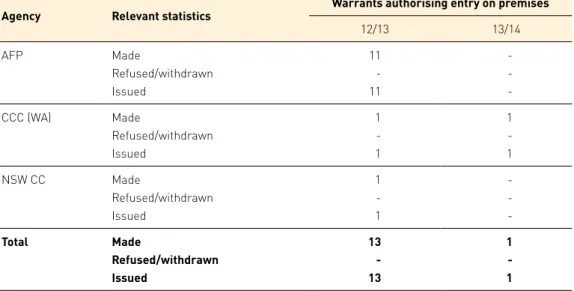
In exceptional circumstances an issuing authority can issue an interception warrant that authorises entry on to premises to carry out telecommunications interception. An issuing authority can only issue such a warrant if satisfied that it would be impracticable or inappropriate to intercept communications by less intrusive means. Agencies only use this type of warrant on rare occasions. One warrant was issued in 2013–14 (see Table 5).
16 SA Police has advised the Attorney-General’s Department that the 2012–13 figure should be revised up from 121 warrants to 126 warrants.
Table 5: Applications for telecommunications interception warrants authorising entry on premises—ss. 100(1)(d) and 100(2)(d)
Agency Relevant statistics Warrants authorising entry on premises
12/13 13/14 AFP Made Refused/withdrawn Issued 11 -11 -CCC (WA) Made Refused/withdrawn Issued 1 -1 1 -1 NSW CC Made Refused/withdrawn Issued 1 -1 -Total Made Refused/withdrawn Issued 13 -13 1 -1
An issuing authority can place conditions or restrictions on an interception warrant. Figure 1 provides information about the use of warrants issued with conditions or restrictions. In 2013–14, 84 interception warrants were issued with a condition or a restriction, 25 per cent less than the last reporting period (in 2012–13, 112 warrants were issued with a condition or a restriction).
Figure 1: Telecommunications interception warrants issued with specific conditions or restrictions—ss. 100(1)(e) and 100(2)(e)
0 5 10 15 20 25 30 ACLEI AFP NSW CC NSW
POLICE ICAC (SA) ACC CCC (WA)
25 7 2 24 4 5 17
Effectiveness of telecommunications interception warrants
The information provided in this section should be interpreted with some caution, particularly in presuming a relationship between the number of arrests, prosecutions (which include committal proceedings) and convictions in a reporting period. An arrest recorded in one reporting period may not result in a prosecution until a later reporting period. Any resulting conviction could be recorded in that or a subsequent reporting period. Additionally, the number of arrests may not equate to the number of charges laid as an arrested person may be prosecuted and convicted for a number of offences, some or all of which may be prosecuted at a later time.
The tables may also understate the effectiveness of interception in so far as, in some cases, prosecutions may be initiated and convictions recorded, without the need to give intercepted information in evidence. In particular, agencies continue to report that telecommunications interception effectively enables investigators to identify persons involved in and the infrastructure of, organised criminal activities. In many cases, the weight of evidence obtained through telecommunications interception results in defendants entering guilty pleas, thereby eliminating the need for the intercepted information to be introduced into evidence.
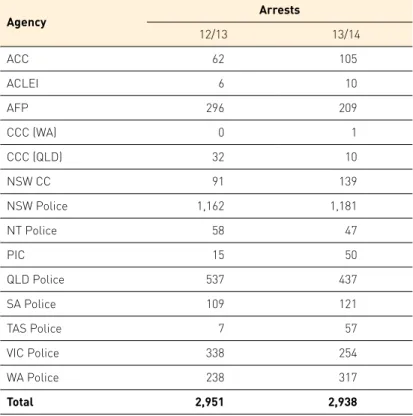
In 2013–14 there were 2,938 arrests, 4,008 prosecutions and 2,210 convictions based on lawfully intercepted material.
The following table shows the number of arrests made by law enforcement agencies over the past two years on the basis of lawfully intercepted information.
Table 6: Arrests on the basis of lawfully intercepted information—ss. 102(1)(a) and 102(2)(a)
Agency Arrests 12/13 13/14 ACC 62 105 ACLEI 6 10 AFP 296 209 CCC (WA) 0 1 CCC (QLD) 32 10 NSW CC 91 139 NSW Police 1,162 1,181 NT Police 58 47 PIC 15 50 QLD Police 537 437 SA Police 109 121 TAS Police 7 57 vIC Police 338 254 WA Police 238 317 Total 2,951 2,938
CASE STUDY:
CORRUPTION AND CRIME COMMISSION (WA)
A former detective sergeant with the Western Australia Police Service (WA Police) has been jailed in what a magistrate described as ‘particularly serious’ offences relating to breaches of the TIA Act.
In 2013–14, the Corruption and Crime Commission of Western Australia (the Commission) secured multiple convictions against the former officer, including a conviction for contravening the TIA Act’s prohibition for communicating interception warrant information.
After a five month investigation by the Commission into offences that
occurred between 2008 and 2013, the former officer was charged with a total of 17 offences. These included one count of unlawful dealing in interception warrant information, 15 counts of unlawful use of a restricted-access computer system and one count of supplying an audio-visual recording of an interview. The former officer was charged in August 2013 and sentenced to nine months imprisonment in September 2014.
The officer was involved in a personal relationship with a lawyer to whom he communicated two affidavits: one relating to a telephone interception warrant and the other to a surveillance devices warrant, both of which
contained interception warrant information. The lawyer was not involved in the WA Police investigation.
The Deputy Chief Magistrate noted that the disclosure of the interception warrant information had the potential to seriously compromise investigations, as the documents would normally be the subject of a non-disclosure order. In sentencing the former officer to nine months imprisonment for these offences, the Deputy Chief Magistrate acknowledged that any term of imprisonment for a former officer ‘would be difficult’ but stated that it was the only way to deal with the gravity of the offences.
The following tables show the number of prosecutions and convictions in which lawfully intercepted information was given in evidence by each of the law enforcement agencies. More information about the offences listed in these tables is provided at Appendix D.
Tabl
e 7: Pr
osecutions in which lawfull
y int er cept ed inf ormation w as giv en in e videnc e Cat egories of off enc es ACC A CLEI AFP CCC (WA) CCC (QLD) ICAC (NSW) NSW CC NSW POL NT POL QLD POL SA POL TA S POL VIC POL WA POL TOT A L AC C special inv es tigations -Adminis tr ation of Jus tic e -1 -1 As sis ting a per son t o esc ape or dispose of pr oc eeds -1 3 -1 -5 Bribery or c orruption; off enc es agains t s s 131.1, 135.1,
142.1, 142.2, 148.2, 268.112 of the Criminal Code
-1 9 4 -1 -4 -19 Cart el off enc es -Chil d pornogr aph y off enc es -1 -23 -24 Conspir
e/aid/abet serious off
enc e 2 -26 -7 -9 -44 C yber crime off enc es -7 -8 -15 Kidnapping -18 -8 -26 Los s of lif e or per sonal injury -1 -3 175 -5 3 -77 7 271 Mone y laundering -15 -14 3 -8 -30 8 78 Mur der -45 -4 7 -8 12 76 Or ganised off enc es and/or criminal or ganisations -19 210 -38 10 -278 555 P eopl e smuggling and r elat ed -6 -6 Serious damage t o pr
operty and/or serious ar
son -24 -7 -4 35
Serious drug off
enc es and/or tr afficking 9 4 109 -22 -102 1,046 1 149 81 -202 505 2,230 Serious fr aud and/or r ev enue l os s -4 1 -1 2 12 -20 Tel ec ommunic ations off enc es -4 -4 Terr orism off enc es -1 -1
Other serious off
enc es -43 9 1 6 -284 2 137 10 -106 -598 Tot al 11 5 190 21 23 7 141 1,881 3 340 127 -445 814 4,008
Tabl
e 8:
Convictions in which lawfull
y int er cept ed inf ormation w as giv en in e videnc e Cat egories of off enc es ACC A CLEI AFP CCC (WA) CCC (QLD) ICAC (NSW) NSW CC NSW POL NT POL QLD POL SA POL VIC POL WA POL TOT A L AC C special inv es tigations -Adminis tr ation of Jus tic e -As sis ting a per son t o esc ape or dispose of pr oc eeds -1 2 -1 -4 Bribery or c orruption; off enc es agains t s s 131.1, 135.1,
142.1, 142.2, 148.2, 268.112 of the Criminal Code
-1 4 4 -4 -13 Cart el off enc es -Chil d pornogr aph y off enc es -9 -9 Conspir
e/aid/abet serious off
enc e -7 -4 -11 C yber crime off enc es -7 -7 Kidnapping -4 -4 Los s of lif e or per sonal injury -3 28 -7 -48 2 88 Mone y laundering -2 -4 2 -24 4 36 Mur der -7 -2 1 5 4 19 Or ganised off enc es and/or criminal or ganisations -8 100 -38 -153 299 P eopl e smuggling and r elat ed -4 -4 Serious damage t o pr
operty and/or serious ar
son -7 -7 -2 16
Serious drug off
enc es and/or tr afficking 3 4 21 -22 -75 446 24 149 9 183 321 1,257 Serious fr aud and/or r ev enue l os s -1 1 -1 2 19 -24 Tel ec ommunic ations off enc es -Terr orism off enc es
-Other serious off
enc es -11 9 1 5 -170 3 137 2 81 -419 Tot al 3 5 43 21 23 6 93 797 27 340 12 354 486 2,210
Named person warrants
A named person warrant can authorise the interception of telecommunications services (such as a landline or mobile service), and in certain circumstances,
telecommunications devices (such as a mobile handset). Before issuing a named person warrant an issuing authority must take into account:
• how much the privacy of any person would be likely to be interfered with • the gravity of the offence
• whether the interception will assist in the investigation
• the extent to which methods other than using a named person warrant are available to the agency.
The following tables and figures show that in 2013–14, 999 named person warrants were issued, a 12 per cent increase from 2012–13. The increase is consistent with fluctuations associated with operational demand (between 2011–12 and 2012–13 there was a 28 per cent increase in the number of named person warrants issued).
Table 9: Original applications for named person warrants, telephone applications for named person warrants and renewal applications—ss. 100(1)(ea) and 100(2)(ea)
Agency Relevant statistics
Applications for named person warrants Telephone applications for named person warrants Renewal applications for named person warrants 12/13 13/14 12/13 13/14 12/13 13/14 ACC Made Refused/withdrawn Issued 124 -124 168 -168 -30 -30 22 -22 ACLEI Made Refused/withdrawn Issued 3 -3 4 -4 -2 -2 1 -1 AFP Made Refused/withdrawn Issued 290 5 285 318 3 315 -96 -96 106 -106 CCC (WA) Made Refused/withdrawn Issued 3 -3 2 -2 -1 -1 CCC (QLD) Made Refused/withdrawn Issued 9 -9 13 -13 -1 -1 6 -6 NSW CC Made Refused/withdrawn Issued 96 -96 145 -145 -19 -19 32 -32
Agency Relevant statistics Applications for named person warrants Telephone applications for named person warrants Renewal applications for named person warrants 12/13 13/14 12/13 13/14 12/13 13/14 NSW POLICE Made Refused/withdrawn Issued 132 -132 105 -105 -27 -27 25 -25 NT POLICE Made Refused/withdrawn Issued 2 -2 3 -3 -PIC Made Refused/withdrawn Issued 3 -3 -1 -1 -QLD POLICE Made Refused/withdrawn Issued 42 -42 42 1 41 -7 -7 6 -6 SA POLICE Made Refused/withdrawn Issued 32 -32 25 -25 -1 -1
-TAS POLICE Made
Refused/withdrawn Issued 1 -1 9 -9 -1 -1 4 -4
vIC POLICE Made
Refused/withdrawn Issued 69 -69 44 -44 1 -1 1 -1 8 -8 1 -1 WA POLICE Made Refused/withdrawn Issued 94 -94 117 -117 -15 -15 26 -26 IBAC Made Refused/withdrawn Issued -8 -8 -1 -1 Total Made Refused/withdrawn Issued 900 5 895 1,003 4 999 1 -1 1 -1 208 -208 231 -231
Under the TIA Act, issuing authorities can issue a warrant with conditions and restrictions about interceptions under the warrant. In 2013–14, 17 named person warrants were issued with a condition or restriction. In 2012–13, 12 named person warrants were issued with conditions or restrictions.
Figure 2: Named person warrants issued with conditions or restrictions—ss. 100(1)(ea) and 100(2)(ea)
NSW POLICE
ACC ACLEI AFP NSW CC CCC (WA)
0 1 2 3 4 5 6 5 4 3 2 2 1
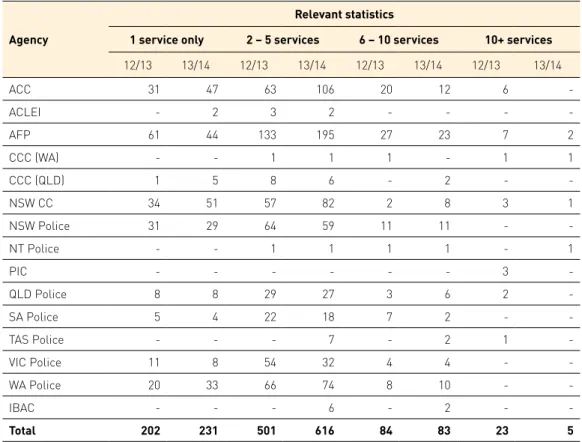
Consistent with the last reporting period, in 2013–14 the majority of named person warrants were for the interception of between two to five telecommunications services.
Table 10: Number of services intercepted under named person warrants—ss. 100(1)(eb) and 100(2)(eb)
Agency
Relevant statistics
1 service only 2 – 5 services 6 – 10 services 10+ services
12/13 13/14 12/13 13/14 12/13 13/14 12/13 13/14 ACC 31 47 63 106 20 12 6 -ACLEI - 2 3 2 - - - -AFP 61 44 133 195 27 23 7 2 CCC (WA) - - 1 1 1 - 1 1 CCC (QLD) 1 5 8 6 - 2 - -NSW CC 34 51 57 82 2 8 3 1 NSW Police 31 29 64 59 11 11 - -NT Police - - 1 1 1 1 - 1 PIC - - - 3 -QLD Police 8 8 29 27 3 6 2 -SA Police 5 4 22 18 7 2 - -TAS Police - - - 7 - 2 1 -vIC Police 11 8 54 32 4 4 - -WA Police 20 33 66 74 8 10 - -IBAC - - - 6 - 2 - -Total 202 231 501 616 84 83 23 5
In 2013–14, a total of 2,745 telecommunications services were intercepted under service-based named person warrants.
Figure 3: Total number of services intercepted under service-based name person warrants— ss. 100(1)(ec) and 100(2)(ec)
NSW Poli ce NSW CC IBAC CCC (QLD ) CCC (WA) AFP ACLEI WA P olice VIC Polic e TAS P olice SA Poli ce QLD Poli ce NT Polic e ACC 0 100 200 300 400 500 600 700 800 900 424 9 23 39 33 801 372 276 57 147 70 37 131 326
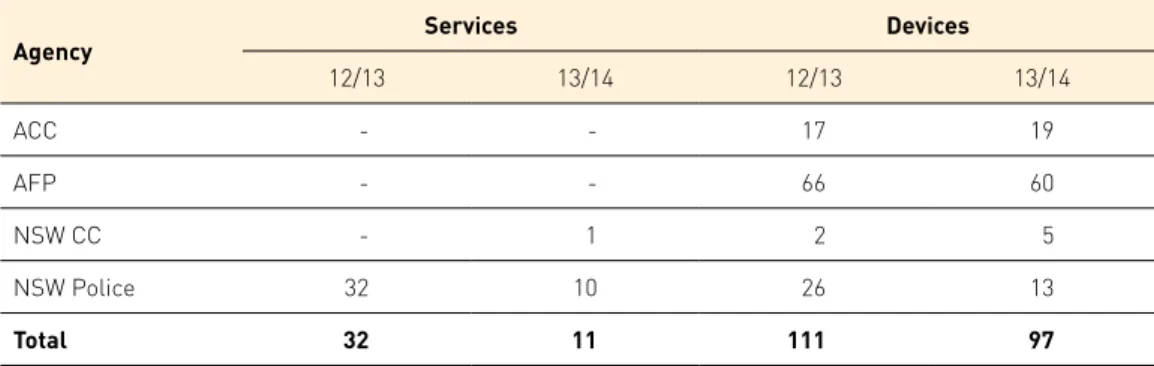
Table 11: Total number of services and devices intercepted under device-based named person warrants—ss. 100(1)(ec) and 100(2)(ec)
Agency Services Devices
12/13 13/14 12/13 13/14 ACC - - 17 19 AFP - - 66 60 NSW CC - 1 2 5 NSW Police 32 10 26 13 Total 32 11 111 97
Under the TIA Act, agencies can apply for a named person warrant in relation to telecommunications devices, where a device or devices of interest can be identified. Table 11 shows, consistent with previous years, that in 2013–14 device-based named person warrants were used by only a few agencies.
B-Party warrants
Definition
A ‘B-Party warrant’ is a warrant that enables an interception agency to intercept the communications of a person who is communicating with a person suspected of involvement in a serious offence.
An issuing authority can issue a B-Party warrant, but only if there are no other practicable methods of identifying the telecommunications services of the person involved in the offences, or if interception of communications from that person’s telecommunications services would not otherwise be possible.
Table 12 shows that in 2013–14, 139 B-Party warrants were issued, around 16 per cent more than in 2012–13. Around 10 per cent of those warrants were issued with conditions on restrictions (see Table 12).
Table 12: Applications for B-Party warrants, telephone applications for B-Party warrants, and renewal applications—ss. 100(1)(ed) and 100(2)(ed)
Agency Relevant statistics
Applications for B-Party warrants Telephone applications for B-Party warrants Renewal applications for B-Party warrants 12/13 13/14 12/13 13/14 12/13 13/14 ACC Made Refused/withdrawn Issued 1 -1 -ACLEI Made Refused/withdrawn Issued 2 -2 11 -11 -1 -1 10 -10 AFP Made Refused/withdrawn Issued 34 -34 62 -62 -21 -21 18 -18 CCC (WA) Made Refused/withdrawn Issued 3 -3 -NSW CC Made Refused/withdrawn Issued 1 -1 6 -6 -1 -1 NSW Police Made Refused/withdrawn Issued 71 1 70 57 -57 20 1 19 8 -8 4 -4 -SA Police Made Refused/withdrawn Issued -3 -3 -1 -1
Agency Relevant statistics Applications for B-Party warrants Telephone applications for B-Party warrants Renewal applications for B-Party warrants 12/13 13/14 12/13 13/14 12/13 13/14 QLD Police Made Refused/withdrawn Issued 6 -6 -vIC Police Made
Refused/withdrawn Issued 2 -2 -WA Police Made Refused/withdrawn Issued 1 -1 -Total Made Refused/withdrawn Issued 121 1 120 139 -139 20 1 19 8 -8 26 -26 30 -30
Table 13: B-Party warrants issued with conditions or restrictions—ss. 100(1)(ed) and 100(2)(ed)
Agency Applications for B-Party warrants
12/13 13/14 ACLEI 2 11 AFP 3 -NSW Police 1 2 Total 6 13
Duration of warrants
Under the TIA Act, a telecommunications interception warrant, other than a B-Party warrant, can be in force for up to 90 days. Under section 57, the chief executive of an agency may revoke a warrant at any time and must revoke a warrant if they are satisfied that the conditions for issuing the warrant no longer exist. Table 14 sets out the average length of time for which interception warrants—including renewals, but not including B-Party warrants—were issued and the average length of time they were in force.
Table 14: Duration of original and renewal telecommunications interception warrants—ss. 101(1)(a)-(d) and 101(2)(a)-(d)
Agency
Duration of original telecommunications interception warrants Duration of renewal of telecommunications interception warrants Average period specified in warrants (days) Average period warrants in force (days) Average period specified in warrants (days) Average period warrants in force (days) ACC 88 51 90 58 ACLEI 77 62 64 57 AFP 80 49 90 74 CCC (WA) 59 48 69 46 CCC (QLD) 69 60 85 70 ICAC (NSW) 86 64 80 57 NSW CC 53 89 86 71 NSW Police 67 48 72 56 NT Police 87 56 90 82 PIC 70 85 65 62 QLD Police 61 43 61 56 SA Police 81 63 84 66 TAS Police 55 46 60 56 vIC Police 79 56 90 54 WA Police 89 54 90 56 ICAC (SA) 57 35 - -IBAC 86 72 90 -Average 73 58 79 61
Under the TIA Act, a B-Party warrant can be in force for up to 45 days. The following table sets out the average length of time for which B-Party warrants and renewals of those warrants were issued and the average length of time they were in force.
Table 15: Duration of original and renewal B-Party warrants—ss. 101(1)(da) and 101(2)(da)
Agency
Duration of original telecommunications B-Party warrants Duration of renewal of telecommunications B-Party warrants Average period specified in warrants (days) Average period warrants in force (days) Average period specified in warrants (days) Average period warrants in force (days) ACLEI 45 45 45 42 AFP 41 32 45 43 NSW CC 44 44 45 45 NSW Police 36 24 - -SA Police 44 32 44 32 Average 42 35 45 41
A final renewal means a telecommunications interception warrant that is the last renewal of an original warrant. A final renewal is recorded as the number of days after the issue of the original warrant that the last renewal of the warrant ceases to be in force.
The categories of final renewals are:
• 90 day final renewal—a last renewal that ceases to be in force more than 90 days but not more than 150 days after the date of issue of the original warrant
• 150 day final renewal—a last renewal that ceases to be in force more than 150 days but not more than 180 days after the date of issue of the original warrant
• 180 day final renewal—a last renewal that ceases to be in force more than 180 days after the date of issue of the original warrant.
Table 16: Number of final renewals—ss. 101(1)(e) and 101(2)(e)
Agency 90 days 150 days 180 days
12/13 13/14 12/13 13/14 12/13 13/14 ACC17 9 9 9 9 8 1 ACLEI - - - 1 1 3 AFP 22 64 4 2 28 23 CCC (QLD) 1 - 1 - - 2 ICAC (NSW) 1 1 - 2 - 2 NSW CC 5 12 19 27 24 15 NSW Police 72 79 25 48 14 34 PIC - 4 28 - - 3 QLD Police 14 14 12 4 1 3 SA Police 2 6 - - - 1 TAS Police - 5 - - - -NT Police - - - 1 - -CCC (WA) - 6 - 1 - 2 vIC Police 8 2 - - - -WA Police 9 - 17 30 1 1 Total 143 202 115 125 77 90
Eligible warrants
DefinitionAn ‘eligible warrant’ is a warrant that was in force during the reporting period —not necessarily a warrant that was issued during the reporting period— where a prosecution was instituted or was likely to be instituted on the basis of information obtained by interceptions under the warrant.
Table 17 indicates what percentage of each agency’s total warrants in force during the reporting period were eligible warrants.
Table 17 sets out the number of eligible warrants issued to agencies during the reporting period and the percentage of warrants issued to agencies that were eligible warrants.
17 The ACC has provided revised figures for the 2012–13 reporting period. Table 13 provides these new figures.
Table 17: Percentage of eligible warrants—ss. 102(3) and 102(4)
Agency Total number of
warrants Number of eligible warrants % ACC 192 124 65 ACLEI 32 8 25 AFP 458 245 53 CCC (WA) 66 37 56 CCC (QLD) 42 15 36 ICAC (NSW) 21 7 33 NSW CC 411 366 89 NSW Police 1,579 1,222 77 NT Police 50 22 44 PIC 35 13 37 QLD Police 337 322 96 SA Police 132 87 66 TAS Police 34 24 71 vIC Police 205 150 73 IBAC 16 10 63 ICAC (SA) 6 3 50 WA Police 339 191 56 TOTAL 3,955 2,846 72
Interception without a warrant
Under the TIA Act, agencies can undertake interception without a warrant in limited circumstances, for example, where there is a serious threat to life or the possibility of serious injury. Table 18a reports on interceptions under subsection 7(5) of the TIA Act, which relates to situations where the person to whom the communication is directed consents to the interception. Table 18b reports on subsection 7(4) of the TIA Act, which relates to situations where an officer of the agency undertaking the interception is a party to the communication. There were no interceptions under subsection 7(4) of the TIA Act in 2011–12 and 2012–13.
Table 18a: Interception without a warrant—s. 102A
Agency
Consent where person likely to receive communication from person who has: Committed an act
that has or may result in loss of life or serious personal injury Threatened to kill or seriously injure another Threatened to cause serious damage to property Threatened to take, endanger, or create serious threat to own life/safety 12/13 13/14 12/13 13/14 12/13 13/14 12/13 13/14 AFP - - 1 5 - - - -Total - - 1 5 - - -
-Table 18b: Interception without a warrant—s. 102A
Agency
Agency is a party to the communication and has reasonable grounds for believing person likely to receive communication from person who has: Committed an act
that has or may result in loss of life or serious personal injury Threatened to kill or seriously injure another Threatened to cause serious damage to property Threatened to take, endanger, or create serious threat to own life/safety 12/13 13/14 12/13 13/14 12/13 13/14 12/13 13/14 AFP - - - 5 - - - -NSW Police - - - 1 Total - - - 5 - - - 1
Mutual assistance
Section 102B of the TIA Act requires that the annual report include information about the number of occasions on which lawfully intercepted information or interception warrant information was provided to a foreign country under paragraph 68(1) or section 68A of the TIA Act in connection with an authorisation made under subsection 13A(1) of the Mutual Assistance in Criminal Matters Act 1987. Consistent with the 2012–13 reporting period, agencies reported that no information was provided under these provisions in 2013–14.
Number of interceptions carried out on behalf of other agencies
The TIA Act supports the ability of interception agencies to cooperate and to work collaboratively by enabling one interception agency to carry out interception on behalf of other agencies. Typically this occurs when a larger agency assists a smaller agency to intercept to reduce the costs of the smaller agency.
Table 19: Number of interceptions carried out on behalf of other agencies—s. 103(ac)
Interception carried out by: Interception carried out on behalf of: Number of interceptions:
ACC ACLEI 10
ACC CCC (QLD) 49
AFP ACLEI 40
NSW Police NSW CC 1
vIC Police TAS Police 40
IBAC ICAC (SA) 3
Total 143
Telecommunications interception expenditure
Table 20 below provides information about the total expenditure (including expenditure of a capital nature) by interception agencies on telecommunications interception warrants and the average expenditure (total warrant expenditure divided by the number of warrants issued) per warrant. The average cost per warrant is significantly affected by capital expenditure (which can vary significantly, for instance, due to a capital upgrade program) and the number of warrants issued, meaning that smaller interception agencies typically have higher average costs as they apply for less warrants.
Table 20: Total expenditure incurred by each agency in connection with the execution of telecommunications interception warrants and Average expenditure per telecommunications interception warrant—ss. 103(a) and 103(aa)
Agency Total expenditure ($) Average expenditure ($)
ACC 7,210,000 28,498 ACLEI 787,497 31,500 AFP 10,541,869 15,412 CCC (WA) 1,431,412 22,366 CCC (QLD) 1,493,116 39,293 IBAC 1,454,405 90,900 ICAC (NSW) 252,289 12,014 NSW CC 3,072,249 8,803 NSW Police 6,805,841 4,495 NT Police 925,139 21,515 PIC 1,498,153 42,804 QLD Police 4,741,294 15,596 ICAC (SA) 45,420 7,570 SA Police 2,961,807 22,438 TAS Police 557,000 15,914 vIC Police 6,670,207 35,480 WA Police 3,467,883 11,560
Table 21 provides a breakdown of the total recurrent costs of interception over the reporting period. As agencies do not necessarily treat or record particular items of expenditure in the same way, caution should be exercised in comparing costs incurred by individual agencies.
Table 21: Recurrent costs of interceptions per agency
Agency Salaries Administrative
support Capital expenditure Interception costs Total ($) ACC18 5,877,274 158,635 192,224 980,807 7,208,940 ACLEI 611,203 140,820 - 35,473 787,496 AFP 8,103,605 174,597 1,760,955 502,712 10,541,869 CCC (WA) 1,046,391 7,906 296,853 80,262 1,431,412 CCC (QLD) 928,879 132,054 - 432,182 1,493,115 ICAC (NSW) 194,563 - - 57,726 252,289 NSW CC 2,033,475 - 345,056 693,718 3,072,249 NSW Police 5,252,529 118,379 - 1,434,933 6,805,841 NT Police 672,126 - 123,459 129,554 925,139 PIC 1,248,038 - - 250,115 1,498,153 QLD Police 3,097,332 614,886 281,380 747,695 4,741,293 SA Police 2,302,870 261,661 198,581 198,695 2,961,807 TAS Police 400,000 50,000 60,000 47,000 557,000 vIC Police 5,370,790 241,491 59,048 998,878 6,670,207 IBAC 1,122,373 54,962 93,200 183,870 1,454,405 ICAC (SA) 3,840 - 17,280 24,300 45,420 WA Police 3,099,492 204,757 - 163,634 3,467,883
Emergency service facilities
Table 22 sets out the number of places that have been declared under the TIA Act to be emergency service facilities. Under the TIA Act, listening to or recording calls to and from a facility declared by the Minister to be an emergency service facility is not interception. This exemption ensures that emergency services can assist emergency callers and respond to critical situations as quickly as possible, without the need to first obtain a caller’s consent to recording of the call.
18 The ACC has advised the Attorney-General’s Department that the 2012–13 recurrent cost should be revised up from a total amount of $6,586,933 to $6,640,761.
Table 22: Emergency service facility declarations
State/territory Police Fire brigade Ambulance
Emergency services authority
Despatching
New South Wales 8 97 7 - 4
victoria 18 - 30 3 22
Queensland 21 12 6 - 12
Western Australia 1 2 2 2 4
South Australia 3 2 1 - 3
Tasmania 1 2 1 - 2
Australian Capital Territory 3 - - - 3
Northern Territory 2 - 1 1 4
Total 57 115 48 6 54
Safeguards, controls and reporting requirements
The TIA Act contains a number of safeguards, controls and reporting requirements in relation to interception, access to stored communications and disclosure of telecommunications data including:
• the heads of interception agencies provide the Secretary of the Attorney-General’s Department (AGD) with a copy of each telecommunications interception warrant
• interception agencies report to the Attorney-General, within three months of a warrant ceasing to be in force, detailing the use made of information obtained by the interception
• the Secretary of the AGD maintains a General Register detailing the particulars of all telecommunications interception warrants. The Secretary of the AGD must provide the General Register to the Attorney-General for inspection every three months
• the Secretary of the AGD maintains a Special Register recording the details of telecommunications interception warrants that do not lead to a prosecution within three months of the warrant expiring. The Special Register is also given to the Attorney-General to inspect.
Law enforcement agencies’ use of interception powers under the TIA Act is independently overseen by the Commonwealth Ombudsman and equivalent state bodies.
At least twice a year the Commonwealth Ombudsman must inspect the records kept by the ACC, ACLEI and the AFP relating to interceptions and the use, dissemination and destruction of intercepted information.
The Commonwealth Ombudsman is required under the TIA Act to report to the
Attorney-General about these inspections, including information about any deficiencies identified and remedial action.
State and Territory legislation imposes similar requirements on State and Territory interception agencies regarding their use of interception powers.
While the Commonwealth Ombudsman is responsible for inspecting the records of the ACC, ACLEI and the AFP in relation to interception, the relevant state or territory Ombudsman generally undertakes this function for State and Territory agencies. The reports of the inspections of the declared state and territory agencies are given to the responsible state or territory Minister who provides a copy to the Commonwealth Attorney-General.
The Commonwealth Ombudsman also conducts regular inspections of records in relation to access by enforcement agencies (including both Commonwealth and state agencies) to stored communications and reports to the Attorney-General on the results of those inspections.
Commonwealth Ombudsman—inspection of
telecommunications interception records
During the reporting period the Commonwealth Ombudsman conducted six
inspections of the interception records of the ACC, ACLEI and the AFP (two inspections for each agency).
The Ombudsman found that there continued to be a high level of compliance with the telecommunications interception provisions of the TIA Act and that agencies were cooperative with inspections and receptive to suggestions for improvement.
Overall, the Ombudsman considered that agencies demonstrated a good understanding of the Act’s requirements, with all agencies found to be compliant with the majority of the Ombudsman’s inspection criteria. The Ombudsman’s inspection criteria (see Figures 4 and 5) are:
• Were restricted records properly destroyed (s79)?
• Were the requisite documents kept in connection with the issue of warrants (s80)?
• Were warrants properly applied for and in the correct form (s49)? • Were the requisite records kept in connection with interceptions (s81)? • Were interceptions conducted in accordance with the warrants (s7) and was
Commonwealth Ombudsman’s summary of findings
Table 23: Summary of findings from the two inspections conducted at each agency during the reporting period
Criteria ACC ACLEI AFP
Ss7 and 63 – Interceptions conducted in accordance with warrant, any unlawful information properly dealt with
Nothing to indicate otherwise
Nothing to indicate otherwise, with one exception19
Nothing to indicate otherwise
S49 – Warrants in the correct form Compliant except for issues noted20
Compliant, except for issue noted21
Compliant except for issues noted22
S79 – Restricted records properly destroyed
Compliant Not assessed as no records destroyed
Not assessed as no records destroyed S80 – Requisite records kept in
connection with issue of warrant
Compliant, except for issue noted23
Compliant Compliant, except for issue noted24
S81 – Requisite records kept in connection with interceptions
Compliant Compliant Compliant, except for issue noted25
Further information about the Commonwealth Ombudsman’s telecommunications interception inspection criteria is outlined in Figure 4 and 5 below.
Commonwealth Ombudsman’s findings for individual agency
ACC
No recommendations were made as a result of either of the two inspections of the ACC. The Ombudsman acknowledged the commitment of the ACC to ensuring and improving agency compliance with TIA Act. In April 2014, the ACC introduced a compulsory online e-Learning module that staff will be required to undertake prior to being able to apply the provisions of the TIA Act.
19 Intercepted information from one warrant was not quarantined after ACLEI identified that the
telecommunications number was no longer being used by the person listed on the warrant. ACLEI advised the Ombudsman it has taken measures to address this.
20 Two warrants had minor errors. The ACC self-disclosed that one warrant was not issued for a serious offence as it was not an ACC special investigation, one warrant referred to serious offences not listed in the affidavit and two warrants stated incorrect expiry dates. All self-disclosed warrants were voluntarily revoked. 21 Four warrants referred to ‘issuing authority’ rather than eligible Judge or nominated AAT member. 22 In eight instances, one self-disclosed and voluntarily revoked, warrants were not in the prescribed form.
The AFP has advised the Ombudsman that training is ongoing. The AFP self-disclosed that two warrants were issued for longer than 90 days and one warrant was issued without an issue date. These warrants were voluntarily revoked.
23 A new warrant was given the same warrant number as the warrant it replaced. The ACC subsequently informed the Attorney-General’s Department about the additional warrant.
24 In one instance, only a certified copy of the warrant was kept on file.
ACLEI
No recommendations were made as a result of either of the two inspections of ACLEI. The Ombudsman noted in relation to one warrant that interception continued ten days after the carrier subscribed the telecommunications number to a different person (it appears the carrier did not advise ACLEI of the change). Initially, intercepted information not associated with the target was not quarantined and was still available to investigators. The Ombudsman reported that ACLEI advised that the information was not provided to investigators or used during ACLEI hearings and following the Ombudsman’s inspection was quarantined. ACLEI advised the Ombudsman that it has since addressed this issue.
AFP
No recommendations were made as a result of either of the two inspections of the AFP. The Ombudsman noted several instances where warrants were not in the
prescribed form. The Ombudsman reported that in conjunction with ongoing training, the AFP was reviewing the prescribed forms to ensure key areas to be completed in the form were clear.