Data-Driven Grasp Synthesis - A Survey
Jeannette Bohg,
Member, IEEE,
Antonio Morales,
Member, IEEE,
Tamim Asfour,
Member, IEEE,
Danica Kragic
Member, IEEE
©2014 IEEE. Personal use of this material is permitted. Permission from IEEE must be obtained for all other uses, in any current or future media, including reprinting/republishing this material for advertising or promotional purposes, creating new collective works, for resale or redistribution to servers or lists, or reuse of any copyrighted component of this work in other works. DOI: <10.1109/TRO.2013.2289018>
Abstract—We review the work on data-driven grasp synthesis and the methodologies for sampling and ranking candidate grasps. We divide the approaches into three groups based on whether they synthesize grasps for known, familiar or unknown objects. This structure allows us to identify common object rep-resentations and perceptual processes that facilitate the employed data-driven grasp synthesis technique. In the case of known objects, we concentrate on the approaches that are based on object recognition and pose estimation. In the case of familiar objects, the techniques use some form of a similarity matching to a set of previously encountered objects. Finally, for the approaches dealing with unknown objects, the core part is the extraction of specific features that are indicative of good grasps. Our survey provides an overview of the different methodologies and discusses open problems in the area of robot grasping. We also draw a parallel to the classical approaches that rely on analytic formulations.
Index Terms—Object grasping and manipulation, grasp syn-thesis, grasp planning, visual perception, object recognition and classification, visual representations
I. INTRODUCTION
Given an object, grasp synthesis refers to the problem of finding a grasp configuration that satisfies a set of criteria relevant for the grasping task. Finding a suitable grasp among the infinite set of candidates is a challenging problem and has been addressed frequently in the robotics community, resulting in an abundance of approaches.
In the recent review of Sahbani et al. [1], the authors divide the methodologies intoanalyticandempirical. Following Shi-moga [2], analytic refers to methods that construct force-closure grasps with a multi-fingered robotic hand that are
dexterous, inequilibrium,stableand exhibit a certaindynamic
behaviour. Grasp synthesis is then usually formulated as a
constrained optimization problem over criteria that measure one or several of these four properties. In this case, a grasp is typically defined by the grasp mapthat transforms the forces exerted at a set of contact points to object wrenches [3]. The criteria are based on geometric, kinematic or dynamic formulations. Analytic formulations towards grasp synthesis have also been reviewed by Bicchi and Kumar [4].
Empirical ordata-drivenapproaches rely on sampling grasp candidates for an object and ranking them according to a
J. Bohg is with the Autonomous Motion Department at the MPI for Intelligent Systems, Tübingen, Germany, e-mail: [email protected].
A. Morales is with the Robotic Intelligence Lab. at Universitat Jaume I, Castelló, Spain, e-mail: [email protected].
T. Asfour is with the KIT, Karlsruhe, Germany, e-mail: [email protected]. D. Kragic is with the Centre for Autonomous Systems, Computational Vision and Active Perception Lab, Royal Institute fo Technology KTH, Stockholm, Sweden, e-mail: [email protected].
This work has been supported by FLEXBOT (FP7-ERC-279933).
specific metric. This process is usually based on some existing grasp experience that can be a heuristic or is generated in simulation or on a real robot. Kamon et al. [5] refer to this as the comparative and Shimoga [2] as the knowledge-based
approach. Here, a grasp is commonly parameterized by [6, 7]:
• the grasping point on the object with which thetool center
point(TCP) should be aligned,
• the approach vector which describes the 3D angle that
the robot hand approaches the grasping point with,
• the wrist orientation of the robotic hand and • an initial finger configuration
Data-driven approaches differ in how the set of grasp candi-dates is sampled, how the grasp quality is estimated and how good grasps are represented for future use. Some methods measure grasp quality based on analytic formulations, but more commonly they encode e.g. human demonstrations, perceptual information or semantics.
A. Brief Overview of Analytic Approaches
Analytic approaches provide guarantees regarding the crite-ria that measure the previously mentioned four grasp proper-ties. However, these are usually based on assumptions such as simplified contact models, Coulomb friction and rigid body modeling [3, 8]. Although these assumptions render grasp analysis practical, inconsistencies and ambiguities especially regarding the analysis of grasp dynamics are usually attributed to their approximate nature.
In this context, Bicchi and Kumar [4] identified the prob-lem of finding an accurate and tractable model of contact compliance as particularly relevant. This is needed to analyze statically-indeterminate grasps in which not all internal forces can be controlled. This case arises e.g. for under-actuated hands or grasp synergies where the number of the controlled degrees of freedom is fewer than the number of contact forces. Prattichizzo et al. [9] model such a system by introducing a set of springs at the contacts and joints and show how its dexterity can be analyzed. Rosales et al. [10] adopt the same model of compliance to synthesize feasible and prehensile grasps. In this case, only statically-determinate grasps are considered. The problem of finding a suitable hand configuration is cast as a constrained optimization problem in which compliance is introduced to simultaneously address the constraints of contact reachability, object restraint and force controllability. As is the case with many other analytic approaches towards grasp synthesis, the proposed model is only studied in simulation where accurate models of the hand kinematics, the object and their relative alignment are available.
In practice, systematic and random errors are inherent to a robotic system and are due to noisy sensors and inaccu-rate models of the robot’s kinematics and dynamics, sensors
or of the object. The relative position of object and hand can therefore only be known approximately which makes an accurate placement of the fingertips difficult. In 2000, Bicchi and Kumar [4] identified a lack of approaches towards synthesizing grasps that are robust to positioning errors. One line of research in this direction explores the concept of
independent contact regions (ICRs) as defined by Nguyen
[11]: a set of regions on the object in which each finger can be independently placed anywhere without the grasp loosing the force-closure property. Several examples for computing them are presented by Roa and Suárez [12] or Krug et al. [13]. Another line of research towards robustness against inaccurate end-effector positioning makes use of the caging formulation. Rodriguez et al. [14] found that there are caging configurations of a three-fingered manipulator around a planar object that are specifically suited as a waypoint to grasping it. Once the ma-nipulator is in such configuration, either opening or closing the fingers is guaranteed to result in an equilibrium grasp without the need for accurate positioning of the fingers. Seo et al. [15] exploited the fact that two-fingered immobilizing grasps of an object are always preceded by a caging configuration. Full body grasps of planar objects are synthesized by first finding a two-contact caging configuration and then using additional contacts to restrain the object. Results have been presented in simulation and demonstrated on a real robot.
Another assumption commonly made in analytic approaches is that precise geometric and physical models of an object are available to the robot which is not always the case. In addition, we may not know the surface properties or friction coefficients, weight, center of mass and weight distribution. Some of these can be retrieved through interaction: Zhang and Trinkle [16] propose to use a particle filter to simultaneously estimate the physical parameters of an object and track it while it is being pushed. The dynamic model of the object is formulated as a mixed nonlinear complementarity problem. The authors show that even when the object is occluded and the state estimate cannot be updated through visual observation, the motion of the object is accurately predicted over time. Although methods like this relax some of the assumptions, they are still limited to simulation [14, 10] or consider 2D objects [14, 15, 16].
B. Development of Data-Driven Methods
Up to the year 2000, the field of robotic grasping1 was
clearly dominated by analytic approaches [11, 4, 17, 2]. Apart from e.g. Kamon et al. [5], data-driven grasp synthesis started to become popular with the availability of GraspIt! [18] in 2004. Many highly cited approaches have been developed, analyzed and evaluated in this or other simulators [19, 20, 21, 22, 23, 24]. These approaches differ in how grasp candidates are sampled from the infinite space of possibilities. For grasp ranking, they rely on classical metrics that are based on ana-lytic formulations such as the widely used -metric proposed in Ferrari and Canny [17]. It constructs thegrasp wrench space
1Citation counts for the most influential articles in the field. Extracted from
scholar.google.com in October 2013. [11]: 733. [4]: 490. [17]: 477. [2]: 405. [5]: 77. [18]: 384. [19]: 353. [20]: 100. [21]: 110. [22]: 95. [23]: 96. [24]: 108. [25]: 38. [26]: 156. [27]: 39. [28]: 277. [29]: 75. [30]: 40. [31]: 21. [32]: 43. [33]: 77. [34]: 26. [35]: 191. [36]: 58. [37]: 75. [38]: 39.
(GWS) by computing the convex hull over the wrenches at the contact points between the hand and the object.quantifies the quality of a force closure grasp by the radius of the maximum sphere still fully contained in the GWS.
Developing and evaluating approaches in simulation is attractive because the environment and its attributes can be completely controlled. A large number of experiments can be efficiently performed without having access to expensive robotics hardware that would also add a lot of complexity to the evaluation process. However, it is not clear if the simulated environment resembles the real world well enough to transfer methods easily. Only recently, several articles [39, 40, 24] have analyzed this question and came to the conclusion that the classic metrics are not good predictors for grasp success in the real world. They do not seem to cope well with the challenges arising in unstructured environments. Diankov [24] claims that in practice grasps synthesized using these metrics tend to be relatively fragile. Balasubramanian et al. [39] systematically tested a number of grasps in the real world that were stable according to classical grasp metrics. Compared to grasps planned by humans and transferred to a robot by kinesthetic teaching on the same objects, they under-performed significantly. A similar study has been conducted by Weisz and Allen [40]. It focuses on the ability of the-metric to predict grasp stability under object pose error. The authors found that it performs poorly especially when grasping large objects.
As pointed out by Bicchi and Kumar [4] and Prattichizzo and Trinkle [8], grasp closure is often wrongly equated with stability. Closure states the existence of equilibrium which is a necessary but not sufficient condition. Stability can only be defined when considering the grasp as a dynamical system and in the context of its behavior when perturbed from an equilibrium. Seen in this light, the results of the above mentioned studies are not surprising. However, they suggest that there is a large gap between reality and the models for grasping that are currently available and tractable.
For this reason, several researchers [25, 26, 27] proposed to let the robot learn how to grasp by experience that is gathered during grasp execution. Although, collecting exam-ples is extremely time-consuming, the problem of transferring the learned model to the real robot is non-existant. A crucial question is how the object to be grasped is represented and how the experience is generalized to novel objects.
Saxena et al. [28] pushed machine learning approaches for data-driven grasp synthesis even further. A simple logistic regressor was trained on large amounts of synthetic labeled training data to predict good grasping points in a monocular image. The authors demonstrated their method in a household scenario in which a robot emptied a dishwasher. None of the classical principles based on analytic formulations were used. This paper spawned a lot of research [29, 30, 31, 32] in which essentially one question is addressed: What are the object features that are sufficiently discriminative to infer a suitable grasp configuration?
From 2009, there were further developments in the area of 3D sensing. Projected Texture Stereo was proposed by Kono-lige [41]. This technology is built into the sensor head of the PR2 [42], a robot that is available to comparatively many
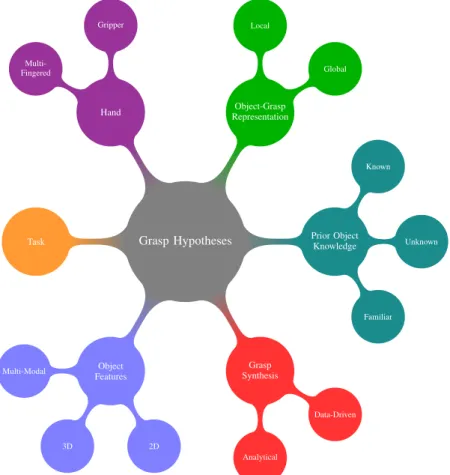
Grasp Hypotheses Prior ObjectKnowledge Known Unknown Familiar Grasp Synthesis Analytical Data-Driven Object Features 2D 3D Multi-Modal Task Hand Gripper Multi-Fingered Object-Grasp Representation Global Local
Figure 1: We identified a number of aspects that influence how the final set of grasp hypotheses is generated for an object. The most important one is the assumedprior object knowledgeas discussed in Section I-D. Numerous differentobject-grasp representationsare proposed in the literature that are relying onfeaturesof different modalities such as 2D or 3D vision or tactile sensors. Either local object parts or the object as a whole are linked to specific grasp configurations.Grasp synthesiscan either be analytic or data-driven. The latter is further detailed in Fig. 2. Very few approaches explicitly address thetaskorhandkinematics of the robot.
robotics research labs and running on the OpenSource middle-ware ROS [43]. In 2010, Microsoft released the Kinect [44], a highly accurate depth sensing device based on the technology developed by PrimeSense [45]. Due to its low price and simple usage, it became a ubiquitous device within the robotics community. Although the importance of 3D data for grasping has been previously recognized, many new approaches were proposed that operate on real world 3D data. They are either heuristics that map structures in this data to grasp configu-rations directly [33, 34] or they try to detect and recognize objects and estimate their pose [35, 46].
C. Analytic vs. Data-Driven Approaches
Contrary to analytic approaches, methods following the data-driven paradigm place more weight on the object rep-resentation and the perceptual processing, e.g., feature extrac-tion, similarity metrics, object recognition or classification and pose estimation. The resulting data is then used to retrieve grasps from some knowledge base or sample and rank them by comparison to existing grasp experience. The parameterization of the grasp is less specific (e.g. an approach vector instead of fingertip positions) and therefore accommodates for uncer-tainties in perception and execution. This provides a natural precursor to reactive grasping [47, 48, 49, 33, 50], which, given a grasp hypothesis, considers the problem of robustly acquiring it under uncertainty. Data-driven methods cannot provide guarantees regarding the aforementioned criteria of
dexterity, equilibrium, stability and dynamic behaviour [2]. They can only be verified empirically. However, they form the basis for studying grasp dynamics and further developing analytic models that better resemble reality.
D. Classification of Data-Driven Approaches
Sahbani et al. [1] divide the data-driven methods based on whether they employ object features or observation of humans during grasping. We believe that this falls short of capturing the diversity of these approaches especially in terms of the ability to transfer grasp experience between similar objects and the role of perception in this process. In this survey, we propose to group data-driven grasp synthesis approaches based on what they assume to knowa prioriabout the query object:
• Known Objects: These approaches assume that the query
object has been encountered before and that grasps have already been generated for it. Commonly, the robot has access to a database containing geometric object models that are associated with a number of good grasp. This database is usually built offline and in the following will be referred to as anexperience database. Once the object has been recognized, the goal is to estimate its pose and retrieve a suitable grasp.
• Familiar Objects: Instead of exact identity, the
ap-proaches in this group assume that the query object is similar to previously encountered ones. New objects can
be defined in terms of shape, color or texture. High-level similarity can be defined based on object category. These approaches assume that new objects similar to old ones can be grasped in a similar way. The challenge is to find an object representation and a similarity metric that allows to transfer grasp experience.
• Unknown Objects: Approaches in this group do not
assume to have access to object models or any sort of grasp experience. They focus on identifying structure or features in sensory data for generating and ranking grasp candidates. These are usually based on local or global features of the object as perceived by the sensor. We find the above classification suitable for surveying the data-driven approaches since the assumed prior object knowledge determines the necessary perceptual processing and associated object representations for generating and ranking grasp candidates. For known objects, the problems of recog-nition and pose estimation have to be addressed. The object is usually represented by a complete geometric 3D object model. For familiar objects, an object representation has to be found that is suitable for comparing them to already encountered object in terms of graspability. For unknown objects, heuristics have to be developed for directly linking structure in the sensory data to candidate grasps.
Only a minority of the approaches discussed in this survey cannot be clearly classified to belong to one of these three groups. Most of the included papers use sensor data from the scene to perform data-driven grasp synthesis and are part of a real robotic system that can execute grasps.
Finally, this classification is well in line with the research in the field of neuroscience, specifically, with the theory of the dorsal and ventral stream in human visual processing [51]. The
dorsal pathway processes immediate action-relevant features
while theventralpathway extracts context- and scene-relevant information and is related to object recognition. The visual processing in the ventral and dorsal pathways can be related to the grouping of grasp synthesis for familiar/known and unknown objects, respectively. The details of such links are out of the scope of this paper. Extensive and detailed reviews on the neuroscience of grasping are offered in [52, 53, 54].
E. Aspects Influencing the Generation of Grasp Hypotheses
The number of candidate grasps that can be applied to an object is infinite. To sample some of these candidates and define a quality metric for selecting a good subset of grasp
hypotheses is the core subject of the approaches reviewed
in this survey. In addition to the prior object knowledge, we identified a number of other factors that characterize these metrics. Thereby, they influence which grasp hypotheses are selected by a method. Fig. 1 shows a mind map that structures these aspects. An important one is how the quality of a candidate grasp depends on the object, i.e., the
object-grasp representation. Some approaches extract local object
attributes (e.g. curvature, contact area with the hand) around a candidate grasp. Other approaches take global characteristics (e.g. center of mass, bounding box) and their relation to a grasp configuration into account. Dependent on the sensor
Data-Driven
Grasp Synthesis Heuristics
Learning Human Demon-stration Labeled Training Data Trial & Error
Figure 2: Data-driven Grasp Synthesis can either be based on heuristics or on learning from data. The data can either be provided in the form of offline generated labeled training data, human demonstration or through trial and error.
Object-Grasp Represen.
Object Features Grasp Synthesis
Local Global 2D 3D Multi-Modal Heuristic Human
Demo Labeled Data T rial & Error T
ask Multi-Fingered Deformable Real
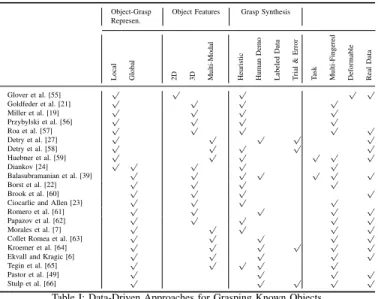
Data Glover et al. [55] √ √ √ √ √ Goldfeder et al. [21] √ √ √ √ Miller et al. [19] √ √ √ √ Przybylski et al. [56] √ √ √ √ Roa et al. [57] √ √ √ √ √ Detry et al. [27] √ √ √ √ √ Detry et al. [58] √ √ √ √ √ Huebner et al. [59] √ √ √ √ √ √ Diankov [24] √ √ √ √ √ Balasubramanian et al. [39] √ √ √ √ √ √ √ Borst et al. [22] √ √ √ √ Brook et al. [60] √ √ √ √
Ciocarlie and Allen [23] √ √ √ √
Romero et al. [61] √ √ √ √ √
Papazov et al. [62] √ √ √ √ √
Morales et al. [7] √ √ √ √ √
Collet Romea et al. [63] √ √ √ √ √
Kroemer et al. [64] √ √ √ √ √ √
Ekvall and Kragic [6] √ √ √ √ √
Tegin et al. [65] √ √ √ √ √
Pastor et al. [49] √ √ √ √
Stulp et al. [66] √ √ √ √ √
Table I: Data-Driven Approaches for Grasping Known Objects
device,object features can be based on 2D or 3D visual data as well as on other modalities. Furthermore, grasp synthesis
can be analytic or data-driven. We further categorized the latter in Fig. 2: there are methods forlearning either from human
demonstrations, labeled examples or trial and error. Other
methods rely on various heuristics to directly link structure in sensory data to candidate grasps. There is relatively little work on task-dependent grasping. Also, the applied robotic hand is usually not in the focus of the discussed approaches. We will therefore not examine these two aspects. However, we will indicate whether an approach takes the task into account and whether an approach is developed for a gripper or for the more complex case of a multi-fingered hand. Table I-III list all the methods in this survey. The table columns follow the structure proposed in Fig. 1 and 2.
II. GRASPINGKNOWNOBJECTS
If the object to be grasped is known and there is already a database of grasp hypotheses for it, the problem of finding a feasible grasp reduces to estimating the object pose and then filtering the hypotheses by reachability. Table I summarizes all the approaches discussed in this section.
A. Offline Generation of a Grasp Experience Database
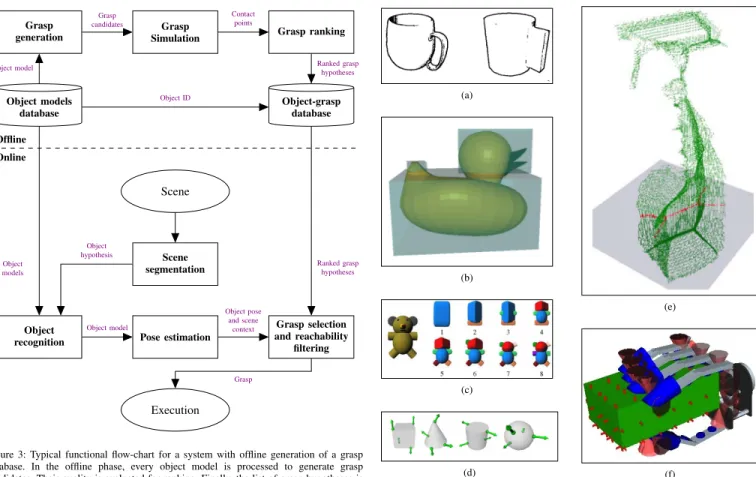
First, we look at approaches for generating the experience database. Figs. 3 and 5 summarize the typical functional flow-chart of these type of approaches. Each box represents a processing step. Please note, that these figures are abstractions
Grasp generation
Grasp
Simulation Grasp ranking
Object models database Object-grasp database Object model Grasp candidates Contact points Ranked grasp hypotheses Object ID Offline Online Scene Scene segmentation Object
recognition Pose estimation
Grasp selection and reachability filtering Execution Object hypothesis Object model Object pose and scene context Grasp Object models Ranked grasp hypotheses
Figure 3: Typical functional flow-chart for a system with offline generation of a grasp database. In the offline phase, every object model is processed to generate grasp candidates. Their quality is evaluated for ranking. Finally, the list of grasp hypotheses is stored with the corresponding object model. In the online phase, the scene is segmented to search and recognize object models. If the process succeeds, the associated grasp hypotheses are retrieved and unreachable ones are discarded. Most of the following approaches can be summarized with this flowchart. Some of them only implement the offline part. [21, 19, 56, 57, 59, 24, 39, 22, 60, 23, 7, 65]
that summarize the implementations of a number of papers. Most reviewed papers focus on a single module. This is also true for similar figures appearing in Sections IV and III.
1) 3D Mesh Models and Contact-Level Grasping: Many
approaches in this category assume that a 3D mesh of the object is available. The challenge is then to automatically generate a set of good grasp hypotheses. This involves sam-pling the infinite space of possible hand configurations and ranking the resulting candidate grasps according to some quality metric. The major part of the approaches discussed in the following use force closure grasps and rank them according to the previously discussed-metric. They differ mostly in the way the grasp candidates are sampled. Fig. 3 shows a flow-chart of which specifically the upper part (Offline) visualizes the data flow for the following approaches.
Some of them approximate the object’s shape with a constel-lation of primitives such as spheres, cones, cylinders and boxes as in Miller et al. [19], Hübner and Kragic [67] and Przybylski et al. [56] or superquadrics (SQ) as in Goldfeder et al. [21]. These shape primitives are then used to limit the amount of candidate grasps and thus prune the search tree for finding the best grasp hypotheses. Examples for these approaches are shown in Fig. 4a-4c and Fig. 4e. Borst et al. [22] reduce the number of candidate grasps by randomly generating a number of them dependent on the object surface and filter them with a simple heuristic. The authors show that this approach works well if the goal is not to find an optimal grasp but
(a) (b) (c) (d) (e) (f)
Figure 4: Generation of grasp candidates through object shape approximation with prim-itives or through sampling. 4a) Primitive Shape Decomposition [19]. 4b) Box Decompo-sition [67]. 4c) SQ DecompoDecompo-sition [21]. 4d) Randomly sampled grasp hypotheses.[22]. 4e) Green: Centers of a union of spheres. Red: Centers at a slice through the model [68, 56]. 4f) Grasp candidate sampled based on surface normals and bounding box [69].
instead a fairly good grasp that works well for “ everyday tasks”. Diankov [24] proposes to sample grasp candidates dependent on the objects bounding box in conjunction with surface normals. Grasp parameters that are varied are the distance between the palm of the hand and the grasp point as well as the wrist orientation. The authors find that usually a relatively small amount of 30% from all grasp samples is in force closure. Examples for these sampling approaches are shown in Fig. 4d and 4f. Roa et al. [57] present an approach towards synthesizing power grasps that is not based on evaluating the force-closure property. Slices through the object model and perpendicular to the axes of the bounding box are sampled. The ones that best resemble a circle are chosen for synthesizing a grasp.
All these approaches are developed and evaluated in simu-lation. As claimed by e.g. Diankov [24], the biggest criticism towards ranking grasps based on force closure and the-metric is that relativelyfragile graspsmight be selected. A common approach to filter these, is to add noise to the grasp parameters and keep only those grasps in which a certain percentage of the neighboring candidates also yield force closure. Weisz and Allen [40] followed a similar approach that focuses in particu-lar on the ability of the-metric to predict grasp stability under object pose uncertainty. For a set of object models, the authors used GraspIt! [18] to generate a set of grasp candidates in force closure. For each object, pose uncertainty is simulated by perturbing it in three degrees of freedom. Each grasp candidate
Scene: Human Demonstration Scene segmentation Grasp recogni-tion/Kinesthetic Teaching
Object database Object recognition
Pose estimation Object-grasp database Object hypothesis Object model Object models Grasp hypotheses Object pose & scene context Offline learning
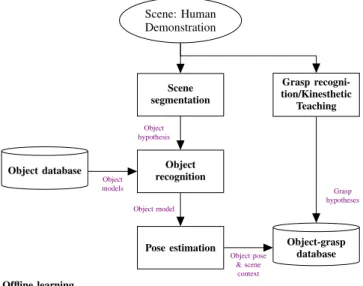
Figure 5: Typical functional flow-chart of a system that learns from human demonstration. The robot observes a human grasping a known object. Two perceptual processed are followed in parallel. On the left, the object is recognized. On the right, the demonstrated grasp configuration is extracted or recognized. Finally, object models and grasps are stored together. This process could replace or complement the offline phase described in Fig. 3. The following approaches follow this approach: [27, 39, 61, 64, 49, 66].
was then re-evaluated according to the probability of attaining a force closure grasp. The authors found that their proposed metric performs superior especially on large objects.
Balasubramanian et al. [39] question classical grasp metrics in principle. The authors systematically tested a number of task-specific grasps in the real world that were stable accord-ing to classical grasp metrics. These grasps under-performed significantly when compared to grasps planned by humans through kinesthetic teaching on the same objects and for the same tasks. The authors found that humans optimize a
skewness metric, i.e., the divergence of alignment between
hand and principal object axes.
2) Learning from Humans: A different way to generate
grasp hypotheses is to observe how humans grasp an object. This is usually done offline following the flow-chart in Fig. 5. This process produces an experience database that is exploited online in a similar fashion as depicted in Fig. 3.
Ciocarlie and Allen [23] exploit results from neuroscience that showed that human hand control takes place in a space of much lower dimension than the hand’s degrees of freedom. This finding was applied to directly reduce the configuration space of a robotic hand to find pre-grasp postures. From these so called eigengraspsthe system searches for stable grasps.
Detry et al. [27] model the object as a constellation of local multi-modal contour descriptors. Four elementary grasp-ing actions are associated to specific constellations of these features resulting in an abundance of grasp candidates. They are modeled as a non-parametric density function in the space of 6D gripper poses, referred to as abootstrapdensity. Human grasp examples are used to build an object specific empirical
grasp density from which grasp hypotheses can be sampled. This is visualized in Fig. 8f and 8g.
Kroemer et al. [64] represent the object with the same fea-tures as used by Detry et al. [27]. How to grasp specific objects is learned through a combination of a high-level reinforcement learner and a low level reactive grasp controller. The learning
Object database Scene
Recognition Segmentation Pose estimation Grasp generation & filtering Object-grasp database
Execution evaluationGrasp
Object hypothesis Object models Object model Object model & scene context
Grasp performaceGrasp Object ID
Grasp hypotheses
Online learning
Figure 7: Typical functional flow-chart of a system that learns through trial and error. First, a known object in the scene is segmented and recognized. Past experiences with that object are retrieved and a new grasp hypothesis is generated or selected among the already tested ones. After execution of the selected grasp, the performance is evaluated and the memory of past experiences with the object is updated.The following approaches use trial-and-error learning: [27, 58, 64, 66].
process is bootstrapped through imitation learning in which a demonstrated reaching trajectory is converted into an initial policy. Similar initialization of an object specific grasping policy is used in Pastor et al. [49] and Stulp et al. [66].
Romero et al. [61] present a system for observing humans visually while they interact with an object. A grasp type and pose is recognized and mapped to different robotic hands in a fixed scheme. For validation of the approach in the simulator, 3D object models are used. This approach has been demonstrated on a humanoid robot by Do et al. [70]. The object is not explicitly modeled. Instead, it is assumed that human and robot act on the same object in the same pose.
In the method presented by Ekvall and Kragic [6], a human demonstrator wearing a magnetic tracking device is observed while manipulating a specific object. The grasp type is recognized and mapped through a fixed schema to a set of robotic hands. Given the grasp type and the hand, the best approach vector is selected from an offline trained experience database. Unlike Detry et al. [27] and Romero et al. [61], the approach vector used by the demonstrator is not adopted. Ekvall and Kragic [6] assume that the object pose is known. Experiments are conducted with a simulated pose error. No physical experiments have been demonstrated. Examples for the above mentioned ways to teach a robot grasping by demonstration are shown in Fig. 6.
3) Learning through Trial and Error: Instead of adopting a
fixed set of grasp candidates for a known object, the following approaches try to refine them bytrial and error. In this case, there is no separation between offline learning and online exploitation as can be seen in Fig. 7. Kroemer et al. [64], Stulp et al. [66] apply reinforcement learning to improve an initial human demonstration. Kroemer et al. [64] uses a low-level reactive controller to perform the grasp that informs the high level controller with reward information. Stulp et al. [66] increase the robustness of their non-reactive grasping strategy by learning shape and goal parameters of the motion primitives
(a) (b) (c)
Figure 6: Robot grasp learning from human demonstration. 6a) Kinesthetic Teaching [71]. 6b) Human-to-robot mapping of grasps using a data glove [6]. 6c) Human-to-robot mapping of grasps using visual grasp recognition [61]
that are used to model a full grasping action. Through this approach, the robot learns reaching trajectories and grasps that are robust against object pose uncertainties. Detry et al. [58] builds a an object-specific empirical grasp density from successful grasping trials. This non-parametric density can then be used to sample grasp hypotheses.
B. Online Object Pose Estimation
In the previous section, we reviewed different approaches towards grasping known objects regarding their way to gen-erate and rank candidate grasps. During online execution, an object has to be recognized and its pose estimated before the offline trained grasps can be executed. Furthermore, from the set of hypotheses not all grasps might be feasible in the current scene. They have to be filtered by reachability. The lower part of Fig. 3 visualizes the data flow during grasp execution and how the offline generated data is employed.
Several of the aforementioned grasp generation meth-ods [64, 27, 58] use the probabilistic approach towards object representation and pose estimation proposed by Detry et al. [72] as visualized in Fig. 8e. Grasps are either selected by sampling from densities [27, 58] or a grasp policy refined from a human demonstration is applied [64]. Morales et al. [7] use the method proposed by Azad et al. [73] to recognize an object and estimate its pose from a monocular image as shown in Fig. 8a. Given this information, an appropriate grasp configuration can be selected from a grasp experience database that has been acquired offline. The whole system is demonstrated on the robotic platform described in Asfour et al. [74]. Huebner et al. [59] demonstrate grasping of known objects on the same humanoid platform and use the same method for object recognition and pose estimation. The offline selection of grasp hypotheses is based on a decomposition into boxes as described in Hübner and Kragic [67]. Task constraints are taken into account by reducing the set of box faces that provide valid approach directions. These constraints are hard-coded for each task. Ciocarlie et al. [75] propose a robust grasping pipeline in which known object models are fitted to point cloud clusters using standard ICP [76]. The search space of potential object poses is reduced by assuming a dominant plane and rotationally-symmetric objects that are always standing upright as e.g. shown in Fig. 8b. Papazov et al. [62] demonstrate their previous approach on 3D object recognition and pose estimation [77] in a grasping scenario. Multiple objects in cluttered scenes can be robustly recognized and their pose estimated. No assumption is made about the geometry of the scene, shape of the objects or their pose.
The aforementioned methods assume a-priori known rigid 3D object model. Glover et al. [55] consider known de-formable objects. Probabilistic models of their 2D shape are learned offline. The objects can then be detected in monoc-ular images of cluttered scenes even when they are partially occluded. The visible object part serve as a basis for planning a grasp under consideration of the global object shape. An example for a successful detection is shown in Fig. 8c.
Collet Romea et al. [78] use a combination of 2D and 3D features as an object model. Examples for objects from an earlier version of the system [63] are shown in Fig. 8d. The authors estimate the object’s pose in a scene from a single image. The accuracy of their approach is demonstrated through a number of successful grasps.
III. GRASPINGFAMILIAROBJECTS
The idea of addressing the problem of grasping familiar
objects originates from the observation that many of the objects in the environment can be grouped together into categories with common characteristics. In the computer vision community, objects within one category usually share similar visual properties. These can be, e.g., a common texture [79] or shape [80, 81], the occurrence of specific local features [82, 83] or their specific spatial constellation [84, 85]. These categories are usually referred to asbasic level categoriesand emerged from the area of cognitive psychology [86].
For grasping and manipulation of objects, a more natural characteristic may be the functionality that they afford [30]: similar objects are grasped in a similar way or may be used to fulfill the same task (pouring, rolling, etc). The difficulty is to find a representation that encodes these common affor-dances. Given the representation, a similarity metric has to be found under which objects of the same functionality can be considered as alike. The approaches discussed in this survey are summarized in Table II. All of them employ learning mechanisms and showed that they can generalize the grasp experience on training data to new but familiar objects.
A. Discriminative Approaches
First, there are approaches that learn a discriminative func-tion to distinguish between good and bad grasp configurafunc-tions. They mainly differ in what object features are used and thereby in the space over which objects are considered similar. Fur-thermore, they parameterize grasp candidates differently. Many of them only consider whether a specific part of the object is graspable or not. Others also learn multiple contact points
(a) (b) (c)
(d) (e) (f) (g)
Figure 8: Object representations for grasping and corresponding methods for pose estimation. 8a) Object pose estimation of textured and untextured objects in monocular images [73]. 8b) ICP-based object pose estimation from segmented point clouds [75]. 8c) Deformable object detection and pose estimation in monocular images[55]. 8d) Multi-view object representation composed of 2D and 3D features [63]. 8e) Probabilistic and hierarchical approach towards object pose estimation [72]. 8f) Grasp Candidates linked to groups of local contour descriptors. [27]. 8g) Empirical grasp density built by trial and error. [27]
Object-Grasp Represen.
Object Features Grasp Synthesis
Local Global 2D 3D Multi-Modal Heuristic Human
Demo Labeled Data T rial & Error T
ask Multi-Fingered Deformable Real
Data
Song et al. [87] √ √ √ √ √
Li and Pollard [88] √ √ √ √
El-Khoury and Sahbani [89] √ √ √ √
Hübner and Kragic [67] √ √ √ √ √ √
Kroemer et al. [90] √ √ √ √ √ √ √ Detry et al. [91] √ √ √ √ Detry et al. [92] √ √ √ √ √ Herzog et al. [71] √ √ √ √ √ √ Ramisa et al. [93] √ √ √ √ √ √ Boularias et al. [94] √ √ √ √ √
Montesano and Lopes [95] √ √ √ √ √
Stark et al. [30] √ √ √ √ √ √
Saxena et al. [28] √ √ √ √
Saxena et al. [29] √ √ √ √ √
Fischinger and Vincze [96] √ √ √ √
Le et al. [31] √ √ √ √ √ √
Bergström et al. [97] √ √ √ √ √ √ √
Hillenbrand and Roa [98] √ √ √ √ √ √
Bohg and Kragic [32] √ √ √ √ √
Bohg et al. [99] √ √ √ √ √ √
Curtis and Xiao [100] √ √ √ √
Goldfeder and Allen [101] √ √ √ √ √
Marton et al. [102] √ √ √ √ √ √ Rao et al. [103] √ √ √ √ √ Speth et al. [104] √ √ √ √ √ Madry et al. [105] √ √ √ √ √ √ Kamon et al. [5] √ √ √ √ Montesano et al. [26] √ √ √ √ √ Morales et al. [25] √ √ √ √ √ Pelossof et al. [20] √ √ √ √
Dang and Allen [106] √ √ √ √ √ √
Table II: Data-Driven Approaches for Grasping Familiar Objects
or full grasp configurations. A flow-chart for the approaches discussed in the following is presented in Fig. 9.
1) Based on 3D Data: El-Khoury and Sahbani [89]
distin-guish between graspable and non-graspable parts of an object. A point cloud of an object is segmented into parts. Each part is approximated by a superquadric (SQ). An artificial neural network (ANN) is used to classify whether or not the part is prehensile. The ANN is trained offline on human-labeled SQs. If one of the object parts is classified as prehensile, an n-fingered force-closure grasp is synthesized on this object part. Grasp experience is therefore only used to decide where to apply a grasp, not how the grasp should be configured. These steps are shown for two objects in Fig. 10.
Pelossof et al. [20] approximate an object with a a sin-gle SQ. Given this, their goal is to find a suitable grasp configuration for a Barrett hand consisting of the approach vector, wrist orientation and finger spread. A Support Vector
Labeled examples database Feature extraction Learning features-grasp relation Sample Grasp label of sample Features Scene Scene segmentation Feature extraction Learned model features - grasp Grasp selection and filtering Execution Learned model Segmented cluster Features Grasp hypotheses Scene context Grasp Offline learning Online
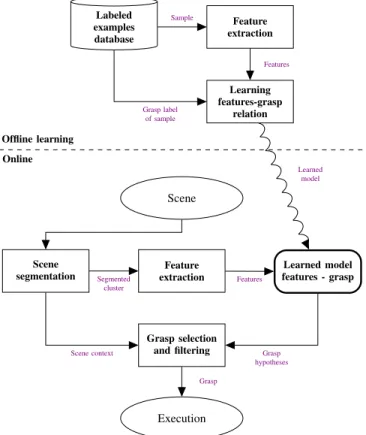
Figure 9: Typical functional flow-chart of a system that learns from labeled examples. In the offline learning phase a database is available consisting of a set of objects labeled with grasp configurations and their quality. Database entries are analyzed to extract relations between specific features and the grasps. The result is a learned model that given some features can predict grasp qualities. In the online phase, the scene is segmented and features are extracted from the scene. Given this, the model outputs a ranked set of promising grasp hypotheses. Unreachable grasps are filtered out and the best is executed. The following approaches use labeled training examples: [87, 88, 89, 67, 91, 92, 93, 94, 30, 28, 29, 31, 97, 98, 32, 99, 100, 101, 102, 105, 20, 106]
Machine(SVM) is trained on data consisting of feature vectors
containing the SQ parameters and a grasp configuration. They are labeled with a scalar estimating the grasp quality. This training data is shown in Fig. 11. When feeding the SVM only with the shape parameters of the SQ, their algorithm searches efficiently through the grasp configuration space for parameters that maximize the grasp quality.
Figure 10: a) Object model. b) Part segmentation. c) SQ approximation. d) Graspable part and contact points [89].
Figure 11: Top) Grasp candidates performed on SQ. Bottom) Grasp quality for each candidate [20].
Both of the aforementioned approaches are evaluated in simulation where the central assumption is that accurate and detailed 3D object models are available: an assumption not always valid. An SQ is an attractive 3D representation due to its low number of parameters and high shape variability. However, it remains unclear whether an SQ could equally well approximate object shape when given real-world sensory data that is noisy and incomplete.
Hübner and Kragic [67] decompose a point cloud into a constellation of boxes. The simple geometry of a box reduces the number of potential grasps significantly. A hand-designed mapping between simple box features (size, position in constellation) and grasping task is proposed. To decide which of the sides of the boxes provides a good grasp, an ANN is trained offline on synthetic data. The projection of the point cloud inside a box to its sides provides the input to the ANN. The training data consists of a set of these projections from different objects labeled with the grasp quality metrics.
Boularias et al. [94] model an object as a Markov Random
Field(MRF) in which the nodes are points in a point cloud and
edges are spanned between the six nearest neighbors of a point. The features of a node describe the local point distribution around that node. A node in the MRF can carry either one of two labels: a good or a bad grasp location. The goal of the approach is to find the maximum a-posteriori labeling of point clouds for new objects. Very little training data is used which is shown in Fig. 12b. A handle serves as a positive example. The experiments show that this leads to a robust labeling of 3D object parts that are very similar to a handle.
Although both approaches [67, 94] also rely on 3D models for learning, the authors show examples for real sensor data. It remains unclear how well the classifiers would generalize to a larger set of object categories and real sensor data.
Fischinger and Vincze [96] propose a height-accumulated
(a) (b)
Figure 12: Labeled training data. 12a) One example for each of the eight object classes in training data in [28] along with their grasp labels (in yellow). 12b) Positive (red) and negative examples (blue) for grasping points [94].
feature that is similar to Haar basis functions as successfully applied by e.g. Viola and Jones [107] for face detection. The values of the feature are computed based on the height of objects above e.g. the table plane. Positive and negative examples are used to train an SVM that distinguishes between good and bad grasping points. The authors demonstrate their approach for cleaning cluttered scenes. No object segmentation is required for the approach.
2) Based on 2D Data: There are number of
experience-based approaches that avoid the complexity of 3D data and mainly rely on 2D data to learn to discriminate between good and bad grasp locations. Saxena et al. [28] propose a system that infers a point at where to grasp an object directly as a function of its image. The authors apply logistic regression to train a grasping point model on labeled synthetic images of a number of different objects. The classification is based on a feature vector containing local appearance cues regarding color, texture and edges of an image patch in several scales and of its neighboring patches. Samples from the labeled training data are shown in Fig. 12a. The system was used successfully to pick up objects from a dishwasher after it has been additionally trained for this scenario.
Instead of assuming the availability of a labeled data set, Montesano and Lopes [95] allow the robot to autonomously explore which features encode graspability. Similar to [28], simple 2D filters are used that can be rapidly convolved with an image. Given features from a region, the robot can compute the posterior probability that a grasp applied to this location will be successful. It is modeled as a Beta distribution and estimated from the grasping trials executed by the robot and their outcome. Furthermore, the variance of the posterior can be used to guide exploration to regions that are predicted to have a high success rate but are still uncertain.
Another example of a system involving 2D data and grasp experience is presented by Stark et al. [30]. Here, an object is represented by a composition of prehensile parts. These so called affordance cues are obtained by observing the interaction of a person with a specific object. Grasp hypotheses for new stimuli are inferred by matching features of that object against a codebook of learnedaffordance cuesthat are stored along with relative object position and scale. How to grasp the detected parts is not solved since hand orientation and finger configuration are not inferred from the affordance cues. Similar to Boularias et al. [94], especially locally very discriminative structures like handles are well detected.
3) Integrating 2D and 3D Data: Although the above
ap-proaches have been demonstrated to work well in specific manipulation scenarios, inferring a full grasp configuration
Figure 13: Three grasp candidates for a cup represented by two local patches and their major gradient as well as their connecting line. [31]
(a)
(b)
(c)
(d)
Figure 14: Example shape contexts descriptor for the image of a pencil. 14a) Input image. 14b) Canny edges. 14c Top) All vectors from one point to all other sample points. Bottom) Sampled points of the contour with gradients. 14d) Histogram with four angle and five log-radius bins comprising the vectors in 14c Bottom) [32].
from 2D data alone is a highly under-constrained problem. Regions in the image may have very similar visual features but afford completely different grasps. The following approaches integrate multiple complementary modalities, 2D and 3D vi-sual data and their local or global characteristics, to learn a function that can take more parameters of a grasp into account. Saxena et al. [29] extend their previous work on inferring 2D grasping points by taking the 3d point distribution within a sphere centered around a grasp candidate into account. This enhances the prediction of a stable grasp and also allows for the inference of grasp parameters like approach vector and finger spread. In earlier work [28], only downward or outward grasp with a fixed pinch grasp configuration were possible.
Rao et al. [103] distinguish between graspable and non-graspable object hypotheses in a scene. Using a combination of 2D and 3D features, an SVM is trained on labeled data of segmented objects. Among those features are for example the variance in depth and height as well as variance of the three channels in the Lab color space. These are some kind of metafeatures that are used instead of the values of e.g. the color channels directly. Rao et al. [103] achieve good classifi-cation rates on object hypotheses formed by segmentation on color and depth cues. Le et al. [31] model grasp hypotheses as consisting of two contact points. They apply a learning approach to rank a sampled set of fingertip positions according to graspability. The feature vector consists of a combination of 2D and 3D cues such as gradient angle or depth variation along the line connecting the two grasping points. Example grasp candidates are shown in Fig. 13.
Bohg and Kragic [32] propose an approach that instead of using local features, encodes global 2D object shape. It is represented relative to a potential grasping point by shape contexts as introduced by Belongie et al. [81]. Fig. 14 shows a potential grasping point and the associated feature.
Figure 15: Matching contact points between human hand and object [88].
Bergström et al. [97] see the result of the 2D based grasp selection as a way to search in a 3D object representation for a full grasp configuration. The authors extend their pre-vious approach [32] to work on a sparse edge-based object representation. They show that integrating 3D and 2D based methods for grasp hypotheses generation results in a sparser set of grasps with a good quality.
Different from the above approaches, Ramisa et al. [93] consider the problem of manipulating deformable objects, specifically folding shirts. They aim at detecting the shirt col-lars that exhibit deformability but also have distinct features. The authors show that a combination of local 2D and 3D descriptors works well for this task. Results are presented in terms of how reliable collars can be detected when only a single shirt or several shirts are present in the scene.
B. Grasp Synthesis by Comparison
The aforementioned approaches study what kind of features encode similarity of objects in terms of graspability and learn a discriminative function in the associated space. The methods we review next take an exemplar-based approach in which grasp hypotheses for a specific object are synthesized by finding the most similar object or object part in a database to which good grasps are already associated.
1) Synthetic Exemplars: Li and Pollard [88] treat the
prob-lem of finding a suitable grasp as a shape matching probprob-lem between the human hand and the object. The approach starts off with a database of human grasp examples. From this database, a suitable grasp is retrieved when queried with a new object. Shape features of this object are matched against the shape of the inside of the available hand postures. An example is shown in Fig. 15.
Curtis and Xiao [100] build upon a knowledge base of 3D object types. These are represented by Gaussian distributions over very basic shape features, e.g., the aspect ratio of the object’s bounding box, but also over physical features, e.g. material and weight. Furthermore, they are annotated with a set of representative pre-grasps. To infer a good grasp for a new object, its features are used to look up the most similar object type in the knowledge base. If a successful grasp has been synthesized in this way and it is similar enough to the object type, the mean and standard deviation of the object features are updated. Otherwise a new object type is formed in the knowledge base.
While these two aforementioned approaches use low-level shape features to encode similarity between objects, Dang and Allen [106] present an approach towardssemantic grasp planning. In this case, semantic refers to both, the object category and the task of a grasp, e.g. pour water, answer a call or hold and drill. A semantic affordance map links
object features to an approach vector and to semantic grasp features (task label, joint angles and tactile sensor readings). For planning a task-specific grasp on a novel object of the same category, the object features are used to retrieve the optimal approach direction and associated grasp features. The approach vector serves as a seed for synthesizing a grasp with the Eigengrasp planner [23]. The grasp features are used as a reference to which the synthesized grasp should be similar.
Hillenbrand and Roa [98] frame the problem of transferring functional grasps between objects of the same category as pose alignment and shape warping. They assume that there is a source object given on which a set of functional grasps is defined. Pose clustering is used to align another object of the same category with it. Subsequently, fingertip contact points can be transferred from the source to the target object. The experimental results are promising. However, they are limited to the category of cups containing six instances.
All four approaches [88, 100, 106, 98] compute object features that rely on the availability of 3D object meshes. The question remains how these ideas could be transferred to the case where only partial sensory data is available to compute object features and similarity to already known objects. One idea would be to estimate full object shape from partial or multiple observations as proposed by the approaches in Sec. IV-A and use the resulting potentially noisy and uncertain meshes to transfer grasps. The above methods are also suitable to create experience databases offline that require only little labeling. In the case of category-based grasp transfer [106, 98] only one object per category would need to be associated with grasp hypotheses and all the other objects would only need a category label. No expensive grasp simulations for many grasp candidates would need to be executed as for the approaches in Section II-A1. Dang and Allen [106] followed this idea and demonstrated a few grasp trials on a real robot assuming that a 3D model of the query object is in the experience database. Also Goldfeder and Allen [101] built their knowledge base only from synthetic data on which grasps are generated using the previously discussed Eigengrasp planner [23]. Different from the above approaches, observations made with real sensors from new objects are used to look up the most similar object and its pose in the knowledge base. Once this is found, the associated grasp hypotheses can be executed on the real object. Although experiments on a real platform are provided, it is not entirely clear how many trials have been performed on each object and how much object pose was varied. As discussed earlier, the study conducted by Balasubramanian et al. [39] suggests that the employed grasp planner is not the optimal choice for synthesizing grasps that also work well in the real world.
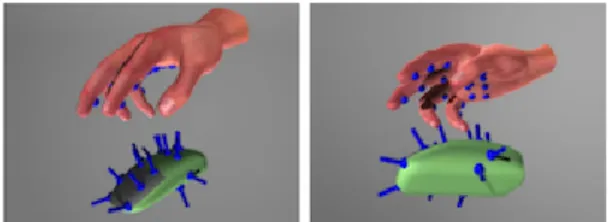
Detry et al. [91] aim at generalizing grasps to novel ob-jects by identifying parts to which a grasp has already been successfully applied. This look-up is rendered efficient by creating a lower-dimensional space in which object parts that are similarly shaped relative to the hand reference frame are close to each other. This space is shown in Fig. 16. The authors show that similar grasp to object part configurations can be clustered in this space and form prototypical grasp-inducing parts. An extension of this approach is presented by Detry
Figure 16: Lower dimensional space in which similar pairs of grasps and object parts are close to each other [91].
et al. [92] where the authors demonstrate how this approach can be used to synthesize grasps on novel objects by matching these prototypical parts to real sensor data.
2) Sensor-based Exemplars: The above mentioned
ap-proaches present promising ideas towards generalizing prior grasp experience to new objects. However, they are using 3D object models to construct the experience database. In this section, we review methods that generate a knowledge base by linking object representations from real sensor data to grasps that were executed on a robotic platform. Fig. 18 visualizes the flow of data that these approaches follow.
Kamon et al. [5] propose one of the first approaches towards generalizing grasp experience to novel objects. Their aim is to learn a function f :Q→ Gthat maps object- and grasp-candidate-dependent quality parameters Q to a grade G of the grasp. An object is represented by its 2D silhouette, its center of mass and main axis. The grasp is represented by two parameters f1 and f2 from which in combination with the object features the fingertip positions can be computed. Learning is bootstrapped by the offline generation of a knowl-edge database containing grasp parameters along with their grade. This knowledge database is then updated while the robot gathers experience by grasping new objects. The system is restricted to planar grasps and visual processing of top-down views on objects. It is therefore questionable how robust this approach is to more cluttered environments and strong pose variations of the object.
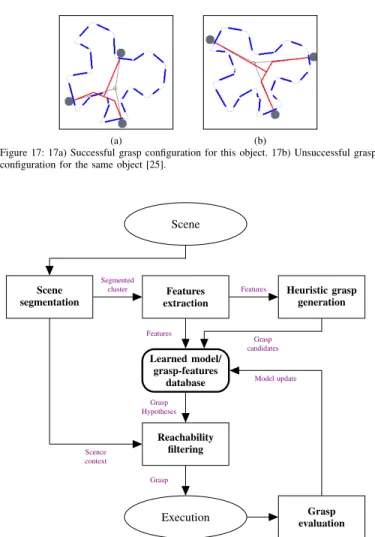
Morales et al. [25] use visual feedback to infer successful grasp configurations for a three-fingered hand. The authors take the hand kinematics into account when selecting a number of planar grasp hypotheses directly from 2D object contours. To predict which of these grasps is the most stable one, a
k-nearest neighbour (KNN) approach is applied in connection
with a grasp experience database. The experience database is built during a trial-and-error phase executed in the real world. Grasp hypotheses are ranked dependent on their outcome. Fig. 17 shows a successful and unsuccessful grasp config-uration for one object. The approach is restricted to planar objects. Speth et al. [104] showed that their earlier 2D based approach [25] is also applicable when considering 3D objects.
(a) (b)
Figure 17: 17a) Successful grasp configuration for this object. 17b) Unsuccessful grasp configuration for the same object [25].
Scene Scene segmentation Features extraction Heuristic grasp generation Learned model/ grasp-features database Reachability filtering
Execution evaluationGrasp
Segmented cluster Features Grasp candidates Features Grasp Hypotheses Scence context Grasp Model update
Figure 18: Typical functional flow-chart of a system that learns from trial and error. No prior knowledge about objects is assumed. The scene is segmented to obtain object clusters and relevant features are extracted. A heuristic module produces grasp candidates from these features. These candidates are ranked using a previously learned model or based on comparison to previous examples. The resulting grasp hypotheses are filtered and one of them is finally executed. The performance of the execution is evaluated and the model or memory is updated with this new experience. The following approaches can be summarized by this flow chart: [90, 71, 95, 104, 5, 26, 25]
The camera is used to explore the object and retrieve crucial information like height, 3D position and pose. However, all this additional information is not applied in the inference and final selection of a suitable grasp configuration.
The approaches presented by Herzog et al. [71] and Kroe-mer et al. [90] also maintain a database of grasp examples. They combine learning by trial and error on real world data with a part based representation of the object. There is no restriction of object shape. Each of them bootstrap the learning by providing the robot with a set of positive example grasps. However, their part representation and matching is very different. Herzog et al. [71] store a set of local templates of the parts of the object that have been in contact with the object during the human demonstration. Given a segmented object point cloud, its 3D convex hull is constructed. A template is a height map that is aligned with one polygon of this hull. Together with a grasp hypotheses, they serve as positive examples. If a local part of an object is similar to a template in the database, the associated grasp hypothesis is executed. Fig. 19 shows example query templates and the matched template from the database. In case of failure, the object part is added as a negative example to the old template. In this
Figure 19: Example query and matching templates [71].
way, the similarity metric can weight in similarity to positive examples as well as dissimilarity to negative examples. The proposed approach is evaluated on a large set of different objects and with different robots.
Kroemer et al. [90] use a pouring task to demonstrate the generalization capabilities of the proposed approach to similar objects. An object part is represented as a set of points weighted according to an isotropic 3D Gaussian with a given standard deviation. Its mean is manually set to define a part that is relevant to the specific action. When shown a new object, the goal of the approach is to find the sub-part that is most likely to afford the demonstrated action. This probability is computed by kernel logistic regression whose result depends on the weighted similarity between the considered sub-part and the example sub-parts in the database. The weight vector is learned given the current set of examples. This set can be extended with new parts after action execution. Herzog et al. [71] and Kroemer et al. [90] both do not adapt the similarity metric itself under which a new object part is compared to previously encountered examples. Instead the probability of success is estimated taken all the examples from the continuously growing knowledge base into account.
C. Generative Models for Grasp Synthesis
Very little work has been done on learning generative models of the whole grasp process. These kind of approaches identify common structures from a number of examples in-stead of finding a decision boundary in some feature space or directly comparing to previous examples under some similarity metric. Montesano et al. [26] provide one example in which affordances are encoded in terms of an action that is executed on an object and produces a specific effect. The problem of learning a joint distribution over a set of variables is posed as structure learning in a Bayesian network framework. Nodes in this network are formed by object, action and effect features that the robot can observe during execution. Given 300 trials, the robot learns the structure of the Bayesian network. Its validity is demonstrated in an imitation game where the robot observes a human executing one of the known actions on an object and is asked to reproduce the same observed effect when given a new object. Effectively, the robot has to perform inference in the learned network to determine the action with the highest probability to succeed.
Song et al. [87] approach the problem of inferring a full grasp configuration for an object given a specific task. As in [26], the joint distribution over the set of variables
influenc-Figure 20: Ranking of approach vectors for different objects given a specific task. The brighter an area the higher the rank. The darker an area, the lower the rank [87].
ing this choice is modeled as a Bayesian network. Additional variables like task, object category and task constraints are introduced. The structure of this model is learned given a large number of grasp examples generated in GraspIt! and annotated with grasp quality metrics as well as suitability for a specific task. The authors exploit non-linear dimensionality reduction techniques to find a discrete representation of continuous vari-ables for efficient and more accurate structure learning. The effectiveness of the method is demonstrated on the synthetic data for different inference tasks. The learned quality of grasps on specific objects given a task is visualized in Fig. 20.
D. Category-based Grasp Synthesis
Most of the previously discussed approaches link low-level information of the object to a grasp. Given that a novel object is similar in shape or appearance to a previously encountered one, then it is assumed that they can also be grasped in a similar way. However, objects might be similar on a different level. Objects in a household environment that share the same functional category might have a vastly different shape or appearance. However they still can be grasped in the same way. In Section III-B1, we have already mentioned the work by Dang and Allen [106], Hillenbrand and Roa [98] in which task-specific grasps are synthesized for objects of the same category. The authors assume that the category is known a-priori. In the following, we review methods that generalize grasps to familiar objects by first determining their category.
Marton et al. [108] use different 3D sensors and a thermo camera for performing object categorization. Features of the segmented point cloud and the segmented image region are extracted to train a Bayesian Logic Network for classifying object hypotheses as either boxes, plates, bottles, glasses, mugs or silverware. A modified approach is presented in [102]. A layered 3D object descriptor is used for categorization and an approach based on the Scale-invariant feature transform
(SIFT) [109] is applied for view based object recognition. To increase robustness of the categorization, the examination methods are run iteratively on the object hypotheses. A list of potential matching objects are kept and reused for verification in the next iteration. Objects for which no matching model
can be found in the database are labeled as novel. Given that an object has been recognized, associated grasp hypotheses can be reused. These have been generated using the technique presented in [110].
Song et al. [87] treat object category as one variable in the Bayesian network. Madry et al. [105] demonstrate how the category of an object can be robustly detected given multi-modal visual descriptors of an object hypothesis. This information is fed into the Bayesian Network together with the desired task. A full hand configuration can then be inferred that obeys the task constraints. Bohg et al. [99] demonstrate this approach on the humanoid robot ARMAR III [74]. For robust object categorization the approach by Madry et al. [105] is integrated with the 3D-based categorization system by Wohlkinger and Vincze [111]. The pose of the categorized object is estimated with the approach presented by Aldoma and Vincze [112]. Given this, the inferred grasp configuration can be checked for reachability and executed by the robot.
Recently, we have seen an increasing amount of new approaches towards pure 3D descriptors of objects for cate-gorization. Although, the following methods look promising, it has not been shown yet that they provide a suitable base for generalizing grasps over an object category. Rusu et al. [113, 114] provide extensions of [35] for either recognizing or categorizing objects and estimating their pose relative to the viewpoint. While in [114] quantitative results on real data are presented, [113] uses simulated object point clouds only. Lai et al. [36] perform object category and instance recognition. The authors learn an instance distance using the database presented in [46]. A combination of 3D and 2D features is used. Gonzalez-Aguirre et al. [115] present a shape-based object categorization system. A point cloud of an object is reconstructed by fusing partial views. Different descriptors (capturing global and local object shape) in combination with standard machine learning techniques are studied. Their performance is evaluated on real data.
IV. GRASPINGUNKNOWNOBJECTS
If a robot has to grasp a previously unseen object, we refer to it asunknown. Approaches towards grasping known objects are obviously not applicable since they rely on the assumption that an object model is available. The approaches in this group also do not assume to have access to other kinds of grasp experiences. Instead, they propose and analyze heuristics that directly link structure in the sensory data to candidate grasps. There are various ways to deal with sparse, incomplete and noisy data from real sensors such as stereo cameras: we divided the approaches into methods that i) approximate the full shape of an object, ii) methods that generate grasps based on low-level features and a set of heuristics, and iii) methods that rely mostly on the global shape of the partially observed object hypothesis. The reviewed approaches are summarized in Table III. A flow chart that visualizes the data flow in the following approaches is shown in Fig. 21.
A. Approximating Unknown Object Shape
One approach towards generating grasp hypotheses for un-known objects is to approximate objects with shape primitives.
![Figure 6: Robot grasp learning from human demonstration. 6a) Kinesthetic Teaching [71]](https://thumb-us.123doks.com/thumbv2/123dok_us/1962887.2790756/7.918.103.819.92.248/figure-robot-grasp-learning-human-demonstration-kinesthetic-teaching.webp)
![Figure 11: Top) Grasp candidates performed on SQ. Bottom) Grasp quality for each candidate [20].](https://thumb-us.123doks.com/thumbv2/123dok_us/1962887.2790756/9.918.91.422.104.477/figure-grasp-candidates-performed-sq-grasp-quality-candidate.webp)
![Figure 16: Lower dimensional space in which similar pairs of grasps and object parts are close to each other [91].](https://thumb-us.123doks.com/thumbv2/123dok_us/1962887.2790756/11.918.495.821.81.356/figure-lower-dimensional-space-similar-pairs-grasps-object.webp)