Towards the Optimal
Inventory Review Intervals
A simulation study into the effect of inventory review
intervals on the supply chain performance of a
single-product company
Areti Satoglou
March 2016
3
Information Master thesis – Management of Technology
Areti Satoglou – 4325516 March 2016
Graduation Committee
Chairman Dr. R.M. (Robert) Verburg
1st supervisor Dr. M.A. (Michel) Oey
2nd supervisor Dr. Ron van Duin (J.H.R.)
External supervisor Dr. Ivo Wenzler (from Accenture) Laurens van der Drift (from Macomi)
5
Contents
Abbreviations ... 8 Aknowledgements ... 9 Executive summary ... 11 1 INTRODUCTION ... 15 1.1 Background information... 151.2 Continuous vs periodic replenishment policy ... 16
1.3 Presentation of the company ... 16
1.4 Presentation of the situation ... 16
1.5 Positioning of the author’s contribution in the project ... 17
2 RESEARCH PROBLEM AND APPROACH ... 19
2.1 Knowledge gap and problem statement ... 19
2.2 Research objective ... 20
2.3 Scientific and social relevance ... 20
2.4 Research Questions ... 20
2.5 Conceptual model of research ... 20
2.6 Research approach ... 21
2.7 Research methods: literature review, case study design and simulation ... 22
2.7.1 Literature review ... 22
2.7.2 Embedded single case study strategy ... 23
2.7.3 Simulation ... 23
2.7.4 IDEF0, system theory, black box theory ... 27
2.7.5 DEMO methodology ... 27
2.8 Outline of report... 29
2.9 Concluding remarks ... 30
3 SUPPLY CHAIN ANALYSIS ... 31
3.1 Research framework for literature review ... 31
3.2 Inventory Theory ... 31
3.2.1 Reasons for focusing on inventory management ... 32
3.2.2 Why keeping inventories? ... 33
3.2.3 Inventory in the supply chain ... 33
3.2.4 Inventory strategies ... 34
6
3.2.6 Introduction to inventory control ... 35
3.2.7 Inventory classification ... 37
3.2.8 Inventory control in certain conditions ... 39
3.2.9 Inventory control in uncertain conditions: stochastic inventory models... 40
3.2.10 The independent variable: the inventory review interval ... 42
3.2.11 The dependent variable: Supply chain performance ... 42
3.2.12 The key performance indicators (KPIs) ... 42
3.3 Concluding remarks ... 43
4 CASE STUDY ANALYSIS ... 45
4.1 Selection of case study strategy: embedded single case study ... 45
4.2 Case study performance ... 47
4.2.1 Current and future replenishment policy of company X ... 48
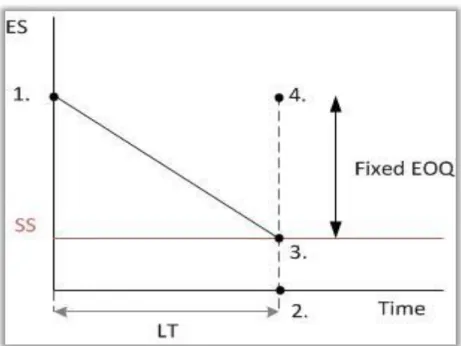
4.2.2 Detailed description of the logic for current replenishment policy (the (s,S) policy) ... 50
4.2.3 Detailed description of the logic for new replenishment policy (Min/Max policy) ... 52
4.2.4 Data description ... 53
4.3 Linking the literature review and the case study with the conceptual design of simulation 53 4.4 Concluding remarks ... 54
5 INVENTORY SIMULATION MODEL ... 55
5.1 Model conceptualization ... 55
5.1.1 Model objectives ... 55
5.1.2 Conceptual design of simulation ... 55
5.1.3 Description of the conceptual design: system as a black box ... 56
5.2 Specification of the conceptual model ... 56
5.2.1 The control variables : IRI and inventory replenishment policy ... 56
5.2.2 The mechanisms: the choice of the simulation archetype ... 56
5.2.3 Inputs: data collection and data analysis ... 59
5.2.4 Outputs: KPIs expressing finished inventory and service levels ... 63
5.2.5 Specification and analysis of the system: Opening the black box ... 63
5.3 Verification and Validation of the model ... 70
5.3.1 Verification ... 70
5.3.2 Validation... 71
5.4 Simulation and Results ... 85
5.4.1 Design of experiments ... 85
5.4.2 Execution of experiments ... 88
5.4.3 Results ... 90
7
6 CONCLUSIONS ... 105
6.1 Answering the research questions ... 105
6.1.1 Review of the sub research questions... 105
6.1.2 Review of the main research question ... 109
6.2 Generalization of results ... 110
7 LIMITATIONS, RECOMMENDATIONS AND REFLECTION ... 113
7.1 Limitations ... 113
7.2 Recommendations for future research ... 114
7.2.1 Future research from a business perspective ... 114
7.2.2 Future research from an academic perspective ... 114
7.3 Reflection... 115
8 APPENDICES ... 117
A: Simulation results ... 117
B: “% Delivered on time versus Requested” KPI comparison between the two replenishment policies regarding ABC classification ... 120
C: “% Delivered on time versus Requested” KPI comparison between the two replenishment policies regarding XYZ classification ... 123
D: “% Delivered on time versus Requested” KPI comparison between the two replenishment policies regarding Lead Time classification ... 127
E: “Inventory final product” KPI comparison between the two replenishment policies regarding ABC classification ... 130
F: “Inventory final product” KPI comparison between the two replenishment policies regarding XYZ classification ... 134
G: “Inventory final product” KPI comparison between the two replenishment policies regarding Lead Time classification ... 137
8
Abbreviations
KPI Key Performance Indicator
IRI Inventory review interval
ATD Actor Transaction Diagram
9
Aknowledgements
Executing this graduation project and writing a thesis about the research is the completion of my master Management of Technology at the Delft University of Technology. I made the conscious choice of performing this research in combination with an internship at a company in order to gain work experience besides the execution of my graduation. At Macomi and Accenture I found an interesting case to work on a project of a Macomi and Accenture’s client, together with a very interesting company and environment and a group of nice colleagues. Furthermore, I would like to express my gratitude to those who helped, guided and supervised me in the process of writing this thesis.
From the University, I would like to thank Michel Oey, my first supervisor, for his involvement in my project, his willingness to help me, his feedback and the interesting discussions we had during our meetings. I also want to thank Robert Verburg as Chair of my graduation committee and Ron van Duin as my second supervisor from the University, for their helpful feedback during the ‘official’ meetings of my project.
From Macomi, I would like to thank Michel Fumarola and Corne Versteegt for supervising my progress throughout my graduation and also Ivo Wenzler form Accenture, for in the first place providing me with an internship there. Moreover, I would like to thank Tim Tutenel from Macomi, for his patience when explaining to me the technical parts that I did not know about or when exporting for me database queries from S3N. And of course, I would like to thank Laurens van der Drift for regularly giving useful feedback on my work, for helping me building the simulation model and for his patience consumed by me when answerig all these questions of mine during those 9 months of internship. (It is true that if I gave him a penny everytime he answered to a question of mine, by now he would have made a fortune. )
Also, I would like to thank my father Pavlos, mother Ntina and sister Fay, for their interest and full support in the progress of my graduation. My friends are appreciated for their support and for all our nice and relaxing activities that helped me taking my mind of the thesis every now and then.
11
Executive summary
Inventory management is one of the cornerstones of supply chain management as inventory consists of a key contributor in all supply chains. In the supply chain sector, many inventory management-related problems have been broadly investigated and discussed over the years. It is of great importance for the supply chain of a company to make proper decisions when it comes to plan the order quantity or the time of placing an order, the safety stock that should be keep, the optimal location for its warehouse or other related decisions. Further, it is understood that defining “how much to stock” is closely correlated with defining “how much to order”. Hence, each firm follows a specific replenishment policy according to its needs.
One categorization among inventory replenishment policies is made with respect to the inventory review interval (IRI). The IRI refers to the frequency of reviewing the inventory to determine when orders must be placed for replenishment. However, the IRIs differs among policies and companies. According to this categorization inventory replenishment policies can be either continuous or periodic. In the continuous review process, the inventory levels are continuously reviewed, and as soon as the stocks fall below a predetermined level (known as the reorder point or reorder level), a replenishment order is placed.
This research is conducted from the scope of a specific company’s supply chain, company X that is an international book seller. Company X is currently one of the many clients of Accenture. Company X is currently using an inventory replenishment policy similar to the (s,S) policy. However, company X is in a transition phase aiming to change this current inventory replenishment policy to the so called Min/Max replenishment policy. The Min/Max inventory replenishment policy is based on the EOQ calculation. At this project conducted by Accenture, Macomi, a business consulting firm, provides the simulation capabilities. A discrete event simulation model was built for providing company X with the optimal EOQs of company X’s suppliers for the new replenishment policy by Macomi with the author’s contribution. However, it is unknown how the IRI of the current or the new inventory replenishment policy can influence the supply chain performance of Company X. The author of this thesis built with Macomi a simulation model and adapted it afterwards in order to conduct this research. The author contributed in building the simulation model with Macomi and parametrized it afterwards along with collected data of company X provided by Accenture for her research purposes. From the aforementioned, the aim of this research is to explore the relationship between the IRI and supply chain performance of company X. Hence, the main research question that needs to be answered is: “What are the effects of review intervals on the supply chain performance of company X?” The following sub questions are intended to be answered in order to answer to the main research question presented above. Those are formulated below:
1. Why it is important to focus on the IRI and what theories are relevant regarding the IRI?
2. Which inventory replenishment policies and IRI ranges are relevant to company X’s case?
3. How can supply chain performance be defined and measured, in the case of company X?
4. How can one test the effect of IRIs on supply chain performance of company X?
5. How do supply chain performance metrics behave under different IRIs for company X?
First, in order to understand the purpose of inventory management, theoretical drivers of inventory were gathered. This includes the analysis of the currently used inventory model. Also, measures were
12 selected to rate the performance of inventory management practices, the KPIs. This step is achieved by conducting first a literature review. A top down approach is applied for that purpose starting from general notions such as supply chain management and narrowing down step by step in a systemic way to the IRI that is the key concept of this research. Second, an embedded case study strategy was used, specifically company X‘s case, in order to scope the research.
A discrete event simulation model was built for providing company X with the optimal EOQs of company X’s suppliers for the new inventory replenishment policies by Macomi with the author’s contribution. After the model was finished, the author built another version of the model to use it in order to answer the relevant research questions. The simulation model’s main outputs are inventories and service levels expressed in Key performance indicators (KPIs). The author’s model is based on Macomi’s model and is used to conduct this research to identify the impact of the IRI on supply chain performance.
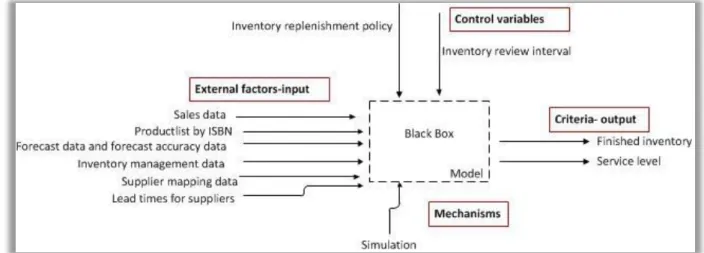
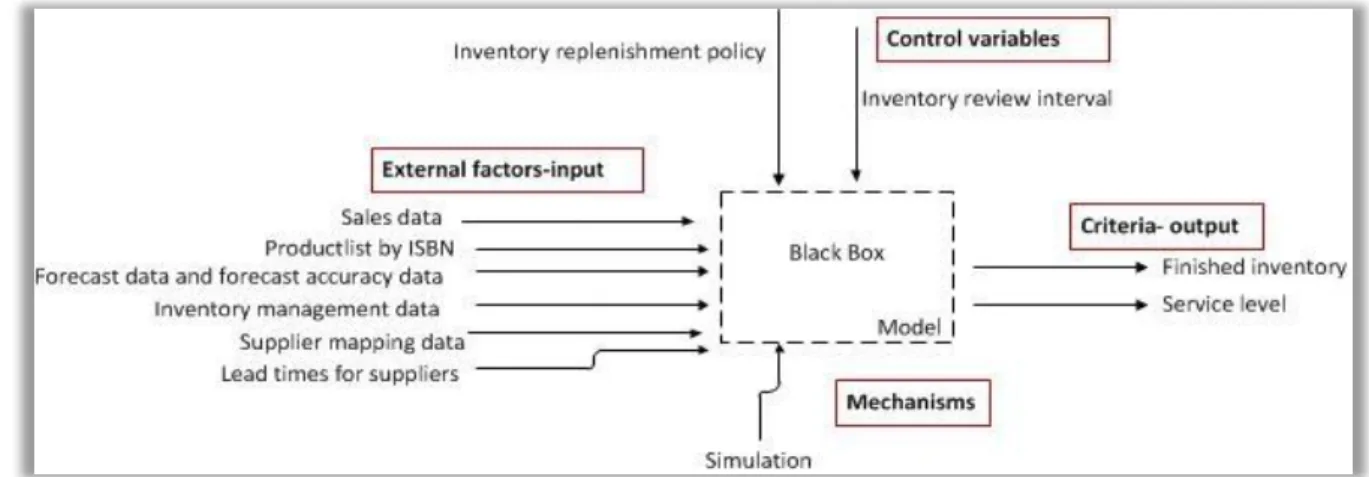
Hence, first the conceptual design of the simulation was developed using IDEF0. The conceptual model was perceived as a system. After defining the inputs, controls mechanisms and outputs as seen in the following figure, the system that was perceived as a black box was opened up using the DEMO methodology. DEMO was selected as a suitable methodology in order to map the business processes that are relevant to the inventory management and inventory control of company X.
Figure 1: The conceptual design of the simulation presented as a system diagram.
Afterwards, the model is implemented in the S3N interface. Before using the simulation model to run the tests, the author verified and validated the model. Subsequently, the design and the execution of experiments followed. After having executed all the experiments, the author proceeded in exporting the relevant KPIs for obtaining the results and for being able to analyze them afterwards, for all the 57 products that were selected from the product list. There are two relevant KPIs: “Inventory final product” and “% Delivered on time versus Requested.
As expected, the results showed that both KPI values decline as we move from smaller to bigger IRIs: both the finished inventories and the service levels decrease as we move from smaller to bigger IRIs. However, if one looks at the scale, it is not that strong. Further, looking at both the two different KPI behaviors, they are consistent in their decrease. However, it is noticed that the decrease is not that intense, and hence, the influence of the IRIs is not that big. Moreover, it was observed that as long as
13 the IRIs are fluctuating from 1 day to 1 month, the KPI values do not decrease that significantly. The KPI values drop faster as we move the IRI beyond one month.
Hence, valuable recommendations are made from a business perspective and from a scientific perspective as well. For instance, from a business perspective, a recommendation for company X would be to estimate if the Min/Max policy that is proposed to be “a real time” policy is indeed beneficial: Based on the results of this research, it could be stated that the Min/Max policy works efficiently with the low levels of inventory that are kept, but still, the review interval of the inventory does not seem to influence the service level and the inventory KPI. Thus, paying for the real time policy implementation, from the IRIs perspective does not seem beneficial enough since during one month period it is not needed to have a real time observation on what is happening to the inventories. More specifically, the results showed that the influence of the IRIs is not that important when they are less than one month. In other words, there is no need for investing on expensive software that helps company X managing and controlling the replenishment of products in real time because both inventories and service levels decrease with a low rate.
From a scientific perspective, a knowledge gap was tackled as there was not much literature found regarding the impact of the IRIs on supply chain performance. Further, this research was scoped for a specific company; company X, in order to answer to the research question “What are the effects of review intervals on the supply chain performance of company X?” Thus, from a scientific perspective, it was not clear how supply chain performance could be influenced by different IRIs. Hence, the author selected a case in order to narrow down the scope of the research. However, limitations that occurred are presented and discussed. Hence, based on the result interpretations and the limitations that are observed, someone in the future could perform another case study to test this model for another company with different supply chain. Nevertheless, one could go further and perform a more fundamental study and not take just one case of company, but perform a more controlled experiment in which he is going to turn all the variables that have been thoroughly discussed during the implementation of the experiments.
15
1
INTRODUCTION
This chapter start with providing the reader wih background information on relevent theories regarding supply chain and invenory management and inventory replenishment policies. Subsequently, an introduction to the company that is considered in this thesis takes place along with the backgroud information regarding the situation and the positioning of the author of this research and his contribution in the existing project of this company.
1.1
Background information
Supply chain m
a
nagementIn today’s complex market place the competition is towards supply chains rather than individual companies. Hence, the need of efficient supply chain management is evident. Supply chain management is commonly defined as the management of the flow of goods, information and services. It includes the movement and storage of raw materials, work-in-process inventory, and finished goods from point of origin to point of consumption. Supply chain management has also been defined as the "design, planning, execution, control, and monitoring of supply chain activities with the objective of creating net value, building a competitive infrastructure, leveraging worldwide logistics, synchronizing supply with demand and measuring performance globally.” (APICS, n.d.) In addition, when managing and developing the supply chain, performance measurement of the entire supply chain and its processes is essential and also helpful in the continuous improvement of SCM. Performance measurement provides information for managers and decision makers that enable them identifying which strategies to follow and facilitating the understanding of the situation in a market of complexity and uncertainty. Further, performance measurement assists in directing management attention, revising company goals, and re-engineering business processes. (Chan, 2003)
Inventory management
Inventory management is one of the cornerstones of supply chain management as inventory consists of a key contributor in all supply chains. Logistic costs, holding inventory costs are examples of costs that all companies want to control while providing satisfactory services to their clients. Thus, effective management of inventories is considered to be a vital function of management plays a crucial role in basic engineering management topics such as quality management and lean manufacturing. In general, successful inventory management involves creating a purchasing plan that will ensure that items are available when they are needed. This means that the inventory level should be neither too low nor too high.
Moreover, successfully managing the inventory means keeping track of existing inventory and its use. Two common inventory-management strategies are the just-in-time method, where companies plan to receive items as they are needed rather than maintaining high inventory levels, and materials requirement planning (MRP) which schedules material deliveries based on sales forecasts. In order to control the imbalances between supply and demand, companies use various inventory management methods. Usually, demand is uncertain and that is why firms should always be able to fulfill customer needs and have an adequate inventory level that is not so high to cause excessive costs to the firm and at the same time not so low to prevent a stock-out situation.
In the supply chain sector, many inventory management-related problems have been broadly investigated and discussed over the years. It is of great importance for the supply chain of a company
16 to make proper decisions when it comes to plan the order quantity or the time of placing an order, the safety stock that should be keep, the optimal location for its warehouse or other related decisions. Further, it is understood that defining “how much to stock” is closely correlated with defining “how much to order”. Hence, each firm follows a specific replenishment policy according to its needs.
1.2
Continuous vs periodic replenishment policy
Inventory Replenishment policies and inventory management are close related. Planning of the inventory establishes the optimal inventory level for each company to maintain in order to balance costs and service levels for demand fulfillment. In general, reordering or replenishment process needs to define a review period for reordering and an ordering quantity. Then it needs the inventory parameters to determine whether an order for replenishment should be placed at the time of review or not. Based on how the review period and order quantities are defined, there are a few options to drive the reordering.
Hence, one categorization among inventory replenishment policies is made with respect to the inventory review interval (IRI). This refers to the frequency of reviewing the inventory to determine when orders must be placed for replenishment. However, the IRI differs from inventory replenishment policy to inventory replenishment policy and from company to company. According to this categorization inventory replenishment policies can be either continuous or periodic. In the continuous review process, the inventory levels are continuously reviewed, and as soon as the stocks fall below a predetermined level (known as the reorder point or reorder level), a replenishment order is placed. Regarding the periodic review, the inventory levels are reviewed at a set frequency. This could be the end of each day, week, year etc. At the time of the review, if the stock levels are below the pre-determined level, then an order for replenishment is placed, otherwise it is ignored until the next cycle.
1.3
Presentation of the company
This research is conducted from the scope of a specific company’s supply chain. The company selected will not be named due to confidentiality issues. Thus in this thesis the chosen company will be referred to as company X. Company X was selected as a case study, thus, data from company X were provided to the author in order to conduct this research. Company X is a multinational publishing and education company. It is one of the largest education companies and book publishers in the world. Furthermore, the company has a limited portfolio of products. The focus of this thesis is only on books as product type. Hence, in this report the company will be referred to as a single product- company, meaning the books.
1.4
Presentation of the situation
Company X is currently one of the many clients of Accenture. Accenture is a management consulting, technology services and outsourcing company. Company X’s supply chain consists of a central warehouse in UK, 16 Litho-suppliers worldwide and 2 digital suppliers based in UK. Accenture has been asked from company X to propose the optimal Economic Order Quantities (EOQs) for the 18 suppliers. EOQ is a calculation that determines the most cost effective quantity to order or produce by finding the point at which the combination of order cost and carrying cost is the least. Company X is currently using an inventory replenishment policy similar to the inventory replenishment policy called the (s,S) policy, that will be discussed in the following chapters. However,
17 company X is in a transition phase aiming to change this current inventory replenishment policy to the so called Min/Max replenishment policy. The Min/Max inventory replenishment policy is based on the EOQ calculation. At this project conducted by Accenture, Macomi, a business consulting firm, provides the simulation capabilities. A discrete event simulation model was built for providing company X with the optimal EOQs of company X’s suppliers for the new replenishment policy by Macomi with the author’s contribution. However, it is unknown how the IRI of the current or the new inventory replenishment policy can influence the supply chain performance of Company X. The author of this thesis built the simulation model with Macomi and adapted it afterwards in order to conduct this research: The author contributed in building the simulation model with Macomi and parametrized it afterwards along with collected data of company X provided by Accenture for her research purposes.
1.5
Positioning of the author’s contribution in the project
With respect to the requirement of the University, the author conducted this thesis externally at Accenture. For the purposes of the research, the author was involved in the project of company X. The author contributed in building the simulation model with Macomi and parametrized it afterwards along with collected data of company X provided by Accenture for her research purposes.
19
2
RESEARCH PROBLEM AND APPROACH
This chapter presents the knowledge gap along with the formulation of the problem statement. Hence, the research objective stems from the identification of the problem at stake and further, the scientific and societal relevance regarding this topic are tackled. Subsequently, the research questions are formulated, a preliminary conceptual model is presented and the research approach and methods that are necessary to conduct this research are introduced. In the end of the chapter, the outline of the report is shown along with some concluding remarks.
2.1
Knowledge gap and problem statement
Relationship between IRI and supply chain performance
Inventory replenishment policies have been thoroughly investigated along with the effects that they have on the supply chain performance. Example papers can be found in the literature. For instance, in a paper, (Lau, et al., 2008) the effects of information sharing and early order commitment on the performance of four inventory policies used by retailers in a supply chain of one capacitated supplier and four retailers, are investigated.
However, while conducting this preliminary literature research, it was observed that there is little literature on this topic and mostly papers that are recently published. In a recent article (Shang, et al., 2015), a periodic inventory review system is considered that aims to minimizing the average costs per period. Shang et al find the optimal reorder intervals for their research by decomposing the total costs into each facility and then construct a lower bound to the allocated facility cost. Subsequently they use these lower bounds to reach bounds for the optimal order intervals. Moreover, in an older article (Axsater, 1993)a system with a periodic review order-up-to-S policy is considered and provides procedures for the evaluation of holding and shortage costs. Further, Liu et al (2012) studied the optimization of the (S, T) policy where T is the replenishment interval and S is the order-up-to level. In their research they identify properties based on which they develop algorithms to calculate the optimal policy for cases of either continuous or discrete demand.
The IRI refers to the frequency regarding how often to review the inventory in order to determine when to place the next order. In other words, a review period is the length of the interval between two consecutive inventory reviews. From a literature review perspective, a reason why there is not enough literature on the topic is because the focus is usually on determining the optimal order quantity instead of the optimal review interval: If one determines the optimal order quantity he can define what the review period will be. A simple calculation for that would be to divide the demand by the order quantity to estimate the number of times needed to place an order and thus, one can calculate what will be the order period. Moreover, it is observed in both literature and real life cases that this frequency varies among replenishment policies and companies. With respect to the IRI, as mentioned before, there are two kinds of inventory reviews: continuous review and periodic review. From the aforementioned, it is intended to explore the relationship between the IRI and supply chain performance of company X.
Hence, the overall problem that is intended to be explored in this research can be formulated as follows:
“There is not a clear picture regarding the effects of the IRI on supply chain performance.”
Given the fact that company X is chosen for performing a case study, this problem will be tackled in the frame of Company X.
20
2.2
Research objective
Based on the problem statement the following research objective is formulated:
“The research objective is to investigate the impact that the IRI has, on the supply chain performance of Company X.”
2.3
Scientific and social relevance
To begin with, from a scientific perspective, a knowledge gap will be investigated and the research will shed light on the relationship between the review interval and supply chain performance on a real life case. Specifically, the result of conducting a preliminary literature review showed that this topic is not researched much due to the very few literature that there exists. As mentioned, it was assumed while reviewing literature that the focus usually is on determining the optimal order quantity instead of first destemming the review intervals. Hence, the outcome of the research intends to contribute in linking the notions of supply chain performance and IRIs.
The social relevance lies in the added value in practice for company X, the company chosen for the research conduction. More specifically, the exports of the simulation model that is built, aims to give useful recommendations to Company X regarding the dependence of the IRI on supply chain performance for both the current and the new replenishment policies of company X. Hence, the research product could be used as an advising report, regarding which review interval would best fit the company’s profile with respect to supply chain performance metrics (KPIs). In addition, the research product aims to be valuable for Accenture in practice, as the stakeholders of the project from the side of Accenture will able to enrich their advice to company X and in the future apply these insights to other similar projects.
2.4
Research Questions
The main research question follows from the problem definition and from the aforementioned research objective and is formulated as follows:
“What are the effects of review intervals on the supply chain performance of company X?”
In order to answer this research question, the following sub questions have to be answered. These questions provide structure for the research.
1. Why it is important to focus on the IRI and what theories are relevant regarding the IRI?
2. Which inventory replenishment policies and IRI ranges are relevant to company X’s case?
3. How can supply chain performance be defined and measured, in the case of company X?
4. How can one test the effect of IRIs on supply chain performance of company X?
5. How do supply chain performance metrics behave under different IRIs for company X?
2.5
Conceptual model of research
The basic conceptual model of this research is causal and it can be depicted by the following simple diagram in Figure 2:
21
Figure 2: The basic conceptual model
As illustrated in the figure, the dependent variable is the supply chain performance and the independent variable is the IRI. The causal relationship among those is the interest of this research that is framed within the case study conducted in company X.
2.6
Research approach
Ostrom (2008) defines the hierarchy between three levels of analysis: frameworks, theories and models. According to her, frameworks help to identify general concepts including important elements and constraints for understanding the problem. Nevertheless, theories are a level lower and are used to focus on the key parts of a framework and make certain assumptions to analyze the problem. Regarding models, they fill in a selected group of parameters which result in a set of outcomes. This chapter will introduce the research framework, which will be the start to select applicable theories and models.
For a structured approach, a research framework is designed based on Verschuren & Doorewaard (2010) and using the defined research objective. The framework is presented in figure 3 and illustrates an overview of the stages of performing this research.
22 Moreover, the stages will be now elaborated on:
a) Select key drivers and performance measures for inventory management
In order to understand the purpose of inventory management, first theoretical drivers of inventory should be gathered. This includes the analysis of the currently used inventory model. Also, measures will be selected to rate the performance of inventory management practices. This is achieved by developing and applying a research framework to conduct the necessary literature review. A top down approach is applied for that purpose starting from general notions such as supply chain management and narrowing down step by step in a systemic way to the IRI that is the key concept of this research.
b) Perform case study to analyze the inventory management situation in company X
Using the developed framework in phase a), a case study is performed within the frame of company X. The desk research or literature review conducted in the first step is combined to better understand the inventory management and control that is applied in company X.
c) Set up approach for developing an inventory management simulation model
A design approach for the simulation model is developed using literature on inventory modeling, simulation and general modeling methods. Theory on systems and model, for example the black-box model, as well as theory behind the DEMO methodology is used for that purpose.
d) Design inventory simulation model and validation tests
The design approach and the system analysis of the current situation are used to develop an inventory management simulation model. Purpose of this model is to test how the different IRIs influence supply chain performance. Supply chain performance is defined in terms of service levels and measuring inventories.
e) Analyze the effects of IRI on supply chain performance using the simulation model
The effects of IRI on supply chain performance are tested using the simulation model. Results are recommendations for inventory management at company X and the added value of using a simulation model for academic and business purposes.
f) Validate new inventory management practices and evaluate results
The results of the simulation model are validated with expert opinion, use of historical data and comparison to the model of Macomi. Evaluation on the results is performed and generalization of them is tackled. Further, limitations of the simulation model are identified and recommendations are defined for future research both from a business and from a scientific perspective. In the end, reflections on the research process are also identified.
2.7
Research methods: literature review, case study design and simulation
2.7.1
Literature review
Regarding the literature review, the research objective is to identify the impact of the inventory review interval (IRI) on supply chain performance for the case of company X. Soon it became clear
23 that there is not an easy way to start the research by focusing on the two main variables. Therefore first a comprehensive literature review was conducted on supply chain management and inventory management in particular. Afterwards, an additional literature review is performed that involves the summary, collation and/or synthesis of existing research. The performance of this literature review is implemented based on the top-down approach.
2.7.2
Embedded single case study strategy
First, the core method used in this research is the conduction of a case study as the research will consists of company X’s case. Case study research is used because it is particularly suitable for studying a phenomenon in its real-life context, and when the phenomena are intertwined with the situation (Yin, 2009)
The problem defined is on the one hand, a problem that can be considered by many companies. However, in order to quantify it and perform an analysis, it has been chosen to do so from the scope of a specific company, company X. The case study method allows the researcher to retain the holistic and meaningful characteristics of real-life events (Yin, 2009). Moreover, it is not possible to identify the effect of the IRI on supply chain performance on the basis of highly aggregated data when every company is unique because in every separate case there is a different set of parameters and variables that depend on the company’s strategies, characteristics and policies that are followed. Further, the results will be more accurate and meaningful not only from a technical perspective for this specific company, but also form a social perspective by contributing in solving a real-life problem of a company with similar characteristics as company X.
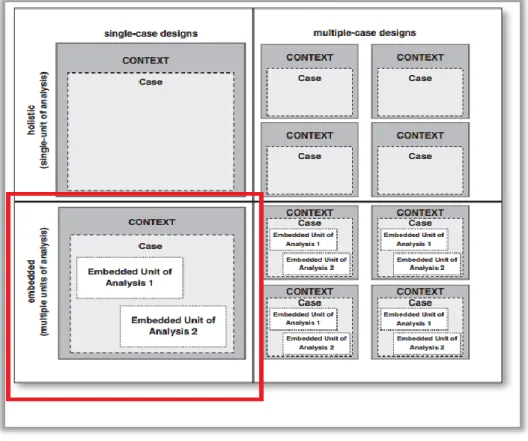
For the purpose of this research, the author will use a single-case study design to confirm, challenge, and broaden existing theory (Yin, 2009). A single case study focuses on only one case to be thoroughly examined (Verschuren & Doorewaard, 2010). This will be the case of Company X. Moreover, with respect to a case study research design, the researcher should identify if the single case study is a holistic or an embedded one. A holistic case study means studying a case in its totality and it is used when no logical subunits can be identified and a study might be conducted on a too abstract level. On the other hand, in an embedded case study, various subcases or units or processes are studied (Verschuren & Doorewaard, 2010). A characteristic of an embedded case study is that extensive analysis is performed and also it might focus too much on subunits, thus, losing higher level (holistic) aspects. Regarding to the characteristics of this spicific case study, it is considered by the author to be an embedded single case study. This case is not examined with a holistic perspective but in fact there are sub-units related to the IRI such as demand, forecast of the demand, different categories of inventory replenishment policies that lead to different processes and to products with different characteristics. Hence, extensive analysis will be performed in order to reach the research objective and thus, this is the reason for using the research strategy of an embedded case study.
2.7.3
Simulation
A discrete event simulation model was built for providing company X with the optimal EOQs of company X’s suppliers for both the current and the new inventory replenishment policies by Macomi with the author’s contribution. After the model is finished, the author built another version of the model to use it in order to answer to the relevant research questions.
24 The conceptual design of simulation will be developed by perceiving the model as a system. A system is by definition a combination of elements of parts that format a complex or unitary whole (Blanchard, et al., 1998). When dealing with complicated systems, it is not easy to analyze every system aspect. Thus, systems engineering constitutes the endeavor of adopting a goal centered and systematic approach in order to analyze and integrate every aspect of a system. To continue, system engineering aims to ensuring that the system requirements are met. Hence, the life-cycle of a system starts with a requirements analysis and subsequently the system design and development have to be elaborated in order for the system to be implemented. Moreover, regarding the structure of a system, every system entails components, attributes, and relationships (Blanchard, et al., 1998). Components are the parts of a system that consist of inputs, processes and outputs. Further, attributes refer to the properties of manifestations of the components of a system. Finally, the links between components and attributes express the relationships (Blanchard, et al., 1998).
A model is the representation of a system and its involved relationships (Blanchard, et al., 1998). Building a model is essentially the process of developing a model for a real life system for which information exists. However, it is not easy in many cases to experiment with a real life system. Thus, decisions and improvements can derive from the use of models and their analysis by gathering information regarding the system when it is not easy to experiment directly on it.
When it comes to analyze and interpret a complex system, there are various approaches from which one can choose. One approach is the analytical approach that entails the building of a mathematical model. Another approach of building a mathematical model is simulation. Simulation is a useful tool that can be considered when a model of a system is built and a researcher wants to perform an experiment to test the various scenarios that can occur during the life cycle of a real life system. This way the behavior of a system can be represented through the use of simulation. The most usual type of simulation is to build a computer model using simulation software in order to imitate and explain a system’s behavior.
More specifically, simulation is very useful for supply chains for the decision makers. In general, in a supply chain there are decisions to be made on an operational level and also on a structural level. With the use of simulation improvements on an existing supply chain or on a new supply chain to be implemented can derive. In the case of company X, simulation is used to derive to operational improvements for the company, as the focus is on inventory management and control.
According to Law & Kelton (1991), in order to build a simulation model for any system there is a sequency of steps to take. The process starts with the proper definition of the problem and also of the system that is studied and will be modeled. Further, after the implementation of specific steps, the process ends with the implementation of the simulation results on the real world system.The steps are presented bellow (Law & Kelton, 1991):
1. Formulate the problem and plan study
2. Collect data and define the model
3. Check the validity of data
4. Construct the computer program
5. Make the pilot runs
6. Check the validity of the model
7. Design the experiments
8. Run the experiments
9. Analyze the output data
25 For this research, those steps will constitute the design approach that will be used in order to build the simulation model. This approach is also applied in order to define the conceptual design of the simulation.
The simulation model
The simulation model’s main outputs are inventories and service levels expressed in Ley performance indicators (KPIs). The author’s model is based on Macomi’s model and is used to conduct this research to identify the impact of the review interval on supply chain performance. In other words, to explore the effect of the interval on supply chain performance, it is needed to investigate how supply chain performance is affected by different time intervals. For example, what changes in supply chain performance metrics if instead of every month the inventory review is implemented every week or every day? Such tests are performed using the simulation model that is built.
Fixed Parameters
Regarding the structure of the supply chain in the model, 18 locations of the suppliers are included as well as the central warehouse in UK, a virtual customer (only one), the logistic services, the types of products and an inventory manager that manages the inventory in two different ways : within the ( s,S) policy and within the Min/max policy. The safety stocks are given in both cases and are considered fixed by company X. The whole supply chain will be considered as fixed including the aforementioned elements as well.
Varying Parameters: Product- dependent
There are two types of parameters that can vary in this model in order to make sense and generate valuable and relevant results for this research: the product- dependent parameters and the replenishment policy- dependent ones. Regarding the product-dependent parameters that can vary, those are:
Fast versus slow moving products
Demand volatility
Demand predictability or forecast accuracy
In general, by demand volatility, it is meant that we could have the same average demand although the demand could be more volatile and vary along time. In company X’s case it is intended to select a number of products that are distinctive in terms of demand volatility, of differentiation between slow or fast movers and demand predictability. Nevertheless, demand predictability refers to the estimation of how accurate is the forecast and it will be scoped in the research. Forecast accuracy relates forecasted sales quantities to actual quantities and measures the ability to forecast future demands. (Stadtler & Kilger, 2008)
Furthermore, in multi-item inventory systems, classification of inventories can help to reduce the complexity of managing thousands of items. In many cases of inventory management the use of two dimensional classification systems is also usual as the first is the traditional ABC classification and the second is based on criticality. In this research a two dimensional classification of items is used. The first is the traditional ABC classification and the second is based on variability (XYZ classification). Those classifications provide indications on how to distinguish products based on the aforementioned product-dependent parameters. (Fast versus slow moving products, demand volatility and demand predictability)
26
ABC- XYZ classification
In order to build scenarios, products should be first selected. More specifically, the products will be selected according to the ABC classification being an indicator of slow or fast movers, and to the XYZ classification that is an indicator of the items ‘demand predictability and expected forecast accuracy. Regarding the ABC classification, the items are classified based on demand (consumption) rate: Inventory control is based on a form of Pareto analysis. The inventory items are divided into three categories (A, B, and C), according to a criterion such as revenue generation, turnover, or value. Typically, 'A' items represent 20 percent in terms of quantity and 75 to 80 percent in terms of the value. Regarding the XYZ classification, it is an indicator of the items ‘demand predictability and expected forecast accuracy. Hence, the items are classified according to demand variability in a way that X items include all items in which use is relatively constant and fluctuates only rarely. The probability of correct predictions is very high. Y items include all items with substantial fluctuations in demand due to seasonal reasons or because of trends in product use. Z-products are all articles with highly irregular use. The reliability of predictions in this case is low.
Hence, to get more insight into the behavior and sensitivity of the demand pattern of each item, the items will be clustered or grouped based on the combination of two classifications (ABC & XYZ classifications). Thus, nine different categories (classes) of items will be generated (XA, XB, XC, YA, YB, YC, ZA, ZB, and ZC). From this category, due to the fact that products are mostly books, the category CZ will be out of scope, as it refers to items that are slow moving products with very high demand variability for which company X follows the strategy “Make to order”. This is a business production strategy that typically allows consumers to purchase products that are customized to their specifications. The Make to order strategy only manufactures the end product once the customer places the order. Hence, the CZ items are not stored at all and that is why they remain out of scope concerning the selection process. Thus, there are 8 different categories of products.
Varying Parameters: Inventory replenishment policy- dependent
The inventory replenishment policy- dependent parameters that were estimated as relevant to the existent model and to the frame of this research are the following:
The type of replenishment policy (the (s,S) policy or the Min/max policy)
Preferred type of replenishment frequency (either through intervals or quantities)
Regarding the aforementioned, the main parameter is the type of inventory replenishment policy that will be either the (s,S) policy or the Min/max policy. Moreover, the preferred type of replenishment frequency are characteristics of every type of inventory replenishment policy and at this research it gets the values that correspond to the given values of the two inventory replenishment policies.
Methodology to Build the Scenarios
The scenarios are built after coming to the decision on which of the aforementioned parameters vary and how. This way certain products will be selected with varying characteristics. For the product dependent parameters, the method with which they will vary is to choose a number of products that have very different properties in terms of slow or fast movement, of demand volatility and demand predictability. Regarding the inventory replenishment policy- dependent parameters that were defined above, the plan is to see how those products behave according to the two inventory replenishment policies.
27 More specifically, due to the classifications that were mentioned above, it is possible for the products to be distinguished by categorizing them into 9 categories, from which the 8 are relevant to this research. These are the items that belong to XA, XB, XC, YA, YB, YC, ZA, and ZB. Hence the product selection will be performed based on such criteria. In addition, two different inventory replenishment policies the old and the new one, will be investigated in this research. Moreover, six IRIs are selected to be investigated. Hence, the methodology for selecting products and building the scenarios leads to the formation of 12 scenarios.
Scenario Analysis
Scenario building is another methodology that is applied in order to use the simulation model. In fact, building scenarios is the way that the simulation model will be used, to test those scenarios and answer to the relevant research questions. A scenario analysis is a method in which possible future events are thought of in order to be able to analyze possible outcomes. It is not the purpose of a scenario analysis to present an exact picture of the future. Instead, it presents several alternative future developments or combinations of future developments. This methodology will be used to explain and analyze the results of the 12 scenarios that are built.
2.7.4
IDEF0, system theory, black box theory
The conceptual design of the simulation is developed using IDEF0. The conceptual model is considered as a system, and hence, a system diagram is developed in IDEF0. IDEF0 stands for Integrated Definition for Function Modeling and is designed to model the decisions, actions, and activities of an organization or system. Moreover based on system theory, the system is perceived as a black box. In general, a black box model is a conceptual system that has no direct relationv with the construction and operation of the concrete system that it models.
2.7.5
DEMO methodology
DEMO methodology DEMO stands for Design & Engineering Methodology for Organizations. In general DEMO is a methodology for designing and engineering organizations. Its main goal is to align the design and development processes to the core processes of an organization. This methodology is selected to open up the system that describes company X’s case.
DEMO: the theory behind the methodology
DEMO stands for Design & Engineering Methodology for Organizations. In general DEMO is a methodology for designing and engineering organizations. Its main goal is to align the design and development processes to the core processes of an organization. To achieve that, DEMO abstracts away from the detailed description of each process and focuses on the generic concepts and roles (Dietz, 2006). DEMO was first introduced by Jan Dietz in the early 90s and then evolved into a methodology which can represent a coherent, comprehensive, consistent, concise and essential conceptual model of the organization (Dietz, 2006).
DEMO relies on a sound theory which identifies the principals and definitions of the system and also the entities within that system. This theory defines the world, the existing entities in it and the behavior of these entities along with their interdependencies. According to this theory that is the core milestone of DEMO methodology, each system is identified by a set of elements interacting with each other and with the elements in the environment. The environment itself is composed of the same type of elements. By referring to elements in DEMO, it is meant human beings who perform specific tasks in the system and have specific responsibilities and are known by the role they play.
28 Thus, the core elements forming the system and the environment in DEMO are the actor roles (Dietz, 2006).
Actor roles are able to perform certain types of acts. They have the ability to interact with each other by performing coordination acts. Every coordination act is performed by two actors, the performer and the addressee. By performing a coordination act the performer informs the other party regarding his intention towards a production. In coordination acts, actor roles can request, promise to deliver, question or declare a production. Production is the result of a production act which is performed by one actor role. Production will be delivered to the environment or another actor role inside the system who has requested that production (Dietz, 2006).
The productions are categorized in three different layers. The layers differentiate form each other by the level of intellect used for producing that production. The highest layer is called ontological layer in which the production is an innovation or a decision. In the second layer, the Infological layer, the level of intellect is reduced to only interpreting the data and producing information out of data (No new innovative idea is created in this layer). The lowest layer is called the Datalogical layer and its production is regarding data or documents.
Every action is done based on an agreement between two actor roles through a series of negotiations. This process is called a transaction. Essentially, a transaction is composed of several coordination acts revolving around performing one production act. Thus, transactions become unique and identifiable by their productions. Since the productions are associated with layers, each transaction can also be associated with layers. Hence, a transaction can be categorized as an ontological, infological or a datalogical transaction. Moreover, sometimes the execution of a production act is dependent on the production of another transaction and thus, the actors in a transaction may have to wait for some other actors to finish their transactions before they can proceed with their own (Dietz, 2006). A transaction between two actors can be seen in the following figure.
Figure 4: The actor roles and their binding transaction (Janssen, 2016)
Moreover, the figure shows an actor role (A) that initiates the transaction by making a request. Actor role B is the one that delivers the product (the black dot). The transaction is as follows: A makes a request, B makes a promise, B provides the product, and B performs the state (for instance he states the product to be ready, handing it over to the customer), and A accepts the offer. Thus, a transaction consists of three phases: the order phase (request and promise), the execution phase (the product is created) and the result phase (state and accept). The person who makes a request is the initiator of the transaction. The person who makes a promise is the executor.
Overall, this methodology has some core concepts such as the actors, their roles and relationships and the transactions among them. At that point, it should be noted that this is the main reason for choosing this methodology over other similar ones to dive into the analysis of the processes in company X. More specifically, there are other relevant methodologies that can be used, for instance
29 BPM methodologies that stand for Business Process Management. BPM however, does not have a sound and standard theoretical basis like DEMO has. On the contrary, it is mostly founded on practical experiences (Smart, et al., 2009). Thus, the correctness of the final results of such a methodology cannot be validated and different experts in that methodology may not come up with the same results after applying it to a problem. Further, another reason for choosing DEMO over BPM is the fact that BPM methodology BPM only focuses on the functionality and the end result of each process while it ignores the interaction of actors in an organization contrasted to DEMO. Furthermore, the unique feature of displaying this cooperation in the form of a separate transaction unlike flowcharts or other business process management practices is that it presents a more complete picture. More specifically, it indicates which actor role starts the transaction, the name of the actor role, the name of the transaction, the actor role which is tasked with providing the product and the name of that actor role (Janssen, 2016). Hence, even if both methodologies are used to explain organizations, in that case the approach of DEMO is selected to be applied for the aforementioned reasons.
DEMO: The way of modeling
The models that can be built using DEMO methodology are essentially a representation of the concepts discussed in the previous sub chapter that introduced the sound theory that DEMO is based on. DEMO can represent an organization in four partial models: the construction model, the process model, the action model and the state model.
The construction model (CM) specifies the identified transaction types and the associated actor roles, as well as the information links between the actor roles and the information banks (the collective name for production banks and coordination banks). It is considered to be the most concise model compared to the other models and there is nothing above it. The CM consists of an interaction model (IAM) and an interstriction model (ISM). The interaction model (IAM) specifies the actor roles in the organization and the transactions that take place between them. The IAM shows the active influencing relationship between actor roles. Moreover, the interaction structure of an organization consists of the transaction types in which the identified actor roles participate as initiator or executor. For this it provides an Actor Transaction Diagram (ATD) and a Transaction Result Table (Dietz, 2006). Further, the interstriction model (ISM) The interstriction model (ISM) constitutes the right side of the CM. The ISM specifies the relationship between the actor roles in the organization and the information banks used by them. The ISM shows the passive influencing relationship between actor roles. The interstriction structure of an organization consists of the information links between actor roles and coordination and production banks. The ISM provides an Actor Bank Diagram (ABD) and a Bank Contents Table (BCT). When they are merged, the ATD and ABD are called the Organization Construction Diagram (OCD).
2.8
Outline of report
The report consists of several chapters. In this first chapter, an introduction along with relevant background information is provided. The second chapter presents the research methods that are used for this report. The following chapters are used to answer the research questions.
Hence, in the third chapter a supply chain analysis is presented. First, the analysis starts with performing a literature review that involves the summary, collation and/or synthesis of existing research. The performance of this literature review is implemented based on the top-down approach. The forth chapter includes a case study that is presented and performed to scope the
30 research in the frames of company X. Chapter 5 discusses the development of both the conceptual model and the simulation model for inventory management and control of company X. After defining the right modeling approach, several modeling cycles are discussed which result in testing the model and identifying the impact on the defined performance measures.
Further, chapter 6 discusses the results from the simulation and draw conclusions. In chapter 7, limitations, opportunities for further research and reflection on the research are elaborated on. Figure 5 shows a visual representation of the thesis outline.
Figure 5: Structure of the thesis
2.9
Concluding remarks
In this chapter, the knowledge gap and problem statement of this research were identified and presented and subsequently. Further, the research objective is to investigate the impact that the IRI has, on the supply chain performance of Company X. Moreover, the research will reflect its relevance both scientifically and socially. The research questions were presented in this chapter and thus a preliminary conceptual model of research was illustrated that sums the main research question: “What are the effects of review intervals on the supply chain performance of company X?” Further, the research approach was tackled. Subsequently, a literature review, an embedded case study strategy, simulation, IDEFO, system theory, black box theory and DEMO methodology were the core research methods introduced as appropriate to conduct this research. The chapter ends with the presentation of this report’s outline.
Part 1: Introductio n Part 2: Research problem and Approach Part 3: Supply Chain Analysis Part 4: Case study Analysis Part 5: Inventory Simulation Model Part 6: Conclusions Part 7: Limitations, Recommen dations, Reflection
31
3
SUPPLY CHAIN ANALYSIS
Analysis starts with performing a literature review that involves the summary, collation and/or synthesis of existing research. The performance of this literature review will be implemented based on the top-down approach. The top- down approach is a strategy of information processing and knowledge ordering used in a variety of fields. Hence, a research framework is developed to conduct the literature review according to which the analysis starts by describing broader notions that aim to lead to more specific ones that are relevant to the research objective of this thesis. Afterwards, a case study is presented and performed to scope the research.
3.1
Research framework for literature review
For the conduction of this research, a literature review is firstly necessary to combine and present the information that was reviewed and to further develop the initial causal conceptual model that has been formulated. The literature review was conducted with a top-down approach, meaning that literature was reviewed starting from a broad perspective and then continuing with narrowing down gradually the theories that the author came across until reaching the objectives. In this case, the objectives represent the main variables: The independent variable is the IRI and the dependent variable is supply chain performance. Under this scope, the following framework illustrated in figure 6, presents the building of the conceptual model.
Figure 6: Literature review conduction and further development of the causal conceptual model.
3.2
Inventory Theory
Inventories are kept at almost all parties within a supply chain. One reason why this happens is uncertainty (Waters, 2003). In general, inventory theory deals with mathematical theories of inventory and production. This field of study constitutes a subspecialty within the fields of operations research and operations management and above all, it concerns the design of inventory and production systems aiming to minimize costs. Furthermore, this field includes the decision making process of firms regarding manufacturing, warehousing, supply chains, spare parts allocation and so on. Inventory theory covers both the field of Inventory management and inventory control.
32 Usually the terms “inventory” and “stock” are used to express the same thing. (Wild, 2002) However, when it comes to inventory management there can be essential distinctions. Stock is in brief an amount of goods that is being kept at a specific place, for instance in warehouse, and sometimes it can also be referred to as inventory. On the other hand, inventory management refers primarily to the processes and the decisions that should be made for specifying the size and placement of stocked goods. Inventory management is necessary at different locations within a firm or within multiple locations of a supply chain and aims in managing the production in a way that will not allow the running out of materials or goods.
The scope of inventory management is broader than stock. Regarding its definition, inventory management can be referred to as the “management of materials in motion and at rest”. (Coyle, et al., 2003) The following activities all fall within the range of inventory management: control of lead times, carrying costs of inventory, asset management, inventory forecasting, inventory valuation, inventory visibility, future inventory price forecasting, physical inventory, available physical space for inventory, quality management, replenishment, returns and defective goods and demand forecasting.
According to Reid & Sanders (2007), inventory management basically serves two main goals. The first goal is the availability of goods. It is essential for all the operations in process that the required materials or goods are present in the right quantities, quality and at the right time in order to deliver the required service level. The second goal is to achieve the aforementioned service level against optimal costs. This leads to the inevitable challenge, that is, to find the suitable equilibrium between keeping sufficient inventory with the optimal costs with respect to the desired service level that one has to deliver. In that sense, not all items can be held in stock against every cost and therefore choices have to be made.
3.2.1
Reasons for focusing on inventory management
According to Harrington (1996), inventory often is related to the most significant costs a firm faces. With regard to the literature, there are three reasons that explain the importance of focusing on inventory management. Those are: costs, risks and the higher possibility to identify and to cope with those risks.
Regarding costs, according to Goor & Weijers (1998) stocks are responsible for up to about one third of the total working capital costs. Moreover, inventory costs represent a big part of the overall logistics costs (Coyle, et al., 2003). As a consequence, there are important benefits that can be gained by reducing these costs. Further, according to literature (Wild, 2002; Fawcett, et al., 2007), working capital invested in stocks could be a useful resource if it was used differently. That is why from a company-perspective, capital invested in stocks can be considered as a waste of money. Generally, cost reductions are required from the market in order for firms to be competitive and as illustrated, reducing the working capital costs by performing efficient inventory management is one way to achieve that.
As far as the risks are concerned, according to literature (Visser & Goor, 2004; Fawcett, et al., 2007), keeping stock is related to risk as there are events that if they occur, they could influence negatively the business processes. For instance, inventory could catch fire, or be stolen, lost or become obsolete. Such events could even block the production process and this subsequently would lead to late deliveries, hence, lower service levels and customer dissatisfaction. Risks caused by keeping stock are interrelated with costs, because in order to maintain stock secure to prevent risky events from happening, firms invest on inventory management.