THE IMPLEMENTATION OF SHADOWING TECHNIQUE TO
IMPROVE STUDENTS’ SPEAKING PERFORMANCE
PENERAPAN TEKNIK MEMBAYANGI DALAM MENINGKATKAN
KEMAMPUAN BERBICARA SISWA
HAMZAR
GRADUATE PROGRAM
STATE UNIVERSITY OF MAKASSAR
2014
THE IMPLEMENTATION OF SHADOWING TECHNIQUE TO IMPROVE STUDENTS’ SPEAKING PERFORMANCE
Thesis
Submitted as one of partial fulfillments of the requirements for Master Degree
Study Program
Language Education
Written and Submitted by
HAMZAR
to
GRADUATE PROGRAM
STATE UNIVERSITY OF MAKASSAR 2014
ACKNOWLEDGEMENTS
يِحَّرلا ِنَمْحَّرلا ِهّللا ِمْسِب
Alhamdulillah Rabbilalamin, all praise and gratitude should be recommended to the Almighty God, Allah SWT, because of His blessing given to the writer, so that this thesis can be completed. The writer sends his deepest respect and best regard to the prophet Muhammad SAW as the Messenger of Allah SWT that had brought us from the darkness to the brightness in this world.
The writer realizes that in writing this thesis, many people have given their uncountable help, motivation, support, sharing knowledge and useful advice. Therefore, he expresses his appreciation to them, especially to the following:
The writer expresses special thanks and heartfelt appreciation to the Rector of State University of Makassar, Prof. Dr. H. Arismunandar, M.Pd; the Director of Graduate Program State University of Makassar, Prof. Dr. Jasruddin, M.Si, and; the Head of English Language Education Program, Prof. Dr. H. Haryanto, M.Pd for their support and motivation to the researcher during his study. Spescial thanks are also presented to the examiners, Prof. Dr. Baso Jabu, M. Hum and Prof. Dr. H. Haryanto, M. Pd who always give their suggestions to the writer in completing this thesis. Special thanks are dedicated to all the lecturers who have given their knowledge, inspiration, and suggestion during his study and to all staff of Graduate Program State University of Makassar who always facilitate the writer with the easiness until he can finish his study.
Many deepest and most sincere thanks are expressed and given to the first supervisor; Prof. Dr. H. Muhammad Amin Rasyid, MA and also to the second supervisor; Dr. Maemuna Muhayyang, M.Pd for their hours of reading, guidance, advices, suggestions, corrections, and for their patience during the writing of this thesis.
A great and genuine appreciation goes to the Director, staff, and English teachers of PIA Monginsidi Makassar for allowing and helping the writer to conduct his research in their English course. Special thanks are also addressed to the students of Power Speaking One in the experimetal group and in the control group for their kind attention as the writer’s sample. And profoundly, he would like to convey his whole feeling and mind to all his friends in English Language Education of Graduate Program State University of Makassar particularly class A and in other universities especially family friends and closed friends for their help, cordial, closed relationship, nice stories, wonderful time, and unforgettable moment.
Special thanks go to his beloved friends; Ikhsan, S.Pd, M.Pd., Ali Wira Rahman S.Pd, M.Pd., Nasrul Hidayat, Riswandi S.Pd., M.Pd., Asriati S.Pd.,M.Pd. and Darmayanti S.Pd., M.Pd. Thanks for helping him attentively to all his crucial problems and for giving him rest time to recover the best of him.
He also would like to thank to his beloved father, H. Ratang Hanapi, S.Pd. and his loving mother, Hj. Hasniati, who taught him the easy life and thanks for the greatest advice, encouragement, for being his best solutions, givers, and everything that he can not mention here. He is grateful to be their son. He also sends his deepest
thanks to his beloved younger sister, Pirawati, A.M.D.Keb and younger brother, Rivai Gading for helping, wonderful moments, criticism, and togetherness.
Finally, he realizes that without those people, this thesis would not be finished. He also realizes that this thesis is still far from being perfect. Therefore, the criticism and suggestion will be highly appreciated.
May Almighty Allah SWT keep and bless us now and forever. Amin.
Makassar,
SURAT PERNYATAAN KEORISINILAN THESIS
Saya, Hamzar,
Nomor Pokok: 11B01073,
menyatakan bahwa thesis yang berjudul The Implementation of Shadowing Technique to Improve Students’ Speaking Performance merupakan karya asli. Seluruh ide yang ada dalam thesis ini, kecuali yang saya nyatakan sebagai kutipan, merupakan ide yang saya susun sendiri. Selain itu tidak ada bagian dari thesis ini yang telah saya gunakan sebelumnya untuk memperoleh gelar atau sertifikat akademik.
Jika pernyataan di atas terbukti sebaliknya, maka saya bersedia menerima sanksi yang ditetapkan oleh PPs Universitas Negeri Makassar.
ABSTRACT
HAMZAR. The Implementation of Shadowing Technique to Improve Students’
Speaking Performance (supervised by Muhammad Amin Rasyid and Maemuna
Muhayyang).
This research aimed at finding out the implementation of shadowing technique to improve students’ speaking performance in terms of accuracy, fluency and comprehensibility of the students of PIA Monginsidi Makassar in academic year 2013/2014. In detail, this research aimed to identify (1) whether the implementation of shadowing technique improves students’ speaking performance, and (2) whether the implementation of shadowing technique motivates the students to speak English or not.
This research employed a quasi experimental design. The sample consisted of 20 students. There were 10 students in power speaking one as the experimental group and 10 students in power speaking one as the control group. The research data were collected by using three kinds of instrument: speaking test for the students’ speaking performance, and motivation scale and interview for the measurement of the students’ motivation. The data on the students’ speaking performance dealing with the three criteria in assessing speaking test namely accuracy, fluency and comprehensibility were analyzed by using descriptive and inferential statistics in terms of SPSS 17.00, and the data on the students’ motivation were analyzed by using Likert scale while data from interviews were analyzed descriptively.
The results of the research indicated that (1) the implementation of shadowing technique improved the students’ speaking performance in terms of accuracy, fluency and comprehensibility, and (2) the implementation of shadowing technique motivated the students to speak English. The improvement of the students’ speaking performance proved by the mean score of the students’ pre-test to post-test in the experimental group using shadowing technique was 58.32 to 79.42 and the mean score of the students’ pre-test to post-test in the control group using teacher-based technique was 58.88 to 64.99. It means that there was higher improvement in the experimental group than the control group if it was compared with the result score in pre-test and post-test both of the groups (79.42>64.99). The students’ motivation was proved by the mean score 84.70 and it was classified as high motivation. It was concluded that the implementation of shadowing technique was effective to be implemented in improving the students’ speaking performance, and shadowing technique motivated the students to speak English.
ABSTRAK
HAMZAR. Penerapan Teknik membayangi untuk meningkatkan prestasi berbicara
siswa ( dibimbing oleh by Muhammad Amin Rasyid and Maemuna Muhayyang).
Penelitian ini bertujuan menemukan penerapan teknik membayangi untuk meningkatkan prestasi berbicara siswa berkenaan dengan keakuratan, kelancaran dan pemahaman siswa PIA Monginsidi Makassar tahun ajaran 2013/2014. Secara detail, penelitian ini bertujuan untuk mengidentifikasi (1) apakah penerapan teknik membayangi meningkatkan prestasi berbicara siswa, dan (2) apakah penerapan teknik membayangi memotivasi siswa untuk berbicara bahasa Inggris atau tidak.
Penelitian ini menggunakan metode eksperimen. Sampel terdiri dari 20 siswa. Ada 10 siswa di kelas power speaking one sebagai kelas eksperimen dan 10 siswa di kelas power speaking one sebagai kelas kontrol. Data penelitian dikumpulkan dengan menggunakan tiga jenis instrumen: tes berbicara atas prestasi berbicara siswa, dan skala motivasi dan wawancara atas pengukuran motivasi siswa. Data pada prestasi berbicara siswa berkenaan dengan tiga kriteria dalam menilai tes berbicara yaitu keakuratan, kelancaran dan pemahaman dianalisa dengan menggunakan statistik deskriptif dan inferensial berkenaan dengan SPSS 17.00, dan data pada motivasi siswa dianalisa dengan menggunakan skala Likert sementara data dari wawancara dianalisa secara deskriptif.
Hasil penelitian menunjukkan bahwa (1) penerapan teknik membayangi meningkatkat prestasi berbicara siswa berkenaan dengan keakuratan, kelancaran dan pemahaman, dan (2) penerapan teknik membayangi memotivasi siswa berbicara bahasa Inggris. Peningkatan prestasi berbicara siswa dibuktikan oleh nilai rata-rata tes awal ke tes akhir siswa di kelas eksperimen menggunakan teknik membayangi 58.32 ke 79.42 dan nilai rata-rata tes awal ke tes akhir siswa di kelas kontrol menggunakan teknik berdasarkan guru 58.88 ke 64.99. Itu berarti ada peningkatan yang lebih tinggi di kelas eksperiment dari pada kelas kontrol jika dibandingkan dengan nilai hasil tes awal dan tes akhir kedua kelas tersebut (79.42>64.99). Motivasi siswa dibuktikan oleh skor rata-rata 84.70 dan itu digolongkan sebagai motivasi tinggi. Disimpulkan bahwa penerapan teknik membayangi efektif diterapkan dalam meningkatkan prestasi berbicara siswa, dan teknik membayangi memotivasi siswa berbicara bahasa Inggris.
TABLE OF CONTENT
Page
ACKNOWLEDGEMENTS iv
SURAT PERNYATAAN KEORISINILAN THESIS vii
ABSTRACT viii
ABSTRAK ix
TABLE OF CONTENT x
LIST OF TABLES xii
LIST OF FIGURES xiv
LIST OF APPENDIXES xv
CHAPTER I INTRODUCTION 1
A. Background 1
B. Problem Statements of the Research 6
C. Objectives of the Research 7
D. Significance of the Research 7
E. Scope of the Research 8
CHAPTER II REVIEW OF RELATED LITERATURE 9
A. Previous Related Studies 9
B. Some Pertinent Ideas 19 C. Resume 55
D. Conceptual Framework 57
CHAPTER III RESEARCH METHOD 59
A. Research Design 59
B. Variables of the Research 60
C. Population and Sample 62
D. Research Instrument 63
E. Procedure of Data Collection 64
F. Technique of Data Analysis 66
CHAPTER IV FINDINGS AND DISCUSSION 73 A. Findings 73
B. Discussion 84
CHAPTER V CONCLUSION AND SUGGESTION 103
A. Conclusion 103
B. Suggestion 104
REFERENCES 106
LIST OF TABLES
Number Page
2.1 The Differences between Steps of Teacher-based Technique
and Shadowing Technique 26
2.2 Five Principles for Building Fluency 34
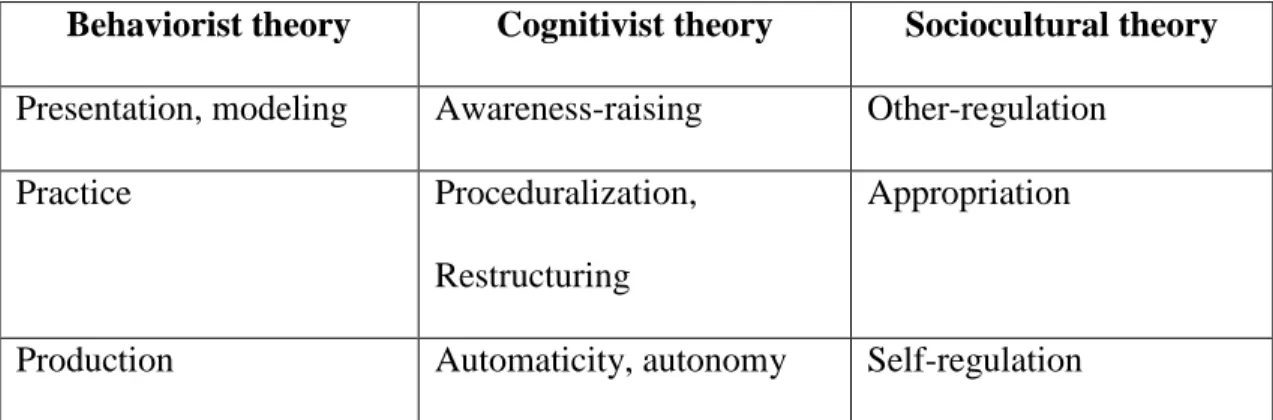
2.3 The Differences between Behaviorist Theory, Cognitivist Theory
and Sociocultural Theory 39
3.1 The Score Criteria of Speaking Accuracy 67
3.2 The Score Criteria of Speaking Fluency 68
3.3 The Score Criteria of Speaking Comprehensibility 68
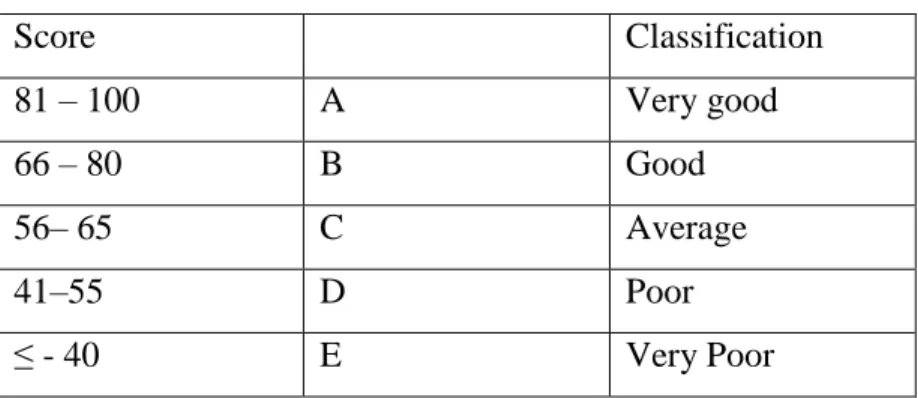
3.4 The Scoring Classification of the Students’ Speaking Performance 70
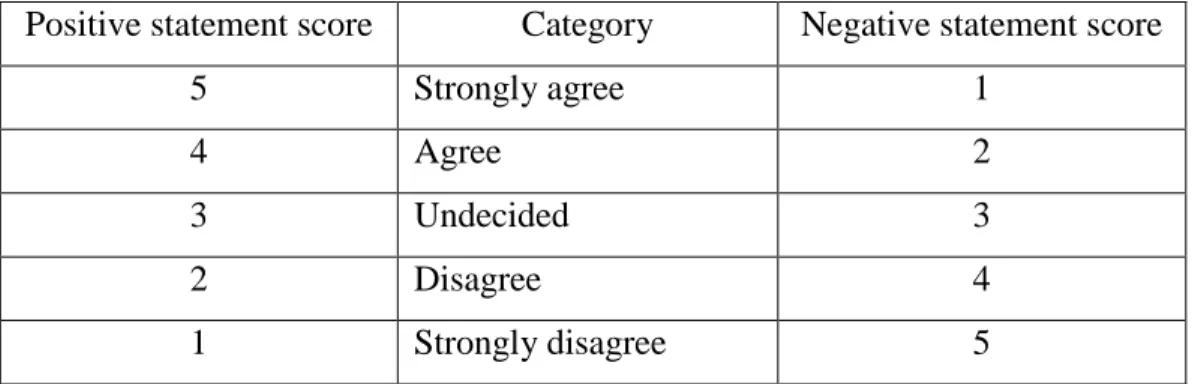
3.5 Likert Scale 71
3.6 The Rating Score of the Students’ Motivation 71
4.1 The Frequency and the Percentage of the Students’ Pre-test and Post-test
both Experimental Group and Control Group relating to Accuracy,
Fluency and Comprehensibility 74
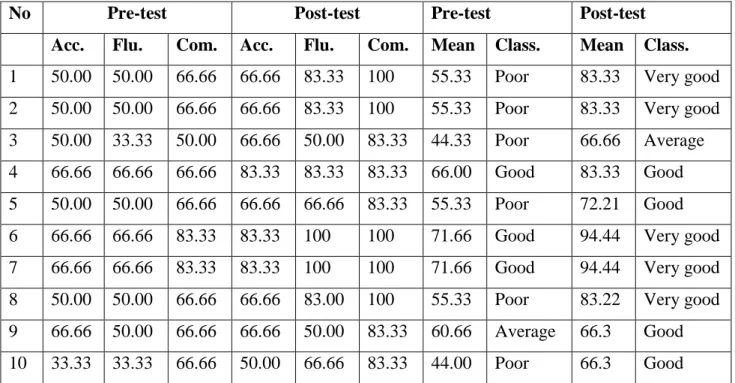
4.2 The Converting Scores and the Overall Score of the Students’ Speaking
Performance in the Experimental Group 77
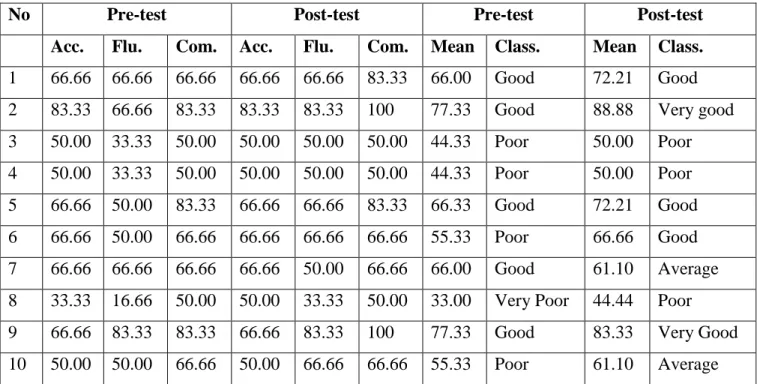
4.3 The Converting Scores and the Overall Score of the Students’ Speaking
Performance in the Control Group 78
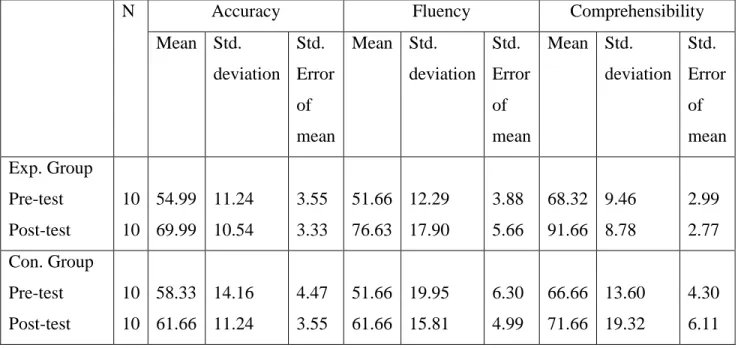
4.4 The Mean Score and the Standard Deviation of the Students’ Pre-test and Post-test both Experimental Group (Exp.Group) and Control Group
(Con.Group) in regard to Accuracy, Fluency and Comprehensibility 79
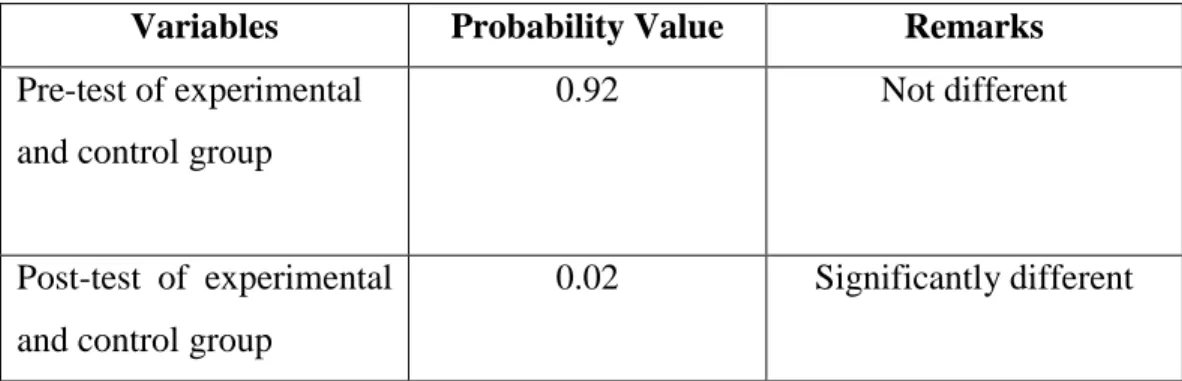
4.5 The Probability Value of T-test of the Students’ Speaking Performance
in Pre-test of Experimental Group and Pre-test of Control Group and
Post-test of Experimental Group and Post-test of Control Group 81
4.6 Mean Difference (the gain score) between Experimental and Control Group 82
4.7 The Percentage of the Students’ Motivation in Shadowing Technique
in Experimental Group 83
4.8 The Mean Score and the Standard Deviation of the Students’ Motivation
in Experimental Group 84
LIST OF FIGURES
Number Page 2.1Conceptual Framework 57
LIST OF APPENDIXES
Number Page
1. Speaking Test 114
2. Lesson Plans and Attached Materials 116
3. Motivation Scale 146
4. Sheet of Interview 151
5. The Students’ Pre-test in Experimental and Control Group 153
6. The Students’ Post-test in Experimental and Control Group 154
7. The Distribution Score on the Students’ Speaking Performance 155
8. The Data Analysis of Accuracy 157
9. The Data Analysis of Fluency 161
10.The Data Analysis of Comprehensibility 165
11.The Mean Score and the Standard Deviation of Pre-test and Post-test 169
12.T-test 172
13.The Score of the Students' Motivation 173
14.Speaking Text Script both Experimental Group and Control Group in Pre-test and Post-test 175
15.Teaching and Learning Process Pictures 182
16.Letters 190
CHAPTER I
INTRODUCTION
A. Background
English has four skills namely listening, speaking, reading and writing but speaking is the most important skill of other skills that the learners should emphasize to be learned. There are numerous reasons why speaking should be emphasized. Firstly, speaking is used for communication in social interaction. It can be seen when foreigners come to Indonesia. They always use English as a media to communicate with Indonesian people although their mother tongue is not English. Secondly, speaking becomes requirement and it is always tested for getting scholarship. When students take TOEFL IBT or IELTS, speaking test is included and when they face an interview, they are interviewed by speaking English. Thirdly, speaking is also required as a prerequisite and it is tested in interview session when the applicants apply for job in companies or institutions. Some companies or institutions require them to speak English actively.
In mastering speaking, some students learn speaking skill at schools and some of them decide to take additional lessons by taking an English course. The researcher observed that there are some reasons why the students want to join an English course. Firstly, the teachers at schools do not succeed to make them speak English fluently. The teachers are influenced by curriculum that requires them to teach based on it.
However, the curriculum does not focus on speaking and cannot assist the students to speak English after finishing their study at school. Secondly, English course guarantees them to speak English because the teachers and the curriculum focus on speaking. Those facilitate them to speak English all the time in the classroom. Thirdly, learning English at school takes long time but learning English at English course just needs short time. Learning English at school needs many years but learning English at English course just needs several months. Fourthly, some students are workers and it is impossible to study at school. As a result, they join an English course and they think that an English course can foster them to speak English for short time.
Teaching speaking at schools and teaching speaking at English courses are highly different. At schools reading, listening and grammar are emphasized but speaking is not really emphasized. It can be seen when the students encounter national examination, reading and listening are tested to them. However, at English courses listening and speaking are strongly emphasized. It can be proved when the teachers teach speaking in the classroom, they speak English all the time in order to stimulate the students to speak English and to train their listening comprehension.
Some students experience problems in learning speaking skill. They learn language for a long time but they cannot communicate with other people and they have low motivation to foster their language. It is due to the lack of ability of the teacher to teach speaking skill in the classroom. The success of students to speak English is influenced by the teachers. The teachers are the determiners who determine
the students to succeed to speak English. If the teachers do not have teaching skill, the students will be bored to join their class. In addition, the teachers are determiners of students’ learning motivation. The teachers should become motivators. The teachers should have teaching skill, they should master and apply an appropriate approach, method or technique, and they should provide some motivating activities and novelties that can encourage the students to speak English. Moreover, they should motivate the students by giving them advice to be diligent in studying English and to master speaking. Motivation is the main factor that can create the successful teaching and learning process. The students will obtain good speaking performance if they have high motivation to study.
Broadly speaking, motivation is needed in all aspects of human’s life. Motivation is very crucial because it affects people’s behavior to pursue and to attain their expectation and motivation functions to encourage someone in doing activity. People can do something what they wish for if they have motivation. However, people cannot do something what they want if they do not have motivation. In particular situation, motivation is needed in education field. It can decide whether education goal succeeds or not. Motivation is the most important that must be had both teachers and students in teaching and learning process.
The researcher had taught at PIA Bawakareang Makassar for three months starting from June 2012 until August 2012. He taught one class in Basic Communication One (PC 1), one class in Step Communication 3 (Step 3), one class in Step Communication 4 (Step 4), and one class in Inter English Conversation
(Level 2). The researcher observed during his teaching that the students’ speaking performance was very low. When he taught speaking in the classroom, he asked the students to speak English but most of them could not speak English fluently and they used code-switching and code-mixing when they spoke to the teachers and their friends. In addition, the researcher observed that the students lacked motivation because they used to get absent and they were lazy to come. It was caused by some teachers who could not provide a good teaching activity that can engage the students in developing their speaking performance immediately and can motivate the students to speak English. After doing observation, the researcher had tried to find technique that can foster the students’ speaking performance and their motivation, and he finally found thesis information on the internet from researchers who had conducted researches dealing with shadowing technique in the classroom interaction.
PIA is an English course in Makassar. Based on the information from its brochure, PIA stands for “Philippines-Indonesia-America”. It has four branches namely PIA Bawakaraeng, PIA Sungai Saddang, PIA Monginsidi and PIA Sungguminasa. There are three program levels at PIA namely English for children, English for teenagers and English for adults. English for children consists of 6 levels namely basic communication 1 until basic communication 6. English for teenagers consists of 6 levels namely step communication 1 until step communication 6. It is added two levels before entering English for adult in preparatory practical. They are communication 1 and communication 2. English for adult consists of 7 levels of class namely beginner class, basic English conversation, inter English conversation,
English conversation fluency, young-adult’s courses 1, young-adult’s courses 2 and young-adult’s courses 3. And then it is added three levels in power speaking namely power speaking 1, power speaking 2 and power speaking 3.
Based on problems dealing with low speaking performance and lack of motivation of the students of PIA Bawakaraeng Makassar, the researcher tried to carry out a research with the title” The Implementation of Shadowing Technique to Improve Students’ Speaking Performance”. However, the researcher tried to conduct his research at PIA Monginsidi Makassar because its students had the same problems as the students of PIA Bawakaraeng Makassar based on the interview result of the teachers of PIA Monginsidi Makassar. The researcher wanted to prove whether shadowing technique could improve the students’ speaking performance and whether shadowing technique motivated the students to speak English. He decided to conduct this research at PIA Monginsidi Makassar because the researcher thought that he should find technique to nurture the students’ speaking performance and their motivation. From the long contemplation, the researcher decided to provide shadowing technique to foster the student’s speaking performance and to motivate them.
Based on the result studies dealing with shadowing technique and some opinions from Ware and Doung on the discussion of steps of shadowing technique in chapter II supported by some videos, the researcher concluded that shadowing technique had some advantages based on its steps. Firstly, it improved the students’ listening comprehension in order to train their ears to listen to the native speakers
speak. Secondly, it trained the students’ mouth and tongue to shadow or to pronoun the words correctly on script of shadowing material like the native speaker on video, CD or MP3. Thirdly, it enriched the students’ vocabularies in order to expand their vocabularies when they express their ideas. Fourthly, it gave chance to the students’ to retell the content of shadowing material after doing shadowing technique. Fifthly, it gave more chance to the students to do discussion or debate after doing shadowing technique. Based on the advantages of shadowing technique in its steps, shadowing technique was assumed to improve the students’ speaking performance dealing with accuracy, fluency and comprehensibility. It also motivated the students to speak English nearly like the native speakers on video, CD or MP3. Moreover, it created language exposure. If the students could not create language exposure and they could not speak English with the native speakers to improve their speaking performance, they could improve their speaking performance by doing shadowing technique in the classroom or at home without spending much money to go outside.
B. Problem Statements of the Research
Based on the issues in the backgrounds, the main concerns of this research are the speaking performance of the students of PIA Monginsidi Makassar was low and they lacked motivation. Regarding these problems, the researcher tried to find whether shadowing technique could improve their speaking performance and motivated them to speak English or not.
This research had two research questions which are formulated as follows: (1). Does the implementation of shadowing technique improve the speaking
performance of the students of PIA Monginsidi Makassar?
(2). Does the implementation of shadowing technique motivate the students to speak English?
C. Objectives of the Research
Based on the problem statements above, this research had two main objectives. The objectives of this research are formulated as follows:
(1). to find out whether the implementation of shadowing technique improves the students’ speaking performance or not, and;
(2). to find out whether the implementation of shadowing technique motivates the students to speak English or not.
D. Significance of the Research
The result of this study was expected to have theoretical and practical contribution. The significance of the research was useful as below:
(1) to be useful and helpful information for the teachers of PIA to improve the speaking performance and to motivate the students of all branches of PIA to speak English by using shadowing technique.
(2) to be useful and helpful information for all teachers, lecturers and researchers in teaching speaking in order to improve the students’ speaking performance and to motivate them to speak English by using shadowing technique.
(3). to be useful and helpful information for the teachers of all branches of PIA for curriculum and syllabus development.
(4). to be useful and helpful information for the students of PIA and other students to improve their speaking performance at home without a teacher by using shadowing technique.
E. Scope of the Research
The scope of this research covered three aspects namely discipline, content, and activity. Based on discipline, this study was under the study of applied linguistics dealing with teaching speaking and psycholinguistics in terms of motivation. Based on content, this research emphasized on the implementation of shadowing technique in improving the students’ speaking performance and motivating them to speak English in terms of accuracy, fluency and comprehensibility covering report text, descriptive text or news item text with the topics “Mother’s day, Beer, April fools, Thanks giving, False advertising and The history of internet”. The topics were informative or debatable. Moreover, based on activity, the researcher implemented and investigated shadowing technique in teaching and learning process in the classroom to the students of PIA Monginsidi Makassar in 2013-2014 academic year.
CHAPTER II
REVIEW OF RELATED LITERATURE
This chapter presents the literature reviews which deal with previous related studies, some pertinent ideas, conceptual framework, and hypothesis.
A. Previous Related Studies
The researcher found some researchers who conducted researches in terms of shadowing technique, motivation and speaking performance after he had read some Asian EFL journals from the internet. The related studies to shadowing technique, motivation, and speaking performance are presented as follows:
1. Related studies to shadowing technique
a. Hamada (2012:8) who conducted a research with the title “An Effective Way to Improve Listening Skills through Shadowing” found in his study that learners’ listening comprehension skills improved more when combining different difficulties of learning materials alternately.
The research above used quantitative method that used one experimental group and one control group. Both experimental group and control group used shadowing technique to improve the listening comprehension. The control group used the same level of materials and the experimental group used a different level of difficulties alternately from TOEIC test new official book (2008) for pre-post test and TOEIC test new
official book (2009) for treatment. Both the research above and this research used quantitative method. The research above found that the learners’ listening comprehension skills improved more when combining different difficulties of learning materials alternately. However, the result of this research was expected to improved the students’ speaking performance. b. Tamai’s research in Yonezawa & Ware (2008: 1256) showed that shadowing
produced positive effects over a three-month period, especially for middle and lower-level students. Higher level students showed less improvement, probably because of their familiarity with the language (p. 44-45). His research showed that shadowing improved listening ability; however shadowing skills were not equal to listening abilities (p. 36).
Both the research above and this research used quantitative method. The research above focused on improving the students’ listening ability by implementing shadowing technique. However, this research focused on improving the students’ speaking performance and motivating them to speak English.
c. Ware at al. (2012:122-123) who conducted a research with the title “Investigating Extensive Listening Using Graded Reader CDs” found that from the students’ written comments and interviews, listening to GR-CDs and doing shadowing had the potential to improve the students’ English. These activities enabled the students to become more aware of different aspects of their English skills. The positive results from these activities can be achieved
by using them in class. (1) Some reading, listening, and shadowing should be done during class. (2) Beneficial reading and shadowing need the instructor’s guidance and care.
Ware’s study included qualitative research but this study emphasized quantitative research. The research above concerned about shadowing technique but its main focus was on extensive listening. However, this research implemented shadowing technique with the main focus on speaking performance and motivation. The data of research above were collected from listening test and interview but this research data were collected from speaking test, motivation scale and interview.
d. Nakanishi & Ueda (2011:12) conducted a research with the title “Extensive Reading and the Effect of Shadowing”. Their second research question asked whether or not shadowing could enhance the effects of extensive reading. When compared with the ER class, the ER-and-shadowing class showed more gains on post-test scores, indicating that shadowing seemed to enhance the effects of extensive reading.
Both the research above and this research only used quantitative method. The research above used two experimental groups and two control groups. Whereas, this research only used one experimental group and one control group. The research above focused on the implementation of shadowing technique on reading but this research focused on the implementation of shadowing technique on speaking performance.
Based on the research findings, the researcher concluded that no one who conducted a research relating to shadowing technique in improving the students’ speaking performance and motivating them but all of the researchers only conducted researches in improving the listening comprehension skill and reading skill. In addition, shadowing technique can improve the students’ listening comprehension and their reading ability. The results of those studies give inspiration to the teachers to use shadowing technique in teaching listening and reading in order to enhance the students’ achievement. The researcher assumed that shadowing technique can be applied to teach speaking. Regarding that assumption, the researcher proved it by conducting this research dealing with the effectiveness of shadowing technique in teaching speaking.
2. Related studies to speaking performance
a. Bashir (2011:48) conducted a research at secondary level with the title “Factor Affecting Students’ English Speaking Skills”. The result of study was found that more than half of the teachers used English as a medium of instruction. Students also reported the same. Both teachers and students were using interactive technique for teaching-learning process. Teachers as well as students had the view that English was better medium of instruction than Urdu. Teachers were also using mother language during instruction. Teachers and students were promoting questioning and answering in English. Teachers were using helping material for their effective teaching.
The research above used qualitaitive method that implemented descriptive research collecting data from questionnaire. The reserach above only had one method dealing with descriptive research. Thus, this research had difference with the research above. That research did not use quantitative method but this research used quantitative method dealing with quasi-experimental design.
b. Gan (2012: 43) conducted a research with the title “ Understanding L2 Speaking Problems: Implications for ESL Curriculum Development in a Teacher Training Institution in Hong Kong”. The result of study above found that insufficient opportunities to speak English in lectures and tutorials, lack of a focus on language improvement in the curriculum, and the input-poor environment for spoken communication in English outside class apparently contributed to a range of problems that closely related to the sociocultural, institutional and interpersonal contexts in which individual ESL students found themselves.
The research above used qualitative research that applied semi-structured interview. However, this research used quantitative research dealing quasi-experimental design that applied opened-ended interview. c. Sou (2005:49) conducted a research with the title “Improving Speaking Skills
through Instruction in Oral Classroom Participation”. The result of the study based on the differences (post-test-pre-test) for each variable between group indicated that the students in the experimental group on average significantly
increased scores in motivation (t (61)= 2.62, p=.01) and SPEAK (t (61)= -6.11, p.=00 than students in the control group. However, the increase in difference among groups in oral classroom participation was not significant (t (61) = -1.72, p=.09). These result suggested that PI helped to raise students’ learning motivation and SPEAK scores.
The research above and this research used quantitative research both of them had experimental group and control group. Both the research above and this research had the difference in terms of data collecting. The research above used quantitative data that were collected through questionnaires, tests, and observation, and the quantitative data that were gathered through passive participant observation, survey responses, and an interview with the EFL teacher. Whereas, in this research the quantitative data were collected from pre-test, post-test, motivation scale and interview.
d. Noom-ura (2010:173) conducted a research with the title “Teaching Listening-Speaking Skills to Thai Students with Low English Proficiency”. The findings showed that: (1) the students’ scores, readiness, interests and confidence in learning and using English were significantly increased; (2) some students rated as 0 or 0+ speakers became Level 1+ and Level 2 performers; (3) from classroom observation, the students showed good rapport among themselves and with the teachers; (4) the students reflected on their changes cognitively, affectively and behaviorally, and; (5) the students were
satisfied with the course as a whole. The research also analyzed the factors for success and it gave some recommendations for an EFL situation.
The data of the research above was collected from the pre-post test, pre-post questionnaires, classroom observation, students’ self reflection, and course evaluation. However, in this research the researcher collected the data from pre-post test, motivation scale and interview.
3. Related studies to motivation
a. Hsu (2006: 188) conducted a research with the title “The Impact of Perceived Teachers’ Nonverbal Immediacy on Students’ Motivation for Learning English”. The results of the Pearson correlation indicated that teachers’ nonverbal immediacy behaviors were correlated positively and significantly with students’ motivation for learning English. In addition, multiple regression analyses revealed that five nonverbal behaviors were significant predictors to students’ motivation for learning English. Findings of this study suggested that students’ motivation for learning English was likely enhanced when the teacher utilized the following behaviors: smile, gesture, a relaxed body position, a variety of vocal expression, and a monotone voice while teaching.
Hsu’s research used qualitative method that was distributed questionnaires to the participants. However, this research focused on quantitative method. This research used quantitative method to improve
students’ speaking performance and to motivate them to speak English by using shadowing technique.
b. Gupta & Woldemariam (2011: 34) conducted a research with the title “The Influence of Motivation and Attitude on Writing Strategy Use of Undergraduate EFL Students: Quantitative and Qualitative Perspectives”. The obtained results indicated that undergraduate students with strong motivation demonstrated high level of enjoyment, confidence, perceived ability, and positive attitude towards effective teaching methods of writing, and they were found to have employed writing strategies most frequently. That is, highly motivated students that were found to use more writing strategies than less motivated ones. Moreover, the students who frequently practiced writing, exerted adequate effort, scored expected grades, and obtained early support and encouragement from significant others were also found to be high writing strategy users. The study also revealed that the majority of the undergraduate students were instrumentally motivated when learning writing. This motive had been found to be one of the main driving forces in developing writing skills of learners in the EFL context.
The research above used quantitative method in terms of proficiency test to asses the students’ writing skills and to measure the students’ motivation by giving them questionnaire. In addition, the research above used interviews as supporting data. However, this research used quantitative
research by giving the students pre-test, treatment, post-test, motivation scale and interview.
c. Vivian Wu & Natalie Wu (2010: 211) conducted a research with the title “Creating an Authentic EFL Learning Environment to Enhance Students’ Motivation to Study English”. This empirical study, using quantitative methodology, explored the perceptions of students at a Taiwanese technical university concerning its EFL learning environment in three aspects: the physical environment, instructional arrangements, and social interaction. The study also examined the relationship between the learning context and students’ motivation. Quantitative data revealed that the EFL environment in the three aspects was considered by students to be an obstacle to their learning, and that students’ motivation positively correlated with the learning environment. The research concluded with recommendations by the researchers for improving practice.
Both the research above and this research used quantitative research. The research above used quantitative method to measure students’ motivation. Pre-experimental research design was utilized and only one intact group participated in the study. In addition, group was administered a pre-test prior to the treatment (learner training program). Following the treatment, a post-test was conducted again to find out whether the treatment caused any significant differences in participants’ motivational level in learning English.
In addition, interviews were conducted with a group of participants in order to collect qualitative data.
d. Balkir and Topkaya (2009: 1) conducted a research with the title “Exploring the Effects of Learner Training on Motivation”. The results of quantitative findings revealed that there was not a significant difference in learners’ overall motivation after the treatment. However, the analysis of qualitative findings from the interview indicated that a reasonable level of increase in learners’ motivation occurred. Furthermore, learners’ metacognition turned out to be developed. Finally, no notable differences between intrinsic and extrinsic motivation, and between female and male students’ motivation were detected. This study concluded that learner training activities had resulted in a moderate increase in learners’ motivational level and had enhanced metacognition. In the light of these findings, this study drew attention to the importance of learner training in foreign language learning and pointed to some methodological and pedagogical implications. Finally, it offered some suggestions for further research.
The study above used quantitative method dealing the effect of learner training on motivation. The research above was pre-experimental study design. Whereas, this research used quantitative method in terms of quasi-experimental design to improve speaking performance of the students and to motivate them to speak English.
B. Some Pertinent Ideas
In this part, the researcher provided some pertinent ideas dealing with shadowing, speaking, and motivation. These pertinent ideas are explained one by one as follows:
1. Shadowing
a. Definition of shadowing
The teachers should find some resources on the internet dealing with shadowing technique because it is still a very new term in teaching English as foreign language. The researcher has not found the writer who writes a book that discusses shadowing technique specifically. He has just found articles, journals and videos on the internet relating to shadowing tehnique. Shadowing has been defined by some people and every person has a different definition. Yonezawa & Ware (2008: 1256) state that shadowing is reproducing phrases right after listening to a chunk of meaningful English without looking at the text. Thus, the listener follows the speaker on the CD like a shadow or an echo. Kadota & Tamai (2004) in Nakanishi & Ueda (2011:4) state that shadowing is defined as an act or task of listening in which the learner tracks the target speech and repeats it immediately as exactly as possible without looking at a text. Lambert (1992) in Hamada (2012:4) defines shadowing as a paced, parrot-style auditory tracking task, conducted with headphones. Rather than a passive activity, however, shadowing is an active and highly cognitive activity in which learners track the heard speech and vocalize it as clearly as possible while
simultaneously listening (Tamai, 1997). This process of repeating incoming speech and monitoring the shadowed material engages many areas of the learners’ brains, especially the language centers (Kadota, 2007). According to Shiki et al., (2010), shadowing is the on-line immediate process of repeating speech while repeating is an off-line task because it provides learners with silent pauses to reproduce the sounds. Luster (2005) states that “shadowing”, which means repeating what a speaker says, may be well known as an exercise for simultaneous interpreting, but this technique is also an excellent way of teaching English. The term comes from “shadow” which means shade. We call it shadowing because, just as your shadow does everything that you do when you move, the shadowing voice says everything that the original voice says. Shadowing sometimes goes by other names, such as shadow talking, shadow speaking, mimicking, tracking echoing. He also states that there are several meanings about shadowing as follows:
1) Shadowing is not listening and repeating.
2) Shadowing is not listening while you are reading. 3) Shadowing is not memorizing and then shadowing. 4) Shadowing is not mumbling sounds.
5) Shadowing is saying what you hear as soon as you hear it.
6) Shadowing is listening without reading and repeating it immediately. 7) Shadowing is saying what you hear without knowing it before. 8) Shadowing is trying to make clear speaking sounds.
From some definitions given by some experts except luster, the researcher concluded that shadowing is listening and repeating directly what the speaker is saying on video, CD or MP3 by looking at or without looking at the material script. The learners can simply listen and repeat directly what the native speaker is saying on video, CD or MP3 without looking the script if they can follow the native speaker easily. However, if they feel difficult and they want to know the writing of words, phrases or sentences, they may look at the script. Shadowing can be done by turning on the video, CD or MP3 and the listeners try to do shadowing by looking the script or without looking script. It can be repeated there times or more than it if the learners are not fluent on it. The learners can also pause the video, CD or MP3 in every word, phrase and sentence if it is too fast. The learners should find English books or English articles that have video, CD or MP3 from English native speakers. Shadowing the native speaker is strongly recommended by the researcher. The learners can do shadowing technique by themselves at home or the teachers can implement shadowing technique in the classroom in teaching speaking.
b. Types of shadowing
Shadowing has been categorized into some types. According to Murphey in Adachi (1997) there are varieties of shadowing. For example “lecture shadowing” is when listeners shadow a speaker silently in their mind when hearing a lecture. In “reading shadowing”, one person reads a passage when his/her partner shadows. “conversational shadowing” is conversation where listeners shadow each other out
loud. “complete/listening shadowing” indicates shadowing every word a speaker utters. Finally, “interactive shadowing” includes selected information and adds questions or comments, like a natural conversation. Except for lecture shadowing, shadowing can be either silent or aloud. The biggest advantage in shadowing is students’ involvement in the activity.
According to the unknown writer (2010), there are many ways to shadow. They are:
1) Full shadowing.
Say everything listeners hear. Use this in English class, not in “the real world. 2) Slash shadowing.
This is like full shadow but with pauses. This gives listeners more time to shadow. Use this in class. It is easier than full shadowing.
3) “Key word/last word” shadowing
Say the most important words. Say the last words. Use this often! It shows the listeners are listening.
4) “About you” shadowing.
Say what listeners hear. Change “I” to “you.” This is usually for English class.
The listeners have to think about the sentence to do this.
In terms of the classification of shadowing above given by unknown writer, the researcher took a conclusion that the types of shadowing dealing with the speed are full shadowing and slash shadowing. Full shadowing is the listener listens and
repeats directly what the speaker says without pause but slash shadowing is the listener listens and repeats directly what the speaker says with pause. However, based on using script, shadowing can be classified as direct shadowing and indirect shadowing. Direct shadowing is the listener listens and repeats directly what the speaker says without looking at the script and indirect shadowing is the listener listens and repeats what the speaker says by looking at the script.
c. Effectiveness of shadowing
There are some opinions about the effectiveness of shadowing technique. Hamada (2012:4) states that the effectiveness of shadowing on improving listening comprehension skills has been examined in classroom research. Furthermore, learners appear to improve prosody, gain more concentration, and become used to natural speed as well (Takizawa, 2002). Thus, learners are able to receive a variety of benefits and listening improvements from shadowing.
Luster (2005) states that there are several ways of shadowing that help our English. First, shadowing gives you lots of speaking practice. Second, shadowing gives you lots of excellent listening practice. Third, shadowing gives you lots of practice with the sounds, melody, stress patterns and overall rhythm of English. Fourth, shadowing improves your speaking speed. Fifth, shadowing helps to improve your vocabulary. Sixth, shadowing helps to improve your grammar. Seventh, and finally, shadowing helps you improve your usage of discourse and pragmatics.
Regarding the explanations above, the researcher concluded that shadowing is very effective to build up linguistic competence in terms of grammar, vocabulary and
pronunciation. In addition, shadowing can foster language performance dealing with listening, speaking and reading.
d. Steps to build shadowing skills
To build shadowing skills, it has some steps that should be applied. Ware (2012) states that there are some steps to building shadowing skill. During the first class using the graded readers, students should read their selected book for a few minutes in class to verify that it is both interesting and a good level. They should then finish reading the book without using a dictionary as homework. Teachers should stress that students should understand 95% of the words, otherwise they should choose a lower level book. During class the next day, and every day thereafter, the following steps should be used.
Step 1. Students should read and listen to what they had previously read for about 7 minutes.
Step 2. Ideally, students should listen to the book a second time without reading. However, because of time constraints, we skipped this step during class. Step 3. Students should listen again (while their books are closed) and shadow (say)
what they hear for about 6 minutes.
Step 4. Students should then engage in interactive activities related to their graded readers.
Alternately, the teacher could divide step 3 above into two parts. The first, the teacher has students shadow while reading (books open). The second, the students shadow without reading (books closed). This could help weaker students become
more comfortable with shadowing and give more time for students to connect what they see with what they are hearing. However, shadowing without reading requires more intense listening and should not be omitted.
Doung (2010:716) states that in shadowing exercise, learners repeat what they have heard such as speech and news at the same pace. The purpose of the training is to cultivate learners’ split of attention and the skill of speaking while listening. It is better to do this training in mother tongue at first, and then other languages. At the beginning stage, learners can repeat immediately after they hear something; little by little, they should delay and then repeat. When training, they should listen, speak and think at the same time. Even after repeating for 10 minutes, they can still retell the main idea. Thus, after 2 or 3 months, they can step into next stage.
The researcher concluded that steps to build shadowing skills are categorized into three steps. Firstly, the learners do shadowing technique by looking at the script. Secondly, the learners do shadowing technique without looking at the script. Thirdly, the learners can find some new vocabularies from the script and they can retell the main idea.
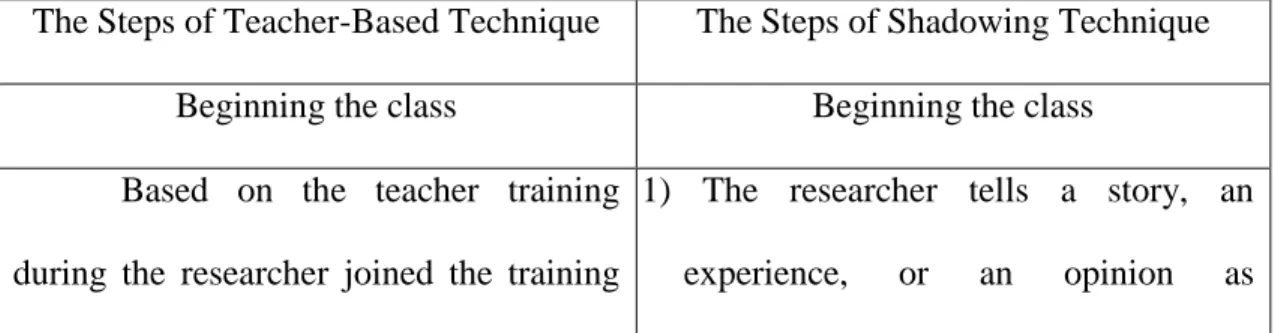
In addition, based on the steps of shadowing technique proposed by Ware and Doung above, the researcher constructed his own steps of shadowing technique that almost closely related to above steps. He also provided the steps of teacher-based technique currently used at PIA. But, the steps of teacher-based technique that the researcher provided here are not permanent to be used in every meeting. The teachers can create different technique every meeting during teaching speaking at PIA. The
main ways to teach speaking in PIA are by telling the students story or giving them leading questions in the beginning of class. Moreover, in running the class, the teachers explain the material in the text book or they give another activity based on their own creativity. In the end of class, the teachers sometimes give the students a game. Teacher-based technique is a technique which is designed by the teachers to explain material in the textbook or a tehnique that is used by the teachers based on his creativity to teach the students without using the students’ course book. The teachers are free to create their own creativity to give interesting activity in the classroom in every course as long as their technique follows or closely relates the guide line of the steps of teacher-based technique that was given in teaching training in the following table but the teachers may not follow it as long as their own technique can encourage the students to speak English. However, shadowing technique is listening and repeating immediately what the speaker is saying on video, CD or MP3 by looking at or without looking at the material script. The differences of both techniques can be seen in the following table:
Table 2.1 The Differences between Steps of Teacher-based Technique and Shadowing Technique
The Steps of Teacher-Based Technique The Steps of Shadowing Technique
Beginning the class Beginning the class
Based on the teacher training during the researcher joined the training
1) The researcher tells a story, an experience, or an opinion as
as a new teacher at PIA. The trainer, the director trained him the way to teach at PIA. The keys of teaching at PIA were presented as follows:
1. Cues
Before the teacher and the students come to material, the teacher gives the students some questions relating to the material that the students will learn or the teacher tells a story.
introductory teaching or the researcher gives the students some questions relating to the script of shadowing material that will be learned by the students. In addition, the researcher may provide leading questions to the students and then he asks the students to stand up and to speak to their partner if there is remain time left;
Running the class Running the class
2) Reinforcement
The teacher teaches the students about the material in the textbook. The teacher can use the students’ textbook to whole levels but especially for power speaking class, the teacher may not use the textbook. In power speaking class, most of the teachers do not use the students’ textbook. They just teach the students based on their
2) The researcher gives the students the copy of material script. The students will be given one or two different topics in every meeting;
3) The students are given instructions and motivation regarding shadowing technique. The researcher motivates the students to speak English fluently nearly like native speakers on the video, CD or MP3 after doing
own technique. The teachers are free to choose the materials or the techniques as long as those can encourage and involve all students to speak English actively.
3) Feed Back or Correctives
The teacher gives feed back to the students’ exercise but the teacher is not allowed to correct the students’ speaking by saying “You are wrong”. 4) Participation of the students
The teacher ensures all the students to be more active to speak. The teacher should give chance to all students to speak. In addition, the teacher should create enjoyable and motivating activity that can involve all the students to speak. The teacher may group the students or he can instruct the students to speak to their partner.
shadowing technique;
4) The researcher turns on the laptop and the speaker. After that he turns on the video, CD or MP3 of the script of shadowing material;
5) The students are instructed to listen and repeat directly what the speaker is saying. It will be repeated in three times. The first turn, the whole students listen and repeat directly what speaker is saying by looking the script. The second turn, the whole students listen and repeat directly again what the speaker is saying by looking at the script. If the researcher thinks that the remain time is limited he can omit the second turn of shadowing technique. After that, the researcher asks the students to read, understand and find 5-10 new words whole passages in every meeting. The third turn, the students
are asked to shadow one by one by looking at or without looking at the script. Each student is instructed to shadow one paragraph for one student. In every turn, the students can pause in every phrase or sentence if the speaker speaks too fast;
6) Every student is asked to speak in 2-3 minutes about the content of the given material and their opinion on it. The researcher can give additional questions to the students or the researcher can give discussion or debate related to the shadowing material if there is remain time left, and;
Closing the class Closing the class
In the last section of teaching process, most of the teachers give the students a game relating to the material given to the students before.
7) At the end of class, the researcher motivates the students to do shadowing technique at home without a teacher. The researcher motivates the students to speak English fluently nearly like
native speakers on video, CD or MP3 after doing shadowing technique. Moreover, the researcher can give the students data regarding material script of shadowing technique with video, CD or MP3 or web site dealing with shadowing material so that they can practice shadowing technique at home.
2. Speaking
a . Definition of speaking
Before the researcher discusses more about speaking, it is better to see some definitions of speaking from some experts and every expert has different definition given. Thornbury (2006) states that speaking is a skill, and as such needs to be developed and practiced independently of the grammar curriculum. Speaking is not only about producing words and sentences; it is a process that involves receiving messages, processing them, and producing appropriate responses, -Facilitator guide. Cole at al. (2007: 12) state that speaking is essentially a collaborative and interactive process. It is an exchange. We may finish each other’s comments, interrupt, disagree with or extend what is said. Speaking is an interactive process of constructing meaning that involves producing and receiving and processing information (Brown, 1994; Burns & Joyce, 1997) in Florez (1999:1). Whitaker (1998: 48) states that
speaking is explained as follows: (1) excitation in the visual word center; (2) arouses, through the visual auditory commissure; (3) the auditory word center, which in turn incites, and; (4) the glossokinesthetic center via a pathway (later, this path was to be called the arcuate fasciculus)”. Marson in Brown (2006:92) states that speaking is encoding, and listening is subsequent decoding”. Kuiper in Brown (2006: 3414) states that as for speech, it is to be distinguished from language in the sense that speaking is a variety of linguistic performance, what humans do with language, not language itself, which is a knowledge system”. Seuren in Brown (2006:1604) states that speaking is an expression of thought”. Nemo in Fischer (2006: 376) states that surprisingly, quite a lot, if we assume with both Argumentation in Language Theory (ALT) and Relevance Theory (RT) that speaking is basically a matter of attracting the hearer’s attention to something and asking him or her to take it into account, which is what ALT calls argumentative orientation and what RT calls ostensive-inferential communication”. Krashen’s view in Gass & Selinker (2008:309), speaking is a result of acquisition and not its cause. Speech cannot be taught directly but “emerges” on its own as a result of building competence via comprehensible input”. Fetzer, at al. (2007: 11) argue that speaking is a matter of attracting somebody’s attention to something and asking her/him to take it into account in a particular way”. Coupland (2007: 9-10) states that speaking is the basic modality of language, where linguistic meaning potential is realized and where social meanings of different sorts are creatively implemented”. Cornbleet & Carter (2001:18) state that we can attempt a closer definition by saying that speaking is combining sounds in a recognized and
systematic way, according to language-specific principles, to form meaningful utterances”. Canfield (2005: 9) states that the major idea that guides research in this area is that speaking is intentional behavior and governed by rules”.
From some definitions, the researcher concluded that speaking is a process of producing sounds dealing with words, phrases and sentences by the speaker to the hearer.
b. Components of speaking
Speaking skill has some components that must be known by the teachers to assess the speaking skill. Heaton (1988: 100) classifies components of speaking into three parts. They are accuracy, fluency, and comprehensibility. The highest rating scale of accuracy is pronunciation and it is only very slightly influenced by the mother-tongue. Two or three minor grammatical and lexical errors. The highest rating scale of fluency is speaking without too great an effort with fairly wide range of expression. Searches for words occasionally but one or two unnatural pauses. Moreover, the highest rating scale of comprehensibility is easy for the listener to understand the speaker’s intention and general meaning. Very few interruptions or clarifications required.
Thornbury (2006:7-8) states that in order to give at least the illusion of fluency and to compensate for the intentional demands involved in speech production, speakers use a number of ‘tricks’-or production strategies. One of them is the ability to disguise pauses by filling them. The most common pause fillers are uh and um (also spelt er and erm, respectively). Some vagueness expressions like
sort of and I mean are also used to fill pauses. Another common device for gaining formulation time is the use of repeats-that is the repetition of a single word at the point where formulation has been temporarily paused. In this short extract, the speaker uses both fillers and repeats (the dot indicates a short pause): well what’s the. what’s the failure with the football I mean this. this I don’t really see I mean it. cos the money. How much does it cost to get in down the road now?
The features of fluency can now be summarized: 1) Pauses may be long but not frequent. 2) Pauses are usually filled.
3) Pauses occur at meaningful transition points.
4) There are long runs of syllables and words between pauses.
Brown (2007:323-324) states that how we prioritize the two clearly important speaker goals of accurate (clear, articulate, grammatically and phonologically correct) language and fluent (flowing, natural) language? Accuracy is achieved to some extent by allowing students to focus on the elements of phonology, grammar, and discourse in their spoken output. Fluency is probably best achieved by allowing the “stream’ of speech to “flow”; then, as some of this speech spills over beyond comprehensibility, the “ riverbanks” of instruction on some details of phonology, grammar, or discourse can channel the speech on a more purposeful course.
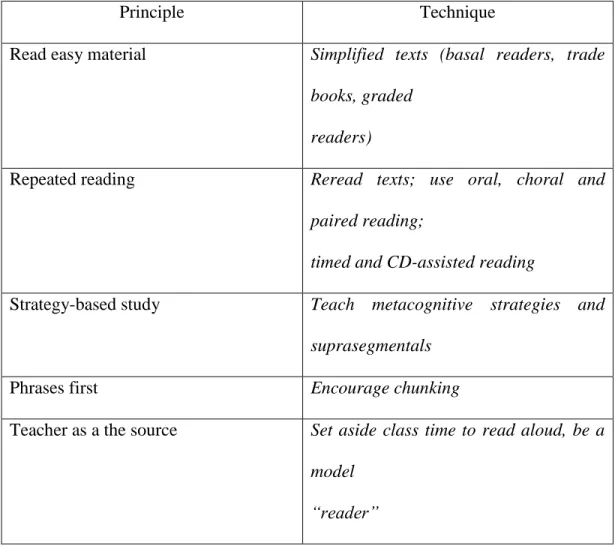
Cohen (2011: 63) gives five principles for building fluency which can be seen in the following table:
Table 2.2. Five Principles for Building Fluency
Principle Technique
Read easy material Simplified texts (basal readers, trade books, graded
readers)
Repeated reading Reread texts; use oral, choral and paired reading;
timed and CD-assisted reading
Strategy-based study Teach metacognitive strategies and suprasegmentals
Phrases first Encourage chunking
Teacher as a the source Set aside class time to read aloud, be a model
“reader”
Regarding the explanations, the researcher concluded that the components of speaking are accuracy, fluency and comprehensibility. Accuracy is the correct of elements of phonology, grammar, pronunciation and vocabulary. Fluency is speaking without hesitation and pause. Comprehensibility is a process where the speaking of the speaker can be understood by the hearer.
c. Types of speaking
The hearer should understand about the types of speaking used by the speaker. Speaking is classified into some types based on the setting and situation. According to Tillit and Bruder (1993: 7), all language people use when speaking formally are different from those used informal. In English someone attends to use formal speech with stranger and people of higher status, and informal speech with family, friends and colleagues. And they add that formal and informal speeches are differentiated in two basic ways: style and content, formal speech is characterized by embedding and a tendency toward more complete sentences as opposed to fragment. Informal speech is characterized stylistically by omission, elisions, reductions and sometime, a faster speaking rate.
Brown (2007:329-330) states that there are two types of oral language that should be explained. The two types of spoken are described as follows:
1) Monologue
In monologue, when one speaker uses spoken language for any length of time, as in speeches, lectures, reading, and hearers must process long stretches of speech without interruption.
2) Dialogue
Dialogue involves two or more speakers can be subdivided into those exchanges that promote social relationship (interpersonal) and those for which the purpose is to convey proportion of factual information.