Daniel B. Singley, Ph.D. Vice President of Curriculum Development and Research Essential Learning, LLC
Carol Hurst, Ph.D., LCSW Director of Continuing Education & Evaluation
Comparing E-Learning, Tele-Classes, and Live Trainings:
An Analysis of Cost and Training Effectiveness
Abstract
This quasi-experimental study assessed student learning outcomes and costs associated with the provision of an in-service training course for mental health professionals counseling parents regard-ing parentregard-ing. The course, Makregard-ing Parentregard-ing Matter: Coachregard-ing Parents on Positive Parentregard-ing, was taught using the same content in three different intervention conditions — e-learning, tele-class, and live workshop. A wait-list control condition was included as a comparison for the three intervention groups. Participants included 159 clinicians employed at a large behavioral health organization who completed pre-test, post-test, and one month follow-up assessments of their learning outcomes. Results showed the three intervention groups’ learning outcome scores were comparable at all three assessments, while the wait list participants showed significantly lower scores (p<.05) than any of the intervention groups at post-test as well as at one month follow-up assessment. E-learning was shown to be the most cost-effective of the three intervention conditions. Implications for training and future training effectiveness research will be discussed.
Introduction
Health and human services organizations are facing unprecedented pressure to meet ever-increasing standards of service delivery due to multiple levels of compliance oversight. In order to stretch shrink-ing budgets as efficiently as possible, these organizations must continuously engage in cost reduc-tion measures (O’Leonard, 2009). Caught between the need to improve service quality and stretch diminishing resources, leadership often has to make tough decisions in order to remain competitive. Cutting the training budget is a common first austerity step an agency makes in lean financial times. However, doing so endangers the organization’s ability to adequately train staff to meet increasing service quality demands. Finding the most efficient and cost effective methods of educating staff has become imperative. This paper provides a brief overview of the historical and current scholarly literature related to distance training and blended learning along with results from a recent research project addressing the effectiveness of several training modalities. The purpose of this paper is to give clear information about the efficiency and cost-effectiveness of online training by quantifying learn-ing outcomes and costs associated with the provision of one course in multiple formats.
Staff and Training Resources
The 2009 Corporate Learning Healthcare Edition published by Bersin and Associates found the following trends in an analysis of the healthcare industry:
• Per-learner spending has declined by 41% over the last three years, dropping from $923 in 2006, to $707 in 2007, and to $549 in 2008 (Average per-learner spending across all
indus-tries was $1,275 in 2006, $1,202 in 2007, and $1,075 in 2008).
• Staffing to support healthcare development also declined, especially over the last two years. In 2006, the average staff per 1,000 learners ratio was 7.9; this dropped to 7.3 in 2007 and to 4.7 in 2008 (Average staffing across all industries per 1,000 learners was 7.0 in 2006, 6.7 in 2007, and 6.7 in 2008).
These figures are a sharp reminder of the need for healthcare trainers, clinicians, and staff at all levels to “do more with less” as the pressure from cost reduction measures mounts.
Online Training
In response to having fewer staff and dwindling training budgets, many organizations are turning to distance learning in order to save money while keeping their staff up to speed on their core com-petencies. There are a variety of alternatives to traditional face-to-face live trainings including online e-learning courses, tele-classes conducted via phone, virtual simulations in multimedia environments such as Second Life, and blended trainings that combine asynchronous (i.e. not in immediate contact with another person in real time) online components with some type of real-time interaction such as live training, instant messenger, webinars, or phone calls. As these approaches have gained popular-ity, a wealth of information is now available to show strong support for the need to use web-based
training in health and human services training in order to optimize how trainees incorporate new techniques into clinical practice (Vozenilek at el, 2004).
Online training is rapidly becoming the industry standard for educational applications of technology (Department of Education, 2009), and is now commonplace in many work settings. As healthcare agencies incorporate learning management systems to automate the provision of training, data col-lection, and reporting – staff are becoming increasingly more comfortable with online education. Trainings available cut across virtually all topics ranging from advanced medical procedures to fire safety guidelines to corporate compliance, and are often available to staff at all levels of an organiza-tion.
Beyond just the virtual trainings they host, learning management systems (LMS’s) are also a key reason why many agencies are taking their live trainings online. A learning management system is a software application that aids in the administration, tracking, documentation, and reporting of a variety of training programs. A growing body of evidence suggests that an LMS enhances learning and is an ideal means to conduct training for large numbers of people in a regulatory environment (Pailing, 2002; Telford, 2003). By automating the assignment of courses, reporting, and serving as a means to collect non-training data including satisfaction surveys and needs assessments, an LMS is a natural extension of the organizational strategy that has resulted in a dramatic increase in the use of technology for record keeping and communication.
Online Training Effectiveness Research
Given that evidence-based practice is a standard for healthcare overall, evidence regarding the efficacy of on-line learning for staff in healthcare provider organizations should ideally guide the adoption of on-line learning options. Online training effectiveness research has developed alongside the continuously-evolving technologies available for learning in a virtual environment. Early studies of online learning concluded that it was not significantly different from regular classroom learning in terms of effectiveness (Bernard et al, 2004; Cavanaugh, 2001; Moore, 1994). Based on such findings, e-learning gained credibility as a viable alternative to face-to-face training in a variety of industries. In a meta-analysis comparing Internet-based and classroom-based trainings, Sitzmann and colleagues (2006) extended earlier findings by showing that online learning was superior to classroom-based instruction in terms of declarative knowledge (i.e. factual information) outcomes. Traditional and distance learning options were equal in terms of procedural learning (i.e. how to perform a task) outcomes.
Clearly, the fields of educational technology and the evaluation of that technology are both thriving areas of practice and research. In order to continue to develop a fine-grained understanding of how web-based instruction facilitates learning, the U.S. Department of Education conducted a sophisti-cated meta-analysis of 51 studies comparing the effectiveness of e-learning and live trainings (De-partment of Education, 2009). Results from this analysis showed that, on average, those participating in online learning performed better than those receiving live, face-to-face instruction. An important caveat is that learners who engaged in a “blended training” format (i.e. including both online and face-to-face elements) showed significantly better learning outcomes than did purely web-based
learners when compared with people taught entirely face-to-face. The difference between student outcomes for online and face-to-face classes was larger in those studies contrasting conditions that blended elements of online and face-to-face instruction with conditions taught entirely face-to-face. Another key finding from this meta-analysis (Department of Education, 2009) was that blended and purely online learning conditions implemented within a single study generally result in similar student learning outcomes. This finding suggests that online and blended trainings are comparable in terms of their effectiveness. Finally, this meta-analysis compared different online learning practices and concluded that online learning can be enhanced by giving learners control of their interactions with media, building in learner reflection prompts, and allowing learners to spend more time in training. The results from the 2009 Department of Education study are in line with Baldwin et al.’s (1988) seminal article emphasizing the key role that training design makes in courses taught through distance technologies. Factors such as training content, principles of learning, and sequencing of training activities play a determining role in takeaway learning for students. Overall, the foundational distance learning research suggests that e-learning and face-to-face training tend to yield similar learning outcomes – while the more recent meta-analysis results suggest the need to dismantle the integral components of effective e-learning. Continuing questions remain regarding which training designs, content formats, and technologies are most strongly related to specific positive learning outcomes. Given the fact that all of these trainings are taken by staff working in agencies that have operational and budgetary “bottom lines,” the comparable effectiveness of e-learning and face to face learn-ing outcomes may not be what is drivlearn-ing the shift to virtual trainlearn-ing. Rather, the last word on why distance learning is here to stay may simply be cost-effectiveness. Leaner and meaner budgets in healthcare organizations mean the attractive bottom line involved in distance learning options are often what drives decision makers to choose them. A recent study quantified the different costs as-sociated with live and face-to-face trainings in a large behavioral health organization by addressing expenditures in each type of training (Singley & Mueller, 2009). Results from that study suggested that due to loss of billable time, travel costs, and paying for presenters, each hour of face-to-face training costs approximately 88% more than an hour of e-learning. In the face of such huge savings without a loss of training quality, senior leadership in healthcare organizations are leading the charge toward online training by “voting with their budgets.”
A New Study Comparing E-learning Courses, Tele-Conferences, and Live Workshops
The present study was conducted in order to compare the learning outcomes and costs associated with three different means of teaching the same course content to clinicians in a large behavioral healthcare company. The course, titled Making Parenting Matter: Coaching Parents on Positive Par-enting, was developed to teach mental health clinicians theory and research-based principles for implementing helpful clinical interventions with parents. The curriculum was developed into a five module course addressing:
• Self-awareness of personal and professional parenting values
• A four-fold parenting typology as a means for assessing parenting style • Research evidence on child outcomes associated with each parenting style
• Typical patterns of parental response to aggressive misbehaviors, socially withdrawn behav-iors, and children with special needs
• Research evidence indicating the importance of parental monitoring and emotion coaching of their children
A quasi-experimental study was then designed to compare learning outcomes and costs associated with teaching this information in one of three conditions:
• A five week, one hour modular e-learning course
• A five week one hour session weekly tele-conference class • A single six hour live workshop
The study aimed to replicate and extend several findings from the Department of Education’s 2009 meta-analytic study by including class elements promoting student reflection and the ability for stu-dents to control media with their technology interfaces in both of the distance learning conditions. In the tele-class condition, a live instructor taught content using conference call technology. The confer-ence line allowed for the division of the large call into small groups for discussion elements, and stu-dents were able to “raise hands” or vote with their telephone keypad for more dynamic interaction with the instructor. The e-learning condition incorporated a variety of best practices in educational technology that capitalized on the benefits of a virtual medium including interactive exercises, breaks for reflection, video vignettes, and an avatar instructor who presented content in an engaging style that directly addressed learners similar to a live facilitator.
The e-learning course and the tele-class both employed similar blended training elements to build a learning community between students participating in each respective intervention condition. The e-learning course modules were hosted on the organization’s learning management system, and in-cluded instructional design principles including an avatar instructor, multimedia elements (video clips demonstrating the material), and “chunking” the information in the courses in order to optimize learner retention. Both the e-learning and tele-class conditions required participants to use an online social networking portal for participants. This system was intended to deepen participants’ learning of course concepts by posting comments/questions to the instructor, uploading weekly homework assignments, and viewing each others’ posted assignments applying course concepts to their ongo-ing clinical work. The organization’s learnongo-ing management system was used to automate the collec-tion of learning outcome data across all four condicollec-tions (e-learning, tele-class, live workshop, and waitlist).
The same instructor facilitated the live workshop, tele-class, and e-learning conditions in this study. The live workshop lasted six hours (not including two 15 minute breaks and a lunch period) and
included lecture with PowerPoint presentation, small group exercises, and discussion. The tele-class met via a conference call for five one-hour sessions over a five week period. The conference line used allowed the instructor to break the class into small groups that could then report back to the full class on group exercises in a manner similar to group work that can be done in a traditional face-to face
classroom. The tele-class students also uploaded integration assignments to an on-line “virtual class-room” where they were reviewed by the instructor and classmates between weekly sessions. This technology allowed class connections to deepen as students were free to respond to what they saw their classmates posting via email. PowerPoint presentations incorporated graphic elements similar to those in the e-learning conditions were used by the instructor in both the tele-class and the live workshop. Regardless of the training medium, participants were exposed to active learning opportu-nities requiring concentration, reflection, and group interaction.
Research Questions
This study was guided by two research questions:
1. How do online learning, telephone-based, and face-to-face instruction compare in terms of learning outcomes?
2. How do online learning, telephone-based, and face-to-face instruction compare in terms of cost effectiveness?
Method Participants
Participants included a sample of 159 clinicians employed by Providence Service Corporation, a large national behavioral health organization. Recruiting for participation in this study was conducted via the same channels generally used to advertise ongoing continuing education opportunities in the organization (emails and announcements in meetings). The representation in the four experimental conditions were live workshop (n=46), tele-class (n=46), e-learning course (n=46), and wait list (n=22) With respect to racial ethnic background, participants identified as White/Caucasian (69.2%), Black/ African American (9.4%), Latino/Hispanic (5.0%), biracial (2.5%), Asian-American (0.6%),“other” (0.6%), and 12.6% declined to state. 79.9% of participants indicated not having clinical licenses, and 20.1% reported having a current state license. Participants held a variety of degrees including B.A.’s and Masters’ degrees in such fields as counselor education, social work, counseling, and clini-cal psychology. Participants had been engaged in cliniclini-cal work with children and parents for an aver-age of 8.5 years (SD 7.76)
Measure
Participants completed a face-valid self-report survey developed for the study. The measure was designed to capture whether or not students endorsed learning mastery and use of course concepts in their clinical work. The Making Parenting Matter Survey (Appendix A) included four sub-scales addressing the following four domains:
1. Understanding of the training material
3. Self-Efficacy in applying the training material in their work with parents and children 4. Application of the training material in their actual clinical work with parents and children Together, the combined subscale scores reflected a full-scale score that served as an indicator of
their overall learning of the course material. Subscale score internal consistencies (Cronbach’s alpha) ranged from α = 0.80 to .93, with the full scale score alphas ranging from α = .94 to .97 across the three data collection points. The subscales evidenced medium-to-high correlations ranging from r = .63 to r = .95, and were highly correlated with the full-scale score. Test-rest reliability from pre-test to
post-test was r = .37 (p<.01), and from post-test to follow up was r=.76 (p<.01). Procedure
After self-selecting into one of the four experimental conditions, all participants completed informed consent forms. All participants received the same training material as described earlier.
Participants in the waitlist condition completed the pre-test immediately upon enrolling in the study. In order to mirror the assessment timeframe of the tele-class and e-learning conditions, the waitlist completed the post-test assessment five weeks later, and the follow-up assessment one month after completing the post-test. Wait-list participants then had the opportunity to take the course via a one day face to face workshop or the e-learning version of the course.
Participants in the live training condition completed a single day-long 6-hour facilitated workshop at which they completed a paper and pencil version of the MPM survey immediately prior to and after the workshop. These participants then completed a one-month follow-up assessment online using their agency’s learning management system.
Participants in the tele-class condition took part in a series of five weekly, hour-long conference calls in which the instructor presented the class material. They completed the pre-test immediately upon entering the study, and completed the post-test assessment five weeks later after finishing their final tele-class. The follow-up assessment was completed one month after completing the final tele-class. Participants completed weekly “homework” assignments between classes, and had to upload their homework on a private password-protected social networking website that allowed them to see each others’ work. The tele-class facilitator reviewed posts and responded to them as appropriate. Participants in the e-learning condition took part in a series of five weekly, hour-long online courses. They completed the pre-test immediately upon entering the study, and completed the post-test
as-sessment five weeks later after finishing their final e-learning course. The follow-up asas-sessment was completed one month after completing the final e-learning course. Participants in this condition did not have access to a live facilitator (although the classes included a facilitator avatar) during the e-learning course, but completed weekly “homework” assignments between classes. They then had to upload their homework on a private password-protected social networking website that allowed them to see each others’ work. The same instructor who facilitated the live workshop and tele-class conditions reviewed posts and responded to them as appropriate.
Analyses
Between-groups differences on full-scale MPMS scores to address differences among the four groups included in this study were analyzed via a repeated measures analysis of variance with group condi-tion as the between-subjects variable.
Results Training Effectiveness
All four groups showed no statistically significant differences (p > .05) on the MPMS full-scale or subscale scores at pre-test, indicating that they were all comparable in terms of their knowledge of the course material prior to participating. Results showed that all three intervention groups’ MPMS full-scale scores were significantly higher (p < .05) than the waitlist group’s at both post-test and one month follow-up (see Graph 1 below).
Graph 1 – Comparison of Learning Outcomes
These findings suggest that learners benefitted equally in terms of learning course material regardless of whether they took the live workshop, tele-class, or via online e-learning.
Making Parenting Matter Full Scale Score 5 4.8 4.6 4.4 4.2 4 3.8 3.6 3.4 3.2 3
Pretest Post-Test One Month Follow-Up
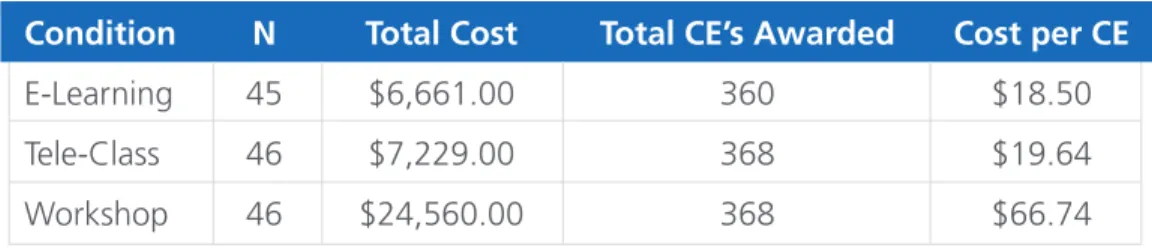
Condition N Total Cost Total CE’s Awarded Cost per CE
E-Learning 45 $6,661.00 360 $18.50
Tele-Class 46 $7,229.00 368 $19.64
Workshop 46 $24,560.00 368 $66.74
Return on Investment
This study also compared the cost involved in having participants complete trainings in each of the three intervention conditions. As shown in the chart below, e-learning proved to be the most cost-effective means to provide the training, followed by the tele-class condition. Because participants in the one hour e-learning and tele-classes were able to complete the trainings without cutting into billable hours (e-learning modules were completed during scheduled administrative time, and tele-classes were conducted in the evening), these clinicians were able to avoid the expense and loss of productivity involved in attending a day-long live workshop. Largely due to travel expenses and loss of billable hours - conducting live workshops was found to be over 70% more expensive than conduct-ing the same trainconduct-ing usconduct-ing an e-learnconduct-ing course. See Appendix B for a detailed breakdown of costs in each of the three intervention conditions.
discussion
Taken together, these findings are in keeping with previous research suggesting that online, blended, and live trainings often yield comparable results in terms of learning outcomes. The results presented here indicate that conducting the Making Parenting Matter course in an e-learning format was as effective as live workshops and tele-classes facilitated by a live instructor. However, the resources required to put the material into an interactive online course format made the e-learning condition considerably more cost-effective than either of the other intervention conditions included in this study. By developing the training content into a reusable e-learning format, the facilitator’s role is streamlined to administering the questions and homework assignments that learners post to the class’ online social networking. Furthermore, while conducting tele-classes and live workshops in-volves coordinating and funding a presenter each time they are conducted, the e-learning course af-fords an agency a highly-effective online training that is accessible to all of their employees any time they choose to access it.
Beyond leveraging the accessibility of the online courses themselves, employing the organization’s learning management system to automate the collection outcome data illustrates how an LMS is more than a way to put courses online – it’s literally a data-collecting machine.
The bottom line finding from this study is that both E-learning and tele-classes represent effective, affordable alternatives to live workshops because they keep training quality high while responding effectively to cost containment mandates.
Limitations
The principal limitation to the results presented here is that the Making Parenting Matter Scale (MPMS) was not validated prior to using it to gauge learning outcomes. Although a review of the items (Appendix A) suggests that it is face valid and very straightforward, there is no direct no evi-dence regarding its validity as an indicator of how well participants learned the course material. An-other limitation stems from a monomethod bias because the MPMS is completely self-report. For this reason, future research in this area should include alternate means of evaluating learning outcomes including behavioral reports, clinical outcomes, etc. Additionally, using a non-randomized sample lim-its generalizeability due to a self-selection bias on the part of participants and the likelihood that this group is a nonrepresentative sample. In terms of identifying the impact of the aspects of the training that varied in each intervention condition, there is no way to determine the extent to which specific learning elements (i.e. social networking website) contributed to learning outcomes. Finally, attrition was greater in tele-class and e-learning conditions than in the live workshop group.
Future Research
These results and limitation suggest a variety of useful next steps to extend the findings from this study including:
• Validation of the MPMS
• Replicating findings from this study with a randomized sample
• Conducting a dismantling study to address how different aspects of the various conditions contribute to different learning outcomes
Citation Information
The following is the suggested citation format for this paper:
Singley, D.B., and Hurst, C.H. (2011). Comparing E-Learning, Tele-Classes, and Live Trainings: An Analysis of Cost and Training Effectiveness [White paper]. Retrieved from http://essentiallearning. com/white_papers.htm.
Contact Information
About Essential Learning
Our mission is to provide customized e-learning services to a variety of organizations and practitio-ners through a variety of easy-to-use web-based products and a top-notch course library developed with subject matter experts who are thought leaders in their areas of expertise. We strive for our e-learning services to save our clients time and money, to keep them in compliance with training requirements, improve staff performance, and to help them maintain high quality services along with easy access to continuing education credits.
About Corporate University of Providence (CUP) of Providence Service Corporation
The Corporate University of Providence is the learning division of the Providence Service Corporation, a company providing a range of behavioral health, non-emergency medical transportation, and human services in 43 states and Canada. CUP values its ability to provide quality distance learning opportunities to Providence’s workforce of almost 9,000 people in diverse and non-centralized locations.
References
Baldwin, T., and Ford., K. (1988). Transfer of training: A review and directions for future research. Personnel Psychology, 41 ,63-105.
Hughes, R. C., and Rycus, S. (1989). Target: Competent Staff Competency Based In-service Training. Washington. D.C.: Child Welfare League of America.
Bernard, R. M., Abrami, P.C., Lou, Y., Borokhovski, E., Wade, A., Wozney, L., Wallet, P.A., Fiset, M., and Huang, B. (2004).
How does distance education compare with classroom instruction? A meta-analysis of the empirical literature. Review
of Educational Research, 74, 379–439.
Cavanaugh, C. 2001. The effectiveness of interactive distance education technologies in K–12 learning: A meta-analysis. International Journal of Educational Telecommunications, 7, 73–78.
Moore, M. 1994. Administrative barriers to adoption of distance education. The American Journal of Distance Education, 8, 1–4.
O’Leonard, K. (2009). Corporate Learning Factbook: Healthcare Edition – Benchmarks, Trends, and Analysis. Bersin and Associates Industry Study.
Pailing, M. (2002). E-learning: Is it really the best thing since sliced bread? Industrial and Commercial Training, 34, 151-155. Singley, D.B., and Mueller, S. (2009). Comparing costs of e-learning and live trainings. Essential Learning Research Report
# 2009-07.
Sitzmann, T., K. Kraiger, D. Stewart, and R. Wisher. 2006. The comparative effectiveness of Web-based and classroom
in-struction: A meta-analysis. Personnel Psychology, 59, 623–64.
Telford, J.M. (2003). Building a learning management system: Corporate environments and their effect on capability. Royal Australian Air Force Report.
U.S. Department of Education, Office of Planning, Evaluation, and Policy Development, (2009). Evaluation of
Evidence-Based Practices in Online Learning: A Meta-Analysis and Review of Online Learning Studies, Washington, D.C.
Vozenilek, J., Huff, J.S., and Gordon, J.A. (2004). See one, do one, teach one: Advanced technology in medical education. Academic Emergency Medicine, 11, 1149-1154.
Appendix A – MAking pARenting MAtteR suRvey Item
1. I have a clear understanding of how my own beliefs about “good parenting” may impact my work with parents 2. I have a clear understanding of how to apply psychoanalytic theory in my work with parents.
3. I have a clear understanding of how to apply attachment theory in my work with parents. 4. I have a clear understanding of how to apply social learning theory in my work with parents
5. I have a clear understanding of how to apply Baumrind’s parenting typology to my work with parents. 6. I have a clear understanding of how child outcomes relate to parenting type.
7. I have a clear understanding of typical patterns of parental response to aggressive children. 8. I have a clear understanding of typical patterns of parental response to withdrawn children. 9. I have a clear understanding of how to apply “monitoring” research in my work with parents. 10. I have a clear understanding of how to apply Gottman’s emotion coaching in my work with parents.
11. I believe that my self-awareness of my own “good parenting” biases can help me as I work with all types of par-ents.
12. I believe that psychoanalytic theory is applicable to my work with parents. 13. I believe that attachment theory is applicable to my work with parents. 14. I believe that social learning theory is applicable to my work with parents.
15. I believe that Baumrind’s parenting typology is applicable to my work with parents. 16. I believe that assessing parenting type is applicable to my work with parents.
17. I believe that understanding typical parental responses to aggressive children is applicable to my work with par-ents.
18. I believe that understanding typical parental responses to withdrawn children is applicable to my work with par-ents.
19. I believe that the “monitoring” research is applicable to my work with parents.
20. I believe that Gottman’s emotion coaching approach is applicable to my work with parents.
21. I am confident in my ability to use pertinent ideas from theory (such as Psychoanalytic , Attachment, & Social learn-ing) on how parenting matters when I work with parents.
22. I am confident in my ability to use Baumrind’s parenting typology as an assessment frame when I work with par-ents.
23. I am confident in my ability to explain Baumrind’s “authoritative” parenting type to parents I work with what parenting qualities have been associated with optimal child outcomes.
24. I am confident about my ability to observe and assess a particular parent’s pattern of responding to her/his child who has an aggressive pattern of problematic behavior.
25. I am confident in my ability to observe and assess a particular parent’s pattern of responding to her/his child who has a socially withdrawn pattern of problematic behavior.
26. I am confident in my ability to use my engagement with a parent to explore that parent’s “internal working model” of her/his particular child.
27. I am confident in my ability to explain the importance of monitoring when I work with parents. 28. I am confident in my ability to use Gottman’s concept of emotion coaching when I work with parents. 29. I use skills and techniques related to psychoanalytic theory when I work with parents.
30. I use skills and techniques related to attachment theory when I work with parents. 31. I use skills and techniques related to social learning theory when I work with parents.
32. I use skills and techniques related to Baumrind’s parenting typology when I work with parents.
33. I use skills and techniques related to my knowledge of typical parental responses to aggressive children when I work with parents.
34. I use skills and techniques related to my knowledge of typical parental responses to withdrawn children when I work with parents.
35. I use skills and techniques related to helping parents implement appropriate monitoring of their children. 36. I use skills and techniques related to Gottman’s emotion coaching approach when I work with parents. Additional demographic items included only at pre-test:
Item
37. For how many years have you been working in a professional capacity with children and parents?
38. For how many years have you been working for a Providence Service corporation region with children and their parents?
39. Please identify the program or population you work in (i.e. Outpatient, foster care, in-home counseling, school based program, etc).
40. What is your educational background? Please enter your field of training (e.g. social work, counseling, psychology, nursing, rehab counseling, etc.) as well as the highest degree you have obtained.
41. Do you have a clinical license for practice in your state (ie: LPC, LCSW, licensed psychologist, etc)? 42. Are you a parent yourself?
Appendix B – BReAkdown of costs foR inteRvention gRoups LIVE WORKSHOPS (Two — Eight hours each)
Direct Staff Costs Total Cost
Loss of billable hours per participant $360
Salary per participant $135
Mileage Reimbursement $15
Total per participant $510
Number of participants 46
Total cost for direct staff $23,460.00 Presenter Costs
Pay $750 Mileage $100 Hotel $200 Food $50
Total cost for presenter $1,100.00 Live Workshops Total Cost $24,560.00 Total CE Hours (8 CE’s x 46 participants) 368
$/CE $66.74 TELE-CLASSES (Three — Eight hours each)
Direct Staff Costs
Salary per participant $135
Number of participants 46
Total cost for direct staff $6,210.00 Presenter Costs
Salary $450
Responding to learners on social networking site $450
Total cost for presenter $900.00 System Administrator Costs
Administering social networking site $119.00
Tele-Classes Total Cost $7,229.00 Total CE Hours (8 CE’s x 46 participants) 368
$/CE $19.64 E-LEARNING COURSE (One — Eight hours total)
Direct Staff Costs
Salary per participant $135
Number of participants 45
Total cost for direct staff $6,075.00 Presenter Costs
Responding to learners on social networking site $450.00
System Administrator Costs
Administering social networking site $136.00
E-Learning Course Total Cost $6,661.00 Total CE Hours (8 CE’s x 45 participants) $360.00 $/CE $18.10