Department of Teaching and Learning Theses
and Dissertations Department of Teaching and Learning
Spring 5-18-2019
Examining the Consequential Validity of Using an English
Examining the Consequential Validity of Using an English
Language Proficiency Assessment for Reclassification Decisions
Language Proficiency Assessment for Reclassification Decisions
Anthony SparksFollow this and additional works at: https://scholar.smu.edu/simmons_dtl_etds
Part of the Educational Assessment, Evaluation, and Research Commons, and the Educational Methods Commons
Recommended Citation Recommended Citation
Sparks, Anthony, "Examining the Consequential Validity of Using an English Language Proficiency Assessment for Reclassification Decisions" (2019). Department of Teaching and Learning Theses and Dissertations. 3.
https://scholar.smu.edu/simmons_dtl_etds/3
This Dissertation is brought to you for free and open access by the Department of Teaching and Learning at SMU Scholar. It has been accepted for inclusion in Department of Teaching and Learning Theses and Dissertations by an authorized administrator of SMU Scholar. For more information, please visit http://digitalrepository.smu.edu.
i
Examining the Consequential Validity of Using an English Language Proficiency Assessment for Reclassification Decisions
A dissertation presented to the graduate faculty of Southern Methodist University
in partial fulfillment of the requirements for the degree of Doctor of Philosophy in Education
Anthony E. Sparks April 2019
ii
Dissertation Approval
This dissertation submitted by Anthony E. Sparks has been read and approved by the following faculty members of the Annette Caldwell Simmons School of Education and Human Development at Southern Methodist University. The final copy has been examined by the Dissertation Committee and the signatures which appear here verify the fact that any necessary changes have been incorporated and that the dissertation is now given the final approval with reference to content, form and mechanical accuracy.
The dissertation is therefore accepted in partial fulfillment of the requirements for the degree of Doctor of Philosophy.
Advisor and Committee Chair: Doris Luft Baker, Ph.D.
Signature:________________________________________Date:_________________ Committee Member: Leanne R. Ketterlin-Geller, Ph.D.
Signature:________________________________________Date:_________________ Committee Member: Meredith P. Richards, Ph.D.
Signature:________________________________________Date:_________________ Committee Member: Deni L. Basaraba, Ph.D.
iii Dedication
iv
Acknowledgements
I am extremely grateful to my advisor, Dr. Doris Luft Baker for her guidance and wisdom throughout my entire doctoral program. I also thank Dr. Leanne Ketterlin Geller for supporting me and pushing me to be a more reflective researcher. I thank Dr. Meredith Richards for her insight and contagious energy she brings to research and teaching. I thank Dr. Deni Basaraba for being a role model of professionalism during tough research situations. I thank all of the faculty at Southern Methodist University for supporting me throughout my doctoral experience. I thank my family, both near and far, for their continued support over the years.
v Abstract
The purpose of the current study is to develop a better understanding of reclassification decisions for English learners. Previous research has primarily viewed reclassification strictly through a policy lens without providing a framework for understanding these high-stakes decisions. However, I adopt a validity framework for reclassification decisions, specifically as a consequence of testing. The framework specifies that assessment uses, such as reclassification decisions, have consequences that need to be understood. Furthermore, I conduct analyses of both achievement data and data related to graduation and college readiness to fully understand the impact of reclassification decisions. The Duke Center for Child and Family Policy provided student-level data from North Carolina with 42,393 students. Outcomes of interest include English language arts performance, mathematics performance, graduation, ACT performance, and Advanced Placement (AP) enrollment. I adopted a coarsened exact matching technique to establish comparable groups of students and a difference in differences approach to assess the effects of reclassification on achievement outcomes. For outcomes related to college readiness and graduation, I utilize coarsened exact matching and regression techniques. I found positive or null effects of reclassification decisions on all outcomes, with some differential effects for subgroups of students for outcomes related to college readiness and graduation. I also find English learners that never reach the criteria for reclassification are limited in their access to AP courses and perform lower than the state average on ACT subtests. Limitations and areas for future research are discussed.
vi
TABLE OF CONTENTS
Chapter Page
I. INTRODUCTION ………... 1
Statement of the Problem ……… 1
Purpose of the Study……… 2
English Language Proficiency Assessments ………... 3
Theoretical Framework ………... 4
Consequential Aspects of Reclassification……….. 6
History of English Language Proficiency Assessments ………. 8
English Language Proficiency Assessment in North Carolina …………... 10
WIDA ACCESS ……….. 10
II. LITERATURE REVIEW …..……… 14
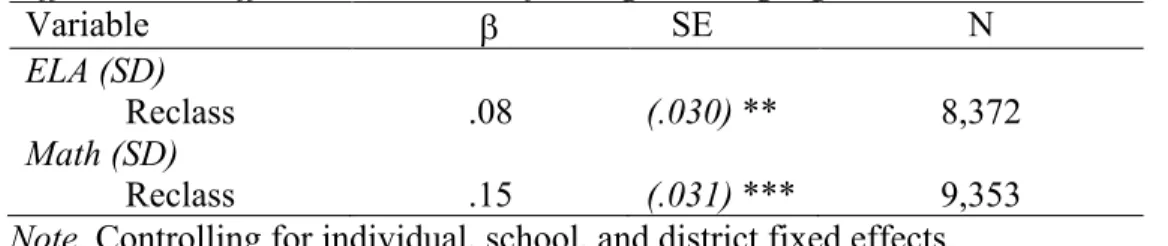
Results of Literature Search ……….... 15
Studies of Achievement Outcomes ………. 16
Correlational Studies ………... 16
Quasi-Experimental Studies ……… 19
Studies of Graduation and College Readiness Outcomes ………... 22
Summary of Literature Review ………... 24
Research Questions ………. 25 III. METHOD ………. 26 Data ………. 26 Population Description ……… 27 Variables ………. 30 Achievement Variables ………... 30
College Readiness and Graduation Variables ………. 31
Analytic Strategy ……… 32
Analytic Strategy for Achievement Outcomes ………... 32
Analytic Strategy for Outcomes Related to College Readiness and Graduation ………... 32
Matching Strategy ………... 33
Matching Strategy for Achievement Outcomes ……….. 34
Results of Matching for Achievement Outcomes ………... 36
Matching Strategy for Outcomes Related to College Readiness and Graduation ………... 37
Results of Matching for Outcomes Related to College Readiness and Graduation ……… 37
Balance Checks ………... 39
Analytic Models ……….. 41
Analytic Models for Achievement Outcomes ………. 41
Analytic Models for Outcomes Related to College Readiness and Graduation ………... 42
vii
Achievement Outcomes ……….. 45
Graduation and College Readiness ………. 46
Results of ACT Outcomes ……….. 46
Results of Graduation and AP Enrollment Outcomes ……… 53
Graduation ………... 53
AP Enrollment ……… 54
V. DISCUSSION ……… 61
Findings ………... 61
Multiple Sources of Evidence ………. 61
Absence of Reclassification ……… 63
Differential Impacts of Reclassification Decisions ………. 64
Implications ………. 66
Implications for Policymakers ……… 66
Implications for Researchers ………. 67
Implications for Test Developers ……… 68
Implications for Practitioners ……….. 69
Limitations ……….. 69
Future Research ……….. 72
Conclusions ………. 73
REFERENCES ………... 75
APPENDICIES ………... 82
A: IRB Documentation and Security Plan ……….. 82
B: List of Variables ………. 84
C: Analytic Models ………. 85
D: Full Regression Results for Outcomes Related to College Readiness and Graduation ……….. 86
viii
LIST OF TABLES
Table Page
1. Summary of Reclassification Criteria by WIDA Consortium Member …………. 13 2. Studies of Achievement Outcomes ……… 17 3. Studies of Outcomes Related to Graduation and College Readiness ………. 23 4. Count of Reclassified English Learners by School Year ……… 29 5. Descriptive Statistics for English Learners and Counts Reclassified by Grade 12 30 6. Available N by Outcome Variable ………. 33 7. Description of Sample after Matching on English Language Arts Performance ... 36 8. Description of Sample after Matching on Mathematics Performance ……… 37 9. Description of Sample after Matching for ACT English and Reading
Performance ……… 38
10. Description of Sample after Matching for ACT Mathematics Performance …….. 38 11. Description of Sample after Matching for Graduation and AP Course Enrollment 39 12. Difference in Differences Estimates for English Language Arts and Mathematics 45 13. Difference in Differences Estimates for English Language Arts and Mathematics
by Subgroup Characteristic ………. 46
14. Weighted Least Squares Regression Estimates of ACTs subtests by Grade of
Reclassification ………... 48
15. Weighted Least Squares Regression Estimates of ACTs by Grade of
Reclassification and Ethnicity ……… 49 16. Weighted Least Squares Regression Estimates of ACTs by Grade of
Reclassification and Gender ………... 50 17. Weighted Least Squares Regression Estimates of ACTs by Grade of
Reclassification and Disability Status ……… 51 18. Weighted Least Squares Regression Estimates of ACTs by Grade of
Reclassification and Economic Disadvantaged Status (EDS) ……… 52 19. Weighted Logistic Regression Estimates for Graduation and AP Enrollment by
Grade of Reclassification ……… 56
20. Weighted Logistic Regression Estimates for Graduation and AP Enrollment by
Grade of Reclassification and Ethnicity ………. 57 21. Weighted Logistic Regression Estimates for Graduation and AP Enrollment by
Grade of Reclassification and Gender ……… 58 22. Weighted Logistic Regression Estimates for Graduation and AP Enrollment by
Grade of Reclassification and Disability Status ………. 59 23. Weighted Logistic Regression Estimates for Graduation and AP Enrollment by
Grade of Reclassification and Economically Disadvantaged Status (EDS) ……... 60 24. Summary of Grades with Differential Impacts of Subgroup Status on Graduation
and College Readiness Outcomes ………... 65 25. Count (%) Dropped by Outcome and Subgroup Characteristic ………. 70
ix
LIST OF FIGURES
Figures Page
1. Process of Coarsened Exact Matching ……….. 34 2. Differences between reclassified English learners and English learners before
CHAPTER I: INTRODUCTION
The Every Student Succeeds Act of 2015 (ESSA, 2015) defines an English learner as an individual whose first language is not English and whose proficiency in English prevents full participation in English-only settings. These settings are not limited to the classroom but also include social contexts outside of school. In 2017, English learners represented 9.5% of the total public-school population (National Center for Education Statistics, 2017, Table 204.20). However, the percentage of English learners was much larger in some states than others. For example, in California, 21% of public-school students were identified as English learners. In Texas, 16.8% of public-school students were classified as English learners. In addition, some states have seen a dramatic increase in their English learner population over time. For instance, the English learner population in North Carolina grew from 44,165 in 2000 to 102,090 in 2015, representing a 131% increase (National Center for Education Statistics, 2017, Table 204.20).
Statement of the Problem
A major concern is that the performance of English learners in public schools has consistently lagged behind the population of public-school students. English learners perform lower on the National Assessment of Educational Progress (NAEP). In 2017, eighth-grade English learners performed, on average, 43 scale score points lower in reading compared to non-English learners (p < .001, National Center for Education Statistics, 2017b). Similarly, English learners performed, on average, 40 scaled-score points lower than non-English learners in math (p < .001, National Center for Education Statistics, 2017b). In summary, English learners, on average, perform lower than their non-English learner peers in reading and mathematics.
However, disaggregation of assessment and graduation data rarely occurs for students previously classified as English learners but have been reclassified and are no longer considered
[or carry the label of] English learners. Therefore, the knowledge base about the performance of English learners after reclassification is small (Carlson & Knowles, 2016). Reclassification refers to the change in status that occurs when English learners reach specific criteria to no longer need additional English language support (Cimpian, Thompson, & Makowski, 2017; Robinson-Cimpian & Thompson, 2016). In most states, English language proficiency assessment performance is the sole basis for reclassification decisions (Linquanti & Cook, 2015). Given that these English language proficiency assessments are utilized to make high stakes decisions such as reclassification, it is essential to evaluate the appropriateness of criteria for reclassification because of the consequential validity these decisions have on the academic future of English learners.
Purpose of the Study
The purpose of this study is to investigate the consequential validity of test-based reclassification decisions of English learners. According to The Standards for Educational and Psychological Testing, consequences refer to, “the outcomes, intended and unintended, of using tests in particular ways in certain contexts and with certain populations” (American Educational Research Association [AERA], American Psychological Association [APA], & National Council on Measurement in Education [NCME], 2014, p. 217). Previous literature around reclassification has primarily studied either students' academic (e.g., academic performance in the year following reclassification) or outcomes related to graduation and college readiness (e.g., ACTs, AP course enrollment) but not both (Carlson & Knowles, 2016). To fully understand the impact of
reclassification decisions from English language proficiency assessments, I argue for analyses of academic performance outcomes and outcomes related to graduation and college readiness. I
argue for analyses of both due to the potential long-term impact reclassification decisions could have on English learners.
On the one hand, reclassified students without the necessary English language
proficiency may experience declines in academic performance and may struggle in mainstream classrooms (Cimpian, Thompson, & Makowski, 2017). On the other hand, students who are reclassified a year or two after they have reached the appropriate English language proficiency may also miss the opportunity to enroll in advanced classes, which prepare them for post-secondary education (Carson & Knowles, 2016). Given that reclassification decisions in most states are based solely on performance on English language proficiency assessments,
reclassification can be viewed as a decision based on a test. Thus, the consequential validity of reclassification decisions should be investigated further to understand better the effects of these decisions on reclassified students and students who remain in English language supports.
To better comprehend the consequences of the decision to reclassify English learners, the current study will focus on examining the consequences of reclassification decisions based on a language proficiency assessment in North Carolina. The reasons to focus on North Carolina is because first, the number of English learners in North Carolina has substantially increased in over the past 12 years (National Center for Education Statistics, 2017, Table 204.20), and second, because of the lack of research on the consequences of reclassification decisions in that state (see Tables 2 and 3).
English Language Proficiency Assessments
The validity and reliability behind English language proficiency assessments have been thoroughly studied and reported by test developers (e.g., WIDA, n.d.). According to the
proposed interpretation(s) of test scores for a given use of a test" (p. 225). Validity is not a property of the test, but the degree in which evidence supports the interpretations and uses of the test. For example, reclassifying English learners out of English language support based on their performance on an English language proficiency test is an example of a decision based on a test score. Validity does not refer to the English language proficiency test itself but to the uses of the test to make educational decisions such as the reclassification of English learners. In the
following section, I provide an overview of validity with an emphasis on the argument-based approach to validation (Cronbach, 1988; Kane, 2013; Messick, 1989).
Theoretical Framework
Messick (1975) developed the unified view of validity which considers previously disjoint validity "types" (i.e., construct, criterion, content) as complementary to each other. Under Messick's unified view of validity, all of these "types" of validity are categorized under construct validity because they all contribute to the score's meaning. For example, a strong relation between performance on an English language proficiency assessment and an English reading comprehension measure adds to the overall understanding of how the English language proficiency assessment and the English reading comprehension measure assess the same construct similarly. Thereby, providing more context for the meaning of the score and the construct the test is proposed to measure.
Cronbach (1988) proposed a “devil’s advocate” mindset when evaluating the
interpretations and uses of test scores. In particular, he proposed that evaluators of test should be open to newer evidence that emerges that could contradict the current evidence in support of a particular test use or interpretation. This view challenged previously held notions of validation
that insisted a single source of evidence was sufficient for evaluating the validity of a test use or interpretation.
Building upon Cronbach's (1988) and Messick's (1989) work, Kane (1992) developed the argument-based approach to validation. The argument-based approach involves stating what is being claimed by the measure and then an evaluation of those claims by the test developer. This approach to validation starts from a score on an assessment to a particular use of a measure. Between the score and use, multiple claims and assumptions are made to arrive at a specific score use. The network of claims and assumptions make up the interpretation and use argument (IUA) of the argument-based approach to validation (Kane, 1996). The validity argument consists of the evaluation of the claims made in the IUA. Sources of evidence to support the claims made are collected and evaluated for the adequacy of the claim within a particular use of an assessment. A test use or interpretation is conditionally valid only after the IUA has
undergone, "a critical appraisal of its coherence and plausibility of its inferences and
assumptions" (Kane, 2013, p. 453). However, the argument-based approach to validation is malleable when new evidence arises that could alter the meaning of the test score.
An example could be a score on an English language proficiency assessment and the use of measuring a student's English language proficiency to position students on a spectrum of English language proficiency (i.e., English language proficiency standards). One claim could be that the English language proficiency assessment accurately measures a student's current level of English language proficiency as determined by English language proficiency standards. A source of evidence to support this claim could be professional judgments on whether the test aligns with the standards. The evaluation of the evidence would critique the appropriateness of these professional judgments. However, reclassification decisions come after the specific use of
the test, as a consequence of testing. For example, a score on an English language proficiency assessment leads to the interpretation of a student's current level of English proficiency. The interpretation is the basis for reclassification decisions.
The decision to reclassify English learners is appropriate when the academic performance of those reclassified is not impacted differentially compared to English learners still receiving English language supports (Cimpian et al., 2017; Robinson, 2011). However, to fully understand the consequences of reclassification decisions, multiple sources of evidence to support these criteria for reclassification purposes are needed (Kane, 2013). In the next section, I provide a more in-depth discussion around consequential validity as it relates to reclassification decisions.
Consequential aspects of reclassification. Haertel (2013) highlights both direct
(intended) and indirect (unintended) uses and consequences of testing. The direct consequences of testing are those the test developers anticipated during test development. Indirect
consequences are those the test developers did not intend. For example, developers of a math assessment may intend for users (teachers) to make mathematics instructional decisions (e.g., pedagogical changes) based on results of the test, but may not intend or anticipate for users such as policy makers and administrators to make policy and programmatic decisions (e.g.,
implementation of new teaching programs) from the same test results.
Typically, test developers explicitly document the intended uses of their assessment. For example, test developers for WIDA’s (n.d.b) English language proficiency assessment
(Accessing Comprehension and Communication in English State-to-State [ACCESS]) specify five potential uses of their assessment, which include: (1) measuring English language
proficiency, (2) making decisions about entry/exit into programs (e.g., English learner
language proficiency, and (5) staffing decisions. Under the argument-based approach to validation (Kane, 2013), all proposed uses for an assessment require a rigorous evaluation of evidence to support their proposed use.
Unless specified as a use of the assessment by the test developer, reclassification decisions are an unintended use of a language proficiency assessment (Haertel, 2013; Lane, 2014). An additional unintended use of an English language proficiency assessment may include evaluations of teachers and schools. For example, a teacher may be evaluated based upon the progress their students made towards English proficiency during the school year. However, the test developer may not have specified their instrument as an evaluative tool for teacher
performance. Therefore, leading to an unintended use of their assessment.
Intended uses of assessment have consequences. For example, a consequence of using the WIDA ACCESS to make reclassification decisions is that English language supports are no longer provided for the student, which may impact their performance on subsequent outcomes. Furthermore, measuring English language proficiency may help teachers improve instructional practices for English learners. In either example, the test developer supported using their assessment in that manner.
Unintended uses of assessments also have consequences. If the test developer did not intend on their assessment to be used for reclassification decisions, then the same impact on subsequent outcomes may be expected. Furthermore, a consequence of using an English language proficiency assessment for teacher evaluations may lead to higher turnover among teachers in school with higher populations of English learners. Evaluations of both the intended and unintended consequences of testing are needed (Haertel, 2013; Lane, 2014).
Sources of evidence to evaluate the use of an assessment for reclassification decisions could include performance on student outcomes. If reclassified and this decision negatively impacts their academic performance, then evidence exists against the decision to reclassify. However, significant positive effects of reclassification on subsequent outcomes could also indicate an invalid use of the assessment at the established criteria as it could indicate English learners were receiving unnecessary services, potentially preventing reclassified English learners from accessing advanced coursework. Therefore, to better understand the effects of
reclassification, it is crucial to analyze the consequences of the use of the test on both, the immediate and the distal academic outcomes. In the next section, I discuss the historical
underpinning of English language proficiency assessments to situate the current research better.
History of English Language Proficiency Assessments
Federal policies regarding English learners were non-existent before 1968 (Wright, 2005). English learners at that time were merely immersed in the mainstream classroom and were expected to perform without English language supports (e.g., sink or swim). However, in 1968, the Elementary and Secondary Education Act (ESEA) was amended to add Title VII or the Bilingual Education Act (BEA; Gándara, 2015). The BEA was the first time the federal
government acknowledged the unique challenges of English learners in reaching the same educational goals as native-English speakers. The law itself was vague and did not provide much direct guidance on how the educational needs of English learners were to be served
(Wright, 2005). Furthermore, BEA lacked accountability measures and mandates for districts to establish bilingual programming (e.g., tracking English language proficiency; Bunch 2011).
In 1974, the Supreme Court case Lau v. Nichols ruled English-only opportunities for English learners without additional language support was in fact, not allowing English learners
equal access to education (Wright, 2005). The court decision made programming (e.g., bilingual programs, English as a second language) that permitted access to public education a right for English learners, protected by the Civil Rights Act of 1964 (Bunch, 2011). However, the use of assessments of English language proficiency for purposes of classification and reclassification were still not federally mandated.
The No Child Left Behind Act (NCLB; 2002) eliminated Title VII and replaced it with Title III, “Language Instruction for Limited English Proficient and Immigrant Students”. Title III required programs for English learners to focus on only two requirements: teaching English and teaching the state content standards. In addition to the elimination of Title VII and the authorization of Title III, Title I was also updated. Title I mandated the annual testing of all students in grades 3 through 8 and once in high school to better monitor student progress (NCLB, 2002). Furthermore, states' accountability measures included English learners as a subgroup in states' accountability measures.
Due to NCLB's requirement to properly report outcomes of state assessments by subgroups (e.g., English learners, students with disabilities), the need to accurately identify students who are ready to be reclassified also grew. In addition to content area assessments, NCLB also required each state to develop English language proficiency standards and English language proficiency tests to monitor English learners' progress towards becoming English proficient (NCLB, 2002). Currently, the basis of these standards and assessments are on the four domains of language development (i.e., reading, writing, speaking, listening). States receiving funding for Title III must submit to the federal government annual reports highlighting the progress of English learners in reaching English proficiency.
Research related to the effects of test-based decisions, such as reclassification, is
relatively new. Therefore, our understanding of how assessment-based decisions affect students' performance is limited (Robinson, 2011). In the next section, I provide an overview of the English language proficiency assessment utilized in North Carolina, and how the state uses the assessment in making reclassification decisions.
English Language Proficiency Assessment in North Carolina
NCLB required states to develop English language development standards and English language proficiency tests to monitor progress towards English proficiency (NCLB, 2002). The following English proficiency test is only one of the tests utilized in the U.S.
WIDA ACCESS. ACCESS is comprised of four different subtests that represent the various domains of language development (i.e., speaking, writing, reading, listening) for students in grades K-12 (WIDA, 2016). The test can be administered with paper-pencil or on the
computer. The test format in kindergarten is different from the other grades. The kindergarten test has two parts, expository and narrative, while the remaining grade levels consist of four parts based on the language development domains. In grades 1-12, tests are administered across
multiple grades and consist of three tiers (e.g., A, B, & C) of increasing difficulty.
Administration of the test for grades 1-12 depends on the particular domain tested and the tier in which the student is placed (WIDA, 2016). The speaking test must be administered individually, whereas tests of writing, reading, and listening are group administered. The online administration of the test is similar to the paper-pencil, except adaptive. Students must take the listening and reading portion of the test before being placed in tiers for the writing and speaking sections. The online administration is not available for kindergarten.
The test administrator directly scores the writing portion of the exam in kindergarten and the speaking portion for grades 1-12 based on rubrics provided by WIDA (WIDA, 2016). The test administrator must have completed training to administer the test before scoring. For the online version, a third-party scoring company scores the speaking portion of the exam in addition to the online and paper-pencil administration of the other three domain tests.
Students receive a score ranging from one to six in each domain with students at the lower end representing those of lower performance (WIDA, 2016). Composite scores are generated across domains to provide an overall indicator of English language proficiency. The test is criterion-referenced which means scores on the assessment linked to levels on the WIDA English Language Proficiency Standards. States can specify what level of English proficiency is adequate for reclassification based on the score from ACCESS, either from the composite score or a combination of the composite score and subtest scores (Linquanti & Cook, 2015).
Claims are made about assessments for which evidence is collected to support these claims. On claim made by WIDA (CAL, 2017) is that items on their assessment work appropriately together. WIDA’s technical manual reports reliability estimates for the overall composite score. Reliability refers to, “the degree to which test scores for a group of test takers are consistent over repeated applications of a measurement procedure and hence are inferred to be dependable and consistent for an individual test taker” (AERA et al., 2014, pp. 222-223). Estimates for the overall composite score internal consistency reliability range between .932 and .974 (CAL, 2017).
Another claim made by developers of the WIDA assessment is that test takers are appropriately classified to proficiency levels defined by WIDA’s English language proficiency standards (CAL, 2017). WIDA provides accuracy of classification for an undisclosed criterion
assessment at the overall cut scores to support this claim (e.g., one vs. two, two vs. three). The accuracy of classification, defined as the proportion of correctly classified students in relation to a comparable English language proficiency assessment, across all cut scores for each grade level range from .870 to .992. High accuracy in classification is critical to consider because it
provides an estimate of how well the test is distinguishing between students at different thresholds of language proficiency. For example, if a state adopts a threshold of five on the WIDA ACCESS for a student to no longer receive English language supports, then evidence needs to be provided that the test can accurately distinguish between students who scored above, below, or at the threshold.
Reclassification decisions with WIDA ACCESS depend on the state. Table 1 highlights the 35 states and the District of Columbia as well as the reclassification criteria summarized by Linquanti and Cook (2015). Nineteen states and the District of Columbia require only
performance on WIDA ACCESS for reclassification while 15 states require additional criteria. Furthermore, the reclassification threshold on the WIDA ACCESS varies between states. Table 1 also highlights the lack of consistency between the number of criteria and the proficiency score required. The Office of English Language Acquisition (2015) reports that the minimum scores for reclassification in states that utilize WIDA ACCESS for reclassification decisions range from 4.5 to 5.0. For example, North Carolina requires a composite score of 4.8 (North Carolina
Testing Program, 2017). North Carolina provides no documentation for this reclassification threshold, which highlights the need for understanding the appropriateness of these criteria for reclassification decisions. To gain a better perspective of the research conducted on
Table 1
Summary of Reclassification Criteria by WIDA Consortium Member
Member Number of Criteria Proficiency Score Member Number of Criteria Proficiency Score
Alabama 2 4.8 Montana 2 5.0
Alaska 1 5.0 Nevada 1 5.0
Colorado 2 5.0 New Hampshire 1 5.0
Delaware 2 5.0 New Jersey 3 4.5
DC 1 5.0 New Mexico 1 5.0
Florida 4 5.0 North Carolina 1 4.8
Georgia 1 5.0 North Dakota 1 4.8
Hawaii 1 4.8 Oklahoma 1 5.0
Idaho 3 5.0 Pennsylvania 3 5.0
Illinois 1 5.0 Rhode Island 3 4.5
Indiana 2 5.0 South Carolina 1 5.0
Kentucky 1 5.0 South Dakota 1 4.7
Maine 1 6.0 Tennessee 1 5.0 Maryland 1 5.0 Utah 2 5.0 Massachusetts 3 5.0 Vermont 1 5.0 Michigan 3 5.0 Virginia 1 5.0 Minnesota 4 5.0 Wisconsin 4 6.0 Missouri 4 6.0 Wyoming 1 5.0
Note: DC is the District of Columbia.
CHAPTER II: LITERATURE REVIEW
To select studies for review, I searched several electronic databases including ERIC, Academic Search Complete, and Google Scholar for peer-reviewed publications using the following keywords: consequential validity, English language proficiency assessment, and reclassification. However, the search results yielded no empirical studies. Furthermore, when the search was broadened to include keywords such as English learner in combination with
consequential validity, no empirical research was found. Therefore, I decided to search for any studies that examined the effects of reclassification on English learners. I again searched several electronic databases including ERIC, Academic Search Complete, and Google Scholar for peer-reviewed publications using the following keywords: English learner, English language learner, reclassification, and reassignment. I also conducted "Snowball sampling" of these 22
publications to ensure a comprehensive search. Snowball sampling involves checking references of initially selected literature for empirical research to ensure inclusiveness of current literature. The initial search yielded 32 articles. Abstract analysis to provide content relevancy produced 25 studies for further review.
After identification and abstract analysis, I read studies to determine if they met inclusion criteria. The process for reporting systematic reviews and meta-analyses developed by Moher, Liberati, Tetzlaff, Atlman, and the PRISMA Group (2009) was adopted to increase the quality of the review. Examples of items to review included objectives, participant selection, and methods. In addition, studies had to (a) be empirical, quantitative, and published in peer-reviewed journals or from a reputable research agency (e.g., government reports), (b) focus on the relation between reclassification and student outcomes, (c) have been published between the years 2001 and 2017, and (d) have been conducted in the United States. The decision to limit research only to studies
conducted in the United States was due to the diverse English learner population in the country. I selected studies that were published between 2001 and 2017 because of the substantial increase in the English learner population during these years, and the rise in awareness of the
consequences of reclassifying English learners. Furthermore, 2002 was when NCLB (2002) was signed into law, which increased accountability measures for English learners in terms of
monitoring and assessing English language proficiency.
Thus, the current chapter reviews research related to the effects of reclassification on English learners and analyzes the consequences of reclassification decisions within the study's context. Furthermore, I also focus on the methodologies utilized to study reclassification. The methods used to study reclassification can provide insight into how to examine reclassification in the context of North Carolina.
Results of Literature Search
In total, 8 of the original 32 studies (25%) met eligibility for inclusion in the current synthesis. Only seven studies analyzed the effects of reclassification on students' immediate academic outcomes (Ardasheva, Tretter, & Kinny, 2012; Cimpian et al., 2017; Hill et al., 2014; Kim & Herman, 2010; Kim & Herman, 2012; Robinson, 2011; Robinson-Cimpian & Thompson, 2016), while the eighth study analyzed the relation between reclassification on college readiness (e.g., ACT performance) and post-secondary enrollment (Carlson & Knowles, 2016).
In the current chapter, I review studies analyzing the effects of reclassification on English learner outcomes. In particular, I review studies in this chapter based on the strengths of the methodologies employed. Also, I consider the consequences of reclassification in each study to understand the consequential validity better. The studies are organized by outcome type, starting with achievement outcomes and then moving to the outcomes associated with graduation and
college readiness. Furthermore, the studies within the section are organized by increasing methodological rigor. For example, studies that adopted multilevel modeling and multivariate regression are reviewed first followed by increasingly rigorous methods such as regression discontinuity. I chose this organizational scheme to highlight the methodological strengths and weaknesses in each study.
Studies of Achievement Outcomes
Previous research has studied achievement outcomes with various methods. In this section, I highlight the methods within their design type. I start with correlational designs and then move to quasi-experimental designs. Furthermore, I organize each sub-section by increasing methodological rigor.
Correlational Studies
Table 2 summarizes the studies of achievement outcomes reviewed, including English proficiency assessment utilized in the state and the number of reclassification criteria as specified by Linquanti and Cook (2015) or the study. Overall, the representation of known states is quite low with only three states studied. Furthermore, variability exists in the number of criteria represented, ranging from one to four criteria for reclassification decisions. Lastly, multiple methodologies have been employed to study the impacts of reclassification.
Hill et al. (2014) compared districts with different reclassification policies to better understand if districts with higher reclassification standards led to higher performance on the state English language arts assessment in California. Four cohorts of English learners consisting of grades two, four, seven, and eight were studied over six school years with sample sizes
ranging from 120,205 to 192,991 English learners. Survey data were also collected from districts to gain a better perspective of each districts' reclassification standards. Data analyses with
cohorts of students were performed utilizing multivariate regressions over time. Multivariate regression is similar to ordinary least squares regression except instead of just one dependent variable; there are multiple (Rencher & Christensen, 2012). Results indicate that districts with stricter reclassification policies (e.g., higher language proficiency thresholds) had slightly better reclassified English learner performance and on-grade progression compared to non-reclassified English learners. Furthermore, districts with stricter standards for achieving reclassification yielded more positive results for reclassified English learners compared to districts with lower reclassification standards. Therefore, the reclassification decisions of districts in California that adopt stricter criteria for reclassification have positive consequences on reclassified English learner performance due to increases in performance of reclassified English learners. Table 2
Studies of Achievement Outcomes
Study State Number of Criteria Assessment Method Ardasheva et al. (2012) Kentucky 1 (Composite + Domain) LAS/WIDA ACCESS Hierarchical Linear Modeling Cimpian et al. (2017) NA 1 NA Regression Discontinuity Kim & Herman
(2010, 2012)
NA 2 NA Hierarchical Linear
Modeling
Hill et al. (2014) California 4 CELDT Multivariate
Regression
Robinson (2011) California 4 CELDT Regression
Discontinuity, Instrumental Variable
Estimation Robinson-Cimpian
& Thompson (2016)
California 4 CELDT Regression
Discontinuity, Instrumental Variable Estimation, Difference-in-Differences, Inverse Probability Weighting
Ardasheva et al. (2012) studied the impact of English proficiency level (i.e., English learner, former English learner, native English speakers) on reading and math performance of middle school students in Kentucky. The sample consisted of 558 English learners, 500 former English learners, and 17,470 native English speakers. Researchers conducted a two-level hierarchical model which included student-level variables such as age, gender, current English learner status, former English learner status, and SES. A hierarchical linear model is a type of multi-level model and is a modeling technique that accounts for the dependence between observations (e.g., times or subjects; Singer & Willet, 2003). Findings indicated former English learners outperformed English learners and native English speakers in reading (p <.001) and mathematics (p < .001) when controlling for student and school-level characteristics. These higher performances suggest reclassified English learners are not adversely affected by the reclassification process. A weakness of the study was the lack of school-level variables present, such as percent minority or other school demographic variables. The only school-level variable utilized in the model was the poverty rate. Overall, Ardasheva et al. (2012) findings suggest reclassification decisions in Kentucky have positive consequences due to the reclassification process not causing a decrease in the academic performance of reclassified English learners. Kim and Herman (2010, 2012) researched the effects of reclassification on math and English language arts performance in an undisclosed state. Six years of longitudinal data from 45,006 English learners and non-English learners in grade three were utilized. The researchers adopted hierarchical linear modeling for analyses. Results from both studies indicated
reclassified English learners in grades four, five, and six have growth rates higher than non-English learners in math and reading (as defined by the state math and reading assessments), implying reclassified English learners would eventually catch-up to their non-English learner
peers. These studies, however, neglected to model individual growth parameters, which leaves a large portion of variability unexplained. Similar to the study in Kentucky (Ardasheva et al., 2012), reclassification decisions in the undisclosed state have positive consequences due to reclassification decisions not causing a decrease in academic performance among reclassified English learners. A weakness of the current studies and similarly with the study conducted by Ardasheva et al. (2012) was the lack of district-level variables in their analytic model such as the programs English learners were offered in their districts.
Quasi-Experimental Studies
Quasi-experiments are studies lacking random assignment of participants or units
(Murnane & Willett, 2011). Unlike the studies mentioned previously, quasi-experimental designs utilize additional techniques to isolate the treatment effect, or in the case of reclassification, the impact of reclassification on academic outcomes. In a study conducted by Shadish, Clark, and Steiner (2008), the researchers conducted a study with random and non-random assignment of participants. The researchers found that with proper utilization of covariate information (e.g., age, gender), the quasi-experiments can approximate results from randomized experiments. Quasi-experiments can be useful when randomization is not feasible due to ethical or logistical constraints.
Cimpian et al. (2017) analyzed the effects of reclassification on English language arts and math performance in an undisclosed state. Longitudinal data of 65,243 English learners in grades three through eleven were analyzed over five years. The researchers adopted a regression
discontinuity approach. Researchers found no significant differences between English learners below and above the threshold for reclassification on English language arts and math
reclassification threshold signal positive consequences of reclassification decisions. Compared to previously mentioned studies, the methodology in this study allowed researchers to establish comparable groups of students, which strengthened the validity of their results.
Robinson (2011) assessed the effects of reclassification on subsequent student English language arts performance in California. Data from a large urban district in California with a sample size of 22,827 English learners in grades three through eleven were utilized. Analyses consisted of a regression discontinuity with instrumental variable estimation. An instrumental variable is a variable unrelated to the dependent variable of interest, and whose relation between the independent variable is not confounded by a third, unexplained variable (Murnane & Willett, 2011). The instrumental variable used by the researcher was whether a student reached the previous year's cutoff for reclassification. In California, reclassification decisions are not solely based on the English language proficiency assessment but additional criteria such as teacher and parent input (Linquanti & Cook, 2015). The instrumental variable helped control for the
selection bias introduced by the subjective input in reclassification decisions. Results indicated no significant differences in the performance of English learners and reclassified English learners on subsequent English language arts performance as measured by state subject tests in
elementary and middle school. However, in high school, there was an adverse effect of being reclassified on subsequent English language arts performance. Unlike the study by Cimpian et al. (2017) that found no significant impact of reclassification on student performance, this study found adverse effects for high school students, which indicates the decision to reclassify students may not be appropriate for all grade levels. In summary, decisions to reclassify students appear to have positive consequences for English learners in elementary and middle school, but negative consequences for English learners in high school, when controlling for the selection bias specific
to California's reclassification policy. A strength of the study was the adoption of instrumental variable estimation to control for selection bias such as subjective teacher input.
Robinson-Cimpian and Thompson (2016) investigated the relation between the adoption of a stricter reclassification policy in California and its effects on the performance of English learners in English language arts. In 2006-2007, state policymakers in California increased the reclassification criteria on the state language proficiency test, which made reclassification more difficult for English learners. Researchers utilized a sample consisting of 609,431 Latino English learners in grades 3-12 from the Los Angeles School District. In addition to utilizing a regression discontinuity and instrumental variable estimation, the study also combined difference in
differences and inverse probability treatment weighting. The difference in differences approach controls for the effect of reclassification that would have occurred under the previous policy (Murnane & Willett, 2011). Inverse probability treatment weighting allowed the researcher to account for the imbalanced number of reclassified English learners compared to English learners. English language arts performance was measured by the state’s assessment. Results indicated that a stricter policy in California for determining English proficiency did not change the performance on English language arts assessments of students in grades 3-8. Before the new policy, the decision to reclassify English learners resulted in negative consequences on English language arts performance for high school students but diminished after the implementation of the stricter policy. The adoption of a new policy had no consequences for students in grades 3-8 but did help students in high school by increasing their academic performance, which provides evidence of positive consequences of stricter reclassification decisions. This study adds to the previous research by extending results to include effects of policy change at the state level and how more rigorous criteria for reclassification can benefit older English learners. As will be
highlighted in the next section, this study also analyzed graduation and college academic outcomes.
Studies of Graduation and College Readiness Outcomes
Bothstudies of graduation and college readiness outcomes utilized quasi-experimental methods to research the impact of reclassification decisions. Table 3 illustrates the two studies addressed the relation between reclassification on graduation rate or college readiness (e.g., ACT performance) of English learners (Carlson & Knowles, 2016; Robinson-Cimpian & Thompson, 2016). Robinson-Cimpian and Thompson (2016), as mentioned in the previous section, were also interested in whether a policy change in California regarding reclassification affected graduation rates among English learners. The researchers utilized the same sample, school district, and research design. There was no indication of changes in state graduation standards during the study. Findings suggest that modifications to a stricter reclassification policy lead to improvements in graduation rates among English learners. Therefore, the adoption of more stringent reclassification criteria resulted in additional positive consequences of reclassification for reclassified English learners.
Table 3
Studies of Outcomes related to Graduation and College Readiness
Study State Number of Criteria Assessment Method Carlson & Knowles (2016) Wisconsin 4 WIDA ACCESS Regression Discontinuity Robinson-Cimpian & Thompson (2016)
California 4 CELDT Regression
Discontinuity, Instrumental Variable Estimation, Difference-in-Differences, Inverse Probability Weighting Carlson and Knowles (2016) were interested in whether students reclassified as former English learners and current English learners in Wisconsin scored similarly on the ACTs. The sample consisted of 2,733 students representing all students ever identified as an English learner between the 2006-2007 and 2012-2013 school years. The researchers adopted a regression discontinuity approach. Results indicated that students who were reclassified by tenth grade had higher scores on the ACT with some evidence of an increase in high school graduation. Thus, decisions to reclassify students in Wisconsin resulted in positive consequences for ACT
performance and some evidence of positive consequences for graduation. Unlike the last study, which only looked at Spanish-speaking English learners, the current study sample included students who spoke Hmong as their native language given that in Wisconsin, the proportion of Hispanic English learners is approximately the same as the proportion of English learners who speak Hmong. Unlike the previous study that utilized an instrumental variable, an instrumental variable was not needed for the current study because reclassification decisions are based solely on the English language proficiency assessment in Wisconsin.
Carlson and Knowles (2016) also investigated the relation between reclassification and post-secondary enrollment. Findings suggested that reclassification by tenth grade increased post-secondary enrollment. However, as only one study in the current review examined the relation between reclassification and post-secondary enrollment, more research is needed to understand this relation in different contexts.
Summary of Literature Review
Three main findings emerged from the literature review. First, I found that there is no one way of researching the effects of reclassification and these methods depend on the specific criteria for reclassification. For example, when researchers investigated reclassification within the context of California, an instrumental variable estimation approach was necessary to control for selection bias (Robinson, 2011), whereas in Wisconsin (Carson & Knowles, 2016) an instrumental variable was not necessary as reclassification decisions are solely based upon the English language proficiency assessment.
Secondly, I found the impacts of reclassification decisions on English learners were not fully understood and more research is needed to understand its impact on other outcomes (e.g., advanced coursework enrollment). This lack of understanding may be attributed to the
methodological limitations that impact the contributions of the current research. For example, types of programming available (e.g., English as a second language, bilingual) to English
learners may attribute to success with reclassification decisions. Furthermore, literature related to rates of reclassification highlight differential reclassification rates by subgroups (Burke, Morita-Mullaney, & Singh, 2016; Greenberg Motamedi, Singh, & Thompson, 2016), but little is known about the impacts of reclassification decisions by subgroup characteristics (e.g., gender, students with disabilities).
Lastly, I found a better understanding of the relation between consequential validity and reclassification decisions. Most studies reviewed were only interested in students’ subsequent achievement or distal outcomes such as graduation and ACT performance. I argue for analyses of both to fully understand the effects of reclassification decisions.
Research Questions
The current dissertation seeks to build upon previous research by analyzing the
consequential validity of reclassification decisions in North Carolina. To better comprehend the consequences of the decision to reclassify English learners, I will address the following research question(s):
1. What are the consequences of reclassification decisions of English learners in North Carolina on (a) their English language Arts performance, and (b) their mathematics performance compared to the consequences of not being reclassified?
i. Do the consequences of reclassification decisions on English learners’ English language arts and mathematics performance vary by student characteristics (i.e. gender, ethnicity, disability status, economic status)?
2. What are the consequences of reclassification decisions of English learners in North Carolina on (a) their advanced placement course enrollment, (b) their ACTs, and (c) their high school graduation compared to the consequences of not being reclassified?
i. Do the consequences of reclassification decisions on English learners’ advanced course enrollment, their ACTs, and their high school graduation vary by student characteristics?
CHAPTER III: METHOD
To better understand the effects of reclassification on English learner outcomes and the appropriateness of reclassification decisions, I studied the outcomes of reclassification in a state context not previously studied, North Carolina. As mentioned previously, the English learner population in North Carolina has doubled from 2000 to 2015, which highlights the importance of understanding the impacts of reclassification decisions (National Center for Education Statistics, 2017, Table 219.46). In this chapter I describe the data, the population in North Carolina, the outcome variables, the analytic strategies for each outcome type, and the analytic models.
Data
I utilized student-level performance data, student-level demographic data, and school-level data from the state of North Carolina. I obtained data from the Duke Center for Child and Family Policy (n.d.), which houses most of North Carolina's public-school data. Data were available from as early as 1980 to as recent as 2017. I chose to use data after 2008-2009 because North Carolina adopted the WIDA ACCESS for measuring English language proficiency the summer of 2008 (North Carolina Department of Public Instruction, 2018). Multiple datasets from the Duke Center for Child and Family Policy were available, and the data provided depends on the need of the researcher. Examples of datasets include yearly performance on end-of-grade tests, demographic information, and student exceptionalities. These datasets aided in estimating the effects of reclassification on English learners in North Carolina. A unique identifier connects student data which is consistently used from year to year to help track student performance over time. Data on school, district, and teachers are also linked. An abbreviated list of available variables is available in Appendix B.
I requested data and was approved from the Duke Center for Child and Family Policy. Approval from Duke required institutional review board (IRB) approval from Southern
Methodist University which included a data security plan. Data were stored and analyzed on a secure remote desktop and could only be accessed by connecting to the remote desktop. Copies of the IRB approval and the data security plan can be found in Appendix A.
Population Description
The datasets consisted of students from 157 local education agencies (e.g., school districts) and 304 schools. Multiple cohorts (i.e., grades) of students were available for the analyses to help meet the assumptions of the methods and to gain enough power to detect significant effects. Three years of consecutive performance data were required due to the analytical strategy I adopted. Therefore, the earliest grade-level analyzed was fifth grade.
Table 4 provides the total number of English learners and the number reclassified in North Carolina by the grade of reclassification. For example, of students who were in fifth grade in 2008-2009, 1,187 were reclassified in sixth grade (2009-2010), and 819 were reclassified in seventh grade (2010-2011). Similarly, Table 5 illustrates the subgroup classification of the students as well as the reclassification count by grade 12. These tables show disproportionate rates of reclassification in some instances. The rate of reclassification for White and Asian English learners were almost six to ten percentage points higher than Hispanic (z = 4.69, p < .001; z = 10.8, p < .001) and Black English learners (z = 4.29, p < .001; z = 6.33, p <.001). Females were reclassified at a higher rate than males (z = 12.2, p <.001). The rate of
reclassification for students without a disability was twice the percentage of students with a disability (z = 27.9, p <.001), and the percentage of economically disadvantaged students
reclassified was higher than the percentage of students not identified as economically disadvantaged (z = 6.13, p < .001).
Table 4
Counts of Reclassified English Learners by School Year (N = 42,393)
Grade in 2008-2009 Year Grade Count Reclassified
5th (N = 6,243) 2009-2010 6th 1,187 2010-2011 7th 819 2011-2012 8th 365 2012-2013 9th 166 2013-2014 10th 1,497 2014-2015 11th 386 2015-2016 12th 168 Total 4,588 6th (N = 7,713) 2009-2010 7th 1,394 2010-2011 8th 808 2011-2012 9th 229 2012-2013 10th 1,976 2013-2014 11th 419 2014-2015 12th 209 Total 5,035 7th (N = 7,027) 2009-2010 8th 960 2010-2011 9th 607 2011-2012 10th 1,755 2012-2013 11th 555 2013-2014 12th 251 Total 4,128 8th (N = 6,556) 2009-2010 9th 558 2010-2011 10th 1,969 2011-2012 11th 551 2012-2013 12th 365 Total 3,443 9th (N = 7,175) 2009-2010 10th 1,403 2010-2011 11th 964 2011-2012 12th 330 Total 2,697 10th (N = 4,369) 2009-2010 11th 1,020 2010-2011 12th 443 Total 1,463 11th (N = 3,310) 2009-2010 12th 765
Table 5
Descriptive Statistics for English Learners and Counts Reclassified by Grade 12
Variable Subgroup English Learners
(%) Reclassified English Learners (%) Ethnicity American Indian 25 (0.06%) 6 (0.01%) Asian 2,726 (6.43%) 2,368 (5.59%) Black 812 (1.92%) 470 (1.11%) Hispanic 21,000 (49.54%) 13,193 (31.12%) Multi-Ethnic 248 (0.59%) 151 (0.36%) White 769 (1.81%) 625 (1.47%) Gender Male 14,314 (33.77%) 8,392 (19.80%) Female 11,266 (26.58%) 8,421 (19.86%) Disability Yes 3,633 (8.57%) 933 (2.20%) No 22,007 (51.91%) 15,820 (37.32%) Economically Disadvantaged Yes 20,107 (47.43%) 13,628 (32.15%) No 5,473 (12.91%) 3,185 (7.51%) Variables
There are seven outcome variables of interest for the current study. Two variables relate to achievement and five variables relate to college readiness and graduation. I briefly describe each variable in the next sections.
Achievement Variables
Two achievement outcome variables are English language arts and mathematics performance as measured by the state's End of Grade tests. These tests are administered at the end of the year at each grade between grades three through eight and are summative assessments of what students have learned in both English language arts and mathematics in their respective grades (North Carolina Department of Public Instruction, n.d.). These tests are intended to measure English language art and mathematics content learned in relation to the state’s
curriculum (i.e., criterion referenced). Due to multiple cohorts (i.e., grades) of students included which reflect different grade-level assessments, I scaled both variables (z-scored) by year to have a grand mean of zero and a standard deviation of one to make comparisons with multiple
assessments.
College Readiness and Graduation Variables
The third, fourth, and fifth outcome variables relate to students’ ACT English, reading, and mathematics performance. I chose to utilize ACT performance over SAT performance because the state mandates all students take the ACTs (North Carolina Department of Public Schools, n.d.b). Scores on each test range from 1 to 36 (ACT, n.d.). The ACT English subtest measures students’ understanding of English, with an emphasis on language skills (e.g.,
grammar). The ACT reading subtest measures reading comprehension indicative of a first-year college student, and the mathematics subtest measures the comprehensive mathematics skills students are expected to acquire by 12th grade. The ACT writing subtest was not included due to the student's ability to self-select out of the writing portion of the test and the ACT science subtest was not included due to the lack of three consecutive years of academic performance data to match.
The sixth and seventh outcome variables are both dichotomous variables. The graduation variable takes the value of 1 if a student graduated in four years and the value of 0 if a student did not graduate in four years. Similarly, the AP enrollment variable takes the value of 1 if a student enrolled in an AP course and 0 if the student did not enroll in an AP course. I chose to dichotomize the variable due to the large number of students who did not take an AP course.
Analytic Strategy
In this section, I describe the analytic strategy for the different types of outcomes separately because each type of outcome variable necessitated a slightly different analysis. In particular, I describe the difference in differences approach for the achievement outcomes and the regression approach for the graduation and college readiness outcomes.
Analytic Strategy for Achievement Outcomes
In previous studies, performance data on the English language proficiency assessment were readily available, which is a necessity to assess the effects of the forcing variable (i.e., reclassification threshold) in regression discontinuity research (Carlson & Knowles, 2016; Robinson-Cimpian & Thompson, 2016). However, in North Carolina performance data on the English language proficiency assessment were not available and other methodological
considerations were needed. For the current study, I adopted a difference in differences approach to establish the treatment effect of reclassification. Weights were added to the
regression model to account for the imbalance in the number of students reclassified compared to students not reclassified. The significance of the difference in differences term provides insight into the effects of reclassification decisions in North Carolina.
Analytic Strategy for Outcomes Related to College Readiness and Graduation
To better understand the consequences of reclassification on graduation and college readiness outcomes, I adopted different methodologies than the previously mentioned outcomes due to the lack of baseline data on these outcomes. Unlike the change of English learner status from one year to the next that was analyzed in the first research question, students may have received the "treatment" of reclassification between the grade of analysis for the academic performance outcomes and the grade levels in the current section (e.g., eleven or twelve). For
example, if reclassification is studied between grades six and twelve, then students can be reclassified in any grade between grade six and the grade students takes the ACT, or the grade students graduate. Therefore, instead of a difference in differences approach utilized in the first research questions, I adopted weighted regression analyses to predict these outcomes.
Regression analyses allowed me to predict the likelihood of graduating/AP enrollment or predict performance on the ACT. I included weights to account for the imbalance between the number of reclassified English learners and the number of English learners never reclassified. I am restricted to three grade levels in the analyses for ACT performance because the ACT for grade eleven was not mandated in North Carolina until 2013 (North Carolina Testing Program, 2017). For graduation and the AP course enrollment outcomes, I utilized all seven cohorts. Table 6 summarizes the N by outcome variable.
Table 6
Available N by Outcome Variable
Variable Number of Cohorts N
English Language Arts/Mathematics 3 20,983
ACTs 3 20,983
Graduation/AP Enrollment 7 42,393
Matching Strategy
A difference in differences approach assumes parallel trajectories (i.e., performance over time), which did not apply to the current data in its current state. As expected, large variability exists within the English learner group, and not all English learners performed similarly to those who were reclassified. Therefore, I adopted coarsened exact matching to establish comparable comparison groups before I conducted analyses. I discuss the matching technique on each outcome type in the following sections.
Matching Strategy for Achievement Outcomes
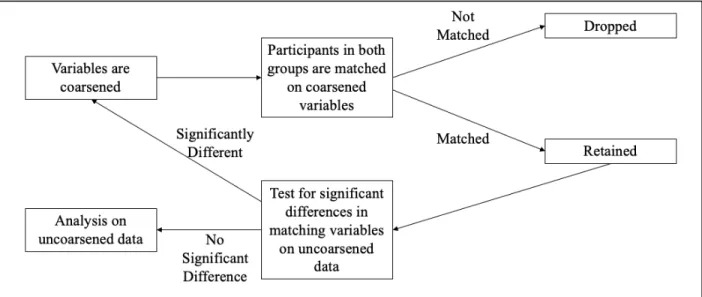
I adopted Coarsened exact matching (CEM) to match reclassified students with a comparable group of English learners. I chose CEM to rectify numerous limitations associated with traditional techniques (Iacus et al., 2011). First, CEM does not rely on a cycle of balance checks that other matching techniques require (e.g., propensity score matching). Second, CEM treats missing data as a value to match upon. For example, if two students performed similarly on two out of the three continuous matching variables but were missing on the third, the two
students would match. Missing data on any variable ranged from 0% to 4.9%, which makes matching via propensity score analysis difficult due to its reliance on complete data (Murnane & Willett, 2011). To conduct matching via propensity scores with missing data, researchers must impute the data before conducting the matching technique. Coarsened exact matching
circumvents the need to impute data values. Lastly, adjustments to allowable imbalance on any of the matching variables does not affect the imbalance of other matching variables, which is a limitation of other techniques that generate a composite (i.e., propensity scores). Figure 1 provides an illustration of the CEM approach.