VISUALIZATION IN THE WRITING PROCESS:
A CASE STUDY OF STRUGGLING K-4 LEARNERS IN A SUMMER WRITING CAMP
by
ERIN K. JURAND
B.J., University of Texas at Austin, 1999 M.S., Kansas State University, 2005
AN ABSTRACT OF A DISSERTATION
submitted in partial fulfillment of the requirements for the degree DOCTOR OF PHILOSOPHY
Department of Curriculum and Instruction College of Education
KANSAS STATE UNIVERSITY Manhattan, Kansas
Abstract
The No Child Left Behind Act of 2001 (PL 107-110) drives today’s teaching
environment. With the pressure not to leave any student behind, classroom teachers often request struggling students to attend summer school. This qualitative case study sought to gain a deeper understanding of how visualization embedded in the writing process may influence struggling learners in a kindergarten through fourth grade summer writing camp.
The 3 ½ week summer writing camp was based on Donald Graves’ (1983/2003) writer’s workshop and writing process. The selected 19 students (K - 4) and 5 teachers in a Midwestern school district participated in the visual, learning, and literacy-rich environment. During the writing workshop, teachers gave Lucy Calkin’s (1994) inspired mini-lessons to teach struggling students how to use visualization embedded in the writing process. Students participated in 4 community-based field experiences, which served as inspiration for drawing and writing. Mental imagery has powerful effects on reading comprehension (Sadoski, 1983, 1985) and students recalled information and images from the field experiences by observing digital photographs, and then drawing and writing. Thirty-nine student art/writing samples were analyzed using Lowenfeld and Brittain’s (1975) stages of artistic development, Northwest Regional Educational Laboratory (2004) writing levels, and Piaget and Inhelder’s (1969/2000) stages of cognitive development.
Drawing in the writing process created tangible images to help student authors in the primary grades increase their Six-Trait Analytical (Spandel, 2004) writing scores for Ideas, Organization, and Conventions. Students in the intermediate writing group also increased their writing scores in Ideas, Voice, and Conventions. In addition, the data revealed the student’s stage of artistic development reflects his or her writing level and stage of cognitive development. The involved teachers believed aspects of the summer writing camp could be incorporated throughout the school year, and they wanted to learn more about using visualization in the writing process. This study provided insight essential to better understand how visualization embedded in the writing process influences struggling learners.
VISUALIZATION IN THE WRITING PROCESS:
A CASE STUDY OF STRUGGLING K-4 LEARNERS IN A SUMMER WRITING CAMP
by
ERIN K. JURAND
B.J., University of Texas at Austin, 1999 M.S., Kansas State University, 2005
A DISSERTATION
submitted in partial fulfillment of the requirements for the degree DOCTOR OF PHILOSOPHY
Department of Curriculum and Instruction College of Education
KANSAS STATE UNIVERSITY Manhattan, Kansas
2008
Approved by:
Major Professor Dr. Marjorie Hancock
Copyright
ERIN K. JURAND 2008
Abstract
The No Child Left Behind Act of 2001 (PL 107-110) drives today’s teaching
environment. With the pressure not to leave any student behind, classroom teachers often request struggling students to attend summer school. This qualitative case study sought to gain a deeper understanding of how visualization embedded in the writing process may influence struggling learners in a kindergarten through fourth grade summer writing camp.
The 3 ½ week summer writing camp was based on Donald Graves’ (1983/2003) writer’s workshop and writing process. The selected 19 students (K - 4) and 5 teachers in a Midwestern school district participated in the visual, learning, and literacy-rich environment. During the writing workshop, teachers gave Lucy Calkin’s (1994) inspired mini-lessons to teach struggling students how to use visualization embedded in the writing process. Students participated in 4 community-based field experiences, which served as inspiration for drawing and writing. Mental imagery has powerful effects on reading comprehension (Sadoski, 1983, 1985) and students recalled information and images from the field experiences by observing digital photographs, and then drawing and writing. Thirty-nine student art/writing samples were analyzed using Lowenfeld and Brittain’s (1975) stages of artistic development, Northwest Regional Educational Laboratory (2004) writing levels, and Piaget and Inhelder’s (1969/2000) stages of cognitive development.
Drawing in the writing process created tangible images to help student authors in the primary grades increase their Six-Trait Analytical (Spandel, 2004) writing scores for Ideas, Organization, and Conventions. Students in the intermediate writing group also increased their writing scores in Ideas, Voice, and Conventions. In addition, the data revealed the student’s stage of artistic development reflects his or her writing level and stage of cognitive development.
The involved teachers believed aspects of the summer writing camp could be
incorporated throughout the school year, and they wanted to learn more about using visualization in the writing process. This study provided insight essential to better understand how
Table of Contents
List of Figures... xii
List of Tables ... xiii
List of Student Art/Writing Samples ... xiv
Acknowledgements... xv
Dedication ... xvii
CHAPTER 1 - Introduction ... 1
Teacher’s Perspective... 2
Overview of the Issues ... 3
Statement of the Problem ... 6
Purpose of the Study... 7
Research Questions ... 8
Significance of the Study ... 9
Limitations of the Study ... 10
Definition of Terms ... 12
Organization of the Study... 14
CHAPTER 2 - Review of Literature... 16
Theoretical Perspectives... 16
Theory of Cognitive Development ... 16
Sociolinguistic Theory ... 18
Theory of Multiple Intelligences ... 21
Emerging Theory of Visual Literacy ... 24
Artistic Developmental Stages... 26
Related Research ... 28
Brain Research ... 28
Art and Cognitive Research ... 30
Writing Workshop ... 33
Visual Literacy... 36
Summary ... 46
CHAPTER 3 - Methodology ... 47
Research Design ... 47
Pilot Exploration... 50
Role of the Researcher ... 52
Gaining Entry ... 54
Setting of the Study ... 56
District... 57
Literacy Environment ... 58
Visual Environment ... 60
Learning Community Environment ... 63
Instructional Context... 64 Participants ... 65 Student Selection ... 68 Teachers ... 75 Data Collection... 78 Fieldnotes... 78 Artifacts... 79 Student Interviews ... 79 Teacher Interviews... 81 Lesson Videotapes ... 82 Additional Documents ... 83 Data Analysis ... 86 Initial Coding ... 87 Focused Coding ... 89 Fieldnote Analysis ... 90 Artifact/Document Analysis ... 91 Video Analysis... 92
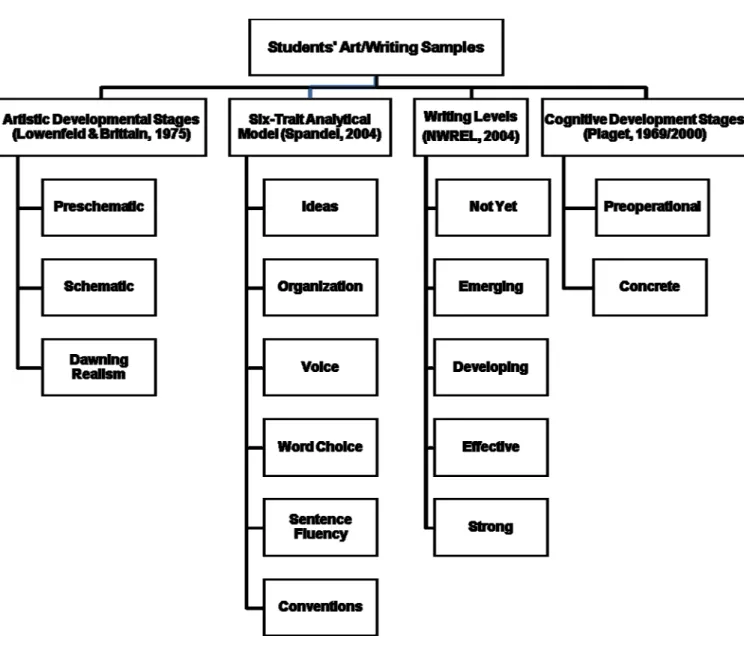
Analysis of Artistic Developmental Stages ... 92
Six-Trait Analytical Model Analysis ... 93
Analysis of Cognitive Development Stages... 95
Establishing Trustworthiness ... 97
Prolonged Engagement and Persistent Observation ... 98
Rich, Thick Description ... 98
Peer Review/Debriefing... 99
Clarifying Researcher Bias ... 101
Member Checks ... 101
Summary ... 102
CHAPTER 4 - Student Art/Writing Sample Analysis... 104
The Context of Summer School ... 105
Summer School Design ... 106
First Field Experience - Fishing Trip ... 107
Primary Camp Mini-Lesson... 108
Representative Primary Students ... 110
Intermediate Camp Mini-Lesson ... 112
Representative Intermediate Students... 113
Additional Students... 119
Summary of First Field Experience ... 120
Second Field Experience – Prairie Conservation ... 120
Primary Camp Mini-Lesson... 122
Representative Primary Students ... 123
Intermediate Camp Mini-Lesson ... 126
Representative Intermediate Students... 128
Additional Students... 133
Summary of Second Field Experience... 135
Third Field Experience - Nature center... 135
Primary Camp Mini-Lesson... 137
Representative Primary Students ... 138
Intermediate Camp Mini-Lesson ... 141
Representative Intermediate Students... 142
Summary of Third Field Experience... 149
Fourth Primary Field Experience - Fire Department... 151
Primary Writing Camp Mini-Lesson ... 152
Representative Students ... 153
Additional Primary Students... 156
Summary of Fourth Primary Field Experience... 156
Fourth Intermediate Experience - Favorite Summer Activity... 156
Intermediate Writing Camp Mini-Lesson... 157
Representative Intermediate Students... 160
Additional Intermediate Students ... 164
Summary of Fourth Intermediate Experience... 166
Final Summer Writing Camp Project... 167
Primary Writing Process ... 167
Representative Primary Students ... 168
Additional Primary Students... 171
Intermediate Writing Process... 171
Representative Intermediate Students... 173
Additional Students... 178
Summary of Final Summer Writing Camp Project... 180
CHAPTER 5 - Holistic Analysis ... 182
Base Line Analysis... 182
Artistic Development Stage Analysis... 186
Individual Six-Trait Analysis ... 189
Writing Level Analysis ... 195
Artistic Stage and Writing Level Analysis... 199
Cognitive Stage Analysis ... 200
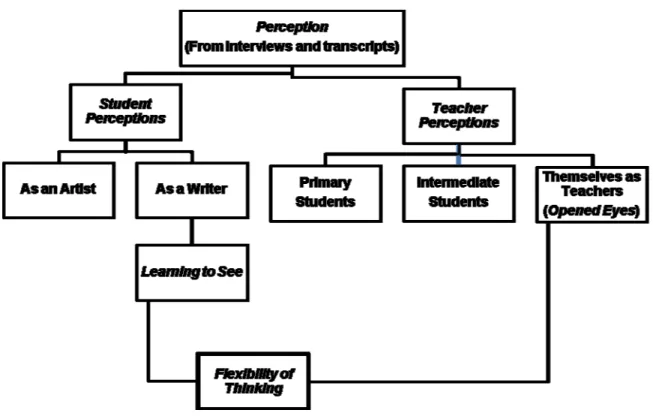
Analysis of Student and Teacher Perceptions ... 202
Student Perceptions... 203
Teacher Perceptions ... 210
The Common Ground – Flexibility of Thinking... 215
CHAPTER 6 - Discussion ... 223
Summary of the Study... 223
Findings ... 226
Conclusions ... 243
Implications for Further Research... 245
Implications for Classroom Instruction... 249
Final Thoughts... 252
References... 255
Children’s Literature Cited ... 273
Instructional Programs Cited ... 274
Appendix A - Summer School Documents... 275
A-1 Summer School Program Flyer... 276
A-2 Summer School Application ... 278
A-3 Sample Lesson Plans (Primary & Intermediate)... 279
Appendix B - Pilot Exploration ... 281
B-1 Flint Hills Writing Project Flyer ... 282
B-2 Flint Hills Writing Project Student Samples ... 283
Appendix C - IRB Documents... 286
C-1 Research Site Permission Letter... 287
C-2 IRB Approval Letter... 288
C-3 Parent Information Letter ... 289
C-4 Parent Informed Consent Form ... 290
C-5 Teacher Informed Consent Form ... 291
Appendix D - Data Collection and Analysis Samples ... 292
D-1 Sample Fieldnotes ... 293
D-2 Original Questions for Guided Conversation... 295
D-3 Revised Primary Questions for Guided Conversations... 296
D-4 Interview Face Sheet ... 297
D-5 Classroom Teacher Questions... 298
D-6 Sample Student Interview Transcript... 299
D-8 Sample Initial Coding ... 303
D-9 Writing Level Continuum ... 305
D-10 Sample Mini-lesson Transcript ... 306
D-11 Primary Student Six-Trait Analytical Model Trait Rubrics... 308
D-12 Intermediate Student 6+1 Writing Trait Rubrics ... 311
D-13 Percent Agreement Worksheets ... 317
Appendix E - HyperRESEARCH, 2.8 Screen Captures ... 320
E-1 Source File Screen Capture ... 321
E-2 Case Screen Capture... 322
E-3 Code Screen Capture ... 323
E-4 Coded Interview Screen Capture... 324
List of Figures
Figure 3.1. Initial Coding Categories... 88
Figure 3.2. Focused Code Methodology... 90
Figure 5.1. Final Artistic Development Stages... 187
Figure 5.2. Average Changes to Six-Trait scores (Primary Camp) ... 190
Figure 5.3. Average Changes to Six-Trait scores (Intermediate Camp)... 192
Figure 5.4. Comparison of Whole Camp Base line and Final Writing Levels ... 197
Figure 6.1. Summer Writing Camp Design ... 227
List of Tables
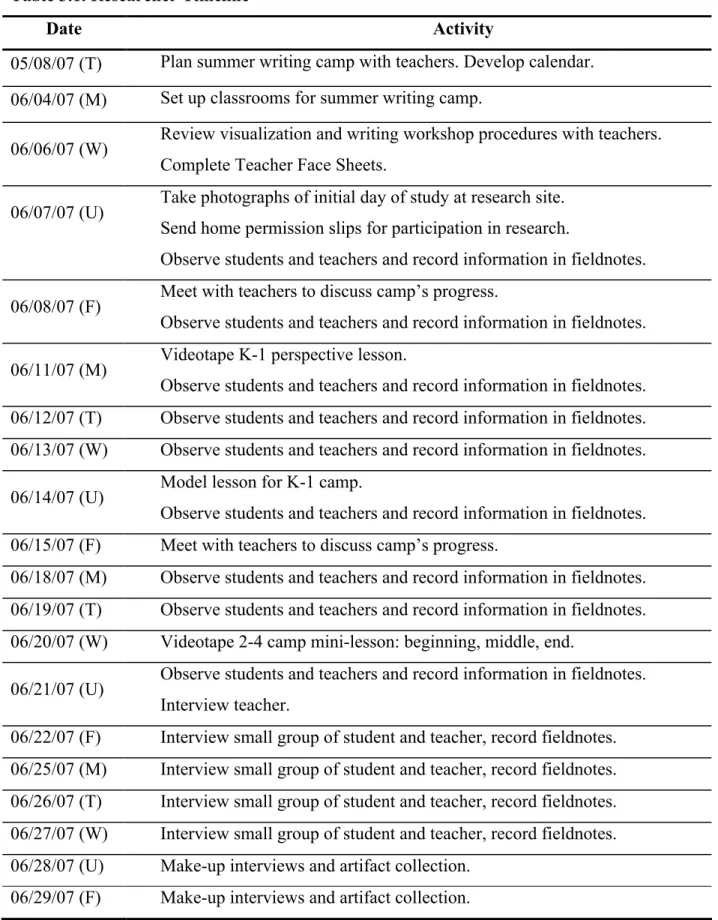
Table 3.1. Researcher Timeline ... 55
Table 3.2. Daily Camp Timeline... 66
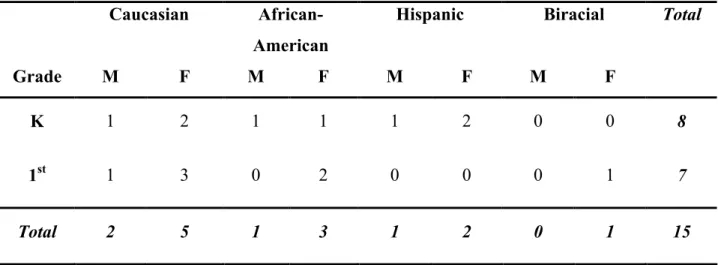
Table 3.3. Primary Camp Demographics... 68
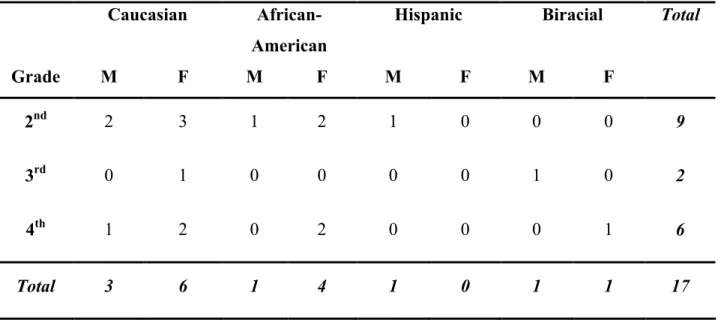
Table 3.4. Intermediate Camp Demographics ... 69
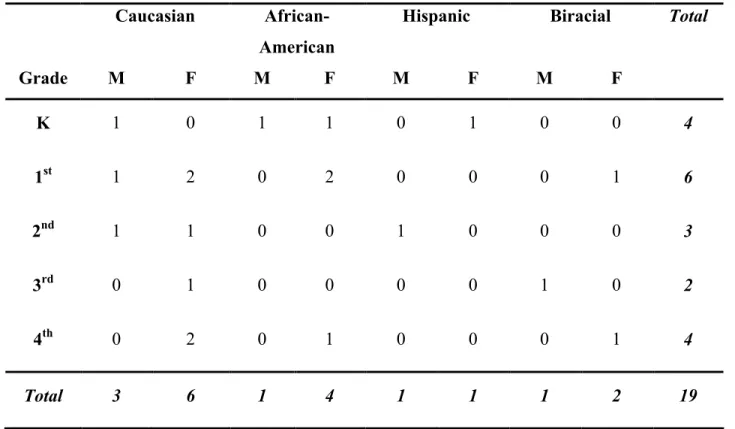
Table 3.5. Demographics of 19 Selected Student Participants ... 75
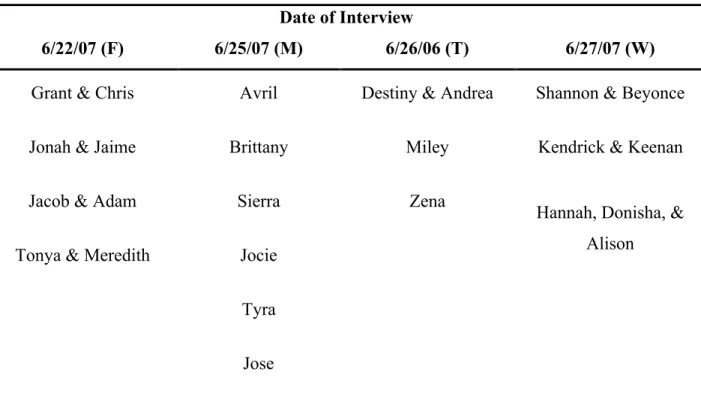
Table 3.6. Student Groups and Interview Dates ... 80
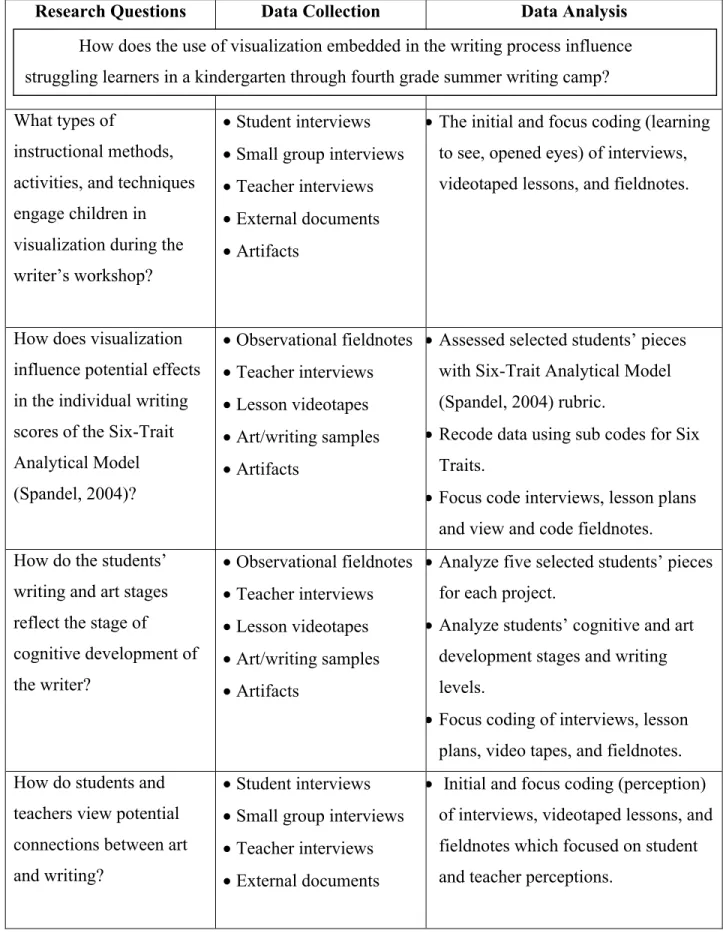
Table 3.7. Research Question, Data Collection, and Data Analysis... 85
Table 3.8. Percent Agreement for the Study... 100
Table 4.1. Artistic, Writing, and Cognitive Analysis of the First Field Experience... 118
Table 4.2. Artistic, Writing, and Cognitive Analysis of the Second Field Experience ... 133
Table 4.3. Artistic, Writing, and Cognitive Analysis of the Third Field Experience ... 147
Table 4.4. Artistic, Writing, and Cognitive Analysis of the Primary Field Experience ... 155
Table 4.5. Artistic, Writing, and Cognitive Analysis of the Intermediate Experience ... 164
Table 4.6. Artistic, Writing, and Cognitive Analysis of the Final Project... 179
Table 5.1. Analysis of Student Participant's Base Line Art/Writing Artifacts ... 184
Table 5.2. Stage of Artistic Development Comparison (19 Students)... 188
Table 5.3. Individual Six-Trait Scores Comparison (Primary Camp) ... 191
Table 5.4. Individual Six-Trait Scores Comparison (Intermediate Camp)... 193
Table 5.5. Writing Level Comparison (19 Students)... 198
Table 5.6. Comparison of Stages of Artistic Development and Writing Levels ... 200
Table 5.7. Comparison of Cognitive Development Stage and Writing Level ... 201
Table 5.8. Comparison of Cognitive Development Stage and Artistic Stage of Development.. 202
Table 5.9. Analysis of Participating Students' Final Art/Writing Samples ... 222
Table D-6.1. Focused Code Agreement for Reliability Sample Cases... 317
List of Student Art/Writing Samples
Art/Writing Sample 4.1. Kendrick's Fishing Trip... 110
Art/Writing Sample 4.2. Brittany's Fishing Trip ... 111
Art/Writing Sample 4.3. Jose's Fishing Trip... 113
Art/Writing Sample 4.4. Jacob's Fishing Trip ... 115
Art/Writing Sample 4.5. Beyonce's Fishing Trip ... 117
Art/Writing Sample 4.6. Kendrick's Prairie Trip... 123
Art/Writing Sample 4.7. Brittany's Prairie Trip... 125
Art/Writing Sample 4.8. Jose's Prairie Trip... 128
Art/Writing Sample 4.9. Jacob's Prairie Trip... 129
Art/Writing Sample 4.10. Beyonce's Prairie Trip... 131
Art/Writing Sample 4.11. Kendrick's Nature Center Trip ... 138
Art/Writing Sample 4.12. Brittany's Nature Center Trip... 140
Art/Writing Sample 4.13. Jose's Nature Center Trip ... 142
Art/Writing Sample 4.14. Jacob's Nature Center Trip... 144
Art/Writing Sample 4.15. Beyonce's Nature Center Trip... 145
Art/Writing Sample 4.16. Kendrick's Fire Department Trip ... 153
Art/Writing Sample 4.17. Brittany's Fire Department Trip ... 154
Art/Writing Sample 4.18. Jose's Favorite Summer Activity ... 160
Art/Writing Sample 4.19. Jacob's Favorite Summer Activity ... 161
Art/Writing Sample 4.20. Beyonce's Favorite Summer Activity ... 162
Art/Writing Sample 4.21. Kendrick's Final Project... 168
Art/Writing Sample 4.22. Brittany's Final Project... 170
Art/Writing Sample 4.23. Jose's Final Project... 173
Art/Writing Sample 4.24. Jacob's Final Project... 175
Acknowledgements
I truly appreciate the guidance and support from Dr. Marjorie Hancock. She has served as a true mentor in this process. Her wisdom and insight is woven through every word I wrote. She always reassured me of my ability to complete this dissertation. Although Dr. Hancock was my Major Advisor, she was also my counselor, life coach, cheerleader, and teacher. I aspire to be as professional and successful as Dr. Hancock. I know my journey through life will somehow be a result of Dr. Hancock’s high and excellent standards.
I would also like to acknowledge and thank the members of my committee, Dr. Trudy Salsberry, Dr. Todd Goodson, and Dr. BeEttaStoney for their expertise and professional guidance. Dr. Salsberry taught me the foundations of research upon which this case study was built. Dr. Goodson always provided professional advice, and he believed in my abilities as a teacher and researcher. Dr. Stoney provided insight with teaching and researching students of diversity. I also extend this gratitude to Dr. Anne Phillips for serving as my outside chair.
I would like to thank USD 475’s Curriculum and Instruction department for their support and allowing me to design a summer writing camp. My sincere appreciation is given to the 5 teachers who were willing to teach visualization embedded in the writing process. I would also like to thank Samrie Devin for appointing me to the summer school committee and supporting my research.
There are a few friends I need to mention. I extend my sincere appreciation to Gail Frakes for always having lunch with me and taking care of me while my husband was away. Thank you to Mary Khoury who supported my teaching and seemed genuinely interested in my research. I appreciate Marilyn Reynoldson for her positive and supportive advice and friendship. I would like to thank Lacey Bonine for her kindness and friendship. I would like to acknowledge Dr. Chris Goering for his professional advice and friendship. I am thankful for Dr. Laurie Curtis’ help as an intercoder. Sarah Bideau spiritually touched my life during this process which gave me the courage to continue. Finally, I deeply appreciate the friendship and editing skills of KaLea Lehman.
I owe my determination and strong work ethics to my mother, Denise Smith. She never doubted my abilities and supported me in every decision. I would like to graciously thank her for passing her wit and introspective personality to me—which was much needed during the long, difficult work days.
Most importantly, I must acknowledge and with all my heart thank my loving and
devoted husband, Major Jeffery W. Jurand, U.S. Army. He is my hero not only for his service to our country, but for fighting his own “War on the Dissertation.” He helped create charts, tables, and figures, which would otherwise have taken me more countless hours to complete. He poured as much of his heart into the completion of my dissertation as I did. He pushed me to work diligently when I did not want to, and he encouraged me to do my best. Jeff always believed in my abilities. Thank you.
Dedication
This manuscript is dedicated to all the students I taught. It was their energy and spirit which moved me daily in the quest to finish. Whenever I had a disheartening day, I remembered their smiles, innocence, and most of all their gratitude for being their teacher. My heart belongs to the children. All I have ever wanted to do is be the best teacher I could. I always strived to help the struggling students in my classroom so they too could feel successful. I hope the work and dedication put forth in this dissertation illustrates how honored I was to be their teacher.
CHAPTER 1 - Introduction
The teacher begins, “Does an image pop into your head when I say ‘cat’? Use your background knowledge of what a cat looks like to form an image. Now, look closer as if you were focusing the image with binoculars. Does the cat have whiskers? What color is the cat? Next, draw the image of the cat from your head in your writing journal.
Now, after visualizing the image in your head, describe what the cat looks like using words. “With this ‘picture in your head,’ what details do you see? Can you write those details?” Those images are expressed through the use of language.
“Let me show you my drawing and caption,” the teacher says. “The fat, lazy orange and white tabby with long, white whiskers peered out the window and watched the bluebirds flutter whimsically in the birdbath.” The teacher explains she had a cat similar to the one she drew and ironically named it Race because its white stripes looked like racing stripes on a car.
The teacher invites the students to share their pieces. One girl raises her hand to share “Kitten Surprise,” an illustration of a mother cat and her four babies curled up together, and reads a short narrative depicting the time her cat had four babies. From the “Kitten Surprise” illustration the young writer demonstrated using visualization to conceptualize the story line for her writing piece.
People often think and learn through the use of images, visual connections, and sound associations. Utilization of imagery aides in the structure of language, art, media, and the thinking processes. It is a formative element of communication and artistic creativity, and an integral aspect of thinking, speaking, listening, reading, and writing (Zitlow, 2000).
Many writing teachers understand the value of art as a form of pre-writing. Sidelnick and Svoboda (2000) note that drawing in the writing process can encourage reluctant writers to compose after the writers draw their ideas. It is important for writing teachers to understand the link between seeing, telling, drawing, and writing (Ernst, 1994).
This study utilizes a combination of learning theories and classroom practices to examine their use in the context of the writing workshop. The study examines visualization in the writing process with elementary students. Chapter 1 has the following sections: (1) teacher perspective; (2) overview of the issues; (3) statement of the problem; (4) purpose of the study; (5) research
questions; (6) significance of the study; (7) limitations of the study; (8) definition of terms; (9) and organization of the study.
Teacher’s Perspective
After teaching second grade for 4 years in a fairly diverse school near a military
installation, I implemented a visualization strategy in the writer’s workshop to help students in their concrete stage of learning physically draw and see what they intended to write. The writing produced in conjunction with these drawings promoted ideas, organization, and word choice– traits typically used to assess student writing.
During those 4 years, I decided to continue my professional education and 2 years ago, I completed and passed the National Board Certification for Teachers. The strongest of my four entries for the certification process was “Writing: Thinking Through the Process.” To fulfill the requirements for this entry, students had to create a fictitious dinosaur, using any media, and compose a narrative based on their new dinosaur’s characteristics. This lesson opened my eyes to using visualization in the writing process. My “ah ha” moment arrived as I observed the students inventing amazing story lines matching their dinosaurs and the creative, original names the students conceived. My students created new dinosaurs such as “Cotton-a-saurus” using cotton balls and “Macaroni-a-saurus” from macaroni shells. The students’ artistic creations were the springboard for their writing.
The student’s idea of a pasta-eating dinosaur named Macaroni-a-saurus was original and ingenious. The use of these simple classroom aides became a palette and canvas with which to write. The students’ writings described texture, shape, color, and other features of the dinosaurs while utilizing a variety of word choice. The students’ visualization of the dinosaurs made the creatures tangible and come to life with vivid detail. Students could see and touch the dinosaurs, then communicate their ideas in a precise and meaningful manner. Previously, student writings lacked the luster and vibrancy of descriptive and inspired writing. After assessing these student narratives, I noticed their scores increased in every category of the district’s writing Criterion Reference Test (CRT) compared to previous compositions. I merely stumbled on this
circumstance, and my observations were converted into the nucleus of my motivation. I began to understand and embrace the concept that students must visualize what they are writing before
they put pen to paper. The products my second graders produced during this dinosaur writing project stood in stark contrast to their other writings. Their work surpassed the other narratives the students composed. Upon reflection, I realized that visualizing as part of the pre-writing stage could lead to incredible writing.
Overview of the Issues
Policy makers, school board members, and educators constantly search for ways to promote learning while closing the achievement gap. In 2002, President Bush signed No Child Left Behind Act [NCLB] of 2001 (PL 107-110). With NCLB (2001), schools are required to make Adequate Yearly Progress (AYP), and the law mandates schools provide students with a high-quality education to make AYP. Reading First (National Reading Panel, 2000), an NCLB (2001) initiative, outlines the manner in which funds and tools are provided to ensure every student can read on grade-level by third grade.
Higgins, Miller, and Wegman (2007) assert current language arts curricula concentrates heavily on reading due to mandatory state testing. As a result of NCLB (2001), many schools adopted an uninterrupted 90 minute block of language arts instruction. A March 2006 report from the Center on Education Policy (p. xi) confirmed that 60% of school districts surveyed reported policies which apportion a specific amount of time to reading instruction and 50% reported similar practices for math. The report also stated that in order for districts to provide more instructional time for reading and math, districts reduced time for all other subject areas of instruction, including the arts. This lack of time for writing requires struggling students to attend after-school or summer literacy programs to receive direct instruction and multiple opportunities to develop as a writer. NCLB has caused educators to think about other strategies to reach all students to make them successful. The National Commission on Writing for America’s Families, Schools, and Colleges (2006), reported that writing was the neglected “R” of, “Reading, wRiting, and aRithmitic” in the time of NCLB. To increase students’ writing abilities, the Commission (2006) recommended doubling the amount of time students write and increase the amount of resources devoted to writing instruction.
Teachers can refer to the Standards for the English Language Arts (National Council of Teachers of English/International Reading Association [NCTE/IRA], 1996) for guidance to
maximize writing instructional time. The purpose of the standards is to provide all students opportunities and resources to develop language skills so the students can become participating, literate members of society (NCTE/IRA, 1996). The impact of NCTE/IRA standards have affected how teachers, administrators, and curriculum developers view and define elementary writing. The following four standards are applicable to writing instruction:
Students adjust their use of spoken, written, and visual language to communicate effectively with a variety of audiences for a variety of purposes.
Students use a varied range of strategies as they compose and use different writing process elements to communicate with audiences.
Students should apply knowledge of language structure, language conventions, media techniques, figurative language, and genre to create, critique, and discuss print and nonprint texts.
Students should participate in a variety of literacy communities (NCTE/IRA, 1996, p. 3).
These standards are addressed in the writing workshop. Graves (1983/2003) noted the writing workshop must occur at least three to four times a week for 45 to 60 minutes per session to increase writing skills. Writing is recursive and should be taught through connections and modeling instead of through grammar drills and assigned timed writing topics (Flower & Hayes, 1981). These fundamentals create the writing workshop model (Atwell, 1987; Graves,
1983/2003). Fletcher (2001) noted that students who participated in the writer’s workshop often performed well on formalized tests. With state testing demands and time constraints often
driving curricula, how can writing instructors incorporate research-based best practices in writing instruction and meet national standards?
Writing is a form of communication and should be shared with others. Students should have the ability to choose what to write about, have ample time to develop ideas, and receive feedback from peers and instructors to write effectively (Atwell, 1987; Routman, 1994; Wood & Dickinson, 2000). Donald Graves (1983/2003) stated young students should publish because, “Publishing contributes strongly to a writer’s development” (p. 54).
One of the main goals of teachers is to create lifelong writers. To achieve this goal, teachers should provide positive writing experiences in a comfortable learning environment where students feel free to take risks and express themselves (Chambliss & Bass, 1995). When
students enter kindergarten they most often do not see themselves as readers, but almost always as writers. Language is the ability to construct meaning from experiences (Tompkins, 2001). From the kindergarten students’ perspectives, they can write because, to them, their scribbles and drawings have meaning.
To create lifelong writers, teachers should provide opportunities for students to write and express themselves every day. Writing should be seen as a way to record information, write personal notes, share poetry, and stories. Writing should not be produced in isolation, but integrated in every subject. Using writing as an everyday tool can show children the value of writing is one’s life. Katie Wood Ray (2001) described the writing workshop as, “. . . often filled with so many more possibilities than is a room where students do the writing process” (p. 5).
With less time and money, “No Child Left Behind legislation means increasing academic time for core subjects, which translates into cutting time for arts education,” (Young, 2005, p.88). The Center for Education Policy’s March 2006 report, From the Capital to the Classroom: Year 4 of the No Child Left Behind Act revealed, “71% of school districts reported that they have reduced elementary school instructional time in at least one other subject to make more time for reading and mathematics—the subjects tested for NCLB purposes” (p. ix). With arts programs first among those feeling the budget and time crunch, classroom teachers often incorporate arts in the daily instruction in order to meet the national standards.
The arts stimulate learning by stimulating developmental areas not used in other subjects which include, “integrated sensory, attentional, cognitive, emotional, and motor capabilities and are, in fact the driving forces behind all other learning” (Jenson, 2001, p.2). Armstrong (2003) claimed arts can enhance literacy skills and encourage new types of literacy to occur. Students learn best when they create because engagement and attention are essential for comprehension (Marzano, 2004). Fiske (1999) asserted all students, especially those at-risk—English-language learners and students with learning disabilities—can prosper from art activities. When students are actively engaged and using different parts of their brain and multiple senses, the products they produce improve and showcase their talents.
Copple et al. (2000) state, “learning to read and write is a complex and multifaceted process that requires a wide variety of instructional practices” (p. 14). From a curriculum and standards perspective, using visualization in the writing workshop to help generate ideas could meet both literacy and art national standards.
Drawing in conjunction with writing permits the child to use multimodality to
communicate. Visual/Spatial intelligence is the ability to think in images and understand their relation to other objects or to one another (Gardner, 1983/2004). A drawing is a tangible image for the writer. Rochelle I. Frei (1999) expressed in plain words, “[art] can be used the same way written text can to expand a child’s knowledge of the world and to understand what children do when they make sense of that world . . . Art can provide a window into how children negotiate their understandings of images and their knowledge of the world” (p. 386). Donald Murray (1994) believed all writers write from images either from paper or their minds. The writer “must use words to communicate the story/image/emotion . . . Writers love their language” (Fletcher, 1993, p. 32). Regie Routman (2005) believed prewriting could occur before writing, but also occurs when the writer rethinks what he or she has written. She listed several ways to prewrite which included, “drawing to spur writing” (Routman, 2005, p. 179). Olshansky (1995) stated when student’s stories are driven by visual images, their writing is transformed in many powerful ways which enriches the story and enhances the finished product. Drawing is one manner with which young students gather and organize ideas for writing.
Statement of the Problem
Elementary school teachers face a number of challenges teaching every subject in a demanding, state-test driven environment. Educators continuously seek ways to meet the individual needs of learners while simultaneously closing the achievement gap. Many teachers alternate their literacy curricula to meet the heavy demands of testing (Harmon, 2000).
Unfortunately, standard, prescriptive, teacher-centered curriculum drives instruction in most states (Falk, 1998). To further complicate the matter, teachers often do not know how to teach writing or schedule the writer’s workshop. Through the writing workshop, students learn to express themselves artistically, emotionally, and factually.
In the modern teaching environment driven by NCLB, educators constantly struggle to demonstrate AYP by producing results instead of teaching meaningful lessons. Wolf and Wolf (2002) state, “Driven by state testing, teachers are being pulled toward prompt-and-rubric
teaching that bypasses the human act of composing and the human gesture of response” (p. 230). With progress now directly tied to the federal budget; administrators are faced with a dilemma.
How do schools demonstrate AYP and achieve a standard of educational excellence given the current metric of success is the standardized tests? This complex issue is, at times, at odds with the fundamental reasons for teaching, the growth and development of young minds and the building of a strong foundation for life.
Regardless of protests against or arguments in favor of NCLB, it is an issue teachers and administrators confront daily. Presently, there is a trend to provide additional time for literacy and math instruction by taking away time spent in instruction in the arts (Rentner et al., 2006). With reading and mathematics so heavily emphasized in a time when AYP is a benchmark for success, everything else has become subordinate to those two subjects. Educators must now find ways to incorporate writing instruction and balance the most precious and dwindling resource of the school—time. Time must also compete with other subject areas which are not measured by standardized testing under the provisions of NCLB. Visualization embedded in the writing process may offer multiple techniques and methods to affect student learning. The current popular and successful method of the writing workshop model (Atwell, 1987; Graves,
1983/2003) takes time on its own. How can educators accomplish everything while providing meaningful and effective writing instruction?
Purpose of the Study
This study sought to gain a deeper understanding of how elementary age students
(kindergarten through fourth grade) in a summer school writing program use art to visualize their writing. Designed as a qualitative case study, this research sought to provide rich description of some practices and techniques that utilize visualization in the writing process during a summer writing camp. Research about the benefits of visualization in conjunction with writing is lacking. Furthermore, the educational field lacks research about the potential developmental relationship between one’s stage of artistic development, writing stage, and stage of cognitive development.
Visualization is defined as the ability to create a mental image and draw the image before writing (Douville, 1999). To understand visualization in the writing process one must analyze the methods, activities, and techniques used to incorporate it. Ernst (2001) asserted when drawing is part of the writing process, the picture becomes the tangible image. Drawing provides the author the ability to see it clearly, write details, and revise both thinking and writing.
The participants of the study were struggling learners attending a summer school writing camp. Students used a variety of experiences and media to visualize images. They then drew in their art/writing journal, as a prewriting strategy, before drafting and referring to the drawings throughout the writing process. Students used self-created art as a springboard to compose either a narrative or expository texts.
As a teacher, I know organizing the writer’s workshop is difficult for a classroom with diverse personalities and abilities. However, when my students drew before writing, I observed, they were less confused about what to write. If my students created something out of clay, paint, or other media, the concrete creation meant something to them and articulating its meaning was easier than writing about a fictitious character. I wanted to understand how the prewriting act of creating an image helped students develop and organize ideas. Although combining writing and art will not create more time in the instructional day, it allows teachers to maximize the time they have left after the reading and math blocks. In addition, using visualization in the writing process simultaneously exposes children to the often removed art curriculum standards.
Available research raises many interesting questions which, to date, have remained unanswered or unexplored. This case study sought to understand how visualization can be used in the writing process to help struggling learners.
Research Questions
Other areas related to learning, such as artistic and cognitive development stages, are foundations to better understanding the writing levels of students in kindergarten through fourth grade. Due to the importance of these areas of learning, a number of research questions utilize these ideas. Thus, the overarching question in this qualitative case study is:
How does the use of visualization embedded in the writing process influence struggling learners in a kindergarten through fourth grade summer writing camp?
To gain a deeper understanding of this topic, the questions below explore the use of visualization in the writing process and seek to provide insight into how visualization can be used as an instructional technique in the classroom.
1. What types of instructional methods, activities, and techniques engage children in visualization during the writer’s workshop?
2. How does visualization influence potential effects in the individual writing scores of the Six-Trait Analytical Model (Spandel, 2004)?
3. How do the students’ writing and art stages reflect the stage of cognitive development of the writer?
4. How do students and teachers view potential connections between art and writing?
Significance of the Study
The connection between the arts and literacy has garnered attention in recent literacy research (Berghoff, 1995; Buehl, 2001; Ernst, 1994; Harste, 1994, 2003; Lambert-Stock, 2004; McKay & Kendrick, 2001; Short, Harste, & Burke, 1995). However, there is limited research linking the visual arts and the writing of a text. There is little to no research stating how a student’s writing and art stages reflect the stage of cognitive development of the writer.
Writing workshop manuals written by Donald Graves (1983/2003), Lucy Calkins (1986/1994), Regie Routman (2005), and Katie Wood Ray (2004) see student’s drawings accompanying the student generated text, but analyze the words instead of the art. There is little available research to help understand how pictures inspire writing or when in the writing process a student drew the picture. Currently, the most common way of incorporating the visual arts into written literacy is drawing a picture after the text is written. This post-writing artwork is
typically seen as a way students celebrate their writing (Ray, 2004).
There are several articles written from a teacher-researcher point of view about the power of implementing writing-artist workshops. Elizabeth Olbrych (2001) explained that the power of her fourth-grade students’ voices reminded her of the importance of using a physical image to jumpstart writing. The opportunity to create artwork before writing helped her students develop skills of description, reflection, and word choice. Kay Cowan (2001b) stated that
drawing inspired word choice in a kindergarten and first grade classroom in rural Georgia: “their drawings helped them find words to tell their stories when they were composing verbally or in writing” (p. 17). The ability to visualize an idea to write enhances the ability to communicate
according to Ernst (2001), “When drawing is part of literacy, it helps us know our subjects and our thinking and encourages us to dig in” (p. 3).
Visualization is strongly connected to increasing reading comprehension. Keene and Zimmerman (1997) in Mosaic of Thought state, “Proficient readers spontaneously and purposefully create mental images while and after they read” (p. 141). “Students create vivid mental images of ideas and concepts that help them remember information longer” (Buehl, 2001, p. 61). Furthermore, research reveals students who create visual images, before, during, and/or after reading increase their comprehension (Douville, 1999; Fillmer & Parkay, 1990). Teachers rely on visualization to increase comprehension. The educational field lacks an in-depth
systematic case study focusing on how visualization embedded in the writing process may be used to help struggling learners in kindergarten through fourth grade. There is evidence linking visualization and reading. However, research connecting visualization and the writing process is lacking and needed.
Limitations of the Study
Qualitative research captures rich details of the case study’s subject which is a summer school writing program in a Midwestern school district. The study’s context has inherent limitations. By identifying the limitations from its inception, they can serve as a stepping stone for further research and not provide a false perspective.I selected a case study approach to understand the specific in depth, rather than generalize (Merriam, 1998). Limitations of this study may include: 1) duration of the study; 2) small sample size; 3) student choice; 4) collection of artifacts; 5) teachers’ right to instructional decision making; and 6) researcher’s predisposition.
The length of the study is one of its shortcomings. The context and timeframe of the case study does not mirror the traditional duration of the school year. Much will be accomplished in the 3 ½ week summer school period, but the ability to continue to develop the concepts and repeated visualization/writing links is limited. Due to the study’s narrow time span, any changes to the students’ writing levels and art stages may not be representative of any changes which may occur using the same techniques over the traditional school year. A writing and art base line will be established and the results of a final writing and art assessment will be discussed in Chapter 4.
As with many qualitative studies, the sample size of this research is small. The 19 students selected for analysis offer diversity in demographics. Most students were selected by their classroom teacher to attend summer school based on academic need. Struggling learners are those who are not on grade-level in reading and math as determined by letter grades and district test scores. Struggling students also include English- language learners (ELL), students at-risk determined by low socioeconomic status or high mobility, and students receiving special education. As a result of those selected to attend summer school, the percentage of students categorized as struggling learners will be higher in this study than the representative population. Although this case study may have a small research sample, I purposefully selected the study’s context to provided rich opportunities for data collection. The summer school writing program’s complete focus on writing provided more opportunities to observe visualization embedded in the writing progress and gain a deeper understanding of how these practices and methods of
instruction may help struggling learners.
The summer school program was divided into four camps. Writing was one of the four camps. Other camps included technology and writing, math and science, and drama and music (see Appendix A1). Parents completed the summer school forms for their child and requested one of these four camps (see Appendix A2) after discussing the options with the student’s teacher. However, the intent of the summer school program was to allow students choice in their learning. The participants in the writing camp may want to be there because they enjoy writing and parents respected their choice, or the parents felt their child needed extra assistance in writing based on their child’s abilities.
Collection of artifacts at times was limited because the media used was not always conducive to duplication. The color yellow does not duplicate well, and I arranged for darker shades of yellow to be available for the students when coloring. Using a digital camera to capture images provided another option for duplicating the students’ work.
The teachers in the study were not trained to embed visualization in the writing process prior to being selected to teach for the summer school writing program. Some teachers were assigned to the summer writing program despite a desire to teach another summer program. I respected the teachers’ instructional decisions. At times respecting the instructional decisions were contrary to the stated purpose of this research. More details about my relationship with the teachers and the results of their decisions will be discussed in Chapters 3 and 5 respectively.
I decided to act as a participant-observer in this study. This was the most suitable role for gathering data given the context of the summer school writing program. I explain the rationale behind this decision in the Role of the Researcher section of Chapter 3. My years as a classroom teacher have helped shape my views in using visualization embedded in the writing process. Eisner (1991) and Patton (1990) both assert a researcher’s ability to be sensitive to the data effects the credibility of the research. My professional experience as a classroom teacher and my personal experience during the National Board Certification process shaped a theoretical
sensitivity to the, “subtleties of meaning of data . . . [It] refers to the attribute of having insight, the ability to give meaning to data, the capacity to understand, and capability to separate the pertinent from that which isn’t” (Strauss and Corbin, 1990, p. 42).
These limitations are relevant to the context of this qualitative case study. It is for future researchers to explore whether comparable research environments will provide a similar
understanding of visualization embedded in the writing process in a summer school writing program for struggling learners in kindergarten through fourth grades.
Definition of Terms
The following terms are defined as they relate to the context of this case study:
1. Egocentrism: A central theme in Piaget’s (1926) Theory of Intelligence. It refers to a child’s awareness of him or herself and how that awareness is expressed. The degree to which a child exhibits an egocentric focus indicates into which of Piaget and Inhelder’s (1969/2000) four cognitive stages he or she can be categorized.
2. Developmental cognitive thought process: A student’s ability to express his/her thoughts which can be categorized into Piaget and Inhelder’s (1969/2000) four cognitive stages: Sensorimotor, Preoperational, Concrete, and Formal.
3. Field experiences: Events where teachers led their students to activities in the local community to create experiences, provide schema, and form a visual environment.
4. Intermediate writing camp: Refers to the students in grades second through fourth who attend the summer writing camp for struggling learners sponsored by a Midwestern district.
5. Art/writing journals: A premade book with three fourths of the page blank for drawing and the bottom fourth, lined for writing. They are used by students to record observations from field experiences as well as personal entries. Writing ideas for the final writing and art piece came from the students’ journals.
6. Journal writing: The act of writing thoughts, observations, memories, and emotions in a journal, day book, or notebook as a way of rehearsing (Calkins, 1986/1994; Graves, 1983/2003).
7. Literacy: The ability of an individual to read, write, listen, speak, view, or visually represent their thoughts and ideas by communicating, understanding, and interpretating both print and non-print media (Hancock, 2007).
8. Mental imagery: The mind’s ability to create images or the patterns produced by the eye and brain (Broudy, 1987).
9. Mini-lesson: “Is our forum for making a suggestion to the whole class- raising a concern, exploring an issue, modeling a technique, reinforcing a strategy” (Calkins, 1986/1994, p. 193).
10.Multimodality: The various ways one makes meaning through drama, art, singing, images, or computer games (Siegel, 2006).
11.Primary writing camp: Refers to the students in kindergarten and first grade who attend the summer writing camp for struggling learners sponsored by a Midwestern district. 12.Semiotic meaning construction: Experiences where students construct and translate
meaning across sign systems (Cowan & Albers, 2006).
13.Semiotics: Knowledge of and facility with communications systems including art, language, math, drama, and dance (Cowan & Albers, 2006).
14.Spatial Relationship: The degree to which students place drawn objects in relation to each other with respect to their location, orientation, and scale (Piaget & Inhelder, 1969/2000, Lowenfeld & Brittain, 1975).
15.Summer writing camp:The 3 ½ weeks of writing instruction for struggling learners sponsored by a Midwestern district. It is the context of this case study.
16.Transmediation: Recasting meaning from written language to another sign system (Cowan & Albers, 2006).
17.Visualization: The ability to create a mental image and draw the image before writing (Douville, 1999).
18.Visual arts: Art forms that are referred to as visual such as drawing, painting, photography, and sculpting (McDonald & Fisher, 2006).
19.Visual literacy: “The ability to understand (read) and use (write) images and to think and learn in terms of images, i.e., to think visually” (Hortin, 1983, p. 99).
20.Writing process: Taking a piece of writing through the writing stages: prewriting, drafting, revising, editing, and publishing (Graves, 1983/2003). In this case study, various stages of the writing process were modeled by teachers and implemented by students.
21.Writing workshop: A devoted allotment of time and space where children practice writing, take a piece through the writing process, and learn from mini-lessons and conferences with an instructor. This experience is “. . . simply a time when children get to try their hands at making written language work—at generating text—all on their own” (Ray, 2004). In this case study it refers to the time spent in the classroom where teachers taught mini-lessons and counseled with students about their pieces, and when students collaborated with each other about their work. It is the community of writers formed by the participants of the summer writing camp. Students had the opportunity to take one piece of writing through the writing process (Graves, 1983/2003).
Organization of the Study
Chapter 1 introduces the case study by providing a background of relevant issues and information. It develops these issues, identifies the need to conduct the research, and states the overarching research question and sub-questions which guided this research. It is organized into the following sections: teacher’s perspective, overview of the issues, statement of the problem, purpose of the study, research questions, significance of the study, limitations of the study, definition of terms, and organization of the study.
Chapter 2 presents a broad theoretical framework highlighting theories and research pertaining to cognitive development, sociolinguistic theory, theory of multiple intelligences, emerging theory of visual literacy, developmental stages in art, and brain research which framed
the context of the study. Weaving these theories together demonstrates how they provide the necessary theoretical framework for this qualitative case study.
Chapter 3 explains the methodology of the study including how rich data were collected and analyzed to gain a deeper understanding of how visualization embedded in the writing process may help struggling learners in kindergarten through fourth grade. It includes a detailed description of a pilot exploration which provided the framework of the qualitative case study. I define my role as a researcher, provide a vivid description of the context of the study, explain the data collection and analysis processes, and discuss trustworthiness.
Chapter 4 presents a detailed analysis of the student art/writing samples collected during the case study. I divide the chapter into sections which correspond to each of the field
experiences. I provide rich details of a representative group of students’ work and weave observations of mini-lessons and comments from other student participants to describe the rich visual and literacy environments of the summer writing camp.
Chapter 5 is an extension of the analysis in Chapter 4, but it takes a holistic approach to the summer writing camp. In this chapter, I analyze artistic, writing, and cognitive levels for all selected participants to gain a greater understanding of how visualization embedded in the writing process may help struggling learners. I also incorporate a discussion of the codes which were revealed in the course of analysis of interview, mini-lesson, and fieldnote transcriptions.
Chapter 6 presents the theories and research in Chapter 2 overlaid with the analysis of the collected data in Chapters 4 and 5. I discuss the research questions and frame them in the context of the results of the case study, address areas for future research, and discuss implications for the practicing classroom teacher.
CHAPTER 2 - Review of Literature
Before examining the role of visualization in the writing process, we must understand its context. Literature exists concerning elementary-aged students’ cognitive development growth, learning styles, writing abilities, and drawing abilities. This chapter reviews literature from the fields of learning and cognitive theories. This theoretical portion of the chapter is organized in the following sections: 1) theory of cognitive development; 2) sociolinguistic learning theory; 3) theory of multiple intelligences; 4) emerging theory of visual literacy; and 5) developmental stages in art. Following the theoretical portion is a discussion of research related to this
qualitative case study from the following areas: 1) brain research; 2) writing workshop; 3) visual literacy; and 4) literacy and art.
Theoretical Perspectives
This study’s framework incorporates several learning theories. Writing is a complex act drawing from cognitive development, sociolinguistic, multiple intelligence, and art development theories. The specific methodology of this qualitative case study, described in Chapter 3, is based on an understanding of these theoretical perspectives.
Several educational philosophers believe teaching should be student centered and meaningful. In “My Pedagogic Creed,” John Dewey (1897) articulated, “only true education comes through the stimulation of the child’s powers by the demands of the social situations in which he finds himself” (p. 77). The case study I conducted explored the various powers of writing, visualization, and drawing to create a student-centered, purposeful learning experience.
Theory of Cognitive Development
Jean Piaget (Piaget & Inhelder, 1969/2000), a developmentalist, described children according to the development of their behavior patterns. He made contributions to the educational field through extensive research on how children progress through different
cognitive ability: Sensorimotor, Preoperational, Concrete-Operational, and Formal-Operational. Jean Piaget’s (Piaget & Inhelder, 1969/2000) theory of cognitive development serves as the main theoretical framework because elementary age students are at the center of the study.
The first stage is the Sensorimotor Stage (birth to about age 2). It is the beginning of comprehension, thinking, and making sense of one’s environment. The stage is characterized by six sub-stages: imitation, circular reactions, time reactions, the object concept, the causality concept and the space concept (Brainerd, 1978). The child moves and interacts with objects using his senses. As the child manipulates an object, he develops schemas, or a mental representation (Cohen, 2002).
The second stage is the Preoperational Stage (from about ages 2 to 7) and indicates the precursor to mental operations. Unlike the other stages, this stage is defined in terms of the lack of certain abilities (Brainerd, 1978) and is divided into two categories: preconceptual (2-4 years) and intuitive (4-7 years) (Cohen, 2002). In this stage, operation originates in action and in an organized manner. Here the child uses speech and other activities such as drawing and playing by pretending to develop language and communication skills (Piaget & Inhelder, 1969/2000).
The third and most pertinent stage to this qualitative case study is the Concrete-Operational Stage (from about ages 7 to 11). In this stage, children work with concrete and tangible information to form an operation, categorized as either logico-arithmetic or spatial operations (Brainerd, 1978). At this point, the child can think in abstract terms and has the ability to generalize knowledge from previous experiences (Piaget & Inhelder, 1969/2000).
The Formal-Operational Stage (from about ages 12 to 15) is last in the cognitive development continuum. The child uses deductive reasoning to make sense of something he or she previously encountered and begins to think in a scientific, inductive, or abstract manner in order to comprehend information (Brainerd, 1978). This requires the child to form higher-level cognitive thought processes and allows the child to think about events which might occur using his or her prior knowledge and experiences (Cohen, 2002).
These stages help the educator understand the child’s developmental cognitive thought processes. They are not finite stages, but act as developmental guides. The ages assigned to each stage are not restrictive because children move through stages when developmentally ready (Piaget & Inhelder, 1969/2000). Arthur Efland (2002) asserted that Piaget never claimed children move concretely from stage to stage; rather, they gradually progress. These vague boundaries
give educators a guideline of what to expect from their students. This qualitative case study is primarily concerned with the Preoperational (from ages 3 to 7) and Concrete-Operational (from ages 7 to 11) stages (Efland, 2002).
Within the Concrete-Operational stage is a category known as spatial operations. Piaget (Piaget & Inhelder 1969/2000) described two sub-stages of development within spatial
operations. The first involved the child grasping the concept and relation of one object and the second is the child’s ability to locate an object in space relative to another object (Brainerd, 1978). Spatial development, within the Concrete-Operational stage of cognitive development, is necessary to understand the drawing in the writer’s workshop because creating a drawing may encourage a greater understanding of the student’s writing idea.
Piaget also observed the development of imagery and drawing in his studies. The ability to draw or make a graphic image usually does not appear before age 2 (Piaget & Inhelder 1969/2000). Drawing is a function which occurs between play and the ability to form mental images. Most drawings are representations of what the child sees. These drawings are depicted realistically (Piaget & Inhelder, 1969/2000). The ability to make a mental image forms because of a child’s experiences and manipulation of objects. To make an image, a visual becomes an internalized imitation (Piaget & Inhelder, 1969/2000). Mental images fall into two broad categories: reproductive images and anticipatory images. Drawing and mental images are developed in the Preoperational stage and refined in the Concrete-Operational stage.
Although educators and psychologists do not agree on Piaget’s developmental theories, his contributions to the educational field are noteworthy. His theory of cognitive development promotes using concrete examples in the classroom to increase students’ ability to construct meaning (Piaget & Inhelder, 1969/2000). Piaget’s theory served as a framework to design writing workshop lesson plans which used visualization as a technique to include tangible examples for students in their various stages of cognitive development.
Sociolinguistic Theory
A second theoretical perspective of learning and language development is Lev
Vygotsky’s (1978, 1986) sociolinguistic theory. Vygotsky (1978) was a pioneer in the field of psychological thought in the early part of the twentieth century. A large portion of his work, and the subsequent efforts of his colleagues and students, has general implications on the study of
learning and education. These Vygotskians developed and refined a theory, with respect to learning, which had not been considered before. Vygotsky concentrated on how a child interacts with his or her parents, siblings, and peers (Cohen, 2002). He theorized that language is
developed through social interactions (Vygotsky, 1978, 1986) with adults and peers (Efland, 2002). This theory’s relevance to this study is specifically related to the methodology used in conducting this qualitative case study. The concept of the writer’s workshop could be
categorized as a Vygotskian method.
Vygotsky’s (1978) sociolinguistic theory was revolutionary because it reversed the way educators viewed the development of a child’s cognitive thought process. Unlike his forerunner Piaget, Vygotsky believed some mental development in children was a result of their own experiences. This was contrary to other contemporary theories in which the child’s cognitive development was seen as occurring naturally and independently of his or her environment. Vygotsky proposed the environment to which the child is exposed is critical and directly shapes the experiences which drive the mental development. This dual approach of engaging the child and acknowledging the social context of his or her experience became commonly referred to as social constructivism.
Vygotsky believed that children constantly sought to acquire higher mental functions and in order to reach a higher functioning level, a child needed to acquire a number of skills,
techniques, and methods. Vygotsky (1978) refers to these skills as the cultural tools of a society. Cultural tools in Vygotsky’s (1978) world are diverse, but regardless of their form, their function remains the same (Bodrova & Leong, 2001). All cultural tools are defined as external or internal (Bodrova & Leong, 2001). External tools are those which assist students to understand concepts above their current mental processing abilities while internal tools are solely within a child. Therefore, cultural tools range from language, to shared activities, to rules commonly
experienced in children’s games. They may be specific to a society and/or generalized across all cultures.
The cultural tools exist to help a child progress from a shared state to an individual state of learning. In the shared state, a child can only comprehend and understand concepts, actions, and artifacts. The child relies on guidance from others with a higher degree of mental maturity in order to bridge the gap between knowledge and experience (Bodrova & Leong, 2001). As time progresses, and a child becomes more capable of functioning on the same level with their
original guide, he or she begins to transition to the individual state of learning. However, it is important to note that depending on the topic studies, a child may be in multiple places on the shared-individual state of learning continuum. Progression from an individual state of learning to a shared state is commonly referred to as the law of the development of higher mental functions (Vygotsky, 1978).
Cultural tools also help bridge the gap between what a child can accomplish on his or her own and what he or she can accomplish with assistance (Freedman, 1994). Vygotsky (1978) refers to this gap as the zone of proximal development(ZPD). The ZPD is, “the distance between the actual developmental level as determined by independent problem solving and the level of potential development as determined through problem solving under adult guidance or in collaboration with more capable peers” (p. 8).
The ZPD is a fundamental concept in Vygotsky’s (1978) theory, but it highlights another issue. How do educators use cultural tools to bridge the ZPD? The answer is what has commonly been called scaffolding. According to Bruner (1985), this occurs when educators, “arrange the environment to enable the child to reach a higher or more abstract ground from which to reflect, ground on which he is enabled to be more conscious” (p. 23). Scaffolding is how a teacher gradually facilitates a student’s transition from a shared to individual state of learning. The further towards the individual side of the learning spectrum a student lies, the greater the use of internal cultural tools. Although the term scaffolding is not Vygotsky’s, it has helped succeeding generations of researchers and educators understand a practical method to employ his techniques.
Vygotsky’s (1978) sociolinguistic theory is relevant to the context of this qualitative case study because the writing workshop is an external cultural tool which places the learning within a comfortable, social context. Through this comfortable, learning environment, students are able to act as each other’s guide through the writing process. A Vygotskian practitioner may use visualization to improve the learning process and reduce the ZPD. Freedman (1994) stated, “The ideal situation for students to learn to write is one where they are engaged in social interaction and faced with accomplishing tasks they cannot complete individually” ( p. 3).
naturalus Vygotsky (1978) examined how children learn to use language as a tool to share cultural meaning as well as how using language affects the child’s learning and cognitive development. Vygotsky (1978) stressed how each child internalizes an experience contributes to the cognitive and personality development. Therefore, if all students are given the same material
to learn, each student may have a different experience depending on his or her background and learning style. Through visualization, teachers may provide an external cultural tool to scaffold the learning experience in an effort to bridge the ZPD.
The role of cognitive development and artistic ability needs to be further investigated to fully understand its impact on education. Linqvist (2001) remarks:
Vygotsky argues that children’s creativity in its original form is syncretistic creativity, which means that the individual arts have yet to be separated and specialized. Children do not differentiate between poetry and prose, narration and drama. Children draw pictures and tell a story at the same time; they act a role and create their lines as they go along. Children rarely spend a long time completing each creation, but produce something in an instant, focusing all their emotions on what they are doing at that time. (p. 8)
Theory of Multiple Intelligences
Teachers must keep abreast on learning theories to maximize lesson design. Over the past decades, there has been a shift in thinking regarding how intelligence relates to the education field. This shift is due to psychologist Howard Gardner’s (1983/2004) multiple intelligence theory (MI), which challenged traditional views of intelligence. “Multiple intelligence theory proposes that it is more fruitful to describe an individual’s cognitive ability in terms of several relatively independent but interacting cognitive capacitates rather than in terms of ‘general’ intelligence,” (Moran, Kornhaber, & Gardner, 2006, p. 23).
Franz Joseph Gall (1835) claimed that different parts of the brain mediate different functions. Building upon Gall’s phrenology theory, Gardner observed that people’s cognitive abilities corresponded with the development of different parts of their brain. This provided the impetus for Gardner’s theory of MI. Gardner’s MI theory is included in the design and
framework of this qualitative case study. In Gardner’s Frames of Mind (1983/2004) he identified seven intelligences humans possess: