An Intelligent Multi-Agent Based Model for
Collaborative Logistics Planning
By Manal Khayyat
A Thesis
In the Department of
Concordia Institute for Information Systems Engineering (CIISE)
Presented in Partial Fulfillment of the Requirements
For the Degree of Master of Applied Science (Quality Systems Engineering) at
Concordia University
Montréal, Québec, Canada
February 2015
© Manal Khayyat
ii
CONCORDIA UNIVERSITY
School of Graduate Studies
This is to certify that the thesis preparedBy: Manal Mahmoud Ali Khayyat
Entitled: An Intelligent Multi-Agent Based Model for Collaborative Logistics
Planning
and submitted in partial fulfillment of the requirements for the degree of Master of Applied Science (Quality Systems Engineering)
complies with the regulations of the University and meets the accepted standards with respect to originality and quality.
Signed by the final examining committee:
_________________________________________ Chair _________________________________________ Internal Examiner _________________________________________ External Examiner _________________________________________ Supervisor Approved by: _______________________________________________ __________ 2015 _________________________ Chair of Department or Graduate Program Director
Dean of Faculty Prof. Anjali Awasthi
Prof. Anjali Agarwal Prof. Yong Zeng
iii
Abstract
Efficient freight distribution is indispensable for sustaining customer demand in modern times. In recent years, there has been a steady growth in the use of information systems in the logistics domain towards facilitating an agile distribution process. This study investigates the problem of collaboration planning in logistics and proposes an agent based approach for better management of collaborative logistics. Based on the approach, a decision support system is designed that utilizes RFID technology for ensuring inventory accuracy and monitoring carriers’ delivery movements.
The proposed approach involves three steps. In the first step, a conceptual framework is designed. Afterwards, a simulation agent based model is developed including six autonomous agents namely (RFIDG, Supplier, Retailer, Carrier, Network, and City Administrator) interacting with each other, as well as, with the surrounding environment. In the second step, game theory is utilized to study and analyze suppliers’ collaboration and carriers’ collaboration behavior in detail. Modeled games are solved using Nash Equilibrium. Finally, correctness of the games is verified by formulating them mathematically. Developed optimization equations are fundamental to the operations research field. They employ the simplex and goal algorithms of linear programming.
Results prove that there are plethora of advantages such as automatism and real time response, cost reduction, increased suppliers’ profits, time management, and a collaborative framework for implementing the proposed agent based model where
iv suppliers, retailers, and carriers will receive immediate benefits. Major contributions of the thesis stems from considering future technologies such as RFID and agent oriented strategies to provide fast quality services to customers.
v
Acknowledgments
I would like to thank my supervisor, Dr. Anjali Awasthi, for her valuable recommendations and efforts during the research study. I also like to thank the Ministry of Higher Education in Saudi Arabia and King Abdulaziz University for awarding me with a full scholarship and covering all my expenses to facilitate my study abroad. I promise that I will best represent my country and serve my nation by proficiently assisting the next generation. I would like to acknowledge my parents who devoted their life to encourage and support me, as well as, my husband who is always besides me during my happy and sad moments. Finally, this acknowledgment will be incomplete if I did not thank all other people who helped in making this work a success that I am proud of; including fellow research students at Concordia University, authors who were a great inspiration to me, and researchers who made their work accessible to motivate others…
vi
This thesis is dedicated to my parents, my husband, and my beloved daughter Rose…
vii
Table of Contents
Abstract ... iii
List of Figures ... xi
List of Tables ... xiii
List of Acronyms ...xv Chapter 1: Introduction ...1 1.1 Background ...1 1.2 Problem Definition ...2 1.3 Research Objectives ...3 1.4 Thesis Organization ...4
Chapter 2: Literature Review ...5
2.1 Collaborative Logistics ...5
2.1.1 Present Problems in Collaborative Logistics ...6
2.2 Distributive Supply Chain Management ...7
2.3 Methodologies for Improving Collaborative Logistics...7
2.3.1 Simulation ...9
2.3.2 Optimization ...10
2.4 Integrated E-Logistics ...16
2.5 Agents Technology ...17
viii
2.5.1.1 Strengths of Agents Based Models ...19
2.5.1.2 Weaknesses of Agents Based Models...19
2.6 RFID Technology ...20
2.6.1 Benefits of RFID Technology ...21
2.6.2 Limitations of RFID Technology...22
2.7 Power of RFID Technology Integrated with Agents Technology ...23
2.8 Research Gaps ...24
Chapter 3: Solution Approach ...26
3.1 Selected Method to Conduct the Study ...26
3.2 System Analysis and Design (ABM) ...30
3.2.1 Conceptual Model Design...30
3.2.2 Risk Management and Control Plan ...37
3.2.3 Unified Modeling Language (UML) ...39
3.2.4 ODD Protocol for Model Formulation ...41
3.2.5 Properties of Model’s Environment ...42
3.3 System Implementation (ABM) ...45
3.3.1 Interaction in the Model ...45
3.3.2 Software’s Background ...46
3.3.3 Assumptions of the Simulation Model ...47
3.3.4 Simulation Model Overview ...49
ix
3.4.1 Game for Suppliers in Coalition ...53
3.4.1.1 Mathematical Formulation ...57
3.4.2 Game for Carriers in Coalition ...59
3.4.2.1 Mathematical Formulation ...63
Chapter 4: Numerical Application ...67
4.1 Simulation Agent Based Model ...67
4.1.1 Running the Simulation Model ...67
4.2 Game for Suppliers in Coalition ...71
4.2.1 Programming...71
4.2.2 Game Theoretic Scenario ...73
4.2.3 Numerical Example for Mathematical Formulation ...81
4.3 Game for Carriers in Coalition ...91
4.3.1 Game Theoretic Scenario ...91
4.3.2 Numerical Example for Mathematical Formulation ...97
Chapter 5: Summary, Conclusions, and Future Works ...100
5.1 Summary of Research ...100
5.2 Answers to Research Questions ...101
5.3 Contribution and Conclusions Drawn ...105
5.4 Limitations and Future Works ...109
Appendix A: Experts Opinions ...113
x
A.2 Selected Companies Background...114
A.3 Summary of Collected Information ...116
A.4 Discussion of Results ...119
A.4.1 Advantages and Disadvantages of SAP Logistics System...120
A.5 Primitive Conclusion...123
xi
List of Figures
Figure 1: Solution Approach ...28
Figure 2: Relation between the three utilized methods ...29
Figure 3: Designed conceptual multi-ABM ...31
Figure 4: State transition diagram (STD)...36
Figure 5: Global UML level of agents ...40
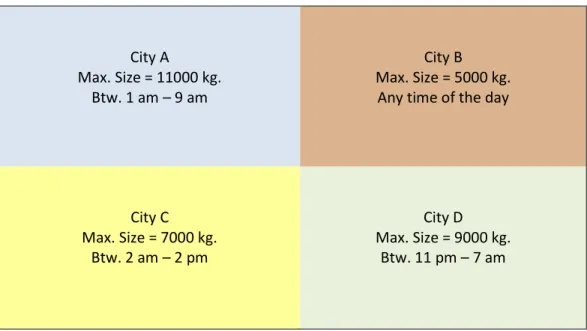
Figure 6: Delivery rules of the model’s logistics cities ...48
Figure 7: ABM system dynamics modeler ...50
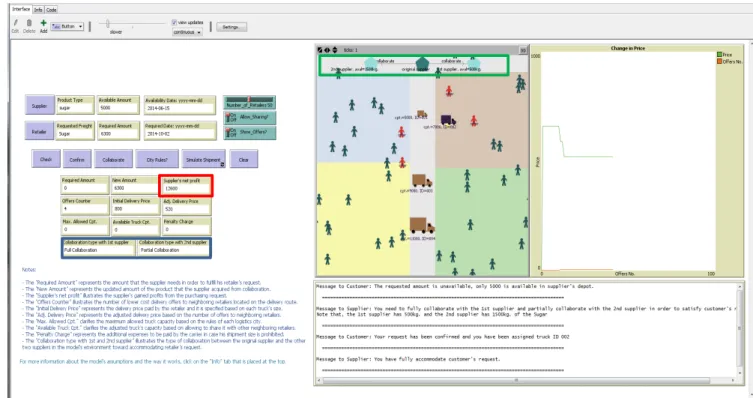
Figure 8: Results of the simulated collaborative case ...69
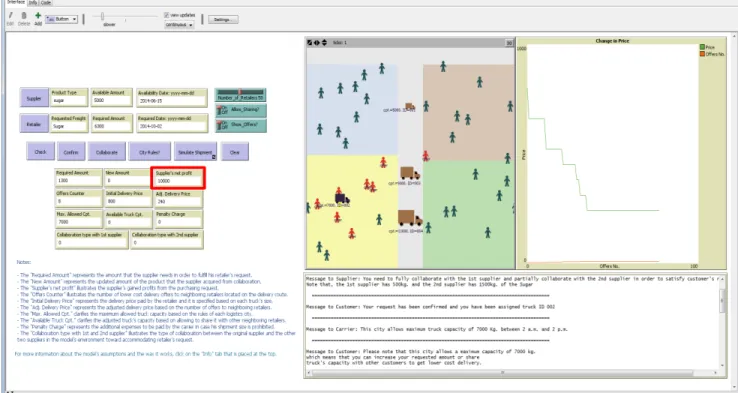
Figure 9: Results of the simulated non-collaborative case ...70
Figure 10: Suppliers’ collaboration chart ...80
Figure 11: Coalition between supplier 1 and 2 ...83
Figure 12: Coalition between supplier 1 and 3 ...84
Figure 13: Coalition between supplier 2 and 3 ...85
Figure 14: Carriers’ collaboration chart ...96
Figure 15: Main stages of the study ...101
xii Figure 17: Applications of SAP system, source (Altaweel, 2011) ...121
xiii
List of Tables
Table 1: Summary of some previous related studies ...13
Table 2: Major objectives of the utilized models ...29
Table 3: Criteria in the multi-agent simulation model ...51
Table 4: Collaborative shipping vehicles’ weights ...62
Table 5: Sellers entered the game (input table) ...74
Table 6: Buyers entered the game (input table) ...74
Table 7: Maximizing profits from buyers’ perspective (output table1) ...76
Table 8: Maximizing profits from sellers’ perspective (output table2) ...78
Table 9: Details of the assumed three suppliers in coalition ...81
Table 10: Numerical analysis of three suppliers in coalition ...86
Table 11: Individual supplier profit when participated in coalition ...90
Table 12: Carriers entered the game (input table) ...91
Table 13: Optimal set of released shipping vehicles (output table1) ...92
Table 14: Planned weights to satisfy each carrier delivery order (output table2) ...94
xiv Table 16: Numerical analysis of three carriers in coalition ...98 Table 17: Comparison between two city logistics models...110
xv
List of Acronyms
Acronym Description
ABM Agent Based Model
DSS Decision Support System
GTM Game Theory Model
JIR Just In Request
JIT Just In Time
LPM Linear Programming Model
LTL Less than Truck Load
ODD Overview, Design concepts, and Details
RFID Radio Frequency Identification
SCM Supply Chain Management
STD State Transition Diagram
TMS Transportation Management System
Chapter 1:
Introduction
1.1 BackgroundCitizens’ freight demands are increasing and accordingly, there is a considerable load on developing efficient distributive logistics. This accentuates the need to develop an optimized approach for handling and managing freights’ distribution to eliminate any existing problems.
SCM is usually performed in collaboration between various logistical entities. The collaboration especially in the transportation field is happening by exchanging commodities and sharing vehicles’ weights (Bailey et al., 2011).
The collaboration requires rapid and effective techniques for decision making. Agent based modeling technique is recommended because it is fast and provides accuracy in performing the work. Accordingly, implementing an agent based model will speed up the supply chain process, make it JIT, JIR, more accurate, and efficient.
Considering the futuristic perspective in planning the strategy, there is a need to take time and speed into account. Therefore, the study proposes utilizing and leveraging RFID technology with Agent technology by integrating them into one powerful system. There are several advantages of integrating the RFID technology with the proposed agent based DSS. RFID technology can check-in suppliers’ inventories into the system’s database and check them out once they get delivered to retailers. Moreover, it automates the work, makes
CHAPTER 1. INTRODUCTION 2
it more accurate, and, less costly since it provides an instantaneous scanning of large quantity of products at once (Wolff, 2001). The scanning process is performed using either a handheld scanner or by attaching RFID tags to physical places such as the entrance of a warehouse. Considering distributive SCM, RFID tags provide highly traceability since commodities can be tracked once moved in/out of depots or if necessary, they can be tracked once they moved in/out of carriers’ vehicles. RFID tags can be attached to carriers’ vehicles for the purpose of monitoring their delivery movements, thus, ensuring deliveries to right retailers within expected delivery times. An online access to freights being delivered can be authorized to involved logistics entities such as retailers, suppliers, etc.
through the proposed application to facilitate real-time monitoring process. Zhang et al.
(n.d.) admit that shipping solutions must enable both suppliers and retailers to rate, ship and track shipments in order to cut costs and expedite the shipping process.
1.2 Problem Definition
Unorganized distribution of freight has several negative consequences such as the LTL problem. The LTL problem occurs when carrier’s vehicles transport shipment, but the shipment allocated is less than the maximum vehicle’s weight, which eventually ends with having a large vehicle moving in a city with an empty space. This problem results in crowding of the city roads and air pollution, which in turn affects citizens’ health negatively. Hernández et al. (2011) claim that LTL results in idle weights in transporting vehicles. The American Trucking Association (ATA) claimed that the fuel average cost has increased by 73% during the last eighteen months, so, we can imagine how much the
CHAPTER 1. INTRODUCTION 3
gas cost is rising up yearly if vehicles are moving at LTL capacity. There is a dramatic increase in the carriers' insurance costs, which made 1,320 carriers to leave market in the
third quarter of 2000 (Lynch, 2001). Another considerable problem is the unorganized
communication between various logistical entities, which causes deficiency in satisfying customers' requests.
Eliminating these and other problems caused by unorganized distributive logistics needs an intensive analysis and studies in order to reach the optimized solution, which is the goal of this study.
1.3 Research Objectives
Our research objectives in the thesis are described as follows.
1. Which collaborative approach suppliers need to follow in order to fulfill their retailers’
needs?
2. Which freight distribution strategy maximizes the number of potential retailers served
while minimizing the delivery costs?
3. How does the physical environment affect the freight delivery cost?
CHAPTER 1. INTRODUCTION 4
1.4 Thesis Organization
After the introduction, the second chapter presents literature review on collaborative
logistics. It presents the methodologies in use and research gaps.
In the third chapter called the solution approach, we present multi-agent based model for collaborative logistics. It includes the design, development, and steps of the simulation model, as well as, its implementation through RFID integrated DSS. Afterwards, the chapter models each of the suppliers and the carriers’ collaboration behaviors in detail utilizing game theory and finally, formulates each modeled game using linear programming.
The fourth chapter is the numerical application chapter. It presents the application of the proposed Agent based model on randomly generated datasets.
Finally, the last chapter contains the summary, conclusions, and future works and
Chapter 2:
Literature Review
2.1 Collaborative LogisticsLogistics is the science of planning, implementing, and controlling the efficient, effective flow and storage of goods, services, and related information from point of origin to point
of consumption1. Wallenburg et al. (2011) claim that the complexity in today's world
supplying businesses increased the need for materials and shipping out products that led to emergence of “Logistics” as a business concept in 1950's. Logistics is usually performed in collaboration between various entities. For instance, suppliers might need to collaborate in order to satisfy their retailers whether it is national or international collaboration. Chinho et al. (2004) conduct a study regarding the factors that influence SCM and based on collected data, they found out that there is an important correlation between the quality management activities and the supplier collaboration in the supply chain field. There are two dimensions of collaboration in SCM, which are vertical and horizontal (Renko, 2009). Each dimension of collaboration can take one of three types that are no collaboration, partial collaboration, or full collaboration.
CHAPTER 2. LITERATURE REVIEW 6 2.1.1 Present Problems in Collaborative Logistics
Frazzon et al. (2006) mention in their research that “aiming to achieve economies of scale in transport operations is one of the problems to be handled by decision makers within global supply chains”. Accordingly, this study is intending to reduce delivery cost and maximize suppliers and carriers profits and revenues through utilizing the proposed intelligent online application. Borade & Bansod (2007) claim that industries have shown an increased need of adopting practices that support the use of SCM since 1980s. Konicki (2001) present in his article “E-Logistics Gets the Kinks out of Supply Chains” the importance of using E-logistics in supply chain projects in order to solve problems that might occur in manually performed logistics. A survey of logistics and supply chain about buyers who are implementing their businesses using manual paper work have revealed that there were postponed logistics related projects and some buyers have cancelled their projects because they realized the significance of using electronic logistics rather than manual work. He also adds that a business with a supplier that doesn’t use E-logistic systems is too costly compared with other companies that perform their businesses electronically. Many industries have used document automation technology in some ways to provide supply chain activities over the Web (Rose, 2010). Even though, the advent of the Internet and electronic communication has enabled companies to be more responsive to their customers than ever (Sanchez & Perez, 2003); there are several problems accompanying this advent. Although the developers are facilitating several online logistical collaborative solutions; these systems are customized and dependent based on each business’ needs and are not standardized for all type of businesses.
CHAPTER 2. LITERATURE REVIEW 7 2.2 Distributive Supply Chain Management
Nagurney (2006) defines supply chain as a system of organizations, people, technology, activities, information and resources involved in moving a product or service from upstream supplier to downstream customer. According to Chopra & Meindl (2001), a supply chain not only includes the manufacturer and suppliers, but also transporters, warehouses, retailers, and customers. SCM is the systematic, strategic coordination of the business functions within a particular company and across businesses within the supply chain, for the purposes of improving the long-term performance of the individual companies and the supply chain as a whole (Mentzer, 2001). An international survey made by Larson & Halldorsson (2004) revealed that there is an argument in clearly defining the SCM meaning for which the involved parties can collaborate upon. Nonetheless, all the collaborated parties must at least understand each other’s perspectives. Sandberg (2005) says that SCM introduces some significant perspectives such as facilitating the lowest total cost, service improvements, and reduced inventory levels. Paradkar (2011) defines distributive SCM as a logistic process that involves transporting finished goods or services to the consumer from the production facility including handling and managing orders, transportations, and distributions.
2.3 Methodologies for Improving Collaborative Logistics
Several studies have addressed the problem of collaborative logistics using different methodologies. These methodologies can be mainly categorized into simulation and
CHAPTER 2. LITERATURE REVIEW 8 optimization. Simulation is an imitation of reality, where researchers can test their
hypothesis on artificially generated or historical data that can be easily compared and implemented. Simulation is not an exact approach. Simulation methods include: discrete event simulation, continuous simulation, agent-based simulation, hybrid simulation, etc. Optimization on the other hand is an exact approach. Optimization methods include: linear programming, non-linear programming, integer programming, goal programming, etc. They are used in structural equation modeling, game theory, hybrid optimization…etc. Few other methods that have seen rapid growth in recent years are metaheuristics, greedy methods, and the stochastic methods, etc. However, there will be always new approaches incoming and more advanced solution methods will be developed depending upon problem complexity.
For using above mentioned methods; there is a need to collect data first in most of the cases before analyzing them. The collected data are closely related to the studied problem. This enables researchers to gain deeper understanding about the problem that needs to be solved, as well as, enables them to test proposed solutions on the collected data. Interviews, surveys, questionnaires, experts’ opinions, etc. is usually the approach to collect useful related information. Afterwards, a suitable solution method can be applied to manage the problem.
CHAPTER 2. LITERATURE REVIEW 9 2.3.1 Simulation
Simulation methodologies are used because many scientific fields require testing and analyzing data, which might be costly if experimented on real life circumstances. Salamon (2011) claims that simulation modeling is heavily used in different fields of engineering. Special cases of simulation are discrete event simulation and continuous simulation. Carvalho & Luna (2002) admit that in discrete models the state variables build a schedule of events because they do not treat time as continuous. While, in continuous models the state variables change their values continuously with respect to time. Dlouhy et al. (2005) indicate that if the differential equations are not able to solve the problem of continuous simulation model then, it becomes the task of the model to find a numerical solution. Furthermore, agent-based simulation is a special case of simulation. It is developed using a bottom up structure starting from the individual agents who represents the necessary part of the system up to the whole complex system. This structure makes the analysis of the system easy to perform. A combination of multiple simulation methods or techniques can be used in conjunction and then it becomes “Hybrid simulation”. The reason behind hybrid simulators is that some special systems require a set of tools in a collection of simulators. Thereby, hybrid simulation allows the use of this combination of tools within a single
simulation environment. For instance, GoldSim Technology Group2 is a hybrid simulator
that is able to combine the features of continuous simulators and discrete-event simulators. Moreover, AnyLogic multi-method simulation software is a hybrid simulator that can provide the functionalities of agent-based simulators along with discrete-event simulators
CHAPTER 2. LITERATURE REVIEW 10 and dynamic systems. The bullwhip effect in semiconductor supply chain can be simulated
using AnyLogic3 technology. The model is used in communication with customers for a
collaborative work on reducing the bullwhip effect in supply chains. It assists companies in identifying particular situations where bullwhip effects occurs and how it affects the supply chain work negatively.
2.3.2 Optimization
Optimization methodologies can take many forms because there are numerous mathematical methods to improve collaborative logistics. Exforsys (2007) claims that “the supply chain optimization begins with the use of advanced planning and scheduling (APS) technology”. The efficient use of APS technology allows planner to make right collaborative decisions after testing the case using appropriate statistical models. Note that, statistics require the selection of appropriate variables to form accurate functions/equations. Integer programming (IP) is a special type of the statistical optimization methods. It is used to solve linear problems where some or all of the variables are integers. Motozawa & Redl (2009) claim that the operations research optimize the utility of limited resources. Moreover, Chinneck (2004) claims that IP can take the form of binary integer programming (BIP) or mixed integer programming (MIP). The values of the variables in a BIP problem can take only one of two values that is either 0 or 1; while, the values of the variables in a MIP problem are mix of integer values and fractional values.
CHAPTER 2. LITERATURE REVIEW 11 Note that, MIP can in fact solve a problem that has a combination of real, integer, and
binary values.
Another optimization method that is being used intensively to optimize the collaborative logistics is the “Game theory”. Webster (2009) claims that decision makers in a game theory are called “players”, which bid in order to optimize generated results, called “payoffs”. Hence, any game usually consists of three factors: players, actions, and payoff. There are two trendy game theory models for describing uncertainty in taking decisions: probability model and state-variable model. Nash equilibrium is a significant solution concept in the game theory. It is named after the American mathematician John Nash. Mehrizi (2013) clarifies that “equilibrium” is realized when every player in the game is willing to change its endeavor to achieve best results corresponding to other players. In addition, Watson (2008) mentions “congruity” behavior in Nash equilibrium games. He explains it as beliefs/rules that are already agreed on or are discussed before playing the game. The previous knowledge about these rules affects other players’ decisions. Rodriguez (2006) states that using a combination of different methods is sometimes better to handle problems than using any one method. Having one technique including approaches from various frameworks is called “Hybrid optimization”. The advantage of using hybrid technique is that it compiles many mechanisms, which enable the selection of most suitable approach based on each dealt problem and taking advantage of each approach while
minimizing its disadvantages. Cavazos et al. (2006) indicate that there is no specific
method that is always preferable instead, based on each problem situation, there is a more suited method. Their study involves machine learning by employing heuristic technique to select the best hybrid optimization algorithm. Since the problem is general, they
CHAPTER 2. LITERATURE REVIEW 12 experimented it on register allocation problem by developing a hybrid allocator chosen
during compilation time of the algorithm. It choses between graph coloring and linear scan algorithms based on computing identified set of features.
Table 1, summarizes some previous related studies and categorizes them into three main categories: a) collaboration, b) logistics, and c) collaborative logistics.
CHAPTER 2. LITERATURE REVIEW 13 Table 1
Summary of some previous related studies
Category Author, Year Problem Solution Strength Limitation Application
Collaboration Wang et al.,
2014 Conventional routing problem Simulation Exploit external resources of other logistical entities in coalition
Generate a bunch of routes instead of selecting the minimal cost route
Transportation market
Lau et al.,
2006 Control global supply chain Agent-based simulation Promote for economics in transportations Does not allow for intermediary storages Transportation market Frazzon et
al., 2006 Complexity of orders flow in global supply chain
Agent-based
simulation Consider the effects of agents to perform the collaborative planning and execution of complex activities
Test and analysis of proposed system is not included in the study
Transportation market Kwon et al., 2007 Uncertainties presented in supply and demand Agent-based
simulation Facilitate collaboration in the emergence of high uncertainties
Focus only on the production
and inventory problems Industrial applications Logistics Chen & Tu,
2009 Tracking manufactured
products
Agent-based
simulation Improve the traceability and visibility of daily numerous manufactured products
Structure a special RFID tag data to be used in the
proposed system Manufacturing companies Ingalls & Kasales, 1999 Dynamics exist in supply chain processes Discrete event simulation
Analyze dynamics exist in SCM using a Compaq supply chain analysis tool
Handle one dimension of
SCM Industrial applications
Anand, 2013 Manage retailers’
economics Agent-based simulation Optimize retailers’ achieved profits Retailers collaboration is not considered Retailers stores Dresner &
Stone, 2006 Transporting freights Simulation Manage road transportation problems Does not handle collaboration Transportation market
Russo &
CHAPTER 2. LITERATURE REVIEW 14 Nazari-Shirkouhi et al., 2013 Supplier selection and order allocation Mixed-integer programming
Provide reliable decision tool
for suppliers selection Does not incorporate uncertain demands in supplier selection
Purchasing departments Erdem &
Göçen, 2012 Suppliers evaluation and order allocation
Goal
programming Provide dynamic, flexible, and fast DSS Collaboration and discussion in selecting suppliers is not considered Purchasing departments Agus, 2011 Managers perceptions regarding SCM Structural equation modeling
Demonstrate the associations between SCM, product quality, and business performance
Limited to three criteria Manufacturing
companies Uchiyama &
Taniguchi, 2010
Vehicle routing Game theory Present a route choice model
considering congestion obstacles and travel time reliability
Other criteria in choosing optimal routes such as minimal cost, etc. were not considered
Transportation market
Siamo et al.,
2009 Fleet management Hybrid optimization Combine both machine learning technique along with mathematical programming to manage fleet
Consider only
high-dimensional state variables fleet
Transportation market
Collaborative
logistics Berger & Bierwirth, 2009
Vehicle routing Optimization Offer LTL pickup facility that
led to significant financial benefits
Limited for traveling
salesman tours Transportation market
Cruijssen & Salomon, 2004 Vehicle routing and sharing quantities
Simulation Study the impact of efficient
trucks routing and investigate the advantages of sharing shipments between carriers
Does not test and compare proposed techniques on multiple auction stores
Auction stores
Lee et al.,
2002 The strategic level of supply chain
Hybrid
simulation Show benefits of using hybrid modeling to simulate collaborative SCM
Combines only two
modeling techniques, which are discrete and continues
Industrial applications Hernández et
al., 2011 Deterministic dynamic single carrier
collaboration
Branch and
cut algorithm Formulate the problem as binary multi-commodity minimum cost flow problem
Proposed collaborative
strategy is time-dependent Small to medium sized LTL industry
CHAPTER 2. LITERATURE REVIEW 15 Vornhusen et
al., 2014 Pickup and delivery problem
in collaborative scenarios Mixed-integer programming Introduce transshipments during vehicles routing and evaluate carriers saved costs corresponding to participating in coalition
Does not evaluate cost saving in large transshipment instances of carriers collaboration Small to medium sized vehicles Bailey et al.,
2011 Cost minimization Hybrid optimization Add pickup and delivery tasks of collaborative carriers to their backhaul and reroute the empty backhaul trucks to fulfill other collaborative carriers’ requests
Lack of incentives to enable
carriers selection Small to medium sized
vehicles Yilmaz & Savasaneril, 2012 Collaboration in the presence of uncertainty
Game theory Introduce retailers
characteristics to benefit the collaborative environment
Limited to small shippers and did not specify the contribution of shippers to the coalition
Transportation market
Krajewska et
al., 2007 Vehicles routing and scheduling Game theory Present real-life and artificial instances to prove incrementing carriers’ profits by solving addressed problem
Limited to unique multi-depot pickup and delivery requests within specific time windows
Truck
transportation industry Dai & Chen,
2009 LTL transportation Hybrid optimization Develop general mathematical model suitable for both shipper and carrier collaboration
Presented solution space and speed need more
enhancements
Transportation Market Zhou et al.,
2011 Stochasticity in demands Simulation Provide the basic approach for studying collaborative strategies to be used by firms in competing with other practitioners in freight consolidation
Depends on two criteria only, which are shipment quantities and calculated profits
Industrial applications
CHAPTER 2. LITERATURE REVIEW 16 2.4 Integrated E-Logistics
One possible definition of E-logistics is that they simply mean processes necessary to transfer commodities sold over the Internet to customers (Auramo, 2001). “Customer satisfaction and cost concerns drive the adoption of Internet-based systems” (Konicki, 2001). Logistics aim to deliver products to their customers as quickly as possible, while E-logistics concern with automating E-logistics activities and providing integrated end-to-end fulfillment and SCM services to the players of logistics processes. This provides visibility of supply chain processes.
According to Kovačič & Groznik (2004), the successful integration of SCM depends on the implementation of E-business in Logistics called E-logistics. One of the results they conclude is the business model creation process renovation. Examination and reengineering of current business policies procedures and activities can be adopted by establishing proactive distinctive internet systems. In addition, they highlight that information technology plays critical role in renovating business processes since it minimizes the negative results generated from manual procedures and this advantage achieved by automating the procedures. Lynch (2001) mentions that the market of the TMS, which emerged in early 1990, is evolving rapidly and that there are many systems that offer numerous best features to all logistics parties. The use of technology and information systems is necessary in making the collaboration between supply chain entities smoother and easier.
An example of electronic collaboration has been introduced by Sophie & Mikael (2008) where a web-based application is used to find routes between suppliers and consumers.
CHAPTER 2. LITERATURE REVIEW 17 Sanders (2005) claims that the use of information technology motivates the integration
between suppliers and customers and has direct, as well as, indirect positive effect on both strategic and operational performance measures. Holzmuller & Schluchter (2002) claim that internet-based business-to-business (B2B) electronic marketplaces are ‘‘open electronic platforms facilitating activities related to transactions and interactions between multiple companies’’.
2.5 Agents Technology
Treytl et al. (2006) define software agents as “entities that autonomously fulfil a given task.
They operate in a multi-agent system (MAS) environment and exchange information between each other”. Agents are “intelligent” code programmed into computer software to achieve a goal. They can be a robot, function, equation, etc. Salamon (2011) believes that an individual agent is usually not capable of performing the entire intended process by it-self. The required generated result of the simulation model, usually occurs when individual agents communicate with each other and with the surrounding environment. In other words, agents are able to interact with each other and respond to environmental effects to simulate specific process even though it is not necessary for them to contain memory or to store data.
Frazzon et al. (2006) state that in order for agents to be intelligent; they should adopt three
features including being autonomous, that is capable to function without the need of another agent or person’s decision, cooperative agents that interact and help each other’s to execute processes, and learning agent, which contain some artificial intelligence since they should be able to learn from instructions and historical information.
CHAPTER 2. LITERATURE REVIEW 18 Chen & Tu (2009) consider agent as “a software entity that continuously monitors the data
sources in a global computer network where the information of interest is made available in real-time and when certain signals are detected in the data”. The RFID journal (2002) mentions that the MIT Media Laboratory has software agents group and they clarify in their website the difference between software agents and traditional programs by clarifying that software agents are “long-lived, semi-autonomous, proactive, and adaptive”.
2.5.1 Agents Based Models (ABM)
A model is a representation of a real system and thus, it is an abstraction of the reality 4.
“The word “modeling” comes from the Latin word modellus which describes a typical human way of coping with the reality” (Schichl, n.d.). Models can take various forms such as mathematical equation, drawing, computer code, etc. However, there is a common purpose of all designed models, which is to simplify the complexity presented in the real system or problem. Therefore, models usually contain only the main aspects of the real system (not all details). Modeling is usually done through several steps. Railsback & Grimm (2012) define the modeling cycle as consisting of five iterating steps:
1. Formulating the accurate research questions
2. Assembling hypotheses for the necessarily processes and structures
3. Choosing scales, entities, state variables, processes, and parameters
4. Developing the required model
5. Analyzing, testing, and finally revising the model
CHAPTER 2. LITERATURE REVIEW 19 2.5.1.1 Strengths of Agents Based Models
ABMs have several advantages and strengths over other traditional methods. Frazzon et al. (2006) claim that using agents to organize SCM work is a noticeable outstanding study. ABM can easily show the interaction between agents and with the surrounding environment since it provides an explicit graphical dynamic system. Moreover, it illustrates the different behaviors that agents can take during the run of the simulation (Brown, 2006). ABM highlights emergent phenomena and can be easily adapted to new barriers. In addition, it provides a framework that can test and answer many wondering questions without costing reality errors since it is just a simulation environment of real situations. Intelligent agents can use decision trees to be able to take wisdom decisions. When a researcher or a scientist is interested in understanding and exploring the behavior of a specific process or system; ABM is the most appropriate approach for finding solution to that problem (Salamon, 2011). Davidsson et al. (2005) mention that using agents in SCM systems especially in TMS can achieve two objectives, which are having DSS and automation system.
2.5.1.2 Weakness of Agents Based Models
Some weaknesses of ABM have been discovered since its production and development. The Journal of Artificial Societies and Social Simulation (JASSS) analyzed some of these problems over the past ten years. Meyer et al. (2009) conclude that some models are too simple so they do not represent the real intended scenario. On the other hand, other models are too complex, which make them difficult to understand and implement in reality.
CHAPTER 2. LITERATURE REVIEW 20 Moreover, ABM usually have computational performance limits, which means that if the
problem needs to be solved based on rigid pure mathematical computation. Then, ABM might not be the best method to follow. The traditional mathematical and statistical methods will be more appropriate in this case.
2.6 RFID Technology
RFID is an abbreviation for Radio Frequency Identification. It includes tags that can be classified as either active or passive. Active tags have longer reading ranges since they have an internal battery inside them and thus, can store up to one megabytes of data in their memory. On the other hand, passive tags have shorter reading ranges since they do not have battery inside them, instead they generate the power by converting the radio signals into power using part of the RFID called transponder. RFID passive tags can store up to one kilobyte of information (Harry et al., 2006). However, both types of the tags are anticipated to live up to few decades (McDowell, 2009).
RFID is tiny sized memory chip that can save, update, and delete data. It might also take
photos of persons and staff. Romer et al. (2003) clarify that RFID tag can handle various
useful information besides recognizing identity. They claim that RFID tag can store geographic locations, as well as, physical nearby information. It can also access memory’s history to act based upon historical information. RFID technology has been widespread in the telecommunication field and existed for decades. However, it has been used only recently in the operations of commodities (Mei, 2004) and demonstrated magnificent success in the logistics/distribution/SCM field.
CHAPTER 2. LITERATURE REVIEW 21 The Laval link (2004) mentioned two well-known markets depending on supply chain
logistics to achieve their work. They are the Wal-Mart and the US department of Defense (DOD). Both have used RFID technology to maintain and make their supply chain processes successful.
2.6.1 Benefits of RFID Technology
RFID technology is mainly utilized to ensure inventory accuracy. Moreover, it avoids risks of stealing shipments or having them lost. It helps controlling products’ distribution, tracking them, and ensuring accurate deliveries to right persons within expected times. In addition, it is used to tag individual products to provide complete visible distribution process. RFIDs are highly intelligent wireless devices (Dixon, 2011).
Instead of having large number of labors working on inventory and checking in/out products; RFID will do the work faster and more efficient. Thereby, it saves costs of both labors and missed products. RFID technology generates automated paperless maintenance of information because the system’s database monitors and records every product inside it. The RFID technology is more powerful than the barcode technology since it enables reading large quantity of tags at once using sinlge handheld scanner. Laval link (2004) mentioned that the sensitivity presented in RFID readers enable them to perform both tag singulation and aggregation. Thus, they can recognize individual tags in SCM and at the same time, they can scan/read huge number of tags as group because they do not require close line of sight to perform the reading (Wolff, 2001). RFID tags are featured than traditional bar codes because they can be programmed to hold useful information such as
CHAPTER 2. LITERATURE REVIEW 22 time, destination, etc. Moreover, Wolff (2001) claims that RFID tags are placed inside
packages and thus, they are less prone to damage unlike traditional bar codes, which are placed on the outside of packages and therefore, can be easily scratched or destroyed. Finkenzeller (2003) mentions that RFID offers more advantages than other technologies; it can recognize identity of an object and record its current status, as well as, its status in the past and in the future.
2.6.2 Limitations of RFID Technology
One of the restrictions of RFID technology that might not let all companies use them is their cost, especially when dealing with low price products such as goods in groceries. However, smart labels can be used in this case to provide cheaper technological chips that are able to hold information and being manufactured in high quantities with tens of cents prices instead of dollars (Wolff, 2001). Another limit is related to passive RFID tags because they do not use battery and therefore, they have distance limit, as well as, computational power limit that is specified by the available energy exists in the electromagnetic field placed on the RFID reader (Treytl et al., 2006). Kaur et al. (2011) mention that conductive materials such as water and metal can be barriers for the RFID reader since water can absorb data signals and metal can reflect them, which causes data deterioration during their transmission to the RFID application.
CHAPTER 2. LITERATURE REVIEW 23 2.7 Power of RFID Technology Integrated with Agents Technology
According to Treytl et al. (2006), integrating RFID technology with agents’ technology
seems reasonable because RFID helps identifying products, while agent handles information provided by RFID readers allowing masterly monitor and control of all orders throughout the whole supply chain system. In addition, they claim that “If the RFID identifying the product and the agent managing the manufacturing of the product are (physically) bound together, advanced solutions for practical problems can be found”. Chen & Tu (2009) propose the use of ontology and RFID technology to improve the traceability and visibility of daily numerous manufactured products. The system is an agent-based manufacturing control and coordination (AMCC) system where every manufactured product should be tagged with RFID to provide real time enterprise management process. The RFID journal (2002) published an article titled “Agents Key to RFID Supply Chain”. It highlighted the substantial role intelligent software agents perform in logistics SCM in particular when combined with RFID technology. It mentioned that the biggest effect of integrating agents with RFID technology is to facilitate a successful collaboration between various logistical entities. Beside responding to real-time instructions and learning from history, real strength of intelligent agents appears in their ability to predict incidents especially critical ones and notify involved logistical entities to enable them to avoid risk before it occur.
A good implementation of above practice was presented in a conference in Orlando by SAP’s system group. They featured a smart shelf with a set of bottles on it. The intelligent agent can report the amount of sold out bottles and alert the vendor in case of sensing more consumptions than expected to enable him to arrange to get more supplements. The RFID
CHAPTER 2. LITERATURE REVIEW 24 journal mentioned that the BiosGroup, which is a software consulting and development
company “sees a world in which agent technology is distributed throughout the supply chain and reacts instantly to information coming from RFID tags”. Moreover Fred Seibel, who is a BiosGroup’s responsible for supply chain technologies, admits that agents’ technology complements the RFID technology because agents instantly respond to real-time data received from RFID readers.
Exploiting the power of agents technology with the RFID technology will significantly improve the logistics SCM and will present entirely innovative ways of performing the work. Treytl et al. (2006) believe that there are two ways of integrating RFID technology with agents’ technology. Agents can be directly hosted on RFID tags’ readers or existed on a separate platform to process data read from the RFID tags’ readers. They also claim that it is more effective when agents are migrated from RFID tags because agents’ existence on RFID tags requires more amount of memory to hold agents’ codes, as well as, it consumes more power and cost.
2.8 Research Gaps
According to carried literature review, it is found that most of conducted studies in logistics have focused on and remedied only one dimension in SCM. For example, some studies focused on demands fulfillment, while others focused on avoiding and mitigating risks. Moreover, there is deficiency in the research field of SCM in some important aspects such as, utilizing recent technologies for facilitating the collaboration planning. There is lack in
CHAPTER 2. LITERATURE REVIEW 25 the knowledge of making effective practical collaboration between various logistical
entities that can be implemented on reality. It is challenging to develop models similar to the dynamic real logistics. In addition, limited scenarios have considered treating uncertainties that might occur during freights’ distribution. Furthermore, some papers focused on solving supply chain problems but, missed proving correctness and accuracy or missed ensuring standard quality performance.
Economics and cutting costs are also crucial aspects to be considered when discussing supply chain optimization, which were also neglected in some papers.
Even though, finding optimal strategies is significant; operating those strategies in an efficient way is significant as well. Hence, although there is no doubt, internet is the commonly used method in today’s world in achieving everything. With today’s rapid technological advances there is a need to develop systems that besides being online, are fast, effective, and accurate. In other words, employed systems should be intelligent enough to accomplish the work successfully.
Most of the studies in collaborative logistics concerned with only exchanging messages to perform the integration and did not consider having an effective intelligent communication approach that is JIT and JIR. Thereby, this research investigates the reasons behind above mentioned inadequacy and provides ultimate solution for successful collaboration in integrated E-logistics collaborative systems.
Chapter 3:
Solution Approach
This chapter begins with introducing the simulation agent based model, which discusses two subjects: the system analysis and design, and the system implementation. The first subject designs conceptual multi-ABM. Afterward, model’s concept is represented using unified modeling language to simplify its implementation. Moreover, ODD protocol is employed for model formulation. The second subject concerns with the system implementation. It begins with identifying the relations and interactions between agents. Then, model’s assumptions and criteria are indicated to help develop the actual simulation model on Netlogo software.After introducing the simulation ABM to represent and simulate freight’ shipments, we model major collaboration problems presented in the simulation ABM in more depth by employing GTM and formulating modeled games mathematically using LPM.
3.1 Selected Method to Conduct the Study
This study aims to solve multiple collaborative logistics problems through three different methods. The ABM simulation is mainly used because it tremendously supports understanding the behavior of a specific system (Salamon, 2011) since it provides an explicit graphical dynamic system that can illustrate different behaviors agents take during run of the various simulated scenarios. Simulation ABMs are used for optimizing
CHAPTER 3. SOLUTION APPROACH 27
logistics/SCM (Wadhwa & Bibhushan, 2006), thus, a multi-agent based simulation model aims to formulate the collaboration problem in general and represent the distributive logistics is designed and developed.
In addition to the agent based simulation model, another optimization method is employed, called the game theory. The reason behind using it is that agent based simulation model alone cannot sufficiently cover all topics in the model due to limited computational power (Salamon, 2011). Moreover, the suppliers’ collaboration and the carriers’ collaboration part of the study are extended parts of the simulation that base on specific defined notations, rules, strategies, etc. Thus, using the GTM to intensively analyze these two particular parts of the study is more efficient than, just including them briefly within the ABM. Furthermore, the GTM concerns with mathematical models and hypothetical problems attempting to resolve cooperation and conflict between intelligent rational decision makers (Myerson, 1991).
Finally LPM is employed to formulate modeled games mathematically and to indicate quantities of freights.
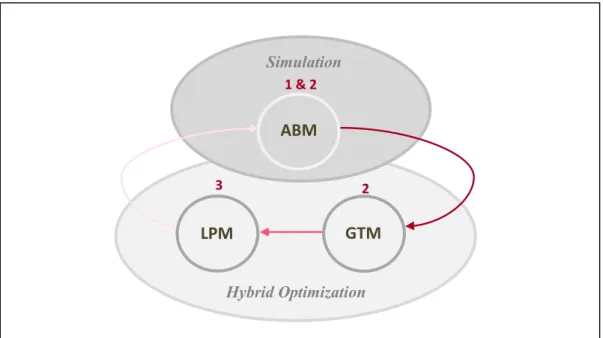
Therefore, the study utilizes three different methods, which are agent simulation, game theory, and linear programming. Each method concerned with solving a particular problem that falls under the collaborative logistics. Figure 1 demonstrates the solution methods used in this study.
CHAPTER 3. SOLUTION APPROACH 28
)LJXUH6ROXWLRQ$SSURDFK
7KH XVH RI WKH WKUHH PHWKRGV WR RSWLPL]H RQH VXEMHFW LV D YHU\ JRRG SODQ IRU LPSOHPHQWDWLRQ)LJXUHGHPRQVWUDWHVWKHUHODWLRQEHWZHHQWKHWKUHHHPSOR\HGPHWKRGV LQWKLVUHVHDUFK
CHAPTER 3. SOLUTION APPROACH 29
Figure 2: Relation between the three utilized methods
Each method has specific objectives to achieve, which are denoted by the numbers above them. Table 2, provides an explanation of the objectives entitled by the numbers.
Table 2
Major objectives of the utilized models
1 - Divide the simulation world into multiple different logistics cities,
each has its own delivery rules and discuss encountered penalty when violating the rules
- Scan delivery routes looking for neighboring retailers to be included
along with the original one who initiated the freight delivery order and then, send them lower cost delivery offers in case of LTL problem existence ABM Simulation 1 & 2 Hybrid Optimization GTM 2 LPM 3
CHAPTER 3. SOLUTION APPROACH 30
- Measure congestion on delivery routes
2 - Encourage suppliers to enter in a game and collaborate toward
maximizing profits and satisfying customers’ purchasing requests
- Ensure successful collaboration between multiple carriers to eliminate
the LTL problem and to maximize vehicles’ utilization rate.
3 - Execute modeled games and formulate them mathematically.
- Select vehicles sizes and indicate quantities for shippers and carriers
3.2 System Analysis and Design (ABM) 3.2.1 Conceptual Model Design
The solution to solve the problem of having empty vehicles or LTL in logistics cities to deliver shipments is to implement an online DSS that has more than one agent interacting properly with each other, as well as with the surrounding environment. The modeled online application helps carriers to share vehicles’ weights effectively and offer lower cost shipments to retailers by recommending delivering shipments through vehicles that are passing near their saved location via the system. This will improve the collaboration and automate the logistics communication, make it JIT, JIR, without the need to have real humans working on the application, which will eliminate humans' errors and will also speed-up the process.
Therefore, the system includes six agents: the RFIDG agent, which ensures inventory
CHAPTER 3. SOLUTION APPROACH 31
SURYLGHV FRPPRGLWLHV WKH&DUULHUDJHQW ZKLFK GHOLYHUV IUHLJKWV WKH1HWZRUN DJHQW
ZKLFKVFDQVGHOLYHU\URXWHDQGWKH&LW\$GPLQLVWUDWRUDJHQWZKLFKSODQVDQGDQQRXQFHV
FLWLHV¶GHOLYHU\UXOHV%HORZLVWKHFRQFHSWXDOPRGHORIWKHSURSRVHGPXOWLDJHQW'66 )LJXUH'HVLJQHGFRQFHSWXDOPXOWL$%0 5),'* 1HWZRUN 5(&(,9( ),/7(5 &LW\$GPLQLVWUDWRU 6(1' 3/$1$11281&( 38// 2))(5 Vehicles’ DB Merchandise’ DB Companies' DB 48(5<B,) 6XSSOLHU 5HWDLOHU &DUULHU 5(48(67&21),50 5(3/$<5(&200(1' ,1)250 ,1)250 &21),50 48(5<B,)83'$7( 127,)< 3/$1$11281&( 5(3/$< Merch 48(5< GTM LPM GTM LPM 7KH³*70/30´QRWLRQLVXVHGEHVLGHWKHVXSSOLHUDQGWKHFDUULHUDJHQWVWRFODULI\WKDWWKHFROODERUDWLRQEHKDYLRXU RIWKHVHWZRDJHQWVZLOOEHPRGHOHGLQGHWDLOODWHULQWKHVWXG\XVLQJJDPHWKHRU\DQGOLQHDUSURJUDPPLQJ
CHAPTER 3. SOLUTION APPROACH 32
To achieve the overall goal of the model, which is to implement a successful collaborative system, each agent has a major role to play. Followings is an explanation of each agent in the proposed intelligent DSS:
The RFIDG Agent: This agent receives data from the RFID reader and places them into the merchandise database after filtering to ensure their accuracy. Moreover, the agent removes duplicate scanned records and displays alert messages in case of sensing exotic behaviors. Such as scanning a product that has been placed in the wrong area. Since scanning products involve human intervention then, there are chances for errors. Thus, the agent’s role becomes significant because the intent of the proposed model is to eliminate mistakes. Hence, ensuring inventory accuracy is the major task for the RFIDG agent. Considering there are several different data structures used in existing RFID tags, the RFID reader sends information to the RFIDG agent and the agent should process the data precisely. Checking the data type and the context, the agent takes necessary information and places them into accurate fields of the system’s database. Besides its major role, the RFIDG agent holds all products unfiltered information. Then, whenever any supplier inquires about any particular information of a specific product that is not entered into the filtered accurate database, the supplier will contact the RFIDG agent to get that particular detail.
The Retailer Agent: When a human retailer logs into the system to request shipment; the retailer agent notifies both the supplier agent and the carrier agent. It notifies the supplier agent to allow it to search in its database about the requested freight. While notifying the carrier agent to enable it to check in its records for arranged shipments with LTL that will
CHAPTER 3. SOLUTION APPROACH 33
pass nearby the retailer’s saved location in the system, it also recommends lower cost delivery of shipments to that retailer in a specific date, which will eliminate the LTL problem.
The Supplier Agent: Once the retailer agent informs the supplier agent about a new retailer’s request; the supplier agent starts searching inside its database about the requested product and then, replies back to the retailer about the status of the request as either available or not. It also recommends another availability date of the needed product or another available amount if different from retailer’s request. In case the retailer requests unavailable commodity or more than the available quantity in the supplier’s depot, the supplier agent will search other suppliers in the system who have enough amount of the requested commodity with reasonable price and high quality, and will recommend the original supplier to collaborate with them. Suppliers’ collaboration allows satisfying customers’ needs. Note that for each specific supplier, the agent keeps record of the most collaborated suppliers. Thus, it recommends them first at later times for that specific supplier, which makes the supplier agent an intelligent agent. In addition, the supplier agent rates suppliers’ performance, which is based on many criteria such as availabilities of their products, qualities, prices, coping situation with other suppliers. In the recommendation list of suppliers to collaborate with, suppliers with higher rates get listed after the most collaborated suppliers.
The Carrier Agent: When a shipment request is confirmed by the retailer, then the supplier agent informs the carrier agent that there is a shipment delivery request. Therefore, the carrier agent will search in its database for an available vehicle in the required date and
CHAPTER 3. SOLUTION APPROACH 34
with adequate weight to assign it to the delivery order. Afterwards, the carriers’ database will be updated automatically and a confirmation number will be generated and sent through the agent to both the supplier and the retailer to confirm them and keep up-to-date. Moreover, once a retailer logs-in to the system, the carrier agent gets notified by the retailer agent that she needs a freight delivery. Hence, the carrier agent looks for arranged delivery vehicles with LTL problem that will pass nearby that retailer’s location to offer lower cost shipments to that retailer enabling him to allocate the available empty weight in the shipping vehicle. Furthermore, the carrier agent rates carriers’ performance, which is based on their efficiency in delivering freights to right retailers and within expected times. For instance, the carrier agent weights a carrier high if he always delivers on time and lowers his rate if he has late deliveries for few times.
The Network Agent: This agent is responsible about measuring congestion on delivery routes and informing the city administrator agent about existing severe congestion. In addition, it assigns the supplier’s location as an origin point and the retailer’s location as a destination point to calculate the shortest delivery path between them using the Dijkstra's algorithm and sends it to the carrier to enable him to deliver freights on time. Afterwards, the agent scans the shortest delivery route looking for neighboring retailers to the original one who initiated the freight’s delivery order and sends the list to the carrier agent. The agent saves shortest paths with their neighboring retailers list to be able to recall them faster on future shipments.
CHAPTER 3. SOLUTION APPROACH 35
The City Administrator Agent: Once the carrier agent informs the city administrator agent about arranged freight delivery order, the agent announces the delivery rules of the city
where the shipment is arranged, to both the carrier and the supplier. Announcing cities’
delivery rules enable suppliers and carriers to obey with the rules. In case of rules violation, the city administrator agent recommends other alternative solutions to them. One solution can be dividing the shipment on two smaller vehicles instead of the large prohibited vehicle’s size. Another solution can be changing delivery time to be within allowed times. Moreover, the agent should provide the carrier with the second shortest delivery route in case of receiving severe congestion alerts from the network agent. In case the carrier cannot go through the second shortest delivery route then, the agent should be able to provide other decisions. Another solution can be dispatching shipment to another retailer than the planned one in case of delivering to more than one retailer. Successful decisions will be stored in agent's history to be used in future similar situations. Thus, the agent is considered intelligent because it uses its knowledge and historical information to take better decisions.
Figure 4, presents the state transition diagram (STD) that clarifies the crucial functionalities
CHAPTER 3. SOLUTION APPROACH 36
)LJXUH6WDWHWUDQVLWLRQGLDJUDP67'
Carrier Agent
Supplier Agent
Network Agent
Retailer Agent
City Admin Agent
Confirming Deciding Checking DB Waiting request Request commodity Replay / Recommend Wait replay Terminate Con Waiting notification Notify carrier Checking AvpCap Checking TCap Wait Decision Updating DB Collaborating Confirm offer Assigning Start Offer available Cpt. Sensing Congestion
Scanning Neighbors Send list Waiting request Planning Inform Waiting retailers’ locations Announcing Rules Affect Requesting
RFIDG Agent
Waiting reading W Filling DB Filtering DataRF
CHAPTER 3. SOLUTION APPROACH 37
3.2.2 Risk Management and Control Plan
Presented multi-agent framework covers both the production fulfillment and the risk management dimensions of the SCM. Each one of the defined agents in cooperation with other agents in the model has a risk management and control plan, which is based on agents’ specialized functionalities and competences. Hence, agents are capable to anticipate, define, assess, and manage risks to either eliminate them before they occur in reality or decrease their effects in case they did emerge.
Utilizations:
- Suppliers might confront low production risk due to labor strike, damage in
manufacturing instruments, low raw material, etc. This risk is rectified by allowing suppliers from various organizations to enter in a game and collaborate instantaneously upon availability of information to satisfy their consumers’ requests.
- The game for suppliers’ collaboration able to cure another risky situation as well. The
situation arises when a retailer requests unavailable product or requests an amount of the product that is more than the available amount in supplier’s depot. In this case, suppliers with higher performance rates and who are having the requested commodity will be listed to the original supplier to allow him to collaborate with them and accommodate his customers’ purchasing needs.
- Another risk that carriers might face is having late deliveries due to accidents,
construction work on delivery routes, etc. Late deliveries result in decreasing carriers’ profits or exasperate their customers. Rectification to this risk will be facilitating real-time scanning of delivery routes. This task is performed by the Network agent, which