Practical Zero-Knowledge Protocols Based on
the Discrete Logarithm Assumption
Stephanie Bayer
A report submitted in partial fulfillment of the requirements for the degree of
Doctor of Philosophy
of the
University College London.
Department of Computer Science University College London
3
I, Stephanie Gertrud Maria Bayer, confirm that the work presented in this thesis is my own. Where information has been derived from other sources, I confirm that this has been indicated in the thesis.
London, December 13, 2013
Abstract
Zero-knowledge proofs were introduced by Goldwasser, Micali, and Rackoff. A zero-knowledge proof allows a prover to demonstrate knowledge of some information, for example that they know an element which is a member of a list or which is not a member of a list, without disclosing any further informa-tion about that element. Existing construcinforma-tions of zero-knowledge proofs which can be applied to all languages in NP are impractical due to their communication and computational complexity. However, it has been known since Guillou and Quisquater’s identification protocol from 1988 and Schnorr’s identifi-cation protocol from 1991 that practical zero-knowledge protocols for specific problems exist. Because of this, a lot of work was undertaken over the recent decades to find practical zero-knowledge proofs for various other specific problems, and in recent years many protocols were published which have improved communication and computational complexity.
Nevertheless, to find more problems which have an efficient and practical zero-knowledge proof system and which can be used as building blocks for other protocols is an ongoing challenge of modern cryptography. This work addresses the challenge, and constructs zero-knowledge arguments with sub-linear communication complexity, and achievable computational demands. The security of our protocols is only based on the discrete logarithm assumption.
Polynomial evaluation arguments are proposed for univariate polynomials, for multivariate polyno-mials, and for a batch of univariate polynomials. Furthermore, the polynomial evaluation argument is applied to construct practical membership and non-membership arguments. Finally, an efficient method for proving the correctness of a shuffle is proposed.
The proposed protocols have been tested against current state of the art versions in order to verify their practicality in terms of run-time and communication cost. We observe that the performance of our protocols is fast enough to be practical for medium range parameters. Furthermore, all our verifiers have a better asymptotic behavior than earlier verifiers independent of the parameter range, and in real life settings our provers perform better than provers of existing protocols. The analysis of the results shows that the communication cost of our protocols is very small; therefore, our new protocols compare very favorably to the current state of the art.
Acknowledgements
The last years leading to my thesis involved a lot of hard work, but were also very interesting and I learned a lot. I want to thank now all the people I worked with in this period.
First, I would like to thank my supervisor Dr. Jens Groth, who gave me helpful feedback and took his time to give me advice whenever needed. I also want to thank my former professors Prof. Otto Forster and Prof. Martin Huxley, who believed in me and encouraged me to go down this path. Without them I would never be in the position to write this work.
Next, I would like to thank people I worked with over the years. Prof. Yvo Desmedt was my second supervisor and helped me along the path as much as his always busy schedule allowed. Thanks go also to Dr. Nicolas Courtois and Dr. Sven Sch¨age who encouraged me and helped me on my way.
I would like to give special thanks to Dr. Douglas Wikstr¨om for his insightful discussion on shuffles and cooperation. Dr. Christopher Wolf was so kind to invite me over to Bochum. I had an enjoyable time there with many interesting discussions.
I also want to thanks Al and Felizitas, who where kind enough to proof-read this work.
I’m full of thanks for Dr. Marko Wolf and the Munich ESCRYPT team, for helping me along the last part of my way and showing me that there is a life after the thesis. Special thanks go here to Mirko and Thomas who saved my work when I thought everything is lost.
Last but not least I want to thank Wolfi who supported me most of time over the last years and encouraged me every time I doubted in myself. Thanks goes also to Anna, without her support the life in London would have been less enjoyable and much harder.
Contents
1 Introduction 21 1.1 Motivation . . . 21 1.2 This work . . . 24 1.3 Published Work . . . 28 1.4 Thesis Structure . . . 29 2 Background 31 2.1 Discrete Logarithm Assumption . . . 312.2 Zero-Knowledge . . . 33
3 Preliminaries 39 3.1 Notation . . . 39
3.2 Discrete Logarithm Assumption . . . 40
3.3 Homomorphic Commitment . . . 40
3.3.1 Generalized Pedersen Commitment . . . 42
3.4 Homomorphic Encryption . . . 44
3.4.1 ElGamal Encryption . . . 45
3.5 GeneralizedΣ−Protocols . . . 46
3.6 The Schwartz-Zippel Lemma . . . 50
4 Implementation Details 51 4.1 Modular Groups . . . 51 4.1.1 Security . . . 51 4.1.2 Group Generation . . . 53 4.2 Optimizing Multiplications . . . 54 4.3 Multi-exponentiation Techniques . . . 55
4.3.1 Sliding Window Algorithm . . . 55
4.3.2 Lim-Lee’s Pre-computation Technique . . . 57
10 Contents
5 Basic Protocols 61
5.1 Simple Product Argument . . . 61
5.2 Invertible Argument . . . 64
5.3 Product Argument . . . 66
5.3.1 Multi Hadamard Product Argument . . . 68
5.3.2 Zero Argument . . . 72
5.3.3 Single Value Product Argument . . . 77
5.3.4 Single Value Product Argument For Secretb . . . 80
5.4 Hadamard Product Argument . . . 82
6 Zero-Knowledge Polynomial Arguments 89 6.1 Introduction . . . 89
6.1.1 Techniques . . . 90
6.1.2 Former Work . . . 91
6.2 Polynomial Evaluation Argument with Logarithmic Cost . . . 92
6.2.1 Implementation and Practical Results . . . 99
6.3 Multivariate Polynomial Argument . . . 105
6.4 Batch Polynomial Argument . . . 111
6.5 Polynomial Evaluation Argument Based on Brands et al.’s [BDD07] techniques . . . 115
6.5.1 Implementation and practical Results . . . 121
6.6 Comparison . . . 126
6.6.1 Polynomial Evaluation Argument . . . 126
6.6.2 Multivariate Polynomial Argument . . . 128
6.6.3 Batch Polynomial Argument . . . 129
7 Zero-Knowledge Non-Membership And Membership Arguments 131 7.1 Introduction . . . 131
7.1.1 Techniques . . . 132
7.1.2 Former Work . . . 133
7.2 Non-Membership Argument Based on our Polynomial Evaluation Argument . . . 134
7.2.1 Implementation and Practical Results . . . 137
7.3 Non-Membership Argument to a Secret List . . . 139
7.4 Membership and Multi Non-Membership Arguments . . . 145
7.5 Brands et al.’s [BDD07] Techniques . . . 146
7.5.1 Implementation and practical results . . . 150
7.6 Comparison . . . 155
8 Zero-Knowledge Shuffle Argument 159 8.1 Introduction . . . 159
Contents 11
8.1.2 Former Work . . . 160
8.2 Shuffle Argument . . . 162
8.3 Multi-exponentiation Argument . . . 167
8.3.1 The prover’s computation . . . 174
8.3.2 Trading computation for interaction . . . 176
8.4 Implementation and Practical Results . . . 181
8.5 Comparison . . . 191
8.5.1 Theoretical comparison . . . 191
8.5.2 Comparison with other implementations . . . 192
9 Conclusion 195 Appendices 198 .1 Proof for matrixM invertible . . . 199
List of Figures
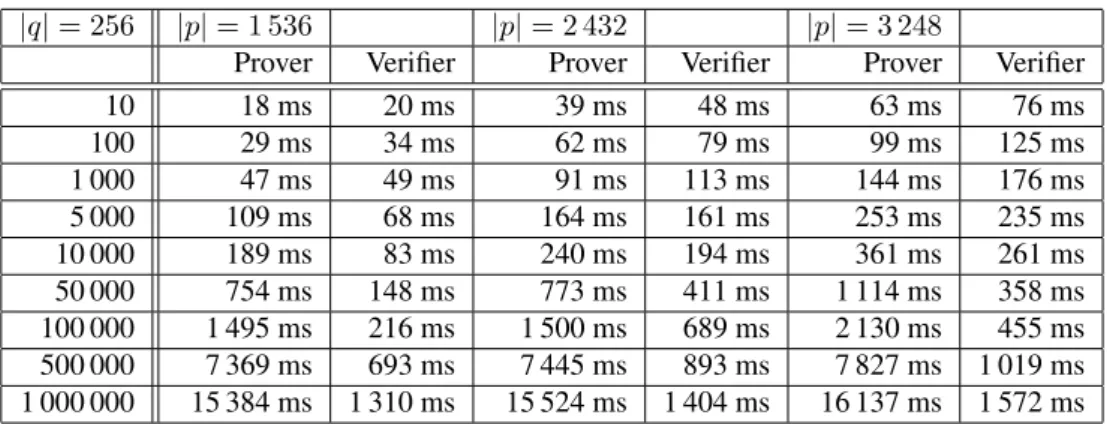
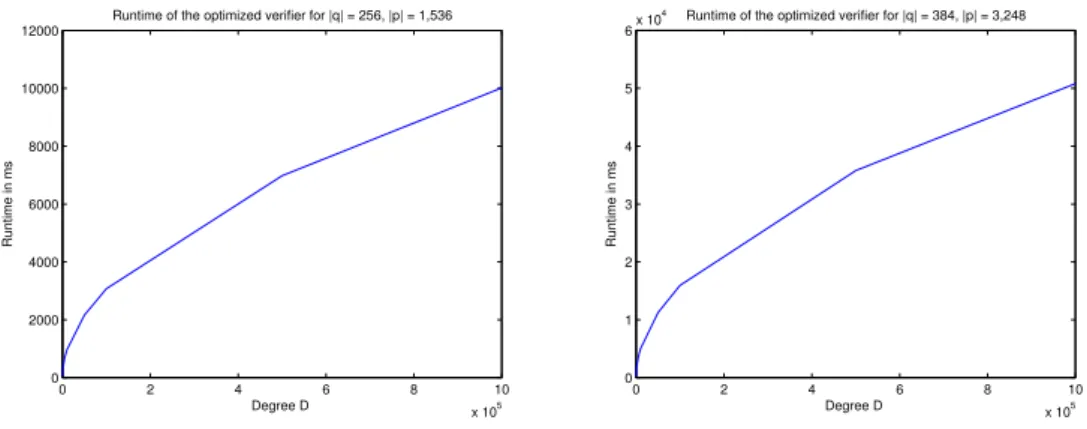
6.1 Run-time of our polynomial argument prover plotted against the degreeDfor|q|= 256
and|p|= 1 536, and|q|= 384and|p|= 3 248 . . . 100 6.2 Run-time of our polynomial argument verifier plotted against the degreeDfor|q|= 256
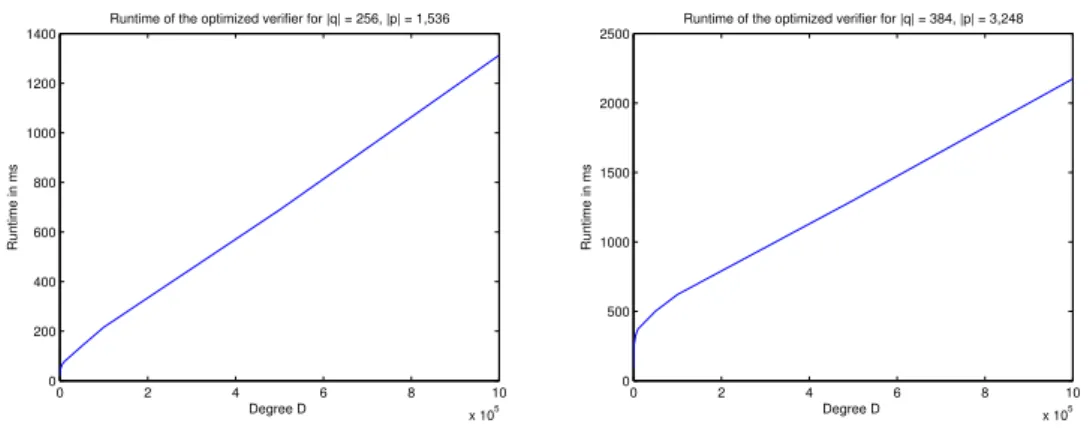
and|p|= 1 536, and|q|= 384and|p|= 3 248 . . . 100 6.3 Run-time of Brands et al.’s polynomial argument prover plotted against the degreeDfor
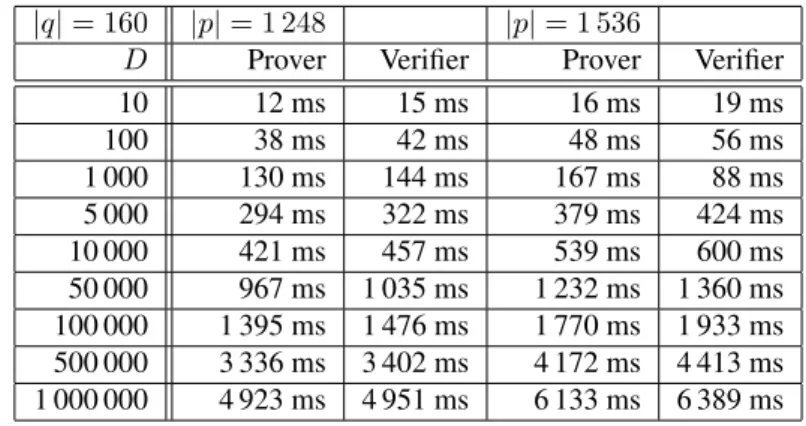
|q|= 256and|p|= 1 536, and|q|= 384and|p|= 3 248 . . . 123 6.4 Run-time of Brands et al.’s polynomial argument verifier plotted against the degreeD
List of Tables
4.1 Estimated security level for primespwith different bit-sizes. . . 52 4.2 Run-time in ms of Brands et al.’s polynomial argument verifier for different window
sizes for the sliding window algorithm and different modular groups for a polynomial with degreeD= 100 000. . . 57 4.3 Run-time in ms of Brands et al.’s blacklist argument verifier for different window sizes
for Lim-Lee’s algorithm on a groupGwith order 160-bit modulo a 1 248-bit prime and polynomials with degreesD= 10,100,1 000. . . 58 4.4 Run-time in ms of Brands et al.’s blacklist argument verifier for different window sizes
for Lim-Lee’s algorithm on a groupGwith order 256-bit modulo a 3 248-bit prime and polynomials with degreesD= 10,100,1 000. . . 58 4.5 Run-time in ms of Brands et al.’s blacklist argument verifier for different window sizes
for Lim-Lee’s algorithm on a groupGwith order384-bit modulo a3 248-bit prime and polynomials with degreesD= 10,100,1 000. . . 58 4.6 Run-time in ms of Brands et al.’s blacklist argument verifier for different window sizes
for Brickell et al.’s algorithm on a groupGwith order 160-bit modulo a 1 536-bit prime and polynomials with degreesD= 10 000,100 000. . . 59 4.7 Run-time in ms of Brands et al.’s blacklist argument verifier for different window sizes
for Brickell et al.’s algorithm on a groupGwith order 256-bit modulo a 3 248-bit prime and polynomials with degreesD= 10 000,100 000. . . 59 4.8 Run-time in ms of Brands et al.’s blacklist argument verifier for different window sizes
for Brickell et al.’s algorithm on a groupGwith order 384-bit modulo a 3 248-bit prime and polynomials with degreesD= 10 000,100 000. . . 59 6.1 Run-time in ms of the polynomial evaluation argument on a groupGwith 256-bit order
modulo a 1 536-bit prime for degreeD between 10 and 1 000 000 for the conservative and the optimized version, and the ratio between the two versions. . . 99 6.2 Run-time in ms of the polynomial evaluation argument on a groupGwith 256-bit order
modulo a 3 248-bit prime for degreeD between 10 and 1 000 000 for the conservative and the optimized version, and the ratio between the two versions. . . 101
16 List of Tables
6.3 Run-time in ms of the polynomial evaluation argument on a groupGwith 384-bit order modulo a 7 936-bit prime for degreeD between 10 and 1 000 000 for the conservative and the optimized version, and the ratio between the two versions. . . 101 6.4 Run-time in ms of the polynomial evaluation argument for different degreeDbetween
10 and 1 000 000 for the optimized version on a group with 160-bit order modulo a 1 248-bit prime and a 1 536-bit prime. . . 102 6.5 Run-time in ms of the polynomial evaluation argument for different degreeDbetween
10 and 1 000 000 for the optimized version on a group with 256-bit order modulo a 1 536-bit a 2 432-bit and a 3 248-bit prime. . . 102 6.6 Run-time of the polynomial evaluation argument for different degreeDbetween 10 and
1 000 000 for the optimized version on a group with 384-bit order modulo a 3 248-bit prime and a 7 936-bit prime. . . 102 6.7 Run-time of the polynomial evaluation argument for different degreeDbetween 10 and
1 000 000 for the optimized version on a group modulo a 1 536-bit prime and order 160-bit or 256-160-bit. . . 103 6.8 Run-time of the polynomial evaluation argument for different degreeDbetween 10 and
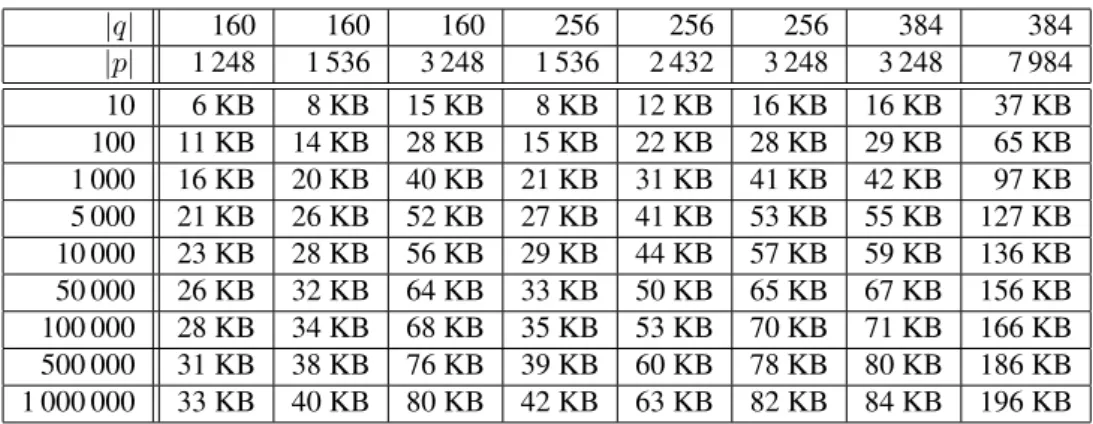
1 000 000 for the optimized version on groups modulo a 3 248-bit prime for different order sizes 160-bit, 256-bit and 384-bit. . . 104 6.9 Size of each round and of the statement for different degreeD for a 256-bit subgroup
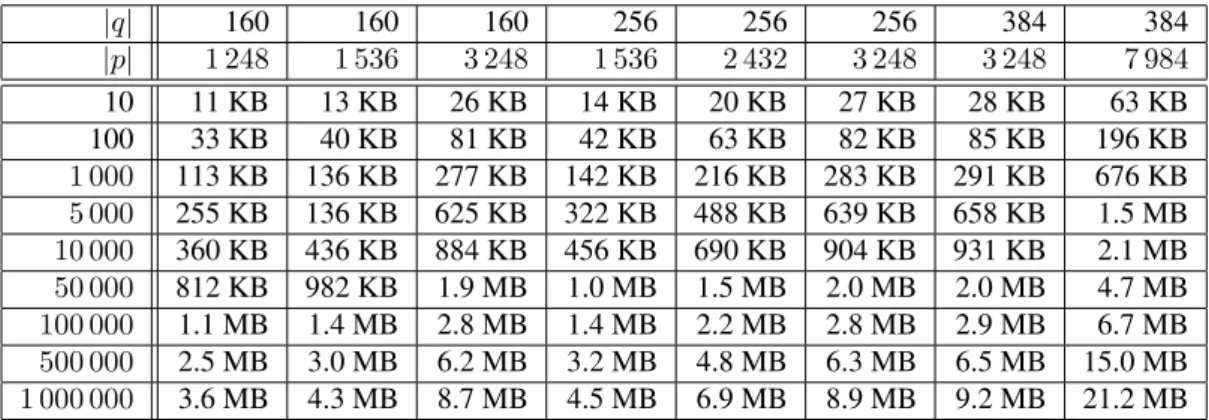
modulo a 1 526-bit prime. . . 104 6.10 Size whole argument for different degreeDfor all choices of groupsG. . . 105 6.11 Comparison of Brands et al.’s polynomial argument for different degreeDand different
levels of optimization on a 256-bit subgroup modulo a 1 536-bit prime. . . 121 6.12 Comparison of Brands et al.’s polynomial argument for different degreeDand different
levels of optimization on a 384-bit subgroup modulo a 3 248-bit prime. . . 122 6.13 Comparison of Brands et al.’s optimized polynomial argument for different degreeDa
on 256-bit subgroups modulo a 1 536-bit, a 2 432-bit, and a 3 248-bit prime. . . 123 6.14 Comparison of Brands et al.’s optimized polynomial argument for different degreeDa
on 160-bit subgroups modulo a 1 248-bit, and a 1 526-bit prime. . . 124 6.15 Comparison of Brands et al.’s optimized polynomial argument for different degreeDa
on 160-bit and a 256-bit subgroup modulo a 1 526-bit prime. . . 124 6.16 Comparison of Brands et al.’s optimized polynomial argument for different degreeDa
on a 256-bit and a 384 subgroups modulo a 3,248-bit prime. . . 124 6.17 Size of each round and of the statement for different degreeD for a 256-bit subgroup
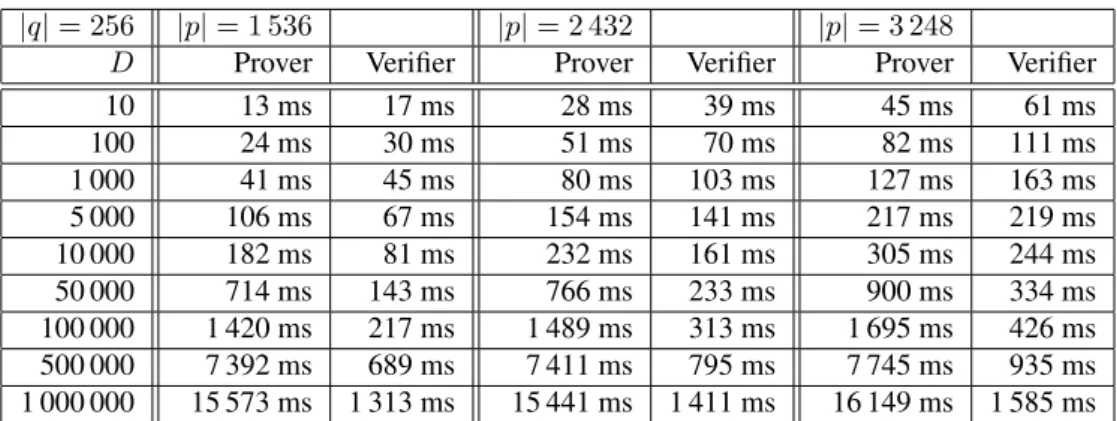
modulo a 1 526-bit prime. . . 125 6.18 Size whole argument for different degreeDfor all choices of groupsG. . . 125 6.19 Comparison of our polynomial argument with former work . . . 126 6.20 Detailed comparison of our polynomial argument with Brands et al. [BDD07] argument . 126
List of Tables 17 6.21 Comparison of our polynomial argument with Brands et al. [BDD07]. All experiments
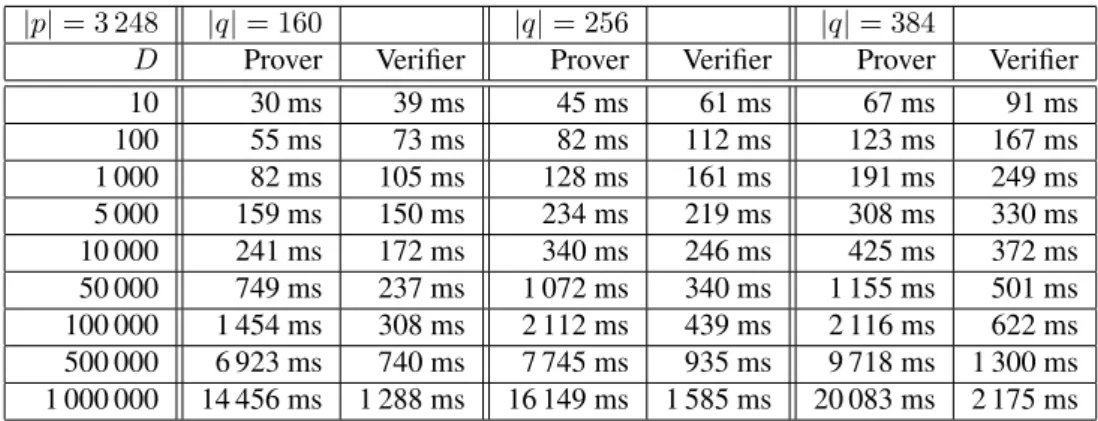
used a 256-bit subgroup modulo a 1 536-bit prime. . . 127 6.22 Comparison of our polynomial argument with Brands et al. [BDD07]. All experiments
used a 256-bit subgroup modulo a 3 248-bit prime. . . 128 6.23 Comparison of our polynomial argument with Brands et al. [BDD07]. All experiments
used a 384-bit subgroup modulo a 7 984-bit prime. . . 128 6.24 Comparison of our multivariate polynomial argument with former work . . . 129 6.25 Comparison of our batch polynomial argument with former work . . . 129
7.1 Run-time in ms of the blacklist argument on a groupGwith 256-bit order modulo a 1 536-bit prime for degreeD between 10 and 1 000 000 for the conservative and the optimized version and the ratio between the two versions. . . 137 7.2 Comparison of the blacklist argument for different degreeDfor optimized version on
different groups with fixed subgroup size of 160-bit. . . 138 7.3 Comparison of the blacklist argument for different degreeDfor optimized version on
different groups with fixed subgroup size of 256-bit. . . 138 7.4 Comparison of the blacklist argument for different degreeDfor optimized version on
different subgroups with moduli of 1 536-bit. . . 138 7.5 Comparison of the blacklist argument for different degreeDfor optimized version on
different subgroups with moduli of 3 248-bit. . . 139 7.6 Size of whole blacklist argument for different degreeDfor all choices of groupsG. . . 139 7.7 Run-time in ms of Brands et al.’s blacklist argument for a verifier without batching and
with batching on a 256-bit subgroup modulo a 1 536-bit prime. . . 151 7.8 Comparison of Brands et al.’s blacklist argument for different blacklist sizes and different
levels of optimization on a 256-bit subgroup modulo a 1 536-bit prime. . . 152 7.9 Comparison of Brands et al.’s blacklist argument for different blacklist sizes and different
levels of optimization on a 256-bit subgroup modulo a 3 248-bit prime. . . 152 7.10 Comparison of Brands et al.’s blacklist argument for different blacklist sizes for a fixed
160-bit subgroup modulo a 1 248-bit prime and a 1 536-bit prime. . . 153 7.11 Comparison of Brands et al.’s blacklist argument for different blacklist sizes for a fixed
256-bit subgroup modulo a 1 536-bit, a 2 432-bit and a 3 248-bit prime. . . 153 7.12 Comparison of Brands et al.’s blacklist argument for different blacklist sizes for different
order sizes modulo a fixed primepwith 1 536-bit. . . 153 7.13 Comparison of Brands et al.’s blacklist argument for different blacklist sizes for different
order sizes modulo a fixed primepwith 3 248-bit. . . 154 7.14 Size of each round and of the statement for different degreeD for a 256-bit subgroup
modulo a 1 526-bit prime. . . 154 7.15 Size whole blacklist argument for different degreeDfor all choices of groupsG. . . 155 7.16 Comparison of our non-membership argument with earlier work . . . 155
18 List of Tables
7.17 Comparison of our non-membership argument with Brands et al. [BDD07]. All experi-ments used a 256-bit subgroup modulo a 1 536-bit prime. . . 156 7.18 Comparison of our non-membership argument with Brands et al. [BDD07]. All
experi-ments used a 256-bit subgroup modulo a 3 248-bit prime. . . 156 7.19 Comparison of our non-membership argument with Brands et al. [BDD07]. All
experi-ments used a 384-bit subgroup modulo a 7 984-bit prime. . . 156
8.1 Run-time of the shuffle arguments in seconds forN = 10 000and different choices of mfor a subgroup of order 160-bit modulo a 1 248-bit prime. . . 182 8.2 Run-time of the shuffle arguments in seconds forN = 100 000and different choices of
mfor a subgroup of order 160-bit modulo a 1 248-bit prime. . . 182 8.3 Run-time of the shuffle arguments in seconds forN = 10 000and different choices of
mfor a subgroup of order 256-bit modulo a 1 536-bit prime. . . 183 8.4 Run-time of the shuffle arguments in seconds forN = 100 000and different choices of
mfor a subgroup of order 256-bit modulo a 1 536-bit prime. . . 183 8.5 Run-time of the shuffle arguments in seconds forN = 1 000 000and different choices
ofmfor a subgroup of order 160-bit modulo a 1 248-bit prime. . . 184 8.6 Run-time of the shuffle arguments in seconds forN = 1 000 000and different choices
ofmfor a subgroup of order 256-bit modulo a 1 536-bit prime. . . 184 8.7 Run-time of the shuffle arguments in seconds for N = 10 000 for different mfor a
subgroup of order 160-bit modulo|p|= 1 248, 1 536, and3,248. . . 185 8.8 Run-time of the shuffle arguments in seconds forN = 100 000for differentmfor a
subgroup of order 160-bit modulo|p|= 1 248, 1 536, and3 248. . . 185 8.9 Run-time of the shuffle arguments in seconds for N = 10 000 for different mfor a
subgroup of order 256-bit modulo|p|= 1 536, 2 432, and3 248. . . 185 8.10 Run-time of the shuffle arguments in seconds forN = 100 000for differentmfor a
subgroup of order 256-bit modulo|p|= 1 536,2 432, and3 248. . . 186 8.11 Run-time of the shuffle arguments in seconds forN= 10,000for differentmfor
differ-ent subgroups modulo a 1 536-bit prime. . . 186 8.12 Run-time of the shuffle arguments in seconds for N = 100 000 for different m for
different subgroups modulo a 1 536-bit prime. . . 187 8.13 Run-time of the shuffle arguments in seconds forN = 10 000for differentmfor
differ-ent subgroups modulo a 3 248-bit prime. . . 187 8.14 Run-time of the shuffle arguments in seconds for N = 100 000 for different m for
different subgroups modulo a 3 248-bit prime. . . 187 8.15 Run-time of the shuffle arguments in seconds forN = 100 000for differentmfor|q|=
160and different moduli valuesp1p2with|p1|= 1 248, 2 432,|p2|= 1 248, 2 432. . . 188
8.16 Run-time of the shuffle arguments in seconds forN = 100 000for differentmfor|q|= 160and different moduli valuesp1, p2with|p1|= 1 248, 3 248,|p2|= 1 248, 3 248. . . 188
List of Tables 19 8.17 Run-time of the shuffle arguments in seconds forN = 100 000for differentmfor|q|=
256and different moduli valuesp1, p2with|p1|= 1 536, 2 432|p2|= 1 536, 2 432. . . 188
8.18 Run time of the shuffle arguments in seconds forN = 100 000for differentmfor|q|= 160and different moduli valuesp1, p2with|p1|= 1 248,3 248,|p2|= 1 248,3 248. . . 189
8.19 Size of each round forN = 10 000for differentmfor|q|= 256and|p|= 1536. . . 189 8.20 Size of the shuffle argument in Mega Byte for N = 10 000 for different m and for
different valuesq, p. . . 190 8.21 Size of the shuffle argument in Mega Byte forN = 100 000for differentm and for
different valuesq, p. . . 191 8.22 Size of the shuffle argument in Mega Byte forN = 10 000,100 000,1 000 000for
dif-ferentmfor|q|= 256and|p|= 1536. . . 191 8.23 Comparison of the protocols with ElGamal encryption. . . 192 8.24 Run-time comparison of [FMM+02] (CPU: 1 GHz, Ram: 256 MB) to our shuffle
argu-ment (Toom-Cook withm = 64, CPU: 1.4 GHz, Ram: 256 MB) for a groupGwith order 160-bit modulo a 1 024-bit prime. . . 192 8.25 Run-time comparison of [TW10] to our shuffle argument for a groupGwith order
Chapter 1
Introduction
1.1
Motivation
Computers and Internet play an important role in our modern life. For a lot of everyday tasks there are online solutions available. The one which probably first comes into one’s mind is the use of e-mails instead of letters. Furthermore, a lot of people do their daily banking online, rather than going to the bank in person or sending a cheque. Wikipedia was developed to help us with the task of looking up and spreading knowledge. Other web based services for completely new tasks were created over the years such as Twitter and Facebook. Users dealing with any of these services are naturally concerned about the security of their data and their privacy.
To protect privacy, anonymising networks such as Tor [Tor13] were invented. They allow a user to hide their IP address and therefore make it difficult to trace the user’s Internet activity. For this reason such networks are used by a number of groups including undercover police agents, abuse victims, and citizens living under dictatorships. During the Arab Spring in 2011, for instance, the Tor network experienced a spike in users from Libya and Egypt [Din11]. However, anonymous access to services can also lead to abuse. Wikipedia, for instance, allows anonymous postings, but blocks the IP address of misbehaving users. This crude solution means that if one user of Tor abuses Wikipedia, all users whose traffic comes out of the same Tor relay with this IP-address are blocked. Thus, one misbehaving user causes many innocent users to be punished.
Different solutions to deal with this problem were suggested. Johnson et al. [JKTS07] suggested the Nymble system. In this alternative solution IP-addresses are not blocked, but instead each user anonymously proves that they have not been blacklisted. Other solutions along that line were suggested, among others, by Li and Hopper [LH11], as well as Henry and Goldberg [HG11]. Non-membership proofs were also studied in their own right, the best asymptotic solutions so far were given by Brands et al. [BDD07] and Peng [Pen11].
The reversed case of membership proofs, where the user wants to prove anonymously that they belong to a certain set, are useful when operating a whitelist access control system or group signature schemes. Membership proofs are also useful in applications such as e-auctions where users want to prove that their bids belong to a set of approved values, another application of membership proofs is e-voting. From a voter’s perspective it is important that they are able to prove that their vote belongs to a
22 Chapter 1. Introduction
certain set and therefore their vote is valid and be counted correctly. Apart from that, potential users of e-voting schemes may fear that the secrecy of the vote does not hold true anymore and that somebody is able to link their votes back to them after the votes are counted. Because of this, it is important to ensure the secrecy of the vote. To guarantee anonymity, e-voting protocols can be based on mix-nets. A mix-net is a multi-party protocol which allows a group of senders to input a number of encrypted messages to the mix-net, which then outputs them in random order.
It is common to construct mix-nets from shufflesand let mix-servers take turns in shuffling the ciphertexts. Informally, a shuffle of ciphertextsC1, . . . , Cn is a list of ciphertexts C10, . . . , Cn0 which contain the same plaintexts in permuted order.
As long as the shuffle is permutation hiding, which means that nobody is able to link input and output of a shuffle operation, the anonymity inside a mix-net can be ensured. Permutation hiding can be accomplished by re-encrypting the permuted ciphertexts, but then these ciphertexts could be substituted without detection. Therefore, it is also important that the correctness of a shuffle is guaranteed, and it is assured that the output ciphertexts contain the same plaintexts as the input ciphertexts. Different solutions to prove correctness were proposed, among these, solutions based on permutation matrices [FS01, Fur05, GL07, Wik09], or solutions based on the invariance of polynomials under permutation of roots [Nef01, GI08, Gro10].
It can be seen that in various settings it is desirable to construct solutions which guarantee the anonymity of the user without compromising performance or usability of the protocol. We also see that many different solutions for various problems have been published relying on different approaches. Some of these are either broken [Cha81, JJ01, JJR02] or do not guarantee full anonymity [JKTS07, HHG10, AST02]. In contrast, it seems that solutions based onzero-knowledgedo not suffer from these drawbacks.
Zero-knowledge proofs are interactive proofs which allow a user to prove a statement without re-vealing more than the correctness of the claim. This concept was introduced by Goldwasser, Micali, and Rackoff [GMR85]. An interactive proof consists of communication between a computationally un-bounded prover and a probabilistic polynomial time verifier. The communication consists of challenges from the verifier and answers to these challenges from the prover. The goal of the prover is to convince the verifier of the statement in such a way that the verifier always accepts, if the assertion is true. On the other hand, the prover should only be able to cheat with negligible probability, which means that there should be a very low probability of the verifier accepting a false statement. Brassard, Chaum, and Cr`epeau [BCC88] pointed out that in most applications it is secure enough to restrict the cheating prover to have polynomial time. This means an unbounded prover may be able to cheat, but a polynomial time prover is only able to cheat with negligible probability. To distinguish the different settings such zero-knowledge protocols are calledarguments[BCY91].
Zero-knowledge protocols, i.e. proofs and arguments, are very powerful tools. They allow to prove statements from every language in NP, that means languagesLwherex∈Lcan be proven in polynomial time given a witnessw.
zero-1.1. Motivation 23 knowledge proof system, the question of whether or not these protocols can be efficient and practical arose. Various aspects in a zero-knowledge proof system can be considered to be optimized, such as round complexity [FS89, BCY91], computational complexity [Sch91], and communication complexity. A lot of theoretical research was undertaken to reduce the communication complexity for all prob-lems in NP. Boyar et al. [BLP93, BBP91] reduced the cost of zero-knowledge proofs to subquadratic. Killian’s [Kil92] construction for proofs has also subquadratic communication cost, and Cramer and Damg˚ard [CD97] showed that it is possible to get zero-knowledge proofs with linear communication cost. Recently, Ishai et al. [IKOS07] improved this result further; their approach depends only linearly on the statement size and they gave also a version depending quasi-linearly on the witness sizen, that means the size of the argument isO(nlog(n)). Crescenzo and Fedyukovych [CF12] have taken a differ-ent approach, and also showed that it is possible to prove all statemdiffer-ents in NP with communication size which depends linearly on the statement size. Their protocol performs better for small circuits sizes than the method proposed by Ishai et al. [IKOS07], which still has the best asymptotic cost for big circuits.
If we consider arguments, the cost can be even lower, Cramer and Damg˚ard’s [CD97] argument for circuit satisfiability is linear in the circuit size. Killian’s [Kil92, Kil95] argument has only a polyloga-rithmic communication cost. The recent works by Ishai et al. [IKOS07] and Goldwasser et al. [GKR08] achieved arguments whose size depends only quasilinearly on the witness size.
The work done so far shows that it is possible to construct zero-knowledge protocols with a low communication cost. However, these techniques tend to have increased computational cost and therefore they are mostly of theoretical interest. It is considered to be one of the important challenges [Joh00] in modern cryptology to construct zero-knowledge proof systems which havebothefficient communication
andcomputational complexity. Therefore, in addition to the effort to lower the amount of communica-tion for general zero-knowledge protocols, work was undertaken to reduce the communicacommunica-tion cost for specific problems, for example as described above, without paying the price of high computational cost. Among others, [FO97, Bra97, CS97] gave polynomial evaluation arguments with linear cost and [FS01, Nef01, Fur05, TW10] achieved linear communication cost for shuffles. However, none of these protocols are really practical, they suffer from a big constant factor and the size of all these arguments is greater than the size of the statement itself.
In recent years more sophisticated techniques helped to reduce the argument size to sublinear. For instance Brands et al. [BDD07] stated a non-membership argument with square root cost or [GI08] proposed a sublinear shuffle argument. Furthermore, Groth [Gro09] gave different zero-knowledge ar-guments with sublinear size for general statements involving linear algebra, and based on this result Seo [Seo11] stated an improved version with less interaction.
This work addresses the challenge posed by Johnson [Joh00] and we construct zero-knowledge arguments with both sublinear communication complexity and practical computation complexity. The security of our protocols rests only on the discrete logarithm assumption, which conjectures that the cal-culation of the discrete logarithm for a random group elementHto baseGin various finite cyclic groups Gis hard. More precisely, a groupGis cyclic with finite ordernifG={G, G2, . . . , Gn−1, Gn = 1}
24 Chapter 1. Introduction
is generated by the base elementG, and the discrete logarithm ofHis the unique elementx∈Zn, for whichGx=H holds.
The discrete logarithm assumption is one of the most fundamental and well-studied cryptographic assumptions. There are several types of prime order groups where the discrete logarithm assumption is believed to hold, for instance an orderqsubgroup ofZ∗pwherepis a large prime, or a group of points on an elliptic curve. This yields group elements that can be much smaller than when using RSA-moduli or pairing-based cryptography, giving us an advantage compared to such schemes.
1.2
This work
One of the important challenges on modern cryptology is to find efficient zero-knowledge proof systems which can be used to construct real life protocols [Joh00]. In this work we address this problem and answer the challenge positively for zero-knowledge arguments based on the discrete logarithm assump-tion. Our new zero-knowledge arguments are all sublinear in the statement size; in addition, our shuffle argument, see Chapter 8, is also sublinear in the witness size. Apart from the sublinear communicational cost, which is desirable in itself, our arguments are practical in terms of computational cost. Thus, we are able to give protocols, which answer the challenge posed by Johnson [Joh00] to find more efficient zero-knowledge protocols.
We will first explain efficient protocols for various specific problems, which can be used as building blocks for more complex zero-knowledge arguments, detailed in Chapter 5. Then, we show how these techniques can be used to construct zero-knowledge arguments for different real life problems. More precisely we propose an univariate polynomial evaluation argument, a polynomial evaluation argument for multivariate polynomials, and an argument to show correct evaluation of a set of polynomials at the same time, see Chapter 6. We will also give non-membership proofs and membership proofs, see Chapter 7, and an argument to show correctness of a shuffle, which will be explained in Chapter 8. We compare all these protocols with former work and see that they compare very favorably to them. This holds especially regarding the communication cost, and all our verifiers are much lighter than the state of the art. Furthermore, we implemented our protocols to verify the practicality of the argument size and also to test the real life behavior of our protocols.
There are various reasons why our zero-knowledge arguments perform better than earlier protocols. First we have chosen our commitment scheme carefully. A commitment scheme allows the prover to commit themselves to a value without disclosing this value. Later the prover can open the commitment to reveal the value. We have chosen the general Pedersen commitment, which will be introduced in detail in Section 3.3.1. The general Pedersen commitment is homomorphic and therefore allows to verify sophisticated combinations of commitments and leads to reduced computational cost. Also the Pedersen commitment is length reducing, since it is possible to conceal many elements in one element, which is important to get sublinear communication cost. Furthermore, we will make use of a special design of the verifier’s challenges. Instead of pickingndifferent challengesxi, the verifier constructs Vandermonde challengesx, x2, . . . , xn. The use of the Vandermonde challenges allows us to use sophisticated batch verification and therefore reduces the communication and computational complexity.
1.2. This work 25 different settings. To reduce the complexity of our polynomial arguments, we have written theXi in binary, similar to multi-exponentiation techniques, which gives us a logarithmic cost. Another trick we used for different arguments, for example, batch-polynomial evaluation or shuffle argument, is to arrange the witness in anm×nmatrix, together with the general Pedersen commitment this leads to sublinear communication cost. Lastly, we used Lagrange interpolation polynomials in our constructions, which led to sophisticated ways to verify our commitments.
All these techniques combined give us zero-knowledge arguments for various applications, which all have sublinear cost and as a result compare very favorably against earlier work for the same problems. In this work we construct our protocols ashonest verifier zero-knowledgeprotocols [BMO90]; this means an honest but curious verifier will gain no knowledge from the interaction with the prover, but a dishonest verifier may be able to gain information. More precisely, we will use the stronger definition of
special honest verifier zero-knowledgearguments [CDS94], in this case there exists a simulatorSwhich can simulate the interaction between a prover and a verifier given the messages of the verifier beforehand. It is possible to transform these arguments into full zero-knowledge protocols secure against arbitrary verifiers using an OR-proof [CDS94] or standard techniques [FS89].
We will present our protocols in the plain model, that means that the security of our protocols is
onlybased on the discrete logarithm assumption. The description of the finite groups and public keys used inside a protocol are part of our statement. This allows us to concentrate on the description of the protocols themselves, without worrying where the groups come from. In real life application the group description and keys could be supplied by a trusted third party that provides the environment the protocols are used in. Alternatively, the group description and the public keys can be generated by multi-party protocols of all parties involved. Another possibility is that the verifier decides on the group description and the public keys, and the prover verifies the correctness of these.
All of our protocols are described as interactive protocols, but all can be transformed to non-interactive proofs using the Fiat-Shamir heuristic [FS86] if a security proof in the random oracle model is secure enough. Nevertheless, in this work we will concentrate on the interactive setting only and therefore compare our work with interactive protocols.
The contributions of this dissertation can be summarized as follows.
1. We demonstrate how Groth’s zero-knowledge argument for linear algebra relation [Gro09] can be used to construct a product argument to showQN
i=1ai=bfor secretaiand public knownb. This
argument was joint work with Jens Groth and was published at Eurocrypt 2012 [BG12].
2. We demonstrate how Groth’s zero-knowledge argument for linear algebra relation [Gro09] can be used to construct a product argument to showQN
i=1ai=bfor secretaiand secretb.
3. We give a multi Hadamard product argument to show for secret vectorsai,bthata1◦. . .◦an =b, with sublinear complexity. This argument was published together with Jens Groth at Eurocrypt 2012 [BG12].
4. We give an argument to show that for secret vectorsai,bithatP m
26 Chapter 1. Introduction
∗ : ZqZq →Zq, with sublinear complexity. This was also published at Eurocrypt 2012 [BG12] together with Jens Groth.
5. We give a zero-knowledge argument for committed vectorsai,bi,ci∈Zqnsatisfyingai◦bi=ci, where◦denotes the entry-wise product. This Hadamard product argument is joint work with Jens Groth.
6. We propose an efficient and practical honest-verifier zero-knowledge polynomial evaluation argu-ment with logarithmic communication and computational complexity. This result was published at Eurocrypt 2013 [BG13] together with Jens Groth.
7. We show how the polynomial evaluation argument can be adjusted to work with multivariate poly-nomials. The new argument has only polylogarithmic communication and computational com-plexity.
8. We explain how one can prove evaluation ofLpolynomials efficiently at the same time. The work leading to the argument was done together with Jens Groth.
9. We propose a practical zero-knowledge non-membership argument to show that a secret valueu is not contained in a list L, which is a straightforward application of our polynomial evaluation argument. This work was published at Eurocrypt 2013 [BG13] together with Jens Groth.
10. We give a zero-knowledge non-membership argument to show that a secret valueuis not contained in a secret listL.
11. We propose a practical zero-knowledge membership argument to show that a secret valueuis contained in a listL. This result was also published at Eurocrypt 2013 [BG13] together with Jens Groth.
12. We explain how one can simultaneously prove non-membership or membership of multiple lists This is also joint work with Jens Groth.
13. Lastly, we propose an efficient honest verifier zero-knowledge argument for the correctness of a shuffle. The argument was published at Eurocrypt 2012 [BG12] together Jens Groth.
In the following we will describe ourmaincontributions in more detail.
Polynomial Evaluation:We propose efficient honest verifier zero-knowledge arguments for univariate or multivariate polynomials in Chapter 6.
We give an efficient zero-knowledge argument for two committed valuesu, vsatisfyingP(u) =v for a given polynomialP(X) ∈Zq[X], whereqis a prime andZq[X]is the ring of polynomials with coefficients inZq. We work over a modular groupGof order qand use the Pedersen commitment scheme, i.e. a commitment touis of the formGuHrfor somer ∈
Zq. Given the coefficients of the polynomialP(X) = PD
i=0aiXi and two Pedersen commitments, our zero-knowledge argument can
1.2. This work 27 Our zero-knowledge polynomial argument is highly efficient. The communication complexity is O(logD) group and field elements, which is very small compared to the statement size of D field elements. The prover computesO(logD)exponentiations inGandO(DlogD)multiplications inZq, and the verifier computesO(logD)exponentiations inGandO(D)multiplications inZq. The constants in the expressions are small.
We also show how this zero-knowledge argument can be efficiently adapted to cover the case of multivariate polynomials. The new protocol only communicatesO((logD)n)elements for ann-variate polynomial with degreeD, which leads to a much smaller argument size compared to all former ap-proaches. Moreover, both parties have to calculate onlyO((logD)n)exponentiations, but an increased number of multiplications. Although the number of multiplications dominates the computational com-plexity, the total computational cost is smaller than theO(Dn)exponentiations needed by former ap-proaches.
Next, we will explain how one can prove forL polynomials P1, . . . , PL at the same time that
Pi(ui) =vifor secretui, viwithout repeating our polynomial argument in parallel. This new approach leads to a communication cost of O(√LlogD) elements, opposed to the formerly needed O(LD)
elements. Furthermore, the computational cost is quite efficient, the prover only needs to calculate O(LlogD)exponentiations, whereas the verifier computes onlyO(√LlogD)exponentiations.
Non-membership and membership proofs:In Chapter 7 we propose a practical non-membership proof and a membership proof for sets which are straightforward applications of our polynomial argument. As a consequence, the communication complexity of each proof isO(logD)group elements. This is a significant reduction compared to previous schemes with complexityO(D)or O(√D). The prover’s computation is a logarithmic number of exponentiations and a quasilinear number of multiplications inZq. The verifier’s computation is a logarithmic number of exponentiations and a linear number of multiplications inZq.
Shuffle:We also propose a practically efficient honest verifier zero-knowledge argument for the correct-ness of a shuffle. Our argument is very efficient, in particular, we drastically decrease the communication complexity compared to previous shuffle arguments. We cover the case of shuffles of ElGamal cipher-texts, but it is possible to adapt our argument to other homomorphic encryption schemes as well. The detailed description can be found in Chapter 8.
Our shuffle argument has sublinear communication complexity. When shufflingN =mn cipher-texts, arranged in anm×nmatrix, our argument transmitsO(m+n)group elements giving a minimal communication complexity ofO(√N)if we choosem = n. In comparison, Groth and Ishai’s argu-ment [GI08] communicatesΘ(m2+n)group elements, and all other state of the art shuffle arguments
communicateΘ(N)elements.
Practical Results:To verify the practicality of our new arguments we implemented some of our new protocols and some of the former protocols. The analysis of the results showed that our protocols perform better for real life parameters, and also that the performance is efficient enough to be practical.
28 Chapter 1. Introduction
for example subgroup size or modulo size, on the running time and size of the argument. These results give us evidence for which parts of the protocols should be optimized further to get even more practical arguments.
When implementing the protocols we need to work over finite cyclic groups. There are many pos-sible choices, for example subgroups of prime order modulo a large prime, or groups based on elliptic or hyper-elliptic curves. In our implementations we have focused on subgroups modulo a large prime, in order to keep our implementation as straightforward as possible. Adding the whole functionality for el-liptic curves expected to increase the work disproportionately compared to the insight we expected from the results. Elements of elliptic curves are smaller; thus, applying elliptic curves to our protocols would lead to even smaller arguments. But this would be the case for all discrete logarithm based arguments. Similarly, implementations of protocols over elliptic curves tend to be faster than implementations over modular groups. Again, this is similar for all protocols based on the discrete logarithm. So, we would gain little extra knowledge by comparing our work with other discrete logarithm based arguments in this setting.
Our implementations are just straightforward implementations, i.e. our prover and verifier are sim-ulated in the same program and communicate over simple data files; thus, we did not simulate a commu-nication over SSL or other secure channels. The main focus of this work is to show that it is possible to construct practical zero-knowledge protocols and analyze the pure run-time of these. Establishing a se-cure connection between two parties adds some time on top of the execution time. This extra time would effect our results; therefore, we can justify our approach. We are also aware that our implementation can be open to general side channel attacks and that making the implementation secure against these might add extra run-time. Again, we only want to measure the pure run-time; thus, we ignored this issue for our implementation.
For the same reasons we did not set up key management. In real life applications key management is used for example to distribute cryptographic keys to parties in a system. In our work we just picked random numbers for the commitment key and the public encryption and passed these values over to the prover and verifier. We are aware that in this case an adversary might learn something relevant from the values, and as a consequence this should not be done in real life. But to change the key generation and storage does not affect the runtime of the underlying protocols, for example shuffle, which was the scope of our experiments. We can, therefore, justify the way we are dealing with the parameters.
1.3
Published Work
The univariate polynomial argument, Section 6.2, and the straightforward application of non-membership and non-membership arguments, Chapter 7, were published at Eurocrypt 2013 in ’Zero-knowledge Argument for Polynomial Evaluation with Application to Blacklists’[BG13].
The shuffle argument, Chapter 8, and the underlying product argument, Section 5.3, were published at Eurocrypt 2012 in’Efficient Zero-knowledge argument for Correctness of a Shuffle’[BG12]. Recently, the developer of the Zeus e-voting scheme told us that they want to integrate our shuffle argument into Zeus [Zeu13]. At the moment we are working with them to find the best way to do it [Lou13].
Fur-1.4. Thesis Structure 29 thermore, the Spanish e-voting company Scytl [Scy13] told us, that they are considering to include our argument in their e-voting platform.
The Hadamard argument, Section 5.4, and the batch polynomial argument, Section 6.4 are joint work with Jens Groth. So far they are unpublished. Furthermore, the multivariate polynomial argument is new and was not published before.
1.4
Thesis Structure
The thesis is organized as follows. First we will give all the background needed for our thesis. In more detail, in Chapter 2, we will briefly introduce the discrete logarithm assumption and give some overview of the history of zero-knowledge. In Chapter 3, we will state all definitions of the concepts needed during our thesis and introduce zero-knowledge formally. Next, in Chapter 4, we will introduce our approach to the implementation and discuss relevant optimizations.
In Chapter 5, we will state and explain zero-knowledge arguments for different problems, which are needed as building blocks for our zero-knowledge arguments. In Chapter 6 we describe our construction of the new polynomial evaluation arguments and also describe Brands et al.’s [BDD07] technique for the same problem. Furthermore, we discuss results from our implementation and compare our work in detail to Brands et al.’s approach. In the next chapter, Chapter 7, we explain how our polynomial argument can be applied to non-membership and membership proofs. Again we will recap Brands et al.’s [BDD07] technique and compare our result theoretically and practically with Brands et al.’s [BDD07] work. Lastly, in Chapter 8, we will state the construction of our efficient sublinear shuffle argument. Also, in this case we will discuss results obtained from our implementation. In Chapter 9, we will conclude and give ideas for possible future research.
Chapter 2
Background
This thesis is about efficient zero-knowledge arguments. We base their security on the discrete logarithm assumption. In this section we will introduce the discrete logarithm assumption and discuss the rele-vant aspects. Furthermore, we will introduce zero-knowledge protocols in more detail and give a short overview over the history.
2.1
Discrete Logarithm Assumption
The discrete logarithm assumption plays an important role in modern cryptography and various cryp-tographic tools are based on it, for example ElGamal encryption [ElG84] or the Pedersen commit-ment [Ped91].
Informally, the discrete logarithm assumption conjects that the calculation of the discrete logarithm is hard for a random group elementH to baseGin various finite cyclic groupsG. A groupGis cyclic with ordern, if there exists a generatorG∈Gsuch thatG={G, G2, . . . , Gn−1, Gn = 1}andGx6= 1 forx < n. The discrete logarithm ofHis an elementx∈Znfor whichH =Gxholds.
More precisely, hard in this context means that there exists no polynomial time algorithm which can calculate the discrete logarithm of the elementH ∈G. For a formal definition, see Section 3.2.
Diffie and Hellman [DH76] were the first to use the discrete logarithm assumption in the context of cryptography. They constructed a secure key exchange protocol based on the belief that the assumption holds for finite fields of prime order.
There are several types of groups where the discrete logarithm assumption is believed to hold. Among them certain prime order groups, for instance an orderqsubgroup ofZ∗pwhereqandpare large primes. It is also believed that the assumption holds for a group of points on an elliptic curve or on a hyper-elliptic curve.
To clarify this belief we have to investigate the different methods of calculating the discrete loga-rithm of an arbitrary elementH ∈G. There are three classes of algorithms to solve the discrete logarithm problem. The first class consists of generic algorithms, that means the algorithms do not exploit special properties of the objects to which they are applied. Other algorithms work best for groups which have smooth group order, a group order is smooth if it is the product of small primes. The last class requires that smooth group elements exist. That means they can be represented as products of primes smaller
32 Chapter 2. Background than a certain boundaryα.
The first and obvious generic algorithm is to test the equationGx=Hfor all possiblex∈
Znuntil axis found, wherenis the order of the underlying group. This approach usesngroup operations and therefore is not recommended for largen.
Baby Step-Giant Step [Sha71] improves the upper-bound of the run-time to find the discrete loga-rithm toO(√n). This method needsO(√n)space. A similar run-time is achieved by Pollard’sρmethod [Pol78] without the space requirement. Pollard’sρcan be set up with constant size space.
Shoup [Sho97] showed that for any generic algorithm the lower bound of group operations to per-form is at leastΩ(√p), wherepis prime and divides the group ordernand for all primesq,q|nand it holdsq≤p. That means for groups with prime orderpit is not possible to improve on the runtime of
Ω(√p)using generic algorithms.
For groups with smooth group ordern the Pohlig-Hellman [PH78] algorithm works best. This algorithm calculates O k X i=1 ci(logn+pi) !
group operations forn=Qk
i=1p
ci
i . This means the run-time to solve the discrete logarithm in groups for which the order has only small prime factors is quite small; therefore, such groups should be avoided in real life applications.
The last class of algorithms has subexponential run-time. The basic idea is to pick a factor base of small primes and use algebraic relations to solve the discrete logarithm. The algorithms can be applied to all groups for which the concept of smoothness makes sense and the group contains many smooth elements. As it is not known how to define the notion of smoothness on general elliptic curves or hyper-elliptic curves, it is not known how to find a factor base. Therefore, these algorithms cannot be applied to groups of points over elliptic curves or hyper-elliptic curves [Mil85, SS98]. However, for some special elliptic or hyper-elliptic curves it is possible to adapt the techniques [Gau00, Gau09, Die11].
To express the expected run-time in these cases we introduce the L-function by
Ln[α] = exph√lnnln lnnαi
and the extended L-function by
Ln[α, c] = exp(c+o(1))(lnn)α(ln lnn)1−α, wherenis the order of the group we are looking at.
The first algorithms with subexponential run-time are the Index-Calculus methods. In the vari-ant described by Pomerance [Pom87], the algorithm calculatesLn[√2]group operations and requires Ln[p1/2]space. Coppersmith, Odlyzko, and Schroepple’s [COS86] version of Index-Calculus yields an even better run-time. Their variant only requiresLn[1/2]time and space.
2.2. Zero-Knowledge 33 The last two algorithms are derived from the number field sieve factorization algorithm [LL93], namely the number field sieve (NFS) algorithm and the similar function field sieve (FFS) [Sch08]. Both algorithms work in finite fieldsFpn, wherepis prime; hence, inFp = Zp. These algorithms have a better expected run-time than the variants of Index-Calculus. The run-time of NFS is
Ln[1/3; (64/9)1/3]
and FFS runs in
Ln[1/3; (32/9)1/3].
We have to mention that recent work by Joux [Jou13] brought down the complexity to calculate the discrete logarithm onFpntoLn[1/4;c]for smallp. However, this result does not affect our work as we will work over finite fields with large prime order.
We see that there are many ways to find the discrete logarithm in groups; however, none of these algorithms runs in expected polynomial time. We also have to mention the work by Shor [Sho97]. He showed that it is possible to calculate the discrete logarithm of a general group element in polynomial time providing that a quantum computer with sufficient number of bits exists. At the moment it seems that it will take a long time before such a computer can be built and we believe that the discrete logarithm assumption holds in near future.
All in all, we can justify to base our protocols on cryptographic schemes, which are secure as long as the discrete logarithm assumption holds, as we have seen that the assumption indeed holds in various groups.
2.2
Zero-Knowledge
The concept of zero-knowledge, introduced by Goldwasser, Micali, and Rackoff [GMR85] is very pow-erful and is used to construct various cryptographic protocols. Informally, a zero-knowledge proof is an interactive protocol, in which the prover wants to convince the verifier of the validity of their assertion without revealing more than the correctness of the claim.
An interactive proof is a protocol between two parties, called prover and verifier. The goal of the prover is to convince the verifier of the validity of an assertion. The protocol consists of multiple rounds and each round consists of a message either from the prover or the verifier. More precisely, such an interactive protocol should allow an honest prover to always convince the verifier of a true statement. That means the protocols should becomplete. On the other hand, the protocol should guarantee that no prover can find a strategy to convince the verifier of a wrong statement except with small probability. This property is called thesoundnessof the interactive proof.
Lastly, the interactive protocol should bezero-knowledge. That means a malicious verifier should gain no new information from the interaction with the prover. Or in other words, zero-knowledge means that everything that the verifier can calculate after the interaction with the prover can be calculated by the verifier by the assertion itself.
34 Chapter 2. Background
Proof vs. Argument:A zero-knowledge proof is a protocol as described above, for which the require-ments holds for a computationally unbounded prover and a probabilistic polynomial time verifier. Even an unbounded time prover should not be able to cheat.
Brassard et al. [BC86, BCC88] relaxed the soundness condition such that no polynomial time prover should be able to fool the verifier, but an unbounded time prover might be able to cheat. This weaker definition is good enough for most cryptographic protocols. Interactive proof systems which satisfy this definition are called arguments [BCY91].
Levels of zero-knowledge:The zero-knowledge property of an interactive proof or argument requires that the verifier learns nothing new from the communication with the prover other than what he can deduce from just seeing the statement itself. Depending how strong or weak an adversary is allowed to be we have different levels of zero-knowledge.
In a perfect world nobody, not even an unbounded time adversary, can learn anything from the tran-script of the interaction. This is calledperfectzero-knowledge. Protocols which fulfill the principle that an unrestricted adversary cannot deduce any useful information from the transcript, except with negligi-ble probability, arestatisticalzero-knowledge. Lastly, if a probabilistic polynomial time adversary will not get any useful information from the transcript, but an unbounded adversary can deduce information, then this type is calledcomputational zero-knowledge. Clearly, a perfect zero-knowledge protocol is also statistical zero-knowledge, and statistical zero-knowledge implies computational zero-knowledge.
Computational zero-knowledge is the most liberal notion of the three levels, but good enough for real life protocols. However, it is not known if in the future more powerful devices will be developed, for example a quantum computer, which allows an adversary to deduce information from the transcript. In this case the other two levels of zero knowledge guarantee a higher level of security, and therefore it is preferable to construct interactive protocols which are perfect or statistical zero-knowledge.
Proof of knowledge:Zero-knowledge proofs defined in [GMR85] are proofs of language membership that means the prover convinces the verifier that common inputxis in some fixed languageL. In more detail the prover wants to show thatxhas some property, for example is a quadratic residue, or is a 3-colorable graph. Though, sometimes the prover wants to show knowledge of some object, and in this case the definition by Goldwasser et al. does not fit. To get an adequate definition the notion ofproof of knowledgewas first suggested in [GMR89], but not formalized. Formal definitions were first given by Feige et al. [FFS88, FS89], and Tompa and Woll [TW87], but they only considered provers which can convince the verifier with non-negligible probability. This can lead to problems, as pointed out by Bellare and Goldreich [BG92]. In the same work they gave the nowadays standard definition of a proof of knowledge and also of arguments of knowledge.
Private coin vs. public coin:In the setting of interactive proof systems, defined by Goldwasser et al. [GMR85], the verifier can pick some randomness in private, and there are no restrictions on the use of the outcome. The verifier can perform any polynomial time computation on it and send the result to the prover. Therefore, this setting is called private coin. On the contrary in the setting of Babai [Bab85] it is required that the verifier shows the result of the coin toss to the prover. Thus, this is called a public
2.2. Zero-Knowledge 35 coin protocol.
In some of the early examples of interactive proofs, it was important that a verifier keeps their coin tosses secret. So, it seems that the general case of private coin is stronger and can prove more statements. However, Goldwasser and Sisper [GS86] showed that private coin interactive proofs can be transformed into public coin interactive proofs. This transformation increases the number of rounds only by an additive constant. However, the new prover needs to be super-polynomial time and the transformation does not preserve zero-knowledge. Furthermore, the transformation cannot be applied to arguments.
Okamoto [Oka96] was able to show that private coin statistical zero-knowledge proofs can be trans-formed into public coin zero-knowledge proofs which need a super-polynomial time prover. Similar results were found by Vadhan [Vad06], who showed that computational private coin zero-knowledge equals computational public coin zero-knowledge. Furthermore, Pass et al. [PV10] state a transforma-tion from private coin zero-knowledge into public coin zero-knowledge which can also be applied to arguments.
Existence of zero-knowledge proofs systems:Goldwasser et al. [GMR85, GMR89] gave in their semi-nal work the first examples for zero-knowledge proofs. However, it was not clear how powerful the new notion is and how much can be proven using zero-knowledge protocols.
Goldreich, Micali, and Wigderson [GMW86, GMW91] showed that, assuming one-way functions exist, every language in NP has a computational zero-knowledge proof. Ben-Or et al. [BOGG+88] gen-eralized this result and showed that every language that has an interactive proof has a computational zero-knowledge proof, given a secure probabilistic encryption scheme exists. Goldreich and Kahan [GK96] explained how to construct constant-round computational zero-knowledge proofs for every language in NP.
Unfortunately, the same does not hold for statistical zero-knowledge proofs, Fortnow [For87] showed that if all languages in NP have a statistical zero-knowledge proof then the polynomial time hierarchy will collapse. However, for some problems in NP statistical zero-knowledge proofs exist.
For arguments the situation is better, Brassard et al. [BCC88] proved that every language in NP has a statistical zero-knowledge argument based on specific algebraic assumptions. Naor et al. [NOVY92] showed that the existence of one-way permutations is enough for every language in NP to have a perfect zero-knowledge argument. Furthermore, Nguyen et al. [NOV06] showed that every language in NP has a statistical zero-knowledge argument under the assumption that one-way functions exist. Feige and Shamir [FS89] gave constructions for perfect zero-knowledge arguments of knowledge for all NP.
Honest verifier zero-knowledge:The definition of zero-knowledge requires that no verifier, not even a cheating one, learns anything new from the conversation with the prover. A weaker definition ofHonest verifier zero-knowledge (HVZK)was given by Bellare et al. [BMO90], they considered the amount of information which can be extracted by an honest verifier following the protocol.
This definition is not strong enough for cryptographic applications; however, Bellare et al. [BMO90] showed that there exists a statistical zero-knowledge proof for each problem which has a statistical HVZK proof, under the assumption that the discrete logarithm assumption or the factoring assumption
36 Chapter 2. Background
holds. Ostrovsky et al. [OVY93] have proven that the same result holds under the more general assump-tion that one-way permutaassump-tion exists. Okamoto [Oka96] were able to show that if a languageLhas a statistical HVZK proof thenLhas a statistical zero-knowledge proof, given one-way functions exist.
Damg˚ard [Dam93] could show that each constant round public coin statistical HVZK proof or argument can be transformed in a constant round public coin statistical zero-knowledge proof sys-tem. This transformation does not rely on any computational assumption. Damg˚ard et al. [DGOW95] proposed other transformations from constant round public coin HVZK to constant round public coin zero-knowledge with less round complexity, but these transformations can only be applied to proofs. Goldreich et al. [GSV98] gave the first transformation of statistical HVZK into statistical general zero-knowledge under no condition, which holds for all interactive proof systems. Vadhan [Vad06] showed that the same is true for computational zero-knowledge.
All the transformations above are not practically viable, a more practical approach was given by Feige and Shamir [FS89] provided the discrete logarithm holds. Also, Groth [Gro04], Jarecki and Lysyanskaya [JL00], Damg˚ard [Dam00], Garay et al. [GMY06] gave ways to transform HVZK proof systems into zero-knowledge proof systems which cost only a small number of elements, see Section 3.5.
Optimizations:All general constructions of zero-knowledge proofs and arguments are not practical and efficient. Naturally, the question arose whether or not interactive proof protocols can be more efficient. Various aspects in zero-knowledge proof systems can be considered to be optimized, that is the number of rounds, communication complexity, and computational complexity.
Brassard, Cr´epeau, and Yung [BCY91] constructed a 6-move perfect zero-knowledge argument for all languages in NP. Whereas, Feige and Shamir [FS89] showed that it is possible to construct compu-tational zero-knowledge arguments of knowledge with 4-rounds given some algebraic assumptions or in 5-rounds assuming that one-way functions exist. Similar results were stated by Bellare et al. [BJY97] they showed the existence of 4-round zero-knowledge arguments of knowledge, given that one-way func-tions exist. As shown by Goldreich and Krawczyk [GK90] this result is optimal, unless the language is in BPP.
In the case of proofs, Goldreich and Kahan [GK96] explain how to construct constant round zero-knowledge proofs with 5-rounds, under widely believed number-theoretical assumptions. Results by Katz [Kat12] indicated that for computational zero-knowledge that 5-rounds are optimal and therefore the result by Goldreich and Kahan are optimal. Recently, Ong and Vadhan [OV08] showed that in-deed all languages which have a statistical knowledge proof have a constant round statistical zero-knowledge proof.
These results only hold for zero-knowledge proofs for language membership and it was not clear if constant round proofs of knowledge with constant rounds exist. The gap was closed by Lindell [Lin10] who showed the existence of 5-round computational zero-knowledge proofs of knowledge for all lan-guages in NP.
Round complexity is one aspect which can be optimized, another one is the amount of data sent between both parties. In protocols with a unbounded number of rounds a basic protocol was repeatedk
2.2. Zero-Knowledge 37 times to achieve a security of2−k, this approach has a cost of at leastΩ(kn)bits, wherenis the statement size. Special techniques allowed Boyar et al. [BLP93, BBP91] to reduce this cost to subquadratic for any languageLand Kilian [Kil92] reduced this cost slightly for proofs using PCPs.
Cramer and Damg˚ard [CD97] were able to construct a zero-knowledge proof for all NP with linear communication cost and constant number of rounds. Recently, Ishai et al. [IKOS07] improved this result further, their approach depends only linearly on the statement size and they gave also a version depending quasilinearly on the witness size. Crescenzo and Fedyukovych [CF12] have taken a different approach and also showed that it is possible to prove all statements in NP with communication cost which depends linearly on the statement size. Their proof performs better than [IKOS07] for small circuits; however, for big circuits the technique by [IKOS07] gives better performance.
Cramer and Damg˚ard’s [CD97] technique for arguments turns out to have the same complexity as the technique by the authors for proofs. But for arguments the communication cost can be even lower. Kilian’s [Kil92, Kil95] technique leads to arguments for each language in NP with constant number of rounds and a communication with polylogarithmic cost in the statement size. The recent work by Ishai et al. [IKOS07], and Goldwasser et al. [GKR08] achieved arguments with communication depending only quasilinearly on the witness size.
The last important aspect which can be optimized is the computational complexity. Since Schnorr’s [Sch91] construction to prove identification in zero-knowledge, it has been known that it is possible to have zero-knowledge proofs and arguments with low computational complexity. However, all general constructions to prove statements in NP requires heavy reductions to special problems; thus, they are not efficient in this respect. Moreover, it is hard to give good lower bounds on the computa-tional complexity, as all protocols have to read at least the statement. However, work was undertaken to reduce the cost of zero-knowledge protocols for specific problems. For instance, [BDD07, Pen11] for non-membership arguments or [CD98, Gro09, Gro11] for circuit satisfiability.
Chapter 3
Preliminaries
In this chapter we will give definitions of the key concepts needed to construct our zero-knowledge arguments. When arguing that a protocol is correct we will use homomorphic commitment schemes extensively, different commitment schemes can be used. We will describe our work using the Pedersen commitment scheme [Ped91] as it is based on the discrete logarithm. Our shuffle protocol works for different types of homomorphic encryption schemes, for example ElGamal encryption [ElG84] or Pail-lier encryption [Pai99]. We will focus on ElGamal encryption since it is based on the discrete logarithm assumption and also for notational reasons. Finally, we give precise definitions of what we mean by honest verifier zero knowledge arguments.
3.1
Notation
Definition 1(Negligible, Overwhelming). We say a functionf :N→[0,1]is negligible if
f(x) =O(x−c)
for every constantc >0. We say1−fis overwhelming iffis negligible.
To define security in our protocols, we will use a security parameterλ. The security parameterλ is written in unary1λ and is given as input to all parties in our protocols. Intuitively, the higher the security parameter the more secure the protocol, see also Section 4.1.1. Formally, we define security in the following by saying a protocol has security levelλif an adversarial algorithm requires at least2λ steps to succeed.
We writey =A(x;r)when the algorithmA, on inputxand randomnessr, outputsy. We write y ←A(x)for the process of picking randomnessruniformly at random and settingy =A(x;r). We also writey←Sfor samplingyuniformly at random from a setS.
We will denote field elements fromZq with lower case characters. For randomizers we will stick throughout the thesis tor, s, t, ρ, σ, τ ∈ Zq and tox, y, z ∈ Z∗q for challenges, which are sent by the verifier. The encryption scheme and the commitment scheme may use different underlying groups, but we require that both groups have the same prime orderq. We will writeGfor the group used by the commitment scheme and writeHfor the ciphertext space.
![Table 6.21: Comparison of our polynomial argument with Brands et al. [BDD07]. All experiments used a 256-bit subgroup modulo a 1 536-bit prime.](https://thumb-us.123doks.com/thumbv2/123dok_us/10196042.2922443/127.892.159.820.726.935/table-comparison-polynomial-argument-brands-experiments-subgroup-modulo.webp)
![Table 6.22: Comparison of our polynomial argument with Brands et al. [BDD07]. All experiments used a 256-bit subgroup modulo a 3 248-bit prime.](https://thumb-us.123doks.com/thumbv2/123dok_us/10196042.2922443/128.892.104.764.230.438/table-comparison-polynomial-argument-brands-experiments-subgroup-modulo.webp)