Procedia Computer Science 12 ( 2012 ) 356 – 360
1877-0509 © 2012 Published by Elsevier B.V. Selection and/or peer-review under responsibility of Missouri University of Science and Technology. doi: 10.1016/j.procs.2012.09.084
Complex Adaptive Systems, Publication 2
Cihan H. Dagli, Editor in Chief
Conference Organized by Missouri University of Science and Technology
2012- Washington D.C.
Traffic Simulation System Based on Fuzzy Logic
Mohammad A. Taha
a,*, Laheeb Ibrahim
bacollege of computer science and mathmatics ,University of Mosul ,Mosul, Iraq. bcollege of computer science and mathmatics, University of Mosul ,Mosul, Iraq.
Abstract
The advent of the intelligent transport systems has prompted traffic simulation to become one of the most used approaches for traffic analysis in support of the design and evaluation of traffic systems. The capability of traffic simulation to emulate the time variability of traffic events makes it a matchless facility for capturing the complexity of traffic systems. There are many researches which implement fuzzy but to specific traffic problems and there are many traffic simulation applications but with no support for fuzzy logic. This paper presents a simulation environment, designed for testing and evaluation of any fuzzy logic based traffic management system. The user could simulate any traffic isolated intersection or intersection network with multiple lanes. He could also specify input parameters, build fuzzy rules that control the traffic flow and simulate the model to monitor the efficiency of model by noticing the output parameters. A graphical user interface allows visualization of the simulation, including animation of vehicle movements.
Keywords: Traffic management; Simulation environment; Fuzzy logic control;
1.Introduction
Since 1977 began the first attempt to resolve the problem of traffic intersections using fuzzy logic a study by Pappis and Mamdani[1]. The study considered a single junction of two one-way streets. It was later extended to two consecutive intersections by Nakatsuyama et al. in 1984 [2]. Then Favilla et al. expanded the work to multiple lanes in 1993 [3], but still only with a single intersection. A more recent study in [4] simulated a Multilane Isolated Intersection. All studies of the related literature mentioned in this study or not are an applying of the fuzzy logic to specific cases.
In this paper we use fuzzy logic to solve problems of any number of consecutive intersections and lanes. The user can design and construct intersection(s) using graphical interface and then connect his design to fuzzy engine
* Corresponding author. Tel.: +964-7701610217. E-mail address: [email protected].
,simulate the design and tune, review and compare the results. The paper is organized as follows. Section 2 will describe the traffic controller. Then Sections 3 and 4, the traffic simulator and fuzzy engine are proposed, respectively. Then section 5 presents the case study and results. Finally, Section 6 gives the conclusion of the work.
2. Traffic signal control
There are two different types of traffic signal control, Fixed time control and adaptive signal control. The fixed time control is based on the historical traffic data, assuming traffic conditions are unchanged in the time periods. A local controller uses the pre-defined timing schedule to control intersection signals. More green time is allocated during peak periods and reduced green time during off peak periods. This approach although may work quite effectively during normal traffic condition, a sudden change in traffic condition results in the failure of this approach. Adaptive signal control arises as an refinement over fixed time control, this control scheme uses the real-time data that are gathered from sensors installed at an intersection. The operation of signal control relied on the real traffic situation. latter developments on traffic signal control use artificial intelligence technology, such as fuzzy logic [1-4,6,7] and neural networks [8]. Algorithms using Petri nets [9] and Markov decision control [10] have also been investigated in recent years.
3. Traffic simulation
Traffic flows can be modeled macroscopically from an aggregated point of view based on a hydrodynamic analogy by regarding traffic flows as a particular fluid process whose state is characterized by aggregate macroscopic variables: density, volume, and speed. But they can also be modeled microscopically, that is, from a fully disaggregated point of view aimed at describing the fluid process from the dynamics of the individual particles (the vehicles) that compose it. Mesoscopic models represent a third intermediate modeling alternative based on a simplification of vehicular dynamics[5]. This paper is based on macroscopic variables that considered to be the input for fuzzy engine.
4. Fuzzy engine
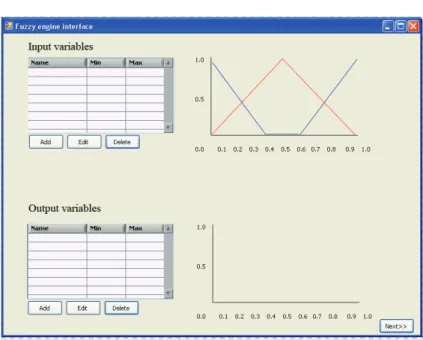
The fuzzy engine has been built using object oriented approach so it is more flexible in responding users' requirements. The engine divided into four classes (Fuzzy_engine, Fuzzy_rules, Linq_var, Member_fun). Once the user ends the first step(design of intersection(s) using graphical user interface tool see figure 1) ,the user can begin the next step, which to connect the design with fuzzy engine and here there are also a graphical user interface see figure 2 to choose input variables ,build rules and specify the output variables. Fuzzy rules can be designed manually by a user, or automatically, it means that fuzzy engine generate rules for all combinations of selected premise variable and a user fills consequent fuzzy terms. all rules can be deactivated and independent rule weight can be assigned for each consequent variable.
Each linguistic term defined for Input or Output Linguistic Variables is described by a membership function. Fuzzy engine supports the following membership functions:
•Trapezoidal •Inverse Trapezoidal •S-shape •Inverse S-shape •Singleton •Piece-wise linear •Gaussian combination •Gaussian curve •Bell-shape
Then the fuzzy engine supports 5 defuzzification methods: •Centroid Average (CA).
•Maximum Center Average (MCA). •Mean of Maximum (MOM). •Smallest of Maximum (SOM). •Largest of Maximum (LOM).
Fig. 1. Intersection design.
5. Case study and results
In order to evaluate the effectiveness of the fuzzy logic system, we carried out two cases, namely: • case 1 (A,B,C,D) traffic flow (vph) is steady for each direction (N,E, S, W).
• case 2 (A,B,C,D) traffic flow (vph) Differs for each flow direction (N,E, S, W).
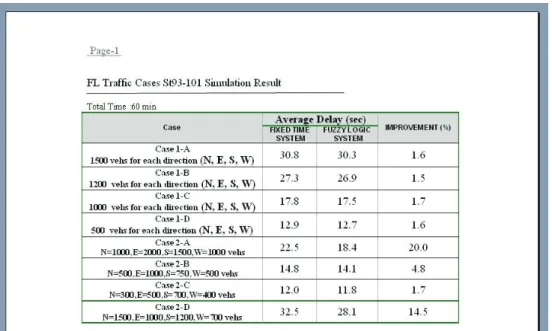
A simulation run is made for 60 min periods with different traffic flow (vph) for each case (A,B,C,D) to produce the output average delay of vehicles.The results for case 1 show that generally the proposed fuzzy logic system and the fixed time controller produce little difference (best rate Case 1-C =1.7%) in results. The results for case 2 indicate that the proposed fuzzy logic system performs much better (best rate Case 2-A =20.04 %) than the fixed time controller see figure 3 that shows the simulation report for two cases.
Fig. 3. Simulation result report.
6. Conclusion
Fuzzy control algorithms fit well to various traffic problems as was shown e.g. in [1,2,3,6,7]. In this paper we introduced a new fuzzy logic tool that help traffic designers and engineers to use the fuzzy logic approach to find best solution for their problems. The tool provides a graphical environment for user to design and build the road intersections then connect the design to fuzzy engine using another graphical environment which contain all necessary settings for input variables, member functions, fuzzy rules, defuzzification methods and output variables in easy to use way. after that the user simulate the design and get the simulation output report that contain simulation results like average delay time, served vehicles, queues length and Etc. The performance of fuzzy logic system is affected by the configuration of input/output variables and the rule base. In order to optimize the performance of the proposed controller it can be done by tuning these variables and rule base using fuzzy engine interface. The proposed fuzzy logic system and fixed time controller produce little difference in results in term of average delay when used in cases with constant traffic flow. Whereas, in cases of time-varying traffics, the proposed fuzzy logic system is superior to the fixed time controller
References
1. Pappis C. and Mamdani E. (1977). A Fuzzy Logic Controller for a Traffic Junction. IEEE Transactions on Systems, Man and Cybernetics. Vol. SMC-7, No. 10.
2. M. Nakatsuyama, H. Nagahashi, N. Nishizuka, Fuzzy logic phase controller for traffic functions in the one-way arterial road, in: Proc. IFAC 9th Triennial World Congress, Pergamon Press, Oxford, 1984.
3. J. Favilla, A. Machion, F. Gomide, Fuzzy traffic control: adaptive strategies, Second IEEE International Conference on Fuzzy Systems II (1993) .
4. Azura Che Soh ,Lai Guan Rhung, Haslina Md. Sarkan., MATLAB Simulation of Fuzzy Traffic Controller for Multilane Isolated Intersection, (IJCSE) International Journal on Computer Science and Engineering,Vol. 02, No. 04, 2010.
5. Jaume Barceló , Fundamentals of Traffic Simulation, Springer , 2010.
6. D. Teodorovic, Fuzzy logic systems for transportation engineering: the state of the art, Transport. Res. Part A 33 (1999).
7. W. Wei, et. al., “Traffic signal control using fuzzy logic and MOGA,” Proceedings of IEEE conference on systems, man, and cybernetics, 2001.
8.Srinivasan, D and M C Choy, "Neural Networks for Real-time Traffic Signal Control". IEEE Transactions on Intelligent Transportation Systems, 7, no. 3 (2006).
9. G. List, and M. Cetin, “Modeling traffic signal control using Petri nets”, IEEE Transaction on intelligent transportation systems, vol. 5, no. 3, 2004.
10. X.-H. Yu, and A. Stubberud, “Markovian decision control for traffic signal systems”, Proceedings of the 36th IEEE conference on decision and control, 1997.