Universidade Nova de Lisboa
Faculdade de Ciências e Tecnologia
Departamento de Informática
Dissertação de Mestrado em Engenharia Informática 2º Semestre, 2007/2008
Efficient Middleware for Database Replication
André Abecasis Gomes Ferreira, nº26836Orientador
Prof. Nuno Manuel Ribeiro Preguiça
Nº do aluno: 26836
Nome: André Abecasis Gomes Ferreira
Título da dissertação:
Efficient Middleware for Database Replication Palavras-Chave: • Replicação • Execução especulativa • Bases de Dados • Middleware Keywords: • Replication • Speculative execution • Databases • Middleware
Resumo
Os sistemas de bases de dados são usados para armazenar informação nas mais variadas aplicações, incluindo aplicações Web, empresariais, de investigação e pessoais.
Dada a sua larga utilização em sistemas fundamentais para os utilizadores, é necessário que os sistemas de bases de dados sejam eficientes e fiáveis. Adicionalmente, para que estes sistemas possam servir um elevado número de utilizadores, é importante que as bases de dados sejam escaláveis, podendo processar grandes quantidades de dados. Para tal é necessário recorrer à replicação dos dados. Num sistema replicado, os vários nós contêm cópias da base de dados. Assim, para garantir a convergência das réplicas, as operações de escrita têm de ser efectuadas sobre todas as réplicas. O modo como esta propagação é efectuada dá origem a duas estratégias diferentes. A primeira, em que os dados são propagados assincronamente após a conclusão de uma transacção de escrita, conhecida como replicação assíncrona ou optimista. A segunda, em que os dados são propagados sincronamente durante a transacção, conhecida como replicação síncrona ou pessimista.
Na replicação pessimista, ao contrário da replicação optimista, as réplicas mantêm-se consistentes. Assim, esta aproximação permite simplificar a programação das aplicações, porque a replicação dos dados é transparente para as mesmas. No entanto, este tipo de aproximação apresenta problemas de escalabilidade, devido ao número de mensagens trocadas na sincronização, que obriga a um atraso na conclusão da transacção. Assim, o utilizador tende a experimentar uma latência bastante superior na abordagem pessimista.
Neste trabalho apresenta-se o desenho e implementação dum sistema de replicação de bases de dados, com semântica snapshot isolation, usando uma aproximação de replicação síncrona. O sistema é composto por uma réplica primária e um conjunto de
réplicas secundárias que replicam totalmente a base de dados. A réplica primária executa as transacções com operações de escrita, enquanto que as restantes executam as transacções que só têm operações de leitura. Após a conclusão de uma transacção de escrita na réplica primária as alterações são propagadas para as restantes réplicas. Esta aproximação adequa-se a um modelo de utilização em que a fracção de operações de leitura é bastante superior à de operações de escrita, podendo a carga das leituras ser dividia pelas várias réplicas.
Para melhorar o desempenho do sistema, os clientes executam algumas operações de forma especulativa, de modo a evitar que fiquem em espera durante a execução de uma operação na base de dados. Deste modo, o cliente pode continuar a sua execução enquanto a operação é executada na base de dados. Caso o resultado devolvido ao cliente se verifique ser incorrecto, a transacção será abortada, garantindo a correcção da execução das transacções.
Abstract
Database systems are used to store data on the most varied applications, like Web applications, enterprise applications, scientific research, or even personal applications. Given the large use of database in fundamental systems for the users, it is necessary that database systems are efficient e reliable. Additionally, in order for these systems to serve a large number of users, databases must be scalable, to be able to process large numbers of transactions. To achieve this, it is necessary to resort to data replication. In a replicated system, all nodes contain a copy of the database. Then, to guarantee that replicas converge, write operations must be executed on all replicas. The way updates are propagated leads to two different replication strategies. The first is known as asynchronous or optimistic replication, and the updates are propagated asynchronously after the conclusion of an update transaction. The second is known as synchronous or pessimistic replication, where the updates are broadcasted synchronously during the transaction.
In pessimistic replication, contrary to the optimistic replication, the replicas remain consistent. This approach simplifies the programming of the applications, since the replication of the data is transparent to the applications. However, this approach presents scalability issues, caused by the number of exchanged messages during synchronization, which forces a delay to the termination of the transaction. This leads the user to experience a much higher latency in the pessimistic approach.
On this work is presented the design and implementation of a database replication system, with snapshot isolation semantics, using a synchronous replication approach. The system is composed by a primary replica and a set of secondary replicas that fully replicate the database- The primary replica executes the read-write transactions, while the remaining replicas execute the read-only transactions. After the conclusion of a
read-write transaction on the primary replica the updates are prop agated to the remaining replicas. This approach is proper to a model where the fraction of read operations is considerably higher than the write operations, allowing the reads load to be distributed over the multiple replicas.
To improve the performance of the system, the clients execute some operations speculatively, in order to avoid waiting during the execution of a database operation. Thus, the client may continue its execution while the operation is executed on the database. If the result replied to the client if found to be incorrect, the transaction will be aborted, ensuring the correctness of the execution of the transactions.
Index
1 INTRODUCTION ...13
1.1 MOTIVATION AND CONTEXT OF THE PROBLEM...13
1.2 SOLUTION PROPOSED...15
1.3 MAIN CONTRIBUTIONS...18
1.4 OUTLINE...18
2 RELATED WORK ...19
2.1 SPECULATIVE EXECUTION...19
2.1.1 “Speculative Execution in a Distributed File System” [1] ...20
2.1.2 “Execução especulativa em bases de dados” [2]...21
2.1.3 “Zyzzyva: Speculative Byzantine Fault Tolerance” [3] ...22
2.2 DATABASE ISOLATION LEVELS...24
2.3 DATABASE REPLICATION...26
2.3.1 "The dangers of replication and a solution" [9]...27
2.3.2 “A suite of database replication protocols based on group communication primitives” [4] ...29
2.3.3 “Ganymed: Scalable Replication for Transactional Web Applications” [5] ...33
2.3.4 “Database Replication Using Generalized Snapshot Isolation” [6]...36
2.3.5 “Tashkent+: Memory-Aware Load Balancing and Update Filtering in Replicated Databases” [7] .38 2.3.6 “Don’t be lazy, be consistent: Postgres-R, A new way to implement Database Replication” [8] ...40
2.3.7 “The Database State Machine Approach” [10] ...42
2.3.8 “Revisiting the Database State Machine Approach” [11] ...44
2.3.9 “Gorda: An Open Architecture for Database Replication (extended)” [12] ...45
2.3.10 Summary ...49 3 DESIGN ...51 3.1 ANALYSIS...51 3.1.1 Design Principle ...51 3.1.2 Optimizations...52 3.2 ARCHITECTURE...53 3.2.1 Client ...54 3.2.2 Server...56 3.2.3 Speculation ...58 4 IMPLEMENTATION ...61 4.1 BASE FUNCTIONALITY...61 4.1.1 Binding...61 4.1.2 Transaction Execution ...62
4.1.3 Handling JDBC Internal Structures ...65
4.1.4 Handling with Concurrency and Speculation Consequences ...67
4.2 WRITE-SET EXTRACTION...68
4.3 TREATMENT OF FAILURES...69
4.4 SPECULATION...71
5 RESULTS ...75
5.1 WRITE-SET EXTRACTION...75
5.2 BENCHMARK TPC-C...76
6 CONCLUSION ...79
6.1 CRITICAL EVALUATION...79
6.2 FUTURE WORK...81
Index of Figures
Figure 1: Replication protocol guaranteeing snapshot isolation (from [4]) ... 30
Figure 2: Ganymed Prototype Architecture (from [5])... 34
Figure 3: Tashkent replicated database design (from [7]) ... 39
Figure 4: Postgres-R Architecture (from [8]) ... 41
Figure 5: Processing stages and contexts (from [12])... 46
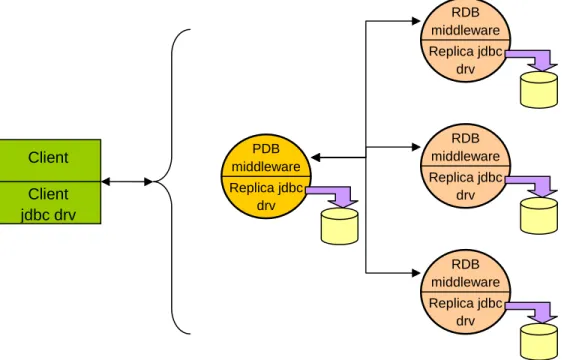
Figure 6: Middleware architecture... 54
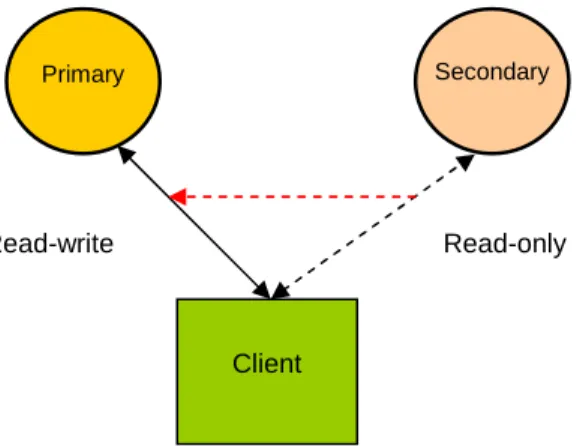
Figure 7: Change of replica when the transaction is found to be read-write... 55
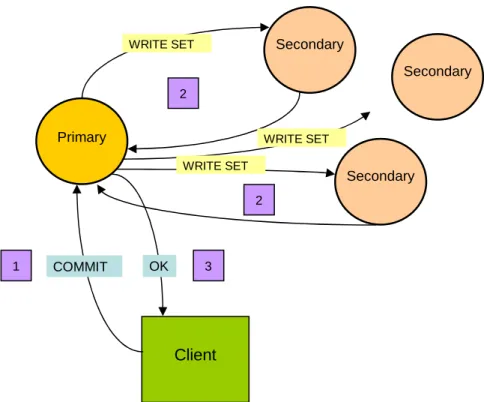
Figure 8: Execution of a commit operation. ... 64
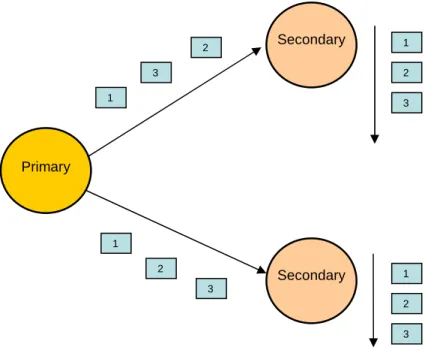
Figure 9: Reordering of the write sets on the secondary replicas ... 65
Index of Tables
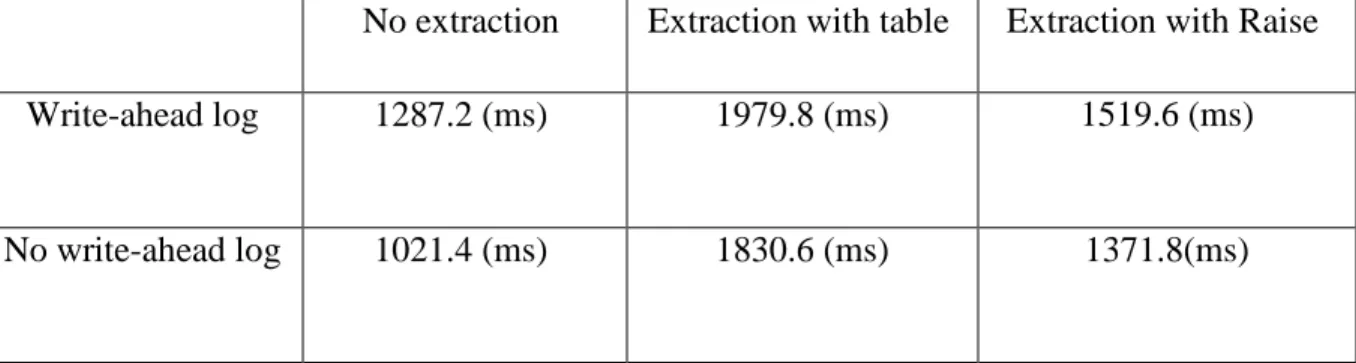
Table 1: Comparing some of the presented systems properties ... 50 Table 2: Time measures (milliseconds) for the extraction of the write sets... 75 Table 3: Total of executed transactions with the increase of the number of servers... 77
1 Introduction
1.1 Motivation and context of the problem
A large number of different applications are built on top of database systems. These applications include most sites with dynamic contents, corporate applications (e.g. banking, airline reservations, etc.), scientific and even personal applications. Thus, database systems need to provide a service that is reliable and efficient, in order to be useful and practical to users. Additionally a database system must be scalable to process large amounts of operations and data.
To guarantee reliable transaction execution, database systems implement the ACID properties (Atomicity, Consistency, Isolation and Durability). In a system that provides Atomicity, a transaction must be performed atomically, so that all of the transaction operations are performed and if one is not performed then none must be performed. The Consistency property allows the database to be inconsistent while the transaction is being processed, but before the transaction begins and after the transaction terminates the database must be consistent. To reach Isolation, the order for the execution of the transactions operations must be serializable, meaning that independently of the schedule of the transaction history, the outcome must be equal as if the transactions where executed sequentially with no overlapping. In most database systems, Isolation is relaxed to improve performance, thus allowing some limited concurrency. Finally, Durability guarantees that if the transaction commits, and the user has received its result, the modifications to the database are not lost, even if the system crashes.
Replication is a mechanism used to improve availability and performance of database systems, as well as to allow the scalability of the database. When replication is used, several sites, or replicas, maintain copies of the database. Under full replication the
whole database is stored at every replica. Under partial replication, only a subset of the data is stored at each replica. Although, partial replication is very attractive, since a smaller amount of resorts is necessary, it is harder to implement automatically, as the data needed for each operation may be distributed over several sites.
When using replication, when an update transaction is executed, all replicas must be updated to maintain consistency. The propagation of updates may be postponed to the end of the transaction or it may be executed immediately for each write operation. Deferred update replication techniques offer advantages over immediate update techniques, such as better performance, simplified server recovery and a lower deadlock rate. However, there is a drawback to this approach: the lack of synchronization during transaction execution that may increase greatly the transaction abort rates.
There are two major replication approaches, synchronous or eager replic ation, and asynchronous or lazy replication. When a transaction is executed in a replica the changes must be applied to all other replicas. In eager replication, the updates are propagated inside the transaction, i.e., before finishing the transaction. On commit, all replicas must be updated synchronously using an atomic commit protocol. In lazy replication the updates are propagated asynchronously only after the commit of the transaction, i.e., after the transaction has committed locally, therefore allowing the replicas to diverge. Each approach has its own advantages and drawbacks.
Eager replication provides serializable execution since there are no concurrency anomalies, but there is a decrease in the global performance since extra messages are exchanged as a consequence of the synchronization to achieve consistency between the replicas. The synchronization itself is a problem for efficiency since before returning the result of the transaction to the client, all replicas must be updated. Therefore clients experience a large latency using eager replication systems. This approach provides single-copy consistency, meaning that clients observe the system as if it has only one copy of the data, allowing the programmer to use a familiar model.
Lazy replication allows more efficient implementations as replicas do not need to be synchronously updated inside a transaction. However, as this approach allows a
transaction to see old values, the replicas can diverge. To solve the divergence, a reconciliation mechanism is necessary. If the number of nodes scales up, the number of reconciliations tends to scale up, which may lead to system delusion (the database replicas will be inconsistent) [9]. In lazy replication the principle of single-copy consistency is not observed. In fact, the programmers must be aware of this drawback and adapt their applications accordingly.
Synchronous replication with good performance is still an area of research, as recent work show [4, 5, 6, 7, 8]. Commercial databases often use asynchronous replication that tolerates inconsistencies among replicas.
1.2 Solution proposed
In this work, we have tried to develop an efficient middleware for database replication. Since a lazy replication requires reconciliation because it allows replicas to diverge, we have chosen to implement a synchronous approach. Our approach provides single-copy consistency, making it much easier to implement new applications because the programmer observes one (logical) copy of the data.
The architecture of the system is loosely based on the Ganymed [5] system, as it is a replication system based on primary-copy. In this approach, updates are first committed on a primary copy of the data, and then applied to the other copies, thus guaranteeing that replicas evolve to the same state. A read operation may execute in any of the system copies, thus allowing distributing the load among system replicas.
The proposed middleware system is composed by clients and a set of replica servers. Users’ applications run in clients and access the replicated database system using a custom JDBC driver. Thus, applications can use our replication middleware without any modification.
At each replica server, the middleware component uses a JDBC driver to communicate with the local database copy. The local database fully replicates the data managed by
the system. The database itself was not modified. At any moment, there is a designated master/primary replica.
The system provides Snapshot Isolation, an isolation level that relaxes serializability. When a transaction is started, the system creates a (logical) snapshot of the database with the currently committed values. The snapshot is used to read values and write new values, inside the transaction. Transactions do not observe updated values from transactions that commit after the snapshot. Snapshot Isolation can be implemented using a lock-based approach or the first-committer-wins rule to prevent lost-updates. In this case, when a transaction tries to commit, if it has updated data that was also updated by a transaction that committed after the start of this transaction, this transaction must be aborted. In the former case, the locking subsystem prevents concurrent updates from being executed.
Unlike Ganymed, we avoid requiring applications to declare transactions as read-only, while using a similar strategy for load balancing read-only and update transactions. For this end, the following approach is used. When a client starts a transaction, a transaction is started both on a replica and on the master, guaranteeing that the same database snapshot is used. After this, the operations of the transaction are sent only to the replica. If the transaction ends without any write operations, the transaction is committed in the replica and it is discarded in the master. If one of the transaction operations happens to be a write operation, then the transaction is discarded in the slave replica and the transaction in the master continues the execution from the write operation and thereafter. In practice, this is similar to the Ganymed functionality, which implements a Primary-Copy approach, where read-only transactions execute on slave replicas and update transactions execute on the master replica. The difference is that read-only transactions do not need to be declared a-priori.
One disadvantage of a Primary-Copy is that it can become a bottleneck of the system, particularly with a large number of replicas, since all update transactions are executed on the primary, as well as being a single point of failure. For addressing failures, we have implemented a failure recovery mechanism that replaces the primary in case of failures. Regarding load, as it is usual that the fraction of update transactions be small,
we expect that this primary-copy approach does not limit the system’s performance, in practice.
When an update transaction is committed, the updates must be propagated to the slave replicas. The master bundles the updates in a write set which it propagates to the slave replicas.
In our approach, as read-only transactions are executed in slaves, it is necessary to balance the load among the replicas. Additionally, it is necessary to guarantee that an update transaction from a client does not observe a snapshot that does not include updates observed/executed by previous transactions from the same client. Unlike Ganymed, we implement our approach without a central scheduler to provide these properties. For balancing the load, transactions are executed on randomly chosen replicas. The system guarantees that a client does not observe snapshots of the database older than the previously seen snapshot.
Our system resorts on speculative execution to improve the global performance. It also decreases the number of messages exchanged by grouping specific messages and propagating them in a set.
Regarding speculative execution, it is used on the clients, along with the regular execution. When a client requests an operation prone to be speculative, a speculative execution is started. Without waiting for the database server reply, the client assumes the most plausible reply and continues executing (speculatively). When the reply finally arrives at the client, the reply is compared with the result assumed before. If both are equal, then the client continues the execution. On the other hand, if the server result differs from the result returned to the application, the speculative execution is invalid. To signal this to the application, the transaction will fail and the application code must re-execute the transaction, as usual.
In summary, the goal of this dissertation was to design and implement an efficient middleware for database replication that provides good performance with strong consistency. To attain this goal, speculative execution was used on the clients, along with some optimizations that are later explained on the implementation chapter.
1.3 Main contributions
This project contributes with the design and implementation of a middleware database replication system. As already discussed, a replication system aims to improve availability and performance of the database system.
Speculative execution is also applied to the replicated system, in order to explore the advantages of this type of execution, namely to improve the efficiency of the system by using it in the clients. The clients are allowed to carry on with the execution, instead of blocking in remote operations to the database.
The overall performance of the developed system was evaluated with a standard realistic benchmark, the TPC-C. TPC-C is an on-line transaction processing (OLPT) benchmark. It is composed by a set of five different concurrent transactions that simulate a computing environment, where users execute transactions on a database. TPC-C reflects the transactions executed at warehouses, like entering and delivering orders, checking the status of these orders, recording payments, and monitoring the stocks.
1.4 Outline
This dissertation is organized as follows: Chapter 2 describes the related work and it is divided in three sections. Section 2.1 introduces the speculative execution and related works. Section 2.2 presents the different database isolation levels. Section 2.3 discusses database replication and various works related, ending with a comparison between specific properties of the systems. Chapter 3 presents the design of the system and Chapter 4 discusses the implementation of this design. Chapter 5 presents the evaluation of the system. Finally Chapter 6 presents the conclusions of the thesis.
2 Related work
In this chapter, we will present works related to ours, organized in three sections. The first section addresses speculative execution. The second section briefly presents isolation levels used in database systems. The third section addresses database replication, focusing on synchronous replication approaches.
2.1 Speculative Execution
Speculative execution is the execution of some operations that might not be necessary. In general, speculative execution is used as a performance optimization. For example, modern pipelined processors resort to speculative execution to optimize conditional branches instructions by assuming the most probable branch decision and executing from there immediately, instead of waiting for the decision. Later, if the correct value is different, the execution past the branch decision is discarded (i.e. the pipeline is emptied).
Speculator [1] allows clients to execute operations at the application level speculatively, performing client level rollback if needed. Speculator extends the Linux kernel to support speculative execution, preventing processes from exteriorizing output until their depending speculations are verified as correct and assuring no speculative state is directly seen by non-speculative processes. In [1] the system was used to improve the performance of distributed file systems.
Speculator was used to explore speculative execution in a client-server database system [2]. In a database system, a client waits on a remote call to the database for the results of submitted operations. In this system, when a client submits operations to the database server the client speculatively assumes a result and continues executing. Later, the
assumed result is compared with the one from the server. If they are equal, the speculative execution is made definite. On the contrary, if they are different, the speculative execution is rolled back and the program is re-executed with the correct result.
Zyzzyva uses speculation in a state machine replication system that tolerates byzantine failures. This system serves replicas speculatively, executing operations before they can definitely establish the final execution order. If the order turns out to be incorrect, the system restores a previous version.
2.1.1 “Speculative Execution in a Distributed File System” [1]
Motivation and objectives
Distributed file systems performance is worse than that of local file systems because clients must contact remote servers to obtain data or, at least, to verify that local copies are up-to-date. Even distributed systems with loose consistency and safety, where the number of synchronous messages exchanged is greatly reduced, are outperformed by local file systems.
This work adds support for speculative execution to the Linux operative system. Then it uses the mechanism to increase the performance of distributed file systems with no loss in consistency, by allowing clients to speculatively execute using the cached values before their consistency is confirmed.
Architecture and functionality
To implement the Speculator the authors were forced to do some changes to the Linux kernel. The system forbids a speculative process to externalize output, since a non-speculative process cannot see the state of a non-speculative process. This lead to a set of modifications to prevent a process from externalizing output, like altering operative system mechanisms like fork, exit, signals, pipes, fifos, sockets, etc. The output is buffered to be later externalized when the speculative execution becomes definitive.
The checkpoint of the speculation is performed doing a fork of the process, but the child process is not put on the run queue, it is just used to store the process state. Later if the speculation execution is to be definitive this child process is discarded, if the speculation is to be rolled back then the child process assumes the identity of the current process.
A distributed file system using Speculator maintains basically the same architecture of a distributed file system without Speculator, that is, a set of clients sends requests to the distributed file system server(s). But using Speculator involves modifications to the client, the server and the network protocol. The clients do caching of the file system. In the event of a read operation from the client application, the cached values are used immediately, initiating a speculation, without waiting for the server reply. When the reply arrives at the client, the speculation is committed if the value is the same as the value used in the speculation, or rolled back if the value is different. In the case of speculative write operations the file server checks if the speculation hypothesis is true or false since it knows the true state of the file system. If it is false the write operation fails and the speculation fails.
2.1.2 “Execução especulativa em bases de dados” [2]
Motivation and objectives
This project was developed with the future idea of using the information obtain with its execution to build an efficient middleware replicated system recurring to speculation, since replicated database systems have a substantial overhead caused by the data replication, which diminishes its efficiency. Usually that is the trade-off for choosing replication, a higher security of the data but lower efficiency.
The objective of the project was to test the application of speculative execution to a database system in order to test the improvement in its efficiency.
Architecture and functionality
The system is composed by any number of clients and proxies. The clients submit operations to the database using a special JDBC driver to communicate with the proxy.
The proxy receives operations submitted by the client and uses a JDBC driver to forward them to the database server.
The Speculator [1] library is used to allow clients to continue execution speculatively instead of waiting for remote operations to the database server. In this process, the client checkpoints the current state and continues execution with the most probable reply from the database server. If the guessed reply proves to be correct, the client saves precious execution time avoiding blocking during remote operations. If the server reply is different from the guessed reply then the client rollbacks to the checkpoint and re-executes with the correct reply this time.
While executing, the JDBC driver starts a new speculation when an operation prone to be speculative is executed (if not already in speculative mode). Operations for which the result cannot be guessed are not prone to speculation obviously.
For implementing out system, some changes were introduced to the speculator. First, as the Speculator interface was built to be used in supervisor mode, new system calls had to be added to the kernel to execute the Speculator functionalities in user mode. Second, since the output is postponed in speculative mode, some changes were made to allow communication between proxies and clients. The reason for this is because a non-speculative process (e.g. the proxy) cannot see the state of a non-speculative process (e.g. the client).
Kaffe, an open-source Java Virtual Machine with user level threads, was used because Speculator only supports single-threaded programs. The database system used was the open-source system PostgreSQL.
2.1.3 “Zyzzyva: Speculative Byzantine Fault Tolerance” [3]
Motivation and objectives
Byzantine fault tolerance pretends to provide support against byzantine failures in a distributed system, which are caused by erroneously components that lead to arbitrary faults. In a byzantine fault tolerant system the correctly functioning components reach consensus regardless of the byzantine faulty components.
Byzantine fault tolerant (BFT) replication is increasingly attractive for practical deployment because the hardware is becoming inexpensive, therefore lowering the costs of implementing BFT. Additionally, several improvements have been proposed to BFT replication techniques, thus diminishing the overhead involved. Nevertheless, the BFT replication algorithm still imposes a considerable overhead.
This work proposes the use of speculation to improve a Byzantine fault tolerant state machine replication using tentative speculative execution on the server to reduce the latency experienced by clients.
Architecture and functionality
The system is composed by a finite number of clients and 3f + 1 replicas. Up to f nodes can experience byzantine failures.
The Zyzzyva protocol proceeds in a sequence of view runs. In each view, there is a designated primary replica.
The protocol has three sub-protocols: 1- agreement, which orders requests for the replicas to execute; 2- view change, which coordinates the election of a new primary replica; 3- checkpoint, to limit the state that is stored by replicas, reducing also the cost of view changes.
In the agreement protocol, the client sends its requests to the primary, which forwards the requests to the replicas that speculatively process the request and reply to the client. The client assumes a request is completed when it receives 3f + 1 mutually-consistent replies. When the client receives between 2f + 1 and 3f replies, it gathers 2f + 1 replies in a commit certificate that it sends to the replicas, waiting for 2f + 1 replies to consider the request complete. If less than 2f + 1 replies are received, the client resends the request to all replicas which may need to contact the primary. The client detects a faulty primary if the ordering of the messages is inconsistent, and warns the replicas, leading to a view change to elect a new primary.
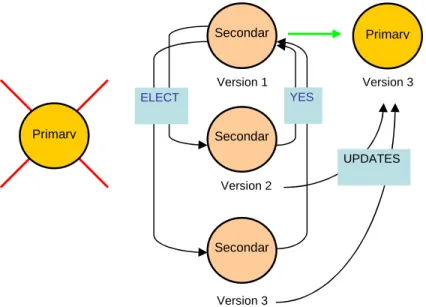
The view change protocol is used to elect a new primary. A new primary is to be elected when a replica takes knowledge of its faulty state, or because f +1 replicas
agreed to a new primary. This protocol has a phase called “I hate the primary”, which serves to prevent a replica to abandon a view unless it is guaranteed that all replicas will do the same, leading to the election of a new primary. When a replica suspects the primary is faulty, the replica sends a message to all replicas warning them of the suspicion. If the replica receives f + 1 answers confirming the suspicion then it sends another message to every replica asking for a view change, containing the information that f + 1 replicas confirmed this suspicion, and stops sending messages in this view. A replica that receives this last message automatically commits to the view exchange, so eventually all replicas will commit to the view change.
For every fixed number of requests received by a replica, a checkpoint is made. Each checkpoint is associated with a snapshot of the database. The replica maintains a stable checkpoint and can store a tentative checkpoint. When a tentative checkpoint is generated is one replica, a message is sent to every other replica. When f + 1 replicas answer to the message the checkpoint is committed and the history before the committed checkpoint is garbage collected.
The protocol has speculative execution because replicas execute requests before the total order is established. In each replica there’s a committed history and a speculative history. The committed history is the history from the last committed checkpoint till the last request of the max commit certificate, which is the certificate that covers the largest stored history. The speculative history is the history thereafter, i.e. it includes the operations for which the server has not established that the execution order is correct. If the execution order is determined to be incorrect, e.g. due to a malicious primary node, the speculative history is discarded and the replica restarts executing operations immediately after the committed history.
2.2 Database Isolation Levels
Database systems isolate the transactions from each other to prevent the inconsistency of the data in a multi-user environment. As full serializability restricts concurrency, weaker isolation levels have been defined. The ANSI SQL-92 [13] standard defines
isolation levels relying on the following phenomena (or anomalies) that can occur during concurrent transaction execution:
1- Dirty Read – occurs when a transaction reads uncommitted data that is later rolled
back;
2- Non-Repeatable Read – occurs when a transaction executes the same query multiple
times and the results are different because they were modified by an interleaving transaction.
3- Phantom – occurs when transaction T1 executes a query that returns a set of data from the database and another transaction creates data that satisfy the previous transaction query. If the transaction T1 then executes the same query the set obtained will be different.
The standard SQL [13] defines the following four isolation levels that partially avoid these phenomena:
1- Read Uncommitted – This is the lower isolation level and does not prevent any of
the phenomena.
2- Read committed – Prevents only the Dirty Read phenomenon.
3- Repeatable Read – Prevents both the Dirty Read and the Non-Repeatable Read
phenomena.
4- Serializable – The highest isolation level. The Serializable isolation level prevents all the above phenomena.
The transactional system used in our middleware (PostgreSQL) provides the four ANSI SQL isolation levels but internally only two distinct isolation levels exist, which correspond to the ANSI SQL levels Read Committed and Serializable. Read Uncommitted is Read Committed internally and Repeatable Read is Serializable. This is possible by the standard SQL since the isolation levels translate internally to equal or higher isolation levels, therefore preventing the same phenomena as the isolation level requested by the user, or more.
Snapshot Isolation is a level of isolation not defined by the standard SQL that avoids the same phenomena as defined in the ANSI SQL Serializable isolation level, but does not provide full serializability. The advantage of snapshot isolation is that it is more efficient since the read-only transactions never block nor abort. In this isolation level, a transaction executes in a snapshot of the database, which is taken before the transaction begins and that contains all the committed values this far. This snapshot is used by the transaction to read and update values and is only committed to the database when the transaction commits. Two concurrent transactions conflict with each other if they both write the same data items. In this case, one of the transaction must abort.
The PostgreSQL system Serializable isolation level corresponds to the Snapshot Isolation. This may seem awkward but in practice it is possible to obtain an execution with Snapshot Isolation equivalent to an execution with the ANSI SQL Serializable isolation level.
2.3 Database Replication
Replication is used to improve reliability, fault-tolerance and availability. In database systems, when using replication, database copies are stored in multiple nodes (replicas). If a master replica exists, it processes all the requests: we call this approach a primary-backup scheme. In contrast in a multi-master scheme any replica can process a new request and distribute the new updates to the other replicas. This later approach requires a distributed concurrency control and a solution for handling conflicting transactions. Eager replication solves the conflicts between transactions by preventing the conflicts. The conflict is detected before the committing of the transaction and one of the conflicting transactions is aborted. Lazy replication allows transactions to commit and resolves the conflicts after the commit. Eager solutions promote consistency by propagating changes to replicas within the transaction boundaries. Lazy solutions promote efficiency over consistency by only propagating changes to replicas after the transaction commits (with a possible considerable delay). We start by presenting an
example of a system that uses lazy replication [9], and continue with systems that use eager replication, as this late approach is the focus of our work
2.3.1 "The dangers of replication and a solution" [9]
Motivation and objectives
Scalability is an important issue for database systems. This work studies the scalability problems associated with update anywhere-anytime-anyway transactional replication system on mobile environments. The results show that the deadlocks and reconciliation rates raise greatly, leading to unstable behavior.
In this study it is also shown that the use of primary copy approaches reduce the aforementioned problems and it is proposed a novel algorithm that relies on the primary copy approach, while providing disconnected operations and serializable transaction execution.
An analysis of different replication strategies (for mobile computing)
Eager replication reduces update performance and increases transaction response times because it adds extra updates and messages to the transaction, since all replicas are updated inside the transaction. Additionally, it does not support mobile applications, since most nodes are usually disconnected.
Lazy replication is a solution for mobile applications since the updates can be propagated to other nodes asynchronously, outside transactions. However, in this approach, data on replicas can become stale, allowing a transaction to observe old committed values, increasing the probability of conflicting transactions. With a lazy strategy, when some replica updates have already been committed when a conflicting transaction is detected, it is necessary to rely on a reconciliation mechanism.
Simple lazy replication only works well with low loads and few nodes. If the application scales up to a larger number of nodes, if the nodes are disconnected more often, or if the delays of messages are longer, then it is necessary to reconcile
conflicting transactions more often. As reconciliation fails, the nodes begin to diverge to the point where the database becomes inconsistent with no obvious way to repair.
In eager replication, locking detects possible conflicts before they occur converting them to waits or deadlocks. The waits cause delays while the deadlocks create application faults. In lazy replication the transactions that would wait using an eager strategy face reconciliation, which frequency is determined by the much more frequent waits using a lazy strategy.
Due to the need of contacting the master, lazy-master replication is not an option for mobile applications. In this type of replication, objects have owners that store their current “official” value. Updates are executed in the master first, and then they are propagated to the other replicas. Lazy-master replication is slightly less deadlock prone than eager replication but it requires contact with object masters, which store the object’s current value.
Architecture and functionality
The solution proposed is based on a two-tier replication approach, which is a modified mastered replication scheme. Each object is mastered by a node, to avoid reconciliation. This scheme assumes two kinds of nodes: mobile nodes and base nodes. The mobile nodes are disconnected most of the time. They store a replica of the database and may originate tentative transactions. They may also master some of the data items. Base nodes are always connected and also store a replica of the database. This nodes master most of the items. The items have two versions at mobile nodes: a master version, which is the most recent value received from the master; and a tentative version, which is an updated version of the local objects modified by a tentative transaction. Following the same idea there are two kinds of transactions: base transactions that work only on master data and produce new master data; and tentative transactions that work on local tentative data and produce new tentative versions and a base transaction to be run on the base nodes.
Mobile nodes accumulate tentative transactions that run against the tentative database stored at the node. These tentative transactions are reprocessed as base transactions
when the mobile node reconnects to the base nodes, but may fail when being reprocessed.
2.3.2 “A suite of database replication protocols based on group communication primitives” [4]
Motivation and Objectives
Replication in most commercial database systems is based on optimistic replication. This approach allows inconsistencies and relies in centralized algorithms. The reason for this is the strong belief of database designers that synchronous and update-everywhere approaches, based on 1-copy-serializability, have performance and scalability problems.
The goal of this work was to design synchronous, update everywhere protocols, based on group communication, that do not suffer from performance and scalability problems.
Architecture and Functionality
The system is a distributed database consisting in a fixed number of nodes. The database is fully replicated, so each node has a full copy of the database. The nodes themselves, communicate via message passing. The group communication subsystem provides two different services, a basic service, with no ordering guarantees; and a total order service, where all the sites deliver the messages by the same total order. Regarding message delivery, there is an atomic delivery and a non-atomic delivery. A node that fails is excluded from the group by group maintenance services. The members of the new group coordinate the delivery of the failing node pending messages.
The system uses a version of the all available copies approach. Reads operations are executed locally. Write operations are deferred until all read operations have been executed and are broadcasted in a write set. Since it is an all available copies approach, an update request must be performed by all available replicas. The ordering of
conflicting transactions is established by the total order service from the communication model.
There are four levels of isolation supported by the system: Serializability, Cursor Stability, Snapshot Isolation and a Hybrid Protocol. Snapshot Isolation (SI) is implemented using the protocol presented in figure 1.
Figure 1: Replication protocol guaranteeing snapshot isolation (from [4])
For implementation of Snapshot Isolation each object in the system has various versions. An older version can be reconstructed applying undo operations to the object until the required version is generated. Each one of these versions is labeled with the transaction that created the version. The first writer wins strategy is used, so when a transaction T wants to write to an object that was updated by other transaction after the transaction T started, the transaction T is aborted.
The beginning (BOT) and the ending (EOT) of a transaction are identified by timestamps. Since the system is distributed, the timestamps (TS) need to be
synchronized. The system uses the write sets sequence numbers as a global virtual time, to synchronize the timestamps.
The decision of the abort or commit of a transaction is local to each node, so no messages are sent between the nodes.
The protocol, illustrated in figure 1, is composed by five phases. The first phase is the reading phase, where the read operations are executed in a snapshot of the database. Phase two is the send phase, where the write sets are sent to every replica using a total order service unless the transaction is read-only and therefore is immediately committed. The next phase, executed on the delivery of the write sets, is the lock phase which includes a version check. If a write operation from transaction T (bundled in the write set), updates an object that was updated by another transaction that committed after the start of T, T is aborted. The same happens for conflicts with transactions that are in the process of committing, but are ordered before T (in the timestamp order). To avoid the overhead in the case of frequent aborts a preliminary check can be done locally, before sending the write set, and the transaction is aborted and restarted if a conflict is detected. This does not avoid the need for the remote check. Finally, the protocol ends with the write phase and the commit phase respectively. The write phase performs the write operations when the write lock is granted and the commit phase commits the transaction when all operations from the write set have been executed and releases all the locks for this transaction on the replica.
The system also supports three other protocols, for which that we now briefly summarize: Serializability is implemented using strict 2-phase locking (2PL); Cursor Stability, is implemented using short read locks, and may lead to non-repeatable reads because a lock is placed on an item as long as an SQL cursor is positioned on the item, but is released when the cursor moves on; and the Hybrid Protocol, which is a mixture of the 2PL protocol, used for update transactions, and the SI protocol, for read-only transactions, which must be pre-declared.
The broadcast primitives are relaxed to minimize message and logging overhead, which leads to three versions of the Serializability, Cursor Stability and Snapshot Isolation
protocols. The versions of the protocols are non-blocking, blocking and reconciliation based.
In the non-blocking versions of the protocols, the delivery of the write set and the commit message is atomic, and the abort message does not need to be sent atomically. This way, each node can decide to abort in-doubt transactions of a failed node, without contacting other nodes. A transaction is seen as in-doubt by a node N, when it is invoked at a node N’ and the write set is delivered to node N, but the abort or commit message has not. With this approach, a group change that excludes a failing node is not announced to the application of a node N, until all messages the failing node might have delivered are delivered at node N.
In a blocking version of the protocol, some of the overhead of the non-blocking approach is avoided by allowing not reaching a decision about the transactions of the failed node. The delivery of the write set in this approach is atomic, but the commit message is not. In this version of the protocols, a node can no longer decide independently on an in-doubt transaction, because the delivery of the commit and abort messages are non-atomic, which allows other nodes, including the failed one, to deliver the commit or abort and terminate the transaction. So, a coordination protocol is needed in this version. When a transaction is in-doubt at all nodes, it must be blocked until the recovery of the failing node. If there is a node where the transaction is not in-doubt, that node must inform the nodes where the transaction is in doubt.
Finally, the reconciliation based version that does not broadcast any message atomically and is an alternative when performance needs to be improved. In this case, a failing node may have committed a transaction but the other nodes may have not received the write set or may have decided to abort the transaction. When the failing node recovers, it must conciliate its database with the databases of the working nodes and compensate the changes done by the transaction.
2.3.3 “Ganymed: Scalable Replication for Transactional Web Applications” [5]
Motivation and objectives
Replication is a common solution for the scalability requirements of database services like data grids and large scale web application. However to implement replication it is necessary to balance trade-offs between consistency and scalability. Commercial systems usually choose scalability, giving up on consistency. Other common solutions offer limited scalability in exchange for consistency.
Ganymed is a database middleware that intends to provide scalability in a replicated database system without sacrificing consistency. The system targets the needs of typical dynamic content generation with a large amount of complex reads and a small number of short update transactions.
Architecture and functionality
Figure 2: Ganymed Prototype Architecture (from [5])
The Ganymed architecture, depicted in figure 2, is composed by four components: the clients, the replicas, the scheduler and a manager component.
The clients are application servers that connect to the scheduler through a custom JDBC driver, for submitting operations. For the clients the scheduler abstracts a single database with Snapshot Isolation. The scheduler communicates with the replicas using a PostgreSQL JDBC driver. The set of replicas contains a Master replica and several Slave replicas. Each replica must be a database providing Snapshot Isolation. The replicas can be added and removed from the system at runtime and the Master role can be assigned dynamically. There is also a manager component which runs in a dedicated machine and monitors the system. This manager component is used to allow the user to configure the system, adding and removing replicas, and to substitute a failing scheduler.
The main component is the middleware scheduler that controls the execution of client transactions over the set of replicas. There is a backup scheduler to substitute a failing one.
The scheduler implements the RSI-PC (Replicated Snapshot Isolation with Primary Copy) algorithm. The algorithm separates update and read-only transactions. Updates go directly to the master replica without delay and queries go to the slave replicas. After committing a transaction in the master, the updates are bundled into a write set, which is broadcasted to all replicas. For the extraction of the write sets, the JDBC interface was extended with the necessary logic to collect changes to the database. The write sets are table row based.
Read-only transactions need to call Connection.setReadonly(), so they are known in advance. Read-only transactions that are known in advance are assigned to a slave replica according to the least pending requests first rule, even if the master has capacity to process them. If the read-only transactions are not known in advance, or there are no slave replicas present, the transactions have to be processed by the master replica. Read-only transactions will always see the latest snapshot of the database. If the replica does not have the latest version of the database the execution of the transaction is suspended until all needed write sets have been applied to the replica, which is verified by the scheduler. To avoid this delay the client may specify the allowed staleness of the transaction, or send the read-only transactions to the master replica.
If a replica fails, the system uses the remaining replicas. If the master fails, a slave replica becomes the master. The reaction to failing replicas can be done by the scheduler without intervention from the manager console.
Ganymed can be used of-the-shell for any application, as it does not impose any special data organization, structuring of the load, or particular arrangement of the schema. The only requirement for achieving good performance is for read-only transactions to be known in advance.
2.3.4 “Database Replication Using Generalized Snapshot Isolation” [6]
Motivation and objectives
Conventional snapshot isolation requires transactions to observe the latest snapshot of the database, which is not suitable for replicated databases, because, unlike centralized databases, the latest snapshot is not available in every replica – in fact, to determine which is the latest snapshot, it might be necessary to contact all replicas.
This work extends snapshot isolation to suite replicated databases, by defining Generalized Snapshot Isolation, which allows the transactions to observe older snapshots of the database, instead of just the latest. A particular case of the Generalized Snapshot Isolation is the Prefix-Consistent Snapshot Isolation, where the snapshot contains, at least, the writes of previously committed transactions.
Generalized Snapshot Isolation
Generalized snapshot isolation (GSI) is an extension of the conventional snapshot isolation, maintaining many of its properties. This approach allows a transaction to execute in a snapshot older than the latest, instead of just the latest like the conventional snapshot isolation. This increases the probability of aborts for update transactions in consequence of the increase in the number of “concurrent” transactions.
Replicas can process read-only transactions locally as no conflicts may arise. An update transaction may be executed locally, except the commit, which requires certification to detect write-write conflicts. A transaction reads only committed data and does not commit if updates conflict with another committed update transaction ("first-committer-wins"). If there is any intersection of the write set of the transaction, with the write sets of the update transactions that have committed after the snapshot used by the transaction, the transaction aborts; otherwise it commits.
Prefix-Consistent Snapshot Isolation (PCSI) is an instance of the GSI that uses the most recent snapshot available, by including the updates of all transactions that are in the transaction's workflow and have committed before the transaction started.
Architecture and functionality
The system architecture is composed by any number of clients, any number of replicas running Snapshot Isolation and a certifier. Transactions are executed on the replicas. If the transaction is read-only then it executes locally in the replica and does not involve the certifier, but the commits of update transactions must be certified.
The authors propose two algorithms to implement PCSI. The algorithms vary regarding the certifier implementation.
The first algorithm has a centralized certifier which also stores the write sets of the transactions and is implemented on a master replica. The remaining replicas work as slaves that communicate only with the master. Read and write operations are locally executed on the slave replicas and read-only transactions do not communicate with the master, while update transactions must be certified, therefore must communicate with the master.
The other algorithm has a distributed certification: all replicas execute transactions and certify update transactions. For the delivery of the write sets for certification, for all replicas, an atomic broadcast is used. Thus the ordering of transactions is established and all replicas may reach the same decision on which replicas commit/abort.
In both algorithms the only operation that requires remote communication is the certification of an update transaction. Upon the commit of the update transaction, the write set is applied at the other replicas, according to the algorithm.
Regarding failures, a recovering site must apply the effects of all messages which it has not delivered or that it has not processed. In the first algorithm, when a site recovers it reads the last committed snapshot locally and asks for the most recent updates from the master. In the second algorithm, the recovering site also reads the last committed
snapshot locally but then broadcasts a recovery message to ask for the missing updates, which may be sent by any replica.
2.3.5 “Tashkent+: Memory-Aware Load Balancing and Update Filtering in Replicated Databases” [7]
Motivation and objectives
In replicated databases, an important feature to achieve good performance is the load-balancing of the requests among running replicas. Conventional load-load-balancing strategies, like round robin and least active connections, have a good load balance but introduce memory contention (as transactions are placed without any knowledge on which data they will access). LARD (Locally-Aware Request Distribution) reduces memory contention using a content aware load-balancing technique, and it is very effective for read-only static content Web workloads – small files – but it can work poorly for workloads where requests with large working sets are frequent, like database transaction workloads, besides handling updates inefficiently.
This work introduces a memory-ware load balancing (MALB) technique, which uses knowledge about the size and the contents of the working set of transactions to assign them, so that they can execute in main memory, reducing disk I/O.
Architecture and functionality
Figure 3: Tashkent replicated database design (from [7])
Tashkent+ is composed by the database replicas, a certifier and a load balancer to accept requests from clients and dispatch them to the set of replicas. As the previous system, Tashkent+ uses generalized snapshot isolation (GSI). Replicas communicate only with the certifier. The certifier is used to verify which concurrently executed update transaction can commit, by deciding the commit order and checking for conflicts. Each replica has a proxy attached that intercepts the requests transparently. The proxies use an algorithm to prevent bursts from overloading the database. When a commit is attempted by an update transaction, the proxy sends a request to the certifier, to certify the write set, so this one can detect write-write conflicts. The successfully certified write sets are recorded in a persistent log. Data consistency is maintained propagating the write sets to all replicas.
For handling failures, a primary-backup scheme is used. There is a backup load balancer. When the primary fails, clients use the backup and all active transactions are aborted and retried. The certifier is also replicated for availability, with one leader certifier and two backups.
The main innovation of Tashkent is the MALB algorithm that intends to dispatch transactions to replicas avoiding memory contention. To this end, the state of each database replicas is monitored by taking estimates of the working sets. This is achieved exploring information in the transactions execution plans, which contain the tables and indices used and how they are accessed. The estimates are used by the MALB algorithm to create transaction groups so that each one fits in the main memory of a replica and to dynamically allocate replicas for the transaction groups.
The load balancer receives replica load information on the CPU and the disk I/O channel utilization from lightweight daemons running in each replica. The loads of each transaction group are compared and additional replicas are allocated to the most loaded group.
In a stable workload, the partitioning of the transaction groups across the replicas can be made permanent by the load balancer. Each replica receives a subset of the transaction types, so the tables not used at the replica can be dropped or allowed to become out-of-date. So, updates to these unused tables can be filtered since they do not have to be processed by the replica. This technique is called update filtering, and can be enabled on the Load Balancer. Dynamic replica allocation is disabled when update filtering is enabled.
2.3.6 “Don’t be lazy, be consistent: Postgres-R, A new way to implement Database Replication” [8]
Motivation and objectives
Update everywhere replication has several limitations, as high deadlock rates, message overhead and poor response times.
The goal of this work is to circumvent these limitations by using shadow copies to first execute the transactions locally, thus postponing the propagation of the updates. The system relies on group communication to pre-order the transactions and to acquire all locks needed by a transaction in an atomic step.
Architecture and functionality
Figure 4: Postgres-R Architecture (from [8])
Postgres-R was implemented as an extension to PostgreSQL, maintaining the same functionality but providing replication as an additional feature.
The Postgres-R architecture consists of several nodes (servers), each running an instance of Postgres-R. The database is replicated at all sites. When clients want to access the database they send a request to a postmaster process running in a replica. The postmaster handles the transactions required by the client.
Update transactions execute on shadow. The changes to the shadow copies are propagated to the other sites at commit time, thus reducing the message. A transaction can read its previous writes by reading the shadow copies. Constraints can be checked and triggers fired during the update on the shadow copy.
Read transactions are executed locally. A read transaction is aborted when a conflicting write arrives. This approach avoids deadlocks and inconsistent executions.
The replication protocol has an eager approach, and executes a transaction in four phases: I - Local Read Phase, II - Send Phase, III - Lock Phase, IV - Write Phase. In the first phase, all read operations are performed locally and the write operations are executed on the shadow copies. In the second phase, if the transaction is read-only, it commits locally. Otherwise, the write sets are broadcasted to all sites. The third phase is used to request all write locks needed by the transaction, thus guaranteeing that the transaction can be serialized in respect to concurrent transactions. Finally, on the fourth phase, the updates of the transaction are executed and after the commit all locks it required are released.
To provide serializability, Postgres-R uses a reliable total order group communication primitive to multicast the write set and to determine the serialization order of the transactions. A local site commits a transaction whenever the global serialization order has been determined. It does not have to wait for the other sites to have executed the transaction because it relies on the fact that the other sites will serialize the transaction in the same way.
Since PostgreSQL uses locking at the table level, which is not desirable for efficiency reasons, Postgres-R uses a simple (logical) tuple level locking scheme based on key values. This is implemented resorting to the shadow copies. Since during the Read Phase, the updates of a transaction are executed on the shadow copy, locally, the updated key values can be include on the write set that will be propagated to the other sites. This allows a logical tuple level locking during the Lock Phase.
2.3.7 “The Database State Machine Approach” [10]
Motivation and objectives
As many of the previous works, the motivation for this work is the need for good performance in replicated databases that provide 1-copy serializability.
The Database State Machine approach for synchronous database replication proposes an approach to deal with replicated databases over a cluster of servers, which differs from traditional mechanisms by not using distributed transactional mechanisms. The approach relies on deferred updates, but is meant to reduce the transaction abort rate using a reordering certification test to look for possible serializable executions before deciding to abort.
Architecture and functionality
The system is composed by a set of replicas, each with a full copy of the database, and a set of clients. The sites communicate via message passing and fail independently by crash (Byzantine failures are not supported). Clients submit transactions that are executed by the database sites. The system provides 1-copy serializability for the transaction execution.
The transactions are locally executed with no interaction with other sites and locally synchronized using strict two phase locking. The system has a termination protocol, which is executed when the client requests the commit of a transaction. In this protocol, the transaction’s write set and read set are atomically propagated to all replicas, where the transaction is certified and committed, if possible. The certification is used to ensure one-copy serializability, aborting a transaction if its commit leads the database to an inconsistent state.
Each replica behaves like a state machine, so when processing the delivered transactions, all replicas should reach the same state. To achieve this, all certifiers must enforce that write-conflicting transactions are applied in the same order, by granting their locks by the same order as they are delivered. To certify the delivered transaction, the certifier checks if the write sets of committed transactions conflict with the read set of the committing transaction.
Read-only transactions are locally executed and committed, and do not need certification, but may be aborted due to local deadlocks or during the certification of remote update transactions. To avoid aborting read-only transactions during certification
![Figure 2: Ganymed Prototype Architecture (from [5])](https://thumb-us.123doks.com/thumbv2/123dok_us/10225195.2926366/34.918.237.733.146.578/figure-ganymed-prototype-architecture-from.webp)
![Figure 3: Tashkent replicated database design (from [7])](https://thumb-us.123doks.com/thumbv2/123dok_us/10225195.2926366/39.918.261.714.153.546/figure-tashkent-replicated-database-design.webp)
![Figure 4: Postgres-R Architecture (from [8])](https://thumb-us.123doks.com/thumbv2/123dok_us/10225195.2926366/41.918.272.691.263.597/figure-postgres-r-architecture-from.webp)
![Figure 5: Processing stages and contexts (from [12])](https://thumb-us.123doks.com/thumbv2/123dok_us/10225195.2926366/46.918.323.683.401.658/figure-processing-stages-contexts.webp)