University of Redlands University of Redlands
InSPIRe @ Redlands
InSPIRe @ Redlands
Ed.D. Dissertations in Leadership forEducational Justice Theses, Dissertations, and Honors Projects 12-31-2019
Querer Superarse: First-Generation Latinos
Querer Superarse: First-Generation Latinos
Cynthia Oliveros University of Redlands
Follow this and additional works at: https://inspire.redlands.edu/eddissertations
Part of the Educational Leadership Commons, and the Secondary Education Commons
DOI:
DOI: https://doi.org/10.26716/redlands/doctor/2019.10
Recommended Citation Recommended Citation
Oliveros, Cynthia, "Querer Superarse: First-Generation Latinos" (2019). Ed.D. Dissertations in Leadership for Educational Justice. 97. https://doi.org/10.26716/redlands/doctor/2019.10
https://inspire.redlands.edu/eddissertations/97
This work is licensed under a Creative Commons Attribution 4.0 License. This material may be protected by copyright law (Title 17 U.S. Code).
UNIVERSITY OF REDLANDS Redlands, California
Querer Superarse: First-Generation Latinos
A Dissertation Submitted in Partial Satisfaction of the Requirements
for the Degree Doctor of Education
By Cynthia Oliveros
Supervised by: James Valadez, Ph.D.
© Copyright by Cynthia Oliveros
ABSTRACT Querer Superarse: First-Generation Latinos By: Cynthia Oliveros Doctor of Education
University of Redlands, California, 2019 Professor James Valadez, Ph.D., Chair
First-generation Latinos have endured challenges in an educational system that was not designed to serve or support them as they progress from kindergarten through high school. However, many first-generation students have beaten the odds through scholastic achievement, high school graduation, and acceptance to a four-year university. The intention of this study was to get a better understanding of what the determining factors are that help first-generation students overcome the challenges they face as they strive to succeed in high school, then obtain a college degree. The research also aimed to understand which intrinsic and extrinsic influences impact first-generation Latino students. Guided by social capital theory, this study used a qualitative approach to examine the high school experiences of eight first-generation Latinos attending a local university. The findings indicated that first-generation students are driven to succeed in high school via five interconnecting areas: encouragement from their parents, encouragement
from teachers, programs and resources, thinking about the future, and aprovechar las
oportunidades (taking advantage of the opportunities) an education offers. Each of this study’s
eight first-generation Latinos currently attending a local four-year university experienced all five of the finding areas throughout their high school journey. The purpose now is to share these findings with my school site, which serves a significant large population of Latinos, so that we may continue to guide and support students who are going to college and strive to encourage, motivate, and inspire more Latinos to pursue a college degree.
This dissertation of Cynthia Oliveros is approved.
Committee member names George Hamilton, Ed.D.
Phillip Mirci, Ph.D. James Valadez, Ph.D., Chair
University of Redlands, California 2019
DEDICATIONS
Para mi abuelita, “Mi feita linda,” gracias por ser mi madre, tu amor incondicional y tus sacrificios para darme una mejor vida no serán en vano. Te quise mucho entonces y te seguiré queriendo siempre. No se preocupe, que algún día mis hijos la conocerán.
TABLE OF CONTENTS Abstract ... ii Dedication ... v List of Tables ... ix List of Figure... x Glossary ... xi Acknowledgments... xii
Chapter One: Introduction ... 1
Background of the Problem ... 2
Purpose of the Study ... 4
Theoretical Framework ... 5
Summary ... 11
Chapter Two: Literature Review ... 13
History of Education ... 13
Social Injustices and Oppression ... 14
Social Classes... 18
Family ... 20
Poverty ... 22
Race... 24
Summary ... 26
Chapter Three: Methodology ... 28
Research Design... 28
Participants Background ... 30 Research Setting... 31 Data Collection ... 32 Data Analysis ... 33 Limitations ... 34 Summary ... 35
Chapter Four: Findings ... 36
Introduction ... 36
Encouragement from Parents ... 38
Encouragement from Teachers ... 39
Programs and Resources ... 42
Thinking about the Future ... 45
Aprovechar las Oportunidades ... 46
Summary ... 48
Chapter Five: Discussion and Conclusion ... 49
Discussion ... 49
Encouragement from Parents ... 50
Encouragement from Teachers ... 51
Programs and Resources ... 53
Thinking about the Furture ... 54
Aprovechar las Oportunidades ... 55
Limitations ... 57
Conclusion ... 58
References ... 61
Appendix A: Gate Keeper Letter ... 67
Appendix B: Interested Participants Letter ... 68
Appendix C: Post Interview Letter ... 69
Appendix D: Pre-Screening Survey ... 70
LIST OF TABLES
Table 1: Participants’ Demographics ...30 Table 2: Meaning of Themes ...36
LIST OF FIGURES
GLOSSARY
Querer Superarse: To want to succeed or to beat the odds
ACKNOWLEDGEMENTS
“Cynthia, no te voy a premiar por estar bien en la escuela, lo que tu hagas en la escuela será para tu futuro, no para el mío.” Maria Luisa Jimenez Gradilla
This Ed.D. is a product of the life lessons my grandmother taught me during our long hours conversing during the commercial breaks while watching our evening novelas and during our unforgettable adventures to Mexicali. The unconditional love I felt from my grandmother inspires me to work hard. She inculcated in me how great it feels to give to others and that giving is better than receiving. She taught me that whatever I do, I do with love and passion. She never got the opportunity to go to school and learn to read or write, but she was a very wise woman. She shared her life lessons with me so that I would learn from her experiences and not make the same mistakes she made. I know she wanted me to have an amazing life, and I give thanks to her extraordinary strength, bravery, compassion, patience and love for her family and others. I would not have had the discipline to achieve this degree without her being my greatest role model. My accomplishments are her accomplishments.
To Tia Mila, gracias por la oportunidad de una mejor vida, gracias por su carácter fuerte que tiene, gracias por sus sacrificios de criar y mantener a hijas ajenas y darnos un hogar, y gracias por ser una mujer trabajadora a quien inspiro por ser fuerte, luchadora e independiente. Gracias por ser chingona.
To Sofia y Alfonso, gracias por darme vida y ser parte de mi vida. Nunca es tarde. To my husband, Jose, thank you for being patient, loving. and supportive. Your story inspires me. Love you.
To my sister Karin, I love you more than you could ever imagine.
To my nephews Chris, Ismael, and Alex, I love all three of you unconditionally.
To my dear friend Yolanda “Yolandita” Martinez, thank you for being a great friend and colleague. Thank you for all the laughs, making me work out with you to release some of my stress, for the great advice you always share, for your encouragement and support throughout this long journey, and for sharing your family with me.
To Kara, “Karita” Schnabel, thank you for your support, love, and laughs. You have a true gift. Thank you for helping me since day one and for the countless hours you have dedicated in making this happen. You are the best editor. Thank you for your friendship, “Dr”. Schnabel.
At the University of Redlands, I was fortunate to have met some great friends and professors. To cohort 9, thank you for being supportive throughout those two years of classes. To a special lady, Yolanda De Loera, thank you for your support and sharing your unique and extraordinary life experiences and inspiring me to work harder and be a “Chingona,” just like
balance everything you do. Thank you for allowing me into your world and helping me by wanting to work with me and guide me throughout this long and challenging, yet amazing five years.
I want to thank my dissertation committee for their guidance, support, and opportunity throughout this live-changing venture. Dr. James Valadez, thank you for your very calm demeanor as it always helped me stay calm and focused. Every time I met with you, I got re-energized and inspired to keep working. You knew what to say to me to encourage me to keep going. Your compassion and understanding as life happened to me after the second year of this program, as I got married and tried to start a family, is greatly appreciated. You are the reason I did not give up and that I am crossing that finish line. Thank you so much, Dr. Valadez.
Dr. Gregory Hamilton, since the first class, you have been very supportive, and your words of encouragement have truly motivated me to continue to work with children. Your feedback after every assignment was not only appreciated but it gave me fuel and confidence in pursuing my doctorate degree. Dr. Phillip Mirci, thank you for sharing your wisdom during class discussions, your love, and advocacy for children in education and in life. You inspire me to dig deep inside my soul and practice spirituality to better fulfill my potential being and make change happen in education for the sake of all children.
CHAPTER ONE: INTRODUCTION
Latinos in the United States, specifically those from low socioeconomic status, have typically faced different obstacles compared to children from higher socioeconomic
demographics. Institutionalized inequalities, such as those faced by Latino students, have existed for so long that they have been woven into the roots, the very beginnings, of our
educational system. Those roots sustain marginalization and oppression, thereby “reproducing” individuals who perpetuate existing social divisions (Ornstein, Levine, Gutek, & Vocke, 2014). Latinos have endured challenges in education because it was not built to serve or support them as they progress from kindergarten to high school. It is important to note, however, that many Latinos have beaten the odds by achieving in school, graduating from high school, and meeting university entry requirements. Thus, first-generation Latinos do find a way to pursue higher education. Through a qualitative approach, this study examined the high school experiences of eight first-generation Latinos currently attending a local university. The research question I intend to address is this: How do first-generation students’ high school experiences impact their motivation and aspiration to pursue college? The intention was to gain a better understanding of what the determining factors are that help first-generation students overcome the challenges they face, considering that they come from low-socioeconomic backgrounds, to succeed in high school and pursue a college degree. Data will be collected using procedures based on Spradley’s (1979) ethnographic interviewing.
In this chapter, I will present an overview of the educational status of Latino students, the statement and background of the problem, the purpose of the study, the research question that will guide the study, and my theoretical framework.
Background of the Problem
The Latino population in the United States is increasing rapidly, and Latino youth constitute a significant portion of the school-aged population (Calero et al., 2014; National Center for Education Statistics, 2019; Zychinski & Polo, 2012). It is estimated that by 2050, more than one in three children in the United States will be Latino (Murphey, Guzman, & Torres, 2014). According to the most recent data, more than 56 million Hispanics or Latinos, roughly 18% of the overall population, live in the United States (Pew Research Center, 2014). In California alone, nearly 15 million Latinos comprise 39% of the population (U. S. Census
Bureau, 2017). Latino students will soon become the majority in California’s public schools. These increasing numbers, along with their pattern of lackluster academic achievement, need to become a major concern of teachers, school leaders, and policy makers (Gándara, 2015; Madrid, 2011). While Latino high school graduation rates have certainly increased over the past decade, academic achievement and college completion have fallen behind in comparison to other racial and ethnic groups (Gándara & Contreras, 2009; Vega, Moore, & Miranda, 2015).
Educators and school professionals will be working with more and more Latinos; for this reason, it is important to understand their needs, especially those of children (Moreno & Gaytán, 2013). Many Latino students combat significant barriers and adversity in their lives: poverty, health problems, jail time, violence, marginalization, and oppression. Children in poverty experience a greater risk of health problems, food insecurity, teen pregnancy, and diminished adulthood employment (Berliner, 2013; Moreno & Gaytán, 2013). Such children are more likely to drop out of school, especially when they encounter ill-equipped learning environments,
misidentification of (dis)abilities, difficulties in acquiring English as a second language, and poor teacher-student relationships. Latinos have received a lower-quality educational experience
compared to their White peers or other ethnic groups, and they face an educational crisis as they falter throughout the educational pipeline, particularly regarding college enrollment rates.
The national goal of increasing college attendance began with the Reagan
administration’s 1983 report, “A Nation at Risk” (U. S. Department of Education, 1983). This document showed a link between the slumping performance of schools with economic
vulnerability and international competition (Achinstein, Curry, & Ogawa, 2015). The focus on “college for all” continued with the Obama administration’s “Race to the Top” initiative, with the goal of greater educational equity accomplished, in part, by “increased college enrollment rates” (U. S. Department of Education, 2015). Despite such initiatives, Latinos face potential disaster as they consistently lag behind their peers, a problem that is most noticeable when analyzing college enrollment rates (Ocasio, 2014). The significant gap between Latino and White students has been well documented in public education (Howard, 2010). Children of Mexican descent, especially, are less likely than their peers from other ethnic backgrounds to graduate from high school; they are also least likely to enroll in college and complete a four-year degree. While many Latinos do enroll in college, the rate of enrollment in two-year colleges is higher than in four-year colleges (Gándara, 2015). In fact, 60.6% of African Americans and 63.2% of Asian Americans selected four-year universities in 2008, but a mere 48.1% of Latinos enrolled in four-year programs. The remaining 51.9% attended two-year colleges (Aud, Fox, & KewalRamani, 2010).
The long-term implications for the US economy and social stability will depend, in part, on addressing the issues of Latino educational attainment (Marrero, 2016). Particularly
important are the lower levels of academic achievement demonstrated by this group (Zychinski & Polo, 2012) and the continued achievement gap that separates students from dominant and
non-dominant cultures (Howard, 2010; Trumbull & Rothstein-Fisch, 2011), which may be due to Latinos not obtaining college degrees at the same rate as their non-Latino peers.
Purpose of the Study
The purpose of this study was to provide a deeper understanding of the challenges first-generation Latinos face, as well as learning about the determining factors that allow these students to succeed academically. Most of these young people will be the first in their families to graduate high school and, more notably, the first to attend college. This study was also an opportunity to enhance the educational outcomes of future Latinos. Latinos are the fastest growing population in the United States and, according to projections, the Latino population will increase to approximately 20% of the total population by 2030 (U. S. Census Bureau, 2017). Most research analyzing college students’ experience is limited when focused exclusively on first-generation Latinos and their high school experiences and what impacts their desire to pursue a college degree (Yosso, 2006). This study serves to share the experiences of eight
first-generation Latinos pursuing a college degree and examine existing knowledge regarding their aspirations to pursue college. Once my study is complete and approved by my committee and my university, my goal will be to share the results with my school site, the population of which is 87% Latino (National Center for Education Statistics, 2019). These findings would also add to the existing literature about Latinos and their journey along their educational pathways.
The research findings from this study can be used by educators as they strive to improve the academic outlook for this population. Schools have the power to create a strong foundation that will have long-term, positive societal effects on students. Development of educator cultural competency, incorporation/partnering of social agencies, and the demonstration of positive regard are critical first steps schools can take in assisting all Latino students. Taking these
important steps may create a positivistic view of diverse Latino populations, not only among educators and school professionals, but also among Latino students, themselves (Moreno & Gaytán, 2013). Understanding how students perceive high school and what barriers they encounter is essential in identifying factors contributing to a lack of motivation and the
disconnect from aspirations to succeed academically. The goal, then, is to address those barriers by sharing them with staff, teachers, and parents so that they may work directly to address these issues. Educators play a significant role in transforming potentially negative situations into positive school experiences for these students. It is imperative that school personnel, especially those who may not share the cultural backgrounds and experiences of these students, deepen their understanding of what impacts students’ desires to pursue a college education (Trumbull & Rothstein, 2011). Although increasing high school graduation rates is a top priority for educators locally and nationally, identifying what impacts student desire to continue education after high school should be a goal for educators. Once the needs are identified, teachers can better support students.
Theoretical Framework
Social capital theory has increasingly been applied to the study of college access, particularly for Latino students. Social capital theory provides a means to assess the ways in which an individual’s social relationships and networks provide access to important economic, cultural, and academic resources (Bourdieu, 1986). Previous research on college access for Latino students has demonstrated the importance of various relationships, including those with immediate family, peers, extended family, teachers, and guidance counselors (Carolan-Silva & Reyes, 2013). Social capital analysis allows for an understanding of how students access different types and different numbers of resources available through their schools, families, and
communities. These differences are critical for understanding educational inequities, such as those faced by Latino students, that impede college access. This study will use social capital theory to explore first-generation Latino students who have achieved in high school and then pursued a college education despite the tendency of this population to struggle academically. It is important to note that scholars have been working to elaborate new conceptual and theoretical frameworks for understanding the social networks, socialization, and educational attainment for racial minority youth, particularly Latino youth from working-class or economically
disenfranchised urban communities (Stanton-Salazar, 2011). It is crucial to have such
frameworks that detail the complexities of socialization, network relationships, and educational attainment among racial minority youth, including the roles of resourceful and committed socialization and institutional agents designed to empower both youth and stakeholders, such as parents, teachers, counselors, and youth program personnel.
Bourdieu (1986) developed the theory of social capital that has been used to analyze the educational success of children from different social classes. For Bourdieu, social capital included resources a person has and can use to pursue successful educational outcomes and social mobility. He asserted that classes can be distinguished by the amount of capital they “posses,” and some communities are culturally wealthy while others are culturally poor. Thus, the social capital of marginalized groups is quite different, basically unfavorable, compared to the social capital of more “fortunate” students. The low cultural capital minority youth experience sadly defines the education they will receive, for they may be denied access to programs that could benefit them as they enter and move through the educational system. Depending on the quality of their lives and the obstacles they have endured, minority students require extra resources to have an equitable opportunity for academic success (Bourdieu, 1986).
Of interest, however, is the fact that some students can and do overcome these hurdles and achieve more success than their non-Latino peers.
In 1966 James Coleman authored The Coleman Study (Coleman, 1966) one of the most cited and influential articles on social capital. He investigated this concept from two different perspectives: family and environment. He believed that both family and community played a significant role in the creation of human capital in society’s younger generations. He
emphasized the role of family and family life in producing social capital. Specifically, family was vital in raising a healthy generation and ensuring a healthy society; this responsibility continues throughout life. The second provider of social capital was environment. He believed individuals benefit from social capital not only in their family but also within the larger
community, comprising all associational and relational networks. Schools, neighborhoods, and other organizations provide individuals with social capital at different levels (Coleman, 1988).
Putnam (2000) contended that the central idea of social capital is that social networks have values. He emphasized the benefits of social networks, such as information, trust, and reciprocity. The collective value of all social networks and the benefits that arise from these then help people resolve individual and collective problems more easily. In terms of educational issues, people use their social networks in different phases of education (Putnam, 2000). Different stakeholders’ involvement, specifically related to the community and state, helps to increase the relevance and quality of education. In other words, the strong bonds and links that people have with other individuals and organizations help create and maintain certain character traits: tolerance, empathy, reciprocal respect, and eagerness to engage in dialogue with other members of society. In contrast, people lacking connection or interconnectedness with others find themselves less able to test the accuracy of their own views and opinions. Without such
opportunities, people grow less tolerant, more cynical, and more likely to be swayed by negative or unhealthy impulses. Furthermore, associational and relational networks that comprise social capital serve as channels for the flow of helpful information amongst people, and this facilitates the pursuit of individual and collective interest.
In his most recent work, Stanton-Salazar (2011) offered a social capital framework, specifically related to working-class minority children and youth, that defines social capital as consisting of resources and key forms of social support embedded in their network and
accessible through direct and indirect ties with institutional agents who empower students and youth lacking higher levels of social capital. Stanton-Salazar defined an institutional agent “as an individual who occupies one or more hierarchical positions of relatively high status and authority” (p. 1067). Working-class minority students, such as Latinos, access social capital through these individuals who figure prominently in an adolescent’s social network and who fulfill their roles as institutional agents when they advocate for disenfranchised youth via the transmission of highly valued institutional support: resources, opportunities, privileges, and services geared toward academic success in high school and beyond. Stanton-Salazar further added that access to resources and institutional support among low-status youth is significantly dependent upon the network characteristics, network-related capacities and skills, and
networking orientations of those institutional agents devoted to supporting and empowering low-status youth.
Lareau and Horvat (1999) stated, “the role of race [can be] independent to the power of class” (p. 49). Social class certainly correlates with educational outcomes, in that higher social class leads to better educational opportunities. Then again, working-class and poor families live together in the same communities, so their children attend the same schools, this results in
schools with large populations of the same social class; thus, reproducing social reproduction and social inequities. Despite the relevancy of social class, including race in this framework is crucial, however, for it is intertwined with social capital and children’s school experiences. Although parents’ social class influences where children will go to school, race is also a factor. In fact, Lareau (1989), a sociologist who has been exploring social class and family-school relationships since the 1980s, maintained that while social class has an important influence on children’s school experiences, race can serve to compound the impact of class. Lareau (1989) further contended that race specifically and substantially influences interactions in school settings. Moreover, Lareau (2011) discovered in her study that African-American families from middle-class neighborhoods were very concerned about the impact of race on their children and for this reason they monitor their child’s experiences closely. In addition, one family studied was adamant about teaching their son about race being an important aspect of his life and that although discrimination would exist in his life because people “see a color first” that his race would also impact his life so his parents stressed to him that he should never use discrimination as an excuse for not succeeding or doing his best. Children’s overall school experiences, which are impacted by their social interactions while dealing with social institutions and personnel, may depend on individual characteristics, such as race and class. In Lareau’s (2011) study, an
African-American family also shared that the activities their son would participate in were monitored to make sure their son would not be the only Black child and that he was in mixed groups from “cultured” families, meaning people who were accepting of different people in a positive manner. Parents’ involvement and views of schools can also be shaped by their race, which further impacts their children’s overall school experiences. For example, the Williams’ family in Lareau’s (2011) study shared that they were aware for the potential of their son
Alexander being exposed to racial injustice, but they were prepared to protect their son from injustices and any type of discrimination. Additionally, parents’ race plays an important role in their ability to communicate with their children’s school, to express their concerns, and to comply with school requests (Lareau & Horvat, 1999). For example, in Lareau’s (2011) study, Ms. Marshall and other African-American parents were faced with the possibility of Whites having low expectations for their children, different forms of discrimination, and the experience of racial insensitivity from other children and adults. For the middle class African-American parents, the thought of their own children experiencing any type of injustice or discrimination in an institutional setting automatically came up due to their own personal experiences of
discriminations they endured growing up. For the middle-class Black mothers, those were the types of concerns or issues they were dealing with because their children spent a large part of their daily lives in predominantly White environments. On the other hand, at the middle-class, predominately White suburban school the middle-class White parents frequently went to the school to complain about minor matters such as scheduling conflict resulting in their child not being able to perform in a skit for other students, criticizing teacher’s choice of projects, book report assignments, homework levels or classroom arrangements. Lareau (2011) referred to Pierre Bourdieu’s theoretical language in that in her study both Black and White middle-class parents consistently explored for opportunities to activate their social capital on behalf of their children to potentially gain important advantages for their children. Black and White middle-class parents passed along their skills that could be particularly beneficial to their children in adulthood.
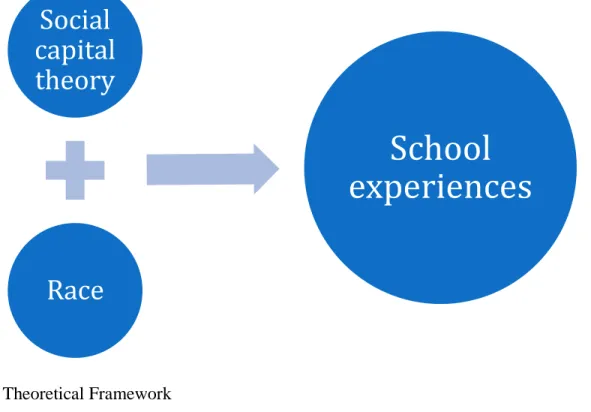
Social capital theory serves as the foundation and guiding lens for the analysis of the experiences for the eight participating first-generation Latino university students. These
students’ endeavors to confront existing institutionalized social inequalities, marginalization and oppression, all while navigating through school to better themselves, are the reason for including race with this framework and explaining how social capital and race influence their school experiences (as can be seen in Figure 1).
Figure 1: Theoretical Framework
Summary
The increasing number of Latino students in public education has not always translated into increased levels of success; thus, these students perpetuate a “tradition” of poverty and struggle. However, as there are students who do succeed despite the challenges they face, it is important to discover what it is about those students that sets them apart from the others. Understanding the relationships among social networks, socialization, and educational
Social
capital
theory
Race
School
experiences
attainment of Latinos can lead to answers and help create interventions and school systems that truly encourage more youth to attend a four-year university.
Chapter Two includes the review of the related literature to better elucidate important obstacles first-generation Latinos face throughout their education, including the history of education, social injustices, social classes, family, poverty, and race.
CHAPTER TWO
Literature Review
This chapter includes a description of the literature supporting this study, as it is important to understand what impacts the education of first-generation Latino high school students. An outline of obstacles these students face while attending K-12 schooling in the United States is also included in this chapter. Sections discussed in this chapter are the
following: history of education, social injustice and oppression, social classes, family, poverty, and race. These elements are important to any discussion of the challenges first-generation Latino students face while attending school in the US.
History of Education
During the national period, the Founding Fathers of education in America, including Benjamin Franklin, Thomas Jefferson, Benjamin Rush, and Noah Webster, developed three important proposals for schools: first, prepare people to be citizens in a new and different republic; second, teach utilitarian and scientific skills and subjects to help citizens develop the nation’s vast territory and abundance of natural resources; third, create a new culture unique to America (Ornstein et al., 2014). These leaders, however, had different ideas about how to enact the proposals. On one hand, Benjamin Franklin founded a private secondary school with a curriculum emphasizing useful knowledge: carpentry, shipbuilding, engraving, printing, and farming. He recognized how important science, invention, and technology would be to America’s future (Ornstein et al., 2014). Thomas Jefferson, on the other hand, who was
influenced by The Enlightenment period which began in Europe, believed that the main purpose of education was to promote a republican society of literate and well-informed citizens
(Alexander, Salmon, & Alexander, 2015). Those citizens would, of course, be White men who demonstrated academic aptitude.
Horace Mann, a member of the Massachusetts Board of Education during the 1830s, pushed for the establishment of common schools to be paid for through taxation. His argument to the wealthy was this: being the guardians of society, they had a responsibility for educating the populace (Ornstein et al., 2014). Common schools could train individuals to be productive, responsible members of society who worked hard and obeyed the laws. He strove to convince farmers and workers that their children, if educated by the common schools, could advance up the social ladder, for they would finally have the knowledge and skills necessary to do so. In other words, these schools would function as social equalizers. While Mann visualized common schools as providing more equality of access to education and lessening class differences, he still believed that the upper classes should maintain control of the economic and political systems (Ornstein et al., 2014). Since that time, the earliest ideas about who should be empowered versus who should be marginalized still typify social classes and education in America. Thus, common schools laid the foundation of the American public-school system, and the common school movement is important because it created publicly controlled and funded elementary education (Alexander et al., 2015).
Social Injustices and Oppression
The general concepts of social domination and oppression in the United States were redefined by the new left social movements of the 1960s and 1970s and then applied to the thoughts and actions of many individuals and organizations in contemporary American political life. Socialist activists claimed that deep institutional injustices characterized American society.
Indeed, Young (1990) described five concepts of oppression: exploitation, marginalization, powerlessness, cultural imperialism, and violence, all of which are discussed below.
The different social classes have a direct impact on society and the inequalities children face in schools. Social class affects the type of schooling students receive, and children who are most impacted in schools are those from low-socioeconomic classes and those who are poor. Lower-class children are also the most impacted by the incompatible theories of education. They are missing socialization in education because they lack social capital (Coleman, 1988). For many children of the lower class, moving constantly from school to school is often their reality. These changes are not always for the better. They usually attend schools with fewer resources to help them reach the proper level of achievement for their grade level (Anyon, 1980; Berliner, 2013; Gándara, 2015). Thus, the trend continues: These children have less access and opportunity for social mobility and may be directly impacted by not having the same level of social capital as their peers from the middle- and high-social classes (Alexander et al., 2015).
In educating working-class students, “democratic solidarity” was the focus.
Unfortunately, this model further contributed to oppression, for these students are treated more as a collective group and less as individuals with ideas and creativity to be expressed. They are instructed to follow adults’ directions and be compliant, and they are often taught via the copying of class notes and the following of procedures (e.g., an agenda), much like the type of education offered by the common schools promoted by Horace Mann. Students in these schools do not have opportunities for discussions about what they should be learning and/or why they are learning what is being taught (Anyon, 1980). Unfortunately, despite the recognition of these discrepancies, the achievement gap between students from different socioeconomic levels continues to grow, and students from the lower socioeconomic ranks suffer the most (Howard,
2010). Ultimately, the low social capital for these students is the result of coming from poor families who lack education, and this situation passes from generation to generation.
Marginalization, or the process of exclusion, is the second face of oppression (Young, 1990). Marginalization occurs because certain parts of society decide who is “worthy” of an education or who will be used for labor. Those from the higher socioeconomic classes who have a better education use their power to exclude those who they believe should not participate in social life (Young, 1990). In the United States, a substantial portion of the Latino population is marginalized in this manner. The problem for most schools with a high percentage of
marginalized Latino students involves an epidemic of underachievement in reading and math skills, failed classes, truancies, suspensions and, even more distressing, high drop-out rates (Howard, 2010). Additionally, poor minorities, who often live in the same neighborhoods, end up in schools serving other poor minorities, thereby propagating social and educational norms that are not conducive for higher levels of school achievement (Berliner, 2013; Lareau, 2011).
While students with low-socioeconomic status typically have unequal academic achievement compared to those students from higher social classes (Berliner, 2013), the curriculum from which they are taught may inherently expect less: less cognitive activity, less impactful collaboration, and less exposure to post-high school opportunities. In fact, higher-order skills are embedded in the curriculum of schools in high-income areas. The students are encouraged to develop reasoning and mathematical thinking; they complete independent
research, and their writing assignments become research reports. The students also benefit from enrichment experiences that further their overall intellectual development. Districts (and
families) from these areas have the resources to finance such activities. Children from the upper-class can count on social capital thanks to their parents’ social capital.
The third face of oppression is powerlessness (Young, 1990). Socially, people are aware some will have power, and some will not. Those who have internalized their powerlessness will be dominated by those from the ruling class. Those being dominated may be treated with disrespect, have trouble in making decisions, and/or fail to develop their capabilities.
Educational philosopher Paulo Freire (1970) believed that powerlessness was the strongest form of oppression because it often causes people to oppress themselves and, in turn, oppress others. Many people who are oppressed may not be aware of their oppression and are, therefore,
powerless. Students may demonstrate this powerlessness through lack of motivation; they lack the power to change their situation, so they do not even try. Freire called this type of oppression a culture of silence. Those who are powerless are silent; they do not discuss their oppression and are certainly not allowed to by their oppressors. Some victims internalize their situation and almost seem to accept that they are “naturally” inferior.
The fourth face of oppression is cultural imperialism (Young, 1990). The culture of the ruling class is to rule and to force the dominant culture on others. The teaching of English as the dominant language can be viewed as a form of cultural imperialism. This began early on: In the early 1800’s, Noah Webster promoted a monocultural American identity with its own distinctive American version of English as the national language (Ornstein et al., 2014). Webster, after whom a dictionary is named, helped create this distinctive American version of English. Even today, public schools “Americanize” all children from every race and ethnicity by imposing this monolithic cultural version on them, often at the expense of native languages and/or dialects. Consequently, a major source of discussion and funding relates to the education of English Language Learners. Whatever the method of bilingual education, the goal is the same: the acquisition of English. Success and inclusion in American society is dependent on this skill.
The last face of oppression is violence (Young, 1990), which takes the form of hate crimes. Many oppressed groups experience threats of violence due, at least in part, to xenophobia, an intense and irrational fear of people, ideas, or customs that seem foreign or strange. The historical tendency not to prosecute perpetrators of hate crimes appropriately has led to frustration and, as can be seen almost daily on the news, answering violence. The tensions even boil over into the public-school system. Minority students who have endured living in a deeply divided society engage in physical altercations at school or in their neighborhoods because that is how they might manifest their anger and frustration over their lack of social and cultural capital.
Social Classes
Although social class in the United States is a controversial issue, with some believing there are three levels of classes, some insisting five, and others arguing that there are six different levels, this paper will describe upper, middle, and lower. Annette Lareau (2011), a sociologist who studies family life, explored how the social position of children and parents has an impact on the quality of their life experiences, specifically in the arena of family-school relationships, the cultural logic of child rearing, and the process through which parents go about deciding where to live and send their children to school. The children of upper-class parents have the option of attending expensive private schools, or they live in areas with high-achieving public schools (Lareau, 2011). These students have more opportunities because their parents have more connections with other upper-class individuals; in other words, they possess academic and social “capital” (Anyon, 1980). Upper-class children have more opportunities to practice 21st century skills, including critical thinking, collaboration, communication, and creativity, as these skills are embedded in the curriculum. Furthermore, since income and income stability are highly
correlated with education, better-off children will succeed and more of the less well-off children will fail to make a good living (Berliner, 2013) as adults.
The middle-class, which makes up about half of the US population, has several layers: upper-middle class, average-middle class, and lower-middle class. Most upper-middle
individuals are college graduates and earn above-average salaries. Children of upper-middle individuals may also attend private schools or highly ranked public schools. “Discursive
democracy” is the form often used in classrooms containing these students. As shared by Anyon (1980), this type of education is more evident in affluent, professional classrooms that focus on student individuality within a collaborative group setting; the purpose is to encourage students to speak up and to promote creativity and problem-solving skills.
Lastly, individuals from the lower class often lack the means to meet the most basic needs of their families. Lower-class children are those who are also the most affected by the incompatible theories of education. Despite the recognition of these discrepancies, the
achievement gap between students from different socioeconomic levels continues to grow, and students from the lower socioeconomic ranks are, of course, impacted the most. While in some nations, a family’s social class has a greater effect on tested achievement; it is also clear that in some nations, the effects of familial social class on a student’s school achievement are about half of what they are in the USA (Berliner, 2013).
In all, few people would expect there to be equal achievement outcomes when inequality of income exists among families (Berliner, 2013). The inequalities between schools from wealthier communities and those in poor communities are well known to students, parents, and teachers (Anyon, 1980). One reason for the lack of movement in generational income is the unequal schooling provided to our nation’s middle and lower-class children (Berliner, 2013).
Family
The educational attainment of parents, meaning the number of years they attend school and their success later in life, has been identified as the strongest factor affecting children’s success in school (Coleman, 1988; Egalite, 2016). Parental support also has many
well-documented benefits for students of all ages (Stevens & Patel, 2015), meaning that the inclusion of parents in education is widely accepted as a critical factor in the long-term success of students in the United States (Jeynes, 2012). Much research indicated that children are less likely to drop out of school, be truant, or earn low grades if their parents are actively involved in their
education in some way (Fuller, 2014). According to Egalite (2016), Coleman’s report Equality
of Educational Opportunity summarized one of the most comprehensive studies of American
education ever conducted. The report declared that the impact of family background has a more powerful effect on achievement than what schools deem to be of importance: class size, teacher qualifications, and program expenditures.
Egalite (2016) studied four family variables that may influence student achievement: family education, family income, parents’ criminal activity, and family structure. The first variable is family education. Better educated parents, who may be more careful in choosing the neighborhoods they move into, consider the quality of the schools that are assigned to a
particular neighborhood (Egalite, 2016). Educated parents are also more likely to read to their children, to enhance their children’s development and human capital by using advanced language skills when communicating with their children, and to use their social capital in ensuring their children experience a higher quality of education (Egalite, 2016). Interestingly, despite low educational and occupational success, parents can serve as important role models for their children (Carolan-Silva & Reyes, 2013). Their children might not want to end up in the same
social and economic milieu as their parents, but they do want to be like their parents in the areas of resilience, strength, and perseverance. Admiration and appreciation for their parents’
sacrifices were emphasized, as were specific skills and qualities the students learned from their parents in terms of overcoming challenges (Carolan-Silva & Reyes, 2013). Their parents also regularly emphasized the connection between education and not “ending up like them” (Carolan-Silva & Reyes, 2013, p. 341). In one study, some of the participants, mainly “the high aspirers,” cited their parent’s lack of education as a motivating factor for their own aspirations (Fuller, 2014).
Second, parents with greater financial resources can identify communities with higher-quality schools and thus choose more expensive neighborhoods, places where good schools are most likely located (Egalite, 2016). On the other hand, parents who are struggling financially do not have resources to check homework, send their children to summer camp, organize museum trips, or help plan for college (Egalite, 2016). One promising social policy for combating the effects of family background could be the expansion of programs that enable families to choose the best schools for their children regardless of the neighborhood in which they live (Egalite, 2016).
Third, parents’ criminal activity affects student achievement. The Bureau of Justice Statistics reports that 2.3 percent of US children have a parent in federal or state prison, and Hispanic children are 2.5 times more likely than White children to have a parent who is incarcerated (Berliner, 2013). The emotional strain caused by a parent’s incarceration can impact a child’s achievement in school (Egalite, 2016).
Fourth, with family structures becoming more diverse, living arrangements have grown increasingly complex (Egalite, 2016). The two-parent family, for example, is vanishing among
the poor (Egalite, 2016). Single parents who work long hours have less time to spend with their children, and household responsibilities further cause them to have less time to spend in the development of their children, such as making sure their children do their homework and get sufficient sleep (Egalite, 2016). Schools cannot fully alleviate the disruptive effects of a
dysfunctional or unstable family, so a strong, supportive school culture can transform the “social ecology” of a disadvantaged child (Egalite, 2016).
Poverty
The culture of poverty, a theory introduced by anthropologist Oscar Lewis (1959) during the 1960s, emphasized that poverty was an economic and psychological condition passed from one generation to another, thereby creating a cycle of poverty. Lewis believed that mobilization of the poor and community action is imperative in the war against poverty. Poverty can exist without inequalities, but in societies where inequalities are as great as in ours, poverty may appear to be worse to those who have little, perhaps because all around them are those who have so much more (Berliner, 2013). It is known that poverty can have a devastating impact on children’s development. Unfortunately, poverty seems to have an almost genetic effect in that it can “follow” a family from one generation to the next. Many poor individuals are trapped in poverty, and it is difficult to break out of it (Howard, 2010). The Great Society policies, designed to eliminate poverty and equalize economic opportunity, were successful in
institutionalizing the federal government’s commitment in providing education for economically disadvantaged children but failed to make educating disadvantaged students a priority.
On the other hand, other sociologists of education put the obligation on society. According to an interview, Giroux stated that in order to reach a good and just society, social justice must face social, political, and economic factors (Peters, 2012). Creating social
movements with multigenerational voices is vital in order to be critical and transformative. Critical Pedagogy must be meaningful in order to be critical and transformative (Giroux, 2014). As Giroux (2018) asserted,
As cultural workers, artists, activists, media workers and others, it is our responsibilities to recognize that pedagogy illuminates the relationship among power, knowledge and ideology, while self-consciously, recognizing the role it plays as a deliberate attempt to influence how and what knowledge and identities are produced within particular sets of social relations. (p. 6)
Furthermore, Fine (2016) stated the desire for change is embodied by many researchers and sociologists. Michelle Fine is a professor of social psychology and urban education. She has conducted research for the past 20 years on public education with poor, middle income, and wealthy adolescents in and out of schools as well as urban educators, parents, and prisoners in college. In addition, Fine (2016) declared it is not enough to gather narratives of young people who embody lives of critique and desire and instead is advocating for the request to work along those young people as informants and co-researchers in creating a social movement. The social movement is to shed light on the systems in place that have kept the social injustices in society for so long and most importantly have worsened inequalities in schools that serve students from poor neighborhoods.
According to Giroux (2017), in order to improve the US public education system, it is vital to address the issues of economic exploitation, racist oppression, and patriarchal gender relations that form the socio-economic context in which public schools operate. In other words, schools are not the problem nor are the students or families from working-class or poor
reproduction of poverty. The work of Henry Giroux (2017) is an important contribution to the ongoing effort to develop and nurture a critical theory and practice of education. The struggle for a socially, politically, and economically just society is an on-going problem that directly affects children living in poverty. When democracy begins to disappear, innocent people and children mostly from poverty stricken communities are subjected to catastrophes such as Hurricane Katrina and Poisoned water supply in Flint, Michigan. There was devastation in Hurricane Katrina, where thousands of poor people, mostly Black, were stranded, isolated with no food or clean water, medical help and place to sleep, and many who died. In Flint, 8,657 children under six-years old were subjected to lead poisoning by being exposed to poisoned water supply. Both of these catastrophes directly affected poor Black populations (Giroux, 2017). Poor people experience disenfranchisement as the people from New Orleans and Flint, Michigan did. According to Giroux (2017), poor minorities suffer the most and most of the children it affects are marginalized and powerless.
Race
It is essential to include race in any discussion of social reproduction and inequalities that continue to occur and affect children’s schooling in the US. There are populations of people and children who have been and may still be oppressed and marginalized solely for being part of a social group that is seen as inferior by the dominant society. As described in the previous sections, education has favored White children, children of higher economic classes, children who have more social and cultural capital, children whose parents possess networks of people with higher social capital, and children who live in better neighborhoods than their non-white counterparts. Giroux maintains, since the 1980’s young people, especially from minorities of class and color, are under siege which he refers as “war on youth” (Peters, 2012). Furthermore,
as mentioned in the previous section on poverty, people and children who are subjected to catastrophes such as Katrina and Flint were poor and Black. It is inevitable to realize how poverty and race work mutually to produce an unequal society. Minority children, including Latino children, have had to navigate through K-12 schooling while enduring discrimination because of their race or ethnicity.
Lareau (2011) studied 88 students’ parents, representing both White and Black races, from different social classes. She argued that race is more determinative of the organization and experience of childhood than social class. In addition, she stated that all Black children
encounter racism from Whites in the middle, lower, and poor classes. Black children and Black parents in each class category faced discrimination. Also, Black parents are less involved in their children’s schools and tend not to comply with institutional standards (Lareau & Horvat, 1999). They are reluctant to express their concerns, fearing a lack of acceptance and a
breakdown of communication. Similarly, Latino parents are generally not as involved with their children’s schooling as White parents, in part, because of the language barrier (Stanton-Salazar, 1997).
Also, Latino families, sharing the same distrust as African-American families,
demonstrate less involvement with the schools their children attend (Lareau & Horvat, 1999; Stanton-Salazar, 1997). White parents, on the other hand, have better communication with their children’s schools and express their concerns freely, for they have more confidence that their children will not be marginalized. Clearly, race can impact students’ experiences in school yet more so when the student is both poor and of a minority group such as Latino or Black.
Relevantly, Orfield and Lee (2005) asserted segregation and discrimination in schools continue to happen in the US which results in unequal opportunity and racial inequality for
students. As immigration has transformed American schools and the numbers of Black students and Latinos has grown substantially, with Latinos now being the largest minority group and Black students following closely. There has been a continuous pattern of deepening segregation for Black and Latino student since the 1980’s (Orfield & Lee, 2005). Black and Latino students attend schools with a majority of students in their own groups and attend more diverse schools than their White peers (Orfield & Lee, 2005). Moreover, Black and Latino students are heavily isolated in extreme poverty schools depending on the state they live in. Also, there is a link between segregation by poverty, race, and academic performance. Furthermore, in a few hundred highly minority high schools there tends to be a high percentage of dropouts and the students never finish school as those schools are referred as “dropout factories.” In addition, Black and Latino students attend predominately minority schools in disproportionate numbers resulting in racial inequality as well as social injustice. It is inevitable to discover racial consequences and educational inequality when studying students of poor communities and the segregation of schools; meaning the large populations of Black and Latino students attending concentrated poverty schools (Orfield & Lee, 2005).
Summary
In this chapter, I summarized the review of the literature by discussing the obstacles first-generation Latinos from low socioeconomic background face when navigating their education in the US. Poverty, restricted social mobility, race, and the legal/political situations involved with immigration status tend to reduce the quality of life many families experience. This
unfortunately creates a cyclical turn of events affecting one generation after another, all with few opportunities to change or escape the situation (Moreno & Gaytán, 2013). As stated by
create a movement with critical pedagogy in order to create the change needed to end poverty. Social inequality and racial inequality continue to be the reality for poor and working-class Black and Latino students (Orfield & Lee, 2005). Highly segregated schools maintain neighborhoods with high minority groups such as Black and Latino students. In addition, poverty segregation and racial inequality continues to exist across the nation and directly impact students, especially minorities of class and color (Orfield & Lee, 2005). Inevitably, poverty and race are in sync to create an unequal society. Hence, poverty and race are two critical issues in our society that act as producers of social injustice. The literature in this chapter provided an overview of the institutionalized inequalities that have existed for so long in our educational system. Additionally, the literature presented support for the findings of this study by exploring the determining factors that help first-generation students graduate high school and meet the requirements to pursue a college degree. The following chapter includes the methodological qualitative research design that guided this study under its theoretical framework of social capital.
CHAPTER THREE
Methodology
In this study I used the qualitative method because
[t]hrough qualitative research, we can explore a wide array of dimensions of the social world, including the texture and weave of everyday life, the understandings, experiences and imaginings of our research participants, the ways that social processes institutions, discourses or relationships work, and the significance of the meanings that they generate. (Mason, 2002, p. 1)
This method leads to deeper, more descriptive accounts of Latino students’ experiences. Such in-depth studies of successful Latino students are imperative if we are to increase levels of achievement. The purpose of this qualitative study was to examine the high-school experiences of recently graduated, first-generation Latino students. Through ethnographic interviewing (Spradley, 1979), I gained a deeper understanding how their high school experiences affected their desire to pursue a college education.
Research Design
There were four components to this study: a pre-screening survey, a one-on-one interview, a pre-debrief, and a debrief with each participant. The gatekeeper, a science teacher from a local high school, sent out a letter to former students, as well as current instructional aides and AVID Tutors who work at the same school site. The letter described the study and how to contact the researcher via email and Facebook. Once the interested participants contacted the researcher, the researcher emailed them the Consent to Participate form and granted them access to a pre-screening survey designed to filter the participants to ensure they met the age
their current educational level, and verify if they self-identified as Hispanic or Latino. Once each interested student completed the survey the researcher contacted him/her via email to schedule the one-on-one interview, the main source for data collection. Through ethnographic interviews, the participants shared their culture which, according to Spradley (1979), refers to the acquired knowledge that people use to interpret experiences and generate social behavior. The interviews were guided by the researcher’s questions which were intended to initiate and focus dialogue on the overall research question. Each interview lasted from one to two hours. The pre-debrief focused on informing participants what to expect after the main interview, how long all the interviews were projected to take, and when data analysis would be shared with each participant. The debrief focused on how the participants could contact the researcher if they had any questions or if they wanted to meet to discuss the findings once the research was completed and approved by the University.
Participants
The participants for this study were eight first-generation Latinos attending a local
university in southern California. The participants were five males and three females between 18 and 21-years of age. The participants were made aware of the study via an email invitation sent by a gatekeeper, a local high school science teacher. The gatekeeper stays in contact with many of her students and reached out to them via email or Facebook. The letter emailed or shared through Facebook informed students of the research title, purpose, significance, participant criteria, and the survey link for them to complete if they were interested in participating in the study. Once the surveys had been submitted by the participants through Google Docs, the interested participants who met the requirements were contacted by email to schedule the interview. Each participant, prior to the start of the research was asked to sign a consent form
that reiterated study details and their willingness to be electronically recorded for the purpose of the study. The participants were also reminded at each level of engagement in the study that they could terminate their participation at any time, even after the interviews had been conducted (Mason, 2002). Table 1 illustrates the participants’ demographics. Following the chart is a description of the participants’ background. A pseudonym was used for each participant to protect his/her identity.
Table 1
Participants’ Demographics
Participant
Male or
Female Age Year in college
1- Jose Male 21 Second
2- Sofia Female 18 First
3- Luis Male 18 First
4-Manuel Male 19 First
5-Jennifer Female 20 Second
6-Gabriel Male 20 Second
7-Pedro Male 20 Second
8-Yolanda Female 21 Fourth
Participants’ Backgrounds
The eight participants in this study are first-generation Latinos who currently attend a local four-year university. Three of the participants were current freshmen; four of the
when I interviewed her. All the participants completed a prescreening survey and were selected to participate in this study because they were interested in participating and met the criteria: self-identifying as a first-generation college student, self-self-identifying as Hispanic or Latino, and meeting the age requirement of 18. The participants all share key factors: They all attended and graduated from the same local high school; their parents never attended college; their parents immigrated to this country; some of their parents never learned English; the participants all learned English as a second language; they are all currently pursuing a bachelor’s degree at local universities. Additionally, all the participants live locally and have lived in southern California. Four participants mentioned they were in the AVID (Advancement Via Individual
Determination) program during all four years of high school. One participant mentioned she was in the AVID program since the seventh grade, but two others were never part of the AVID program. One of the students shared that she had been in both AVID and the Middle College Prep program (college courses offered to high school students with great academic standing and taught by college professors) since her freshman year. Five participants disclosed they want to be teachers, and the other three want to pursue a career in the medical field. While the eight first-generation Latino interviewees have different personalities and different career goals, they all share the motivation and aspiration to obtain a bachelor’s degree.
Research Setting
Some of the interviews were conducted in a study room at a local university that was reserved ahead of time to avoid interruptions. The study room was a neutral, convenient location geared toward maintaining privacy and where neither the participant nor the researcher had an advantage. One interview was conducted in a patio area outside a local coffee shop because it was more convenient for the participant. It was also important to conduct the interview in a
setting where a conversation could take place, and both the researcher and participant were able to hear one another and for a clear recording of the interview to take place (Mason, 2002).
Data Collection
According to Spradley (1979), culture refers to the acquired knowledge that people use to interpret experience and generate social behavior; in fact, every culture has many social
occasions recognizable by the kind of talking—speech events, in other words—that occur. Ethnographers watch, listen, ask questions, and take notes as they interview the participants. Because gathering data requires a great deal of time, energy, and patience, it was necessary to limit the sample size for this study.
The eight participants were interviewed with the goal of making the discussions feel more like friendly conversations. These friendly conversations became the ethnographic interviews, as ethnographic elements were introduced. The three most important ethnographic elements used are explicit purpose, ethnographic explanations, and ethnographic questions (Spradley, 1979). The first element occurred once the researcher met with the informant and shared the reason and importance for the interview. The second element took form when ethnographic explanations, such as the purpose of the study, the goal for the interview, the explanation for recording the interview, and the purpose of notetaking during the interview. The third element took place before and after the conversations when the interviewees were invited to ask any questions they had. The participants then became the informants (Spradley, 1979), in that throughout the interviews, they shared their culture and experiences. The interviews were the primary source of valuable and significant data used for this research study.
The main tool for discovering another person’s cultural knowledge and experiences is through ethnographic questions (Spradley, 1979). Even though many styles of questions can be
used for ethnographic interviewing, this study used questions that were purposely neutral in an effort to invite the participants to open up and share as much as they could. The data collected includes the audio recoded interviews, the transcribed interview, and any notes taken during and after the interviews. When not being analyzed, the recorded interviews, transcriptions, and notes were kept in a locked file cabinet at the researcher’s home (Mason, 2002) in order to guarantee the safety and privacy of all the participants.
Data Analysis
Once all the ethnographic interviews were conducted, the data analysis took place via coding (Saldaña, 2013). In qualitative data analysis, a code is concept that symbolizes and attributes meaning to the interview transcripts for the purpose of categorizing, pattern detection, and theory building (Saldaña, 2013). Once the interviews were transcribed and typed, the coding process began. Coding took place through different cycles (Saldaña, 2013). In the first cycle of the coding processes, the data was coded into a word, an expression, or a sentence. For example, the word “background information” was coded next to each section where the
participants shared a little about themselves when asked the first question. As the coding continued, more expressions, sentences, and words were coded: “My parents told me to do well in school;” “Seeing my family struggle led me to want to take education more serious;” “My parents did not go to college;” “My parents did not having the opportunity to go to college;” “Teachers influenced me;” “Teachers were supportive;” “support from resources;” “support from the career center;” “programs;” “Culinary club made me think about college;” “resources;” “AVID was very helpful;” “ I want to be teacher;” “AVID teachers;; “my counselor;” “parents’ constant motivating and encouraging;” “My parents couldn’t really help me with school;” “The best opportunity or thing that helped me was AVID;” “parents’ motivation;” “I want to pursue a