2014
A n n u A l R e p o R t
An ErA of
Ginnie Mae’s
mission is to
support affordable
housing in America
by linking global
capital markets
to the nation’s
housing markets.
Secretary’s Message
For nearly 50 years, Ginnie Mae has played an indispensable role in our nation’s effort to create sustainable and affordable housing. By leveraging resources from the U.S. Government and the private sector, and by infusing that capital into our national housing finance market, Ginnie Mae has helped millions of low- and moderate-income households find an affordable place to call home.
Ginnie Mae’s strong foundation has positioned the organization for long-term growth and contributed to its status as a successful, independently financed government corporation. This enables Ginnie Mae, through its numerous programs, to support housing liquidity across the nation at no cost and with limited risk to taxpayers.
In the last fiscal year, that commitment to affordable housing access through sound financial discipline was strengthened. In Fiscal Year 2014, Ginnie Mae generated $1.5 billion in profits for the Federal Government and managed guarantees on more than $1.5 trillion in mortgage-backed securities. The Ginnie Mae guarantee means that, even in uncertain times, investors are guaranteed payment of principal and interest, in full and on time. The benefits of this process are passed on to the lenders, who can then make more mortgage loans at more affordable rates, providing access to credit for millions of hardworking Americans who aspire to own a home.
As our nation’s economy continues to grow, Ginnie Mae is building for the future. In 2015, Ginnie Mae will bolster its risk-management practices to better protect taxpayers as it manages a growing and diversifying Issuer base. Ginnie Mae will also innovate to meet the technological demands of an evolving housing market. And Ginnie Mae will expand its commitment to protecting the mortgage guarantee, which attracts global investment to our nation’s housing market.
I commend Ginnie Mae on its continued success, and I’m confident that its vital contribution will help make 2015 a year of opportunity for more Americans.
March 1, 2015
The Honorable Julián Castro Secretary
U.S. Department of Housing and Urban Development 451 7th Street, SW
Washington, DC 20410 Dear Mr. Secretary:
In FY 2014 Ginnie Mae’s guarantee, which carries the explicit backing of the U.S. government, once again
proved its growing relevance to the recovering housing market as the volume of guarantees in our mortgage backed securities (MBS) surpassed $1.5 trillion for the first time in history. In FY 2014 alone we guaranteed
$302.1 billion in MBS issuance, ensuring that millions of Americans can either own their home or live in affordable rental homes.
Ginnie Mae’s astounding growth and continued profitability as a self-financed government corporation is due to a simple but sound business model that attracts capital from all over the world and provides flexibility, transparency and fairness to all Issuers participating in our single security platform. Our financial position has never been stronger. Since 2010, Ginnie Mae has generated an average of $772 million annually in core profits to the federal government. In 2014 alone, we generated $1.5 billion in profits while keeping operating expenses to about 9 percent, or $143.6 million.
Every move we make is measured against the responsibility of protecting the taxpayers’ investment that is
inherent in our guaranty. As the industry has transformed in the wake of the financial crisis and new entrants pose increasing counterparty risk, we are responding by strengthening the capital and liquidity requirements for our Issuers, seeking more staff for monitoring risk, modernizing our operating systems, and upgrading our accounting principles and internal controls.
To that end, we have transitioned servicing portfolios that have been acquired through Issuer defaults to industry-leading servicers. Our goal is to exit this non-core business as soon as prudent.
I am honored to have the opportunity, through Ginnie Mae’s contributions, to ensure that affordable mortgage finance is available and accessible for all Americans.
Sincerely,
CONTENTS
01 FY 2014, An Era of Transformation ...3
Purposeful Leadership in FY 2014 ... 3
Understanding Ginnie Mae’s Business ... 4
Ginnie Mae’s Business Model ... 6
How Ginnie Mae Enables Housing ... 6
Ginnie Mae’s Role in Preserving the 30-year Mortgage ... 7
Assertive Leadership ahead of Landscape Change... 8
Managing in an Era of Transformation ... 9
Partnering to Broaden Access to Mortgage Credit...10
Ginnie Mae Signs First International Agreement to Bolster Housing Finance ...10
Ginnie Mae Demonstrates Leadership in Housing Industry ...12
Leadership through a Highly Trained and Skilled Workforce ...13
Ensuring a Liquid Market ...19
02 Financial Highlights and Management Discussion and Analysis ...21
Revenues ...23
Expenses ...25
MBS Issuance and Portfolio Growth ...27
Liquidity and Capital Adequacy ...30
Risk Management and Systems of Internal Controls ...31
03 Audit Report of Ginnie Mae’s FY 2014 and FY 2013 Financial Statements ...33
CONNECT WITH US:
www.facebook.com/ ginniemae.gov @GinnieMaeGov www.linkedin.com/ company/ginnie-mae
2014
1968−2010 Ginnie mae mBs issuance
1968−2010 Ginnie mae mBs issuance
2010–2014 Ginnie mae mBs issuance tops
introduction
UnPrECEDEnTED ExPAnSIon in its mortgage-backed securities portfolio to the point of eclipsing $1.5 trillion, worldwide recognition of the value of its guaranty, and a growing and diversifying base of Issuers combined to make Ginnie Mae’s role in the U.S. mortgage finance landscape more evident than ever in fiscal Year 2014. Throughout this fiscal year, Ginnie Mae moved forward in a strategic and deliberative manner to ensure it meets its statutory goals of providing access to housing opportunities through prudent stewardship of the full faith and credit guaranty of the U.S. government. As the nation’s sole mortgage-backed securities administrator and guardian with the explicit backing of the U.S. government, Ginnie Mae has a unique responsibility to lead, especially in this Era of Transformation.
Ginnie Mae’s remarkably successful track record, along with its market ascent, illustrates that its business model is sustainable and scalable and remains a crucial component of the continued housing recovery. Ginnie Mae’s common securitization platform enables its 433 Issuers to pool mortgage loans into securities using guidelines that apply equally to all Issuers. The Ginnie Mae model is increasingly relevant today as its framework is representative of a model for consolidating the government’s role in housing finance.
Ginnie Mae’s 2014 Annual report provides a summary of its role in housing finance, outlines how it is responding to increased risk in the market and presents financial results for fiscal Year 2014.
purposeful leadership in FY 2014
In the past four years, Ginnie Mae has increased its guarantees of mortgage-backed securities (MBS) outstanding by 50 percent, growing from $1 trillion in 2010 to $1.5 trillion in 2014. The rapid growth is put into perspective by the fact that it took 42 years from 1968, when Ginnie Mae was created, until 2010 to reach the $1 trillion mark. Correspondingly, Ginnie Mae continues to update its systems’ technology and strengthen its approach to managing the risk its counterparties pose, including the approved financial entities that issue and service the MBS it guarantees.
With a consistent year-over-year track record of providing significant revenue to the government while limiting risk exposure to the U.S. taxpayer, Ginnie Mae has increased its market share and generated a net profit of approximately $900 million in FY 2014 from its core business lines.
Even with its continuing success, Ginnie Mae recognizes that the mortgage finance landscape in which it now operates is vastly different from when it was conceived, or even from five years ago. Commercial banks are retreating, and non-depository institutions are taking their place. While the capital brought to the market by these new entities is welcome, Ginnie Mae also must respond appropriately to protect its guaranty. Ginnie Mae’s leadership has embarked on modernization efforts and strategic planning to address the complexity of new program entrants and their operational structures. To ensure that its unqualified success continues, Ginnie Mae aggressively manages its guarantees which now surpass $1.5 trillion, while continuing to invest to the full extent of its statutory limits in expertise in human capital and infrastructure modernization in order to balance the emerging diverse nature of its program participants.
an era of
understanding Ginnie Mae’s Business Ginnie Mae makes affordable housing finance a reality for millions of low- and moderate-income households across America by channeling global capital into the nation’s housing markets. Specifically, the Ginnie Mae guaranty allows mortgage lenders to obtain a better price for their mortgage loans in the secondary mortgage market. The lenders can then use the proceeds to make new mortgage loans available.
Ginnie Mae does not buy or sell loans or issue MBS. What Ginnie Mae does (Figure 1-1) is guarantee investors the timely payment of principal and interest on MBS backed by federally insured or guaranteed loans — mainly loans insured by the Federal Housing Administration (FHA) or guaranteed by the Department of Veterans Affairs (VA). Other guarantors or insurers of loans eligible as collateral for Ginnie Mae MBS include the Department of Agriculture’s Rural Development (RD) Office and the Department of Housing and Urban Development’s Office of Public and Indian Housing (PIH).
Ginnie Mae approves MBS Issuers, who pool government-backed mortgage loans and issue MBS. Issuers service and manage their MBS obligations and underlying loans. Ginnie Mae guarantees the timely payment of principal and interest to the investors who
provide the capital and own or invest in the MBS. In exchange, Issuers pay Ginnie Mae a guaranty fee from the spread between the interest rate paid by the mortgage borrowers and the interest rate paid to MBS investors. The Ginnie Mae guaranty, coupled with an expected rate of return higher than U.S. Treasury securities, makes Ginnie Mae MBS highly liquid and attractive to domestic and foreign investors of all types.
Through its common security, Ginnie Mae provides for the pooling of government-insured mortgage loans made by private-sector lenders into homogenous securities. Because these MBS are guaranteed by the full faith and credit of the U.S. government, they are highly sought all over the world.
Even in difficult times, an investment in Ginnie Mae MBS is one of the safest an investor can make. Since the 2007 Great Recession, Ginnie Mae’s MBS outstanding has increased by more than 200 percent, from $427 billion to $1.5 trillion, providing stability to the mortgage market.
Ginnie Mae’s MBS has been successful in every respect. Ginnie Mae has never posted an annual loss, and the securities it guarantees are in high demand across the globe.
“Ginnie mae’s sustained success in enabling
housing opportunities for all americans
is a testament to their leadership and simple
business model, which minimizes risk to the
taxpayer and affords a place to call home
for low to moderate-income individuals and
families across the nation.”
honoraBle Julián castro
secretary, u.s. department of housing and urban development
FiGuRe 1-1: CApitAl Flow oF Ginnie MAe GuARAntY SeCuRitieS
GINNIE MAE
Guarantees Investors Timely Payment of Principal and Interest on Securities LENDERS Originate Loans under Guidelines of Federal Credit Programs INVESTORS Purchase Securities and Receive Monthly Pass-Through of Principal and Interest from Borrowers
ISSUERS
(Often the Lenders Pool Loans and or Their Affiliates) Create Mortgage-Backed Securities
FHA, VA, RD, OR PIH
Insures or Guarantees Loans
Homeowner Equity
Government Agency Insurance Ginnie Mae
Corporate Resources of Issuer
RELATIVE LOSS POSITION
LO
SSES
First Dollar Loss Last Dollar Loss
◀ Ginnie Mae incurs losses on a security only in the rarest cases — when all borrower equity and government insurance resources are exhausted and the issuing institution fails.
FiGuRe 1-2:
ProTEcTinG
THE GinniE MAE
GuArAnTY
Ginnie Mae’s Business Model
The value of the Ginnie Mae program is underscored by a powerful yet simple business model that is inherently risk-averse, and is supported by a conservative approach and strong risk management practices.
Ginnie Mae’s fourth loss position (as depicted in Figure 1-2) — behind borrowers and their home equity, government-insured or -guaranteed mortgage programs, and the corporate resources of the Issuer — has meant that even during the Great Recession, Ginnie Mae has not needed a bailout. It has weathered the storm without any appropriation from general tax revenue or assistance from the U.S. Treasury.
How Ginnie Mae enables Housing
Prior to the 1970s, when banks invested in long-term FHA and VA mortgages, interest rate volatility led to
the Savings and Loan crisis. To address the inability of banks to match deposits with long-term liabilities, Ginnie Mae created the mortgage-backed security. The innovation of the MBS by Ginnie Mae enables interest rate risk to be transferred from financial institutions to global investors willing and capable to retain interest rate risk. In so doing, Ginnie Mae is able to reduce interest rates to borrowers leveraging the government-insured financing. As the primary funding source for FHA, VA and RD lending programs, Ginnie Mae obtains funds from domestic and global investors to fund the capital used by mortgage lenders. The foundational support and innovation Ginnie Mae provided in establishing the MBS decades ago is more relevant today than at any time in recent history as its current market share of fixed rate MBS exceeds that of others in the market (as represented in Figure 1-3).
Ginnie mae supports active duty and military
veterans through the Va mortgage program.
FiGuRe 1-3: 30-YeAR And 20-YeAR Fixed RAte SinGle FAMilY MBS MARketSHARe*
*30-year and 20-year MBS products include:
Fannie Mae: FNM30, FNM30HILTV, FNM30JM, FNM30INITIO, FNM30RELO, FNM30FHA, FNM30PPAYP, FNM20, FNM20HILTV
Freddie Mac: FHL30CONV, FHL30RELO, FHLG30INIOJM, FHL30FHA, FHL30, FHLG30MOD, FHLG30FHA, FHLG30RELO,
REVENUES ($ BILLIONS) MBS GR O SS I SS U ANCE VA LUE — — —
Ginnie Mae’s Role in preserving the 30-year Mortgage
The continued availability of the 30-year mortgage has been a central tenet in the national debate on housing finance reform. As the U.S. Congress considers the reform of national housing policy, there is growing consensus that the 30-year mortgage should be preserved. The Ginnie Mae model aligns with such policy as the 30-year mortgage has long been the predominant mortgage loan in the MBS it guarantees.
Ginnie Mae supports active duty and military veterans through the VA mortgage program. With veterans returning home, the share of VA loans in Ginnie Mae MBS has grown in Fiscal Year 2014 to account for more than 40 percent of its volume. In fact, the VA mortgage program increased year-over-year with volume peaking in FY 2013 with a record 629,293 mortgage loans guaranteed.
The increase in VA lending volume (as depicted in Figure 1-4) did not require systems enhancements or new program guidance or requirements. Rather, the scalability of the Ginnie Mae model was exercised with the demand generated by the nation’s veterans through VA-approved lenders.
“Veterans across the country have
obtained home financing through
efficient and timely access to
the Va-guaranteed mortgage
loan program in record numbers
thanks to the seamless ability
of Ginnie mae to scale with our
dramatic increase in volume.”
miKe frueh
Va director of loan Guaranty
FiGuRe 1-4: VA MoRtGAGe SuRGe
FYS 2007 to 2014 600,000 700,000 500,000 400,000 300,000 200,000 100,000 0 2007 2008 2009 2010 2011 2012 2013 2014
Assertive leadership ahead of landscape Change
Since its founding more than 40 years ago, the Ginnie Mae MBS program has fulfilled its mission of attracting capital into the U.S. housing finance system and returned a profit to the federal government. Since 2008, Ginnie Mae’s Issuer base has changed from traditional regulated commercial banks to new entrants that are non-depository financial institutions with complex financial and operating structures. The emerging non-depositories consist primarily of firms whose development and structure has occurred largely in the post–Great Recession era. A portion of these new entrants are firms that specialize in linking funds of capital with operating platforms for the primary purpose of overseeing mortgage servicing rights (MSR) investments.
As the Issuer base evolves (as depicted in Figure 1-5), Ginnie Mae’s monitoring responsibility is also changing to adapt to the challenges of this vastly different Issuer base. Akin to the role of the Federal Deposit Insurance Corporation’s (FDIC’s) monitoring of banks, Ginnie Mae monitors its Issuers. This is because non-banks are not subject to the same regulations to which depositories are held. Accordingly, this year Ginnie Mae increased its monitoring staff and revised and strengthened its minimum adjusted net worth and liquid asset requirements to ensure all program participants can be successful.
51% 49% FY 2010 SinGle-FAMilY iSSuAnCe VoluMe: $389 B FY 2014 SinGle-FAMilY iSSuAnCe VoluMe: $277 B 18% 82% FiGuRe 1-5: CHAnGe in CoMpoSition oF Ginnie MAe MBS iSSueR* BASe
fY 2010
fY 2014
* Ginnie Mae Issuers are responsible for servicing the securities and the loans backing them; when an original Issuer sells servicing to another entity, the new
entity takes on all obligations of the original Issuer.
depositories non-depositories
this fiscal year,
six of Ginnie mae’s
top 10 issuers are
non-depository
institutions.
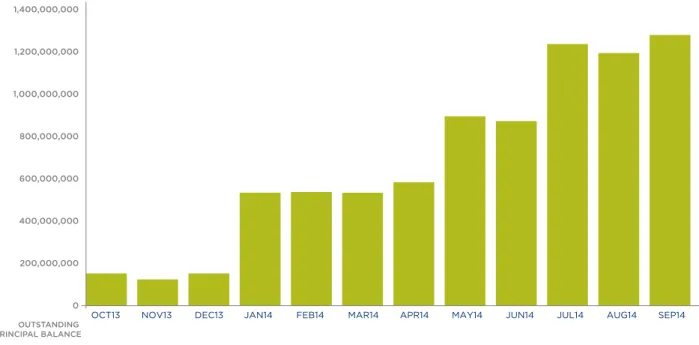
An example of the evolution and diversification of the Issuer base is the business line of Pools Issued for Immediate Transfer (PIIT) (Figure 1-6), which gives the Issuer the option to issue an MBS and simultaneously transfer the servicing. Ginnie Mae recognizes how the MBS business is segmenting in a manner consistent with the diversification and specialization of its Issuers. PIIT volume increased significantly in 2014. Average monthly PIIT volume in 2013 was $114 million. By 2014, the average monthly PIIT volume was $712 million. In July 2014, PIIT reached another record high of $1.2 billion. Of total PIIT volume in 2013 and 2014 so far, 96 percent was transferred between non-depositories, and just 4 percent went from depositories to non-depositories.
Managing in an era of transformation Looking ahead, Ginnie Mae is mindful of how the changing Issuer base has moved beyond the operating environment for which Ginnie Mae was originally designed. Today, Ginnie Mae is positioned favorably to monitor the compliance and financial wherewithal of its Issuers. Nevertheless, to address issues of capacity to maintain the utility and relevance of its MBS program, Ginnie Mae is seeking funding for future growth in both human capital and infrastructure
modernization.
To manage the evolving risk profile of its Issuers, Ginnie Mae will upgrade its ability to assess the financial and operating compliance of its non-depository Issuers. This effort will focus on liquidity, MSR valuations and information-driven benchmarks. In addition, Ginnie Mae will make appropriate modifications to its MBS program to support an evolving residential financial marketplace with emphasis on the role of non-depository lenders.
For example, Ginnie Mae has adopted a special customer relationship management framework that focuses on viewing an Issuer based on how it transacts business with Ginnie Mae and on its management and mitigation of internal and external risk with key stakeholders such as document custodians, service providers and vendors. Ginnie Mae will use the framework to identify Issuers whose size, growth, business model, complexity, or non-traditional structures or characteristics that are deemed worthy of a more intensive level of ongoing engagement, defined in part by regularly scheduled business review meetings. 0 200,000,000 400,000,000 600,000,000 800,000,000 1,000,000,000 1,200,000,000 1,400,000,000
OCT13 NOV13 DEC13 JAN14 FEB14 MAR14 APR14 MAY14 JUN14 JUL14 AUG14 SEP14
OUTSTANDING PRINCIPAL BALANCE
partnering to Broaden Access to Mortgage Credit
Outside of its risk management enhancements, Ginnie Mae is also managing an era of transformation by delivering creative solutions to its Issuers and thereby broadening access to its program through nontraditional financing structures. In one such effort to infuse liquidity into small and lower-volume lenders, Ginnie Mae established a pilot program with its approved Issuer,
“the Ginnie mae-fhlBc conduit will
allow participating members to be more
competitive in their communities and will
provide them better pricing to enhance
access to affordable mortgage financing
in the communities they serve.”
matt feldman
president, fhlB-chicago
Ginnie Mae President Ted Tozer and Japan Housing Finance Agency President Shinya Shishido at the January 2014 Ginnie Mae and Japan Housing Finance Agency Memorandum of Understanding Ceremony
the Federal Home Loan Bank of Chicago (FHLBC). This pilot program allows the FHLBC to issue securities guaranteed by Ginnie Mae. The FHLBC may now offer smaller financial institutions access to the secondary mortgage market for their home-buying customers. Through programs such as the FHLBC pilot and Ginnie Mae’s mainstay 30-year fixed-rate MBS programs, the trend line for Ginnie Mae market share issuance continues to grow.
Ginnie Mae Signs First international Agreement to Bolster Housing Finance The worldwide attraction to Ginnie Mae securities has been steadfast throughout the history of the program and has contributed to global stability of financial markets. Sought after for its expertise on issues related to affordable housing finance, sustainable community development and stabilization of housing markets, Ginnie Mae has fostered collaboration and international exchange of best practices with global investors and international governments.
This year Ginnie Mae signed a Memorandum of Understanding (MOU) with the Japanese government. The objective of this MOU is to exchange innovative
practices that promote access to affordable housing finance. Japan Housing Finance Agency’s (JHF’s) President Shinya Shishido led Japan’s delegation to visit Washington, D.C., and sign the MOU with President Theodore W. Tozer.
JHF is the Japanese equivalent to Ginnie Mae. This MOU was Ginnie Mae’s first international agreement with another country and is indicative of the success of Ginnie Mae’s $1.5 trillion portfolio business model. Japan is one of the world’s largest economies and an important partner in the mortgage-backed securities market. The signing of this MOU illustrates 1) Japan’s recognition of the importance of the Ginnie Mae model in the global housing finance community; 2) the strong relationships among Ginnie Mae, the government of Japan and each country’s respective financial sectors; and 3) the priority Ginnie Mae places on strengthening the U.S. housing market and promoting financial stability with counterparts in global capital markets.
Ginnie Mae anticipates continued partnership and collaboration with other governments in the Asia-Pacific region given the global acceptance of Ginnie Mae as an important component of the U.S. economic recovery and the nation’s improving housing market.
Ginnie Mae in the news
Ginnie MAe’S extRAoRdinARY GRowtH, its increased MBS volume, and the success and efficiency of its business model garnered increased attention in FY 2014 from the housing finance industry and u.S. policymakers. Ginnie Mae and its work have been featured in more than 700 print, online and broadcast media stories in Fiscal Year 2014.
the headlines are consistent with the stakeholder view of the significance Ginnie Mae has in an evolving housing finance market. news coverage throughout the fiscal year portrayed the active engagement of Ginnie Mae in the public domain, acknowledging its expanding portfolio, its leadership in the transformation of the housing finance industry, the importance of monitoring its program participants, its creation of partnerships and the recognition that permanent staffing levels commensurate with the growth are necessary.
Ginnie Mae demonstrates leadership in Housing industry
Ginnie Mae recognizes how crucial it is to foster a collaborative relationship with all of our business partners who help us fulfill our mission to support affordable housing in the U.S. To that end, throughout the year, Ginnie Mae coordinates and runs a monthly interagency workgroup to address new programs, regulatory requirements and topical issues of importance to its MBS program. Attendees of the interagency workgroup include the Federal Housing Finance Agency (FHFA), Consumer Financial Protection Bureau (CFPB), Treasury, FHA, VA and RD. In fostering this exchange of information with federal loan insurance agencies, Ginnie Mae provides insight, guidance, and expertise on proposed rules and regulations. From this vantage point, Ginnie Mae can monitor how new rules and regulations will impact its guaranty business.
The corporation also created the Ginnie Mae Summit in FY 2014, an event where business partners had the opportunity to discuss programs and share perspectives on the industry. The November 2014 event drew some 800 housing industry professionals.
The event provided more in-depth perspectives on the corporation’s business and programs. Issuers, document custodians, other federal agencies, and interested stakeholders attended and participated in a free flow of discussion and knowledge sharing. The dialogue focused on successful participation in and compliance with programs and policies so that Ginnie Mae’s mission of bringing global capital into the housing market, ensuring liquidity and reducing risk to taxpayers continues successfully.
General sessions and panels at the Summit included policy and industry discussions on how customers, Issuers, and their partners can best utilize the Ginnie Mae program and platform. The Summit also gave attendees the opportunity to provide feedback and make recommendations directly to Ginnie Mae.
Using the hashtag and conference title #ThePowerofPartnerships, Ginnie Mae engaged the audience through social media on Twitter, Facebook and LinkedIn. The prevalence and influence of social media in housing finance is growing. Through its Twitter account
Ginnie mae summit draws 800
housing industry professionals.
Ginnie Mae Executive Vice President Mary Kinney addressing attendees at the September 2014 Ginnie Mae Summit
@GinnieMaeGov, Ginnie Mae participates in the growing public conversation on national housing policy.
During the Summit, Ginnie Mae made several announcements including its intention to increase its net worth and liquidity requirements to augment the wherewithal of its Issuers; to enhance its Acknowledgement Agreement to expand liquidity so that its Issuers may use mortgage servicing rights as collateral; and to adopt a dormant Issuer policy whereby Issuers must actively participate within an 18-month time frame.
leadership through a Highly trained
and Skilled workforce In September 2014, Ginnie Mae published a thought leadership paper titled “An Era of Transformation.” The paper is significant because it describes how the aftermath of the Great Recession set in motion a transformation in the MBS market that poses challenges for Ginnie Mae.
These changes are rooted in the retreat of commercial banks from mortgage lending and servicing, and the replacement of this capacity by non-depository institutions with more complex financial and operating structures than those for which the Ginnie Mae program was originally designed.
Year in Review
(FY 2014)
1.5 Trillion
current outstanding GM Guarantees$25.2 Billion
Average MBS issued per Month in FY 20149.1 Million
Loans currently collateralized in Ginnie Mae MBS$24 Billion
P&i Paid to investors Monthly
443
Approved issuers
4
Guarantors
HUD Secretary Julián Castro addressing attendees at the September 2014 Ginnie Mae Summit
As the housing finance industry has changed dramatically over the past few years, transforming at an unprecedented pace, so too should the Ginnie Mae organization. In the past four years, the Ginnie Mae portfolio has grown from $1 trillion to $1.5 trillion. It took Ginnie Mae 40 years to reach the $1 trillion mark, and only four more years to reach the $1.5 trillion milestone.
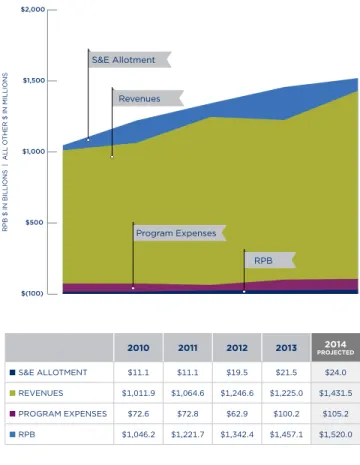
Ginnie Mae’s historic staffing model (as depicted
in Figure 1-7) is characterized by modest levels of
permanent staff complemented by private firms that provide transactional and support services on a contract basis. This blend has served Ginnie Mae well in that it offers a fluent market-oriented perspective from the private sector. The skillful management of relationships with commercial business partners will continue to be an important part of Ginnie Mae’s approach.
Even so, the growing complexity of monitoring Issuers and gauging counterparty risk is leading Ginnie Mae to seek to reduce its reliance on contractors in these key areas. Given the growth in the MBS portfolio, the diversification of the Issuer base to complex non-depository institutions and the era of transformation in housing finance, Ginnie Mae is seeking like- size growth in permanent staff to meet current workload demands. $(100) $500 $1,000 $1,500 $2,000 RPB $ IN BILLIONS | A LL O T HER $ IN M ILLION S
GINNIE MAE SPENDING/ALLOTMENTS/RPB
Fiscal years 2010-2014 S&E Allotment Revenues Program Expenses RPB 2010 2011 2012 2013 proJected2014 ■ S&E ALLoTMEnT $11.1 $11.1 $19.5 $21.5 $24.0 ■ rEVEnUES $1,011.9 $1,064.6 $1,246.6 $1,225.0 $1,431.5 ■ ProGrAM ExPEnSES $72.6 $72.8 $62.9 $100.2 $105.2 ■ rPB $1,046.2 $1,221.7 $1,342.4 $1,457.1 $1,520.0
FiGurE 1-7: GinniE MAE SPEnDinG/ALLoTMEnTS/ rEMAininG PrinciPAL BALAncE
Fiscal Years 2010-2014
in the past four years, the Ginnie mae
portfolio has grown from $1 trillion to
$1.5 trillion. it took Ginnie mae 40 years to
reach the $1 trillion mark, and only four more
years to reach the $1.5 trillion milestone.
Ginnie MAe i MBS Ginnie MAe ii MBS
Single-Issuer pools Single- or multiple-Issuer pools
note rates on underlying mortgages are fixed
and all the same Multiple note rates on underlying mortgages — limited to a range of 50 basis points (0.25 to 0.75 above the pass-through interest rate) Acceptable collateral:
• To Be Announced (TBA)eligible: Single-family Level Payment Mortgages • non-TBA eligible: Buydown Mortgages,
Graduated Payment Mortgages, Growing Equity Mortgages, Serial notes, Manufactured Home Loans, Project Loans, Construction Loans
Acceptable collateral:
• TBA eligible: Single family Level Payment Mortgages, including up to 10 percent Buydown Mortgages
• non-TBA eligible: Adjustable-rate Mortgages, Graduated Payment Mortgages, Growing Equity Mortgages, Serial notes, Manufactured Home Loans, Home Equity Conversion Mortgage (HECM) Loans
Timing of payments: 15th of the month Timing of payments: 20th of the month Larger pool size*
More demographically and geographically diverse*
Customizable pools** Ginnie Mae’s Products and Programs
Ginnie Mae offers reliable solutions that meet the needs of a broad constituent base of borrowers, lenders and investors and provides sufficient flexibility to respond to market changes. At the core of its business model and product offerings is the simple pass-through security, which comes in the form of two product structures: Ginnie Mae I MBS and Ginnie Mae II MBS.
The two product structures fit well against the Ginnie Mae model that insures only Issuer performance. By guaranteeing only the performance of Issuers in their servicing responsibilities and their financial obligations to make principal and interest payments to investors, Ginnie Mae significantly reduces taxpayer exposure to risk.
The credit exposure of Ginnie Mae is limited to the financial strength of our Issuers because Ginnie Mae guarantees that an Issuer will meet its obligations. Ginnie Mae manages this risk through its comprehensive Issuer approval process and ongoing monitoring procedures, both of which are a part of a multilayer risk management framework.
The characteristics of the Ginnie Is and IIs are summarized in the table below.
Historically, the Ginnie Mae I Single Issuer MBS was the program of choice for Issuers. In recent years, however, the Ginnie Mae II MBS has generated increased demand and surpassed the Ginnie Mae I MBS in terms of issuance volume. In FY 2013, the Ginnie Mae II program accounted for approximately 92 percent of Ginnie Mae’s MBS issuance. This is the result of investors’ growing preference for multi-Issuer pools, as well as increased appetite for larger pools with diverse collateral characteristics.
The Ginnie Mae MBS also serve as the underlying collateral for multiclass products, such as Real Estate Mortgage Investment Conduits (REMICs), Callable Trusts, Platinum Securities and Stripped Mortgage-Backed Securities (SMBS). Ginnie Mae also guarantees the timely payment of principal and interest of these products. These structured transactions allow the private sector to combine and restructure cash flows from Ginnie Mae MBS into securities that meet unique investor requirements for yield, maturity and call-option features.
* Multiple-iSSueR poolS; tBA eliGiBle ** SinGle-iSSueR pool; non-tBA eliGiBle
Multiclass products are structured for offering in the public markets by “sponsors.” These sponsors are approved Ginnie Mae securities dealers in the REMIC program, and depositors in the Platinum program, who have wide access to global investors. By managing the ongoing relationship with investment banks and institutional investors, Ginnie Mae supports multiple products that meet the needs of global capital market participants and attract financing to the U.S. housing market.
This wide range of multiclass products finances the diverse single-family and multifamily lending initiatives provided by the government’s housing agencies. Those government-insured and guaranteed lending programs align with Ginnie Mae’s four multiclass programs. These programs are designed to serve a variety of loan financing needs and different Issuer origination capabilities. All loans in each of these programs are insured or otherwise
guaranteed by the government, which minimizes risk to Ginnie Mae.
Single Family Program: The majority of Ginnie Mae guarantees outstanding are backed by single family mortgages predominantly originated through FHA and VA loan insurance programs (58.3 percent and 34.7 percent, respectively). In FY 2014, 99.2 percent of FHA fixed-rate single family loans and 96.7 percent of VA fixed-rate single family loans were placed into Ginnie Mae pools. The Single Family Program supports purchase mortgages, loans that are modified to support loss mitigation programs, and mortgage refinancing. Within the Single Family MBS Program, the Targeted Lending Initiative provides incentives for lenders to increase loan volumes in traditionally underserved areas.
Ginnie mae milestones
1968
Ginnie Mae created1970
first MBS created1983
Ginnie Mae II MBS program created1994
Ginnie Mae creates real Estate Mortgage Investment Conduit (rEMIC) program
1996
Ginnie Mae establishes Targeted Lending Initiative
ReMiCs CAllABle tRuStS SeCuRitieSplAtinuM SMBS
Investment vehicles reallocate pass-through cash flows from underlying mortgage obligations into a series of different bond classes, known as tranches, which vary based on term and prepayment risk.
Investors can redeem or call a security prior to its maturity date under certain conditions to hedge against fluctuating interest rate environments.
Investors can hold multiple pools of MBS to combine them into a single Ginnie Mae Platinum Certificate. Custom-designed securities that redirect MBS principal and/or interest cash flows to meet investors’ specific objectives. Ginnie Mae
guarantees the timely payment of principal and interest on each class of SMBS.
Multifamily Program: Ginnie Mae’s Multifamily MBS Program enables lenders to reduce mortgage interest rates paid by property owners and developers of apartment buildings, hospitals, nursing homes, assisted living facilities and other types of housing. These lower interest rates provide the necessary incentive for many developers to construct new projects or substantially rehabilitate existing structures.
The importance of multifamily financing is growing as the population ages, facilities need renovation and the demand for memory care services increases. Tailored for many property types and financing scenarios, Ginnie Mae’s Multifamily MBS Program reaches diverse segments of the U.S. rental housing market and finances projects that stabilize local economies and bring jobs to communities across the country. The sophisticated and flexible structure of the program provides Ginnie Mae with a competitive advantage over other multifamily financing offerings in the industry. This advantage is due to four key characteristics typically attributed to government loan programs: lower interest rates on loans; higher loan-to-value ratio for borrowers; all-in-one construction to permanent loan origination; and an advantageous capital source for health care properties, including nursing homes and hospitals. In FY 2014 Ginnie Mae’s Multifamily MBS portfolio increased to $87.9 billion, compared with $79.8 billion in FY 2013, helping finance loans for 1,476 apartment buildings, 14 hospitals, 355 nursing homes and 217 assisted living homes.
Ginnie mae milestones
2006
Ginnie Mae creates HECM mortgage-backed securities (HMBS) program
2008
Ginnie Mae stabilizes housing market2010
Ginnie Mae MBS issuance tops $1 trillion2013
Ginnie Mae guarantees $460 billion in securities2014
Ginnie Mae MBS issuance tops $1.5 trillionHome Equity Conversion Mortgage (HECM) MBS
(HMBS) Program: Ginnie Mae’s HECM securities
program provides capital and liquidity for FHA-insured reverse mortgages. HECM loans can be pooled into HMBS within the Ginnie Mae II MBS program. They also can serve as collateral for REMICs backed by HMBS (H-REMICs). Ginnie Mae has been a pioneer in the development of a liquid securities market for reverse mortgages, providing senior citizens with access to their home equity during challenging economic times. In FY 2014, Ginnie Mae’s HMBS portfolio reached $48.9 billion, compared with $44.6 billion in FY 2013.
Manufactured Housing (MH) Program: Ginnie Mae’s MH Program provides financing for and allows the
issuance of pools of loans insured by FHA’s Title I Manufactured Home Loan program for manufactured home loans that do not include land as collateral. This program went through significant changes in support of the Housing and Economic Recovery Act of 2008.
Prudent Use of the Strength of the Full Faith and Credit Guaranty
The full faith and credit guaranty separates Ginnie Mae from all other MBS guarantors, including Fannie Mae and Freddie Mac. As federally chartered secondary market participants, these government-sponsored enterprises (GSEs) share many similarities with Ginnie Mae. These organizations each provide liquidity in the secondary mortgage market, support housing
Ginnie MAe GSes
Governance Wholly owned government corporation. Under government conservatorship since September 2008 but remain publicly traded companies (not on nYSE).
Government
Guaranty Explicit guaranty to investors. Implicit guaranty to investors. Business
Activities Does not purchase loans, nor does it buy, sell or issue securities as part of its regular course of business, but approves private lending institutions to issue MBS for which Ginnie Mae provides the guaranty.
Purchase loans, and buy, sell and issue securities.
Rates and terms Trade at a higher price than comparable GSE MBS, thus providing a lower interest rate to borrowers.
Trade at lower prices relative to Ginnie Mae MBS.
Functions Guaranty and bond administration of MBS
only. Loan-level guaranty and bond administration of MBS, and management of investment portfolio of whole loans and MBS.
Risk Limited risk to Ginnie Mae. Issuer/servicer risk. Issuers must have capital to advance payments of principal and interest to investors when a loan defaults. Government agencies’ insurance (e.g., fHA, VA, rD, PIH) repays Issuers for principal (not Ginnie Mae). Also, Issuers are responsible for unreimbursed credit losses for the securities they issue.
Significant risk to the GSEs. Borrower credit risk, interest rate risk, and servicer risk. These GSEs guarantee full repayment of principal to investors when a loan defaults. Also, these GSEs are responsible for the risk of loss on their securities.
eligible Collateral Government-backed loans (fHA, VA, rD,
finance opportunities, and guarantee MBS by ensuring the timely payment of principal and interest to investors. Their structure and business models, however, differ in a number of ways, including most notably their guaranty of the loans underlying the MBS.
The key differences between Ginnie Mae and the GSEs are summarized in the table on page 18.
ensuring a liquid Market
The recovery of the housing market depends on a reliable supply of liquidity that only a strong capital market can provide. The consistent performance of Ginnie Mae’s MBS products has been essential to providing this liquidity. Issuers know that Ginnie Mae securities provide attractive pricing and are an important asset class for many investors. The favorable pricing on securities, enabled by the Ginnie Mae guaranty, is ultimately passed on to many homeowners and renters in the form of lower interest rates and more attractive leasing terms. In addition, these securities provide the financing necessary for all federal government loan guarantee programs. Ginnie Mae’s creation of pass-through securities also led to the establishment of the “To Be Announced” (TBA) market, a critical feature of the secondary mortgage market allowing for future lending commitments and valuation. Investors in TBA securities know that the
terms and conditions of the security are consistent and the underlying mortgage loans comprise relatively homogeneous collateral. This innovative process enables lenders to lock in a rate for the mortgages before closing, which facilitates the availability of affordable mortgages to millions of prospective homeowners. Although this type of security was established many years ago, a significant portion of the volume of MBS traded in the market today continues to be in the form of TBA securities, which are contracts for the purchase or sale of a type of mortgage-backed security that will be delivered at a future agreed-upon date. Though the specific loans, the pool numbers, and the number of pools that will be delivered to fulfill the trade obligation or terms of the contract are unknown at the time of the trade, the TBA market uses accepted parameters for loans and pools to be delivered. Ginnie Mae’s TBA-eligible MBS enables mortgage lenders to sell their primary originations forward by securitizing the mortgages for purchase in the secondary market.
Ginnie mae has been a pioneer in the
development of a liquid securities market for
reverse mortgages, providing senior citizens
with access to their home equity during
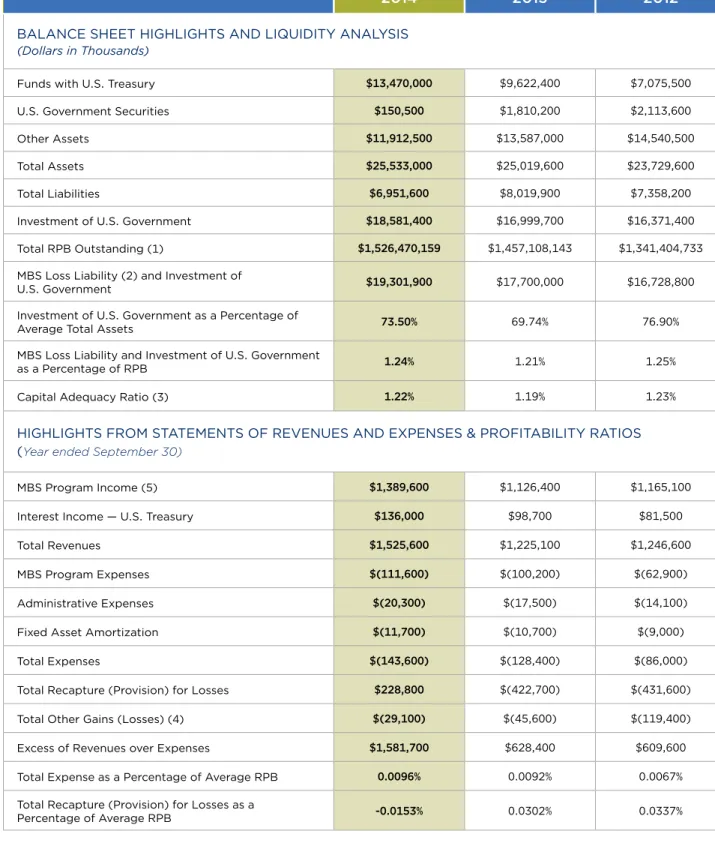
Ginnie Mae continued to post stable financial results during FY 2014. Revenues increased by 24.5 percent to $1.5 billion, up from $1.2 billion in FY 2013. Expenses increased to $143.6 million in FY 2014, compared with $128.4 million in FY 2013. The provision for MBS loss liability was $651.5 million less than in FY 2013. As shown
in Table 1 on the following page, Ginnie Mae achieved excess revenues over expenses (net profit) of $1.6 billion,
compared with $628.4 million in FY 2013. Total assets increased to $25.5 billion from $25 billion in FY 2013. The outstanding MBS portfolio guaranteed by Ginnie Mae increased by $69.4 billion in FY 2014, which led to increased guaranty fee revenues. In FY 2014, MBS guaranty fees increased to $928.3 million, up from $870.9 million in FY 2013. Interest on mortgage loans held for investment increased to $346.8 million in FY 2014, up from $116.4 million in FY 2013.
In FY 2014, Ginnie Mae issued $286.3 billion in commitment authority, a 38.4 percent decrease from FY 2013. The $302.1 billion of MBS issued in FY 2014 represents a 34.4 percent decrease from FY 2013. The outstanding MBS balance of $1.5 trillion at the end of FY 2014, compared with $1.4 trillion in FY 2013, resulted from new issuances exceeding repayments. FY 2014 production provided the capital to finance home purchases, refinances or rental housing for approximately 1.6 million U.S. households.
Table 1 also provides financial highlights of Ginnie Mae over the past three years.
The following discussion provides information relevant to understanding Ginnie Mae’s operational results and financial condition. It should be read in conjunction with the financial statements and notes in Section 03 of this report. Ginnie Mae’s operating results are subject to change each year, depending on fluctuations in interest income from its U.S. government securities and MBS program income, expenses, and provisions for losses.
financial highlights
and management
tABle 1: Ginnie MAe FinAnCiAl HiGHliGHtS FYS 2012 to 2014
2014 2013 2012
BALAnCE SHEET HIGHLIGHTS AnD LIqUIDITY AnALYSIS
(Dollars in Thousands)
funds with U.S. Treasury $13,470,000 $9,622,400 $7,075,500 U.S. Government Securities $150,500 $1,810,200 $2,113,600 other Assets $11,912,500 $13,587,000 $14,540,500 Total Assets $25,533,000 $25,019,600 $23,729,600 Total Liabilities $6,951,600 $8,019,900 $7,358,200 Investment of U.S. Government $18,581,400 $16,999,700 $16,371,400 Total rPB outstanding (1) $1,526,470,159 $1,457,108,143 $1,341,404,733 MBS Loss Liability (2) and Investment of
U.S. Government $19,301,900 $17,700,000 $16,728,800 Investment of U.S. Government as a Percentage of
Average Total Assets 73.50% 69.74% 76.90% MBS Loss Liability and Investment of U.S. Government
as a Percentage of rPB 1.24% 1.21% 1.25% Capital Adequacy ratio (3) 1.22% 1.19% 1.23%
HIGHLIGHTS froM STATEMEnTS of rEVEnUES AnD ExPEnSES & ProfITABILITY rATIoS (Year ended September 30)
MBS Program Income (5) $1,389,600 $1,126,400 $1,165,100 Interest Income — U.S. Treasury $136,000 $98,700 $81,500 Total revenues $1,525,600 $1,225,100 $1,246,600 MBS Program Expenses $(111,600) $(100,200) $(62,900) Administrative Expenses $(20,300) $(17,500) $(14,100) fixed Asset Amortization $(11,700) $(10,700) $(9,000) Total Expenses $(143,600) $(128,400) $(86,000) Total recapture (Provision) for Losses $228,800 $(422,700) $(431,600) Total other Gains (Losses) (4) $(29,100) $(45,600) $(119,400) Excess of revenues over Expenses $1,581,700 $628,400 $609,600 Total Expense as a Percentage of Average rPB 0.0096% 0.0092% 0.0067% Total recapture (Provision) for Losses as a
Percentage of Average rPB -0.0153% 0.0302% 0.0337%
(1) Remaining Principal Balance (RPB) of Ginnie Mae MBS (2) Liability for loss on MBS program guaranty (MBS Loss Liability)
(3) MBS Loss Liability and Investment of U.S. Government divided by the sum of Total Assets and Remaining Principal Balance (4) Total Losses from credit impairment of mortgage loans held for investment net and loss on MSR offset by the gain on sale of securities
(5) MBS Program Income includes MBS guaranty fees, interest on mortgage loans held for investment, commitment fees, multiclass fees and other MBS program income
Revenues
Ginnie Mae receives no appropriations from general tax revenue. Instead, its operations are self-financed through a variety of fees. In FY 2014, Ginnie Mae generated total revenue of $1.5 billion. This included $928.3 million in guaranty fee income and $136 million in interest income from the U.S. Treasury. It should be noted that Ginnie Mae’s cash reserves are held at the U.S. Treasury.
Figure 2-1 shows Ginnie Mae’s total annual revenue for the past five years.
MBS Program Income
MBS program income consists primarily of guaranty fees, commitment fees and interest on mortgage loans held for investment (HFI). For FY 2014, MBS program income was concentrated in guaranty fees of $928.3 million, followed by interest on mortgage loans HFI of $346.8 million and commitment fees of $60.7 million. Combined guaranty fees, interest on mortgage loans HFI and commitment fees made up 96.1 percent of total MBS program revenue for FY 2014. Other lesser income sources included multiclass fees, new Issuer fees, handling fees and transfer-of-servicing fees.
Guaranty Fees
Guaranty fees are income streams earned for providing Ginnie Mae’s guaranty of the full faith and credit of the U.S. government to investors. These fees are paid over the life of the outstanding securities. Guaranty fees are collected on the aggregate principal balance of the guaranteed securities outstanding in the non-defaulted Issuer portfolio. MBS guaranty fees grew 6.6 percent to $928.3 million in FY 2014, up from $870.9 million in FY 2013. The growth in guaranty fee income reflects the increase in the MBS portfolio. The outstanding MBS balance at the end of FY 2014 was $1.5 trillion, compared with $1.4 trillion as of the end of FY 2013, as new issuances exceeded repayments (see Figure 2-2).
Commitment Fees
Commitment fees are income that Ginnie Mae earns for providing approved Issuers with the authority to pool mortgages into Ginnie Mae MBS. This authority expires 12 months from its receipt for single family Issuers and 24 months from its receipt for multifamily Issuers.
FiGuRe 2-1: Ginnie MAe totAl ReVenueS
FYS 2010 to 2014 1,011.9 1,225.1 1,525.6 1,246.6 REVENUES ($ MILLIONS) 0 500 1,000 1,500 2,000 2014 2013 2012 2011 2010
■ Program Income and Other Revenue
■ Interest Income – U.S. Government Securities
1,064.6
FiGuRe 2-2: ReMAininG pRinCipAl BAlAnCe (RpB) outStAndinG in tHe MoRtGAGe-BACked SeCuRitieS poRtFolio FYS 2010 to 2014
REVENUES ($ BILLIONS) 2014 2013 2012 2011 2010 1,500 1,200 900 600 300 0
Ginnie Mae receives commitment fees as Issuers request commitment authority. Ginnie Mae issued $286.3 billion in commitment authority in FY 2014, a 38.4 percent decrease from FY 2013. The commitment fees are counted as earned when Issuers use their commitment authority. The balance is deferred until earned or expired, whichever occurs first. As of September 30, 2014, commitment fees deferred totaled $22.2 million.
Multiclass Revenue
Multiclass revenue is part of MBS program revenue and is composed of REMIC and Platinum program fees. Ginnie Mae guaranteed approximately $7.6 billion in Platinum products in FY 2014. Total cash fees for Platinum securities amounted to $2.1 million. Total cash guaranty fees from REMIC securities totaled $39.7 million on $106.2 billion in issuance of REMIC products. Ginnie Mae recognizes a portion of REMIC and Platinum program fees in the period they are received, with balances deferred and amortized over the remaining life of the financial investment.
In FY 2014, Ginnie Mae guaranteed $113.7 billion of issuance in its multiclass securities program (REMIC and Platinum). The estimated outstanding balance of multiclass securities in the total mortgage-backed
securities balance on September 30, 2014, was $487.1 billion. This represents an $18.6 billion increase from the $468.5 billion outstanding balance as of the end of FY 2013.
Interest Income
Ginnie Mae earns interest on uninvested funds based on the Federal Credit Reform Act of 1990. Uninvested funds in the financing account consist of the fund balance with Treasury and/or offsetting collections that have not been disbursed. Interest income is calculated using the current version of the Credit Subsidy Calculator 2 provided by the Office of Management and Budget (OMB). In FY 2014, Ginnie Mae’s uninvested interest income was $123.5 million, compared with $53.2 million in FY 2013. The increase was due to collections on FHA claims outstanding for the defaulted portfolios.
Ginnie Mae invests the excess of its accumulated revenue over expenses in U.S. government securities of varying terms. Ginnie Mae’s interest income decreased due to maturing of long-term investments in FY 2014. In FY 2014 interest income declined by 72.5 percent to $12.5 million from $45.5 million in FY 2013.
expenses
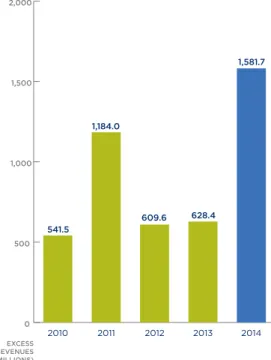
Operating expenses in FY 2014 increased by 11.8 percent to $143.6 million, up from $128.4 million in FY 2013, while total expenses were 9.41 percent of total revenues in FY 2014, down from 10.48 percent in FY 2013. Ginnie Mae had higher excess revenues over expenses (net profit) of $1.5 billion for FY 2014, versus $628.4 million for FY 2013 (see Figure 2-3), were driven by an increase in additional program revenues.
Table 2 presents the expenses related to Ginnie Mae programs and contractors during the past five years. Although issuance volume has increased, related expenses have been well managed over this time frame. Credit-related expenses include Ginnie Mae’s provision for loss and defaulted Issuer portfolio costs. Ginnie Mae completes an MBS loss liability analysis on an annual basis. Based on this analysis in FY 2014, Ginnie Mae recognized a $228.8 million reduction in total provisions for losses. This contrasts with a $422.7 million increase in total provisions for losses in FY 2013, which resulted in an increase in net profit for FY 2014. Ginnie Mae had no Issuer defaults with extinguishments in FY 2014.
tABle 2: pRoGRAM/ContRACtoR expenSeS FYS 2010 to 2014
2014 2013 2012 2011 2010
Central Paying Agent $34.2 $29.0 $11.3 $9.7 $10.4 Contract Compliance $0.6 $0.6 $1.3 $0.9 $0.9
federal reserve $6.0 $6.0 $5.2 $4.5 $4.8 financial Support $2.6 $2.9 $1.7 $4.9 $1.8 IT related & Miscellaneous $26.2 $15.1 $3.9 $7.6 $8.0 MBS Information Systems & Compliance $27.1 $31.4 $21.4 $17.2 $19.2
Multiclass $13.5 $11.6 $11.2 $21.2 $17.5 Multifamily Program $0.6 $2.7 $5.8 $5.1 $7.7 Servicemembers Civil relief Act $0.8 $.09 $1.1 $1.7 $2.3
total $111.6 $99.4 $62.9 $72.8 $72.6
FiGuRe 2-3: exCeSS oF ReVenueS oVeR expenSeS FYS 2010 to 2014 EXCESS REVENUES ($ MILLIONS) 0 500 1,000 1,500 2,000 2014 2013 2012 2011 2010 609.6 628.4 1,581.7 1,184.0 541.5 (In Millions)
FiGuRe 2-4: RelAtiVe MARket SHARe oF Ginnie MAe And GSe SeCuRitieS
Calendar YearS 2010 through 2014
0 200 400 600 800 1,000 2014* 2013 2012 2011 2010 MBS ISSUANCE *as of September 30, 2014 ($ BILLIONS) n Ginnie Mae $383.6 $301.7 $394.4 $312.5 $212.7 n Fannie Mae $629.7 $551.0 $827.9 $622.3 $267.1 n Freddie Mac $387.0 $301.8 $439.7 $357.3 $187.1 n non-agency $59.9 $27.6 $13.1 $25.4 $23.8
FiGuRe 2-6: Ginnie MAe-SuppoRted unitS oF HouSinG FYS 2010 to 2014
UNITS OF HOUSING (THOUSANDS) 2014 2013 2012 2011 2010 2,500 2,000 1,500 1,000
FiGuRe 2-5: Ginnie MAe MoRtGAGe-BACked SeCuRitieS iSSuAnCe FYS 2010 to 2014
MBS ($ BILLIONS) 0 100 200 300 400 500 2014 2013 2012 2011 2010 388.0 460.4 302.1 350.4 413.0
MBS issuance and portfolio Growth
Ginnie Mae MBS issuance decreased by 34.4 percent to $302.1 billion in FY 2014, as shown in Figure 2-5. The current MBS guarantees outstanding amount is $1.5 trillion, which is a $69.4 billion increase over the amount at the end of FY 2013. The increase in the portfolio also has changed its character, as evidenced in the average age of the loans. Approximately 14.7 percent
of the $5.2 trillion in MBS guaranteed by Ginnie Mae since its inception has been issued in the past two years. As shown in Figure 2-6, Ginnie Mae supported approximately 1.6 million units of housing for individuals and families in FY 2014, a 22 percent decrease from FY 2013.
Single Family Program
The vast majority of the mortgages in Ginnie Mae securities are insured by FHA and VA loans. FHA-insured mortgages accounted for 58.3 percent of loans in Ginnie Mae pools, while VA-guaranteed loans accounted for 34.7 percent in FY 2014; RD and PIH loans made up the remainder. Although other agencies and private Issuers may pool FHA-insured loans for non-guaranteed MBS or hold in portfolio as whole loans, almost all of these loans make their way into Ginnie Mae securities. In FY 2014, 99.2 percent of FHA fixed-rate loans and 96.7 percent of VA fixed-rate loans were placed into Ginnie Mae pools. In FY 2014, 20.6 percent of single family Ginnie Mae pools received a discounted guaranty fee for the inclusion of a high percentage of loans originated in economically depressed markets.
Although loans underlying its securities may be concentrated in specific areas, Ginnie Mae has provided homeownership opportunities in every U.S. state and territory. Figure 2-7 highlights the geographic distribution of single family properties securing Ginnie Mae securities as of September 30, 2014.
Multifamily Program
At the end of FY 2014, Ginnie Mae guaranteed securities that contained 99.1 percent of eligible multifamily FHA loans. The Multifamily Program portfolio increased by $8.1 billion, from $79.8 billion at the end of FY 2013 to $87.9 billion at the end of FY 2014, marking the 20th year of consecutive growth.
Figure 2-8 shows the geographic distribution of multifamily properties securing Ginnie Mae securities as of September 30, 2014. Since 1971, Ginnie Mae has guaranteed $218.7 billion in multifamily MBS, helping finance affordable and community-stabilizing multifamily housing developments and health care facilities across the nation. In addition, Ginnie Mae’s portfolio of multifamily RD loans grew in FY 2014 to an outstanding principal balance of $617 million at fiscal year-end. These loans are guaranteed through the RD office. The number of multifamily RD programs became more diverse in FY 2014 than in previous years, as new Issuers entered the program.
HMBS Program
FHA-insured reverse mortgages are the only loan types that qualify for Ginnie Mae’s HMBS program. FHA initiated several changes during 2014 to improve the health of its insurance program, which contributed to a decline in year-over-year HMBS issuance volume.
Ginnie mae
has provided
homeownership
opportunities
in every u.s.
state and
territory.
FiGuRe 2-7: GeoGRApHiC diStRiBution oF SinGle FAMilY pRopeRtieS SeCuRinG Ginnie MAe
SeCuRitieSAS of SePTeMBeR 30, 2014
FiGuRe 2-8: GeoGRApHiC diStRiBution oF MultiFAMilY pRopeRtieS SeCuRinG Ginnie MAe
SeCuRitieS AS of SePTeMBeR 30, 2014
StAte loAnS oF totAl peRCent loAnS ReMAininG pRinCipAl BAlAnCe (MillionS) Tx 949,752 10.35% $115,524 CA 686,641 7.48% $160,618 fL 537,182 5.85% $75,143 GA 394,745 4.30% $51,671 oH 364,235 3.97% $41,018 nC 345,290 3.76% $46,803 VA 339,369 3.70% $73,188 PA 314,658 3.43% $43,502 IL 288,735 3.15% $40,044 nY 271,723 2.96% $48,465 top 10 states 4,492,330 48.95% $695,976
n FeweR tHAn 100,000 loAnS ■ 100,000-149,999 loAnS
n 150,000-200,000 loAnS n MoRe tHAn 200,000 loAnS
n FeweR tHAn 100 loAnS n 100-199 loAnS
n 200-299 loAnS n 300-399 loAnS
n 400 oR MoRe loAnS
StAte loAnS oF totAl peRCent loAnS ReMAininG pRinCipAl BAlAnCe (MillionS) oH 902 7.38% $3,669 Tx 867 7.10% $7,201 CA 834 6.83% $6,234 IL 653 5.34% $5,232 In 625 5.11% $3,131 MI 545 4.46% $3,306 nY 508 4.16% $7,137 fL 440 3.60% $3,920 nC 429 3.51% $2,785 Mn 405 3.31% $3,035 top 10 states 6,208 50.80% $45,650
HMBS issuance volume in FY 2014 was $7.1 billion, a decrease of $2.1 billion from FY 2013. The outstanding principal balance of HMBS as of FY 2014 was $48.9 billion, compared with $44.6 billion in FY 2013.
There were 22 H-REMIC transactions in FY 2014, totaling $4.1 billion in issuance, compared with 32 transactions totaling $6.4 billion in FY 2013. The structure and support that Ginnie Mae has brought to this market has increased its liquidity, which translates into better execution on the securities and, ultimately, lower costs for the growing population of senior citizens.
Manufactured Housing Program
Three Issuers are currently approved to issue MH securities under Ginnie Mae’s MH program since its relaunch in June 2010. The MH program’s remaining principal balance was $279.2 million at the end of FY 2014, compared with $284.9 million in FY 2013.
liquidity and Capital Adequacy
Ginnie Mae’s primary sources of cash are MBS and multiclass guaranty fee income, and commitment fee income. After accounting for expenses and other factors, on September 30, 2014, Ginnie Mae reported approximately $13.5 billion in funds with the U.S. Treasury, compared with $9.6 billion on September 30, 2013.
Ginnie Mae’s MBS guaranty activities operate at no cost to the U.S. government. Ginnie Mae operates at a profit, which reduces the U.S. government’s budget deficit. Ginnie Mae’s net income continues to build its capital base, and management believes the organization maintains adequate capital reserves to withstand downturns in the housing market that could cause Issuer defaults to increase.
Ginnie mae’s mBs guaranty activities
FiGuRe 2-9: RetAined eARninGS FYS 2010 to 2014 CAPITAL RESERVES ($ MILLIONS) 0 5,000 10,000 15,000 20,000 2014 2013 2012 2011 2010 16,371 16,999 18,581 15,762 14,578
As of September 30, 2014, the investment of the U.S. government (GAAP-based retained earnings) was $18.6 billion, compared with $17 billion as of September 30, 2013. Figure 2-9 shows Ginnie Mae’s capital reserves for each of the past five years.
Risk Management and Systems of internal Controls
Ginnie Mae reviews and manages an internal controls framework for the organization, including internal controls assessments in accordance with OMB Circular A-123, Appendix A, and other internal controls and risk management activities. The audits, reviews, and monitoring of all Issuers and major contractors that Ginnie Mae conducts enable Ginnie Mae to strengthen its internal controls and minimize risks that would negatively impact financial and operating results.
Finally, Ginnie Mae is undertaking a complete and thorough top-to-bottom assessment of all its internal controls and financial reporting, including the reliability of financial reporting and financial management systems, in accordance with the requirements of OMB Circular A-123, Appendix A. Safeguarding assets is a subset of all of these objectives. Internal controls should be designed to provide reasonable assurance regarding prevention or prompt detection of unauthorized acquisition, use, or disposition of assets.
Audit Report
of Ginnie Mae’s
FY 2014 and
FY 2013 Financial
Statements
February 27, 2015
To: Theodore Tozer, President Government National Mortgage Association, T
From: Thomas R. McEnanly, Director, Financial Audits Division, GAF
Subject: Audit of the Government National Mortgage Association’s Financial Statements for Fiscal Years 2014 and 2013
Attached is the U.S. Department of Housing and Urban Development (HUD), Office of Inspector General’s (OIG) final results of our audit of the Government National Mortgage Association’s fiscal year 2014 financial statements.
HUD Handbook 2000.06, REV-4, sets specific timeframes for management decisions on recommended corrective actions. For each recommendation without a management decision, please respond and provide status reports in accordance with the HUD Handbook. Please furnish us copies of any correspondence or directives issued because of the audit.
The Inspector General Act, Title 5 United States Code, section 8M, requires that OIG post its publicly available reports on the OIG Web site. Accordingly, this report will be posted at http://www.hudoig.gov.
If you have any questions or comments about this report, please do not hesitate to call me at 202-402-8216.
Government National Mortgage
Association,Washington, DC
Fiscal Years 2014 and 2013 Financial Statements Audit
Office of Audit, Financial Audits Division
Washington, DC
Audit Report Number: 2015-FO-0003
February 27, 2015
3
Table of Contents
Independent Auditor’s Report... 4
Material Weaknesses ...
10 Finding 1: Material Asset Balances Related to Nonpooled Loans Were NotAuditable ... 10 Finding 2: Ginnie Mae’s Internal Control Over Financial Reporting Had
Weaknesses ... 14 Finding 3: The Mortgage-Backed Security Loss Liability Account Balance Was Unreliable... 20 Finding 4: Financial Management Governance Issues Contributed to Ginnie Mae’s Inability to Produce Auditable Financial Statements... 26