Vol.2, No.1, March 2013, pp. 11~22
ISSN: 2089-3191 11
ANFIS and BPNN based Expression Recognition using
HFGA for Feature Extraction
S.P. Khandait, R.C. Thool, P.D. Khandait
KDKCE, RTMNU, Nagpur, Maharashtra, SGGSIET, Nanded, Maharashtra, India e-mail: [email protected]
Abstract
The area of human-computer interaction (HCI) will be much more effective if a computer is able to recognize emotional state of human being. Emotional states have a greater effect on the face which can tell about mood of a person. So if we can recognize facial expressions, we will know something about the human’s emotions and mood. This paper focuses on the use of novel Hybrid Facial Geometry Algorithm (HFGA) for facial feature extraction and its use to classify facial expressions. Feed forward back propagation neural network (BPNN) and Adaptive Neuro-Fuzzy Inference System (ANFIS) are used as classifiers for expression classification and recognition. Experimentations are carried out using Japanese Female Facial Expression (JAFFE) database. Experimental results shows that average recognition efficiency from 95.33% to 93.33% is achieved for 30 to 75 test samples using BPNN and 95.71% to 95.33% with ANFIS approach.
Keywords: HCI, BPNN, HFGA, Facial features, Expression recognition, ANFIS
1. Introduction
An Intelligent Biometrics systems aims at localizing and detecting human faces from supplied images so that further recognition of persons and their facial expression recognition will be easy. Mehrabian [1] pointed out that 7% of human communication information is communicated by linguistic language (verbal part), 38% by paralanguage (vocal part) and 55% by facial expression. Therefore facial expressions are the most important information for emotions perception in face to face communication.
In recent years, much research has been done on machine recognition of human facial expressions [2-5]. In last few years, use of computers for facial expression and emotion recognition and its related information use in HCI have gained significant research interest which in turn given rise to a number of automatic methods to recognize facial expressions in images or video [6-10]. A more recent, complete and detailed overview can be found in [11-13]. Accuracy of facial expression recognition is mainly based on accurate extraction of facial feature components. Facial features are located and extracted using approaches like SUSAN algorithm [14], selective feature rules [15], PCA and wavelet [16-19], EICA, FLDA, ICA [17], LBP [20]. Jun Ou et al., [16] used manually extracted 28 facial feature points located on face and the gabor filter were applied on these regions to get the facial features.KNN is used as classifier and achieved 80% recognition efficiency. Hong Bo Deng et al., [3] used hybrid approach for extracting facial features. They located facial feature points manually on eyes, nose and mouth. Also they used rectangular face model of fixed size. Anitha C. et al., [21] used manually extracted eight distance parameters which were used to classify six facial expressions excluding neutral one. Kulkarni et al., [22] used manually extracted real valued and binary parameters to get transient and intransient feature information which then be given to committee neural network for classifying expressions and achieved 90.43% recognition accuracy. Z. Zhang [23] used manually extracted Geometric positions of set of fiducial points and multiscale & multi orientation Gabor wavelet coefficient for feature extraction and neural network for expression classification and achieved 92.3 % recognition efficiency. Many researchers used PDM/ASM like model based approaches for feature extraction. But these approaches were suffering from the fact that manual labor is necessary to construct shape models [12] and are time consuming since manual intervention is required. From the survey, it is observed that various approaches
have been used to detect facial features [24] and classified as holistic and feature based methods to extract facial feature from images or video sequences of faces. These are geometry based, appearance based, template based and skin color segmentation based approaches. Thus manually pointing the positions of feature point for feature extraction, manual constructions of model in ASM/PDM techniques, recognition of few of the facial expressions instead of recognizing all seven facial expressions and recognition efficiency are the major issues to be considered as far as existing facial expression recognition systems are concerned.
In our previous paper [25], novel geometry based approach with SUSAN operator and morphological operations were used to extract facial feature segments. The purpose of this research is to develop novel hybrid facial feature extraction i.e Hybrid modified Facial Geometry Algorithm (HFGA) approach for extracting facial features and classifying facial expressions into different groups based on the geometric value of facial features. This algorithm is an extension of Geometry based feature extraction method explained in [25] and is fully automatic i.e there is no need of model initialization or feature point initialization like fiducial points. Here one can show the features located graphically with the help of bounding box. Hence, the proposed facial expression recognition system aimed to use image preprocessing and HFGA techniques for feature extraction and BPNN and ANFIS model for expression recognition for the frontal view face images.
2. Novel HFGA for Facial Feature Extraction
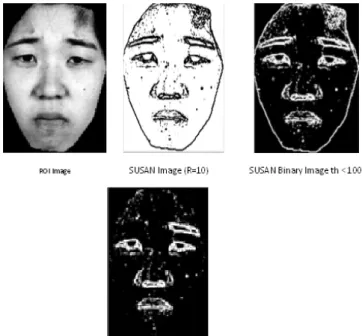
Our Facial Geometry algorithm explained in [25] localizes six feature segments properly for 175 images out of 200 supplied preprocessed images. Mis-localization of facial feature segment is because of the fact that if we apply SUSAN algorithm to get edge detected image and then apply morphological operations we do not get some feature segments if that segment touches the face boundary (Figure 1). Novel Hybrid Facial Geometry Algorithm (HFGA) is an extension of facial geometry method explained in [25] which is slightly modified with some additions in techniques. Also feature vector set is enhanced considering normalized features.
Figure 1. Mis-localization of right Eyebrow segment using Novel FGA method
Following Steps are used to localize six feature segments in HFGA method:
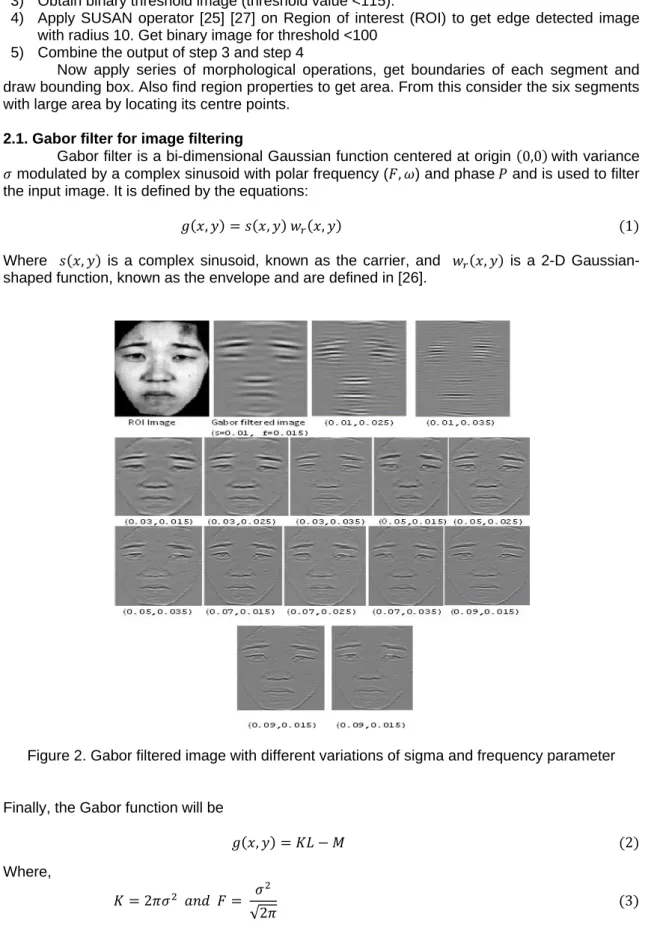
2) Apply Gabor filter [26] for image filtering and get real part which contains approximately 10000 elements with pixel value in the range 0-255. Certain threshold (127.5) is considered for range adjustment so as to visualize the image properly. (Standard deviation i.e. sigma=0.05, polar frequency (F =0.025, w=0, p=0).
3) Obtain binary threshold image (threshold value <115).
4) Apply SUSAN operator [25] [27] on Region of interest (ROI) to get edge detected image with radius 10. Get binary image for threshold <100
5) Combine the output of step 3 and step 4
Now apply series of morphological operations, get boundaries of each segment and draw bounding box. Also find region properties to get area. From this consider the six segments with large area by locating its centre points.
2.1. Gabor filter for image filtering
Gabor filter is a bi-dimensional Gaussian function centered at origin 0,0 with variance modulated by a complex sinusoid with polar frequency ( , ) and phase and is used to filter the input image. It is defined by the equations:
, , , 1
Where , is a complex sinusoid, known as the carrier, and , is a 2-D Gaussian-shaped function, known as the envelope and are defined in [26].
Figure 2. Gabor filtered image with different variations of sigma and frequency parameter
Finally, the Gabor function will be
, 2
Where,
2
exp 2 4
5
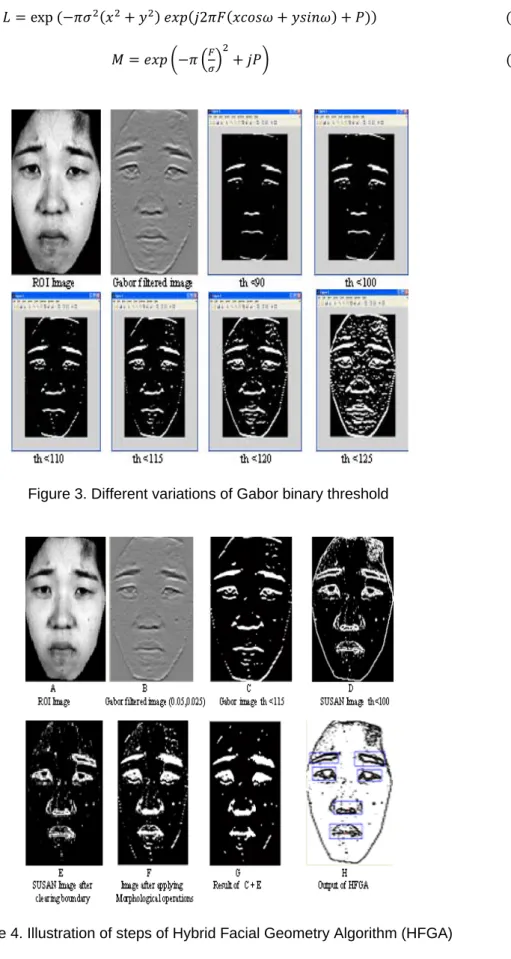
Figure 3. Different variations of Gabor binary threshold
Figure 4. Illustration of steps of Hybrid Facial Geometry Algorithm (HFGA)
Values of sigma and frequency are chosen by trial and error method. Figure 2 shows different variations of sigma and frequency parameter for Gabor filtered image for one of the JAFFE
image. For small value of sigma(s=0.01) and polar frequency in the range 0.015-0.035, image appears as blurred image from which it is difficult to obtain detail information about feature segments. Figure 3 shows different variations of Gabor binary threshold. Figure 4 shows the illustration of steps of Hybrid Facial Geometry Algorithm (HFGA). Here note that the image whose six feature segments were not located using novel FGA method (Figure 1) are located using HFGA approach (Figure 4).
2.2. Formation of Modified Feature Vector
Application of algorithmic steps mentioned in section 3 results into 36 values ,6 for each feature segment as (x1,y1,w,h,x2,y2) where (x1,y1) is the coordinates of top left corner of the bounding box (feature segment) ,(x2,y2) is the coordinate of centre of facial feature segment (bounding box) and w and h is the width and height of feature segment respectively (Figure 5). For extracting the facial feature segments, facial geometry shown in Figure 6 is used. Figure 7 shows the Feature segments Located on the cropped face; features F and F shown on it are useful for normalizing the feature values. In order to model the variations in facial expression, a feature vector is derived from these 36 facial feature values. In addition to fifteen feature vector values considered in novel facial geometry method [25] which were not normalized, some additional parameters are also added along with 15 normalized values. Thus total twenty-one parameters are used to form feature vector (Figure 8).
Figure 5. Six feature values Figure 6. Facial Geometry for extracting facial feature segments
Thus
, , , … … … , , 6
Where,
= Height of Left Eyebrow, = Width of Left Eyebrow = Height of Right Eyebrow, = Width of Right Eyebrow = Height of Left Eye, = Width of Left Eye = Height of Right Eye, = Width of Right Eye = Height of Nose, = Width of Nose
= Height of Mouth, = Width of Mouth = Horizontal distance between Centre of Left Eyebrow and centre of Right Eyebrow = Horizontal distance between Centre of Left Eye and centre of Right Eye
= Vertical distance between Centre of Nose and Centre of Mouth
= Vertical distance between Centre of Left Eyebrow and centre of Left Eye = Vertical distance between Centre of right Eyebrow and centre of right Eye
= Vertical distance between Centre of right Eyebrow and left Eyebrow and centre of Nose = Vertical distance between Centre of right Eyebrow and left Eyebrow and centre of mouth = Vertical distance between Centre of right Eye and left Eye and centre of Nose
= Vertical distance between Centre of right Eye and left Eye and centre of mouth. Distance is obtained by using Euclidian distance formula-
7
All the feature vector values are normalized by using and feature vector such as
⁄ , ⁄ 8
Thus all the height features (vertical values) are normalized using vertical distance between centre of left and right eye and centre of mouth ( ) and all width features (horizontal values) are normalized using the horizontal distance between centre of left eye and right eye ( ). Feature is normalized using height of image and feature is normalized using width of image. All the normalized feature vector values are given as input to the classifiers for training.
3. Methodology
3.1. Novel Image preprocessing, face area segmentation and localization
Images required for experimentation are obtained from JAFFE [28] database available online.
Image preprocessing and required face portion is obtained using following steps:
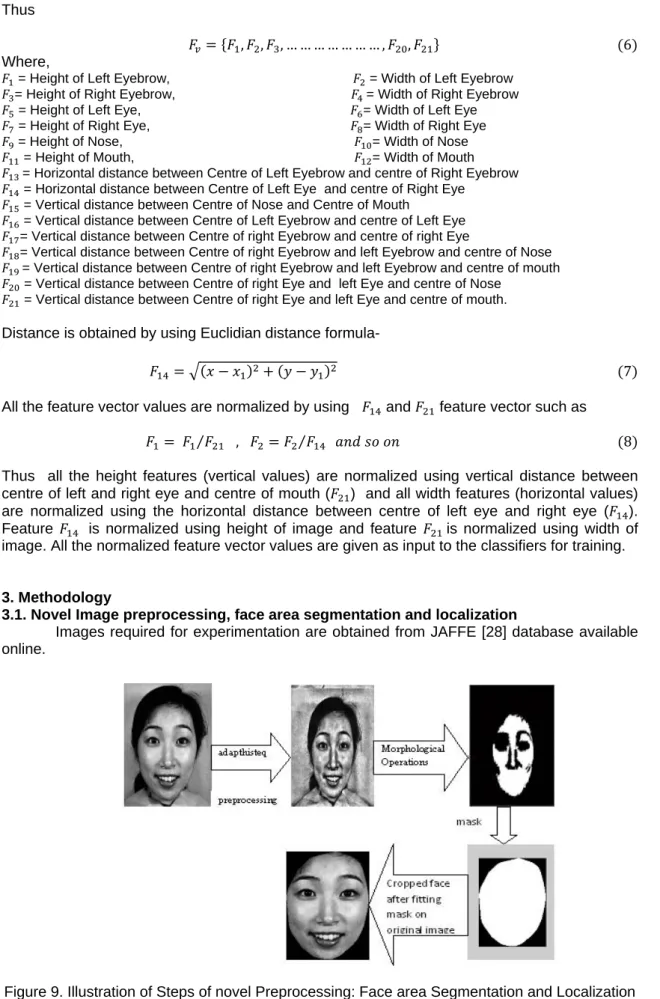
1. Preprocess the image by applying contrast limited adaptive histogram equalization operation to adjust Intensity /contrast of an image [32].
2. Apply sequence of morphological operations [29] like dilation, erosion, opening, closing, reconstruction, boundary extraction, region properties, etc to get the required face portion called mask.
3. Fit this mask area on the original image and crop the required portion i.e. normalized face portion called region of interest (ROI).
Figure 9 shows Illustration of Steps of novel Preprocessing, Face area Segmentation and Localization. Feature values are obtained using novel HFGA method explained in section 2. 3.2. Back propagation Neural Network (BPNN) for expression recognition
BPNN is widely used NN algorithm than other algorithms due to its simplicity and universal approximation capacity [30]. It uses supervised learning where input along with the target is given as input and gradient descent method to minimize the error Figure 10 shows architecture of BPNN model.
Figure 10. Architecture of BPNN
Figure 11. GUI for recognition of facial Expression Figure12. Performance plot of HFGA-BPNN w1 1 ∑ ∑ ∑ ∑ ∑ ∑ ∑ w1,2 f1 O1 O2 On O fn b b b wn,1 i1 i2 … in w n,2
Twenty-one feature values obtained using novel HFGA method are given as an input to the model. BPNN model with different number of neurons for two hidden layers along with variation in transfer function is tried. BPNN Model with two hidden layers having 7 and 15 neurons each and an output layer achieved better efficiency. Transfer function used at both the hidden layer is tansig, and at output layer is linear. During training phase, model is trained for different number of samples (159, 146, 134, and 114) and achieved 100% classification accuracy. During testing phase, trained model is used to test for different number of unseen samples (30, 43, 55, and 75) and achieved average recognition efficiency from 95.33% to 93.33%. Figure11 shows GUI for recognition of facial expression using novel HFGA-BPNN method. Performance plot of HFGA-BPNN model (Figure 12) shows that the network learns gradually and reaches towards the goal.
3.2. Adaptive Neuro Fuzzy Inference System (ANFIS) for expression recognition
Back propagation neural network has limitations like very long training process, with problems such as local minima and network paralysis[30] therefore another model of classification and recognition i.e. Hybrid model is used. ANFIS proposed by Jang [31] are a class of adaptive networks that are functionally equivalent to fuzzy inference systems. Initial FIS Structure is generated using grid partitioning method. Twenty-one feature values obtained using novel HFGA method are given as an input to the ANFIS model. In this approach, feature vector data is partitioned into seven groups with three inputs each. Seven ANFIS models are constructed which takes three inputs each. Three Gaussian bell membership functions are associated with each input in order to model the variation of input values (small, medium and large), so the input space is partitioned into fuzzy subspaces. In all 27 rules are generated for an ANFIS model. The premise part of a rule describes a fuzzy subspace, while the consequent part specifies the output with in this fuzzy subspace. Figure 13 shows the architecture of ANFIS approach which is formulated for n=3 inputs, 3 membership functions giving rise to seven models. Output of layer 5 of each model is given as input to maximum occurrence finder (Figure 14) which finds the maximum occurrence value of particular expression. For example, output of any four models is angry, one model give neutral and remaining two models give fear expression as output then maximum occurrence finder give angry expression as output due to maximum occurrence of angry expression. During training phase, ANFIS model is trained for different number of samples (159, 146, 134, and 114) and achieved 100% average classification accuracy. Figure15 shows performance plot of HFGA-ANFIS model. Here network learns gradually and reaches towards the goal. During testing phase, trained ANFIS model is used to test for different number of unseen samples (30, 43, 55, and 75) and achieved average recognition efficiency from 95.71% to 95.33 %. Figure16 shows GUI for recognition of facial expression using novel HFGA-ANFIS method.
Figure 15. Performance plot of HFGA-ANFIS Figure 16. GUI for HFGA-ANFIS approach
4. Result and Discussion
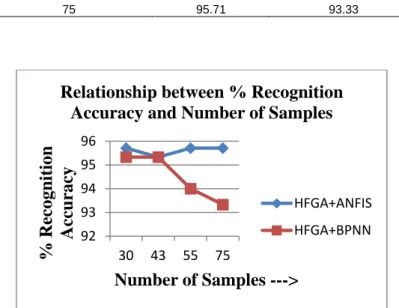
Total 210 images from JAFFE database were given as input to novel face preprocessing, segmentation and localization algorithm (section 4.1) which extracts required face portion for 200 images giving 95.24 % success rate which is promising. These 200 images are given as input to novel Hybrid Facial Geometry Algorithm (HFGA) which localizes six feature segments properly for 189 samples out of 200 samples resulting into 94.5% feature extraction efficiency .Table 1 shows result obtained as a Confusion matrix for testing dataset with novel HFGA-BPNN based Facial Expression recognition. Model gives 93.33 % average recognition efficiency for 75 samples obtained from JAFFE database. Table 2 shows result obtained as a Confusion matrix for testing dataset with novel HFGA-ANFIS based Facial Expression recognition .Here model gives 95.71% average recognition accuracy for 75 test samples obtained from JAFFE database. Table 3 shows comparison of % average recognition efficiency for novel HFGA-BPNN and HFGA-ANFIS approach. Figure 17 shows Plot of % recognition accuracy of two approaches for different number of test samples.
Table 1. Confusion matrix for test dataset with HFGA-BPNN based Expression recognition.
Expression Angry Disgust Fear Happy Neutral Sad Surprise Accuracy Rate
Angry 8 0 0 0 0 2 0 80.00 Disgust 0 9 1 0 0 0 0 90.00 Fear 0 0 9 0 0 1 0 90.00 Happy 0 0 0 10 0 0 0 100.00 Neutral 0 0 1 0 14 0 0 93.33 Sad 0 0 0 0 0 10 0 100.00 Surprise 0 0 0 0 0 0 10 100.00
Average recognition accuracy 93.33
Table 2. Confusion matrix for testdataset with HFGA-ANFIS based Expression recognition
Expression Angry Disgust Fear Happy Neutral Sad Surprise Accuracy Rate
Angry 9 0 0 0 0 1 0 90.00 Disgust 0 9 1 0 0 0 0 90.00 Fear 0 0 9 0 0 1 0 90.00 Happy 0 0 0 10 0 0 0 100.00 Neutral 0 0 0 0 15 0 0 100.00 Sad 0 0 0 0 0 10 0 100.00 Surprise 0 0 0 0 0 0 10 100.00
Table 3. % average recognition accuracy for novel HFGA-BPNN and HFGA-ANFIS approach
Figure 17. Plot showing % recognition accuracy of two approaches.
5. Conclusion and Future Scope
Novel Hybrid Facial Geometry Algorithm (HFGA) is designed for facial feature segment localization and extraction. 200 samples from JAFFE database were given as input to this algorithm which localizes six feature segments properly for 189 samples resulting into 94.5% feature extraction efficiency with significant improvement of 7.0% for localization of six facial feature segments over our previous algorithm explained in [26] which localizes six feature segments properly for 175 samples out of 200 samples resulting into 87.5% extraction success rate. Normalized feature vector (21 values) are then obtained from 36 values thus reducing feature dimensions and hence reduction in memory requirement. Extracted feature vector values are given as input to BPNN and ANFIS classifier. Lowest % Recognition accuracy (93.33 %) was achieved using novel HFGA-BPNN approach for 75 testing samples from JAFFE database. Table 4 presents the % recognition accuracy of facial expression which appears in literature and our approach. In future an attempt can be made to develop a method which can recognize expressions for real time images and recognition accuracy can be further improved using hybrid approach or other classifiers like SVM. Thus an attempt can also be made for recognition of other database images or images captured from camera.
Table 4 % recognition accuracy in literature and our method
Authors No. of subjects Used Images Tested % accuracy
Kobayashi and Hara[22] 15 90 85
Zhang[12] 10 213 90.1
Lyons et. al.[22] 10 193 92
Sebe et. al.[22] - - 85-95
Kulkarni SS et. al.[22] 62 282 90.4
Chang JY,Chen JL [33] 08 38 92.1(for 3 expressions)
Our Method 10 30-75 95.71-93.33
Acknowledgements
Authors like to express appreciation to the producer of JAFFE image Database by the Psychology Department in Kyushu University.
92 93 94 95 96 30 43 55 75
%
Recognition
Accuracy
Number of Samples --->
Relationship between % Recognition
Accuracy and Number of Samples
HFGA+ANFIS HFGA+BPNN Number of Samples
% Average Recognition accuracy
HFGA+ ANFIS HFGA+ BPNN
30 95.71 95.33
43 95.33 95.33
55 95.71 94.00
References
[1] Mehrabian A, 1968, Communication without Words , Psychology Today, Vo1.2, No.4, pp 53-56. [2] Daw-tung lin. , Facial Expression Classification Using PCA and Hierarchical Radial Basis Function
Network, in Journal of Information Science and Engineering, Vol. 22, pp 1033-1046, 2006
[3] Hong-Bo Deng, Lian-Wen Jin, Li-Xin Zhen, Jian-Cheng Huang,. A New Facial Expression Recognition Method Based on Local Gabor Filter Bank and PCA plus LDA , International Journal of Information Technology Vol. 11 No. 11, 2005,pp. 86-96.
[4] Limin Ma, David Chelberg and Mehmet Clelenk , Spatio-Temporal Modeling of Facial Expressions using Gabor-Wavelets and Hierarchical Hidden Markaov Models, the Proc.of ICIP 2005, pp-57-60, 2005.
[5] Pantic.M. and Ioannis Patras , Dynamics of Facial Expression: Recognition of Facial Actions and Their Temporal Segments from Face Profile Image Sequences, IEEE transactions on Systems, Man, and Cybernetics—Part B: cybernetics, vol. 36, no. 2, 2006.
[6] Ruicong Zhi, Qiuqi Ruan , A Comparative Study on Region-Based Moments for Facial Expression Recognition, in Congress on Image and Signal Processing, Vol. 2, pp.600-604, 2008.
[7] Irene Kotsia, Ioannis Pitas, Facial Expression Recognition in Image Sequences Using Geometric Deformation Features and Support Vector Machines, IEEE Transactions on Image Processing 16(1): pp. 172-187, 2007.
[8] Kakumanu.P., Nikolaos G. Bourbakis, A Local-Global Graph Approach for Facial Expression recognition , ICTAI, pp 685-692,2006.
[9] Aleksic. P.S., Aggelos K. Katsaggelos. Automatic facial expression recognition using facial animation parameters and multistream HMMs, IEEE Transactions on Information Forensics and Security 1(1): pp. 3-11,2006.
[10] Spiros Ioannou, George Caridakis, Kostas Karpouzis, and Stefanos Kollias, Robust Feature Detection for Facial Expression Recognition, EURASIP Journal on Image and Video Processing, vol. 2007, Article ID 29081, 2007.
[11] Pantic.M and L. J. M. Rothkrantz , Automatic analysis of facial expressions: the state of the art, IEEE Trans. on PAMI, vol. 22, no. 12,pp. 1424-1445, 2000
[12] B. Fasel and J. Luettin , Automatic facial expression analysis: A survey , Pattern Recognition, vol. 36, pp. 259-275, 2003.
[13] Vinay Kumar Bettadapura, Face Expression Recognition and Analysis: The State of the Art, pp.1-27 [14] Hua Gu Guangda Su Cheng Du , Feature Points Extraction from Faces , Image and Vision Computing
NZ, Palmerston North, November 2003 , pp.154-158
[15] Gengtao Zhou, Yongzhao Zhan, Jianming Zhang, Facial Expression Recognition Based on Selective Feature Extraction, Proceedings of the sixth International Conference on Intelligent System Design
and Applications (ISDA’06) 2006 pp.412 - 417IEEE
[16] Jun Ou, Xiao-Bo Bai, Yun Pei, Liang Ma, Wei Liu, Automatic facial expression recognition using gabor filter and expression analysis , 2010 Second International Conference on Computer Modeling and Simulation , 2010 IEEE, pp 215-218
[17] Md. Zia Uddin, J. J. Lee, and Y. –S. Kim, An enhanced independent component-based human facial expression recognition from video , IEEE Transactions on Consumer Electronics, Vol 55, No. 4. November 2009, pp. 2216-2224.
[18] G. R. S. Murthy, R. S. Jadon , Effectiveness of Eigenspaces for facial expression recognition, International Journal of Computer Theory and Engineering Vol. 1, No. 5, December 2009 ,1793-8201, pp. 638-642
[19] Nectarios Rose , Facial Expression Classification using Gabor and Log-Gabor Filters, Proceedings of
the 7th International Conference on Automatic Face and Gesture Recognition (FGR’06) IEEE
computer society,pp.346 – 350
[20] V.Gomathi, Dr. K. Ramar, and A. Santhiyaku Jeevakumar, A Neuro fuzzy approach for facial expression recognition using LBP Histograms , International Journal of Computer Theory and Engineering, Vol 2, No. 2 ,April 2010, 1793-8201, pp 245-249.
[21] Anitha C. ,M. K. Venkatesha, B. Suryanarayana Adiga, Distance parameter based facial expression recognition using neural networks, Journal of Computing ,vol.2,issue 7, July-2010 , ISSN 2151-9617,pp. 158-161
[22] S.S. Kulkarni, Reddy NP, Hariharan SI, Facial Expression (Mood) recognition from facial images using Committee Neural Networks, Biomedical Engineering online 2009,8:16
[23] Z. Zhang, M. Lyons, M. Schuster, S. Akamatsu, Comparison between Geometry Based and Gabor Wavelets-Based Facial Expression Recognition Using Multi-Layer Perceptron, Proceedings of International Conference on Automatic Face and Gesture Recognition, 454-459, 1998.
[24] S.P. Khandait, P.D. Khandait and Dr.R.C.Thool, An Efficient approach to Facial Feature Detection for Expression Recognition, International Journal of Recent Trends in Engineering, Vol .2, No. 1, November 2009,PP. 179-182
[25] S.P.Khandait, Dr. R.C.Thool, P.D.Khandait , Automatic Facial Feature Extraction and Expression Recognition based on Neural Network , International Journal of Advanced Computer Science and
Applications,Vol. 2, No.1, January 2011, pp. 113-118.
[26] Movellan,J.R., Tutorial on Gabor Filters,Tech. Rep. , 2002
[27] S.M. Smith, J.M. Brady , SUSAN-A New Approach to Low Level Image Processing, International Journal of Computer Vision 23(1), 45-78(1997)
[28] JAFFE dataset, http://www.kasrl.org/jaffe.html
[29] Rafael C. Gonzalez, and Richard E. Woods, Digital Image Processing, 2nd edition, Prentice Hall, 2002
[30] HAYKIN , S., Neural Networks: A Comprehensive Foundation , Prentice Hall, Upper Saddle River,
NJ,1999.
[31] Jang. J.S.R., ANFIS: Adaptive Network based Fuzzy Inference System , IEEE Transaction on Systems Man and Cybernetics, May 1993
[32] Zuiderveld, Karel. Contrast Limited Adaptive Histogram Equalization. Graphic Gems IV. San Diego:
Academic Press Professional, 1994. 474–485.
[33] Chang J.Y, Chen J.L , Automated Facial Expression Recognition System Using Neural Networks, Journal of Chinese Institute of Engineers. vol. 24,No. 3 , pp. 345-356(2001)