DEVELOPING SAENS: DEVELOPMENT AND VALIDATION OF A STUDENT ACADEMIC ENGAGEMENT SCALE (SAENS)
by
DISHA DEEPAK RUPAYANA B.A., Pune University, 2002
M.A., Devi Ahilya Vishwavidhyalaya, 2004 M.S., Kansas State University, 2008
AN ABSTRACT OF A DISSERTATION
submitted in partial fulfillment of the requirements for the degree DOCTOR OF PHILOSOPHY
Department of Psychology College of Arts and Sciences
KANSAS STATE UNIVERSITY Manhattan, Kansas
Abstract
Student engagement has become an important way of assessing student outcomes for college and is used to provide information to accreditation agencies, for internal accountability as well as to assess impact of college on students. However, current measures of student engagement do not assess the core process underlying student engagement, instead focusing on antecedents and consequences of engagement. The current research addressed this gap by first developing a new measure of student engagement called SAENS (Student Academic ENgagement Scale), which is strongly grounded in theory derived from the work engagement literature. Two dimensions of engagement were found: enjoyment and effort. A second study validated this measure by
forming a nomological net of relationships with other variables and testing these antecedents and consequences of engagement. Results indicated that engagement effort is strongly related to student grades for their classes and the dimension of enjoyment is related to the teaching style of collaborative learning. However, engagement was not related to students’ levels of critical thinking.
DEVELOPING SAENS: DEVELOPMENT AND VALIDATION OF A STUDENT ACADEMIC ENGAGEMENT SCALE (SAENS)
by
DISHA DEEPAK RUPAYANA B.A., Pune University, 2002
M.A., Devi Ahilya Vishwavidhyalaya, 2004 M.S., Kansas State University, 2008
A DISSERTATION
submitted in partial fulfillment of the requirements for the degree DOCTOR OF PHILOSOPHY
Department of Psychology College of Arts and Sciences
KANSAS STATE UNIVERSITY Manhattan, Kansas
2010
Approved by: Major Professor Dr Clive Fullagar
Abstract
Student engagement has become an important way of assessing student outcomes for college and is used to provide information to accreditation agencies, for internal accountability as well as to assess impact of college on students. However, current measures of student
engagement do not assess the core process underlying student engagement, instead focusing on antecedents and consequences of engagement. The current research addressed this gap by first developing a new measure of student engagement called SAENS (Student Academic
ENgagement Scale), which is strongly grounded in theory derived from the work engagement literature. Two dimensions of engagement were found: enjoyment and effort. A second study validated this measure by forming a nomological net of relationships with other variables and testing these antecedents and consequences of engagement. Results indicated that engagement effort is strongly related to student grades for their classes and the dimension of enjoyment is related to the teaching style of collaborative learning. However, engagement was not related to students’ levels of critical thinking.
Table of Contents
List of Figures ... vii
List of Tables ... viii
Acknowledgements ... ix
CHAPTER 1 - General Introduction... 1
Student Engagement ... 5
CHAPTER 2 - Developing a New Measure of Student Engagement ... 13
Positive Psychology ... 14 Engagement... 15 Job Satisfaction ... 18 Commitment ... 18 Job Involvement ... 19 Flow ... 20
CHAPTER 3 - Scale Development Method ... 25
Step 1: Item Development ... 25
Step 2: Questionnaire Administration ... 26
Participants and Procedure ... 26
Step 3: Item Reduction ... 27
Step 4: Scale Evaluation ... 28
Step 5: Replication ... 28
CHAPTER 4 - Scale Development Results ... 29
Descriptive Statistics ... 31
Factor Analysis Results... 31
Replication. ... 36
CHAPTER 5 - Scale Development Discussion ... 39
Factor Structure ... 40
Theoretical Implications ... 42
Practical Implications... 43
Conclusion and Directions for future research ... 45
CHAPTER 6 - Study 2: Validation Study ... 47
The Nomological Context of Student Engagement ... 47
Outcomes of Engagement ... 56
CHAPTER 7 - Study 2: Method ... 59
Participants and Procedure ... 59
Measures Used ... 60
Procedure ... 63
Analysis... 64
CHAPTER 8 - Study 2: Results ... 66
Descriptive Statistics ... 67
Hypothesized Findings... 69
CHAPTER 9 - Study 2: Discussion ... 76
Predictors of Engagement: ... 76
Consequences of Engagement ... 79
Theoretical Implications ... 83
Practical Implications... 86
Limitations ... 88
Directions for future research ... 88
Conclusions ... 89
References ... 91
Appendix A - Instructions read to students (2008) or on the online form (2009) ... 101
Appendix B - Sample CAAP Item (from the ACT website) ... 102
Sample Items for Passage 1 ... 103
List of Figures
List of Tables
Table 3.1 Gender Breakdown by class for Fall 2008... 27
Table 4.1 Means(M), Standard Deviations(SD), and Correlations for the Initial 16 Items ... 30
Table 4.2 Initial Factor Analysis, Factor loadings and Communalities ... 32
Table 4.3: Pattern Matrix Loadings and Communalities for Oblique Factor Analysis ... 34
Table 4.4: Confirmatory Factor Analysis Results... 35
Table 4.5: Cronbach’s Alpha Reliability Statistics for Enjoyment ... 36
Table 4.6: Cronbach’s Alpha Reliability Statistics for Effort ... 36
Table 4.7: Confirmatory Factor Analysis for the Replication Sample ... 37
Table 4.8: Means (M), Standard Deviations(SD), and Correlations for the Replication Sample . 38 Table 7.1: Demographics, Breakdown of Gender by Class for Fall 2009 ... 60
Table 7.2: IDEA scores means (M), Standard Deviations (SD) and Reliabilities (α) Across Classes. ... 62
Table 8.1: Means (M), Standard Deviations (SD) and Correlations for Variables in Study 2 ... 67
Table 8.2: Means(M), Standard Deviations(SD) and Correlations for the SAENS and NSSE Items ... 68
Table 8.3: ANOVA Comparing Effect of Gender on Engagement ... 69
Table 8.4: ANOVA Comparing Effect of First Generation to Go To College on Effort and Enjoyment ... 69
Table 8.5: Parameter Estimates and Variance Components of Null Models Tested ... 70
Table 8.6: Parameter Estimates and Variance Components of Substantive HLM Model Testing the Relationships for Effort and IDEA Teaching Styles ... 71
Table 8.7: Parameter Estimates and Variance Components of Substantive HLM Model Testing the Relationships for Enjoyment and IDEA Teaching Styles ... 72
Table 8.8: Hierarchical Regression Predicting Grades from the SAENS ... 73
Acknowledgements
Getting my PhD has been an incredible journey, which has taken me from Indore, MP, India to Pune, MH, India to Manhattan, KS, US. Along this journey, there have been many people who have believed in me, supported me and sometimes pushed, kicked, dragged or carried me to this point. Thank you all.
Nothing would have been possible without my parents: my father, Deepak Rupayana and my mother, Dr Yeshomati Rupayana. Their unwavering belief in me and my abilities continues to astound me at every step of the way. Thanks goes to my extended family as well, for never pressuring me into doing anything and for supporting every endeavor.
Journeys of this magnitude are only possible when someone gives you an opportunity. I have been given many opportunities and I am grateful for those who thought I could reach this point. My advisor, Dr Fullagar, for inviting me to KSU. Thank you for introducing me to flow, the theory and the experience, supporting me, and letting me trip at certain points, it was all for the best. Dr Downey, thank you for your belief in me, for giving me opportunities I didn’t think would come my way, and for being my mentor. I would also like to extend my gratitude to my other committee members, Dr Saucier, Dr Procter, and Dr Gwinner for their support, feedback and the lively academic discourse.
Along the way, I have met many fellow travelers and others who cheered from the sidelines. Thank you my friends, for being sounding boards, rocks to lean on, ears to whine to, soothers of cases of extreme worry, prodders for cases of extreme procrastination and excellent cheerleaders. You all know who you are. You have made this journey fun, exciting, and a trip of a lifetime. Even though our paths may separate now, postcards of our adventures will always find their way to each other.
CHAPTER 1 - General Introduction
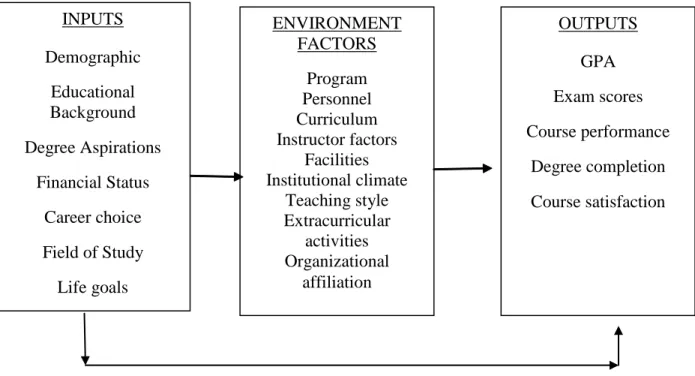
Attending college is thought to be an important developmental phase of an individual’s life. College attendance has a far reaching effect on an individual’s life and causes a person to grow and change. Even though growth and change does take place in the form of maturation, whether an individual chooses to attend college or doesn’t, the type of change that takes place is different when college becomes a part of the picture (Astin, 1993). College has been found to impact several factors including individuals’ critical thinking, attitudes, values and moral development (Pascarella & Terenzini, 2005). College also affects career choices, quality of life as well as economic status of college attendees (Pascarella & Terenzini, 2005). However, the extent to which college impacts students is determined by multiple factors. Students bring certain characteristics to college, some of which are modified, and others stay the same through college (inputs), such as demographic characteristics, family background as well as their
academic and social experiences. These inputs affect what students get out of college (Outputs). All of these outputs are moderated by several factors. Some of these are the college social and academic environment, and include institutional characteristics such as size, diversity, faculty student ratios, students’ interaction with faculty, interaction with other students, policies as well as student effort and engagement (Astin, 1984). The most important of these is student
engagement. For example Astin (1984) believes that “students learn by becoming involved” (Astin, 1984, p. 133) . Pascarella & Terrenzini (2005) in their influential book “How College Impacts Students” assert “…because individual effort and involvement are the critical determinants of college impact, institutions should focus on the ways they can shape their academic, interpersonal, and extracurricular offerings to encourage student engagement” (In Kuh, 2009, p 5).
Research on college student development shows that the time and energy students devote to educational activities is the single best predictor of their learning and personal development (Kuh, 2001; Astin, 1993; Pascarella & Terenzini, 2005; Pace, 1980). Student engagement has been found to be strongly related to several important college outcomes. Kuh (2003) asserts that more students study a subject, the more they learn. Also the more time they invest in practice and get feedback on their writing, analyzing or problem solving, the more adept they become. More
engaged students develop lifelong habits of learning and development. Engaged students also have higher psychological as well as physical well being (Steele & Fullagar, 2008). Students who are more engaged experience “flow”, a concept of complete involvement in activities, and thereby invest more effort into their work (Rupayana, 2008). Students’ academic engagement has also been found to influence decisions to persist in college, with highly engaged students being more likely to persist through college and reach completion (Pascarella & Terenzini, 2005). Academic involvement has also been found to be strongly related to students’ development of career related competencies (Davis & Murrell, 1993). Higher academic engagement also indicates higher gains in knowledge and cognitive growth as well as increased autonomy and intellectual orientation.
Due to this positive impact of engagement on students, an increasing amount of attention is being given to college students’ engagement at college, its outcomes and precursors, as well as categorizing colleges on the basis of engagement they engender in students (Carini, Kuh, & Klein, 2006). The most popular measure of student engagement is the National Survey of Student Engagement (NSSE) which is increasingly being used to measure and assess student engagement as well as for external accountability and accreditation processes that are important issues for universities (Hu & Kuh, 2002).
Accountability and accreditations are important processes for higher education
institutions for a number of reasons. Firstly, higher education is dependent on external sources which control important resources, such as accreditators, legislators, alumni, prospective students and parents. As a result of this, higher education institutions are accountable to these external sources and have to provide information about organizational performance for continued availability of resources. Secondly, assessment results have to be reported in the interest of transparency (McCormick, 2009). In a report of the Education Commission “A Test of
Leadership” on the Future of Higher Education (called the Spelling commission) that discusses accountability, A Test of Leadership (Commission of Higher Education, 2006), asserts that colleges and universities must become more transparent about cost, price and student success outcomes and be willing to share this information”. Bennet (2007) cites five norms that guide public disclosures. The first is that colleges and universities have a professional obligation to disclose information that is relevant to students making decisions about college. Secondly, information should be disclosed according to published professional standards and have validity,
reliability and audit-ability. Third, it should include information about student learning. Fourthly, it should represent student experiences, and lastly it should contain information on price of college attendance.
Apart from external accountability, there is another type of accountability, reflective accountability, which is not coerced by external resources, but is based on the mission of the institution. Assessment provides a way for the institution to measure whether they are meeting their mission objectives or not (McCormick, 2009). As mentioned earlier, student engagement mediates the impact college has on students, and has therefore become an important way of assessing institutions, providing accountability to external sources as well as reflective accountability (McCormick, 2009).
Accrediting agencies, even though they are an accountability system, have focused more on peer review rather than public reporting. Their initial goals included demonstrating that the institution satisfies minimum capacity and infrastructure. Now these goals have shifted towards the institutional plans for assessment and improvement of educational effectiveness. Even though public disclosure, as expected by the Spelling Commission (Commission of Higher Education, 2006), is different from internal dialogues about effectiveness, and accreditation approval (Burke, 2005), engagement is considered to be one of the ways of assessing and satisfying all these requirements. Due to increasing pressure for accountability and in order to satisfy accreditation agencies requirements, more and more universities have started reporting student engagement data (Kuh, 2009).
Whether the purpose is reflective accountability or external accountability, a good assessment tool should meet certain criteria. McCormick (2009) points out that to improve institutional performance through assessment the first necessary condition is a focus toward objective performance information, which should be gathered using appropriate assessment tools. Improvement can only take place by defining essential performance information and using the results from these assessments. Secondly, the assessment tool that is used should provide relevant and useful data. Therefore, before assessment, it should be ascertained that the
assessment tool is grounded in theory about the topic of interest. It should provide information about factors that are controllable and can be changed. The tool should also meet validity and reliability standards. The data from the assessment should support comparison of institutions in
terms of performance, past performance as well as intra-institutional analysis by supporting subunits such as colleges, subpopulations etc.
The above criteria are applicable not just to institution’s internal assessment for reflective accountability, but also for external accountability. By using well established assessment tools for these purposes, an institution indicates its interest, attention as well as commitment towards important outcomes’ assessment and improvement. As discussed earlier, student engagement and overall student involvement has been found to affect students’ success at college ( (Pascarella & Terenzini, 2005), and engagement has become a way of assessing institutional effectiveness for both reflective and external accountability.
Many instruments are available for assessing student engagement, such as the College Student Experience Questionnaire (CSEQ; Pace, 1980) and Cooperative Institutional Research Program's Entering Student Survey and the College Senior Survey (Astin, 1993). These
instruments were mainly designed for research rather than assessing accountability and
effectiveness. More recently, The National Survey of Student Engagement (NSSE) has emerged as a popular method for assessing student engagement. Kuh (2009) cites that the purpose for the NSSE was to provide high quality, actionable data that can be used by institutions to improve the undergraduate experience. Over the past decade NSSE has gone from being used by 140 schools to being used by more than 700 institutes in 2008 (Kuh, 2009).
The NSSE is used as an indicator of college performance and other accountability functions. Second, it is used to document effective educational practices in postsecondary education. Its third and final use is as an empirically derived measure of collegiate quality intended for use by the public (Kuh, 2009). To this purpose the NSSE collects information in 5 areas. First it assesses participation in educationally purposeful activities. Second, it determines institutional requirements in academic arenas such as reading requirements and nature of coursework. The third set of indicators assess students’ perceptions of the college environment associated with achievement, satisfaction and persistence. Fourthly, the NSSE collects
information about student's background such as age, gender, socioeconomic status. Last, NSSE assesses students’ perceptions of learning, by asking students about their growth in the areas of general knowledge, intellectual skills, communication skills and vocational preparation. Based on these assessment clusters, certain benchmarks have been established to expedite and simplify comparisons of institutions. These are academic challenge, active and collaborative learning,
student faculty interaction, enriching educational experiences and supportive campus environment (Kuh, 2009).
The NSSE has recently also been used for providing consumer information. The US News & World Report and its America's Best Colleges report have added NSSE results from institutions that agreed to the inclusion of their engagement data (McCormick, 2009). As of May 2008 about 400 institutions have agreed to participate in the USA Today program (McCormick, 2009).Therefore the NSSE solves the multiple purposes of providing accountability through public reporting of institutional quality, also providing a way for institutions to assess themselves in terms of meeting their student learning outcomes, and lastly providing accreditation agencies a way of assessing institutional focus on effectiveness.
However, as can be seen from the above descriptions, NSSE is a measure of overall student involvement with the college experience and how it impacts their learning. It is not a measure of the processes underlying student engagement and does not assess actual engagement but the result of this engagement, which is involvement in college. The question then remains as to what is student engagement, what are the dimensions of student engagement in the classroom and how students become academically engaged. The next section addresses the issue of student engagement and how it is defined and studied.
Student Engagement
The premise of engagement has been in the literature for a very long time, with a constantly evolving definition and meaning. The first mentions of student engagement can be found in the 1940's, Tyler (1949) demonstrated that time spent on the task has a positive effect on students' learning. According to Tyler (1949), “Learning takes place through the active behavior of the student; it is what he does that he learns, not what the teacher does (p. 63).” Effort is the common factor between all the conceptualizations of student engagement and it is still a central part of the concept of student engagement. The most current definition of student engagement by NSSE defines student engagement as the “quality of effort and involvement in productive learning activities” (Kuh, 2009; pg 9). The evolution of this definition and the NSSE measure are described next
This concept of effort is further elaborated by Pace (1980), who developed the College Student Experiences Questionnaire (CSEQ; Pace 1980) based upon the concept of quality of
effort. He asserted that quality of effort determines the experience students get from college and by measuring the effort we can judge the quality of the educational process. The CSEQ was the first measure of its kind, which was used to assess higher education institutes as well as assess student outcomes and shift responsibility of student achievement toward student engagement rather than institutional issues (Pace, 1984). In this measure, effort was measured as the frequency of students’ use of the major resources and opportunities for learning and personal growth provided by the college. He included measures of use of facilities such as classroom, library, science, cultural facilities, student union, athletic and recreation facilities as well as residence facilities. The other types of activities included in the measure were social experiences, faculty and peer interaction, as well as the extent of conversations with other people. Quality of effort was defined as the extent of influence of these resources on learning or personal growth. Items ranged from low quality and low effort to high quality and high effort and were weighted by time invested in these activities. The main aim of this scale was research and it contributed to the area of assessment of learning outcomes. Pace (1984) found that "… the more aspects of college experience one participates in at above an average level of quality of effort, the more... above average progress is made towards educational goals. Breadth of involvement and breadth of attainment go hand in hand" (Pace, 1984, pg 75). This measure has been used extensively to assess higher education institutes as well as study differential outcomes of college for students and the impact of the college environment on learning (Pascarella & Terenzini, 2005). However, certain questions remain about this measure. Astin (1984) asks, to what extent can high quality involvement compensate for lack of quantity and what are the causes of low quality involvement. Astin also poses the question as to whether time expended is expended wisely or is it just
inefficient time waste on the part of the student? These methodological questions with the CSEQ rendered it problematic for use with large inter university comparisons and it never gained the same level of popularity as the NSSE.
Another similar definition of engagement was responsible for making the study of student engagement popular (Kuh, 2009). Astin(1984) suggested that students learn by becoming
involved. Involvement is used by Astin (1984) to denote engagement. He suggests that learning takes place due to the time spent on a task, as well as by investing energy into the task. Based on this, there are five basic postulates of student involvement. The first is that involvement requires the investment of psychological and physical energy; secondly different students will invest
varying amounts of energy in different things. Thirdly, involvement has both quantitative and qualitative features. Fourthly the amount of learning is directly proportional to the quality and quantity of involvement. Lastly, the educational effectiveness of any institutional policy or practice is related to its capacity to induce student involvement. Student effort thus determines the overall impact of college (Astin, 1993).
This theory resulted in the Cooperative Institutional Research Program (CIRP; Astin, 1993) and Astin (1984) specifies different forms of involvement which have been found to impact different aspects of college students. On campus residence as a form of engagement was found to impact persistence, seeking further degrees as well as higher involvement in on-campus extracurricular activities. Another area of involvement is honors programs which affect student satisfaction, and faculty student interactions. Academic involvement here is defined as a complex set of traits and behaviors such as extent of working hard at studies, hours of studying and
interest in their courses. Other forms of involvement are athletic involvement and involvement in student government. This theory of student involvement was explored by Astin (1993) using the CIRP longitudinally over the college career of UCLA students. However, this was intended for research purposes to study impact of college on students and never became a popular method for studying student engagement across universities or even for comparing engaged student with other disengaged ones.
Another student outcome model that has influenced the area of student engagement to a great extent and also contributed to the development of the NSSE measure (Kuh, 2009) is the Chickering & Gamson’s (1987) seven categories of effective educational practices. These practices were intended to improve undergraduate education. First is improving student-faculty contact which increases student likelihood of graduation and encourages thinking about future plans. The second practice is of cooperation among students as working together to improve student involvement in learning. Thirdly, students learn better by writing and applying subject matter to their lives, so effective practice would have to include active learning. Prompt feedback is the fourth effective practice; assessment and feedback are importance determinants of
improving performance. The fifth effective practice is time on task. Students need to learn to spend time effectively and the more time that is spent on tasks the more students learn. “Time plus energy equals learning” (Chickering & Gamson, 1987; pg 3). Communicating high expectations is the sixth effective practice and this acts as a self fulfilling prophecy in that
students tend to do better when expected to do well. Lastly, effective practice should include respect for diverse talents and ways of learning. This is important because students bring
different talents and styles of learning to college, and letting them learn in their diverse ways can help them perform better. Thus all these seven categories influence student learning and the quality of their educational experiences (Kuh et al., 2004) and form the base of the national Survey of Student Engagement (NSSE; Kuh, 2009).
The NSSE began as a way of shifting away from college rankings as a way of expressing collegiate quality. College rankings emphasize institutional resources and reputation. What was needed was evidence of student learning and effective educational practice. Thus began the National Survey of Student Engagement, which was developed using the above mentioned CSEQ and the CIRP. About 2/3 of the first NSSE was derived from the CSEQ (Kuh, 2009). The NSSE has now become one of the most popular methods of institutional assessment with more than 700 higher education institutes using it in 2008 and is often thought of as "institutional research in a box" (Kuh, 2009).
Overall, the NSSE has three purposes. First is to provide data that can be used by institutions to improve the undergraduate experience. The engagement measure acts as process indicators that can be used to improve student and institutional performance (Kuh, 2009). The second purpose of the NSSE is to document effective educational practices in post secondary settings. Thirdly NSSE advocates for public acceptance and use of empirically derived conceptions of collegiate quality (Kuh, 2009).
To fulfill these purposes the NSSE is divided into 5 benchmarks and a number of subscales. The NSSE collects information about students' background, including age, gender, ethnicity, living situations, major as well as educational status. They assess student engagement by asking students to report the frequency with which they engage in activities that represent good educational practices, for example use of resources, curricular programs, and opportunities for learning and development as well as the effort they expend for classes (Kuh, 2001). The benchmarks are based on forty two key questions from the NSSE that focus on many of the important student experiences during college.
The first benchmark is academic challenge, which taps into the Chickering & Gamson's (1987) effective practice of setting high expectations. If students are challenged academically they perform better. This benchmark includes questions on preparing for class, number of
assigned textbooks, number of written papers or reports, nature of coursework and emphasis of campus environment on academic work and study time.
The second benchmark is active and collaborative learning. Again a part of the
Chickering & Gamson’s (1987) effective practices. Students learn more when they are intensely involved through active learning and collaborating with others helps with mastering difficult material and also helps in solving problems in real life. Questions in this benchmark include asking questions in class, working with other students, working on community based projects, and discussing ideas from classes outside of class (Kuh, 2001).
The third benchmark is student faculty interaction, where students are posited to learn better by interacting with faculty members inside and outside the classroom. Questions include extent of communication with faculty in terms of grades, discussing career plans, discussing class readings outside of class, working with faculty on non class related activities and receiving feedback from faculty.
The fourth benchmark is enriching educational experiences, which deals with activities outside of class. Questions on this benchmark include topics such as participation in
co-curricular activities, internship or practicum experiences, community service or volunteer work as well as questions related to technology and diversity experiences.
The final benchmark of the NSSE is supportive college environment. Students perform better and are more satisfied at colleges that provide positive social and working environments. This benchmark includes questions on campus environment as well as quality of relationships with peers, faculty and administrative personnel (Kuh, 2001).
The above benchmarks are used by schools to estimate the efficacy of their improvement efforts. Banta, Pike & Hansen (2009) specify the different ways in which NSSE is used by higher education institutes. The first step for universities is to set goals for student learning and
engagement. The next step is deciding which assessments accurately measure these goals. These include direct assessments in the form of exams and research papers and indirect assessment through the NSSE. The scalelets and benchmarks of NSSE provide these assessments, such as communication skills, critical thinking, integration and application of knowledge, intellectual depth, breadth and adaptiveness as well as an understanding of society and culture. Based on the results of these assessments, institutions modify programs and create new ones. New goals and strategic planning is also an outcome of NSSE results. NSSE data is also used by institutions in
their accreditation process to show that the university is meeting its educational objectives. Accountability reports also include NSSE results to show that the university is meeting goals related to access, retention and graduation, student learning and campus environments (Banta et al, 2009). NSSE has also been used as a method for comparing across colleges. Pike (2003) also found that NSSE benchmarks and US news college ranking are not strongly related to each other, indicating that college reputation and resources are not an indicator of student engagement, while the NSSE is a good indicator of overall student involvement in college.
Thus the NSSE is used for a variety of purposes that cater to multiple assessment issues that universities face, such as accountability, accreditation as well as internal assessment and planning. NSSE provides them with data to help assess whether educational effectiveness goals as well as student outcomes are being fulfilled or not. However, NSSE, even though it is thought of as a measure of student engagement, it is not a measure of the same. It is a measure of overall college involvement and includes academic as well as extracurricular involvement of students during their college years (Kuh, 2009). Kuh (2003, 2009) asserts that NSSE is a measure of student outcomes as well as effective educational practices. Engaged students are an outcome of effective educational practices. Thus the NSSE measures outcomes and antecedents of student engagement and does not assess the underlying psychological aspects of what is meant by an academically engaged student. This becomes clearer on examination of the NSSE benchmarks. The first benchmark is academic challenge. Challenge has been found to be a precursor of engagement. When students’ challenges balance the skills they have, they experience “flow” which is a form of engagement (Rupayana, 2008; Shernoff, Csikzentmihalyi & Shernoff, 2003). Thus the NSSE is measuring a precursor of engagement with this benchmark rather than
engagement itself. The second and third benchmarks are collaborative learning and faculty student interaction. Both assert “students learn better when intensely involved due to
collaborative and active learning as well as more interaction with faculty” (Kuh, 2009, pg 6). This again indicates that collaborative learning and faculty interaction set up the stage for an academically involved student. However they do not measure student engagement directly. The fourth and fifth benchmarks are involvement with activities outside of class and supportive college environment respectively, direct attention towards overall college involvement rather than academic engagement.
Other NSSE questions assess how much time and effort students put into academic activities. Effort is an outcome of engaged students. If a student is disengaged he/she is less likely to put effort into an activity. Previous research supports this finding (Rupayana, 2008). At the same time, by using effort and time spent as a measure of student engagement, brings to mind Astin’s (1984) criticism of the Pace (1984) CSEQ. Astin (1984) poses the question, whether time expended is expended wisely or is it just inefficient time waste on part of the student. Is time spent an indicator of engagement or the process by which students become engaged.
Thus, even though NSSE serves several higher education assessment issues admirably, it cannot be called a measure of student engagement. It is too broad in scope and is more of a survey of student experiences rather than a theoretical explanation of student engagement. Such a broad reference makes it impractical for developing action plans aimed at enhancing student engagement. Due to it’s atheoretical nature, NSSE is unable to explain any of the differences that occur between students. Such as why student background is a predictor of NSSE benchmarks (Pike, 2003) and also why effort and time does not always explain gains in student learning (Kuh, 2009). NSSE also does not have a sound conceptual basis and confuses processes of engagement with its outcomes and antecedents. NSSE can serve to assess student outcomes as well as students’ overall engagement in college, however it cannot explain student engagement in the classroom and in academic activities or the processes underlying it. At the same time, there are other areas, such as work engagement, that have been explored extensively and many
theories of work engagement exist which can shed some light on student engagement in the classroom and its underlying processes. These theories have produced diverse conceptualizations and assessments of engagement but have not been used to develop a comprehensive
understanding of student engagement. Use of these theoretical foundations will lead to a better understanding and operational definition of student engagement.
The current study utilized some of the literature from work engagement and its related processes to develop a measure of student engagement and to assess some of the outcomes and antecedents underlying the process of student engagement. By so doing I formalized the definition of students’ academic engagement and standardized its measurement. Secondly, it made it possible to test higher order models regarding mechanisms for increasing engagement
and the process by which it generates positive outcomes. Last, this allowed for advancement of the literature and application of theory aimed towards increasing student engagement.
CHAPTER 2 - Developing a New Measure of Student Engagement
The concept of engagement has been a part of psychology for a long time in different forms especially in the area of work related behavior. Organizations consider engagement to be an important aspect of a productive workforce. Engagement in the workplace and with the work itself has been found to be related to critical work outcomes such as performance (Harter, Schmidt, & Hayes, 2002), lower stress (Salanova, Bakker & Llorens, 2006; Britt, Castro & Adler, 2005) and increased commitment toward work and the organization (Schaufeli & Bakker, 2004). Due to the positive impact of engagement on the workforce, engagement has been studied extensively in the industrial organizational psychology literature. Not unlike student engagement, workplace engagement has gone through a process of evolution with different conceptualizations and definitions of engagement over time. Due to this evolution process as well as the increasing amount of attention being paid to engagement, the characteristics of work that engage workers have emerged much more clearly than in the area of student engagement. Therefore workplace engagement can contribute to assessing student engagement and the characteristics that cause students to be engaged in their work.Factors of engagement that apply to workers are applicable to students as well. Research has shown that students share many characteristics of workers and being a college student can be conceptualized as a job (Cotton, Dollard, & DeJonge, 2002). Like workers, students work in hierarchical structures, they have defined job task for which they have variable levels of control and support from outside. Students are also required to meet deadlines, and progress is dependent on performance. One major goal of university work is attainment of qualifications through performance, so even though students do not get paid for their performance, performance results in a secondary important outcome of obtaining qualifications. Therefore student work is similar to work in organizations. This has also been corroborated by the use of workplace engagement measures to assess student engagement and its outcomes (Schaufeli, Salanova, Gonzalez-Roma, & Bakker, 2002). Engagement has been found to impact outcomes such as student performance, well being, and student satisfaction (Steele & Fullagar 2008; Schaufeli et al., 2002). From this research it is evident that student engagement is similar to workplace engagement and students have been used to study engagement outcomes important to the workplace. However, most of this research uses engagement items modified for use with students and not developed
specifically for use with student populations. This necessitates the development of a measure of engagement expressly directed at students.
Hinkin (1995) describes a process of scale development where development goes through several stages, including item generation, scale construction, reliability and validity before a scale is ready for use. The first step is item generation where the focus is on content validity, that is, the extent to which the measure assesses the domain of interest. Item generation can take place in an inductive or deductive manner. An inductive process has very little theory involved and is based on participants’ responses. On the other hand, a deductive process of item generation indicates that a typology is developed before data is collected which ensures that the measure is strongly grounded in theory. Hinkin (1998; pg 968) says “This approach requires an understanding of the phenomenon to be investigated and a thorough review of the literature to develop the theoretical definition of the construct under examination. The definition is then used as a guide for the development of items”. A deductive process will be used in this case due to the large amount of literature that exists on engagement. Additionally engagement is a part of
positive organizational behavior constructs, some of which have strong overlaps with engagement. Facets of these constructs are relevant to students and can be utilized in the theoretical underpinnings of student engagement. These definitions of engagement and the associated constructs are discussed next in a context of positive psychology.
Positive Psychology
The concept of engagement belongs to a set of positive psychology constructs,
specifically to positive organizational behavior. Seligman & Csikszentmihalyi (2000) in a special issue of the American Psychologist stated "the purpose of positive psychology is to "...begin to catalyze a change in the focus of psychology from preoccupation only with repairing the worst things in life to also building positive qualities” (p.5). Different levels of analysis for positive psychology include the subjective level comprising of constructs such as well being, contentment with the past, flow, happiness, hope and optimism. Second, the individual level consists of traits such as capacity for love, courage, talent, and wisdom. Lastly, the macro level comprises of characteristics such as positive civic virtues, altruism, strong work ethic etc. These levels of positive psychology have been applied to the workplace in the form of positive organizational behavior (Luthans, 2002).
Positive psychology in the workplace is defined as “the study and application of
positively oriented human resource strengths and psychological capacities that can be measured, developed and effectively managed for performance improvement in today's workplace."
(Luthans, 2002, p 175). Criteria for a positive organizational constructs include measurability, state like, as well as changeability of this state to manage and optimize performance in the workplace. Work engagement is a part of this set of positive organizational behaviors at the subjective individual level of positive psychology which include other variables such as job satisfaction, flow, organizational commitment, job involvement and vigor. All these are job attitudes and have been found to have a certain amount of shared variance. Research on job satisfaction, involvement, engagement, vigor, and positive organizational support shows that they are distinct and do contribute uniquely to the area of job attitudes and impact performance and productivity of an organization (Steele, Rupayana, Mills, Smith, Wefald, & Downey, 2010; Halleberg & Schaufeli, 2006). Other research contradicts this view, asserting that job satisfaction and engagement measures do not contribute uniquely to the study of organizational variables (Wefald & Downey, 2009). At the same time engagement is often measured as a combination of satisfaction, commitment, and involvement (Newman & Harrison, 2008). To design a new measure of engagement, it is important to assess the way engagement is defined and measured as well as its overlap with other variables which can contribute to the current measure. This is done next.
Engagement
Although engagement is a work-based concept and has been found to be related to important outcomes in the workplace, it still lacks a common definition and operationalization (Kahn, 1990; Harter, et al., 2002; Saks, 2006; Shirom, 2003). Kahn (1990) was the first to study engagement and proposed that engagement is comprised of three components, namely physical, cognitive, and emotional. Kahn studied students as well as architects for his 1990 ethnographic study of engagement. For engagement to occur, the situation has to involve meaningfulness, safety, and availability. Meaningfulness is a function of work elements such as the nature of the task, roles played by the person etc. Safety is created by the social systems such as group and inter-group dynamics, and interpersonal relationships. For safety these systems need to have predictability, consistency, and should be non-threatening. The last criterion of engagement is availability. Availability is the sense of possessing emotional, physical and psychological
resources necessary for investing in the work. In an empirical study based on Kahn (1990) work, May, Gibson,& Harter (2004) found that meaningfulness, safety, and availability enhance engagement in the workplace and concluded that engagement has three components, physical, emotional and cognitive.
After the Kahn (1990) work, Maslach and colleagues (Maslach & Leiter, 1997; Maslach, Schaufeli, & Leiter, 2001) proposed that engagement is the positive antipode of burnout.
Burnout has characteristics of exhaustion, cynicism and lack of professional efficacy. If engagement is lack of burnout then engagement is characterized by energy, involvement, and efficacy. However, research has not upheld this view of engagement. Lack of efficacy develops separately from exhaustion and cynicism, also exhaustion and cynicism may deal with external factors such as resource availability and may not have anything to do with the task itself (Schaufeli & Salanova, 2007), while engagement is focused on the work itself.
Due to this (Schaufeli, Salanova, Gonzalez-Roma, & Bakker, 2002) proposed a somewhat different conceptualization of engagement. They described engagement as a “persistent and pervasive affective cognitive state not focused on any particular object, event, individual or behavior”. Schaufeli and his colleagues also proposed that engagement is a
multidimensional construct. However, their dimensions varied from those offered by Maslach & Leiter (1997), as engagement was no longer seen to be the opposite ends of a
burnout-engagement continuum. The most widely used definition of burnout-engagement defines it as a, “positive, fulfilling, work related state of mind that is characterized by vigor, dedication and absorption” (Schaufeli, et al., 2002). Schaufeli and colleagues hold the prevailing view that engagement consists of three dimensions; vigor, dedication and absorption. Work vigor is characterized by high levels of energy and mental resilience, the willingness to invest effort in one's work, and persistence even in the face of difficulties. Dedication is characterized by a sense of significance, enthusiasm, inspiration, pride and challenge in one’s work. Lastly, absorption is characterized by being fully concentrated and deeply engrossed in one's work, whereby time passes quickly and one has difficulties detaching oneself from work (Schaufeli, et al., 2002). This is the most widely used definition and conceptualization of engagement in the work literature and forms the basis for the most commonly used measure of engagement, the Utrecht Work Engagement Survey (UWES, Schaufeli et al, 2002). A recent metaanalysis in the area reported that the UWES has been used for a variety of samples such as students, managers,
executives, entrepreneurs, farmers, blue collar workers, police officers and home care staff (Christian & Slaughter, 2007). However, UWES is often criticized for being atheoritical and as having considerable overlap with other measures and measures of related job attitudes (Shirom, 2003; Newman & Harrison, 2008) and its three dimensions have very strong correlations and often do not separate out as different dimensions.
A new construct that has been increasingly highlighted as an alternative measure of workplace engagement is workplace vigor (Shirom, 2003). According to Shirom (2003), vigor aims to merge positive psychology with workplace affect to capture the interplay of worker well-being and organizational effectiveness in the organizational context. Pulling from other theories including Kahn’s (1990) Engagement Theory, Shirom emphasizes the importance of cognitive, physical, and emotional energy expressed in the work environment. Cognitive liveliness deals with mental agility, cognitive awareness, and one’s feeling of flow in thought. Physical abilities and physical strength are the second key component. Finally, emotional energy refers to the interpersonal expressions of sympathy, empathy, and emotional sustenance. Thus, when physical, emotional, and cognitive resources are properly allocated, the corresponding result is an increased expression of workplace energy toward the fulfillment of organizational outcomes. Overall, vigor is seen as a better measure of engagement, with Shirom (2003) asserting that vigor is more grounded in theory and has less overlap with preexisting constructs than the Schaufeli et al. (2002) definition of engagement. However, the confirmation of vigor adding incremental validity beyond engagement and other similar constructs has not been realized.
Thus there are varying definitions of engagement and how it is measured. At the same time, engagement in the workplace belongs to a set constructs that are often thought of as overlapping to the extent that it has been proposed that there is just one single construct that manifests itself in different forms (Newman & Harrsion, 2008). Recent research on workplace engagement by academic and organizational research has done little to squelch the arguments of those who argued that workplace engagement is essentially, ‘old wine in new bottles’ (Saks, 2006). In the literature, workplace engagement has been measured by combining elements of workplace commitment, workplace involvement, flow, and job satisfaction (Harter, Schmidt, & Hayes, 2002; Macey & Schneider, 2008; Saks, 2006). These constructs, their overlaps with engagement and the various definitions of engagement are described next.
Job Satisfaction
Job satisfaction has been of great interest to psychologists and many other researchers. Job satisfaction is an emotional reaction to a job resulting from comparisons of actual outcomes with desired outcomes (Hulin & Judge, 2003). Locke (1976) defined job satisfaction as a positive emotional state stemming from an appraisal of one's job and associated experiences, or the perception of the ability of one's job to fulfill needs and important values. Job satisfaction has been described as a state that changes over the course of an individual’s employment (Boswell, Shipp, Payne, & Culbertson, 2009).
Both job satisfaction and job engagement focus on enjoyment of work. In engagement, this enjoyment is thought to lead to involvement, while in satisfaction, enjoyment is expressed as satiation or contentment, but affective reactions to the job are present in both definitions. If engagement is distinct from satisfaction and is a unique construct, then engagement should uniquely predict outcomes, (e.g., employee turnover intentions, performance, well-being, etc.) beyond other similar constructs such as job satisfaction. Work in this area asserts that there is significant overlap between engagement and satisfaction, and engagement does not add any unique variance beyond that of satisfaction (Wefald & Downey, 2009). Macey & Schneider (2008) in their article on state of the engagement concept try to sort some of the overlap between the constructs by asserting that when satisfaction is assessed as satiation it is not the same as engagement, but if it is measured as a feeling of energy, enthusiasm and positive affect, it becomes a measure of engagement. Thus the main difference between satisfaction and
engagement is energy, with engagement meaning activation and investment of energy into work and satisfaction denoting satiation (Macey & Schneider, 2008). Recent research exploring the overlaps between satisfaction and engagement found that they are unique variables loading on to separate latent constructs (Steele et al, 2010). In addition to job satisfaction, there are other constructs related to engagement including commitment, vigor (Shirom, 2003), and flow (Rupayana, 2008).
Commitment
There are several forms of commitment; There is commitment to the organization as well as to the occupation. In both form, commitment can be of several types. Affective commitment describes the emotional attachment that an individual has to their occupation. Continuance commitment is an individual’s desire to remain in the occupation as a result of the perceived
costs of leaving. Finally, normative commitment is the obligation one feels to remain in the occupation. Vance (2006) argued for the linkage between engagement and commitment, stating that both can be increased in the same way. For example, engagement can be heightened by making jobs meaningful and allowing workers some degree of both variety and autonomy. Likewise, commitment can be increased by facilitating acquisition of knowledge and skills on the part of the worker. In fact, engagement and commitment have been found to have such a strong positive correlation that Saks (2006) attempted to clarify a definitional issue regarding the great similarity of the two, although he ultimately argued that they are not one and the same, as commitment is more attitudinal, whereas engagement may be more behaviorally-based. Hallberg and Schaufeli (2006) reached a similar conclusion, again judging the two constructs as distinct and thus reflecting different aspects of positive attachment to one’s work. Snape & Redman (2003) suggested that an individual who is affectively and/or normatively committed to an occupation may be more inclined to actively engage themselves in the occupation than would an individual who is experiencing continuance commitment, and therefore may have little desire to engage themselves in the intricacies of the occupation more than is
necessary. Fleming, Coffman, and Harter (2005) identified commitment as an integral
component in the measurement of workplace engagement. Similarly, Robinson, Perryman and Hayday (2004) looked at engagement and commitment as overlapping constructs which operate in a repetitive loop. Thus engagement and commitment overlap to a great extent. However, they represent different aspects of attachment to one’s organization.
Job Involvement
Kanungo (1982) and Blau (1985) defined involvement in terms of psychologically identification with the job and further suggested a multidimensional construct that operates at both the general and specific levels. Accordingly, work involvement offers an evaluation of the work environment in general, incorporating the person’s past experiences and normative beliefs. Alternatively, specific job involvement focuses on the normative beliefs about one’s current job (Kanungo, 1982). May, Gilson, and Harter (2004) suggested the distinctiveness of job
involvement and work engagement lies in the employment of different cognitive, emotional, and behavioral strategies. They explain that although both job involvement and work engagement require the use of cognitive judgments, work engagement also emphasizes the use of emotions and behaviors in individual role performance. Therefore, they suggest work engagement is an
antecedent to job involvement. Macey & Schneider (2008) assert that involvement is an aspect of engagement but does not encompass the entire conceptual space that engagement does. Morrow (1983) suggests that job involvement and organizational commitment are distinct constructs, emphasizing the reliance of each on distinctive referent foci – job involvement on the job and organizational commitment on the organization. However, Saks (2006) supported the
antecedents and consequences of job engagement as paralleling those of organizational commitment and job satisfaction. These findings lend tentative support to the notion that engagement, commitment, and job involvement are largely redundant, and thus confounded, a notion that several researchers support (Hallberg & Schaufeli, 2006; Meyer, Stanley,
Herscovitch, & Topolnytsky, 2002).
Flow
“Flow” was first penned by Csikszentmihalyi (1975) who defined it as the “holistic sensation that people feel when they act with total involvement” (p.4). Flow has been described as the experience of working at full capacity, with intense engagement and effortless action, where personal skills match required challenges (Nakamura & Csikszentmihalyi, 2002). It is regarded as an “optimal experience” to such an extent that the two terms are often used interchangeably. Thus, flow is an experience where individuals lose themselves in the task at hand. The absorption in the activity is so enjoyable that it becomes worth doing for its own sake without any extrinsic contingencies (Csikszentmihalyi, 1999). Flow has been operationally defined as consisting of multiple facets (Csikszentmihalyi, 1988; Jackson & Eklund, 2002). Nine dimensions of flow have been identified and measured: challenge skill balance, action awareness merging, lack of self consciousness, complete concentration, feeling of control, time distortion, goal clarity, feedback, and autotelic experience. However comparison of several
operationalizations reveals three core components. First, there is an optimal balance between the challenges presented by the task, and the skills necessary to meet those challenges. If the task is too challenging, then it becomes stressful. If it is too easy then it becomes boring
(Csikszentmihalyi, 1975, 1990; Csikszentmihalyi & Rathunde, 1993). Second, flow is a state of total absorption. Individuals report being totally focused on, and immersed in, the activity that they are performing (Bakker, 2005; Csikszentmihalyi, 1990; Ghani & Deshpande, 1994). The third core element is that flow experiences are reported as being so enjoyable and optimal that individuals are intrinsically motivated by the task itself. In other words, people perform the task
for the sake of the process rather than for any external reward (Bakker, 2005; Csikszentmihalyi, 1990)
Even though flow and engagement conceptually overlap, the literature has tended to focus on their differences. Flow has been described as a short-term, acute, absorption in a specific kind of activity, whereas engagement has been thought to be a more pervasive and persistent involvement in a broad range of activities (Schaufeli & Salanova, 2007). Kahn (1990) wrote, “…such (engagement) underlies what researchers refer to as effort, involvement,
mindfulness, flow and intrinsic motivation” (p. 701). Bakker (2005) stated that flow transfers from music teachers to their students and culminates in engagement. Macey & Schneider (2008) have suggested that autotelic personality, which is a trait manifestation of flow, can be
conceptualized as trait engagement. Due to the similarity between the two constructs and in the way they have been defined, there are differing viewpoints in the literature as to whether flow causes engagement or engagement results in flow. Although Steele and Fullagar (2008) offered only cross-sectional data, they supported a model in which flow totally mediated the relationship between engagement and well-being.
In addition to overlapping conceptually, operationalizations and measures of engagement and flow also overlap. Bakker’s (2005) flow measure, known as the Work reLated Flow
inventory (WOLF; Bakker, 2005) has several similarities with the Utrecht Work Engagement Scale (UWES; Schaufeli et al., 2002). For example, the dimension absorption in WOLF includes items such as, “I get carried away by my work”, and the UWES has items such as, “I am
immersed in my work”. Thus, both measures are measuring a similar aspect of absorption. The dedication dimension from the engagement literature overlaps with the dimension of intrinsic motivation because both dedication and intrinsic motivation are looking at work in terms of internal reasons such as pride, inspiration and challenge for working rather than because of external rewards. Recent research by Rupayana (2008) found that flow (as measured by WOLF) and engagement (As measured by UWES) correlate strongly (uncorrected r =.72) and appeared to be different manifestations of the same construct of engagement. Also, engagement was not found to add incremental validity over flow in predicting student effort (Rupayana, 2008). Thus engagement has a significant overlap with the domain of flow constructs as well.
Therefore engagement has been measured in many ways and has significant overlaps with other constructs including job satisfaction, work involvement as well as flow and vigor.
However, none of these constructs or measures of engagement have been designed specifically for students or operationalized for assessment of student engagement and the characteristics that engender it. At the same time, the similarities in the definitions, conceptualizations, and
manifestations of these organizational attitudes indicate that they can be drawn upon to create a measure of student engagement. From these overlapping definitions a new definition and dimensions for a measure of student engagement can be deduced. These are described next.
A common aspect of all measures of work engagement, involvement and flow is absorption. UWES defines absorption as being characterized by being fully concentrated and deeply engrossed in one's work, whereby time passes quickly and one has difficulties detaching oneself from work (Schaufeli, et al., 2002). One of the dimensions of WOLF is absorption and workers exhibiting high work involvement show high amount of absorption in the task
(Kanungo, 1982). They become preoccupied with the task and stay involved in it for long periods of time. Previous research using flow models has found that absorption and
concentration in work is an important aspect of the flow experience (Csikszentmihalyi, 1988). In a study on students by Shernoff, Csikszenmihalyi, Schneider & Shernoff (2003) engagement was represented by concentration in the task. Similar research by Csikszenmihalyi, Rathunde & Whalen (1996) found that deep absorption in academic activities is an indicator of student achievement and talent development. Since flow is a form of engagement, absorption should be an important aspect of how students exhibit their academic engagement. Absorption can be seen in the NSSE measure as well. The NSSE benchmark of time spent on academic activities is an indicator of absorption in academic activities, it can be assumed that when students are absorbed in a task, they spend more time involved with the task, with time on task as an indirect measure of absorption. Therefore absorption is an integral part of engagement as well as flow literature and has been shown to be important for student outcomes and should be one of the dimensions of student engagement. Therefore, it was deduced that student engagement will contain aspects of absorption.
Another important aspect of flow is challenge/skill balance. Bakker (2005) asserts that challenge/skill balance is a precursor to flow, while Nakamura & Csikszentmihalyi (2002) assert that challenge/skill balance is an essential element of flow. Only when a person’s skills match the challenges they face, then they experience flow. If skills are too high and the challenge minimal, boredom is experienced and if skills are too low to successfully master the task, anxiety
results. Previous research has also shown that flow can be pared down to a balance between the skills of the person and the challenge of the task (Rupayana, Steele & Fullagar, 2008). Another study by Rupayana (2008) also found that challenge/skill balance predicts student effort indicating that challenge skill balance is an important part of student engagement. At the same time the dimension of dedication from the UWES also contains aspects of challenge, Schaufeli et al (2002) assert that dedication is characterized by a sense of significance, enthusiasm,
inspiration, pride and challenge in one’s work. Shernoff et al (2003) also found that
challenge/skill balance affected the amount of engagement students experienced in academic activities, with perception of high challenge leading to higher engagement. Thus a balance of skills and challenges is a part of being engaged. Therefore the second dimension of student engagement was challenge/skill balance.
The third dimension of the current measure of student engagement was vigor. It
corresponds to the UWES dimension of vigor. Since engagement is characterized by affective, cognitive as well as physical involvement, vigor represents the physical or energy oriented aspect of engagement. (UWES) contains the dimension of vigor which is defined as high levels of energy and mental resilience, the willingness to invest effort in one's work, and persistence even in the face of difficulties. At the same time, a newer measure of engagement is vigor, which is characterized by physical and well as mental energy in one’s work. Work involvement as well as commitment also show aspects of being invested in one’s work. Flow also contains elements of vigor, with the dimensions of loss of self consciousness (Csiksenmihalyi, 1988) indicating investing of the self completely into work. Thus vigor is an important part of experiencing engagement.
The final dimension of student engagement was intrinsic motivation. The variable with which engagement has the most overlap and the strongest connection is flow. As mentioned earlier, flow has often been considered to be a peak experience of engagement. An advantage of WOLF over the UWES is that it measures flow as characterized by enjoyment, absorption and intrinsic motivation. This adds to the measurement of engagement by adding a dimension of enjoyment and intrinsic motivation.
Enjoyment and intrinsic motivation are pertinent to student engagement as research has shown that student involvement goes hand in hand with their enjoyment of academic activities (Pascarella & Terenzini, 2005). When students enjoy academic activities, engaging in these
activities becomes motivating for its own sake which is called intrinsic motivation. Intrinsic motivation is an aspect of WOLF and has been shown to improve engagement as well as impact student related outcomes (Deci, Vallerand, Pelletier, & Ryan, 1991). Students who are
intrinsically motivated have been found to be more likely to stay in school than externally motivated students and are also more likely to perform better. They are also more likely to show positive emotions in the classroom, enjoy academic work and be more satisfied with work. It has also been asserted that internalizing uninteresting activities by giving them value also leads to students that are actively engaged (Deci et al., 1991). Thus intrinsic motivation is an important facet of engagement and was one of the dimensions of the current measure of student
engagement.
Taken together students academic engagement can be defined as a state of cognitive, affective, and physical involvement in academic work and is characterized by intrinsic
motivation, absorption, challenge skill balance as well as vigor. Therefore, the current measure was derived using these dimensions and the measure itself was called SAENS (Student
Academic ENgagement Scale). The process for constructing the items for the SAENS and assessing them is described next in the method section.
CHAPTER 3 - Scale Development Method
The process of scale development using deductive reasoning involves a number of steps. Hinkin (1998, 2005) provided a framework for scale development, which includes five steps 1) item development 2) questionnaire administration 3) item reduction 4) scale evaluation 5) replication with an independent sample. Each step and its results are described next.
Step 1: Item Development
Deductive scale development was undertaken, based on the assumption that a theoretical foundation provides the necessary information to generate items. First a definition of the
construct was developed, which is discussed in the introduction section. This was then used as a guide for the development of items (Hinkin, 1998). A total of 24 items were developed that assessed the engagement dimensions of intrinsic motivation, absorption, challenge skill balance and vigor. Preexisting engagement, flow, and involvement items were examined and new items were created to represent these dimensions. Items were rewritten or reworded to ensure face validity and to establish consistency in tone and perspective across all of the items in the pool.
The final aspect of item generation is deciding upon item scaling. Research indicates that likert type scales are the most commonly used response formats. Internal consistency (coefficient alpha reliability) optimizes for scales that use a 5-point format, but levels off after that point (Lissitz & Green, 1975). Accordingly, a 5-point Likert scale was used, ranging from 1 = “Strongly disagree” to 5 = “Strongly agree.” Hinkin (2005) also suggests including a neutral midpoint, in this case 3 = “neither agree nor disagree”, to ensure respondents the choice of being neutral towards an item and still retaining the information for use in the final dataset.
The next part of the item generation process was to assess the content validity of the items (Hinkin, 1998). This can be done using the method developed by Schriesheim and collegues (Schreisheim, Powers, Scandura, Gardiner, & Lankau, 1993). In this process, first, items are administered to respondents along with definitions of these constructs. Respondents are then asked to rate the extent to which each item corresponds to each definition. Next, the
proportion of respondents who assign an item to its intended construct is assessed (Anderson & Gebring, 1991). An acceptable limit of 75% agreement was specified prior to the administration. Hinkin (1998) mentions that it is adequate to use a student sample for this purpose, as extensive