Transatlantic Value Chains with Swiss Participation and
Rules of Origin:
IS TRADE CREATION
DOMINATING
TRADE DIVERSION?
Study established on behalf of the
State Secretariat for Economic Affairs SECO
July 2014
Author:
Emanuela Balestrieri, Geneva
[email protected]
2
T
ABLE OF
C
ONTENTS
Summary 6
1. Introduction ... 10
1.1. The role of RoO in FTAs and the interface with trade diversion ... 10
1.2. The issue of cumulation ... 12
1.3. Some reflections on the potential impact of extended cumulation in EU FTAs and the US TTP negotiations ... 16
2. The US and EU respective way and experience of drafting rules of origin ... 18
2.1. The EU experience in drafting rules of origin in FTAs ... 18
2.1.1. The relevance of the reform of the EU rules of origin for the TTIP: from the GSP rules of origin to where? ... 20
2.1.2. The major changes and improvements in the GSP rules of origin ... 21
2.1.3. Beyond the EU GSP reform to the latest generation of the FTAs ... 22
2.2. The US experience in drafting rules of origin in FTAs ... 24
2.3. The main criteria for determining origin in NAFTA and EU ... 26
2.3.1. De Minimis (US) or value tolerance (EU) ... 29
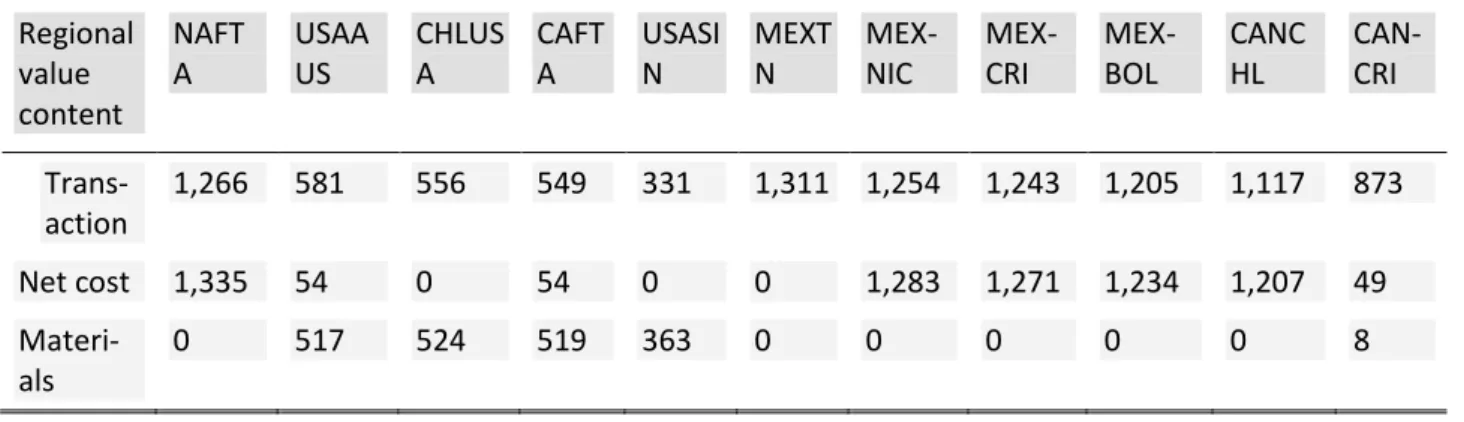
2.3.2. Regional value content in NAFTA and percentage requirements in the US and in the EU... 30
2.3.3. Self-produced Materials and intermediate materials (US) and absorption principle (EU) ... 33
2.3.4. Automotive products in NAFTA and in EU FTAs ... 38
2.3.5. The evolution of the NAFTA model of rules of origin: From NAFTA to CAFTA trough U.S.-Chile and U.S.-Singapore and other FTA agreements ... 41
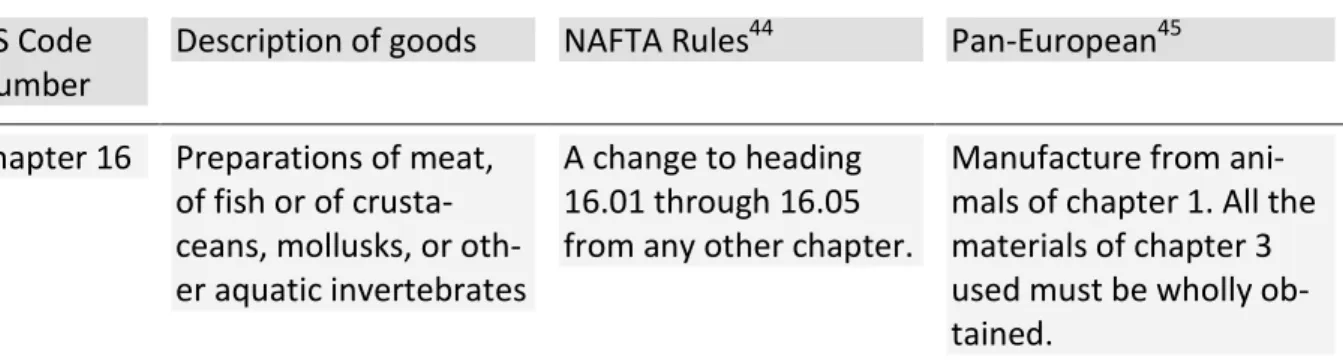
2.4. A comparison between the NAFTA-Model and the Pan-European Rules of Origin approaches: Techniques and substantive requirements ... 44
3. The methodology used to identify the possible trade diversion effects on Swiss inputs of the TTIP rules of origin ... 52
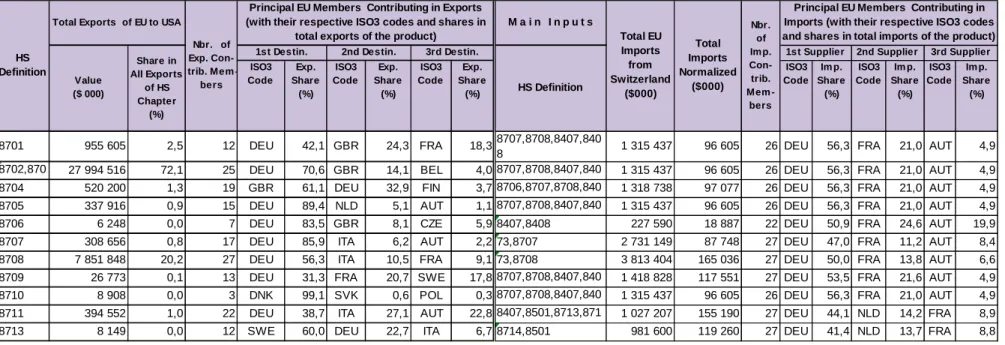
3.1. Analysis of input-output of Swiss components in the US and EU trade of selected HS chapters: possible impact of different sets of Rules of Origin ... 57
3.1.1. Findings from tariff and data analysis ... 58
3.1.2. Methodology applied in examining the results of the input/output tables ... 61
3
3.1.4. Examination of input –output for Chapter 30 ... 68
3.1.5. Examination of input –output for Chapter 87 ... 70
3.1.6. Examination of input-output for HS Chapter 90 ... 77
4. Non-tariff measures, NTMs ... 82
4.1. Automotives ... 83
4.2. Pharmaceuticals and chemicals ... 84
4.3. The trade implication on Swiss products from a lessening on NTB on EU/US trade diversion: some preliminary conclusions ... 85
5. Conclusions ... 87
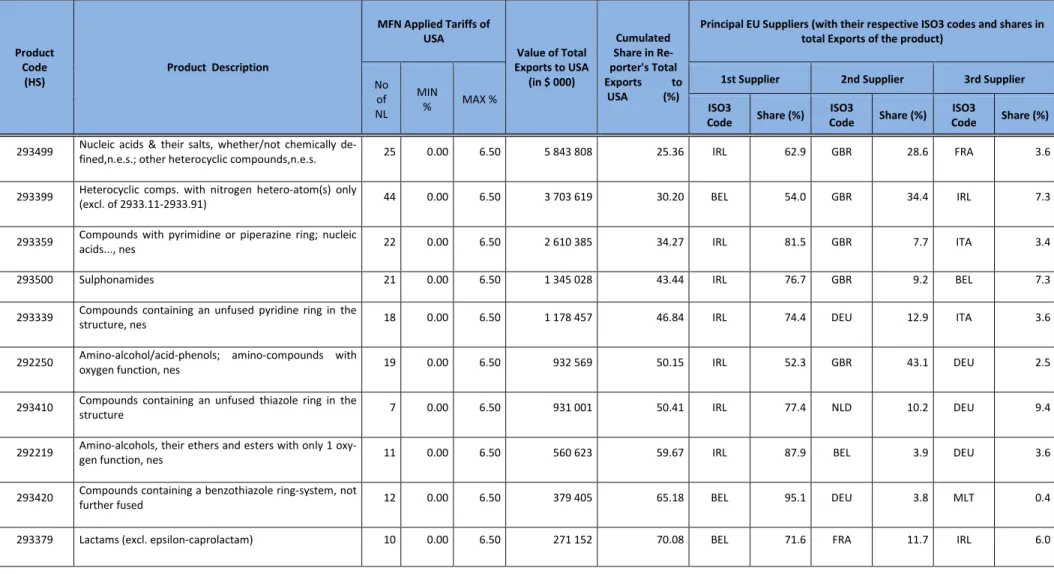
ANNEX I - EU to US and CH to EU: Most exported dutiable products ... 92
ANNEX II - EU to US: Most exported products with zero MFN duty in US ... 106
ANNEX III - CH to US and US to EU: Most exported dutiable products ... 111
4
A
CRONYMS AND ABBREVIATIONS
ACP Africa Caribbean and Pacific countries ARO Agreement on Rules of Origin
ASEAN Association of South East Asian Nations CHE ISO Country Code for Switzerland CGE Computable General Equilibrium CTH Change of tariff heading
CTSH Change of tariff subheading DCs Developing Countries EBA Everything But Arms EC European Commission
EFTA European Free Trade Association EPAs Economic Partnership Agreements EU European Union
FDI Foreign Direct Investment FTA Free Trade Area
GATT General Agreement on Tariffs and Trade GSP Generalized System of Preferences HS Harmonized System
ISO International Standards Organization MFN Most Favored Nation
NAFTA North America Free Trade Agreement NTB Non-Tariff Barriers
NTMs Non-Tariff Measures
OECD Organization for Economic Co-operation and Development RoO Rules of Origin
5
SECO State Secretariat for Economic Affairs SMEs Small and Medium Enterprises SPS Sanitary and Phytosanitary Measure TOR Terms of Reference
TRIPS Trade-Related aspects of Intellectual Property rights WB World Bank
WCO World Customs Organization WTO World Trade Organization
6
Summary
The purpose of this study is to carry out an analysis of the economic impact of the Transat-lantic Trade and Investment Partnership [TTIP] on global value chains involving companies located in Switzerland depending on the possible Rules of Origin [RoO] regimes in the TTIP for some specific sectors.
Moreover, the study briefly addresses the impact on Switzerland of the changes that could be introduced in the regulatory regimes of Non-Tariff measures [NTMs], namely Sanitary and Phyto-Sanitary Measures [SPS] and Technical Barriers to Trade [TBT].
The impact of RoO-regimes that could be applied under the TTIP is analyzed for selected sec-tors/products of greater significance to the Swiss producers:
a) automobiles and their parts, as companies in Switzerland are important suppliers for EU car manufacturers;
b) precision instruments such as medical devices where companies in Switzerland not on-ly produce finished goods but also suppon-ly US or EU manufacturers with parts of these products;
c) chemicals/pharmaceuticals.
The study conducts a comparative analysis of RoO regimes to identify those specific RoO having a potential to affect the sourcing policy of firms located in the TTIP area and involved in global value chains – thus, ultimately, generating a possible impact on Swiss suppliers. For the section on NTMs, a brief analysis is being made of the proposed architecture of the regulatory changes in the current TTIP to show areas where Swiss products might be affect-ed. This section has been designed with the objective to provide an overview of the possible options and avenues that Swiss policy makers may undertake for further investigation in this complex area.
The methodology of this study is based on a twofold approach.
1] Text-based analytical review of the recent EU and US models of RoO regimes to identify those provisions and/or modalities that may affect Swiss producers,
2] Input-output matrix to match trade flows of Swiss inputs used in the EU/US to manufac-ture finished products for export. This approach has been first developed by Stefano Inama1 using the Harmonized System (HS) nomenclature to develop an input/output matrix that could be matched with detailed trade flows.
To verify and test the outcome and relevance of the findings which have been emerging from the mentioned analytical process, a series of preliminary contacts with selected repre-sentatives of the private sector have been established [resource persons are mentioned in the relevant footnotes]. Yet, there is scope to deepen the analysis with firm-level investiga-tions based on a detailed questionnaire to be run on a series of face-to-face interviews. This exercise would provide useful insights on the sourcing policy of inputs and intermediates
1
See Inama, Made in China or Made in Tlon? The quest for a new origin concept measuring international trade and respecting consumers' rights,2013 Global Trade Analysis Policy (GTAP)
7
that Swiss producers may use in the manufacture of finished products and/or of parts that can be exported to the EU producers for further assembly into finished products. Such de-tailed information could also be extremely useful used in other FTA negotiations.
On the basis of the outcome of the study, specific replies are being formulated [Chapter 5 on Conclusions refers] with respect to the following research questions as contained in the Terms of Reference:
I. What are the advantages and limitations of modeling rules of origin in the context of TTIP?
The various FTAs that the EU and US have negotiated with other countries allow a rather ex-haustive comparison of the product-specific RoO [PSROs] that the Swiss industry may be confronted with and provide valuable background for modeling rules of origin in the TTIP. For instance, by comparing the different sets of rules of origin contained in the recent re-form of the GSP rules and FTAs, it has been found that the PSROs contained in the EU-Switzerland FTA are more stringent in a number of cases.
II. With TTIP, in which sectors will there be
i. A tendency of EU companies to replace Swiss inputs with US, intra-EU or third coun-try inputs for exports of finished products to the US?
This question is of significance for the automotive products of HS 87 Chapter and precision instruments of HS Chapter 90. These are the products appearing the most exposed to trade diversion effects. This finding is largely dependent on the specific form of PSROs. Pharma-ceutical products of HS Chapter 30 and many chemicals of Chapter 29 are not expected to suffer from trade diversion effects due to rules of origin as they are MFN duty free in the US and EU market thanks to an early understanding entered by a Group of WTO Members at the end of the Uruguay Round2
.
and
ii. A tendency of US firms to replace Swiss inputs with EU, US or third country inputs for exports of finished products to the EU?
Such a tendency will be minimal given the combination of trade flows, their nature and the cost of transport in sending Swiss inputs for incorporation in US finished products and re-exported to the EU. US exports to the EU of HS Chapter 30 are MFN duty free and there is no trade diversion incentive. Trade diversion effects could be theoretically imagined for some subheadings of Chapter 29 with the caveat that many tariff lines in HS Chapter 29, chemicals, are MFN duty free in the EU. In HS Chapter 87 most of the US exports to the EU are com-plete cars. However the value of exports of Swiss parts of cars to the US are rather minimal [around USD100 million], suggesting that these parts are eventually used as parts in the as-sembly of cars for the US market given the nature of automotive components.
2
8 III. Which forms of RoO in TTIP, TTIP plus or TTIP mult would most affect trade of
Switzer-land (trade diversion)?
PSROs that are restrictive may take two forms: Those PSROs based on a change of tariff clas-sification that do not allow a change of tariff subheading [CTSH] and those that are requiring not to exceed a maximum value of non-originating of 40% out of the ex-works price or 50% of the net cost method calculation. In both cases these PSROs are not conferring origin to as-sembly operations that could involve Swiss parts into complete articles or finished products.
IV. How would a cut back of NTBs [TBT/SPS] in TTIP such as harmonizing/mutual recogni-tion of product regularecogni-tions affect Switzerland?
Swiss products and inputs that are not aligned with the regulatory measures or the equiva-lence agreements that will be contained in the TTIP on TBT/SPS may not benefit from enter-ing the TTIP area or may not be used as an input or component of finished products. This is one of the most complex areas in the TTIP. It should be explored as a matter of urgency how equivalence agreements entered by the US and EU in the context of the TTIP deal with the third parties that are adopting the same standards or regulations of one of the parties to the TTIP. Example: Canada or Switzerland that are third parties with respect to TTIP may adopt the same regulations as those adopted by the US or the EU: will these regulations be consid-ered equivalent or is there need for a another equivalence agreement. The current negotia-tions of the EU–Canada FTA may provide precious guidance on this matter and Swiss policy makers and private sector should closely follow the progress made during such negotiations as they may provide valuable insights on how the EU intends to treat such issues.
V. Which inputs would remain unaffected and which ones would benefit in the TBT/SPS area from the trade creation effect of the agreement?
There is no indication of an intention in the TTIP to create a bilateral hub of regulatory poli-cies limited to the EU and US. The EU initial negotiating position papers are unequivocal in this regard: the ultimate goal is to reach a multilateral outcome in removing regulatory ob-stacles. Yet it is recognized that this ultimate goal will be reached through greater coopera-tion and integracoopera-tion efforts at EU-US bilateral level. Hence there might be transicoopera-tional phases of this integration efforts where third parties like Switzerland may be potentially affected. To the extent that multilateral disciplines exist or in the cases where the US and EU will de-cide to make use of existing multilateral channels it is clear that the inputs covered by these multilateral efforts will remain either unaffected or will benefit according to the progress made in these multilateral fora thanks to the US and EU joint efforts.
Both the US and the EU have gradually changed their rather restrictive approach in the de-sign of RoO embraced at the beginning of the nineties with NAFTA and the Pan European3 model. Significant observations made in the course of this study - ranging from the progres-sive abandonment of the net cost method in subsequent US FTAs and the diversity of Prod-uct Specific Rules of Origin [PSROs] in recent EU FTAs - are revealing of these different
3
In this study the terminology Pan-European rules of origin is used for ease of reference. In reality there are "Pan-European" rules of origin that are used among EU, EEA, Turkey; and the system of Pan-Euro-Med rules of origin operating between the EU and the States of the European Free Trade Association (Iceland, Liechtenstein, Norway and Switzerland) and Turkey and the countries which signed the Barcelona Declaration, namely Algeria, Egypt, Israel, Jordan, Lebanon, Morocco, Syria, Tunisia and the Palestinian Authority of the West Bank and Gaza Strip, Faroe Islands.
9
proaches. The evolution of the US approach to PSROs towards more lenient requirements is evident, especially in the later US-Korea FTA.
The evolution of EU RoO and the reform of the EU GSP rules of origin have led to a paradoxi-cal situation since Switzerland is having less favorable PSROs under the EU-Swiss FTA than the EU GSP rules. While it is true that the favorable cumulation provisions contained in the EU-Switzerland FTA lessen considerably the stringency of the PSROs, it is clear that the PSROs of the EU-Switzerland FTA are less favorable than those of the GSP. This finding calls for the immediate attention of the Swiss policy makers that have already initiated consulta-tions with the EU Commission.
In terms of recommendations, these can be expressed as follows:
The Swiss policy makers should continue their consultations with the EU Commission to explore an updating of the EU-FTA PSROs ensuring GSP parity in terms of stringen-cy requirement.
The combined observation of the trade flows and findings at tariff levels with the PSROs analysis-carried out on specific headings and subheadings in section 3 also points to a further general observation:
In fact, it has been found that a significant part of the products covered by this study are du-ty-free into the US and EU on a MFN basis. Translating into trade policy terms, this finding reduces the potential trade diverting effects of the TTIP for a considerable amount of Swiss exports to the EU and US, especially for pharmaceutical products of HS Chapter 30 and many product of HS Chapter 29. This overall consideration, however, has to be read in conjunction with the PSROs analysis where it has been found that a number of PSROs negotiated by US and EU, especially in the automotive and precision instruments sectors, may have trade di-verting effects. Thus Swiss trade policy makers and the private sector should focus on those PSROs where there might be trade-diverting effects.
Bearing in mind that the potential trade diversion effects may not be significant in some sectors, attention should focus on those specific sectors, particularly the auto-motive and precision instruments sectors, where trade diverting effects may take place for some specific products. The Swiss government should use the findings of this study to carry out a qualitative survey and exchange views at firm level to clearly identify at product and firm level what are the possible implications of TTIP rules of origin. Such a survey could provide invaluable insights that could also be used in other future FTA negotiating scenarios.
10
1.
I
NTRODUCTION
1.1.
The role of RoO in FTAs and the interface with trade diversion
Rules of origin are clearly at the very core of free trade areas [FTAs] because they ensure that preferential market access will be granted only to goods that have actually been “sub-stantially transformed” within the area, and not to goods that are produced elsewhere and simply transshipped through one of the member countries. In the absence of rules of origin, it would not be possible to discriminate against imports from third countries, so that the sig-nificance of regional integration would be drastically diminished.
Traditionally, the main reason for the existence of rules of origin in FTAs is the preoccupation with trade deflection. In a free trade area, each country maintains its own external tariff and commercial policy in relation to the outside trading partners. To the extent to which the tar-iffs and commercial policy are different with regard to third countries, the incentive exists to import a good through the country with the most liberal import regime and tariffs. In that case, importers and producers will eventually operate minimal transformation and they will, then, re-export the goods towards the countries with the higher tariffs. In substance, this would be equivalent to a tariff circumvention operation.
In the TTIP configuration, only EU and US “originating” products will be traded either duty free or at reduced rate of duty. Thus, only originating products in the FTA will enjoy such tar-iff free or reduced duty trade [hereinafter FTA treatment] while Swiss originating products that are merely transshipped tough the EU to the US will not enjoy any tariff reduction. In a FTA like the TTIP, there are two kinds of trade diversion effects. The first effect is the simplest one to be detected and it concerns finished products. As an example, such trade di-verting effect is caused by the duty free or reduced duty on an originating finished product exported from the EU to the US and a comparable Swiss finished originating product. As il-lustrative example a men’s suit of synthetic fibres classified in US tariff line 6203.12.20 origi-nating in the EU may be granted duty free entry under TTIP while the same suit if origiorigi-nating in Switzerland will have to pay a duty of 27,3%.
It is obvious that the consumer, assuming that quality and price is equal, will have an incen-tive to buy the suit originating in the EU since it is more competiincen-tive pricewise due to the ab-sence of duties. In reality it may also be that the importer chose to pocket the margin of preference without reflecting the margin of preferences in the consumer prices. Be this as it may, the diverting effects remain the same. In any case , this does not mean that the suit originating in the EU is, in absolute terms, more competitive pricewise than the suit originat-ing in Switzerland or in a third country not member of TTIP since the advantage has been provided by the cut in tariff rather than by the efficiency of production. This trade diversion effect due to a tariff cut is considered suboptimal and trade distorting in economic terms. The second trade diverting effect is more complicated to detect and measure. It concerns Swiss inputs that may be object of further processing or being incorporated in a finished product in the EU and US to be exported in the respective partner.
The globalization or, rather, the fragmentation of production has generated a series of value chains where the majority of products are rarely produced in one single country. Nowadays, most of the traded products are the results of assembly or processing operations of inputs
11
originating from different countries. RoO in the TTIP, like in other FTAs, will determine under what conditions an EU or US product containing Swiss inputs or components could be con-sidered originating in the TTIP area and enjoy the FTA tariff treatment.
As a rule of thumb, Swiss inputs used in the manufacturing of finished products in the EU and US would be entitled to FTA treatment only if they have undergone “substantial trans-formation” when incorporated in a finished product in the EU or US.
As an illustration, suppose that under the TTIP the transformation of fabrics into the men suit mentioned above is origin conferring. Producers of garments in the US and EU will, then, be encouraged to continue to source fabrics from within or from outside the TTIP, including Switzerland, depending on the most competitive supplier, for transformation into ready-made clothing and subsequent export among themselves at duty free or, at a reduced rate of duty.
Alternatively, if the TTIP product-specific rules of origin for the men’s suit are requiring that to be originating in TTIP, the use of third country fabric is not permitted and only the use of third country yarn is allowed, producers of garments in the EU and US will be encouraged to start sourcing fabrics from within the EU or US in order to enjoy duty free or reduced rate of duty. However, sourcing fabrics within US and EU may have a trade diverting effect away from the more competitive suppliers based in Switzerland -or elsewhere- since the sourcing switch is made for the purpose of compliance with the RoO requirements and, thus, to quali-fy for duty free or reduced duty FTA treatment.
Another possible choice for the EU and US producers willing to comply with such a RoO re-quirement would be to invest in further manufacturing by carrying out the weaving opera-tions from imported yarn.
It is obvious that such trade diverting effects of a given RoO are, from an economic point of view, highly distorting and suboptimal: the RoO, in fact, induces a diverting of the sourcing from the most efficient producer to a less efficient one because of the preferential tariff treatment.
In the worst case scenario, RoO may induce import substitution policies as in the example above where producers of garments may be tempted to set up regional weaving capacity. The combined effects of RoO and FTAs preferential treatment may ultimately works as a subsidy for the producers established within the FTA.
This example is inspired from the yarn-forward rules in NAFTA where garments made in Mexico benefit from the NAFTA tariff preference only provided that the U.S. textile material is being utilized. In a similar fashion, stringent rules of origin in the TTIP may affect Swiss producers of inputs. The more stringent RoO are, the more prevalent trade diversion may become since producers from the integrated area, in our case the TTIP partners, will favour intermediate inputs originating in the EU or in the US to comply with rules of origin require-ments, in spite of their potential higher cost in comparison with inputs from countries out-side the FTA like Switzerland. Swiss inputs used in the production of finished goods will thus be affected since they may be penalized by the fact that using such inputs may entail not compliance with rules of origin and payment of corresponding MFN rate of duties. This trade diverting effect may take place even in cases where Swiss inputs are more expensive than US or EU inputs but they have been used because of their better quality or match with the final
12
user specification. In fact the MFN rate of duty for non-compliance with rules of origin may obliterate such quality advantage of these Swiss inputs. Thus, trade diversion will be greater, the higher the preferential margin. This study is focusing on the second type of trade diver-sion effect, aiming at identifying and depicting the possible trade diverting effects of RoO in the TTIP on the basis of a combined analysis of the RoO disciplines adopted, respectively, in the EU and US, the potential preferential margins and the current trade flows.
1.2.
The issue of cumulation
Normally, rules of origin have to be complied within the boundaries of a single country. In the case of TTIP, rules of origin have to be complied within the US or the EU customs territo-ries.
However, the FTAs contain provisions allowing cumulation among the member Parties. Un-der such cumulation rule, a Party is allowed to consiUn-der originating materials in the other Party[ies] as its own materials. Cumulation could be bilateral, for instance among the EU and the US in the TTIP, or plurilateral like the case of NAFTA, providing for cumulation among the US, Canada and Mexico.
Cumulation could also be diagonal, to borrow a term from the Pan Euro-Med rules of origin. Under diagonal cumulation, the Parties to a FTA can also consider as originating products those products that, in fact, originate in countries outside the specific FTA. For instance, Switzerland participates to the Pan-Euro-Med cumulation of origin that is operating between the EU, the States of the European Free Trade Association (Iceland, Liechtenstein, Norway and Switzerland), Turkey and the countries which signed the Barcelona Declaration (namely Algeria, Egypt, Israel, Jordan, Lebanon, Morocco, Syria, Tunisia and the Palestinian Authori-ty).
Under such system, Switzerland can consider as Swiss materials the originating materials from all other countries that are participating to the Pan-Euro-Med cumulation of origin when these materials are imported into Switzerland for further manufacturing of a finished product exported to these countries.
Such cumulation regime enters into effect provided that a number of conditions are fulfilled according to Article 4, paragraph 5 of the EU-Switzerland Agreement4.
Article 4
Cumulation in Switzerland
1. Without prejudice to the provisions of Article 2(2), products shall be considered as originat-ing in Switzerland if such products are obtained there, incorporatoriginat-ing materials originatoriginat-ing in Switzerland (including Liechtenstein), Iceland, Norway, Turkey or in the Community, provided that the working or processing carried out in Switzerland goes beyond the operations referred to in Article 7. It shall not be necessary that such materials have undergone sufficient working or processing.
2. Without prejudice to the provisions of Article 2(2), products shall be considered as originat-ing in Switzerland if such products are obtained there, incorporatoriginat-ing materials originatoriginat-ing in
4
See: Decision No 3/2005 of the EC-Switzerland Joint Committee of 15 December 2005 amending Protocol 3 to the Agreement, concerning the definition of the concept of ‘originating products’ and methods of administra-tive cooperation.
13
the Faeroe Islands or in any country which is a participant in the Euro-Mediterranean part-nership, based on the Barcelona Declaration adopted at the Euro-Mediterranean Conference held on 27 and 28 November 1995, other than Turkey4, provided that the working or pro-cessing carried out in Switzerland goes beyond the operations referred to in Article 7. It shall not be necessary that such materials have undergone sufficient working or processing.
3. Where the working or processing carried out in Switzerland does not go beyond the opera-tions referred to in Article 7, the product obtained shall be considered as originating in Swit-zerland only where the value added there is greater than the value of the materials used orig-inating in any one of the other countries referred to in paragraphs 1 and 2. If this is not so, the product obtained shall be considered as originating in the country which accounts for the highest value of originating materials used in the manufacture in Switzerland.
4. Products, originating in one of the countries referred to in paragraphs 1 and 2, which do not undergo any working or processing in Switzerland, retain their origin if exported into one of these countries.
5. The cumulation provided for in this Article may only be applied provided that:
(a) a preferential trade agreement in accordance with Article XXIV of the General Agreement on Tariffs and Trade (GATT) is applicable between the countries involved in the acquisition of the originating status and the country of destination;
(b) materials and products have acquired originating status by the application of rules of origin identical to those given in this Protocol; and
(c) notices indicating the fulfillment of the necessary requirements to apply cumulation have been published in the Official Journal of the European Union (C series) and in Switzerland ac-cording to its own procedures.
As stated in paragraph 5 above, the effective operation of the cumulation provision in the Pan- European-Mediterranean cumulation territory is subject to conditionality, more pre-cisely consisting in: 1) the existence of a FTA among Switzerland and the concerned Mediter-ranean country that, in its turn, must already have a FTA with the EU, and 2) the rules of origin contained in these FTAs are identical.
At the time of this writing, how cumulation will feature in the TTIP is still an incognito. Yet, there is likelihood that the partnership will make provision for bilateral cumulation among the US and EU materials. It is also possible that an open door will be maintained in the TTIP for cumulation with those third countries that have signed free trade area agreements with the US and EU - with the obvious candidate being Canada, as a part of NAFTA and currently negotiating a FTA with the EU.
The eventual inclusion of Switzerland in a cumulation scheme under the TTIP is questioned by the fact that Switzerland does not have a FTA with the USA5. As outlined above, in the case of the Pan-Euro-Med cumulation, the existence of a FTA among the parties to a
5
At a present stage it is highly unlikely that cumulation with Switzerland will be part of the TTIP since land does not have an FTA with US. The trade implications arising from the absence of cumulation with Switzer-land in the TTIP is a key trade policy aspect that this study is called to address. Hence the examples here below serve to better illustrate such possible implications
14
Duty-free
Duty-free
US MFN Rate of duty on steering wheels: 2,5%
nal cumulation scheme is the necessary precondition for such cumulation to be WTO con-sistent.
Figure 1 depicts the possible scenarios. Normally, a steering wheel [HS 870894] exported from Switzerland to the US has to face a MFN customs duty of 2.5 % ad valorem. Assuming that cumulation with Switzerland is effective in the TTIP - even in the absence of a FTA among Switzerland and the US - Swiss components like a steering wheel could be incorpo-rated into a finished originating car and exported to the US without paying customs duty at the entry into the US market, thanks to the FTA among the US and the EU.
Figure 1 - WTO inconsistency of Diagonal cumulation in the absence of a FTA among Switzer-land and the US
This situation would be equivalent to a tariff circumvent and in breach of art I of GATT 1994. Moreover, as pointed out in the second requirement of the Pan-European cumulation sys-tem, the rules of origin applicable in the FTAs should be identical for cumulation to work properly.
Figure 2 depicts the situation with Canada that has entered a FTA with Switzerland and is fi-nalizing a FTA with the EU. In this case, the first condition for Switzerland having a FTA with the EU and Canada is met. It means that the steering wheel exported by Switzerland can en-ter into the Canadian market duty free or, at reduced rate of duty either when exported di-rectly or when incorporated into a finished car exported from the EU to Canada. However, the second condition has also to be met, i.e. that the rules of origin for the steering wheel have to be the same in both FTA agreements, the one among Canada and Switzerland and the one among the EU and Canada.
US EU
Steering wheel incorporated in a finished car
Switzerland
15
Duty free
Duty free Duty free
Figure 2 - WTO Consistency of diagonal cumulation when Switzerland entered in a FTA
As an illustration, here below four product-specific rules of origin for steering wheels classi-fied in Harmonized System sub-heading HS 870894 are reproduced:
Switzerland-Canada FTA6 EU-South Korea FTA7
EU-Swiss Euromed8 EU-GSP rules9
6
The product–specific rule of origin is set at subheading level for subheading 870894
7
The product- specific rule of origin is set at heading level for subheading 870894.
8
The product- specific rules of origin is set at chapter level for subheading 870894 since the list of exceptions to the chapter rule does not single out heading 8708
9
The product-specific rules of origin is set at chapter level for subheading 870894 since the list of exception, just one in the new EU GSP refers to heading 8711, motor cycles.
EU
Steering wheel imported from Switzerland and incor-porated in a finished car Canada
Switzerland Steering wheel
8708.10 to 8708.95
A change from any other heading; or
A change from within any one of these subheadings
or subheading 8708.99, whether or not there is also a change from any other heading, provided that the value of the non-originating materials of that sub-heading or subsub-heading 8708.99 does not exceed 50 % of the transaction value or ex-works price of the product
Manufacture in which the value of all the materials used does not exceed 40 % of the ex-works price of the product
Manufacture in which the value of all the materials used does not exceed 50 % of the ex-works price of the product
8708 to 8711 and 8713 to 8716
Parts and accessories for vehicles of headings 8701 to 8705 and 8711 to 8713; Motorcycles; Works trucks and parts thereof; carriages; baby carriages and parts thereof; Trailers and semi- trailers and parts thereof
Manufacture from materials of any head-ing, except that of the product
Manufacture in which the value of all the materials used does not exceed 50 % of the ex-works price of the product
16
As can be easily noted these four product specific rules of origin are different among each other albeit some similarities may be detected. The EU-South Korea and the EU GSP prod-ucts specific rules of origin are reproduced here since they represent the latest generation of the EU product specific rules of origin. As noted below in section 2.1.2 and 2.1.3 concerning the reform of the EU GSP rules of origin, contrary to the common belief that such reform is limited to the EU GSP rules of origin, the new product specific rules of origin contained in the EU GSP represent the new blueprint from where the EU is considering to negotiate the product specific rules of origin in the new FTAs. Although in the relevant EU documents it is stated that the reform of the EU GSP rules of origin is limited to those rules of origin, the PSROs contained in the EU GSP reform for developing countries is taken as a starting point for the FTAs that the EU is currently negotiating with a number of partners. This fact is not expressly written anywhere except from oral EU sources. Be this as it may this finding is demonstrated by the fact the recent EU FTAs like the EU–Singapore FTA are containing PSROs that are inspired to the EU GSP PSROs for developing countries. In addition during the recent EU-Vietnam negotiations on rules of origin, the EU has taken as initial negotiating po-sition PSROs that are largely inspired to the PSROs contained in the EU GSP10.
The comparison among the EU-Swiss FTA and the EU-South Korea FTA and the EU GSP rules of origin shown above is a telling example. The EU-CH products specific rules of origin dates from 2005 when the EU reform started and requires to comply with a threshold of 40% on non-originating materials out of the ex-works price of the finished product. Under the new EU GSP rules of origin such threshold has been elevated to 50 %.Thus Developing countries beneficiaries of the GSP scheme, a unilateral preferential scheme, are enjoying more lenient product specific rules of origin than the Swiss exporters under the EU-Swiss FTA11
.This is con-trary to past practice where GSP product specific rules of origin for GSP beneficiaries were equal or more restrictive than those used under EU FTAs. In a word the reform of the EU GSP rules of origin has made the product-specific rules of origin under the EU-Swiss FTA less fa-vorable that those granted to GSP beneficiaries.
In a similar vein the product specific rules of origin of the EU-South Korea for automotive products, a notable sensitive issue, are more liberal than those under the EU-Swiss FTA al-lowing up to 45% to 50% of non-originating materials. Once again this is a sign of a new trend on negotiating product specific rules of origin that has taken the EU-GSP rules of origin as a new benchmark.
1.3.
Some reflections on the potential impact of extended cumulation in EU
FTAs and the US TTP negotiations
Quite differently from the US practice, the EU has consistently promoted the idea of cumula-tion to establish regional hubs where diagonal cumulacumula-tion is allowed among the different partners. The Pan-Euro-Med cumulation system is an eloquent demonstration of this trend. The GSP reform of rules of origin and the recent EU FTAs entered with Asian countries such as Singapore, South Korea contains elements indicating that such trend is continuing in the new generation of FTAs rules of origin.
10
As emerged during latest unofficial discussions with EU practitioners and EU sources in April 2014.
11
This statement is limited to requirements under product specific rules of origin since cumulation under Pan – European and Euro-Med Protocols of rules of origin lessen considerably the stringency of the product specific rules of origin.
17
First the EU GSP rules of origin introduced the innovative concept of extended cumulation whereby a GSP beneficiary can cumulate with countries that have entered with FTA with the EU12, second the provisional text13 of the EU Singapore FTA provides explicitly for cumulation among ASEAN countries and the EU. At the time of writing it remains to be seen if the other FTAs that the EU is negotiating, most importantly with Canada and Japan feature the issue of cumulation and how. The US FTAs agreements signed with individual countries like Colom-bia, Peru, Singapore14 does not feature diagonal cumulation with other countries non- mem-ber of the individual FTA.
The question for the future is how cumulation will feature in the TTIP among EU, US and the third countries that have FTAs concluded with US and EU. This is of fundamental importance to the Swiss producers of intermediate inputs since in a scenario where diagonal cumulation is allowed among the different FTAs the potential trade diversion effects may be considera-ble greater that those under the TTIP where cumulation is limited among US and EU. Negoti-ations on the Trans Pacific partnership [TPP] Agreement are on-going and at the time of this writing the draft text are not publically available. It is not clear whether the US and its part-ners would be interested in opening the possibility of expanding diagonal cumulation in a TTIP-TPP or TTIP-TPP- Plus fashion.
This is clearly an area where Swiss policy makers and private sector should pay immediate attention and monitor the on-going TTIP and TPP negotiations. In the case where extended cumulation is a feature appearing in TTIP and TPP trade diversion will be greater and Swit-zerland will be outside the network. Negotiations of a US-SwitSwit-zerland FTA would be neces-sary precondition to become part of such cumulation scenario.
12There are a series of limitation and procedures to be followed for the extended cumulation. See Inama The Reform of the EC GSP Rules of Origin :Per aspera ad astra ? JWT, 45, no. 3 (2011): 577–603 and Commission Regulation No. 1063/2010 of 18 Nov. 2010 amending Regulation (EEC) No. 2454/93 laying down provisions for the implementation of Council Regulation (EEC) No. 2913/92 establishing the Community Customs Code.
13
Available at http://trade.ec.europa.eu/doclib/docs/2013/september/tradoc_151773.pdf, September 2013
14
See for instance paragraph [f] of the US-Singapore FTA: Accumulation.
(i) For purposes of this note, originating materials from the territory of either Singapore or the United States that are used in the production of a good in the territory of the other country shall be considered to originate in the territory of such other country.
(ii) A good is an originating good when it is produced in the territory of Singapore or of the United States, or both, by one or more producers, provided that the good satisfies all of the applicable requirements of this note
18
2.
T
HE
US
AND
EU
RESPECTIVE WAY AND EXPERIENCE OF
DRAFTING RULES OF ORIGIN
The U.S. approach and experience with drafting and administering preferential rules of origin differ widely from the European Union, mainly depending on the different trade policies and economic relations the two unions have embarked upon with their respective third country parties.
2.1.
The EU experience in drafting rules of origin in FTAs
Drawing upon the EU Member States’ relations with former colonies and the preferential trade arrangements in place, the EU practice of preferential rules of origin has been con-sistent since the adoption of a basic set of rules of origin early in the seventies.
At the outset of the EU rules of origin, the main common characteristic of the EU preferen-tial rules of origin has been the adoption of the change of tariff heading criterion (CTH) in de-fining the concept of “substantial transformation” coupled with a list of product-specific rules of origin, requiring CTH with or without exceptions, specific working or processing or maximum import content percentages. This approach has been later replaced by the adop-tion of an exhaustive list of product –specific rules of origin covering all products and using a variety of methodologies in defining substantial transformation as listed above. Albeit with notable differences, such ways of drafting rules of origin has remained unaltered throughout the years.
This adoption of the CTH as method of defining substantial transformation even if in combi-nation with other methodologies used in product-specific rules distinguished for many years the EU practice from the one adopted by the United States and Canada in autonomous pref-erential arrangements such as their GSP or the Caribbean Basin Initiative (CBI). In fact, under these latter unilateral preferences, the US rules of origin consisted on an across-the-board percentage criterion.
This simplicity in dealing with preferential rules of origin in the US administration took a dramatic change when the US- Canada free-trade area and, later, NAFTA rules of origin were negotiated.
The apparent consistency of the EU policy towards origin did not necessarily mean that the EU adopted a single set of rules of origin for all the preferential arrangements it entered into with third countries. On the contrary, given the a general use of mix of CTH with or without exceptions, percentage requirements and specific working or processing articulated in prod-uct-specific rules’ common starting point, the EU’s trade policy on rules of origin has tradi-tionally been as different and complex as its agreements with third countries. In fact, rules of origin have been one of the preferred policy instruments adopted by the EU in modulating and tailoring according to its priorities the content of the concessions contained in the trade agreements with third countries.
In contrast to this traditional approach that lasted for almost three decades, the progressive enlargement of the EU generated the first drastic changes on EU policies on rules of origin.
19
A communication by the Commission of 30 November 1994 introduced a new policy towards rules of origin15 by progressively adopting a uniform set of rules of origin commonly referred a “Pan-European Rules of Origin.” According to this Communication, the EC started to revise and substitute the old protocols on rules of origin annexed to the Europe Agreements with standard protocols, that have been utilized to negotiate rules of origin protocols with South Africa, the Mediterranean countries, and was gradually applied to all the other trading part-ners benefiting from tariff preferences, including GSP and Cotonou Partpart-nership Agreement. FTAs with Mexico and Chile have also been negotiated using this standard set of Pan-European rules of origin.
The Pan-European rules of origin regulated all trade relations conducted under the Former Europe agreements with Central and Eastern European countries for more than a decade. The concept of Pan-European rules of origin was extended to the Mediterranean countries, those with whom the EU launched the Barcelona process in 1995 for the creation of Euro-Mediterranean Free Trade Area by 2010.The progressive enlargement of the EU meant that the scope of the European rules of origin has been progressively replaced by the Pan-Euro Mediterranean cumulation of origin. The actual system of Pan-Pan-Euro-Med cumulation of origin is the extension of the previous system of Pan-European cumulation. It operates be-tween the EU and the States of the European Free Trade Association (Iceland, Liechtenstein, Norway and Switzerland) and Turkey and the countries which signed the Barcelona Declara-tion, namely Algeria, Egypt, Israel, Jordan, Lebanon, Morocco, Syria, Tunisia and the Palestin-ian Authority of the West Bank and Gaza Strip16
.
Curiously enough, almost at the same time of the implementation of the process of adopting a Pan-European rules lasting almost a decade, the “Green Paper on the Future of Rules of Origin in Preferential Trade Arrangements”17
paved the way for a gradual re-thinking of the of EU preferential rules of origin and a reforming process within an immediate future. Ac-cording to this communication, the review of the EU rules of origin was not originally meant to be touching upon the intrinsic substance of the rules, whilst it did in its actual format out-come. At the beginning of the process, the review appeared to be rather heavily focused on the management aspects and procedures in relation to the administration of the rules of origin. In particular, the issuance and verification of the origin certification were the issues at stake, along with the role being played by importers, exporters and certifying authorities closely examined in the Green Paper.
15
Communication from the Commission to the Council, concerning the unification of rules of origin in preferen-tial trade between the Community, the Central and East European countries and the EFTA countries, SEC (94) 1897 FINAL.
16
Actually the effective implementation of the Pan-Euro-Med cumulation is dependent on a number of condi-tions ,basically those outlined above under section 1.2.There are also significant variacondi-tions in the scope of cu-mulation and drawback provisions depending on the countries concerned
17
Communication from the Commission to the Council The rules of origin in preferential trade arrangements Orientations for the future Brussels, 16.3.2005COM(2005) 100 final
20
2.1.1. The relevance of the reform of the EU rules of origin for the TTIP: from the
GSP rules of origin to where?
On 1 January 2011, a new regulation on EC Generalized System of Preferences (GSP) rules of origin (hereinafter ‘the Regulation’) came into force, ending a reform process that was initi-ated by Green Paper of 2003 on the future of rules of origin in preferential trade arrange-ments, and the 2005 Communication entitled ‘The rules of origin in preferential trade ar-rangements: Orientations for the future’.
The new EU rules of origin contained in the regulation herald a new era: they are far more liberal than the previous one, with the notable exception of fishery products and processed agricultural food. The regulation also introduces a new administration of rules of origin whereby origin declarations are made by registered exporters upon their submission of nec-essary application to the certifying authorities and maintained in a database. This new sys-tem will be introduced after a transitional phase lasting until 2017.
As stated above under section 1.2 there is a common belief that the reform of the GSP rules of origin is limited and confined to the GSP rules. As demonstrated in recent developments and most notably by the recent FTAs entered by the EU with South Korea and with Singa-pore18, the EU GSP rules of origin have largely influenced the product specific rules of origin in these recently negotiated FTAs. Thus the analysis of the underpinnings and evolution of the EU GSP rules of origin as later evolved in the most recent FTAs may provide significant insights on the negotiating stand that the EU may consider when negotiating the TTIP.
Suffice here to recall that, as mentioned in section 1.2 above the first implication of the GSP reform is that many product specific rules of origin contained in the EU-Swiss FTA are now obsolete with respect to the product specific rules of origin of the EU GSP rules of origin. As outlined below in section 2.1.3, a cursory glance to the product specific rules of origin nego-tiated by the EU in the EU –South Korea and EU Singapore FTA.
As mentioned above the EU started a first revision of the rules of origin in 1993 when the Pan-European rules of origin were conceived following the signing and entering into force of the Europe Agreement with Eastern and Central European countries. The adoption of the system of Pan-Euro-Mediterranean cumulation of origin by the Council of the European Un-ion (EU) on 2005 marked the end of this process.
Almost at the same time, the Green Paper on the Future of Rules of Origin in Preferential Trade Arrangements (hereinafter ‘Green Paper’) opened the way for a reform of EU prefer-ential rules of origin. According to this communication, the review of the EU rules of origin was not meant to immediately touch the substance of the rules of origin contained in the product-specific list rules. In fact, the original plan of the reform was heavily focused on the management procedures elated to the administration of the rules of origin. However the fi-nal result of the reform marked a significant liberalization of the EU rules of origin.
The Commission, rather than addressing the restrictiveness of the rules of origin, was mainly concerned that, following a stream of the European Court cases, the existing system based
18
The text of the Protocol on rules of origin is available at http://trade.ec.europa.eu/doclib/press/index.cfm?id=961
21
on the authorities of beneficiary countries to certify the origin of products was leading to a loss of Community-owned resources. According to the existing system where the declared origin proves to be incorrect, importers frequently may not have to pay duty because they acted in good faith and an error was made by the competent authorities in beneficiary coun-tries. Under these circumstances, the EC suffered a double jeopardy: First, a loss of customs revenue and second, this was due to a misinterpretation of EC rules by the certifying author-ities in beneficiary countries
2.1.2. The major changes and improvements in the GSP rules of origin
With respect to the previous EC Regulation on GSP rules of origin, the following changes have been introduced in these three areas in order of practical importance:
– Changes in product-specific rules of origin introducing more lenient criteria for a number of sectors, especially for LDCs. The new regulation introduces a differentiation among devel-oping beneficiary countries and LDCs that did not exist before. In a number of HS chapters and headings, especially in the textile and clothing sector and also in machinery and elec-tronics, more lenient rules of origin are set for developing countries and LDCs. For develop-ing country beneficiaries, in the clothdevelop-ing sector the double transformation (weavdevelop-ing and making-up) is still in place but the dying process has been recognized as a processing re-quirement. In the case of LDCs, the double processing has been replaced with a single pro-cessing requirement (making-up), a major improvement argued for years by LDCs.
In machineries of Chapter 84 and electronics of Chapter 85, the chapter rule previously re-quiring a CTH and a maximum allowance of non-originating materials of 40% out of the ex-works price has been replaced with a CTH or a maximum allowance of 70% of non-originating materials out of the ex-works price for developing countries and LDCs alike. [at times 50% for Developing Countries]
More complex is the analysis in the agricultural and processed agricultural products: in some chapters with high most favoured nation (MFN) duties like Chapter 15, the rules of origin have been substantially liberalized, in others, like Chapter 4, dairy products, limits concern-ing the use of non-originatconcern-ing sugar have been introduced at chapter level while the use of non-originating fruit juices previously restricted for yogurt has been liberalized.
There are also a number of technical improvements to the rules of origin where, in certain cases, the tolerance rule is expressed a percentage of weight rather than value. The toler-ance rule has been generally raised from 10% to 15% and could also be applied to the wholly obtained product when the origin requirement is used as a product-specific rule of origin cri-terion.
– Cumulation of origin: regional cumulation has always been featured in the EC GSP rules of origin. Mercosur has been added as new entity benefiting from regional cumulation. The rule for the allocation of origin among the different members of a regional organization has been relaxed. Under the previous regulation, the origin was conferred to the country of last manufacturing only if the value added was greater than the customs value of the imported inputs from other country member of the regional organization. In practical terms, it meant that a Cambodian producer wishing to use fabrics originating in Thailand was not obtaining Cambodian origin since the value of the fabrics was greater than the value added achieved in Cambodia. In the new Regulation, this requirement has been lifted provided that the inputs
22
originating in the other members of the regional group have undergone working or pro-cessing going beyond minimal working propro-cessing operations. Some agricultural and fishery products are excluded from regional cumulation.
In addition, a new type of cumulation is introduced: extended cumulation. Such cumulation may be applied between GSP beneficiary countries and EU Free Trade Agreement partner countries under certain conditions further explained below. However, agricultural products classified in Chapters 1–24 of the HS are excluded from extended cumulation.
– The reform drastically changed the EC administration of rules of origin providing a transi-tional period until 2017 and beyond. The current system of certification of origin based on certificate of origin Form A officially stamped by the certifying authorities will be replaced by statements on origin to be given directly by registered exporters. A database will have to be established in each beneficiary to be administered and updated by the authorities of the country concerned. This new administration will entail a drastic change of business practices for the certifying authorities of beneficiary countries who will be responsible to maintain and administer the database. Only exporters registered in the database could issue statements of origin for receiving trade preferences. The current system will remain in place until 2017 with a provision for extension until 2020 for beneficiaries asking for additional transitional period.
2.1.3. Beyond the EU GSP reform to the latest generation of the FTAs
Albeit the EU reform started with the desire to reform the GSP rules of origin its ultimate re-sult has been an overall re-thinking of the EU policy in negotiating rules of origin in FTA that may have significant implications for the design of rules of origin in the TTIP. Obviously there are other trade policy considerations and dynamics of the EU trade policy that has deter-mined such a change.
It is now a fact that the EU has abandoned the idea of presenting a single protocol of rules of origin and product specific rules of origin [PSROs] to all the FTAs partners as it has been the case in the nineties under the Pan- European rules of origin system. The product specific rules of origin contained in the EU-South Korea and EU –Singapore are different as much as the scope of cumulation provided therein. Reportedly the rules of origin of the EU-Vietnam FTA have taken the GSP rules of origin for Developing countries as a benchmark.
The design of product specific rules of origin under the latter FTA agreements show the in-fluence of the EU reform of GSP rules of origin, especially in the percentage requirements and the fact that as under EU GSP rules of origin the specific requirement are no longer cu-mulative as in the case of the EU-Swiss FTA but alternative. The overall result is that the new rules that are significantly more lenient in a number of chapters that are of key importance for Switzerland19.
19
Actually a definitive answer may only be provided by a close analysis contrasting preferential margins, trade flows and products specific rules of origin of the different countries under the specific agreements.
23
Brief Comparison of selected product specific rules of origin for chapter 90 Optical, photographic, cinemato-graphic, measuring, checking, precision, medical or surgical instruments and apparatus
EU-Swiss EU -GSP EU –South Korea EU Singapore
Manufacture:
– from materials of any heading, except that of the product, and
– in which the value of all the materials used does not exceed 40 % of the ex-works price of the product
Or
Manufacture in which the value of all the materials used does not exceed 30 % of the ex-works price of the product
Manufacture from ma-terials of any heading, except that of the product or Manufac-ture in which the value of all the materials used does not exceed 70 % of the ex-works price of the product
Manufacture from materi-als of any heading, except that of the product or Manufacture in which the value of all the materials used does not exceed 45 % of the ex-works price of the product
Manufacture from materials of any head-ing, except that of the product
or
Manufacture in which the value of all the materials used does not exceed 60% of the ex-works price of the product
Heading rules for 902720
Manufacture in which the value of all the materials used does not exceed 40 % of the ex-works price of the product
As above Manufacture from
materi-als of any heading, except that of the product or Manufacture in which the value of all the materials used does not exceed 50 % of the ex-works price of the product
As above
Obviously some of these changes may also be due to the dynamics of the negotiations. Be this as it may it has to be acknowledged that there is a pressing need to rejuvenate the PSROs of the 2005 protocol of the EU- Switzerland agreement. Moreover the dynamics of the latest FTA negotiations provide strong indications that the EU has abandoned in its re-cent FTAs “the one size first all” approach adopted under the former Pan- European rules of origin.
EU FTA rules of origin negotiations are progressively showing a grated degree of flexibilities in the way rules of origin are drafted that have no precedent in former EU practices. The EU-Canada and ultimately the TTIP PSROs will most likely be the new frontier. Yet it is difficult to predict how and where the border of such frontier will be finally drawn up.
20
Heading 9027 classify a number Instruments and apparatus for physical or chemical analysis, in particular Swit-zerland is exporting to the EU 278 million USD according to trade statistics of 2011 of subheading 902790 Micro-tomes; parts and accessories.EU MFN rates of duty ranges from duty free to 2.5% ad valorem
24
2.2.
The US experience in drafting rules of origin in FTAs
Until the beginning of the 1990s, the United States had few bilateral agreements and prefer-ential tariff relations were centered around the GSP, the Caribbean Basin Initiative, the An-dean Trade Preferences, and the US-Israel Free Trade Area. At that time, the U.S. preferen-tial rules of origin were based on the US-GSP rules of origin requiring an across the board percentage criterion of 35 percent21
.
A first rather drastic change in this simple approach to preferential rules of origin occurred when the U.S.-Canada Free-Trade Area Agreement was negotiated. At that time, the trade volume involved and the subsequent emergence of powerful lobbies during the negotiations demanded a higher degree of discipline and specificity in setting up the Rules of origin. The U.S.-Canada featured product-specific rules of origin, that, during the NAFTA negotiations, rapidly evolved in one of the most sophisticated and detailed origin regime yet devised at that time.
As one commenter described22
the CUSFTA contained 1,498 separate rules of origin spread among the 20 pages of the relevant annex to the FTA23.There is no public count of the num-ber of separate rules of origin in the NAFTA, but the numnum-ber of pages in the relevant annex (Annex 401) listing the specific rules is 148 (pp. 2–150) and it is notorious fact the NAFTA rules were more restrictive and specific that the ones under CUSTFA24.
One of main reasons generating the complexity and the level of detailed discipline of the NAFTA rules, was the much-publicized fears of loss of North American jobs during NAFTA negotiations. These fears were partly based on the belief that North American industries would relocate in low-cost Mexico to obtain preferential access and compete with domestic industries in North America. In general, when forming a free trade area with a developing country, developed countries that already have a strong industrial basis, fear the trade de-flecting or de-localization effects of liberal rules of origin more than they value – as export-ers – their potential trade-creating effect. This fear prompted U.S. domestic producexport-ers to press for finely tuned rules of origin in, for instance, automobiles25, textile and toy-manufacturing industries and color picture tubes.
Much of the complexity of NAFTA derived partly from the technical choices made during the negotiations to adopt a tariff-shift approach and partly from the intensity of lobbying and in-volvement of the specific industrial sectors. These two factors are closely intertwined. In drafting rules of origin there are a series of technical options, which may be pursued in
21
For a discussion on the US GSP and Caribbean rules of origin, see, Palmeter, D. “Rules of origin or rules of re-striction? A commentary on a new form of protectionism, Fordham International Law Journal, Vol. 1, number 1,1987 and Handbook on US GSP Scheme including features of the AGOA, UNCTAD, 2003
22
Palmeter D. “Rules of origin in Regional Trade Agreements” in Regionalism and Multilateralism after the Uru-guay Round, Convergence, Divergence and Interaction, European Interuniversity press, Brussels, 1997.
23
See, Palmeter D., “The FTA rules of Origin: Boon or Boondoggle,” in DEARDEN, HART & STEGER (eds), Living with Free Trade: Canada, the Free Trade Agreement and the GATT, Institute for Research on Public Policy and Centre for trade Policy and Law, Ottawa, 1989, 41, 47
24
See, Estedeavordal, A and D. Miller, “Rules of origin and the pattern of trade between US and Canada,” Inte-gration, Trade and Hemispheric issues Division, Inter-American Development Bank, 2002
25
See Jonathan Cooper, “NAFTA rules of origin and its effect on the North American automotive industry in the North-West,” Journal of International Law and Business, vol. 14, no. 2, winter 1994. See also Joseph A. La Nasa III, “Rules of origin under the North American Free Trade Agreement: A substantial transformation into objec-tively transparent protectionism,” Harvard International Law Journal, vol. 34, no. 2, 1993.
25
termining when “substantial transformation” occurs26. By adopting the “tariff shift” as main criteria for determining origin the negotiators implicitly opted for product-specific rules of origin given the inherent structures of the HS. This rendered rules of origin susceptible to capture by industries interested in minimizing their exposure to competition27.
The United States was not the first country to utilize the harmonized system as main criteria to determine origin. In fact, for more than two decades the main general criteria of the EU was the change of tariff heading criteria (CTH) until the introduction of the Pan-European rules of origin. However the general criteria based on a CTH requirement was coupled with a list of product-specific rules that was around 70 pages long. For the products falling in this list the respective product-specific rules applied instead of the general criteria based on CTH. The main difference in the utilization of the harmonized system for rules of origin purposes between the United States and the EU resides in the level of detail or disaggregation of the HS that occurs in NAFTA and to NAFTA similar rules of origin. Such difference in the design of rules utilizing the full codes at six digit level and in some cases at tariff lines level in the case of NAFTA is one of the major difference between the U.S. and EU model remaining valid to-day even in the case of the Pan-European rules of origin. The experience that the U.S. has gained with NAFTA and change of tariff classifications techniques has largely influenced the Harmonized Work Program HWP under the Agreement on Rules of Origin ARO.
As it has been pointed out earlier the EU utilizes a number of different techniques when drafting rules of origin ranging from specific working or processing to maximum import con-tent and the change of tariff classification based on the Harmonized System. However, the design and drafting of the rules of origin utilizing the Harmonized system in the EU has been always done at heading level (four digits) and never at subheading (six digits) or national line level (see the tariff items in NAFTA) as was the case for NAFTA.
NAFTA negotiators negotiated and utilized the full disaggregation at six-digit level of the HS and even recurred in certain products to use national lines at eight-digit level. This entailed that concordances were to be made among the different national tariff lines (tariff items in NAFTA jargon). Since national tariff lines changes on a yearly basis a complex exercise of concordances had to be repeated every year by Customs officers.
In spite of their unprecedented complexity some commentators and users perceived NAFTA rules of origin as rather user friendly. They argued that the extensive use of the HS made rules of origin predictable and transparent even to the private sector.
Undoubtedly, both in legal and economic literature on rules of origin, NAFTA rules of origin created a watershed in terms of complexity and implication deriving from their use and ap-plication. It is, therefore, not surprising that NAFTA implementation by Canadian and U.S. administrators was in many respects a learning ground and that the post NAFTA period gradually generated changes in the North American attitude towards preferential rules of origin.
NAFTA rules have also evolved as demonstrated by the recent revision to the NAFTA rules and the negotiations of FTAs with Central America, Colombia, and Peru.
26
For a summary on drafting rules of origin see WCO bulletin, october 2013
27
26
In comparison with the EU, the United States has maintained within the overall architecture of NAFTA style rules a distinct degree of flexibility to better customize the origin rules of the FTAs to the trade patterns and volumes of the partners. This tendency is also reflected in the relative importance given to cumulation in the U.S. FTAs. In the EU context, cumulation has been perceived as a major factor in liberalizing rules of origin and stimulating intra- regional trade. In the recent FTAs that the U.S. has recently entered with Latin American countries there are no plans of establishing cumulation among Latin American countries. It follows that there is no insistence by the U.S. as it is the case in the EU when negotiating with part-ners to use identical rules of origin in different trade agreements.
2.3.
The main criteria for determining origin in NAFTA
28and EU
According to the original NAFTA text there are four ways in that goods generally meet the NAFTA rule of origin, and therefore qualify for NAFTA tariff preference29
:
1. Goods “wholly produced or obtained” in the NAFTA region, i.e., they contain no non-NAFTA material;
2. Goods containing non-originating inputs, but meeting the product-specific origin rules;
3. Goods produced in the NAFTA region wholly from originating materials, i.e. produced from materials that may contain non-NAFTA materials, but these materials have met the NAFTA rule of origin;
4. Unassembled goods and goods classified in same (HS) Harmonized System category as their parts, that do not meet product-specific origin rules, but contain sufficient North American regional value content (Goods qualify in this category only in very limited circumstances).
Goods falling under 1 above respond although with significant variations to the usual list and concept of wholly obtained products used in the Kyoto convention and in the EU rules of origin:
a) a mineral good extracted in the territory of one or more of the NAFTA countries; b) a vegetable or other good harvested in the territory of one or more of the NAFTA
countries;
c) a live animal born and raised in the territory of one or more of the NAFTA countries; d) a good obtained from hunting, trapping or fishing in the territory of one or more of
the NAFTA countries;
e) fish, shellfish or other marine life taken from the sea by a vessel registered or record-ed with a NAFTA country and flying its flag;
f) a good produced on board a factory ship from a good referred to in paragraph (e), where the factory ship is registered or recorded with the same NAFTA country as the vessel that took that good and flies that country’s flag;
28
The examples and other material in this chapter have been excerpted from Memorandum D-11-5-1 NAFTA as revised in 2003.
29
If the good is an agricultural good, as defined by the NAFTA, then exporters must ensure that their goods qualify under the special criterion for agricultural goods. Exporters should review the NAFTA definition of an “agricultural” good. Processed foods, often not considered an agricultural product, fall within the NAFTA defini-tion of agriculture, as does raw natural fibers (silk, cotton, etc.) and fur skins.
![Figure 1 depicts the possible scenarios. Normally, a steering wheel [HS 870894] exported from Switzerland to the US has to face a MFN customs duty of 2.5 % ad valorem](https://thumb-us.123doks.com/thumbv2/123dok_us/10845644.2973204/14.892.117.715.382.670/figure-depicts-possible-scenarios-normally-steering-exported-switzerland.webp)