Entangled Financial Systems
∗
JOB MARKET PAPERAdam Zawadowski
Princeton University
[email protected] www.princeton.edu/∼azawadowJanuary 6, 2010
AbstractThis paper analyzes counterparty risk in entangled financial systems. The system is “entangled” because banks hedge risks using a network of bilateral over-the-counter contracts. If banks have large exposures to a few counterparties, they do not buy insurance against a low probability counterparty default even though it is socially desirable. This is because they do not take into account that their own failure also drags down other banks — a network externality. Given that banks choose short-term financing, the failure of a single large bank prompts a systemic run. The whole system collapses even though banks have positive equity and are not directly linked through credit exposure. Mandatory counterparty insurance is welfare improving.
∗I thank Markus Brunnermeier and Wei Xiong for advice, and Ana Babus, Marco Battaglini, Amil Dasgupta, Thomas
Eisenbach, Harrison Hong, Paul Glasserman, Mark Flannery, Zhiguo He, Jakub Jurek, Anil Kashyap, Nobuhiro Kiyotaki, P´eter Kondor, Stephen Morris, Tam´as Papp, Ricardo Reis, Jos´e Scheinkman, Felipe Schwartzman, Hyun Shin, David Skeie,
´
Ad´am Szeidl, B´ela Szem´ely, Bal´azs Szentes, Motohiro Yogo, Tanju Yorulmazer (discussant), and conference and seminar participants at the Western Finance Association 2009 Annual Meeting (San Diego), Federal Reserve Bank of New York, Central Bank of Hungary, Princeton University macro, micro and finance workshops for useful discussions and comments on this and earlier versions of the paper. I thank the Federal Reserve Bank of New York and the Central European University for their hospitality while part of this research was undertaken. All remaining errors are mine. First draft: April 3, 2008.
1
Introduction
Modern financial institutions are entangled in a network of illiquid bilateral hedging contracts, such as over-the-counter (OTC) derivatives. The fear of these instruments affecting the whole financial system was a major argument brought up to support government intervention in the Financial Crisis of 2008.1 In this paper, I propose a model of the core of the financial system in which institutions get endogenously entangled in OTC contracts to hedge their exposure and thus expose themselves to counterparty risk. I assess whether the failure of a single institution could lead to the collapse of the whole system. The main goal of the paper is to understand the conditions under which financial institutions have an incentive to get exposed to counterparty risk without hedging it: I show that the degree of “entanglement” in the system is crucial.
In my model, financial institutions (banks from hereon) have to satisfy risk-adjusted capital con-straints. They hedge their risks using OTC contracts, which link banks together. In the event that one of the banks is hit by a large negative shock, it goes bankrupt, leaving its counterparties unhedged. Banks that have lost their hedge may not have enough capital to satisfy their capital constraint and thus could fail. If all banks are linked, the above mechanism can lead to a complete collapse of the financial system. The result that a single default can lead to a systemic crisis only holds for core banks, the financial system is resilient to the default of smaller periphery banks.
Why does the violation of the capital constraint lead to a bank’s failure? If banks are financed short-term, they need to hold enough capital to reassure investors of their incentives. In case their risk-adjusted capital is not sufficient, short-term debt is not rolled over. Thus the collapse of the system is induced by a systemic run of short-term lenders due to a crisis of confidence. If capital is costly and borrowing cheap, banks indeed choose to finance their activities by short-term borrowing, keeping as little capital as possible to satisfy incentive constraints. In order to maximize leverage, banks even use their non-pledgable payoff linked to their survival, e.g long-term profits, as “collateral” to overcome the moral hazard problem. If a bank’s counterparty fails, it becomes riskier and its probability of default increases, thus decreasing the expected value of non-pledgable payoff. This is what makes the bank’s short-term lenders wary of its incentives, withdrawing short-term funds and leading to the liquidation of banks.
The above contagion mechanism is different from the traditional channel through direct credit exposure.2 This is important since the ISDA Margin Survey 2008 reports that 65% of total OTC credit exposure is covered by collateral or margin accounts. In this paper, I show that even if there are no direct losses in assets when a counterparty defaults, contagion is possible. Even though in equilibrium there is systemic failure, it is not driven by “domino” losses in assets. The failure comes through the liability side: lenders run on banks whose hedges fail. A crucial assumption is that rehedging is impossible after the failure of the counterparty. This assumption captures the insight that in crisis, as in the aftermath of the Lehman bankruptcy, it is very costly or even impossible to
1“Wall Street’s crisis”, The Economist, March 22, 2008.
rehedge risks.3
The basic question is why do banks not insure against the failure of a counterparty if that could have such devastating consequences? I show that banks’ individual decisions endogenously lead to a contagious network, even though this is socially suboptimal. The inefficiency comes from a network externality. Banks do not take into account that their own failure can also drag down others: their counterparties, the counterparties of their counterparties, etc. Assume for example that bank A is linked to bank B, and bank B is linked to bank C. Thus A is not directly linked to C, however, it is linked indirectly through B. If B insures against the failure of C, A can enjoy the benefits of being shielded from the failure of C without having to contribute and without buying insurance against the failure of B. Clearly, B does not take into account this positive externality on A when choosing whether to buy insurance against the failure of bankC. These externalities lead to a market failure: the public good of financial stability is not provided in equilibrium. This inefficient contagious equilibrium exists for relatively rare crisis events. However, if crises are very rare, it is socially optimal not to insure against them. On the other hand, if crises are very likely, then it is even individually optimal for banks to insure against counterparty default.
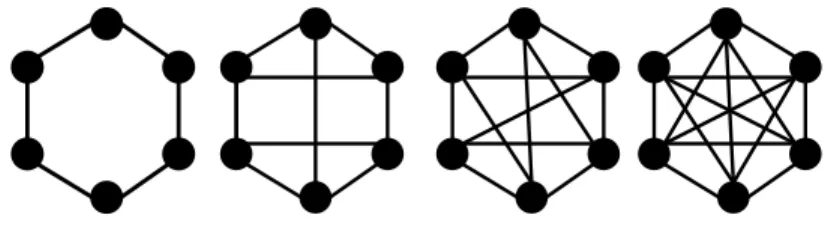
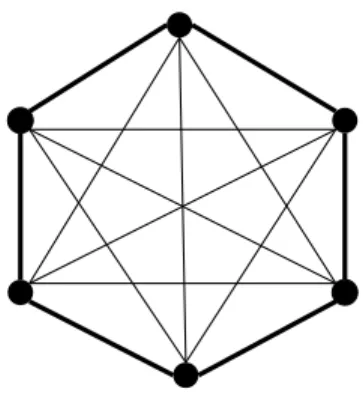
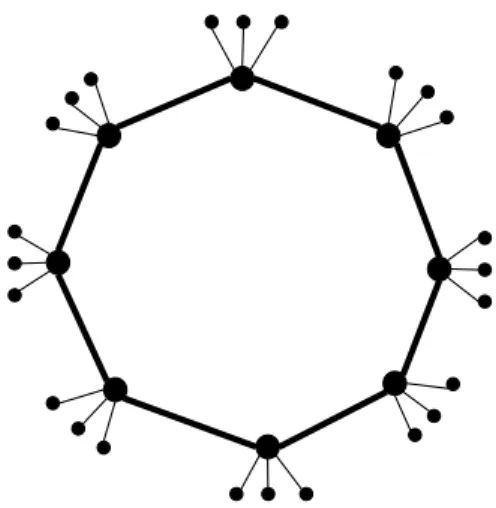
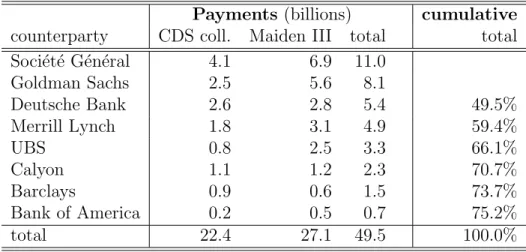
This paper clarifies the effects of “entanglement”: it is partially entangled financial systems, those resulting in sparse networks, that are most likely to be prone to crisis because of an inefficiently low ex ante choice of counterparty insurance. The sparse network structure of OTC contracts is crucial for the externality: it implies that every bank has exposures to only a few counterparties, so banks only care about the potential bankruptcy of their direct counterparties when making decisions. If instead the financial system was dense and each bank had the same exposure to every other bank in the system, the system would be constrained efficient. The interval of crisis probabilities, for which inefficiency prevails, shrinks as the network of hedging contracts becomes denser. The reason is that if every bank is directly linked to the failing bank, they cannot count on other banks’ insurance contracts to shield them from the crisis. Since they need to have insurance of their own to survive, free riding is not possible any more. The inefficiency results regarding sparse networks extend to entangled systems where banks hedge with most or all banks in the network but have some disproportionately large exposures. Interestingly, it is exactly the largest exposures that the banks fail to insure against, since these are the most costly to insure. The limited empirical data on OTC exposures of financial institutions, such as the exposures of AIG, indicate that the financial system indeed exhibits strong counterparty exposures: see Table 1 at the end of the paper.
The externality that leads to an inefficient ex ante choice of counterparty insurance can be elim-inated by regulatory intervention. One possibility is to mandate banks to buy default insurance on their counterparties from the other banks in the system. This could be implemented using a central-ized insurance fund or in a decentralcentral-ized way in the form of pre-funded credit default swaps (CDS). Thus this paper suggests that there are not enough CDS’s in the market: a counterintuitive conclu-sion given that CDS contracts also link banks together leading to an entangled system. In my model,
banks do not have enough default swaps on other banks that are their counterparties. In essence counterparty insurance makes the network dense and thus eliminates the free riding problem. It is an ex ante mechanism that stabilizes the financial system in case of the idiosyncratic failure of a bank in the core of the system, even if the regulator cannot observe the full network structure. It can be seen as a complement to the recession insurance proposal of Kashyap et al. (2008), which is designed to maintain the stability of the financial system in case of an aggregate shock affecting all banks.
An alternative policy intervention, if implementable, is to mandate the use of a central counterparty (CCP) for hedging risk. The important feature that helps overcome inefficiency in a CCP arrangement is loss mutualization: risks from the failure of a bank are spread evenly all over the system thus it makes all other banks internalize the full social cost of the collapse of another bank in the system, basically again making the network dense. Thus the reason a CCP would be welfare improving in my model is different from the reasons put forward by Duffie and Zhu (2009) and Acharya and Bisin (2009). My result that banks fail to insure against counterparty risk gives one potential explanation of why participants in the financial market have resisted the call for setting up a CCP for OTC contracts: it would basically act as an insurer, making trades more expensive.
The paper is structured as follows. Section 2 discusses how the paper relates to previous work. Section 3 shows the main inefficiency result in a baseline model with exogenous capital constraints. The full microfounded model is presented in Section 4: it endogenizes the capital constraint and highlights the role of short-term debt. Section 5 extends the analysis of the baseline model to more general network structures. In Section 6, I argue that the proposed contagion mechanism could have contributed to the Financial Crisis of 2008. Section 7 concludes and discusses avenues for further research.
2
Related literature
The seminal paper of Allen and Gale (2000) shows that while interbank deposits help banks share liquidity risk, they expose banks to asset losses if their counterparty defaults. In their setting, the probability of crisis is arbitrarily small so the crisis is socially optimal. Also, the underlying Diamond and Dybvig (1983) model does not explicitly model equity choice. This contrasts to my model where there is no direct credit exposure and I explicitly allow for anticipated crises, insurance against the default of a counterparty, and for equity choice. Allen and Gale (2000) also show that the system most prone to crisis is the one connected in a sparse network, a similar result in random networks is obtained by Gai and Kapadia (2007). However, this result is purely mechanical: if a bank has links to more banks in the interbank market, each of its interbank deposits is smaller and thus there is a smaller effect of any failure in the system. In my model, the same result is due to externalities when making ex ante choices. Babus (2009) extends the analysis to allow banks to hold mutual deposits to insure against the failure of a counterparty and finds a mixed equilibrium where some completely insure against failure; in my model, a centralized insurance market breaks down. Dasgupta (2004) allows for
positive probability of crisis but still solves for a social planner problem. Even though Soram¨aki et al. (2007) and Bech and Atalay (2008) show that interbank lending networks are indeed sparse, empirical evidence on contagion through interbank deposits shows that it is unlikely that large fractions of the banking system could collapse due to the mechanism outlined by Allen and Gale (2000): see Furfine (2003) for evidence from the US and Upper and Worm (2004) for Germany.
Kiyotaki and Moore (1997) develop a different model where bilateral credit links result from the specificity of intermediate goods, not from hedging of liquidity risk. They point out an externality due to the chain of credit: entrepreneurs are unwilling to renegotiate loans ex post since they do not internalize the benefits accruing to others in the credit chain. However, they not allow for counterparty insurance, only for insurance against the aggregate event. Rampini and Viswanathan (2009) also show that firms with limited net worth have such a large opportunity cost of equity that they might rationally forego hedging risk, however, there is no externality in their setting.
Other papers model externalities and contagion in credit markets, but without networks: Lorenzoni (2008) shows externalities through fire-sale prices, while in Adrian and Shin (2008) and Adrian and Shin (forthcoming), the channel of contagion is due to marking-to-market accounting rules. Cifuentes et al. (2005) show that the interaction between marked-to-market pricing and networks magnifies initial shocks due to forced liquidation.
Stulz (2009) lists three positive effects of a clearinghouse in OTC markets: netting, monitoring exposures, and spreading losses. I focus on the third, while the first two effects have been modeled previously. Duffie and Zhu (2009) show a clearinghouse would help reduce costly margin accounts by netting, Brunnermeier (2009) argues that netting stops worries about the creditworthiness of a single counterparty from leading to a systemic crisis. Acharya and Bisin (2009) show that market participants build up excessive exposures to risks without monitoring total exposures. On the other hand, Pirrong (2009) argues that a clearinghouse would reduce the incentives of market participants to monitor each other.
My paper also gives an alternative explanation for the breakdown of private coinsurance arrange-ments between banks, such as those discussed in Calomiris (2000). Acharya et al. (2008) attribute their collapse to the market power of institutions with surplus liquidity, while my paper shows that if banks are connected in a network, coinsurance collapses due to externalities.
Research on networks in finance has uncovered a number of externalities. Rotemberg (2008) studies the amount of liquidity needed to settle interconnected financial obligations using results from graph theory. Lagunoff and Schreft (2001) show that contagion in a financial network cannot only be backward looking through asset losses, but also forward looking: agents break links to reduce their risk exposure. Leitner (2005) extends this analysis to show that links prompt luckier investors to bail-out weaker investors to prevent contagion even without any ex ante commitment, while in my paper bail-out arrangements break down because of externalities in the network. Caballero and Simsek (2009) show that uncertainty about the network structure can lead to inefficient levels of liquidity hoarding, while Zawadowski (2009b) argues that uncertainty about the availability of funding in a credit network
can lead to over-hoarding of liquidity, even in the absence of any defaults in equilibrium.
3
Baseline model
I first introduce a baseline model to show the main source of inefficiency in entangled financial systems. I simply assume that there is a risk-adjusted capital constraint and banks that violate this constraint fail. Section 4 then presents a full microfounded model that rationalizes these assumptions. First, it shows how a moral hazard problem endogenously gives rise to a risk-adjusted capital constraint. Second, it proves that the capital constraint is indeed hard: banks that do not have enough capital experience a crisis of confidence and their short-term debt is not rolled over, pushing them into bankruptcy. In the generalizations of the network structure, in Section 5, I once again return to the baseline model due to tractability.
3.1
Setup of the baseline model
3.1.1 Banks
The model has three time periods: t= 0,1,2. I call these the initial, the interim and the final period. There are n markets on a circle indexed by i = 1...n, where n > 3. There are also n entrepreneurs who can each set up one bank in one of the n markets. I assume no bank can operate in multiple markets: one can interpret this as gains to specialization. In market i, bankican use its expertise to invest a unit att= 0 in a long-term real asset. This asset yields a return ofRi=R+i−i+1 in the
final period, where R is a constant, and i ∼ N(0, σ) are normally distributed independent random
variables with variance σ. Note that risks in neighboring markets exactly offset each other, thus they can be perfectly hedged away: see Figure 1.
i
i+1
i-1
R
i=R+ε
i-ε
i-1R
i+1=R+ε
i+1-ε
iR
i-1=R+ε
i-1-ε
i-2hedge ε
i-1hedge ε
iFigure 1: Market and risk structure around market i
The figure depicts the risk structure of the models in Sections 3 and 4. Ri is the return on
the real project i and R is a constant. The shocks are offsetting between neighbors and thus can be completely hedged.
3.1.2 Capital requirement
Entrepreneur i can choose to place capital Ki in the bank at t= 0 at an opportunity cost of c per
unit. However, it is not possible to raise capital at t = 1, except for transferring capital from one bank to another.4 There is a risk-adjusted capital requirement att= 1, e.g. a Value-at-Risk measure. If the bank holds a normally distributed risk with standard deviation σ1 att= 1, it needs to hold a
minimum amount of capital att= 1:
K =K(σ1) (1)
whereK(0)≥0, andK0(x)>0 forx >0. This capital requirement could be regulatory or endogenous and enforced by the market. If the bank does not have enough capital in t= 1, it goes bankrupt: I rule out partial liquidation due to the specificity of the real asset.5 In the full model of Section 4, I endogenize the capital constraint: investors rationally run on banks which do not have enough capital, thus the debt of these banks is not rolled over and they go bankrupt. Note that there is no explicit capital requirement as oft= 0 but agents rationally anticipate the capital constraint at t= 1 which might prompt banks to hold capital att = 0. In the microfounded model the absence of an explicit capital constraint att= 0 arises endogenously.
3.1.3 Uninsurable idiosyncratic shocks
There are two possible states of nature att= 1. With probabilitypthe state of nature is “crisis”: one of the banks on the circle receives an uninsurable idiosyncratic shock and goes bankrupt. The bank hit by the shock is selected with an equal probability, thus each bank fails with probability np. I refer to the state where there is no idiosyncratic shock, the state realized with probability 1−p, as “normal” times. This idiosyncratic shock in the times of crisis is the exogenous shock that can potentially drive the financial system into a systemic crisis. Note, however, that the state of nature being crisis does not lead to a systemic crisis in general: that depends on the endogenous capital choice of the banks. In the full model of Section 4, the uninsurability of the idiosyncratic shock results from a moral hazard problem.
3.1.4 Hedging and insurance contracts and payoffs
I assume capital is costly, so banks take decisions to credibly reduce risk: they hedge their risks. I also assume that only banks i and i+ 1 can contract on i, that is while they can sign an OTC
contract with each other to hedgei, they cannot hedge it with any other bank. One interpretation is
that you need to be present and have expertise in marketsiori+ 1 to be able to contract oni. One
example for such risks are CDS contracts on complicated collateralized debt obligations. Thus the banks hold risks that can be hedged using OTC contracts, leading to a financial system entangled in
4A similar assumption underlies the result of Shleifer and Vishny (1997): arbitrageurs cannot raise more capital in crisis. 5In general it would be enough to give an upper bound on liquidation value: if liquidation is too costly, it not only reduces
OTC contracts. I assume that the existence of these hedging contracts is observed by all participants. Also, recall that the risks of neighboring banks are exactly offsetting: while bank iholds +i, bank
i+ 1 holds −i. This assumption is not crucial and is only introduced to simplify the analysis.
If a counterparty defaults on a hedging contract, the contract is canceled and the risk offloaded to the counterparty lands back on the bank’s balance sheet. In case a bank does not have enough capital to bear this increased risk, it goes bankrupt. Even though banks cannot insure against the idiosyncratic shock that drives them into bankruptcy, they can in effect insure against the idiosyncratic shock of their counterparties by buying default insurance on them. I allow for such contracts in a centralized way: banks put up capital ex ante in an insurance fund which then pays it out to the claimants.6 Since banks cannot raise capital in crisis, the capital in the insurance fund has to cover all claims in all states of nature: it is pre-funded. If there is no crisis, the capital locked up in the insurance fund is returned to the banks at t= 2. The crucial assumption is that it is not verifiable whether or not a bank buys insurance. Given that in practice it is very easy to undo insurance by selling it short, this assumption seems reasonable.
If a bank goes bankrupt, it is liquidated for L < R. Thus if a bank goes bankrupt at t= 1 with endogenous probabilityq, holds capitalK, then the expected payoff of entrepreneur iis:
[1−q(Ki, K−i, ...)]·R+q(Ki, K−i, ...)·L−1−c·Ki (2)
Thus the full decision problem of bank i is: choose the level of capital Ki, whether to hedge i and
i−1, and what amount of default insurance to buy on its counterparties to maximize expected payoff.
Note that the probability of bankruptcy depends on the capitalK−iand the choices of all other banks.
3.2
Systemic crisis in equilibrium
I refer to financial networks, in which the collapse of a single bank leads to the collapse of the whole system, as contagious. If in a crisis all banks fail, I call that a systemic crisis. In this subsection, I show that for some intermediate values of crisis probabilityp none of the banks hold enough capital or counterparty insurance to survive, even if the network is contagious.
At first let us abstract from counterparty insurance. Based on the capital requirement, the mini-mum amount of capital needed to survive at t= 1 depends on whether the bank is hedging its risks. A bank in autarchy needs to hold capital of at least Ka =K(√2σ) since it holds two uncorrelated normal risks with standard deviation of σ. A bank with only one hedge needs Ku = K(σ), while a bank with both risks hedged needsKh =K(0). It is clear that in normal times if banks hedged their risks with their counterparties, then they can all survive with capital K(0), since they have no risk left on their balance sheets. However, if one of the banks fails and all banks hold capital K(0), then all banks fail in crisis. To see this point, assume bankj fails exogenously in crisis. Then banks j+ 1 and j−1 both have riskσ land back on their balance sheets at t = 1 since they become unhedged.
Given that they have only K(0) capital, they fail and now banks j+ 2 and j−2 become unhedged and thus fail, etc.
To see that holding onlyK(0) capital in a contagious system is a subgame perfect Nash-equilibrium, we have to analyze the potential deviation of one bank. Note that if the system is contagious, then the only deviation that can save the bank from liquidation is to completely self-insure by holding Ka
in order to survive even if all other banks, including its counterparties, fail. In this case, the bank only fails if it is hit directly by the exogenous shock, with probability np. However, it has to maintain a higher level of capital. This deviation to autarchy is profitable in a contagious system if and only if the payoff in case of holding capitalKais higher than the payoff when holding capital of only Kh:
(1−p)·R+p·L−1−Kh·c <1− p n ·R+ p n·L−1− ·cK a (3)
Thus a bank chooses to self-insure by holding substantial capital instead of hedging if and only if:
p > pa= n
n−1 ·c·
K √2σ−K(0)
R−L (4)
If p < pa the contagious system is an equilibrium even if counterparty insurance is available. The reason is that in the contagious system no bank contributes to the insurance fund, thus the deviating bank has to self-insure.
Now let us assume that counterparty insurance is available and all banks participate. The insurance pool has to be large enough to increase the capital of the two counterparties of the failing bank in order to stop them from going bankrupt: 2· Ku−Kh
= 2·[K(σ)−K(0)]. Thus in essence all banks not directly affected by the crisis transfer capital to the two banks neighboring the failed bank through the insurance pool. I assume the insurance is fairly priced: given the symmetry of the setup, the private cost for every participant is to pay the costs of holding additional capital of n2 ·[K(σ)−K(0)] locked up in the insurance fund.
Such an insurance scheme is sustainable if no bank chooses to opt out. Let us analyze the possible deviation of a single bank. If a bank opts out, the probability that the bank goes bankrupt and thus has to liquidate its assets increases from np to 3np, since given that it is uninsured, it also collapses if either of its counterparties collapses. The private benefit is that it does not have to contribute to the insurance fund at all. Thus a bank stays in the insurance scheme if and only if:7
1− p n ·R+ p n·L−1−K(0)·c−2· K(σ)−K(0) n ·c > 1−3p n ·R+3p n ·L−1−K(0)·c (5)
Note that if any bank has an incentive to opt out, that means that every other bank will opt out, since they all face the same decision. Furthermore, only every other bank contributing to the scheme
7In this simple calculation I assume that the rest of the system is still stable if one bank opts out, i.e. no bank is pivotal
in implementing the scheme. Technically this would only be true if the initial insurance fund was n+1n times the minimum necessary to bail out two banks. However, this knife-edge feature is only due to the deterministic nature of the setup, if there was uncertainty regarding how much money is needed in the fund then no bank’s contribution would be pivotal.
is not an equilibrium either: although the probability of being hit by the crisis doubles due to every other bank being uninsured, so does the price of insurance. In a similar way it follows that no mixed equilibrium is possible: see the Proof of Proposition 2 for a detailed discussion. Thus the insurance scheme is sustainable if and only if:
p > piout =c·K(σ)−K(0)
R−L (6)
Since piout < pa, there is a range with multiple equilibria: both the systemic crisis and the stable system with insurance are equilibria. The insurance is socially optimal if the total welfare of the system with counterparty insurance is higher than that without it:
(n−p)·R+p·L−n−n·c·K(0)−c·2 [K(σ)−K(0)]
>(n−n·p)·R+n·p·L−n−n·c·K(0) (7)
where the left hand side is the payoff of allnbanks in a stable system with counterparty insurance and the right hand side is that without insurance, in a contagious system. Thus counterparty insurance is socially optimal if and only if:
p > ps= 2
n−1·c·
K(σ)−K(0)
R−L (8)
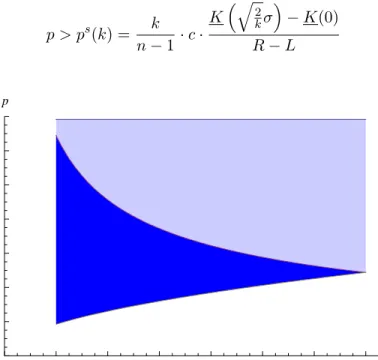
Note that asp→0, the financial system completely collapses in crisis and crisis is socially optimal, as in the analysis of Allen and Gale (2000). However, in an intermediate region of crisis probabili-tiesp∈(ps, piout), counterparty insurance is not sustainable in equilibrium, even though it is socially optimal: I call this the inefficiency region. In Subsection 5.1, I generalize the model from two coun-terparties tokand show that the inefficiency region shrinks as the networks becomes more dense and eventually disappears once the network of hedging contracts is complete.
What is the missing market that makes the privately optimal choice social inefficient? In the model, it is due to the assumption thathedging contracts cannot be made conditional on the coun-terparty’s decision on counterparty insurance. If implementable, so called “due diligence” contracts could in theory lead to demanding that counterparties hold insurance against the default of their own counterparties. However, if others cannot observe whether such a covenant is indeed implemented, efficiency is not restored. This is due to the fact that it would still only incorporate the private benefits to the two counterparties, but not to the system as a whole. Counterparties could still decide to drop the clause and thus increase their own expected payoffs.
3.3
Possible policy responses
In case of inefficiency, mandatory counterparty insurance would be welfare improving. There are two main mechanisms to do this: using a central insurance fund like the one modeled above or
a decentralized system of default swaps. The decentralized system has to insure that each bank buys the same amount of default insurance on its counterparties from all other banks. In case the sellers of the insurance have to put up the maximum amount of money they might have to pay on their insurance contracts ex ante into a separate fund, the decentralized system is equivalent to the centralized one. The decentralized insurance scheme has the advantage of letting the market price the insurance, however, if the default swaps are not well diversified then that results in another layer of counterparty risk on top of the existing one. Having to buy default insurance on one’s counterparty also discourages contracting with financial institutions with high probability of default. A potential drawback of the decentralized scheme is that if banks want to game the regulation they could easily set up a firm, like a monoline insurer, that issues very cheap default insurance for all agents to cover the needs from regulation but then fails to pay in crisis. However, this can be overcome by mandating that default insurance be pre-funded, thus capital set aside ex ante to pay in case of default events. In theory it is not necessary that the regulator implement mandatory counterparty insurance, it is enough if it continuously verifies whether banks have counterparty insurance and then banks can sign contracts that are contingent on others’ counterparty insurance. While banks could hypothetically set up a self-regulatory framework to verify counterparty insurance, it seems unlikely that such an entity would be able to verify insurance without the powers of a systemic regulator.
Another possible policy I did not discuss yet is mandating the use of a central counterparty (CCP) with loss mutualization. This would ensure that the risks after the default of a bank are spread out to all other banks, similar to that in case of mandatory counterparty insurance. However, this approach crucially assumes that the OTC contracts can be standardized and the CCP can manage them even if one of the banks who was the original counterparty goes bankrupt. The framework I use, based on special risks which can be only traded OTC, hints that such an approach might not be viable. Nevertheless, we can analyze and compare it to the results from the insurance fund. The risk in the system after the default of one bank has standard deviation of √2σ and is split up between the remaining n−1 banks. Thus each remaining bank needs additional capital ofK
√ 2σ n−1
−K(0): the
total amount of capital to be pledged in the so-called “guarantee fund” is (n−1)·hK √
2σ n−1
−K(0)i. This can be compared with the capital of the centralized insurance fund: 2·[K(σ)−K(0)]. For example if the capital constraint is linearK(x) =x, then the amount of capital in the CCP guarantee fund is only √2σ, while that in the insurance fund is 2σ. Thus the CCP, if implementable, is more efficient. This is true in general if the capital requirement is convex: K00(x) ≥0 . Convexity implies
n√−1 2 ·K √ 2σ n−1
< K(σ) since K(0)≥0 andn >3 by assumption, yielding the result.
The fact that while default insurance on large banks is easily standardized, while other risks are not, leads to a potential hybrid setup. This would standardize default swaps on large banks as reference entities and make them available through the CCP, basically resulting in an insurance fund. All other OTC contracts that can be standardized can be traded through the CCP as well. For all other products that are not standardized or traded through the CCP and thus remain OTC, counterparty insurance would be mandatory. To ensure that counterparty insurance does not add another layer of
entanglement to the system, they would have to be purchased from the CCP. The notional amount of insurance that would have to be bought for each OTC instrument would be determined by the amount of extra capital that would be required if the bank held it on its own balance sheet. Note that this is much more efficient than making all banks keep enough capital to survive a crisis, which in the model means forcing all banks into autarchy. The reason is that in case a bank defaults, the insurance scheme surgically injects the capital into the counterparties of the failing bank and thus stabilizes the system.
3.4
Discussion of model assumptions and robustness
In this section, I discuss some of the key assumptions of the baseline model and also argue that the main results would still hold up if some of the assumptions were relaxed. Assumptions of the microfounded model are discussed in Subsection 4.3.
A central assumption implicit in the structure of the model is that banks cannot rehedge with other banks if their counterparty fails. Even though this assumption is extreme, it captures the fact that rehedging is very costly in crisis. Evidence from the aftermath of the Lehman default suggests that even if counterparties could rehedge, they incurred huge losses,8 since they had to rehedge in a very volatile market with counterparties who were less willing to hedge away their risks. Also, many risks are specialized and thus illiquid, even more so in crisis, making them even harder to replace (Stulz 2009). The qualitative results of my analysis would hold if rehedging were possible but costly. A theoretical question is why only two banks can contract on each risk and how these contracts are enforced. Here I propose one way to rationalize these assumptions. Assume that the realization of is observable and thus enforceable by the court. Ex ante each bank has several types of risks which are indistinguishable from therisk for any outside bank. However, not all risks have a normal distribution like the risk, they might be skewed such that if the bank can sell this risk for price zero to another bank, it makes substantial profits. Thus except for banksiandi+ 1 which can distinguish risk i risk from other risks, no other bank will be willing to buy risk i, since it is afraid of “being
taken for a ride”. This kind of market breakdown due to asymmetric information is akin to the lemon’s problem of Akerlof (1970).
Another important question is whether some entrepreneurs would want to sit on the sideline to buy real assets as banks fail. However, this is not the case since entrepreneurs have a large opportunity cost and crisis are relatively infrequent. Thus they would have to buy assets at huge discounts (low liquidation value) to make up for the large opportunity cost of sitting on liquid assets: liquidation in a real sense is still better.
4
Full microfounded model
This section extends the baseline model and provides a microfoundation for the contagion mechanism. It endogenizes the capital constraint and highlights the importance of short-term debt. The basic intuition is the following. When a bank becomes more risky, because of the failure of a counterparty, it is more likely to go bankrupt. This in turn means its non-pledgable payoff, that is conditional on survival, decreases and thus it cannot convince its short-term lenders that it has the proper incentives to exert effort. This leads to a crisis of confidence and short-term lenders do not roll over the bank’s debt. The section also shows that banks endogenously choose short-term financing.
A reader only interested in the insights of the paper regarding inefficiency can skip this section at first reading. The basic setup of the model is similar to that described in Section 3. Nevertheless, I still describe the full microfounded model in this subsection in order to avoid any confusion. Given the complexity of the full microfounded model, the results in this section are presented in the form of Lemmas and Propositions. All proofs are relegated to the Appendix.
4.1
Model setup
4.1.1 Participants and markets
The model has three time periods: t = 0,1,2. There are n markets on a circle indexed by i= 1...n, where n > 3. There are two types of market participants: n entrepreneurs and a continuum of investors, both of them assumed to be risk-neutral. Only entrepreneurs can invest in risky real assets, investors can only invest in bank debt.
Entrepreneur ican set up a bank in market i, and no bank can operate in multiple markets. By establishing a bank, the entrepreneur becomes both manager and equityholder of the corresponding bank, i.e. there are no agency issues between the owners and the management of the bank. As equityholders, entrepreneurs have limited liability. The equity provided by the entrepreneur is the capital of the baseline model. Entrepreneurs have an outside option to invest in an asset with expected return of Re in the long run (from t= 0 to 2), which they cannot liquidate in the interim period.
The other type of participant is a continuum of investors, who cannot invest in bank equity, only debt issued by the bank. Investors can be interpreted as uninformed life-cycle savers.9 Thus bankiis
financed by equity (stock) Ki≥0 provided by entrepreneurs and debtDi ≥0 provided by investors.
Both market participants are risk neutral, have abundant capital att= 0, and value payoff only in the long run. Neither of them gets additional endowment att= 1. All participants in the market have full understanding of the model of the economy, know the network structure,10 and act rationally.
9I take it as given that they prefer simple debt securities. For a model of how debt is informationally insensitive and
preferred by uninformed investors, see Gorton and Pennacchi (1990).
10This assumption can be relaxed: it is enough if agents know that all banks are connected and each lender knows the
4.1.2 Investments
In market i, bank i can use its expertise to invest a unit in a long-term real asset which yields a return ofRi =R+i−i+1−δi in the long run, whereR is a constant andi∼N(0, σ) are normally
distributed independent random variables with variance σ. Note thatrisks in neighboring markets exactly offset each other like in the baseline model: see Figure 1. The new term compared to the baseline modelδi is an idiosyncratic shock to the bank’s asset value, the realization of which depends
on bank i’s effort: see Subsection 4.1.3. If the investment is liquidated early at t= 1, it only yields
L < R. I assume that all the liquidation value accrues to the bondholders and cannot be reinvested in the real asset.
In addition to the real asset and bank debt, there is a third asset, an outside liquid riskless asset, I call them government bonds. Both agents can invest in government bonds, which have a return of
Rf,0in the short run (from 0 to 1). For analytical simplicity I setRf,0= 1. The return on government
bonds from t= 1 to 2 is Rf,1. Government bonds are short-term investments and can be liquidated
costlessly at t= 1. The amount of government bonds, held by the bankiis denoted by Gi, thus the
accounting identity becomes 1 +Gi=Ki+Di.
I assume Re > R > Rf,1.11 This can be interpreted as the talent of entrepreneurs, e.g. financial
sophistication, being scarce. To achieve this desired higher return, they borrow from investors using debt contracts. However, entrepreneurs do not have any superior investment possibility in the interim period.
Projects also have a non-pledgable payoff of X: if a bank survives the last period in the model, i.e. can settle all its contractual obligations, it gets this additional payoff. It can be thought of as franchise value, expertise of the bankers, growth opportunities, certain types of intangible capital, etc. It cannot be seized by the creditor in case of default since it is only valuable within the bank, if the bank survives. Even though banks cannot directly borrow against it, it still has an important role in the decision of the banks in the interim period. The idea of using the threat of termination to induce effort is similar to that of Bolton and Scharfstein (1990).
4.1.3 Moral hazard and idiosyncratic shocks
Banks are subject to moral hazard: the idiosyncratic componentδi of the long-term project of bank
i depends on the bank’s unobservable effort choice ei,0 ∈ {0,1} at t = 0 and ei,1 ∈ {0,1} att = 1.
Following the model of Holmstr¨om and Tirole (1997), banks get private benefitBi=B0∗(1−ei,0) + B1 ∗(1−ei,1) depending on their efforts. That is, if they exert full effort in both periods, they get
0, while if they shirk in both periods, they getB0+B1. Since the shareholders and the management of the bank are the same, this can be both thought of as direct payoffs to the equityholders or higher wages and perks to the management: for a detailed discussion see Subsection 3.2. If a bank goes bankrupt att= 1, I assumeei,1= 1, thus there is only private benefit based on the effort at t= 0.
11The required return on equity is taken as exogenous here but could be endogenized using scalable investments and limited
The idiosyncratic shock does not only depend on effort. With probability p the unobservable state of nature is “crisis”: one bank on the circle gets the worst possible idiosyncratic shock, δi =d,
irrespective of its effort. Formally we can write:
δi = max [d(1−ei,0), d(1−ei,1), µi] (9)
for alli= 1...n. δiis stochastic since it depends on a stochastic variableµi, which I call adverse shock:
µ∼ with probability 1−p: ∀i:µi = 0 with probability p: ∀i6=j:µj = 0 fori=j:µi =d (10)
where, in the crisis state, bankj is selected with an equal probability pn from {1,2...n}.
Thus the idiosyncratic shock can take on a bad value for three reasons: shirking in the initial period, shirking in the interim period or simply bad luck. In normal times, δi = 0 if bank i exerts
full effort, and δi = d if it shirks in either period. However, in times of crisis, one of the banks
receives δi =d irrespective of its effort, while the other banks get the idiosyncratic shock according
to their efforts. This large shock to one bank can be thought of as a risk outside the standard model used by market participants or simply a mistake: something that cannot be hedged, but still market participants know there is some small probability of it happening.
Even though market participants do not directly observe efforts, they do get a signal about the expected realization of δi att= 1. The signal is:
si = max [d(1−ei,0), µi] (11)
That is they get a bad signal about a bank if it either shirked in the initial period or if it was hit by the idiosyncratic shockµ. Since the effort choices are only observable by banki, outsiders cannot tell apart bad luck from shirking. In equilibrium, bad realizations of si are due to bad luck but any
insurance leads to a moral hazard problem, making these idiosyncratic risks non-insurable: see Lemma 7. Given that in the equilibrium of this model the banks choose full effort, the idiosyncratic shock driving the results of the model and leading to a potentially systemic crisis is the shock unrelated to effort hitting a single market in case of crisis.
4.1.4 Contracts
Banks can choose between long-term and short-term debt financing. Short-term debt has to be rolled over at t = 1, thus debtholders have an option to withdraw funding and force the bank to liquidate the real project. They can also reset the interest rates in the interim period based on the observed behavior of the bank, even if writing such a state contingent contract is hard ex ante in the initial period. The benefit of short-term debt is that it has a lower interest rate since it can be withdrawn
in a state-contingent way and thus can help overcome the moral hazard and risk shifting problem at
t= 0. I do not allow long-term debt to be explicitly state-contingent on bank actions, since in practice a bank’s risk management is hard to verify. The benefit of long-term debt, on the other hand, is that it is a safe financing source even in crisis. I do not allow for the renegotiation of debt contracts. Given that large financial institutions usually issue bonds and commercial papers, renegotiation does not seem to be a viable option in practice.
As in the baseline model, banks can write hedging contracts. To establish an contract between two banks, both banks have to agree in the initial period to enter into the contract. I rule out the Nash equilibrium of no hedging contracts if there is also an equilibrium where the contract is established: in essence I use the pairwise stability concept of Jackson and Wolinsky (1996). Why do banks choose to hedge at all, since debt contracts induce risk-shifting? The reason is that in equilibrium the banks choose short-term debt, and the riskier the bank, the more equity it has to keep in order to roll over its debt.
I also allow for buying counterparty insurance from a centralized insurance fund. Like in the baseline model, banks have to put up some of their equity ex ante since the fund has to be able to pay out all claimants in crisis. I assume that the existence of counterparty insurance is non-verifiable, thus the price ofhedging contracts cannot be made conditional on the counterparty having default insurance on its own counterparties. In practice it is indeed hard to verify counterparty insurance, since it can easily be undone by offsetting contracts. Note that the setup is symmetric, so assuming equal bargaining power, the banks do not pay each other for the hedging contract, it has price zero at t= 0. Since no information is revealed about ’s in the interim period, the price of the contract remains zero at t= 1.
Bondholders have seniority to equityholders and get an equal share of the proceeds from liquidating the bank. Furthermore, if the bank defaults in the interim period, all its state contingent hedging and insurance contracts are canceled without payment.12 Given that the expected value of everyis zero att= 1, this is their fair value. However, if banks survive until the final period oncerisks are realized, then they first have to settle their hedging contracts before paying back debt. These assumptions model the main features of U.S. bankruptcy laws regarding derivatives (Bliss and Kaufman 2006).
4.1.5 Timeline of events and information sets
The timeline of events is the following. Att = 0, the initial period, banki, using its own resources, decides on whether to invest one unit in real asset i and how much government bonds Gi to hold.
Then it can decide whether to leverage up using either long-term or short-term debt: one way to do this is through share repurchases. It then chooses effort level ei,0 ∈ {0,1} and whether to sign OTC
contracts to hedge theirrisks.
12Counterparties can close-out contracts with a failing bank and demand the replacement value. However, if the replacement
value is not covered by collateral the counterparty becomes a general creditor and is subject to the automatic stay provision in bankruptcy. Thus unless the liquidation value is high, counterparties suffer substantial losses or have to take back the risk on their balance sheets.
At t = 1, the interim period, all market participants get the signals si for all i’s. They also get
information about all the hedging contracts outstanding in the market. If investors hold short-term debt they can decide whether to roll over the debt or collect proceeds and invest in government bonds instead. If the bank goes bankrupt because its short-term financing is not being rolled over, it has to liquidate its real project. If banki receives continued financing, it then chooses effortei,1 ∈ {0,1}.
At t= 2, the final period,’s are realized, real investmenti yields payoff ofRi, hedging contracts
are settled. Banks pay back their debt and all banks that could fulfill all their obligations, i.e. survive, get an extra non-pledgable payoff of X. Finally, all participants consume their payoffs.
4.1.6 Entrepreneur’s choice
The entrepreneur’s problem is to choose the maximum expected payout, given some constraints. The first choice is between long and short-term debt. This decision is made given the schedule of rates posted by investors. Given that in Subsection 4.2.4 I show that in equilibrium long-term debt financing is not offered by investors due to the commitment problems in the model, here I only present the choice in case of short-term debt.
In case of short-term debt financing, entrepreneur i’s problem is to choose debt (bond) Di, equity
(stock)Ki, liquid reservesGi, effort levels, and hedging contracts to maximize:
(1−π1)·Et=0[max(0, Ri+Rf,1Gi−Rl,1Rl,0Di+Ci)|A] + (1−π1)·(1−π2|1)·X−Re·Ki (12)
where the event Ais survival at t= 1. The maximization is subject to the following constraints: (1−π1)·Et=0[max(0, Ri+Rf,1Gi−Rl,1Rl,0Di+Ci)|A] + (1−π1)·(1−π2|1)·X−Re·Ki≥0
(13)
1 +Gi =Ki+Di (14)
Et=1[max(0, Ri+Rf,1Gi−Rl,1Rl,0Di+Ci)] + (1−π2|1)·X≥B1 (15)
The first constraint is the participation constraint of the entrepreneur, the second one is the accounting identity that assets equal liabilities. The third constraint ensures that the bank exerts effort at t = 1 conditional on surviving. Ci is the net payoff from hedging and insurance contracts
that bankihas signed. π1 is the endogenous probability that the bank goes bankrupt att= 1. π2|1 is
the probability that the bank fails att= 2, conditional on surviving att= 1. Rl,0 is the endogenously
determined interest rate paid by the entrepreneur on its short-term debt fromt = 0 to 1, whileRl,1
is that from t= 1 to 2. To receive the final payoff, both pledgable and non-pledgable, the bank has to survive both periods t = 1 and t = 2 without ending up bankrupt, this occurs with probability (1−π1)·(1−π2|1). The max operator makes sure that payoff att= 2 is only taken into account if the
bank can repay all its obligations. It is assumed that in case of bankruptcy, shareholders are wiped out completely, an assumption that is proved in Lemma 3. The incentive compatibility constraint at
t= 0 is not spelled out since it is satisfied in equilibrium, otherwise investors would not lend in the first place.
4.1.7 Debtholder’s choice
Interest rates are determined endogenously such that investors break even. Investors anticipate the banks’ equity and investment choices in equilibrium. The expected return on bank debt has to be the same as the return on government bonds with corresponding maturity. If the bank does not go bankrupt, creditors are repaid fully. In case there is a shortfall of proceeds compared to debt obligations, all creditors share equally. This means that there is no strategic interaction between them, thus liquidation only happens when it is optimal for all bondholders of that bank, i.e. there is no front-running. In general, even if the model has a good equilibrium there is a bank-run equilibrium. Following Allen and Gale (2000), I rule out the bank-run equilibrium in case there is a non bank-run equilibrium as well.
I assume that debt does not carry any covenants, thus the amount of debt and the interest rate on it cannot be contingent on any given level of equity, thus the bank takes interest rates as given. However, ex post the decision whether to roll over debt can depend on the amount of equity held by the bank. This is an important simplifying assumption, since equityholders can take interest rates as given when making decisions. Also, this assumption rules out long-term borrowing, since with long-term debt there is no interim decision to verify a bank’s level of equity and risk exposure. This assumption is by no means central to the results: see the discussion in Subsection 4.3.
4.1.8 Parameter restrictions and assumptions
A following parameter restrictions are needed in order to make the problem relevant to modeling counterparty risk in a contagious network:
L > R−d >0 (16)
d > B0+B1 (17)
B1≥(R−Rf,1) +X (18)
R−B1> Rf,1L (19)
The restriction of Equation 16 ensures that it is rational for debtholders to liquidate a project when the bank does not exert effort. This is crucial, since otherwise one would need some kind of bank-run framework to ensure contagion. While I do believe this is a possible channel, the main goal of the paper is to show that systemic crisis is possible in an entangled financial system, even without coordination issues between investors. Restriction 17 means that it is socially optimal to exert effort. Equation 18 ensures that banks have to keep at least some equity to overcome moral hazard and banks cannot operate with negative equity. Restriction 19 implies that a bank does bankrupt if its debt is not rolled over in the interim period.
To ensure that short-term borrowing is feasible, even though long-term borrowing is not, one has to place an upper limit on B0, the private benefit from shirking in the initial period. Furthermore, to make sure that the entrepreneur’s participation condition is satisfied ex ante, one has to place an upper bound on the return on the outside option to entrepreneurs. The following, not too intuitive, Assumption 1 does both. Note that the coefficient of Re is positive (by restriction 18), making
Assumption 1 an upper bound onRe.
Assumption 1. (1−p)B1 > B0+Re 1−(1−p)R+X−B1 Rf,1
The following technical Assumption 2 is made to facilitate the solution of the model. It is needed because in the model hedged banks hold no risk, thus there is no risk-return tradeoff. In a more general model where banks can choose how much risk to keep on their balance sheets and there is a risk-return tradeoff, this assumption could be relaxed. However such a model would be much less tractable without providing much additional insight.
Assumption 2. σ ≥ √ 2 √ π · p·X Re Rf,1 1− p nL −1
4.2
Systemic run and crisis in equilibrium
4.2.1 Equilibrium with contagion
First, let us abstract from counterparty insurance, it is added to the analysis in Subsection 4.2.6. Given the parameter restriction of Subsections 4.1.8, I prove the existence of the following subgame perfect Nash equilibrium for an intermediate range of crisis probabilities. Banks choose to finance their operations using short-term debt, which is used as an incentive device to ensure prudent behavior at
t= 0. Since equity is costly, banks hold equity that is just enough to make the incentive constraint to exert effort in normal times satisfied at t = 1. This means there is no slack equity to use in crisis. When one of the banks defaults, all banks default. The defaults are driven by all short-term debtholders denying to roll over debt. Debtholders run since they know that if the neighboring bank collapses and they do not run then the bank they lent to becomes risky because it lost one of its
hedges. This increases the probability that it ends up bankrupt at t = 2 and in turn reduces the expected value of the non-pledgable payoff as of t = 1. Since the non-pledgable payoff is used as reputational collateral in the incentive constraint, the incentive constraint is now violated. Thus it is optimal for the debtholders to withdraw their funding and liquidate the project instead of letting it mature while the bank shirks.
In the following I show, step by step, that the proposed equilibrium exists: this yields the micro-foundation for the baseline model of Section 3. First, we conjecture that banks use short-term debt and hedge their risks. Lemma 2 calculates how much is the minimal equity needed to ensure that
debt is rolled over in the interim stage given the level of riskiness of the bank’s assets. Lemmas 3 and 4 prove that the contagion mechanism indeed leads to the collapse of all connected banks. Then, in Lemmas 5 and 6, we verify that short-term debt financing is chosen over long-term debt and that hedging of risks is optimal for banks. Finally, Proposition 1 shows that if the probability of crisis is small, then banks endogenously choose to hold only the minimum amount of equity and thus the system is contagious and completely collapses in crisis.
4.2.2 Minimal equity needed for rolling over debt
Lemma 1. Banks do not hold government bonds: Gi= 0 for alli.
The basic insight is that holding government bonds does not alleviate the incentive constraint since it does not mean having more equity. Since government bonds have a lower return than that at which banks can borrow, they have no incentives to hold any.
In the following I set G = 0, since by Lemma 1 holding government bonds is never optimal for a bank. I conjecture that the banks use short-term debt and that they hedge their risks. I verify this in Lemmas 5 and 6. It is also assumed that in case of bankruptcy, shareholders are wiped out completely, a conjecture that is proved in Lemma 3. For notational simplicity I drop the subscripti
since entrepreneurs are ex ante symmetric.
Now we calculate the minimal amount of equity K(Rl,0, σ1), that needs to be held by the bank to
make sure the incentive constraint is satisfied in the interim period if it holds risks of standard deviation
σ1 att= 1. Banks need to hold equity since creditors are worried that banks could misbehave in the interim period and collect private benefitsB1.
Lemma 2. If a bank has a final payoff with expected value R and normally distributed risk σ1 as of t= 1and is financed by short-term debt, then the minimum amount of equity to be held by this bank to avoid a withdrawal of debt financing at t= 1 is given by the following implicit equation:
K(Rl,0, σ1) =
B1−(R−Rf,1Rl,0)−[1−π2|1(Rl,0, σ1)]·X Rf,1Rl,0
(20)
where the endogenous probability of default at t= 2 is:
π2|1(Rl,0, σ1) = Φ R l,1Rl,0[1−K(Rl,0, σ1)]−R σ1 (21)
and Φ denotes the cumulative density function of the standard normal distribution. The short-term rate Rl,1 charged to the bank att= 1 is determined endogenously. Also,K(Rl,0, σ1)≥0 and ∂σ∂K1 >0. This lemma provides the microfoundation for the capital constraint in the baseline model, since the functionK(x) =K(Rl,0, x) fulfills the two assumption made there: K(0)≥0 andK0(x)>0. Also
note that the minimal amount of equityK is decreasing in the bank’s expected non-pledgable payoff 1−π2|1
“collateral” to overcome the moral hazard problem. Thus if the expected value of non-pledgable payoff decreases because of an increase in the probability of bankruptcyπ2|1, more equity is needed to ensure
high effort. In fact the increase in the required amount of equity in crisis is the main mechanism that leads to withdrawal of short-term financing.
4.2.3 Minimal equity is not enough in crisis
To show that all banks collapse in crisis if they all hold equity of onlyKh(Rl,0) =K(Rl,0,0), as if they
were riskless, two steps are needed. First, in Lemma 3, I show that the bank, the market of which is hit in crisis by the adverseµshock, fails. As a next step, in Lemma 4, I show that if bankicollapses and leaves its counterparty, banki+ 1, unhedged, that counterparty will also suffer a run of creditors, i.e. its debt will not be rolled over and thus it too will fail. Since all banks are linked, lenders of all banks will rationally run.
Lemma 3. If a bank only holds equity ofKh(Rl,0), it goes bankrupt if its debt financing is not rolled
over at t = 1. If for bank i, the signal about final payoff at t= 1 is low si =d, then its creditors do
not roll over its debt and thus the bank has to be liquidated because it is bankrupt.
The interpretation is straightforward. Consider the bank, the long-term project of which is guar-anteed to have a bad payoff, either because of the shockµor because of an unhedged risk. It is optimal for its creditors to demand the project be abandoned and liquidated, since that is still better than letting this bad project run. In fact, this is exactly the rational for short-term debt: creditors want to have the right to terminate a project if it is surely going to have a very low return e.g. when the bank did not exert sufficient effort in the initial period. Note that at this point ruling out renegotiation is important: see Subsection 4.3 for a discussion.
The next step, formalized in Lemma 4, is at the heart of the contagion mechanism: if all banks hold only an equity ofKh(Rl,0), the failure of a counterparty, with which it hedged anrisk, leads to a
violation of its incentive constraint, thus it would choose to shirk so it is also preemptively liquidated by its creditors by a run.
Lemma 4. In case a bank holds equity of Kh(Rl,0), it exerts full effort at t= 1 if both of its
coun-terparties survive. However, it chooses to shirk if one or both of its councoun-terparties defaults leaving it unhedged: its debt is not rolled over at t= 1, it goes bankrupt and its real project is liquidated.
Lemma 4 highlights the main mechanism of contagion through the loss of hedging contracts. The intuition is as follows: if a bank collapses and leaves its counterparty unhedged, that bank will become more risky. Becoming more risky means that there is a larger probability of it going bankrupt at the final date oft= 2. This in turn reduces the expected value of non-pledgable payoff beyond the long run. However, non-pledgable payoff was used as collateral in the incentive problem: basically it is used by banks to be able to commit to high effort even with relatively low levels of equity. This mechanism, to my best knowledge, has not been proposed previously as a potential cause for a cascade of bank runs induced by wholesale creditors or bondholders.
4.2.4 Choice of debt maturity and hedging
Now I show in Lemmas 5 and 6 that-hedging and short-term borrowing is indeed the optimal choice for banks. Given the assumption that banks cannot commit to a capital structure att= 0, long-term borrowing is not feasible. Lemma 5 below formalizes this intuition.
Lemma 5. Since banks cannot commit to a given equity level at t = 0, long-term borrowing is not offered by the investors, thus entrepreneurs use short-term debt. Furthermore, they are willing to participate in the market.
Long-term lending is impossible under these assumptions since if the investor has no mechanism to enforce that the bank has some level of equity and contracts at the interim period, there is no way the bank can commit to exerting effort. Once the bank has raised long-term debt it is always worthwhile to shirk and collect private benefits. Thus in this model, the short-term debt is an optimal outcome like in Calomiris and Kahn (1991) and Diamond and Rajan (2001). In practice it might be the case that using short-term debt is an inefficient outcome like in Brunnermeier and Oehmke (2009), however, since I focus on the inefficiencies due to the network of hedging contracts, I choose to model short-term debt as an efficient choice.
Lemma 6. For any i∈ {1...n}, bank i completely hedges risk i with bank i+ 1, and risk i−1 with
bank i−1 in case debt is short maturity.
The basic insight is that with short-term debt, banks are punished by higher borrowing rates, or even withdrawal of funds in the interim period, if they do not hedge their risks. Thus even though the entrepreneur’s payoff is a convex function of the pledgable payoffs of the bank’s operations, the entrepreneur cannot gain from shifting risk to debtholders. Furthermore, not hedging also decreases the expected value of their non-pledgable payoff, through the increased probability of bankruptcy, so all in all they lose by not hedging their risks. The Lemma also highlights the strong incentive to get entangled in these OTC hedging contracts: hedging decreases the amount of equity that has to be held in order to satisfy incentive constraints, since a hedged bank is less risky. It also makes clear that banks do not simply engage in hedging to lower the capital requirement set by the regulator: there is an underlying moral hazard issue that is the “raison d’etre” of these contracts.
4.2.5 Contagious system in equilibrium
Similarly as in the baseline model, a potential deviation from the proposed contagious Nash-equilibrium is that a bank chooses to hold a higher amount of equity, to make sure it survives the crisis. An autarchic bank holds total risk of√2σ, so the amount of equity it needs is: Ka(Rl,0) =K(Rl,0,
√ 2σ). Intuitively, if the probability of a systemic crisis is high, it is worth to self-insure, while if it is low, given the high costs of holding equity, no bank chooses to self-insure. Proposition 1 formalizes this intuition and gives a cut-off value in the probability of crisis p.
Proposition 1. There exists a pˆa > 0, such that if p < pˆa, then there is an equilibrium where all banks hold equity of onlyKh(Rhl,0) and the system completely collapses if a single bank fails, i.e. if the financial network is contagious. The implicit equation for pˆa is:
ˆ pa= Re[K a(Rh l,0)−K h(Rh l,0)]−π˜2|1X n−1 n B1−π˜2|1X (22)
The equation is implicit for the cutoff value of pˆa since both Ka(Rhl,0) and Ka(Rhl,0) depend on pˆa
throughRhl,0. π˜2|1 is the endogenous probability of bankruptcy. In the specific case where the system is
contagious and all banks fail in crisis, the endogenous short-term interest rate at 0 is:
Rhl,0 = 1
1−p1− Rf,1L
R+X−B1
(23)
Furthermore, the entrepreneurs’ participation constraint holds in this equilibrium.
4.2.6 Suboptimal counterparty insurance
Since the adverse idiosyncratic shockµin crisis is so devastating to the system, it might be worthwhile to insure against it. However, due to the moral hazard problem, such an insurance is not possible. This also means that any policy which saves failed banks to prevent systemic crisis creates a moral hazard problem, thus relying on ex-post bailouts is not a reasonable policy in this model.
Lemma 7. It is not feasible to have an insurance scheme that aims at saving the bank hit directly by the adverse idiosyncratic shock in crisis.
However, insuring against the default of another bank is feasible, since it does not entail the same moral hazard problem. Under such a scheme, the banks neighboring the one that failed get a state contingent transfer to raise their equity and allow them to roll over debt. Since the counterparty insurance fund in place has to be fully funded ex ante, it has to be of the size of 2·[Ku(Rl,0)−Kh(Rl,0)],
similarly to that in the baseline model. Proposition 2 contains the main results of the paper: in an intermediate range of crisis probabilities p, counterparty insurance cannot exist in equilibrium even though it is socially optimal. Thus the inefficiency result of the simple baseline model of Section 3 holds up in the full microfounded model.13
Proposition 2. There exist thresholds pˆi and pˆs, st. pˆi >pˆs>0 and (i) if p <pˆs, it is not socially optimal to insure against counterparty risk
(ii) ifpˆs≤p <pˆi, counterparty insurance is socially optimal but it cannot be sustained in equilibrium (iii) if p≥pˆi, the stable equilibrium with voluntary counterparty insurance is sustainable
The implicit equations for pˆs and pˆi are: ˆ ps: p= 2 n−1· Re−Rf,1 Rf,1Rˆl,0 · πˆ2|1X R+X−Rf,1L− n−21πˆ2|1X (24) ˆ pi : p= Re−Rf,1 Rf,1Rˆl,0 · πˆ2|1X B1−πˆ2|1X (25)
the equations are implicit since Rˆl,0, the endogenous interest rate at t= 0, depends on p. πˆ2|1 is the
endogenous probability that a bank goes bankrupt att= 2 if it is the counterparty of a failed bank and got ample capital infusion through the insurance scheme to roll over its debt.
4.2.7 A numerical example
For illustrational purposes I give a numerical example for which all the parameter restrictions and assumptions are satisfied and the unique equilibrium is the one with systemic crisis. I useR = 1.01,
Rf,1 = 1 to model that the assets of banks are not much more profitable than their liabilities. I set n= 15 to model the core of the global financial system. The non-pledgable payoff is set to X = 0.15 reflecting that the stock market value of large banks is small compared to their balance sheets. The return to early liquidation is set to L = 0.7, loss from shirking is set to d = 0.5, private benefit in the initial period to B0 = 0.05, in the interim period to B1 = 0.2. The standard deviation of risks
is set toσ = 0.1. The entrepreneurs demand returns of Re = 1.25. This value might seem high but
it is a long-term return over more than a year and the average annual return on common equity for investment banks was 16% before the crisis.14 The probability of crisis in the baseline model is chosen to be p = 0.05, corresponding to crisis few times a century. The minimal equity share of a bank in the contagious equilibrium is Kh = 0.053, which means the banks in the model work with about 20 leverage, which was not unusual for banks just before the crisis of 2008.
4.3
Discussion of model assumptions and robustness
In this section, I discuss some of the key assumptions of the microfounded model and also argue that the main results would still hold if some of the assumptions were relaxed.
The choice of using a private benefit framework instead of risk-shifting is due to two reasons. First, debt contracts are in general not optimal for a settings with risk-shifting (Biais et al. 2007), while they are optimal in case of unobservable effort that results in a shift in the distribution of the returns (Innes 1990). Second, if one looks at recent years, there is evidence for banks engaging in activities that can be modeled by private benefits: such as accounting profits being pumped out of a company in the form of dividends, equity repurchases and high bonuses before the long-term projects mature. For example, Acharya et al. (2009) show that some banks kept on paying out substantial dividends during the Financial Crisis of 2007-2008, irrespective of large losses and dwindling capital.