Research Report 7/2013
Minimum wages and their role in the process and incentives to bargain
John Buchanan, Tanya Bretherton, Betty Frino, Michelle Jakubauskas, Johanna Schutz, Garima Verma, Serena Yu
Workplace Research Centre, University of Sydney Business School
The contents of this paper are the responsibility of the author and the research has been conducted without the involvement of members of the Fair Work Commission.
ISBN 978-0-9874935-5-2
© Commonwealth of Australia 2013
This work is copyright. Apart from any use as permitted under the Copyright Act 1968, all other rights are reserved. Requests and inquiries concerning reproduction and rights should be addressed to:
Diana Lloyd, Manager, Media and Communications GPO Box 1994
Melbourne VIC 3001 Phone: 03 8661 7680
All research undertaken by or commissioned by the Fair Work Commission for the Annual Wage Review 2013–2014 has been agreed by the Research Group. The Research Group comprises a Chair from the Workplace and Economic Research Section, Tribunal Services Branch of the Fair Work Commission, and representatives nominated by:
Australian Chamber of Commerce and Industry (ACCI); Australian Industry Group (Ai Group);
Australian Council of Social Service (ACOSS); Australian Council of Trade Unions (ACTU); Australian Government; and
state and territory governments.
This paper is the work of John Buchanan, Tanya Bretherton, Betty Frino, Michelle Jakubauskas, Johanna Schutz, Garima Verma and Serena Yu of the Workplace Research Centre, University of Sydney, Business School.
A draft of this paper was workshopped with the Research Group prior to finalisation. The authors would also like to thank the Research Group for its comments.
Acknowledgement
This report has been several years in the making and involved many, many people. This acknowledgement gives recognition to only the most obvious contributors.
This report is based on extensive new empirical material, most of which was provided freely by employers and employees. Over the last 20 years it has become increasingly difficult to gain access to workplaces because people are just so busy. While practitioners want to share
information, most simply cannot fit this extra demand into tight work schedules. In undertaking this project the research team had the very positive experience of finding that most organisations and individuals approached to participate willingly accepted. This outcome was primarily made possible by the very active support provided by key experts, especially those in employer organisations and unions, who helped to clarify the key issues to explore and the key sites to approach. This support was greatly appreciated by the research team. This support was matched by the high response by employers to the Award Reliance Survey in Australian organisations. Full details about this
cooperation and the report it helped produce are provided in the companion research report to this study titled Award reliance.1 Moreover, in keeping with the high level of goodwill associated with the information sharing surrounding this project, the federal Department of Employment (formerly part of the Department of Education, Employment and Workplace Relations (DEEWR)) made information on its Workplace Agreements Database desired by the research team available as soon as it was needed. If there are problems with this report they do not arise from a lack of access to information—the research team got the information it needed.
The project team would also like to thank Fair Work Commission staff for their assistance, in particular Miranda Pointon, Samantha Farmakis-Gamboni, Kim Rusling and Joelle Leggett. Miranda Pointon in particular devoted extensive attention to negotiating the original contract and engaged very actively during the initial project scoping stage. This group greatly assisted ensuring a very tight and robust product has been produced.
Within the research team at the Workplace Research Centre (WRC), many people contributed a huge amount of time and expertise. Justine Evesson drove the development of the original project proposal and the first round of project scoping. Her initial research identified the importance of undertaking workplace case studies on the basis of ‘like for like’ comparisons. This provided the discipline for the entire research design underpinning this project. Toby Fattore conducted follow-up scoping work on identifying industries for potential inclusion and exclusion. Sarah Oxenbridge undertook the initial specification of field work procedures, including production of a detailed ‘workplace case studies guide book’.
The agreements analysis component of this project was only possible because of the very active support of DEEWR personnel, especially Sue Devereux and Phil Swinton—custodians of the Workplace Agreements Database at the time. The selection of agreements for qualitative analysis was guided by experts within employer associations and unions. All those approached for
assistance gave their time generously. The qualitative analysis of agreements was undertaken by Betty Frino, Michelle Jakubauskas and Johanna Schutz of WRC. Their work on relativities broke new ground in how data on enterprise agreements can shed important new light on wage determination in contemporary Australia. The quantitative analysis of agreements was driven by
1
Wright S and Buchanan J (2013) Award reliance, Research Report 6/2013, Fair Work Commission, December, Melbourne.
Serena Yu. Serena, together with Garima Verma, made major contributions to the presentation of the findings concerning relativities. Extensive assistance with drafting and improving the analytical coherence in the quantitative study of agreements was provided by Damian Oliver.
The workplace case studies were prepared by a team including Johanna Schutz, Michelle Jakubauskas, Betty Frino and Tanya Bretherton. Assistance with editing these was provided by Damian Oliver and Rose Ryan. Tanya conducted the heavy lifting to generate a sensitive narrative out of the very rich empirical material contained in Section 2.4.
The original statistical material on the incidence and nature of different wage arrangements within organisations and across the labour market was prepared by the team that undertook the Award Reliance Survey. The project manager and prime researcher on this study was Sally Wright. She was assisted by a range of staff at the WRC and the experts at ORC International, especially Phil Hughes, Kerry Sproston, Danielle Belleville and John Nielsen. Full details of all the people involved in that study are provided in the report on that project.
A number of staff within the WRC have helped with formatting and copy editing the report. This has included Cate Murray, Rebecca Fielding and Stacey Young. In the later stages of the project Garima Verma worked tirelessly and with good humour to tighten up drafting, and ensure
consistency in presentation and formatting. She also contributed to the analytical coherence of the final product.
The final acknowledgement needs to go to the Fair Work Commission itself. This is a body that has, in one form or another, existed for over 100 years. Its research program is exemplary in providing evidence to help it better execute its very important but difficult work. Without its funding and support this project would not have happened.
I have been involved through all stages of the project—from proposal development, scoping, all stages of field work, data analysis and report finalisation. It’s been a privilege and pleasure to work with such a great team of researchers and to be the recipient of so much goodwill from those with such important information to share.
Professor John Buchanan Director
Workplace Research Centre
University of Sydney Business School December 2013
www.fwc.gov.au Research Report 7/2013
Table of Contents
List of Abbreviations and Glossary ... i
Executive Summary ... iv
Research Questions, Terminology and Methods... 1
Research questions ... 2
Annual wage review decisions and wage outcomes ... 2
Annual wage review decisions and bargaining behaviours ... 2
Terminology ... 2
Awards and agreements: formally mutually exclusive categories, in reality often intimately connected ... 5
Bargaining and agreement making: not necessarily the same thing ... 5
Formal wages policy decisions need not necessarily have any impact on substantive outcomes ... 6
Research design ... 6
The primary object of research interest: annual wage review minimum wage increases and their effects ... 6
Key complexities to be overcome and the strategy for doing so ... 10
The core components of research design ... 11
Practicalities: how new knowledge was generated from analysis of enterprise agreements and workplace case studies ... 18
Quantitative analysis of enterprise agreements ... 18
Qualitative analysis of enterprise agreements (including relativities analysis) ... 19
Workplace case studies ... 19
1
Part 1—Quantitative analysis ... 23
1.1 Introduction ... 23
1.2 Key findings ... 24
1.2.1 Wage-setting arrangements within organisations and across the labour market ... 24
1.2.2 Wage-setting arrangements and average weekly rates of pay ... 25
1.2.3 Average annual wage increases in awards and enterprise agreements ... 25
1.3 Wage-setting arrangements within organisations and across the labour market ... 27
1.3.1 Population of interest: national system covered non-public sector organisations ... 28
1.3.2 The incidence of different wage-setting arrangements across all organisations ... 29
1.3.3 The diversity of wage-setting arrangements within award-reliant organisations ... 30
1.3.4 The use of different types of wage-setting arrangements in award-reliant organisations ... 31
1.3.5 The impact of minimum wage adjustments on ‘non award-reliant’ employees working in award-reliant organisations ... 34
1.3.6 Summary ... 34
1.4 Average weekly rates of pay associated with different methods of setting wages 2010–12 ... 35
1.5 Average annual wage increases in awards and enterprise agreements 2010–12 ... 39
1.6 The nature of wage increases in enterprise agreements registered between January 2010 and June 2011 ... 45
1.6.1 Incidence of provisions dealing with wage movements in approved enterprise agreements ... 45
1.6.2 Provisions linking enterprise agreement with minimum wage movements ... 46
1.6.3 Associations between the minimum wage increase of the 2009–10 AWR and wage increases contained in enterprise agreements ... 47
1.6.4 Comparison of first year increase with outer year increases in enterprise agreements ... 48
1.6.5 Changes in the proportion of enterprise agreements with AAWI below minimum wage increases ... 51
1.7 Conclusions ... 56
2
Part 2 - Qualitative analysis ... 57
2.1 Introduction ... 57
2.2 Key findings ... 58
2.2.1 Analysis of agreements considered as whole documents ... 58
2.2.2 Analysis of relativities ... 58
2.2.3 Workplace case studies ... 59
2.3 Qualitative agreement analysis ... 59
2.3.1 How wage movements and allied changes in conditions are outlined in enterprise agreements ... 61
2.3.2 How job classifications and wage relativities are handled in awards and enterprise agreements ... 69
2.4 Workplace case study analysis ... 82
2.4.1 Workplace case studies ... 84
2.4.2 Factors shaping the incentives to bargain for employers and employees ... 120
2.4.3 Process of bargaining, and key issues underpinning process ... 135
3
Conclusions ... 141
3.1 The case study findings ... 141
3.2 Findings from the quantitative and qualitative analysis of enterprise agreements ... 142
3.3 Findings from the Award Reliance Survey ... 143
3.4 Conclusion ... 143
Appendix 1: Categories for classifying arrangements that define wage entitlements... 144
Appendix 2: Workplace Agreements Database Coding Frameworks ... 146
www.fwc.gov.au Research Report 7/2013
A3.1 Significant changes in the March quarter 2011 trends report ... 168
A3.2 Significant changes in the June quarter 2011 trends report ... 168
Appendix 4: WRC’s Long Coding Framework for the Qualitative Analysis of
Agreements from the Five Case Study Sectors ... 169
A4.1 Overall Demographics ... 169
A4.2 Award Comparison ... 169
A4.3 Hours, Penalty Rates and Working Arrangements ... 169
A4.4 Wage increases and wage relativities ... 170
A4.5 General comments/insight ... 170
Appendix 5: Qualitative Analysis of Agreements—Industry Case Studies... 171
A5.1 Supermarket and grocery stores... 171
A5.1.1 Demographics ... 171
A5.1.2 Reference awards ... 174
A5.1.3 Coverage ... 175
A5.1.4 Wage increases and relationship to AWR ... 176
A5.1.5 Non-wage issues in agreements ... 177
A5.2. Fast Food ... 186
A5.3. Dairy and Beef Cattle Farming... 200
A5.4. Domestic Waste Management ... 210
A5.4.1 Demographics ... 210
A5.4.3 Coverage ... 212
A5.5 Medical Services ... 220
List of Tables
Table 1: Categories for classifying arrangements that define wage entitlements—how legislative
categories align with workplace practice ... 4
Table 2: Wages policy context for this project: signals from tribunals, enterprise agreements and wage/price Indicators and time periods that were associated with different elements of data collection and analysis ... 8
Table 3: Elements of research design for the incentives to bargain project ... 12
Table 4: Industries, sub-industries and sub-sectors included in this project ... 17
Table 5: Case study matrix—descriptive characteristics ... 21
Table 1.1: Incidence of organisations and employees covered by the non-public sector national workplace relations system by organisation size, percentages by column ... 29
Table 1.2: Incidence of organisations and employees by wage-setting arrangements, percentages by cell ... 29
Table 1.3: Incidence of award reliance and pay-setting arrangements among award-reliant organisations, by size of organisation ... 30
Table 1.4: Reasons for award reliance, percentages by row ... 31
Table 1.5: Reason for progression off award rates of pay, all industries, percentages by row ... 32
Table 1.6: Reasons for over-award payment among award-reliant organisations, by other pay-setting arrangements or enterprise agreements ... 33
Table 1.7: Incidence of annual minimum wage adjustments being passed on to over-award employees in award-reliant organisations by size of organisation, percentages by row ... 34
Table 1.8: Average weekly total cash earnings by method of setting pay, May 2010 and May 2012 ... 36
Table 1.9: Average weekly total cash earnings by method of setting pay by industry (1-digit ANZSIC), May 2012 ... 37
Table 1.10: Average weekly total cash earnings by method of setting pay by occupation (1-digit ANZSCO), May 2012... 38
Table 1.11: Average weekly ordinary time earnings for full-time Registered Nurses and Secondary School Teachers, May 2012 ... 39
Table 1.12: Wage movements for federal eEnterprise agreements lodged by industry, 2010–12 ... 43
Table 1.13: Incidence of wage clauses in approved national system enterprise agreements, January 2010–June 2011 ... 46
Table 1.14: Approved national system enterprise agreements that refer to FWC minimum wage outcomes and/or processes, sector and industry, January 2010-June 2011... 47
Table 1.15: Breakdown of average first and outer year wage increases by industry ... 50
Table 1.16: Wage Movements in approved national system enterprise agreements, sector and industry, January 2010–June 2011 ... 52
Table 1.17 Change in proportion of agreements where the average annual wage increase (AAWI) was less than 4 per cent, Industry, 1 January–30 June 2010, 1 July–31 December 2010 and 1 January–30 June 2011 (i.e. periods 1, 2 and 3 surrounding the annual wage review decision of June 2010) ... 54
www.fwc.gov.au Research Report 7/2013
Table 2.1: Employment coverage, generational status and union status of strategic sample of
enterprise agreements used in the qualitative analysis ... 61
Table 2.2: Degree to which classification structures in approved enterprise agreements analysed aligned with those in modern awards. ... 71
Table 2.3: Changes in award relativities, C14–C2(b) in the Manufacturing Award, 1990–2010 ... 72
Table 2.4: Classification levels for lower, upper and median reference points ... 77
Table 2.5: Case study matrix—descriptive characteristics ... 83
Table A5.1: Demographics of supermarket and grocery stores agreements ... 172
Table A5.2: Number of agreements referencing each type of award ... 174
Table A5.3: Retail Industry Award classifications levels and associated job titles ... 181
Table A5.4: Internal wage relativities of retail agreements, per cent ... 183
Table A5.5: Demographics of fast food agreements ... 187
Table A5.6: Number of agreements referencing each type of award ... 188
Table A5.7: Fast food modern award classification levels ... 195
Table A5.8: Loaded Aces classification structure ... 196
Table A5.9: ‘Award-reliant’ classification structure, internal wage relativities (per cent) ... 198
Table A5.10: Demographics of dairy and beef cattle farming agreements (per cent) ... 201
Table A5.11: Internal wage relativities (per cent)... 208
Table A5.12: Demographics of waste collection and materials recycling facility agreements ... 211
Table A5.13: Classification levels in the Waste Management Award ... 216
Table A5.14: Internal wage relativities over-award waste agreements (per cent) ... 218
Table A5.15: Demographics of medical practice agreements ... 221
Table A5.16: ‘Slightly above the award’ classification structure, internal wage relativities, clerical workers (per cent)... 229
Table A5.17: ‘Slightly above the award’ classification structure, internal wage relativities, nursing workers (per cent)... 232
Table A6.1: Award wage relativities compared with labour market benchmarks ... 237
List of Figures
Figure 1.1: AAWI (per cent), all industries, 2002–12 ... 40
Figure 1.2: Wage movements for federal enterprise agreements lodged in quarter, March 2010– December 2012 ... 41
Figure 1.3: AAWI (per cent) by industry, 2002–12 ... 44
Figure 1.4: Wage increases by approval date a b ... 49
Figure 2.1: Award relativities for each classification level, as at 30 June 2010 ... 73
Figure 2.2: Going pay rates for a key job category in selected industry sectors, for strategically selected enterprise agreements ... 76
Figure 2.3: Entry level rates and wage relativities in a sample of enterprise agreements ... 79
Figure 2.4: Factors of influence: Employer incentives and disincentives to bargain ... 121
www.fwc.gov.au Research Report 7/2013 i
List of Abbreviations and Glossary
AAWI Average Annualised Wage Increase
ABN Australian Business Number
ABS Australian Bureau of Statistics
AFPC Australian Fair Pay Commission
AIRC Australian Industrial Relations Commission
AMA Australian Medical Association
ANZSIC Australian and New Zealand Standard Industrial Classification ANZSCO Australian and New Zealand Standard Classification of Occupations
ANF Australian Nursing Federation
APNA association
Award-reliant employee Award-reliant organisation
Australian Practice Nurses Association
Any reference to ‘association’ between variables in this report means ‘prima facie association’. As is standard in social science it is not assumed that associations are necessarily indicative of causal relations.
An employee paid at exactly the level specified in the relevant award An organisation that employs at least one award-reliant employee
AWOTE Average Weekly Ordinary Time Earnings
AWR Annual wage review conducted by the Fair Work Commission. In earlier legislative regimes, decisions adjusting award rates of pay have gone by different names, often reflecting the different nature of the wages policy regime of which they were a part. Prior to 1967 they were referred to as ‘Basic Wage’ and ‘Margins Cases’. From then until 1993 they were known as ‘National Wage Cases’ of the Australian Conciliation and Arbitration Commission. From 1993 to 2006 they were called ‘Safety Net Adjustments’ of the Australian Industrial Relations Commission. From 2006 to 2010 they were called ‘wage setting decisions’ of the Australian Fair Pay Commission. BOOT
C10
Better Off Overall Test
This is the entry level classification for a trades qualified employees in the Manufacturing and Associated Industries and Occupations Award 2010 (MA000010). It, and its processor (the metal fitter and machinist classification), has been the benchmark classification for setting award relativities in Australia for nearly a century.
CPI Consumer Price Index
EEH Employee Earnings and Hours
F&LH Farm and Livestock Hand
FWA Fair Work Australia
FWC Fair Work Commission
Fair Work Act Fair Work Act 2009 (Cth)
Fast Food Industry Award Fast Food Industry Award 2010 (MA000003) Retail Industry Award General Retail Industry Award 2010 (MA000004)
HR human resources
Health Award Health Professionals and Support Services Award 2010 (MA000027)
HSUA Health Services Union of Australia
KPI key performance indicator
Manufacturing Award Manufacturing and Associated Industries and Occupations Award 2010 (MA000010)
Minimum wage increases In this report this primarily refers to annual wage review (AWR) decisions of the Fair Work Commission.
MOU Memorandum of Understanding
MRF material recycling facilities
NMW national minimum wage
NES National Employment Standards
NSW New South Wales
Nurses Award Nurses Award 2010 (MA000034)
OECD Organisation for Economic Co-operation and Development
Panel Expert Panel of the Fair Work Commission, formerly Minimum Wage Panel of the Fair Work Commission, formerly Minimum Wage Panel of Fair Work Australia
Pastoral Award Pastoral Award 2010 (MA000035)
TOIL time off in lieu
TWU Transport Workers’ Union of Australia
Waste Management Award
Waste Management Award 2010 (MA000043)
www.fwc.gov.au Research Report 7/2013 iii wages Any reference to wages in this report is to nominal wages
Executive Summary
The questions examined
This project was undertaken to answer two questions.
How do minimum wage increases impact on over-award and agreement rates of pay? How do minimum wage increases impact on the incentive to bargain?
For this project the minimum wage increases of interest are annual wage review (AWR) decisions made by the Expert Panel (Panel) of the Fair Work Commission (FWC)2 (previously known as Fair Work Australia (FWA)). The Panel undertakes an AWR each financial year and may set or vary minimum wages.
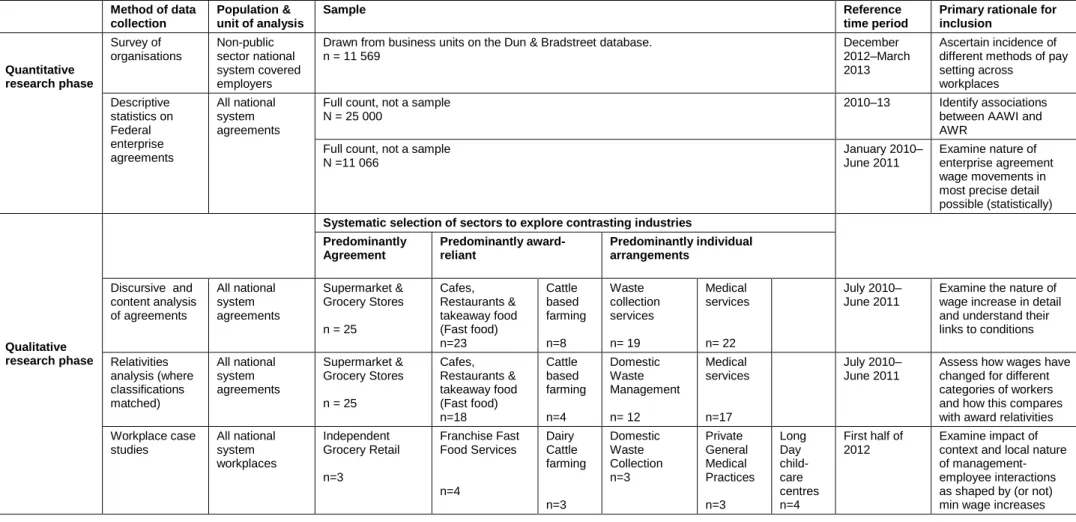
The questions were answered on the basis of new knowledge generated by four research methods: a large scale survey of award reliance in organisations3 which collected information on
wage-setting arrangements across the labour market (and collected especially detailed information from those organisations with at least one employee paid exactly according to the award, hereafter referred to as ‘award-reliant employees’);
a quantitative analysis of enterprise agreements;
a qualitative analysis of a selection of enterprise agreements (which included a comparison of wage relativities contained in awards and agreements); and
qualitative workplace level case studies.
The key findings
Wage-setting arrangements within organisations and across the labour market
This research report includes an analysis of data collected from the Award Reliance Survey. Although the Award reliance research report4 provides a comprehensive review of findings drawn from the survey, this report presents findings from the survey arising from questions about the different types of wage-setting arrangements used by organisations, such as enterprise agreements and individual wage-setting arrangements. It also presents findings on whether organisations that pay at least one employee exact award rates of pay were likely to pass on minimum wage increases to employees not covered by award rates of pay.
A study of 11 569 organisations was undertaken in 2012–13 to investigate the incidence and nature of wage-setting using awards.5 The population of interest was defined as non-public sector organisations covered by the national workplace relations system.
2
From 1 January 2013, the Fair Work Amendment Act 2012 (Cth) amended the Fair Work Act 2009 (Cth) to change the name of Fair Work Australia to the Fair Work Commission and, from 1 July 2013, to replace the Minimum Wage Panel with an Expert Panel constituted for the purpose of annual wage reviews. In this report, a reference to the Panel is a reference to the Minimum Wage Panel or Expert Panel of Fair Work Australia or the Fair Work Commission as appropriate.
3
Wright S and Buchanan J (2013) Award reliance, Research Report 6/2013, Fair Work Commission, December, Melbourne.
4
Wright S and Buchanan J (2013) Award reliance, Research Report 6/2013, Fair Work Commission, December, Melbourne. This project was undertaken by the Workplace Research Centre in collaboration with fieldwork company ORC International on behalf of the Fair Work Commission.
5
www.fwc.gov.au Research Report 7/2013 v The majority (89.1 per cent) of organisations had less than 20 employees and accounted for just
over two in five (41.4 per cent) employees. A similar proportion of employees (39.1 per cent) was employed by the 1.8 per cent of organisations with 100 or more employees.
Organisations commonly used a number of pay arrangements for their employees. The most prevalent was individual arrangements (reported by 65 per cent of organisations), followed by awards (52 per cent) and enterprise agreements (7 per cent). Of those using awards, half (or 25 per cent of all organisations) had at least one employee paid at exactly the award rate (i.e. hereafter referred to as ‘award-reliant’ organisations). The incidence of different pay-setting arrangements was closely related to organisation size: for example, enterprise agreements were reported to be used by 42 per cent of organisations with 100 or more employees.6
Detailed information on the incidence and operation of different wage-setting arrangements were collected from award-reliant organisations.
Organisations with 100 or more employees were more likely to be award-reliant (44 per cent). By comparison, only 18 per cent of micro organisations (less than five employees) were award-reliant.
Within award-reliant organisations, on average 51 per cent of employees were award-reliant, 11 per cent were covered by an enterprise agreement and 38 per cent were on other wage-setting arrangements.
There were two primary reasons for some employees being paid exact award rates: awards were regarded as providing a good indicator of the ‘going rate’; and were considered to be affordable. The primary reasons for using enterprise agreements were: award terms and conditions were
considered to be unsuitable or inflexible for the organisation; and to meet compliance obligations with clients.
The primary reasons for using other wage-setting arrangements were: to reward higher performance or higher duties; and award wages were not considered to be competitive for attracting and retaining employees.
Amongst employees in award-reliant organisations paid over-award rates, about 30 per cent received the 2011–12 AWR increase even though they were not ‘award-reliant’.7
Further details are provided in Section 1.3 of this report.
Wage-setting arrangements and average weekly rates of pay
The most commonly used data on wage levels and methods of pay setting are produced by the Australian Bureau of Statistics (ABS) in its Survey of Employee Earnings and Hours (EEH).8 EEH average weekly total earnings data indicate that the earnings of employees on awards are around half that of employees on collective agreements and individual arrangements. These findings, however, must be treated with caution for the following reasons:
Total earnings data combines full-time and part-time employees.
6
Wright S and Buchanan J (2013) Award reliance, Research Report 6/2013, Fair Work Commission, December, Melbourne, Table 3.2.7.
7
Wright S and Buchanan J (2013) Award reliance, Research Report 6/2013, Fair Work Commission, December, Melbourne, Table 3.3.3.
8
Disaggregation of these data by industry9 reveals major differences, with award-reliant workers in Accommodation and food services earning more than those on agreements. This probably stems from those on agreements working shorter hours.
Disaggregation of the data by occupation10 found similar diversity. Controlling for hours and more specific occupational definitions (i.e. examining registered nurses and secondary school teachers and not just professionals) revealed a completely different picture to that provided by the more summary indicators (i.e. there was virtually no difference in pay for registered nurses as between the methods of pay, and those on collective agreements had the lowest pay rate amongst secondary teachers).
These findings highlight the importance of using the most detailed information possible for generating robust insights into the nature of wages and how they change. Conventions commonly used for producing summary statistical information often generate results that reflect the level of aggregation as opposed to capturing insights into the relations between the variables of interest.
Further details of this analysis are provided in Sections 1.2.2 and 1.2.3.
Average annual wage increases in awards and enterprise agreements
The best publicly available information on movements in over-award wage rates is contained in the Department of Employment’s Workplace Agreements Database (WAD).11
This collects information, including wage movements, on all federally registered enterprise agreements and at the time of analysis it contained 11 066 agreements. Sections 1.2.3 and 1.5 provide detailed analysis of these data.
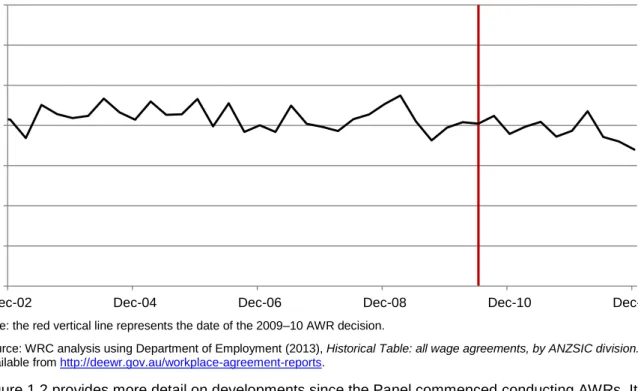
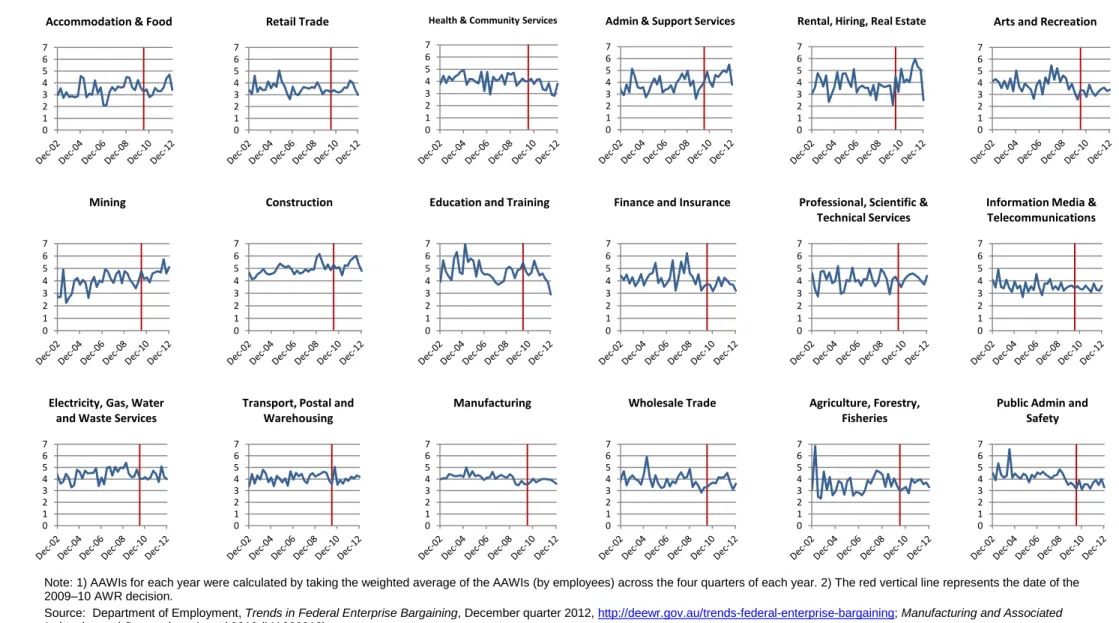
On the basis of the measure most commonly used to analyse these enterprise agreements—the all industry Average Annualised Wage Increase (AAWI)—there was no association between AWR increases and wage increases in enterprise agreements in the period since 2010, either across all industries or at the one-digit level of the Australian and New Zealand Standard Industrial Classification (ANZSIC).
Analysis based on the raw (i.e. unit record) data contained in the WAD was undertaken on all enterprise agreements registered between January 2010 and June 2011. This was to ascertain what impact, if any, the 2009–10 AWR had on wage increases contained in these agreements. This analysis revealed that just under one-quarter (24.4 per cent) of enterprise agreements reference wage clauses related to AWR increases or processes. The five industries with a high proportion of agreements linking AAWIs with clauses referring to AWR increases were: Agriculture, forestry and fishing (70.6 per cent), Accommodation and food services (68.3 per cent), Retail trade (66.7 per cent), Rental, hiring and real estate services (66.3 per cent) and Arts and recreation services (65.7 per cent).
When wage increases were awarded in an enterprise agreement’s first year of operation, the following results were found:
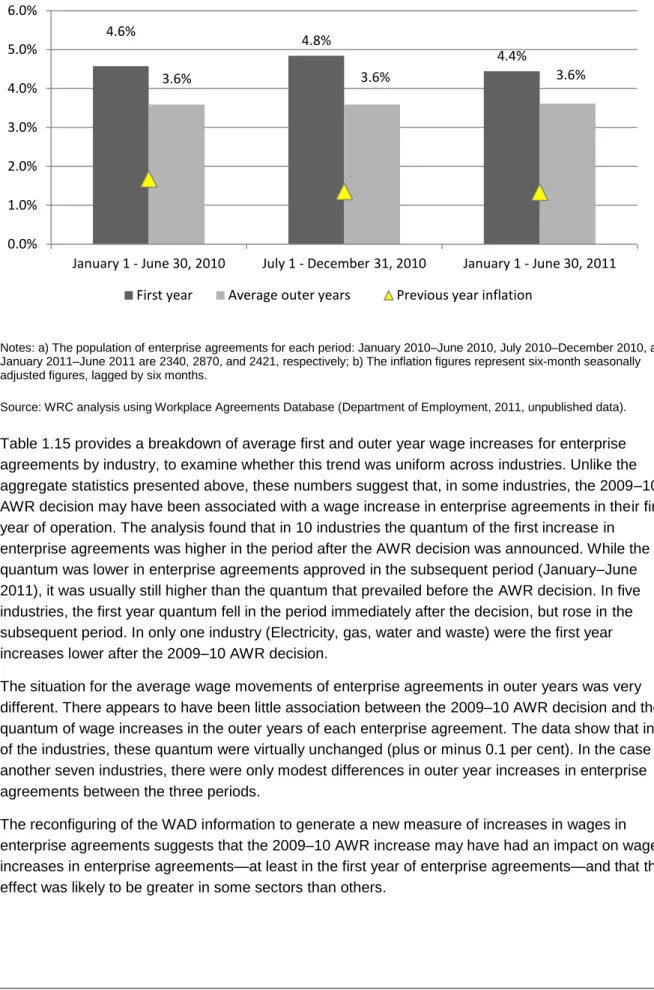
In 10 industries, the quantum of the wage increase awarded in the enterprise agreement’s first year of operation was significantly higher in enterprise agreements registered in the first six months following the 2009–10 AWR decision. In a further five industries the quantum fell in the
9
1-digit level of ABS, Australian and New Zealand Standard Industrial Classification 2006, Catalogue No. 1292.0.
10
1-digit level of ABS, Australian and New Zealand Standard Industrial Classification 2006, Catalogue No. 1292.0.
11
www.fwc.gov.au Research Report 7/2013 vii period immediately after the decision, but rose in enterprise agreements registered 7–12 months after the 2009–10 decision was announced. In only one industry (Electricity, gas, water and waste) did the wage increase awarded in the enterprise agreement’s first year of operation decrease in both periods following the 2009–10 decision.
Furthermore, for all industries the data found little association between the minimum wage increase awarded in the 2009–10 AWR decision and the level of wage increase awarded in the outer years of each enterprise agreement.
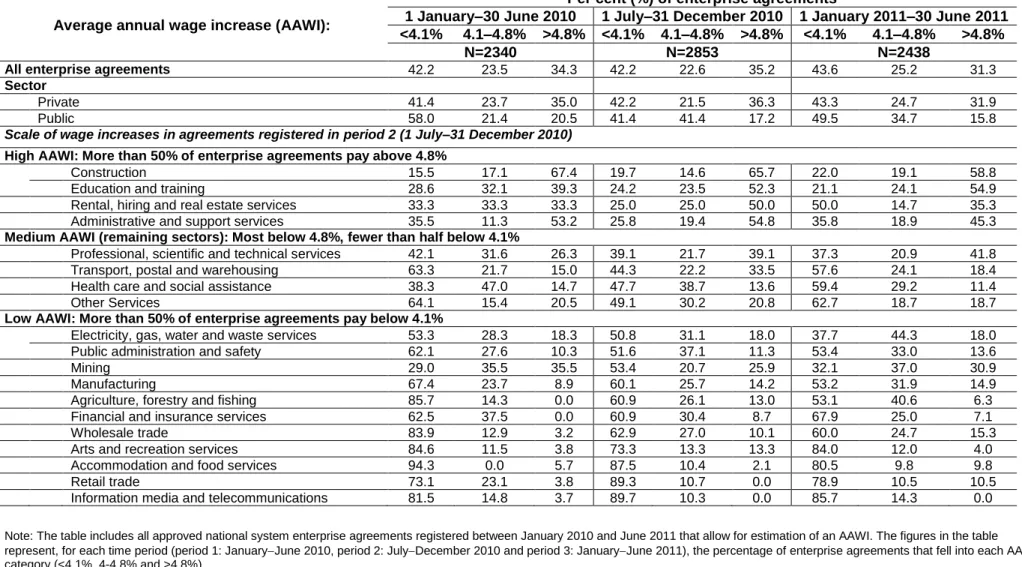
The WAD data were grouped by the scale of the AAWI recorded in each enterprise agreement. The classification of AAWIs into the following three groups enabled comparisons to be made with AAWIs and the minimum wage increase awarded in the 2009–10 AWR decision:
enterprise agreements with AAWI less than 4.1 per cent (i.e. less than or equal to the increase to the C10 rate in the Manufacturing and Associated Industries and Occupations Award 2010 (MA000010) (Manufacturing Award)12);
enterprise agreements with AAWI between 4.1–4.8 per cent (i.e. above the increase awarded to the C10 rate and below or equal to the national minimum wage (NMW) increase); and
enterprise agreements with AAWI greater than 4.8 per cent (i.e. above the increase awarded to the NMW).
The analysis examined whether the AWR increase was more likely to be associated with enterprise agreements that granted lower levels of AAWIs. For example, a positive association between the AWR increase and enterprise agreements may be exhibited if there was a decline in the proportion of enterprise agreements with AAWI less than 4.1 per cent after the 2009–10 AWR decision was announced. The data showed that:
the proportion of enterprise agreements with AAWI of less than 4.1 per cent decreased in 14 of the ANZSIC 19 industries for enterprise agreements registered in the first six months after the 2009–10 AWR decision. In six of these industries, the proportion of enterprise agreements with AAWI of less than 4.1 per cent also decreased in the period 7–12 months after the decision; the proportion of enterprise agreements with AAWI less than 4.1 per cent over the 12 months
following the 2009–10 AWR decision increased in Construction and Health care and social assistance. Only in the latter industry was the increase in the proportion of enterprise agreements with low AAWI significant, rising from 38.8 to 59.4 per cent, over the 12 months following the decision; and
prima facie positive associations were particularly strong in sectors which previously had a very high proportion of enterprise agreements with AAWI of less than 4.1 per cent, such as
Agriculture, forestry and fishing; Retail trade; and Accommodation and food services. In short, the quantitative analysis of enterprise agreements found that there may be a positive association between wage increases in enterprise agreements and AWR increases. This was particularly the case for industries with higher proportions of enterprise agreements with AAWIs of less than 4.1 per cent and a large number of employees with wages set solely with reference to awards. These industries include Agriculture, forestry and fishing; Retail trade; Accommodation and
12
The C10 and its earlier incarnations have been the reference point for consideration of wage relativities in Australia for decades, and are a proxy for a qualified tradesperson. In using this classification in this way it is important to emphasise that this is not regarding it as a privileged or ‘typical’ job.
food services; and Arts and recreation. Approximately two-thirds of enterprise agreements from these industries included provisions making direct reference to minimum wage processes or outcomes. These were also industries that had experienced a large decrease in the proportion of enterprise agreements with AAWI of less than 4.1 per cent following the 2009–10 AWR.
Qualitative analysis of agreements
A selection of 97 enterprise agreements from five industries was qualitatively analysed to identify any possible connections between the wage increases identified within them and the increases provided by the AWR, taking into account the impact of other provisions contained in the agreements. The key findings were as follows:
References to AWR processes varied dramatically between sectors, as well as within sectors. In particular, the analysis identified the importance of distinguishing between agreements that are ‘award-reliant’ (i.e. pay no or little more than the award), ‘slightly above award’ (i.e. pay a modest amount more than the award) and ‘over-award’ (i.e. pay a substantial amount more than the award).13
Wage increases specified in agreements are not necessarily ‘going rates’. A significant minority of agreements contain the lowest increase in earnings that can be granted to an employee. Further increases in wages in many enterprise agreements were contingent on either performance or management discretion. AWR decisions rarely influenced these contingent elements of pay. They did, however, appear to fundamentally shape the base from which they were assessed.
Analysis of non-wage issues in agreements revealed that most agreements granting wage increases did not just simply ‘pass on’ the increase to employees without variations to other employment conditions. Decisions to include wage increases in agreements appeared to be associated with a wide range of other matters, but were most commonly connected to provisions regulating hours of work and education/training. The AWR increase appeared to set the
framework for thinking about the quantum of increase for above-award employees, however, the wage increases were ultimately achieved by bargaining around hours, penalty rates and other employment conditions rather than stemming directly from the AWR decision.
Classification arrangements in the agreements were directly comparable to those in awards in approximately half of the agreements examined. Comparability (for the purposes of research and analysis) was not possible for about one-quarter of agreements, and some comparability was possible in the remaining quarter. This section highlights, however, that caution should be exercised in accepting at face value the level of ‘incomparable’ agreements. The problem of opaqueness is an important issue for assessing the impact of the AWR. Opaque classifications have the potential to result in the under-classification of employees relative to the applicable modern award, offsetting the potential impact of the AWR minimum wage increases.
Analysis of relativities
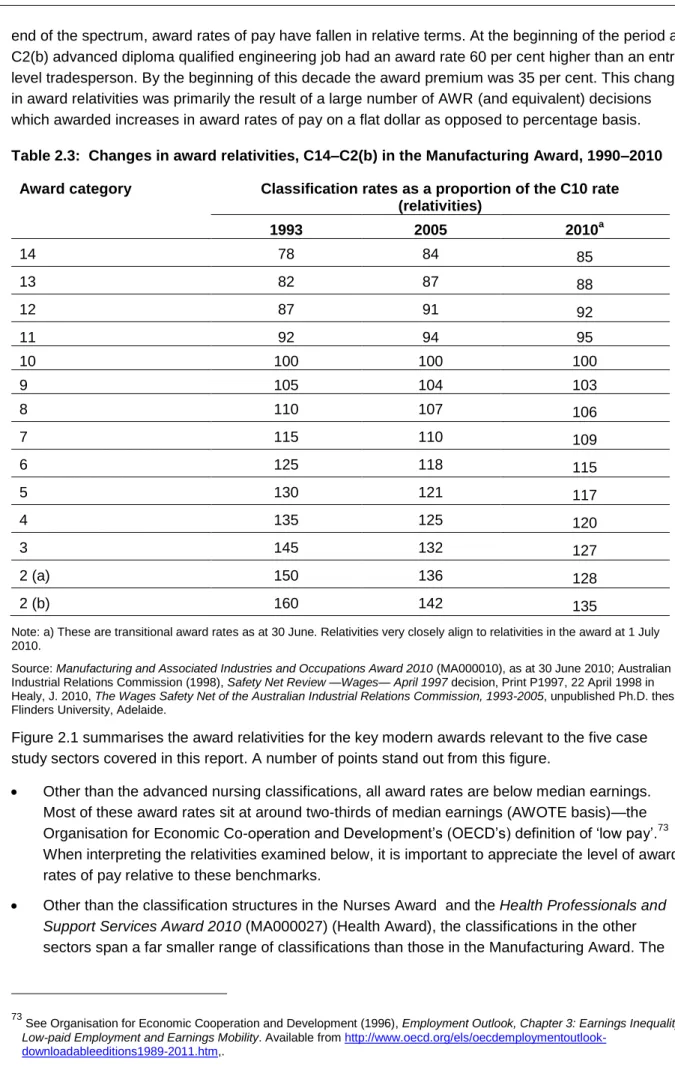
This analysis (detailed in Sections 2.2.2 and 2.3.2) was undertaken to assess the nature of wage increases in enterprise agreements for those on high and low award classifications. As a result of AWR increases being defined in flat dollar amounts, award relativities have been compressed over
13
Differing industry job classification structures meant that the boundaries between these categories varied for each industry. Additionally, given the extreme variability in the way specific classifications and actual pay rates were reported in agreements within an industry, comparisons of pay relativities contained in awards and agreements were conducted in a piecemeal fashion with extensive cross checking. Full details are provided in Appendix 5.
www.fwc.gov.au Research Report 7/2013 ix the last 20 years. In the Manufacturing Award,14 for example, the relativity between the lowest classification (C14, which is equivalent to the NMW) and the benchmark C10 rate rose from 78 to 85 per cent. In the highest classification (C2(b) - advanced diploma engineer) the award wage premium relative to the C10 rate fell from 60 to 35 per cent. Analysis of the relativities in the agreements examined revealed the following:
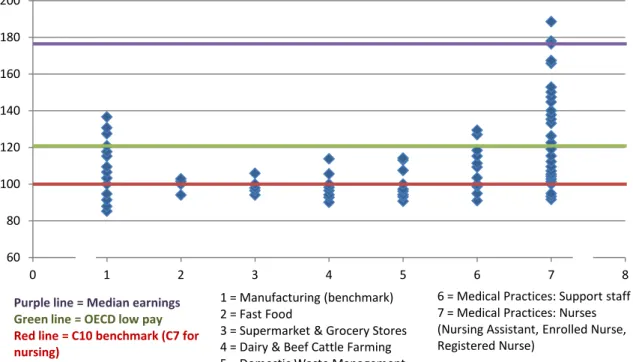
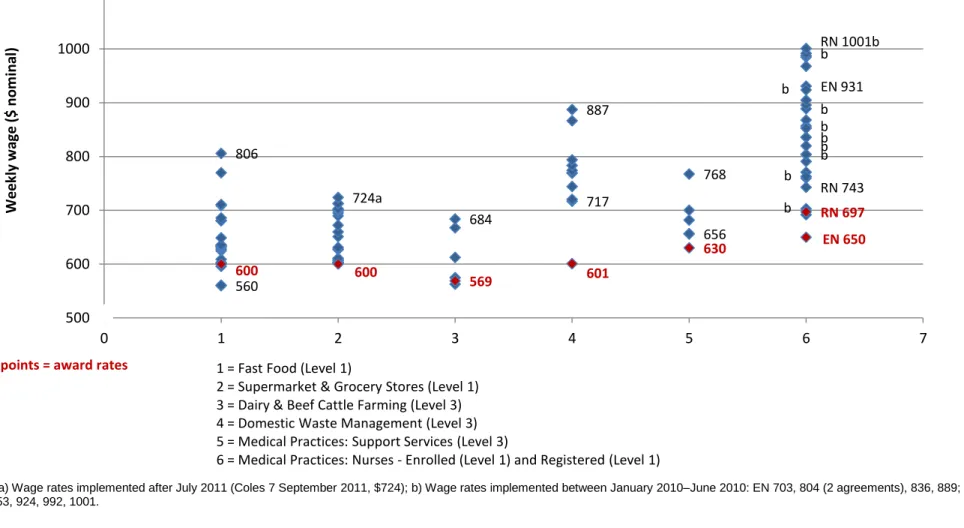
External relativities (i.e. differences in pay for exemplar or reference classifications common across employers) were dispersed among all industries considered. For example, the weekly wage for a Class 1 Food and Beverage Worker ranged from $560 to $806 in the agreements analysed.
Internal relativities within agreements were very similar to those in their related awards. This was the case despite there being no requirement for it, and many enterprises were paying
significantly over the award. The commonality in relativities was particularly strong in agreements that were paying close to award rates and in jobs paying less than median earnings.
The close resemblance between the internal relativities in agreements and those in awards suggests that agreement making has not resulted in employees in higher classifications overcoming the compression of relativities that has occurred in awards. This has most likely arisen as a result of successive AWR decisions being paid as dollar amounts and/or being absorbed into over-award payments.
While the decline in award wage rate relativities for higher classification employees should have objectively given such employees a greater incentive to bargain, the analysis suggests it has not had this impact. Either such employees have not been induced to make agreements offsetting these falls, or if they have been induced employees have not been successful in changing wage outcomes.
Findings from the workplace case studies
AWR increase impacts on over-award rates of payInterviews were conducted at 20 case study sites with varying wage arrangements (award-reliant (i.e. paying the exact award rate), informal over-award (i.e. above-award payments) and formal over awards (i.e. enterprise agreements)) (detailed in Section 2.4). These interviews found that for most employers who paid over-award payments to their employees, AWR increases were not perceived to be an influential factor in the determination of over-award wage payments at the workplace level. Only one employer (across the 20 case study sites) directly factored AWR increases into decision making processes surrounding over-award payments. Few case study workplaces reported incorporating AWR increases into key aspects of wage negotiations (for informal over-award or enterprise agreement negotiations) including in: initial contract negotiations with staff; subsequent adjustments to these contracts on renewal or revision; and performance management discussions with employees paid over-award wages.
Employers (at workplaces with over-award payments) in the case study sites identified a range of other factors, beyond AWR increases, as critical in shaping the frequency and magnitude of award payments. For example, across the independent grocery retail sites studied, the setting of award payments was informed primarily by competitor wage movements and the need to link
14
award payments closely with individual performance reviews. Employers in the Private General Medical Practices sites reported using over-award payments to attract and retain high quality labour (which were set in line with competitor employers which were largely above minimum levels). For the Private General Medical Practice employers interviewed, the minimum wage increases were
perceived to be of limited relevance because they sat well below the threshold of their wage arrangements.
AWR impacts on bargaining
Across the 20 case study workplaces, employer and employee interviewees generally reported that AWR increases neither discouraged nor encouraged enterprise bargaining at the workplace level. The majority of interviewees presented a rationale for this position, and while this rationale varied depending on sectoral setting, recurring themes were present across the study. In retail workplaces for example, bargaining over hours and rosters represented the issue for which both employers and employees were most motivated to bargain. In child care, both owners/managers and employee interviewees stated that minimum wage increases did not deter bargaining. In this sector, both managers and employee interviewees stated that bargaining was motivated around the tight cost margins within which most centres were required to operate. Moreover, most child care employees interviewed saw little point in bargaining over wages because the returns were likely to be so slim. Factors shaping the incentive to bargain: employer and employee perspectives
Given interviewee reports of the relatively limited impact of AWR decisions on both over-award rates of pay and the bargaining process, attention was devoted to analysing what interviewees reported were the key factors in shaping both. Employers and employees reported different factors as influential. To give order to the analysis, these incentives were ranked from high order to low order incentives based on the sentiments expressed by participants. For employers, the ‘first order’ incentives to bargain all dealt with the preservation of commercial viability for the business including: local labour market and product market concerns; workplace level restructuring; performance
management; and policy directives (either macro or micro) which employers identified as having more immediate impacts for pricing or cost structures. For employees, ‘first order’ incentives to bargain emerged from a mix of personal and work factors and included: workplace level restructuring; perceptions of value to their employer; a desire to achieve a better fit between work and home life; and perceptions about ‘receptiveness’ to bargaining at the workplace level (i.e. workplace culture). On the basis of this material this part of the study concluded that the impact of the AWR decisions on the incentive to bargain was a third order factor.
Other issues concerning the bargaining process
In terms of bargaining process, cost imperatives were identified by all employers as playing a critical role in the choice of over-award arrangements (i.e. formal or informal, collective or individual) that were used. The act of bargaining was defined by all of the employers interviewed in ‘cost
effectiveness’ terms and evaluated in terms of functional efficiencies.
Across the majority of workplaces studied, processes of bargaining were not well defined or
systemised. The enterprise agreement workplaces appeared to have some formal systems in place to administer and coordinate negotiations between employer and employees. However, even within these workplaces, interviewees reported that they viewed the bargaining processes as ‘complex’. During the course of the analysis it became clear that employers focused on the ‘functional’ role of bargaining in terms of helping achieve desirable commercial ends. None interviewed reported that bargaining had any value in broader labour management strategies such as nurturing employee engagement or promoting collaborative processes to workplace change. For this reason, purposeful
www.fwc.gov.au Research Report 7/2013 xi consideration of how the ‘act’ or ‘process’ of bargaining might be improved or altered was reported to be of limited or no concern for the employer participants overall.
Answers to the project’s research questions
This study has used an array of data sources to generate new knowledge about the core research questions concerning the impact of AWR decisions on wage outcomes and the incentive to bargain. As part of this process, the research also made some findings on the impacts of minimum wages themselves on over-award and agreement rates of pay as well as on the incentives to bargain. The impact of minimum wage increases on over-award and agreement rates of pay
The data considered in this study, while providing limited evidence of a general relationship between AWR increases and over-award or agreement wage outcomes, did indicate that a more limited positive association may exist in some instances.
The Award Reliance Survey found that, in award-reliant organisations, close to a third of employees on over-award rates of pay (either through an informal arrangement or enterprise agreement) received the most recent AWR decision wage increase. This suggests that in organisations required to pass on the minimum wage increase to one or more award-reliant employees, there may be a flow-on effect to over-award wage outcomes of nflow-on-award-reliant employees in some circumstances. Analysis of summary data commonly reported from the WAD (i.e. AAWI by industry) provided no evidence of minimum wage increases impacting on enterprise agreement wage outcomes. This report, however, conducted analysis of the level of AAWI in agreements grouped in different ways. First, the quantum of the first wage increase granted in an agreement was compared to the AWR increase of 2009–10. Second, AAWIs in agreements were grouped on whether they were higher, lower or roughly the same as that contained in the AWR of 2009–10. Consideration of these data uncovered some prima facie positive associations at the industry level:
in 10 of 19 industries, the average first year wage increase recorded in enterprise agreements registered in the six month period after the 2009–10 AWR decision was higher than in the six months before it; and
in 14 of 19 industries, the proportion of enterprise agreements in the lowest (sub 4.1 per cent) AAWI grouping that were registered in the six month period after the 2009–10 AWR decision decreased compared to the six months before it.
Industries with high levels of award reliance, such as Retail trade and Accommodation and food services, exhibited both these prima facie positive associations and were also identified as industries in which a high proportion of enterprise agreements directly referred to minimum wage processes or outcomes.
These findings suggest that, in the period of study, there was some association between AWR increases and enterprise agreement wage outcomes in some industries. Questions remain, however, about the extent and nature of any association, particularly given the qualitative case study findings which showed a number of diverse factors underpinning the setting of employee wage rates by employers and the relatively low priority that some employers placed on AWR increases as part of their consideration of wage adjustments for over-award employees.
The study did not reveal a positive or negative relationship between AWR increases and the incentive to bargain, instead pointing to a complex mix of factors that may contribute to employee and employer decision-making about whether to not to bargain.
The qualitative workplace case study research identified that AWR increases, for the workplaces studied, were largely not influential in decisions about whether to bargain for the employers and employees concerned. As part of this research, it was generally observed that AWR increases for over-award employees were assessed as a third order factor in generating incentives or disincentives to bargain, behind more influential factors including cost, restructuring and job changes.
Conclusion
The workplace case studies, qualitative relativities analysis and Award Reliance Survey each suggest that there may be a link between minimum wages (and their associated instruments) themselves and over-award wage outcomes, but the extent of this link remains unclear and may require further investigation.
The qualitative relativities in selected award and enterprise agreements revealed that internal relativities within most of the agreements studied were very similar to those in their related awards. This included similarities in higher classification compression.
The Award Reliance Survey found that the market position of award rates may be a reason for award-reliant organisations to adopt over-award wage-setting arrangements (among award-award-reliant
organisations without an enterprise agreement). Just under half (48 per cent) reported the need for more competitive wages as a reason for making over-award payments. However, the survey also found that the reasons for making over award arrangements differed for the type of instrument pursued. That is, for organisations using individual and informal over-award arrangements, the main reason for adopting over-award rates were for ‘rewarding’ employees (39 per cent), however the main reason for organisations perusing an enterprise agreement chiefly related to inflexibilities in award conditions (23 per cent). This may suggest that further consideration of the effect of AWR increases (or minimum wage impacts) on bargaining may need to consider the divergence of wage
arrangements that exist in the workforce.
The direct impact of AWR decisions was perceived to be limited at the work sites studied. However, analyses of enterprise agreements revealed some prima facie associations with AWR decisions. Further, the workplace cases in general, and the relativities analysis in particular, revealed that minimum wages themselves (awards) can shape the wage determination process and wage outcomes. All of these findings are consistent with and help to better understand findings from the related 2012–13 study of award reliance.15
If the AWR increases examined are conceived as being part of an ongoing evolution of the award system, then their impact could be seen to be significant, primarily because such increases are an integral part of a labour standards regime that conditions workplace behaviour and shapes wage outcomes. This appears to be especially the case in those parts of the labour market paying below median wages.
15
www.fwc.gov.au Research Report 7/2013 1
Research Questions, Terminology and Methods
The Expert Panel (Panel) of the Fair Work Commission (FWC) (previously known as Fair Work Australia (FWA)) undertakes an annual wage review (AWR) each financial year and may set or vary minimum wages.16 Minimum wages include the national minimum wage (NMW), modern award minimum wages and minimum wages in some transitional instruments. In the Panel’s 2010–11 research program, the Panel outlined that it sought the following research to be undertaken:
Minimum rates of pay and over-award/agreement rates of pay
Research into the relationship between minimum rates of pay and over-award/agreement rates of pay. This research will seek to inform an understanding of:
- how minimum wage increases impact on over-award and agreement rates of pay; and - how minimum wage increases impact on the incentive to bargain.
The research could include an:
- analysis of the Employee Earnings and Hours (EEH) survey data; - analysis of the Workplace Agreements Database (WAD); and
- case studies to gain a better understanding of the bargaining process, in particular to facilitate an understanding of the relationship between minimum wage adjustments and the incentive to bargain for both employers and employees.17
The WRC was subsequently commissioned by the FWC to undertake this work using four methods of research, these being:
a large scale survey of award reliance in organisations which collected information on wage-setting arrangements across the labour market (and collected especially detailed information from those organisations with at least one employee paid exactly according to the award, hereafter referred to as ‘award-reliant employees’);
a quantitative analysis of enterprise agreements;
a qualitative analysis of a selection of enterprise agreements; and qualitative workplace level case studies.
This research was to address the two core questions:
How do minimum wage increases impact on over-award and agreement rates of pay? How do minimum wage increases impact on the incentive to bargain?
The questions concerned how decisions of the Panel are connected with wage outcomes and the processes used to set pay at the enterprise and workplace level. That is, how formal processes (i.e., AWR decisions) impact on work-related earnings and their determination for those in an employment
16
From 1 January 2013, the Fair Work Amendment Act 2012 (Cth) amended the Fair Work Act 2009 (Cth) to change the name of Fair Work Australia to the Fair Work Commission and, from 1 July 2013, to replace the Minimum Wage Panel with an Expert Panel constituted for the purpose of annual wage reviews. In this report, a reference to the Panel is a reference to the Minimum Wage Panel or Expert Panel of Fair Work Australia or the Fair Work Commission as appropriate.
relationship. These research questions are concerned with whether, and how, decisions of the Panel impact on substantive practice at the enterprise and workplace level. Addressing the questions requires that due consideration be given to understanding both the formal and substantive domains. The following sections explore each question separately, describing the context from which they emerge and defining the concepts implicit in the questions. This is followed by a description of the research methodologies used to conduct this project.
Research questions
Annual wage review decisions and wage outcomes
The first research question is concerned with wage outcomes—the impact of AWR decisions on wage increases, especially for employees covered by award classifications earning above the relevant award rate of pay. The primary objects of concern are over-award rates of pay. These can be formal (as set out in a registered enterprise agreement) or informal (e.g. operating on the basis of common law contracts that may be documented or take the form of tacit arrangements embedded in custom and practice). Evidence examined to understand the impact of AWR increases is drawn from two sources: enterprise agreements in the national system and workplace case studies. Details of the methodologies used to analyse these data are provided in the section below on Research design.
Annual wage review decisions and bargaining behaviours
The second question is concerned with processes associated with setting pay—especially the impact of AWR decisions on employers’ and employees’ interest in, and approaches to, bargaining. These are matters of interest because of two key objectives for modern awards which are stated in s.134(1)(b) of the Fair Work Act 2009 (Cth) (Fair Work Act):
(1) FWC must ensure that modern awards, together with the National Employment Standards, provide a fair and relevant minimum safety net of terms and conditions, taking into account:
...
b) the need to encourage collective bargaining
The Panel must consider these objectives when conducting annual wage reviews (s.134(2) of the Fair Work Act). The difference in the significance of these objectives for employers and employees was noted by the Panel in its Annual Wage Review 2009–10 decision:
...the gap between award minimum wages and bargained wages is likely to increase the incentive for employees to bargain. On the other hand a large gap may be a disincentive for employers to bargain...18 To help answer the two questions of interest, this project generates new knowledge to understand how the differences between award and actual rates of pay shape and are shaped by bargaining and enterprise agreement making between employers, employees and their representatives.
Terminology
The Panel’s decisions are centrally concerned with setting minimum standards for work-related earnings for parties to the employment relationship (i.e. employers and employees). It operates in the
18
www.fwc.gov.au Research Report 7/2013 3 context of the national workplace relations system in place since the commencement of the Fair Work Act in 2009.19 Within this system, wages and standards are set at a number of levels.
The remit of central wage-setting bodies is determined primarily by the federal parliament through specific legislation. Parliament also legislates directly on the content of 10 National Employment Standards (NES).
The NMW is set by the Panel of the FWC. The Panel also considers and adjusts minimum wage rates in awards as part of the AWR. The minimum rates apply to workplaces within the national system of employment, while state commissions (other than in Victoria) set minimum wages for other workplaces such as state public sectors.
Employment standards, including wage rates, are also set by the parties to the employment relationship at the enterprise or workplace level. This can occur on either an individual or collective basis or a combination of the two. Provided that publicly defined minimum standards are honoured, the parties to an employment relationship can have varying standards—both formally and informally. The Fair Work Act regulates these arrangements through provisions concerning the settlement and enforcement of formal enterprise agreements.20
In conducting empirical research, especially gathering information on experiences that prevail at the workplace level, it is important to appreciate that the terminology of labour law does not necessarily neatly align with workplace arrangements. This is especially the case when considering the
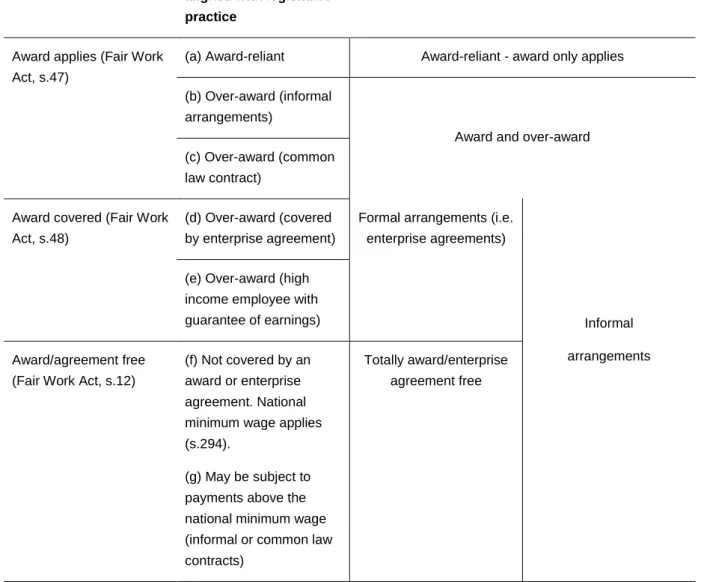
relationship between awards, registered enterprise agreements and informal over-award arrangements. Table 1 provides guidance on how formal labour law categories align with
arrangements and terminology commonly used at the workplace level. Appendix 1 provides more detailed information about how workplace practices align with legislative categories.
19
Fair Work Act 2009 (Cth) s.2.
20
As a technical matter, it is important to note that some employment arrangements have been transitioning from state awards and agreements to national instruments. Some of these transitional arrangements include wages and conditions below nationally defined standards. When the term ‘below award’ is used in this report it refers to situations such as these.
Table 1: Categories for classifying arrangements that define wage entitlements—how legislative categories align with workplace practice
Classification: legislation
Sub-classifications: wage-setting practice aligned with legislative practice
Classification: workplace practice
Award applies (Fair Work Act, s.47)
(a) Award-reliant Award-reliant - award only applies
(b) Over-award (informal arrangements)
Award and over-award (c) Over-award (common
law contract) Award covered (Fair Work
Act, s.48)
(d) Over-award (covered by enterprise agreement)
Formal arrangements (i.e. enterprise agreements)
Informal arrangements (e) Over-award (high
income employee with guarantee of earnings) Award/agreement free
(Fair Work Act, s.12)
(f) Not covered by an award or enterprise agreement. National minimum wage applies (s.294).
(g) May be subject to payments above the national minimum wage (informal or common law contracts)
Totally award/enterprise agreement free
Note: For the purpose of this study, an employee was described as having ‘award-based’ pay-setting arrangements if they fall within cells (a), (b), (c) and/or (e).
Source: Workplace Research Centre.
In the course of collecting data for the workplace case studies, there was a need to appreciate that terms with a precise legal meaning or assumed relationship did not necessarily have the same meaning at the workplace level. Three categorical conventions required particular sensitivity to ensure the reality of workplace practice was accurately understood:
the formal distinction between awards and agreements;
the relationship between bargaining and agreement making; and
the assumption that AWRs (the formal means of increases to minimum wages) have an impact at the workplace level.
www.fwc.gov.au Research Report 7/2013 5
Awards and agreements: formally mutually exclusive categories, in reality often
intimately connected
Under the Fair Work Act, modern awards and enterprise agreements are separate legal instruments. This results in the formal distinctions noted in the above table: ‘award applies’, ‘award covered’ and ‘award/agreement free’.
It is important to appreciate, however, that legal and administrative convention do not necessarily mean that awards and enterprise agreements are unconnected. All enterprise agreements have to pass the ‘Better Off Overall Test’ (or BOOT),21
and in this formal sense there is an indirect but
relevant connection between modern awards and enterprise agreements. The researchers were open to interviewees noting that the connection was often also substantive. Some enterprise agreements are best understood as building upon (and often incorporating) significant features of awards. Indeed, as shown through the agreement analysis contained in Section 2.3, award standards and categories pervade many enterprise agreements. When analysing the formal realm of wages policy, the
categories outlined in Table 1 have been followed. In reporting our empirical findings we note, however, that these formal distinctions often do not capture the close connection and often extensive overlap between awards and enterprise agreements. The categories we use for capturing the diversity of workplace practice are presented in the far right column of Table 1.
Bargaining and agreement making: not necessarily the same thing
22In undertaking research for this project, the research team was careful not to assume that ‘bargaining’ and ‘agreement making’ (i.e. making an enterprise agreement) are inter-changeable terms. The essence of bargaining involves substantive participation by all parties in arriving at a set of
arrangements that are broadly and, ideally positively, accepted. Or, using the definition from FWC’s website, bargaining could be described as ‘the process by which one or more employers and employees negotiate the terms and conditions which make up an agreement’.23
While this definition refers to bargaining in relation to making an enterprise agreement, for the purpose of this research, the researchers have adopted a similar definition as it relates to the negotiation of any over-award arrangement, whether it results in an informal over-award arrangement or an enterprise agreement. Agreement making involves the formal process of changing enforceable rights at work by complying with legally specified requirements. These rights and the processes required for their variation are specified in the Fair Work Act, the NES and modern awards. Often bargaining coincides with the formal agreement making process. That is, agreement making formalises a relationship of substantive bargaining. However, in conducting the research we have not assumed that this is necessarily the case, and have been sensitive to all possible situations. While close links between the substance of bargaining and form of agreement making are recognised as one possibility, we have also been sensitive to understanding other relationships between the substantive and formal domains in wage setting.
21
Fair Work Act 2009 (Cth), s.186(2)(d).
22
Drawn from Fair Work Commission (2013), Bargaining & workplace determinations (background reference and information materials). Available at http://www.fwc.gov.au/index.cfm?pagename=agreementsdeterminations
23
Fair Work Commission (2013), Bargaining & workplace determinations, accessed 2 April 2013 from <http://www.fwc.gov.au/index.cfm?pagename=agreementsdeterminations>.
Formal wages policy decisions need not necessarily have any impact on substantive
outcomes
The question of how minimum wage adjustments impact on the incentive to bargain takes for granted the existence of such a relationship. Once again, we do not assume that this is necessarily the case. Evidence of the impacts, if any, of adjustments in minimum wages on incentives to bargain is explored through workplace case studies (see Section 2.4).
Overall, our approach to undertaking the research has involved making as few assumptions as possible about relationships between categories and the connections between awards and
agreements, bargaining and agreement making. Instead, we have relied as extensively as possible on original evidence to understand how the AWR decisions affect wage outcomes at the workplace level and the processes of their determination.
Research design
The primary object of research interest: annual wage review minimum wage increases
and their effects
The questions guiding this project pose the issues of interest in very general terms. These are ‘minimum wage increases’ and their impact on:
‘over-award and agreement rates of pay’; and ‘the incentive to bargain’.
The primary audience of interest to this project is the Panel of the FWC and those interested in, and who contribute to, its deliberations. This context meant that this project has focused on understanding the impact of AWR decisions of the Panel. As a result, the new knowledge generated by the project has concerned developments in wage setting, wage outcomes and the processes of wage
determination since the Panel’s first decision in 2010.
Table 2 presents wage increases from 2005–13 using various wage measures. The table reveals that the last three decisions of the Panel granted minimum wage increases in percentage terms. This is in contrast to its predecessor organisations—the Australian Industrial Relations Commission (AIRC) and the Australian Fair Pay Commission (AFPC)—which had granted most increases in ‘flat dollar’ terms. In 2009, the AFPC did not increase minimum wages (in the wake of the uncertainty surrounding the global financial crisis).
The first decision of the Panel (operative from 1 July 2010) granted a wage increase in dollar terms. As listed in Table 2, the unusual situation of a zero increase immediately before this provides a relatively tidy reference point to help identify associations concerning the impact of AWR increases on wage outcomes and bargaining preferences and processes. As Table 2 shows, the Panel’s first decision was a flat $26 for all award rates: the equivalent of 4.8 per cent increase in the NMW (equivalent to the Manufacturing and Associated Industries and Occupations Award 2010
(Manufacturing Award) C14 classification); a 4.0 per cent increase for the Manufacturing Award C10 classification rate;24 and a 2.2 per cent increase for award-reliant workers on Average Weekly
24
The Manufacturing Award C10 classification and its earlier incarnations have been the reference point for consideration of wage relativities in Australia for decades, and are a proxy for a qualified tradesperson. In using this classification in this way it is important to emphasise that this is not regarding it a privileged or ‘typical’ job. For comparative purposes, the national minimum wage is also aligned to the C14 classification in the Manufacturing Award.
www.fwc.gov.au Research Report 7/2013 7 Ordinary Time Earnings (AWOTE). As a flat dollar increase, the decision had varied effects on those lower and higher award classification structures.
The final three columns of Table 2 list the different research techniques that have been used as part of an integrated research strategy to understand the connections (if any), between AWR increases, enterprise agreement wage outcomes and the bargaining processes associated with wage