1616 P St. NW
Washington, DC 20036
N o ve m b e r 2 0 1 0 R F F D P 1 0 - 5 9
Are Energy Efficiency
Standards Justified?
I a n W . H . P a r r y , D a v i d E v a n s , a n d W a l l a c e E . O a t e s
© 2010 Resources for the Future. All rights reserved. No portion of this paper may be reproduced without permission of the authors.
Discussion papers are research materials circulated by their authors for purposes of information and discussion. They have not necessarily undergone formal peer review.
Are Energy Efficiency Standards Justified?
Ian W.H. Parry, David Evans, and Wallace E. Oates AbstractThis paper develops and parameterizes an overarching analytical framework to estimate the welfare effects of energy efficiency standards applied to automobiles and electricity-using durables. We also compare standards with sectoral and economywide pricing policies. The model captures a wide range of externalities and preexisting energy policies, and it allows for possible “misperceptions”—market failures that cause underinvestment in energy efficiency.
Automobile fuel economy standards are not part of the first-best policy to reduce gasoline: fuel taxes are always superior because they reduce the externalities related to vehicle miles traveled. For the power sector, potential welfare gains from supplementing pricing instruments with efficiency standards are small at best. If pricing instruments are not feasible, a large misperceptions failure is required to justify efficiency standards, and even in this case the optimal reductions in fuel and electricity use are relatively modest. Reducing economywide carbon dioxide emissions through regulatory packages (combining efficiency and emissions standards) involves much higher costs than pricing instruments.
Key Words: standards, energy taxes, market failure, climate, power sector, gasoline JEL Classification Numbers: Q48, Q58, H21, R48
Contents 1. Introduction ... 1 2. Analytical Framework ... 4 A. Model Structure ... 4 B. Welfare Formulas ... 9 3. Parameter Values ... 15
A. Basic Transportation Data ... 15
B. Basic Electricity Data ... 15
C. Externalities ... 16
D. Misperceptions ... 17
E. Other Parameters ... 17
4. Quantitative Results... 18
A. Welfare Comparison of Efficiency Standards and Energy Taxes ... 18
B. Market Failures Required to Justify Different Levels of Efficiency Standards ... 20
C. Role of Efficiency Standards in CO2 Mitigation ... 21
5. Conclusion ... 22
References ... 23
Appendix A. Analytical Derivations ... 27
Are Energy Efficiency Standards Justified?
Ian W.H. Parry, David Evans, and Wallace E. Oates∗ 1. IntroductionIn recent years, the political pendulum has swung back toward a far more interventionist role for government in U.S. energy markets. A major manifestation of this movement has been the proliferation of actual and proposed energy efficiency standards. Most prominent are the recent rulings on new light-duty vehicles requiring manufacturers to increase theirs fleets’ average fuel economy from 25 miles per gallon to about 35 mpg by 2016. In addition, household appliances are subject to numerous standards, incandescent light bulbs are being phased out, and federal energy efficiency standards are proposed for residential and commercial buildings.
What kinds of market failure could justify energy efficiency standards? An obvious possibility is pollution externalities, especially emissions of carbon dioxide (CO2). Generally speaking, however, efficiency standards are an inferior instrument to energy or emissions taxes. Unlike the pricing approach, efficiency standards do not reduce the intensity of use of energy durables; in fact, they tend to increase their use through the “rebound effect” (Khazzoom 1980). Nor do they reduce pollution emissions per unit of energy or produce least-cost outcomes through equating marginal abatement costs across different sectors.
A second class of potential market failures is associated with the so-called energy paradox, the observed reluctance of energy users to adopt apparently cost-effective, efficient technologies (Jaffe and Stavins 1994; Gillingham et al. 2009; Tietenberg 2009), even energy-saving technologies with implicit rates of return in excess of 25 percent (Allcott and Wozny 2009, Hausman 1979, Sanstad et al. 2006, Train 1985). Some analysts cite this as evidence that consumers misperceive energy efficiency benefits perhaps because of “missing” information. Others point out that there might be “hidden costs” not accounted for in these studies, such as product attributes (e.g., people may object to the quality of fluorescent lighting), various search
∗ Ian W.H. Parry, corresponding author, Allen V. Kneese Senior Fellow at Resources for the Future ([email protected]);
David Evans, U.S. Environmental Protection Agency; Wallace E. Oates, University of Maryland. We are grateful to Karen Palmer and seminar participants at Cornell University, the University of Maryland, the University of Arizona, the Society for Cost-Benefit Analysis, and the ASSA meetings for helpful comments and suggestions. Zachary Ficklin provided valuable research assistance. We also thank the U.S. Environmental Protection Agency (EPA) for financial support. This study has not been subject to EPA peer review, and the views expressed here should not be attributed to the EPA.
costs, high borrowing costs, and aversion toward “irreversible investments” with uncertain returns (Hassett and Metcalf 1993).1 At the same time, certain information programs (like the voluntary EPA Green Lights program and various EnergyStar programs) appear to have increased energy-efficiency investments (e.g., Howarth et al. 2000).
The general issue is important because the source of the failures has direct policy implications. For externalities, the preferred approach is pricing measures, but for
misperceptions, information programs can play an important role. In either case, efficiency standards appear to be a second-best measure whose justification presumably depends on practical constraints on the economically preferred policy.
The actual and prospective adoption of energy efficiency standards raises a number of interrelated policy issues. First, what are their overall welfare effects and how do they compare with welfare effects from other policy options? Second, what combinations of market failures, particularly related to CO2 damages and the extent of misperceptions market failures, justify efficiency standards of given stringencies? And third, to what extent can efficiency standards, when combined with other regulatory approaches, achieve the cost-effectiveness of CO2 pricing instruments, should the latter prove difficult to implement in practice?
Our paper provides an analytical framework for understanding these questions and for gaining some sense of the empirical magnitude of welfare effects, for policies affecting energy efficiency in the transport and power sectors. From the model we derive a series of empirically useful formulas that show how the welfare effects of regulatory and pricing policies depend on interactions with externalities, informational market failures, and preexisting energy policies. Although a richer framework than ours might incorporate capital dynamics, greater product disaggregation, and producer heterogeneity, a good deal may still be learned from the parsimonious model developed here, which captures the most important features for our purposes.
In general, prior literature provides insight on some components of our welfare analysis but does not construct the overarching framework needed for the policy questions posed here. For example, previous studies have been largely sector specific and therefore do not compare the welfare effects of standards versus economywide pricing, nor do they compare and contrast
1 Another possibility is that, rather than utility maximization, consumer behavior is based on simplified decision
processes, like “rules of thumb,” because of cognitive constraints on processing information. There is, however, little empirical work relating these kinds of behavioral failures directly to decisionmaking on energy efficiency.
standards across the transport and power sectors, or explore to what extent regulatory packages can mimic emissions pricing. There has also been little attempt to simultaneously integrate externalities and informational market failures. And the conditions required to justify standards of different stringencies, with and without constraints on emissions pricing policies, have not been explicitly modeled.2
One study that also, like ours, provides an overarching framework is Krupnick et al. (2010), who estimate the cost-effectiveness of a wide range of policies, including efficiency standards, to reduce CO2 and oil use. Their analysis is based on simulating a variant of the Department of Energy’s National Energy Modeling System (NEMS) out to 2030; ours is a much simpler, static analytical framework. Nonetheless, there is useful complementarity between the two studies, and some of our results on policy costs (gross of externalities) are broadly consistent with those from the far more sophisticated variation of NEMS.
We summarize some of our findings as follows.
First, efficiency standards are not part of the optimal policy (or policy combination) to address market failures for automobiles, even under our upper-bound case for misperceptions market failures. Fuel taxes have a much lower net cost because of (unpriced) externality benefits associated with reduced vehicle use (reduced traffic congestion and so on). The welfare gains forgone under efficiency standards from failing to exploit this response outweigh any potential advantage at targeting misperceptions failures more directly. Even if fuel taxes are fixed,
efficiency standards are warranted only under stringent conditions. For example, using standards to cut fuel use by 5 percent under a standard value for CO2 damages is warranted only if
consumers fail to internalize 44 percent of the savings from higher fuel economy. In fact, recent rulings that rapidly ramp up the corporate average fuel economy (CAFE) standards are not supported on welfare grounds, even under our bounding cases for market failures.
Second, in the power sector, where there are no large ancillary externalities related to product use, even under our upper-bound case for misperceptions market failures, supplementing electricity taxation with an efficiency standard can increase welfare by only a relatively small amount. And if taxes are infeasible, the market failures needed to justify reducing economywide
2 For a selection of prior literature, see Goldberg (1998), Austin and Dinan (2005), Kleit (2004), Fischer et al.
(2007), Goulder et al. (2009), and Small (2009) on automobile fuel economy standards and Sanstad and Auffhammer (2010) on efficiency standards for the power sector.
electricity use under standards alone soon become implausibly large beyond reductions of a few percentage points.
Third, regulatory approaches, even when used in least-cost combinations, are poor substitutes for pricing approaches. When large misperceptions failures justify a role for efficiency standards, and when these standards are used in combination with CO2 emissions standards for the power sector, the costs of this regulatory combination are around $15 billion more per year than for an emissions pricing policy (given the goals for reducing energy-related CO2 emissions envisioned in recent climate bills).
The rest of the paper is organized as follows. The next section develops the analytical model and derives key formulas. Section 3 discusses the baseline data. Section 4 presents the main quantitative findings. Section 5 summarizes and discusses model limitations.
2. Analytical Framework
We develop a static, general equilibrium model with CO2 emissions produced from vehicle fuel combustion, power generation, and other sectors. The model captures the possibility of suboptimal investment in energy efficiency for vehicles and electricity durables; broader externalities (which are especially important for automobiles); energy efficiency regulations that apply comprehensively to automobiles and partially to electricity durables (representing a
combination of appliance standards, building codes, etc.); possible taxes on energy and CO2; and possible regulations on the power generation mix. Our analysis implicitly assumes that any regulations—efficiency or emissions standards—are “smart” in terms of providing credit-trading provisions that equate marginal compliance costs across different firms.
A. Model Structure (i) Household utility
At the start of the period, households purchase three durable goods for use over the period, indexed by i: an automobile (A); an electricity-intensive durable good (R) representing an aggregation of final and intermediate products that are, or could potentially be, subject to binding energy efficiency regulations (e.g., appliances, buildings, lighting); and an electricity-intensive durable good (N) representing an aggregation of all electricity-using goods that might be difficult
to regulate. Although R is an aggregate of many heterogeneous products, we indicate below how results would change if efficiency regulations were applied to narrower product categories.3
The representative agent’s utility function is (1a)u=u(vA,vR,vN,I,Y,C,ZA,ZE)
(1b)vi =vi(Si,mi,μi(ei))
In (1b), vi(.) is subutility from use of durable good i, Si is purchases (at the start of the
period), or the stock, of durable good i, and mi is the intensity with which this good is used—
miles driven per auto or hours of operation for electricity-using goods over the period.4ei is energy consumption per unit of use of durable good i—that is, fuel use per mile of driving or electricity use per unit of time; the inverse of ei is thus energy efficiency. The role of ei in the
utility function is to allow for possible hidden costs from reductions in energy intensity. For example, fuel-saving technologies have hidden costs if they imply reduced vehicle power, and fluorescent bulbs may have hidden costs if households prefer the brighter, instantaneous lighting from incandescent bulbs. Thus, μi represents a broad index of attributes from product i, where μi(.) is weakly concave with μi′≤0. The ei may be determined by household choices (implicitly
through their choice of models with and without advanced energy-saving technologies);
alternatively, eA and eR may be set by the government, if energy intensity standards are binding.5
In (1a), C is carbon dioxide emissions; ZA is an index of externalities related to
automobile use, including local pollution, congestion, and accidents; ZE is local pollution from
electricity generation. Here we have omitted externalities from oil dependence because they are difficult to define, let alone quantify—including them would be equivalent to attaching a higher value to CO2 reductions from the transport sector (see below). Finally, I is an aggregate of industrial consumer products, and Y is an aggregate of nonindustrial consumer goods and services that do not use electricity. The former sector captures CO2 emissions outside the power and (light-duty) transport sectors, and the latter represents “clean” consumption.
3 Explicitly distinguishing the use of electricity durables at the industrial, commercial, and residential level would
not affect our results.
4m
iand Si enter vi separately, rather than as a product, to avoid the corner solution where only one good of type i is
purchased in the entire economy.
5 Historically, standards for autos have been defined in terms of fuel economy rather than fuel intensity. However,
All variables are economywide aggregates, expressed in per capita terms (variables are therefore continuous even though the quantity of durables is discrete at the individual level). A bar denotes a variable perceived as exogenous by individuals. u(.), overall utility, is increasing and quasi-concave in its first five arguments and declining in the last three; vi(.) is increasing and
quasi-concave in its arguments. (ii) Perceived energy costs
The (actual) lifetime energy cost for durable good i, denoted Li, is
(2)Li =(qE +tE)miei,i = R, N, LA =(qG+tG)mAeA
where discounting over the lifecycle is implicit. qE and qG are the producer prices of electricity
and gasoline, respectively, and tE and tG are specific taxes on these goods (residential electricity
use is currently taxed at the state level but gasoline is taxed at both federal and state levels). Lifetime costs equal product use, times energy consumption per unit of use, times the tax-inclusive consumer price.
The lifetime cost, as perceived by agents when the good is purchased, is (1−ρi)Li, where
1
0≤ρi ≤ reflects the extent to which agents misperceive, or otherwise fail to internalize, future energy costs relative to actual costs. Such undervaluation could result from misperceptions over future energy efficiency, limitations on their cognitive ability to absorb and process information on energy efficiency, or systematic errors in forecasting energy prices or use of energy durables. Implicitly, government programs, such as required fuel economy stickers on salesroom cars or certified labeling of appliance efficiency through EnergyStar, imply a lower value of ρi.
(iii) Externalities
Externalities are defined by (3a)C z G z E zII C E C G C + + = ,ZA =zAmASA, ZE =zEE (3b)G=eAmASA,Ei =eimiSi, i≠G,E=ER +EN
G is gasoline consumption (the fuel consumption rate times miles per vehicle times the vehicle stock). Similarly, Ei is electricity use from product i, and E is total electricity use.
In (3a), G C z , E C z and I C
z denote the CO2 intensity of gasoline, electricity, and industrial production, respectively. zCG and
I C
z are given, but zCE is chosen by firms, implicitly through
their chosen mix of power generation fuels. zA is an index of congestion, accident, and local
pollution externalities per mile of automobile travel; local emissions vary with mileage rather than fuel use, given that all vehicles must satisfy the same emissions per mile standards
regardless of their fuel economy, which decouples emissions from fuel economy (Parry and Small 2005). zE is an index of local emissions, which vary in proportion to power generation
(this potentially includes NOX, mercury, and SO2, depending on how these emissions are regulated).
(iv) Production
All firms are competitive and produce under constant returns; thus, producer prices equal unit production costs. For our purposes, this assumption seems reasonable for automobiles.6 For the power sector, the issue is more complex, and we return to it at the end of the paper.
Product and energy prices are determined by (4a)pi =ki(ei),pI = pI,pY = pY (4b) G C C G G q t z q = + (4c) E C C E C E E k z t z q = ( )+ (4d) E C C E z t k′( )=
where tC is a uniform, economywide “price” on CO2 emissions, assumed not to exceed its Pigouvian level. For now, this represents an emissions tax, but later we also consider cap-and-trade systems.
In (4a), pi is the consumer priceand ki(.) the unit production cost for durable good i,
respectively. ki(.) is increasing with respect to reductions in ei, reflecting the incorporation of
(costly) energy-saving technologies into the product. pI and pY denote the (fixed) unit
production costs of the industrial good and the clean good, respectively. In (4b), the producer price of gasoline equals the (fixed) unit production cost qG plus the pass-through of the CO2 price. In (4c), kE (.) is the unit production cost for power generation, which is increasing and
convex with respect to reductions in E C
z , reflecting costs of substituting coal with cleaner fuels (or possibly, down the road, installation of carbon capture and storage technologies). The producer price of electricity equals this cost plus the pass-through of the CO2 price. In (4d), we assume that power companies abate CO2 emissions from fuel switching until the incremental cost equals the (avoided) tax payment.
6 Although in practice there are significant differences between the price of new autos and their unit production cost,
this appears to make little quantitative difference to the overall efficiency costs of fuel economy regulations and fuel taxes, given their modest effect on new vehicle demand (e.g., Austin and Dinan 2005).
Firms play a passive role, meeting household demand for products, fuel, electricity, and energy efficiency (if it is not fixed by regulation).
(v) Government
The government sets maximum energy efficiency standards for automobiles, eA, and regulated electricity durables, eR. We also consider a policy combination involving these standards and an emissions standard imposed on the power sector, E
C
z .
The government budget constraint, equating spending and revenue from gasoline, electricity, and emissions pricing, is
(5)GOV=tGG+tEE+tCC
where GOV is a lump-sum government transfer to households to capture the recycling of revenue to the economy.
(vi) Household optimization
Households optimize in two steps. First, they make upfront choices over product
purchases and energy efficiency, based on perceived lifecycle costs and planned use of durables and consumption goods, subject to a perceived, fixed-income budget constraint. Second, during the course of the period, they may reoptimize over product usage if energy costs differ from initial perceptions.7 As shown in Appendix A, this optimization implies that the private benefit from one additional durable good equals its price plus perceived lifetime energy cost; the private benefit from incremental usage of the durable good equals its (tax-inclusive) energy cost; and energy intensity is reduced until the resulting increase in cost of the durable equals the marginal saving in perceived lifetime energy costs less the value of any reduction in other product
attributes.
All demands are taken to be constant elasticity functions of the relevant own-price— product prices plus perceived lifetime energy costs for durables, and energy prices for product usage and energy intensity (see Appendix A). In addition, we make the (reasonable)
approximation that the demand for travel, industrial goods, and regulated and unregulated electricity durables are independent; this rules out, for example, the possibility that reduced emissions from sector-specific policies in the transport sector are partly offset by extra emissions
7 This is reasonable because vehicle or appliance usage is an ongoing decision, unlike the one-off consumer durable
in the industrial and power sectors.8 From the demand functions we can decompose the following relations (Appendix A):
(6) mG G η SA G η + eA G η + =ηG, mi + E η Si E η ei E η + i E η = , i ≠A A m G η , SA G η and eA G
η are the elasticity of miles per vehicle, vehicle demand, and gasoline intensity with respect to gasoline prices, and the sum of these elasticities, ηG, is the overall gasoline price elasticity. mi
E
η , Si
E
η and ei
E
η are the elasticity of usage of electricity durable i, the demand for that good, and its electricity intensity, with respect to electricity prices, and
i
E
η is the elasticity of electricity consumption for good i with respect to the electricity price. (All
elasticities are negative.)
B. Welfare Formulas
We now discuss formulas (derived in Appendix A) for the marginal welfare effects of policy-induced reductions in gasoline, electricity, and CO2 emissions. We focus on marginal costs (denoted MC), defined net of welfare benefits from correcting market failures—thus, policies improve welfare up to the point where MC is zero. Marginal costs are obtained by totally differentiating the household’s indirect utility function with respect to a policy variable,
accounting for changes in pollution, other externalities, and (balanced budget) government transfers, and dividing by the induced change in gasoline, electricity, or CO2. We also briefly discuss how results change when CO2 is fixed by a cap, when efficiency standards should complement pricing instruments, the relation between information dissemination programs and efficiency standards, and the welfare potential of policies combining efficiency standards with emissions rate standards.
(i) Reducing gasoline use
Gasoline tax. The marginal cost of a tax-induced reduction in gasoline ( tG
G
MC ),
expressed per gallon, can be decomposed as follows:
(7a) = G − C − C CA− t G t EXT t z MCG ( ) G S G m G A A A A e EXT η η η + ⋅ G S G e G G G A A A t q η η η ρ ⋅ + ⋅ + − ( )
8 For example, in Small (2009) the effects of transportation policies on the power sector are negligible. Down the
road, the power and transportation sectors could become more integrated if there is substantial penetration of plug-in electric vehicles and greater competition between the two sectors for biomass-based fuels. For the most part, electricity durables that are unregulated (e.g., TV sets) are not close substitutes for regulated electricity durables (e.g., refrigerators, buildings).
where (7b)tG =(qG+tG0)(1−ΔGˆ)1/ηG −qG, 0 0 ˆ G G G G= − Δ (7c)EXTC =−uZC /λ,EXTA=−zA⋅uZA/λ (7d) eA =0 G η if eA is binding Gˆ
Δ denotes the proportionate reduction in gasoline (and similarly for other variables with ^ below), and superscript 0 denotes an initial value prior to policy change. λ is the marginal utility of income.
As indicated in (7c), EXTC is the (monetized) disutility, or external cost, per additional unit of CO2 emissions, and EXTA is the external cost from congestion, accidents, and local
pollution, per extra auto mile. We assume EXTC and EXTA are constant (which is reasonable
over the range of fuel reductions considered below).
The first component of the marginal cost in (7a) is the prevailing fuel tax or wedge between forgone consumer benefits and savings in supply costs per gallon reduction in gasoline. In (7b) the tax rate rises with respect to the proportionate reduction in gasoline. Thus, this first component determines the slope of the marginal cost as well as contributing 0
G
t to its intercept, given preexisting gasoline taxes. All other components in (7a) serve to shift down the marginal cost curve and reduce its intercept.
The second component nets out the marginal external benefit from reducing CO2 emissions per gallon, less any amount of this externality internalized through a CO2 tax.
The third component nets out the marginal external benefit from reduced auto mileage. It equals EXTA, divided by eA to express externalities in costs per gallon, where eA falls with higher
taxes as manufacturers incorporate fuel-saving technologies into vehicles. This component is multiplied by the fraction of the gasoline demand elasticity that is due to reduced overall mileage (through reduced intensity of vehicle use and reduced demand for vehicles) as opposed to
improved fuel economy. The smaller the fraction of the marginal reduction in gasoline use that comes from reduced driving, the smaller the mileage-related externality benefits per gallon reduction in fuel use (Parry and Small 2005).
The final component nets out the potential welfare gain from offsetting misperceptions market failures. It equals the noninternalized fraction of fuel economy benefits, times the consumer value per gallon of gasoline savings, times the fraction of the gasoline reduction that comes from improved fuel economy, and also reduced vehicle purchases (recall that vehicle
demand is excessive when ρA <1). Thus, different assumptions about the share of the
incremental gasoline reduction that comes from improved fuel economy, as opposed to reduced mileage per vehicle, will alter the relative magnitude of the last two cost components in (7a), but in opposite directions.
Finally, from (7d), preexisting and binding fuel economy standards alter the tax-induced welfare cost indirectly by eliminating the reduction in fuel intensity. This (greatly) reduces the magnitude of the last welfare component. However, it also implies that mileage now falls in proportion to gasoline use, which (greatly) increases mileage-related externality benefits per gallon reduction in gasoline. As discussed in Small (2009), eA
G
η may still be nonzero, even with binding fuel economy standards (e.g., households with two vehicles may drive the more efficient one more intensively in response to higher fuel prices); hence our analysis with and without binding standards provides bounding cases.
Energy efficiency standard. The marginal cost from tightening a (binding) fuel per mile standard ( eA G MC ) is (Appendix A) (8a) = − − A+ C C C G e G EXT t z MC A δ ( ) A A A A r r e EXT − ⋅ 1 − A⋅ qG+tG ⋅1−rA 1 ) ( ρ (8b) r G G G G q t G A q A e G − Δ − + = (1− ) 1 ) ˆ 1 )( ( η δ (8c) A A A A A A A e d S m d S m e r =− ⋅ ( ) mA G η − ≅
rA denotes the rebound effect. As defined in (8c), this is the fraction of the initial fuel
savings from an incremental reduction in fuel intensity (mASA) that is offset by the increase in mileage in response to lower fuel costs per mile (−eA⋅d(mASA)/deA). Here (following Small and Van Dender 2006), we approximate by assuming that changes in fuel economy do not affect vehicle demand. The rebound effect is therefore equivalent to mA
G
η
− because proportionate reductions in fuel consumption and fuel prices have an equivalent effect on per mile fuel costs and vehicle use.
G
δ is the shadow price on gasoline. As shown in Appendix A, it corresponds to the gap between the increase in vehicle costs and possible loss of vehicle attributes, net of the actual savings in lifetime fuel costs, expressed per gallon of fuel savings. Its initial value (when Gˆ =0) is the preexisting fuel tax (which distorts equally all margins of behavior affecting fuel
consumption). However, this shadow cost rises more rapidly with respect to Gˆ than the gasoline tax does in (7b) because the policy places almost the entire burden of fuel savings on improved
efficiency and does not exploit savings from reduced mileage per vehicle. In other words eA
G
MC
is more steeply sloped than tG
G
MC . In fact, because of the rebound effect, an even larger
improvement in fuel economy is required to achieve a given Gˆ (i.e., the rebound effect increases the rate at which δG rises).
The second component in (8a), reflecting net CO2 benefits per gallon, is the same as in (7a). However, the third component in (8a) is a positive (rather than negative) cost because mileage-related externalities increase with the rebound effect; thus, this component shifts up the marginal cost curve. On the other hand, to the extent that lifecycle costs are not internalized, the last component is a larger gain than under the tax. This is because all, rather than a fraction, of the gasoline reduction comes from improved fuel economy (or reduced vehicle demand). These gains are magnified (moderately) to the extent that the fuel economy increase must be higher, because of the rebound effect, to achieve a given reduction in fuel use.
(ii) Reducing electricity use
The marginal cost of reducing electricity through higher electricity taxes, expressed per kWh, is given by (9a) = − − E− C C C E t E t EXT t z MCE ( ) E EXT E S E e E U R i E E i i i t q η η η ρ ⋅ + ⋅ + −
∑
= , ) ( where (9b)tE =(qE +tE0)(1−ΔEˆ)1/ηE −qE (9c)EXTE =−zE⋅uZE/λ (9d) eR 0 E η = if eR is binding EEXT is the external cost from non-CO2 pollution, per extra kWh (assumed constant). The components of (9a) are essentially analogous to those for the gasoline tax in (7a), with two exceptions. One is that that non-CO2 externalities are proportional to all changes in electricity consumption (rather than just those from changes in product use). The other is that noninternalized lifecycle costs are weighted averages across the two electricity durables.
The marginal cost of the efficiency standard ( eR
E
MC ) is similar to that for the auto efficiency standard in (8a and b) (see Appendix A for the formula). The big difference is that there is no exacerbation of non-CO2 externalities from the rebound effect. The final welfare component for the efficiency standard is analogous to that in (8a), with parameters applying only to the regulated durable.
(iii) Deriving iso-market failures curves required to justify efficiency standards For any given level of (prevailing or prospective) energy or emissions taxation, an efficiency standard that further reduces gasoline by amount Gˆ , or electricity by Eˆ, is fully efficient if the marginal cost curves, eG
G
MC and eR
E
MC , have negative intercepts and are exactly zero when evaluated at these reductions. From these conditions, it is straightforward to obtain “iso-market failure” curves that indicate combinations of CO2 (or energy security) externalities and misperceptions failures that are required to justify efficiency standards of given stringencies. (iv) Reducing (nationwide) CO2 emissions
The marginal costs of energy taxes and efficiency standards are easily expressed in costs per ton of (economywide) CO2 reduced, by dividing the above expressions by CO2 per gallon or CO2 per kWh of electricity, as follows (see Appendix A):
(10) A C t G t C z MC MCG = G , A C e G e C z MC MC G = G , E C t E t C z MC MCE = E , E C e E e C z MC MC R = R
The marginal cost per ton of reduced CO2 under the emissions tax, denoted MCCtC , can be
expressed thus (see Appendix A): (11a) tC C MC tG C G⋅MC =α tE C E⋅MC +α I C E C zE t EXT t ⋅ + − ⋅ +α ( ) α (11b)t C C C η β⋅ ˆ =
Equation (11b) shows our assumed functional relation between economywide CO2 emissions and the CO2 tax, where β and ηC are parameters.
In (11a) αG, αE, zE
α , and αI are the share of the marginal, tax-induced reduction in
nationwide CO2 emissions from reduced gasoline use, reduced electricity consumption,
reductions in CO2 per unit of electricity, and reductions from the industrial sector, respectively (see Appendix A for definitions of these terms). The marginal cost of the CO2 tax is the envelope of the marginal costs of reducing emissions through these four behavioral responses. For
industrial reductions, the marginal cost is simply the CO2 tax rate, since there are no broader market failures for this margin of behavior, but for reductions from reduced emissions intensity in the power sector, local pollution effects are netted out from the CO2 tax.
(v) The distinction between cap-and-trade and emissions taxes We show, in Appendix A, that the marginal cost formulas tG
G MC , eG G MC , tE E MC , and R e E
MC change in one regard when CO2 emissions are fixed by a binding cap-and-trade system rather than taxed. The term EXT −t in the second component of the marginal cost formulas is
replaced by tC
C
MC . In this case, each unit reduction in CO2 due to the new policy is offset by a unit increase in emissions in the economy as a whole (via a reduction in the CO2 allowance price), resulting in a cost savings of tC
C
MC . Thus, if the emissions price imposed by climate policy is greater than 50 percent of the external cost of CO2 emissions, there is a greater gain from reducing emissions through other policies when the carbon instrument is cap-and-trade rather than an emissions tax.
(vi) Potential value of energy information programs
As shown in Appendix A, the marginal cost of information programs, per unit reduction in gasoline, electricity, or CO2 emissions, is analogous to the marginal cost of the relevant energy efficiency standards (hence we do not illustrate separate results for information programs). Information programs increase energy efficiency, just like standards, though this is achieved indirectly through raising the perceived private benefits from higher efficiency. The effects of these programs may be limited if ρ is already close to zero. However, information programs avoid the risk of excessively increasing energy efficiency, in the sense of pushing the
incremental costs of energy efficiency improvements beyond the point at which they are justified by discounted energy savings.
(vii) Regulatory alternatives to CO2 pricing
Although not a central focus of our paper, a CO2/kWh emissions standard can be a
relatively low cost approach for exploiting the large potential for CO2 emissions reductions in the power sector. Our interest here lies in the extent to which combining this policy with efficiency standards can mimic the effects of a CO2 pricing policy, which is especially timely given the practical obstacles to pricing policies.
As shown in Appendix A, the marginal cost of the emissions standard is approximately equivalent to the CO2 tax that would produce the same overall emissions reduction as the emissions standard, divided by the share of reductions under this CO2 tax that would come from reduced emissions intensity in the power sector. The emissions standard does also reduce electricity demand because abatement costs are passed forward into electricity prices. However, this effect is relatively small, given that the emissions standard does not create the equivalent of carbon tax payments, or allowances rents, that are reflected in higher electricity prices under market-based policies.
All of the above formulas were simulated in a spreadsheet, using functional form assumptions noted above and parameter values described below. In addition, we also mention
some results for policy combinations that were obtained iteratively in the spreadsheet (rather than from explicit analytical formulas).
3. Parameter Values
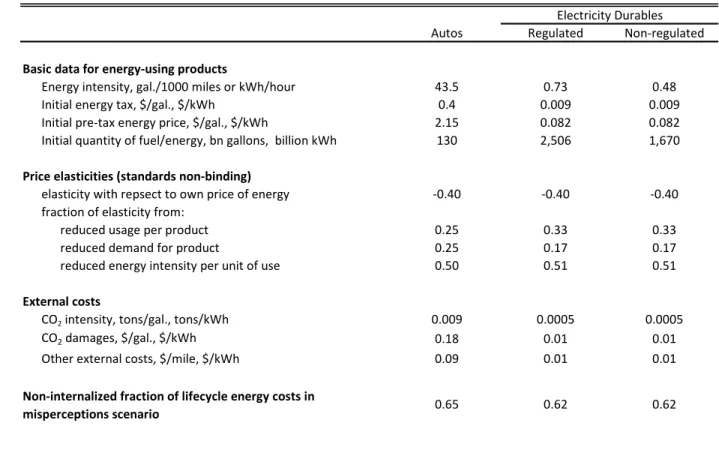
Here we comment briefly on data assumptions for our simulations, as summarized in Table 1, which is representative of year 2008 or thereabouts. Parameters for the transportation sector are taken from prior literature; for the power sector we construct estimates by aggregating products within regulated and unregulated sectors.
A. Basic Transportation Data
We assume the average fuel economy of the (on-road) light-duty vehicle fleet is 23 miles per gallon, or alternatively, fuel intensity is 43.5 gallons per 1,000 miles (BTS 2009, Table 4.23). From Parry and Small (2005), we take the combined federal and (average) state gasoline tax to be $0.40/gallon And, based on the average price between 2003 and 2008, we assume a pretax gasoline price of $2.15/gallon.9 Initial fuel use is taken to be 130 billion gallons (BTS 2009, Table 4.5).
Based on the widely cited study by Small and Van Dender (2006), we assume that the (long-run) own-price elasticity of gasoline is –0.4, with half of the response due to changes in fuel economy and half due to changes in vehicle miles. Thus, the gasoline demand elasticity is – 0.2 in the presence of fully binding fuel economy standards. We further assume that the mileage response is split equally between changes in the vehicle stock and miles per vehicle. This implies a rebound effect of 10 percent (for a given vehicle stock), which is approximately consistent with Small and Van Dender (2006).
B. Basic Electricity Data
Electricity consumption in the residential, industrial, and commercial sectors was 4,176 billion kWh in 2007, according to the Energy Information Administration (EIA 2009). Based on classifying products, and aggregating over each product’s electricity use, in EIA surveys, we assume that 60 percent of this consumption is from durables that are, or are potentially, subject to efficiency standards. The main groups in the regulated category include most major appliances, lighting, buildings, and heating and cooling equipment, while the unregulated category includes
smaller appliances, audio and entertainment equipment, industrial processes such as assembly lines. We suspect that a large share of industrial electricity consumption is unlikely to be subject to efficiency standards given the heterogeneity of the electricity-consuming capital stock across industries and facilities. Furthermore, in the analysis below, we make the favorable assumption that the set of efficiency standards reduce consumption at least cost. That is, the marginal cost per kWh of consumption reduced of each individual product standard is the same. Energy intensity for the two electricity sectors is simply usage divided by 8760 hours per year.
The average (pretax) electricity price over all end users was 8.2 cents/kWh in 2007, and state taxes averaged 0.9 cents/kWh (EIA 2010).
We assume that the own-price elasticity of demand for electricity is –0.4 for both
regulated and unregulated sectors, based on a long-run estimate by Myers et al. (2009), which is broadly consistent with other evidence (Sanstad and McMahon 2008). We further assume that the use per product, product demand, and electricity intensity elasticities are –0.13, –0.07, and – 0.2, respectively, for both sectors.10
C. Externalities
As regards CO2 emissions intensities, a gallon of gasoline combustion produces 0.009 ton of CO2, and given the prevailing fuel mix, the average emissions intensity of power generation is 0.0005 ton of CO2 per kWh (EIA 2009).11 We consider a benchmark value of $20/ton for CO2 damages and a range of up to $100/ton for sensitivity analysis (see Appendix B for the justification). The benchmark value implies CO2 damages of 18 cents/gallon and 1 cent/kWh.
As regards oil dependence, Brown and Huntington (2009) put the external costs due to macroeconomic disruptions from world oil price volatility at equivalent to about 10 cents per gallon. Perhaps more important, dependence on an oil market influenced by hostile regimes might constrain U.S. foreign policy or threaten national security, though these geopolitical costs are not easily quantified. Therefore, we simply infer the implicit costs per gallon that would be required to justify automobile efficiency standards of different stringencies.
10 The first figure is Myers et al. (2009)’s electricity demand elasticity over the very short run, when there is very
limited scope for altering product demand or energy efficiency.
11 The latter reflects an average rate over different fuels. In practice, natural gas is often the marginal fuel, but its
From Small and Verhoef (2007), we assume local pollution damages of $0.01/auto-mile. For marginal congestion costs, we update Parry and Small (2005)’s figure by 30 percent to $0.045/mile.12 For marginal accident externalities, we increase Parry and Small (2005)’s estimate to $0.035/mile, based on the value of a statistical life now assumed by the U.S. Department of Transportation, $5.8 million. Thus other externalities amount to $0.09/mile for autos.
For electricity generation there are no externalities analogous to the energy security and product usage externalities applicable to autos.13 And local pollution benefits are modest, 0.13 cents/kWh, because the bulk of high-damage emissions are capped under the sulfur trading program (see Appendix B).
D. Misperceptions
Appendix B describes empirical literature on implicit discount rates and possible reasons why they exceed market rates. We consider two bounding cases, one in which there is no
misperceptions market failure (ρi = 0); that is, any differences between implicit and social
discount rates are entirely explained by hidden costs. In the other, the entire difference is due to misperceptions over energy efficiency benefits. For electricity durables, we assume ρi (i = R, N)
= 0.62 for this case, based on typical estimates of implicit discount rates; for automobiles, we adopt a bounding case of ρA = 0.65, based on a common assumption that consumers consider fuel
savings from higher efficiency over only the first three years of a vehicle’s life (see Appendix B).
E. Other Parameters
We choose the αs in equation (11) to imply that for a 10 percent reduction in energy-related, economywide CO2 emissions under a CO2 tax, 60 percent of these reductions would come from reduced emissions intensity in the power sector, 20 percent from reduced electricity demand, and 10 percent each from automobiles and from industrial and other sources. These assumptions are approximately consistent with U.S. EPA (2010), EIA (2008), and the relative responsiveness in the power and transport sectors implied by our own assumptions. Note that CO2 emissions from the power sector (which initially account for 40 percent of nationwide
12 This accounts for recent growth in the value of travel time and congestion (based on data in CEA 2009, Table B
47, and Schrank and Lomax 2009, Table 4).
13 Power generation fuels are domestically supplied. And although there is sporadic congestion on the grid, the
emissions) are approximately twice as large as those for autos (Table 1). Finally, based approximately on U.S. EPA (2010) and EIA (2008) we set ηC = 1.2 (implying a moderately convex function), and we choose β such that the CO2 tax associated with an emissions reduction of 10 percent is $30 per ton.
4. Quantitative Results
This section compares the welfare effect of efficiency standards and energy taxes for the transport and power sectors and identifies conditions under which efficiency standards are warranted. The marginal costs of reducing economywide CO2 emissions under all policies are also compared.
A. Welfare Comparison of Efficiency Standards and Energy Taxes (i) Reducing Gasoline
Figure 1 shows the marginal cost of reducing gasoline under fuel taxes and efficiency standards with either no misperceptions failures (panel (a)) or our bounding case for the magnitude of misperceptions failures (panel (b)). These estimates incorporate preexisting fuel taxes but assume that under higher fuel taxes, efficiency standards are not binding. We note the following points.
First, the marginal cost curves under the standards are more than twice as steep as those under the gasoline tax. This is because the fuel standard puts the entire burden of fuel reductions on improvements in fuel economy, whereas the gasoline tax also exploits fuel savings from reduced vehicle miles traveled.
Second, with no misperceptions failures, the intercept of the marginal cost under the standard is well above that for the tax. For both policies, the preexisting gasoline tax contributes 40 cents/gallon to the intercept, though this is partly offset by CO2 externality benefits of 18 cents per gallon in the benchmark case.
Under the gasoline tax there is an additional welfare gain of $1.04/gallon due to the reduction in congestion and other mileage-related externalities. Overall, the marginal cost curve under the gasoline tax in panel (a) has a negative intercept of 81 cents/gallon. The marginal cost is negative up to a fuel reduction of 11 percent, corresponding to the fuel reduction under the optimal gasoline tax, which is $1.26/gallon. Implementing this optimal tax would yield annual welfare gains of $5.8 billion. In contrast, mileage increases moderately under the fuel economy standard, and the resulting increase in congestion and other externalities further shifts up the marginal cost, so it has an overall intercept of 43 cents/gallon. In fact, in this scenario the
standard would impose potentially large (total) welfare losses—for example, $5.9 billion a year for a 5 percent fuel reduction.
The third main point is that even with our bounding case for misperceptions failures, the marginal cost under the standard does not fall below that for the tax. Again, a fuel tax–efficiency standard combination is inferior to the fuel tax alone. This result is independent of climate and oil security externalities because they affect the intercept of both marginal cost curves by the same amount.
The marginal cost under the gasoline tax is shifted down substantially further: now the intercept is –$1.64 per gallon, the optimal fuel tax rises to $3.08/gallon, and the fuel reduction under the optimized tax is 25 percent. The downward shift in the marginal cost curve is much larger under the standard because all, rather than a fraction, of the reduction in fuel use comes from improved fuel economy. However, even under this bounding case, the intercept of the marginal cost under the efficiency standard does not (quite) fall below that for the tax.
If there are constraints on fuel taxes, fuel economy standards can still be warranted, but only with big misperceptions market failures. In our bounding case for these failures, a standard that cut fuel use by 8.9 percent would be optimal, though potential welfare gains are only about a third of those for the fuel tax.
(ii) Reducing Electricity
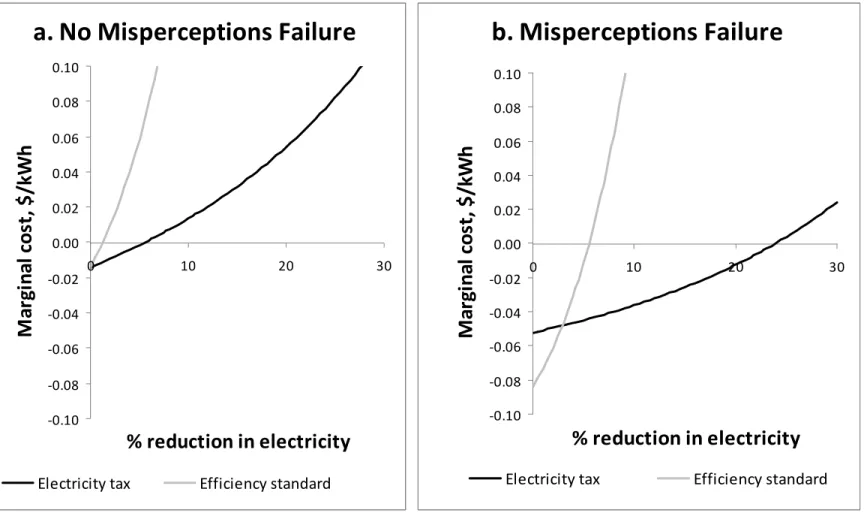
Figure 2 shows the marginal cost of reducing electricity under taxes and efficiency standards, again with no misperceptions failure (panel (a)) and our bounding case for the magnitude of the misperceptions failure (panel (b)). We note the following points.
First, the marginal cost curve under the standard is much steeper than that under the electricity tax. This again reflects the failure of the standard to exploit reductions in product usage. However in addition, unlike the electricity tax, the standard fails to exploit any electricity savings in the unregulated sector (which accounts for 40 percent of use).
Second, with no misperceptions failures, the electricity tax is welfare improving up to a reduction in electricity use of 5.5 percent. Implementing the optimal tax increase (1.4 cents per kWh) would generate modest welfare gains of $1.6 billion. Potential welfare gains under the efficiency standard are positive (unlike the corresponding case for autos) but very modest, at $0.3 billion (the optimized standard would reduce overall electricity use by just 1.3 percent).
For these policies, local pollution benefits are approximately cancelled out by prior (state-level) electricity taxes. Both curves have negative intercepts of –1.3 cents/kWh, reflecting
Third, accounting for the misperceptions failure, efficiency standards can be superior to electricity taxes, but only for modest reductions in electricity use, of 3 percent or less. The marginal cost in Figure 2(b) under the standard has a lower intercept (–8.4 cents/kWh) compared with the electricity tax (–5.2 cents/kWh). However, because of its much steeper slope, marginal costs under the standard quickly rise above those under the tax. If standards alone were
optimized, total electricity use would be reduced by 5.5 percent (electricity use in the regulated sector would fall by 9.2 percent), but if the tax alone were optimized, electricity would be reduced by 24 percent. In principle, for any given reduction in electricity use, it would be optimal to supplement the electricity tax with an efficiency standard to skew reductions toward efficiency improvements (away from reductions in product use). But even in this upper-bound case for misperceptions, in general the potential welfare gains from this combination policy are only moderately larger than those from the electricity tax. For example, cutting electricity use by 10 percent under the tax yields welfare gains of $19.8 billion, while achieving the same
reduction under the combination yields welfare gains of $21.1 billion.
B. Market Failures Required to Justify Different Levels of Efficiency Standards
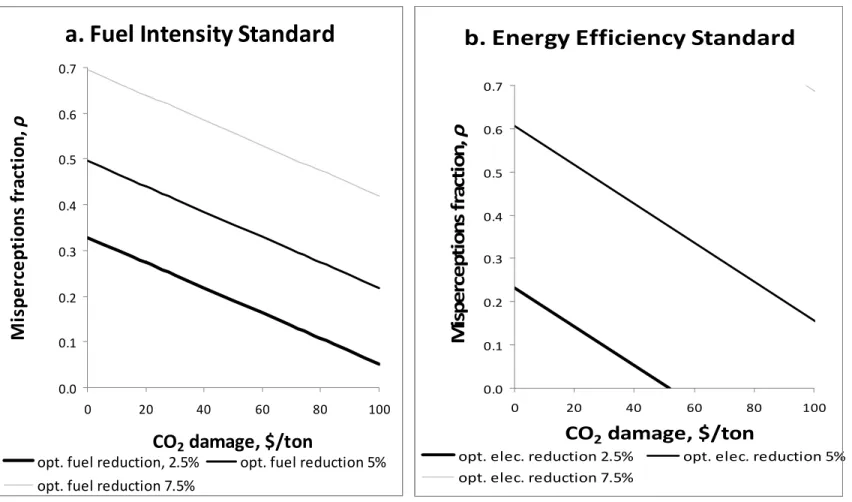
Figure 3 summarizes, in a different way, the results so far for the efficiency standards. It shows “iso-market failure” curves—that is, combinations of CO2 damages and misperceptions failures under which it is optimal to reduce fuel or electricity use by different amounts, given current energy taxes.
For automobiles, there is still a high threshold for standards to improve welfare, even if current fuel taxes are fixed. For example, if there is no misperceptions market failure, even if CO2 damages were $100 per ton, cutting fuel use by 2.5 percent under standards is not
warranted. Alternatively, reducing gasoline use by 5 percent or more by raising fuel economy standards is efficient only if consumers fail to internalize at least 44 percent of the value of fuel savings (under our benchmark value for CO2 damages). The recent tightening of CAFE standards actually represents a far more aggressive policy than this: new passenger vehicle fuel economy is set to rise from 25 mpg to about 35 mpg by 2016, implying a long-run gasoline reduction of about 25 percent (after allowing for the rebound effect). Most likely, there would be some
improvement without regulation as new fuel-saving technologies are incorporated and fuel prices rise. Nonetheless, our analysis suggests that it is difficult to justify such a rapid ramp-up in the CAFE standards on welfare grounds (i.e., the iso-market failure cost curve for this scale of fuel reduction is outside our upper-bound cases for market failures).
For the power sector, there is a lower threshold for efficiency standards to be optimal, but only for small (2.5 percent) reductions in energy use. For more substantial reductions, efficiency
standards for the power sector are even more difficult to justify, on market failure grounds, than for automobiles. In Figure 3, this is indicated by the higher position of the iso-market failure curve in panel b for the 5 percent electricity reduction compared with the corresponding curve in panel a, in part because only 60 percent of consumption is subject to these standards. And a 7.5 percent reduction in electricity use under standards is warranted only under the most extreme of our scenarios for market failures.
C. Role of Efficiency Standards in CO2 Mitigation
Figure 4 shows marginal cost curves for reducing economywide CO2 emissions under alternative policies, where again panels a and b correspond to our two bounding cases for
misperceptions failures. In contrast to Figures 1 and 2, we do not net out CO2 externality benefits from these costs. Again, these figures underscore our previous point that efficiency standards, and regulatory approaches more generally, are poor substitutes for pricing policies.
With no misperceptions failures, the costs of either efficiency standard are huge, relative to those of the CO2 tax, for nonmarginal emissions reductions. An emissions standard for the power sector is dramatically more effective and cost-effective than efficiency standards. But even this regulatory policy does not perform that well relative to the CO2 tax. For example, for a CO2 reduction of 10 percent (which, roughly speaking, was projected for 2020 under recent federal cap-and-trade proposals), this policy costs $12.9 billion. In contrast, the CO2 tax costs only $2.3 billion for the same emissions reduction, given that it exploits more margins for abatement and it reduces driving-related externalities. In fact, to target these broader
externalities, an optimal policy in this case would combine a fuel tax increase with a CO2 tax. With (our bounding case for) misperceptions failures, marginal costs under both
efficiency standards and the gasoline and electricity taxes lie below marginal costs under the CO2 emissions tax for some range of reductions. However, for both the efficiency standards, marginal costs rise rapidly, becoming positive at economywide emissions reductions of 2 percent or less. In contrast, marginal costs under the electricity tax and CO2 tax are negative up to emissions reductions of about 8 and 15 percent, respectively. In fact, for the 10 percent reduction in CO2, total costs under the CO2 tax are now negative, –$10.8 billion. Even the least-cost regulatory approach involving both efficiency standards and the emissions standard has costs of plus $3.8 billion (costs for this combination are not shown in Figure 4), or $14.6 billion more than the CO2 tax.
5. Conclusion
Our analysis suggests that efficiency standards applied to the transport and power sectors are difficult to justify, certainly as a complement to pricing instruments, and even if pricing instruments are infeasible for the time being. Although there is much dispute about the magnitude of possible market failures associated with misperceptions over energy efficiency benefits, even under upper-bound assumptions for these market failures, only modest reductions in energy use or emissions are warranted under standards, and potential welfare gains are a minor or tiny fraction of those under pricing policies.
Of course, our analytical framework provides only a first-level assessment of welfare effects. Digging deeper, we see a number of caveats.
For example, our model assumes “smart” regulation that (implicitly) equates marginal compliance costs across producers within a sector. Moving forward, this may be a reasonable approximation for automobiles, given the recent extension of credit-trading provisions in the CAFE program. It is more questionable for the power sector, given the practical complexities of monitoring credit trading among heterogeneous producer groups (e.g., real estate developers and refrigerator manufacturers). At any rate, allowing the possibility of imperfect regulation would only strengthen our main findings.
The same would apply to incorporating dynamics into our analysis. Distinguishing capital of different vintages would allow us to explore transitory inefficiencies from new product
standards resulting from the uneven treatment of new and preexisting capital (though it would add considerable analytical complexity).
We assume marginal-cost pricing. In practice, prices deviate from marginal costs because of cost-of-service regulation of power generation in many states and limited use of time-of-day pricing. However, it is difficult to make general statements about the economywide implications of these deviations (even with regard to their sign, let alone their magnitude), given that they are highly specific to region and time of day.
Finally, our welfare analysis is incomplete in that it excludes interactions between energy and environmental policies and the distortions in the economy created by the broader fiscal system, particularly distortions in factor markets. Literature on this issue suggests that the tax revenue or allowance rent created by corrective taxes or cap-and-trade systems is potentially problematic (e.g., Goulder et al. 1999). This revenue or rent needs to be used in ways to increase economic efficiency, particularly by cutting other distortionary taxes, to offset efficiency losses in factor markets caused by higher energy prices and the consequently higher general price level and lower real factor returns. Standards, in contrast, have an advantage in this regard: they have a
weaker effect on the general price level (i.e., they do not involve the pass-through of tax revenues or allowance rents).
References
Allcott, Hunt, and Nathan Wozny. 2009. “Gasoline Prices, Fuel Economy, and the Energy Paradox.” Discussion paper, Department of Economics, Massachusetts Institute of Technology, Cambridge, MA.
Austin, David, and Terry Dinan. 2005. “Clearing the Air: The Costs and Consequences of Higher I Standards and Increased Gasoline Taxes.” Journal of Environmental Economics and Management 50: 562–82.
Berkovec, J., Jerry A. Hausman, and J. Rust. 1983. “Heating System and Appliance Choice.” Report MIT-EL 83-004WP, MIT Energy Laboratory, Cambridge, MA.
Brown, Stephen P.A., and Hillard G. Huntington. 2009. “Reassessing the Oil Security Premium.” Working paper, Resources for the Future, Washington, DC.
Bureau of Transportation Statistics (BTS). 2009. National Transportation Statistics. U.S. Department of Transportation, Washington, DC. Available at
www.bts.gov/publications/national_transportation_statistics.
Council of Economic Advisors (CEA). 2009. Economic Report to the President 2009. Washington, DC.
Dreyfus, Mark K., and W. Kip Viscusi. 1995. “Rates of Time Preference and Consumer Valuations of Automobile Safety and Fuel Efficiency.” Journal of Law and Economics
38: 79–105.
Dubin, Jeffrey A., and Daniel I. McFadden. 1984. “An Econometric Analysis of Residential Electric Appliance Holdings and Consumption.” Econometrica 52: 345–62.
Energy Information Administration (EIA). 2001. Residential Consumption of Electricity Survey.
U.S. Department of Energy, Washington, DC. Available at
http://www.eia.doe.gov/emeu/recs/recs2001/enduse2001/enduse2001.html Accessed October 10, 2009.
———. 2008. Energy Market and Economic Impacts of S. 2191, the Lieberman-Warner Climate Security Act of 2007. Report SR/OIAF/2008-01. U.S. Department of Energy,
Washington, DC.
———. 2010. Electric Power Annual. U.S. Department of Energy, Washington, DC.
Fischer, Carolyn, Winston Harrington, and Ian W.H. Parry. 2007. “Should Corporate Average Fuel Economy Standards Be Tightened?” Energy Journal 28: 1–29.
Gately, D. 1980. “Individual Discount Rates and the Purchase and Utilization of Energy-Using Durables: Comment.” Bell Journal of Economics 11: 373–74.
Gillingham, Kenneth N.G., Richard G. Newell, and Karen L. Palmer. 2009. “Energy Efficiency Economics and Policy.” Annual Review of Resource Economics 1: 597–620.
Goldberg, Pinelopi. 1998. “The Effects of the Corporate Average Fuel Economy Standards in the Automobile Industry.” Journal of Industrial Economics 46: 1–33.
Goulder, Lawrence H., Ian W.H. Parry, Roberton C. Williams, and Dallas Burtraw. 1999. “The Cost-Effectiveness of Alternative Instruments for Environmental Protection in a Second-Best Setting.” Journal of Public Economics 72: 329–60.
Goulder, Lawrence H., Mark Jacobsen, and Arthur van Benthem. 2009. “Unintended Consequences from Nested State & Federal Regulations: The Case of the Pavley
Greenhouse-Gas-per-Mile Limits.” Working paper, Department of Economics, Stanford University.
Greene, David L. 2010. How Consumers Value Fuel Economy: A Literature Review. EPA-420-R-10-008. U.S. Environmental Protection Agency, Washington, DC.
Hassett, Kevin A., and Gilbert E. Metcalf. 1993. “Energy Conservation Investment: Do Consumers Discount the Future Correctly?” Energy Policy 21: 710–16.
———. 1995. “Energy Tax Credits and Residential Conservation Investment: Evidence from Panel Data.” Journal of Public Economics 57: 201–17.
Hausman, Jerry A. 1979. “Individual Discount Rates and the Purchase and Utilization of Energy-Using Durables.” Bell Journal of Economics 10: 33–54.
Heal, Geoffrey. 2009. “Climate Economics: A Meta-Review and Some Suggestions for Future Research.” Review of Environmental Economics and Policy 3: 4–21.
Howarth, Richard B., Brent M. Haddad, and Bruce Paton. 2000. “The Economics of Energy Efficiency: Insights from Voluntary Participation Programs.” Energy Policy 28: 477–86. Jaffe, Adam B., and Robert N. Stavins. 1994. “The Energy-Efficiency Gap: What Does It
Khazzoom, Daniel J. 1980. “Economic Implications of Mandated Efficiency Standards for Household Appliances.” Energy Journal 1: 21–40.
Kleit, Andrew N. 2004. “Impacts of Long-Range Increases in the Corporate Average Fuel Economy (CAFE) Standard.” Economic Inquiry 42: 279–94.
Krupnick, Alan J., Ian W.H. Parry, Margaret Walls, Tony Knowles, and Kristin Hayes. 2010.
Toward a New National Energy Policy: Assessing the Options. Resources for the Future and National Energy Policy Institute, Washington, DC.
Little, Arthur D. Inc. 1984. “Measuring the Impact of Residential Conservation Programs: An Econometric Analysis of Utility Data.” Volume III, Final Report for RP1587, Electric Power Research Institute.
Myers, Erica, Karen L. Palmer, and Anthony Paul. 2009. “A Partial Adjustment Models of U.S. Electricity Demand by Region, Season and Sector.” Discussion Paper 08-50, Resources for the Future, Washington, DC.
National Research Council (NRC). 2002. Effectiveness and Impact of Corporate Average Fuel Economy (CAFE) Standards. National Academy Press, Washington, DC.
———. 2009. Hidden Costs of Energy: Unpriced Consequences of Energy Production and Use.
Washington, DC, National Academy Press.
Nordhaus, William D. 2007. “The Stern Review on the Economics of Climate Change.” Journal of Economic Literature. XLV: 686–702.
———. 2008. A Question of Balance: Weighing the Options on Global Warming Policies. Yale University Press, New Haven, CT.
———. 2009. “An Analysis of Weitzman’s Dismal Theorem.” Working paper, Yale University. Parry, Ian W.H., and Kenneth A. Small. 2005. “Does Britain or the United States Have the Right
Gasoline Tax?” American Economic Review 95: 1276–89.
Ruderman, Henry, Mark D. Levine, and James E. McMahon. 1987. “The Behavior of the Market for Energy Efficiency in Residential Appliances including Heating and Cooling
Equipment.” Energy Journal 8: 101–24.
Sallee, James, and Sarah West. 2010. “Testing for Consumer Myopia: The Effect of Gasoline Price Changes on the Demand for Fuel Economy in Used Vehicles.” Working aper, Harris School, University of Chicago.
Sanstad, Alan H., and Maximilian Auffhammer. 2010. “Energy Efficiency in the Residential and Commercial Sectors.” Agricultural and Resource Economics Department, University of California, Berkeley.
Sanstad, Alan H., and James E. McMahon. 2008. “Aspects of Consumers’ and Firms’ Energy Decision-Making: A Review and Recommendations for the National Energy Modeling System (NEMS).” Papers from the Workshop on Energy Market Decisionmaking for the New NEM. Energy Information Administration: Washington, DC.
Sanstad, Alan H., W. Michael Hanemann, and Maximillian Auffhammer. 2006. “End-use Energy Efficiency in a ’Post-Carbon’ California Economy: Policy Issues and Research
Frontiers.” California Climate Change Center at UC-Berkeley, Berkeley, CA. Schrank, David, and Timothy Lomax. 2009. The 2009 Urban Mobility Report. Texas
Transportation Institute, Texas A&M University, College Station.
Small, Kenneth A. 2009. “Energy Policies for Passenger Transportation: A Comparison of Costs and Effectiveness.” Working paper, University of California, Irvine.
Small, Kenneth A., and Kurt Van Dender. 2006. “Fuel Efficiency and Motor Vehicle Travel: The Declining Rebound Effect.” Energy Journal 28: 25–52.
Small, Kenneth A., and Erik Verhoef. 2007. The Economics of Urban Transportation.
Routledge, New York.
Stern, Nicholas. 2007. The Economics of Climate Change. Cambridge University Press, Cambridge.
Tietenberg, Tom. 2009. “Reflections—Energy Efficiency Policy: Pipe Dream or Pipeline into the Future?” Review of Environmental Economics and Policy 3: 304–20.
Train, Kenneth. 1985. “Discount Rates in Consumers’ Energy-Related Decisions: A Review of the Literature.” Energy 10: 243–53.
U.S. Environmental Protection Agency (EPA). 2010. EPA Analysis of the American Power Act in the 111th Congress. Washington, DC.
U.S. Interagency Working Group on Social Cost of Carbon (IAWG). 2010. Technical Support Document: Social Cost of Carbon for Regulatory Impact Analysis under Executive Order 12866. U.S. Government, Washington, DC.
Weitzman, Martin L. 2009. “On Modeling and Interpreting the Economics of Catastrophic Climate Change.” Review of Economics and Statistics 91: 1–19.