514 Vol. 3, Issue 1, pp. 514-524
P
OWER
F
LOW
A
NALYSIS OF
T
HREE
P
HASE
U
NBALANCED
R
ADIAL
D
ISTRIBUTION
S
YSTEM
Puthireddy Umapathi Reddy
1, Sirigiri Sivanagaraju
2, Prabandhamkam
Sangameswararaju
31
Department of Electrical and Electronics Engineering, Sree Vidyanikethan Engineering College, Tirupati-517102, India.
2
Department of Electrical and Electronics Engineering, Jawaharlal Nehru Technological University College of Engineering Kakinada, Kakinada-533 003, India.
3
Department of Electrical and Electronics Engineering, Sri Venkateswara University College of Engineering, Tirupati-517502, India.
A
BSTRACTThis paper provides a new approach for power flow and modeling analysis of three phase unbalanced radial distribution systems (URDS) using the simple forward/backward sweep-based algorithm. A three phase load flow solution is proposed considering voltage regulator and transformer with detailed load modeling, for the transformer modeling symmetrical components theory is used and zero sequence-voltage and-current updating for the sweep-based methods is shown. The validity and effectiveness of the proposed method is demonstrated by a simple 19-bus unbalanced system for grounded wye-delta and delta grounded wye transformer connections. Results are in agreements with the literature and show that the proposed model is valid and reliable.
K
EYWORDS:
Distribution System, Forward-Backward sweep-based methods, Three-phase load model analysis, Power flow analysis.I.
I
NTRODUCTIONPower distribution systems have different characteristics from transmission systems [1],[2].They are characterized as Radial/weakly meshed structures, Unbalanced networks/loads: single, double and three phase loads, High resistance/reactance(R/X) ratio of the lines, Extremely large number of branches/nodes, Shunt capacitor banks and distribution transformers, Low voltage levels compared with those of transmission systems and distributed generators[3].[4]. Because of the inherent unbalanced nature of the power distribution system, each bus may be having loads that can be three- phase grounded wye or ungrounded delta connected, two-phase grounded or single-phase grounded [5]. The unbalanced nature of power distribution systems requires special three phase component and system models [6]. The operation and planning studies of distribution system requires a steady state conditions of system can be obtained from the load flow solution[7],[8].The efficiency of the entire process depends heavily on the efficiency and capability of the load flow program used for this purpose[9].
Most of the researchers presented techniques, especially to obtain the load flow solution of distribution networks [10],[11] have proposed a load flow solution method by writing an algebraic equation for bus voltage magnitude. However this method is suitable for single-phase analysis [12]. A few researchers have proposed load flow solution techniques[17] to analyze unbalanced distribution networks [13],[14] have formulated load flow problem as a set of non linear power mismatch equations as a function of the bus voltages. These equations have been solved by Newton’s method [15],[16] have proposed three phase power flow algorithm based on the forward and back word walk along the network. The method considers some aspects of three phase modelling of branches and detailed load modelling [18],[19]. P. Aravindhababu, proposed a method [20], A new fast decoupled
515 Vol. 3, Issue 1, pp. 514-524
power flow method for distribution systems. Improvements in the representation of PV buses on three-phase distribution power flow [21] are proposed. A new approach have given [22], [23] for three-Phase Fast Decoupled Load Flow for Unbalanced Distribution Systems. T.H. Chen, N.C. Yang, proposed three-phase power-flow by direct ZBR method for unbalanced radial distribution systems [24]. A Simple and Direct Approach for Unbalanced Radial Distribution System three phase Load Flow Solution [25] have been explained. The significance of this power flow analysis is to apply load flow data for capacitor placement, network reconfiguration, voltage regulator placement etc. in URDS.
This paper presents an algorithm for solving load model and power flow analysis of three-phase unbalanced radial distribution systems. The algorithm is capable of solving for systems with many feeders emanating from grid substation with large number of nodes and branches. This paper considers all types of load modelling i.e distribution system line model, line shunt admittance model distributed load model, capacitor model, transformer modeling, Forward-Backward Sweep (FBS) load flow, algorithm for load flow, results and discussion, conclusions and references. Based on the proposed algorithm, a computer program has been developed using MATLAB and results are presented for typical network of 19-node URDS.
II.
M
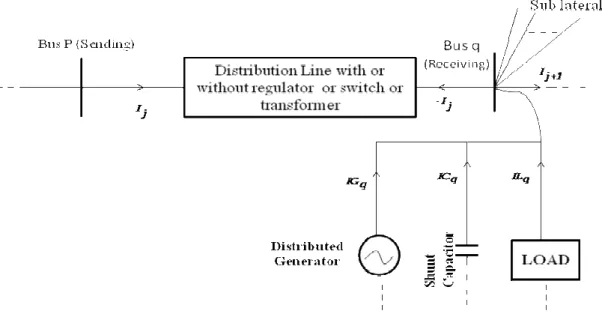
ODELING OF UNBALANCED RADIAL DISTRIBUTION SYSTEMRadial distribution system can be modeled as a network of buses connected by distribution lines, switches or transformers. Each bus may also have a corresponding load, shunt capacitor and/or co-generator connected to it. This model can be represented by a radial interconnection of copies of the basic building block shown in Figure 1. Since a given branch may be single-phase, two-phase, or three-phase, each of the labeled quantities is respectively a complex scalar, a 2 × 1, or a 3 × 1 complex vector. The model consist of distribution line with are without voltage regulator or Switch or Transformer.
Figure 1. Basic building block of unbalanced radial distribution system inclusion of all models
2.1 Distribution system line model
For the analysis of power transmission line, two fundamental assumptions are made, namely: Three-phase currents are balanced and Transposition of the conductors to achieve balanced line parameters. A general representation of a distribution system with N conductors can be formulated by resorting to
the Carson’s equations, leading to a N×N primitive impedance matrix. The standard method used to
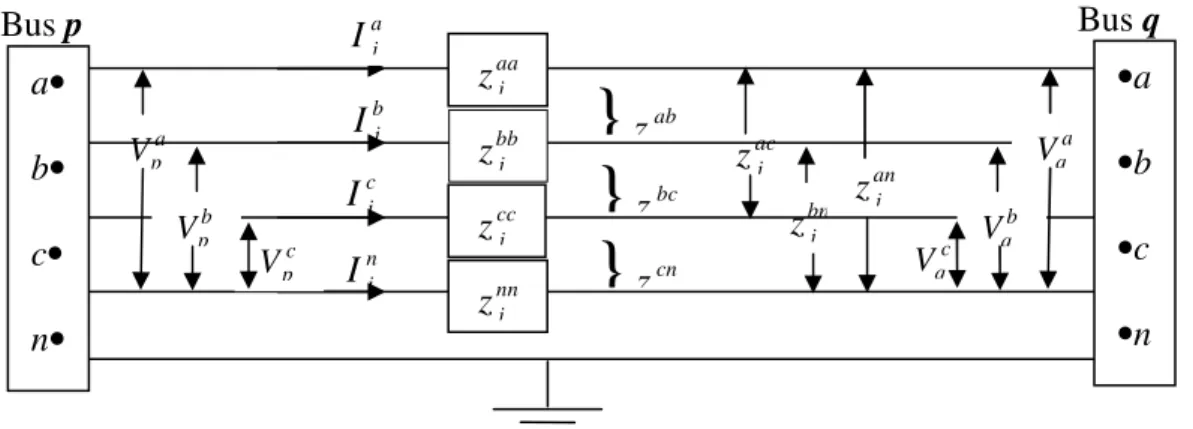
form this matrix is the Kron reduction, based on the Kirchhoff’s laws. For instance a four-wire grounded star connected overhead distribution line shown in figure 2 results in a 4×4 impedance matrix.
516 Vol. 3, Issue 1, pp. 514-524
Figure 2. Model of the three-phase four wire distribution line
(1)
It can be represented in matrix form as
+ = n j I nn j z n q V n p V abc j I T n j z n j z abc j Z abc q V abc p V (2)
If the neutral is grounded, the voltage Vnpand Vqncan be considered to be equal. From the lst row of eqn. (2) it is possible to obtain
abc
j
I
T
n
j
z
1
nn
j
z
n
j
I
=
−
−
(3)and substituting eqn.(3) into eqn. (2), the final form corresponding to the Kron’s reduction becomes
abc j I abc j Ze abc q V abc p V = + (4) Where = − − = cc j ze cb j ze ca j ze bc j ze bb j ze ba j ze ac j ze ab j ze aa j ze T n j z 1 nn j z n j z abc j Z abc j Ze (5) abc j
I is the Current vector through line between nodes p and q can be equal to the sum of the load
currents of all the nodes beyond line between node p and q plus the sum of the charging currents of all the buses beyond line between node p and q, of each phase.
Therefore the bus q voltage can be computed when we know the bus p voltage, mathematically, by
rewriting eqn. (4) ac j
z
bn jz
an jz
b jI
c jI
n jI
Bus q a jI
Busp a p V}
cn jz
}
bc jz
}
ab jz
bb jz
cc jz
nn jz
aa jz
b p V c p V Vqc b q V a q V a• b• c• n• •a •b •c •n + = n j c j b j a j nn j nc j nb j na j cn j cc j cb j ca j bn j bc j bb j ba j an j ac j ab j aa j n q c q b q a q n p c p b p a p I I I I z z z z z z z z z z z z z z z z V V V V V V V V517 Vol. 3, Issue 1, pp. 514-524 − = c j I b j I a j I cc j ze cb j ze ca j ze bc j ze bb j ze ba j ze ac j ze ab j ze aa j ze c p V b p V a p V c q V b q V a q V (6)
2.2 Line shunt admittance model
These current injections for representing line charging, which should be added to the respective compensation current injections at nodes p and q, are given by
(
)
(
)
(
)
+ + − + + − + + − = c q b q a q cc j cb j ca j cb j ca j bc j bc j bb j ba j ba j ac j ab j ac j ab j aa j c q b q a q V V V y y y y y y y y y y y y y y y Ish Ish Ish 2 1 (7)2.3 Distribution System Load Model
Constant Power: Real and reactive power injections at the node are kept constant. This load
corresponds to the traditional PQ approximation in single-phase analysis.
Constant Impedance: These types of loads are useful to model large industrial loads. The impedance
of the load is calculated by the specified real and reactive power at nominal voltage and is kept constant.
Constant Current: The magnitude of the load current is calculated by the specified real and reactive
power at nominal voltage and is kept constant.
2.3.1 Distributed load model
Sometimes the primary feeder supplies loads through distribution transformers tapped at various locations along line section. If every load point is modeled as a node then there are a large number of nodes in the system. So these loads are represented as lumped loads. At one fourth length of line from sending node, where two thirds of the load is connected. For this a dummy node is created. One third loads is connected at the receiving node.
In the unbalanced distribution system, loads can be uniformly distributed along a line. When the loads are uniformly distributed it is not necessary to model each and every load in order to determine the voltage drop from the source end to the last loads.
2.4 Capacitor model
Shunt capacitor banks are commonly used in distribution systems to help in voltage regulation and to provide reactive power support. The capacitor banks are modeled as constant susceptances connected in either star or delta. Similar to the load model, all capacitor banks are modeled as three-phase banks with the currents of the missing phases set to zero for single-phase and two-phase banks.
2.5 Transformer modeling
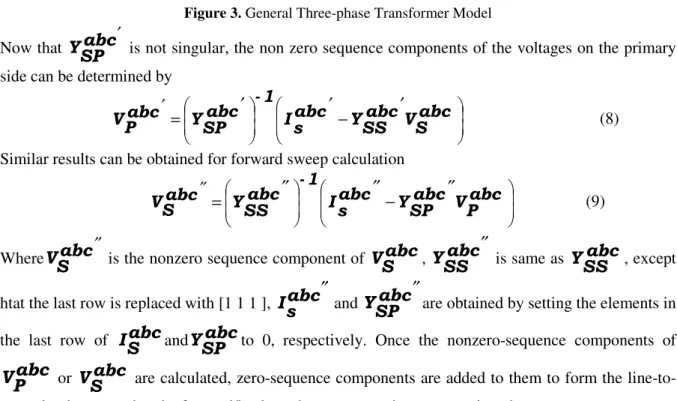
Three-phase transformer is represented by two blocks shown in Figure 3. One block represents the per unit leakage admittance matrix
Y
T
abc
and the other block models the core loss as a function of voltage on the secondary side.518 Vol. 3, Issue 1, pp. 514-524
Figure 3. General Three-phase Transformer Model
Now that abc′
SP
Y is not singular, the non zero sequence components of the voltages on the primary
side can be determined by
′ ′ − ′ ′ = abc S V abc SS Y abc s I 1 -abc SP Y abc P V (8) Similar results can be obtained for forward sweep calculation
″ ″ − ″ ″ = abc P V abc SP Y abc s I 1 -abc SS Y abc S V (9)
WhereVSabc″ is the nonzero sequence component of VSabc,YSSabc″ is same as YSSabc , except
htat the last row is replaced with [1 1 1 ], Isabc″ and YSPabc″are obtained by setting the elements in the last row of ISabcandYSPabcto 0, respectively. Once the nonzero-sequence components of
abc
P
V
or VSabc are calculated, zero-sequence components are added to them to form theline-to-neutral voltages so that the forward/backward sweep procedure can continued.
III.
F
ORWARD-
B
ACKWARDS
WEEP(FBS)
L
OAD FLOW METHOD3.1 Backward Sweep:
The purpose of the backward sweep is to update branch currents in each section, by considering the previous iteration voltages at each node. During backward propagation voltage values are held constant at the values obtained in the forward path and updated branch currents are transmitted backward along the feeder using backward path. Backward sweep starts from extreme end branch and proceeds along the forward path.
Figure 4.Single phase line section with load connected at node q between phase ‘a’& neutral n.
Figure 4 shows phase a of a three-phase system where lines between nodes p and q feed the node q
and all the other lines connecting node q draw current from line between node p and q.
a q
IL
a j I a j I p a q V aa j ze a q S q a q IC519 Vol. 3, Issue 1, pp. 514-524
During this propagation different load currents and capacitor currents (if exist) are calculated using mathematical models of loads and capacitors presented in section 2.1.
The line charging currents of all the branches are added to the load current. Figure 5 shown a branch
‘j’ of the distribution network, connected between two nodes p and q and M sub-laterals are connected
to it. The parent branch current feeds the load at the
q
th node and the sub-laterals connected to theparent branch. This current can be calculated using Eqn. (10).
Figure 5. Branch jof distribution network connected to M sub-laterals ∑ ∈ ∑ ∈ − + + = M m m M 1 k m abc q V k m abc sh Y k abc m I k abc q IL k abc j I (10) Where k m abc sh
Y is the half line shunt admittance of the branch in kth iteration.
k abc
j
I isthe branch current vector in line section j in kth iteration.
k abc m
I is the current vector in branch m before updating in kth iteration.
1 k m abc q
V − is the voltage vector of the branch m in (k-1)th iteration.
M represents the set of line sections connected to jth branch
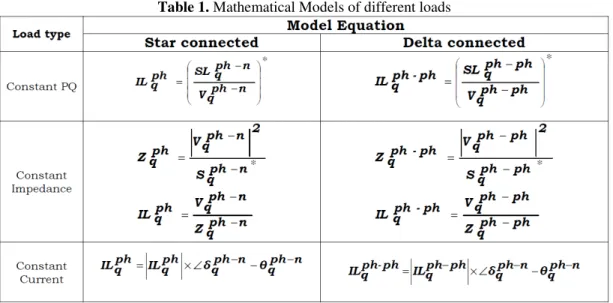
If capacitor bank is placed at the receiving end of the branch then capacitor current should also be included. Table 1. shows a mathematical Models of different loads(star & delta connected) which gives constant power, constant impedance and constant current. Another advantage of the proposed method is all the data is stored in vector form, thus saving an amount of computer memory. The proposed method finds extensive use in network reconfiguration, capacitor placement and voltage regulator placement studies.
520 Vol. 3, Issue 1, pp. 514-524 3.2 Forward Sweep
The purpose of the forward sweep is to calculate the voltages at each node starting from the source node. The source node voltage is set as 1.0 per unit and other node voltages are calculated as
−
+
=
V
p
abc
k
Ze
abc
j
Y
sh
abc
V
p
abc
k
I
abc
j
k
k
abc
q
V
(11) Where k abc p V k abc qV , are the voltage vectors of phases for pth and qth nodes respectively in kth
iteration. = cc j ze cb j ze ca j ze bc j ze bb j ze ba j ze ac j ze ab j ze aa j ze abc j Ze k abc j
I is the current vector in jth branch in kth iteration.
These calculations will be carried out till the voltage at each bus is within the specified limits. Therefore the real and reactive power losses in the line between nodes p and q may be written as:
Sabcj =(Vpabc −Vqabc)(Iabcj )* (12)
Where
abc j
S is a vector of power loss with three, two or single phase
abc p
V and Vqabc are voltage vector of three phases at nodes p and q
abc j
I is the branch current vector of three phases for the section connected in between pth and qth node
3.3 Forward Backward sweep method algorithm
Step 1: Read input data regarding the unbalanced radial distribution system.
Step 2: Determine forward Backward propagation paths.
Step 3: Initialize the voltage magnitude at all nodes as 1 p.u and voltage angles to be 00, -1200,
and 1200 for phase A, phase B and phase C respectively.
Step 4: Determine forward Backward propagation paths.
Step 5: Initialize the voltage magnitude at all nodes as 1 p.u and voltage angles to be 00, -1200,
and 1200 for phase A, phase B and phase C respectively.
Step 6: Set iteration count k=1 and∈ = 0.0001
Step 7: Calculate load currents and capacitor currents(if exist) at all nodes.
Step 8: Calculate the branch currents using eqn. (10) in the backward sweep.
Step 9: Calculate node voltages using eqn. (11) in the forward sweep
Step10: Check for the convergence, if the difference between the voltage magnitudes in two consecutive iterations is less than ∈ then go to step 9 else set k=k+1 and go to step 5.
Step11: Calculate real and reactive power loss in each branch. Step12: Print voltages and power losses at each node.
521 Vol. 3, Issue 1, pp. 514-524
IV.
R
ESULTS ANDD
ISCUSSIONThis method computes the power flow solution for its given radial network with its loadings and illustrated with 19 node test system of unbalanced radial distribution system. The outcome of this paper is to apply load flow data for capacitor placement, network reconfiguration, voltage regulator placement etc. in URDS are very useful.
4.1 Example – 1
A 19 node unbalanced radial distribution system is shown in Figure 6. The line and load data are given in [23]. For the load flow the base voltage and base MVA are chosen as 11 kV and 1000 kVA respectively.
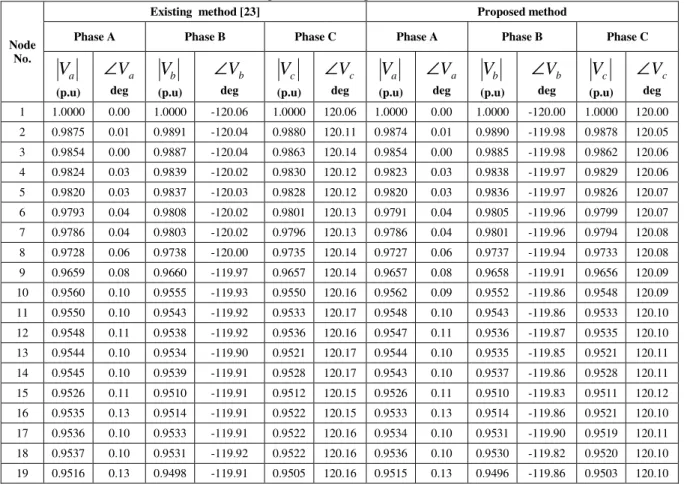
Table2: Voltage and Phase angles of 19 node URDS
Figure 6. Single line diagram of 19 node URDS
Node No.
Existing method [23] Proposed method
Phase A Phase B Phase C Phase A Phase B Phase C
a
V
(p.u) a V ∠ deg bV
(p.u) b V ∠ deg cV
(p.u) c V ∠ deg aV
(p.u) a V ∠ deg bV
(p.u) b V ∠ deg cV
(p.u) c V ∠ deg 1 1.0000 0.00 1.0000 -120.06 1.0000 120.06 1.0000 0.00 1.0000 -120.00 1.0000 120.00 2 0.9875 0.01 0.9891 -120.04 0.9880 120.11 0.9874 0.01 0.9890 -119.98 0.9878 120.05 3 0.9854 0.00 0.9887 -120.04 0.9863 120.14 0.9854 0.00 0.9885 -119.98 0.9862 120.06 4 0.9824 0.03 0.9839 -120.02 0.9830 120.12 0.9823 0.03 0.9838 -119.97 0.9829 120.06 5 0.9820 0.03 0.9837 -120.03 0.9828 120.12 0.9820 0.03 0.9836 -119.97 0.9826 120.07 6 0.9793 0.04 0.9808 -120.02 0.9801 120.13 0.9791 0.04 0.9805 -119.96 0.9799 120.07 7 0.9786 0.04 0.9803 -120.02 0.9796 120.13 0.9786 0.04 0.9801 -119.96 0.9794 120.08 8 0.9728 0.06 0.9738 -120.00 0.9735 120.14 0.9727 0.06 0.9737 -119.94 0.9733 120.08 9 0.9659 0.08 0.9660 -119.97 0.9657 120.14 0.9657 0.08 0.9658 -119.91 0.9656 120.09 10 0.9560 0.10 0.9555 -119.93 0.9550 120.16 0.9562 0.09 0.9552 -119.86 0.9548 120.09 11 0.9550 0.10 0.9543 -119.92 0.9533 120.17 0.9548 0.10 0.9543 -119.86 0.9533 120.10 12 0.9548 0.11 0.9538 -119.92 0.9536 120.16 0.9547 0.11 0.9536 -119.87 0.9535 120.10 13 0.9544 0.10 0.9534 -119.90 0.9521 120.17 0.9544 0.10 0.9535 -119.85 0.9521 120.11 14 0.9545 0.10 0.9539 -119.91 0.9528 120.17 0.9543 0.10 0.9537 -119.86 0.9528 120.11 15 0.9526 0.11 0.9510 -119.91 0.9512 120.15 0.9526 0.11 0.9510 -119.83 0.9511 120.12 16 0.9535 0.13 0.9514 -119.91 0.9522 120.15 0.9533 0.13 0.9514 -119.86 0.9521 120.10 17 0.9536 0.10 0.9533 -119.91 0.9522 120.16 0.9534 0.10 0.9531 -119.90 0.9519 120.11 18 0.9537 0.10 0.9531 -119.92 0.9522 120.16 0.9536 0.10 0.9530 -119.82 0.9520 120.10 19 0.9516 0.13 0.9498 -119.91 0.9505 120.16 0.9515 0.13 0.9496 -119.86 0.9503 120.10522 Vol. 3, Issue 1, pp. 514-524
Table3: Active and Reactive Power flows of 19 node URDS
Table4: Summary of test results of 19 node URDS
Voltage profile with comparison of the proposed method with existing method and active and reactive Power flows of 19 node URDS are given in table 2 and 3. Voltage variation is given in table 2, which gives better magnitudes are obtained in proposed method. The active power flow gives higher power flow capacity with proposed method shown in Table 3. The Table 4 gives summary of test results for 19 node unbalanced radial distribution systems. From table 4 it has been observed that the minimum voltage in phases A, B, C is 0.9515, 0.9496 and 0.9502 at node 19. The maximum percentage voltage regulation in phases A, B and C are 4.82%, 5.01% and 4.93%. The total active power loss in phases of A, B and C are 4.34, 4.42 and 4.54 kW and the total reactive power loss in phases of A, B and C are 1.95,1.90 and 1.94 kVA respectively. The real power losses in phases A, B and C are 3.64%, 3.96% and 3.78% and the reactive power losses are 3.32%, 3.34% and 3.33% of their total loads. The solution is converged in 4 iterations and time taken is 0.00645 seconds for 19 node URDS. The proposed method is capable of solving for systems with many feeders emanating from grid substation with large number of nodes compared with the existing method [23] and results are found satisfactory.
V.
C
ONCLUSIONSIn this paper, a simple algorithm has been presented to solve power flow and load modeling i.e distribution system line model, line shunt admittance model, Distributed load model, capacitor model and transformer modeling of unbalanced radial distribution networks. The proposed method has good
Description Phase A Phase B Phase C
Minimum Voltage 0.9515 0.9496 0.9503 Max. Voltage regulation (%) 4.82 5.01 4.93 Total Active Power Loss (kW) 4.34 4.42 4.54 Total Reactive Power Loss (kVAr) 1.95 1.90 1.94 Total Active Power Demand (kW) 126.32 116.14 123.17 Total Reactive Power Demand (kVAr) 61.12 56.13 59.65 Total Feeder Capacity (kVA) 140.23 129.21 136.67
523 Vol. 3, Issue 1, pp. 514-524
convergence property for practical distribution networks with practical R/X ratio. Computationally, this method is extremely efficient; as it solves simple algebraic recursive equations for voltage phasers and another advantage is all the data is stored in vector form, thus saving computer memory.
The Forward-Backward Sweep (FBS)algorithm is capable of solving for systems with many feeders
emanating from grid substation with large number of nodes and branches. A computer program has been developed using MATLAB and results are presented for typical network of 19-node URDS.
R
EFERENCES[1] W.H.Kersting, “A method to the design and operation of a distribution system”, EEE Trans. on Power Apparatus and Systems, Vol.PAS-103 1984, pp.1945-1952.
[2] Chen. T. H, Chen M. S, Hwang. K. J, Kotas. P, Chebli. E. A., "Distribution system power flow analysis-a rigid approach," IEEE Trans. on Power Delivery, vol. 6, no. 3, pp. 1146-1153, Jul. 1991.
[3] Chen. T. H, Chen M. S, Hwang. K. J, Kotas. P, Chebli. E. A, “Three phase generator and transformer models for distribution analysis” IEEE Trans. power Del., vol. 6, no. 4, pp- 1671-1681, Oct. 1991. [4] Bishop. M.T, Foster J.D, Down D. A, "The application of single phase voltage regulators on
three-phase distribution systems," Rural Electric Power Conference, pp. C2/1- C2/7, April 1994.
[5] Das.D, Kothari.P, Kalam.A, "Simple and efficient method for load flow solution of radial distribution systems," Electrical Power and Energy Systems, vol. 17, no. 5, pp. 35-346, Oct. 1995.
[6] Shirmohammadi. D, Carol S. Cheng. A, “A Three phase power flow method for real time distribution system analysis”, IEEE Trans. on Power System, Vol. 10, No. 2, May 1995.
[7] Zimmerman. R. D, Chiang. H. D, "Fast decoupled power flow for unbalanced radial distribution systems," IEEE-PES Winter Meeting, paper no. 95, New York, 1995.
[8] Ghosh. S, Das.D, “Method for load flow solution of radial distribution networks”, IEE Proc. Generation, Transmission and Distribution, Vol. 146, No. 6, pp. 641-648, 1999.
[9] Goswamy. S. K, Basu, "Direct solution of distribution systems," IEE Proc., pt. C, vol. 188, no. 1, pp. 78-88, 1999.
[10] Thukarm. D, Wijekoon Banda. H.M, Jerome.J, "A Robust three phase power flow algorithm for radial distribution systems," Electric Power System Research, vol. 50, no. 3, pp. 227-236, Jun. 1999.
[11] Lin. W.M, Su. Y.S, Chin .H.C, Teng. J.H , "Three-Phase unbalanced distribution power flow solutions with minimum data preparation," IEEE Trans. on Power Systems, vol. 14, no. 3, pp. 1178-1183, Aug. 1999.
[12] Lin.W. M, Teng. J. H., "Three-Phase distribution networks fast decoupled power flow solutions," Electric Power and Energy Systems, vol. 22, no. 5, pp. 375-380, Jun. 2000.
[13] Garika. P. A. N, Pereia. J. L. R, Camerio. S, Dacosta . V. M, Martin.S N., "Three-Phase power flow calculations using the current injection method," IEEE Trans. on Power Systems ,vol. 15, no. 2, pp. 508-514, May 2000.
[14] Mui K. N, Chiang H. D, “Existence, uniqueness and monotonic properties of the feasible power flow solution for radial three phase distribution networks,” IEEE Trans. Circuit and Syst., vol.47, no.10, pp.1502-1514, Oct. 2000.
[15] Teng. J. H, “A Network-Topology-based Three-Phase Power Flow for Distribution Systems,” Proceedings of National Science Council ROC (A), vol.24, no.4, pp.259-264, 2000.
[16] Kersting W . H, Distribution System Modeling and Analysis, CRC Press 2000.
[17] Garika. P. A. N, Pereia. J. L. R, Camerio., “Voltage control devices models for distribution power flow analysis,” IEEE Trans. Power Syst., vol. 16, no. 4, pp. 586–594, Nov. 2001.
[18] Teng. J. H, "A Modified gauss- seidel algorithm of three–phase power flow analysis in distribution network," Electrical Power and Energy Systems, vol. 24, no. 2, pp. 97-102, Feb. 2002.
[19] S. Herraiz, L. Sainz, and J. Clua, “Review of harmonic load flow formulations,” IEEE Trans.Power Del., vol. 18, no. 3, pp. 1079–1087, Jul.2003.
[20] P. Aravindhababu, “A new fast decoupled power flow method for distribution systems,” Electric power Components and Systems, vol.31, no. 9, pp. 869–878, 2003.
[21] Garika. P. A. N, Pereia. J. L. R, Camerio, “Improvements in the representation of PV buses on three-phase distribution power flow,” IEEE Trans. Power Del., vol. 19, no. 2, pp. 894–896, Apr. 2004.
[22] Jen-Hao Teng, Chuo-Yean Chang,”Backward/Forward Sweep-Based Harmonic Analysis method for Distribution Systems” IEEE Trans. Power Del.,vol. 22, no. 3, pp. 1665–1672, July.2007.
[23] A. R. Hatami and M. Parsa Moghaddam, ”Three-Phase Fast Decoupled Load Flow for Unbalanced Distribution Systems,” Iranian Journal of Electrical and Computer Engineering, vol. 6,no.1,winter-spring 2007.
524 Vol. 3, Issue 1, pp. 514-524 [24] T.H. Chen,N.C. Yang, “Three-phase power-flow by direct ZBR method for unbalanced radial
distribution systems,” IET Generation Transmission Distribution, Vol. 3, Issue 10, pp. 903– 910, 2008.
[25] J.B.V. Subrahmanyam, C. Radhakrishna and K. Pandukumar,” A Simple and Direct Approach or Unbalanced Radial Distribution System three phase Load Flow Solution”Research Journal of applied Sciences, Engineering and Technology, vol. 2, no.5, pp. 452–459, Augest,2010.
Authors
P.UMAPATHI REDDY: He Received B.E from Andra University and M.Tech.,(Electrical Power Systems) from Jawaharlal Nehru Technological University, Anantapur, India in 1998 and 2004 respectively, Now he is pursuing Ph.D. degree. Currently he is with Department of Electrical and Electronics Engineering, Sree Vidyanikethan Engineering College, Tirupati, India. His research interest includes Power distribution Systems and Power System operation and control. He is Life Member of Indian Society for Technical Education.
S.Sivanaga Raju: He received B.E from Andra University and M.Tech.degree in 2000 from IIT, Kharagpur and did his Ph.D from Jawaharlal Nehru Technological University, Anantapur, India in 2004. He is presently working as Associate professor in J.N.T.U.College of Engineering Kakinada,(Autonomous) Kakinada, Andrapradesh, India. He received two national awards (Pandit Madan Mohan Malaviya memorial Prize and best paper prize award from the Institute of Engineers (India) for the year 2003-04. He is referee for IEEE journals. He has around 75 National and International journals in his credit. His research interest includes Power distribution Automation and Power System operation and control.
P. Sangameswara Raju: He is presently working as professor in S.V.U. College Engineering, Tirupati. Obtained his diploma and B.Tech in electrical Engineering, M.Tech in power system operation and control and Ph.d in S. V. University, Tirupati. is areas of interest are power system operation, planning and application of fuzzy logic to power system, application of power system like non-linear controllers.