An analysis and comparison of web development
between local governments and SMEs in Spain
Pedro Soto-Acosta*
and Angel L. Meroño-Cerdan
Dpto. de Organización de Empresas y Finanzas, Universidad de Murcia,Campus de Espinardo, 30.100 Murcia, Spain E-mail: [email protected] E-mail: [email protected]
*Corresponding author
Abstract: The internet has emerged as a key channel for both firms and governments. E-government programmes are diverse, and difficult to assess and compare with e-business initiatives. There is therefore a need for a framework to allow for assessment and comparison of e-government and e-business initiatives. This paper develops a framework (applicable to both business and governments) that allows evaluation and comparison of the development of the external, public side of their websites. This framework has been applied to study differences in web development between SMEs and local governments in Spain. The results indicate that local governments have richer and more advanced websites than SMEs.
Keywords: e-government; e-business; SMEs; local government; websites; web development; web analysis.
Reference to this paper should made as follows: Soto-Acosta, P. and Meroño-Cerdan, A.L. (2006) ‘An analysis and comparison of web development between local governments and SMEs in Spain’,Int. J. Electronic Business, Vol. 4, No. 2, pp.191–203.
Biographical notes: Pedro Soto-Acosta is Assistant Professor and PhD Candidate in the Department of Management and Finance at the University of Murcia, Spain. He holds a Master’s Degree in Technology Management and a BA in Business Administration from the University of Murcia, as well as a BA in Accounting and Finance from the Manchester Metropolitan University (UK). His research interests are in the areas of information systems and e-business.
Angel L. Meroño-Cerdan is an Associate Professor of Management at the University of Murcia in Spain. He holds a Master’s Degree in Business and Foreign Trade and a PhD in Business Administration (University of Murcia, Spain). His teaching and research are related to information systems, knowledge management and e-business. He has published in journals such as
International Journal of Information Management and Universia Business Review.
1 Introduction
The advent of the internet and the explosion of e-business in the private sector have brought both increasing pressure and incentive upon public organisations to embrace the technology as a means to improve the way governments operate. Since the late-1990s, governments and businesses are shifting to a digital basis for doing business. Electronic government (e-government) refers to the use of information and communication technologies, and particularly the internet, as a tool to achieve better government (OECD, 2003). The impact of e-government at the broadest level is simply ‘better government’ by enabling better policy outcomes, higher quality services, and greater engagement with citizens and businesses (OECD, 2003). Government organisations at all levels are currently developing and implementing e-government initiatives. In this way, municipal governments are facing the pressure from their clients (i.e., citizens and businesses), partners and higher-level governmental organisations. It seems that local governments cannot escape this e-government trend. Although e-government can provide communications, transactions and integration of administrative services, many countries are not making extensive use of the web. A study by Accenture (2004) found that the world’s governments are at a crossroads with their online programmes. With a few exceptions, e-government advances have slowed over the past few years. While some e-government strategic agendas focus primarily on information and service delivery issues, others may focus more on creating internally efficient systems and processes. Still other may adopt a more comprehensive view, incorporating issues such as constituent relationship management and e-democracy (Grant and Chau, 2005). Although each of these views of e-government may be legitimate, there is a need for some common understanding to allow for assessment, comparison and explanation of current and future efforts in e-government initiatives. In this sense, we find it particularly useful to take as reference, the progress achieved in the analysis of internet implementation within the private sector.
In recent years the research areas of e-government and e-business have experienced an exploding growth because of its relative novelty, global reach, and economic impact. Although they have a common background with regard to research methods, the two are traditionally studied separately. In this sense, recent research has started to suggest that e-business and e-government are related and should be studied together.
In an attempt to cover this research gap, this study develops a methodology (applicable to both private corporations and governments) that allows evaluation and comparison of the development of the external public side of websites. That is, the main objective is directed towards the valuation of the public website sections; those which are publicly accessible, according to the design and content of the website. In this regard, content characteristics are analysed under three web orientations (informative, relational and transactional).
To compare e-government and e-business web development, the organisations selected for the study are local governments and SMEs (small and medium size enterprises). Local governments and SMEs share similar issues that both have less financial, technological and personnel resources than their higher-level counterparts (large firms and national or regional governments).
The nation considered for this research is Spain. A study by E-business w@tch (2004) suggested that companies from this country have similar infrastructure concerning information and communications technologies (ICTs) than other European Union (EU) member states such as France and Italy. This report also indicated that the geographic divide in e-business activity within the EU was smaller than initially expected, with Spanish firms having close e-business figures in comparison with France and higher than Italian companies. With regard to e-government statistics, Spain is well-positioned internationally with online availability of public services similar to that in France and higher than that in Germany and Italy (OECD, 2003).
Considering the above-mentioned points, the key research questions that motivated our work were:
• is it possible to draw up a framework capable of evaluating and comparing e-government and e-business website initiatives?
• what is the real use of websites by SMEs and local governments in Spain?
• what are the differences, if any, between e-government and e-business websites initiatives in Spain?
This paper consists of six sections and is structured as follows. The next section presents the study’s theoretical foundation. Then, the methodology used for the sample selection and the data collection are discussed. Following this, the data analysis and the empirical results are examined. Finally, the paper concludes with a discussion of research findings, limitations and directions for future research.
2 Research framework
With regard to the external use of the internet, the general belief is that websites are merely transactional, that is, they allow customers to purchase products and/or services and check their order status. However, this perception is incorrect since websites can be used for other reasons besides e-commerce. They can provide company information and offer the necessary means to communicate with the company (Young and Benamati, 2000). In this respect, Heldal et al. (2004) developed a model which shows how communications can be optimised through the corporate site by improving and developing sustainable relationships. Therefore, it can be argued that corporate websites frequently represent the firm’s strategic intent to use the internet in order to share information, facilitate transactions, communicate with different stakeholders and improve customer service.
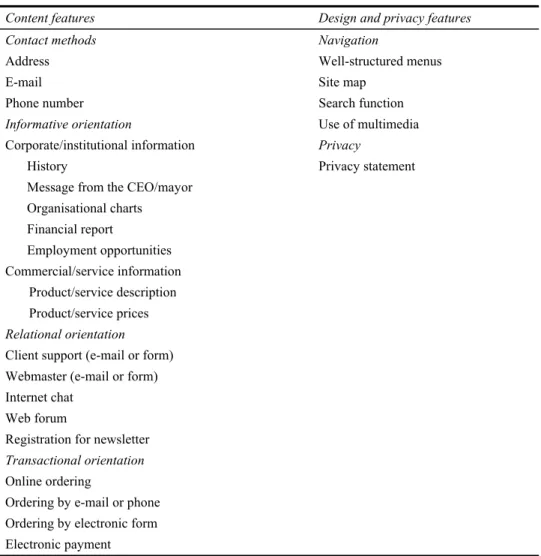
To evaluate and compare SMEs and local government websites, a research framework which assesses content and design characteristics is introduced in the following sections. For this research, content and design features were measured objectively (e.g., the website either contained the feature or did not). Table 1 provides an overview of the features measured.
Table 1 Website content and design features
Content features Design and privacy features
Contact methods Navigation
Address Well-structured menus
E-mail Site map
Phone number Search function
Informative orientation Use of multimedia
Corporate/institutional information Privacy
History Privacy statement
Message from the CEO/mayor Organisational charts Financial report Employment opportunities Commercial/service information Product/service description Product/service prices Relational orientation
Client support (e-mail or form) Webmaster (e-mail or form) Internet chat
Web forum
Registration for newsletter
Transactional orientation
Online ordering
Ordering by e-mail or phone Ordering by electronic form Electronic payment
2.1 Content features
The minimum externally accessible content in any given website, either from the public or private sector, is related to the offering of basic contact information such as name, address, electronic mail and phone number. In this regard, Teo and Pian (2004) found that the presence of contact methods in businesses’ websites do not differ much among the web adoption levels. Nonetheless, when engaging in further website development, these entities (firms or government agencies) usually present content features used for other purposes such as facilitation of background information, communication and establishment of relationships (with customers, citizens, businesses, the general public etc.), provision of information on products and/or services; even presentation of transactional features for the fulfilment of orders or government requirements, online. Given the different nature of these content characteristics, website development presents distinct directions for benchmarking and improvement.
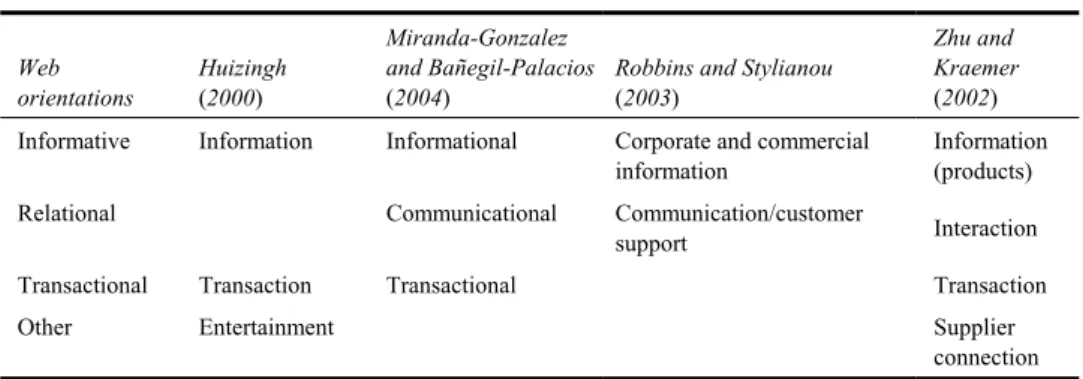
Within the literature on web development, the primary orientations that have been studied for web content analysis are: information, communication and transactional orientation. In Table 2, a group of studies related to the topic of this paper have been structured according to the type of analysis used. Thus, the content categories considered in each research for the website analysis are identified and classified according to the mentioned web orientations. Huizingh (2000) conducted empirical research of a sample made up of companies found on Yahoo and the Dutch Yellow Pages. Huizingh considered information, transaction and entertainment as the main features of content. Robbins and Stylianou’s (2003) work is an extension of Huizingh’s and was intended to overcome many of its weaknesses. The sampling frame was designed to be a good mix of international companies and a more comprehensive set of content features was employed. Other authors, such as Zhu and Kraemer (2002) used a web content analysis to characterise a firm’s e-commerce capabilities. E-commerce capabilities were measured along four dimensions: information on products and services, transaction, interaction and customisation, and supplier connection. They thereby created a total e-commerce capability index by aggregating these four composite metrics. In addition, attempts to evaluate the content quality of a website have also been made. Miranda-Gonzalez and Bañegil-Palacios (2004) considered three sets of factors to assess the content quality of a website: informational, communicational, and transactional. They thus created a web assessment index which focused on four categories (accessibility, speed, navigability and content).
Table 2 Content features considered in previous research
Web orientations Huizingh (2000) Miranda-Gonzalez and Bañegil-Palacios (2004)
Robbins and Stylianou
(2003)
Zhu and Kraemer
(2002)
Informative Information Informational Corporate and commercial
information
Information (products)
Relational Communicational Communication/customer
support Interaction
Transactional Transaction Transactional Transaction
Other Entertainment Supplier
connection
This study intends to measure website content in both firms and governments according to the mentioned web orientations. With this objective in mind, we next present our approach for each of these web orientations.
2.1.1 Informative orientation
Firms can use their websites to disseminate corporate or commercial information to customers, business partners or other stakeholders (shareholders, employees, the public, etc.) (Huzingh, 2000). Corporate information can provide insights into the background of the company (financial statements, employment offers, history, etc.) and commercial information implies providing product-related information, such as prices, specifications, terms of delivery, etc. Similarly, governments use their websites to diffuse information on the web. In fact, as many citizens and business are able to access information from the
private sector, they expect the same access from the government. Government information includes two categories of information ‘institutional and services information’. Institutional information refers to the providing of generic data about some general facets of government related to administrative, political and socioeconomic aspects (government structure, organisational chart, employment, history, etc.). Service information comprises the publishing of information about the services and functions that governments deliver to citizens, businesses and other stakeholders. By these means, government intends to provide detailed information on their services as well as where to go for government services and post-service support. Therefore, the informative orientation consists of one-way electronic information directed to one or more stakeholders. This way, the quality of information on a website, either from businesses or governments, is reflected by the extent of available information on each of theses categories.
2.1.2 Relational orientation
Internet communications, besides allowing a cost reduction in comparison to traditional communication tools, offer a unique and integrated opportunity for interacting with several business agents (both internal and external to the organisation). Certain applications such as the internet chat or the web cam enable a two-way real time information exchange between an organisation and its stakeholders (customers, citizens, suppliers, businesses, etc.). Unlike other cost-effective and user-friendly applications such as the e-mail, the web forum and the feedback form allow unsynchronised two-way conversations. Moreover, the creation of web forums could form the basis of online communities where people can exchange views. In this sense, all these internet technologies facilitate the exchange of information, collaboration and the possibility of establishing close relationships based on trust and mutual commitment. The difference between the informative orientation and the relational orientation is that the latter permits two-way information exchange. This exchange of information can vary from more structured tools such as the request for information forms to more open and interactive forms such as the online chat. As a result, the quality of communication on a website is estimated by the extent of available communication mechanisms through which an agent can interact with the firm/government or with other agents (using its website as the web platform). Presumably, both firms and governments present similar zeal in providing support to customers/citizens and to allow them the opportunity to discuss products and/or services and public issues or new policies.
2.1.3 Transactional orientation
Over the past 20 years the economy has rapidly transformed from its traditional base to a new, information-based economy. In this new environment, work has shifted from the creation of tangible goods to the flow of information through the value chain (Basu and Kumar, 2002). For this transition, the establishment and development of workflow processes has played a fundamental role. According to the Workflow Management Coalition (WFMC, 2004) a workflow is
“the automation of a business process, in whole or in part, during which documents, information or tasks are passed from one participant to another for action, according to a set of procedural rules.”
Internet technology provides great opportunity for automation processes. Thus, the transactional orientation is considered a web orientation which involves the establishment of electronic processes for the fulfilment of orders or government services through the firm’s website. In ideal cases, web transactions are connected directly to the internally functioning government systems with minimal interaction with government staff (Layne and Lee, 2001). The same argument holds for businesses.
2.2 Design and privacy features
Design refers to the way in which the content is presented to the internet users. Huizingh (2000) considered six characteristics in web design: navigation structure, search function, protected content, quality of the structure, image and presentation style. Liu et al. (1997) proposed a framework which considered information quality, learning capability, playfulness, system quality, system use and service quality as factors that are related to well-designed websites. They tested these factors on a sample of companies from Fortune 1000 and found that information quality, system use, playfulness and system design influenced the success. Based on prior research, we identified four variables to capture the design dimension of a website: well-structured menus, site maps, internal search engines, and use of multimedia.
As websites use a number of mechanisms to gather information about their visitors, privacy is becoming an important issue. Some of these mechanisms such as registration and ordering forms are explicit. However, other implicit mechanisms for tracking online activities exist (the length of time spent on each page, frequently accessed products, etc.). While this tracking information can be used for improving the website and its offerings, the temptation to sell this information to external parties may also exist (Layne and Lee, 2001). Thus, organisations must provide information on their website about the use of personal information collected from their visitors. For this study, the presence of a privacy statement on the organisation’s website was examined.
3 Methodology
The authors directly observed the websites of all councils in one Spanish region, the Region of Murcia (Southeast Spain), and a listing of SMEs from the same region. To explore the content and design of websites, a content analysis of the organisation’s (company or municipality) website was performed. Content analysis has been previously applied to a few empirically based investigations relating to the e-business topic in the literature (e.g., Huzingh, 2000; Robbins and Stylianou, 2003; Teo and Pian, 2004; Zhu and Kraemer, 2002). The main contribution of this technique comes from the possibility of measuring objectively, a significant number of content features (Huzingh, 2000).
3.1 Sample
This study employed a sample consisting of 33 councils and 180 SMEs with websites, from the Region of Murcia (Spain). The diffusion of websites for the councils of this region is nearly 87% (33 out of 38 of its councils have a website). Thus, all the local government websites from this region were analysed. The selected businesses were firms which were compelled to present financial statements and had between 1 and 250 employees. Further, organisations pertaining to certain activities within the service industry (NACE groups 80, 85, 90–93) as well as agricultural and fishing companies (NACE groups 1–9) were excluded as these firms do not conform to the traditional concept of business. Taking into account that in the Region of Murcia 33,753 companies exist with at least one employee (excluding those from the above mentioned NACE groups) and considering that several sources (INE, 2002) predict that in the Murcia region, only 28.9% of the companies with more than ten employees have a corporate website, p = 30 was applied. Finally, the sample error estimated was 6.8% at the 95.5% confidence interval.
3.2 Data collection
To analyse each company’s website an electronic questionnaire was developed. This way the data introduction process was intended to be facilitated, making it easier, faster and more accurate (required fields were used). The questionnaire evaluated different content and design characteristics. The items were introduced considering previous studies within the literature (Huzingh, 2000; Meroño-Cerdan and Sabater-Sanchez, 2003; Robbins and Stylianou, 2003; Teo and Pian; 2004). A panel of academic experts was also consulted to ensure that all variables measured broadly, the website’s content. The questionnaire was initially pretested on ten companies and seven local governments. This process resulted in 24 variables that were used to measure a firm’s website content and design.
Each variable represented a different feature and was coded using a binary variable, where 1 was ‘yes’ and 0 was ‘no’. Data were gathered and independently coded by both the authors during April and May 2004. Subsequently, comparisons were made to check for consistencies in coding.
4 Results: content
4.1 Results for contact methods
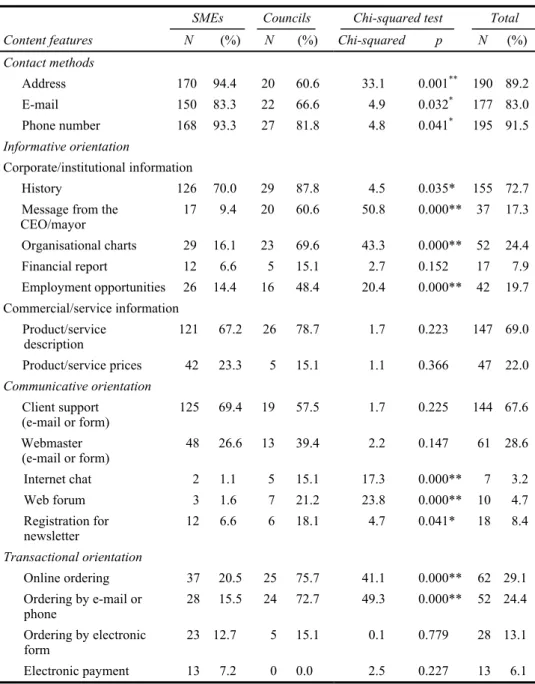
The contact method which is most often available is the organisation’s phone number. Of all analysed websites, 91.5% contain it (see Table 3). When both sources, business and councils, are compared, significant statistical differences were found for the three contact methods. Thus, more businesses than councils presented address, e-mail and phone number.
Table 3 Content features of the website vs. the source of the site
SMEs Councils Chi-squared test Total
Content features N (%) N (%) Chi-squared p N (%)
Contact methods Address 170 94.4 20 60.6 33.1 0.001** 190 89.2 E-mail 150 83.3 22 66.6 4.9 0.032* 177 83.0 Phone number 168 93.3 27 81.8 4.8 0.041* 195 91.5 Informative orientation Corporate/institutional information History 126 70.0 29 87.8 4.5 0.035* 155 72.7 Message from the
CEO/mayor 17 9.4 20 60.6 50.8 0.000** 37 17.3 Organisational charts 29 16.1 23 69.6 43.3 0.000** 52 24.4 Financial report 12 6.6 5 15.1 2.7 0.152 17 7.9 Employment opportunities 26 14.4 16 48.4 20.4 0.000** 42 19.7 Commercial/service information Product/service description 121 67.2 26 78.7 1.7 0.223 147 69.0 Product/service prices 42 23.3 5 15.1 1.1 0.366 47 22.0 Communicative orientation Client support (e-mail or form) 125 69.4 19 57.5 1.7 0.225 144 67.6 Webmaster (e-mail or form) 48 26.6 13 39.4 2.2 0.147 61 28.6 Internet chat 2 1.1 5 15.1 17.3 0.000** 7 3.2 Web forum 3 1.6 7 21.2 23.8 0.000** 10 4.7 Registration for newsletter 12 6.6 6 18.1 4.7 0.041* 18 8.4 Transactional orientation Online ordering 37 20.5 25 75.7 41.1 0.000** 62 29.1 Ordering by e-mail or phone 28 15.5 24 72.7 49.3 0.000** 52 24.4 Ordering by electronic form 23 12.7 5 15.1 0.1 0.779 28 13.1 Electronic payment 13 7.2 0 0.0 2.5 0.227 13 6.1 *Significant at P < 0.05 level. **Significant at P < 0.01 level.
4.2 Results for the informative orientation
With regard to corporate/institutional information, councils presented more features than business for all the items (see Table 3). Statistical differences at the 5% level were found for the History item, while significant differences at the 1% level were encountered for
message from the Mayor, organisational charts and employment opportunities. No significant differences were found for the presence of financial statements. The type of corporate/institutional information more frequently presented in both types of websites is, by far, History, with 72.7% of the total number of websites containing this feature. As far as commercial/service information was concerned, no significant differences between councils and businesses were found for the two variables. When considering both groups simultaneously, more than two-thirds of the websites contained a detailed product/service description, while slightly less than one fourth presented their product/services prices.
4.3 Results for the relational orientation
The relational orientation has been measured using five variables: Client support, Webmaster e-mail/form, internet chat, web forum and registration for newsletters. As shown in Table 3, more than two-thirds of the websites were found to contain an e-mail or feedback form specific to client support. Less than 30% of websites offered the possibility of contacting the webmaster, while the other three characteristics (internet chat, web forum, and registration for newsletters) were found in less than 10% of the websites. However no statistical differences (between businesses and councils) were found for the Client support and Webmaster features; significant differences (all in favour of councils) were found for the rest of the relational characteristics.
4.4 Results for the transactional orientation
These content characteristics are related to the possibility of fulfilling orders or government requirements, online. As presented in Table 3, nearly 30% of the websites permitted online ordering. Nonetheless, only 7.2% of the business websites allowed electronic payment, while no council website had this characteristic. When both sources, business and councils, were compared, significant statistical differences where found for online ordering and ordering by e-mail or phone. Thus, more councils than businesses presented the chance of conducting government requirements and services online, but these services were offered primarily by e-mail or by telephone.
5 Results: design and privacy
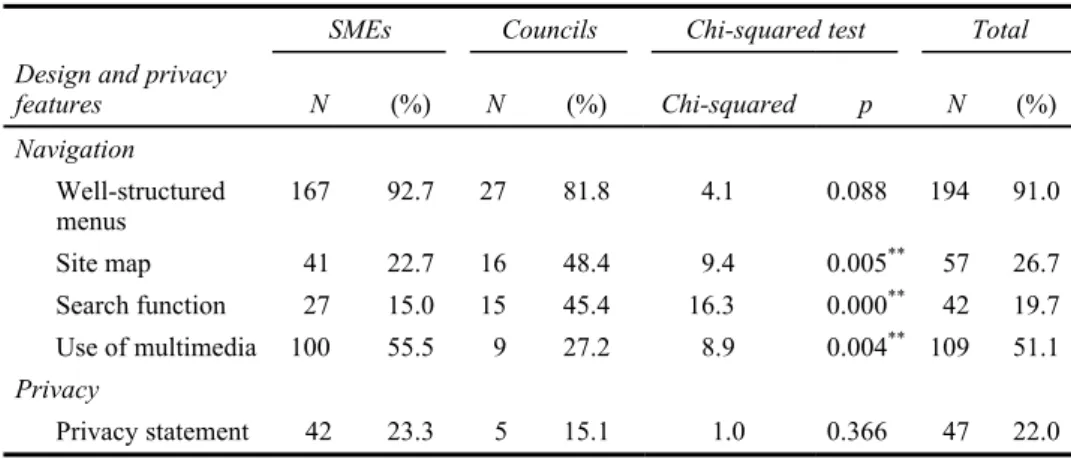
Of the variables related to the design of a website, it was found that over 90% of the websites had well-structured navigation menus (see Table 4) and statistical differences for this characteristic were not found between the two sources (SMEs and councils). Statistical differences at the 1% level were found for the other three variables: site map, search function and use of multimedia. In this way, more councils’ websites contain site maps and search functions, while more SMEs include multimedia features on their websites. Regarding privacy issues, only 22% of the total number of websites analysed contain a privacy statement. Nonetheless, no statistical differences for this feature were found between SMEs and councils.
Table 4 Design features of the website vs. the source of the site
SMEs Councils Chi-squared test Total
Design and privacy
features N (%) N (%) Chi-squared p N (%) Navigation Well-structured menus 167 92.7 27 81.8 4.1 0.088 194 91.0 Site map 41 22.7 16 48.4 9.4 0.005** 57 26.7 Search function 27 15.0 15 45.4 16.3 0.000** 42 19.7 Use of multimedia 100 55.5 9 27.2 8.9 0.004** 109 51.1 Privacy Privacy statement 42 23.3 5 15.1 1.0 0.366 47 22.0 *Significant at P < 0.05 level. **Significant at P < 0.01 level.
6 Discussion and conclusions
Although much research has been conducted in different e-business and e-government issues, there is a need to further investigate more basic and primary use of the internet, the external website, as a means of interaction with stakeholders. Moreover, despite using a common background concerning research methods, e-business and e-government have traditionally conducted studies separately. To cover this research gap, this paper develops a framework that allows evaluation and comparison of external web development of business and government websites. The organisations selected for this study are local governments and SMEs because of their closeness and level of expertise concerning internet implementation. Broadly, this research offers several contributions:
• it facilitates a framework for evaluating and comparing e-government and e-business websites initiatives
• it provides sufficient knowledge about the real use of websites by SMEs and local governments in Spain
• it sheds light on which are the main differences between SMEs and local governments in Spain.
The results show that SMEs’ websites contain more contact methods (address, e-mail, and phone number) than councils. This could be interpreted as businesses being more willing to be sure that potential customers have different means to get in touch with them, unlike councils which seem to prefer being contacted by certain contact methods (mainly by phone). This finds contrast with Teo and Pian’s finding (2004), which suggested that within firms contact methods do not differ among the web adoption levels. Therefore, Teo and Pian’s finding does not seem to hold when considering websites pertaining to organisations with different goals.
The empirical results also demonstrate that councils present on their websites, more corporate/institutional information than SMEs. Significant differences were found for four out of five website features in this category. This implies that councils are more interested in disseminating information about themselves while businesses may be more concerned with providing information on their products and services. The reasons may be because, first, although this type of information does not include real services for the citizens, it can be useful for other purposes of the councils such as attracting visitors. Second, governments are more committed to information transparency and social responsibility. With respect to commercial/service information, significant differences between SMEs and councils were not found. Thus, presumably councils and SMEs have similar zeal in providing information about their products/services.
Although within the relational web orientation differences for client support and webmaster e-mail were not found, differences were encountered for the other three variables: the presence of internet chat, web forums and registration for newsletters. This argument, together with the results obtained for the design features (where it was found that more councils’ websites contain site maps and search functions) indicate that councils have richer and more technologically advanced websites. Thus, councils engage further than SMEs in web development by allocating more funds and hiring top web design companies. In addition, with regard to the transactional web orientation, this study found that more councils’ websites allowed the possibility of fulfilling services or government requirements, online. Trust can be an important issue here. In this sense, governments are more trustworthy organisations than businesses when considering online payment and services.
While the study’s contributions are significant, it has some obvious limitations which can be addressed in future research. First, websites have been analysed at one point in time (cross-sectional picture) while the web is a highly dynamic medium. Therefore, a longitudinal study could enrich the findings. Second, the country from which our sample was obtained is Spain. Similar studies in different countries are likely to show different results, especially when considering countries with high levels of e-business and e-government intensity, such as the USA, Finland and Canada. Therefore, in future research, using a sampling frame which combines councils and SMEs from different countries could provide a more international perspective to the subject.
References
Accenture (2004) ‘eGovernment leadership: high performance, maximum value’, Fifth Annual Accenture Egovernment Study.
Basu, A. and Kumar, A. (2002) ‘Research commentary: workflow management issues in e-business’, Information Systems Research, Vol. 13, No. 1, pp.1–14.
E-business W@tch (2004) The European E-business Report, 2004 Edition, Available at http://www.ebusiness-watch.org.
Grant, G. and Chau, D. (2005) ‘Developing a generic framework for e-government’, Journal of Global Information Management, Vol. 13, No. 1, January–March, pp.1–30.
Heldal, F., Sjovold, E. and Heldal, A.F. (2004) ‘Success on the internet: optimizing relationships through the corporate site’, International Journal of Information Management, Vol. 24, pp.115–129.
Huzingh, E. (2000) ‘The content and design of web sites: an empirical study’, Information and Management, Vol. 37, pp.123–134.
INE (2002) Encuesta de uso de Tecnologías de Información y comercio electrónico, http://www.ine.es.
Layne, K. and Lee, J. (2001) ‘Developing fully functional e-government: a four stage model’,
Government Information Quarterly, Vol. 18, pp.122–136.
Liu, C., Arnett, K.P., Capella, L.M. and Beatty, R.C. (1997) ‘Websites of the Fortune 500 companies: facing customers through homepages’, Information and Management, Vol. 31, pp.335–345.
Meroño-Cerdan, A.L. and Sabater-Sanchez, R. (2003) ‘Valoración del nivel de negocio electrónico’, Revista Europea de Direccion y Economia de la Empresa, Vol. 12, No. 1, pp.9–22.
Miranda-Gonzalez, F.J. and Bañegil-Palacios, T.M. (2004) ‘Quantitative evaluation of commercial web sites: an empirical study of Spanish firms’, International Journal of Information Management, Vol. 14, pp.313–328.
OECD (2003) ‘The e-government imperative’, Organisation for Economic Co-operation and Development, Paris, France.
Robbins, S.S. and Stylianou, A.C. (2003) ‘Global corporate web sites: an empirical investigation of content and design’, Information and Management, Vol. 40, pp.205–212.
Teo, T.S.H. and Pian, Y. (2004) ‘A model for web adoption’, Information and Management, Vol. 41, pp.457–468.
WFMC (2004) Workflow Management Coalition, http://wfmc.org.
Young, D. and Benamati, J. (2000) ‘Differences in public web sites: the current state of large US firm’, Journal of Electronic Commerce Research, Vol. 1, No. 3, pp.94–105.
Zhu, K. and Kraemer, K.L. (2002) ‘E-commerce metrics for net-enhanced organizations: assessing the value of e-commerce to firm performance in the manufacturing sector’, Information Systems Research, Vol. 13, No. 3, pp.275–295.