2006
and Manufacturing Engineering
and Manufacturing Engineering
Laboratory support for the didactic process
of engineering processes automation at the
Faculty of Mechanical Engineering
J. Świder, P. Michalski, G. Wszołek*
Institute of Engineering Processes Automation and Integrated Manufacturing Systems,
Silesian University of Technology, ul. Konarskiego 18a, 44-100 Gliwice, Poland
* Corresponding author: E-mail address: [email protected]
Received 15.11.2005; accepted in revised form 15.02.2006Education and research trends
ABSTRACT
Purpose: The scope of the paper is to present effects of creating the laboratory support for the didactic process of automatic control of engineering processes.
Design/methodology/approach: The discussed laboratory framework is a complex system, flexible in terms of further development, operating on four basic levels: rudimental- serving general introductory classes to the subject, advanced level- suitable for specialisation classes, hardware and software for individual or team work assignments completed in the course of self-studies, semester projects, BSc and MSc. theses, and the sophisticated level designed for PhD and DSc research workers.
Findings: Close cooperation with industry and practical implementation of joint research projects play a crucial role in the functioning of the laboratory framework.
Practical implications: The education of modern engineers and Masters of Science in automatic control and robotics is a challenging task which may be successfully accomplished only if faced with industrial reality. Continuously advancing industrial companies demand graduates who can quickly adjust to the workflow and who can instantly utilize the knowledge and skills acquired in the complex, interdisciplinary field of mechatronics.
Originality/value: The discussed laboratory framework successfully couples software and hardware, providing a complex yet flexible system open for further development, enabling teaching and research into the design and operation of modern control systems, both by means of virtual construction and testing in simulation programs, as well as on real industrial structures configured in laboratory workstations.
Keywords: Aautomatic control of engineering processes; Didactic process; Mechatronics
1. Introduction
Nowadays in the reality of the market economy all industries must be competitive. To maintain their market positions, companies continuously reduce the manufacturing costs, while simultaneously improving quality, reliability, aesthetics, modernity and durability of products. To achieve such goals, appropriate methods of production management and optimisation are required, which is impossible without the implementation of automatic control and robotics of process technologies [1,2]. The maintenance of constant,
repeatable and accurate parameters of industrial processes with the required dynamics of their run and in consideration of all the negative impacts that may cause disruptions, lead to a consistent elimination of the human factor from the performance of numerous repetitive and tedious tasks and limitation of human labour to general supervision and decision-making responsibilities. The role of human staff is taken over by externally supplied technical systems in the form of automatic regulation systems, control systems, or specialised industrial robots [12,13]. The training of specialists who are to be responsible for the design, manufacturing
and operation of mecha-electronic systems is a serious educational challenge. Nowadays engineering studies cannot be limited to one discipline only and modern mechanical engineers, rather than having a narrow-minded knowledge on how to transform input signals to the output, should have an insight into electronics and machine control [4].
The design of electro-pneumatic or electro-hydraulic systems would be very difficult without the grasp of micro-processing techniques and learning how to design electric control systems or how to program logical PLCs [5,15].
The implementation of complex process technologies must be based on the knowledge about automatic control of continuous processes, as some of their crucial parameters, such as: temperature changes, fluid or loose materials contents in tanks or hoppers, medium pressure in the system, light intensity, rotational velocity of vibrating machine elements, etc. Hence, it is necessary to teach students the rudiments of automatics and control theory, rules of the functioning of sensor systems, regulators and operational systems.
2. Laboratories
In view of the above, the Laboratory of Automatics, Mechatronics, Integrated Manufacturing Systems and Production Management Methods was founded at the Faculty of Mechanical Engineering, Silesian University of Technology in Gliwice, Poland, on the basis of the hardware and partly software offered
by FESTO DIDACTIC, thanks to which it is possible to educate mechanical engineers in the fields of automatic control of process technologies, with pneumatic and electro-pneumatic systems, logical PLCs, and continuous process regulators, to meet, at least partially, the demand for up to date- university graduates [1,2]. The laboratory accommodates lab and project classes for students of four study lines: Automatics and Robotics, Technical and IT Education, Mechanics and Machine Building, Production Engineering and Management that offer courses in the following subjects: rudiments of automatic control and robotics, automatic regulation and manufacturing measuring and control systems, as well as classes for all students specializing in the fields within the scope of the Institute, involving automation of industrial processes and systems.
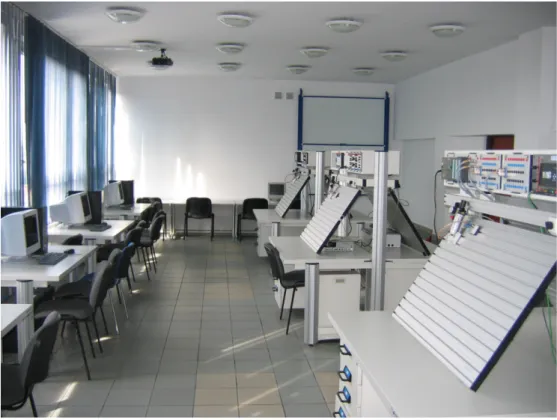
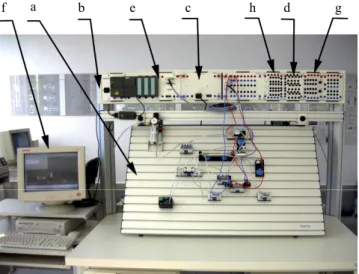
The Laboratory Study Rooms of Engineering Processes Automation (Fig.1 and 2) are equipped with three double stations for configuration and testing of pneumatic systems, electro-pneumatics and programmable PLCs with logical SIEMENS S7 controllers and FESTO controllers (Fig.3), a five-segment modular production system (MPS) which contains the following modules: distribution, control, treatment, transport and sorting (Fig.4), workstation for continuous processes control (level of fluid in the tank, fluid temperature, flow intensity) furnished with industrial PID Burkert regulator (Fig.6), advance sorting system based on a three-axis manipulator used for storing and transporting materials and elements in a robotized manufacturing system (Fig.5) [6,7,8,9,10,11], and- as described in detail in this paper- the mechatronic assembly system (Fig.4 f), constructed as part of student MSc thesis [3].
Fig. 1. The Laboratory study room of Engineering Processes Automation
Fig. 2. The second Laboratory study room of Engineering Processes Automation
Fig. 3. Laboratory workstation for the conecting and testing pneumatic systems, electro-pneumatics and programmable PLCs: a) assembly panel with an exemplary control system, b) panel of mounting electric feeders, logical transmitters and controllers, c) feeder, d) set of relays, e) PLCs made by Siemens, f) computer stand for programming of logical controllers, g) set of slugged relays, h) set of buttons and switches
Fig. 4. Modules: a) distribution, b) control, c) treatment, d) transport, e) sorting- mps laboratory work stand made by Festo, f) mechatronic assembly module,
Students at the Faculty of Mechanical Engineering complete their semester and diploma works (BSc and MSc theses) in the Lab using the workstations placed in the Automation of Process technologies Workshop (Fig.7) [3,20,21].
The results of their work are expressed in the creation of innovative work-stations (Fig.7,9) within the framework of the cooperation between the Institute and industry.
f a b e c h d g
a b c d e f
and operation of mecha-electronic systems is a serious educational challenge. Nowadays engineering studies cannot be limited to one discipline only and modern mechanical engineers, rather than having a narrow-minded knowledge on how to transform input signals to the output, should have an insight into electronics and machine control [4].
The design of electro-pneumatic or electro-hydraulic systems would be very difficult without the grasp of micro-processing techniques and learning how to design electric control systems or how to program logical PLCs [5,15].
The implementation of complex process technologies must be based on the knowledge about automatic control of continuous processes, as some of their crucial parameters, such as: temperature changes, fluid or loose materials contents in tanks or hoppers, medium pressure in the system, light intensity, rotational velocity of vibrating machine elements, etc. Hence, it is necessary to teach students the rudiments of automatics and control theory, rules of the functioning of sensor systems, regulators and operational systems.
2. Laboratories
In view of the above, the Laboratory of Automatics, Mechatronics, Integrated Manufacturing Systems and Production Management Methods was founded at the Faculty of Mechanical Engineering, Silesian University of Technology in Gliwice, Poland, on the basis of the hardware and partly software offered
by FESTO DIDACTIC, thanks to which it is possible to educate mechanical engineers in the fields of automatic control of process technologies, with pneumatic and electro-pneumatic systems, logical PLCs, and continuous process regulators, to meet, at least partially, the demand for up to date- university graduates [1,2]. The laboratory accommodates lab and project classes for students of four study lines: Automatics and Robotics, Technical and IT Education, Mechanics and Machine Building, Production Engineering and Management that offer courses in the following subjects: rudiments of automatic control and robotics, automatic regulation and manufacturing measuring and control systems, as well as classes for all students specializing in the fields within the scope of the Institute, involving automation of industrial processes and systems.
The Laboratory Study Rooms of Engineering Processes Automation (Fig.1 and 2) are equipped with three double stations for configuration and testing of pneumatic systems, electro-pneumatics and programmable PLCs with logical SIEMENS S7 controllers and FESTO controllers (Fig.3), a five-segment modular production system (MPS) which contains the following modules: distribution, control, treatment, transport and sorting (Fig.4), workstation for continuous processes control (level of fluid in the tank, fluid temperature, flow intensity) furnished with industrial PID Burkert regulator (Fig.6), advance sorting system based on a three-axis manipulator used for storing and transporting materials and elements in a robotized manufacturing system (Fig.5) [6,7,8,9,10,11], and- as described in detail in this paper- the mechatronic assembly system (Fig.4 f), constructed as part of student MSc thesis [3].
Fig. 1. The Laboratory study room of Engineering Processes Automation
Fig. 2. The second Laboratory study room of Engineering Processes Automation
Fig. 3. Laboratory workstation for the conecting and testing pneumatic systems, electro-pneumatics and programmable PLCs: a) assembly panel with an exemplary control system, b) panel of mounting electric feeders, logical transmitters and controllers, c) feeder, d) set of relays, e) PLCs made by Siemens, f) computer stand for programming of logical controllers, g) set of slugged relays, h) set of buttons and switches
Fig. 4. Modules: a) distribution, b) control, c) treatment, d) transport, e) sorting- mps laboratory work stand made by Festo, f) mechatronic assembly module,
Students at the Faculty of Mechanical Engineering complete their semester and diploma works (BSc and MSc theses) in the Lab using the workstations placed in the Automation of Process technologies Workshop (Fig.7) [3,20,21].
The results of their work are expressed in the creation of innovative work-stations (Fig.7,9) within the framework of the cooperation between the Institute and industry.
f a b e c h d g
Fig. 5. a) high-level sorting module, b) visualization and work-stand control system, c) work work-stand for computer programming of controllers and system visualizations
Fig. 6. Laboratory work stand for the control of continuous processes: a) pipeline systems, b) water tank systems, c) electric feeders, d) Burkert pid industrial regulator
There is also a new industrial FANUC robot (Fig. 8) placed in the Laboratory Study Room, which in the near future will be surrounded with many necessary equipment to build a professional robot cell, including safety barriers and CNC milling machine.
In practice, all of the above-mentioned laboratory work-stands contain elements and subsystems of high integration with mechanic and electric subsystems and IT systems, which force the users of the laboratory to work in the integrated environment of modern mechatronic systems [12,13,14].
Fig. 7. Electro-pneumatic student work stand with plc for colour separation
Fig. 8. Industrial FANUC robot intended for teaching of program-ming
a b c d e f
a b c
Fig. 9. Robotized laboratory stand with a colour separation module
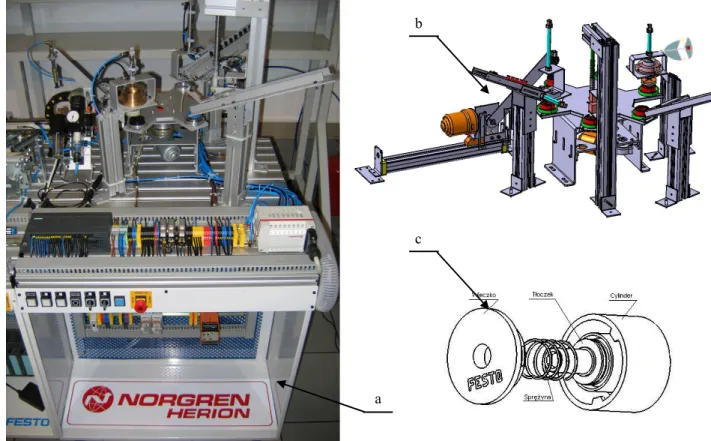
Fig. 10. Mechatronic assembly station, b) model created in catia v5 program, c) pneumatic one-sided actuator assembled on the station
a
b
Fig. 5. a) high-level sorting module, b) visualization and work-stand control system, c) work work-stand for computer programming of controllers and system visualizations
Fig. 6. Laboratory work stand for the control of continuous processes: a) pipeline systems, b) water tank systems, c) electric feeders, d) Burkert pid industrial regulator
There is also a new industrial FANUC robot (Fig. 8) placed in the Laboratory Study Room, which in the near future will be surrounded with many necessary equipment to build a professional robot cell, including safety barriers and CNC milling machine.
In practice, all of the above-mentioned laboratory work-stands contain elements and subsystems of high integration with mechanic and electric subsystems and IT systems, which force the users of the laboratory to work in the integrated environment of modern mechatronic systems [12,13,14].
Fig. 7. Electro-pneumatic student work stand with plc for colour separation
Fig. 8. Industrial FANUC robot intended for teaching of program-ming
a b c d e f
a b c
Fig. 9. Robotized laboratory stand with a colour separation module
Fig. 10. Mechatronic assembly station, b) model created in catia v5 program, c) pneumatic one-sided actuator assembled on the station
a
b
The Laboratory Study Room of Engineering Processes Automation is also equipped with 4 computer work-stations, where the following software has been installed:
FluidSIM-P – for teaching the design and simulation of the operation of pneumatic and electro-pneumatic systems,
FluidSIM-H – for teaching the design and simulation of the operation of hydraulic and electro-hydraulic systems,
FluidStudio-P – for teaching the rudiments of pneumatics, FluidStudio-H – for teaching the rudiments of hydraulics, COSIMIR for teaching the rudiments of modeling production work centres cooperating with industrial robots,
Digital Training Studio for teaching the rudiments of digital electronics,
COSIVIS for teaching the rudiments of design, simulation, visualization and control of industrial processes,
Catia for supporting 2D and 3D designs,
In-Touch Wonderware for visualizations of manufacturing processes.
The FluidSIM-P, FluidSIM-H, FluidStudio-P, FluidStudio-H, Digital Training Studio, COSIMIR and COSIVIS are used for modelling and simulations of processes that can be realised on laboratory work-stands in the Study Room of Engineering Processes Automation.
The scope of one of the BSc theses completed in the course of study at the Faculty of Mechanical Engineering was the creation of a MAS (Mechatronic Assembly Station - Fig.10) [3] designed as an additional module of FESTO’s MPS. The station involves the assembly of a one sided actuator (Fig.10c). The main part of the actuator (cylinder) is supplied by MPS sorting module, whereas the other parts (piston with the rod, spring, cover) are placed in the relevant MAS sections.
The mechatronic assembly station consists of 6 sub-sections performing elementary process operations, strictly coordinated by programmable PLCs. Each module contains the required number of sensors informing about the location and condition of the working elements and elements deposited in the stores. On the bases of Siemens S7 controller software, the generated input signals control the operational systems: electro-pneumatic valves that direct the pneumatic operators (actuators), transmitters controlling direct current engines and electro-magnetic coils opened up by the store feeder work-stands.
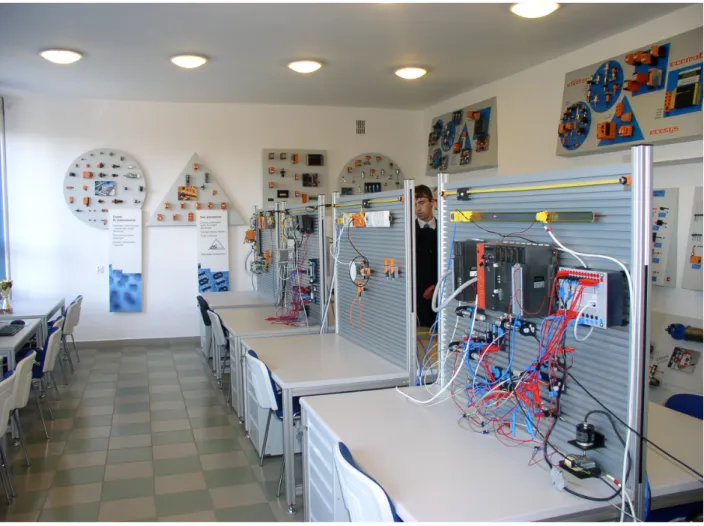
Another part of the Laboratory is the Sensors and Industrial Networks Study Room (Fig. 11). The Study Room is equipped with five double workstations for configuration and testing active sensor systems and various standards of industrial networks based on PLCs.
Fig. 11. Sensorics and industrial networks study room
There is an active display on the Study Room walls enabling the first introduction into sensorics (induction sensors, volumetric sensors, optimeters, special constructions for the food processing industry, color and contrast sensors, heat sensors and pressure transducers, etc).
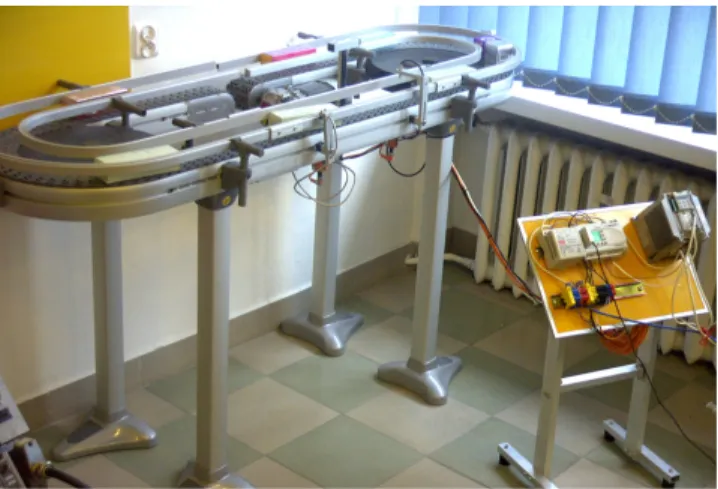
Special display boards show real elements of industrial automation, describing the ways of controlling electro-pneumatic mechatronic systems and fundamental elements used for industrial networks. The staff of the Institute Engineering Processes of Automaton and Integrated Management Systems have ensured close cooperation with industry to equip the Sensorics and Industrial Networks Study Room with PLCs, drives, frequency converters, industrial computers, sensory systems, feeders, regulators, LCDs, elements of linear pneumatics, as well as complete mechatronic systems: SEW- scattered drive systems (Fig. 12), and FlexLink belt conveyor system (Fig. 13) [3,15,16,17,18,19,20,21].
Fig. 12. Mechatronic system of roller conveyor- control by sew scattered drive systems used for profibus industrial networks
Fig. 13. Mechatronic system of flexlink belt conveyor-control based on mitsubishi frequency converters and ifm electronic sensory systems
Nowadays PLC controllers are commonly combined into industrial networks for data exchange with other machines. Network connections facilitate the following tasks:
� construction of very complex control systems; � control of systems remote from central PLC unit; � visualization of the manufacturing process; � storage of data on the manufacturing process; � diagnostics of faults and failures.
Currently, the Sensorics and Industrial Networks Study Room has separate workstations for configuration and testing the following systems:
� measurements of the angle of rotation and linear displacement by means of incremental and absolute encoders;
� detection of the presence of elements by means of inductive sensors, capacitive sensors, optimeters (laser, infrared, diffusion, reflective, optic gates, color and contrast sensors); � measurements and storage of temperature data by means of
temperature monitors (PT100 and PT1000) and analogue input modules of various industrial controllers;
� measurements and storage of pressure data by means of pressure monitors with analogue output modules of various industrial controllers;
� measurements of pressure drops depending on the selection of elements of linear pneumatics;
� start-up of industrial networks based on ifm electronic controllers for AS-i v.2.0 network;
� start-up of industrial networks based on ifm electronic controllers for AS-i v.2.1 network with gates to higher level networks;
� start-up of industrial networks based on SIEMENS S7 controllers for ProfiBus network;
� start-up of industrial networks based on ifm electronic mobile controllers for CANopen network:
� start-up of industrial networks based on MITSUBISHI Q and A2, A4 controllers for CC-Link, MelsecNet and MelsecNetB networks;
� application of mobile technologies and WIFi wireless networks for process technologies control;
� application of the Internet topology and TCP/IP protocol for processing and collecting data on process technologies. The operation of the Sensors and Industrial Networks Study Room has facilitated learning and dissemination of the information on the design of the following industrial networks: Ethernet, WiFi, ProfiBus, AS-I, CC_Link, MelsecNET, MelsecNET B, CANOpen. In the course of diploma works or other projects PhD students and individual study course students construct different testing and measuring systems.
Thanks to effective cooperation with the industry (Mitsubishi Electric, MPL Technology, ASTOR, BibusMenos, FESTO, Norgren Herion, Newtech Engineering, ifm electronic, Siemens, SMC, Bosh Rexroth, Flexlink, SEW Eurodrive, Automotive Lighting, Lenze, Frisko, B&R) new elements of industrial automation are acquired as well as orders for further research works.
The Study Room provides venue for workshops and training. The workshops offered to students and staff of the Institute are run by representatives of industry and focused on facilitating work with newly acquired elements of automation and indicating
The Laboratory Study Room of Engineering Processes Automation is also equipped with 4 computer work-stations, where the following software has been installed:
FluidSIM-P – for teaching the design and simulation of the operation of pneumatic and electro-pneumatic systems,
FluidSIM-H – for teaching the design and simulation of the operation of hydraulic and electro-hydraulic systems,
FluidStudio-P – for teaching the rudiments of pneumatics, FluidStudio-H – for teaching the rudiments of hydraulics, COSIMIR for teaching the rudiments of modeling production work centres cooperating with industrial robots,
Digital Training Studio for teaching the rudiments of digital electronics,
COSIVIS for teaching the rudiments of design, simulation, visualization and control of industrial processes,
Catia for supporting 2D and 3D designs,
In-Touch Wonderware for visualizations of manufacturing processes.
The FluidSIM-P, FluidSIM-H, FluidStudio-P, FluidStudio-H, Digital Training Studio, COSIMIR and COSIVIS are used for modelling and simulations of processes that can be realised on laboratory work-stands in the Study Room of Engineering Processes Automation.
The scope of one of the BSc theses completed in the course of study at the Faculty of Mechanical Engineering was the creation of a MAS (Mechatronic Assembly Station - Fig.10) [3] designed as an additional module of FESTO’s MPS. The station involves the assembly of a one sided actuator (Fig.10c). The main part of the actuator (cylinder) is supplied by MPS sorting module, whereas the other parts (piston with the rod, spring, cover) are placed in the relevant MAS sections.
The mechatronic assembly station consists of 6 sub-sections performing elementary process operations, strictly coordinated by programmable PLCs. Each module contains the required number of sensors informing about the location and condition of the working elements and elements deposited in the stores. On the bases of Siemens S7 controller software, the generated input signals control the operational systems: electro-pneumatic valves that direct the pneumatic operators (actuators), transmitters controlling direct current engines and electro-magnetic coils opened up by the store feeder work-stands.
Another part of the Laboratory is the Sensors and Industrial Networks Study Room (Fig. 11). The Study Room is equipped with five double workstations for configuration and testing active sensor systems and various standards of industrial networks based on PLCs.
Fig. 11. Sensorics and industrial networks study room
There is an active display on the Study Room walls enabling the first introduction into sensorics (induction sensors, volumetric sensors, optimeters, special constructions for the food processing industry, color and contrast sensors, heat sensors and pressure transducers, etc).
Special display boards show real elements of industrial automation, describing the ways of controlling electro-pneumatic mechatronic systems and fundamental elements used for industrial networks. The staff of the Institute Engineering Processes of Automaton and Integrated Management Systems have ensured close cooperation with industry to equip the Sensorics and Industrial Networks Study Room with PLCs, drives, frequency converters, industrial computers, sensory systems, feeders, regulators, LCDs, elements of linear pneumatics, as well as complete mechatronic systems: SEW- scattered drive systems (Fig. 12), and FlexLink belt conveyor system (Fig. 13) [3,15,16,17,18,19,20,21].
Fig. 12. Mechatronic system of roller conveyor- control by sew scattered drive systems used for profibus industrial networks
Fig. 13. Mechatronic system of flexlink belt conveyor-control based on mitsubishi frequency converters and ifm electronic sensory systems
Nowadays PLC controllers are commonly combined into industrial networks for data exchange with other machines. Network connections facilitate the following tasks:
� construction of very complex control systems; � control of systems remote from central PLC unit; � visualization of the manufacturing process; � storage of data on the manufacturing process; � diagnostics of faults and failures.
Currently, the Sensorics and Industrial Networks Study Room has separate workstations for configuration and testing the following systems:
� measurements of the angle of rotation and linear displacement by means of incremental and absolute encoders;
� detection of the presence of elements by means of inductive sensors, capacitive sensors, optimeters (laser, infrared, diffusion, reflective, optic gates, color and contrast sensors); � measurements and storage of temperature data by means of
temperature monitors (PT100 and PT1000) and analogue input modules of various industrial controllers;
� measurements and storage of pressure data by means of pressure monitors with analogue output modules of various industrial controllers;
� measurements of pressure drops depending on the selection of elements of linear pneumatics;
� start-up of industrial networks based on ifm electronic controllers for AS-i v.2.0 network;
� start-up of industrial networks based on ifm electronic controllers for AS-i v.2.1 network with gates to higher level networks;
� start-up of industrial networks based on SIEMENS S7 controllers for ProfiBus network;
� start-up of industrial networks based on ifm electronic mobile controllers for CANopen network:
� start-up of industrial networks based on MITSUBISHI Q and A2, A4 controllers for CC-Link, MelsecNet and MelsecNetB networks;
� application of mobile technologies and WIFi wireless networks for process technologies control;
� application of the Internet topology and TCP/IP protocol for processing and collecting data on process technologies. The operation of the Sensors and Industrial Networks Study Room has facilitated learning and dissemination of the information on the design of the following industrial networks: Ethernet, WiFi, ProfiBus, AS-I, CC_Link, MelsecNET, MelsecNET B, CANOpen. In the course of diploma works or other projects PhD students and individual study course students construct different testing and measuring systems.
Thanks to effective cooperation with the industry (Mitsubishi Electric, MPL Technology, ASTOR, BibusMenos, FESTO, Norgren Herion, Newtech Engineering, ifm electronic, Siemens, SMC, Bosh Rexroth, Flexlink, SEW Eurodrive, Automotive Lighting, Lenze, Frisko, B&R) new elements of industrial automation are acquired as well as orders for further research works.
The Study Room provides venue for workshops and training. The workshops offered to students and staff of the Institute are run by representatives of industry and focused on facilitating work with newly acquired elements of automation and indicating
new directions for further research projects. The trainings (on basic and advanced levels) are run by well-qualified university staff of the Institute. The trainings involve industrial networks and construction of sensory systems. They are often offered to the employees of the companies that cooperate with the Institute.
The Sensors and Industrial Networks Study Room has been operating effectively for one year. Students who used it to prepare for the National Contest of Mechatronics have won the second place and the Contest Cup in 2004.
3.Conclusions
The education of modern engineers and Masters of Science in automatic control and robotics is a challenging task which may be successfully accomplished only if faced with industrial reality. Continuously advancing industrial companies demand graduates who can quickly adjust to the workflow and who can instantly utilize the knowledge and skills acquired in the complex, interdisciplinary field of mechatronics.
The discussed laboratory framework successfully couples software and hardware, providing a complex yet flexible system open for further development, enabling teaching and research into the design and operation of modern control systems, both by means of virtual construction and testing in simulation programs, as well as on real industrial structures configured in laboratory workstations.
Acknowledgements
This work has been conducted as a part of the research project No. 4 T07C 01827 supported by the Committee of Scientific Research in years 2004-2007
References
[1] J. �wider, G. Wszo�ek, The methodical collection of laboratory and project tasks of technological process control. Pneumatic and electropneumatic systems with logical PLC control. Silesian University Publishing Company, Gliwice 2003, pp. 270, (in Polish).
[2] J. �wider (ed.), Control and Automation of Technological Process and Mechatronic Systems. Silesian University Publishing Company, Gliwice 2002 (in Polish), pp.546. [3] S. Nowak, Mechatronic Assembly Station in a Modular
Manufacturing System, Silesian University of Technology, MSc. thesis, Gliwice 2004 (in Polish).
[4] J. �wider, G. Wszo�ek, Collection of laboratory and design tasks concerning the control of process technologies, Silesian University of Technology, Gliwice 2003 (in Polish). [5] T. Legierski, J. Wyrwa�, PLC Programming, Jaska
Skalmie-rski’s Publishing Company, Gliwice 1998 (in Polish).
[6] K. Rdzanek, Indexed rotary desks for flexible complex machine tools. Mechanical engineering Review , No 14 1998 (in Polish).
[7] F. Ebel, Distribution Station. Modular Production System. Festo Didactic, Denkendorf 1999.
[8] F. Ebel, Handling Station. Modular Production System. Festo Didactic, Denkendorf 1999.
[9] F. Ebel, Processing Station. Modular Production System. Festo Didactic, Denkendorf 1998.
[10] F. Ebel, Sorting Station. Modular Production System. Festo Didactic, Denkendorf 1998.
[11] F. Ebel, Testing Station. Modular Production System Festo Didactic, Denkendorf 1998.
[12] G. Kost, Control systems for industrial robots. SUT’s Publishing Company, Gliwice 2000, (in Polish).
[13] G. Kost, Rudiments of robots construction. SUT’s Publishing Company, University Course Book No 1992, (in Polish). [14] R. Zdanowicz, Robotization of process technologies. SUT’s
Publishing Company, Gliwice, 1999 (in Polish).
[15] J. �wider, G. Wszo�ek, Analysis of complex mechanical systems based on the block diagrams and the matrix hybrid graphs method. Journal of Materials Processing Technology, Elsevier, the Netherlands, 157-158 (2004) 250-255. [16] J. �wider, G. Wszo�ek, Vibration analysis software based on a
matrix hybrid graph transformation into a structure of a block diagram method. Journal of Materials Processing Technology, Elsevier, the Netherlands, 157-158 (2004) 256-261.
[17] G. Wszo�ek, Vibration analysis of the excavator model in GRAFSIM program on the basis of a block diagram method. Journal of Materials Processing Technology, Elsevier, the Netherlands, 157-158 (2004) 268-273.
[18] G. Wszo�ek, Modelling of mechanical system vibrations by utilisation of the GRAFSIM software. Journal of Materials Processing Technology, Elsevier, the Netherlands, 164-165 (2005) 1466-1471.
[19] J. �wider, G. Wszo�ek, P. Michalski, Physical and geome-trical data acquiring system for vibration analysis software. Journal of Materials Processing Technology, Elsevier, the Netherlands, 164-165 (2005) 1444-1451.
[20] J. �wider, G. Wszo�ek, W. Carvalho, Programmable Contro-ller designed for electro-pneumatic systems. Journal of Materials Processing Technology, Elsevier, the Netherlands, 164-165 (2005) 1459-1465.
[21] J. �wider, G. Wszo�ek, A. Baier, G. Ciupka, O. Winter, Testing device for electrical car networks. Journal of Materials Processing Technology, Elsevier, the Netherlands, 164-165 (2005) 1452-1458.