Boston University
OpenBU
http://open.bu.edu
BU Open Access Articles BU Open Access Articles
2017
Active network alignment: A
matching-based approach
This work was made openly accessible by BU Faculty. Please
share
how this access benefits you.
Your story matters.
Version
Published version
Citation (published version): Eric Malmi, Aristides Gionis, Evimaria Terzi. 2017. "Active Network
Alignment: A Matching-Based Approach." Proceeding CIKM '17
Proceedings of the 2017 ACM on Conference on Information and
Knowledge Management, pp. 1687-1696.
https://hdl.handle.net/2144/30012
Active Network Alignment: A Matching-Based Approach
Eric Malmi
Aalto University Espoo, Finland [email protected]Aristides Gionis
Aalto University Espoo, Finland [email protected]Evimaria Terzi
Boston University Boston, USA [email protected]ABSTRACT
Network alignment is the problem of matching the nodes of two graphs, maximizing the similarity of the matched nodes and the edges between them. This problem is encountered in a wide array of applications—from biological networks to social networks to ontologies—where multiple networked data sources need to be integrated. Due to the difficulty of the task, an accurate alignment can rarely be found without human assistance. Thus, it is of great practical importance to develop network alignment algorithms that can optimally leverage experts who are able to provide the correct alignment for a small number of nodes. Yet, only a handful of existing works address this active network alignment setting.
The majority of the existing active methods focus onabsolute queries(“are nodesaandbthe same or not?”), whereas we argue that it is generally easier for a human expert to answerrelative queries(“which node in the set{b1, . . . ,bn}is the most similar to
nodea?”). This paper introduces two novel relative-query strate-gies, TopMatchings and GibbsMatchings, which can be applied on top of any network alignment method that constructs and solves a bipartite matching problem. Our methods identify the most infor-mative nodes to query by sampling the matchings of the bipartite graph associated to the network-alignment instance.
We compare the proposed approaches to several commonly-used query strategies and perform experiments on both synthetic and real-world datasets. Our sampling-based strategies yield the high-est overall performance, outperforming all the baseline methods by more than 15 percentage points in some cases. In terms of accu-racy, TopMatchings and GibbsMatchings perform comparably. However, GibbsMatchings is significantly more scalable, but it also requires hyperparameter tuning for a temperature parameter.
KEYWORDS
network alignment; graph matching; active learning
1
INTRODUCTION
The network-alignment problem, also known as graph matching [40] or graph reconciliation [18], asks to find a matching between the nodes of two graphs so that both(i)node-attribute similari-ties and(ii)structural similarities between the matched nodes are maximized. This is an ubiquitous problem with application areas ranging from biological networks [8] to social networks [14, 41], ontologies [36], and image matching in computer vision [9]. For instance, in the case of social networks, one might be interested in aligning the friendship graphs of two social-networking services in order to suggest new friends for the users.
Typically, some of the network nodes are easy to align auto-matically if they, for example, share a unique name. Other nodes
This is a pre-print of an article appearing at CIKM 2017.
can be considerably more ambiguous and thus fully-automatic methods are likely to align them incorrectly. In theactiveversion of the network-alignment problem, such difficult cases are redirected to human experts who act as oracles. In this way, the alignment process is judiciously enhanced by involving humans in the loop. The idea of algorithms that select which data to be labeled in order to improve accuracy is not new; in fact, this is the main focus ofactive learning. Research in this area aims to identify effective ways for utilizing access to labeling oracles, such as human experts. Although there is a lot of research in active learning for classification or clustering problems, few studies have tackled the problem ofactive network alignment.
To the best of our knowledge, active network-alignment methods appear mostly in the domain of ontology matching [16, 32, 35]. These methods ask the human experts to assess whether two given nodes are a match or not, and thus, focus on identifying the most useful pair of nodes to query. The limitation of this approach is that absolute yes/no questions can be very hard to answer for a human if no context about alternative candidate matches is provided.
In this paper, we obtain human feedback, where questions are asked in the following form:“Given nodevand a set of candidate matchesC, which node inCis the most likely match forv?”. To answer suchrelativequestions, an expert needs to make only com-parative judgments, which are less challenging for humans [23], despite the fact that the expert needs to consider more nodes at once. Additionally, the expert may be given an opportunity to say that none of the candidate matches is correct. In this scenario, the querying is more similar to the absolute querying scheme, but it may still be easier for the expert since more context is provided to answer the question.1Although in certain scenarios the absolute querying scheme may be more appropriate, this work focuses only on comparing different relative approaches.
Given the above relative querying scheme, our framework for active network alignment is based on a novel algorithmic idea for identifying the best questions to ask to the experts. Since access to experts is typically costly, the objective is to maximize the alignment accuracy for a given number of queries.
A well-established approach in active learning is to label the data points for which the current model isleast certainas to what the correct output should be [33]. Accordingly, we introduce novel ways of quantifying theuncertaintyintroduced by each node in the network-alignment process. Using these measures we ask queries that resolve most of the uncertainty, and therefore, only few queries suffice to obtain an alignment of high accuracy.
1
An interesting parallel to the absolute vs. relative querying issue is found in the psychology literature regarding eyewitness identifications. Some experimental studies show that simultaneous lineups, where suspects are shown to an eyewitness simulta-neously, result in a higher true positive rate, whereas sequential lineups result in a lower false positive rate [6].
In the classic (non-active) network-alignment problem the input consists of two networks: asourcenetworkGs = (Vs,Es)and atarget networkGt = (Vt,Et). Finding an alignment is often reduced into the problem of finding amatchingon a weighted bipartite graphH =(Vs,Vt,Eh), where the weights incorporate both attribute and structural similarities. Examples of such methods include L-Graal [27], Natalie [12, 17], NetAlignMP++[3], and IsoRank [37].
In this paper we propose a new approach for active network alignment, which can be employed on top of any matching-based (non-active) network-alignment method. The main idea is to sample a set of matchingsM`, use the resulting distribution to quantify the certainty of each node, and identify which node to query based on this certainty. We study and experiment with two alternative meth-ods for obtaining a set of sampled matchings, GibbsMatchings, where Gibbs sampling is employed to sample matchings according to their score, and TopMatchings, where the top-`matchings are taken in the sample. We also experiment with different methods for estimating node certainty, using entropy, the expected certainty of the unlabeled nodes, as well as a consensus-based criterion.
Our experiments with real and synthetic data show that the proposed strategies perform consistently well and in some cases they outperform our baseline methods by more than 15% in ac-curacy. The baseline methods include three previously proposed query strategies as well as random querying. When comparing the two proposed methods, GibbsMatchings and TopMatchings, we obtain a robustness-scalability trade-off: GibbsMatchings is significantly more scalable but it is also sensitive to the choice of a temperature parameterβ.
Our main contributions are summarized as follows.
• We formalize a relative-judgment framework for active network alignment.
• We develop an active-querying framework, which can be em-ployed on top of any network-alignment method that finds an alignment using maximum-weight bipartite matching. Indeed, several state-of-the-art network-alignment methods follow this approach. We also explore two algorithms that instantiate this framework: GibbsMatchings and TopMatchings.
• We conduct experiments with real and synthetic datasets, demon-strating the superiority of our algorithms compared to several previously proposed baseline methods. We also show that our algorithms can be parallelized without significantly compromis-ing the accuracy of the methods.
• The code and the data used in the experiments are publicly available at: https://github.com/ekQ/active- network- alignment
Roadmap: The paper is organized as follows. In Section 2 we review the related work. Our problem formulation is provided in Section 3 and our algorithm in Section 4. Section 5 presents the experimental evaluation of our method and a comparison with baselines. We conclude in Section 6.
2
RELATED WORK
Numerous methods have been developed for the non-active network-alignment problem. The problem has drawn particular attention in the bioinformatics domain [12, 15, 17, 21, 24, 27, 37], due to the
interest in the the task of matching protein-protein interaction net-works; a recent survey in the area is provided by Elmsallati et al. [13]. Non-active network alignment methods are classified according to how the matching cost is defined and how they algorithmically proceed to finding a solution. For example, IsoRank [37] and Iso-RankN [24], which are among the earliest-developed methods, uti-lize a PageRank-type computation to recursively compute node sim-ilarity via the simsim-ilarity of the nodes’ neighbors. Natalie [12, 17] formulates the alignment task as a quadratic assignment problem, which it then solves using Lagrangian relaxation combined with a subgradient optimization; more details are given in Section 4.2. The Graal [21, 22, 27] family of alignment methods enhance the match-ing scormatch-ing function with topological similarity features, such as graphlet degree signatures [30]. L-Graal [27] is a recent algorithm in the Graal family, which incorporates the Lagrangian-relaxation framework of Natalie, and is shown to outperform several other state-of-the-art methods.
In addition to bioinformatics, the non-active network-alignment problem has been studied in different application areas, such as ontology matching [1, 11] and social-network matching [18].
As discussed earlier, our active network-alignment framework can be employed on top of any non-active method that maps the alignment problem into a weighted bipartite graph-matching prob-lem. Many of the methods discussed above fall in this category, e.g., L-Graal [27], Natalie [12, 17], NetAlignMP++[3], and Iso-Rank [37]. In our experimental evaluation we use Natalie and NetAlignMP++, which are state-of-the-art methods that have been shown to have a robust performance in several independent stud-ies [3, 8, 12, 27].
The problem of active network alignment has been previously studied by Cort ´es and Serratosa [10]. Compared to our work, they focus on a more limited class of network-alignment methods that return a probability matrix for different matches, making the quan-tification of uncertainty more straightforward. However, some of their query strategies are also applicable to our setting and thus, in our experiments, we adopt two baseline strategies from their work, namely lccl and Margin. Another closely-related line of work is active ontology matching. Shvaiko and Euzenat [36] list it as one of the important areas for future work in their recent survey on ontology matching. Existing work on active ontology matching focuses on absolute queries [16, 32, 35], and thus, not directly comparable with our approach.
Active-learning approaches have been developed also for other related problems. Charlin et al. [7] develop an active-learning method for many-to-many matching problems encountered in rec-ommender systems, comparing different absolute-querying strate-gies. Another area where active learning has been studied and where data is in a network format is the inference problem for Gaussian fields [25, 42]. Macskassy [25] finds an empirical risk minimization (erm) to be the best method to find the next instance to query but due to the high computational complexity of erm, he proposes to use the betweenness centrality as a filter to select a subset of nodes for which erm is applied to. Finally, Bilgic et al. [4] introduce an active learning method for collectively classifying networked data.
C B A Gs A1 A2 A3 B1 B2 C1 C2 Gt
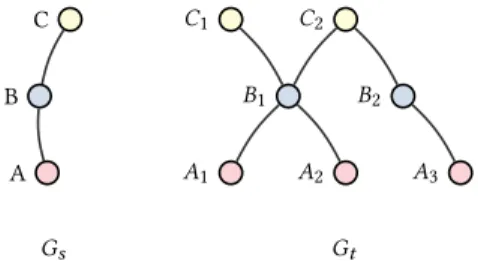
Figure 1: An illustration of the network-alignment prob-lem. The task is to align two input networksGs andGt. Some nodes and/or edges from either network may be left unmatched. Letters and colors are used to indicate the sets of candidate matching nodes, e.g.,CA = {A1,A2,A3}, CB = {B1,B2}, andCC ={C1,C2}.
3
PROBLEM FORMULATION
Before defining theactive network alignmentproblem, we first discuss the non-active version of the problem.
Network alignment:In the standard network-alignment problem we consider two input graphsGs=(Vs,Es)andGt =(Vt,Et), the sourceand thetargetgraph. The adjacency matrices of the two graphs are denoted byAs andAt, respectively. Throughout we assume that the smaller graph is aligned to the larger one, that is,|Vs| ≤ |Vt|. In addition, we consider that a similarity function σ :Vs×Vt→Ris available, which measures the similarity between pairs of nodesi∈Vsandj∈Vt. The similarity functionσdepends on the application at hand.
The objective of the network-alignment problem is to find a matchingbetween the nodes of the two networks. More specifically, we want to align the nodes of the source graphVsto the nodes of the target graphVt. Formally, we want to findM={(i,j)} ⊆Vs×Vt so that each node ofVs andVt appears at most one time inM. A high-quality alignment should satisfy the following properties: (i) nodes inVsshould match to similar nodes inVt, according toσ, and (ii) the endpoints of each edge inEs should match to nodes in Vt that are connected by edges inEt.
For each nodev ∈Vswe consider a set ofcandidate matching nodes Cv ⊆Vt. Those are the only nodes inVt thatv can be matched to. In this paper we assume that the setsCv are given. In practice, the setsCv are computed by a simple heuristic, e.g., considering all nodes inVtwhose feature-based similarity tov∈Vs exceeds a certain threshold. When the candidate sets are small compared toVt, the problem is sometimes calledsparse network alignment.
Globalnetwork-alignment methods formulate an objective func-tion that captures the above properties, and then devise algorithms for optimizing this objective.
In some applications, it is desirable to leave nodes unmatched if no suitable match is found. This can be achieved without having to change the problem formulation by adding a special “gap” node to the target graph for each node in the source graph. The gap nodes are isolated and the user has to define a similarity value (which can also be negative) between the source nodes and the gap nodes, which controls the cost of leaving a source node unmatched.
An example of the network-alignment problem is shown in Fig-ure 1. We use letters and colors to indicate sets of matching nodes. Indicatively, in an application of aligning social networks, one can think ofA=Andres,A1 =Andre,A2 =Andrew,A3 =Andreas,
whileB=Brendon,B1=Brenden,B2=Brendan, etc.
Active network alignment:Assume now that we have access to an oracle, for example, a human expert, with whom we can interact in the form of queries and obtain partial information about the correct alignment of the two networksGsandGt.
As already discussed, we focus on interaction with the oracle that takes the form of the following queries:
Given a nodevin the source networkGs, and a set of candidate matchesCvin the target networkGt, which node fromCvshould be matched tov?
The oracle returns an answeru∈ Cvand the algorithm proceeds to aligningGs withGt giventhatv∈Vs is matched withu ∈Vt. Depending on the application, one of the candidate matchesCv may be the gap node ofv.
The problem of active network alignment is to select the most informative nodev∈Vsfor which to ask the oracle to reveal the correct matched nodeu ∈Vt. More specifically, we aim to solve the following problem.
Problem 1 (ActiveNetworkAlignment). Given a source net-workGs =(Vs,Es)and a target networkGt =(Vt,Et), select the nodev ∈Vs for which to ask an oracle to reveal the correct matched nodeu∈Vtso that the alignment accuracy for the remaining nodes inVsis maximized.
Thealignment accuracyin Problem 1 is computed by fixing the alignment ofvtou, then aligning the remaining nodes using a standard (non-active) network alignment method, and finally by computing the fraction of correctly aligned unqueried nodes inVs. A natural way to approach Problem 1 is to design a function Cert(v|Gs,Gt)that quantifies thecertaintyassociated with each v ∈Vs with respect to its match inVt. Nodes with low certainty scores are good candidates for being the query node, since these nodes would otherwise be more likely to decrease the alignment accuracy. The active-learning framework provides general princi-ples for designing such a function. We deploy these ideas in order to design and experiment our Cert function. More details on this are given in Sections 4 and 5.
In the example of Figure 1, we see thatAinGs is most similar toA1,A2, andA3inGt. IfAis matched toA1orA2, thenBshould be uniquely matched toB1. IfAis matched toA3, thenBshould
be uniquely matched toB2andCtoC2. Thus, matching nodeA first, to a large extent, determines the rest of the alignment. On the other hand, matchingBorCfirst does not determine the rest of the alignment with the same level of certainty. We conclude that, in this example, it is a good strategy to ask the oracle to provide us with the correct alignment for nodeA.
4
MATCHING-BASED ACTIVE NETWORK
ALIGNMENT
In this section, we present the proposed strategy for active network alignment. Our strategy identifies which nodev∈Vsto query via a novel approach for quantifying the certainty of each node. The 3
Algorithm 1 The general active network alignment framework.
Input:Gs=(Vs,Es),Gt =(Vt,Et), candidate matchesC, and query budgetk.
Output:An alignment betweenVs andVt.
1: fori=1, . . . ,kdo
2: H =NetworkAlignment(Gs,Gt | C)
3: vˆ=argminv∈V
sCert(v|H,Gs,Gt)
4: uˆ=OracleQuery(vˆ,Cvˆ), with ˆu∈ Cvˆ
5: Cvˆ ={uˆ} .Update candidate matches.
6: forv∈Vs\ {vˆ}do
7: Cv=Cv\ {uˆ}
8: H =NetworkAlignment(Gs,Gt | C)
9: returnBipartiteMatching(H)
main idea is as follows: instead of solving the alignment problem to find only a single matching (the optimal network alignment), we sample a number of high-quality matchings (near-optimal net-work alignments), and then, compute the certainty of each node by considering the distribution of its matched nodes on the sampled matchings.
We study two different methods for sampling matchings; Gibbs-Matchings, where matchings are sampled according to their score (so better matchings have higher probability of being included in the sample), and TopMatchings, where the top-`matchings are considered. We also consider different alternatives for computing node certainty based on the sampled matchings.
We now discuss our approach in more detail. We start by describ-ing our strategy at a high level, and then proceed to the description of each of its components and different alternatives.
4.1
Overview
The general active network alignment approach, in which nodes are queried iteratively, can be summarized as follows: In every iteration pick a node ˆv∈Vs. The node ˆvtogether with its set of candidate matching nodesCvˆ⊆Vtis shown to the (human) oracle, and the oracle selects a node ˆu∈ Cvˆas the best match for ˆv. Assert that ˆ
uis the best matching for ˆvby updating the candidate node sets so thatCvˆ={uˆ}, and removing ˆufrom all other sets of candidate nodes. When the budget of oracle queries is exhausted, solve the remaining network alignment problem to align the unqueried nodes. Pseudocode for this approach is shown in Algorithm 1 (different steps of the algorithm are explained later in this section).
Our main contribution, is the methodology for quantifying the certainty of the candidate nodes to be queried at every iteration of Algorithm 1. Our approach consists of the following steps.
Step 1. Construct a weighted bipartite graphH=(Vs,Vt,Eh)that forms the basis for the matching-based network-alignment al-gorithm.
Step 2. Sample a setM`of`high-quality matchings inH.
Step 3. For each nodev∈Vs, estimate thecertaintywe have about the correct match forv. These certainty values, Cert(v), are computed using the information in the set of sampled match-ingsM`.
Step 4. Identify the node ˆv∈Vswith theleast certainty, and query the oracle for selecting the best match of ˆvamong the set of candidate matching nodesCvˆ⊆Vt.
For sampling a set of matchingsM`we consider two alternatives: GibbsMatchings (sample matchings according to their score) and TopMatchings (take the top-`matchings); those are discussed in Section 4.3. We also consider three different ways of estimating node certainty (Step 3) presented in Section 4.4. First we discuss how to construct the weighted bipartite graphH =(Vs,Vt,Eh)on which the set of sampled matchingsM`is obtained.
4.2
Constructing the bipartite graph
H
Our strategy is applicable to any NetworkAlignment algorithm that is based on solving a bipartite-matching problem. In our exper-iments, we use Natalie [12] and NetAlignMP++[3], two state-of-the-art algorithms. Both methods aim to solve the following qua-dratic integer program, adopting, however, different approaches. Integer-programming formulation:The IP formulation of Natalie and NetAlignMP++introduces a variablexijfor each pair of nodes i ∈Vs andj ∈Vt. The variablexijis set to 1 ifiis matched toj, while it is set to 0 otherwise. We also use∆(v), forv ∈Vs ∪Vt, to denote the set of all pairs{(i,j)}for whichv=iorv=j, andAs;ik (At;ik) to denote whether there is an edge between nodesiandk in the source (target) graph.
max x Õ (i,j)∈Vs×Vt σ(i,j)xij +д Õ (i,j)∈Vs×Vt Õ (k, `)∈Vs×Vt As;ikAt;j`xijxk`, such that Õ (i,j)∈∆(v) xij ≤1, for allv∈Vs∪Vt, xij∈ {0,1}, for all(i,j) ∈Vs ×Vt.
In the above integer program, each pair of matched nodesiandj contributes a reward of valueσ(i,j), while an additional reward of valueдis given if an edge inEs is matched to an edge inEt. The user-defined parameterдquantifies the relative importance between correctly-matched nodes and correctly-matched edges, and it is typically set based on prior knowledge or cross-validation. The inequality constraint ensures that the solution is a matching. Solution via Lagrangian relaxation:Natalie, originally proposed by Klau [17], solves the quadratic integer program by first linearizing it and then employing a Lagrangian relaxation technique. Klau shows that the original integer program isNP-hard, but remarkably, by relaxing a symmetry constraint for the linearized quadratic terms, the problem becomes solvable in polynomial time via multiple maximum-weight bipartite matchings.
Natalie iteratively updates the Lagrangian multipliersλfor the relaxed constraints using subgradient optimization. The solutions of the relaxed problem provide upper bounds for the original problem, whereas the feasible solutions, which can be directly extracted from the relaxed solutions, provide lower bounds.
The best feasible solution found provides the bipartite graphH for our active strategy.
Solution via message passing:The NetAlignMP++algorithm, pro-posed by Bayati et al. [3], solves the same optimization problem 4
using a belief propagation (BP) approach. This approach makes local, greedy updates by passing messages between the neighboring nodes. To obtain an integral solution, NetAlignMP++constructs and solves a maximum-weight matching problem based on the BP messages at every iteration of the algorithm.
Again, we setHto correspond to the matching problem that gives the best solution.
Due to space constraints, we do not discuss in detail how the weights of the edges of the bipartite graphs are set. Note, however, that the weights aim at capturing both the feature-based and struc-tural similarities of the matching nodes, and the higher the weight the more similar the nodes are. For more details we refer the reader to the original papers [3, 12].
4.3
Sampling matchings
Next we present two approaches for sampling matchings: Gibbs-Matchings, which first defines a probability distribution over the space of matchings and then employs Gibbs sampling to draw samples from this space, and TopMatchings, which computes the top-`matchings.
Gibbs sampling for matchings:Markov chain Monte Carlo tech-niques are popular for drawing samples from complex multi-dimen-sional distributions [5]. In order to apply these methods to sample matchingsM, we need to define a probability distribution over the space of matchings induced by the bipartite graphH. Similar to Volkovs and Zemel [38], we use the standard Gibbs form
P(M|H)= 1 Z(M,β)exp −1 βE(M,H) =Z 1 (M,β)exp © « 1 β Õ v∈Vs Hv,M(v)ª® ¬ , (1)
whereM(v) denotes the node to whichv is matched to in M, Z(M,β)is the partition function that normalizes the distribution, andβis a “temperature” constant that defines the smoothness of the distribution. The value ofβis optimized using a training dataset, as discussed in Section 5.3.
We sample`matchingsM`={M1, . . . ,M`}from this
distribu-tion as follows: we initializeMwith the maximum-weight matching. Then at each iterationi, we go through the nodes inVs in a ran-dom order and for each nodev∈Vs, we pick one of the candidate matching nodesu ∈ Cvuniformly at random. Next we consider re-assigningvtouandv0toM(v)wherev0is the node currently matched touif any. IfM(v)is not among the candidate matches ofv0, we pick another nodeu uniformly at random among the remaining candidates ofvuntil a possible re-assignment has been found (vcan always be re-assigned to its current matchM(v)). The new matchingM0, which would result from the re-assignment, is realized and the updateM←M0performed with probability
P M0|M,H = exp −1 βE(M0,H) exp −1 βE(M,H) +exp −1 βE(M0,H) = exp 1 β Hv,u+Hv0,M(v) exp 1 β Hv,M(v)+Hv0,u +exp 1 β Hv,u+Hv0,M(v) . (2)
Once each node has been processed, we leti-th sample beMi ←M. Then, we generate a new random permutation of the nodesVs
and repeat the process until`samples have been drawn. We call this method GibbsMatchings.2 Assuming that each node hasc candidate matches, the worst-case complexity of GibbsMatchings isO(`c|Vs|).
Volkovs and Zemel [38] note that Gibbs sampling is often found to mix slowly and get trapped in local modes. In our case, such slow mixing implies that we will end up exploring only the areas around the maximum weight matching, which is the starting point of the sampling. However, even if this happens, we do not expect it to be a problem as we indeed are interested in sampling high-quality matchings close to the optimal solution.3
Top-`maximum-weight matchings:To compute the top-` max-imum-weight matchingsM`, we use an algorithm invented by Murty [29] in 1968. This algorithm first computes the best maximum-weight matching inH, then splits the problem intoO(n)smaller matching problems and reconstructs the second best matching based on the solutions of the smaller problems. The process is re-peated until`matchings have been discovered, and in total, the algorithm has a running time ofO(`n4), wherenis the total number of nodes in the graph, i.e., in our casen=max{|Vs|,|Vt|}. Using a modification by Miller et al. [28], the algorithm runs in timeO(`n3).
4.4
Quantifying certainty and identifying the
node to query
Using uncertainty to determine which data points should be labeled is a standard active-learning strategy [33]. The idea is to select for labeling the data points for which we are theleast certainas to what the correct output should be.
A natural approach for quantifying the uncertainty of a match M(v)of nodev ∈ Vs is to consider the marginal distribution P(M(v)=u|H), whereu∈Vt. Given the set of sampled match-ingsM`, the marginal distribution can be obtained simply by com-puting the fraction of samples for which nodevis matched tou. We then define thecertaintyof nodevas
Cert(v)= max
u∈CvP
(M(v)=u|H). (3) The intuition for Equation (3) is that when a nodevis matched to the same nodeuin most of the matchings inM`, then there is little uncertainty; based on the evidence in the set of sampled matchingsM`,uis a good match forvand no extra information will be gained by queryingv. On the other hand, if the evidence inM`is inconclusive with respect to the best match forv, thenv should be queried. Accordingly, the proposed strategy is to query the node ˆvwith the least certainty, i.e.,
ˆ
v=argminv
∈VsCert(v). (4)
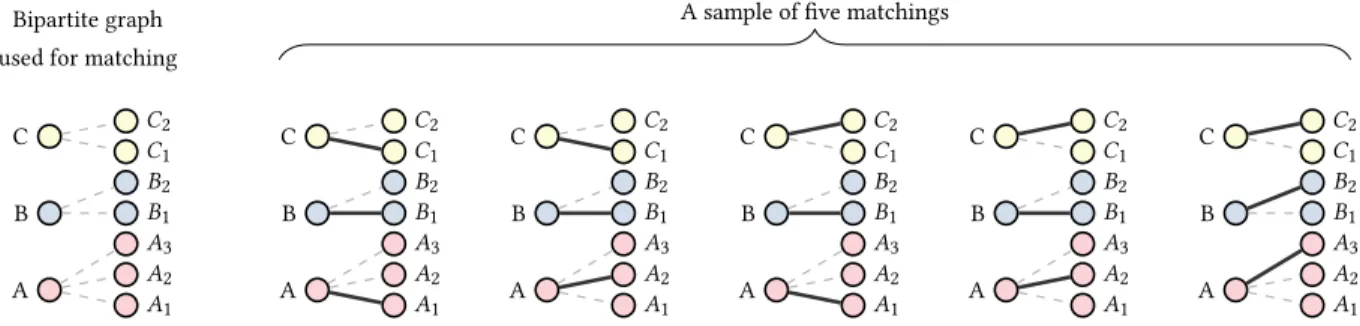
To obtain further intuition for the proposed method, consider again the example in Figure 1. The bipartite graphHfor this exam-ple is shown on the left in Figure 2.
2
A limitation of this swap-based approach is that if the problem at hand has nodes with partially overlapping sets of candidate matches, there will be some states that are unreachable by the Markov chain (i.e. the chain is non-ergodic).
3
We also tested the sequential matching sampler proposed by Volkovs and Zemel [38] which outperformed a Gibbs sampler in their experiments. However, in our case, this approach suffered from extremely low acceptance rates, even after adjusting parameter ρ[38]. This might be related to the distribution of the weights inHor to the small sizes of the graphs studied in [38].
A B C A1 A2 A3 B1 B2 C1 C2 Bipartite graph
used for matching
A B C A1 A2 A3 B1 B2 C1 C2 A B C A1 A2 A3 B1 B2 C1 C2 A B C A1 A2 A3 B1 B2 C1 C2 A B C A1 A2 A3 B1 B2 C1 C2 A B C A1 A2 A3 B1 B2 C1 C2 A sample of five matchings
Figure 2: The instance of the network-alignment problem in Figure 1 is transformed to an instance of a maximum-weight matching problem. Computing the setM`of`=5matchings helps to quantify the uncertainty of a node in network
align-ment.
Now assume that we draw a sample of`matchings in this bipar-tite graph. A sample of five matchings is shown in Figure 2. For each nodev∈Vswe can compute the distribution of the nodes in Vt thatvis matched to in these five matchings. A node with high uncertainty is a node that is matched to many different nodes in Vt and the distribution of matches is well-balanced. In the exam-ple of Figure 2, the distribution of matchings for nodesA,B, and Cis{A1 : 40%,A2 : 40%,A3 : 20%},{B1 : 80%,B2 : 20%}, and {C1 : 40%,C2: 60%}, respectively. From these distributions one
can argue that nodeAhas the highest uncertainty.
An alternative measure for the certainty of a node would be to study entropy, which is commonly used in active learning [31, 34]. However, in our experiments we found that Equation (3) consis-tently outperformed a method which defined certainty as the nega-tive entropy of the marginal distribution. Thus we do not report experimental results using the entropy-based method.
A limitation of Equation (3) is that it measures certainty only locally and thus it does not capture the effect that knowing the matching for a given nodevwould have on the remaining align-ment. Therefore, we consider also another alternative query strat-egy which queries the node ˆvsuch that once ˆvis queried and its match is known, the expected certainty of the remaining nodes is maximized. That is,
ˆ v=arg max v∈Vs Õ u∈Cv © « P(M(v)=u|H) Õ v0∈V s\v Cert(v0)ª ® ¬ . (5)
This approach is inspired by previous works in sensor placement [19, 20] and active learning [25]. As pointed out by the previous works, a limitation of this approach is its high computational complexity, which in our case is given byO(c2|Vs|2), assuming that each node hasccandidate matches. In our initial experiments, it performed similarly to the simpler query strategy given in Equation (4), which is why we only consider the latter hereafter.
4.5
Batch querying
Instead of finding the best query to ask at every iteration of Algo-rithm 1 we can adopt a “batch” approach, where in each iteration we identify a batch of queries to ask — the ones that correspond to the nodes with the smallest Cert values. When considering batches
of sizek0<k, wherekis the total number of queries to be made, we can achieve a speedup of the orderdk
k0e.
We can readily employ all the query strategies studied in this paper to query in batches. However, these strategies might yield nodes that strongly depend on each other (that is, if we knew the alignment for one node, we could easily align another node). Thus, developing more sophisticated methods for batch querying remains an interesting avenue for future research.
5
EXPERIMENTAL EVALUATION
We evaluate a number of different network-alignment query strate-gies on networks where the correct alignment is known. Our methodology is as follows: First, we solve the network-alignment problem with a non-active alignment method and report the align-ment accuracy, that is, the fraction of correctly aligned nodes. Then we start simulating the oracle queries by fixing the nodes to their correct matches. After each query we solve the network-alignment problem given the current correct matches and report the align-ment accuracy on the unqueried nodes. This process is repeated for each query strategy separately with the same initial graphs. A good strategy should use as few queries as possible to reach the desired alignment accuracy.
As mentioned earlier, the query strategies discussed in this pa-per can be applied on top of any (non-active) network-alignment method that results in solving a bipartite-matching problem. In the experiments, we employ the query strategies on top of two state-of-the-art alignment methods, Natalie [12, 17] and NetAlignMP++ [3] (see Section 4.2 for a brief discussion). The query strategies as well as the non-active network alignment methods used in the experiments support leaving nodes unmatched, but in our experi-ments, there is always a match for each node of the source graph.
Next we describe our datasets and present an empirical compari-son between GibbsMatchings, TopMatchings, and four baseline query strategies.
5.1
Datasets
We use three types of datasets. In all datasets, there is a sufficient degree of ambiguity in the node attributes so that for each node in one graph there are several candidate matches in the other graph. Furthermore, the edges of the graphs may have been corrupted. 6
Preferential-attachment graphs:We generate a network using the preferential-attachment model [2], which captures some of the key characteristics of social networks and has been previously used to study network-alignment methods [18]. The network consists of 1 000 nodes and 2 edges per new node. For each node, we sample a label from a set of 33 unique labels and treat the labels as attributes so that the similarity between two nodes is set to 1 if their labels are the same and 0 otherwise. Only the nodes with the same label are considered candidate matches, resulting in 30 candidate matches per node on average.
We make two copies of the network and in each copy we inde-pendently corrupt the edges to further complicate the alignment task. We first discard 60 % of the graph edges chosen at random and then add 50 % more edges again selected at random.
Social networks:We use the the multiplex dataset from Aarhus University [26], which contains five networks between the employ-ees of the Department of Computer Science. We select two of these layers, the Facebook and the lunch networks, and try to align the former to the latter. Since the dataset only contains anonymized user identifiers, we again sample a label for each node so that on average there are three people with the same label. The lunch net-work contains 60 people, whereas the Facebook netnet-work covers only a subset of 32 of them. While this dataset is small, it makes an interesting case study since it contains two very different types of real-world networks and the correct alignment is known.
Family trees:Aligning family trees is an import problem encoun-tered in various online genealogy services where different people provide family tree fragments, which then, ideally, get merged into a single large family tree. We have obtained a family tree4 con-taining 64 208 people constructed by an individual genealogical researcher. We sample a subgraph of this network by randomly picking a seed person and doing a random walk until 1 000 distinct people have been discovered.
For each person we only consider the first name, last name, and birth year. Birth year is corrupted by rounding it to the nearest ten. Some of the first and last names are randomly replaced by their alternative spellings based on a list of common name variations. For example, the nameFelix Ahlroothmight get replaced byFeeliks Alroot. Such name variations are frequently encountered in histor-ical documents used in genealoghistor-ical research. From both graphs independently, we discard 50% of the edges at random.
The task is to align the subgraph into the larger graph. When selecting candidate entities for each individual in the subgraph, we find people from the larger graph born in the same decade and select four of them with the most similar names in addition to the groundtruth match. Name similarity is computed as the average Jaro-Winkler similarity [39] between the first names and between the last names.5
5.2
Baseline query strategies
We compare the performance of the sampling-based query strate-gies to four baseline stratestrate-gies.
4
Note that in the graph-theoretic sense family trees are not trees since they contain cycles such asMother–FirstChild–Father–SecondChild–Mother.
5
The Jaro-Winkler similarity is a popular choice for de-duplicating name records.
Margin: Querying data samples with a small score difference ( mar-gin) between the two most probable labels is a common approach in active learning [33]. In the context of active network alignment, this method has been previously used by Cort ´es and Serratosa [10]. Thus, given the bipartite graphH, Margin computes Cert(v) for everyv ∈Vs by first finding the two edges incident tovwith the largest weightsw1(v)andw2(v)inH. Then the node is scored according to
Cert(v)=w1(v) −w2(v).
Intuitively, the larger the difference betweenw1(v)andw2(v), the
less uncertainty there is with respect to the best match for nodev. lccl: TheLeast Confident given the Current Labellingquery strategy ranks nodes according to
Cert(v)=Hv,M(v),
whereMis the current matching (the maximum-weight matching inH) andHv,M(v)is the weight between nodevand its current match. This method was reported to yield the highest precision of the four uncertainty sampling based methods studied by Cort ´es and Serratosa [10].
Betweenness: This method queries a previously unqueried node with the highest betweenness centrality inGs. The method has been previously used by Macskassy [25].
Random: This method queries nodes fromVs in a random order.
5.3
Query strategy comparison
Here we perform an empirical comparison of the different query strategies. For each dataset, we run a minimum of 30 random ini-tializations of the input graphs and average the results; for the preferential-attachment graphs, we generate a new pair of input graphs at each initialization, for social networks, we sample new node labelings and for family trees a new subgraph at each initial-ization.
Adjusting hyperparameters:The number of matchings`in Top-Matchings is set to 30. We also tried larger values up to 3000 but this did not seem to have a significant effect on the results. In GibbsMatchings, we set the number of samples`to 3000. Addi-tionally, we have to choose the value of the temperature parameter β. If the value is set too high, the distribution becomes close to a uniform distribution, whereas if it is set too low, the distribution becomes very concentrated and the swaps to a lower energy state will always fail. Therefore, we first normalize the bipartite graphH by dividing its values with the difference of the average minimum and maximum value of the different rows ofH. Then we optimize βusing a separate training dataset. This dataset is generated using the preferential-attachment model, as described in Section 5.1 but with only 50 nodes per graph and 5 unique labels. Among the values we tried,{0.001,0.01,0.1,1}, we foundβ=0.1 to produce the most accurate predictions for the training data, and thus we fix this value for the rest of the experiments.
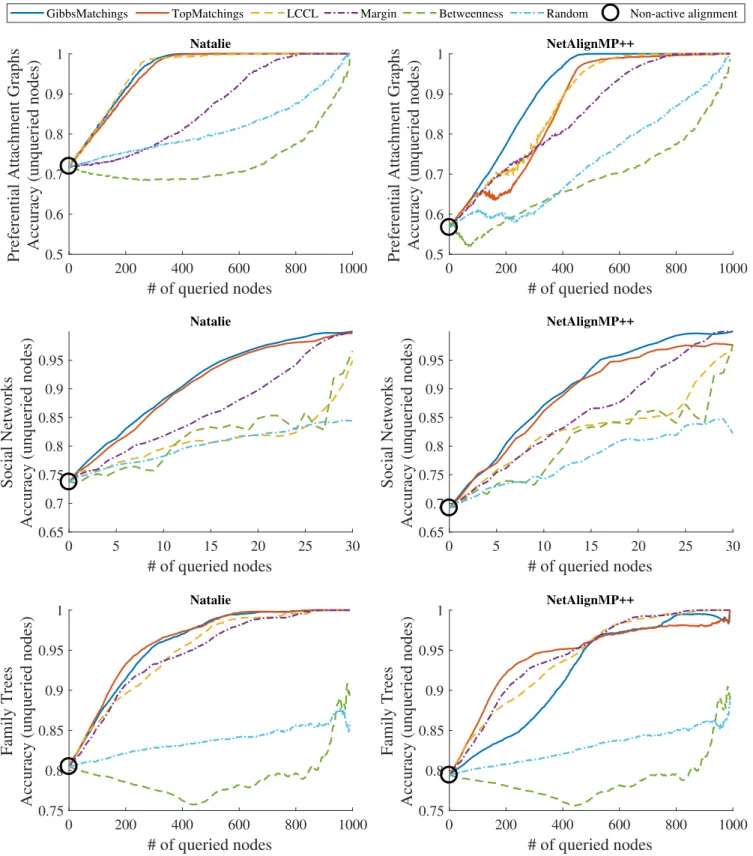
Results:The alignment accuracies are shown in Figure 3. On the x-axis, we have the number of queried nodes and on they-axis, the alignment accuracy for the unqueried nodes, that is, the fraction of correctly aligned unqueried nodes.
In the top row of Figure 3, we see that by querying the 400 best nodes according to GibbsMatchings, TopMatchings, or lccl, the 7
0 200 400 600 800 1000
# of queried nodes
0.5 0.6 0.7 0.8 0.9 1Preferential Attachment Graphs
Accuracy (unqueried nodes)
Natalie
GibbsMatchings TopMatchings LCCL Margin Betweenness Random Non-active alignment
0 200 400 600 800 1000
# of queried nodes
0.5 0.6 0.7 0.8 0.9 1Preferential Attachment Graphs
Accuracy (unqueried nodes)
NetAlignMP++ 0 5 10 15 20 25 30
# of queried nodes
0.65 0.7 0.75 0.8 0.85 0.9 0.95Social Networks
Accuracy (unqueried nodes)
Natalie 0 5 10 15 20 25 30
# of queried nodes
0.65 0.7 0.75 0.8 0.85 0.9 0.95Social Networks
Accuracy (unqueried nodes)
NetAlignMP++ 0 200 400 600 800 1000
# of queried nodes
0.75 0.8 0.85 0.9 0.95 1Family Trees
Accuracy (unqueried nodes)
Natalie 0 200 400 600 800 1000
# of queried nodes
0.75 0.8 0.85 0.9 0.95 1Family Trees
Accuracy (unqueried nodes)
NetAlignMP++
Figure 3: Alignment accuracy of the unqueried nodes for three datasets: preferential attachment graphs (top), social networks (middle), and family trees (bottom). In most cases, the proposed methods (GibbsMatchingsandTopMatchings) achieve a high
accuracy with fewer queries than the four baseline methods. Furthermore, the proposed active-querying strategies clearly improve the initial solution obtained by a non-active alignment method.
remaining 600 nodes get correctly aligned when using Natalie, whereas the other query strategies require at least 800 queries for ob-taining a perfect alignment. For social networks (Figure 3; middle) Margin clearly outperforms lccl, while GibbsMatchings and Top-Matchings outperform both of them except for when querying 26 nodes or more and using TopMatchings with NetAlignMP++. Fi-nally, in family trees (Figure 3; bottom), GibbsMatchings and Top-Matchings consistently outperform the other methods when using Natalie. With NetAlignMP++, lccl and Margin outperform the sampling methods after querying half of the nodes, and in contrast to the other experiments, GibbsMatchings performs clearly worse than TopMatchings within the first half of the queries. To under-stand this difference better, we ran GibbsMatchings with different temperatures and noticed that withβ =0.001, GibbsMatchings obtains a comparable performance with TopMatchings. This sug-gests that the optimalβvalue is sometimes problem dependent.
A surprising observation is that in most cases Betweenness is outperformed even by random querying. This is probably explained by the fact that Betweenness queries central nodes that have many neighbors and are thus less uncertain since the neighbors help inferring their correct alignment.
We conclude that the best overall performance is obtained us-ing the GibbsMatchus-ings and TopMatchus-ings methods; lccl and Margin are both competitive baselines but in some cases they yield more than 15 percentage point lower accuracies, whereas the sampling methods perform consistently well.
5.4
Batch querying and scalability
When aligning large networks with the help of human experts, getting the responses from the humans easily becomes the bottle-neck of the algorithm. To circumvent this problem, we can query batches of nodes as discussed in Section 4.5. To study the effect of batch querying on GibbsMatchings, we run an experiment on the preferential-attachment graphs and vary the batch size. Figure 4 shows the effect of the batch size on the alignment accuracy. With a batch size of 10, the accuracy is hardly affected, and even when batch size is increased to 100 nodes, the accuracy decreases by no more than 3.5%. This shows that we can obtain accurate network alignments even when querying the experts in parallel.
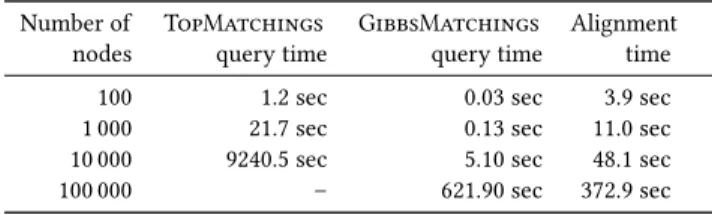
Another potential bottleneck is computing the nodes to query. Table 1 lists the running times for computing a query node us-ing TopMatchus-ings and GibbsMatchus-ings combined with Natalie, when aligning two preferential-attachment graphs with a varying number of nodes. The number of matchings is set to`=30 with both methods (note that in the main experiments, we used 3 000 samples with GibbsMatchings). With networks of up to 1 000 nodes, TopMatchings is not yet a significant bottleneck but when the number of nodes becomes 10 000, TopMatchings takes already 2.6 hours.6 GibbsMatchings, on the other hand, scales well so that and even for graphs with 100 000 nodes it only takes 10 min-utes to sample 30 matchings. Furthermore, GibbsMatchings can be parallelized in a straightforward manner by running multiple independent Markov chains simultaneously.
6
We use the original algorithm proposed by Murty [29] for TopMatchings instead of the optimization by Miller et al. [28]. However, instead of the standard Hungarian algorithm, we employ a bipartite matching solver optimized for sparse graphs, available at: https://www.cs.purdue.edu/homes/dgleich/codes/netalign/ 0 200 400 600 800 1000 # of queried nodes 0.5 0.6 0.7 0.8 0.9 1
Accuracy (unqueried nodes)
GibbsMatchings Batch size 10 Batch size 50 Batch size 100 Batch size 200 Batch size 300
Figure 4: The effect of querying nodes in batches to the over-all alignment accuracy.
Table 1: Running times for the proposed query methods and for the network alignment methodNatalie.
Number of nodes TopMatchings query time GibbsMatchings query time Alignment time
100 1.2 sec 0.03 sec 3.9 sec 1 000 21.7 sec 0.13 sec 11.0 sec 10 000 9240.5 sec 5.10 sec 48.1 sec 100 000 – 621.90 sec 372.9 sec
Finally, we also discovered that Natalie can be optimized when employing it multiple times for a sequence of similar problems. More specifically, after we have queried a node and fixed its align-ment, otherwise keeping the problem unaltered, we can leverage the solution of the previous problem for solving the current prob-lem. This is achieved by initializing the Lagrangian multipliers corresponding to the relaxed constraints by the optimal values of the multipliers in the previous run of Natalie. In our initial experi-ments, this strategy provided speed ups of more than 60% for the convergence of the subgradient optimization. However, since Na-talie is typically not the bottleneck of the proposed active network alignment approach, we have omitted these results.
6
CONCLUSIONS
In this paper we formalized an active-learning framework, which allows us to incorporate human feedback into the network align-ment problem (also known as graph matching). In this framework, we obtain human feedback by asking relative queries to make in-teraction with experts easier, whereas most of the existing works on active network alignment rely on absolute queries. Moreover, we develop a scheme for selecting which nodes to obtain human feedback for. Our approach relies on sampling a set of matchings in a transformed bipartite graph, and quantifying the certainty of each node using the marginal distribution of the node. We study two alternative methods for sampling matchings, GibbsMatchings, where matchings are sampled according to their score, and Top-Matchings, where the top-`matchings are taken in the sample. The 9
two proposed methods are shown to outperform several previously-proposed baseline methods, while offering a robustness-scalability trade-off.
This study opens many possibilities for future work. First, sam-ples of matchings could be used for not only relative but also for absolute queries. It would be interesting to perform an experimental comparison between the two query strategies (absolute vs. relative) but in order to quantitatively compare their effectiveness, we would need to develop a model to compare the cognitive load induced by the different type of human expert queries. Second, in this work we assume the oracle to always provide the correct alignment for a node but it would be useful to study how the results change given an imperfect oracle. Third, it would be useful to develop methods for tuning the temperature parameterβin GibbsMatchings so that GibbsMatchings would generalize better to different types of networks. One possibility would be to compute the maximum likelihood estimate forβbased on the results of the previous oracle queries and adaptively update the estimate when new oracle results are received.
ACKNOWLEDGMENTS
We would like to thank Pekka Valta and the Genealogical Society of Finland for providing the data for the family-tree experiment, as well as the anonymous reviewers for constructive comments and suggestions. Eric Malmi and Aristides Gionis were supported by the Academy of Finland project “Nestor” (286211) and the EC H2020 RIA project “SoBigData” (654024). Evimaria Terzi was supported by a Nokia Visiting Professor Fellowship and NSF grants: IIS 1320542, IIS 1421759, and CAREER 1253393.
REFERENCES
[1] David Aumueller, Hong-Hai Do, Sabine Massmann, and Erhard Rahm. 2005. Schema and ontology matching with COMA++. InSIGMOD.
[2] Albert-L ´aszl ´o Barab ´asi and R ´eka Albert. 1999. Emergence of scaling in random networks.Science286, 5439 (1999).
[3] Mohsen Bayati, David F Gleich, Amin Saberi, and Ying Wang. 2013. Message-passing algorithms for sparse network alignment.TKDD7, 1 (2013), 3. [4] Mustafa Bilgic, Lilyana Mihalkova, and Lise Getoor. 2010. Active learning for
networked data. InICML.
[5] Christopher M. Bishop. 2009.Pattern recognition and machine learning. Springer. [6] Curt A Carlson, Scott D Gronlund, and Steven E Clark. 2008. Lineup composition,
suspect position, and the sequential lineup advantage.Journal of Experimental
Psychology: Applied14, 2 (2008), 118–128.
[7] Laurent Charlin, Rich Zemel, and Craig Boutilier. 2012. Active learning for matching problems. InICML.
[8] Connor Clark and Jugal Kalita. 2014. A comparison of algorithms for the pairwise alignment of biological networks.Bioinformatics30, 16 (2014).
[9] Donatello Conte, Pasquale Foggia, Carlo Sansone, and Mario Vento. 2004. Thirty Years Of Graph Matching In Pattern Recognition.IJPRAI18, 3 (2004). [10] Xavier Cort ´es and Francesc Serratosa. 2013. Active-learning query strategies
applied to select a graph node given a graph labelling. InGraph-Based
Represen-tations in Pattern Recognition.
[11] AnHai Doan, Jayant Madhavan, Pedro Domingos, and Alon Halevy. 2004. Ontol-ogy matching: A machine learning approach. InHandbook on ontologies. [12] Mohammed El-Kebir, Jaap Heringa, and Gunnar W Klau. 2015. Natalie 2.0:
Sparse Global Network Alignment as a Special Case of Quadratic Assignment.
Algorithms8, 4 (2015).
[13] Ahed Elmsallati, Connor Clark, and Jugal Kalita. 2016. Global alignment of protein-protein interaction networks: A survey. IEEE/ACM Transactions on
Computational Biology and Bioinformatics13, 4 (2016), 689–705.
[14] Oana Goga, Patrick Loiseau, Robin Sommer, Renata Teixeira, and Krishna P Gummadi. 2015. On the reliability of profile matching across large online social networks. InKDD.
[15] Somaye Hashemifar and Jinbo Xu. 2014. HubAlign: an accurate and efficient method for global alignment of protein–protein interaction networks.
Bioinfor-matics30, 17 (2014), i438–i444.
[16] Ernesto Jim ´enez-Ruiz, Bernardo Cuenca Grau, Yujiao Zhou, and Ian Horrocks. 2012. Large-scale Interactive Ontology Matching: Algorithms and Implementa-tion. InECAI.
[17] Gunnar W Klau. 2009. A new graph-based method for pairwise global network alignment.BMC Bioinformatics10, Suppl 1 (2009).
[18] Nitish Korula and Silvio Lattanzi. 2014. An efficient reconciliation algorithm for social networks. InVLDB, Vol. 7. 377–388.
[19] Andreas Krause and Carlos Guestrin. 2007. Near-optimal observation selection using submodular functions. InAAAI, Vol. 7. 1650–1654.
[20] Andreas Krause, Ajit Singh, and Carlos Guestrin. 2008.Near-optimal sensor placements in Gaussian processes: Theory, efficient algorithms and empirical studies.Journal of Machine Learning Research9, Feb (2008), 235–284. [21] Oleksii Kuchaiev, Tijana Milenkovi´c, Vesna Memiˇsevi´c, Wayne Hayes, and Nataˇsa
Prˇzulj. 2010. Topological network alignment uncovers biological function and phylogeny.Journal of the Royal Society Interface(2010), rsif20100063. [22] Oleksii Kuchaiev and Nataˇsa Prˇzulj. 2011. Integrative network alignment reveals
large regions of global network similarity in yeast and human.Bioinformatics 27, 10 (2011), 1390–1396.
[23] Donald Laming. 2003.Human judgment: the eye of the beholder. Cengage Learning EMEA.
[24] Chung-Shou Liao, Kanghao Lu, Michael Baym, Rohit Singh, and Bonnie Berger. 2009. IsoRankN: spectral methods for global alignment of multiple protein networks.Bioinformatics25, 12 (2009), i253–i258.
[25] Sofus A Macskassy. 2009. Using graph-based metrics with empirical risk mini-mization to speed up active learning on networked data. InKDD.
[26] Matteo Magnani, Barbora Micenkova, and Luca Rossi. 2013. Combinatorial analysis of multiple networks.arXiv:1303.4986(2013).
[27] No¨el Malod-Dognin and Nataˇsa Prˇzulj. 2015. L-GRAAL: Lagrangian graphlet-based network aligner.Bioinformatics(2015), 2182–2189.
[28] Matt L Miller, Harold S Stone, and Ingemar J Cox. 1997.Optimizing Murty’s ranked assignment method.IEEE Trans. Aerospace Electron. Systems33, 3 (1997). [29] Katta G Murty. 1968. An Algorithm for Ranking all the Assignments in Order of
Increasing Cost.Operations Research16, 3 (1968), 682–687.
[30] Nataˇsa Prˇzulj. 2007. Biological network comparison using graphlet degree distribution.Bioinformatics23, 2 (2007), e177–e183.
[31] Nicholas Roy and Andrew McCallum. 2001.Toward optimal active learning through monte carlo estimation of error reduction. InICML.
[32] Cristina Sarasua, Elena Simperl, and Natalya F Noy. 2012. Crowdmap: Crowd-sourcing ontology alignment with microtasks. InISWC.
[33] Burr Settles. 2010.Active Learning Literature Survey. Technical Report. University of Wisconsin–Madison.
[34] Burr Settles and Mark Craven. 2008. An analysis of active learning strategies for sequence labeling tasks. InEMNLP.
[35] Feng Shi, Juanzi Li, Jie Tang, Guotong Xie, and Hanyu Li. 2009. Actively Learning Ontology Matching via User Interaction. InISWC.
[36] Pavel Shvaiko and J ´er ˆome Euzenat. 2013. Ontology matching: state of the art and future challenges.TKDE25, 1 (2013).
[37] Rohit Singh, Jinbo Xu, and Bonnie Berger. 2008. Global alignment of multiple protein interaction networks with application to functional orthology detection.
PNAS105, 35 (2008).
[38] Maksims Volkovs and Richard S Zemel. 2012. Efficient sampling for bipartite matching problems. InNIPS.
[39] William E Winkler. 1990. String Comparator Metrics and Enhanced Decision Rules in the Fellegi–Sunter Model of Record Linkage. InProceedings of the Section
on Survey Research Methods.
[40] Junchi Yan, Xu-Cheng Yin, Weiyao Lin, Cheng Deng, Hongyuan Zha, and Xi-aokang Yang. 2016. A Short Survey of Recent Advances in Graph Matching. In
ICMR. 167–174.
[41] Jiawei Zhang and Philip S. Yu. 2015. Multiple Anonymized Social Networks Alignment. InICDM.
[42] Xiaojin Zhu, John Lafferty, and Zoubin Ghahramani. 2003. Combining active learning and semi-supervised learning using gaussian fields and harmonic func-tions. InICML Workshop.