M. D. Fredlund W. S. Sillers D. G. Fredlund
G.W. Wilson
Department of Civil Engineering University of Saskatchewan
Saskatoon, Sask. S7N 5A9
ABSTRACT
The Soil-Water Characteristic Curve (SWCC) is an important soil function relating the water content in a soil to soil suction. Many soil properties (or functions) can be related to the water content versus suction relationship of a soil. Hydraulic
conductivity, shear strength, chemical diffusivity, chemical adsorption, storage, unfrozen volumetric water content, specific heat, thermal conductivity and volume change are all functions of the Soil-Water Characteristic Curve. Considerable judgement is required to develop the relationship between soil property functions. The judgement rules can be enforced by a knowledge-based system based on observations and empirical relationships
among soil property functions. A knowledge-based system was developed using a relational database management system (RDBMS) known as Microsoft’s Access database program. Access provided a suitable environment for combining the user interface, knowledge base, database, and query system. This system provides an estimate of the Soil-Water Characteristic Curve as well as the other unsaturated property
functions using basic soil classification data such as grain-size distribution, density and specific gravity. The system allows estimation for many complex soil properties while reducing both time and cost requirements.
1.0 INTRODUCTION
Theory governing the behavior of unsaturated soils has been available for several years and has shown that the Soil-Water Characteristic Curve is the central relationship describing how a soil behaves as it desaturates. Research has shown that empirical relationships can be used to describe property functions related to the Soil-Water Characteristic Curve. These empirical relationships can then be used to predict how the permeability, shear strength, thermal properties, diffusion and adsorption will behave as a soil desaturates. The principles of how an unsaturated soil behaves are encoded into the knowledge-based system. The process for predicting the behavior of unsaturated soils is then greatly simplified. General soil properties are stored in a primary knowledge frame. Subsiduary properties are stored in frames with links respective to the main soil frame. Knowledge was aquired by interviewing experts in the field as well as researching current publications. Soils information for the soils database was aquired from several different sources with a total of approximately 6000 soils represented in the database.
2.0 PROBLEM DEFINITION
Classical soil mechanics has emphasized specific types of soils (e.g., saturated sands, silts, and clays and dry sands). Textbooks cover these types of soils in a completely dry or a completely saturated condition. Recently, it has been shown that attention must be given to soils that do not fall into common categories. A large portion of these soils can be classified as unsaturated soils. Unsaturated soils have typically been avoided due to the complexity of their behavior. An unsaturated soil consists of more than two phases and therefore the natural laws governing its behavior are changed. Central to the behavior of an unsaturated soil is the relationship between water and air as the soil
desaturates. This relationship is described as the Soil-Water Characteristic Curve
(SWCC). Laboratory studies have shown that there is a relationship between the Soil-Water Characteristic Curve and unsaturated soil properties (Fredlund and Rahardjo, 1993b). Properties such as hydraulic conductivity, shear strength, storage, unfrozen water content, specific heat, thermal conductivity, diffusion and adsorption can all be related to the SWCC. Until present, however, a method of combining unsaturated soil property functions into a single system has not existed. The knowledge system provides a way to link complex property functions together to describe the behaviour of an unsaturated soil.
2.1 The Soil-Water Characteristic Curve (SWCC)
The SWCC, typically the desaturation or moisture retention curve, is a
continuous sigmoidal function representing the water storage capacity of a soil as it is subjected to increasing soil suction. It is the relation between volumetric water content,
θ, and stress state, (ua-uw). The SWCC can be used as a means of deriving and linking
soil behaviours such as permeability, shear strength and volume change. It is the center or base of the engineering behaviour of an unsaturated soil. The SWCC provides a means of relating the fundamental soil properties to each other and controlling the state at which each engineering behaviour is calculated. This is important for modelling more than one aspect of soil behaviour in a single analysis. The SWCC contains three
important pieces of information: pore size distribution, amount of water contained in the pores at any suction and the stress state of the soil and soil water. The SWCC has three stages which describe the process of desaturation of a soil (ie. increasing suction). These are outlined below starting at saturation of the soil.
1. The Capillary Saturation Zone where the pore-water is in tension but the soil remains saturated due to capillary forces. This stage ends at the air entry value (ua-uw)b, where
the applied suction overcomes the capillary water forces in the soil and air enters the soil pores.
2. The Desaturation Zone where water is displaced by air within the pores. Liquid water drains from the pores and is displaced by air. This stage ends at the residual water content, θr, where pore-water becomes occluded and the permeability is greatly reduced.
3. The Residual Saturation Zone where the water is tightly adsorbed onto the soil particles and flow occurs in the form of vapor. In this stage the term suction loses its physical significance. Instead it can be regarded as a term for energy required to withdraw a unit of water from a mass of soil. This stage is terminated at oven dryness. When the soil is heated to 105° C, corresponding to a suction of approximately 1 x 10⁶ kPa, and is assumed to have zero water content. This point is a benchmark for all soils,
any water not driven off is chemically bonded to the soil and is not important with respect to the engineering behaviour.
The SWCC is a measured soil property that is used to derive other soil functions and provides a common reference to stress state at which other properties are calculated. In other words, it ensures that each soil property is calculated at the same state.
2.2 Methods of obtaining SWCC
There are several methods available in the knowledge-based system for obtaining a SWCC for a particular soil. The method used should be determined by the application for which the SWCC will be used and its desired accuracy. The most accurate way to
determine a SWCC is through laboratory experimentation. Because of the high cost of lab equipment and the time required to run this test, alternate methods are often desirable. The knowledge-based system provides three alternative methods of
determining a SWCC. The first method involves searching the database for a soil with similar properties as the current soil being analyzed and assuming a similar SWCC. Secondly, the knowledge-based system will look up and suggest reasonable fitting
parameters based on the current soil properties. To accommodate recent research, a third method was also provided in the system. It has been found that correlations exist
between the grain-size distribution and the SWCC (Arya, 1981). A method was therefore developed that allowed the prediction of the SWCC from the grain-size distribution. The final method selected to obtain a SWCC will depend on a users confidence in each of the three prediction methods.
2.3 Prediction of unsaturated soil properties based on SWCC
Laboratory studies have shown that there is a relationship between the Soil-Water Characteristic Curve and unsaturated soil properties (Fredlund and Rahardjo, 1993b). To confirm this belief, a literature review was performed to determine the best prediction methods currently available. It was found that extensive research has been performed in predicting various unsaturated soil property functions. The predictions adopted for the knowledge-based system were then selected based on the following criteria. Firstly, the prediction method should have a correct theoretical basis. Statistical predictions were avoided and prediction methods were accepted if they were founded in theory governing soil
behavior. Secondly, it was attempted to find the most accurate prediction methods. The amount of error between experimental and predicted results was noted in the selection
process. The prediction methods finally selected appear to be the best available in current literature.
3.0 KNOWLEDGE ACQUISITION
The most important process in a knowledge-based system is knowledge acquisition. How the knowledge is obtained and where it is obtained determines the usefulness of the system. The knowledge-based system described in this paper compiles information from three primary sources. Experts in the field of unsaturated soils were interviewed to obtain methods and heuristics common to the field of unsaturated soils. A search of current and past research was performed to determine the framework of the system. Experimental soil data containing at the minimum a Soil-Water Characteristic Curve was required for the database system. Lastly, current computer modelling software in the field of unsaturated soils was reviewed to determine what input properties were most significant. The information was then compiled to create a system to describe the property functions for unsaturated soils.
3.1 Interviewing Experts
Much knowledge in the field of unsaturated soils can only be found by probing the minds of people currently involved in research. Documentation of the newer techniques is not extensive making it necessary to rely on the experience of current experts. D.G. Fredlund and G.W Wilson provided insight and guidance into the design of the system and the way soil information should be represented. Research done in the physical theory of how unsaturated soils behave by D.G. Fredlund laid the foundation for development of the system. Since the SWCC is central to the system, advice was also received from D.G. Fredlund on its representation and implementation. Knowledge regarding the
implementation of thermal properties of soils was contributed by G.W. Wilson with colleague S.L. Barbour providing insight into how unsaturated soils behave in the area of contaminant transport. Mention must also be given to Walter Rawls from the USDA who provided input in determining what methods to use in the prediction of saturated hydraulic conductivity. Advice from the aforementioned experts provided the foundation for the design of the system as well as the heuristic rules used in the field of unsaturated soils.
3.2 Search of current literature
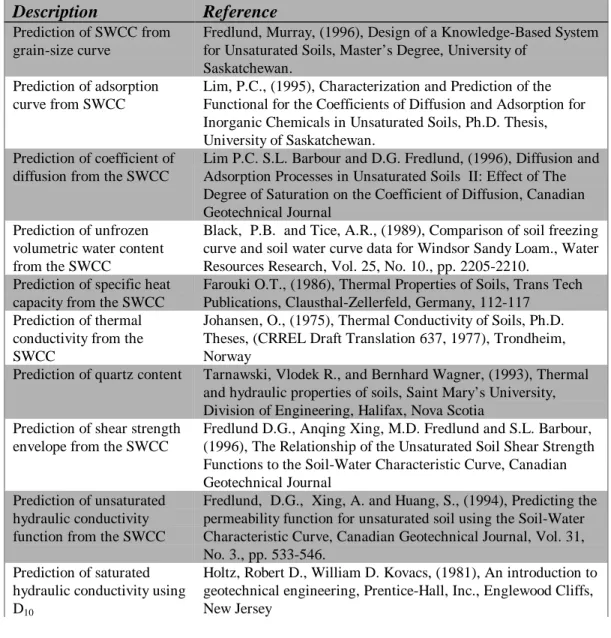
An extensive literature review was performed to determine the best prediction methods to use in the knowledge system. The prediction methods used by the knowledge system are
summarised in Table 1.
Table 1 Summary of prediction methods used in Knowledge-Based System
Description Reference
Prediction of SWCC from grain-size curve
Fredlund, Murray, (1996), Design of a Knowledge-Based System for Unsaturated Soils, Master’s Degree, University of
Saskatchewan. Prediction of adsorption
curve from SWCC
Lim, P.C., (1995), Characterization and Prediction of the Functional for the Coefficients of Diffusion and Adsorption for Inorganic Chemicals in Unsaturated Soils, Ph.D. Thesis, University of Saskatchewan.
Prediction of coefficient of diffusion from the SWCC
Lim P.C. S.L. Barbour and D.G. Fredlund, (1996), Diffusion and Adsorption Processes in Unsaturated Soils II: Effect of The Degree of Saturation on the Coefficient of Diffusion, Canadian Geotechnical Journal
Prediction of unfrozen volumetric water content from the SWCC
Black, P.B. and Tice, A.R., (1989), Comparison of soil freezing curve and soil water curve data for Windsor Sandy Loam., Water Resources Research, Vol. 25, No. 10., pp. 2205-2210.
Prediction of specific heat capacity from the SWCC
Farouki O.T., (1986), Thermal Properties of Soils, Trans Tech Publications, Clausthal-Zellerfeld, Germany, 112-117
Prediction of thermal conductivity from the SWCC
Johansen, O., (1975), Thermal Conductivity of Soils, Ph.D. Theses, (CRREL Draft Translation 637, 1977), Trondheim, Norway
Prediction of quartz content Tarnawski, Vlodek R., and Bernhard Wagner, (1993), Thermal and hydraulic properties of soils, Saint Mary’s University, Division of Engineering, Halifax, Nova Scotia
Prediction of shear strength envelope from the SWCC
Fredlund D.G., Anqing Xing, M.D. Fredlund and S.L. Barbour, (1996), The Relationship of the Unsaturated Soil Shear Strength Functions to the Soil-Water Characteristic Curve, Canadian Geotechnical Journal
Prediction of unsaturated hydraulic conductivity function from the SWCC
Fredlund, D.G., Xing, A. and Huang, S., (1994), Predicting the permeability function for unsaturated soil using the Soil-Water Characteristic Curve, Canadian Geotechnical Journal, Vol. 31, No. 3., pp. 533-546.
Prediction of saturated hydraulic conductivity using D10
Holtz, Robert D., William D. Kovacs, (1981), An introduction to geotechnical engineering, Prentice-Hall, Inc., Englewood Cliffs, New Jersey
Prediction of saturated hydraulic conductivity using an effective porosity, ne
Ahuja L.R. D.K. Cassel, R.R. Bruce, and B.B. Barnes, (1989), Evaluation of Spacial Distribution of Hydraulic Conductivity Using Effective Porosity Data, Soil Science Journal, Vol. 148, No. 6, 404-411
3.3 Acquisition of existing databases
Existing experimental data was used as the starting point in the development of the knowledge based system. Once a database of soil information is acquired, statistical calculations can be performed to check the validity of theoretical predictions as well as providing an estimation of the reasonableness of current soil properties. Soil data is continually being added to the system but original data was collected from four main sources. Hundreds of research publications containing SWCCs were reviewed and compiled by the co-author into a database of over 200 soils (Sillers, 1996). R.D. Williams (Williams, 1992) from the USDA contributed soils information from his personal database of approximately 650 soils all with a well-defined SWCC. Walter Rawls (Rawls, 1989) also from the USDA contributed 4200 soils with experimentally measured SWCC’s. Finally, soils information for approximately 770 soils containing experimental grain-size, hydraulic conductivity, and SWCC information was contributed by Feike Leij from the USDA. In summary, this provided a database with information on approximately 6000 soils from all over the world.
3.4 Review of current computer modelling procedures
The input functions required in the five programs listed below are used as an indication of the soil functions that are most widely used in unsaturated soils modelling:
Seepage modelling programs for unsaturated soils typically require a Soil-Water Characteristic Curve and a hydraulic conductivity curve. Either of these curves can be obtained in two main ways from the knowledge system. The curves can be theoretically
predicted or the database can be searched for experimental data representing a similar soil.
TEMP/W performs uncoupled thermal analysis of soils and therefore requires property functions describing thermal conductivity and specific heat capacity. SoilCover is a fully coupled, one-dimensional finite element program to model the flux boundary conditions at the surface of unsaturated soils. As such it requires property curves describing volumetric water content, hydraulic conductivity, thermal conductivity, specific heat capacity and unfrozen water content. To satisfy the needs of these programs, the knowledge system is capable of providing functions representing volumetric water content versus suction (SWCC), hydraulic conductivity versus suction, thermal conductivity versus suction, volumetric specific heat versus suction, and unfrozen volumetric water content versus degrees below freezing.
The program SIGMA/W allows for uncoupled modelling of the stress state of an unsaturated soil. To properly model this phenomenon, a function describing the
relationship between the shear strength of an unsaturated soil and suction and net normal stress is required. The knowledge-based system provides a method of predicting this function. For fully coupled programs modelling volume changes in soils, the system is also capable of providing property functions describing the change in void ratio versus both suction and net normal stress.
CTRAN/W allows uncoupled modelling of contaminant transport in unsaturated soils. To do modelling of contaminant transport, property functions describing how the
coefficient of diffusion and the coefficient of adsorption vary according to different levels of saturation is needed. An estimate of each of these curves can be obtained by the knowledge-based system.
The knowledge-based system provides property functions to allow for coupled or
uncoupled modelling in the areas of seepage, thermal, contaminant transport, and volume change.
4.0 KNOWLEDGE REPRESENTATION
The area of knowledge-based systems has blossomed over the past decade from merely an academic interest into a useful technology. Carrico describes knowledge systems as follows.
Knowledge systems are software systems that have structured knowledge about a field of expertise. They are able to solve some problems within their domain by using knowledge derived from experts in the field. (Carrico, 1989)
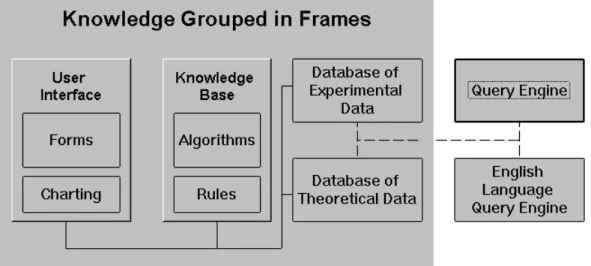
Development of the methods for knowledge representation followed the knowledge acquisition phase. With a suitable amount of knowledge gathered, the structure and representation method for the knowledge system can be described. The knowledge representation is shown in Figure 1. Information was represented in frames. Each frame consisted of a database of experimental data, a database of theoretical data, a knowledge base consisting of rules and algorithms applicable to the current frame, and the user interface which allowed the information to be viewed in forms, tables, or charts.
Examples of frames in the system are the main soil information frame which contains soil texture, description, volume-mass relations, soil origin, etc. or the permeability frame which stores information related to the hydraulic conductivity of a soil as well as algorithms and rules applicable to this frame. Independent of the knowledge frames are two query engines which allow for access to pertinent information. The main query
engine builds a query by stepping the user through a series of forms while the English language engine allows querying the database with common statements like “Show me soils with porosities between 0.25 and 0.30”.
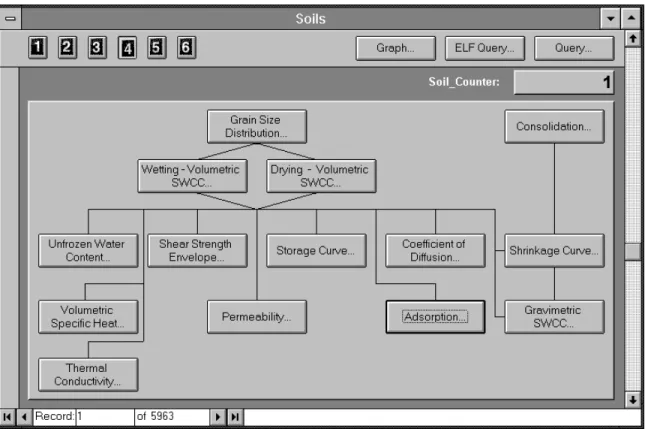
The soil properties are organized into separate frames or subcategories which are linked to the main soil information frame. The manner in which this is done is shown in Figure 2. While Figure 1 shows the theoretical structure of the Knowledge-Based System (KBS), Figure 2 displays the physical implementation of the system in Access.
Figure 2 Knowledge frames included in system
5.0 KNOWLEDGE SYSTEM SHELL
Once the structure of the KBS was determined, a shell or programming environment was needed to build the system. The relational database shell provided by Microsoft’s
Access relational database management system (RDMS) was selected as an
environment. The database system handled the manipulation of large amounts of data while allowing time to be focused on the coding of the knowledge system. The system requires at least a 486 class personal computer with 8 megabytes of RAM while a suggested system would be a pentium class machine with 16 megabytes of RAM for
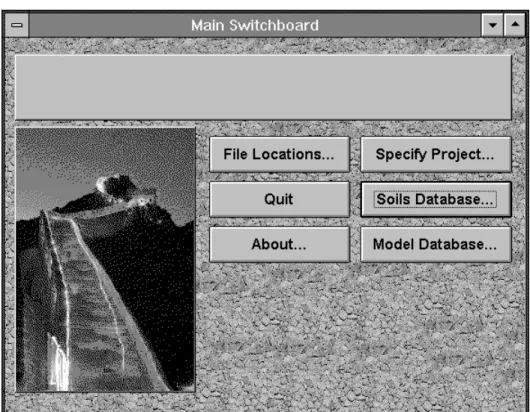
operation of the system. Approximately 20 megabytes of hard disk storage are required for installation of the application. A picture of the main switchboard for the system can be seen in Figure 3.
Figure 3 Main switchboard for knowledge-based system
Knowledge-based systems typically contain an inference engine allowing for a decision-tree type of dialog between the system and the user. The size of the unsaturated soil mechanics field and uncertainty regarding the application the system dictated several decisions. A parameter-driven inference engine was selected to lessen ambiguity. Also, the inference engine has been limited to handling the statistical estimation of soil parameters should a gap be found in the current data.
5.1 Main Soil Information Frame
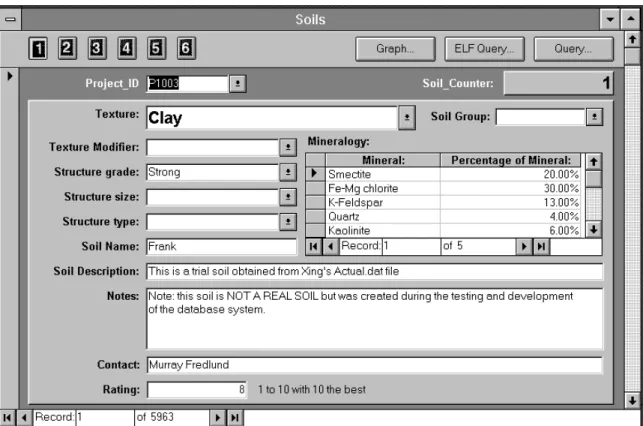
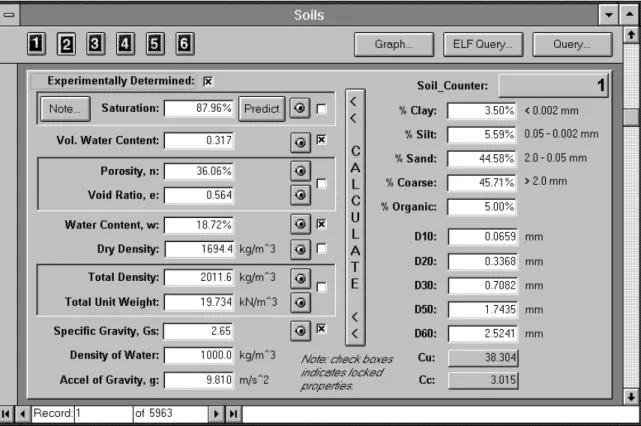
The fields used for classification of the soil were adopted from current USDA soil databases for the sake of familiarity. Figure 4 shows the main text descriptors used in the classification of soils. The volume-mass and grain-size properties have also typically been
used for soil classification and are shown in Figure 5. Other soil properties that are stored are atterberg limits, water chemistry, soil origin properties, publication
information, and the geographical location of the soil (Country, State, County, Site). Soil origin fields store information such as horizon depth, horizon type, family, and soil series.
Figure 5 Page two of the main soil form showing volume-mass classification properties
The main soil information form also provides links to the forms describing soil properties such as SWCC, permeability, shear strength, etc. Typical forms linked to the main soil form are described in the following sections. For the sake of brevity, not all the forms linked to the main soil form are shown.
5.2 Other Frames Linked to Main Frame
Complimentary to data stored in the main soil frame is information stored in other frames which are linked to the main frame. Information was organized in frames for storage efficiency reasons as well as to provide a good conceptual view of the different soil properties. The properties or frames linked to the main soil frame are listed below:
Adsorption Shear strength
Consolidation Shrinkage
Diffusion Specific heat
Grain-size distribution SWCC
Gravimetric SWCC Thermal conductivity
Permeability
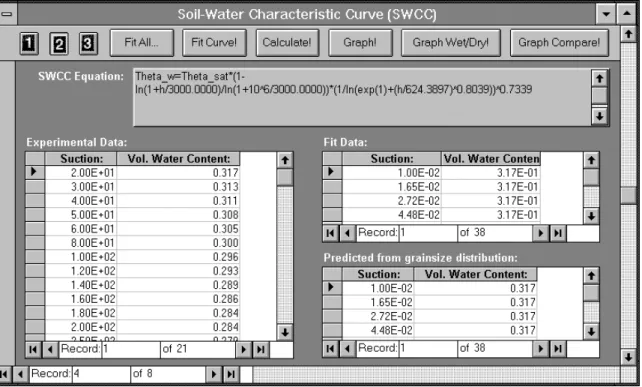
Page one of the SWCC frame can be seen in Figure 6. This frame stores pertinent information relating to the SWCC as well as experimental and fitted points on the curve. The equation describing the curve shown in Figure 7 is stored in the database once experimental data is fit with a curve. A focus of the knowledge-based system was to allow mathematical representation of soil property functions wherever possible. This then allows the equations to be entered into popular finite element modelling packages for modelling of unsaturated soil behavior. To provide a starting point for mathematical representation, the SWCC, grain-size distribution, and consolidation curves must be fit with a mathematical equation. A single equation was selected to fit each of the grain-size and consolidation curves. For the SWCC, however, a number of different equations have been previously used. To accommodate this variability, 28 different equations are
available for use in the system. For each equation, a routine allowing the equation to be fit to experimental data must be provided. Therefore, a number of curve fitting
algorithms were implemented. Once an equation is fit to experimental data, the resulting equation can be used in the calculation of other soil properties.
Figure 7 Page two of form describing SWCC information
5.3 Shear Strength Frame
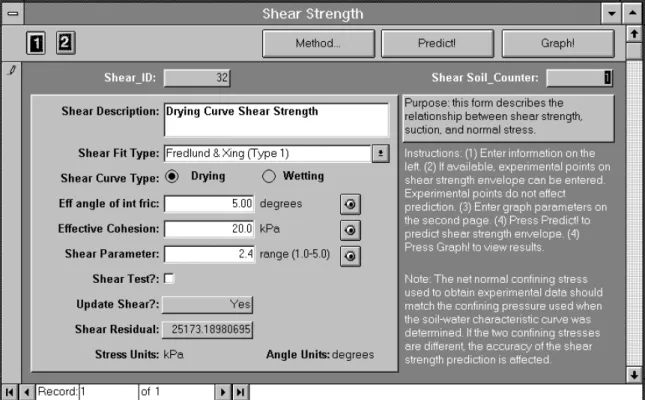
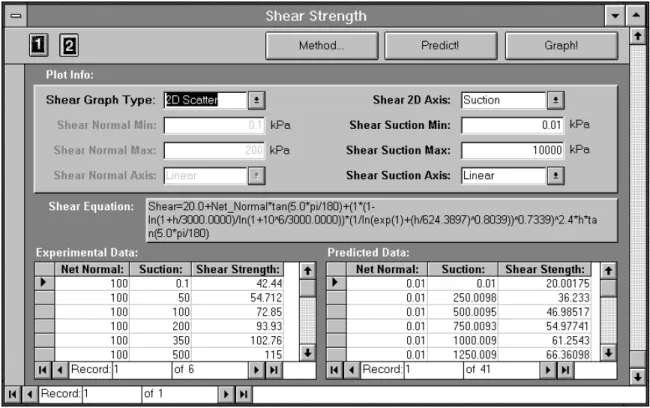
The shear strength frame provides an example of a frame linked to the main soil information frame. Page one, which can be seen in Figure 8, stores soil parameters relating to the shear strength of the current soil. Knowing the effective angle of internal friction and the effective cohesion, the prediction method references the SWCC to predict the shear strength of the soil will behave at different levels of saturation. Figure 9 shows the plotting information, shear strength equation, points on experimental curve and points on the fitted curve. The results can then be viewed as either a two or three dimensional plot as shown in Figure 10.
Figure 9 Page two of shear strength frame
Shear Strength
Experimental
Predicted
Shear Strength (kPa)
Suction (kPa)
Net Normal (kPa)
0 100 200 300 400 500 0 50 100 150 200 0 50 100 150 200
6.0 SUMMARY
Theory governing the behavior of unsaturated soils has been available for several years and has shown that the Soil-Water Characteristic Curve is the central relationship describing how a soil behaves as it desaturates. Research has shown that empirical relationships can be used to describe property functions related to the Soil-Water Characteristic Curve. These empirical relationships can then be used to predict how the permeability, shear strength, thermal properties, diffusion and adsorption will behave as a soil desaturates. The complexity of unsaturated soil physics requires a knowledge-based system to provide tools for describing unsaturated soil behavior. Knowledge was accumulated from experts in the field of unsaturated soil mechanics, published research, and current databases. The system was described within the relational database shell provided by Microsoft’s Access relational database management system (RDMS). The database system handled the manipulation of large amounts of data while allowing time to be focused on the coding of the knowledge system. Information was stored in frames consisting of a main soil frame with links established to alternate soil property frames. The current database consists of information on over 6000 soils. The knowledge-based system manipulates 13 separate property frames and allows prediction of 10 different soil property functions. The system then allows for the estimation of unsaturated soil
properties when experimental data is limited or too costly to obtain. The unsaturated property functions can be used in finite element modelling among other applications to give an estimate of engineering design limits.
7.0 CONCLUDING REMARKS
The current system allows for expansion in a number of ways. The most pressing interest appears to be to combine the soil knowledge-based system with a modelling program so that unsaturated soil processes can be more accurately studied.
Property functions are currently defined in terms of suction. Describing property functions in terms of net normal stress may be a possible area of development.
A complete inference engine covering the field of unsaturated soil mechanics would also enhance the system. However, the cheap availability of personal computers will allow extensive benefit from the current system when applied to numerous situations.
REFERENCES
Arya, L.M. and Paris, J.F., (1981)., A physicoempirical model to predict the soil moisture characteristic from particle-size distribution and bulk density data., Soil Science Society of America Journal, Vol. 45, pp. 1023-1030.
Rawls W.J. D.L. Brakensiek, 1989, Estimation of Soil Water Retention and Hydraulic Properties, H.J. Morel-Seytoux (ed.), Unsaturated Flow in Hydrologic Modeling Theory and Practice, Kluwer Academic Publishers Very good booklet, Beltsville, MD, 275-300
Sillers, W. S., 1996, Mathematical representation of the Soil-Water Characteristic Curve, Master’s Thesis, Saskatoon
Williams, R.D., Ahuja, L.R., and Naney, J.W., (1992)., Comparison of methods to estimate soil water characteristics from texture, bulk density, and limited data., Soil Science, Vol. 153, pp. 172-184.