Purdue e-Pubs
Department of Electrical and Computer
Engineering Technical Reports
Department of Electrical and Computer
Engineering
10-31-2018
D2P: Automatically Creating Distributed Dynamic
Programming Codes
Nikhil Hegde
Purdue University, [email protected]
Qifan Chang
Purdue University, [email protected]
Milind Kulkarni
Electrical and Computer Engineering, Purdue University, [email protected]
Follow this and additional works at:
https://docs.lib.purdue.edu/ecetr
This document has been made available through Purdue e-Pubs, a service of the Purdue University Libraries. Please contact [email protected] for additional information.
Hegde, Nikhil; Chang, Qifan; and Kulkarni, Milind, "D2P: Automatically Creating Distributed Dynamic Programming Codes" (2018).Department of Electrical and Computer Engineering Technical Reports.Paper 492.
D2P: Automatically Creating Distributed Dynamic
Programming Codes
Nikhil Hegde, Qifan Chang, Milind Kulkarni
School of Electrical and Computer Engineering, Purdue University, West Lafayette, USA {hegden,qchang,milind}@purdue.edu
Abstract
Dynamic Programming (DP) algorithms are common targets for parallelization, and, as these algorithms are applied to larger inputs, distributed implementations become necessary. However, creating distributed-memory solutions involves the challenges of task creation, program and data partition-ing, communication optimization, and task scheduling. In this paper we present D2P, an end-to-end system for au-tomatically transforming a specification of any recursive DP algorithm into distributed-memory implementation of the algorithm. When given a pseudo-code of a recursive DP algorithm, D2P automatically generates the corresponding MPI-based implementation. Our evaluation of the generated distributed implementations shows that they are efficient and scalable. Moreover, D2P-generated implementations are faster than implementations generated by recent general distributed DP frameworks, and are competitive with (and often faster than) hand-written implementations.
Keywords Dynamic Programming, Recursive, Distributed-memory parallel, Autogen, Framework
1
Introduction
Dynamic Programming (DP) [8] algorithms are very effi-cient in solving problems arising in domains such as bio-informatics, mobile communication, and finance. As some of the problems operate over large data sizes, which can exceed the memory capacity of a single compute node, distributed-memory solutions become necessary to process the entire data. While most parallel implementations of DP algorithms are for shared-memory systems, there exist only a few hand-tuned distributed-memory implementations of DP algorithms [2, 4, 5, 35]. Creating distributed-memory implementations in-volves several challenges that do not arise in shared-memory systems. First, we need to partition the data and computation
intotasksof appropriate granularity split among different
compute nodes so that different nodes can process portions of the DP problem in parallel. Second, we need to insert communication between nodes to satisfy data dependences between tasks. Finally, we need to schedule tasks efficiently, to balance parallelism with communication overhead.
Because formulating an efficient DP algorithm is a differ-ent challenge than performing data partitioning and task creation, communication insertion, and task scheduling, we would like a system where the concerns ofcreating a DP
algorithm can be separated from the concerns of distribut-ingit. In particular, we would like a system that automates as much of the distribution process as possible, allowing programmers to focus on simply designing DP algorithms.
Recent work has shown that efficientrecursive formula-tions of DP algorithms outperform iterative counterparts on shared-memory systems [11, 12]. The primary reason is better cache utilization due to a top-down or depth-first ap-proach in recursive formulations as opposed to a bottom-up or breadth-first approach of iterative formulations. These recursive formulations have the property that each recur-sive “task” (think: invocation) touches a subset of the data of its parent task (think: caller method). This approach pro-vides a key advantage for distributed execution: the data-dependencies of a recursive method are inclusive (i.e. the col-lective data-dependencies of all the recursive sub-invocations within the body of the method are a subset of the depen-dencies captured by method’s arguments) and hence coarse-grained parallel tasks, suitable for a task-parallel model of computation, can be easily identified. This is the key insight we exploit inautomaticallycreating distributed-memory im-plementations of recursive DP algorithms.
Automating the creation of distributed-memory imple-mentations requires automatic resolution of the associated challenges. Specifically, we need to (i) automatically partition the data among multiple nodes, (ii) infer data-dependencies, and then (iii) establish communication channels for the pur-pose of exchanging data to satisfy data-dependencies. While much of prior work has addressed these challenges in differ-ent contexts for iterative codes, recursive programs are not explored as extensively. Existing systems [6, 30, 31, 34] either work on iterative codes or adopt a profiling-based approach and assume a regular communication pattern in the case of recursive programs [31]. Efficient recursive DP programs involve irregular communication patterns and hence, previ-ous techniques are not effective. Currently, shared-memory implementations of these recursive DP programs can be generated automatically [22]. However, there do not yet ex-ist tools for automating the creation of these programs on distributed-memory platforms.
Overview
In this paper, we present D2P, an end-to-end system that takes in an iterative code snippet (without any parallelism or partitioning specifications) capturing all the read and
write accesses in a DP program, and produces an MPI based, distributed-memory parallel code with recursive methods.
D2P builds on a tool called Autogen [10], which takes as input an iterative code snippet of the DP program and produces aspecificationof the recursive DP algorithm. The specification is a shared-memory pseudocode, with explicit annotation for parallelizable code regions, consisting entirely of a set of recursive methods calling each other.
D2P takes as input the pseudocode from Autogen and pro-duces a distributed-memory implementation. In order to do this, D2P first unfolds the recursion until a sufficient number of tasks are generated to keep the compute nodes busy. The leaves of the recursion tree are recursive method invocations and represent the tasks to execute. The method parameters capture the data regions read and written within the method invocation (due to the inclusion property mentioned above). D2P then determines data dependences by inspecting leaf methods for overlapping read and write regions. D2P also merges some leaves to coarsen the task granularity. After performing merging (coalescing), the remaining tasks are partitioned among compute nodes in a deterministic manner known to all nodes (facilitating determination of commu-nication later). The nodes follow an owner-computes rule (single owner for a data region) during computation.
D2P then inserts communication—identifying and estab-lishing communication channels between compute nodes to send/receive data as demanded by the task allocation. By default, intra-node parallelism in D2P is expressed through the use of Cilk [18] parallelism constructs. The result is a “single program multiple data” (SPMD) implementation em-ploying asynchronous communication capable of running on a distributed memory machine.
The contributions of this paper are:
• We build an end-to-end system that takes an iterative code snippet of DP algorithms and outputs MPI-based distributed-memory implementations of these algo-rithms.
• We provide an interface for application programmers to create distributed-memory implementations for any recursive DP algorithm.
• We evaluate the scalability of our generated MPI-based code implementations and measure speedups achieved w.r.t. baseline implementations, preprocessing over-heads, and compare against existing distributed mem-ory implementations.
Our evaluations show that D2P implementations scale well and can admit extremely large problem sizes much be-yond the memory capacity of a single node. We also observe that the overheads of task partitioning (recursion unfolding, dependency determination, and task assignment) are negligi-ble compared to the actual computation. Finally, we find that a D2P generated program scales better compared to other distributed-memory implementations. The D2P-generated
implementation of Smith-Waterman performs from 33×to 483×faster than an implementation generated by an existing framework for generating distributed implementations of
iterativeDP formulations. Moreover, the D2P-generated
im-plementation even outperforms ahand-written, application-specific implementation of Smith-Waterman in most cases, and is only 27% slower in the worst case.
2
Background and Motivation
In this section we discuss some of the essential background needed to understand D2P. First, we briefly discuss dynamic programming with a concrete problem, which serves as a running example throughout the paper. We discuss what it means to design iterative, naïve recursive, and efficient recursive algorithms for this problem. We then discuss the Autogen tool in order to understand how efficient recursive algorithms can be automatically generated. We conclude this section with a discussion on the advantages that recursive formulations offer for distributed implementations.
2.1 Dynamic Programming
Dynamic Programming is based on the principle of divide-and-conquer to find an optimal solution to a variety of prob-lems. Two fundamental properties of problems that admit DP solutions areoptimal substructureandoverlapping subprob-lems[14]. The optimal substructure property is necessary for combining optimal solutions of simpler subproblems in order to find an optimal solution of a problem. The overlapping substructure property ensures that the subproblems repeat. We illustrate these properties with an example, minimum weight triangulation (MWT) of a polygon [23].
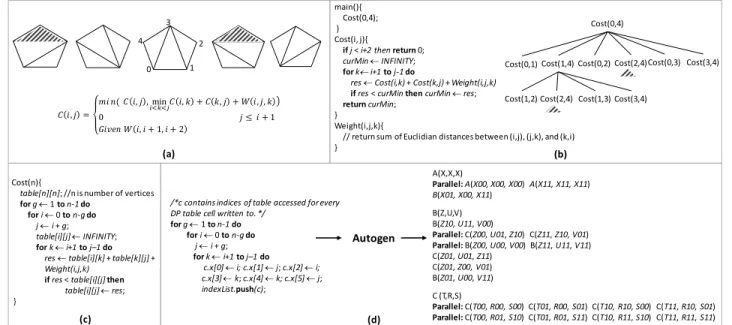
MWT is used in applications such as finite element method, and computational geometry, among others. It is an instance of the parenthesis problem [19]. As Figure 1 shows, the goal in MWT is to partition a convex polygon into triangles such that the edges do not intersect while minimizing the sum of the edge lengths of the component triangles. The intuition behind the recurrence equation in Figure 1(a) is to parti-tion the polygon into a simple triangle and sub-polygon(s) to the left and/or right of the simple triangle, compute the solutions for each part separately, then combine the solu-tions. If the sub-polygons have an optimal solution, then the combined solution is guaranteed to be optimal (optimal substructure property). The sub-polygons can be computed as separate triangulations (overlapping subproblems prop-erty). This corresponds to computingCost(2,4)in the naïve recursive implementation of Figure 1(b), which also shows the recursion tree withCost(0,4)as the root representing the cost of triangulating the entire pentagon. This property of DP problems contrasts with traditional divide-and-conquer solutions, in which the subproblems do not repeat. The naïve recursive pseudocode is inefficient and leads to exponential
main(){ Cost(0,4); } Cost(i, j){
ifj < i+2 thenreturn0;
curMin←INFINITY; fork←i+1toj-1do
res ←Cost(i,k) +Cost(k,j) +Weight(i,j,k)
ifres< curMinthencurMin←res;
returncurMin; }
Weight(i,j,k){
// return sum of Euclidian distances between (i,j), (j,k), and (k,i) }
2
0 1
3 4
/*c contains indices of table accessed for every DP table cell written to. */
forg←1 ton-1do for i←0 ton-gdo j←i+ g; fork←i+1toj–1 do c.x[0]←i; c.x[1]←j; c.x[2]←i; c.x[3]←k; c.x[4]←k; c.x[5]←j; indexList.push(c); Autogen A(X,X,X) Parallel: A(X00, X00, X00)A(X11, X11, X11) B(X01, X00, X11) B(Z,U,V) B(Z10,U11,V00) Parallel:C(Z00,U01,Z10) C(Z11,Z10,V01) Parallel:B(Z00,U00,V00) B(Z11,U11,V11)
C(Z01,U01,Z11) C(Z01,Z00,V01) B(Z01,U00,V11) C (T,R,S) Parallel:C(T00,R00,S00) C(T01,R00,S01) C(T10,R10,S00) C(T11,R10,S01) Parallel:C(T00,R01,S10) C(T01,R01,S11) C(T10,R11,S10) C(T11,R11,S11) Cost(0,4)
Cost(0,1)Cost(1,4)Cost(0,2) Cost(2,4)Cost(0,3) Cost(3,4)
Cost(2,4) Cost(1,3) Cost(3,4) Cost(1,2)
Cost(n){
table[n][n]; //n is number of vertices forg←1 ton-1do
for i←0 ton-gdo
j←i+ g;
table[i][j]←INFINITY; fork←i+1toj–1 do
res←table[i][k] +table[k][j] +
Weight(i,j,k)
if res< table[i][j] then
table[i][j]←res; } (c) (d) 𝐶𝐶 𝑖𝑖,𝑗𝑗 = 𝑚𝑚𝑖𝑖 𝑛𝑛(𝐶𝐶 𝑖𝑖,𝑗𝑗, min𝑖𝑖<𝑘𝑘<𝑗𝑗𝐶𝐶 𝑖𝑖,𝑘𝑘 +𝐶𝐶 𝑘𝑘,𝑗𝑗 +𝑊𝑊 𝑖𝑖,𝑗𝑗,𝑘𝑘� 0 𝑗𝑗 ≤ 𝑖𝑖+ 1 𝐺𝐺𝑖𝑖𝐺𝐺𝐺𝐺𝑛𝑛 𝑊𝑊 𝑖𝑖,𝑖𝑖+ 1,𝑖𝑖+ 2 (a) (b)
Figure 1.The Minimum Weight Triangulation problem: (a) shows all possible triangulations of a pentagon. Every triangulation has an associated cost that depends on some notion of distance between the vertices of the pentagon. The recurrence equation calculates the least cost. (b) shows the pseudocode of a naïve recursive implementation and the resulting recursion tree. Shaded triangles in the recursion tree highlight repeated subproblems. (c) shows an iterative pseudocode that avoids re-computing solutions for a repeated subproblem. (d) shows an efficient recursive pseudocode generated from Autogen.
time costs because of not reusing the computation already performed due to a repeated subproblem.
The iterative pseudocode of Figure 1(c) overcomes this inefficiency by storing the results of subproblems intable, allowing previously-computed results to be reused, but re-quiring an additionalO(N2)space. Every iteration of the middleforloop can be run in parallel in this code. This par-allelization strategy reflectswavefront-parallelism, which is a popular approach for parallelizing iterative DP codes. How-ever, the order of computation performed in this approach— starting on the main diagonal of a matrix, and then ending at top-right corner—exhibits poor temporal locality. This is because the wavefront-parallel code performs bottom-up computation of finding optimal solutions to all subproblems of smaller sizes first before moving on to a bigger subprob-lem (e.g. computing all points on the main diagonal before computing points on the smaller adjacent diagonal).
Efficient recursive algorithms take a top-down or depth-first approach to problem decomposition and solution. As a result they have better temporal locality compared to itera-tive algorithms [12], which adopt a bottom-up or breadth-first approach. Hereafter, we refer to the efficient versions when mentioning recursive algorithms. Designing recur-sive DP algorithms that have better temporal locality is not straightforward. Autogen [10] is a tool that automates the design of such recursive algorithms.
2.2 Autogen
Autogen [10] is a tool to discover efficient, recursive, parallel, cache-oblivious DP algorithms from iterative specifications of DP recurrences. The output is a pseudocode of a non-trivial, parallel, recursive DP algorithm.
Figure 1(d) shows how Autogen is used to produce a recur-sive MWT algorithm. Note the similarity between the input to Autogen and the pseudocode of Figure 1(c). This implies that for an existing real-world application, an end-user needs to translate only the embedded loop structure representing the DP table recurrence equation and feed it to Autogen. Autogen stores and analyzes the read and write accesses to the DP table cells within the loop structure of the pseu-docode. The dependences among DP table cells are translated to region-wise dependences, where regions are groups of DP table cells. Every unique access pattern corresponds to a distinct recursive method. More details on how Autogen discovers the recursive methods and defines their bodies can be found in the Autogen paper. The output is a pseudocode consisting of a set of recursive methods calling each other. Themainfunction is expected to call the top-level recursive method, always namedA, with argumentsX, which repre-sent a single tile corresponding to the entire DP table. Also, it is assumed that the first parameter of a recursive method is the tile written and the remaining parameters represent the tiles read before the tile is written. The output pseu-docode exhibits better temporal locality because of solving hierarchically decomposed subproblems and combining their
solutions. Furthermore, shared-memory parallel recursive DP algorithms adapt better in the presence of cache sharing, are an order of magnitude faster, and have more predictable runtimes than their tiled iterative counterparts [10].
2.3 Distributed-memory parallelism
Recursive algorithms, in particular, have advantages when it comes to distributed-memory implementations: parallel recursive invocations are naturally easier to adapt to a task-parallel model of computation as opposed to a data-task-parallel model, which is a good fit for iterative DP algorithms. The iterative codes, as we saw in Figure 1(c), could have mul-tiple layers of forloops with regular and irregular data accesses. This poses a challenge for inferring the data parti-tioning needed for distributed-memory parallel codes. Data dependency analysis is also complicated in iterative codes when compared to recursive codes that exhibit inclusive de-pendencies: in the case of the recursive DP codes output from Autogen, every method invocation accesses a set of tiles, which is the super-set of the union of the tiles accessed within all recursive invocations done in the method body. In other words, the method arguments specify a bound on the entire data regions read/written. This makes it easier to reason about data-dependencies when we try to automate data-partitioning. We next explain how D2P takes advantage of these properties of recursive DP algorithms in overcoming the challenges associated with automating the generation of distributed-memory parallel codes.
3
Design
Automating the generation of distributed-memory imple-mentations from serial impleimple-mentations involves multiple challenges: (i) partitioning control and data to create tasks of appropriate granularity, (ii) determining data dependences and identifying parallelism, (iii) identifying communication channels and insert communication code, and (iv) scheduling tasks in parallel to minimize execution time and communi-cation overhead. However, many of these challenges are simplified in the context of D2P. Because the input to D2P is a recursive algorithm, a task in D2P can be a recursive method invocation. However, we do not create a task for every method invocation to avoid creating too many fine-grained tasks. Control partitioning is much simplified due to the absence of branches in the Autogen generated recursive pseudocode. As the recursive method arguments capture in-clusive data dependences, reasoning about data dependences and hence data partitioning is also simplified. We also need not identify parallelism as the input to D2P has explicit par-allelism specification (‘parallel’ annotation from Autogen, Figure 1(d)). We let the underlying task-parallel runtime sys-tem handle the scheduling of tasks. We next look in detail how these challenges are addressed in D2P.
3.1 Task creation, partitioning, and communication
The preprocessing stage in D2P consists of task creation, dependency inference, and partitioning. Figure 2 summarizes these phases.
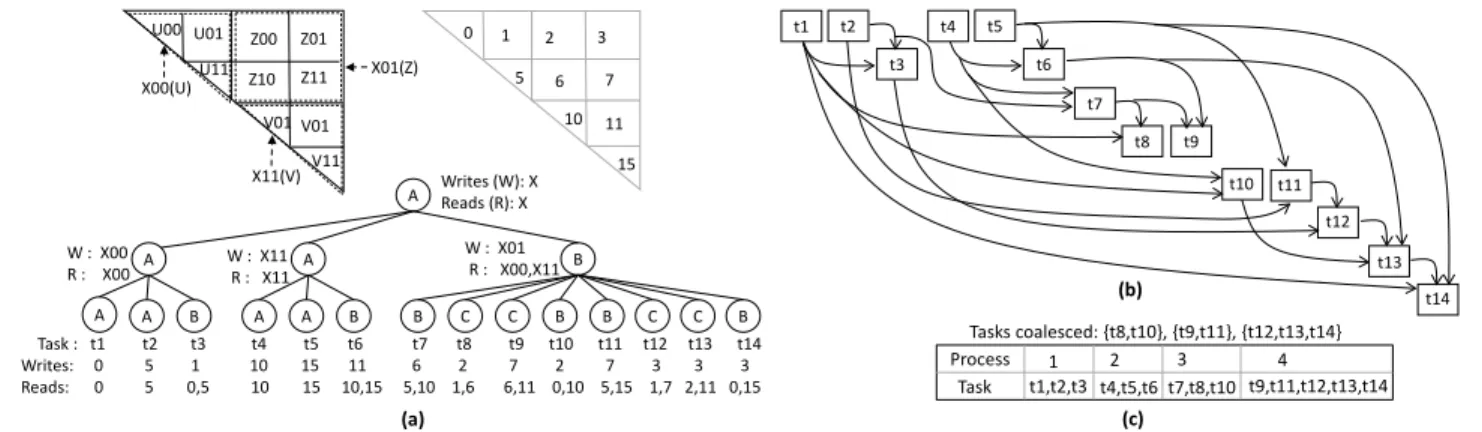
Task creation via recursion unrolling Recall from the discussion on Autogen in Section 2.2 that themainprogram invokes the top-level recursive methodAwith a set of ar-guments representing the entire DP table to update. If each method invocation is considered as an independent task, we have just a single task to begin with. In order to generate more tasks, we expand (unroll) the body of the top-level recursive method. Any order of the parallel method invo-cations in the algorithm of Figure 1(d) can be considered while unrolling. Unrolling is equivalent to hierarchically decomposing the DP table to compute solutions of smaller subproblems. Unrolling results in a recursion tree, whose leaves (L) represent the tasks computing the smaller subprob-lems. Deciding the optimal granularity of these tasks—i.e., number of levels of recursion to unroll—is hard. Typically, when executing a recursive parallel program on a single compute node, the tradeoff is between the overhead of creat-ing new tasks and the amount of parallelism exposed. For a distributed-memory implementation, the number of levels of recursion to unroll,D, reflects a tradeoff between com-munication overhead and the available parallelism: a larger Dintroduces more tasks, which may increase the available parallelism but also introduces more data dependences, and hence communication. Note that unrolling decomposes the DP table computation into smaller subproblems computing the tiles of the table. Figure 2(a) shows unrolling for the MWT problem whenDis two.
Identifying data dependences via effect intersection Fig-ure 2(b) shows the data dependences among tasks resulting from unrolling. Correct dependences can be derived after computing a linearization of the tree in preorder traversal (to ensure that dependences are resolved in program order). The tiles resulting from unrolling are numbered in a deterministic manner known to all processes. The dependency structure, as the arrows indicate, is derived from the tile numbering information, which can be computed using simple set inter-section (of the tile numbers). The source of the arrow is a task writing to a DP table tile (producer) and the destination is a task that reads these tiles (consumer). Enforcing these data dependences is all that is necessary to ensure correct execution, due to the inclusion property of the dependences as described earlier.
Note, interestingly, that because D2P performs unrolling of the original recursive algorithm, it is able to exposemore
parallelism than the original formulation. This is because the original formulation uses control dependences (in the form of sequential ordering instead ofparallelannotations)
b. Resulting tree and the data-dependency structure among tasks after unrolling the recursive methods of MWT 2 levels. A B C A B A A A B A A B C C B B C B Task : t1 t2 t3 t4 t5 t6 t7 t8 t9 t10 t11 t12 t13 t14 Writes: 0 5 1 10 15 11 6 2 7 2 7 3 3 3 Reads: 0 5 0,5 10 15 10,15 5,10 1,6 6,11 0,10 5,15 1,7 2,11 0,15 W : X00 R : X00 W : X11R : X11 W : X01 R : X00,X11 Writes (W): X Reads (R): X 0 5 10 15 1 2 7 3 11 6 X01(Z) X00(U) X11(V) U00 U01 U11 Z00 Z01 Z10 Z11 V01 V11 V01 (a) Tasks coalesced: {t8,t10}, {t9,t11}, {t12,t13,t14} t7 t8 t9 t4 t5 t6 t1 t2 t3 t10 t11 t12 t13 t14 (b) Process Task 1 2 3 4 t1,t2,t3 t4,t5,t6 t7,t8,t10 t9,t11,t12,t13,t14 (c)
Figure 2.Preprocessing in D2P: (a) shows decomposition of the DP table into subproblems (numbered tiles and corresponding identifiers used in recursive pseudocode of Figure 1(d)) after two levels of unrolling of the MWT recursive algorithm. Unrolling results in the shown recursion tree, whose leaves (L) are identified as tasks. (b) shows dependences among tasks. (c) shows a blocked partitioning scheme applied to the task distribution among 4 processes.
to conservatively enforce data dependences that arise be-tween coarse-grained tasks. Two coarse-grained tasksxand ymay have to execute sequentially because some subtask in theyis dependent on some subtask inx, even thoughother
subtasks inycan execute in parallel withx. As a concrete example, note that in the original recursive formulation of MWT in Figure 1(d), the firstBtask executes sequentially after the parallel execution of the first twoAtasks. However, in the unrolled dependence graph of Figure 2(b), we see that this is conservative:t7(arising from aBtask) can execute in parallel witht3andt6(arising fromAtasks) despite the con-trol dependence in the original formulation. D2P enforces exactly these data dependences, and hence is able to expose more parallelism than the original parallel recursive imple-mentation, depending on how much unrolling is done. Of course, performing additional unrolling can incur additional runtime overhead and communication, so this tradeoff must be carefully managed.
Task coalescing and partitioning D2P uses an
owner-computesstrategy: DP table tiles are assigned to processes
(P), and thenalltasks that write to that tile are assigned to the same process. Note that this simplifies communication, as we do not need to consider different processes writing to the same tile. Tasks writing to the same tile are coalesced prior to distributing all the tasks among different processes so that task-to-process mapping results in a single owner for a tile. Given owner-computes, all that remains is to assign tiles to processes. D2P provides the programmer with control over this distribution scheme (see Section 4). The complete list of coalesced tasks in MWT resulting in a total of 10 tasks (considering coalesced tasks as a single task) and a blocked partitioning scheme distributing these 10 tasks among 4 processes is shown in Figure 2(c).
Communication insertion In a distributed-memory set-ting, if the consumed data does not reside on local memory,
then the producer and consumer of the data must establish communication channels and perform communication. Due to the SPMD nature of the code, all processes participate in unrolling and determining dependences. However, a process determines dependents (and consumer IDs) of a task only if it is the producer of that task. While unrolling, a process examines the write parameter (first parameter) of a recursive method invocation (associated with the task) to know if it is the producer of the task, since, given a tile number, every process can find out the owner of the tile. If the process is not a producer, it examines the read parameters (remaining parameters) to check if the actual owner can be added as a potential consumer of any tasks for which the process is a producer. This enables a producer to determine the con-sumer IDs for the purpose of sending data and the receiver to expect a message from the correct sender. Overall, this distributed dependency determination scheme in D2P takes
O(L/P)time.
Leaf-task implementation One advantage of D2P is that end users can rely on D2P for orchestrating inter-task par-allelism as shown in Figure 2 while continuing to use their highly-optimized, single-process code within a task. Because a task computes a recursive method with inclusive depen-dences, users can replace the method body with codes offload-ing computation to multiple threads, vectorizoffload-ing processors, GPUs etc. By default, D2P uses Autogen’s shared-memory, task-parallel, recursive approach (see Section 2)
4
Implementation
Parameters - preprocessing D2P uses a few user-configurable parameters provided at runtime for the purpose of prepro-cessing and tuning. By default, D2P adopts a simple heuristic of unrolling until there are at least as many tiles in a row or column as the number of processes. Hence, in this scenario, D depends on the number of processesP. However, D2P
also lets users choose aDbased on the maximum number of processes that would be used in program execution.D determines the structure of the task graph, which is built at runtime. The input size information is used in inferring the number of DP table cells per row or column, which is required to compute the owner of a tile given the tile number. The tiles are numbered based on the partitioning scheme, which is specified by the user as a parameter. By default, D2P uses a column-cyclic distribution. In many DP prob-lems, dependences exist along rows and columns of the DP table, and parallelism is along the diagonal (MWT) or anti-diagonal. A column-cyclic distribution of the tiles means that column-wise communication can be avoided, while still leading to tasks along diagonals and anti-diagonals being assigned to different processes. This reduces communication while maintaining parallelism for many DP problems.
Parameters - intra-task parallelism While D2P primar-ily concerns itself with identifying and exploiting inter-task parallelism, as shown in Figure 2(b), each task itself repre-sents a fairly coarse-grained computation. D2P leverages the resultingintra-task parallelism—easily exposed due to the recursive nature of the implementation—by using Cilk
spawn[13] to implement Autogen’sparallelsections
(though, as described in Section 3, the user can instead re-place a leaf recursive implementation with their own opti-mized single-process code).
During code generation, D2P inserts a Cilksyncat the end of parallel sections as the synchronization is implicit in the Autogen produced code. While executing a recursive method body, spawning sub-tasks down till the recursion base case can greatly increase the parallel overhead. The spawn cutoff parameter,C, controls this overhead by execut-ing sequential version of the recursive method body,
with-outcilk_spawn and cilk_sync, till the base case is
reached. We setCto two levels beyondD, which means that each resultant task (after unrolling) mapped to a process spawns sub-tasks for up to two levels down the recursion. For all the benchmarks and the input sizes considered, this created a sufficient number of sub-tasks. Cilk workers exe-cute the sub-tasks and D2P provides a knob to set the number of Cilk workers per process at execution time. The total num-ber of available Cilk workers for a process on a node is equal to the number of cores divided by the number of processes mapped to a node. By default, we set the number of workers per process to 1 so that it is easier to map one process per core and evaluate a process-level decomposition.
Going deeper into the recursive method body, the recur-sion may proceed all the way down to computing a single cell or a sub-tile of the DP table. The recursion base case,B, defines when to stop the recursion. The default value ofB is 1 in D2P since, by default, Autogen produces a code that computes a single cell in the base case.
API Description
ReadInput Captures input-data. For example, reading 2-dimensional coordinates of points from a file in MWT
InitTable Captures algorithm-specific initialization of the DP table. For example, MWT initializes all the elements on the main diagonal to zero BaseCase Recursion base case. Specifies the exact function applied
in computing a DP table cell. For example, for MWT, tablei,j=min(tablei,j,tablei,k+tablek,j+weighti,k,j).
GetScore Fetches optimal score. Since the DP table is distributed over multiple processes, aggregate functions MAX, MIN are provided to fetch the maximum/minimum value among DP table cells. Specific cell content can be obtained using GetCell(i,j). For example, in MWT, the optimal score is always in the cell at top right corner. GetCell(0,N-1) fetches the data from the process owning the cell.
Table 1.APIs in D2P.
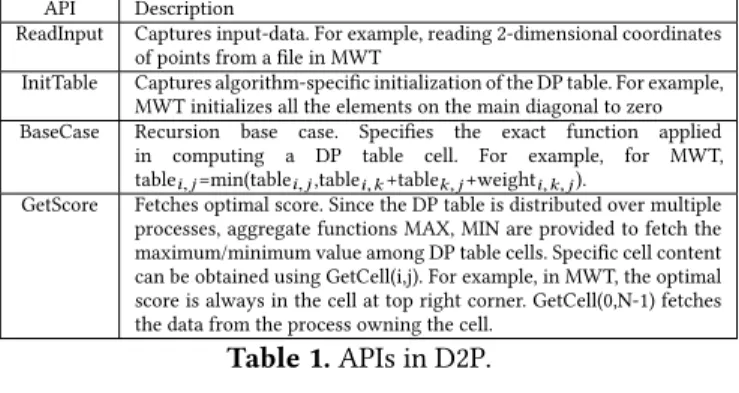
Programmer interface The application programmer in-terfaces (APIs) in D2P are designed to capture application-specific properties such as initializing the DP table, defining the base case, fetching the optimal score, and reading inputs. The APIs in D2P and their purpose are described in Table 1. These APIs abstract away the details of distributed-memory programming and let an application programmer focus on the algorithm aspects. The APIs need to be implemented in Autogen and we provide reference implementations for six benchmarks. Note that since the original input to Au-togen is an iterative skeleton code (Figure 1(d)), complete automation in the form of source-to-source translation of the input shared-memory implementation of an iterative algorithm to a distributed-memory implementation of a re-cursive algorithm is not yet available and is future work.
5
Evaluation
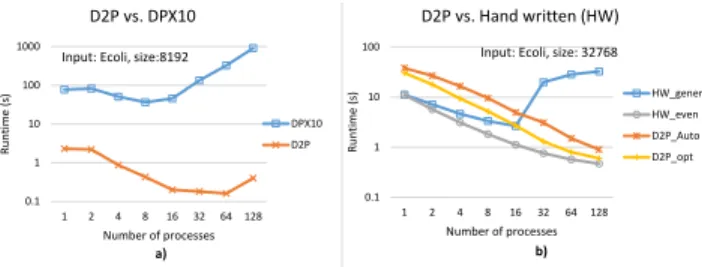
We present the evaluation results of D2P with six DP based applications. These applications are drawn from the domains of bio-informatics, computational geometry, and computer science. The applications differ in their data dependency pat-tern and are spread over the different categories of DP prob-lems mentioned in Galil et al. [19]. We begin with the scala-bility results and demonstrate that the distributed-memory implementations of these DP applications scale well and can handle problem sizes much beyond the memory capacity of a single node. Finally, we present case studies compar-ing D2P implementation of a benchmark with other works. We compare D2P with DPX10 [34], a generic framework for implementing distributed-memory DP algorithms. We also compare a D2P generated program with a hand written distributed-memory program [2] implementing a popular algorithm in bio-informatics. Our results show that the per-formance of D2P is significantly better than DPX10 and that D2P not only outperforms but also scales much better than the hand-written code in general cases.
5.1 Methodology
The distributed-memory (DM) implementations of DP algo-rithms evaluated are based on the Autogen produced shared-memory pseudocode. Our baselines are shared-shared-memory im-plementations of recursive DP algorithms, as formulated by Autogen. Being recursive implementations, they are op-timized for locality and represent the best single process sequential implementations of each benchmark among the approaches we tested. Section 5.2 shows a comparison of our single process recursive (1_rec) and iterative (1_ite) im-plementations for a subset of the benchmarks. We assume that the results hold for remaining benchmarks based on the findings from the Autogen paper.
The overall computation in a DP application can be broadly divided into three steps: 1) table initialization, 2) table com-putation, and 3) backtracking. Backtracking is an important step constructing the optimal solution based on the optimal scores computed in the second step. As step 2 is computation-ally dominant in a majority of the DP problems, step 2 alone is timed in all performance measurements unless otherwise noted. The runtimes are measured using wall-clock time and every configuration of a test is run until a steady state is achieved.
Benchmarks
i Minimum Weight Triangulation (MWT)[23] is a tri-angulation algorithm, detailed in Section 2.
ii Matrix Chain Multiplication (MCM)[14] finds the optimal way to associate a sequence of matrix multiplica-tions. Like MWT, MCM is an instance of theparenthesis
problem [19] and has a similar dependency structure in its DP algorithm. Computing a single DP table cell re-quires reading fromO(N)cells in both, and they compute only the upper triangular matrix of the DP table. iii Smith-Waterman Local Alignment (SW)[33]
deter-mines the similarity of two DNA (or amino acid) se-quences. All pairs of possiblesubsequencesfrom both the sequences are compared and scored rather than consid-ering whole sequences. The algorithm finds local regions within the sequences having an optimal similarity score. iv Needleman-Wunsch Global Alignment (NW)[27] is another sequence alignment algorithm. In contrast to SW, NW does aglobal alignmentby considering the entire sequence, rather than subsequences, from the given pair of input sequences. Both NW and SW compute the en-tire matrix in the DP table in the same order and have the same dependency structure. Hence, the Autogen pro-duced algorithm is the same in both cases, with slightly different base cases.
v Floyd-Warshall All Pairs Shortest Path (APSP)[17] finds the shortest path between every pair of vertices in a graph. APSP computes the entire DP table matrix. SW, NW, and APSP are all instances of thegapproblem [19]
Input Description Size Used with
bench-mark Dros mRNA sequence of Drosophila arizonae 14630 (bases) N4D Ecoli1
Ecoli2
Complete genome FASTA sequences of Escherichia coli. Ecoli1=NC_000913.2E, EColi2=BA000007.2
Ecoli1=4.6x10⁶ Ecoli2=10x106 (bases)
SW, NW
AS The CAIDA Autonomous Systems Rela-tionships Dataset. A vertex in the graph is an internet service provider (ISP) and the directed edges are relationships.
26,475 ver-tices. 106,762 edges
APSP
Synth1 Convex hull of randomly generated points in 2-dimensional integer space
65,536 MWT
Synth2 Randomly generated integer weights, each of which is in the range (0,1000). A weight value represents either matrix row or column dimensions
262,145 MCM
Table 2.Data sets used in the evaluation
with SW and NW being special cases havingO(1) de-pendencies whereas in APSP, computing a cell requires readingO(N)cells.
vi Nussinov 4D (N4D)[29] predicts the structure produced as an RNA strand folds onto itself. Our N4D implementa-tion stores similarity values of all possible pair of subse-quences, leading to a 4-dimensional DP table. Computing a DP table cell requires readingO(1)cells.
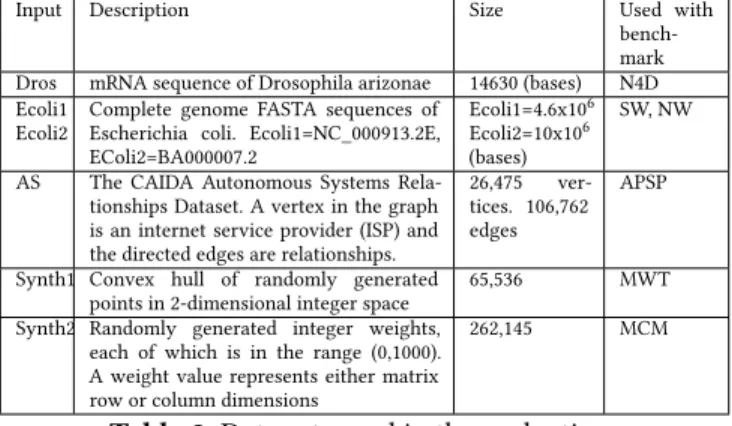
Table 2 describes the data sets [3, 32] used.
Development and execution environment The distributed memory implementations of all benchmarks use C++11, Intel MPI [1], and Intel CilkPlus [13]. We compile the programs with mpiicpc, a wrapper compiler for ICC 16.0.3. The exper-iments are run on a cluster of 10 nodes, interconnected by Gigabit ethernet. Each node of the cluster runs RHE Linux workstation release 6.10, contains two 10-core Intel Xeon-E5-2660 processors with 32KB L1 data and instruction cache, and 256KB of L2 cache, a shared 25MB L3 cache, and 64GB main memory. In our multi-process experiments, we accessed up to 8 nodes of the cluster and mapped processes to as many nodes as available on the cluster first before using additional cores on a compute node.
5.2 Scalability
Strong scaling In these experiments, we measure the per-formance of the benchmarks with increased number of com-puting resources (processes, Cilk workers) for a fixed input size. The input sizes are chosen such that the single-process DM executions complete in a reasonable amount of time and that the entire DP table can be allotted memory in a contigu-ous space for comparison with a single process baseline.
Figure 3 shows the strong-scaling results with the default D2P configuration of 1 Cilk worker per process. Since the scalability plots of MCM and NW are similar to that of MWT and SW respectively, we show the scalability plots of only four benchmarks in the figure. The plots show speedup of a DM execution over the sequential recursive baseline (1_rec). Table 3 shows baseline runtimes. The recursion base case, B, is 1 by default unless otherwise noted. We observe that
0 2 4 6 8 10 12 14 16 1 2 4 8 16 32 64 128 Spe edup
Number of processes / cores
MWT
Input size = 4096 points DP Table size = 0.5 GB 0 10 20 30 40 50 1 2 4 8 16 32 64 128 Spe edup
Number of processes / cores
SW
Sequence length = 32767 bases DP Table size = 1.0 GB 0 5 10 15 20 25 1 2 4 8 16 32 64 128 Spe edup
Number of processes / cores
APSP
Input size = 8192 vertices DP Table size = 0.5 GB 0 5 10 15 20 25 1 2 4 8 16 32 64 128 Spe edup
Number of processes / cores
N4D
Sequence length = 128 bases DP Table size = 0.5 GB
Figure 3.Strong scaling in D2P benchmarks showing speedup of 1 Cilk worker/process configuration over baseline.
Processes MCM MWT SW APSP N4D
1_ite 47.4s 293.4s 14.6s -
-1_rec 43.6s (B=8) 215.8s 31.7s 4570.6s 331.4s
Pre Cilk-workers Pre Cilk-workers Pre Cilk-workers Pre Cilk-workers Pre Cilk-workers
1 16 1 16 1 16 1 16 1 16 1_DM 0.4s 0.4× 0.7× 0.3s 0.9× 4.8× 1.2s 0.8× 1.9× 2.2s 0.9× 7.5× 0.3s 0.9× 9.3× 2_DM 0.4s 0.7× 3.9× 0.3s 1.3× 15.3× 0.8s 1.1× 2.2× 1.7s 1.3× 2.3× 0.13s 1.6× 6.2× 4_DM 0.2s 1.3× 7.1× 0.2s 1.7× 28.1× 0.4s 1.9× 2.7× 0.9s 3.1× 5.9× 0.1s 2.5× 6.6× 8_DM 0.1s 2.2× 12.5× 0.1s 2.2× 45.9× 0.3s 3.2× 3.2× 0.5s 5.9× 15.9× 0.09s 4.1× 10.4× 16_DM 0.1s 3.1× 12.5× 0.09s 2.9× 52.6× 0.2s 6.2× 1.3× 0.3s 9.7× 35.1× 0.08s 6.9× 11.8× 32_DM 0.09s 3.8× 7.4× 0.08s 5.4× 22.2× 0.1s 9.9× 1.2× 0.2s 16.3× 37.8× 0.07s 5.0× 10.1× 64_DM 0.08s 4.2× 4.8× 0.07s 8.2× 14.5× 0.08s 18.6× 2.1× 0.14s 20.9× 33.6× 0.07s 8.0× 8.5× 128_DM 0.08s 2.9× 0.9× 0.08s 13.4× 3.8× 0.07s 39.6× 2.1× 0.1s 15.9× 6.9× 0.07s 20.1× 9.6×
Table 3.Measurements showing i) iterative (1_ite) and recursive (1_rec) baseline runtimes in seconds (s). ii) preprocessing overhead (Pre), and iii) Comparison of speedups (×) obtained over recursive baselines in 1 and 16 Cilk worker per process configuration for the inputs used in Figure 3.
8192 10322 13004 16384 0 5 10 15 16 32 64 128 No rm al ize d r unt im e Number of processes MWT
Runtime Number of points
16 process baseline run = 183.1s, D=5
32768 46339 65536 92679 0 2 4 6 8 10 16 32 64 128 No rm al ize d r unt im e Number of processes SmithWaterman
Runtime Sequence length
4096 5161 6502 8192 0 5 10 15 16 32 64 128 No rm al ize d r unt im e Number of processes Floyd_Warshall_APSP
Runtime Number of points
16 process baseline run = 60.9s, D=5
256 304 362 430 512 0 200 400 600 0 2 4 6 8 8 16 32 64 128 No rm al ize d r unt im e Number of processes Nussinov_4D
Runtime Sequence length
8 process baseline run = 108.4, D=4 16 process baseline run =11.6s, D=7
Figure 4.Weak scaling in D2P benchmarks. The y-axis (for the bars) shows normalized runtime w.r.t. the 16-process run (except Nussinov 4D, where we normalize w.r.t. an 8-process run). The lines (with labels) give the input size used for that execution.
in general withB> 1, the recursive versions are faster than the iterative versions, 1_ite(MWT is faster even withB= 1). Overall, in the default D2P configuration, we get a 20.3×
geomean speedup, which further increases to 35.5×when we exploit intra-task parallelism.
We investigate exploiting Cilk parallelism within pro-cesses by assigning more than one Cilk worker per process. Table 3 shows speedups in 1 and 16 Cilk worker per process configurations. We performed a sweep of 1 to 16 Cilk work-ers per process at each scale, however, we show here only a part of these results due to lack of space. Since the base case computation in SW and NW differs only in the values used for scoring, the performance numbers of NW are very simi-lar to SW. Hence, we do not show them here. We find that in SW and N4D, multiple Cilk workers do not help improve the performance relative to single Cilk worker configuration: the best speedups seen in SW (39.6×), and N4D (20.1×) are with a single Cilk worker. In contrast, the best speedups seen in MCM (12.5×), MWT (52.6×), APSP (39.9×) are with 16 Cilk
workers per process. Our experiments showed that allocat-ing parallelism to additional processes rather than additional Cilk workers consistently gave better performance, even though using more processes requires more communication. We thus believe that there is some performance issue with the single-process Cilk implementation, though we have not yet determined the root cause. The table also shows preprocess-ing overheads, and the speedups seen earlier are inclusive of the preprocessing overheads. The overhead remains un-der 1.7% in most cases and decreases with increase in the number of processes due to theO(L/P)time (see Section 3.1, communication insertion).
Overall as the results show, D2P implementations scale well given the inherently strong data dependencies in DP problems. The addition of more Cilk workers improves per-formance in general, and intra-process parallelism is nec-essary in order to get the absolute best performance. The results reflect D2P’s use of coarse-grained, task-level par-allelism at the level of leaves of the tree (see Section 3.1,
recursion unrolling) and Cilk workers to exploit an intra-process, sub-task parallelism available within a task.
Weak Scaling In these experiments, we increase the input size with increasing number of processes while keeping the per-process computation fixed. We also fix the unroll depth, D, to override the default D2P configuration of increasingD as more processes are added. As a result, the runtime some-times decreases with more processes due to more effective utilization of available parallelism. In weak-scaling experi-ments in general, we expect the communication overhead to increase proportional to the number of processes. In D2P benchmarks, we have an additional source of communica-tion overhead: as some benchmarks readO(N)(APSP, MWT, MCM) data to compute a cell, the amount of
communica-tionper cellcan increase with scale. Additionally, when the
input size is not a perfect power-of-two the recursive de-composition does not evenly divide the table, so partitioning tasks/sub-tasks computing these tiles can result in load im-balance. As a result, we expect the overall runtime to increase with scaling up the inputs and number of processes.
Figure 4 confirms this behavior. The X-axis shows the number of processes and the Y-axis shows runtime normal-ized to a 16-process baseline. The secondary line plot shows the input sizes for reference. We see that the runtimes show different degrees of increase for different benchmarks. The figure shows that the 32 process runtime is greater com-pared to the 64 process runtime in SW. This is because of load imbalance in the former run. The 16 process run in SW uses an input sequence length of 32,768, which is perfect-power-of-two. Because SW is O(N2) algorithm, the next perfect-power-of-two input size is used when the processes are scaled to 64. We consider scaling from 16 to 64 as an indi-cator of true weak-scaling since these correspond to perfect load-balance. For MWT and APSP,O(N3)algorithms, 16 and 128 process runs represent the load-balanced configurations. In N4D, which isO(N4), 8 and 128 process runs are each perfectly balanced.
In a perfectly load-balanced scenario, SW, MWT, APSP, and N4D weak-scale differently. SW weak-scales the best and shows the least increase of 1.08×in runtime due to a
O(1)amount of communication per cell. Even though MWT and APSP have bothO(N)dependencies in computing a cell, MWT shows 5.9×increase while APSP shows a 10.1×
increase in runtime. This is because MWT only computes an upper triangular matrix. Hence, the communication over-head is reduced by half. N4D, despite computingO(N4)cells, shows a modest 4.5×increase in runtime. This is because, like SW, each cell in N4D depends onO(1)other cells.
0.1 1 10 100 1000 1 2 4 8 16 32 64 128 Ru nt ime ( s) Number of processes D2P vs. DPX10 DPX10 D2P
Input: Ecoli, size:8192
0.1 1 10 100 1 2 4 8 16 32 64 128 Ru nt ime ( s) Number of processes D2P vs. Hand written (HW) HW_general HW_even D2P_Auto D2P_opt b)
Input: Ecoli, size: 32768
a)
Figure 5.Case studies comparing D2P with other systems.
5.3 Case Studies
D2P vs. DPX10 We compare D2P with DPX10 [34], the best available framework for generating distributed imple-mentations ofiterativeDP programs. DPX10 captures node-level, and thread-level parallelism for iterative DP programs when the computation is partitioned across nodes of a com-pute cluster. Node-level parallelism is captured through X10 Places and the thread-level parallelism through pthreads.
We compare the performance of SW benchmark only, since, DPX10 currently supports only DP programs with 2-dimensional DP table andO(1)dependency in computing a cell (2D/0D) [34]. DPX10 takes a master-slave approach in executing tasks. First, a master process creates a DAG of tasks based on a user-specified dependency pattern. The tasks are then distributed among slaves, who report back to master with results. Each slave (and master) coordinate task execution with the help of an additional per slave (and master) scheduler processes. DPX10 recommends a single X10 place per compute node and multiple threads to engage the cores on a node.
Figure 5(a) shows the strong scaling results. In this exper-iment we chose the best performing DPX10 configuration among different choices of X10 threads available per place. We observe that the single process runtime of D2P is 33×
faster than DPX10. Since DPX10 stops scaling beyond 16 places (more than two place per node) and D2P continues to scale up to 128 processes, the performance gap widens and we see that D2P achieving a speedup from 33×to 483×. We attribute the reason for superior performance of D2P to its implementation choices and the recursive algorithm advantage [10] over the iterative codes in DPX10. In addition, we believe that the control overheads in DPX10 (e.g. runtime task management, and of a dedicated process for scheduling tasks) make it slower than D2P.
Case Study II: D2P vs. Hand_Written (HW) In this case study we compare D2P with a highly optimized, hand writ-ten, distributed memory implementation of iterative SW algorithm [2]. Like DPX10, the HW implementation takes a master slave approach. The master divides the work (row-wise) evenly among slaves and computes any rows remaining due to an uneven division. The row-wise division means that a process depends on only a single row of data owned by a remote process. Note that this is in contrast to D2P, where
a producer sends an entire tile of data even though only a single row (or column) of a tile is required by the consumer. Figure 5(b) shows the strong scaling results. The HW code is evaluated with input sizes where slaves evenly divide the work (HW_even), and where master computes some rows (HW_дeneral). D2P is also evaluated with an auto generated implementation (D2P_auto) and a modified implementation communicating only a row or column of the tile (D2P_opt). We observe that D2P is competitive. In the general case, HW_дeneral, the master process waiting for all the data from slaves in order to compute its rows necessitates an
MPIAllGathercommunication besides creating a need to
allocate space for the entire DP table. D2P does not have any of these bottlenecks and as a result D2P scales much better than HW in the general case and even outperforms beyond 16 processes. When master does not compute any rows, there is no bottleneck. As a result,HW_evenscales very well. Even in this ideal scenario, the bestD2P_optperformance (0.6s) is only 27% slower than HW (0.47s).
6
Related work
Dynamic programming [8] algorithms, with their application in a wide variety of domains, are the target of parallelization efforts [19, 26, 35] as multi-cores and commodity clusters become increasingly accessible.
Frameworks simplifying parallel programming and ex-ploiting multiple levels of parallelism on heterogeneous ar-chitectures have been proposed [7, 16, 24, 30, 34]. While D2P is aligned with these works on the end goal, there are some major differences: D2P specializes in recursive DP programs in comparison with OMPD [24], Legion [7], and others [6, 30, 31], which are more general. Both Legion and D2P leverage the inclusion property of recursive for-mulations. However, Legion relies on region annotations to determine dependencies, which would still need to be generated by something like D2P’s unrolling and analysis. Among important prior works that automate the genera-tion of distributed-memory parallel programs, some [6, 24] rely on a convenient starting point of explicit parallelism specification (e.g.#pragma omp parallel for) and implicit partitioning (implicit assignment of iterations to threads), while others [30, 31] work well on regular/irreg-ular/mixed iterative codes. D2P instead relies on Autogen producedparallelspecifications, performs explicit par-titioning and works on recursive codes. Sarkar et al. [31] do an extensive study of the serial to parallel program con-version problem. They automate program partitioning in a functional programming setting, and explore compile- and runtime scheduling techniques on multi-processors with different system architectures. We could augment the ex-isting, recursion unrolling influenced partitioning scheme in D2P with sophisticated inspector-executor based tech-niques [20, 30, 31]. Also, compared to these systems, D2P
could be thought of as a semi-automatic framework special-izing in recursive DP programs. Semi-automatic because the input is an iterative code snippet rather than an entire pro-gram, thus necessitating the introduction of APIs to capture user input. Like D2P, FastFlow [4], EasyHPS [16] and its successor DPX10 [34] focus on simplifying the creation of distributed-memory DP programs through system provided APIs and user-configurable parameters. However, unlike D2P, they work on iterative DP codes.
Galil et al. [19] design parallel iterative DP algorithms and categorize DP problems based on the data-dependency patterns. Chowdhury et al. [10] design efficient recursive DP algorithms and automate the design process through Autogen. They also show that recursive DP algorithms ex-hibit better temporal locality and outperform their iterative counterparts [11, 12]. Bellmania [22] takes a program syn-thesis approach in generating parallel shared-memory imple-mentations of recursive pseudocodes output from Autogen. Lifflander et. al. [25] show that cache performance can also be improved for a broader set of divide-and-conquer prob-lems with recursive implementations. They use programmer specified ‘effect’ annotations for identifying fine-grained parallelism in recursive programs implementing stencil com-putations. Based on the results, different recursive method invocations are spliced (interleaved) effectively to improve cache locality. The parallelism expressed in D2P is explicit at a coarser level of recursive method invocation. Because the method parameters specify the entire read and write access regions, effect annotations are redundant for the re-cursive methods in D2P. However, through the use of effect annotations, we could extend our distributed-memory code generation scheme to arbitrary recursive programs.
Majority of the prior work on distributed-memory DP im-plementations focus on problem-specific customizations [2, 3, 5, 9, 21, 26, 28, 35, 36]. While some focus on algorithmic opti-mizations [21, 26, 36], others [5, 15, 28] have system-specific optimizations. For example, in optimizing Smith-Waterman algorithm for distributed-memory, a majority [15, 28] exploit the coargrained parallelism available in comparing a se-quence against a database of sese-quences. Whereas, D2P’s im-plementation of Smith-Waterman parallelizes the algorithm, which computes the DP table to compare two sequences.
7
Conclusions
In this paper, we presented D2P, an end-to-end system for auto-generating distributed-memory implementations of re-cursive DP algorithms. We presented how D2P generates those implementations starting from a code snippet of an iter-ative DP algorithm. In the process, we showed how D2P uses Autogen and transforms its output to produce distributed-memory implementations from shared-distributed-memory recursive parallel pseudocodes of DP algorithms. Finally, we presented
an evaluation of D2P that showed that the generated imple-mentations scale well, preprocessing overheads are negligi-ble, and that D2P significantly outperforms the best available system for parallelizing DP programs on distributed-memory systems and is competitive against hand written programs.
8
Acknowledgements
The authors would like to thank Rezaul Chowdhury for pro-viding the source code of Autogen, and Samuel Midkiff for providing access to the Wabash cluster. This work was sup-ported by a DOE Early Career award (DE-SC0010295).
References
[1] [n. d.]. Intel MPI Libraries:. https://software.intel.com/en-us/
intel-mpi-library. ([n. d.]).
[2] [n. d.]. SmithWaterman with OpenMPI and OpenMP.
https://www.alexjf.net/projects/distributed-systems/ smith-waterman-openmp-and-openmpi/. ([n. d.]).
[3] [n. d.]. The CAIDA AS Relationships Dataset, Nov’5, 2007. http:
//www.caida.org/data/as-relationships/. ([n. d.]).
[4] Marco Aldinucci, Massimiliano Meneghin, and Massimo Torquati. 2010.
Efficient Smith-Waterman on multi-core with FastFlow. InParallel,
Distributed and Network-Based Processing (PDP), 2010 18th Euromicro International Conference on. IEEE, 195–199.
[5] Matthew Baker, Aaron Welch, and Manjunath Gorentla Venkata. 2014. Parallelizing the Smith-Waterman algorithm using OpenSHMEM and
MPI-3 one-sided interfaces. InWorkshop on OpenSHMEM and Related
Technologies. Springer, 178–191.
[6] Ayon Basumallik and Rudolf Eigenmann. 2006. Optimizing irregular
shared-memory applications for distributed-memory systems. In
Pro-ceedings of the eleventh ACM SIGPLAN symposium on Principles and practice of parallel programming. ACM, 119–128.
[7] Michael Bauer, Sean Treichler, Elliott Slaughter, and Alex Aiken. 2012. Legion: Expressing locality and independence with logical regions. In
High Performance Computing, Networking, Storage and Analysis (SC), 2012 International Conference for. IEEE, 1–11.
[8] Richard Bellman. 2013.Dynamic programming. Courier Corporation.
[9] Sanjay Chatterjee, Sagnak Tasirlar, Zoran Budimlic, Vincent Cave, Milind Chabbi, Max Grossman, Vivek Sarkar, and Yonghong Yan. 2013.
Integrating asynchronous task parallelism with MPI. In2013 IEEE 27th
International Symposium on Parallel and Distributed Processing. IEEE, 712–725.
[10] Rezaul Chowdhury, Pramod Ganapathi, Jesmin Jahan Tithi, Charles Bachmeier, Bradley C Kuszmaul, Charles E Leiserson, Armando Solar-Lezama, and Yuan Tang. 2016. Autogen: Automatic discovery of cache-oblivious parallel recursive algorithms for solving dynamic programs. InProceedings of the 21st ACM SIGPLAN Symposium on Principles and Practice of Parallel Programming. ACM, 10.
[11] Rezaul Alan Chowdhury, Hai-Son Le, and Vijaya Ramachandran. 2010.
Cache-oblivious dynamic programming for bioinformatics.IEEE/ACM
Transactions on Computational Biology and Bioinformatics (TCBB)7, 3 (2010), 495–510.
[12] Rezaul Alam Chowdhury and Vijaya Ramachandran. 2008.
Cache-efficient dynamic programming algorithms for multicores. In
Proceed-ings of the twentieth annual symposium on Parallelism in algorithms and architectures. ACM, 207–216.
[13] CilkPlus [n. d.]. Intel Cilk Plus.https://www.cilkplus.org.
([n. d.]).
[14] Thomas H. Cormen, Charles E. Leiserson, Ronald L. Rivest, and Clifford
Stein. 2009.Introduction to Algorithms, Third Edition(3rd ed.). The
MIT Press.
[15] Aaron E Darling, Lucas Carey, and W Chun Feng. 2003.The design,
implementation, and evaluation of mpiBLAST. Technical Report. Los Alamos National Laboratory.
[16] Jun Du, Ce Yu, Jizhou Sun, Chao Sun, Shanjiang Tang, and Yanlong Yin. 2013. EasyHPS: A multilevel hybrid parallel system for dynamic
pro-gramming. InParallel and Distributed Processing Symposium Workshops
& PhD Forum (IPDPSW), 2013 IEEE 27th International. IEEE, 630–639.
[17] Robert W Floyd. 1962. Algorithm 97: shortest path.Commun. ACM5,
6 (1962), 345.
[18] Matteo Frigo, Charles E Leiserson, and Keith H Randall. 1998. The
implementation of the Cilk-5 multithreaded language. InACM Sigplan
Notices, Vol. 33. ACM, 212–223.
[19] Zvi Galil and Kunsoo Park. 1994. Parallel algorithms for dynamic
programming recurrences with more than O (1) dependency.J. Parallel
and Distrib. Comput.21, 2 (1994), 213–222.
[20] Kang Su Gatlin and Larry Carter. 1999. Architecture-cognizant divide
and conquer algorithms. InProceedings of the 1999 ACM/IEEE conference
on Supercomputing. ACM, 25.
[21] Khaled Hamidouche, Fernando Machado Mendonca, Joel Falcou, Alba Cristina Magalhaes Alves de Melo, and Daniel Etiemble. 2013. Paral-lel Smith-Waterman Comparison on Multicore and Manycore
Com-puting Platforms with BSP++. International Journal of Parallel
Pro-gramming41, 1 (01 Feb 2013), 111–136. https://doi.org/10.1007/ s10766-012-0209-6
[22] Shachar Itzhaky, Rohit Singh, Armando Solar-Lezama, Kuat Yessenov, Yongquan Lu, Charles Leiserson, and Rezaul Chowdhury. 2016. De-riving divide-and-conquer dynamic programming algorithms using
solver-aided transformations. InProceedings of the 2016 ACM SIGPLAN
International Conference on Object-Oriented Programming, Systems, Languages, and Applications. ACM, 145–164.
[23] GT Klincsek. 1980. Minimal triangulations of polygonal domains.
Annals of Discrete Mathematics9 (1980), 121–123.
[24] Okwan Kwon, Fahed Jubair, Rudolf Eigenmann, and Samuel Midkiff.
2012. A hybrid approach of OpenMP for clusters. InACM SIGPLAN
Notices, Vol. 47. ACM, 75–84.
[25] Jonathan Lifflander and Sriram Krishnamoorthy. 2017. Cache locality
optimization for recursive programs. InProceedings of the 38th ACM
SIGPLAN Conference on Programming Language Design and Implemen-tation. ACM, 1–16.
[26] Saeed Maleki, Madanlal Musuvathi, and Todd Mytkowicz. 2014.
Par-allelizing dynamic programming through rank convergence. ACM
SIGPLAN Notices49, 8 (2014), 219–232.
[27] Saul B. Needleman and Christian D. Wunsch. 1970. A general method applicable to the search for similarities in the amino acid sequence
of two proteins.Journal of Molecular Biology48, 3 (1970), 443 – 453.
https://doi.org/10.1016/0022-2836(70)90057-4
[28] Mahdi Noorian, Hamidreza Pooshfam, Zeinab Noorian, and Rosni Ab-dullah. 2009. Performance enhancement of smith-waterman algorithm using hybrid model: Comparing the mpi and hybrid programming
paradigm on smp clusters. InSystems, Man and Cybernetics, 2009. SMC
2009. IEEE International Conference on. IEEE, 492–497.
[29] Ruth Nussinov, George Pieczenik, Jerrold R Griggs, and Daniel J
Kleit-man. 1978. Algorithms for loop matchings.SIAM Journal on Applied
mathematics35, 1 (1978), 68–82.
[30] Mahesh Ravishankar, Roshan Dathathri, Venmugil Elango, Louis-Noël Pouchet, J Ramanujam, Atanas Rountev, and P Sadayappan. 2015. Distributed memory code generation for mixed irregular/regular
com-putations. InACM SIGPLAN Notices, Vol. 50. ACM, 65–75.
[31] Vivek Sarkar. 1989.Partitioning and Scheduling Parallel Programs for
Multiprocessors. MIT Press, Cambridge, MA, USA.
[32] Stephen T Sherry, M-H Ward, M Kholodov, J Baker, Lon Phan, Eliza-beth M Smigielski, and Karl Sirotkin. 2001. dbSNP: the NCBI database of genetic variation.Nucleic acids research29, 1 (2001), 308–311.
[33] T.F. Smith and M.S. Waterman. 1981. Identification of common
molec-ular subsequences.Journal of Molecular Biology147, 1 (1981), 195 –
197. https://doi.org/10.1016/0022-2836(81)90087-5
[34] Chen Wang, Ce Yu, Shanjiang Tang, Jian Xiao, Jizhou Sun, and Xiangfei Meng. 2016. A general and fast distributed system for large-scale
dynamic programming applications.Parallel Comput.60 (2016), 1–21.
[35] Wenduo Zhou and David K Lowenthal. 2006. A parallel, out-of-core
al-gorithm for RNA secondary structure prediction. InParallel Processing,
2006. ICPP 2006. International Conference on. IEEE, 74–81.
[36] Michal Ziv-Ukelson, Irit Gat-Viks, Ydo Wexler, and Ron Shamir. 2008.
A faster algorithm for RNA co-folding. InInternational Workshop on