THE LONGITUDINAL RELATIONS OF DISCIPLINARY AND NON-DISCIPLINARY PARENTAL PRACTICES TO CHILD BEHAVIOR AND
ACADEMIC PERFORMANCE AND THE UNIQUE CONTRIBUTION OF PARENT-CHILD SYNCHRONY
By CHAO LIU
Bachelor of Arts/Science in Applied Psychology Beijing Normal University
Zhuhai, Guangdong, China 2009
Master of Arts/Science in Developmental Psychology University of Maine
Orono, Maine, USA 2013
Submitted to the Faculty of the Graduate College of the Oklahoma State University
in partial fulfillment of the requirements for
the Degree of
DOCTOR OF PHILOSOPHY July, 2018
ii
THE LONGITUDINAL RELATIONS OF DISCIPLINARY AND NON-DISCIPLINARY PARENTAL PRACTICES TO CHILD BEHAVIOR AND
ACADEMIC PERFORMANCE AND THE UNIQUE CONTRIBUTION OF PARENT-CHILD SYNCHRONY Dissertation Approved: Amanda Harrist Dissertation Adviser Michael Criss Robert Larzelere Mwarumba Mwavita
iii
Acknowledgements reflect the views of the author and are not endorsed by committee members or Oklahoma State University.
ACKNOWLEDGEMENTS
Looking back to this journey, I am so grateful for the wonderful guidance by God who helps me grow intellectually and spiritually. I am continuously being amazed by the ways and circumstances that God uses to shape me. All the achievements, honors, and awards I obtained are not by my own talents or power but by His gracious gifts, alone. I am also blessed to be surrounded by a group of intelligent and warm-hearted colleagues at Oklahoma State University–they are my mentors in academics and friends in life. I have been greatly indebted to these people as I will not be able to finish this journey without their help and support. My first gratitude is for my advisor Dr. Amanda Harrist who is always there to challenge me when I succeeded and encourage me when I failed. Her upbeat spirit and academic enthusiasm will continue to motivate me in my future career. I would also like to thank Dr. Robert Larzelere, a must-turn-to colleague whenever I had questions related to statistics. And Dr. Larzelere is more than a statistical consultant–he is a spiritual mentor who helps me see how faith and science can be integrated. For my parents, a thank-you note is not enough: they may not understand a single word in this dissertation and know very little about the parenting literature but they have shown what good parents should be in real life. Lastly, my deepest appreciation goes to my dear wife Huanyun Duan, to whom I just want to say: “with all the joys and tears we made it!”
iv Name: Chao Liu
Date of Degree: AUGUST, 2018
Title of Study: THE LONGITUDINAL RELATIONS OF DISCIPLINARY AND NON-DISCIPLINARY PARENTAL PRACTICES TO CHILD BEHAVIOR AND ACADEMIC PERFORMANCE AND THE UNIQUE
CONTRIBUTION OF PARENT-CHILD SYNCHRONY Major Field: Human Development and Family Science
Abstract: This dissertation contains two studies. The first study investigated the relations between parenting practices and child social and academic outcomes. This study adopted a comprehensive approach that examined the longitudinal relations of three types of disciplinary and non-disciplinary tactics (power-assertion, positive parenting, derogatory practices) to child psychosocial adjustment and academic performance from kindergarten to second grade. Five hundred and eighty-five children (281 girls, 304 boys) and their parents (581 mothers, 577 fathers) from the Child Development Project served as the sample of this study. Results from parallel growth curve models showed that a higher level of derogatory practices was associated with a slower decrease of social competence, perhaps because children with parents who used more derogatory practices already started with a low level of social competence (the initial levels of parent derogatory practices and child social competence were negative correlated). Results from propensity score matching analysis indicated that high level, in comparison to a low level, of mother disciplinary tactics at first grade predicted lower levels of child social competence and academic performance at second grade. The second study explored the unique
contribution of parent-child synchrony in child development. This study examined the construct continuity of synchrony from early childhood (kindergarten year) to middle adolescence (16 years old) and construct validity of synchrony in child social competence and academic performance after taking into account the influences of parenting practices. A subsample (N=157) of Child Development Project was included in the current study. Results indicated that mother positive synchrony at kindergarten positively predicted child social competence and academic performance at first grade whereas mother non-synchrony negatively predicted child academic performance. In regard to the father sample positive synchrony at kindergarten positively predicted both child social competence and academic performance at first grade. On the contrary, father non-synchrony positively predicted child externalizing problems. The continuity of the construct synchrony was also established such that mother positive synchrony at the kindergarten year was positively correlated with mother connectedness/balance at child age 16 but mother nonsynchrony in kindergarten was negatively correlated with mother connectedness/balance at age 16.
v
TABLE OF CONTENTS
Chapter Page
I. MANUSCRIPT ONE INTRODUCTION ... 1
Background of the Study... 1
Statement of the Problem and Purpose ... 1
II. MANUSCRIPT ONE REVIEW OF LITERATURE ... 3
Advocacy of Positive Parenting ... 3
Warmth ... 3
Advocacy of Power-Assertive Disciplinary Practices ... 7
Physical and Verbal Power Assertion ... 8
Time-out... 11
Privilege Removal ... 13
III. MANUSCRIPT ONE METHODOLOGY... 15
Sample... 15
Procedure ... 15
Child Development Project (CDP) ... 15
Measures ... 18
Disciplinary Tactics ... 18
Positive Parenting ... 22
Child Social Competence and Behavioral Problems ... 24
Child Academic Performance ... 25
vi
Chapter Page
IV. MANUSCRIPT ONE FINDINGS ... 28
Model Fit for Growth Curve of Predictors and Outcomes ... 28
Latent Growth Curve Modeling for Full Sample ... 31
Predicting the Change in Child Outcomes ... 33
Predicting the Initial Level of Child Outcomes ... 33
Latent Growth Curve Modeling for Mothers versus Fathers ... 35
Predicting the Change of Child Outcomes: Mothers ... 37
Predicting the Initial Level of Child Outcomes: Mothers ... 37
Predicting the Change of Child Outcomes: Fathers ... 38
Predicting the Initial Level of Child Outcomes: Fathers ... 38
Latent Growth Curve Modeling for Boys versus Girls... 39
Predicting the Change of Child Outcomes: Boys... 41
Predicting the Initial Level of Child Outcomes: Boys ... 41
Predicting the Change of Child Outcomes: Girls ... 42
Predicting the Initial Level of Child Outcomes: Girls ... 43
Supplementary Analysis: Propensity Score Matching ... 44
V. MANUSCRIPT ONE DISCUSSION AND CONCLUSION ... 45
Discussion of Findings ... 45
Limitations ... 52
Conclusion... 53
VI. MANUSCRIPT TWO INTRODUCTION ... 54
Background of the Study... 54
Statement of the Problem and Purpose ... 54
VII. MANUSCRIPT TWO REVIEW OF LITERATURE ... 56
The Definition of Synchrony... 56
The Uniqueness and Stability of Parent-Child Synchrony ... 59
vii
Chapter Page
Sample and Procedure ... 65
Measures ... 65
Disciplinary Tactics and Positive Parenting ... 65
Parent-child Synchrony at Kindergarten ... 65
Child Outcomes ... 68
Parent-child Synchrony at Child 16 ... 68
Analytic Plan ... 71
IX. MANUSCRIPT TWO FINDINGS ... 73
Mother and Father Kindergarten Synchrony and Child Social Development at the First Grade ... 73
Longitudinal Continuity of Synchrony ... 76
X. MANUSCRIPT TWO DISCUSSION AND CONCLUSION ... 78
Discussion of Findings ... 78
Limitations ... 83
Conclusion... 84
REFERENCES ... 85
APPENDICES... 116
Appendix A: The Use of Propensity Score Matching to Reduce Bias in Manuscript One ... 116
Selection of Covariates for Matching ... 116
Estimation of Treatment Effects without Propensity Score Matching ... 117
Balance Evaluation for Propensity Score Matching... 118
Regression using Propensity Scores ... 124
Appendix B: Coding Instructions for Synchrony at Age 16 ... 125
viii LIST OF TABLES Table Page 3.1 ... 17 3.2 ... 20 3.3 ... 23 4.1 ... 29 4.2 ... 30 4.3 ... 32 4.4 ... 36 4.5 ... 40 8.1 ... 68 8.2 ... 71 9.1 ... 74 9.2 ... 75 12.1 ... 120 12.2 ... 121
ix LIST OF FIGURES Figure Page 3.1 ... 26 3.2 ... 27 3.3 ... 27 12.1 ... 122 12.2 ... 123
1 CHAPTER I
MANUSCRIPT ONE INTRODUCTION
Background of the Study
Parental discipline is a subject undergoing intense debate not only in the popular press but also among academic circles. The discussion has been centered on the effectiveness of different disciplinary practices in children’s upbringing that result in favorable outcomes. Opinions and views have largely been divided into two distinct schools with one upholding positive parenting that advises against the use of firm disciplinary practices (Grolnick, 2003; Gershoff, 2002; Grusec, Goodnow, & Kuczynski, 2000; Straus, 2001) and the other
advocating the use of some power assertion to exercise control (Barber & Xia, 2013;
Baumrind, 2012; Larzelere, Gunnoe, Roberts & Ferguson, 2016). These perspectives can be explored by comparing child “outcomes” (later behavioral and developmental patterns) associated with different parenting practices.
Statement of the Problem and Purpose
Much parenting research in the past has been split by two isolated perspectives on disciplinary practice (i.e., positive parenting versus power assertive parenting) and this split persists in a considerable portion of the field. This ongoing division will hinder our
understanding of optimal parenting practices because as reviewed above both perspectives have received empirical support for those disciplinary practices they advocate. In addition, this academic schism will do no good for practitioners and parents as they are left unadvised
2
about the most effective practice in children’s upbringing. The goal of this study is to resolve this issue by adopting a more comprehensive lens that includes disciplinary tactics
recommended by both perspectives and compares their effectiveness in promoting
competence and reducing problems of children. Based on previous findings, the following three hypotheses were developed that link disciplinary tactics and child outcomes: Tactics advocated by positive parenting perspective (i.e., warmth, supportiveness, reasoning, positive reinforcement) are effective in promoting children’s positive outcomes (viz., competence, academic achievement) whereas tactics advocated by the power assertive parenting perspective (i.e., TO, privilege withdrawal, simple command, coercive order, extra-work penalty, threatening) are effective in reducing children’s problematic (internalizing and externalizing) behaviors. It is further hypothesized that non-physical derogatory practices including verbal hostility (yell or scold, raise voice) and shaming are associated with the worst child outcomes (i.e., low level of positive outcomes and high level of negative outcomes). The potential moderators include parental and child gender, and gender match, but no specific hypothesis will be given because of the limited evidence and mixed findings.
3 CHAPTER II
MANUSCRIPT ONE REVIEW OF LITERATURE
Advocacy of Positive Parenting
Positive parenting has been generally labeled as loving guidance (Markham, 2015). Previous studies have highlighted several defining attributes including warmth (Kulkarni, 2010; McKee et al., 2007), support (van Aken & Riksen-Walraven, 1992), and praise (Pfiffner & Kaiser, 2010). Although positive parenting researchers focus on
different facets of positive parenting, they commonly eschew the use of any firm
disciplinary tactics. According to this perspective, gentle and mild disciplinary practices such as reasoning and induction can be employed in a noncoercive way but forceful and power assertive acts such as verbal reprimands and physical punishment should be avoided. The advocacy of positive parenting is primarily based on the evidence that documented the link between positive-reinforcement types of parenting and desired child outcomes (Davalos, Chavez, & Guardiola, 2005; Day & Padilla-Walker, 2009; Eamon & Mulder, 2005). Because positive parenting is a general concept which subsumes a wide range of tactics, it would be helpful to examine specific forms of parenting practice and their associated effects on child development.
Warmth
In child development or family studies, warmth is a construct that depicts the positive emotionality within parent-child relationships (MacDonald, 1992). Several other
4
terms including affection and acceptance also have been applied to this construct. A parenting style characterized by high levels of warmth and responsiveness is known to promote children’s well-being in various aspects (Bornstein & Tamis-LaMonda, 1989; Parpal & Maccoby, 1985). For example, parenting was shown to impact child physical health: the display of parental warmth and support lowered the chance of child obesity (Berge et al., 2010; Rhee et al., 2010) and increased the odds of treatment success in weight loss and weight control if children were in fact obese (Rhee et al., 2016). To assess social-cognitive development, Smith, Landry and Swank (2000) followed 364 children from 6 months to 40 months and found the optimal social and cognitive
outcomes assessed at 40 months were predicted by their mothers’ high levels of warmth over time with only slight increases in restrictiveness. The least desirable parenting style showed low levels of warmth but dramatic increases of restrictiveness as children aged.
The positive influences of warm parenting are probably due to the recognition of child needs and interests which sends the message to the child that he or she is important. Moreover, the consistent immersion in a warm climate helps children form a positive outlook with respect to interpersonal relationships and therefore facilitates an inclination to pursue these relationships in the future (Sroufe, 2005). Parental warmth seems to be particularly salutary in promoting children’s positive development rather than reducing negative outcomes. For example, Davidov and Grusec (2006) found that parental warmth predicted children’s ability to express positive affect and greater peer acceptance but not the ability to regulate negative emotions. Notably, Davidov and Grusec in their study distinguished parental warmth from parental responsiveness and noted that the latter contributed independently to children’s negative emotion regulation.
5
Several child factors can moderate the positive relation between parental warmth and child outcomes and temperament is one of them. Parenting effects may vary (i.e., attenuate or amplify) depending on child temperament and the interaction between child temperament and parenting (Bates & Pettit, 2007). As one example, the relation between maternal warmth and child externalizing problems was qualified by child effortful control such that maternal warmth offered a buffer against externalizing problems only among children with low levels of effortful control (Pluess & Belsky, 2013). This finding highlights the important role of parenting in overcoming the risks of some heritable psychological traits. Another possible moderating factor to consider is gender. Both child and parent gender as well as the constellation of these two matters in terms of child outcomes associated with parental warmth. Drawing data from a national survey, Anderson (2016) found that the positive association between parental warmth from childhood and physical health during adulthood followed a sex-matching pattern; that is, the benefits associated with paternal warmth seemed to be male-specific whereas the benefits of maternal warmth tended to be female-specific. This sex-matching pattern could be due to a mutual selection process in which same-sex parent-child bonds are more likely to form, thereby becoming more salient to children (Anderson, 2016). Of course, more studies need to be conducted in order to corroborate this speculation. It is also unclear whether this sex-matching pattern also extends to psychosocial outcome domains such as depression, anxiety, social competence, and self-esteem.
Two forms of parental warmth–verbal and physical affection–have been studied in relation to child development. For verbal affection, the evidence has convergently documented a longitudinal relation between early exposure of verbal affection and
6
subsequent socio-emotional well-being of children (Floyd & Morman, 2000; Park, Vo, & Tsong, 2009; Polcari, Rabi, Bolger, & Teicher, 2014) as well as the deleterious
consequences of verbal aggression (Belsky & de Haan, 2011; Iwaniec, Larkin, & McSherry, 2007; Teicher, Samson, Polcari, & McGreenery, 2006). However, verbal affection, if used too frequently and without any substantial basis, can be harmful. An example of inappropriate use of verbal affection is inflated praise such as the phrase, “You made an incredibly beautiful drawing!” (Brummelman, Crocker, & Bushman, 2016; Brummelman, Thomaes, Orobio de Castro, Overbeek, & Bushman, 2014) when, in fact, the drawing is ordinary. Inflated praise, while intended to raise children’s self-esteem, offers exorbitant compliments that are ungrounded in reality. In other words, children are praised not based on their actual performance. These exaggerated
commendations are intended to boost children’s self-confidence but may inadvertently convey an implicit message to the children that they are expected to live up to the same standard in the future (Brummelman, Crocker, & Bushman, 2016). This may backfire if children fail to maintain an exceptional performance in the future, thereby decreasing children’s tendency to seek challenges and learning opportunities, particularly if the child has low-self-esteem to begin with (Brummelman et al., 2014).
The findings on physical affection similarly convey a message of beneficial effects on child outcomes. For example, Bornstein, Haynes, and O'Reilly (1996) found that the expressions of physical affection by mothers such as tactile behaviors signaling warmth and sensitivity could facilitate children’s collaborative play. Barber and Thomas (1986) reported positive correlations between parents’ physical affection and child self-esteem worth and this association was particular salient among father-daughter dyads.
7
Although verbal and physical affection are two major components of parental warmth, most previous studies did not investigate their respective influences on child development but instead aggregated them into a global measure (e.g., “positive involvement”,
Schluderman & Schluderman, 1970; “parental acceptance”, Coopersmith, 1967). This aggregation practice therefore leaves the independent contributions of the two specific affectionate behaviors unknown. Furthermore, very few studies have explored the of role of parent verbal and physical affection in non-social domains such as academic
performance and it thus becomes an area of interest for the present study.
Advocacy of Power-Assertive Disciplinary Practices
Since Baumrind (1966) proposed three types of parenting styles in her seminal work, an enormous amount of studies have been conducted to compare and contrast the effects of these three styles on child and adolescent development. Among these three, authoritative parenting style is recognized as the optimal parenting practice (Baumrind, 1966). Parents with authoritative parenting styles have high levels of responsiveness and demandingness, two components that underlie Baumrind’s parenting typology. However, much of research attention and emphasis is placed on the importance of responsiveness with the role of demandingness in authoritative parenting being downplayed, if not completely ignored, by many positive parenting researchers (see Grolnick, 2003; Kochanska, 1995; Smith, 2010). The use of power-assertive techniques is an ongoing subject of debate among parents, practitioners, and scholars. Controversies have tended to concentrate on three power assertive parenting tactics in particular: physical and verbal punishment, time out, and privilege removal (Baumrind, Larzelere, & Owens, 2010; Durrant, 2007; Markham, 2015; Siegel & Bryson, 2014).
8
Physical and Verbal Power Assertion
Physical and verbal power assertion, as two subsets of punitive disciplinary practices, are ways of providing negative consequences for children’s misbehavior. Many parents resort to physical and verbal power assertion in hopes that such unpleasant
disciplinary experiences can halt or decrease child undesirable behaviors in the future (Committee on Psychosocial Aspects of Child and Family Health, 1998). Although physical and verbal power assertion can be well-intended disciplinary techniques, the legitimacy of their use has been questioned, particularly in western cultures (Gershoff, 2002; Grusec, Danyliuk, Kil, & O’Neill, 2017). On the other hand, advocates of “parental management” (Eyberg et al., 2008; Patterson, 1982) which emphasizes both positive reinforcement and limit setting endorse the use of power assertion under appropriate conditions. For example, Baumrind (2012) made a distinction between coercive and confrontive power assertion and posited that while the former was characterized by arbitrary and peremptory power implementation, the latter was considered as negotiable and reasoned parental regulation. Making this distinction is critical in terms of
contrasting the type of power assertion used by authoritarian parents (mainly coercive) versus authoritative parents (mainly confrontive). This difference may be substantive but it could also be attributed to children’s internal representations of parenting. Lee et al. (2016) showed that children’s perceived authoritative parenting buffered against negative effects of physical and verbal punishment. Perhaps children with this positive
representation do not regard parental punishment as purposefully punitive but rather as an instrumental practice conducted for the good of the children themselves. As a result, this power assertion, if embedded in a harmonious context, is less likely to arouse resentment
9
and resistance from children. In addition to the different characteristics of power
enforcement, the condition under which power is asserted also matters. Coercive power assertion is often proactive, carried out irrespective of children’s preceding behaviors. In contrast, confrontive power assertion is typically reactive, implemented when the child is disobedient (Baumrind et al., 2010).
One of the most heavily debated forms of physical punishment is spanking. Spanking and other forms of physical punishment are clearly correlated with negative child outcomes (Boutwell, Franklin, Barnes, & Beaver, 2011; Gershoff & Grogan-Kaylor, 2016; Jackson, Preston, & Franke, 2010; Regev, Gueron-Sela, & Atzaba-Poria, 2012; Straus, Douglas, & Medeiros, 2014). However, the causal impact of spanking remains a heated scientific dispute primarily because (a) data are correlational given that spanking cannot be examined in a randomized experimental setting, and (b) divergent interpretations have been made of empirical findings analyzed through meta-analyses and other critical reviews (see Gershoff, 2002, 2016; Ferguson, 2013; Larzelere, Gunnoe, Roberts & Ferguson, 2016; Horn, Joseph, & Cheng, 2004; Paolucci & Violato, 2004). With so much research attention having been focused on the “spanking debate,” far less has been paid to alternative disciplinary tactics to physical discipline. Because of this and given the current international trend that advocates bans against physical punishment by parents (e.g., Global Summit on Ending Corporal Punishment held in 2011), there is a need to investigate the effectiveness of other non-physical disciplinary tactics. Some initial evidence has pointed out the reductions (albeit non-significant) of child
externalizing problems over time associated with parents’ use of alternative disciplinary tactics including grounding, privilege removal, and sending to room (Larzelere, Cox, &
10
Smith, 2010). This finding is encouraging because it at least offers some alternatives that parents can adopt when physical punishment is not an option.
The use of power assertive disciplinary tactics could vary by ethnicity. Because not many studies have been conducted with respect to alternative disciplinary tactics, relevant evidence is thus drawn from ones that focused on physical and verbal
punishment. Insofar as the interaction between physical punishment and demographic factors is concerned, ethnic background seems to be more important than socioeconomic status. For example, African American parents have been shown to a higher frequency of physical punishment than White parents (Regalado et al., 2004; Slade & Wissow, 2004). This difference holds even when family income served as a covariate (Berlin et al., 2009). The authors of these studies speculated that more frequent use of physical
punishment perhaps reflected African American parents’ mindset that conceived of strict discipline as a way to keep their children from involving in some risk behaviors when living a dangerous neighborhood. Latino parents have shown either no difference from (Regalado et al., 2004; Wissow, 2001) or a lower level (Slade & Wissow, 2004) of spanking than White parents. The level of acculturation could be factored in when considering the relatively low level of spanking among Latino parents. As an example, Berlin et al. (2009) found that less acculturated Mexican American mothers spanked their children less than White and African American parents.
The role of ethnicity in verbal punishment is even less clear: whereas some studies (e.g., Smith & Brooks-Gunn, 1997) reported more frequent use of verbal
punishment by African American mothers than White mothers, others (e.g., Regalado et al., 2004; Wissow, 2001) showed no ethnic differences. One possible reason of these
11
discrepant findings can be attributed to the equivocal definitions of verbal punishment. For example, Smith and Brooks-Gunn (1997) defined verbal punishment as the use of humiliating phrases towards children such as scolding and derogation but Regolado et al. (2004) and Wissow (2001) classified verbal punishment as acts that were negative in tone but non-derogatory in nature (e.g., yelling). Although these acts were emotionally
aversive, they were not abusive remarks that operated as personal attacks against
children. The use of derogatory verbal punishment by African American is somewhat in line with their higher levels of physical punishment, perhaps due to the heightened concerns of these parents to establish firm control that keep their children away from trouble.
Time-out
Time-out (TO) is defined as “a period of time in a less reinforcing environment made contingent on a behavior” (Brantner & Doherty, 1983, p. 87). TO is a popular parent management tactic that is often used as an alternative to physical and verbal punishment. Although TO has been recommended as an effective parenting technique by interventionists to deal with child misbehaviors when other techniques often fail to work (Delaney, 1996), it is a misunderstood and understudied research topic.
TO is considered as a necessary strategy in many behavioral interventions (Everett, Hupp, & Olmi, 2010). The implementation of TO often results in an
inaccessibility to some desired items or activities and therefore (theoretically) abates the rates of children’s inappropriate behaviors. Classified as a mild form of restrictive
punishment, it remains to be a popular technique for behavioral modification purposes. In reviewing 30 years of studies that investigated parental use of TO, Everett et al. (2010)
12
showed that TO was a widely-used behavioral intervention by parents in treating
children’s noncompliance (71% of the cases), with over half of the TO sessions (58.4%) lasting for about 2 to 3 minutes. When the functional value of TO was assessed, Everett and colleagues demonstrated the effectiveness of TO in reducing attention-maintained (e.g., seeking attention from parents to get access to toys) and escape-maintained (e.g., avoiding unwanted demands such as a work task) behaviors.
The benefits of TO are maximized when used in combination with other management methods, mostly positive reinforcement tactics including praise, rewards, instructional representation, and social skills training (for reviews, see Everett et al., 2010; Morawska et al., 2011). These benefits have been found among children during different developmental stages (e.g., 1-year-old infants, Mathews et al. 1987; toddlers, Larzelere et al., 1996; Morawska & Sanders, 2006; preschoolers, Sanders et al., 2000; primary school children, Webster-Stratton, 1993) and across different settings (e.g., behavioral outpatient service program, Warzak & Floress, 2009; psychiatric settings, Crespi 1988, Joshi et al., 1988; summer camp for children with ADHD, Fabiano et al. 2004).
In order for TO to be effective, it is imperative that parents be consistent in their responses to children’s misconduct. In dealing with child oppositional behaviors, the reaction from parents is crucial. Delaney (1996) described how verbal battles between a child and parent over an expectation (e.g., to pick up a toy) can easily escalate if these prolonged verbal exchanges are intentionally used by the child to delay complying with the expectation. As a result, the child is likely to adopt the same aversive pattern of interactions in the future given the “successful” experience of stalling an undesired
13
demand from the parent in the past. If TO is meant to break this cycle of continuous fighting, it needs to be delivered every time the argument occurs without exception.
Some coercive parameters that can add to the effectiveness of TO include a verbalized warning prior to the implementation of TO (Roberts, 1982), a barrier-enforced prevention of escape (e.g., bolt the door), and even a follow-up spanking enforcement in response to escape (Day & Roberts, 1983; Roberts, 1988). In spite of their usefulness in reducing child noncompliance and problematic behaviors, these forceful “add-ons” can escalate TO into child abuse and are thus not recommended by many parenting experts and professional associations (e.g., Council for Children with Behavioral Disorders, 1990; Delaney, 1996; Herbert, 1981).
Privilege Removal
In addition to TO, privilege removal (PR) is another commonly used noncoercive disciplinary technique. It functions as a punishment technique that imposes a
consequence to child inappropriate behaviors by taking away the activities or belongings he/she enjoys. In surveying parental discipline practices for children 2 to 11 years old from a national sample, Barkin, Scheindlin, Richardson, Ip, and Finch (2007) found that 41% of parents reported their use of PR in the past month, ranked only second to TO (Barkin et al., 2007). The prevalent use of PR could be a result of parents’ own experience as children: 31.4% of the parents reported privilege removal as the most commonly experienced discipline in childhood. Despite its popularity, the pros and cons of PR have not been studied extensively. And among those handful of investigations, most lumped PR into a broader category that included other noncoercive practices such as TO (see, e.g., Chamberlain et al., 2008; Forgatch & DeGarmo, 1999; Forgatch,
14
Patterson, & DeGarmo, 2005). As a result, it is difficult to identify the independent contributions of PR to child outcomes.
15 CHAPTER III
MANUSCRIPT ONE METHODOLOGY
Sample
Participants in this study were drawn from a large multi-site longitudinal study (Child Development Project; Dodge, Bates, & Pettit, 1990), which included 585 children (281 girls, 304 boys). Children were approximately 5 years old (M = 4.61 years, SD = .59) when they completed the first assessment prior to or early in kindergarten. Children participated in this study reflect a diverse background of ethnicity (80% European American, 18% African American, and 2% other ethnic groups) and socioeconomic status (9%, 17%, 25%, 33%, and 16% classified into five lowest-to-highest classes according to Hollingshead’s Four Factor Index of Social Status, (Hollingshead, 1975).
Procedure Child Development Project (CDP)
The CDP is a longitudinal project that was launched in April 1987 at three geographical regions in the US (Nashville, Tennessee; Knoxville, Tennessee;
Bloomington, Indiana). Children in this project were recruited from the years before they entered kindergarten (1987, 1988) and followed to their adulthoods. During kindergarten pre-registration, parents of matriculating children were approached in person or by mail to solicit their involvements in the longitudinal study. Interested parents were further
16
contacted by research staff to obtain their signed permissions for data collection at all phases of the project (Dodge et al., 1990).
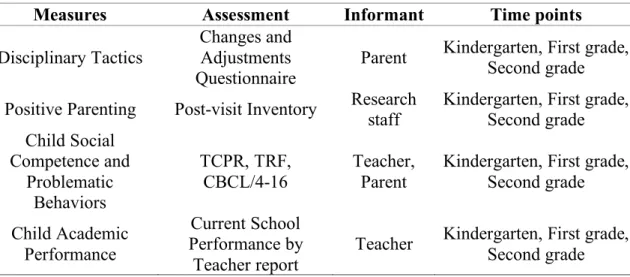
Information pertinent to the present study was collected by interviews and
observations during home visits (Table 3.1 summarizes measures used for manuscript one at different time points). Both interviews and observations were conducted by research staff who previously went through a 4-week training session. Before conducting any real interviews, interviewers were trained to reach a reliability of .80 or higher based on the percentage agreement with a supervisor’s scores across all items. Reliability of scores from actual interviews were calculated by the independent ratings of 56 randomly selected families (9.6% of total) made by a second research staff who was present when the interview was conducted. A 90-minute audio-recorded interview including both open-ended and structured questions was conducted by one research staff with the mother and father (if he was available). During the time when one parent was interviewing, the other parent filled out some questionnaires that were relevant to the project. The other research staff member conducted an interview with the child during this time.
17
Table 3.1. Measures Used for Manuscript One at Three Time Points.
Measures Assessment Informant Time points
Disciplinary Tactics
Changes and Adjustments Questionnaire
Parent Kindergarten, First grade, Second grade Positive Parenting Post-visit Inventory Research staff Kindergarten, First grade, Second grade
Child Social Competence and
Problematic Behaviors
TCPR, TRF,
CBCL/4-16 Teacher, Parent Kindergarten, First grade, Second grade Child Academic
Performance
Current School Performance by
Teacher report
Teacher Kindergarten, First grade, Second grade
Research staff conducting the parent and child home interviews had opportunities to observe the interaction between the parent and child from greeting to the end of the visit. After the home visit, each research staff independently completed a post-visit inventory to summarize their impressions of parent-child interactions.
18
Measures Disciplinary Tactics
Disciplinary tactics were measured by the home interview (kindergarten year) and parent report (first and second grade). During the home visit, parents were asked about their disciplinary experience (either through interview or self-report) in regard to child misbehaviors during the past year. Using the Changes and Adjustments Questionnaire (Dodge et al., 1994), the interviewer recorded and coded parents’ use of particular
disciplinary tactics on a 3-point scale (0=never mentioned, 1=mentioned, 2=emphasized). In the first and second grade, parents reported their use of particular disciplinary tactics on a 5-point scale (0=never, 1=less than once a month, 2=about once a month, 3=about once a week, 4=about every day). The coding was different for the kindergarten year because during the interview at kindergarten parents were allowed to freely mention any disciplinary tactics they used and “2” was coded if specific disciplinary tactic from the list was by chance mentioned. The interviewers followed up by prompting parents those tactics that were not mentioned from the list and “1” was coded if parents responded in the affirmative and “0” otherwise. For parent report in first and second grade, parents were not given the chance to express freely their disciplinary tactics but rather were asked about their frequencies of using specific disciplinary tactics listed on the questionnaire. The listed tactics included TO, privilege withdrawal, simple command, reasoning, verbal hostility (yell or scold, raise voice), physical punishment (grabbing, shaking, spanking with hand or objects), coercive order (get child to apologize; make amends), extra-work penalty (give child extra chores), threatening, shaming, and positive reinforcement (promise treat for good behavior). Scores from TO, privilege withdrawal, simple
19
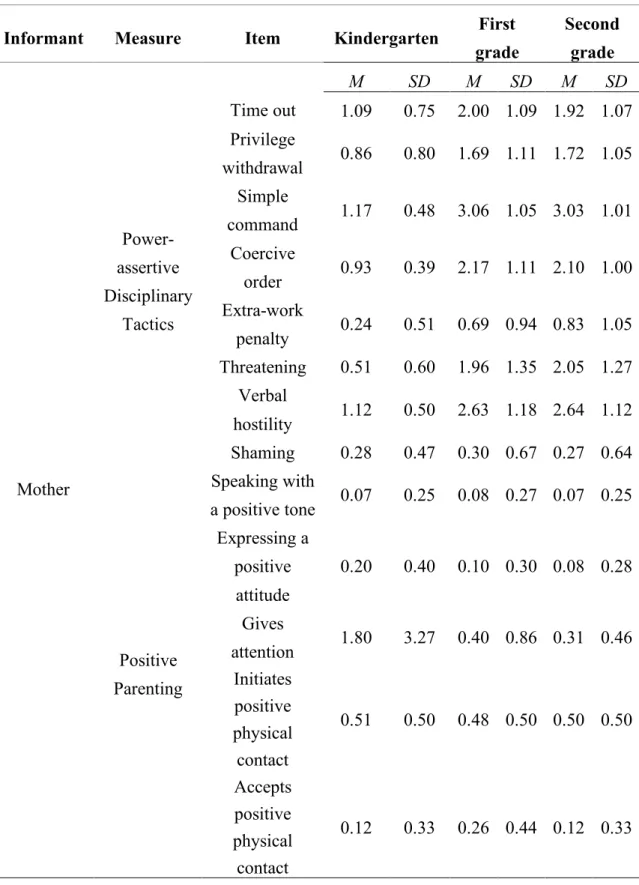
command, coercive order, extra-work penalty, and threatening were summed in the current study to create a composite measure of power-assertive disciplinary tactics for mothers and fathers1 respectively within kindergarten year, first and second grade
(descriptive statistics for each category of the composite measure are presented in Table 3.2). The composite measure of derogatory disciplinary practices was created similarly by summing scores from verbal hostility and shaming with each era (see Table 3.2). Both the individual scores of specific disciplinary tactics and the composite scores of power-assertive disciplinary tactics and derogatory disciplinary practices were standardized for use in the statistical analysis. The interrater agreement was high (r = 0.80) at the
kindergarten year 2 and internal consistencies of the disciplinary tactic measure across the
three time points are shown in Table 3.3.
1 Data regarding fathers’ disciplinary tactics were only available for fathers at the
kindergarten year
2 Interrater agreement was only available at the kindergarten year because in subsequent
20
Table 3.2. Descriptive Statistics for Unstandardized Disciplinary Tactics and Positive Parenting Measures.
Informant Measure Item Kindergarten First
grade Second grade M SD M SD M SD Mother Power-assertive Disciplinary Tactics Time out 1.09 0.75 2.00 1.09 1.92 1.07 Privilege withdrawal 0.86 0.80 1.69 1.11 1.72 1.05 Simple command 1.17 0.48 3.06 1.05 3.03 1.01 Coercive order 0.93 0.39 2.17 1.11 2.10 1.00 Extra-work penalty 0.24 0.51 0.69 0.94 0.83 1.05 Threatening 0.51 0.60 1.96 1.35 2.05 1.27 Verbal hostility 1.12 0.50 2.63 1.18 2.64 1.12 Shaming 0.28 0.47 0.30 0.67 0.27 0.64 Positive Parenting Speaking with a positive tone 0.07 0.25 0.08 0.27 0.07 0.25 Expressing a positive attitude 0.20 0.40 0.10 0.30 0.08 0.28 Gives attention 1.80 3.27 0.40 0.86 0.31 0.46 Initiates positive physical contact 0.51 0.50 0.48 0.50 0.50 0.50 Accepts positive physical contact 0.12 0.33 0.26 0.44 0.12 0.33
21 Father Disciplinary Tactics Time out 0.99 0.73 - - - - Privilege withdrawal 0.78 0.75 - - - - Simple command 1.24 0.47 - - - - Coercive order 0.92 0.37 - - - - Extra-work penalty 0.15 0.39 - - - - Threatening 0.52 0.63 - - - - Verbal hostility 1.16 0.47 - - - - Shaming 0.21 0.43 - - - - Positive Parenting Speaking with a positive tone 0.01 0.11 0.10 0.31 0.10 0.31 Expressing a positive attitude 0.18 0.39 0.13 0.34 0.08 0.28 Gives attention 0.33 0.47 0.46 0.50 0.43 0.50 Initiates positive physical contact 0.42 0.50 0.54 0.50 0.55 0.50 Accepts positive physical contact 0.01 0.10 0.34 0.48 0.10 0.31
22
Positive Parenting
Parents’ use of positive parenting tactics was captured by a post-visit inventory completed by two visitors (the parent interviewer and the child assessor) to assess parental warmth and supportiveness toward the child during their naturally-observed interactions (i.e., interactions observed when setting up and concluding the interviews). Items from the post-visit inventory were adopted from the HOME scale (Caldwell & Bradley, 1984). The two visitors each coded parental warmth and supportiveness (for mother and father separately) by noting the occurrence: 0=occured, 1=did not occur. Three items evaluated parental warmth which is defined as an emotion-laden construct (a measure of verbal affection) in the present study: “mother/father speaks to child with a positive tone”, “mother/father expresses a positive attitude when speaking of the child”, and “mother/father gives attention when child talked”. Additionally, parental
supportiveness as a behavioral-oriented construct (a measure of physical affection) was assessed by two items: “mother/father initiates positive physical contact with the child” and “mother/father accepts positive physical contact from the child”. The two visitors had substantial agreement on the sum of their ratings at the kindergarten year 3 (r = .49,
p<.01); internal consistencies across the three time points are presented in Table 3.3. Scores from corresponding items were summed to create two composite measures— verbal and physical affection—for mothers and fathers. respectively. Standardized scores were used for subsequent analysis.
23 T abl e 3 .3 . I nt er na l C ons ist enc y of M ea sur es U se d in M anus cr ipt O ne M ot her di sc ip linary tac tic s Fat he r di sc ip linary tac tic M ot her posi tive pare ntin g Fat he r posi tive pare ntin g C BCL/4 -16 TCP R C hi ld ac ade m ic per for m anc e Exte rnal iz in g proble m In ter nal iz in g proble m Op posi tio nal def ian t di sor der K inde rga rte n 0.55 0.57 0.68 0.6 0.92 0.86 0.69 0.85 0.82 First G rad e 0.81 - 0.78 0.82 0.93 0.89 0.72 0.88 0.92 Sec ond G rad e 0.82 - 0.74 0.86 0.94 0.9 0.73 0.88 0.88
24
Child Social Competence and Behavioral Problems
To assess social competence, classroom teachers completed the Teacher Checklist of Peer Relationships (TCPR; Dodge, 1986). The TCPR is a 5-point scale (from 1=never true to 5 = almost always true) that evaluates child social behaviors and peer relationships in the school setting. Six items that measured child social competence were drawn from the TCPR: “gets along well with peers of the same sex”, “gets along well with peers of the opposite sex”, “isolates him/herself from the peer group” (reverse coded), “accepted by the peer group”, “other children actively dislike this child and reject him or her from their play” (reverse coded) and “other children like this child and seek him or her out for play”. A composite score of social competence was created by summing the scores from these six items, which then will be standardized for use in the data analysis. Inter-item reliability is reported in Table 3.3.
To assess externalizing behavior problems (i.e., aggression, delinquency), teachers also completed the Teacher's Report Form (TRF) of the Achenbach Child Behavior Checklist (Achenbach & Edelbrock, 1986) for each child. TRF is a 118-item scale that assesses a range of children’s adaptive functioning and behavioral problems, with a scoring system from 0=not true, 1=somewhat or sometimes true, to 2=very true or often true. The TRF externalizing subscale include 51 items that assess child aggressive and delinquent behaviors. The scores from these items were summed to form a composite externalizing behaviorproblem score which was standardized to be used in subsequent analysis. Reliability scores are presented in Table 3.3.
Child Behavior Checklist (CBCL/4-16) completed by mothers was used to measure child internalizing problems (50 items). CBCL/4-16 contains 112 items on
25
which the child is rated on a 3-point scale (0=not true, 1=somewhat or sometimes true, 2=very true or often true) for various emotional and behavioral problems (Achenbach & Edelbrock, 1983). A composite score was created for internalizing problems by summing the corresponding items. Again, standardized scores were computed and used in the data analysis.
Child Academic Performance
Teachers reported child academic performance in the current year for four common subjects (reading, writing, spelling, and math) using a 4-point scale (0=Failing, 1=Below Average, 2=Average, 3=Above Average). The internal consistency of this measure is presented in Table 3.3. A composite assessment of child academic
performance was created by summing the scores across all four subjects and standardized scores will be used in further analysis.
Analytic Plan
Given the longitudinal nature of the data in manuscript one, latent growth
modeling was used for the analysis. Latent growth modeling is appropriate for this study because it allows one to estimate the growth trajectories of both parental practices and child outcomes (Bollen & Curran, 2006). And more importantly, it permits an
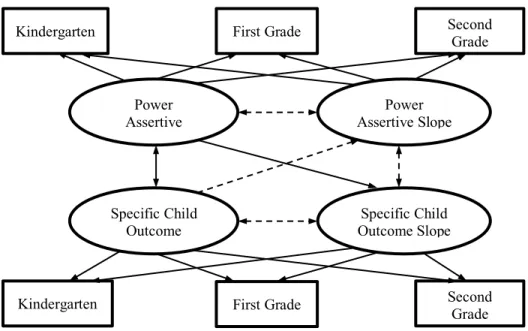
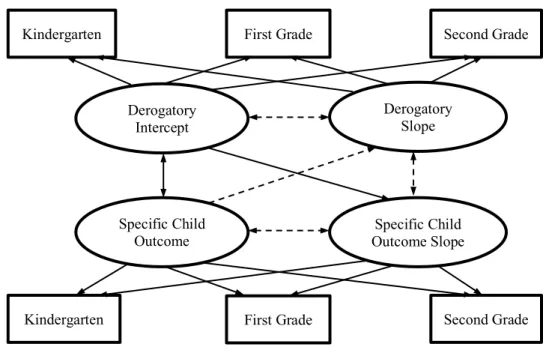
examination of the association between the interceptof independent variables (parental practices in this study) and boththe intercept and slope of dependent variables (both positive and negative child outcomes in this study). In other words, it offers an opportunity to answer the question: how does the initial level of parental practices
influence both the initial level and the rate of change of child outcomes (both positive and negative) across time (see Figures 1, 2 and 3; dotted lines are the paths not examined in
26
this study)? Moreover, to reduce the chance of drawing causal inference from other observed covariates (e.g., family socioeconomic status, oppositional defiant disorder, problematic behaviors, social competence, academic performance) rather than the variables of interest (parental practices in this study), a propensity score matching approach (Haviland, Nagin, & Rosenbaum, 2007; Haviland, Nagin, Rosenbaum, & Tremblay, 2008) was used as a supplementary analysis to create balance on these
observed covariates for different groups in order to level out the effects of these matched covariates on the outcome variables (child social and academic outcomes in this study). To put it in another way, through matching propensity scores individuals from different groups appear comparable on some observed but theoretically irrelevant covariates, thereby rendering the causal effects attributable to the variables of interest. Missing data were handled by multiple imputation approach.
Figure 3.1. Latent Growth Model for the Association between Power-Assertive Disciplinary Tactics and Specific Child Outcomes.
Power Assertive Intercept Power Assertive Slope Specific Child Outcome Slope
Kindergarten First Grade Second
Grade
Specific Child Outcome Intercept
Kindergarten First Grade Second
27
Figure 3.2. Latent Growth Model for the Association between Derogatory Parenting Practices and Specific Child Outcomes.
Figure 3.3. Latent Growth Model for the Association between Positive Parenting Practices and Specific Child Outcomes.
Derogatory Intercept
Kindergarten First Grade Second Grade
Specific Child Outcome Slope Specific Child Outcome Intercept Second Grade First Grade Kindergarten Derogatory Slope Positive Parenting Intercept Positive Parenting Slope
Kindergarten First Grade Second Grade
Specific Child Outcome Slope Specific Child Outcome Intercept Second Grade First Grade Kindergarten
28 CHAPTER IV
MANUSCRIPT ONE FINDINGS
Model Fit for Growth Curve of Predictors and Outcomes
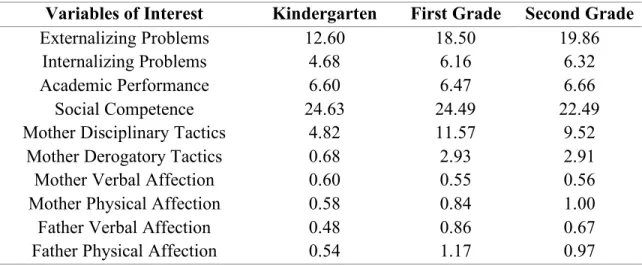
The first step was to determine the shape of growth curve that best fitted each predictor and outcome (i.e., straight line, quadratic curve). The current study adopted the criteria for fit indexes proposed by Hu and Bentler (1999) who recommended that a good fitting model should follow the combinational rules of Comparative Fit Index (CFI) and Tucker-Lewis Index (TLI) above .95, Standardized Root Mean Square Residual (SRMR) below .08, and Root Mean Square Error of Approximation (RMSEA) below .06. For parental practices, linear curve models fit well to the data for mother verbal and physical affection whereas quadratic curve models had better fit for the rest of parenting variables: mother physical affection increased over the three years whereas mother verbal affection generally decreased across time, all other parenting variables first increased from
kindergarten year to first grade and then decreased from first grade to second grade (see Table 4.1 for the change in mean scores). Linear curve models also had good fit with respect to all four child outcomes: externalizing problems, internalizing problems, academic performance, and social competence: both externalizing and internalizing problems increased from kindergarten to second grade while social competence decreased over the three years and academic performance remained relatively stable across time (see Table 4.1 for the change in mean scores across time and see Table 4.2
29
for the fit statistics for the linear and/quadratic models). Models with shapes that had better fit were included in subsequent analyses.
Table 4.1. Change of Mean Scores Across Time for Variables of Interest in Manuscript One.
Variables of Interest Kindergarten First Grade Second Grade
Externalizing Problems 12.60 18.50 19.86
Internalizing Problems 4.68 6.16 6.32
Academic Performance 6.60 6.47 6.66
Social Competence 24.63 24.49 22.49
Mother Disciplinary Tactics 4.82 11.57 9.52
Mother Derogatory Tactics 0.68 2.93 2.91
Mother Verbal Affection 0.60 0.55 0.56
Mother Physical Affection 0.58 0.84 1.00
Father Verbal Affection 0.48 0.86 0.67
30 T abl e 4. 2. Fit S ta tis tic s of L ine ar a nd Q ua dr ati c G row th C ur ve M ode ls for E ac h Pr edi ctor a nd O ut co m e. ꭓ 2 df CF I T LI RM SE A SRMR df CF I T LI RM SE A SRMR Mo ther Dis cip lin ar y T acti cs 562 .19 1. 00 0. 00 -3. 89 0. 98 0. 71 3. 00 1. 00 1. 00 0. 00 0. 00 Mo ther Der o gato ry T acti cs 346 .45 1. 00 0. 00 -3. 25 0. 77 0. 39 0. 00 † 1. 00 1. 00 0. 00 0. 00 Mo ther Ph ysi cal Affec tio n 1. 93 1. 00 0. 98 0. 92 0. 04 0. 02 -Mo ther Ver bal Affec tio n 0. 52 1. 00 1. 00 1. 03 0. 00 0. 01 -F ath er Ph ysi cal Affec tio n 79. 64 1. 00 0. 00 -72. 48 0. 37 0. 14 0. 00 † 1. 00 1. 84 0. 00 0. 01 F ath er Ver bal Affec tio n 47. 42 1. 00 0. 00 -2. 06 0. 28 0. 10 0. 00 † 0. 92 0. 77 0. 08 0. 03 E xter nal izin g Pr o ble ms 11. 59 1. 00 0. 98 0. 94 0. 14 0. 03 -Int er nal izin g Pr o ble ms 5. 89 1. 00 0. 97 0. 90 0. 09 0. 03 -So cial Co mp eten ce 0. 00 † 0. 00 † 1. 00 1. 00 0. 00 0. 00 -Academic Per fo rmance 5. 16 1. 00 0. 99 0. 97 0. 09 0. 02 -† T he m odel is ju st-ide nti fie d w ith z er o deg re e of fr ee dom a nd m odel fi t c an not be a ss es se d i n t his c as e. * p <.05 *** p <.001 0. 00 † -Var iab le Lin ear Mo del Qu adr atic Mo del ꭓ 2 347 .46 0. 00 † -0. 00 †
31
Latent Growth Curve Modeling for Full Sample
With the full sample, 14 of16models (2 models did not converge) that linked disciplinary tactics and positive parenting with different child outcomes had excellent fit to the data (see Table 4.3). A parallel latent growth curve modeling was then preformed to estimate the intercept-slope relationship between parenting variables and child outcomes in two aspects: first, the intercepts of parenting variables and child outcomes were correlated to see whether the initial levels of the former were related to the initial levels the latter; second, the slope of each child outcome was regressed onto the intercept of all parenting variables to determine whether initial level of the latter predicted the change of the former.
32 T abl e 4. 3. Fit S ta tis tic s f or G row th C ur ve M ode ls w ith the F ul l S am pl e ( N = 581) C hil d O ut com e ꭓ 2 df CF I TLI RM SE A SR M R 30.30 7.00 0.98 0.95 0.08 0.05 14.88 7.00 0.99 0.98 0.04 0.02 18.04 8.00 0.98 0.97 0.05 0.03 16.46 8.00 0.99 0.97 0.04 0.02 12.83 7.00 0.99 0.98 0.04 0.03 13.22 7.00 0.98 0.97 0.04 0.03 9.68 8.00 0.99 0.98 0.02 0.02 10.33 8.00 0.99 0.98 0.02 0.02 21.32 7.00 1.00 0.99 0.06 0.06 6.14 7.00 1.00 1.00 0.00 0.01 7.83 7.00 1.00 1.00 0.01 0.03 14.22 9.00 0.99 0.98 0.03 0.03 13.60 8.00 0.99 0.99 0.04 0.02 11.81 8.00 0.99 0.99 0.03 0.03 8.51 8.00 1.00 1.00 0.01 0.02 12.46 8.00 0.99 0.98 0.03 0.02 E xte rn ali zin g P robl em s In te rn ali zin g P robl em s Soc ia l C om pe te nc e A ca de m ic P er for m an ce
33
Predicting the Change in Child Outcomes
No parenting variables were found to significantly predict the change in child externalizing problems over time (power-assertive disciplinary tactics: β = -0.04, p = 0.68; derogatory tactics: β = 0.17, p = 0.29 parent verbal affection: β = 0.12, p = 0.33; parent physical affection: β = 0.23, p = 0.26). None of the intercepts from parenting variables significantly predicted the slope of child internalizing problems (power-assertive disciplinary tactics: β = 0.09, p = 0.63; derogatory disciplinary practices: β = -0.19, p = 0.64; parent verbal affection: β = 0.52, p = 0.28; parent physical affection: β = 0.34, p = 0.61). The intercept of derogatory practices positively predicted the change of child social competence (β =0.05, p = 0.05), meaning a higher initial level of mother derogatory practices was associated with a slower decrease of child social competence. No significant predictions were found from other parenting variables (power-assertive disciplinary tactics: β = 0.02, p = 0.12; derogatory disciplinary practices: β = 0.42, p = 0.16; the models for parent verbal and physical affection did not converge because of problems in iterations). None of the intercepts from parenting variables significantly predicted the slope of child academic performance (power-assertive disciplinary tactics: β = -0.06, p = 0.46; derogatory disciplinary practices: β = -0.06, p = 0.69; parent verbal affection: β = 0.00, p = 1.00; parent physical affection: β = 0.17, p = 0.35).
Predicting the Initial Level of Child Outcomes
Intercepts of child outcomes were predicted by parenting variables at the same time point to understand the relationship between their initial levels. The intercept of child externalizing problems was positively predicted by parent derogatory practices (β = 0.27, p = 0.04), meaning that children had a high level of externalizing problems at the
34
kindergarten year if their parents used a high level of derogatory practices at that time (or vice versa). No other parent variable intercepts significantly predicted the intercept of the child externalizing problem (power-assertive disciplinary tactics: β = 0.11, p = 0.09; parent verbal affection: β = 0.12, p = 0.33; parent physical affection: β = 0.23, p = 0.26). The intercept of child internalizing problems was not predicted by any of the parenting variables intercepts (power-assertive disciplinary tactics: β = -0.07, p = 0.67; derogatory disciplinary practices: β = 0.06, p = 0.71; parent verbal affection: β = 0.12, p = 0.30; parent physical affection: β = -0.20, p = 0.35). For child social competence, the intercept was negatively correlated with derogatory practices (β = -0.37, p = 0.01). The prediction was not significant by parent power-assertive disciplinary tactics (β = -0.07, p = 0.29), and the models for parent verbal and physical affection did not converge because of problems in iterations. Lastly for child academic performance, the intercept was
negatively predicted by the intercept of parent verbal affection (β = -0.33, p < 0.01) and physical affection (β = -0.52, p < 0.01) whereas it was not significantly predicted by power-assertive disciplinary tactics: β = 0.01, p = 0.89) nor derogatory practices (β = -0.06, p = 0.58).
In summary, 5 of the 16 predictions (31.25%) were significant at p < .05 (and one was marginally significant at p < .10), suggesting findings greater than would be
expected by chance. Four concurrent predictions on the initial levels of child outcomes were significant: the initial level of parent derogatory practices was positively correlated with child externalizing problems and negatively correlated with social competence, and the initial level of child academic performance was negatively correlated with both parent verbal and physical affection. One significant intercept-slope prediction was found: The
35
intercept of derogatory practices positively predicted the change of child social
competence, meaning a higher initial level of mother derogatory practices was associated with a slower decrease of child social competence.
Latent Growth Curve Modeling for Mothers versus Fathers
Two separate analyses of growth curve modeling were conducted for data collected for mothers and fathers respectively. The models that linked parenting variables and different child outcomes all had good fit to the data (see Table 4.4).
36 T abl e 4. 4. Fit S ta tis tic s f or G row th C ur ve M ode ls w ith D ata fr om M ot he rs (N = 581) a nd F athe rs (N =577) P ar en t G en de r P re dic tor ꭓ 2 df CF I TLI RM SE A SR M R D isc ipl in ar y T ac tic s 33.12 7.00 0.97 0.94 0.08 0.05 D er og ator y T ac tic s 12.98 7.00 0.99 0.98 0.04 0.02 Ph ys ic al A ffe cti on 17.66 8.00 0.98 0.97 0.05 0.03 V er ba l A ffe cti on 21.07 8.00 0.98 0.96 0.05 0.03 D isc ipl in ar y T ac tic s 18.44 8.00 0.98 0.96 0.05 0.03 D er og ator y T ac tic s 16.06 8.00 0.98 0.96 0.04 0.03 Ph ys ic al A ffe cti on 14.88 8.00 0.96 0.93 0.04 0.03 V er ba l A ffe cti on 13.59 8.00 0.97 0.95 0.04 0.03 D isc ipl in ar y T ac tic s 22.02 7.00 1.00 0.99 0.06 0.06 D er og ator y T ac tic s 5.74 7.00 1.00 1.00 0.00 0.01 Ph ys ic al A ffe cti on 15.91 8.00 1.00 1.00 0.00 0.02 V er ba l A ffe cti on 10.50 8.00 1.00 1.00 0.02 0.02 D isc ipl in ar y T ac tic s 13.35 8.00 0.99 0.99 0.03 0.02 D er og ator y T ac tic s 13.02 8.00 0.99 0.99 0.03 0.03 Ph ys ic al A ffe cti on 9.25 8.00 1.00 1.00 0.02 0.02 V er ba l A ffe cti on 18.21 8.00 0.98 0.97 0.05 0.02 Ph ys ic al A ffe cti on 19.83 10.00 0.98 0.97 0.04 0.03 V er ba l A ffe cti on 18.31 8.00 0.98 0.97 0.05 0.03 Ph ys ic al A ffe cti on 14.23 10.00 0.97 0.96 0.03 0.03 V er ba l A ffe cti on 15.23 8.00 0.96 0.93 0.04 0.03 Ph ys ic al A ffe cti on 14.92 9.00 1.00 1.00 0.03 0.03 V er ba l A ffe cti on 7.38 7.00 1.00 1.00 0.01 0.02 Ph ys ic al A ffe cti on 16.83 10.00 0.98 0.98 0.03 0.03 V er ba l A ffe cti on 9.77 8.00 1.00 0.99 0.02 0.02 Fa th er M ot he r
37
Predicting the Change of Child Outcomes: Mothers
No significant regression was found for any of the parenting variable intercepts in predicting the slope of child externalizing problems for mothers (power-assertive disciplinary tactics: β = 0.04, p = 0.71; derogatory disciplinary practices: β = 0.07, p = 0.65; parent verbal affection: β = 0.16, p = 0.17; parent physical affection: β = 0.13, p = 0.40). Nor did any parenting variable intercepts predict child internalizing problem slope (power-assertive disciplinary tactics: β = 0.12, p=0.63; derogatory disciplinary practices: β = -0.50, p = 0.39; parent verbal affection: β = 0.41, p = 0.34; parent physical affection: β = 0.20, p = 0.58). The intercept of mother derogatory practices positively predicted the change of child social competence (β = 0.05, p = 0.04), meaning a higher initial level of mother derogatory practices was associated with a slower decrease of child social competence. No significant prediction was found for child social competence (marginally significant for power-assertive disciplinary tactics: β = 0.02, p = 0.08; parent verbal affection: β = -0.01, p = 0.60; parent physical affection: β = -0.01, p = 0.58) nor for child academic performance (power-assertive disciplinary tactics: β = -0.11, p = 0.31; derogatory disciplinary practices: β = 0.03, p = 0.84; parent verbal affection: β = 0.02, p = 0.85; parent physical affection: β = -0.12, p = 0.41).
Predicting the Initial Level of Child Outcomes: Mothers.
For child externalizing problems, the intercept of mother verbal affection positively predicted the initial level of child externalizing problems (β = 0.24, p = 0.01). The intercept of mother derogatory practices also positively predicted the initial level of child externalizing problems, although it was only marginally significant (β = 0.22, p = 0.06). No significant prediction was found for mother power-assertive disciplinary tactics (β =
38
0.11, p = 0.17) but the prediction was marginally significant for derogatory practices (β = 0.22, p = 0.06). None of the intercepts of mother parenting variables significantly predicted the initial level of child internalizing problems (power-assertive disciplinary tactics: β = -0.06, p = 0.52; derogatory practices: β = 0.18, p = 0.26; verbal affection: β = 0.13, p = 0.27; physical affection: β = 0.10, p = 0.54). However, the intercept of mother derogatory tactics and verbal affection both significantly negatively predicted the initial level of child social competence (β = -0.30, p = 0.01; β = -0.19, p = 0.04, respectively). No significant predictions were found for other mother parenting variables (power-assertive disciplinary tactics: β = -0.06, p = 0.45; physical affection: β = -0.17, p = 0.13). For child academic performance, the intercept of mother verbal and physical affection negatively predicted the initial level (β = 0.04, p = 0.61; β = -0.03, p = 0.74).
Predicting the Change of Child Outcomes: Fathers.
For fathers, growth curve models were only run for positive parenting variables (i.e., parental verbal and physical affection) because no data were collected for father disciplinary tactics in first and second grade. The intercepts of father verbal and physical affection did not significantly predict the change of child externalizing problems (β = -0.04, p = 0.71; β = 0.18, p = 0.48, respectively), internalizing problems (β = 0.59, p = 0.42; β = 0.25, p = 0.43, respectively), social competence (β = 0.02, p=0.44; β = 0.00, p = 0.98, respectively), nor academic performance (β = 0.19, p = 0.44; β = 0.02, p = 0.84, respectively).
Predicting the Initial Level of Child Outcomes: Fathers
For father parenting variables, the intercepts of verbal and physical affection did not predict the initial level of child externalizing problems (β = -0.09, p = 0.21; β = -0.03,
39
p = 0.86, respectively). Nor did father verbal and physical affection intercepts predict the initial level of child internalizing problems (β = 0.06, p= 0.55; β = -0.33, p = 0.19,
respectively), child social competence (β = -0.12, p = 0.12; β = -0.02, p = 0.92, respectively), or child academic performance (β =-0.03, p=0.68; β = -0.25, p = 0.17, respectively).
To summarize, 4 of the 24 predictions (12.5%) were significant at p < .05 (and three were marginally significant at p < .10), with the findings again greater than would be expected by chance. Three concurrent predictions were found: The intercept of mother derogatory tactics and physical affection both significantly negatively predicted the initial level of child social competence whereas the intercept of mother verbal affection
positively predicted the initial level of child externalizing problems. One intercept-slope prediction was found: The intercept of mother derogatory practices positively predicted the change of child social competence, meaning a higher initial level of mother
derogatory practices was associated with a slower decrease of child social competence.
Latent Growth Curve Modeling for Boys versus Girls
Similar to the analyses conducted for mothers and fathers, growth curve models were run separately for boys and girls.All models had good fit to the data (see Table 4.5).
40 C hil d G en de r C hil d O ut com e P re dic tor ꭓ 2 df CF I TLI RM SE A SR M R D isc ipl in ar y T ac tic s 14.74 7.00 0.97 0.94 0.08 0.06 D er og ator y T ac tic s 9.74 7.00 0.99 0.97 0.05 0.04 Ph ys ic al A ffe cti on 11.83 8.00 0.97 0.95 0.05 0.04 V er ba l A ffe cti on 11.70 9.00 0.98 0.97 0.04 0.05 D isc ipl in ar y T ac tic s 19.39 7.00 0.93 0.86 0.10 0.07 D er og ator y T ac tic s 14.55 7.00 0.93 0.86 0.08 0.05 Ph ys ic al A ffe cti on 4.00 7.00 1.00 1.14 0.00 0.03 V er ba l A ffe cti on 7.97 7.00 0.98 0.96 0.03 0.03 D isc ipl in ar y T ac tic s 12.74 7.00 0.99 0.98 0.07 0.06 D er og ator y T ac tic s 6.29 7.00 1.00 1.00 0.00 0.03 Ph ys ic al A ffe cti on 4.90 7.00 1.00 1.01 0.00 0.03 V er ba l A ffe cti on 11.53 7.00 0.99 0.99 0.06 0.06 D isc ipl in ar y T ac tic s 7.37 8.00 1.00 1.01 0.00 0.03 D er og ator y T ac tic s 7.44 8.00 1.00 1.01 0.00 0.03 Ph ys ic al A ffe cti on 16.22 8.00 0.94 0.89 0.07 0.04 V er ba l A ffe cti on 8.81 8.00 0.99 0.99 0.02 0.03 D isc ipl in ar y T ac tic s 18.24 8.00 0.99 0.97 0.06 0.05 D er og ator y T ac tic s 11.75 8.00 0.99 0.99 0.03 0.02 Ph ys ic al A ffe cti on 12.92 8.00 0.99 0.98 0.04 0.03 V er ba l A ffe cti on 7.00 8.00 1.00 1.00 0.00 0.02 D isc ipl in ar y T ac tic s 11.21 8.00 0.99 0.98 0.03 0.03 D er og ator y T ac tic s 13.15 8.00 0.98 0.97 0.04 0.03 Ph ys ic al A ffe cti on 7.22 8.00 1.00 1.01 0.00 0.03 V er ba l A ffe cti on 6.35 10.00 1.00 1.04 0.00 0.02 D isc ipl in ar y T ac tic s 16.60 7.00 1.00 0.99 0.06 0.05 D er og ator y T ac tic s 5.70 7.00 1.00 1.00 0.00 0.02 Ph ys ic al A ffe cti on 7.06 7.00 1.00 1.00 0.01 0.02 V er ba l A ffe cti on 5.53 7.00 1.00 1.00 0.00 0.02 D isc ipl in ar y T ac tic s 9.42 8.00 1.00 1.00 0.02 0.02 D er og ator y T ac tic s 10.59 8.00 1.00 0.99 0.03 0.03 Ph ys ic al A ffe cti on 7.20 8.00 1.00 1.00 0.00 0.02 V er ba l A ffe cti on 12.85 8.00 0.99 0.98 0.04 0.03 Gi rl E xte rn ali zin g P robl em s In te rn ali zin g P robl em s Soc ia l C om pe te nc e A ca de m ic P er for m an ce B oy E xte rn ali zin g P robl em s In te rn ali zin g P robl em s Soc ia l C om pe te nc e A ca de m ic P er for m an ce T abl e 4. 5 Fi t S ta tis tic s f or G row th C ur ve M ode ls w ith D ata fr om B oys (N = 186) a nd G irl s ( N = 395)