Dissertation
zur Erlangung des akademischen Grades Doktoringenieur (Dr.-Ing.)
vorgelegt an der
Technischen Universität Dresden Fakultät Informatik
eingereicht von
Robert Dietrich
geboren am 10. August 1983 in Dresden
Gutachter:
Prof. Dr. rer. nat. Wolfgang E. Nagel Technische Universität Dresden, Prof. Dr. rer. nat. Matthias S. Müller
Rheinisch-Westfälische Technische Hochschule Aachen
Tag der Einreichung: 6. Mai 2019
The efficient parallel execution of scientific applications is a key challenge in high-performance com-puting (HPC). With growing parallelism and heterogeneity of compute resources as well as increasingly complex software, performance analysis has become an indispensable tool in the development and opti-mization of parallel programs. It is a recurring task as HPC systems and their software stack are regularly replaced and applications have to be ported to the new execution environment.
This thesis presents a framework for systematic performance analysis of scalable, heterogeneous appli-cations. Based on event traces, it automatically detects the critical path and inefficiencies that result in waiting or idle time, e.g. due to load imbalances between parallel execution streams. The building blocks of the analysis are patterns of inefficient execution in the parallelization at process and thread level and in computation offloading. The latter is, compared to the other two, a relatively new programming model in HPC. As a prerequisite for the analysis of heterogeneous programs, this thesis specifies inefficiency patterns for computation offloading. Furthermore, an essential contribution was made to the development of tool interfaces for OpenACC and OpenMP, which enable a portable data acquisition and a subsequent analysis for programs with offload directives. The specified runtime events also enable the tracking of de-pendencies between tasks and thus between program regions on the host and offloaded tasks. At present, these interfaces are already part of the latest OpenACC and OpenMP API specification.
The aforementioned work, existing preliminary work, and established analysis methods are combined into a generic analysis process, which can be applied across programming models. Based on the detection of wait or idle states, which can propagate over several levels of parallelism, the analysis identifies wasted computing resources and their root cause as well as the critical-path share for each program region. Thus, it determines the influence of program regions on the load balancing between execution streams and the program runtime. The analysis results include a summary of the detected inefficiency patterns and a program trace, enhanced with information about wait states, their cause, and the critical path. In addition, a ranking highlights program regions that are relevant for program optimization. The ranking criteria is the amount of waiting time a program region caused on the critical path.
The thesis concludes with a description of the performance analysis framework, its implementation, and application. The scalability is demonstrated using High-Performance Linpack (HPL), while the analysis results are validated with synthetic programs. A scientific application that uses MPI, OpenMP, and CUDA simultaneously is investigated in order to show the applicability of the analysis.
Contents
1 Introduction 3
2 Heterogeneous High Performance Computing 5
2.1 System Architectures . . . 5
2.2 Many-Core Processors . . . 6
2.2.1 Graphic Processing Units . . . 7
2.2.2 Many Integrated Core Architecture . . . 8
2.2.3 Hybrid Processor Architectures . . . 8
2.3 Programming Models . . . 9
2.3.1 Computation Offloading . . . 9
2.3.2 Low-Level Offloading APIs . . . 10
2.3.3 Directive-Based Programming APIs . . . 11
2.3.4 Other Programming Abstractions for Heterogeneous Systems . . . 13
2.3.5 Inter-Process Communication . . . 14
2.3.6 Hybrid Programming Models . . . 16
2.4 Conclusion . . . 17
3 Application Performance Analysis 19 3.1 Performance Challenges in Parallel Programs . . . 19
3.1.1 Scalability . . . 19
3.1.2 Parallelization Overhead . . . 20
3.1.3 Load Balancing and Resource Contention . . . 20
3.2 Performance Analysis Layers . . . 21
3.2.1 Data Acquisition . . . 22
3.2.2 Data Recording . . . 24
3.2.3 Data Inspection . . . 25
3.3 Performance Data Analysis . . . 26
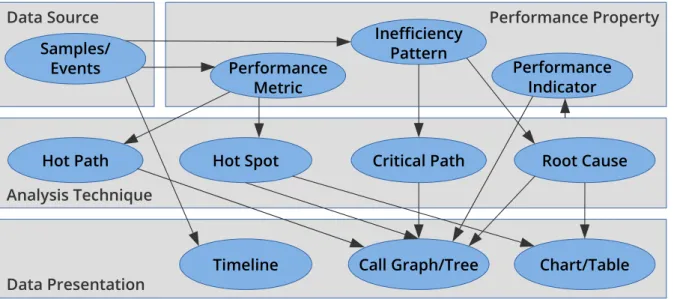
3.3.1 Performance Properties . . . 26
3.3.2 Inefficiency Patterns in MPI and OpenMP Applications . . . 27
3.3.3 Hot-Spot and Hot-Path Analysis . . . 28
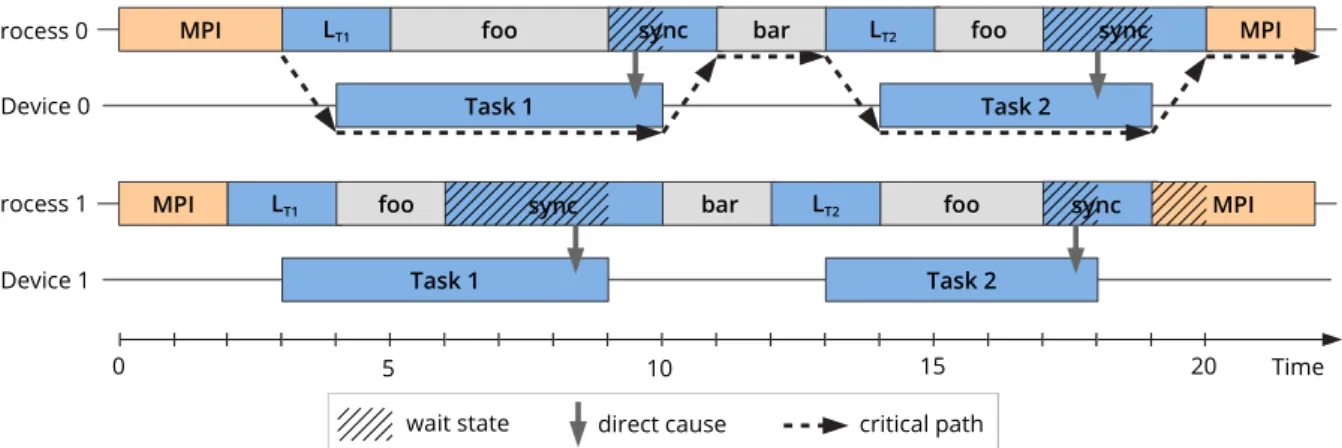
3.3.4 Wait-State Analysis . . . 29
3.3.5 Critical-Path Analysis . . . 30
3.3.6 Analyzing the Cause of Wait States . . . 32
3.4 Related Performance Analysis Tools . . . 34
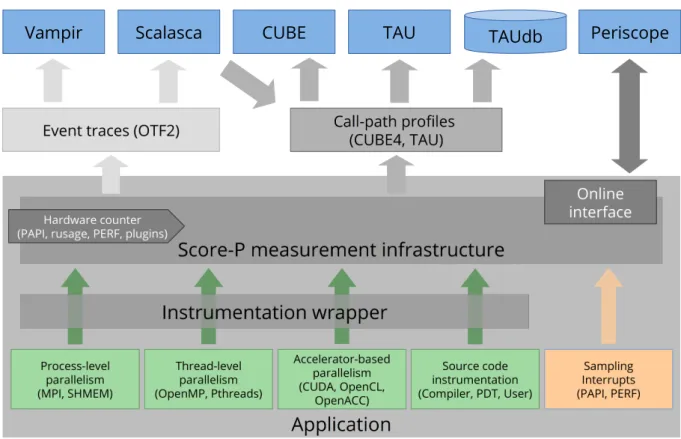
3.4.1 Score-P Performance Tools . . . 35
3.4.2 HPCToolkit . . . 39
3.4.3 CEPBA-Tools . . . 39
3.4.4 Vendor Tools . . . 40
3.5 Conclusion . . . 44
4 Performance Analysis for Computation Offloading 47 4.1 Inefficiency Patterns in Computation Offloading Models . . . 47
4.1.1 Early Device Synchronization . . . 47
4.1.2 Idle Offloading Device . . . 52
4.1.4 Interference of Inefficiencies by Other Paradigms . . . 55
4.2 Data Acquisition for Directive-Based Computation Offloading . . . 57
4.2.1 The OpenACC Profiling Interface . . . 57
4.2.2 The OpenMP Performance Tools Interface . . . 59
4.2.3 Portable Acquisition of Device Activity . . . 61
4.2.4 Sampling the Runtime State . . . 62
5 Generic Performance Analysis for Heterogeneous HPC Applications 63 5.1 Requirements on Performance Data . . . 63
5.1.1 Generic Data Representation . . . 63
5.1.2 Impact of Data Reduction . . . 65
5.2 Parallel Event Trace Analysis . . . 65
5.2.1 Temporal and Spatial Trace Segmentation . . . 65
5.2.2 Distributed and Local Trace Analysis . . . 66
5.2.3 Shared Offloading Devices . . . 66
5.3 Distributed Root-Cause Analysis for Hybrid Programs . . . 67
5.3.1 Parallelization Wait States . . . 67
5.3.2 Blame the Cause of Wait States . . . 69
5.3.3 Propagation of Blame . . . 72
5.4 Distributed Hybrid Critical-Path Analysis . . . 72
5.4.1 Combination of Distributed and Local Critical-Path Analysis . . . 72
5.4.2 Weighted Critical Path . . . 73
6 A Framework for Systematic Performance Analysis 77 6.1 Workflow and Toolset Architecture . . . 77
6.2 Extended Performance Data Collection . . . 77
6.3 A Scalable Trace Analyzer for Hybrid Programs . . . 79
6.3.1 Trace Analysis Procedure . . . 79
6.3.2 Analysis Rules . . . 80
6.3.3 Implicit Dependencies between Offloaded Tasks . . . 81
6.4 Presentation of the Analysis Results . . . 82
6.4.1 Pattern Summary and Optimization Guidance Profile . . . 82
6.4.2 Timeline Visualization . . . 82
6.5 Application of the Analysis by CASITA . . . 83
6.5.1 Synthetic Programs . . . 83
6.5.2 High-Performance Linpack . . . 87
6.5.3 LSMS – Analyzing a Complex Scientific Code . . . 92
7 Conclusion, Future Work, and Outlook 97
Bibliography 99
List of Figures 111
List of Tables 113
Appendix 115
1 Introduction
Most parallel programs offer optimization potential, which, if left unused, wastes an unpredictable amount of computer resources. Especially in high-performance computing (HPC), where scientific sim-ulations can execute on thousands of interconnected compute nodes concurrently, a small inefficiency can have a large impact at scale. In addition, the hierarchical parallelism of computing systems with heterogeneous hardware increases the complexity of application development and thus the challenge of efficient parallelization and load balancing. In November 2018, seven systems in the top 10 of the TOP500 [MSD+] fastest supercomputers in the world were heterogeneous systems with accelerators or coprocessors.
Performance analysis is an indispensable tool to detect execution inefficiencies and optimize applications for such complex systems. As waiting or idle time can propagate over multiple levels of parallelism, e.g. from a delayed task on an accelerator over host threads to another compute node, the actual cause of an inefficiency might be difficult to find. Hence, there is a need for a holistic analysis that covers all parallelization layers in a program.
Due to the regular replacement of HPC systems and changes in the software environment, performance optimization is also a recurring task. It can be significantly shortened by prioritizing inefficiencies and program regions appropriately and thus preventing unnecessary local optimizations that have a negli-gible influence on the overall runtime. Such a systematic approach requires a sophisticated analysis, which nevertheless can be executed in a timely manner, even for large-scale applications with hybrid parallelization.
In HPC, MPI+X has been established to develop scalable heterogeneous programs [GS13]. While the Message Passing Interface (MPI) is the defacto standard for communication between nodes, prominent X-models for node-local parallelization are OpenMP, OpenACC, OpenCL, and CUDA [MLP+17]. Due to the variety and the combined use of multiple X-models, performance analysis becomes more complex.
Main Contribution
This thesis proposes a framework for systematic performance analysis of scalable, heterogeneous ap-plications, which covers process- and thread-level parallelism as well as computation offloading. It addresses two essential aspects that have so far been neglected: potential inefficiencies with computa-tion offloading and generic analyses across programming models. Furthermore, established analyses are combined in such a way that inefficiencies and program regions can be prioritized to enable a more focused optimization process.
In HPC, computation offloading is a relatively new programming concept, compared to process- and thread-level parallelization. On the basis of common offload application programming interfaces (APIs), the underlying programming model is examined and generic inefficiency patterns are specified. In the context of this thesis, a significant contribution was also made to the specification of the tool interfaces for OpenACC and OpenMP, which build the basis for corresponding performance data collection and subsequent analysis.
Using this groundwork and existing preliminary work on performance analysis of MPI and OpenMP applications, a generic analysis is presented. Based on wait and idle states, it determines wasted com-puting resources and their cause as well as the influence of program regions on the load balancing and the overall program runtime. The analysis results are presented in form of a program region profile, a summary of all inefficiencies, and timelines. In the core analyses, the implementation is independent of APIs and can detect further inefficiencies and wait states by adding new analysis rules. It is applied to synthetic and real-world programs to validate the applicability, correctness, and scalability.
Structure of this Thesis
After the brief introduction to the topic of this thesis, the first part of Chapter 2 describes heteroge-neous systems as a target platform for the developed performance analysis. The second part describes the most relevant programming models and APIs that are used on such systems, including a short intro-duction to computation offloading as an additional parallelization layer next to process- and thread-level parallelization. The following Chapter 3 discusses the state-of-the-art in performance monitoring and analysis as well as related software tools. After discussing previous work in this area of research, the following chapters present the contribution of this thesis. The first part of Chapter 4 specifies potential inefficiencies in the execution of programs with computation offloading. To enable a reasonable analysis of programs with OpenACC and OpenMP target directives, respective tool interfaces are presented in the second part of the chapter. Based on this preliminary work, Chapter 5 presents the proposed generic analysis for scalable heterogeneous programs and their requirements on the performance data. To vali-date the analysis, its implementation in a software tool as well as its application to synthetic programs and a scientific use case are described in Chapter 6. Moreover, the scalability is demonstrated. Chapter 7 concludes this thesis with a summary of the scientific contribution and an outlook on future work.
Formatting and Terminology
To ease reading, different font styles are used. Italicshighlights the introduction of new terms or terms that are taken from the original sources or referenced figures.Typewriter fontis used for function names and code segments.
The term accelerator refers to compute devices, which are attached to a host processor to speed up parts of the computational workload. As the implied acceleration is not given, other names are also used synonymously. For example, Intel calls their Xeon Phi extension boardscoprocessors, whereas the programming APIs CUDA and OpenCL use the termdevice. The OpenACC API specification describes directives for accelerators and OpenMP provides device constructs fortarget devices. For abstraction, the termsoffloading device,compute device, or onlydeviceare used.
In the context of this thesis, the termsheterogeneous computing,heterogeneous program,heterogeneous hardware, andheterogeneous systemrefer to the coexistence or combined use of central processing units (CPUs) and additional compute devices.
Computation offloadingdescribes the programming model used by programming APIs such as CUDA, OpenCL, OpenACC, and OpenMP target. In HPC, this refers to the offloading of computational work-load from a host CPU to other compute devices.
2 Heterogeneous High Performance Computing
Today’s computing systems are usually composed of heterogeneous computing resources, often with ad-ditional many-core processors such as graphics processing units (GPUs) or Intel Many Integrated Core (MIC) coprocessors. Referring to the 52nd TOP500 list [MSD+] of the fastest supercomputers, a sig-nificant number of systems (137 out of 500, 27,4%, 7 in the top 10) utilize accelerator or coprocessor technology. There are several reasons for the success of many-core devices in general-purpose comput-ing. One reason is the efficient execution (also in terms of energy) of massively data-parallel workloads. Another reason is the availability of GPUs in almost every computer, which provides virtually everyone with access to heterogeneous hardware.
The use of heterogeneous hardware introduces additional challenges for software development. Usu-ally, it is necessary to use an additional programming model or API. Another layer of parallel compute resources also increases the complexity of load balancing. Furthermore, applications on heterogeneous systems should benefit from advantages of different hardware architectures and compensate their indi-vidual drawbacks, which requires knowledge of the functioning of each architecture. As a rule of thumb, serial and hardly parallel parts of an application should be executed on a multi-core processor with high single-core performance, whereas massively parallel parts are appropriate for offloading to many-core processing units such as GPUs or Intel MIC coprocessors.
The first part of this chapter, section 2.1, gives an overview on current heterogeneous HPC system archi-tectures. Section 2.2 provides more details on the currently widely used many-core device types GPUs and Intel MIC. As basis for the contributions of this work, Section 2.3 introduces the offloading con-cept and the currently most relevant programming APIs for the development of scalable applications on heterogeneous system architectures.
2.1 System Architectures
Today’s large-scale systems are composed of multiple compute nodes, which are connected through a network. A compute node is typically equipped with one or two multi-core CPUs, which share local memory in the form of dynamic random access memory (DRAM). The major number of large-scale systems and the fastest supercomputers in the world are distributed-memory systems, so called comput-ing clusters, where nodes cannot address the memory of another node. Fast network interconnects are either based on InfiniBand or they are proprietary such as Intel’s Omni-Path, NVIDIA’s NVLink, and Cray’s Aries interconnect. The most common network topologies for large-scale systems are tree or torus layouts [BDG+16].
There are also shared-memory systems based on non-uniform memory access (NUMA), where all CPUs share a large amount of (virtual) memory. Large systems of this kind are distributed shared memory systems, where the memory is distributed across nodes, but exposed as a shared resource. This allows programs to use a large amount of (shared) memory. However, the locality of the memory is hidden to the program. To achieve decent performance, remote memory accesses are tried to reduce to a minimum, as they introduce an extra penalty. Shared-memory systems are not used at very large scale, as ensuring coherence and memory consistency introduces additional costs [SSR95] and it is not required in most scalable applications, which use message passing instead.
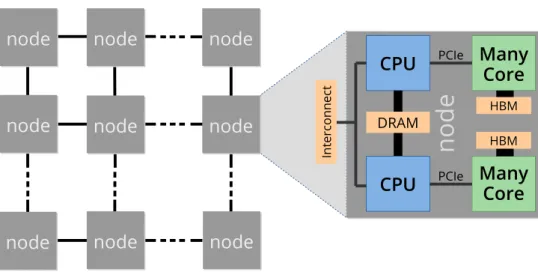
In general, heterogeneity of computing resources implies multiple different compute units or processors, often also with different instruction set architectures (ISAs). Mostly, it means that a combination of CPU and many-core processor is used. Figure 2.1 shows the conceptional composition of a heterogeneous
node
node
no
de
no
de
In te rc on ne ctCPU
DRAMMany
Core
PCIeCPU
PCIeMany
Core
HBM HBMnode
node
node
node
node
node
node
node
node
node
node
node
node
node
node
node
Figure 2.1: Heterogeneous HPC clusters use multiple types of processors, e.g. one or two CPUs and additional many-core devices per compute node. Different topologies are used to connect compute nodes (illustration shows a 2D mesh). The interconnects are either proprietary or they are based on InfiniBand or Gigabit Ethernet.
computing cluster, where each node is equipped with two CPUs and two GPUs. Current offloading devices for HPC are equipped with high bandwidth memory (HBM), which is physically separated from the node’s main memory. Hence, a heterogeneous compute node is already a distributed memory system. A major bottleneck of heterogeneous HPC compute nodes has been the limited bandwidth of the Pe-ripheral Component Interconnect Express (PCIe) bus with about32 GByte/secfor PCIe 3.0. It is used to communicate and exchange data between the CPU and the offloading device. GPUs from NVIDIA and AMD as well as Intel’s Knights Corner (second generation of Intel’s MIC) are connected via PCIe on systems with AMD or Intel platforms. Recent proprietary interconnects, such as NVIDIA NVlink, reduce the this communication bottleneck by providing a higher bandwidth. Nevertheless, it is still re-quired to move data to and from offloading devices, which is a challenge for the development of efficient heterogeneous applications on most HPC systems, where offloading devices have their own memory.
2.2 Many-Core Processors
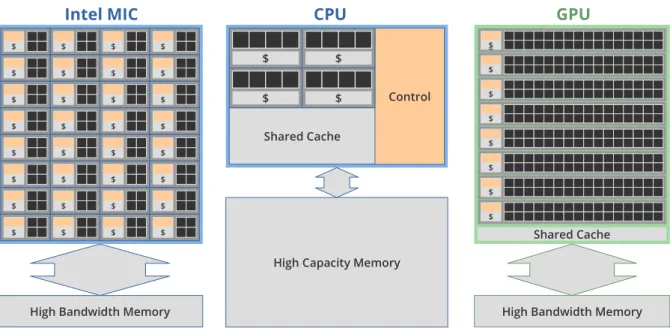
Two many-core hardware architecture types have established in HPC in the past years: GPUs and Intel’s MIC architecture. To distinguish the use of GPUs for graphics processing from its use for general purpose computations, the term general-purpose computing on graphics processing units (GPGPU) has been introduced. Figure 2.2 illustrates basic similarities and differences between the architecture of CPUs, GPUs and Intel MIC. Table 2.1 provides a quantitative comparison of respective high-end products launched in 2016 of these three processor architectures. The theoretical peak performance of the Intel CPU has been determined as described in [Dol16].
Starting with the launch of the Tesla product series, NVIDIA released the first GPU for HPC in 2007, which was deployed in the 29th most powerful supercomputer in TOP500 list [MSD+] in November 2008. The first Intel MIC product was released in 2012 under the branding of the processor product family “Intel Xeon Phi”. In November 2012 the first system with Intel MIC technology (Stampede) entered the TOP500 list [MSD+] directly in the top 10 at rank 7. The Green500 list [cFC07], a ranking of the most energy-efficient supercomputers in the world, is dominated by GPU-based systems.
Juckeland also describes in [Juc12] other accelerator technologies and special purpose solutions that did not gain enough market share and therefore were discontinued. Hence, this work will briefly explain only the concepts of GPUs, Intel MIC, and the combination of CPU and GPU as a hybrid processor. Other relevant many-core processors are the Matrix-2000, which is used as an accelerator in Tianhe-2A (rank 4
Shared Cache
High Capacity Memory
High Bandwidth Memory Control $ Shared Cache CPU GPU $ $ $ $ $ $ $ $ $ $ $
High Bandwidth Memory $ Intel MIC $ $ $ $ $ $ $ $ $ $ $ $ $ $ $ $ $ $ $ $ $ $ $ $ $ $ $ $ $ $ $
Figure 2.2: Heterogeneous compute nodes use multiple processor architectures. The dedicated memory of offloading devices is optimized for high bandwidth, whereas the usually larger CPU main memory is optimized for short latencies. Typical CPUs have more control logic than many-core processors. The latter use more chip area for arithmetic logic units (ALUs) and their core designs are less complex and their caches are smaller.
Feature Xeon Phi 7290 CPU E5-2699v4 GPU Tesla P100
Number of Cores 72 22 3584(FP32)
Max. Clock Frequency [GHz] 1.7 3.6 1.48
FP64 Peak Performance [GFLOPS] 3456 986 5304
Max. Memory Bandwidth [GB/s] ~400 76.8 720
Last-Level Cache Size [MB] 36 (L2) 55 (L3) 4 (L2)
Table 2.1: Performance indicators for an Intel Xeon Phi 7290 [Int16b], an Intel E5-2699v4 CPU [Int16c], and an NVIDIA Tesla P100 GPU [NVI16]
in TOP500 list [MSD+] from November 2018), and the PEZY-SC2, which is used as an accelerator in the most energy-efficient system according to Green500 in November 2018 [FS18]. Both are conceptional similar to the Intel MIC architecture.
2.2.1 Graphic Processing Units
Although GPUs are used for accelerated graphics visualization in the segment of desktop computers for a long time, their final breakthrough in HPC happened with the Titan system at Oak Ridge National Laboratory in 2012, the first GPU-based supercomputer with a peak performance over 10 petaFLOPS (PFLOPS). According to the 45th TOP500 [MSD+] list from June 2015, Titan was with 17.59 PFLOPS on the Linpack benchmark the second fastest supercomputer in the world.
Compared to the microarchitecture of CPUs and Intel MIC, GPUs have much simpler cores with less control logic and smaller caches. Hence, a larger percentage of the die (silicon) can be used for ALUs. GPU cores are grouped into so called streaming multiprocessors (NVIDIA) or compute units (AMD). They share resources such as a common cache and schedulers for GPU thread groups. Recent GPU architectures provide special purpose units, e.g. tensor cores in NVIDIA Volta GPUs [NVI17] for deep learning. Modern GPUs have a last-level cache (LLC), which is compared to the LLC in CPUs (most
often the L3 cache) much smaller. Similar to the L2 cache in CPUs, GPUs provide scratchpad memory that is shared across all ALUs in a compute unit (AMD) or streaming multiprocessor (NVIDIA). Fur-thermore, the scratchpad memory is managed by software and therewith a key property for the tuning of GPU kernels.
2.2.2 Many Integrated Core Architecture
The Intel MIC architecture uses the x86 ISA, which enables the use of programming APIs such as MPI, OpenMP and Pthreads. The first commercial MIC product is the Knights Corner(KNC) coprocessor board, which is connect via the PCIe bus with the host CPU. KNC boards can either operate in offloading mode as coprocessor (similar to GPUs), in native mode as independent processor that runs a whole application, or in a symmetric manner with the host. The latter mode allows some processes of a program to execute on the CPU and others on the Xeon Phi coprocessor. Nevertheless, it is necessary to use vectorization, multithreading, and data locality to achieve decent performance [JR13]. The fastest KNC coprocessors, e.g. the Xeon Phi 7120D, provide up to 61 cores with a total theoretical peak performance of 1.2 teraFLOPS (TFLOPS) (double precision). The enhanced P54C cores with in-order execution are capable of four-way simultaneous multi-threading (SMT) and provide a 512-bit-wide vector unit. The successor of KNC is Knights Landing (KNL). Primarily designed as standalone processor, KNL is based on the Airmont microarchitecture with out-of-order execution, which improves the single-core performance over KNC. The up to 72 cores support AVX-512 instructions and provide a theoretical peak performance of about 3.5 TFLOPS (double precision). The offloading concept (see Section 2.3.1) is supported by offloading computations from a normal Intel Xeon CPU server to an Intel Xeon Phi server with Intel’s proprietary OmniPath interconnect.
2.2.3 Hybrid Processor Architectures
Hybrid processors combine two types of processors on a single die, often with different instruction set architectures (ISAs). In the context of general purpose computing, a hybrid processors integrates a CPU and another processor. A common combination are CPU and GPU. AMD APUs, NVIDIA Tegra, Intel Sandy Bridge Core processors and their successors are commercially available hybrid processors, which address the desktop and the mobile personal computer market. The IBM Cell processor is another promi-nent hybrid processor architecture, where the Power Processor Element (PPE) controls the Synergistic Processing Units (SPUs).
An important characteristic of recent hybrid processors is the shared memory, which supersedes data transfers over external buses, such as PCIe. Since the Intel Sandy Bridge microarchitecture, all Intel Core processors also have a cache that is shared between the CPU cores and the on-die GPU.
The Heterogeneous System Architecture (HSA) is a cross-vendor standard, which covers the specifica-tion of a system architecture, a programmer’s reference manual, and a runtime programmer’s reference. It “is designed to efficiently support a wide assortment of data-parallel and task-parallel programming models.”[Fou18] Furthermore, it allows the efficient integration of multiple processors with potentially different ISAs, e.g. a CPU and a GPU. An important requirement for HSA-conformance is a shared virtual memory for all processing units, which eases the programming of heterogeneous processor, e.g. due to enabling so called zero-copy operations [SAF12]. Nevertheless, data have to be copied between processing units if they do not physically share a memory. CUDA 6 also introduced unified virtual memory.
Other combination candidates for CPUs in hybrid processors are field programmable gate arrays (FP-GAs) and potentially also Intel MIC. Intel Arria FPGAs combine ARM CPU cores as fixed logic and programmable logic that characterizes typical FPGAs. Due to the reconfigurability of FPGAs, the hard-ware can adapt to the needs of applications and not vice versa. In the context of embedded systems, hybrid processor architectures are called multiprocessor system-on-chips (MPSoCs).
Time Host
Target Task
submit task
launch test test test wait
request status ensure completion
queue
Figure 2.3: Asynchronous computation offloading
2.3 Programming Models
To effectively utilize the hardware resources of large heterogeneous computing clusters, several paral-lelization models and programming APIs have to be used in combination. There are three paralparal-lelization levels that need to be covered in HPC: inter-node parallelization, shared-memory parallelization and computation offloading. With regard to the programming APIs, MPI is the de facto standard for inter-process and therewith also inter-node communication, whereas OpenMP has become a widely-adopted programming API for shared-memory parallelization based on threads. In addition, a number of APIs for computation offloading have evolved to cope with the trend towards complex heterogeneous system architectures.
Section 2.3.1 introduces the concept of computation offloading. The following sections describe pro-gramming models and APIs that are used to develop heterogeneous HPC applications. If it is not further specified, this thesis refers to MPI 3.1, CUDA 9.0, OpenCL 2.2, OpenACC 2.5, and OpenMP 4.5. Com-mon offloading APIs basically differ in the abstraction level for the programmer, which influences the performance and the portability between different compute devices.
2.3.1 Computation Offloading
Computation offloading is the process of transferring the execution of computational tasks to a target processor, device, or system. It describes a host-centric programming model, where the host triggers the offloading of tasks, may request their execution status, or wait for offloaded tasks. Figure 2.3 illus-trates the concept in a timeline visualization. Offloaded tasks are typically submitted to a target queue before they start executing. This allows the target device to autonomously schedule tasks on the assigned resources when they are available.
Offloading can be performed either synchronous or asynchronous with the host execution. In the first case, the host triggers the offloading task and directly waits until it is completed. Asynchronous of-floading gives the control back to the host, after the task has been submitted to its target. The host can continue execution and start waiting for the target if it cannot proceed otherwise. Synchronization or wait operations are a potential waste of computing resources and hence an inefficiency, which should be considered in application development and performance analysis.
A reasonable computational task generates output data and most often also consumes input data. Hence, computation offloading requires data movement between the host and the target resource, if both do not share the same memory. In the discussed offloading models, the host also initiates the allocation and deallocation of memory on the target device as well as the data transfer between host and device. In HPC, workloads are offloaded to specialized compute devices mostly via the PCIe bus or vendor specific interconnects such as NVIDIA’s NVLink within a compute node. With the Xeon Phi processor x200 (KNL architecture) Intel introducedoffload over fabric[Int16a], which enables offloading to other compute nodes.
For mobile devices there are obvious reasons for offloading of computations to remote devices [KLLB13], e.g. the mobile device cannot execute a task due to resource limitations (not enough main memory or insufficient compute resources), reducing the load to save energy on the mobile device, or improve per-formance. The latter is the main reason for computation offloading in HPC. However, energy efficiency is currently a key factor to build exascale systems [BP13]. GPUs and Intel MIC processors can pro-cess massively data-parallel workloads more efficiently than CPUs, which enables faster execution and energy savings.
Computation offloading has some similarities with multiple program, multiple data (MPMD) paralleliza-tion and task-based programming approaches. In the MPMD model, different programs can be executed simultaneously. Each program uses different data. This is similar for computation offloading, where the host and all its targets can execute a different program and process different data. However, the host controls the programs of the offloading targets.
Computation offloading uses the term task as a unit of work, which is executed on a target resource. Similar to other task-based models, it allows dependencies between tasks. Other inherent computation offloading dependencies include the task trigger on the host to start before the associated offloaded task and the host wait operation for a task to end after the associated task.
2.3.2 Low-Level Offloading APIs
The offloading of general purpose computations to GPUs, hardware that was initially optimized for graphics, became popular with the introduction of programmable shaders and respective APIs such as Directx and OpenGL. Programming APIs such as CUDA and OpenCL hide most of the underlying graphical concepts in favor of general-purpose-computing capabilities. The proliferation of NVIDIA GPUs in desktop and HPC systems has established NVIDIA’s proprietary programming model CUDA for GPGPU. According to the TOP500 list [MSD+] from November 2018, rank one and two as well as three other supercomputers in the top ten are equipped with NVIDIA GPUs. OpenCL is a vendor-independent open standard which can be applied on a large variety of target devices, which provides a portability advantage over CUDA.
CUDA
In November 2006 NVIDIA introduced the Compute Unified Device Architecture (CUDA), the first programming model for GPUs that did not require in-depth knowledge of graphics programming. It extends the C programming language with new constructs to allow the execution of subroutines, so called kernels, on the GPU. The programming of such device kernels is described in detail in [NVI18a]. Kernels are passed to the GPU scheduler and executed as asynchronous tasks sequentially within a device execution stream (see Figure 2.3). Since CUDA 9 and the NVIDIA Pascal architecture, a single kernel instance can be executed on multiple GPUs of the same type (see cooperative groups in [NVI18a]). Data transfers are handled similar to kernels as tasks, which are submitted to a device stream. Multiple device streams can be associated with a single GPU to enable the concurrent processing of tasks on a device. CUDA events are submitted to a device stream to describe inter-stream dependencies, take timestamps on the device, or serve as synchronization point for the host.
CUDA also describes a general-purpose parallel computing platform [NVI18a], where different hardware revisions or GPU generations provide different compute capabilities. A higher capability means more functionality with 1.0 being the lowest.
OpenCL
The Open Computing Language (OpenCL) [Khr19] is an open standard that abstracts from hardware-specific APIs such as CUDA and enables portable access to compute devices from numerous different
Kernel Hierarchy NDRange work item OpenCL grid CUDA thread work group thread block
Hardware Mapping compute device processing element OpenCL CUDA device CUDA CUDA core compute unit multiprocessor
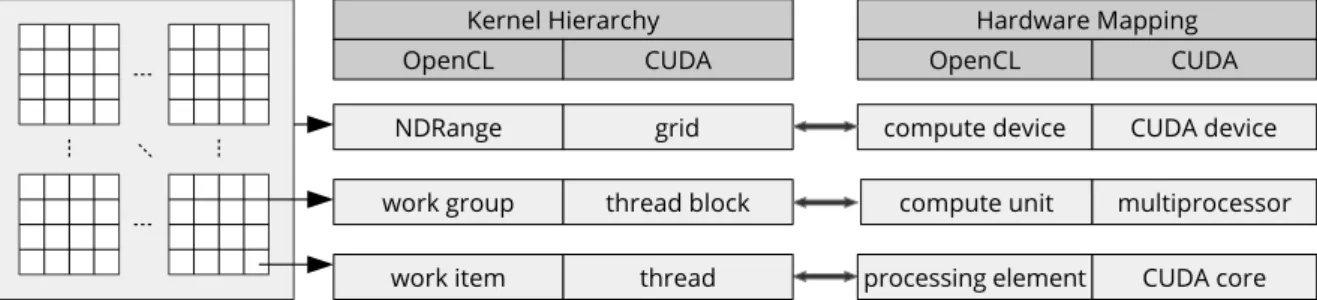
Figure 2.4: Hierarchical decomposition and hardware mapping of device kernels with OpenCL and CUDA terminology
vendors. Therefore, it can be used for programming of heterogeneous computing systems that are com-posed of diverse compute resources. It is also intended to run on supercomputers and personal computers as well as on embedded systems and mobile devices.
OpenCL consists of an API for coordinating parallel compute resources, compute kernels and buffer objects as well as a kernel language that utilizes a subset of ISO C99 with extensions for parallelism to program the compute devices. The programming model uses the concept of command queues to enable concurrent processing of tasks on a single device. A device task, such as a compute kernel and a data transfer, can be associated with an OpenCL event, which can be used to describe task dependencies (also between different command queues), gather timing information of tasks, query the task’s execution status, and wait for the completion of a task.
CUDA and OpenCL Device Kernels
The programming of parallel device kernels in CUDA and OpenCL follows a similar principle. Many threads or workers concurrently execute the kernel code, which is a sequential description of instructions. As each of them has a unique identifier, they span an index space and can operate on different data. Kernels are hierarchically decomposed to map to CUDA’s and OpenCL’s hardware model.
In CUDA terminology, a kernel spans a grid of thread blocks, whereas OpenCL defines a kernel as an n-dimensional range (NDRange) of work groups. The smallest structural unit is a CUDA thread or an OpenCL work item. Figure 2.4 illustrates the hierarchical decomposition of the computation index space of device kernels for two dimensions. It also shows the mapping of the kernel hierarchy to the hardware model, which is similar, except for the terminology.
A CUDA device is composed of multiple simultaneous multiprocessors (SMs), which themselves group a set of CUDA cores. The cores in an SM share a scratchpad memory for fast data exchange. The slower global device memory has to used for data exchange between SMs. OpenCL devices are decomposed into compute units, which contain a set of processing elements and a shared scratchpad memory. CUDA’s hierarchical execution model further specifies warps as a group of 32 CUDA threads. All threads in a warp execute the same instruction simultaneously, which is similar to vector processing. Different warps can execute different instructions at the same time and therewith provide thread-level parallelism. Context switches between warps enables the SM to hide memory latencies.
2.3.3 Directive-Based Programming APIs
Parallel programming based on compiler directives is an alternative to threading APIs such as Pthreads and low-level offloading APIs such as CUDA and OpenCL. Instead of function calls, parallelization hints for the compiler are inserted as comments in the sequential source code, which maintains the code basis for sequential execution, but also allows compilers to generate efficient parallel code. Hence, compiler directives provide a non-intrusive way to port sequential code to parallel programming models.
Directive-based programming APIs typically try to hide hardware-specific details to uniformly program new architectures. Implementation effort is shifted from the application developer to compilers and runtime systems, which avoids a time-consuming and difficult rewrite of application kernels. However, it is still necessary to expose the program’s parallelism in a reasonable way.
To simplify the programming of heterogeneous systems and provide a less intrusive way to introduce computation offloading in existing codes, directive-based offloading APIs have emerged. Widely used are OpenMP [OMP18] and OpenACC [OAC18]. They are both developed and standardized by a con-sortium and are supported by numerous commercial and open-source C, C++ and Fortran compilers which support different target platforms. OpenMP has been initially designed to enable thread-level par-allelism on shared memory systems. Recent extensions to the specification also enable the programming of so called target devices that might have a separate memory address space. OpenACC is focusing on computation offloading and has established as an effective alternative to CUDA and OpenCL.
Other directive-based offloading approaches are Intel’s Language Extension for Offloading (LEO) and HMPP [DBB07]. LEO is proprietary developed by Intel and has mostly been merged into OpenMP 4.0. HMPP has been discontinued and its feature set is almost fully covered by OpenACC.
OpenACC
OpenACC has been designed to create high-level host+accelerator programs without the need to ex-plicitly initialize the accelerator, manage data or program transfers between the host and accelerator, or initiate accelerator startup and shutdown. The OpenACC standard defines a host-directed execution model with an attached accelerator and a memory model that allows data movement to be implicit or explicit between host and accelerator.
OpenACC defines a hierarchical execution model for compute regions on the device, which is similar to CUDA and OpenCL device kernels (see Section 2.3.2). A compute region is executed by a number of gangs, each with one or more workers, which may execute vector operations. A possible mapping of gang, worker, and vector to CUDA’s kernel execution model are thread block, warp, and threads. However, this mapping depends on the target architecture and the compiler.
OpenACC provides the fundamental constructs kernelsand parallelfor computation offloading. The kernelsconstruct defines a region of the program that shall be executed on the device using a sequence of kernels. It gives control over any parallel execution to the compiler that will try to parallelize loop nests in thekernelsregion. Gang size, worker size and vector length may be different for each kernel. The parallelconstruct defines the parallel execution on the device explicitly. When it is encountered during the program execution, one or more gangs of workers are created. Gang size, worker size and vector length will remain constant until the end of the region. One worker in each gang starts executing the code until aloopconstruct is encountered. Work is shared across gangs and workers for the execution of the immediately following loop. Code within aparallelregion but outside of aloopconstruct is executed redundantly by all gangs (see [OAC18]).
The OpenACC standard defines thedataconstruct and theenter dataandexit datadirectives to create data regions. In combination withdataclauses they are used to control data lifetime on the accelerator as well as data motion between host and accelerator. Data clauses that annotated to compute constructs implicitly create a data region. The update directive is used to update data on the device with its corre-sponding data on the host or vice versa.
The async clause enables asynchronous data movement and computation on the device. It may have a single argument to identify the respective device operation or select an asynchronous device activity queue. When there is no asyncclause on a compute or data construct, the host waits until the device finishes execution, as if a wait clause has been added to the construct. The OpenACC standard also specifies the standalonewaitdirective and theacc_wait*API routines, which block execution of the host thread to synchronize with asynchronous operations or activity queues on the device. If theasyncclause is used on awaitdirective, a synchronization point is added to the device activity queue which prevents newly enqueued activities to execute before this point.
OpenMP
OpenMP is one of the most widely used programming APIs for thread-level parallelization on shared-memory architectures. Several additional paradigms such as tasking, offloading and single instruction, multiple data (SIMD) processing have been added over time. The threading concept is a typical fork-join model. The fundamental constructparallel annotates code regions that shall be executed in parallel. When a thread encounters it, a team of threads is created to execute the parallelregion, whereby the encountering thread gets the master thread of the team.
The OpenMP standard definesworksharingconstructs to distribute the work among the members of a thread team. The following worksharing constructs are defined in the API:loop, sections, single and workshare. Consult the OpenMP specification [OMP18] for a detailed description. At the end of a worksharingconstruct there is an implicit barrier, unless anowaitclause is specified.
An explicit barrier is generated with the standalonebarrierdirective. This executable directive creates a synchronization point (and also atask scheduling point) for a team of threads, which cannot continue execution beyond the barrier until all threads in the team and all explicit tasks generated by the team are completed. When a thread is waiting in a barrier it is potentially wasted time which makes them a reasonable investigation objective for performance analysis.
OpenMP introduced a tasking model in version 3.0 of the standard, which has been revised in subse-quent specifications. With OpenMP 4.0 several new constructs address the architecture of many-core processors. Thesimdconstruct enables vectorization of loops to leverage the full potential of processors with wide vector units, e.g. the Intel MIC architecture. Thedistributeandteamsconstructs address the hardware architecture of GPUs by enabling to distribute work across teams of threads, which is similar to gang parallelism in OpenACC or thread blocks in CUDA.
OpenMP for Computation Offloading
To address the programming of heterogeneous systems, OpenMP 4.0 has introduceddeviceconstructs, which enable the execution of code regions on a target device. Similar to OpenACC, target data regions are used in OpenMP to control data lifetime on the target device and data motion between host and device. Data motion operations can be explicitly performed using themap clause or thetarget update construct. The target construct is an executable directive that annotates code regions to be executed by a device. Except for targetconstructs, the behavior of all other OpenMP constructs is specified when enclosed in atargetregion.
OpenMP 4.5 introduces thetarget task, which integrates OpenMP’s offloading concept into its tasking model and therewith enables the programmer to specify dependencies between the execution of target regions and other OpenMP tasks. Atarget,target update,target enter data, ortarget exit dataconstruct generates atarget task, which is executed on the host. The structured block of the target construct is executed as an offloaded task on the device, similar to a compute kernel or data transfer in OpenCL and CUDA.
The nowait clause on a target construct enables asynchronous offloading (see Section 2.3.1). If the nowaitclause is not present, thetarget region is executed immediately by the encountering task which blocks the execution on the host thread while the device is executing the enclosed code block. Synchro-nization of target tasks is performed at task synchroSynchro-nization points such astaskwaitandbarrierregions. OpenMP does not define a query mechanism to request the execution status of offloaded tasks. Instead of multiple sequential device queues, OpenMP uses its tasking model with task dependencies for ordered and concurrent execution of offloaded tasks.
2.3.4 Other Programming Abstractions for Heterogeneous Systems
Besides the presented offloading APIs, several programming abstractions for heterogeneous computing have been developed. They address two major challenges: performance portability and load balancing.
The first group, which focuses on performance portability to different hardware types, are C++ abstrac-tion libraries, such as KoKKos [ETS14], RAJA [HK14], and Alpaka [ZWW+16]. They all require com-piler support for C++ lambda expressions and support several backend APIs for node-level parallelism, including CUDA and OpenMP. KoKKos and RAJA define their own programming model and have been designed to explore the parallelism of existing sequential code. Both use a forall-template method on loops with some form of execution policy, which basically means that the loop body is separated from its traversal. This allows the implementation of different hardware-specific memory access patterns. Al-paka combines concepts from CUDA, OpenCL, and OpenACC into a single source code abstraction. Instead of describing loop nests, it uses the concept of kernels, which are executed by each thread in the grid, similar to CUDA and OpenCL. Alpaka defines the three hierarchy levels known from CUDA (grid, block, and thread) and adds element as a fourth level to address vectorization. The parallelization hierarchy level corresponds to a particular memory level. Data accesses and transfers are transparent and not optimized by the Alpaka library.
The second group focuses on load balancing based on tasks and data dependencies. StarPU [ATNW11] and StarSs [PBAL09] are task-based programming models which provide a uniform way to program heterogeneous computing architectures. The respective runtime systems schedule tasks, resolve data dependencies, and automatically generate data transfers to hardware targets with physically distributed memory. Both define an own API, which allows program developers to declare task and data dependen-cies. OmpSs [FBM+14] is an implementation of StarSs, which supports several OpenMP task directives. It has been used as a research environment for the support of task dependencies in OpenMP. The addi-tionalimplementsclause allows the program developer to write multiple implementations of a task and gives the runtime scheduler more flexibility in distributing tasks on the available devices. StarPU also supports OpenMP task directives [AAB+17], since OpenMP 4.0 introduced task dependencies. Both runtime systems rely on the compiler to generate appropriate code for offloading devices or libraries that use the offloading devices. Hence, custom device kernels still have to be programmed in native device languages. The Parsec framework [BBD+13] is also able to dynamically schedule tasks over computing resources on distributed heterogeneous compute nodes. Furthermore, it can generate an internal directed acyclic graph (DAG) representation from the serial code, without the need for additional annotations. Legion [Bau14] is more data-centric programming model, which includes a runtime that schedules tasks. It uses so calledlogical regionsto partition program data, which is used to express data locality and also data independence. Tasks execute the code and access logical regions, which allows the Legion runtime to identify independent tasks and enable concurrent task processing on heterogeneous platforms. The hardware mapping has to be defined by the program developer based on Legion’s mapping interface. Charm++ [RBK16] also focuses on efficient workload distribution. Therefore, it provides a framework for scheduling and execution management of heterogeneous tasks, including automatic optimizations, such as overlapping between computations and data transfers. Besides the management of native ac-celerator kernels, it allows the automatic generation of acac-celerator code, which is based on source-code annotations. Charm++, Legion, and OmpSs distribute work over multiple compute nodes based on MPI. As the presented programming abstractions build on top of programming APIs such as MPI, OpenMP, CUDA, and OpenCL, they inherit their execution inefficiencies (compare Section 3.3.2 and 4.1). Offload-ing libraries, such as cuBLAS and cuFFT for NVIDIA GPUs, offer an even higher level of abstraction and usually also the best performance. However, they only provide a limited set of algorithms for special device types and are therefore not very flexible to use.
2.3.5 Inter-Process Communication
To develop scalable applications for large computing clusters, communication between nodes is nec-essary. State-of-the-art HPC applications often use message passing to scale across compute nodes. Partitioned Global Address Space (PGAS) approaches are less often used, although they provide some advantages over message passing.
Message Passing Interface
MPI is the most widely-adopted message passing interface for communication between processes. The open-source projects OpenMPI and MPICH provide high-performance implementations of this interface. “MPI addresses primarily the message-passing parallel programming model, in which data is moved from the address space of one process to that of another process through cooperative operations on each process” [Mes15].
Most scientific HPC applications are single program, multiple data (SPMD) codes. This basically means that all processes execute the same program on different data. MPI is most often used to communicate or synchronize between processes. However, there are also MPI-based MPMD codes, where different processes execute different programs, e.g. multi-physics codes. MPI supports both execution modes, SPMD and MPMD.
The MPI standard specifies several communication types: Blocking and non-blocking point-to-point and collective operations as well as one-sided remote memory access (RMA) operations including synchro-nization calls. MPI point-to-point requires active communication partners: sender and receiver. In case of blocking point-to-point communication, the respective MPI routines block until the operation is com-pleted. For example,MPI_Recvblocks the execution of the process until the data is received.MPI_Send blocks until the data has been sent, which however does not guarantee that the data has already been received. MPI collectives are communication or synchronization operations on a group of processes, e.g. a barrier, a broadcast or a gather operation. Non-blocking MPI point-to-point communication and collectives just trigger the messaging, the data transfer or synchronization itself is performed afterwards. The completion can be force with MPI wait operations. To avoid a blocking wait, it is also possible to test for the completion of a non-blocking operation.
MPI one-sided RMA communication uses a per-process memory window which is accessible by other processes. A communication requires only one active process, which specifies all necessary information. MPI one-sided also defines synchronization mechanisms, which define the ordering of data accesses or force completion of all data accesses in a window.
Blocking communication and synchronization operations induce waiting time, which makes them a rea-sonable point for investigation in performance analysis. Section 3.3.2 describes inefficiencies that might occur in MPI applications.
Partitioned Global Address Space
The PGAS programming model intends to combine the advantages of shared memory and distributed memory programming models. These are the simplicity of data access using a global address space (shared memory) and the data locality in message passing models. Remote references are resolved by the compiler or PGAS library into inter-process communication. The address space is partitioned in a way that each process has local memory but also shares memory with an affinity to exploit locality. The latter is useful to improve the performance, because a process can access local data faster than remote data. One-sided communication, which is also available in MPI, is intended to improve inter-process performance compared to two-sided communication.
PGAS languages can be built on top of MPI libraries since version 3.0 that introduced one-sided com-munication. However, this will typically result in limited performance as MPI libraries are often not optimized for one-sided communication [DBH+12, HGC14]. It is more reasonable to build PGAS lan-guages using libraries that are optimized for one-sided communication and support the concept of a global and distributed memory. GASPI (Global Address Space Programming Interface) [ABB+13] and SHMEM are PGAS APIs. Examples for PGAS programming languages are Coarray Fortran, Chapel, and X10 [DWMDF+15].
Time Target Thread 2 Thread 1 H os
t MPI LH2D Lfoo LD2H omp_foo sync MPI
offloaded_foo
H2D D2H
omp_foo
1 2 3 4 1
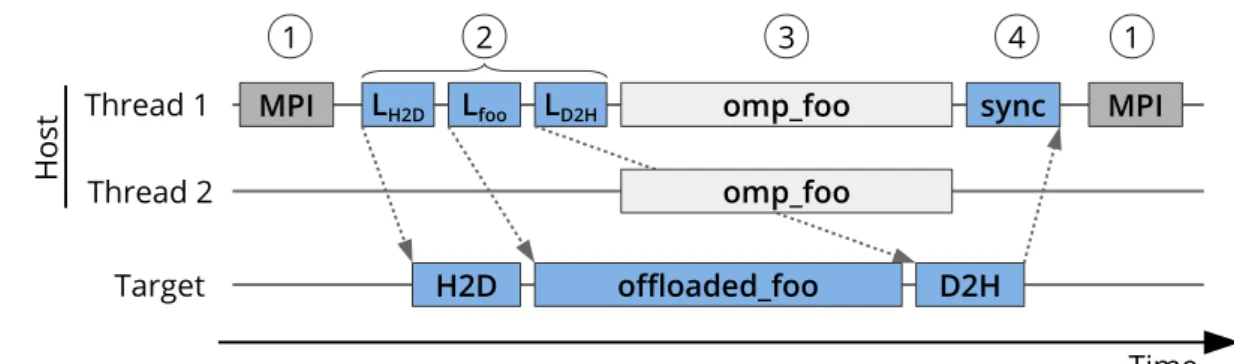
Figure 2.5: Exemplary execution pattern of hybrid MPI, OpenMP, and offloading: (1) MPI communica-tion or synchronizacommunica-tion with other processes, (2) host triggers offloading tasks (host-to-device data transfer, computational task, device-to-host data transfer), (3) OpenMP parallel execu-tion (on two threads), (4) and synchronizaexecu-tion of the asynchronously offloaded tasks.
2.3.6 Hybrid Programming Models
Hybrid programming combines multiple programming models to effectively address different parallel layers in the architecture of computing systems. Primarily, this requires an appropriate mapping of pro-gramming model and hardware resource. Message passing enables communication between compute nodes (different address spaces). Threads are used for efficient parallelization in a shared memory do-main, e.g. within a compute node. Computation offloading is typically used to move highly data-parallel workloads to many-core processors.
In a hybrid MPI/OpenMP program, MPI ranks normally do the communication, while OpenMP threads perform the computation in parallel on available compute cores. As computation and communication of-ten do not overlap, most cores are idle during the communication part. Typically, this cannot be avoided without algorithmic changes. Another challenge is the arrangement of processes and threads, as both can be used to parallelize computation. The optimal setup of threads and processes is difficult to deter-mine [CH01, DK04]. It depends on many factors, including the system’s hardware and its configuration, the MPI and OpenMP implementations being used, and the data locality [DWK+17]. On dual-socket systems, a typical setup uses one MPI rank per CPU and one thread per available CPU core.
Computation offloading adds another parallel execution layer, which usually requires data transfers be-tween host and device (see Section 2.3.1). Host-device communication results in device idle, if it cannot be hidden behind computation. Furthermore, the memory access has to be optimized for different proces-sors [MMBS16], which may require data transformations. Due to the different hardware characteristics of multi-core and many-core processors, the workload cannot be evenly distributed, which results in another challenge in terms of load balancing (see Section 3.1.3).
To optimize data transfers between GPUs on different compute nodes, there are GPU-aware implemen-tations of MPI [WPB+14]. They ease the data movement in MPI+GPU applications, such that the programmer can pass GPU memory pointers to MPI functions using a unified virtual address space. This also enables a faster data exchange between GPUs, as the MPI library can directly send and receive GPU buffers without the need to explicitly stage them in host memory first.
There is no prescribed hierarchy between message passing, multithreading, and computation offloading. However, there are common usage patterns, which are driven by data access latencies and bandwidths. Data movement between nodes is typically slower than between a CPU and an offloading device, which in turn is slower than shared memory accesses of threads. Hence, many applications use the pattern shown in Figure 2.5, which allows concurrent computations on host and offload device. Potential in-efficiencies in the OpenMP parallelization and waiting times in MPI communication are disregarded in the figure, but discussed separately in Section 3.3.2. Section 4.1.4 evaluates combination options of computation offloading with message passing and multithreading.
2.4 Conclusion
Heterogeneous systems have already established in HPC. Currently, the most common many-core pro-cessors are GPUs [MSD+], usually installed on expansion cards with dedicated memory. Hence, a single compute node is already a distributed-memory system, which requires memory transfers to exchange data between CPU and many-core processors. Processor chips that combine several processor types and have a common memory are so far rarely used in HPC.
Additional compute devices are usually controlled via the parallelization model computation offload-ing, which is implemented in four known APIs: CUDA, OpenCL, OpenACC, and OpenMP. Based on these offloading APIs, there are several abstraction libraries, which can partially hide the additional par-allelization layer and simplify programming. Nevertheless, the potential inefficiencies of computation offloading remain.
There are also several programming APIs for inter-process communication and multithreading, with MPI and OpenMP being the dominating representatives. In summary, hybrid parallelization or parallelization over multiple levels of parallel compute resources is indispensable for the efficient programming of current heterogeneous systems. Nevertheless, available programming models and APIs hardly consider performance portability, which remains a challenge for software development for heterogeneous systems.
3 Application Performance Analysis
The complexity of computer architectures and software environments for parallel computing is a tough challenge for the efficient execution of parallel programs. A difficult but important task is load balancing, which causes poor resource utilization if performed inappropriately [CVKG10, PMM+15]. Performance analysis enables a more efficient use of computer resources by identifying inefficient execution behavior and other performance-critical optimization targets, such as runtime-dominating code regions. It is an essential part in the development cycle of applications and a vital step to generate optimized code. This chapter provides an overview of the state of the art in performance analysis of parallel programs. As a starting point, Section 3.1 describes performance challenges for such programs. Subsequently, performance-analysis steps are introduced in Section 3.2, whereupon Section 3.3 focuses on the analysis of performance data. Section 3.4 presents well-known performance analysis tools. The chapter closes in Section 3.5 with a summary of the most important findings as a basis for the contributions of this work.
3.1 Performance Challenges in Parallel Programs
Parallel and serial performance aspects characterize the execution of a parallel program. The latter in-clude the computational efficiency of the single-threaded code and the efficient use of the processor’s memory hierarchy. However, the focus of this thesis are parallel performance challenges. They include the mapping of processes and threads to the compute hardware, communication and synchronization between processes, threads, and offloading devices as well as workload balancing and idle compute resources. In addition, the complexity of program codes, the need for hybrid programming (see Sec-tion 2.3.6), or inefficiencies that only appear in large-scale execuSec-tions amplify the parallel performance challenge.
3.1.1 Scalability
Good scalability of an application is one of the main challenges, to make efficient use of large-scale computers. Scalability considers the speedup of an application when increasing its parallel processing re-sources. In an ideal case the speedup is equivalent to the number of parallel processing resources [Hil90]. Hence, the efficiency of parallelization determines the scalability of an application.
Scalability can be distinguished between computational and communication scalability. The former considers the workload or problem size of a program. In HPC, strong and weak scaling are distinguished. Strong scaling varies the compute resources for a fixed problem size, which, according to Amdahl’s law [Amd67], makes the serial portion of a program a limiting factor for the speedup. Weak scaling varies the problem size and the compute resources proportionally. It is governed by Gustafson’s law [Gus88], which assumes that the serial fraction of a program does not increase with the problem size.
Communication scalability determines the efficiency of data transfer or synchronization operations when the number of communication partners is increased. It depends on the communication pattern, the un-derlying network topology, and the implementation of the communication library in use. For example, a broadcast can be implemented in several ways, e.g. by sending individual messages from the root process to all participating receivers or with a binary tree where messages traverse a tree [PGAB+07]. Communication may also depend on the placing of processes and might be improved by matching logical communication with the underlying physical network topology.
3.1.2 Parallelization Overhead
The parallelization of a program causes overhead in terms of data movement, synchronization between concurrent control flows, and execution management. The total amount of time that is spent in such operations can be denoted as parallelization overhead or parallelization costs. It can be divided into the following categories:
Communication: data transfers and synchronization between processes, threads, and offloading devices
Management: initialization and finalization of processes, threads, and offloading devices
Extra Work: computational work that is not needed in the sequential execution
Minimizing the parallelization overhead is the key to maximizing the speedup of parallel processing and consequently to improve the parallel efficiency of a program. Formula 3.1 illustrates the impact of the parallelization overhead on the parallel efficiency as defined in [EZL89] (fornprocesses).
En= t(serial execution) n∗t(parallel execution) = t(1) n∗ max 1≤p≤n(twork(p) +tparallel_overhead(p)) ⏐ ⏐ ⏐ ⏐ t... time (3.1)
Hence, an increase in the parallelization overheadtparallel_overhead(p)decreases the parallel efficiencyEn,
if the parallel computing timetwork(p)remains constantly. The parallelization overhead can be mostly
determined from a function profile, although the extra work might be hard to expose.
Some parallelization costs are unavoidable, even in embarrassingly-parallel applications, because pro-cesses, threads, or other compute devices have to be managed (e.g. initialized) and data must be dis-tributed to the respective compute resource. Therefore, it is reasonable to distinguish between avoidable parallelization overhead and necessary parallelization costs. For example, waiting times due to load imbalances are avoidable, whereas real communication and synchronization time might be necessary. This thesis focuses on the detection and evaluation of waiting times to expose load imbalances and their causes, which, however, requires the analysis of temporally ordered events instead of profile data (see Section 5.1).
Rosas et al. [RGL14] define the parallel efficiency as a product of the load-balance efficiency, the se-rialization efficiency, and the transfer efficiency, which are determined based on program traces Thus, they distinguish the impact of three potential performance problems: load imbalances, serialization due to data dependencies, and data movement costs.
3.1.3 Load Balancing and Resource Contention
Load balancing across compute resources of massively-parallel systems is a difficult task and certainly a key factor for good parallel performance. For an SPMD execution on homogeneous compute resources, load imbalance can be defined as the differences in workload between processes [Her09], which means that the optimal speedup is achieved by evenly distributing work across processes. For the MPMD model, additional balancing is required between groups of processes executing the same program. Besides the workload, application developers have to balance the communication, which is subject to dynamic effects of the interconnect network and its topology.
Workload balancing on heterogeneous compute resources introduces an additional challenge. To achieve an optimal speedup, work needs to be distributed according to the compute capabilities of the available processing hardware. Considering the energy efficiency, a reasonable mapping of workloads to suitable compute devices is required. It might be even useful to exclude compute devices from workload balanc-ing, e.g. to minimize the power per computation. However, this thesis focuses on reducing the overall program runtime, which most often also reduces the energy footprint.
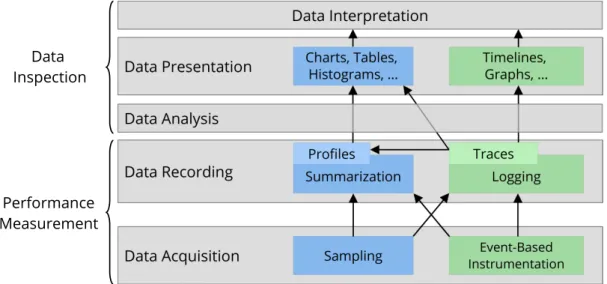
Data Inspection
Performance Measurement
Figure 3.1: The performance analysis process can be divided into separate layers, each comprising sev-eral techniques or concepts.
Imbalanced execution between processes or threads can also be caused by resource contention. In HPC systems, the file system and the interconnect network are usually shared resources, which affects parallel input/output (I/O) operations or inter-node communication. The parallel access to the last-level cache of a CPU can cause dynamic imbalances [KBH+08]. Hence, the same operation can take a different amount of time, depending on the state of the shared resource.
The oversubscription of computing resources can also result in waiting times. For example, more threads can be spawned than CPU cores are available. An offloading device can be used as shared resource between multiple processes or threads. Sharing a resource can increase its utilization, but potentially introduces imbalances in the execution.
When imbalances are not compensated, they might force some processes to wait before they synchronize with each other. This results in so called wait states (see Section 3.3.4). As small imbalances can add up to considerable waiting times at scale, they are an important target for performance optimization.
3.2 Performance Analysis Layers
According to Jain [Jai91] a system monitor for performance analysis is composed of several layers, which are shown in Figure 3.1. Juckeland [Juc12] adopted these layers for application performance analysis, but distinguishes only between data acquisition, data recording and data presentation. However, the main contribution of this work is in the data analysis and data interpretation layer.
The first essential step in the analysis process is data acquisition. Independent of the method that gen-erates data, they are recorded and typically made persistent as profiles or traces in a subsequent step. Whereas a profile contains already summarized data, traces can always be aggregated to profiles. The next step is the data analysis. To keep the impact on the program execution as low as possible, time-consuming and sophisticated or complex data analysis is typically performed after recording data. Sim-ple analysis such as aggregation or counting of events can already be done during data acquisition, which can reduce the amount of data that has to be stored. The data presentation layer covers all types of visual-ization of profiles and traces as basis for the result interpretation, which is usually done by a performance analyst or the program developer. Automated data interpretation can also be performed directly after the data analysis.