Hedging Inventory Risk Through Market Instruments
∗Vishal Gaur†, Sridhar Seshadri†
October 27, 2004
Abstract
We address the problem of hedging inventory risk for a short lifecycle or seasonal item when its demand is correlated with the price of a financial asset. We show how to construct optimal hedging transactions that minimize the variance of profit and increase the expected utility for a risk-averse decision-maker. We show that for a wide range of hedging strategies and utility functions, a risk-averse decision-maker orders more inventory when he/she hedges the inventory risk. Our results are useful to both risk-neutral and risk-averse decision-makers because: (1) The price information of the financial asset is used to determine both the optimal inventory level as well as the hedge. (2) This enables the decision-maker to update the demand forecast and the financial hedge as more information becomes available. (3) Hedging leads to lower risk and higher return on inventory investment. We illustrate these benefits using data from a retailing firm.
KEYWORDS: Demand forecasting, Financial hedging, Newsboy model, Real Options, Risk aversion.
∗
The authors thank Marti Subrahmanyam and seminar participants at Case Western Reserve University, North-western University, Rutgers University, University of Michigan and University of Texas Dallas for helpful comments. They also thank Garrett J. van Ryzin, the Senior Editor and two anonymous referees for many helpful suggestions. The work of the second author is partially supported by NSF Grant DMI-0200406.
†
Department of Information, Operations and Management Science, Leonard N. Stern School of Business, New York University, Suite 8-160, 44 West 4th St., New York, NY 10012. E-mail: [email protected], [email protected].
1
Introduction
The demand for discretionary purchase items, such as apparel, consumer electronics and home furnishings, is widely believed to be correlated with economic indicators. Our analysis not only supports this belief but also shows that the correlation can be quite significant. For example, the Redbook Average monthly time-series data1 for the period November 1999 to November 2001 have a correlation coefficient of 0.90 with the same-period returns on the S&P 500 index (R2 = 81%, see Fig. 1). Further, using sector-wise data, we find that the value of R2 is correlated with the fraction of discretionary items sold as a percentage of total sales. For example, discretionary items comprise a larger fraction of total sales for apparel stores and department stores than discount stores. Correspondingly, apparel stores and department stores have a higher correlation of demand with the S&P 500 index than discount stores (see Table 1). Our results are supported by firm-level analysis as well. Fig. 2 shows that for The Home Depot Inc.,2 sales per customer transaction and sales per square foot both have statistically significant correlation with the value of the S&P 500 index. TheirR2 values are equal to 79.11% and 39.92%, respectively.
These findings present an opportunity to use financial market information to improve demand forecasting and inventory planning, and use financial contracts to mitigate (hedge) the risk in car-rying inventory. This paper addresses these problems for discretionary purchase items based a forecasting model that incorporates the subjective assessment of the retailer and the price infor-mation of a financial asset.
We show how to construct static hedging strategies in both the mean-variance framework and
1
The Redbook Average is a seasonally-adjusted sales-weighted average of year-to-year same-store sales growth in a sample of 60 large US general merchandise retailers representing about 9000 stores (Instinet Research (2001a, 2001b)). It is released by Instinet Research on the first Thursday of every month.
2
Home Depot is a retail chain selling home construction and home furnishing products. We use public data from the first quarter of fiscal 1997 to the second quarter of fiscal 2001, a total of 22 quarterly observations. The data are obtained from the 10-K and 10-Q reports of Home Depot filed with the Securities Exchange Commission.
the more general utility maximization framework. In the mean-variance framework, we determine the optimal portfolio that minimizes the variance of profit for a given inventory level. This hedge could be complex to create in practice. Therefore, we motivate a heuristic hedging strategy and evaluate its performance with respect to the optimal hedge. We similarly derive the structure of the optimal hedging strategy in the utility maximization framework. Finally, we analyze the impact of hedging on the expected utility of the decision-maker and on the optimal inventory decision. The overall contribution of this paper is to show how to generate a solution to the hedging problem and analyze how the hedging solution affects inventory levels. We, however, note that most of the results derived in this paper are either standard or obtained by a combination of standard results. Researchers in inventory theory have considered both risk-neutral and risk-averse decision-makers, but none have studied the impact of hedging on decision-making. According to the received theory, a risk-neutral decision-maker is unaffected by the variance of profit, thus is indifferent towards hedging inventory risk (for example, see Hadley and Whitin 1963, Lee and Nahmias 1993, Nahmias 1993, Porteus 2002, Zipkin 2000). For a risk-averse decision-maker, it is well known that the expected utility maximizing inventory level is less than the expected value maximizing inventory level (for example, see Agrawal and Seshadri (2000a and 2000b), Chen and Federgruen (2000), Eeckhoudt, et al. (1995) and the papers cited therein). While it seems reasonable to conjecture that risk-averse decision-makers will prefer to hedge inventory risk, it is less obvious whether the hedge will also lead to an increase in the quantity ordered. We show that hedging impacts both types of decision-makers:
1. Hedging reduces the variance of profit and increases expected utility. The reduction in the variance of profit is directly proportional to the correlation of demand with the price of the asset.
2. It provides an incentive to a risk-averse decision-maker to order a quantity that is closer to the expected value maximizing quantity. This result holds for a wide range of hedging
strategies and for all increasing concave utility functions with constant or decreasing absolute risk aversion.
3. The hedging transactions do not require additional investment. On the contrary, the funds required to finance inventory at the beginning of the planning period are offset by the cash flows from the hedging transactions, so that the net inventory investment of the firm is reduced.
The last result shows that hedging is useful even to a risk-neutral decision-maker although he/she may not be interested in reducing the variance of profit in a perfect market.3 Hedging is especially useful to small privately owned firms, e.g., the so-called “Mom and Pop” retail stores, because risk reduction provides them access to capital, reduces the cost of financial distress, and enables the owners to diversify their risk and increase their return on investment.
We present a numerical study using data from a retailing firm to quantify the impact of our results on forecasting demand, optimal inventory planning, risk reduction and return on investment. Since the forecast is a function of the asset price, the retailer can dynamically update it with changes in asset price or the volatility of the asset. Therefore, it improves the optimal inventory decision and impacts the expected profit of the retailer. The increase in the expected profit in our numerical study is as high as 7%. The numerical study also shows that hedging reduces the variance of profit by 12.5% to 56.5%. The amount of reduction is a function of the correlation of demand with the asset price, the volatility of the asset and the lead-time. Compared to the optimal hedge, the heuristic hedge proposed by us achieves 6% less reduction in the variance of profit. Dynamic hedging using the heuristic strategy reduces the variance of profit to within 0.5% of the optimal hedge.
This paper is also related to the real options literature. For example, Dasu and Li (1997),
3
When there are market imperfections, for example if bankruptcy is costly, then even a risk-neutral decision-maker may prefer to purchase insurance.
Huchzermeier and Cohen (1996), Kogut and Kulatilaka (1994), Kouvelis (1999) consider the val-uation of real options wherein the cash flows from real assets depend upon the price of a traded security, such as the exchange rate. Other authors including Birge (2000), Brennan and Schwartz (1985), McDonald and Siegel (1986), Triantis and Hodder (1990) and Trigeorgis (1996) consider the valuation of real options using the assumption that the cash flows from a base case scenario and/or a portfolio of marketed securities can be used to replicate the cash flows from the real option. When this assumption holds, the value of the option can be set equal to the value of the replicating portfolio (this assumption is called the Marketed Asset Disclaimer, see Copeland and Antikarov 2001, p. 94). Our paper differs from this literature in two aspects. First, we do not focus on valuation. Instead, we focus on the interaction between real options and financial hedging by analyzing how the optimal inventory decision changes with hedging and with the degree of
corre-lation of demand with the underlying asset. Second, we use neither the marketed asset disclaimer nor the assumption that the cash flows corresponding to each inventory level are traded in a perfect market to construct the hedge. Instead, as set out in the first paragraph of the paper, we justify the application of risk-neutral valuation by demonstrating the correlation of demand with financial assets, and show in§4 how to incorporate this information in a forecasting model to plan inventory. The paper is organized as follows. We set up the framework of our analysis in §2 by using a model in which demand is perfectly correlated with the price of an underlying asset. In §3, we analyze the model with partial demand correlation and establish the properties of the hedged payoff function resulting from the newsvendor model. Section 4 presents a numerical example to illustrate the results of our model. Section 5 concludes the paper with directions for future research.
2
Demand perfectly correlated with the price of a marketable
security
We consider a single-period, single-item inventory model with stochastic demand, i.e., the newsven-dor model. To establish the basic ideas, we first consider the case when the demand forecast for the item is perfectly correlated with the price at time T of an underlying asset that is actively traded in the financial markets. The analysis in this section is based on the theory of valuing real options. Let p denote the selling price of the item, c the unit cost, s the salvage value, I the stocking quantity, and D the demand. The firm purchases quantity I at time 0 and demand occurs at a future timeT. Demand in excess ofI is lost, while any excess inventory is liquidated at the salvage price of s. The firm’s cash flows at times 0 and T, respectively, are
Π0U(I) =−cI, and ΠTU(I) =pmin{D, I}+s(I−D)+. (1)
We use the subscriptU to denote ‘unhedged’ cash flows, i.e., cash flows before any financial trans-actions, and the subscript H to denote ‘hedged’ cash flows, i.e., cash flows including financial transactions.
LetS0be the current price of the financial asset,ST be its price at timeT, andrbe the risk-free
rate of return per annum. We assume that financial market is complete and has a unique risk neutral pricing measure.4 Let E
N denote the expectation under the risk neutral probability measure. Thus,
we haveS0 =e−rTENST. To distinguish expectation under the RNPM from expectation under the
decision-maker’s subjective probability measure, we shall denote expectation under the subjective measure as E[·], and conditional expectation under the subjective measure over a random variable ζ as Eζ[·].
4This assumption can be relaxed further because market completion is not a necessary condition. All we need is
that the no-arbitrage principle should hold in the market and that the claimST should have a unique price at time 0 (see Pliska 1999: chapter 1).
We use the correlation of demand withST in three ways: to value the newsvendor profit function,
to construct transactions to hedge inventory risk and to exploit the benefits of hedging. Since the demand is perfectly correlated withST, we specify it asD=a+bST, whereaand bare constants.
We assume thatb >0 to ensure that the demand is non-negative, and thatI >max{a,0}, otherwise ΠTU(I) will be a deterministic quantity equal topmax{a,0}that requires no risk-analysis. We also assume that p > cerT > s, otherwise the newsvendor problem has trivial solutions at either I = 0 orI =∞.
Substituting the demand forecast in (1) and simplifying the expression for ΠT
U, we get
ΠTU(I) = (p−s) min{a+bST, I}+sI
= (p−s)bST + [(p−s)a+sI]−(p−s)bmax{ST −(I−a)/b,0}. (2)
Equation (2) reveals that the random payoff from the newsvendor model can be represented as a portfolio comprising only of financial assets. This portfolio is said to replicate the newsvendor payoff function. It follows from standard valuation theory that this portfolio can be used not only to value ΠT
U(I) but also to hedge the inventory risk. Since demand is perfectly correlated with ST,
the hedge is perfect and completely eliminates the uncertainty in newsvendor profits. The hedging transactions at time 0 are:
1. Borrow and sell (p−s)bunits of the underlying asset at the current priceS0. The borrowed
asset is to be replaced at timeT by purchasing (p−s)bunits of the asset from the market at priceST.
2. Buy (p−s)b call options on this asset with exercise price (I−a)/band settlement date T.
3. Borrow a sum of money equal to [(p−s)a+sI]e−rT at the risk free rate to be repaid at time T.
These hedging transactions have several benefits. Through hedging, the net payoff to the retailer in all states of nature at time T is zero, and the hedged profit is realized at time 0 itself. This
profit is given by
ΠH(I) = (p−s)bS0+e−rT[(p−s)a+sI]−(p−s)be−rTEN[max{ST −(I−a)/b,0}]−cI.
The hedged profit is identical to the expected newsvendor profit for any inventory I, i.e.,
EN[ΠU(I)] = ΠH(I) and Var[ΠH(I)] = 0,
where ΠU(·) denotes the total unhedged profit discounted to time 0. Therefore, the expected value
maximizing inventory decision remains the same regardless of the decision to hedge the market exposure. Notably, since the hedged profit is realized at time 0, we find that hedging reduces the retailer’s investment to zero in all cases when there is perfect correlation. Moreover, there is no need to revise the hedge as time goes by.
3
Demand partially correlated with the price of a marketable
se-curity
Let the demand forecast forT periods hence be given by
D=a+bST +0,
where0 is an error term independent ofST such that E[0] = 0 and E[02]<∞. In this model,ais
a function of the firm’s subjective forecast,b gives the slope of demand with respect to ST, and
is the firm’s subjective forecast error. Section 4, equation (20), shows how to incorporate both the subjective forecast and the market information in the same forecasting model.
Define =0/b and ˜ST =ST +0/b= ST +, so that demand can equivalently be written as
D=a+bS˜T. As in §2, we assume that b >0 and I >max{a,0}. Additionally, we assume thata
is sufficiently large so that the probability of demand being negative is negligible. Thus, analogous to the case of perfectly correlated demand, the unhedged newsvendor cash flow can be written in
terms of ˜ST as
Π0U(I) =−cI,
and ΠTU(I) = (p−s)bS˜T −(p−s)bmax{S˜T −(I−a)/b,0}+ (p−s)a+sI.
(3)
Suppose that the cash flow at time T is hedged by short selling (p−s)b units of a portfolio derived from the underlying asset. Let XT denote the cash flows of the hedging portfolio at time
T, and X0 denote its price at time 0. Since the financial market is arbitrage-free and frictionless,
we have X0 = e−rTEN[XT]. The hedged cash flow is no longer deterministic because cannot
be replicated in the financial market. It is therefore natural to split the hedged cash flow into components at time 0 and at timeT as shown below:
Π0H(I) = −cI purchase inventory + (p−s)bX0 short sellXT,
(4)
ΠTH(I) = (p−s)bS˜T −(p−s)bmax{S˜T −(I−a)/b,0}
+ [(p−s)a+sI] realize sales
−(p−s)bXT cover short sale of XT.
(5)
Let the present value of the total hedged profit discounted at the risk-free rate be ΠH(I). From
(4) and (5),
ΠH(I) = ΠTH(I)e−rT + Π0H(I).
Consider the expectation under the RNPM of the hedged profit similar to the case of perfectly correlated demand. Using the fact that EN[XT] =erTX0, we find that
EN[ΠU(I)] = EN[ΠH(I)].
Therefore, it follows that ifI∗ maximizes the expected value under the RNPM of the newsvendor profit function EN[Π(I)], then I∗ also maximizes the expected value under the same probability
measure of the hedged newsvendor profit function EN[ΠH(I)] regardless of the hedging transactions
However, it is no longer possible to hedge the inventory risk perfectly. As a consequence, unlike the case in§2, we cannot provide a no-arbitrage argument for the use of RNPM to compute the optimal inventory level. Moreover, different decision-makers could prefer different hedging transactions depending on their utility functions. Therefore, from hereforward, we assume that the decision-maker is risk-averse. We use the subjective probability measure in our analysis. In §3.1, we analyze the hedged payoff (5) in the mean-variance framework. In §3.2, we provide results for more general utility functions.
3.1 Minimum Variance Hedge
Minimum variance hedging is a common solution concept used for a risk-averse decision-maker (see, for example, Hull 2002: Chapter 2). Therefore, in this section, we first determine the optimal hedging portfolio XT that minimizes the variance of the payoff at time T for a given inventory
level I, and then consider a heuristic hedge comprised of fewer financial transactions. Finally, in §3.1.1, we examine dynamic hedging, i.e., the re-balancing of the hedging portfolio when new information regarding the asset price and the demand forecast becomes available over time. The optimal solution to the problem of minimizing the variance of ΠTH(I) with respect to XT for given
I can be obtained from a standard result in probability theory, see for example, §9.4 in Williams (1991). Specifically,
Lemma 1. The variance of ΠTH(I) is minimized by setting XT∗ = E
ΠTU(I)ST
.
Proof: Omitted. 2
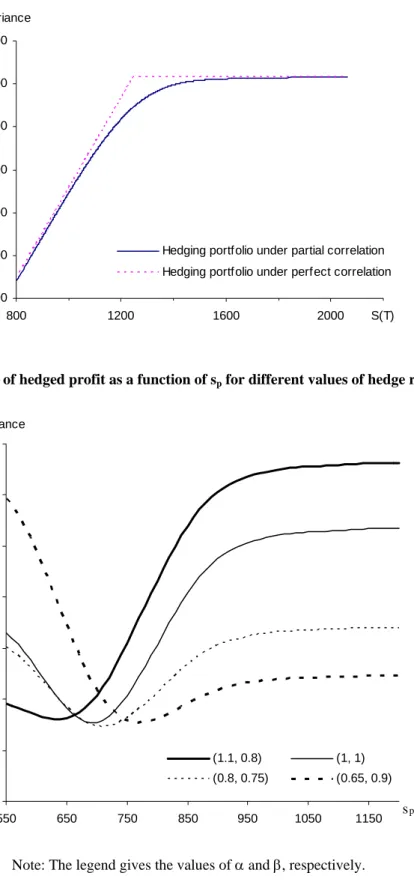
Fig. 3 depicts the cash flows of the minimum variance hedge as a function ofST. For comparison,
it also shows the hedging portfolio when= 0. It can easily be shown that the hedge is a concave increasing function of ST. Thus, the hedge can be approximated by short selling the underlying
As a first order approximation, consider a hedging portfolio consisting of a short sale of the asset and a purchase of call options with a single exercise price,sp. Let
XT = (p−s)bαST −(p−s)bβmax{ST −sp,0}.
We refer to this portfolio as the heuristic hedge with parameters α, β and sp, where α and β are
the hedge ratios. Let C(sp) denote the cost at time 0 of purchasing a European call option on the
underlying financial asset with an exercise price of sp and settlement date T. From Hull (2002:
Chapter 11), C(sp) =e−rTEN[max{ST −sp,0}].
The decision-maker seeks to determineα, βandsp, such that the variance of ΠTH(I) is minimized.
For simplicity, we shall ignore the constant scale factor (p−s)bin (5). We first determineαand β for given sp. min α,β Var h ˜ ST −max{S˜T −(I−a)/b,0} −αST +βmax{ST −sp,0} i . (6)
Sinceis independent ofST, it follows that Cov( ˜ST, ST) = Var(ST) and Cov( ˜ST,max{ST−sp,0}) =
Cov(ST,max{ST −sp,0}. Expanding (6) and using this simplification, we obtain
min
α,β h
(1−α)2Var(ST) +β2Var[max{ST −sp,0}] + 2αCov(ST,max{S˜T −(I −a)/b,0})
−2αβCov(ST,max{ST −sp,0}) + 2βCov(ST,max{ST −sp,0})
−2βCov(max{ST −sp,0},max{S˜T −(I−a)/b,0})
+ terms independent ofα, β andsp ]. (7)
LetA, B, C, DandEdenote Var(ST),Cov(ST,max{ST−sp,0}),Cov(max{ST−sp,0},max{S˜T−
(I −a)/b,0}),Cov(ST,max{S˜T −(I−a)/b,0}), and Var[max{ST −sp,0}], respectively. Ignoring
the terms independent ofα, β andsp, we rewrite (7) as
min
α,β
(1−α)2A+ 2β(1−α)B−2βC+ 2αD+β2E
. (8)
This problem is similar to the minimization of the squared error in regression. Therefore, by applying standard procedures, we obtain the following proposition:
Proposition 1. If sp>0, then the function in (8) is strictly convex inα andβ, and the minimum
variance hedge is obtained by setting
α = 1−DE−BC
AE−B2 (9)
β = AC−BD
AE−B2 . (10)
Proof: Omitted.
Now consider the choice of sp. As pointed out by a referee, it is no longer optimal in general
to set sp = (I −a)/b as was in the case of perfectly correlated demand in §2. Further, we found
examples in which the variance function is not jointly quasi-convex inα, β and sp. Therefore, the
optimal value ofsp has to be determined numerically by doing a line search on sp with the values
of α and β as given by Proposition 1. This method gives the correct answer since the variance is strictly convex in α and β for a given sp.
The following example illustrates how the variance of the hedged profit behaves as a function of sp.
Example. Let S0 = $660, r = 10% per annum, and ST have a log-normal distribution with
µ = 10% per annum and σ = 20% per annum. Let T = 6 months. Let the demand for the item be 10ST +, where is normally distributed with mean 0 and standard deviation 600. Let
p= $1, c= $0.60 and s= $0.10.
Let I = 7000. The variance of the unhedged profit function is equal to 371,280. Fig. 4 shows the variance of the hedged profit as a function ofsp for different values ofαandβ. While (I−a)/b
is equal to 700, the optimal value ofsp differs from 700 for each set ofα andβvalues. For example,
whenα= 1.1 andβ = 0.8, then the minimum variance is 161,301 and is realized atsp= 630; when
α = 0.65 and β = 0.9, then the minimum variance is 155,145 and is realized at sp = 770. The
Now let I = 8950. It can be shown that for α= 0.851 and β = 0.02, the variance function has a local maximum atsp= 472 and a local minimum at sp = 762. Thus, the variance function is not
quasi-convex insp. 2
The minimum variance hedge, as given by Lemma 1, gives a lower bound for the variance of the hedged profit. Thus, the effectiveness of the heuristic hedge can be ascertained by benchmarking it against this lower bound. We provide such comparisons in §4.
We note that the optimal values ofαandβin the heuristic hedge are always non-negative. Thus, the hedging transactions always consist of a short-sale of the asset and a purchase of call options (please see Proposition 8 in Appendix B). This implies that the payoffs from these two transactions offset each other, so that the market exposure of the firm is reduced. Moreover, the sale of the asset at time 0 provides cash to finance the investment in inventory. Thus, the net investment required by the firm is reduced and its return on investment is increased. The numerical study in §4 shows the impact of minimum variance hedging on risk, inventory levels and return on investment.
Our method for computing the hedge parameters can easily be generalized to the case when several call options with different exercise prices are considered in the hedging portfolio. Even for this case, the variance function remains convex in the hedge ratios and the formulas for the optimal hedge ratios can be computed similarly.
3.1.1 Dynamic Hedging
When demand is partially correlated with the price of the underlying financial asset, the demand forecast may change with time as new information is revealed. Suppose that there areT+ 1 trading time instants,t= 0, . . . , T. At each timet, the price, St, of the underlying asset is observed. Also
suppose that the forecast error at timetis given byt, where E[t] = 0. In this manner, the demand
forecast is updated with time. Thus, the decision-maker can utilize dynamic hedging, i.e., he/she can trade between times t= 0 and t=T to re-balance the hedging portfolio.
Such information revelation has implications on whether the hedging strategy is self-financing.
A trading strategy is said to be self-financing if the time t values of the portfolio just before and just after any timettransactions are equal. In a self-financing trading strategy, no money is added to or withdrawn from the portfolio at timest= 1 to T −1. Such a trading strategy has a unique value at time t= 0 (See Pliska 1999: Chapter 3). In our case, the following proposition gives the implications of information revelation on the hedging strategy:
Proposition 2. If new information is revealed at times t= 0, . . . , T−1 aboutST but not about,
then the minimum variance trading strategy,XT∗, defined in Lemma 1 is self-financing. If, instead, new information is revealed at times t = 0, . . . , T −1 about both ST and , then the minimum
variance trading strategy, XT∗, defined in Lemma 1 is notin general self-financing.
Thus, if both the asset price and the subjective forecast error are updated with time, then dynamic hedging can result in net cash flows different from zero at intermediate time instants. The hedging strategy can no longer be uniquely valued at time 0 since it depends on the decision-maker’s utility function. Nevertheless, dynamic hedging can give further reduction in the variance of the profit. Section 4 evaluates the benefits of such dynamic hedging.
The benefits of revising the hedge possibly increase when inventory commitments can be changed or can be made at more than one time epoch. Analysis of these issues is deferred to future work.
3.2 Risk Aversion
This section analyzes whether a risk-averse decision-maker will choose to hedge, the form of the hedging portfolio for such a decision-maker, and the impact of hedging on operational decisions.
Consider a risk-averse decision-maker with a concave utility function,u:< → <. LetW0 denote
the initial wealth of the decision-maker before investing in inventory or undertaking any financial transactions. To facilitate comparison between the hedged and unhedged payoffs, we transfer all payoffs to timeT by investing the certain payoffs at time 0 at the risk-free rate, denoted r. Thus,
the expected utility of the decision-maker after purchasing inventory I takes the form E [u(ΠU(I))] = E u W0erT + (p−s)bmin{ST +,(I −a)/b}+ (p−s)a−(cerT −s)I .
Without loss of generality, we scale all cash flows by 1/(p−s)b. Let c1denote (cerT−s)/{(p−s)b},
andW denote{W0erT+ (p−s)a}/{(p−s)b}. Thus, we write ΠU(I) = min{ST +,(I−a)/b} −c1I
and
E [u(ΠU(I))] = E [u(W + min{ST +,(I−a)/b} −c1I)]. (11)
The decision-maker can access the financial market and construct a portfolio derived from the underlying asset ST at zero transaction cost. Given this alternative, the decision-maker may or
may not prefer to invest in inventory depending on the parameters of the newsvendor model. The following proposition specifies the range of parameter values under which the decision-maker prefers to invest in inventory.
Proposition 3. Any risk-averse decision-maker with utility function, u(·), prefers to invest in
inventoryI than to invest solely in the financial market ifc1I <EN[E[min{ST+,(I−a)/b}|ST]].
In particular, the decision-maker prefers to invest in inventory I ifc1I <EN[min{ST,(I−a)/b}]−
E[||] and does not prefer to invest in inventory I if c1I >EN[min{ST,(I−a)/b}].
This result can be explained as follows: the payoff E[min{ST +,(I −a)/b}|ST] can be
con-structed from derivative instruments with ST as the underlying asset. This payoff is larger than
ΠU+c1Iin the second order stochastic dominance sense and costs EN[E[min{ST+,(I−a)/b|ST}]].
Thus, ifc1I >EN[E[min{ST +,(I−a)/b|ST}]], then we obtain a financial asset that is preferred
to the profits from inventory I and costs less than the investment of c1I in inventory. Thus, any
risk-averse decision-maker chooses to invest in this asset rather than in inventory level I.
In the rest of the analysis, we assume that c1I is such that the decision-maker prefers to invest
in inventoryI. Let there be a hedging portfolio with the random payoff at timeT denoted as XT,
martingale and the decision maker must construct the hedge subject to this assumption. Thus, we require that
E[XT −X0erT] = 0. (12)
If, instead,XT had a positive risk premium then there will be two effects of investing inXT on the
decision-maker’s expected utility, a wealth effect and a risk-reduction effect. By assuming that XT
is a fair gamble, we examine the risk-reduction aspect while controlling for the wealth effect. First consider the problem of determining XT such that the expected utility of the
decision-maker is maximized for a given inventory level I, i.e.,
max E
u W + ΠU(I)−XT +X0erT
such that E[XT −X0erT] = 0. (13)
The following proposition specifies the form of the hedge using the Karush-Kuhn-Tucker conditions (KKT). It provides broad insights but is primarily useful for the purposes of constructing an optimal hedge:
Proposition 4. For a strictly concave utility function, u(·), the optimal solution of problem (13)
is given by XT∗∗ that satisfies the following equations for someλ∈ <:
E u0 W + ΠU(I)−XT∗∗+X0∗∗erT = λ, E[XT∗∗−X0∗∗erT] = 0.
For example, note that for a quadratic utility function, Proposition 4 yields the same solution as given in Lemma 1. To see this, let u(x) =ax−bx2/2 where a, b >0. Then, Proposition 4 gives
E
a−b W + ΠU(I)−XT∗∗+X0∗∗erT
=a−b W −XT∗∗+X0∗∗erT−bE[ΠU(I)] =λ.
Since a, b, W are constants, XT∗∗ = E[ΠU(I)] = XT∗ is an optimal solution to the above problem.
As stated in§3.1, Fig. 3 depictsXT∗ as a function ofST. Optimal hedges for other utility functions
We now consider the questions whether the expected utility of the decision-maker increases with hedging, and whether the optimal inventory level increases in the degree of hedging. In practice, simpler hedges than that in Proposition 4 may be used. Therefore, we consider a fairly general class of hedges in the remaining analysis. We assume thatXT is an increasing function ofST because it
should offset the subject cash flows as closely as possible. The minimum variance hedge considered in §3.1 satisfies this assumption. The heuristic hedge in §3.1 also satisfies this assumption when β ≤α regardless of the value of sp. Further, the hedging strategy permits the use of several call
options with different exercise prices in order to match ΠU more closely. To facilitate the analysis,
we also assume thatXT is a piecewise continuous function ofST, and is differentiable with respect
toST almost everywhere.
The following properties of utility functions are useful in the remaining analysis. The Arrow and Pratt measure of absolute risk aversion of a utility function u(·) of wealthwis defined as the ratio RA(w) = −u00(w)/u0(w) (Arrow 1971). Note that RA(w) is always non-negative for an increasing
concave utility function. The utility function is said to display decreasing absolute risk aversion (DARA) whenRA(w) is decreasing inw, and constant absolute risk aversion (CARA) whenRA(w)
is a constant. Both DARA and CARA further imply thatu00(w) is decreasing in absolute value (i.e., u000(w)≥0). Absolute prudence is defined as the ratio −u000(w)/u00(w) (Kimball 1990). Decreasing or constant absolute prudence imply that u000(w) is decreasing in w. Many commonly used classes of utility functions, such as the power utility function, the negative exponential utility function and the logarithmic utility function, satisfy the properties of constant or decreasing absolute prudence (DAP).
Suppose that the risk-averse firm shorts an amount α of the portfolioXT. Thus, the expected
utility of the decision-maker from the investment in inventory and the hedging transactions is given by E [u(ΠH(I, α))] = E u W + min{ST +,(I−a)/b} −c1I−αXT +αX0erT . (14)
Proposition 5 shows that a risk-averse decision-maker prefers the hedged newsvendor payoff to the unhedged newsvendor payoff for any given I.
Proposition 5. For any concave and differentiable utility function,u(·),
d dαE [u(ΠH(I, α))] α=0 ≥0. (15)
While this result by itself is not surprising, it should be considered as a counterpart to Propo-sition 3. Together they show that under appropriate conditions, a risk-averse decision-maker will both invest in inventory as well as hedge the risk using financial instruments. We now examine the implications of hedging on the optimal inventory level. Propositions 6 and 7 give two sufficient conditions under which the optimal stocking quantity chosen by a risk-averse decision-maker in-creases when he/she decides to hedge the newsvendor risk. Given the utility function, Proposition 6 gives a sufficient condition on the structure of the hedging portfolio, derived using the form of the newsvendor payoff and Jensen’s inequality. Given the hedging portfolio, Proposition 7 gives a sufficient condition on the utility function.
Proposition 6. For any increasing, concave and differentiable utility function, u(·), the value of
inventory that maximizes E[u(ΠH)] is greater than the value of inventory that maximizesE[u(ΠU)]
if XT is such that E[{u0(ΠH(I))−u0(ΠU(I))} ·1{≤(I−a)/b−ST}] ≤ 0, (16) and E u0((I−a)/b−c1I−αXT +αX0erT) −u0((I−a)/b−c1I) ≥ 0. (17)
If u(·) is additionally CARA or DARA, then (17) is automatically satisfied.
Proposition 6 is primarily useful for constructing an optimal hedge. The intuitive content of the proposition is that when ST, and thus, ΠU is small (i.e., when (16) applies), then the hedge
increases the utility of the decision-maker. On the other hand, when ST is large (i.e., when (17)
Proposition 7 considers hedging portfolios that are increasing in ST and gives a sufficient
condi-tion on the decision-maker’s utility funccondi-tion. Thus, it supplements the result in Proposicondi-tion 6. Let I∗(α)≡arg maxI{E[u(ΠH(I, α))]}denote the stocking quantity that maximizes expected utility for
a given value ofα. Also let ¯α be the largest value ofαsuch that E[ΠH(I, α)|ST] is non-decreasing
in ST. We focus attention on hedging ratios in the range 0 ≤ α ≤ α¯ because higher values of α
correspond to overhedging.
Proposition 7. For any increasing, concave and differentiable utility function,u(·), with constant
or decreasing absolute risk aversion and constant or decreasing absolute prudence, dI∗/dα≥0 for 0≤α≤α¯.
We relate these results to the research on the impact of risk-aversion on operational decisions, and specifically, on the newsvendor model. Eeckhoudt, et al. (1995) show that the optimal inventory level for a risk-averse newsvendor is lower than that for a risk-neutral newsvendor under both CARA and DARA preferences. Similar conclusions are to be found in Agrawal and Seshadri (2000) and Chen and Federgruen (2000). Propositions 6 and 7 adds to the above research by showing that financial hedging changes the optimal inventory decision for a risk-averse newsboy under various
conditions. In particular, financial hedging increases the optimal inventory level for the risk-averse newsvendor, and brings it closer to the risk-neutral profit-maximizing quantity. Thus, it increases expected profit, decreases the effect of risk-aversion and brings the market closer to efficiency.
We also note that Eeckhoudt, et al. (1995) make similar assumptions on the utility function as in Proposition 7, and show that the optimal inventory level decreases when an uncorrelated background risk is added. Our result differs from them since the new risk XT is correlated with
the investment in inventory. Therefore, while Eeckhoudt, et al. (1995) find that optimal inventory decreases with the addition of the background risk, we find that the optimal inventory increases with hedging.
4
Numerical Example
In this section, we quantify the impact of our method on expected profit, risk reduction and return on investment using a numerical example. We show how the benefits of hedging change with the degree of correlation of demand with the price of the underlying financial asset, with the volatility of the asset price, and with dynamic hedging. The example is based on sales data for computer games CDs sold at a consumer electronics retailing chain.
We are given the following datasets:
1. A fit sample consisting of historical monthly forecasts and sales data for 42 items for one year aggregated across all stores in the chain. The total number of observations is 216 because the items have short lifecycles and not all items are sold in each month.
2. A test sample consisting of demand forecasts for 10 items for one month in the subsequent year.
Let t = 1, . . . , t0 denote time indices in the fit sample, and T denote the time index in the test
sample, T > t0. Let xit and yit, respectively, denote the forecast and the unit sales for item i
in month t aggregated across all stores, and St denote the value of the S&P 500 index at the
end of month t. We first fit a forecasting equation to the fit sample. Then, using the estimated parameters, we compute the optimal inventory level, the hedging parameters, the expected profit and the standard deviation of profit for the test sample.
To estimate the effect of correlation of demand withSton the performance variables, we perturb
the fit sample by adding independent and identically distributed (i.i.d.) errors ξit to yit. Let
ˆ
yit = yit+ξit. Here, ξit has normal distribution with mean 0. Results are computed for various
values of the standard deviation ofξitto ascertain the effect of decreasing correlation of demand with
St. In this paper, we report results for two datasets, the original dataset and the perturbed dataset
To estimate the effect of the volatility of ST on the performance variables, we consider six
scenarios for each dataset assuming that the inventory decision is taken 1,2, . . . ,6 months in advance of time T. Let l denote the lead-time and T −l denote the time when the order is placed. The longer the lead-time, the greater is the volatility of ST.
For both the datasets in the fit sample, we estimate the following forecasting equations using linear regression.
ˆ
yit = m1+m2xit+bSt+it (18)
ˆ
yit = m01+m20xit+0it. (19)
Here, the error terms, it and 0it, are assumed to be i.i.d. normally distributed.5 The coefficients
m1, m2, m01, m02 and b are assumed to be identical across items and over time.6 Note that the
comparison between the forecasting equations, (18) and (19), remains fair when ξit are added to
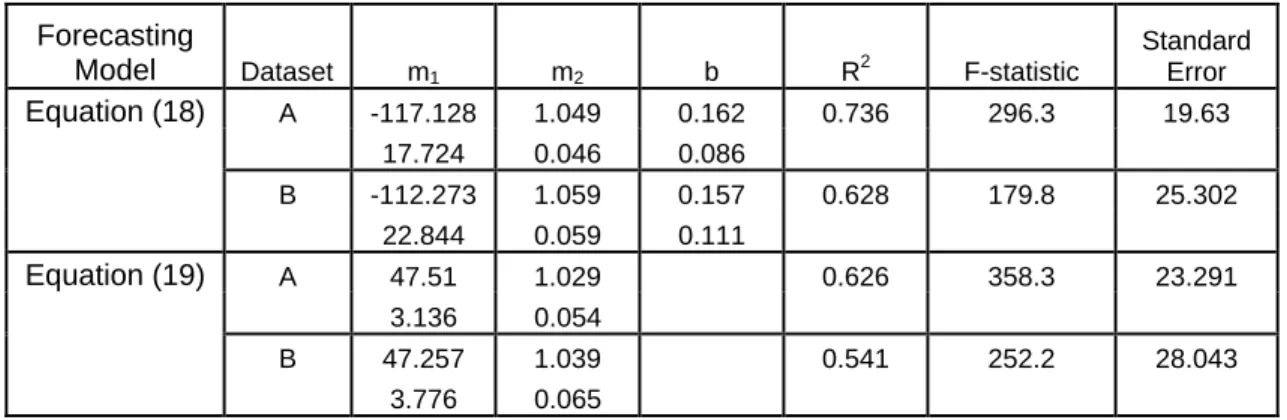
yit. Table 2 shows the estimation results for (18) and (19). The coefficient of St is statistically
significant (p <0.001 in each case), showing that (18) is more appropriate than (19) for modeling demand. However, note that while (18) has a higher R2, it does not imply a lower forecast error because St is a random variable. Thus, the benefit of using (18) is that it provides a method to
incorporate market information in forecasting demand, not that it reduces forecast error.
We compute the volatility of the S&P 500 index using 90 days of historical data prior to the time of inventory decision for month T by the method given in Hull (2002: Section 11.3). The volatility is given by the standard deviation of log(Sd/Sd−1), where Sd is the closing value of the
index for day d. The value of the daily standard deviation is obtained as 1.3984%, and the annual
5
The sales of a given item at a given store may not be normally distributed since they are truncated by the inventory level. However, normal distribution is a fair approximation for the sum of sales across a large number of stores.
6The coefficientbis identical across items since we do not expect items in the product category to have different
degrees of correlation with economic factors. Likewise, the coefficientsm1, m2, m01, m
0
2are identical across items since
standard deviation as 22.1982% assuming 252 trading days in the year. The risk-free rate of return is assumed to be 5% per year.
Optimal Inventory Level and Expected Profit: Using the estimates of model (18), the
demand forecast for item iin the test sample can be written as
DiT =a+bST +iT, (20)
where a=m1+m2xiT. We compute the optimal inventory level and the profit with and without
hedging in this model. As a benchmark, we compute the inventory level and profit for model (19). Note that in (19), the demand forecast for itemiin the test sample is given bym01+m02xiT+0iT.
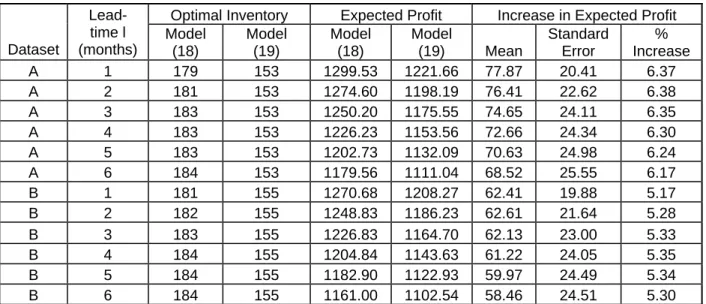
Table 3 compares the inventory levels and the expected profits obtained using demand dis-tributions estimated from the two forecasting models. Results are reported for one item in the test sample. Other items give similar insights. We find that using (18) instead of (19) changes the inventory decision significantly and increases the expected profit by 5.1 to 6.6% for differ-ent datasets. The values of the standard deviation show that the increase in expected profit is statistically significant. The reasons for the increase are as follows:
1. The two models use different probability distributions for the forecast error. In (19), the forecast error 0it is normally distributed, whereas in (18), the distribution of the forecast error is a convolution of the lognormal distribution of St and the normal distribution of it.
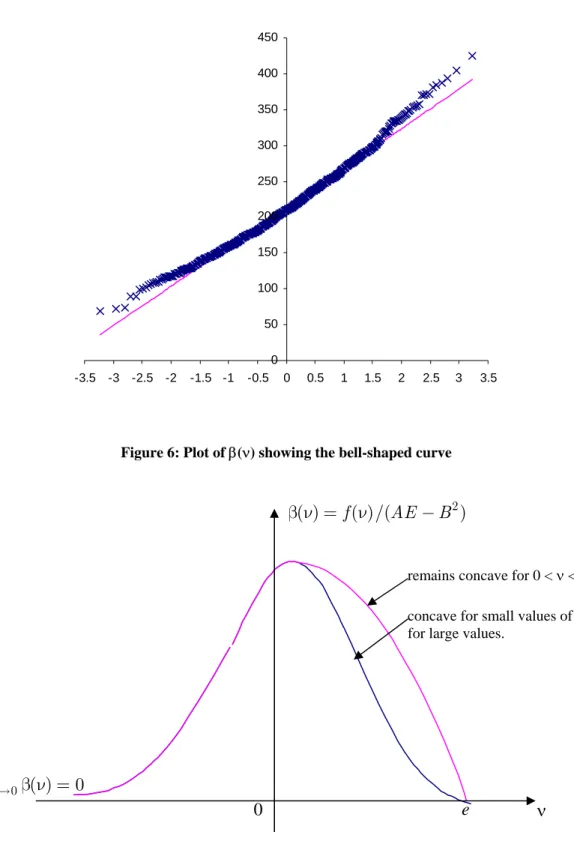
Since the lognormal distribution is skewed to the right, the convolution results in a higher inventory level. See Fig. 5 for a Q-Q plot of the demand distribution.
2. In model (18), up-to-date information from the financial markets has been used to augment the firm’s historical data. Thus, forecasts based on (18) adjust to changes in St. When the
market moves up, the forecasts are revised upwards, and vice versa.
maker to respond to the increase in volatility of St by increasing the inventory level while model
(19) does not. Further, hedging gives agreaterreduction of risk as the volatility ofSt increases, as
shown below.
Risk and Investment: Table 4 compares the variance of unhedged profit at the optimal
inven-tory level with the variance of hedged profit. It compares results from the minimum variance hedge of §3.1 and from the heuristic hedge of §3.1 with no re-balancing of the hedging portfolio (static hedge), and with a re-balancing of the hedging portfolio once at time T −l/2 (dynamic hedge). Since the minimum variance hedge gives a lower bound on the variance of hedged profit, it provides a benchmark for the static and the dynamic hedges.
The static hedge parameters, α, β, and sp, are computed as described in §3.1. The dynamic
hedge is computed by dynamic programming. Thus, at time T −l/2, the following actions take place: (i) the asset price ST−l/2 and the preliminary forecast error, T−l/2 are observed;7 (ii) the
hedge parameters,α1, β1,andsp1), are computed. These hedge parameters yield the cash flows at
time T−l/2. Thus, the hedge parameters at time 0, α0, β0,and sp0, are then computed in order
to hedge the cash flows at time T−l/2.
From Proposition 2, re-balancing the hedge is not a self-financing activity since it uses informa-tion aboutT−l/2. Thus, we re-invest the cash flow at timeT−l/2 at the risk-free rate in order to
evaluate the variance of hedged profit at timeT. Identical series of sample paths are used to eval-uate all hedging strategies. Many simulation runs are conducted to compute average performance statistics and estimate the statistical significance of the results.
All figures in Table 4 are expressed as percentages of the variance of unhedged profit. We find that the lower bound on the variance of hedged profit varies between 87.7% and 43.4%. Thus, the potential reduction in variance that can be obtained by hedging varies between 12.4% - 56.6%.
7We assume that the subjective forecast is re-evaluated at timeT−l/2, and that the forecast error is a sum of two
Static hedging has a gap of about 6% with respect to the lower bound. This gap is statistically significant at p=0.01. Dynamic hedging realizes almost the full potential for variance reduction. Its gap with respect to the lower bound is about 0.4%, and is not statistically significant. This performance is notable since both dynamic and static hedging use only two financial instruments. Particularly, the results on dynamic hedging show that even though the decision-maker is unable to modify the inventory level after time t, it can still use new information to manage its exposure to risk.
We further find that the percent reduction in variance increases significantly with the volatility of St. For example, for dataset A, the percent reduction in variance under the minimum variance
hedge is 20% whenl= 1 and 56.6% whenl= 6. Thus, hedging is more beneficial when the market volatility is high, or equivalently, when the lead-time is longer. As expected, we also find that the percent reduction in variance decreases when demand is less correlated withSt.
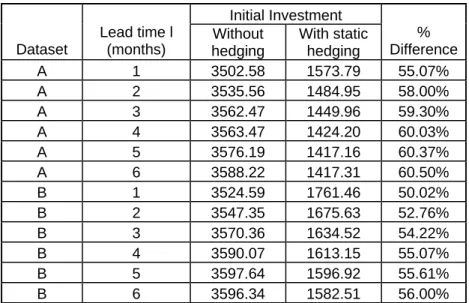
Table 5 shows the initial investment in inventory with and without hedging for each scenario corresponding to Table 5. Note that hedging reduces the initial investment by about 60% because the inflow from the short sale of the stock offsets the cash required for buying inventory and call options. Further, the investment decreases as the volatility of St increases. This is surprising
because we would expect both the amount of inventory and the price of the call option to increase with volatility, resulting in larger investment. However, we find that α increases with volatility. Thus, a larger quantity of the underlying asset is sold short, offsetting the additional investment required in inventory and call options.
Therefore, from Tables 4 and 5, we conclude that the benefits of hedging increase with the volatility ofSt. Interestingly, this implies that items with longer lead times will benefit more from
Risk-averse Decision-maker: To evaluate the effect of hedging on the optimal inventory de-cision of the risk-averse dede-cision-maker, we assume the expected utility representation E[u(w)] = E[w]−ρVar[w], where w denotes wealth. The value of ρ is taken as 0.01. Table 6 presents the inventory levels that maximize the expected utility for each of the 10 items in the test sample with and without hedging. Observe that hedging increases the optimal inventory level. It brings the inventory level closer to the expected value maximizing quantity, restoring efficiency in the market.
5
Conclusions
We have shown how to generate a solution to the hedging of inventory risk using the newsvendor model when demand is correlated with the price of a financial asset. Hedging reduces the variance of profit and the investment in inventory, increases the expected utility of a risk-averse decision-maker, and increases the optimal inventory level for a broad class of utility functions. Our numerical analysis shows that hedging is more beneficial when the price of the underlying asset is more volatile or the product has a longer order lead-time. Dynamic hedging provides additional risk reduction even when the retailer cannot change her initial inventory commitment.
Our forecasting model could be extended to incorporate macroeconomic variables such as inter-est rates and foreign exchange rates that provide demand signals. It might also be customized for specific businesses by using more securities from the equities market, such as sector specific indices or portfolios of firms in similar businesses. Further, the evolution of the price of the underlying asset may be used to update the demand forecast and modify order quantities even in the absence of early demand data.
An important aspect of our analysis is that the demand risk is not fully spanned by the financial market. Our analysis of the effects of financial hedging on operational decisions under such a scenario may be extended to other problems that have been considered in the real options literature, such as production switching (Dasu and Li (1997), Huchzermeier and Cohen (1996), Kouvelis
(1999)), capacity planning (Birge 2000) and global contracting (Scheller-Wolfe and Tayur 1999).
References
Agrawal, V., S. Seshadri. 2000a. Effect of Risk Aversion on Pricing and Order Quantity Decisions. Manufacturing and Service Operations Management Journal 2(4) 410-423.
Agrawal, V., S. Seshadri. 2000b. Risk intermediation in supply chains. IIE TRANSACTIONS 32(9)
819-831.
Arrow, K. 1971. Essays in the Theory of Risk-Bearing. North-Holland, Amsterdam.
Birge, J. 2000. Option Methods for Incorporating Risk into Linear Capacity Planning Models. Manufacturing & Services Operations Management 2(1) 19-31.
Brennan, M., E. Schwartz. 1985. Evaluating Natural Resource Investments. Journal of Busi-ness 58(2) 135-157.
Chen, F., A. Federgruen. 2000. Mean-Variance Analysis of Basic Inventory Models. Working Paper, Graduate School of Business, Columbia University.
Copeland, T., V. Antikarov. 2001. Real Options: A Practitioner’s Guide. Texere Publishers,
London.
Dasu, S., L. Li. 1997. Optimal Operating Policies in the Presence of Exchange Rate Variability. Management Science 43(5) 705-722.
Eeckhoudt, L., C. Gollier, H. Schlesinger. 1995. The Risk-averse (and Prudent) Newsboy.
Man-agement Science 41(5) 786-794.
Hadley, G., T. M. Whitin. 1963. Analysis of Inventory Systems. Prentice-Hall Inc., Englewood
Huang, C. F., R. H. Litzenberger. 1988. Foundations for Financial Economics. Prentice-Hall
Inc., Englewood Cliffs, New Jersey.
Huchzermeier, A., M. Cohen. 1996. Valuing Operational Flexibility Under Exchange Rate Risk. Operations Research 44(1) 100-113.
Hull, J. C. 2002. Options, Futures, and Other Derivatives. 4th ed., Prentice-Hall Inc., Englewood
Cliffs, New Jersey.
Instinet Research. 2001a. Redbook Retail Sales MonthlyNovember 2001, New York.
Instinet Research. 2001b. The Redbook AverageDecember 4, 2001, New York.
Kimball, M. S. 1990. Precautionary Saving in the Small and in the Large. Econometrica 58(1)
53-73.
Kimball, M. S. 1993. Standard Risk Aversion. Econometrica 61(3) 589-611.
Kogut, B., N. Kulatilaka. 1994. Operating Flexibility, Global Manufacturing, and the Option Value of Multinational Network. Management Science 40(1) 123-139.
Kouvelis, P. 1999. Global Sourcing Strategies Under Exchange Rate Uncertainty, Chapter 20 in Quantitative Models For Supply Chain Management. Eds. S. Tayur, R. Ganeshan, M.
Magazine. Kluwer Academic Publishers, Boston.
Lee, H. L., S. Nahmias. 1993. Single Product Single Location Models, Chapter 1 in Handbooks
in OR and MS, Vol. 4, Logistics of Production and Inventory. Eds. S. C. Graves, A. H. G. Rinnooy Kan, P. H. Zipkin. North-Holland Publishers, Netherlands.
McDonald, R., D. Siegel. 1986. The Value of Waiting to Invest. The Quarterly Journal of
Pliska, S. 1999. Introduction to Mathematical Finance: Discrete Time Models. Blackwell
Pub-lishers, Malden, Massachusetts.
Porteus, E. 2002. Foundations of Stochastic Inventory Theory. Stanford University Press, Stan-ford, CA.
Scheller-Wolfe, A., S. Tayur. 1999. Managing Supply Chains in Emerging Markets, Chapter 22 in Quantitative Models For Supply Chain Management. Eds. S. Tayur, R. Ganeshan, M.
Magazine. Kluwer Academic Publishers, Boston.
Triantis, A., J. Hodder. 1990. Valuing Flexibility as a Complex Option. Journal of Finance 45(2) 549-565.
Trigeorgis, L. 1996. Real Options. MIT Press, Cambridge, MA.
Williams, D. 1991. Probability with Martingales. Cambridge University Press, UK.
Appendix A. Proofs
Proof of Proposition 2: According to Lemma 1, the optimal hedge at time t is given by
Et[Π
T
U(I)|St]. If no additional information about is available at time t compared to time 0,
then the optimal hedge at timet equals E[ΠTU(I)|St]. However, E[ΠTU(I)|St] is a martingale with
respect to the filtration generated by {St}. Thus, the dynamic hedging strategy, E[ΠUT(I)|St], is
self-financing.
If, however, additional information about is available at time t, then Et[Π
T
U(I)|St] is not a
martingale with respect to the filtration generated by{St}. Thus, the dynamic hedging strategy is
not in general self-financing. 2
Proof of Proposition 3: We show that if c1I >EN[E[min{ST +,(I−a)/b|ST}]], then there
exists a portfolio XT which is preferred to ΠU by all risk-averse decision-makers. Let XT =
E[min{ST +,(I −a)/b|ST}]. Then XT is a strictly increasing function of ST. The newvendor
profit function can be written in terms of XT as
ΠU =XT −c1I+δ(ST),
where E[δ(ST)|XT] = E[δ(ST)|ST] = 0. From the conditional Jensen’s inequality,
E[u(ΠU)] = E[E[u(XT −c1I+δ)|ST]]≤E[u(XT −c1I)].
Now, note that the time-zero cost of portfolioXT isX0=e−rTEN[XT]. Thus, ifc1I >EN[E[min{ST+
,(I−a)/b|ST}]], then investment of an amount less thane−rTc1I inXT yields a higher expected
utility than the inventory investment.
The second part of the proposition follows from the fact that EN[min{ST,(I −a)/b}] and
EN[min{ST,(I−a)/b}]−E[||], respectively, are upper and lower bounds on EN[E[min{ST+,(I−
Proof of Proposition 4: Let λ ∈ < be the Lagrangian multiplier for the constraint E[XT −
X0erT] = 0.The decision-maker solves the problem
max Eu W + ΠU(I)−XT +X0erT
+λXT −λX0erT
.
Since u is concave, the first order conditions of optimality are sufficient. The optimal solution is obtained by maximizing the utility function point-wise at each value of ST. Thus, the first order
conditions are E u0 W + ΠU(I)−XT +X0erT = λ, (21) E[XT −X0erT] = 0. (22)
A feasible solution to this system of equations can be found as follows. Fixλ. For each value of ST, findXT such that (21) is satisfied. This value ofXT exists and is unique becauseu0 is strictly
decreasing. Substitute XT into (22). If E[XT −X0erT]> 0, then reduceλ (and correspondingly
reduce all XT) until a solution is obtained. Otherwise, increase λand correspondingly increase all
XT.
Suppose that there exist two distinct solutions to (21)-(22), denoted (λ, XT∗∗(λ)) and (λ0, XT∗∗(λ0)). Clearly,λ=λ0. This further shows that XT∗∗(λ) is equal toXT∗∗(λ0) almost everywhere. Thus, the
two solutions are equal except possibly on a set of measure zero. 2
Proof of Proposition 5: The first derivative of the expected utility function evaluated atα= 0
gives
E
u0(W + min{ST +,(I−a)/b} −c1I)
−XT +X0erT
Thus, they have a positive covariance, which gives Eu0(W + min{ST +,(I−a)/b} −c1I) −XT +X0erT ≥ Eu0(W + min{ST +,(I−a)/b} −c1I) E−XT +X0erT = 0,
where the last equality follows from (12). 2
Proof of Proposition 6: The value of inventory that maximizes E[u(ΠH)] is greater than the
value of inventory that maximizes E[u(ΠU)] if
E u0(ΠH(I))−u0(ΠU(I)) ∂ΠU ∂I ≥0.
Here, we have used the fact that ∂ΠH/∂I=∂ΠU/∂I. LetG() denote the distribution function of
. Conditioning onST and taking expectation with respect to , we get
E u0(ΠH(I))−u0(ΠU(I)) ∂Π ∂I ST = −c1 Z (I−a)/b −∞ u0(ΠH(I))−u0(ΠU(I)) dG() + u0((I−a)/b−c1I−αXT +αX0erT)−u0((I−a)/b−c1I) Pr{≥(I −a)/b−ST}.
Consider the expectation overST of the second term in the above equation. We use the facts that
Pr{≥(I−a)/b−ST} ≥Pr{≥(I−a)/b}, and thatST is independent of to write
E {u0((I−a)/b−c1I−αXT +αX0erT)−u0((I −a)/b−c1I)}Pr{≥(I−a)/b−ST} ≥ E {u0((I−a)/b−c1I−αXT +αX0erT)−u0((I−a)/b−c1I)}Pr{≥(I−a)/b} ≥ E u0((I−a)/b−c1I−αXT +αX0erT) −u0((I−a)/b−c1I) Pr{≥(I−a)/b}. (23) Thus, if E u0((I−a)/b−c1I −αXT +αX0erT)
≥u0((I−a)/b−c1I), then the second term is
portfolio under which the hedged optimal inventory level is larger than the unhedged optimal inventory level.
Whenu(·) is CARA or DARA, thenu0(·) is convex in wealth. Thus, applying Jensen’s inequality to (23), we get E u0((I−a)/b−c1I−αXT +αX0erT) −u0((I−a)/b−c1I) ≥ u0((I−a)/b−c1I−αE[XT −X0erT])−u0((I−a)/b−c1I) = 0. 2
The following lemma is a standard result. It is useful for proving Proposition 7.
Lemma 2. Let X be any random variable, and f : < → < be a decreasing function such that
E[f(X)] = 0. Then, (i) for any decreasing non-negative function w(x), E[w(X)f(X)]>0; (ii) for
any increasing non-negative function w(x), E[w(X)f(X)]<0.
Proof: Consider (i). Let G(X) denote the cumulative distribution function of X. Since f(x) is
decreasing inx, there existsx0 such thatf(x)>0 for allx < x0andf(x)<0 for allx > x0. Then,
E[w(x)f(X)] = Z x0 0 w(x)f(x)dG(x) + Z ∞ x0 w(x)f(x)dG(x) > Z x0 0 w(x0)f(x)dG(x) + Z ∞ x0 w(x0)f(x)dG(x) ≥ w(x0)E[f(X)] ≥ 0. Now consider (ii). We have
E[w(x)f(X)] = Z x0 0 w(x)f(x)dG(x) + Z ∞ x0 w(x)f(x)dG(x) < Z x0 0 w(x0)f(x)dG(x) + Z ∞ x0 w(x0)f(x)dG(x) ≤ w(x0)E[f(X)] ≤ 0. 2
Proof of Proposition 7: Let the hedged profit be denoted Π (the subscript H is ignored for simplicity.) We need to show that∂2E[u(Π)]/∂I∂αis greater than or equal to zero. We have
∂2 ∂I∂αE[u(Π)] = E u00(Π)∂Π ∂I ∂Π ∂α = E E u00(Π)∂Π ∂I ST ∂Π ∂α (24) = E −c1E u00(Π)ST ∂Π ∂α − 1 bRA(Π0)u 0(Π 0) Pr{ >(I−a)/b−ST} ∂Π ∂α , (25)
where (24) follows because∂Π/∂α is independent of . For (25), note that ∂Π
∂I =−c1+ 1
b1{ >(I−a)/b−ST}. (26) Also note that Π is independent of for >(I−a)/b−ST, and we write Π0 = (I−a)/b−c1I−
αXT +αX0. Finally, u00(Π) =−RA(Π)u0(Π).
Consider E[u00(Π)|ST]. Let G() denote the distribution function of. We have
E u00(Π)ST = Z (I−a)/b−ST −∞ u00(ST +−c1I −αXT +αX0)dG() + Z ∞ (I−a)/b−ST u00((I−a)/b−c1I−αXT +αX0)dG().
Since u00(·) < 0, the above expression shows that E[u00(Π)|ST] is negative for all ST. Further,
differentiating E[u00(Π)|ST] with respect toST, we get
d dST E u00(Π)ST = Z (I−a)/b−ST −∞ u000(ST +−c1I−αXT +αX0)(1−α dXT dST )dG() − Z ∞ (I−a)/b−ST u000((I−a)/b−c1I−αXT +αX0)α dXT dST dG()
Let f(, ST) = 1{ < (I −a)/b−ST} −αdXT/dST. f(·) is decreasing in . Further, E[f(·)|ST],
which is equal to the slope of E[Π|ST] with respect to ST, is positive for allα∈[0,α¯]. Thus,f(·)
is a decreasing function with a non-negative conditional expectation with respect to .
In addition, u000(·) > 0 because u(·) is CARA or DARA. Further, from the assumption of constant or decreasing absolute prudence, we have that u000(·) is decreasing in . Combining these observations and applying Lemma 2(i), we find that E[u00(Π)|ST] is increasing in ST.
Consider the first term in (25): ∂Π/∂α is decreasing in ST and has zero expectation (due to
the first condition for an optimum with respect to α); −c1E[u00(Π)|ST] is decreasing inST and
is non-negative for all ST. Thus, all conditions of Lemma 2(i) are satisfied. Therefore, applying
Lemma 2(i), we find that the first term in (25) is non-negative.
Consider the second term in (25). Here, Π0 is decreasing in ST. Thus, RA(Π0), u0(Π0), and
Pr{ >(I−a)/b−ST} are increasing inST;∂Π/∂α is decreasing inST and has zero expectation.
Therefore, applying Lemma 2(ii), we find that the second term in (25) (i.e., 1bRA(Π0)u0(Π0) Pr{ >
(I−a)/b−ST}∂Π∂α) is negative.
Appendix B. Further Results on Minimum Variance Hedging
Proposition 8. In Proposition 1,α ≥0 and β≥0.
Proof: To prove thatβ ≥ 0, it suffices to show that AC −BD ≥0 because AE−B2 >0 from
Proposition 1. We first establish this inequality. We then show that β≥0 impliesα≥0.
Let X denote min{ST, sp}and Y denote min{ST,(I−a)/b−}. Letν ≡+sp−(I−a)/b, so
thatY = min{ST, sp−ν}. After some algebraic manipulations, we rewrite AC−BDas
AC−BD= Var(ST)Cov(X, Y)−Cov(ST, X)Cov(ST, Y). (27)
It turns out that this inequality is not true in general for any three random variables8. To analyze the inequality, we simplify it further by conditioning on ν and by using the following fact: for random variables X1 and X2 with finite first and second moments, the covariance of X1 and X2
can be expressed by conditioning on a third random variable X3 (see Feller, 1966) as
Cov(X1, X2) = E[Cov(X1|X3, X2|X3)] + Cov[E(X1|X3),E(X2|X3)]. (28)
In our case, since is independent of ST and X, it follows that E[ST|ν] = E[ST|] = E[ST] and
E[X|ν] = E[X|] = E[X]. Thus, we have
Cov(X, Y) = E[Cov(X|ν, Y|ν)] + Cov[E(X|ν),E(Y|ν)] = E[Cov(X|ν, Y|ν)],
and
Cov(ST, Y) = E[Cov(ST|ν, Y|ν)] + Cov[E(ST|ν),E(Y|ν)]
= E[Cov(ST|ν, Y|ν)].
Therefore, to prove thatAC−BD≥0, it is sufficient to show for eachν that
f(ν)≡Var(ST)Cov(X, Y|ν)−Cov(ST, X)Cov(ST, Y|ν)≥0. (29)
8
The following lemmas are useful.
Lemma 3. EX≤EST andEX ≤sp.
Proof: X = min{ST, sp} ≤ST. Therefore, EX ≤EST. The inequality is strict for sp >0. The
second inequality follows similarly. 2
Lemma 4. Var(ST)≥Cov(ST, X)≥Var(X)≥0.
Proof: The terms for the first inequality can be rearranged to obtain Cov(ST, ST −X) ≥ 0,
or equivalently, Cov(ST,max{ST −sp,0}) ≥ 0. We apply an alternative method of computing
covariance (see Barlow and Proschan, 1981) to show this result.
LetX1andX2be any two random variables with finite first and second moments. Let ¯X1(s) = 1
ifX1 > s, 0 otherwise, and ¯X2(s) = 1 ifX2 > s, 0 otherwise. The covariance ofX1 andX2 is given
by Cov(X1, X2) = Z ∞ −∞ Z ∞ −∞ Cov( ¯X1(s),X¯2(t))ds dt. (30)
Let ¯ST(s) = 1 if ST > s, and 0 otherwise. Similarly, let ¯X(t) = 1 if max{ST −sp,0} > t, 0
otherwise. The covariance of ¯ST(s) and ¯X(t) is given by
Cov( ¯ST(s),X¯(t)) = Prob[ST >max{s, t+sp}]−Prob[ST > s]Prob[ST > t+sp].
Thus,
Cov( ¯ST(s),X¯(t))≥0 fors, t≥0
Cov( ¯ST(s),X¯(t)) = 0 fors, t <0.
Integrating this covariance over s and t gives the first inequality. The proofs for the second and third inequalities are similar. 2
Lemma 5. Cov(ST, Y)≥0.
We now show that f(ν) has a bell-shaped curve and is non-negative at all points. Note that when ν= 0, Y is equal to X, and therefore,
f(0) = Var(ST)Var(X) 1−Cov(ST, X) 2 VarSTVarX ≥0.
Also, whenν goes to∞ or−∞,f(ν) goes to zero. This follows from the facts that limν→∞Y =sp
and limν→−∞Y =ST.
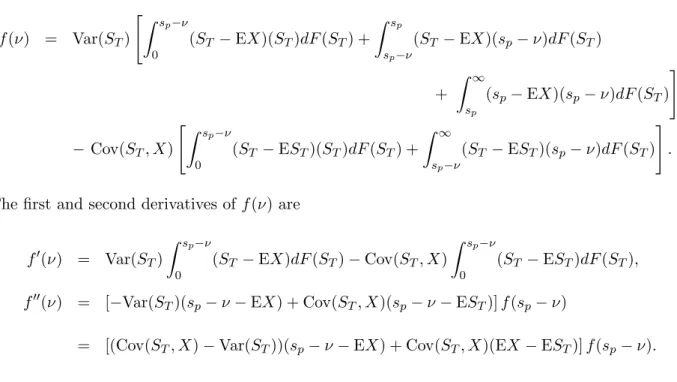
Consider ν <0. We expand the expression for f(ν) by integrating over the distribution of ST.
We expand Cov(ST, Y) as E[(ST −EST)Y] and Cov(X, Y) as E[(X−EX)Y]. Let F(ST) denote
the cumulative distribution function ofST.
f(ν) = Var(ST)E[(X−EX)Y|ν]−Cov(ST, X)E[(ST −EST)Y|ν]
= Var(ST) " Z sp 0 (ST −EX)(ST)dF(ST) + Z sp−ν sp (sp−EX)(ST)dF(ST) + Z ∞ sp−ν (sp−EX)(sp−ν)dF(ST) # −Cov(ST, X) " Z sp−ν 0 (ST −EST)(ST)dF(ST) + Z ∞ sp−ν (ST −EST)(sp−ν)dF(ST) # .
The first and second derivatives off(ν) are
f0(ν) = −Var(ST) Z ∞ sp−ν (sp−EX)dF(ST) + Cov(ST, X) Z ∞ sp−ν (ST −EST)dF(ST), f00(ν) = [−Var(ST)(sp−EX) + Cov(ST, X)(sp−ν−EST)]f(sp−ν)
= [(Cov(ST, X)−Var(ST))(sp−EX)−Cov(ST, X)(ν+ EST −EX)]f(sp−ν).
Applying Lemmas 3 and 4, we observe that for small values ofν,f00(ν)≤0, so thatf(ν) is concave over (−δ,0] for small δ > 0. If f(ν) stays concave for all ν ∈ (−∞,0], then its minimum value occurs at 0 or −∞. Since it is non-negative at both these values, it must be non-negative for all ν ∈(−∞,0].
If, on the other hand,f00(ν) changes sign for a sufficiently large negative value ofν, sayν0, then
Its minimum value over this interval occurs at −∞ because f0(ν) → 0 as ν → −∞, and it is monotonically increasing for ν ∈(−∞, ν0]. Therefore, we observe that f(ν) is non-negative for all
ν <0.
Now consider ν > 0. Again, we expand the expression for f(ν) by integrating over the distri-bution ofST. f(ν) = Var(ST) " Z sp−ν 0 (ST −EX)(ST)dF(ST) + Z sp sp−ν (ST −EX)(sp−ν)dF(ST) + Z ∞ sp (sp−EX)(sp−ν)dF(ST) # −Cov(ST, X) " Z sp−ν 0 (ST −EST)(ST)dF(ST) + Z ∞ sp−ν (ST −EST)(sp−ν)dF(ST) # .
The first and second derivatives off(ν) are
f0(ν) = Var(ST) Z sp−ν 0 (ST −EX)dF(ST)−Cov(ST, X) Z sp−ν 0 (ST −EST)dF(ST), f00(ν) = [−Var(ST)(sp−ν−EX) + Cov(ST, X)(sp−ν−EST)]f(sp−ν)
= [(Cov(ST, X)−Var(ST))(sp−ν−EX) + Cov(ST, X)(EX−EST)]f(sp−ν).
Applying Lemmas 3 and 4 , we observe that for small values ofν,f00(ν)≤0, so thatf(ν) is concave over [0, δ) for small δ > 0. If it stays concave for allν ∈ [0,∞), then its minimum occurs at the boundary values 0 or ∞. If, on the other hand,f00(ν) changes sign for a sufficiently large positive value of ν, say ν0, then it stays non-negative for allν ∈[ν0,∞). The minimum value of f(ν) still
occurs at 0 or ∞ since f0(ν) → 0 as ν → ∞. Thus, arguing as before, we observe that f(ν) is non-negative for allν >0.
Figure 6 shows the graph of β(ν) = f(ν)/(AE −B2) to illustrate the above arguments. We conclude that AC−BD ≥ 0. Further, from Proposition 1, we know that AE −B2 > 0. Thus,
Now, to show that α≥0, we rewrite (6) as
VarhS˜T −max{S˜T −sp,0} −αST +βmax{ST −sp,0} i
=
VarhS˜T −max{S˜T −sp,0}+βmax{ST −sp,0} i
+α2Var(ST)
−2αCovS˜T −max{S˜T −sp,0}+βmax{ST −sp,0}, ST
.
From Lemma 4, we know that Cov(ST,max{ST −sp,0}) = Cov(ST, ST −X)≥0. From Lemma 5,
we know that Cov( ˜ST−max{S˜T −sp,0}, ST) = Cov(Y, ST)≥0. Combining these terms and using
β ≥0 from above, we observe that the value ofα that minimizes the variance of the hedged profit
Table 1: Results for the Regression of Sector-wise Redbook Same Store Sales Growth Rate on the Annual Return on the S&P 500 Index
R2 F-statistic p-value Intercept Slope Apparel 0.411 7.6618 0.0183 -0.583 0.351 2.168 0.127 0.468 9.6673 0.0099 2.088 0.215 Department Stores 1.182 0.069 0.020 0.2298 0.6410 3.596 -0.025 Discount Stores 0.890 0.052
Note: (1) The analysis uses monthly data for 13 months from November 2000 to November 2001 for each sector. The dependent variable is the growth rate of same store sales during the month with respect to the same month in the previous year. The independent variable is the annual return on the S&P 500 index for the same period. (2) The standard errors of the parameters are reported below the corresponding parameter estimates.
Table 2: Results of the Estimation of Forecasting Models (18) and (19) for Item 1
Forecasting
Model Dataset m1 m2 b R2 F-statistic
Standard Error Equation (18) A -117.128 1.049 0.162 0.736 296.3 19.63 17.724 0.046 0.086 B -112.273 1.059 0.157 0.628 179.8 25.302 22.844 0.059 0.111 Equation (19) A 47.51 1.029 0.626 358.3 23.291 3.136 0.054 B 47.257 1.039 0.541 252.2 28.043 3.776 0.065
Notes: (1) The F-test for each regression model is statistically significant at p<0.001. (2) The standard errors of the parameters are reported below the corresponding parameter estimates.
Table 3: Optimal Inventory Level and Expected Profit for Item 1 Obtained Using Forecasting Models (18) and (19) for Each Dataset for Different Degrees of Volatility of St
Optimal Inventory Expected Profit Increase in Expected Profit Dataset Lead-time l (months) Model (18) Model (19) Model (18) Model (19) Mean Standard Error % Increase A 1 179 153 1299.53 1221.66 77.87 20.41 6.37 A 2 181 153 1274.60 1198.19 76.41 22.62 6.38 A 3 183 153 1250.20 1175.55 74.65 24.11 6.35 A 4 183 153 1226.23 1153.56 72.66 24.34 6.30 A 5 183 153 1202.73 1132.09 70.63 24.98 6.24 A 6 184 153 1179.56 1111.04 68.52 25.55 6.17 B 1 181 155 1270.68 1208.27 62.41 19.88 5.17 B 2 182 155 1248.83 1186.23 62.61 21.64 5.28 B 3 183 155 1226.83 1164.70 62.13 23.00 5.33 B 4 184 155 1204.84 1143.63 61.22 24.05 5.35 B 5 184 155 1182.90 1122.93 59.97 24.49 5.34 B 6 184 155 1161.00 1102.54 58.46 24.51 5.30
Table 4: Variance of Profit with Different Hedging Strategies
Lower Bound (LB) Static Hedge – LB Dynamic Hedge – LB Dataset Lead time l (months) Variance Standard Error (σ) Variance σ(Static Hedge – LB) Variance σ(Dynamic Hedge – LB) A 1 80.16 2.87 85.71 0.29 80.40 0.23 A 2 67.5 3.81 73.73 0.51 67.88 0.36 A 3 58.61 4.10 65.02 0.65 59.07 0.42 A 4 52.47 4.20 59.15 0.97 52.98 0.46 A 5 47.47 4.14 54.28 1.02 47.99 0.46 A 6 43.44 4.04 50.72 1.05 43.97 0.46 B 1 87.65 1.98 92.66 0.39 87.79 0.15 B 2 78.56 3.00 84.13 0.57 78.83 0.27 B 3 71.43 3.56 77.22 0.64 71.79 0.35 B 4 65.67 3.87 71.55 0.83 66.10 0.41 B 5 61.09 4.05 67.39 0.94 61.58 0.45 B 6 57.39 4.15 63.96 1.20 57.92 0.48 Note: All variances are expressed as percentages of the variance of unhedged profit. The lower bound is
obtained from the minimum variance hedge in §3.1. The static hedge is identical to the heuristic hedge in §3.1. The dynamic hedge is constructed by dynamically re-balancing the heuristic hedge once at time (T – l)/2 as new information is revealed.