PDF hosted at the Radboud Repository of the Radboud University
Nijmegen
The following full text is a preprint version which may differ from the publisher's version.
For additional information about this publication click this link.
http://hdl.handle.net/2066/94153
Please be advised that this information was generated on 2018-07-08 and may be subject to
change.
Tutorial: Proxmark, the Swiss Army Knife for RFID
Security Research
Flavio D. Garcia, Gerhard de Koning Gans, and Roel Verdult
Institute for Computing and Information Sciences,
Digital Security Group, Radboud University Nijmegen, The Netherlands, Technical Report for RFIDSec 2012 Tutorial, July 1, 2012.
{flaviog,gkoningg,rverdult}@cs.ru.nl
Abstract. This paper gives a hands-on introduction to the Proxmark, a versatile tool for RFID security research. It can be used to analyze and reverse engineer RFID protocols de-ployed in billions of cards, tags, fobs, phones and keys. We give a heads up introduction on how to embed new modulation and encoding schemes into the Proxmark, which helps to get a grip on the low level RF-communication details. As example we point out several (dev-astating) weaknesses which are made at this low levels. Most notably the MIFARE Classic with its weakly encrypted parity bits, which enables an attacker to recover the secret key. Furthermore, we describe the practical cryptanalysis of several proprietary RFID protocols and ciphers. In this part we introduce the Proxmark as an effective attack tool that can perform practical attacks a hundred times faster than regular RFID readers.
Keywords:Proxmark, RFID, NFC, contactless smartcards, open-source
1
Introduction
Radio Frequency Identification (RFID) is one of the most pervasive technologies nowadays. It was first introduced for identification purposes only, but quickly expanded to other applications like transport ticketing systems and access control. The security and privacy of these systems is often overlooked. This is, to a good extend, due to the fact that it is hard to know what are the underlying security mechanisms employed. A surprisingly large number of access control systems use the tag’s unique identifier (UID) as their only security mechanism. Moreover, large scale ticketing systems use simple memory cards [17,46,52,55] for fare collection. This type of cards lack any cryptographic capabilities and therefore the security of these systems relies on UID blacklisting mechanisms. When portable tag-emulating devices are available [11,18,39,42,57,58], these security mechanisms become obsolete.
Many RFID tags and contactless smart cards use proprietary security mechanisms for authen-tication and confidentiality. Since these tags are widely deployed in access control and ticketing systems, it is important to independently assess their security. This paper explains how the Prox-mark device can be used for RFID protocol analysis and to exploit implementation attacks. It facilitate message eavesdropping and emulation of both tags and readers. We analyse various com-munication protocols that operate at a low frequency (125 kHz) and high frequency (13.56 MHz).
The Proxmark supports all major modulation and encoding schemes. Therefore, it is able to com-municate with many different proprietary communication protocols used by various RFID tags. These tools are fully programable and allow for quick prototyping, testing and debugging of new RFID protocols, like proposed in [1,13,19,21,25,56]. All the software, firmware and hardware that is described in this paper is open source and open design.
This paper is organized as follows. Section2 starts with some background information about the Proxmark device. Section 3 addresses the motivation why RFID protocol research is useful and necessary. Next, the hardware and basic components of the Proxmark device are introduced in Section 4. Finally, we select in Section refsec:usecases two interesting use-cases and show how to analyse and attack widely deployed RFID products.
2
Background
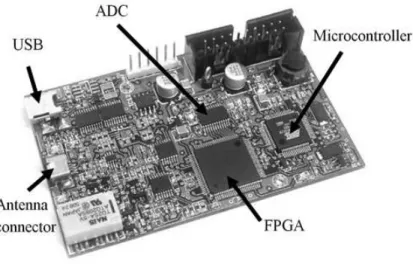
The Proxmark III has been developed by Jonathan Westhues. The Proxmark III, shown in Fig-ure2.1, replaces its predecessors and introduces a high level of flexibility in both signal processing and protocol implementation. It is additionally equipped with a Field Programmable Gate Array (FPGA) which is mainly responsible for the low-level signal processing and allows to set up mul-tiple signal processing schemes. In general, when we speak about the Proxmark, we refer to this latest version.
Fig. 2.1.The Proxmark III
The hardware design and firmware of this latest version is in the public domain since May 2007 under the General Public License. The device costs around e200 and since the schematics are online, it can be ordered through any local printed circuit board (PCB) supplier. Although, most assembled Proxmark devices are sold by one of the main suppliers: Rysc Corp.1
, GeZhi Electronic Corp. Ltd.2
and hackable-devices3
. The following websites contain all the information that is required to assemble, compile, flash, use and develop new features for the Proxmark.
• http://cq.cx/proxmark3.pl The first website about the Proxmark device, created by Jonathan Westhues in 2007. Jonathan made the project free to use and published all the necessary designs and source codes. Five years later, already more than a thousand Proxmarks were sold for extensive RFID protocol and security research.
• http://www.proxmark.orgContains a lot of information about new RFID modulation, encoding and protocols that were added the last years. This website hosts the main community forum, which is currently used by more than 3000 members. This forum answers all frequently asked questions concerning the Proxmark, but also contains various topics about microcontroller and FPGA development.
• http://proxmark3.googlecode.comThis is the development website which hosts the most recent subversion (SVN) repository. Only in 2012 there are already 26 active committers, who reg-ularly fix problems and contribute new features to the Proxmark firmware. The website also hosts a small wiki that contains a manual for using the Proxmark device. Most features and commands are explained in detail, backed up by several output examples and pictures.
1 http://www.proxmark3.com 2 http://www.xfpga.com 3 http://www.hackable-devices.org 2
Throughout this paper we focus on contactless smart cards. For contact based smart cards there are comparable tools available in the literature [8,12] which allows eavesdropping, emulation, man-in-the-middle attacks and fast querying by using a dedicated FPGA.
3
Motivation
Manufacturers often claim that their tags provide ‘state-of-the-art’, ‘field-proven’ or ‘unbreakable’ security, but it is hard to know what this means and how much security you actually get. The widely used RFID communication standards like [33–37] define the low-level transmission layers. However, these standards do not include any details of the secure communication layer. Semi-conductor companies are inclined to create ad-hoc RFID designs that use proprietary protocols and cryptographic algorithms [2,16,31,32,44,47–49,51,54]. Such designs are often kept secret to provide security-through-obscurity. It has been shown many times that without feedback from the scientific community, it is hard to build secure algorithms [38,41]. There are numerous examples in the literature [3–7,9,10,14,15,20,22–24,26–30,40,43,45,50,53,59–62] showing that once the secrecy of an algorithm is lost, so is its security. As long as RFID tags do not comply with open and community-reviewed encryption standards, the security of these tags need to be independently assessed. In order to perform these assessments, we need tools to analyze the underlying security protocols. While designing new RFID products and protocols, it is also useful to have a set of tools at hand for easy protocol prototyping, testing and debugging. There are several reasons for this kind of “analytic” research:
1. Public scrutiny.Unlike other fields, it is not really possible to prove the security of a secure design/product. The way in which security research progresses is by proposing new construc-tions and then exposing them to the community for critical scrutiny.
2. Informing consumers.Manufacturers often boost “unbreakable security” of their products (while they often can be hacked within a few seconds). These claims lead consumers (as non-security experts) to use such products in very critical/non-security sensitive applications.
3. Higher standards.The industry is reluctant to improve their products, even when they are informed of their weaknesses. Only when customers demand better products industry is willing to improve.
4. Responsible disclosure. When weaknesses are found, it is important to inform the manu-facturer ahead of disclosure such that they can take the necessary measures. Without scientific scrutiny, weaknesses are often found too late, when fraud/missuse has already taken place. As long as RFID tags do not comply with open and community-reviewed encryption standards, the security of these tags need to be independently assessed. In order to perform these assessments, we need a powerful and flexibel tool to analyse the underlying security protocols. The Proxmark device is such a tool. It gives direct access to the real-time data and timing information which is very useful during protocol analysis. Furthermore, it allows the user to create a dedicated firmware that can quickly query and repeat a modulation and encoding scheme. This particular function can be used to perform practical attacks a hundred times faster than regular RFID readers.
4
Proxmark
4.1 Hardware
The Proxmark III supports both low (125 kHz-134 kHz) and high frequency (13.56 MHz) signal processing. This is achieved by two parallel antenna circuits that can be used independently. Both circuits are connected to a 4-pin Hirose connector to connect an external loop antenna. When the Proxmark is in reader mode it drives the antenna coils with the appropriate frequency. This is unnecessary when the Proxmark works ineavesdropping mode or incard emulation modebecause then the electromagnetic field is generated by the reader. The signal from the antenna is routed through the FPGA after it has been digitized by an 8-bit Analog-to-Digital Converter (ADC).
After some filtering, the FPGA relays the necessary information to perform the decoding of the signal to the microcontroller. This prevents the microcontroller from being overloaded with signal data. An FPGA has a great advantage over a normal microcontroller in the sense that it emulates hardware. A hardware description can be compiled and flashed into an FPGA. Basic arithmetic operations can be performed in parallel and faster than in a microcontroller. An FPGA is of course slower than a hardware implementation but pure hardware lacks flexibility.
The microcontroller is responsible for the protocol part. It receives the digital signal from the FPGA and decodes it. The decoded signal can just be copied to a buffer in the EEPROM memory. Additionally, an answer to an incoming message can be programmed to be sent immediately, communicating this to the FPGA which then modulates the appropriate signal.
The Proxmark has a USB interface to the computer. The current implementation uses the default Human Interface Device (HID) USB protocol. Flashing of the microcontroller and the FPGA can be done via USB. Only the first time the JTAG interface is used to set up a bootloader on the microcontroller. The hardware design that can be flashed into the FPGA is written in Verilog. Verilog is a hardware description language which allows to describe a hardware design in a C-style syntax.
4.2 Software
The Proxmark can operate in three different mores: sniffing mode; card emulation mode; and reader mode. It is possible to use the Proxmark for very different modulation schemes and protocols as long as there are in the supported frequency range. Some well known protocols and modulation schemes are already available. There are some requirements to implement the mentioned modes for new protocols. First, we need an underlying physical layer which takes care of the Digital Signal Processing (DSP). Next, the modes of operation should be implemented as functions on the microcontroller. Finally, the client should be able to call these functions and display the results. The processing and generation of the protocol messages is partly done by the FPGA and partly by the microcontroller. The FPGA deals with signal processing issues like edge detection and then communicates the result to the microcontroller. The microcontroller then tries to decode the bit stream depending on the modulation scheme. In order to generate a signal the microcontroller will send a bit stream to the FPGA. This stream is encoded using the corresponding modulation scheme, e.g., Manchester or Modified Miller. The FPGA modulates according to this bit stream. The decision to split the DSP in two parts is mainly because of the limited capacity of the FPGA. It cannot do signal processing and message decoding/encoding at the same time.
The microcontroller implements the transport layer. First it decodes the samples received from the FPGA. These samples are stored in a Direct Memory Access (DMA) buffer. The samples are binary sequences that represent whether the signal was high or low. The software on the microcontroller tries to decode these samples. When the Proxmark is insniffing mode this is done for both the reader and tag signal at the same time. Whenever one of the decoding procedures returns a valid message, this message is stored in another buffer (BigBuf). The BigBuf is especially useful for protocol analysis. Every single message is stored in this buffer. When a card is emulated or when the Proxmark is used as a reader the BigBuf can be used to store status messages or protocol exceptions.
The client application works as a console application and connects to the Proxmark via the standard HID USB protocol. The microcontroller continuously polls for new USB packets. Cur-rently it is not possible to stream the retrieved samples directly to the PC in real-time. When the microcontroller retrieves a command from the client, it runs this command and stores any resulting messages in its memory buffer. Next, the client sends a second command to retrieve the data from this buffer.
5
Use-cases
This section shows how to use the Proxmark in practice, by using it for two concrete use-cases. The first use-case exploits one of the many vulnerability that were found in the MIFARE Classic
tag. It shows how to recover the secret key from a building access control reader, by using only one eavesdropped authentication trace. In the second use-case is shown how to recover the secret master key from a iClass Elite access control reader using the Proxmark as a tag emulator.
5.1 MIFARE Classic
Enter the following command to start eavesdropping ISO/IEC 14443 type A communication:
hf 14a snoop
Hold the Proxmark antenna next to the reader and present the MIFARE Classic tag. Blink-ing of the lights indicate transmission was captured. Press the button on the Proxmark to stop the gathering frames or wait until the buffer is full. The trace most likely contains more than only the authentication information. Before the reader can exchange messages with a MIFARE Classic tag, it needs to perform the anti-collision protocol, see [36]. Most of these messages can be ignores, except second message from the tag, which reveals the unique identifier (UID) of the tag. To retrieve the eavesdropped trace from the Proxmark, the following command can be used:
hf 14a list
If the trace is received correctly, it looks very similar to the example trace which is shown below. If the trace partial frames, unexpected messages, not a clear message toggling between reader and tag, then the reception was not good enough. Try a different angle, more/less space between reader-antenna-tag, various speed to present the tag. If the antenna is tuned enough, it should pick up the signal and produce a similar trace to the one below.
+ 50782: : 26 + 33822: : 26 + 50422: : 26 + 64: 0: TAG 04 00 + 944: : 93 20 + 64: 0: TAG 9c 59 9b 32 6c + 1839: : 93 70 9c 59 9b 32 6c 6b 30 + 64: 0: TAG 08 b6 dd + 3783: : 60 32 64 69 + 113: 0: TAG 82 a4 16 6c + 1287: : a1 e4 58 ce 6e ea 41 e0 + 64: 0: TAG 5c ad f4 39
With this information it is possible to execute the mfkey4
tool accordingly:
./mfkey <uid> <nt> <{nr}> <{ar}> <{at}>
./mfkey 9c599b32 82a4166c a1e458ce 6eea41e0 5cadf439
Which results for this example in the following output:
MIFARE Classic key recovery Recovering key for:
uid: 9c599b32 nt: 82a4166c {nr}: a1e458ce {ar}: 6eea41e0 {at}: 5cadf439 4 http://proxmark3.googlecode.com/svn/trunk/tools/mfkey
LFSR succesors of the tag challenge: nt’: 8d65734b
nt’’: 9a427b20
Keystream used to generate {ar} and {at}: ks2: e38f32ab
ks3: c6ef8f19
Found Key: [ff ff ff ff ff ff]
5.2 iClass
Enter the following command to start emulating the card serial number (CSN) of an iClass Elite card.hf iclass sim 0 031FEC8AF7FF12E0
After presenting the Proxmark to an iClass Elite reader, it tries to authenticate the (emulated) card with random challenges. The Proxmark captures the authentication attempts which are used to recover the secret master key. The output that is generated by the Proxmark is shown as follows:
--simtype:00 csn:03 1f ec 8a f7 ff 12 e0
#db# READER AUTH (len=09): 05 00 00 00 00 bf 5d 67 7f
At least one authentication attempts for the following list is required:
Card Serial Number (CSN)| recovers matrix byte index 00 0B 0F FF F7 FF 12 E0 | 00 01 00 04 0E 08 F7 FF 12 E0 | 02 00 09 0D 05 F7 FF 12 E0 | 03 00 0A 0C 06 F7 FF 12 E0 | 04 00 0F 0B 03 F7 FF 12 E0 | 05 00 08 0A 0C F7 FF 12 E0 | 06 00 0D 09 09 F7 FF 12 E0 | 07 00 0E 08 0A F7 FF 12 E0 | 08 00 03 07 17 F7 FF 12 E0 | 09 00 3C 06 E0 F7 FF 12 E0 | 10 00 01 05 1D F7 FF 12 E0 | 11 00 02 04 1E F7 FF 12 E0 | 12 00 07 03 1B F7 FF 12 E0 | 13 00 00 02 24 F7 FF 12 E0 | 14 00 05 01 21 F7 FF 12 E0 | 15
These bytes reveal the first line of the matrix that is constructed by using the master key and some weak combination of encrypting itself. With this information it is possible to brute force the key with a total complexity of only 225
DES encryptions.
References
1. Gergely. Alp´ar, Lejla Batina, and Roel Verdult. Using NFC phones for proving credentials. In
16th Measurement, Modelling, and Evaluation of Computing Systems and Dependability and Fault
Tolerance (MMB&DFT 2012), volume 7201 of Lecture Notes in Computer Science, pages 317–330.
Springer-Verlag, 2012.
2. CryptoRF specification, AT88SCxxxxCRF. Product Datasheet, March 2009. Atmel Corporation. 3. Josep Balasch, Benedikt Gierlichs, Roel Verdult, Lejla Batina, and Ingrid Verbauwhede. Power analysis
of Atmel CryptoMemory - recovering keys from secure EEPROMs. In12th Cryptographers’ Track at
the RSA Conference (CT-RSA 2012), volume 7178 ofLecture Notes in Computer Science, pages 19–34.
Springer-Verlag, 2012.
4. Eli Biham, Alex Biryukov, and Adi Shamir. Cryptanalysis of Skipjack reduced to 31 rounds using impossible differentials. In18th International Conference on the Theory and Application of
Crypto-graphic Techniques, Advances in Cryptology (EUROCRYPT 1999), volume 1592 ofLecture Notes in
Computer Science, pages 12–23. Springer-Verlag, 1999.
5. Alex Biryukov, Ilya Kizhvatov, and Bin Zhang. Cryptanalysis of the Atmel cipher in SecureMemory, CryptoMemory and CryptoRF. In 9th Applied Cryptography and Network Security (ACNS 2011), volume 6715 ofLecture Notes in Computer Science, pages 91–109. Springer-Verlag, 2011.
6. Andrey Bogdanov. Linear slide attacks on the KeeLoq block cipher. In Information Security and
Cryptology (INSCRYPT 2007), volume 4990 of Lecture Notes in Computer Science, pages 66–80.
Springer, 2007.
7. Stephen C. Bono, Matthew Green, Adam Stubblefield, Ari Juels, Aviel D. Rubin, and Michael Szydlo. Security analysis of a cryptographically-enabled RFID device. In14th USENIX Security Symposium
(USENIX Security 2005), pages 1–16. USENIX Association, 2005.
8. Omar Choudary. The Smart Card Detective: A Hand-Held EMV Interceptor. Master’s thesis, Uni-versity of Cambridge, 2010.
9. Nicolas T. Courtois. The dark side of security by obscurity - and cloning MIFARE Classic rail and building passes, anywhere, anytime. In4th International Conference on Security and Cryptography
(SECRYPT 2009), pages 331–338. INSTICC Press, 2009.
10. Nicolas T. Courtois, Sean O’Neil, and Jean-Jacques Quisquater. Practical algebraic attacks on the Hitag2 stream cipher. In 12th Information Security Conference (ISC 2009), volume 5735 ofLecture Notes in Computer Science, pages 167–176. Springer-Verlag, 2009.
11. Gerhard de Koning Gans. Analysis of the MIFARE Classic used in the OV-chipkaart project. Master’s thesis, Radboud University Nijmegen, 2008.
12. Gerhard de Koning Gans and Joeri de Ruiter. The smartlogic tool: Analysing and testing smart card protocols. In 5th International Conference on Software Testing, Verification, and Validation, pages 864–871. IEEE Computer Society, 2012.
13. Gerhard de Koning Gans and Flavio D. Garcia. Towards a practical solution to the RFID desynchro-nization problem. In6th Workshop on RFID Security (RFIDSec 2010), volume 6370 ofLecture Notes in Computer Science, pages 203–219. Springer-Verlag, 2010.
14. Gerhard de Koning Gans, Jaap-Henk Hoepman, and Flavio D. Garcia. A practical attack on the MIFARE Classic. In 8th Smart Card Research and Advanced Applications Conference (CARDIS 2008), volume 5189 ofLecture Notes in Computer Science, pages 267–282. Springer-Verlag, 2008. 15. Benedikt Driessen, Ralf Hund, Carsten Willems, Carsten Paar, and Thorsten Holz. Don’t trust satellite
phones: A security analysis of two satphone standards. In 33rd IEEE Symposium on Security and Privacy (S&P 2012), pages 128–142. IEEE Computer Society, 2012.
16. 125khz crypto read/write contactless identification device, EM4170. Product Datasheet, Mar 2002. EM Microelectronic-Marin SA.
17. 512 bit read/write, ISO15693 standard compliant contactless rw identification device, EM4133. Public Datasheet, May 2008. EM Microelectronic-Marin SA.
18. Martin Feldhofer, Manfred Josef Aigner, Michael Hutter, Thomas Plos, Erich Wenger, and Thomas Baier. Semi-passive RFID development platform for implementing and attacking security tags. In2nd
International Workshop on RFID/USN Security and Cryptography (RISC 2010), pages 1–6. IEEE
Computer Society, 2010.
19. Renato Ferrero, Filippo Gandino, Bartolomeo Montrucchio, and Maurizio Rebaudengo. Fair anti-collision protocol in dense rfid networks. In3rd International EURASIP Workshop on RFID
Tech-nology (EURASIP-RFID 2010), pages 101–105. IEEE Computer Society, 2010.
20. Scott Fluhrer, Itsik Mantin, and Adi Shamir. Weaknesses in the key scheduling algorithm of RC4. In
8th International Workshop on Selected Areas in Cryptography (SAC 2001), volume 2259 ofLecture
Notes in Computer Science, pages 1–24, 2001.
21. Filippo Gandino, Renato Ferrero, Bartolomeo Montrucchio, and Maurizio Rebaudengo. Probabilistic DCS: An RFID reader-to-reader anti-collision protocol. Journal of Network and Computer Applica-tions, 34(3):821–832, 2011.
22. Flavio D. Garcia, Gerhard de Koning Gans, Ruben Muijrers, Peter van Rossum, Roel Verdult, Ronny Wichers Schreur, and Bart Jacobs. Dismantling MIFARE Classic. In13th European Symposium on
Research in Computer Security (ESORICS 2008), volume 5283 ofLecture Notes in Computer Science,
pages 97–114. Springer-Verlag, 2008.
23. Flavio D. Garcia, Gerhard de Koning Gans, and Roel Verdult. Exposing iClass key diversification. In
5th USENIX Workshop on Offensive Technologies (USENIX WOOT 2011), pages 128–136. USENIX
24. Flavio D. Garcia, Gerhard de Koning Gans, Roel Verdult, and Milosch Meriac. Dismantling iClass and iClass Elite. In17th European Symposium on Research in Computer Security (ESORICS 2012), Lecture Notes in Computer Science. Springer-Verlag, 2012.
25. Flavio D. Garcia and Peter van Rossum. Modeling privacy for off-line RFID systems. In9th Smart
Card Research and Advanced Applications (CARDIS 2010), volume 6035 ofLecture Notes in Computer
Science, pages 194–208. Springer-Verlag, 2010.
26. Flavio D. Garcia, Peter van Rossum, Roel Verdult, and Ronny Wichers Schreur. Wirelessly pickpock-eting a MIFARE Classic card. In30th IEEE Symposium on Security and Privacy (S&P 2009), pages 3–15. IEEE Computer Society, 2009.
27. Flavio D. Garcia, Peter van Rossum, Roel Verdult, and Ronny Wichers Schreur. Dismantling Secure-Memory, CryptoMemory and CryptoRF. In17th ACM Conference on Computer and Communications
Security (CCS 2010), pages 250–259. ACM/SIGSAC, 2010.
28. Jovan Dj. Goli´c. Cryptanalysis of alleged A5 stream cipher. In16th International Conference on the
Theory and Application of Cryptographic Techniques, Advances in Cryptology (EUROCRYPT 1997),
volume 1233 ofLecture Notes in Computer Science, pages 239–255. Springer-Verlag, 1997.
29. Jovan Dj. Goli´c. Linear statistical weakness of alleged RC4 keystream generator. In16th International Conference on the Theory and Application of Cryptographic Techniques, Advances in Cryptology
(EU-ROCRYPT 1997), volume 1233 ofLecture Notes in Computer Science, pages 226–238. Springer-Verlag,
1997.
30. M. Hermelin and K. Nyberg. Correlation properties of the Bluetooth combiner. 2nd Information Security and Cryptology (ICISC 1999), 1787:17–29, 2000.
31. 13.56 MHz contactless iClass card. Product Features and Specifications, October 2008. HID Global. 32. PicoPass 2KS. Product Datasheet, Nov 2004. Inside Contactless.
33. Radio frequency identification of animals – code structure (ISO/IEC 11784), 1994. International Organization for Standardization (ISO).
34. Radio frequency identification of animals – technical concept (ISO/IEC 11785), 1996. International Organization for Standardization (ISO).
35. Identification cards – contactless integrated circuit(s) cards – vicinity cards (ISO/IEC 15693), 2000. International Organization for Standardization (ISO).
36. Identification cards – contactless integrated circuit cards – proximity cards (ISO/IEC 14443), 2001. International Organization for Standardization (ISO).
37. Specification of implementation for integrated circuit(s) cards (JICSAP/JSA JIS X 6319), 2005. Japan IC Card System Application Council (JICSAP).
38. Norman D. Jorstad and Landgrave T. Smith. Cryptographic algorithm metrics. In 20th National
Information Systems Security Conference. National Institute of Standards and Technology (NIST),
1997.
39. Timo Kasper, Michael Silbermann, and Christof Paar. All you can eat or breaking a real-world contactless payment system. In14th International Conference on Financial Cryptography and Data
Security (FC 2010), volume 6052 of Lecture Notes in Computer Science, pages 343–350.
Springer-Verlag, 2010.
40. John Kelsey, Bruce Schneier, and David Wagner. Related-key cryptanalysis of 3-WAY, Biham-DES, CAST, DES-X, NewDES, RC2, and TEA. In1st International Conference on Information and
Com-munications Security (ICICS 1997), volume 1334 ofLecture Notes in Computer Science, pages 233–
246. Springer-Verlag, 1997.
41. Auguste Kerckhoffs. La cryptographie militaire. Journal des Sciences Militaires, 9(1):5–38, 1883. 42. M. Ayoub Khan, Manoj Sharma, and Prabhu R. Brahmanandha. FSM based manchester encoder
for UHF RFID tag emulator. In 17th International Conference on Computing, Communication and
Networking (ICCCn 2008), pages 1–6. IEEE Computer Society, 2008.
43. Stefan Lucks, Andreas Schuler, Erik Tews, Ralf-Philipp Weinmann, and Matthias Wenzel. Attacks on the DECT authentication mechanisms. In9th Cryptographers’ Track at the RSA Conference (CT-RSA 2009), volume 5473 ofLecture Notes in Computer Science, pages 48–65. Springer-Verlag, 2009. 44. KeeLoq crypto read/write transponder module, HCS410/WM. Product Datasheet, Jan 2001.
Mi-crochip Technology Incorporated.
45. Karsten Nohl, Erik Tews, and Ralf-Philipp Weinmann. Cryptanalysis of the DECT standard cipher.
In 17th International Workshop on Fast Software Encryption (FSE 2010), volume 6147 of Lecture
Notes in Computer Science, pages 1–18. Springer-Verlag, 2010.
46. MIFARE Ultralight, MF0ICU1. Functional specification, February 2008. NXP Semiconductors. 47. Transponder IC, Hitag2. Product Data Sheet, Nov 2010. NXP Semiconductors.
48. MIFARE Classic 1k, MF1ICS50. Public product data sheet, July 1998. Philips Semiconductors.
49. Security transponder plus remote keyless entry – HITAG2 plus, PCF7946AT. Product Profile, Jun 1999. Philips Semiconductors.
50. Henryk Pl¨otz and Karsten Nohl. Peeling away layers of an RFID security system. In16th International
Conference on Financial Cryptography and Data Security (FC 2012), volume 7035 ofLecture Notes
in Computer Science, pages 205–219. Springer-Verlag, 2012.
51. 13.56 mhz short range contactless memory chip with 4096 bit EEPROM, anti-collision functions and anti-clone functions, SRIX4K. Preliminary Product Datasheet, May 2002. ST Microelectronics. 52. 13.56 mhz short-range contactless memory chip with 512-bit EEPROM and anticollision functions,
SRT512. Public Datasheet, September 2011. ST Microelectronics.
53. Frank A. Stevenson. Cryptanalysis of contents scrambling system (CCS), November 1999.
54. Radio frequency identification systems – digital signature transponder plus, DST+. Product Specifi-cation, July 2004. Texas Instruments Incorporated.
55. Tag-it hf-i transponder IC, TMS37112. Public Reference Guide, July 2005. Texas Instruments Incor-porated.
56. Gauthier Van Damme, Karel M. Wouters, Hakan Karahan, and Bart Preneel. Offline NFC payments with electronic vouchers. In1st ACM Workshop on Networking, Systems, and Applications on Mobile
Handhelds (MobiHeld 2009), pages 25–30. ACM, 2009.
57. Roel Verdult. Proof of concept, cloning the OV-chip card. Technical report, Radboud University Nijmegen, 2008.
58. Roel Verdult. Security analysis of RFID tags. Master’s thesis, Radboud University Nijmegen, 2008. 59. Roel Verdult, Flavio D. Garcia, and Josep Balasch. Gone in 360 seconds: Hijacking with Hitag2. In
21st USENIX Security Symposium (USENIX Security 2012). USENIX Association, 2012.
60. Roel Verdult and Fran¸cois Kooman. Practical attacks on NFC enabled cell phones. In3rd International
Workshop on Near Field Communication (NFC 2011), pages 77–82. IEEE Computer Society, 2011.
61. David Wagner, Bruce Schneier, and John Kelsey. Cryptanalysis of the cellular message encryption algorithm. In 17th International Cryptology Conference, Advances in Cryptology (CRYPTO 1997), volume 1294 ofLecture Notes in Computer Science, pages 526–537. Springer-Verlag, 1997.
62. David Wagner, Leone Simpson, Ed Dawson, John Kelsey, William Millan, and Bruce Schneier. Crypt-analysis of ORYX. In5th International Workshop on Selected Areas in Cryptography (SAC 1998), volume 1556 ofLecture Notes in Computer Science, pages 631–631. Springer-Verlag, 1999.