Three Essays on Informed Trading
Frank J. Sensenbrenner
A dissertation submitted in fulfilment
of the requirements for the degree of
Doctor of Philosophy
Discipline of Finance
Sydney Business School
Statement of Originality
This is to certify that to the best of my knowledge, the content of this thesis is my own work. This thesis has not been submitted for any other degree or purpose.
This further certifies that the intellectual content of this thesis is my own work, and that any assistance and sources used have been acknowledged.
Signature of Candidate
Frank J. Sensenbrenner July 2011
Acknowledgements
I would like to begin by acknowledging my primary supervisor, Dr Kerry Pattenden. Her patience and rigor have refined this thesis from raw ideas into finished modes of testing and expressing them. I would also like to thank my co-supervisor, Dr Joakim Westerholm.
Work at the Capital Markets CRC brought me into contact with a number of academics. I would also like to thank two visiting academics to the CRC, Dr Tom McInish and Dr Rick Harris. Rick and I intensively discussed data, econometric, and interpretation issues regarding price discovery, and for that I thank him. I also note that a version of chapter 4 has been submitted as a paper with two co-authors. A submitted version of that paper is included as an appendix to that chapter.
I would lastly like to thank my family and friends for coping with me during what is not always the easiest of processes! Special thanks go to Margaret Ryznar for her patience and expert proofreading.
Abstract
This thesis consists of three essays examining the behavior of informed traders in financial markets and how they affect asset pricing. It examines informed traders’ role in shaping securities prices in three ways. It examines whether on a macro and micro basis insider traders move prices to a different degree than non-insiders. In addition, it uses econometric methods to determine what exchange generates permanent price trends in UK shares. Lastly, it looks at another side effect of fragmentation – how a ‘best execution’ mandate and related market structure changes affect transactions costs in liquid UK, French, and German shares.
These studies expand on current literature in various ways – extant insider trading literature has either primarily focused on daily price movement and volume or had consisted of case studies, the conclusions of which may be idiosyncratic and therefore unrepresentative of typical insider behavior. The new phenomenon of multilateral trading facilities (also known as electronic communications networks) and the proliferation of algorithmic or computer-mediated trading had not been examined in price discovery papers, due to their relative novelty. In addition, despite a bevy of literature offering informed insight into the impact of the European Union’s Markets in Financial Instruments Directive (MiFID), there has been a dearth of empirical studies assessing its impact on European securities markets. Chapters 2 and 3 examine MiFID and computerized trading from two different perspectives: that of which trades lead to permanent prices, and that of transactions costs.
The conclusions drawn in this thesis will be of interest to regulators, market operators, and traders, as they offer insight into the impact of market structure and how it
Table of Contents
Abstract ... 4
Chapter One: Introduction... 7
1. Introduction to Chapter 3 – Insider Trading in Transaction Time: Impacts and Profits ... 8
2. Introduction to Chapter 4 – Price Discovery in Liquid British Stocks After the Advent of MiFID and Chi-X ... 10
3. Introduction to Chapter 5 – Liquidity and Fragmentation after MiFID on European Exchanges ... 13
Chapter Two: Literature Review ... 16
1. Introduction ... 16
2. Insider Trading ... 17
3. Fragmentation ... 25
3.1 Regulation and Market Integration ... 25
3.2 Fragmentation ... 27
3.3 MTFs, Algorithmic Trading and Fragmentation ... 32
4. Price Discovery ... 35
4.1 Price Discovery Across Channels ... 35
4.2 Price Discovery Across Borders ... 38
5. Transactions Costs ... 39
5.1 Transactions Costs – Theory and Empirics ... 39
5.2 Alternative Trading Systems and Trading Costs ... 45
Chapter Three: Insider Trading in Transaction Time: Impacts and Profits ... 48
1. Introduction ... 48
2. Models and Hypotheses ... 50
3. Data and Method ... 62
3.1 Data ... 62
3.2 Descriptive Statistics ... 66
4. Results... 72
4.1 Daily Analysis and Results ... 72
4.2 Intraday Analysis ... 79
5. Conclusions ... 94
Appendix 1: A Historical Overview of US Insider Trading Legislation ... 96
Chapter Four: Price Discovery in Liquid British Stocks after the Advent of
MiFID and Chi-X ... 99
1. Introduction ... 99
2. Hypotheses and Theory ... 103
3. Data and Empirical Model ... 114
4. Results... 117
4.1Results with Four Channels – the UK and Germany ... 117
4.2 Empirical Results: Price Discovery in the London Stock Exchange /Chi-X Order Flow ... 123
4.2.1 London Stock Exchange’s Plunge in Trade-Based Price Discovery ... 123
4.1.2 Dual Listed Stocks – a Differential Price Discovery Path ... 130
4.1.3 London Stock Exchange Fight Back ... 134
4.1.4 Second Inflection Point Affecting Quotes ... 134
4.1.5 Role of Foreign Primary Listings in Quotes ... 135
5. Conclusion ... 140
Appendix 1:Price Discovery in Liquid British Shares Pre and Post MiFID: The Role of MTFs ... 141
Chapter Five: Liquidity and Fragmentation after MiFID on European Exchanges ... 185
1. Introduction ... 185
2. Hypothesis and Model ... 190
3. Data and Method ... 204
4. Empirical Results and Discussion ... 208
5. Conclusion ... 220
Chapter Six: Conclusion... 221
Chapter One:
Introduction
‘The difficulty lies not so much in developing new ideas as in escaping from old
ones.’ - John Maynard Keynes
Informed trading is critical to the determination of asset prices. According to Efficient Market Theory (Fama, 1969, 1998), asset prices respond to new information by informed traders’ activity and thereby find appropriate prices in securities markets. By their participation in the market, informed traders will seek to capitalize on private holdings on information, and short of brief disturbances such as order imbalances, prices will adjust to the arrival of new information. Informed traders are distinguished from the bulk of traders (liquidity traders) by their holdings of private information, derived either from superior analysis as to an asset’s fundamental prospects or from so-called ‘insider’ information – material non-public information obtained from within the company.
Theoretical work on informed traders ranges from the hypothesis that informed traders will execute trades multiple times in order to extract maximum rent from their private information (Kyle, 1985) to empirical findings that informed traders will use multiple execution channels in order to mask their presence in the market (Menkveld, 2008). Other theories of informed trading speculate that uninformed market
participants will widen the bid-ask spread (increase transactions costs) to compensate them for the potential of adverse selection (Glosten and Milgrom, 1985). Research questions arise from how the impact of informed traders affects price formation, both
in terms of trade-to-trade price movement as well as what trades lead to permanent prices and what trades produce only transitory shocks.
This thesis examines both types of informed traders: Chapter 3 investigates the daily and intraday effects of insider trades – those trades whose information comes from the company in which the insider trades. Chapter 4 examines the locus of price discovery – on which exchange do informed traders both quote and execute their trades- while Chapter 5 studies transactions costs at various exchanges in Europe, a metric highly influenced by the presence (or absence) of informed traders.
1. Introduction to Chapter 3 – Insider Trading in Transaction Time:
Impacts and Profits
A type of market abuse performed by informed traders is insider trading, in which a corporate insider or another party in possession of proprietary non-public information trades upon it. In most countries, insider trading is a violation of the law, but
economists have also contended that it increases price efficiency by impounding fundamental information into asset prices.
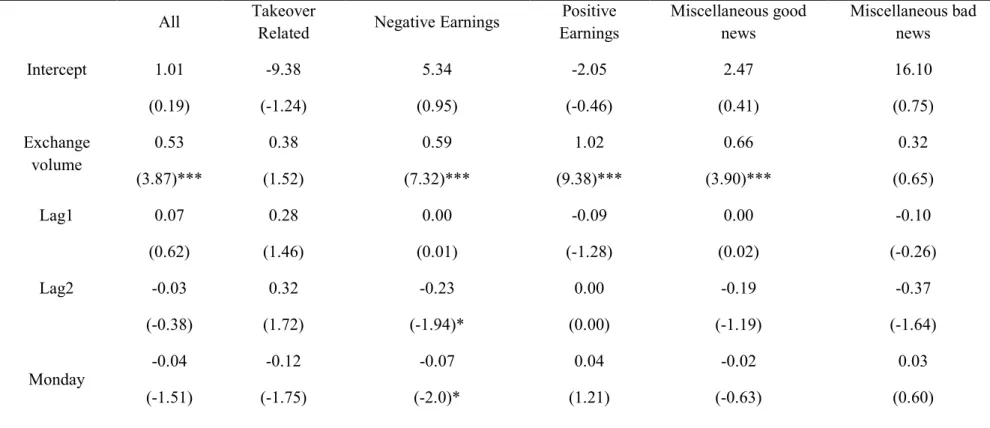
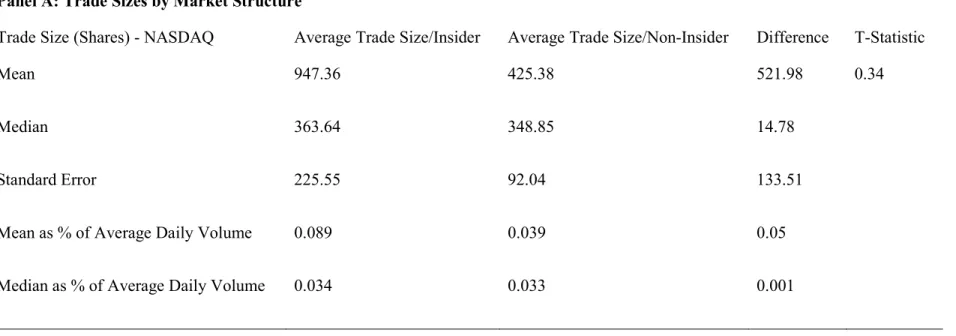
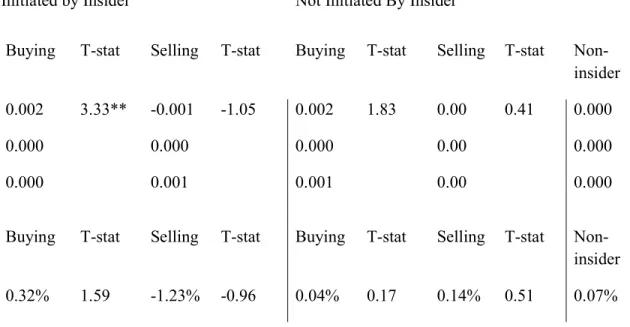
Chapter 3 investigates the impact of insider trading on share prices and volumes, both on a daily basis as well as on an intraday basis. Chapter 3 seeks to determine whether the impact of insiders on both a daily and an intraday basis is statistically significant both in terms of price movements as well as the lot sizes insiders transact. By employing a database created from US Securities and Exchange Commission prosecutions of insider trades, Chapter 3 segments insider trades from non-insider trades in the same 30 minute interval (to control for market-wide factors) and investigates insider trades’ impact on price and volume. Chapter 3’s sample also allows for analysis by different market structure, as both specialist (New York Stock
Exchange and American Stock Exchange) and dealer (NASDAQ) market structures are examined. Using the Lee and Ready (1992) algorithm, trades are classified as either buyer-initiated or seller-initiated, and insider trades are compared with trades with similar classifications.
Glosten and Milgrom (1985) note that price reactions are more pronounced in a specialist market structure, under which the specialist is counterparty to all trades in a security, as opposed to a dealer market structure. This is due to the relative
anonymity of an informed trader active in a dealer marketplace. Garfinkel and Nimelandram (2003) show that counterparties’ price reaction to a potential adverse selection situation extends to legal corporate insiders trading in their firm’s securities. Easley and O’Hara (1987) theorize that uninformed traders may also refrain from trading when they perceive the presence of an informed trader, leading to diminished volume. Admati and Pfleiderer (1988) examines the importance of the spread in the case of informed traders and conclude that although the specialist will, on average, suffer losses to informed traders, he will benefit from liquidity traders paying for immediate execution.
There is also a welfare dimension to the examination of insider trading, as insider trading increases the cost of capital and alters the capital rationing function of the markets (Bhattarchaya and Daouk, 2002). Therefore, determining whether insider trades have different impacts than non-insider trades is key to assessing how insider trading affects market participants both in terms of price movements as well as volume. This thesis examines the two in tandem, as larger trades are more liable to have a larger price impact due to their greater demand for liquidity.
Chapter 3 uses ordinary least squares regressions as well as point estimates to determine the statistical significance (or lack thereof) of insider trading activity on
both a daily and intraday basis. In addition, subsets of the sample are examined in order to assess whether findings in prior literature may be influenced by sample composition. These subsets include insider trading by category of information traded upon (e.g. merger announcement, positive earnings report) and insider trading by market structure of the exchange traded on (the specialist system of NYSE and AMEX and the dealer system of NASDAQ).
Chapter 3 finds that at the intraday level, insider trades are statistically significantly different from non-insider trades in the same 30 minute period in both trade-to-trade price impact and in volume (lot size traded). This effect is most pronounced on the specialist exchanges of NYSE and AMEX, as NASDAQ insider lot sizes are not statistically significantly different from NASDAQ non-insiders. This result confirms the anonymity hypothesis of Glosten and Milgrom (1985), and shows that specialist markets react differently in the presence of an insider than dealer markets, where the insider can remain anonymous.
2. Introduction to Chapter 4 – Price Discovery in Liquid British Stocks
After the Advent of MiFID and Chi-X
The drive to integrate previously segmented equities markets in Europe led the European Commission to promulgate the Markets in Financial Instruments Directive (MiFID). MiFID both allowed for pan-European trading of nationally-listed shares as well as catalysed the growth of new trading platforms such as Chi-X by requiring ‘best execution’ in equities. The launch of Chi-X spurred fragmentation in the European equities market, and can be viewed in conjunction with MiFID, the directive that enabled it. MiFID’s intent was to create a pan-European securities market through two key mechanisms. First, the passport rule allows for a firm regulated by any EU national entity to operate throughout the European Union.
Second, the abolition of the concentration rule eliminated the mandatory shipping of trades to national exchanges (which was not in place in UK or German shares prior to MiFID) (Davies, 2008). With the increased competition due to lower barriers to entry, order flow fragmentation increased. In addition, Chi-X also targeted traders who were more focused on swift trade execution and highly sensitive to marginal fee rates.
Chapter 4 uses price discovery econometrics to determine whether the origin of price formation has migrated from the London Stock Exchange to Chi-X in light of
regulatory changes at the European level. By examining the source of permanent trends (caused by impounding of fundamental information into asset prices) as opposed to that of transitory shocks (caused by order imbalances), price discovery econometrics can pinpoint the prevalence of informed traders within each channel.
Securities often trade in multiple markets and across multiple execution channels within markets. Through the no-arbitrage principle, it is reasonable to believe that trading follows error correction processes towards full-information and efficient security prices. As information is impounded into each market’s price, the question arises as to which market is contributing more to this on-going price discovery. The observable price can be conceived as a common factor that impounds information plus a transitory shock. Two security prices that adhere to this common stochastic trend are expected to be co-integrated. From microstructure theory (Grossman, 1976), it is expected that informed traders, those traders aware of the true path of future prices based on information, are the source of this information impounding, as they are the sole market participants with information.
Two methodologies are used in conjunction to determine the locus of price discovery. Hasbrouck (1995) proposes a vector autoregressive model that decomposes price
volatility into the variance of innovations in the common factor. Hasbrouck’s
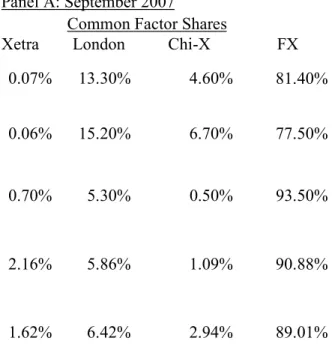
Information Share (IS) represents each market’s contribution to the innovations in the common factor. This contrasts with Gonzalo and Granger’s (1995) Common Factor Share (CFS) approach, which is a proportion of the common factor innovations that is driven by adjustment of the price series from each of the exchanges. Yan and Zivot (2010) confirm that both methodologies need to be used in conjunction, due to ambiguity in interpreting Hasbrouck Information Share estimates, in that the Information Share can be high either when a channel is impounding permanent information or when its competitors actively chase its stochastic shocks. Meanwhile, the Common Factor Share for an exchange will be high only if its prices avoid chasing transitory shocks relative to the competing markets. Therefore, using both measures helps to avoid an equivocal interpretation of Information Share, and at the same time allows one to interpret whether the trades on one channel are informative, or simply reflect another channel’s pursuit of transitory shocks.
Chapter 4 examines how the launch of Chi-X, a Multilateral Trading Facility (MTF) targeting technological traders highly sensitive to costs and low latency, affected price
discovery patterns. Prior assumptions would lead one to believe that, ceteris paribus,
price discovery should take place on each exchange at a level proportionate to its order flow. However, the low latency nature of Chi-X may attract informed traders sensitive to speed of execution. Monthly values for Hasbrouck Information Share and Gonzalo Granger Common Factor Shares are calculated and analysed to assess how developments in the pan-European equities markets affect the source of price discovery.
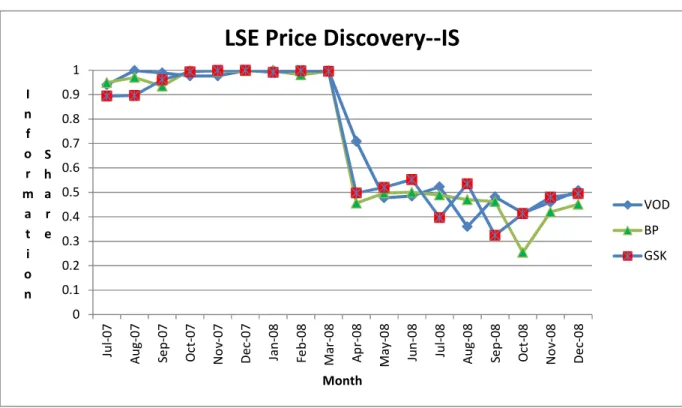
Chapter 4 finds that although the introduction of MiFID had no effect on price discovery flows between the London Stock Exchange and Chi-X, a subsequent event,
Chi-X’s central counterparty fee cut, led to the migration of the majority of price discovery from the London Stock Exchange to Chi-X. In addition, different price discovery patterns occur for shares with single primary listings in the UK and those with dual primary listings in the UK and in Asia. Importantly, Chapter 4 shows that MiFID introduced price cointegration when sampling price tuples every 1 second, causing prices on the London Stock Exchange to respond to prices on Chi-X, Deutsche Borse – Xetra, and the foreign exchange component to ensure that no arbitrage existed between all channels. This can be interpreted as the creation of a single pan-European securities market in equities.
3. Introduction to Chapter 5 – Liquidity and Fragmentation after MiFID on
European Exchanges
Chapter 5 investigates MiFID’s effects on transactions costs on pan-European equities markets. Prior to MiFID, concentration rules in some European countries mandated that securities be traded on a national exchange. More importantly, MiFID imposed a requirement that parties handling trades seek ‘best execution’ on behalf of their customers. Best execution is most often defined in terms of achieving the minimum (maximum) price when buying (selling) a share.
Central to the advent of MiFID was competition between a number of trading venues. As MiFID imposed a regime that required traders to obtain the best price for an order, order flow fragmentation occurred due to competition for best execution as well as a number of other preferences traders possess – from fastest execution to institutional arrangements for block trading. Prior theory offers two predictions as to what fragmentation will do to transactions costs. Hamilton (1979) hypothesizes that off-NYSE trading will spur greater competition and thus better spreads, but that it may
also increase volatility – if exchanges in fact enjoy economies of scale in transacting shares. However, Madhavan (1995) theorizes that fragmentation will drive volatility, reduce liquidity, and may lead to inefficient prices, stemming from the belief that a large exchange enjoys economies of scale in trading an asset. The debate distils into whether the effects of increased competition outweigh diminished economies of scale. Pagano (1989) suggests that if trading costs are homogenous between two markets, trading will cluster on one of them. He also notes that traders will participate on an exchange with idiosyncratic attributes conducive to their activity (e.g. block traders will trade either over the counter or on a market that facilitates large transactions, whilst liquidity traders will interact on a different market).
The literature in fragmentation suggests that there is a trade-off between the effects of stronger competition, as reflected in tighter spreads, and increased price volatility that results from the thinning of liquidity as traders migrate to satellite exchanges. In addition, market participants may split their orders between venues in order to opportunistically capitalize on different fee schedules and improved execution costs for desired order sizes.
Chapter 5 uses Bayesian Information Criteria (BIC) methodology to determine the most relevant variables to examine, and then uses Maximum Likelihood Estimation (MLE) methods to further examine relationships between transactions costs and a number of independent variables to investigate the launch of Chi-X, advent of MiFID, and a central counterparty fee cut on Chi-X to determine whether any of these three events have altered transactions costs in the UK, France, and Germany. It uses the full set of liquid stocks listed on the London Stock Exchange, Paris Euronext, and
Deutsche Borse – Xetra to examine whether costs of a list of major European shares on each of these exchanges or collectively have been changed by fragmentation, the
abolition of France’s concentration rule, volume traded, short-term price volatility, or interactions between these variables. Chapter 5 measures transactions costs in relative effective spread, as a ‘round-trip’ trading cost of a share.
Chapter 5 finds that increased fragmentation from the national exchanges to Chi-X after MiFID leads to decreased transactions costs in the form of lower relative
effective spreads. However, incremental implicit pre- and post-trade costs in the form of a reduced central counterparty fee on Chi-X have a greater negative influence on transactions costs than MiFID’s introduction of a ‘best execution’ obligation.
In summary, this thesis seeks to make a contribution to the literature on regulation and informed trading, utilizing the opportunity of a unique dataset in understanding the characteristics of insider trades in Chapter 3. A series of natural experiments created by regulatory restructures in Chapter 4 and 5 provides detailed insights as to how regulatory and market design affects the nexus between informed trading and transactions costs.
Chapter Two:
Literature Review
1. Introduction
This thesis examines the impact of informed trading on securities markets in several principal ways. Grossman (1976) defines informed traders as those traders who know ‘the true underlying probability distribution that generates a future price, and they take a position in the market based on this information’. Informed traders generate price paths by trading upon their knowledge of this information, and through the interactions of informed traders with the market, prices reflect all available information. Therefore, informed traders stimulate asset markets by impounding information. This thesis examines the actions of informed traders in several fora: first, by examining the intraday impact of illegal insider traders, a subset of informed traders. Illegal insider traders possess private information on the future valuation of a company they either work for or owe a fiduciary duty towards – the Securities Exchange Act of 1934 defines insider information as ‘material’, thus providing a test that implies that those prosecuted for trading upon it use non-trivial information, and ‘non-public’, that is, not disseminated to the general investing populace. The second and third chapters of the thesis examine how fragmentation affects both the
development of prices and transactions costs. Through fragmentation, the splitting of the order flow between multiple exchanges, informed traders can engage in strategic behaviour and mask their participation in the market, thus extracting maximum economic rent from their information. The competition inherent in fragmentation may allow informed traders to capitalize upon their information at a lesser price, although existing literature offers differential evidence on this topic, as economies of scale may be diminished. As price discovery methodology allows for the determination of where
informed traders trade, in that it separates permanent price trends from stochastic price shocks (often caused by order imbalances, as opposed to the impounding of information into market prices), research in this field can determine if market structure innovations attract informed traders.
2. Insider Trading
According to microstructure theory, informed trades, which are trades made on the basis of private information or analysis thereof, should cause traders to react to offset the costs of predation. This predation can be conceptualized as the difference between the trading price of the asset and the ‘true’ price of the asset that only the informed trader knows. Glosten and Milgrom (1985) model price setting in a specialist market. They theorize that with the adverse selection problem facing the specialist, the specialist will ensure a positive bid-ask spread, even when he is not seeking a profit, to provide a margin to compensate for unidentified insider activity due to information asymmetry. This problem may not confront the dealer, as he is anonymous and cannot detect any abnormal behaviour by floor brokers. Glosten and Milgrom (1985) see the specialist as requiring a higher price for liquidity when there is a chance that insiders or informed traders are present in the market who can take advantage of the specialist. As the specialist has a duty to ensure liquidity in the share, he is the monopolist provider of liquidity in the exchange, and thus, any sort of predation in the market is likely to take place at his expense. Easley and O’Hara’s (1987) theory compounds the specialist’s dilemma, in that if liquidity traders do not trade due to the perceived presence of an informed trader, the specialist incurs a greater loss as he must provide liquidity to the informed trader as opposed to mediating between uninformed traders and informed traders.
Benveniste, Marcus, and Wilhelm (BMW) (1992) suggest that the influence of a specialist-based exchange can compensate for the presence of an informed trader with price changes, notably by increasing the spread whenever the specialist perceives an informed trader is active in the market. This model demonstrates that as a result of repeated interaction between brokers and specialists on the floor, specialists will be able to spot informed trading, as the broker has a disincentive to deceive the
specialist, as the specialist has the ability to sanction those who behave counter to his interests through mechanisms like failing to improve quoted prices. Through the repeated interaction of traders and specialists, the specialist will be able to detect when anomalous behaviour exists in the market and consequentially increase his spread or fail to improve prices. As opposed to the specialist’s means of detecting informed traders, the dealer is only able to infer the presence of informed traders through order imbalances. Fishe and Robe (2002) empirically test Benveniste Marcus and Wilhelm (1992) using a natural experiment around traders in possession of a stock-picking column prior to publication. Their results show that spreads after the insider trades increased and depth shrinks, especially for NYSE-listed and AMEX-listed shares. Interestingly, they find no change in spreads on NASDAQ, which is consistent with the anonymity inherent in a dealer market. As Chakravarty, Harris, and Wood (2009) show, information occurs first in changes in depth levels; dealers may be adjusting their risk exposure due to the perception of an insider in the market. Easley and O’Hara (1987) and Admati and Pfleiderer (1988) examine the importance of the spread in the case of informed traders and conclude that although the specialist will, on average, suffer losses to informed traders, he will benefit from liquidity traders who are willing or are forced to pay a spread for immediate execution.
Garfinkel and Nimelandran (2003) test the impact of market structure on transactions costs using a set of legal corporate insider trades falling within Barclay and Warner’s (1993) definition of ‘medium-sized trades’ (500-9999 shares). They posit and find that due to the anonymity of a dealer market such as NASDAQ versus a specialist system such as NYSE and AMEX, spreads and price impact costs on NASDAQ, the dealer market, will be lower, as dealers cannot detect the presence of an insider in the market.
Kyle (1985) theorizes that insider traders will trade over a prolonged period to extract maximum value from their private information. Therefore, one should expect insiders to trade repeatedly and in such a way that does not cause their information to be exposed, which would erode their competitive advantage. Therefore, in a Kyle (1985) universe, insiders may use limit orders to avoid detection and trade over a period of several days in order to extract the maximum rent from their monopoly information.
Meulbroek (1992) is the first empirical research paper on the daily impact of insider trading on share prices. She compiles private SEC files detailing insider trading prosecutions with publicly available data and news reports to profile and examine insider trading behaviour in cases prosecuted from 1980 to 1989. She tests for insider activity (proxied by abnormal returns on the day(s) of insider trading) using a market model with an estimation period of 150 days, controlling for news announcements and examining the return on the day of the public disclosure of the news upon which the insider traded. She uses the Centre for Research in Securities Prices (CRSP) value-weighted index of all shares traded as the basis for the market model.
Meulbroek (1992) also uses a lagged market model to test for abnormal volume on the days insiders are active in the market, controlling again for news. As a robustness test,
she examines abnormal volume net of insider volume to determine whether the differential increase in volume is directly attributable to the insider.
She finds that price movements on insider trading days are almost half (47%) of the size of price movements on days when the news is publicly disclosed. She discovers an average run-up of 3.06% on the day of insider trading, and a cumulative abnormal return of 6.85% on insider trading days. This provides good support for the
assumption that the information is leaking into the market and is impounded into prices. As Meulbroek’s sample consists primarily (80%) of insiders trading upon news of imminent mergers, her results reflect price movement around mergers, and are not driven by earnings or other announcements. Meulbroek attributes the run-up to information leakage from insider traders. She finds a higher price impact for insiders trading on news of impending mergers (2.55% abnormal return and 6.01% CAR) versus that of insiders trading on earnings announcement news, which is consistent with the findings of Jarrell and Poulson (1989), who find a 40% run-up prior to merger announcements that they credit to rumours and arbitrageurs. Some of Meulbroek’s results may be driven by her sample, which is composed of mostly specialist stocks (70%) and mergers (79%), which may exaggerate the impact of an insider trade. Meulbroek finds that insiders provide the marginal volume
distinguishing insider trading days from non-insider days, and thus insiders are not driving additional participation in the market. She further notes that since insider trading drives abnormal volume, insider trading leads to abnormal returns, but asks whether insider trading is detected by trade aspects or by abnormal volume, and discovers that both have a marginal effect on abnormal returns.
Cornell and Sirri (1992) and Chakravarty and McConnell (CM) (1997, 1999) examine a serial insider trader or ring – in Cornell and Sirri’s case, a group of insiders trading
in advance of a merger announcement, and in Chakravarty and McConnell’s case, arbitrageur Ivan Boesky’s insider trading in Carnation shares. Cornell and Sirri determine that insider trading’s effect in this acquisition was complex – while price was affected and volume increased. Contrary to Meulbroek’s findings, Campbell-Taggart’s liquidity improved. This is unexpected in that an aggressive insider ring would lead specialists to protect themselves through changes in the spread (Glosten and Milgrom, 1985), and thus, liquidity would be expected to decrease. Cornell and Sirri (1992) attribute these seemingly contradictory results to the presence of noise
traders, who are defined as falsely informed traders1. Falsely informed traders can be
defined as those traders who believe they are trading on superior information and analysis, but in fact do not have any advantage over other traders. Cornell and Sirri cite technical traders (‘chartists’) as a classic example of falsely informed traders. They argue that the specialist’s problem dissipates when he can match falsely
informed traders and informed traders, as he is not subject to inventory effects, as the informed traders are counterparties to the falsely informed traders’ trades. This coincides with Admati and Pfleiderer’s (1988) conclusion that informed traders
increase activity when liquidity traders are present in the market.2 Therefore, Glosten
and Milgrom’s (1985) finding may not hold because insiders, not the specialist prey upon falsely informed traders. Cornell and Sirri’s case study is distinct from other studies in that the insider ring purchases a substantial proportion of traded shares. In their study, insider purchases constitute 29% of the total volume and represent a significant increase in volume. Cornell and Sirri attribute all the effects in their study to the presence of insiders and falsely informed traders, because the target company,
1
Noise traders are differentiated from liquidity traders in that noise traders believe they are trading on ‘special’ information. See DeLong, Shleifer, Summers, and Waldmann (1990).
2
Campbell Taggart, did not exhibit any confounding behaviour, such as news stories speculating on its potential as a merger target that could be driving abnormal volume. Through tracking short interest (unchanged), volume, and the share price of
Anheuser-Busch (the acquirer), Cornell and Sirri conclude that the only informed traders present are the insider traders.
Chakravarty and McConnell (1997) find a weak link between insider trading and subsequent stock prices, showing a lagged correlation between Boesky’s purchases in the market and subsequent prices with the strongest significance displayed in the link between Boesky’s purchases and the stock price two hours later but also showing a link between Boesky’s buying and contemporaneous price increases. However, price increases immediately after Boesky’s purchases may just be a liquidity effect, as any large trader aggressively buying in the market will push up the price and is thus not an
effect per se of insider trading. Boesky’s trading, as in Cornell and Sirri (1992), did
not affect spreads. Also, although Boesky contributed to the increased volume on days he traded, he was responsible for only half of it, with the other half potentially coming from falsely informed traders or momentum traders. By using time stamped trades and segmenting their sample into Barclay and Warner’s (1993) categories,
Chakravarty and McConnell (1997) discover that the Boesky trades correlated with price movements are the ‘large’ trades. They further conclude that since insider trading may be beneficial, as it assists in price discovery, and if spreads do not change as in this case, there is no adverse selection component. However, Chakravarty and McConnell (1997) were unable to discern as to whether Ivan Boesky’s trading spurred the price run-up, or whether he chose to trade on days after observing such an increase in prices.
Chakravarty and McConnell (1999) reprise the 1997 study, but with an important inclusion of trade direction through the use of the Lee and Ready (1993) algorithm. They find that Ivan Boesky’s trades (buys) in Carnation did not have a different impact than other buy trades, and thus, conclude that a large component of price impact in that case was due to overall trade imbalance as opposed to the presence of an informed trader in the market. They also estimate Meulbroek (1992) and Cornell and Sirri’s (1992) regressions on the Ivan Boesky data, and discover that when adjusting their methodologies for trade direction, insider trading is statistically no different from a trade in the similar direction. They verify with the Boesky data Meulbroek’s (1992) contention that higher returns exist on insider trading days than on days with no insider trading or public news announcements. Chakravarty and McConnell (1999) notably state that their critical assumption is that all non-Boesky trades are uninformed.
Fishe and Robe (2004) discuss the impact of insider trading in advance of a news column. This can be differentiated from the other cases inasmuch as the insiders’ trading pattern is relatively regular – to wit, they trade the day prior to public disclosure of the information. Fishe and Robe (2004) use spreads and depth in the limit order book as key metrics to measure the impact of illegal insider trading, ascertaining that when an insider is present in the market, depth shrinks in both dealer
and specialist markets, but spreads increase only under specialists3. These results
substantiate Glosten and Milgrom’s (1985) model. They find that volume increases substantially only after the insiders are present in the market, and attribute this to the presence of falsely informed traders. The insiders are only responsible for a marginal increase in volume (9.2%), which seems to suggest that either the information on
3
Fishe and Robe (2004) find that only ask depth changes significantly. As their data is comprised solely of purchases of shares, this may be a natural conclusion.
which the insiders trade leaks or liquidity or falsely informed traders are goaded into the market after observing a spike in price and volume. Fishe and Robe (2004) use a control group of equities in which information was available to the insiders but they did not trade, and find that normal price, volume, and spread patterns prevail.
In summary, Cornell and Sirri (1992), Meulbroek (1992), and Chakravarty and McConnell (1997, 1999) all identify a significant price and volume impact on the day of the insider trading, but do not have sufficiently granular data to identify whether the increased volume and price are spurred by insider trades. In addition, each of these studies use aggregated data (for Cornell and Sirri and Meulbroek, daily data, for Chakravarty and McConnell, hourly data), leaving unanswered the question as to how insider trades immediately impact prices and volumes. Furthermore, all the studies with the exception of Meulbroek (1992) are comprised solely of insiders purchasing shares – which may provide an unrepresentative sample of data with which to make blanket conclusions as to the effect of insider trading. Meulbroek’s (1992) sample is driven by speculation on merger announcements, which she shows to have a higher abnormal return than the impact of other information disclosed into the marketplace.
These inconsistent explanations merit further study, as Chakravarty and McConnell (1999) wrote, is whether results from a small population (with one insider trader or a small ring) are valid amongst a larger sample, or if the results are driven by
idiosyncratic attributes of the trades (e.g. a trader accounting for a large proportion of trading volume).
3.Fragmentation
3.1 Regulation and Market Integration
The United States Securities and Exchange Commission (SEC) promulgated Regulation NMS with the intent of protecting retail investors and promoting robust competition between markets, while ensuring markets remained integrated on a security level. Reg NMS’s intent is encapsulated in the idea that ‘[v]igorous
competition among markets promotes more efficient and innovative trading services, while integrated competition among orders promotes more efficient pricing of individual stocks for all types of orders, large and small’ (Reg NMS, 2007). As United States securities law has historically focused on protecting the retail investor from potential predation on the part of the more sophisticated institutional investors, Reg NMS also includes a battery of provisions to ensure the protection of retail investors. Foremost among these is the Order Protection Rule, which mandates that an order be ‘shipped’, or sent, to whatever exchange (known in Reg NMS as ‘market centers’) offers the best price, defined in terms of the highest price for a sell order and lowest price for a buy order. This principle is commonly known as ‘best execution’ in obtaining the optimal terms for an order. As is apparent in MiFID, best execution can take different forms, including speed of trade and likelihood of execution, as well as price.
Concurrent with the drafting of Regulation NMS, the European Union launched the Markets in Financial Instruments Directive (MiFID), a successor to the Investment Services Directive (ISD), MiFID meant to develop a pan-European securities market and, like Reg NMS, ensure the protection of retail investors in European financial markets. While MiFID was drafted by the European Commission, as per European Union subsidiarity, it was the responsibility of individual European Union nation financial market regulators to enforce it and draft national regulations to that end.
Like Reg NMS, MiFID aimed to obtain the International Organisation of Securities Commissions’ (IOSCO) twin goals of efficiency and fairness, and to a similar end, sought to encourage innovation and competition between markets and market participants within. Another similarity between Reg NMS and MiFID is that to comply with MiFID, market participants needed to invest in technological systems in order to ensure that they met best execution obligations. With these routing and trading systems, transparency arguably increased, as a trader could view and access order books in not only all of the established European exchanges, but on the new Multilateral Trading Facilities (MTFs), most notably Chi-X. MTFs differ from the established exchanges in their highly electronic nature and lean operating budgets. They also offer trading terms that may appeal more to technological traders - an increasing breed of market participants. The economic effect of MiFID was a transformation of the marketplace for security services from a monopoly, or highly concentrated oligopoly (in the case of states without concentration rules), to active competition to provide trading services across Europe.
Reg NMS differs from MiFID in several fundamental ways. Whereas MiFID institutes transparency and requires firms to report on best execution policies, Reg NMS’s order protection rule mandates that brokers prevent execution of orders without regards for improved quotes on other exchanges. In short, Reg NMS categorizes best execution through the lens of price. However, as noted by many academics, this rule does not apply to certain types of trades. By contrast, MiFID defines best execution in terms of price, speed, size, likelihood of execution, and a number of other variables (European Commission, 2007). Reg NMS also places the affirmative burden on exchanges and other trading venues to ship an order to a preferential quote whereas MiFID only applies to brokers. Therefore, MiFID’s
structure encourages, but does not ensure, best execution in trading, due to the nebulous definition of best execution in MiFID. Furthermore, critics of MiFID have asserted that MiFID’s obligation to publish a best execution policy and statistics indicating the extent of a broker’s compliance is ineffective, as European securities regulators have not threatened sanctions on any firm in breach of its best execution duty. However, critics of MiFID have stated that competition may come at the price of ‘a transparent and effective price formation process’ (Lannoo, 2007). Blume (2007) argues that Reg NMS’s uniform/one-size-fits-all framework harms investors with heterogeneous preferences, and advocates for a MiFID-like regulatory framework to maximize choice among market participants.
The literature on fragmentation suggests that there is a trade-off between the effects of stronger competition, as reflected in tighter spreads, and increased price volatility that results from the thinning of liquidity as traders migrate to satellite exchanges. One can view this as the diminution of monopoly rents as the marketplace shifts to imperfect competition. In addition, market participants may split their orders between venues in order to opportunistically capitalize on different fee schedules and
improved execution costs for desired order sizes. A cream-skimming effect may also take place with additional small size venues entering into the market.
3.2 Fragmentation
MiFID’s intent was to create a pan-European securities market through two key mechanisms. First, the passport rule allows for a firm regulated by any EU national entity to operate throughout the European Union. Second, the abolition of the concentration rule eliminates the mandatory shipping of trades to national exchanges (which was not in place in UK or German shares prior to MiFID) (Davies, 2008). With the increased competition due to lower barriers to entry, order flow
fragmentation increased. MiFID can be compared and contrasted with the United States’ Reg NMS. Whilst both had the intent of ensuring best execution (Lannoo, 2007), MiFID’s goal of harmonizing securities market rules created different
standards for the achievement of best execution than those in Reg NMS. The ultimate enforceability of the best execution requirement, however, is at issue in MiFID where market participants are at liberty to define their own meaning for best execution as long as that meaning is well known to their clients. However, increased pre- and post-trade transparency requirements have bolstered competition as a vehicle to facilitate best execution. In addition, it can be argued that the national exchanges enjoyed a quasi-monopoly privilege in Europe pre-MiFID, whereas that was not the case prior to Reg NMS.
Petrella (2009) details the fragmentation in major index components that occurred after the advent of MiFID. Chi-X’s market share of FTSE 100 equities moved from 2% in November 2007 to 7% in May 2008 to 12% in November 2008. Over the same period, LSE incurred a gradual decline in its market share, as it slipped from 70% in November 2007 to 58% in May 2008 to 59% in November 2008. Petrella (2009) notes that fragmentation can be attributed to the establishment of new MTFs offering different pricing schemes, and that are often owned in part by major brokers and dealers.
Hamilton (1979) hypothesizes that off-NYSE trading will spur greater competition and thus better spreads, but that it may also increase volatility if exchanges in fact enjoy economies of scale in transacting shares. Empirically, Hamilton finds that both effects exist, but that the competition effect outweighs the volatility effect attributable to fragmentation. Mendelson (1987) presents a theoretical framework in which he compares monopolists against a fragmented market, and shows that price variability
increases for individuals but that the overall amount traded decreases. In addition, overall price volatility decreases, as fragmentation/competition effects dominate the removals of economies of scale. Pagano (1989) suggests that if trading costs are homogenous between two markets, trading will cluster on one of them. He also notes that traders will participate on an exchange with idiosyncratic attributes conducive to their activity (e.g. block traders will trade either over the counter or on a market that facilitates large transactions, whilst liquidity traders will interact on a different market). Pagano (1989) submits that search can be beneficial for large traders’ liquidity needs, despite having some cost. Chowdry and Nanda (1991) focus on the information transmission dynamic, theorizing that competition between market makers will speed-up information impounding into prices, and that liquidity traders will split their orders between markets. In a finding of significance to this thesis, they find that one market will become the information-dominant exchange for trading in a security.
Madhavan (1995) theorizes that fragmentation will drive volatility, reduce liquidity, and potentially lead to inefficient prices. Batallio (1997) finds decreased spreads in NYSE-listed shares in which Madoff Securities competed. However, it is worth noting that Madoff only executed share volumes at or beneath 5000 shares, so he may have engaged in cream-skimming. As a result, fragmentation may lead to this sort of predatory behaviour. Fong, Madhavan, and Swan (2001) provide empirical evidence corroborating Pagano’s (1989) theory that differential liquidity needs affect a trader’s cost of whether to trade on-market or in an alternative venue, such as an upstairs market or ECN. Bennett and Wei (2006) empirically examined Madhavan’s findings and document how fragmentation in NYSE-listed shares affects liquidity and
discovering that NYSE firms have lower bid-ask spreads attributable to the reduced fragmentation. Lannoo (2007) contends that this was the intent of MiFID’s regulatory predecessor, the EU’s Investment Services Directive, which allowed for the
concentration of trading at a national exchange. In this vein, MiFID’s encouragement of competition and the resultant fragmentation may simultaneously increase liquidity and spreads, but at the detriment of the price discovery process.
Lee (1993) focuses on execution quality in US satellite exchanges, and discovers that in the presence of paid order flow, the payment amount tends to capitalize itself into the spread. To wit, non-NYSE trades have larger execution costs than NYSE trades by roughly the amount of the order flow payment. Lee also discovered that satellite exchanges had better execution costs in medium size trades while the NYSE
dominated in large trades, while NASDAQ performed worse than both NYSE and satellite exchanges. In a caveat, Lee noted that he focused only on execution costs, and other attributes of execution may reflect better on the NASDAQ.
Economides (1996) documents potential network externalities in the context of financial markets. While markets must have a minimal level of liquidity to execute transactions, as O’Hara and Ye (2009) note, fragmentation has no detrimental effect. To the extent that fragmentation leads to an increase in liquidity, welfare increases for all participants. In the context of price discovery, this would imply that overall price discovery would not be harmed by fragmentation, and that migration to a new exchange offering will be determined by factors other than liquidity.
Huang and Stoll (1996) attribute the larger spread on NASDAQ shares as compared to a matched sample of NYSE shares to both order preferencing agreements and a lower degree of competition from ECNs in NASDAQ listed shares, which diminish
competitive effects. Another factor to which they attribute higher spreads on NASDAQ to is the lack of a specialist with knowledge of complete order flow; therefore, each market-maker must protect himself from predation by informed traders. While this is theoretically possible, Huang and Stoll (1996) do not find evidence corroborating this. The two largest factors affecting the spread are
NASDAQ’s existing interdealer market4, and internalizing and preferencing
arrangements that reduce the incentive to compete, as that order flow is hypothecated to certain dealers.
A number of recent studies have examined the effect of fragmentation and market integration on measures of liquidity. Liquidity can be posited to affect price discovery as informed traders need sufficient liquidity on which to execute their trades, and thus impound information into prices. In the absence of sufficient liquidity, information fundamentals may not drive prices, but rather order imbalances caused by a patchy limit order book. Moulton and Wei (2009) find that during overlapping ADR trading hours for European cross-listed securities spreads decrease while quoted depth
increases. This is attributed to either competition for order flow between the European exchanges and NYSE or the influx of additional liquidity into the market during overlapping hours. Menkveld (2008) provides evidence of order-splitting behaviour in extending Chowdry and Nanda’s (1991) model to a sample of British and Dutch shares with ADRs. O’Hara and Ye (2009) examine how the growth of non-exchange trading venues affects market execution costs. They find that fragmentation occurs most frequently on small NASDAQ shares and least frequently on large NYSE shares. They conclude that fragmentation lowers transactions costs and increases transaction speed, which further verifies the competition hypothesis.
4
The literature in fragmentation suggests that there is a trade-off between the effects of stronger competition, as reflected in tighter spreads, and increased price volatility that results from the thinning of liquidity as traders migrate to satellite exchanges. In addition, market participants may split their orders between venues in order to opportunistically capitalize on both different fee schedules and improved execution costs for desired order sizes. A cream-skimming effect may also take place with the entrance of additional small size venues into the market. Recent literature, such as Jain and Johnson (2009) proposes a ‘network effect’ with the influx of many additional liquidity providers due to technological changes in the marketplace facilitating trading.
3.3 MTFs, Algorithmic Trading and Fragmentation
Barclay, Hendershott, and McCormick (2003) demonstrate how lower latency in ECNs can lead to more informed trading, and therefore, greater adverse selection costs. In addition, they show that ECNs provide the majority of price discovery compared to traditional exchanges. Hendershott and Moulton (2009) find that lower latency leads to the greater incorporation of information into prices. They also outline how latency can lead to greater competition for liquidity providers, and attribute an increase in effective spreads to the price of immediate execution. Boehmer and Boehmer (2003) investigate the new listing of three exchange traded funds (ETFs) on NYSE and find that a significant amount (10%) of order flow migrates to NYSE, and that in two out of the three shares, NYSE impounds the most information relative to order flow. NYSE’s over performance in proportion to its overflow can be attributed to the influx of informed order flow. Boehmer and Boehmer (2003) note that
NASDAQ’s quotes come from the Island ECN, which provides further support to the theory that a large proportion of informed participation occurs on ECNs, although,
some informed traders may have moved to NYSE with the introduction of
competition. The implications of this is that price discovery is expected to follow the order flow of the informed traders, as per Grossman (1976), informed traders are the market participants aware of the future expected value of the asset, so in trading, they will impound permanent valuation fundamentals.
Smith (2008) outlines the growth of non-exchange trading in the United States and speculates that MTFs will develop differentially to appeal to various sorts of traders.
This coincides with existing literature5 positing that traders have heterogeneous
preferences and endowments. Smith (2008) highlights Markit BOAT’s emergence as an alternative trade reporting facility (where trades that take place on another venue or over-the-counter can be reported to comply with regulation) and Chi-X’s advantage due to a speedier order book and a direct clearing system. Chistella et al (2007) describes Chi-X’s market model as comparable to Xetra and Euronext. Chi-X’s share of the order flow for the largest FTSE 100 components is under 1%, as compared to its 3-5% share of major Dutch and German equities.
Hendershott and Riordan (2009) examine the information shares of algorithmic trades and non-algorithmic trades on Deutsche Borse’s Xetra Platform in the thirty shares comprising Germany’s main index, the DAX. They use a set of algorithmic trades on Xetra provided to them by Deutsche Borse. Using quotes, they find that algorithmic trading has an information share of 51%. Importantly, they find that algorithmic trading is sensitive to the price of liquidity, demanding liquidity when it is
inexpensive, and supplying it when liquidity’s cost increases. They do not find that algorithms raise price volatility.
5
Gresse and Gajewski (2007) compare execution costs on Euronext Paris’s NSC trading system with the London Stock Exchange’s SETS. Drawing on prior literature showing that an electronic order driven market has lower trading costs than a quote-driven market, they conduct an event study following the introduction of the LSE’s SETS system. The key difference between the two trading systems is that NSC (Paris) routes all systems to a central limit order book whilst LSE’s hybrid system includes SETS’s central limit order book with other trading mechanisms that are not displayed. The centralisation of Paris’s limit order book is an artefact of certain EU member states’ ‘concentration rule’ that stymied the development of ECNs outside of the United Kingdom (UK) by mandating that all trades in a nationally-listed share be sent to that country’s national stock exchange. By way of example, prior to MiFID, BP, a UK-listed share, could be traded on the London Stock Exchange, Deutsche Borse’s Xetra, and ECNs in the European Union (EU), while Total, a Paris-listed share, could only be traded on Euronext Paris. A result is that dealers are on standby to bilaterally offer non-displayed quotes outside the order book on London, while all quotes in Paris must be visible on the order book. Gresse and Gajewski (2007) find that prices are more volatile on SETS and that spreads are higher there which is in part driven by the marginally larger size of trades on SETS. Using Huang and Stoll’s (1997) spread
decomposition6, they show that SETS has roughly half the proportion of the spread
falling under both adverse selection and inventory holding that NSC has, which is in accord with most of the literature on adverse selection that shows that adverse selection is lower on venues with less pre-trade transparency. Gresse and Gajewski (2007) thus display that market structure affects local price volatility and can induce trading migration. Therefore, to the extent that market structure changes attract
6
Huang and Stoll split the spread into ‘inventory holding and adverse selection’ and order-processing components.
increased informed order flow, fragmentation will alter price discovery patterns as well as drive changes in transactions costs.
4. Price Discovery
4.1 Price Discovery Across Channels
Securities often trade in multiple markets and across multiple execution channels within markets. From the no-arbitrage principle, it is reasonable to believe that trading follows error correction processes towards full-information and efficient security prices. As information is impounded into each market’s price, the question arises as to which market is contributing more to this on-going price discovery. The observable price can be conceived as a common factor that impounds information plus a
transitory shock. Two security prices that adhere to this common stochastic trend are expected to be cointegrated. From microstructure theory (Grossman, 1976), it is expected that informed traders - those traders aware of the true path of future prices based on information - are the source of this information impounding, as they are the sole market participants with information.
Two alternative econometric approaches seek to provide an answer to the question of contributions to price discovery. Hasbrouck (1995) proposes a vector autoregressive model that decomposes price volatility into the variance of innovations in the common factor. Hasbrouck’s Information Share (IS) represents each market’s
contribution to the innovations in the common factor. This contrasts with Gonzalo and Granger’s (1995) Common Factor Share (CFS) approach, which is a proportion of the common factor innovations that is driven by adjustment of the price series from each of the exchanges. De Jong (2002), Lehmann (2002), and Baillie et al (2002), have surmised that a combination of the two may be informative. Yan and Zivot (2010) argue that CFS is needed to more effectively interpret the IS. The IS for an exchange
can be large either because an exchange’s trades impound permanent information, or because its competitors’ trades are chasing transitory shocks. Meanwhile, the CFS for an exchange will be high only if its prices avoid chasing transitory shocks relative to the competing markets. Therefore, using both measures helps to avoid an equivocal interpretation of Information Share, and at the same time, permits a determination of whether the trades on one channel are informative, or simply reflect another channel’s pursuit of transitory shocks.
Roughly four generations of price discovery technology have existed since Engle and Granger (1987) launched their study of cointegration/error correction systems. The first is exemplified by Harris, McInish, Shoesmith, and Wood (1995), when they specify a vector error correction model (VECM) to determine whether prices in IBM, a NYSE listed security, were solely formed from NYSE price changes, or whether there was an error correction dynamic between trade-based price adjustments in New York and those on the Chicago and Pacific Exchanges. At the time, all markets employed a specialist system, and although New York had ten times the trades of Midwest (and 3.5 times the trades of Pacific), Harris et al were able to match roughly 80 observations per day for analysis. After performing a Johansen (1991) test for cointegration, discovered that the Midwest and Pacific exchanges contribute meaningfully to the price discovery process. IBM prices on NYSE error correct to permanent innovations on the Midwest and Pacific exchanges as well as the Midwest and Pacific exchanges reacting to movements in the NYSE price.
Hasbrouck (1995) investigates the price formulation process in Dow shares by determining how much of the variability in a share’s quote-based returns can be attributed to trading in all tape-reported execution channels in Dow shares. Hasbrouck notes that his sample includes alternative trading systems, but not overseas trades.
Both Harris et al (1995) and Hasbrouck (1995) seek to determine the dynamics of price adjustment, namely which price reacts to adjustments on another exchange. Hasbrouck proceeds to note the sensitivity of his analysis to reporting mechanisms such as auto-quotes, delayed posting of quotes, and to ‘stale’ behaviour in
infrequently updated quotes and trades. In addition, due to the econometric
specifications of Hasbrouck’s (1995) model, simultaneous correlation between quote updates on the primary exchange and on the satellite exchanges will result in a large range of estimates when the order of the series is reversed in the Cholesky
factorization procedure.
Harris et al (2002) pioneer a third generation of price discovery technology, adapting Gonzalo and Granger (1995)’s common factor share approach to financial markets. This extends their previous 1995 work, providing a snapshot in time across the Dow components to see if common factor weights are dynamic. Harris et al (2002) note that the Gonzalo-Granger measure is robust to cross-equation correlations, and characterise it as a representation of the permanent price trend caused by the incorporation of information into asset prices.
Yan and Zivot (2010) and Harris, McInish, and Wood (2010) reconcile the Hasbrouck and Gonzalo-Granger approaches for determining price discovery by showing that although Hasbrouck’s IS approach measures informativeness, it also reflects the chasing of transitory shocks. An IS can be high either because a channel is impounding permanent information, or because its rivals are chasing transitory shocks. In contrast, the Gonzalo-Granger approach will produce a high CFS only if competing execution channels are chasing transitory shocks. Therefore, use of the two measures in conjunction will be required to determine which channel is impounding new information and which is chasing transitory shocks.
Kim et al (2000) investigate price discovery in American Depository Receipts (ADRs) and their underlying securities, using VAR and Impulse response functions, finding that although the domestic price is the leading indicator in price adjustment (roughly 65% of the innovations), exchange rates (roughly 15%) and the ADR market (roughly 10%) play some role in the dynamics of price adjustment between the ADR and the underlying asset.
4.2 Price Discovery Across Borders
The international finance literature demonstrates the sensitivity of modelling of the exchange rate. Ding et al (1999) are the first in this literature with an examination of Sime Darby Berhad, one of Malaysia’s largest corporations, which trades on both the Kuala Lumpur Stock Exchange and the Singapore Stock Exchange. Given the relative stability of the ringgit-Singapore dollar exchange rate, they convert all prices at several times in the day into a common currency. They note that the rate is
sufficiently stable that practitioners do not convert prices on a real time basis. Ding et al (1999) discover that a significant amount of price discovery (from 26-32%) occurs in the foreign (Singapore) market, a price discovery share larger than its proportion of trading volume. The estimation of a VECM shows that although foreign prices strongly error correct to Malaysian prices, Malaysian prices’ error correction to Singaporean price adjustments is relatively weak.
Grammig, Melvin, and Schlag (2005) study the rate of price discovery in German shares and their ADRs and find that an overwhelming (80-90%) amount of the information is impounded in German markets. They also display the importance of modelling the exchange rate process as a separate vector of prices, as opposed to converting to a common currency. Grammig et al (2005) draw the conclusion that a firm’s foreign earnings can affect the price discovery processes. For example, they
find that the New York Stock Exchange influenced price discovery more in
DaimlerChrysler, a firm with significant earnings on both sides of the Atlantic, than in Deutsche Telekom or SAP, the German software company.
5. Transactions Costs
5.1 Transactions Costs – Theory and Empirics
Demsetz (1968) was the first to investigate transactions and conceptualized the bid-ask spread as a way of incorporating ‘immediacy’ into the study of transactions costs. This is the first illustration of a concept of liquidity in the literature, and Demsetz illustrates it either as the direct cost of immediacy or as a profit margin on inventory. Demsetz enumerates five factors that will lead to the narrowing of the spread: competition from others to become the specialist, competing markets, order
aggressiveness, trades directly between counterparties, and other specialists. Benston and Hagerman (1974) provide a framework where the spread is affected by the cost of holding inventory, matching orders, ‘trading with insiders’, and competition.
Therefore, they expand Demsetz’s framework by incorporating what have come to be known as ‘order-processing costs’ and adverse selection. Grossman and Miller (1988) model liquidity as the supply and demand for ‘immediacy’ as negotiated between market makers and liquidity demanders. Market makers recapture the costs of inventory deviating from optimal levels and the costs of their presence in the market through the bid-ask spread. Copeland and Galai (1983) pioneer the modelling of the bid-ask spread as the dealer’s situation between trading with liquidity traders and informed traders. As the dealer profits from trading with liquidity traders and loses from trading with anonymous traders, the spread is set as a way to mediate that interaction. Glosten and Milgrom (1985) model price setting in a specialist market. They theorize that with the adverse selection problem facing the specialist, the specialist will ensure a positive bid-ask spread, even when he is not seeking a profit,
to provide a margin to compensate for unidentified insider activity due to information asymmetry. This problem may not confront the dealer, as he is anonymous and cannot detect any abnormal behaviour by floor brokers. Even in the presence of multiple market makers, the factor of interest that will allow the market maker to detect abnormal behaviour is the concentration of order flow, and her ability to compare the entire order flow with historical patterns. Easley and O’Hara (1987) and Admati and
Pfleiderer (1988)7 examine the importance of the spread in the case of informed
traders and conclude that although the specialist will, on average, suffer losses to informed traders, he will benefit from liquidity traders who are willing or are forced to pay a spread for immediate execution. McInish and Wood (1992) note the presence of an intraday pattern in bid-ask spreads in the NYSE market. Examining all these models of transactions leads one to conclude that a number of factors set liquidity’s price, but ultimately liquidity’s price works as a supply and demand interaction. Another variable this thesis considers is pre- and post- trading fees, costs levied by an exchange for access to it and for certainty and insurance of transactions. While the bid-ask spread can be conceived as an explicit and fluctuating cost, trade-related fees are often fixed costs (platform access fees), or a fixed amount per trade.
Therefore, the spread can be conceived both as a price and insurance for the inventory holder to protect against the possibility of predation by an informed counterparty. Glosten and Harris (1988) are the first to estimate these ratios, and are unable to verify that the adverse-selection components of the spreads of a series of NYSE-stocks in 1981-1983 were positive, and find that the primary determinant of spread size is trade size. This size effect can be seen as a cost of liquidity for large trades that need to walk the book in order to fully execute. However, this is a key driver in the
7
Foster and Vishwanathan (1990, 1993) model how an informed trader’s decision and timing of trading is reliant on the timing of disclosure of public information.