Human Pacman: A Mobile Augmented Reality
Entertainment System Based on Physical, Social,
and Ubiquitous Computing
2.1 Introduction
In recent years, the world has seen the proliferation of highly portable devices, such as personal digital assistants (PDAs), laptops, and cellular telephones. At the same time, trends in computing environment development suggest that users are gradu-ally freed from the constraints of stationary desktop computing with the explosive expansion in mobile computing and networking infrastructure. With this technolog-ical progress in mind, we have developed Human Pacman which serves as a pioneer in the new genre of computer game that is based on real-world-physical, social, and wide area mobile-interactive entertainment. The novelty of this computer game has the following aspects: Firstly, the players physically and immersively role-play the characters of the Pacmen and Ghost, as if a fantasy computer digital world has merged with the real physical world. Secondly, users can move about freely in the real world over wide area indoor and outdoor spaces whilst maintaining seamless networked social contact with human players in both the real and virtual world. Thirdly, Human Pacman also explores novel tangible aspects of human physical movement and perception, both on the player’s environment and on the interaction with the digital world. In other words, objects in the real world are embedded and take on a real-time link and meaning with objects in the virtual world. For example, to devour the virtual “enemy”, the player has to tap on the real physical enemy’s shoulder; to obtain a virtual “magic” ingredient, the player has to physically pick up a real physical sugar jar with an embedded Bluetooth device attached.
In this system, players are provided with custom-built wearable computers, and they interact both face-to-face with other players when in proximity or indirectly via a wireless LAN network. Also fully utilizing the high computing power of wearable computers and the underlying network support, Human Pacman takes mobile gam-ing to a new level of sophistication by incorporatgam-ing virtual fantasy and imaginative play activity elements that have made computer game popular [21] with the imple-mentation of Mixed Reality on the Head Mounted Displays (HMD). The players also experience seamless transitions between real and virtual worlds as they swap between immersive first person augmented reality view (with virtual cookies in the real world) and full virtual reality view of the Pac-world throughout the game. A.D. Cheok, Art and Technology of Entertainment Computing and Communication, DOI10.1007/978-1-84996-137-0_2, © Springer-Verlag London Limited 2010
Another important feature of Human Pacman is its inherent support of networked mobile gaming. Mobile gaming is already a big business in Japan and South Korea where up to 70% of users on some networks regularly use the service [7]. Accord-ing to Forrester Research [31] of the US, within three years 45% of European mo-bile subscribers will regularly play games on their momo-bile phones. London-based Ovum [14] forecasts that global spending on mobile games will reach€4.4 bil-lion by 2006. Well-known mobile entertainment success stories in Japan include NTT DoCoMo’s IMode. Games that it carries, such as Sega’s Space Harrier and ChuChu Rocket, will bring in nearly US $830 million this year (Source: Datamoni-tor). As will be shown below, Human Pacman takes mobile entertainment to a new level of interactivity through its emphasis on seamlessly merging the physical real world with the virtual world, maintaining networked social contacts through out and across the real and virtual world boundaries, and emphasizing physical and tangible contacts with the digital world.
Björk suggested ubiquitous games as a new form of gaming [4]. A ubiquitous game is a game that explores the use of ubiquitous computing (ubicomp) [36] as defined by Weiser. He painted a picture where computers would be embedded in everyday object, and computing is invisible because there is “intelligent” commu-nication between the objects. Employing this philosophy, we have implemented a system that embeds everyday physical objects, which seamlessly take on a digital fantasy meaning, throughout the wide area real-world environment. For example, we have attached Bluetooth devices to sugar jars which when being picked up, will automatically communicate with the wearable computer by adding the correspond-ing virtual correspond-ingredient to the inventory list of the player.
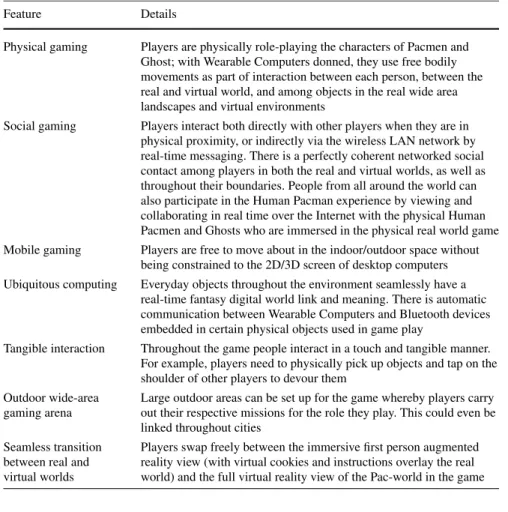
Human Pacman ventures to elevate the sense of thrill and suspended disbelief of the players in this untypical computer game. Each of the novel interactions men-tioned is summarized in Table2.1. We will proceed with details to Human Pacman by firstly giving a research background to this system and previous works that have motivated us. Then we proceed to detail gaming experiences involved by clarifying the actual game play designed. We venture to explore the intricate issues of interac-tion versus experience in mobile mixed reality gaming that arise between physical mobile players together with virtual online players in this game. We study and elab-orate on the impacts of mixed reality gaming on users’ experience arising from a unique combination of physical, virtual and social interactions. We also demonstrate how this novel form interactions provide entertaining and fulfilling sensations and present our user study results to support our arguments. After that we will discuss the various mobile service issues with respect to the system; as well as analyze the system in the context of addressing various ubicomp concerns. Lastly, we conclude with our reflections on the future impacts of the system on everyday life.
2.2 Background
Today’s mainstream entertainment revolves around interactivity. Gone are the days when people were satisfied with passive form of entertainment as provided by televi-sion and cinema. People today enjoy entertainment they can control, and experience
Table 2.1 Detailed feature descriptions of Human Pacman
Feature Details
Physical gaming Players are physically role-playing the characters of Pacmen and Ghost; with Wearable Computers donned, they use free bodily movements as part of interaction between each person, between the real and virtual world, and among objects in the real wide area landscapes and virtual environments
Social gaming Players interact both directly with other players when they are in physical proximity, or indirectly via the wireless LAN network by real-time messaging. There is a perfectly coherent networked social contact among players in both the real and virtual worlds, as well as throughout their boundaries. People from all around the world can also participate in the Human Pacman experience by viewing and collaborating in real time over the Internet with the physical Human Pacmen and Ghosts who are immersed in the physical real world game Mobile gaming Players are free to move about in the indoor/outdoor space without
being constrained to the 2D/3D screen of desktop computers Ubiquitous computing Everyday objects throughout the environment seamlessly have a
real-time fantasy digital world link and meaning. There is automatic communication between Wearable Computers and Bluetooth devices embedded in certain physical objects used in game play
Tangible interaction Throughout the game people interact in a touch and tangible manner. For example, players need to physically pick up objects and tap on the shoulder of other players to devour them
Outdoor wide-area gaming arena
Large outdoor areas can be set up for the game whereby players carry out their respective missions for the role they play. This could even be linked throughout cities
Seamless transition between real and virtual worlds
Players swap freely between the immersive first person augmented reality view (with virtual cookies and instructions overlay the real world) and the full virtual reality view of the Pac-world in the game
in which they are full involved [39]. In fact, not only do they want such entertain-ment; people want to enjoy it together with family and friends. As shown in a sur-vey [11], one of the top reasons why game players like to play games is that game playing is a social activity people can enjoy with family and friends. With advance-ment in networking technology, social gaming has gained popularity since the in-troduction of networked games [11]. Networked games overcame the barrier of dis-tance, enabling real people to play against each other over large areas. After all there is no opponent like a live opponent since no computer model will rival the richness of human interaction [9]. According to a recent study by Nezlek [22], enjoyable and responsive interactions increase life satisfaction scores among people. Nevertheless, even in networked computer games, social interaction between players is limited since natural interactions such as behavioral engagement, and cognitive states are lost. Thus, by bringing players in physical proximity for interaction, Human Pac-man brings networked social computer gaming to a new ground because huPac-mans enjoy being physically together, and socially interacting with each other [5].
Essen-tially, Human Pacman brings the exciting interactive aspects of networked gaming, and merges it with the real physical world, to allow a seamless real-time networked social contact between humans in both the real and virtual worlds simultaneously.
Human Pacman has also aspects derived from pioneering work that has been de-veloped on ubiquitous gaming. Multi-players mobile gaming is demonstrated in ‘Pi-rates!’ [3]. ‘Pirates!’ implements the game on PDAs with proximity sensing technol-ogy to incorporate a player’s contextual information (such as physical co-location of players and objects in the world) into the game context as important elements of the game mechanics. However, visual and sound effects of game play are limited by relatively low computing power of PDAs. Augmented Reality and Virtual Reality cannot be implemented; therefore, immersive experience is rather limited due to the flat 2D display used on PDAs. The E3 project [18] examines the essential elements of free play, and multi-user social interaction. It focuses on human-to-physical in-teraction and human-to-human inin-teraction. However, it does not explore large-scale configuration where users walk around.
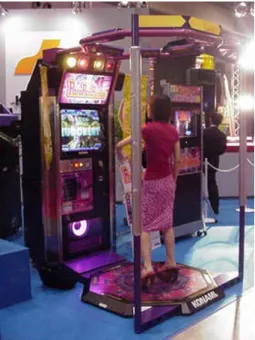
Human Pacman has its roots in serious research about people’s interaction with their world. People as social creatures find physical interaction, touch, and human-to-human presence essential for the enjoyment of life [5]. We remember that in pre-computer age, games were designed and played out in the physical world with the use of real world properties, such as physical objects, our sense of space, and spatial relations. Nowadays, computer games focus the user’s attention mainly on the computer screen or 2D/3D virtual environment, therefore constraining physi-cal interactions. However, there seems to be a growing interest in physiphysi-cal gaming and entertainment. Commercial arcade games have recently seen a growing trend of games that require human physical movement as part of interaction. For exam-ple, dancing games such as Dance Dance Revolution and ParaParaParadise [16] are based on players dancing in time with a musical dance tune and moving graphical objects (see Fig.2.1). However, these systems still force the person to stand at more or less the same spot, and focus on a computer screen in front of them. Nevertheless, our underpinning philosophy is similar. One of the goals for Human Pacman is to bring physical gaming into computer entertainment.
Even though Human Pacman uses augmented reality techniques as part of its interface, it is only for providing a comprehensive user interface for the players. There were some previous works done on using augmented reality in entertainment. AR2 Hockey [24] is a system that allows two users to hit a virtual puck on a real table, as seen through a HMD. AquaGaunlet [33] is a multi-player game where players fight with strange invaders coming from the virtual world through some egg-shape objects into the physical space. These games are played in a small and restricted area, with limited movement, and little interaction with physical space. The games have no transitions between AR and VR. There is also no exploration on the physical environment the player is in. Another important mobile game is known as ARQuake [34], which is an AR extension of the popular computer game Quake. Using Wearable Computer equipped with global positioning system, ARQuake can be played indoor and outdoor. However, it is a single player game with practically no social interaction.
Fig. 2.1 A player at the ParaParaParadise arcade game
Lastly, the transitions between the real and physical world in Human Pacman are derived from research that has been done on continual transversal along the Reality– Virtuality continuum [19]. The Magic Book [2] uses a book metaphor to demon-strate the seamless transitions between augmented and virtual reality. Collaboration is carried out only in a small-scale and closed-up configuration. Touch-Space [6] is an embodied computing based mixed reality game space with free movement be-tween the real world and virtual world. Players are tracked with inertial-acoustic hybrid tracking devices mounted on the ceiling. However, since they are restricted to a small indoor area, there is limited physical movement in game play. In Human Pacman, the interface and transition between the real world and virtual world is achieved in real time throughout the spacious indoor and outdoor physical world.
2.3 System Design and Game Play
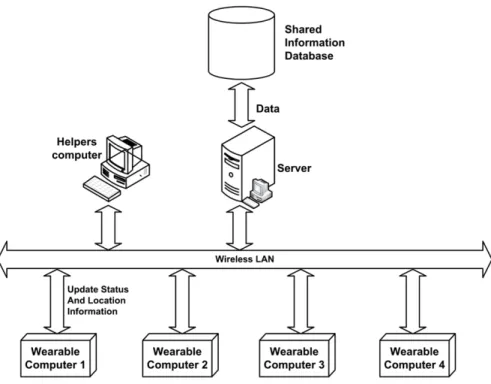
Human Pacman features a centralized architecture that is made up of four main entities, namely the central server, wearable computers, laptops, and Bluetooth em-bedded objects. An overview of the system is shown in Fig.2.2.
The wireless LAN serves as a communication highway between the wearable computers, the helper computers (laptops), and the server desktop computer. The underlying program is built on a client–server architecture with wearable computers and helper laptops as clients, and the desktop computer as a central server. Physical location and players’ status updates are done between the client wearable comput-ers and the server on a frequent and regular basis. The server maintains
up-to-the-Fig. 2.2 Top level system design overview of Human Pacman
minute players’ information (location, status, etc.), and presides over any communi-cation between Bluetooth objects and the wearable computers. The wearable com-puters were developed in the lab and the main components are a Single Board Com-puter, Twiddler2 (handheld keyboard and mouse), Cy-Visor Head Mounted Display (video see-through HMD) with FireWire camera attached, InertiaCube2 (inertia sen-sor from Intersense), and DRM-III module (GPS and Dead-Reckoning device from Point Research Corporation).
With the software architecture mentioned as the backbone of the game engine and the hardware as enabling tools, we proceed to describe the game play of Human Pacman. The main concepts of the game are first given in terms of team collabora-tion, ultimate game objectives, and essential nature of the game’s playground named Pac-world. Then, we move on to present the details on the players’ roles as Pacman, Ghost, and Helper, respectively. We end this section by giving examples on several actual game play situations.
2.3.1 Main Concepts: Team Collaboration, Ultimate Game
Objectives and the Nature of Pac-world
The players are assigned to two opposing teams, namely the Pacman team and the Ghost team. The former consists of two Pacmen and two Helpers; correspondingly,
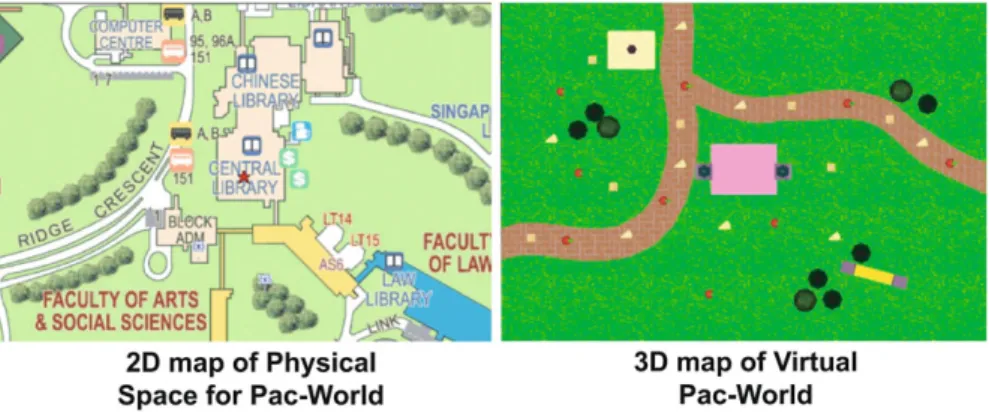
Fig. 2.3 2D map of game area and its corresponding 3D map of Pac-world
the latter consists of two Ghosts and two Helpers. Each Pacman/Ghost is in coalition with one Helper, promoting collaboration and interaction between the users. Since a Helper player is essentially participating in the gameplay remotely using a com-puter terminal over a wireless LAN, Human Pacman can effectively be expanded to include online players anywhere on Earth who can view and collaborate via the Internet with real human Pacmen and Ghosts who are immersed in the physical playground.
Ever since its introduction by Namco to Japanese arcade fans in 1979, Pacman has gone through numerous stages of development, yet the ultimate goal of the game remains fundamentally unchanged. We have designed Human Pacman to be in close resemblance to the original Pacman in terms of game objectives so that the players’ learning curves are very much leveled to the point that they can pick up the game in no time and enjoy the associated familiarity. Basically, the goal of the Pacman team is to collect all virtual plain cookies and hidden ingredients in Pac-world while avoiding the Ghosts. On the other hand, the aim of the Ghost team is to devour all Pacmen in the Pac-world. To add to the excitement of game play, after ‘eating’ certain special ingredients, a Pacman gains Ghost-devouring capability, and henceforth can attack her enemy head on for a limited period of time.
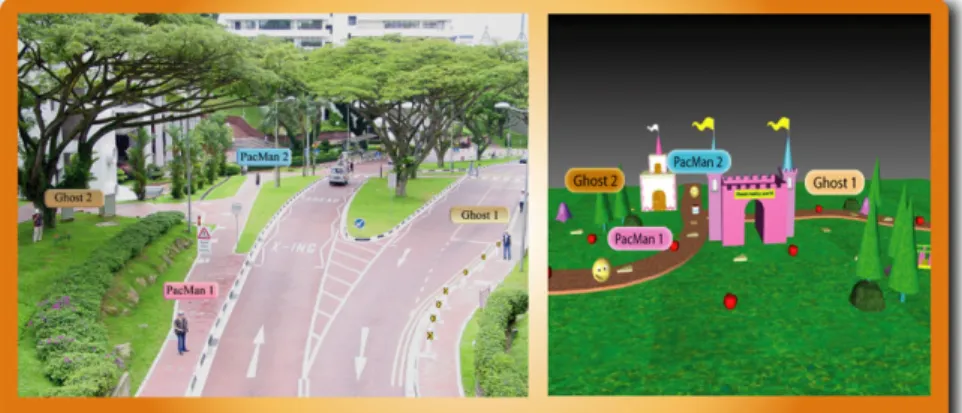
Pac-world is a fantasy world existing dualistically in both Augmented Reality (AR) and Virtual Reality (VR) mode. Pacmen and Ghosts, who are walking around in the real world with their networked wearable computers and head mounted dis-plays (HMD), are allowed to switch between the two viewing modes. Helpers, on the other hand, can only view in VR mode since they are stationed in front of net-worked computers. Most importantly, there is a direct and real-time link between the wide-area physical world and the virtual Pac-world at all times, thus providing the users with a ubiquitous and seamless merging of the fantasy digital world and the realistic physical world. As seen in Fig.2.3where the 2D map of the selected game play area in our university campus and the 3D map of Pac-world are shown side-by-side, we have converted the real world to a fantasy virtual playground by
in-graining the latter with direct physical correspondences. This is done with the help of the Dead Reckoning Module (DRM) and inertia sensors.
The DRM is an electronic module comprising a 12-channel Global Positioning System (GPS) receiver, digital compass, pedometer, and altimeter. The DRM mea-sures the displacement of the user from an initialization point by measuring the direction (with data obtained from the compass), and distance traveled (using ac-celerometer data) with each footstep taken. Although the DRM is a self-contained navigation unit, when GPS position data is available, it can be used to correct both the distance and direction calculations with the help of a Kalman filter algorithm. Besides, in conjunction with the step detection logic (pedometer), the module can detect running, sideways, and backwards walking which is necessary for our appli-cation.
InertiaCube2 is used for head tracking for the implementation of augmented re-ality display in the HMD. Since augmented rere-ality is implemented as an interface feature between the players and their wearable computers, head tracking for the calculation of view perspective of each player is important. It is an inertial three degree-of-freedom orientation tracking system that gives yaw, pitch and roll of the object that it is attached on. By placing the sensor on the cap of each player, her head movement and orientation is tracked to high accuracy. Consequently using the player’s position and head movement, the wearable computer calculates the relative position of each plain cookie within the view of the camera, and super-imposes a 3D virtual cookie image of a proportionate size on corresponding posi-tion on the video stream. The posiposi-tion of other mobile players obtained from the server is used to update the 2D virtual map in the HMD view of the player. Sim-ilarly, the point-of-view of each mobile player is sent to the computer of a helper through the server, and the corresponding view in the virtual Pac-world can be dis-played.
The real-time position of each mobile user is sent periodically to the server through wireless LAN. Upon receiving the position data, the server sends an up-date to each wearable computer with the position of other mobile players, as well as the positions of all “non-eaten” plain cookies.
The position of a player with respect to another player or location in the physical world is calculated as follows. Taking two physical locations as point1 and point2, the distancedbetween user1 and user2 in radian can be calculated by:
d=cos−1sin(lat1)sin(lat2)+cos(lat1)cos(lat2)cos(lon1−lon2), (2.1) where lon1, lat1, lon2 and lat2 are the longitude and latitude of user1 and user2, re-spectively, which all are in radians. To compute the distance in kilometers instead of radians,dis multiplied by the radius of the Earth, which is estimated at 6,371.0 km.
The coursec12 from user1 to user2 will be: IF sin(lon2−lon1) <0
c12=cos−1
sin(lat2)−sin(lat1)cos(d)
sin(d)cos(lat1)
Fig. 2.4 First person view of Pacman
ELSE
c12=2π−cos−1
sin(lat2)−sin(lat1)cos(d)
sin(d)cos(lat1)
. (2.3)
The abovec12 is valid when the user1 is facing to the North Pole. Otherwise the yaw of the North Pole for the user1 must be subtracted fromc12.
2.3.2 Pacman and Ghost
Human Pacman offers physical interactions with themes found not dissimilar in sports and childhood games such as rugby and hide-and-seek. The element of phys-icality is emphasized to explore a new experience in mixed reality gaming played in the city streets.
Pacman has to physically move around the game area attempting to collect all virtual cookies. When she is in AR mode, through the HMD, she sees the real world being overlaid with virtual plain cookies as shown in Fig.2.4. Unlike in PacMan-hattan [25] where the physical players could only envision the imaginary cookies in their mind, physical players in Human Pacman can view the cookie from the first person point of view. Despite the virtuality of the cookies, the body action of moving through them in order to obtain the cookie provides a realistic sensation of physical–virtual interaction. This is further enhanced by the audible “chomp” sound that would alert the player to signify successful collection.
In addition to the virtual plain cookies, she has to find and collect physical in-gredients that are actually Bluetooth embedded objects as shown in Fig.2.5. Unlike in Mogi [20], where players will be moving in an outdoor area and pick up virtual
Fig. 2.5 Bluetooth embedded object
items through their mobile phone interface (by pressing buttons), the Human Pac-man not only has to find the real Special Cookie, but also to hold the box physically in order to gain the Super Pacman skill. These objects have direct links and repre-sentations in the virtual Pac-world. This provides a sense of presence and immersion with the virtual Pac-world, as well as a feeling of actively participating in the game in the real world.
On the other hand, Pacman should avoid being devoured by Ghost, i.e., not letting Ghost tapping on her shoulder where the capacitive sensor is attached on. This phys-ical touch interaction between the players exemplifies tangible physphys-ical interaction between humans, which is commonly found in traditional games such as hide-and-seek and the classic “catching” game, but is now being revived in a computer gaming arena. Similarly, Pacman gets to do the same after becoming Super Pacman. Hence, Human Pacman demands more physical involvement from both parties, resulting in a more exciting and engaging game play.
The role of a Ghost is rather straightforward; she has to track down all Pacmen and devour them. Nevertheless, she has to beware of Pacmen with Ghost-devouring power and avoid being devoured by them.
It must be noted that when Pacman or Ghost switches to VR mode, she is com-pletely immersed in the virtual Pac-world. However, virtual paths are drawn in close correspondence to roads in the real world as seen in Fig. 2.6. Despite be-ing physically separated from one another and highly mobile, each player is con-stantly tracked and her identity as unique entity in Pac-world is maintained in real time.
Searching is yet another important activity for both players; be it Ghost search-ing for Pacman, or the other way round when Pacman has become Super Pac-man. Since players are facing the real opponents instead of computer artificial in-telligence created ones, the hunted real players will be definitely seeking smarter ways to evade and hide in ways that would not be required with present console or PC based computer games. On top of that, Pacman needs to search for cook-ies and hidden special cookcook-ies as well. The physical process of searching con-sequently demands coordination between players’ movements, observations and reactions to the immediate environment. For instance, an observant Ghost could even trail the physical path of the Pacman in the real world through the disap-peared cookies that were seen earlier. Players are thus constantly being challenged
Fig. 2.6 Correspondence between the physical world and virtual Pac-world
to inquire further into the actual physical neighborhood area within finite period of time.
The physical interaction, however, does have its limitations and shortcomings in the context of providing a fulfilling and entertaining experience for players. In ex-amining physical interactions in Human Pacman, we have merely focused on users using their body movements to stay engaged in the game. While contact in terms of competition exists between both parties, collaborations is lacking. As the law of physics binds every player to the ground, collaborations between members of same team could prove to be too difficult when they are physically far apart.
Of course, we can seek ways to enhance the cooperation between the physical players, for instance, using voice for long distance communication through a walkie-talkie or mobile phone. However, it would be more interesting if we could bring in another kind of player who is not being restricted by the physical world limitations to participate in the game. The new interaction between the original physical players and this new type of players should be refreshing and could spark off more inter-active innovations. In the light of this, we introduce a new virtual team member – the Helper – as a new genre of player which we will elaborate further in the next section.
2.3.3 Helper
Helper is a new character in Human Pacman who does not exist in the original Pacman game. This new role is created to enhance the game by contributing an alternate means of hybrid interaction between the real and virtual players. In this context, being a virtual player implies that the participation of the Helper does not take into account of her physical presence relative to the actual location of Pacman
Fig. 2.7 Close collaboration between Pacman and her Helper
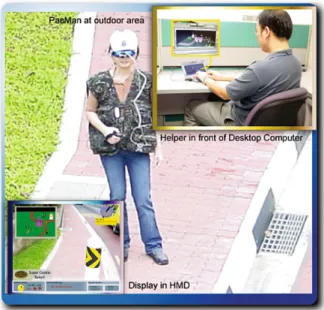
and Ghost. She could connect to the game server from almost anywhere in the world through the Internet. Each Pacman and Ghost will be assigned a partner Helper who acts as an intelligence advisor and coordinator in her quest for achieving the goal. Helper, who is always in the VR mode and sees all, guides her partner by messag-ing her with important information as shown in Fig.2.7, and thus this promotes collaboration and interaction between humans.
We have integrated the elements of situated actions into the role of Helper. For instance, one of the exciting virtual interaction features is the ability of Helper to watch the game in a unique way. A football game or a TV show normally can only allow viewers to accept passively whatever is shown. However, here we al-low Helper to view the game “live” in virtual reality form anywhere through the Internet from any angle and distance. Every movement in the physical world will be reflected immediately in the virtual realm. Even when Pacman becomes Super Pacman, Helper would see a corresponding change in the 3D graphic model. This mode of virtual viewing (watching the real live event in alternate graphical form) provides a new dimension of watching experience for participants, which is both efficient and entertaining.
Helpers, however, are not restricted to watching the game passively. They can actually communicate with Pacman or Ghost in real time via text messaging bi-directionally. While Helpers use computer keyboard for text-inputting, Pacman and Ghost communicate and respond to their Helpers in the chat by using the Twiddler, a handheld inputting device. The communication that takes place could be either a casual chat or a discussion on the winning strategy. Such interactions could promote social cooperation and establish relationships between humans who are operating across radically different contexts.
From the viewpoint of Helpers, while communicating and watching the Pac-man/Ghost avatar move around, they should realize that it is different from other common online games; both Pacman and Ghost are actually bodily moving some-where in the physical world, and are not just any other players who sit in front of the computer screen like them. Every piece of information they can provide mat-ters as it can consequently affect the physical player’s next movement in the actual location which Helpers can see virtually. Also Helper cannot ask physically impos-sible movements, for example, to move from one street to another in too short a time.
From another perspective, with the assistance of Helper, Pacman/Ghost will be having a guardian watching over her, even though the identities or whereabouts of Helpers might be unknown. It would be as if they possess an extra pair of eyes roaming in the sky (like a bird) aiding and advising them. For an outdoor wide area game such as Human Pacman, a human’s assistance would definitely prove to be more useful than some raw numbers to pinpoint the player to her current coordinates.
As the complexity of the game in terms of area space or number of Pacman/Ghost players is increased, we foresee social interaction among players should be even more active and necessary. The role of Helper is more critical in these cases, in order to support the players by providing even more knowledge on the current states and brainstorming for the next move or strategies with limited resources avail-able.
To a great extent, the existence of Helpers for both teams resulted in a power-ful synergy of interaction between real and virtual domains in the social context of mixed reality gaming. Collaboration within each team becomes more effective despite being bridged by only text messages. Winning or losing largely becomes a function of teamwork, and this adds a greater thrill and fun factor to the game as a whole. In short, the introduction of the role of Helper certainly enriches the interaction theme of Human Pacman.
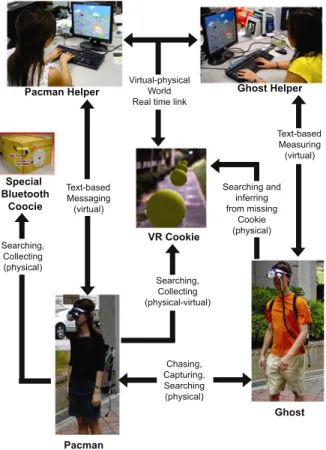
Figure2.8shows the overall picture for the different forms interactions that we have discussed so far. In the figure, Pacman is assisted by her Helper, who is sitting in front of a screen. The screen is displaying the virtual Pac-world, which is in direct real time correspondence to the real world. Similarly, Ghost is also assisted by a different Helper. As both Helpers are able to see positions of Pacman, Ghost, virtual cookies and Bluetooth cookies in the Pac-world, they can guide Pacman or Ghost by using text-based messaging to achieve their ultimate goal of winning the game.
2.3.4 Actual Game Play
Starting the Game Pacmen and Ghosts start from the Pac-castle and Ghost-house in Pac-world, respectively. These two places correspond to two different physical locations in the game area.
Fig. 2.8 Overall game flow in Human Pacman
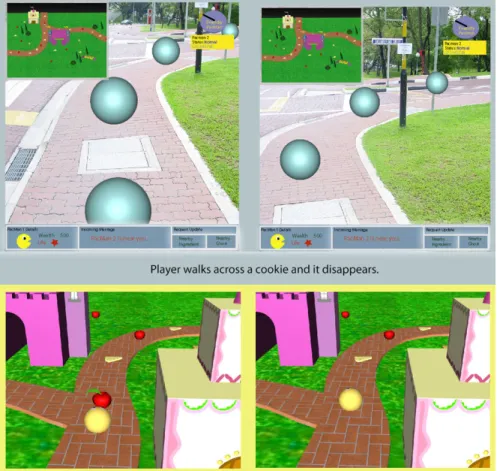
Collection of Plain Cookies Pacman collects a cookie by walking through it. Such physical action is reflected visually in Pac-world through the disappearing of the cookie in both the AR and VR modes. The collection of cookies by a Pacman will be reflected in the Pac-world map seen by all players in real time, be it on the player’s HMD or the Helper’s laptop. In Fig.2.9, the top images show the HMD view of the Pacman player as she collects a cookie. When she walks through the cookie, the cookie disappears. Note that this is also reflected in the virtual Pac-world in real time by the disappearing of the cookie at the corresponding location. This is shown in the images of the figure.
Ghosts are not allowed to collect cookies. Although a Ghost is not able to see en-emy Pacman on the map, the disappearing of cookies in her map can give her a hint to where to find a Pacman. Therefore, Pacman has to be careful as her physical in-teraction with the real world (i.e., movement) can be digitally reflected in the virtual world, and be used by a Ghost. Novelty is again seen in such intimate relationship between interaction in the physical world and its effect in the fantasy virtual world. Neither physical distance nor mobility could restrict each player from seeing this
Fig. 2.9 Pacman collecting cookies
effect real-time as all players, including Ghosts can see an update of the virtual map in real-time.
Collection of Ingredients In the game, Pacmen collect ingredients to make spe-cial cookies. Ingredients include flour, butter, sugar, and spespe-cial ingredients (e.g., Chocolate Chip, Almond). There are two types of special cookies; a butter cookie is made up of flour, butter, and sugar; a super cookie is made up of butter cookie and a special ingredient.
When Pacman eats a butter cookie, she achieves 1 minute immunity from being consumed by a Ghost. When Pacman eats a super cookie, it takes a time lag of 30 seconds before she achieves 3 minutes of ghost-devouring power (30 seconds is for the Ghost to run or devour the Pacman).
Fig. 2.10 Sequence of pictures showing the collection of an ingredient
In the game, real Bluetooth-embedded objects are placed in different parts of the game area. In Fig.2.10, a sequence of pictures shows a Pacman collecting an ingre-dient. When the Pacman is within range of the Bluetooth object (about a distance of 10 meters), communication takes place between the wearable computer and the Bluetooth device. The wearable computer sends the unique address of the Bluetooth device to the server, upon receiving it, the server will then decide if the player is el-igible to collect the virtual ingredient that is associated with the physical Bluetooth object. If the player is not eligible (for example, she has already collected the in-gredient), she will not be alerted to the object. Otherwise, an alert message will be shown on the player’s HMD display.
The player has to hunt for the Bluetooth embedded object upon receiving the alert message in the surrounding physical area and thus adding elements of fun and adventure to the game play. Having found the object, collection is done simply by physically holding the object in her hands. This is achieved by the use of charge transfer sensing on the object that detects the player’s touch. We have designed this capacitive sensor using QT161 IC chip from Quantum Research Group [28]. Once haptic data is collected by the sensor, the Bluetooth device embedded on the object will send an alert message to the wearable computer, which will in turn be relayed to the server. The server performs legitimacy check on the player’s action, and then proceeds to updating its database as well as informing the wearable computer. The collection of ingredient exemplifies a natural tangible interaction that is involved through physically interacting with this object by human touch. Pacman is able to
hold a real object naturally in hand as it should be in real-life treasure finding. Such a tangible action provides the player a sense of touch to the fantasy domain of game-play. The collection of the ingredient will be kept in a virtual inventory list and be immediately reflected in the display; moreover, the action occurs in real-time in the virtual world. As seen in the figure, collection is shown as an addition of an icon of a sugar jar to the inventory list after the ingredient has been collected. Pacman need not lug the physical object with her as she has collected the ingredient virtu-ally.
Collaboration Between Players There is an essential element of collaboration in the game play between a Pacman/Ghost with her Helper, and between any allied Pacmen.
(i) Pacman/Ghost and Helper Collaboration Helper is in a good position to assist her partner as she has a complete view of Pac-world all the time, including the positions of all players and ingredients. Mobile players can only see the complete Pac-world under the VR mode. However, the AR mode is more advantageous for mobility because under VR mode movement is restricted since she does not have a view of the real world. Furthermore, as Helpers within the same team are physically close, they are able to collaborate between themselves and work out a strategy to achieve the team’s goal. The advantage of this setup is that social interaction and collaboration is significant between Helpers, as well as between Helpers and their partners.
(ii) Pacman/Pacman Collaboration Pacman players can collaborate through trans-ferring of ingredient between them, even if they are physically far from each other with the support of wireless LAN. For example, Pacman A can initiate a request for the list of unused ingredients Pacman B has. Upon approval, A can request a trans-fer of an ingredient from B, subject to approval by B. Transtrans-fer of an ingredient is important as Pacman may not be able to comb the whole game area for ingredients. She may lack some ingredients, which may have been collected by her ally. Strategy could be implemented, with the coordination from Helpers, to distribute ingredients between Pacmen. However, Pacmen are not allowed to transfer special cookies so as not to disadvantage the Ghosts.
Use of Special Cookie All special cookies can only be used once. When a Pacman consumes a special cookie, she will see an alert message on her HMD, informing her of the power she acquired. Furthermore, in real-time a label describing her acquired power will be placed on top of her Pacman avatar in the VR mode. This serves to inform all Helpers, including those from the Ghost team, of her ability. This is illustrated in Fig.2.11.
Devouring Enemy Player To devour a Pacman, a Ghost must physically touch the Pacman’s capacitive sensor pads on her shoulders as shown in Fig.2.12. The
Fig. 2.11 HMD display and the corresponding VR mode view
same applies when a Pacman with Ghost-devouring capability devours a Ghost. When a Pacman is devoured, she loses one life point. Each Pacman is given two life points. The same applies to Ghosts. Devouring involves tangible physical touching contact between two players. As close proximity is involved, other forms of human interaction come into play. The act of devouring makes the game more tangible and fun, by involving more types of natural physical movement. As in when a Pacman player is the prey, her agility determines the “life-and-death” of her virtual Pacman role. Not only tangibility is brought to play in this fantasy world, but also other human perceptions and instincts. Thus this computer game provides the benefits of natural wide area free bodily movements as part of humanistic interaction between each person.
Ending the Game The game ends when either team meets its goal or when a time limit of 15 minutes has been reached.
2.4 User Study
To gain useful feedback from the end user, we conducted an experimental user-study survey on the Human Pacman system. Our aim was to find out from actual users their experience of the positive and negative aspects, interaction, and level of enjoyment in using the Human Pacman system. In these tests, the focus was placed on the different novel experiences offered by the game. Our study involved 23 subjects between the age of 21 and 33, of which eight were females and 15 were males. Amongst these people, 39% indicated their level of expertise in computers as advanced, 43% as intermediate, and the rest as beginner.
The experiment setup consisted of four parts. First, the subject was asked to play traditional arcade Pacman game on a desktop computer for five minutes. Then
Fig. 2.12 Ghost catching a Pacman
a three minute Human Pacman video was shown to give him or her a better un-derstanding of the game. This was followed by a 15 minutes trial where the subject tried the roles of Pacman, Ghost and Pacman’s Helper for 5 minutes each, along with other subjects taking a different role. An expert user acted as the Ghost’s Helper. Finally, the subject had to fill up a questionnaire and to provide comments on the system.
2.4.1 Questions and Aims
Table2.2(focussed on the role of real world players of Pacman and Ghost) and Table2.3(focussed on the role of Helper) show the list of questions that were asked in the survey. Following each question is the reason for asking this question in the user study.
Figures2.13and2.14give the user study results of all the multiple-choice ques-tions. The options for each question and the percentage of users who chose each option are given in the figures.
2.4.2 Discussion
In this section, the response to the questions will be discussed. All the data had been analyzed using statistical methods.
Table 2.2 Questions of user study focussing on the real world play role of Pacman and Ghost Question Reason for asking
(i) How do you rank Human Pacman as compared with the normal Pacman game in terms of entertainment value? Please rate between 1 (normal Pacman more entertaining) to 7 (Human Pacman more entertaining)
As the idea of Human Pacman originates from the previous arcade Pacman, the fundamental concepts of game play are similar. The question aims to find out if any value has been added to the old Pacman game in the new system
(ii) How comfortable do you feel when using the Human Pacman system?
The wearable computer system is still rather bulky and heavy compared to mobile devices such as phones, Game Boys, and PDAs. We want to find out if and how much it affects the level of comfort of the user when the user dons it
(iii) How intuitive do you think it is to collect cookies by physically walking through them?
In everyday life, collection of an item is seldom, if ever, made by walking through it. We seek to understand if the user finds it intuitive to collect virtual cookies by walking through them just as is done in the original Pacman game
(iv) Please rate, from 1 (lowest) to 7 (highest), the level of excitement of playing as a Pacman in Pac-world (first person experience), in comparison with the arcade Pacman that you can play using a joystick/keyboard (third person experience)?
We want to find out if the immersive experience of Human Pacman makes the game more exciting. Arcade Pacman is used as the baseline for comparison as it is fundamentally similar in game-play
(v) What do you think of displaying “cookies” as virtual objects augmented inside the real world?
From this question, we want to find out how realistic the experience of collecting virtual cookies using AR is
(vi) Does the physical collection of real objects (special cookies) enhance the gaming experiences?
The collection of special cookies is a tangible interaction with a physical object that translates into a digital meaning (i.e., update of Pacman’s inventory list). We want to find out if such graspable interaction enhances the game for the user (vii) What do you think of
the “capturing” event implemented in our system (touching the Pacman by Ghost)?
The “capturing” event is a reflection of the naturalistic and physical approach Human Pacman took towards tangible interaction. We seek to find out if the user enjoyed this feature
(viii) Do you like to play the Human Pacman game?
Having reflected on the game by answering the previous questions, the user is quizzed on the overall level of interest she has on Human Pacman
Table 2.2 (continued)
Question Reason for asking (ix) Please rate, from 1
(lowest) to 7 (highest), the feeling of “social interaction” in being a Ghost, Pacman, or Helper
We want to find out the level of social interaction experienced by the user in each role
(x) How do you compare this game with other computer games?
As Human Pacman aims to extend and differ itself from conventional human–computer interface used in normal computer games, this question investigates how well Human Pacman achieved its aim
(xi) How do you compare Human Pacman with the traditional “Catch Me” game?
The question looks at how Human Pacman compares with simple, non-computer based games. Traditional “Catch Me” game is used as a basis for comparison due to its similarity with the “capturing” event in Human Pacman. We want to see if adding the fantasy element has any benefit in the user’s enjoyment over a normal catch game
(xii) If there is such a game in an amusement park, how much are you willing to pay to play the game?
Currently acquiring the whole Human Pacman system requires high overhead. So a commercially viable version of the system could only be sustained based on a pay-per-use basis, which is a norm in amusement parks. The question investigates the amount of revenue per person the system could bring in if implemented commercially. The question is asked to see if there is a link between such research systems and potential commercial use (xiii) How often do you
play computer games?
The question finds out how frequently the user plays computer games. This enables us to find out if her love for conventional computer games would influence her desire to play Human Pacman
(xiv) Please give us some comments on how we can improve the system and what the current drawbacks of the system are
We seek user’s comments on our system to further improve the system in areas we may have neglected
First, we will discuss the set of results from the questions in Table2.2focussed on the real world players. Questions (i), (viii), (x), and (xi) examine how well Human Pacman is received by users; and how it compares with respect to other types of game in terms of user preference. As seen from the respective findings given in Fig.2.13, most of the users are enthusiastic about Human Pacman. However, it is noted that, when compared with the traditional “Catch Me” game, 34.8% of the users gave a neutral stand in their preference. Results from (i) give an average rating of 5.85 (and a variance of 1.46) indicating that Human Pacman is much more favored than normal Pacman in terms of entertainment value. Statistical analysis with the T-test confirms the significance of our inference (p=6.72×10⁻⁷).
The element of physicality may have been the pushing factor for the preference shown towards Human Pacman over arcade Pacman and conventional computer games. However, this is not so much of a benefit over the traditional “Catch Me”
Table 2.3 Questions in the user study focussing on the role of Helper Questions Reason for asking
(i) Does the VR mode give you a good idea about the game environment?
It is important for Helper to understand the situation her partner is in so as to dispense the appropriate advice. The ability to comprehend the game environment from the VR mode “Gods-view” is essential in helping her access the situation. Thus we wanted to see if this is confirmed in the user’s opinion
(ii) Do you think Helper increases the chances of winning?
Helper is an additional feature to the original game. It is introduced to breach the geographical barrier in mixed reality gaming. However, we do not want to add this feature just for this sole purpose. We would like to find out if this enhancement to the game is useful
(iii) Does Helper make the game more enjoyable for Pacman/Ghost?
Helper is supposed to be an enhancement to the original game. Thus, if this new role does not make the game more enjoyable to the original players, there may be a need to reconsider the inclusion of Helper
(iv) How boring/exciting is the game for Helpers? Please rank from the 1 (very boring) to 7 (very exciting)
As the role of Helper is played by another person, we should find out from the point of view of Helper whether he or she is enjoying the game as well
(v) Currently the game is played by one Pacman/Ghost to a Helper. Do you think the game would be more interesting for the Helper if he/she could assist more Pacmen/Ghosts? If yes, what is the optimal number? If not, why?
Human Pacman basically revolves around social and physical interaction among all players. Generally, these interactions will increase with more players, thus making the game more enjoyable, too. However, as number of players increases, confusion will inevitably start to creep in. We would like to find out what is generally the optimal number of players
(vi) Do you think the frequency of conversation will increase when the complexity of the game (in terms of area size and number of Pacmen/Ghosts) is increased?
As Human Pacman is based on virtual and real interactions, we would like to know if complexity of the maze will affect the frequency of communication
(vii) Do you think Pacman needs a Helper?
The main role of Pacman helper is to guide Pacman to all the cookies and avoid the path of Ghost. However, some players may find it more exciting to be able to explore the real world freely and without any reins
(viii) Do you think Ghost needs a Helper?
The main role of Ghost is to track down Pacman. Similar to the above situation, some players may feel that the additional help is redundant and would like to explore the real world freely
Fig. 2.13 Graph results for all multiple choice questions focussed on the real world players (some questions have no graphs and are described in the main text only)
Fig. 2.14 Graph of the results for questions related to the virtual Helper players
game (which by itself is a game that involves a high level of physical participation). A number of users commented that they like the idea of “physical involvement” and “physical movement” in Human Pacman. Some said that such movement is a good form of exercise. Note that 60.9% of the users still prefer Human Pacman over the “Catch Me” game. This indicates that the element of physical involve-ment in Human Pacman is not its sole attraction. The immersive experience in the role playing of Pacman could be another element that users enjoyed over arcade Pacman and conventional computer games. Findings from Question (iv) give the average level of excitement rated by the subjects as 6.0 (and a variance of 0.182) for the first person experience in Pac-world and 3.33 (variance of 0.97) for the third person experience in arcade Pacman, indicating a higher level of excitement
in the former. The non-parametric two conditions Wilcoxon statistical test confirms the significant difference in the feeling of excitement by the players at the level of
p=4.88×10⁻⁴.
As reflected by many users, the backpack holding the wearable computer system is bulky and heavy, and the HMD is cumbersome to wear. As seen from the results obtained for Question (ii), 73.9% of the users found the wearable computer to be un-comfortable. This could be the deterring factor for 77% of those who indicated that they like to play Human Pacman but would refrain from playing it frequently. The absence of equipment weighing down the user could also make traditional “Catch Me” game more attractive as one is unencumbered physically.
Despite not being a normal day-to-day experience, collecting virtual cookies by walking through them is deemed to be intuitive by 87% of the users (as seen in Fig.2.13(iii)). The rest found the experience to be acceptable, though not intuitive. Findings for Question (v) show that 78.3% found that the use of virtual cookies enhances the game, whereas 17.4% feel that the cookies are acceptable as virtual objects but they fail to enhance the game.
A shift in alignment of virtual cookies from their supposed absolute position in the real space (caused by sensing drifts), mentioned by some users, could be the rea-son why virtual cookies to some users seem lacking realism, and thus being unable to enhance the game. As the view of virtual cookies is calculated with respect to the user’s location, any discrepancies of her exact position may lead to the “shifting” of the absolute position of the virtual cookies in the real space. Since the system uses DRM-III and the dead-reckoning method to estimate displacement of the user, an inaccurate estimation of her stride (which varies with individual) or the wrong count for the number of steps taken will introduce error in the estimate. The location of the user thus computed is an estimate and may not reflect her true position in the physical space. Some users have reflected that the DRM-III module failed to sense all the footsteps taken by the user.
Users also found the visual cue of the cookies collection (i.e., cookies disappear-ing from AR world when collected) to be weak and insufficient in providdisappear-ing a “better feel” of collection. A number of users suggested using sound, for example, a “beep”, to indicate collection of each virtual cookie. A lack of realistic affordance of virtual cookies makes reliance on other cues more important to indicate collection.
On the issue of tangible interaction element in Human Pacman, 78.3% (as seen in Fig.2.13(vi)) found that the graspable interaction offered by the collection of real objects enhances the game. The other 21.7% gave a neutral response towards having this collection as part of the game. Almost all the users indicated in Question (vii) that they like the “capturing” event. Despite being both naturalistic interaction with the physical world, users seemed to like the “capturing” event more. This suggests the physical human-to-human interaction in the process of “capturing” makes the event more enjoyable.
Results obtained for Question (ix) show that the feeling of having social inter-action have rated means of 5.67, 5.41 and 4.17 with variances of 0.97, 1.17 and
0.88 while playing as Pacman, Ghost and Helper, respectively. The non-parametric Wilcoxon test shows insignificant difference in the level of social interaction be-tween Pacman and Ghost (p=0.5), while the difference of between being Ghost and Helper is significant withp=0.0039. Helper role is perceived to have lesser social interaction as compared to the other roles. We feel this is related to further questions discussed below about Helper’s role, and that the role is less enjoyable. As this is an entertainment system, the fact that Helper has more limited modes of interaction than the physical players seems to lead to less enjoyment and a feeling of social interaction.
Based on the results from Question (xii), the average amount the users are willing to spend to play Human Pacman in amusement parks is S $8.15 with a variance of 16.5. This is in the typical price range of amusement rides available locally. It is noted that the 17.4% who would pay less than S $5 to play Human Pacman also indicated in Question (xiii) that they seldom play computer games. Perhaps they do not enjoy playing games as much as the average person, and are therefore less willing to spend on it.
We now discuss the results from the questions focussed on the experience of the virtual Helper player in Table2.3.
As reflected by the response to Question (i), almost all users were able to compre-hend the game environment from the VR mode. It is noted in the feedback comments that more than half of the users felt that more improvement still needs to be made for the VR mode. Users would like to see better 3D graphics and more variety of virtual objects in the VR world. Perhaps the lack of visually appealing 3D interface as compared to those found in commercial computer games makes Helper’s role less attractive (our 3D models are non-commercial and designed in the laboratory by students).
The subsequent three questions (Questions (ii), (iii) and (iv)) focus on the expe-rience of Helper in the game. Nearly 4 in every 5 participants’ responses to Ques-tion (ii) agreed on the fact that Helper increases the chances of winning, while the rest thought maybe, and none disagreed on the role of Helper in winning the game. From Question (iii), a lesser 64.7% reflected that the role of Helper made the game more enjoyable for Pacman and Ghost, and 5.9% felt otherwise. The remaining 29.4% hesitated and thought it probably did so. Question (iv) sought to examine from the perspective of users who played as Helpers on how enjoyable they felt to-ward the role. Using a scale of 1 (very boring) to 7 (very exciting), a mean rating of 4.96 with a variance of 1.93 was obtained. Evidently, these numbers illustrate the fact that while Helpers are definitely beneficial to the game, the issue of fun and thrill has not been addressed well, since the user (Helper role) did not enjoy it as much as they understood its strategic importance. This may be due to the fact that Helper’s interactions are limited only to text-based messaging. To improve this, per-haps Helper could be assigned to more interesting tasks. For example, Helpers could be granted abilities to temporary make the virtual cookies invisible to the enemies or to make their assisted player immune from being captured, as was suggested by some users.
Question (v) explores the other possibilities and options to be expanded on the interactions between the real physical and virtual online players. More than
two-thirds of the users revealed that the game will be more interesting if a Helper can assist more than one Pacman or Ghost at the same time, so that they can collaborate and form strategies to win the game. According to the feedback, the average optimal number of Pacman or Ghost per Helper is three, as most users commented that it would be too confusing if there were too many players involved.
Regarding the issue of interaction in terms of textual conversation versus plexity of the game, we found out from Question (vi) that 70.6% felt that the com-munication will definitely be more active as the complexity of the game is increased in terms of the area size and the number of players. It can be hypothesized that when more physical players are introduced, Helpers have to put in more effort to coordi-nate the players who are roaming in the real world. The physical players would also need more information too if the game area becomes wider and harder to explore physically.
A correlation test was done on those who answered Question (iii) and Ques-tion (v) to find out the relaQues-tionship between users who enjoy (and those who do not) the game and their attitudes toward the issue of higher communication with increasing the complexity of the game. A high degree of correlation coefficient of 0.876 was derived. This suggests that those who enjoyed the game initially would most likely choose to participate and contribute actively to their teammates when the complexity of the game is increased. On the other hand, the remaining who did not find the game interesting in the first place (Question (iii)) do not feel commu-nication would increase with increasing complexity (Question (v)). In other words, it could be hypothesized from these results that a higher enjoyment can promote a positive increase in communicative interactions.
The two remaining questions (Questions (vii) and (viii)) seek conclusions from the users’ point of view on the necessity of Helper’s role for both Pacman and Ghost. Surprisingly, the results vary slightly instead of being close to each other: 92.3% believed that Pacman needs a Helper, while slightly fewer 82.4% thought Ghosts required such support. While majority agreed on the essential existence of Helpers, a small group commented that it might be better to let the physical players explore on their own as there could be more fun in self exploration, especially for Ghost whose sole job is simply to eliminate Pacman. Nonetheless, the fact that a large majority agreed on the necessity of Helper indicated that it is not something added for the sake of adding; it serves a purpose in completing the whole framework of the game.
2.4.3 Analysis of Message Logs
In this section, we will analyze some excerpts from the text messages that con-tain the conversation which was logged during the user study. Some interesting and unexpected results have been obtained and should be useful to in order to gain more knowledge in the context of real-to-virtual interaction which we are studying here.
One significant result from the user study is illustrated by the fact that the play-ers often assumed beforehand what their team member would like to know or ask. A typical message log often looks like this:
Pacman’s Helper: Carry on. Pacman’s Helper: Go right. Pacman’s Helper: Go straight. Pacman’s Helper: Left. Pacman’s Helper: Go left!!! Pacman’s Helper: Run!!!
Here Pacman remained silent and her Helper dominated the conversation. As a matter of fact, Pacman was preoccupied with her physical activities of moving and searching that she could find no time to reply. Moreover, probably all that she needed (and did not need) to know was already answered by her Helper. The con-versation had, in fact, turned into a monologue and interaction has lost its meaning here.
However, for users who are more proactive, we can still observe some two-way traffic of interactions taking place even in trivial cases of guiding the way:
Pacman: What do you mean?
Pacman’s Helper: Try going backwards. Pacman’s Helper: Stop!
Pacman: What’s next?
Pacman’s Helper: Turn right!
Therefore, despite the same settings, we recognize that the degree of interactions that take place might vary for different individuals. Encouraging the players to col-laborate in reaching the common goal is essential to promote more interactions.
The importance of collaborations often becomes obvious in the face of difficult problems that arise during critical moments, for instance, toward the near end of the game. The role of Helpers in the following scenarios contributes significantly to the eventual outcome:
Pacman: Where’s the last cookie?
Pacman’s Helper: I suggest you try killing Ghost first.
Pacman: Why?
Pacman’s Helper: Coz he is still guarding the last cookie!
Pacman: What shall I do!?
While the element of surprise seemed to be spoiled by having a Pacman’s Helper informing Pacman what has actually happened, it in fact did not spoil the game or caused a stalemate. The next scenario followed from the previous scenario, and Ghost decided on a strategy after she obtained the information from Helper.
Ghost’s Helper: 1 cookie left for Pacman.
Ghost: This one??
Ghost: Tell me when he’s coming.
Ghost: I’m gonna camp here.
Ghost’s Helper: Incoming! But- she’s a Super Pacman now!
Through Helpers on both sides, each had devised its own strategy. Ghost, after being informed by her Helper that only one last cookie remains for Pacman, decided that it would be a wise idea to lay ambush near the cookie. Upon learning that Ghost is idling around the last cookie, Pacman’s Helper passed this information to Pac-man. To outwit Ghost, Pacman found the Super Cookie with the aid of Helper, and became a Super Pacman. Subsequently she eliminated Ghost by surprise, finished collecting the last cookie and won the game.
Pacman’s Helper: Cool, we won!
Pacman: Yeah, cool stuff, great job! Pacman’s Helper: Same to you.
Through simple text messaging, ideas and emotions are channeled mutually be-tween real physical and virtual online players, resulting in a unique interplay of social behaviors across different platforms.
2.4.4 Summary Findings
Through the user study survey, we evaluated how the Human Pacman system model fits into the interaction theme we started out with. We believe that from the findings we can say that users like the idea of Human Pacman as a whole. This is seen from their attitude towards playing the game, their willingness to pay to play the game, and their preference of Human Pacman over other types of games. It is promising that users were positive about the physical interaction aspects of the game such as the first person point of view and the tangible interactive elements. However, it is clear that improvements should be made to reduce the size and weight of the wearable computer.
On the individual elements of Human Pacman, the collection of virtual cookies is well accepted though improvements can be made to make the whole experience of moving towards virtual cookies and collecting them more realistic. Sound could be added as a cue to the collection. More accurate and precise tracking device could also be developed to minimize error in location tracking, which was a factor of disapproval from the users.
Though both the “capturing” event and collection of physical objects in the game add value to the game, it is found that the former is better liked. This could be because during the “capturing” of Pacman, physical human-to-human interaction is involved, along with other forms of human interaction that comes into play (e.g., shrieking). The study also shows that immersive experience is valued by users. Users like to be “physically involved” in this first-person gaming experience. This positive
reception is important to note, as the tangible and physical aspects introduced into Human Pacman are some of its major strengths.
Nonetheless, the mean rating of 4.96 out of 7 received for the Helper role in terms of enjoyment level indicated that perhaps more features should be added to enhance the role. Interaction in the form of text messaging alone may not be sufficient to encourage Helpers to stay engaged or maintain their level of interest. Consequently, some users reflected that even if the overall game complexity is increased, the level of interaction might not increase proportionally. This would mainly be due to the fact that they will still be primarily guiding the physical players through text mes-saging. Besides, some might have rejected the game as boring in the first place, no matter what the complexity.
We also found that interactions might always not take place readily as what the designers had intended in the early stage, whereby the game was actually cus-tomized to promote two-way communication between the physical players and the virtual online players. However, the a priori knowledge of users on their partner’s requirement often led to pre-assumptions, which in turn led to one-way commu-nication – Helper giving commands on where to go, while Pacman/Helper just following the instructions. Nonetheless, as the users approach critical stages (col-lecting the final cookie or capturing the Pacman) collaborations become inevitable as the users interact with each other to achieve their ultimate goal of winning the game.
Based on the user study, we did a qualitative analysis on users’ perceptions toward the different form of interactions and produced a color interactive ma-trix as shown in Fig.2.15. We assigned different levels of importance, in terms of high, medium and low, to each interaction. The levels of importance are ob-tained based on the user study results of the general effectiveness (useful, intu-itive, enjoyable) of each form of interaction. Evidently, Pacman experiences most of the important interactions compared to other users, as the game design is ini-tially revolved around the Pacman character to a larger extent. Interactions be-tween users of any roles are also higher than to those bebe-tween users and objects, implying the importance of social interactions in mixed reality gaming environ-ment.
2.5 Mobile Service and Ubicomp Issues
In recent years, we have witnessed phenomenal growth of mobile devices. Together with current trends in embedded systems and software, real-time interaction and omnipresent wireless networking, these devices fertilize the formation of a ubicomp landscape, in which digital environments are aware of the presence of users, and communicate with the user via natural interaction means. Human Pacman attempts to incorporate a number of mobile and ubicomp elements into the game play, for instance, mobility, ubiquity, awareness, intelligence, and natural interaction. In this section, we will examine the various repercussions in the system by studying the three principle features of mobile computing: wireless communication, mobility and
Fig. 2.15 Interactive matrix
portability [13]; following which we will examine two of the interaction themes in ubicomp, that is, tangible interfaces and context-awareness in the context of Human Pacman.
2.5.1 Mobile Computing
From a broader perspective, the game of Human Pacman is a type of user adaptive application that is built upon the infrastructure of wearable and mobile computing, as well as the wireless multimedia communication. It aims to utilize the mentioned technology to provide nomadic players with personalized location based entertain-ment. However, there are numerous problems associated with the actualization of these concepts.
2.5.1.1 Wireless Communication
We have identified three main problems in deploying the wireless communication network, in this case, the wireless LAN of IEEE 802.11b. Firstly, disconnections in communication often interrupt the flow of the game. Secondly, limitation in band-width sets constraints on the type of multimedia data that can be sent between play-ers and between the playplay-ers and the server. For example, we have to limit ourselves to simple text files for the frequent location, perspective, and status updates between the player’s wearable computer and the server; and forego with the initial intention of sending live video streams between players. Thirdly, unstable outdoor conditions often result in high error rate of the network. These three factors, in turn, increase communication latency which is due to retransmission, retransmission on time-out
delays, error control processing, and short disconnections. Therefore, it is rather difficult to maintain Quality of Service (QoS), especially when players accidentally move beyond the coverage of the network, or move into areas of high interference. We try to minimize the problems by carefully selecting the area for game play in the vicinity of the University campus in Singapore where network connectivity is good. Also, when designing the software for the game, we have embedded compo-nents that enable continual processing based on local data on the wearable computer so that when short disconnections occur, the game can still proceed without many disruptions. Lastly, the client/server communication between the server and wear-able computers occurs in an asynchronous manner in order to reduce the problem of latency.
2.5.1.2 Mobility
The combination of networking and mobility engender this new form of entertain-ment system where support for collaborative environentertain-ment for impromptu commu-nication between mobile players is essential. The dynamism of data, including lo-cation and context information from trackers and sensors, contributes much to the volatility of data in the whole system. This creates a grave problem when the wear-able computer is dozing because of inactivity of players or power failure. Also, with the players moving around in an outdoor physical area in this type of wide area mobile gaming, they might move across multiple heterogeneous wireless works and therefore suffer from address migration interruption between the net-works. However, in Human Pacman, we try to avoid these difficulties by limiting the size of the game play area and using single centralized server network architec-ture.
2.5.1.3 Portability
Wireless networking with mobile computing has greatly enhanced the utility of car-rying a computing device, in this case, a wearable computer. However, unencum-bered portability is very important for the enjoyability of the game. Conventional portable computing devices like netbooks and handphones often suffer from the lack of raw processing power and storage size when running multimedia entertain-ment programs. With the use of custom-built wearable computer, we managed to secure high computing power together with large storage volume for our applica-tion (for details on wearable computer, please, see the previous secapplica-tion on system design). Another important portability issue is the power for the computing device. Since Human Pacman is a game with short duration of play (recommended 10 min-utes), the wearable computer that is powered by two Sony InfoLithium batteries lasting about three hours can adequately manage the task. The last issue in porta-bility is the user interface. Duchamp and Feiner have investigated the use of head-mounted virtual reality displays for portable computers [10]. They concluded with