Evaluating Planning-Based Experience Managers for
Agency and Fun in Text-based Interactive Narrative
Alejandro Ramirez
1and
Vadim Bulitko
1and
Marcia Spetch
2Departments of Computing Science1and Psychology2 University of Alberta
Edmonton, Alberta, T6G 2E8, CANADA {ramirezs|bulitko|mspetch}@ualberta.ca
Abstract
Artificial intelligence (AI) techniques have been applied to video games to make the overall experience more enjoyable. In games with interactive storytelling (IS), player actions can substantially affect plot events and plot characters. Therefore, AI planning techniques have been used to shape the plot in response to player actions that conflict with authorial goals. While such methods are poised to increase player fun and agency, two recent implementations (ASD and PAST) have not been formally evaluated to date. In this paper we do so via a series of user studies for the first time. We show that ASD significantly enhances fun and agency, whereas PAST gets mixed results with an interaction between effects of the expe-rience manager and player prior gaming expeexpe-rience in one user study, and marginally significant results for increased agency in a study with a constrained story domain.
Introduction
Research oninteractive storytelling (IS)is at the intersection of artificial intelligence (AI), interactive entertainment, and traditional storytelling. It is important both because story-telling is deemed to be cognitively rich and because imple-menting such a storyteller with AI is likely to make video games more interactive, narratively complex and customized for a particular audience.
IS systems have been usually implemented around the concept of adrama manager: “an intelligent, omniscient, and disembodied agent that monitors the virtual world” in order to intervene and improve “some model of quality of experience” (Riedl and Bulitko 2013). A generalization of this idea is theexperience manager, which extrapolates this concept to non-dramatic situations in a wide range of active environments (Riedl 2012). In the context of inter-active narrative,fun(i.e., how entertaining and amusing an interactive experience is) andagency(i.e., the ability of the player to affect the virtual world) are frequently deemed im-portant goals targeted by IS systems.
While some experience managers can improve fun and agency in an interactive narrative, they do so by relying heavily on story annotations and extra game content, there-fore increasing the authorial burden on the developers.
To alleviate the authorial burden, AI planning techniques have been used to automatically anticipate ruptures in the original narrative due to player actions and repair it,
aim-ing to increase players’ agency. Of particular interest is the system calledAutomated Story Director (ASD), which repre-sents stories as formal plans and computes narrative repairs to retain story goals a priorispecified by the author (e.g., an evil wolf eats granny inThe Little Red Riding Hoodfolk story) (Riedl et al. 2008).
More recently, this approach was extended with a player model which enabled automatic customization of such re-pairs to the particular player type as detected during game-play (Ramirez and Bulitko 2012). The resulting system, called Player-Specific Automated Storytelling (PAST), re-quires the author to additionally specify a mapping between narrative events and player types (e.g., killing the wolf likely indicates a fighter inclination).
Despite their promise, neither of the two experience man-agers (ASD and PAST) has been formally evaluated with a user study. In this paper we do so in the context of text-based narratives centered onThe Little Red Riding Hoodfolk story. The results indicate that ASD can increase player fun and agency compared to a fixed-narrative baseline. On the other hand, the use of player modelling within PAST did not con-sistently improve fun or agency in one evaluation with a broad story, but improved agency in another evaluation with a more constrained story.
The rest of the paper is organized as follows. We first define the problem formally and then review related work. We then describe the two experience managers in detail and present the empirical test bed employed in the user studies. Finally, we present and discuss the results and conclude the paper with future work directions.
Problem Formulation
The problem tackled in this paper is to determine if planning-based experience managers can deliver on their promise of increasing player fun and agency in the context of an interactive narrative experience. Specifically, the scope is set around planning-based managers that allow player ac-tions outside the exemplar narrative, and that use automated planning to repair the narrative to a consistent state. This can be measured with apost hocinstrument (a psychologically validated questionnaire) in the context of a user study.
The standard setup is to have an experimental and a con-trol condition which are different only in the use of the experience manager being evaluated. One important
con-sideration here is the balance of story content across these conditions. This is fundamental to prevent fun and agency measured in the experimental condition from being affected merely by player’s experience of a particular influential story content, absent from the control condition. Such bal-ance is usually achieved by having players in the control condition play content experienced by random players from the experimental condition (known as “yoking” in psychol-ogy). Consequently, players in both conditions cover similar “story ground” in approximately the same proportion.
Related Work
While several IS approaches have been proposed in the last forty years, from choose-your-own-adventure books by Ed-ward Packard (Kraft 1981) to modern experience and drama managers (Riedl and Bulitko 2013), formal evaluations of their performance have been scarce.
One notable exception is PaSSAGE (Thue et al. 2007; 2010; 2011) which was evaluated via a series of user stud-ies accumulating over one thousand subject hours. While significant effects of using a player model to select con-tent were demonstrated, the experience manager within PaS-SAGE was manually scripted and did not use automated content generation techniques.
User studies have also been carried out for performance metrics other than fun and agency. For instance, a suspense manager was evaluated in a user study (Cheong and Young 2008) and significant benefits were found. Data-driven ap-proaches (Yu and Riedl 2012; 2013) and “interestingness” ratings (Sharma et al. 2007) have been used for player mod-elling. The results indicate that it is possible for an experi-ence manager to model a player cognitively. However, none of this studies evaluated planning-based experience man-agers for improving player fun and agency.
Planning-Based Experience Management
In this section, we briefly present the foundation of the two experience managers evaluated in the paper. Both ASD and PAST are based on representing narratives as formal plans. To illustrate, we will use an interactive extension of the clas-sical narrative of The Little Red Riding Hoodin line with the previously published work on ASD and PAST. In the story, a child (red) travels through a forest to deliver food to her grandmother (granny). She is confronted by an evil wolf (wolf) and the player decides in an interactive fash-ion how the narrative unfolds from there on. Any event in this interactive experience is a planning operator, denoted here with a Lisp-like notation. For instance, the event of the wolf eating the granny is encoded as the planning operator(eat X Y)which has the preconditions(alive X)and
(hungry X)and the post-condition(eaten Y)withX
bound to the wolf andYto the granny.
In this approach, the author specifies the so-called exem-plar narrative. This is done by listing some game events and causal and temporal dependencies among them. Note that the exemplar narrative needs not be linear. For instance, with the original exemplar narrative of ASD (Riedl et al. 2008), the player can experience the events in different
tem-H G Island 1 Island 2 T R K C E S Outcome Initial State
Figure 1: An interactive version of The Little Red Riding Hood employed in the studies: solid lines are causal links that can be threatened by ruptures; dot-ted lines are temporal links. Events: H (greet
red wolf), T(tell-about red wolf granny),
G (eat wolf red), R (eat wolf granny), K
(kill hunter wolf), E(rescue hunter red),
S (rescue hunter granny), C (give granny
cake). Reproduced from (Ramirez and Bulitko 2012).
poral orders: the wolf can eat Little Red first or he can eat her granny first (Figure 1).
The agency the player has in the interactive story can, however, lead toruptureswhere a precondition of an event is invalidated. For instance, the player could choose to(kill
wolf) thereby establishing the post-condition of (:not
(alive wolf))and thus invalidating the authorial goal
(eaten granny). Such ruptures can be foreseen by the
AI planner and repairs to the narrative can be precomputed in response. The rupture above can be repaired by having a fairy resurrect the wolf. The authorial goals are shown as narrative “islands” and the outcome in the figure.
Frequently, a given rupture can be repaired in multi-ple ways necessitating, a method to select among them. Whereas ASD used anad hocmethod of selecting between contingency narratives, PAST uses a player model to do so. For instance, if the player has demonstrated a fighting in-clination then PAST could fix the rupture resulting from
(kill player wolf) by introducing a fiery pack of
wolves. On the other hand, if the player is deemed to be more of a method actor then PAST could have a magic fairy peacefully resurrect the wolf.
In PAST, the player model is a vector of five numbers, each indicating an inclination towards a certain style of play:
fighter, power gamer, storyteller, method actor, and tacti-cian, based on Robin Laws’ player types (Laws 2001). This approach was previously found effective within PaSSAGE although without any automated planning (Thue et al. 2007). The model is initialized with all components being equal. Afterwards, the vector is adjusted based on annotations of
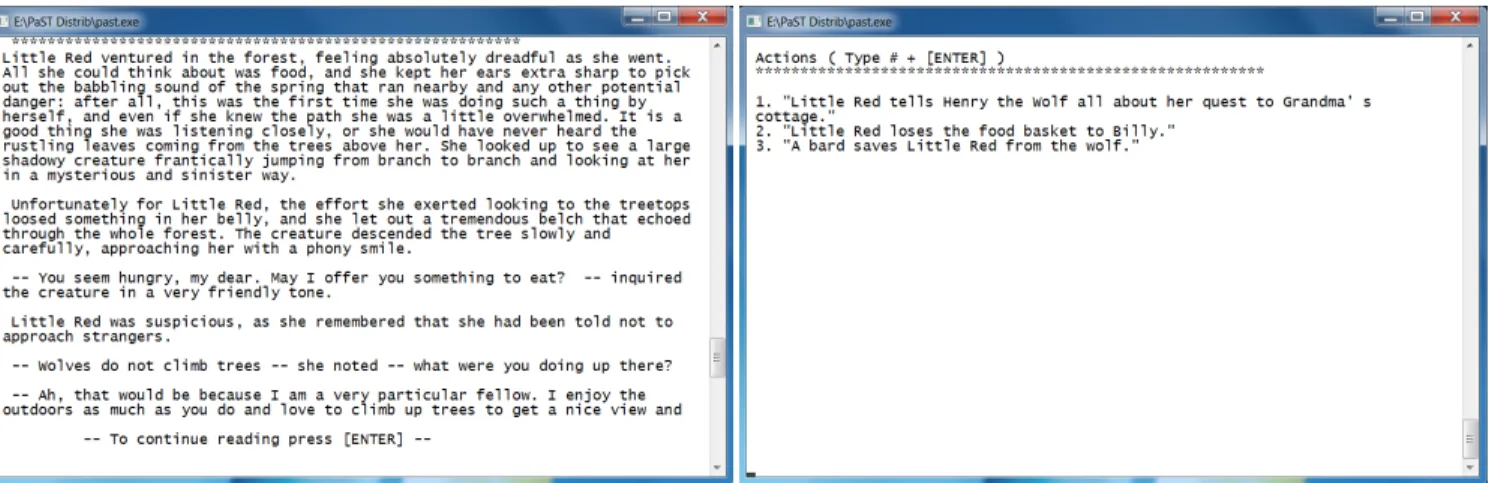
Figure 2: Sample screenshot from the PAST test bed, showing an event description on the left(greets red wolf), and three choices on the right:(tell-about red wolf granny),(persuade bard wolf)and(:not (has red
basket)).
the actions the player takes (e.g., killing the wolf when other options are available indicates a fighter inclination). Each action and rupture in the virtual domain has to be annotated by the author; PAST then uses these to calculate a global annotation for each contingency narrative.
We made minimal changes to PAST from the original design (Ramirez and Bulitko 2012) for our user studies. Specifically, the original PAST precomputed all contingency narratives for all possible ruptures during an off-line phase based on player archetypes. The version of PAST evaluated in this paper forgoes the off-line precomputation. As a re-sult, it saves memory and time off-line and allows to select a narrative repair more closely fitting the player model at hand (instead of one of the five generic model archetypes). Addi-tionally, the planning algorithm is invokedad hoconly when a rupture takes place.
Evaluation
To evaluate ASD and PAST we constructed a text-based in-teractive adventure–inspired partly by RPG text-based ad-venture games–around the exemplar narrative ofThe Little Red Riding Hood, in line with the literature (Riedl et al. 2008; Ramirez and Bulitko 2012). Three different versions were developed. The version used to evaluate ASD had three possible ruptures and enough content for the AI planner to repair any of them. The version used to evaluate PAST had five ruptures and three to five possible contingency narra-tives for each so that a repair suitable for different player types can be chosen. The latter also had a prologue with enough interaction for the system to populate the player model before the first rupture would take place. The third version was also created to evaluate PAST, and had only one rupture and five different repairs available.
Methodology
Three user studies were conducted. Participants gave written consent and received a university course credit for their par-ticipation. These participants were tested in groups of ten to
fifteen people, with sessions lasting approximately30 min-utes. The participants were briefed before the start, and then interacted with the story, selecting from on-screen choices (Figure 2). Upon completion, an evaluation survey was ad-ministered and a debriefing form was provided.
For the survey, we used a previously validated instru-ment (Vermeulen et al. 2010). The instruinstru-ment had twelve questions aimed at measuring player fun and six questions aimed at their agency. Each question was a 5-point Lik-ert scale fromcompletely disagreetocompletely agree. The scores on all fun questions were added together and then nor-malized using the maximum and minimum possible scores. The result is referred to as thefun score. The same was done for the agency score. The instrument has been previously used to evaluate experience managers (Thue et al. 2011).
Because our experiment consisted of a reading assign-ment, there was an inherent risk that some participants might skim through the text without reading it. To reduce noise caused by such skimming we used task completion time to estimate the reading speed for each participant and com-pared it to average reading speeds reported in the literature. First-year college students are reported to skim text at 450
words per minute (Carver 1993). Given the10%slow down due to reading off the screen (Zelfle 1998), we eliminated data from all subjects that read above405words per minute. We then additionally removed data from all subjects whose fun and/or agency score was an outlier according to Tukey’s outlier filter (also known as interquartile outlier detection). The survey also measured participant gaming skills, in order to classify them intogamers(one hour or more of gameplay per week) ornon-gamers(less than one hour per week).
The data for each metric were analyzed using a two-way ANOVA (α= 0.05) with the factors beingexperience man-agementandgaming skills. The data did not violate the as-sumptions of independent observations, normality (assessed by the Kolmogorov-Smirnov test) or unequal variance (as-sessed by the Levine’s and Welch’s tests).Post hoc compar-isons used Tukey’s HSD test.
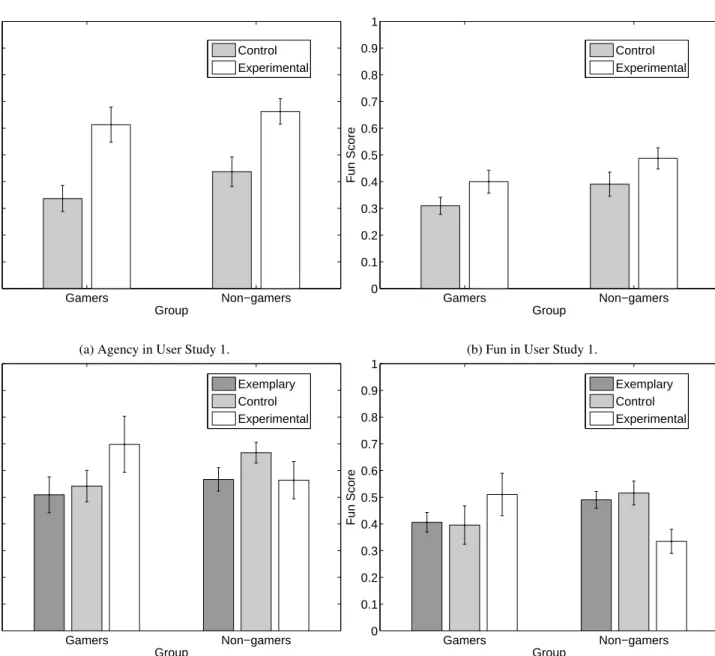
Gamers Non−gamers 0 0.1 0.2 0.3 0.4 0.5 0.6 0.7 0.8 0.9 1 Group Agency Score Control Experimental
(a) Agency in User Study 1.
Gamers Non−gamers 0 0.1 0.2 0.3 0.4 0.5 0.6 0.7 0.8 0.9 1 Group Fun Score Control Experimental
(b) Fun in User Study 1.
Gamers Non−gamers 0 0.1 0.2 0.3 0.4 0.5 0.6 0.7 0.8 0.9 1 Group Agency Score Exemplary Control Experimental
(c) Agency in User Study 2.
Gamers Non−gamers 0 0.1 0.2 0.3 0.4 0.5 0.6 0.7 0.8 0.9 1 Group Fun Score Exemplary Control Experimental
(d) Fun in User Study 2. Figure 3: Mean normalized scores and error bars for user studies1and2(agency and fun).
Results
User Study 1: ASD. The goal of the first user study was to compare ASD to an exemplar narrative. The control condi-tion were participants who experienced theLittle Red Riding Hoodinteractive narrative with choices limited to changing the temporal order of events. The experimental condition was additionally allowed to rupture the narrative at up to three plot points. The number of participants wasn = 81
(n= 98before removing outliers). There were42subjects (21gamers,21 non-gamers) in the experimental condition and39(23gamers,16non-gamers) in the control condition. The experimental condition showed significantly higher scores for both fun (F(1,76) = 5.46, p= 0.02) and agency
(F(1,77) = 20.46, p = 0.001) compared to the control
condition. The interaction between gaming skills and expe-rience management was not statistically significant. In the first row of Figure 3 means and standard errors are shown.
User Study 2: PAST. In the second user study, we evalu-ated the effects of player modelling in PAST. We had three different conditions for the main factor of experience man-agement: control, experimental and exemplar; players had the same set of choices in all three. In the experimental condition, narrative ruptures were repaired according to the player model learnt for the actual player. In the control con-dition, the player model was taken from a randomly drawn player in the experimental condition (as a part of the yoking
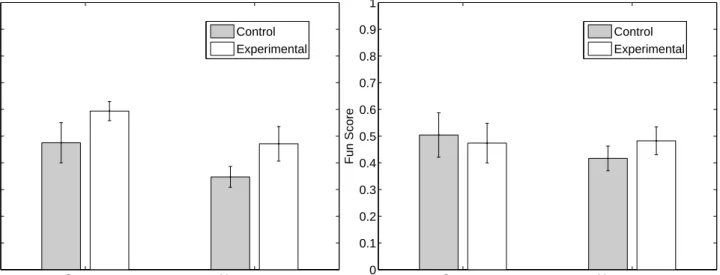
Gamers Non−gamers 0 0.1 0.2 0.3 0.4 0.5 0.6 0.7 0.8 0.9 1 Group Agency Score Control Experimental
(a) Agency in User Study 3.
Gamers Non−gamers 0 0.1 0.2 0.3 0.4 0.5 0.6 0.7 0.8 0.9 1 Group Fun Score Control Experimental
(b) Fun in User Study 3. Figure 4: Mean normalized scores and error bars for user study3(agency and fun).
procedure). If random model coincided with the player’s actual model then the subject would be counted in the ex-perimental condition. The exemplar condition contained all players who never deviated from the exemplar narrative (i.e., never caused a rupture).
In total,n = 72participants (n = 98before outlier re-moval) were evaluated. The experimental condition had23
subjects (8 gamers,15 non-gamers), the control condition had22subjects (6 gamers,16non-gamers) and the exem-plar condition had27subjects (8gamers,19non-gamers).
No statistically significant results were observed in the main factors for either fun or agency. However, a significant interaction between these was found for fun (F(2,66) = 4.73, p= 0.012). Agency showed a similar interaction but it failed to reach significance (F(2,67) = 1.93, p= 0.1538). Means and standard error bars are depicted in the bottom row of Figure 3. Tukey’s HSD post hoctest showed that non-gamers in the control condition had significantly higher fun ratings than non-gamers in the experimental condition; no other comparisons reached significance.
We attempted to replicate user study 2 later in the aca-demic term withn = 63participants (n = 83before out-lier removal). The subjects were distributed over the three conditions as follows: experimental: 19(2gamers,17 non-gamers); control: 19 (5 gamers, 14 non-gamers); exem-plar: 25 (10gamers, 15 non-gamers). This time, no sig-nificant effects were found, which we speculatively attribute to the lack of motivation in end-of-the-term university stu-dents who signed up for the study late and likely to simply get course credit.
User Study 3: PAST with Constrained Domain. In the third user study, we also studied the effects of player mod-elling and planning; however, we constrained the story space to only5 (down from 31 stories in user study2) possible
different stories by permitting only one rupture at a fixed time for all participants. Furthermore, only two conditions were present for the experience management factor: control (ASD) and experimental (PAST).
The total number of participants was n = 34(n = 41
before outliers were removed), with 17subjects in control (5 gamers, 12non-gamers) and 17 subjects in experimen-tal condition (4 gamers and13 non-gamers). No statisti-cally significant results were found for fun (p <0.05); how-ever, a marginally significant result (p < 0.10) for agency
(F(1,67) = 5.46, p = 0.097) was found. No statistically
significant interactions were found.
The Pull-back Effect. Some participants appear to have experienced a pull-back effect wherein they felt that upon breaking the narrative through their choices they were pulled back into the original plot. To illustrate, here are two com-ments collected from the user studies:
The plot of events seems predetermined, anything the user chooses may eventually loop back to the static plot.
(...) It was disappointing when I would try to go away from the typical Red Riding Hood story and then it would just inevitably go back to that (it made me feel like my input in what happened next didn’t matter).
Discussion
The results for the first user study indicate that ASD in-creases player fun and agency over the exemplar narrative. This is despite the pull-back effect reported by some partic-ipants in the comment’s section.
The results of the second user study did not show signif-icant effects of player modelling in PAST for either player
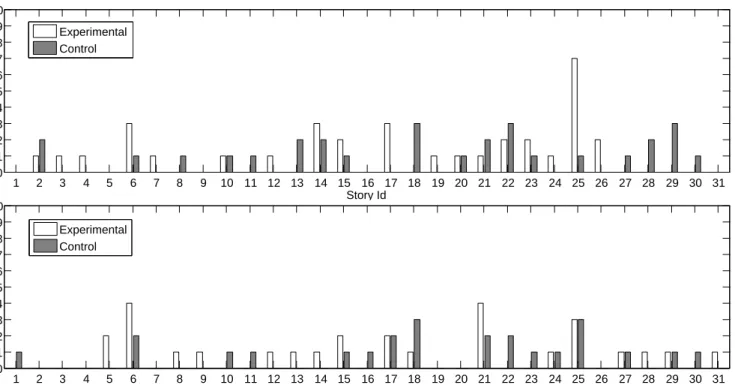
1 2 3 4 5 6 7 8 9 10 11 12 13 14 15 16 17 18 19 20 21 22 23 24 25 26 27 28 29 30 31 0 1 2 3 4 5 6 7 8 9 10 Story Id Frequency Experimental Control 1 2 3 4 5 6 7 8 9 10 11 12 13 14 15 16 17 18 19 20 21 22 23 24 25 26 27 28 29 30 31 0 1 2 3 4 5 6 7 8 9 10 Story Id Frequency Experimental Control
Figure 5: Distribution of players (experimental and control). Top: part 1, bottom: part 2 of the second study.
fun or agency. This is surprising since PAST is a combina-tion of ASD and a player model from PaSSAGE, which in isolation showed an effect in increasing fun and/or agency. We believe several factors may cause this.
Firstly, the PAST user study had fewer participants than the ASD study split into more conditions, thus causing a loss of statistical power. Second, the latter part of the study was run at the end of the academic term, possibly affected by a lack of motivation in “last minute” sign ups, poten-tially adding noise. Third, the richer narrative space (i.e., more ruptures and more diverse repairs) could have induced a higher variance. To illustrate, Figure 5 shows the uneven distribution of players over different stories (i.e., each story being a collection of different events). Our attempt to con-trol variance by randomly assigning player models from the experimental subjects to control condition subjects (yoking) accounted only for the types of repairs, hence not controlling for the actual ruptures taken. Lastly, perception might differ between gamers and non-gamers. Since there is no statisti-cal significance, it is impossible to tell if this is a fluke or an indicative result. If the latter is the case then PAST may in-crease fun for gamers but not for non-gamers in this domain.
The third user study, conducted in a constrained story do-main, obtained marginally significant results that may indi-cate that agency was increased by using PAST when com-pared to ASD. A higher significance level might have been obtained with more participants.
Conclusions and Future Work
This paper presents the first formal evaluation of two recent planning-based experience managers in the context of IS. Both were evaluated with subjects playing a text adventure based on a folk story on the basis of their self-reports of fun and agency. It appears that planning-based experience management can improve fun and agency over even a non-linear exemplar narrative. Player modelling shows mixed re-sults: in one large story domain, positive results are seen in gamers, whereas agency is increased in a constrained story domain. This highlights that the balance of content is of par-ticular importance when evaluating experience managers.
Results presented in this paper support previous conjec-tures that treating IS as AI planning is an effective way to im-prove player’s experience while affording them more choice within a narrative. Adding player modelling on top seems promising, but further evaluations are required. We feel that existing systems can be deployed in the field to automati-cally foresee narrative ruptures and automatiautomati-cally compute repairs. The resulting narratives can then be fleshed out with multimedia elements by game developers.
Acknowledgements
We would like to gratefully acknowledge the funding pro-vided by the Natural Sciences and Engineering Research Council of Canada (NSERC), the help and consultations by David Thue, and the great work by Wayne DeFehr and Shane Riczu with different writing tasks for the protypes.
References
Carver, R. P. 1993. Reading rate: Theory, research, and practical implications.Journal of Reading36(2):84–95. Cheong, Y.-G., and Young, R. M. 2008. Narrative gener-ation for suspense: Modeling and evalugener-ation. In Proceed-ings of the First Joint International Conference on Interac-tive Digital Storytelling (ICIDS), 144–155.
Kraft, S. 1981. He chose his own adventure.The Day 6. Laws, R. D. 2001.Robin’s Laws for Good Game Mastering. Steve Jackson Games.
Ramirez, A., and Bulitko, V. 2012. Telling interactive player-specific stories and planning for it: ASD+ PaSSAGE = PAST. InProceedings of the Eight AAAI Conference on Artificial Intelligence and Interactive Digital Entertainment, 173–178.
Riedl, M. O., and Bulitko, V. 2013. Interactive narrative: An intelligent systems approach.AI Magazine34(1):67–77. Riedl, M, O.; Stern, A.; Dini, D.; and Alderman, J. 2008. Dynamic experience management in virtual worlds for en-tertainment, education, and training.International Transac-tions on Systems Science and ApplicaTransac-tions4(2):23–42. Riedl, M. O. 2012. Interactive narrative: A novel application of artificial intelligence for computer games. InProceedings of the 26th National Conference on Artificial Intelligence, 2160–2165.
Sharma, M.; Mehta, M.; Ontan´on, S.; and Ram, A. 2007. Player modeling evaluation for interactive fiction. In Pro-ceedings of the AIIDE Workshop on Optimizing Player Sat-isfaction, 19–24.
Thue, D.; Bulitko, V.; Spetch, M.; and Wasylishen, E. 2007. Interactive storytelling: A player modelling approach. In
Proceedings of the Third AAAI Conference on Artificial In-telligence and Interactive Digital Entertainment, 43–48. Thue, D.; Bulitko, V.; Spetch, M.; and Romanuik, T. 2010. Player agency and the relevance of decisions. In Proceed-ings of the Third Joint International Conference on Interac-tive Digital Storytelling (ICIDS), 210–215.
Thue, D.; Bulitko, V.; Spetch, M.; and Romanuik, T. 2011. A computational model of perceived agency in video games. InProceedings of the Seventh AAAI Conference on Artificial Intelligence and Interactive Digital Entertainment, 91–96. Vermeulen, I. E.; Roth, C.; Vorderer, P.; and Klimmt, C. 2010. Measuring user responses to interactive stories: to-wards a standardized assessment tool. InThe Third Joint International Conference on Interactive Digital Storytelling (ICIDS), 38–43.
Yu, H., and Riedl, M. O. 2012. A sequential recommenda-tion approach for interactive personalized story generarecommenda-tion. InProceedings of the 11th International Conference on Au-tonomous Agents and Multi Agent Systems, 71–78.
Yu, H., and Riedl, M. O. 2013. Toward personalized guid-ance in interactive narratives. InProceedings of the 8th In-ternational Conference on the Foundations of Digital Games (in press).
Zelfle, M. 1998. Effects of display resolution on visual performance. Human Factors40(4):554–568.